 Location :
Orlando, FL, USA
Location :
Orlando, FL, USA +1 (407) 714-1616
 info@biz4group.com
- Custom AI software development vs. off the shelf product solutions is a strategic choice between owning intelligence versus adapting to generic tools as AI becomes business critical.
- Businesses that build custom AI software vs ready made AI products gain flexibility, scalability, and proprietary insights that packaged tools cannot offer.
- Custom AI application development advantages over off the shelf solutions include stronger security, better user adoption, and future ready architecture.
- In a custom AI vs off the shelf AI cost and ROI comparison, off the shelf tools typically range from $15,000 to $90,000+ per year, while custom AI development ranges from $30,000 to $150,000+ upfront, with higher long term ROI.
- Biz4Group LLC is among the best partners for custom AI development, helping businesses in the USA design, build, and scale AI solutions that deliver real business impact.
Have you ever wondered why so many businesses invest in AI tools but still struggle to see real transformation? The truth is that companies are rushing into solutions without understanding what fits their unique needs.
According to a survey, more than 80% of businesses have embraced AI technology in some form, yet only a fraction achieve measurable impact from those investments so far.
In the debate of custom AI software development vs. off the shelf product solutions, most leaders forget to focus on the business outcome.
Off the shelf tools promise instant access to AI features, but many organizations find they cannot tailor them to existing systems or data. Meanwhile, tailored approaches help companies solve specific problems instead of squeezing their workflows into a generic mold.
When weighing custom AI software development vs off the shelf solutions, it is worth remembering that every business has unique goals, data, and challenges. A solution that works for one organization may be a misfit for another. But when you build custom AI capabilities that align with what actually drives your business, you unlock lasting value beyond initial implementation.
As you read this guide, you will see why leaders increasingly question the value of packaged products and explore why exactly is custom AI development better than ready-made AI tools.
This blog will walk through key differences, risks, and long-term value so you can decide when tailor made solutions make sense for your business.
Why Read About AI When You Can Talk to Experts?
Get clarity from people who build AI for real businesses every day.
Speak to AI Experts NowWhat Are Off the Shelf AI Solutions?
Let's begin with the basics.
Off the shelf AI solutions are pre-built software products designed to serve a wide audience. They come ready to use with minimal setup.
These tools are created with generalized use cases in mind. Instead of adapting to your business, your business adapts to them.
In most cases, you pay a recurring license fee and access AI features that are already defined by the vendor.
Common Examples Businesses Recognize
Most decision makers have already interacted with off the shelf AI software, even if they do not label it that way.
Some familiar categories include:
- AI powered chatbots for customer support
- Resume screening and ATS platforms
- Marketing automation tools with predictive insights
- CRM systems with built in AI recommendations
- Analytics dashboards using pre-trained models
These products are often marketed as quick fixes. And at first glance, they look convincing.
Why Off the Shelf AI Looks Attractive at First
For many businesses, the appeal is easy to understand. Off the shelf solutions offer:
- Faster deployment with minimal development effort
- Lower upfront cost compared to building from scratch
- Pre-configured AI models and workflows
- Vendor managed updates and maintenance
They promise speed.
They promise simplicity.
They promise results without heavy planning.
For early stage startups or teams testing AI for the first time, this can feel like a safe entry point.
Where the Reality Starts to Shift...
As businesses grow, the cracks begin to show. What once felt convenient starts to feel restrictive.
Here are some early warning signs that organizations outgrow off the shelf AI:
- Limited customization beyond surface level settings
- Poor alignment with internal workflows
- Difficulty integrating with legacy systems
- Data locked inside vendor platforms
- Rising licensing costs as usage scales
To make this clearer, here is a simple comparison many leaders experience firsthand.
|
Early Stage Experience |
Growth Stage Reality |
|---|---|
|
Quick setup |
Rigid workflows |
|
Affordable entry cost |
Expensive scaling fees |
|
Generic insights |
Irrelevant recommendations |
|
Vendor support |
Vendor dependency |
Once AI becomes central to operations, limitations become harder to ignore.
Off the shelf AI software works best when needs are simple and predictable. Most businesses, however, are neither.
As data volumes grow and processes become more complex, leaders begin questioning whether generic tools can keep up. That is when conversations around ownership, flexibility, and long term value begin to surface.
And that is where the shift toward custom solutions often starts.
What Is Custom AI Software Development?
Custom AI software development focuses on building AI systems specifically for your organization. These solutions are designed around your data, workflows, users, and long-term goals.
Instead of forcing teams to adjust their processes, custom AI adapts to how your business already operates.
Every component is intentional. From data pipelines to model logic to user interfaces.
How Custom AI Is Built Differently
Unlike packaged tools, custom AI development starts with strategy before code.
Key elements usually include:
- Deep analysis of business processes
- Identification of high impact AI use cases
- Custom AI model selection and training
- Workflow specific automation logic
- Tailored dashboards and decision tools
This approach ensures the AI solves real problems rather than showcasing generic features.
Custom AI Built Around Your Data
Data is where custom AI creates the biggest shift.
Off the shelf tools rely on generalized models trained for broad audiences. Custom AI models learn from your proprietary data. That leads to:
- More accurate predictions
- Context aware insights
- Relevance to industry specific challenges
- Continuous improvement over time
Your data stays under your control. Your insights stay exclusive.
Why Businesses Prefer Custom AI as They Scale
As operations expand, so do expectations from AI.
Custom AI systems can evolve alongside your business. New workflows, departments, and data sources can be added without reworking the entire system.
Here is a simple comparison that decision makers often find useful.
|
Aspect |
Custom AI Software |
|---|---|
|
Workflow alignment |
Built around your processes |
|
Scalability |
Grows with data and users |
|
Data ownership |
Fully retained |
|
Flexibility |
High and adaptable |
When AI becomes core to operations, ownership matters.
Businesses that develop custom AI solutions gain control over innovation instead of depending on vendor roadmaps. They can prioritize features that drive revenue, efficiency, or customer experience.
That control often becomes the difference between using AI and leading with AI.
Next, we'll break down the key differences between custom AI and off the shelf systems, side by side, so the contrast becomes unmistakable.
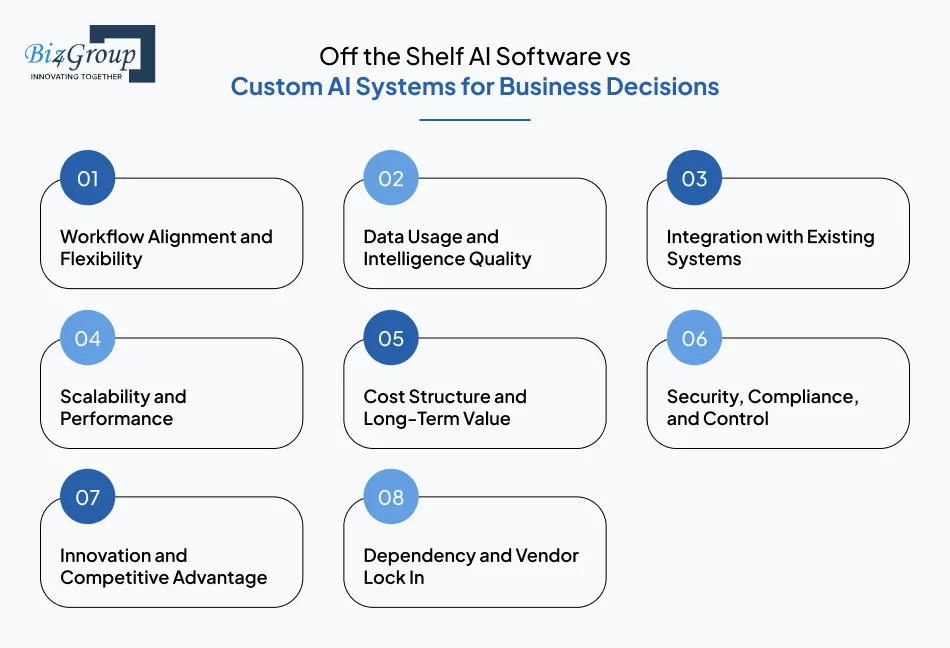
Off the Shelf AI Software vs Custom AI Systems for Business Decisions
At some point, every serious AI conversation comes down to tradeoffs.
Speed versus fit.
Convenience versus control.
Short term gains versus long term value.
This section breaks down the real differences that matter to decision makers. Not surface features. Not marketing promises. Practical business impact.
1. Workflow Alignment and Flexibility
Off the shelf AI software comes with predefined workflows. They are designed to work for many businesses at once.
That often means teams adjust their processes to fit the tool. Over time, this creates friction, workarounds, and inefficiencies.
Custom AI systems are built around existing workflows. The AI supports how teams already work and improves those processes over time.
This leads to smoother adoption and fewer operational compromises.
2. Data Usage and Intelligence Quality
Packaged AI tools rely on generalized models. They perform adequately across common scenarios but lack depth.
As business data becomes more complex, insights start to feel generic or irrelevant.
Custom AI systems learn from your specific datasets. They understand context, industry patterns, and internal logic.
The result is intelligence that reflects reality instead of averages.
3. Integration with Existing Systems
Off the shelf solutions often integrate through limited APIs. Compatibility depends on what the vendor supports.
This can slow down innovation and create data silos.
Custom AI solutions are designed to connect directly with your tech stack. Legacy systems, internal tools, and third-party platforms work together seamlessly.
AI integration becomes an enabler rather than a constraint.
4. Scalability and Performance
Many off the shelf tools handle growth by increasing license tiers. As usage grows, costs rise quickly.
Performance can also decline as data volume increases.
Custom AI systems scale strategically. Architecture, infrastructure, and models are built with future growth in mind.
This ensures consistent performance even as complexity increases.
5. Cost Structure and Long-Term Value
At first glance, off the shelf AI appears cheaper. Entry costs are lower, often ranging between $15,000 and $90,000+ depending on usage and licensing.
Custom AI development typically falls between $30,000 and $150,000+ based on scope.
However, upfront cost tells only part of the story. Long-term value depends on ownership, flexibility, and ROI, which we will explore later.
6. Security, Compliance, and Control
With packaged tools, data flows through third-party systems. Security policies depend on vendor standards.
For regulated industries, this can introduce risk.
Custom AI systems allow full control over data storage, access, and compliance measures.
Security is built around business requirements rather than generalized policies.
7. Innovation and Competitive Advantage
Off the shelf AI delivers the same features to all customers. Competitors can access identical capabilities.
Custom AI becomes proprietary intelligence. It supports unique strategies and differentiates the business in the market.
Over time, this distinction compounds.
8. Dependency and Vendor Lock In
Packaged solutions create dependency on vendor roadmaps. Feature priorities and pricing are outside your control.
Custom AI systems give businesses autonomy. Roadmaps are driven by internal priorities, not third-party updates.
This flexibility becomes critical as markets change.
Summary Comparison Table
To bring everything together, here is a clear side by side comparison.
|
Decision Factor |
Off the Shelf AI Solutions |
Custom AI Systems |
|---|---|---|
|
Workflow fit |
Generic and rigid |
Built around business processes |
|
Data intelligence |
Broad and generalized |
Context rich and proprietary |
|
Integration |
Limited by vendor APIs |
Seamless with existing systems |
|
Scalability |
Tier based pricing growth |
Architecture driven scalability |
|
Upfront cost |
Lower entry range |
Higher initial investment |
|
Long term ROI |
Plateaus over time |
Grows with usage and data |
|
Security control |
Vendor dependent |
Fully controlled by business |
|
Competitive edge |
Feature parity |
Proprietary differentiation |
|
Vendor dependency |
High |
Minimal |
Final Thought for Decision Makers
There is no universal right choice.
There is only the right choice for where your business is headed.
Understanding these differences early helps leaders invest with clarity instead of reacting to limitations later.
Next, we will take a closer look at the limitations of both approaches, including where custom AI can also fall short without the right strategy.
One AI Choice Limits You. The Other Scales with You.
Businesses outgrow generic AI tools faster than expected. A five-minute discussion can reveal which path fits your growth plans.
Get in Touch NowOff the Shelf AI Limitations vs Custom AI Development
Every technology choice comes with trade-offs. Understanding limitations upfront helps businesses avoid expensive corrections later.
This section takes a balanced view.
First, where off the shelf AI starts to break down.
Then, where custom AI needs careful strategy.
Finally, why custom solutions still offer a clear advantage when done right.
Limitations of Off the Shelf AI Solutions
Off the shelf AI tools are built for scale across many customers. That scale often comes at the cost of relevance.
Here are the most common limitations businesses encounter.
- Restricted Customization
Most tools allow configuration, not true customization. You can adjust settings, but not the underlying logic.
This limits how deeply AI can align with business processes. - Generic Intelligence
Pre trained models are designed for broad usage. They struggle with industry specific or organization specific nuances.
Over time, insights feel shallow and repetitive. - Integration Challenges
Vendor supported integrations cover only popular platforms. Custom internal tools or legacy systems remain disconnected.
This leads to fragmented data and manual work. - Scaling Costs Increase Quickly
Usage based pricing grows with data, users, or transactions. What starts affordable becomes a recurring financial strain. - Limited Control Over Data and Roadmap
Data storage policies, updates, and feature direction are owned by the vendor. Businesses adjust to changes they did not plan for.
Limitations of Custom AI Development
Custom AI offers flexibility, but it is not immune to challenges. These limitations usually appear when strategy is weak or rushed.
- Higher Initial Investment
Custom AI requires upfront planning, development, and testing. Costs typically range from $30,000 to $150,000+ depending on scope. - Longer Development Timelines
Building tailored solutions takes time. Rushed implementations often lead to underperforming systems. - Dependency on the Right Partner
Without experienced guidance, projects can lose focus. Poor architecture decisions can limit future scalability.
Strategic Advantages of Custom AI Over Off the Shelf Solutions
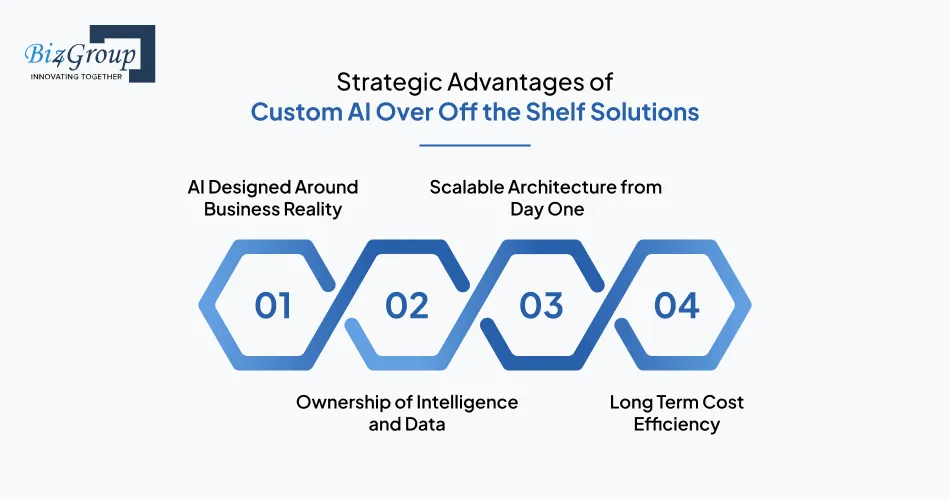
When built with the right approach, custom AI addresses these challenges directly. Below are the key advantages that consistently drive businesses toward custom development.
- AI Designed Around Business Reality
Custom AI mirrors real workflows, data flows, and decision paths. This leads to higher adoption and faster impact. - Ownership of Intelligence and Data
Models, insights, and data remain fully under business control. This protects intellectual property and long-term value. - Scalable Architecture from Day One
Infrastructure and models are built with growth in mind. Expansion does not require tool replacement. - Long Term Cost Efficiency
While upfront costs are higher, recurring licensing fees are avoided. ROI improves as usage increases.
Here's a quick snapshot for your review:
|
Area |
Off the Shelf AI |
Custom AI Development |
|---|---|---|
|
Customization depth |
Limited |
Fully adaptable |
|
Data ownership |
Vendor controlled |
Business owned |
|
Cost predictability |
Low over time |
High long term |
|
Workflow fit |
Generic |
Tailored |
|
Strategic control |
Minimal |
Complete |
Off the shelf AI tools serve a purpose. They work best for simple, short-term needs.
Custom AI development becomes the better path when AI moves from experimentation to execution. That shift often defines whether technology supports growth or slows it down.
Next, we will examine cost and ROI considerations, breaking down how businesses should evaluate investment value beyond initial pricing.
Also read: Custom AI agents vs. off-the-shelf solutions
Custom AI vs Off the Shelf AI Cost and ROI Comparison
Cost is often the deciding factor. But cost alone rarely tells the full story.
This section breaks down what businesses actually pay over time and what they receive in return. The goal is clarity, not assumptions.
Understanding the Initial Investment
At first glance, off the shelf AI tools appear more affordable. They offer faster access with lower upfront commitment.
Typical Upfront Cost Ranges
- Off the Shelf AI Software
$15,000 to $90,000+ annually depending on users, features, and data volume - Custom AI Development
$30,000 to $150,000+ as a one-time development investment
This initial difference often influences early decisions. However, upfront cost is only one piece of the equation.
Hidden Costs That Affect Long Term Spend
Many costs do not appear during purchase discussions. They surface gradually as AI becomes core to operations.
Common Hidden Cost Drivers for Off the Shelf AI
- Increasing license fees as usage scales
- Charges for advanced features or premium support
- Integration costs with internal systems
- Data export or migration fees
- Vendor driven pricing changes
Hidden Cost Drivers in Custom AI Development
- Infrastructure scaling as data grows
- Ongoing model optimization and maintenance
- Feature expansion based on evolving needs
The difference lies in predictability.
Custom AI costs are planned.
Packaged AI costs often react to usage.
Cost Breakdown by Business Function
To make this tangible, here is a simplified comparison across common AI use cases.
|
Function |
Off the Shelf Cost Range |
Custom AI Cost Range |
|---|---|---|
|
AI chatbot and support |
$20,000 to $60,000 per year |
$40,000 to $80,000 one time |
|
Resume screening and HR AI |
$25,000 to $70,000 per year |
$50,000 to $100,000 one time |
|
$30,000 to $90,000 per year |
$60,000 to $150,000+ one time |
|
|
Workflow automation |
$15,000 to $50,000 per year |
$30,000 to $70,000 one time |
This table highlights a recurring pattern. Custom AI costs more initially but stabilizes over time.
ROI Where Custom AI Pulls Ahead
Return on investment depends on ownership and scalability. Custom AI systems improve ROI by:
- Eliminating recurring licensing fees
- Increasing efficiency through tailored workflows
- Improving decision accuracy with relevant data
- Supporting new revenue streams
- Reducing dependency on multiple tools
Over a three to five year horizon, custom AI often delivers higher returns than off the shelf alternatives.
A Long-Term Cost Perspective
Here is a simplified timeline comparison many executives find useful.
|
Time Horizon |
Off the Shelf AI |
Custom AI |
|---|---|---|
|
Year 1 |
Lower cost, faster start |
Higher upfront investment |
|
Year 2 |
Rising license and usage fees |
Stable operating costs |
|
Year 3+ |
Compounding expenses |
Increasing ROI |
Choosing AI based on price alone can be misleading. The smarter approach is evaluating total value over time.
Custom AI development rewards businesses that think long term. It converts AI from a recurring expense into a strategic asset.
Also read: How much does it cost to develop AI software?
Lower Upfront Cost Does Not Mean Lower Total Cost
Off the shelf AI often crosses six figures in recurring fees within a few years. Understand the real numbers before you commit
Get a Practical Cost BreakdownShould Businesses Build Custom AI Software Based on Real World Use Cases
Use cases reveal the truth faster than theory. When AI touches real workflows, generic tools struggle. Custom solutions step in where precision, context, and scale matter.
Below are six real world scenarios where businesses consistently choose custom AI over packaged products.
1. Enterprise HR and Workforce Management
HR workflows vary widely across organizations. Policies, compliance rules, approvals, and reporting are rarely standard.
Off the shelf HR AI tools offer limited flexibility.
Custom AI adapts to company specific processes and integrations.
Project Spotlight: DrHR
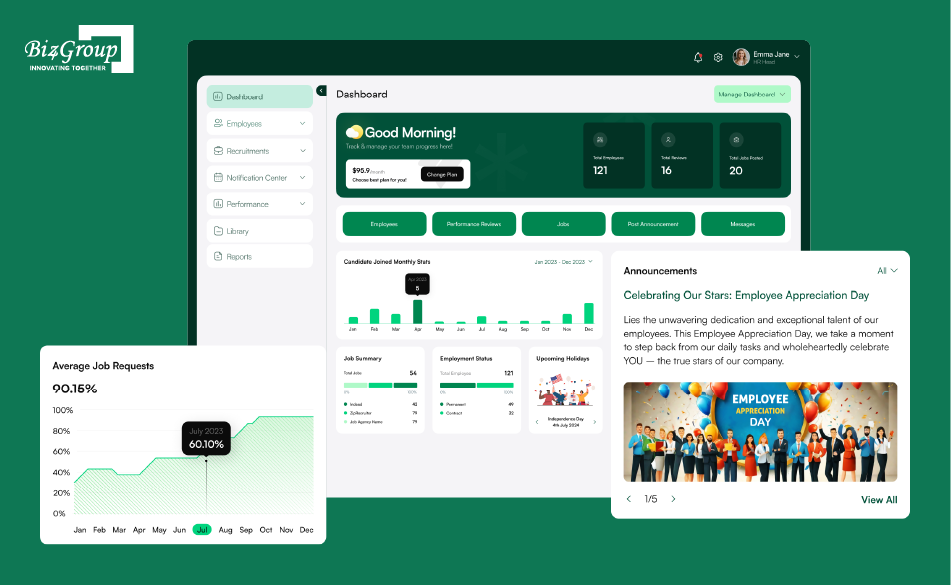
Biz4Group developed a scalable AI powered HRMS designed around real workforce operations.
Key capabilities:
- AI HR assistant for internal queries
- Resume parsing using NLP
- Performance review using AI automation
- Intelligent onboarding and job management
- Deep integrations with Slack, Zoom, DocuSign, Google Calendar, and job boards
This level of workflow alignment is not possible with generic HR software.
Also read: Why HR system customization beats off-the-shelf tools?
2. Holistic Health and Wellness Platforms
Wellness data is deeply personal and highly contextual. Generic AI struggles to connect emotional, behavioral, and lifestyle signals. Custom AI enables continuous learning and personalization.
Project Spotlight: CSO
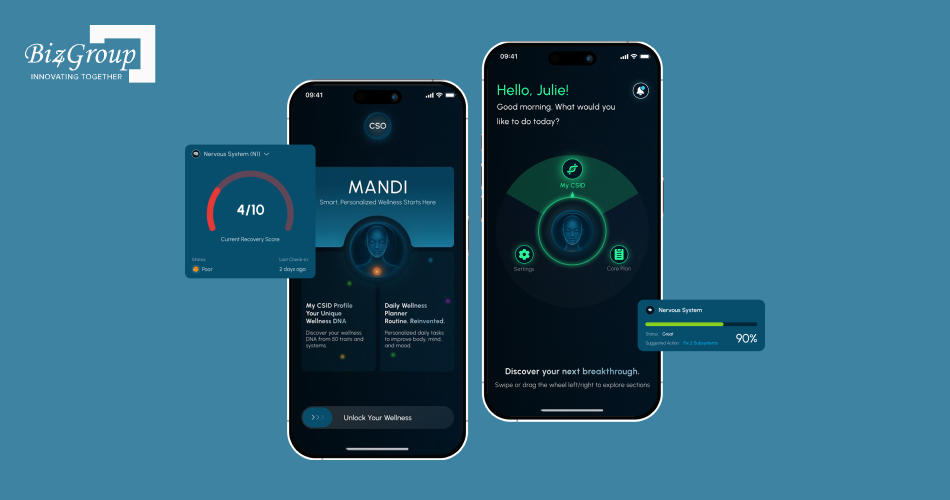
CSO is an inference based conversational AI wellness platform focused on long term insight.
Key capabilities:
- Conversational AI with text and voice support
- Emotional intelligence and sentiment analysis
- CSID scoring across 12 health systems
- Personalized wellness tasks and follow ups
- Long-term memory for adaptive recommendations
Off the shelf wellness tools lack this depth and adaptability.
3. Recruitment and Hiring Intelligence
Hiring decisions require fairness, transparency, and collaboration. Off the shelf tools often prioritize automation over accountability. Custom AI balances efficiency with human oversight.
Project Spotlight: Stratum 9 InnerView
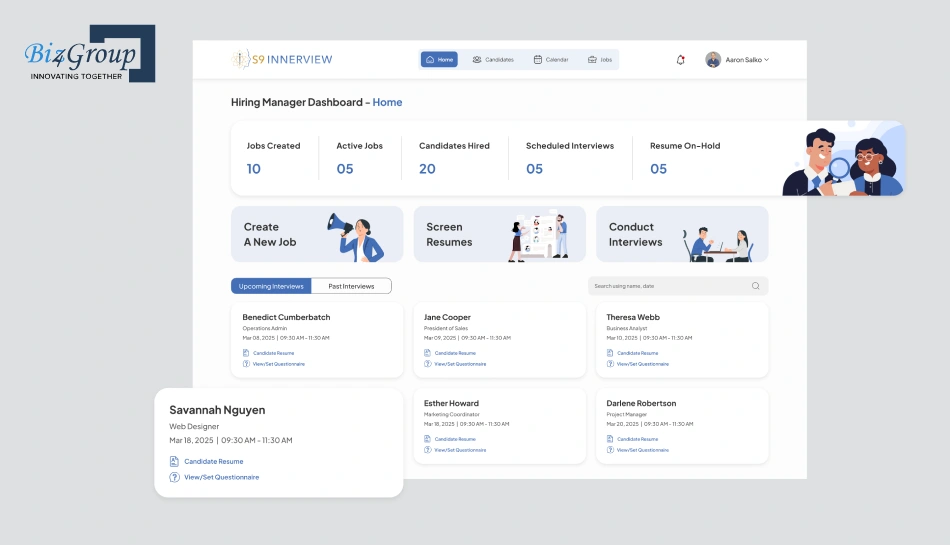
Stratum 9 InnerView is an AI driven hiring platform that streamlines recruitment without bias.
Key capabilities:
- AI generated job descriptions
- Resume screening and skill-based ranking
- AI assisted interview scheduling
- Behavioral analysis during interviews
- Transparent scoring and evaluation dashboards
This balance of automation and human judgment requires custom architecture.
4. Public Sector and Social Impact Systems
Government and nonprofit workflows involve complex data sources. Accuracy, empathy, and compliance are critical. Packaged AI tools rarely meet these demands.
Project Spotlight: AI Chatbot for Personalized Support to Homeless and At-Risk Veterans
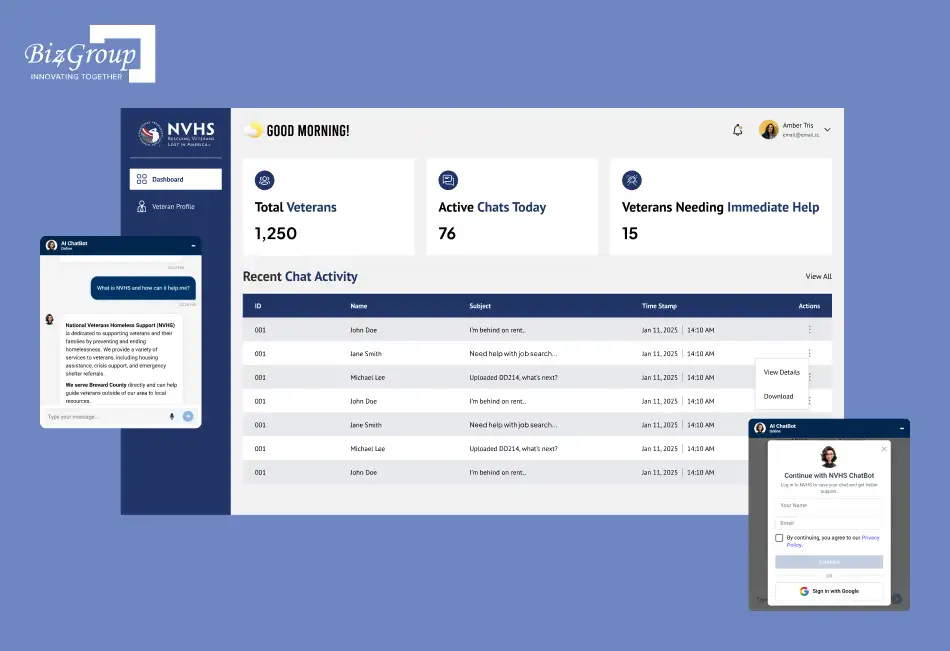
Using our AI chatbot development expertise, Biz4Group built a personalized AI chatbot supporting homeless and at-risk veterans.
Key capabilities:
- Conversational AI with voice and text access
- Crisis detection and real time alerts
- Location based service recommendations
- Admin dashboard for case monitoring
- Secure, compliance focused data handling
Off the shelf tools cannot meet these requirements reliably.
5. Data Heavy Decision Support Systems
Businesses handling large volumes of unstructured data need clarity. Off the shelf analytics tools provide surface level insights. Custom AI systems extract meaning tailored to business logic.
Typical custom AI applications include:
- Predictive analytics engines
- Risk assessment systems
- Operations optimization platforms
- Executive decision dashboards
6. Industry Specific AI Products and Platforms
Many startups build AI as their core product. They need differentiation, not feature parity. Custom AI becomes the foundation of innovation.
Common examples:
- Vertical SaaS platforms
- AI powered marketplaces
- Proprietary recommendation engines
- Intelligent automation tools
Across industries, the pattern stays consistent. The more unique the workflow, the stronger the case for custom AI.
Off the shelf tools handle generic needs.
Custom AI solves business defining problems.
Next, we will explore when and why businesses should choose custom AI development over ready-made solutions, using clear decision signals.
When to Choose Custom AI Development Over Ready-Made Solutions
After understanding costs, limitations, and real use cases, the next step is timing. Knowing when to move from packaged tools to custom AI helps avoid wasted spend and stalled growth.
This section focuses on practical signals and strategic choices.
Clear Signs Your Business Is Ready for Custom AI
Many organizations reach this point without realizing it. Look for these indicators.
- AI Has Become Core to Operations
When AI supports revenue, hiring, compliance, or customer experience, generic tools begin to limit progress. - Workflows Feel Forced
Teams rely on manual steps to work around software limitations. That friction slows decision making. - Data Is Fragmented Across Tools
Information lives in multiple platforms with limited visibility. Custom AI can unify insights. - Costs Keep Rising Without Added Value
Licensing fees increase, but outcomes stay the same. This signals diminishing returns.
Situations Where Off the Shelf Still Makes Sense
Custom AI is not always the first step. Off the shelf solutions work well when:
- AI is used for experimentation or MVP development
- Business processes are simple and standardized
- Data volumes are low
- Budget constraints are strict in early stages
Recognizing this prevents overengineering.
Also read: Top 12+ MVP development companies in USA
Choosing a Hybrid AI Approach
In some cases, a blended strategy delivers the best results. A hybrid approach combines custom AI systems with selective use of ready-made tools.
Common hybrid scenarios include:
- Custom AI core with off the shelf analytics dashboards
- Proprietary models supported by third party APIs
- Internal AI platforms integrated with SaaS tools
This approach reduces development time while preserving flexibility.
Decision Matrix for Leaders
Here is a quick reference table to support decision making.
|
Business Factor |
Off the Shelf AI |
Custom AI |
Hybrid Approach |
|
Speed to deploy |
High |
Moderate |
High |
|
Workflow fit |
Low |
High |
High |
|
Data ownership |
Low |
High |
High |
|
Cost predictability |
Low |
High |
Moderate |
|
Scalability |
Limited |
Strong |
Strong |
|
Flexibility |
Low |
High |
High |
Choosing custom AI is about intent, not trend. It becomes the right move when AI shifts from experimentation to execution.
A thoughtful hybrid approach can also bridge the gap. The key lies in aligning AI strategy with long term business goals.
If These Signs Sound Familiar, It’s Time to Act!
Businesses that delay the right AI decision often spend 2 to 3 times more fixing limitations later. A short conversation can prevent years of rework.
Book a Strategy Call TodayWhy Businesses Across the USA Trust Biz4Group for Custom AI Development?
Choosing the right AI development partner often matters more than choosing the technology itself. Strategy, execution, and long-term thinking separate impactful AI systems from short lived experiments.
Biz4Group LLC is a US based software development company that helps entrepreneurs, startups, and enterprises turn complex ideas into scalable digital products. Our work sits at the intersection of business strategy, engineering excellence, and applied artificial intelligence.
We do not build AI for demonstrations. We build AI that works inside real businesses. From workforce platforms and hiring intelligence to wellness AI apps and public sector solutions, our focus stays consistent.
Solve the right problem. Design with intent. Build for growth.
Our teams specialize in custom AI software development because most businesses do not need generic tools. They need systems designed around their data, users, compliance needs, and growth plans. That philosophy shows in every product we deliver.
Why Businesses Choose Biz4Group for Custom AI Development
Companies partner with us when AI becomes business critical and shortcuts stop working. Here is what consistently sets us apart.
- Business First AI Strategy
We begin with business outcomes, not algorithms. Every model, workflow, and feature maps back to measurable goals like efficiency, revenue, or experience. - Deep Custom AI Engineering Expertise
Our engineers design and deploy enterprise grade AI systems. This includes data pipelines, model training, inference optimization, security, and scalable architecture. - Proven Experience Across Industries
From HR and recruitment to wellness, SaaS platforms, and government initiatives, we have built AI where precision and reliability matter. - Ownership Focused Development
Clients retain control over data, models, and intellectual property. That protects long term value and avoids vendor dependency. - End-to-End Delivery
Strategy, UI/UX design, development, deployment, and optimization happen under one roof. This reduces risk and accelerates delivery. - Scalable and Future Ready Architecture
We build AI software that grow with your business rather than forcing replacements later.
AI investments should create advantage, not complexity. The difference often lies in who builds the solution and how it is built. With Biz4Group, businesses gain AI developers committed to long term success, scalability, and measurable impact.
Schedule a free consultation with Biz4Group today and discover how tailored AI can move your business forward with confidence.
Wrapping Up
Choosing between custom AI software development and off the shelf product solutions comes down to one core question. Do you want AI that simply adds features or AI that actively moves your business forward. Off the shelf tools offer speed and convenience early on, but they often struggle to keep pace as workflows evolve, data grows, and expectations rise. Over time, businesses begin to feel constrained by generic intelligence and rising costs.
Custom AI software development offers a different path. It aligns technology with real business logic, adapts to change, and creates long term value through ownership and scalability. When AI becomes part of daily operations rather than an experiment, tailored solutions provide clarity, control, and competitive advantage that packaged tools cannot match.
This is where Biz4Group LLC stands apart. As a trusted AI product development partner in the USA, we help businesses design, build, and scale AI systems that fit their goals, not someone else's roadmap. Our experience across industries, combined with a business first approach, allows us to deliver AI solutions that perform in the real world.
If you are ready to move beyond generic tools and build AI that truly works for your business, now is the time.
Connect with Biz4Group and start shaping an AI strategy designed for growth, impact, and long term success.
FAQs
1. Can custom AI solutions work with existing software and databases?
Yes. One of the biggest advantages of custom AI development is the ability to connect seamlessly with existing systems, databases, and internal tools. This avoids disruptions and helps businesses extract more value from their current technology stack.
2. Do businesses need large amounts of data to start custom AI development?
Not always. While data improves AI performance, many custom AI projects begin with limited datasets and evolve over time. A strong AI strategy focuses on how data will grow, improve, and be leveraged gradually.
3. How do businesses measure the success of a custom AI project?
Success is measured through business outcomes rather than technical metrics alone. Common indicators include improved efficiency, reduced manual effort, better decision accuracy, higher customer satisfaction, or new revenue opportunities enabled by AI.
4. How often does a custom AI system need updates or improvements?
Custom AI systems evolve as business needs and data change. Updates may include model tuning, feature expansion, or performance optimization. Unlike packaged tools, updates are driven by business priorities rather than vendor schedules.
5. How should businesses choose the right custom AI development partner?
The right partner should understand business strategy, not only technology. Look for proven experience, transparent processes, strong communication, and a focus on long term value rather than quick delivery.
