 Location :
Orlando, FL, USA
Location :
Orlando, FL, USA +1 (407) 714-1616
 info@biz4group.com

 AI Summary Powered by Biz4AI
- AI title and escrow technology can automate document processing, data extraction, order opening, title-search support, escrow tasks, reconciliation, and exception detection.
- The best implementations combine AI, business rules, and human review, especially for title judgment, fund approval, fraud checks, and unusual transaction exceptions.
- Buyers should evaluate vendors on workflow coverage, AI capabilities, integrations, security, auditability, implementation effort, and measurable ROI, not AI claims alone.
- Adopt, integrate, or build based on the problem: replace the core platform when it is the constraint, add AI when specific workflows are manual, or build when workflows and integrations are highly specific.
- For teams needing a tailored approach, custom AI development can connect document intelligence, workflow automation, AI agents, and integrations to existing title and escrow operations, with providers such as Biz4Group supporting this model.
A closing rarely gets stuck because nobody has the information. More often, the right detail is buried in a document, sitting in an inbox, or waiting to be entered into another system.
That is where AI title and escrow technology is becoming useful. It can extract transaction data, organize documents, flag inconsistencies, and move information between connected workflows. But closing is not just a document-processing exercise. When money, identity, sensitive data, and fraud controls are involved, automation also needs the right approvals and human oversight.
The risk is not theoretical. ALTA’s 2026 seller impersonation fraud study found that 59% of surveyed title firms encountered at least one seller impersonation fraud attempt during the previous year. That makes the real question bigger than how many manual steps AI can remove: can it automate routine work while keeping the right controls around the decisions that matter?
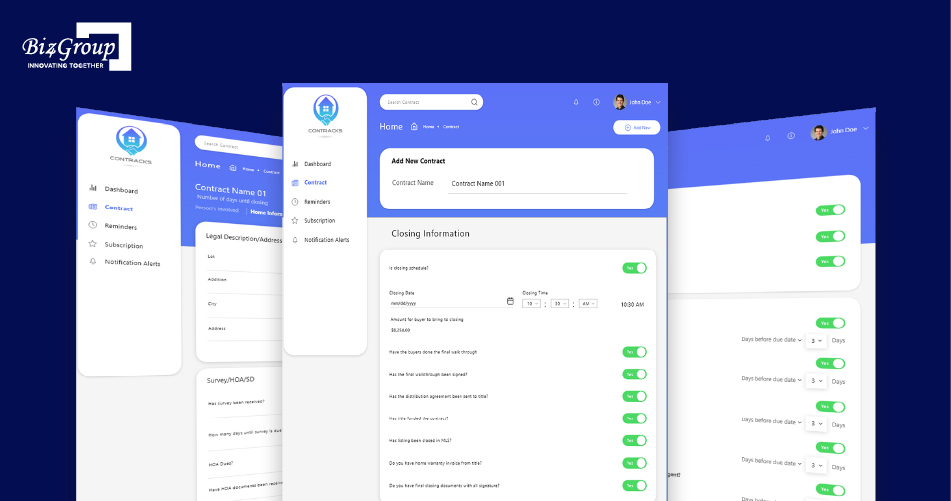
We ran into a similar challenge while building MyContracks for real estate professionals. Contracts are packed with details, but simply getting AI to read them isn't enough. MyContracks uses AI to summarize contracts and extract key information, while helping users track deadlines, manage milestones, organize financial details, and stay on top of next steps. Building it taught us something important: AI becomes truly useful when it turns information into action, not just another document to read. And that's the same principle we believe should guide AI in title and escrow.
The same question now sits at the center of AI in title and escrow: what can technology reliably handle, what still needs professional judgment, and how well does it fit the systems already running the closing?
So, which companies are actually putting AI into U.S. title, escrow, closing, and settlement workflows in 2026? Let's explore.
What Are AI Title and Escrow Companies, and What Types of Technology Do They Use?
AI title and escrow companies use AI to automate or assist with title, escrow, closing, settlement, and risk workflows. The main difference from traditional systems is how they handle information: rules-based systems follow predefined conditions, while AI can interpret variable documents, extract context, identify exceptions, and support the next workflow step.
1. One Connected Market With Five Dominant Roles
The market can be grouped into five roles based on where each technology operates in the closing process:
|
Role |
Primary focus |
AI capabilities |
|---|---|---|
|
Title + escrow platforms |
Title production, escrow, closing |
Document processing, extraction, exception handling |
|
Title-focused solutions |
Search, examination, commitments |
Record analysis, classification, issue detection |
|
Escrow-focused solutions |
Payoffs, deposits, disbursements |
Verification, reconciliation, exception detection |
|
Closing and settlement technology |
Closing coordination, signing, funding |
Workflow automation, document intelligence |
|
Risk and fraud technology |
Identity, wire, transaction risk |
Verification, anomaly and fraud detection |
These roles can overlap. A title and escrow platform may integrate a separate fraud solution, while a title-focused AI system may sit on top of an existing production system.
For buyers, the distinction comes down to workflow coverage. If title examination is the bottleneck, a specialized title solution may address the problem directly. If teams need one connected workflow across title, escrow, closing, and post-closing, broader platform coverage becomes more relevant.
Also Read: How AI Automates Contract Creation and Escrow Management for Real Estate Projects?
2. AI Capability Versus Rules-based Automation
Rules-based automation works when the inputs and conditions are predictable. AI becomes useful when documents, language, and transaction data vary from file to file.
Take a payoff statement. A rules-based workflow may expect specific fields in fixed locations. An AI-enabled system can identify the document, extract the relevant data despite layout differences, compare it with transaction records, and flag discrepancies for review.
A practical architecture combines both:
Document → AI interpretation → structured data → business rules → human review → system update
AI handles interpretation. Rules handle predictable controls such as required approvals, thresholds, segregation of duties, and disbursement conditions.
When evaluating title automation systems, ask:
- Does AI only extract data, or also validate it?
- Can it identify and route exceptions?
- What happens when confidence is low?
- Which actions require human approval?
- Is AI activity recorded for audit?
- Can extracted data flow back into the existing system?
The important distinction is not how much AI a vendor claims to use. It is where AI operates, what it is allowed to do, and how the system controls the handoff to people.
How We Selected These AI Title and Escrow Technology Companies?
The companies in this list were selected based on how directly their technology addresses title, escrow, closing, settlement, or transaction-risk workflows in the U.S. market. We looked beyond the presence of an "AI" label and assessed what each company actually offers, how deeply it fits into the workflow, and where it can be used in practice.
1. Selection criteria
We evaluated each company across seven factors:
- Product relevance: Does the technology directly support title, escrow, closing, settlement, or a closely related risk workflow?
- AI depth: Is AI used for meaningful work such as document understanding, extraction, classification, verification, exception detection, or workflow execution.
- Workflow coverage: Which parts of the closing lifecycle does it support, from order opening and title review to funding and post-closing?
- Maturity: Is there evidence of an established product, production use, customer adoption, or operational deployment?
- U.S. relevance: Does the technology serve U.S. title, escrow, settlement, or real estate transactions?
- Integration: Can it connect with existing title and escrow systems, lenders, banks, data sources, or other transaction systems?
- Practical use case: Is there a clear operational problem the technology can address, rather than AI being added mainly as a feature?
This approach also keeps the list from becoming a collection of companies that simply mention AI on their websites. A useful AI title and escrow system needs a clear role in the transaction and a practical path into the existing workflow.
2. How claims are classified: documented, company claim, or estimate?
We separate vendor information into three categories so readers can see what is established and what still needs validation.
- Documented: The capability or fact is supported by reliable evidence, such as official product documentation, regulatory material, or another verifiable source.
- Company claim: The vendor itself describes the capability, performance, AI functionality, customer usage, or product outcome. We attribute these claims rather than presenting them as independently verified industry facts.
- Estimate: The figure requires calculation or interpretation, such as potential implementation effort or ROI. These are treated as estimates, not vendor-independent facts.
For the company comparison, each capability is labeled Documented or Company claim where applicable. We do not assign an Estimate label to product capabilities because estimates apply to figures such as implementation effort or potential ROI.
This distinction matters when comparing AI title and escrow companies because “AI-powered” can describe very different levels of capability. A document extraction feature, an AI-assisted review workflow, and an AI system that can execute controlled workflow steps are not equivalent. The evidence label makes that difference visible and shows buyers which capabilities should be validated during vendor evaluation.
Seen enough AI claims? Time to look under the hood.
See which capabilities are documented, which are vendor claims, and where the fine print matters.
Talk to Our AI TeamWhere Do Title Automation and Escrow Automation Fit in the Closing Lifecycle?
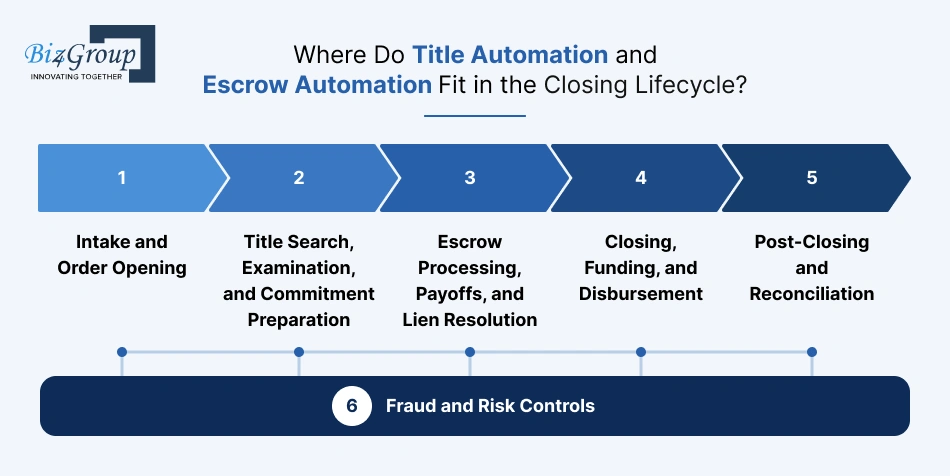
Title and escrow automation can support nearly every stage of closing, but it works best when applied to specific workflows. AI handles document-heavy and repetitive tasks, while rules and human review manage exceptions, approvals, and high-risk decisions.
1. Intake and Order Opening
AI can classify incoming documents, extract property and transaction details, identify missing information, and populate production-system fields. Incomplete or unusual orders can be routed for review before moving forward.
2. Title Search, Examination, and Commitment Preparation
AI can organize records, extract names and legal descriptions, compare information across documents, and flag potential title issues for examiner review.
The examiner retains final judgment. AI can surface a possible lien, discrepancy, or missing document, but determining its impact on insurability requires title expertise and applicable underwriting requirements.
3. Escrow Processing, Payoffs, and Lien Resolution
Escrow automation can organize payoff requests, extract amounts and dates, track outstanding items, and flag inconsistencies.
Escrow officers still handle exceptions such as conflicting payoff information, unresolved liens, or unusual instructions.
4. Closing, Funding, and Disbursement
Automation can coordinate documents, confirm required items, track signatures, and move transaction data between connected systems. AI can assist with document verification and exception detection, while rules control approvals and disbursement conditions.
The key boundary is that AI can prepare funding information, but fund release should remain subject to defined controls, segregation of duties, and human verification.
5. Post-Closing and Reconciliation
Automation can verify documents, payments, and transaction records; identify missing items; reconcile amounts; and route discrepancies for resolution.
For high-volume operations, this can reduce the effort required to catch small reconciliation issues across large transaction volumes.
6. Fraud and Risk Controls
Fraud controls should span the entire workflow, including intake, identity verification, title and escrow review, payment instructions, closing, and disbursement.
AI can compare transaction information, identify unusual patterns, and flag potential risks. It should support a broader control framework rather than act as the sole decision-maker for high-risk transactions.
The practical model is simple:
AI identifies → rules validate → people approve exceptions → the system records the decision.
That is where automation adds value: reducing repetitive work while keeping critical title, escrow, and funding decisions controlled.
Top 10 AI Title and Escrow Companies in the USA 2026: Who’s Bringing What to the Table?
The 10 entries below cover different parts of the title and escrow technology stack. Some provide broad production and closing platforms, while others focus on title intelligence, AI workflow automation, escrow financial controls, digital closing, or fraud prevention. Capabilities below are based primarily on current vendor documentation, with vendor-reported claims identified as such.
|
Company / technology |
Dominant role |
Title capabilities |
Escrow capabilities |
AI capabilities |
Integration / deployment |
|---|---|---|---|---|---|
|
Title + escrow platform |
Order opening, title production, document processing, policy workflows |
Escrow workflow, accounting, closing, reconciliation |
AI-assisted order opening, document processing, workflow assistance |
Core platform with broad integrations across title, escrow, underwriting, and transaction services |
|
|
Title + escrow production system |
Title production, search and examination workflows, commitments, policy production |
Escrow accounting, closing, disbursement, reconciliation |
Primarily workflow automation; AI can be added through connected providers |
SoftPro 360 connects production workflows with external title, lender, recording, identity, and closing services |
|
|
Title + closing platform |
Order entry, title production, document management, underwriting and compliance workflows |
Closing and settlement workflows, vendor management |
Document indexing, data extraction, order routing, compliance auditing, suspicious-change monitoring |
Encompass and other connected services |
|
|
First American AgentNet |
Underwriter / title technology |
Search-package review, underwriting guidance, title intelligence, agency workflows |
Not positioned as a general escrow production system |
AI-assisted title package analysis and underwriting research |
First American ecosystem with connections to production systems |
|
Rezervology / RezeLink |
Title-search AI |
Search-package processing, data extraction, document splitting, hyperlinking, pre-exam support |
Not a primary escrow system |
AI extraction and title search processing |
Designed to feed structured information into title production systems |
|
Custom AI workflow layer |
Title document processing, transaction data extraction, title workflow automation |
Escrow task management, transaction workflows, approvals, and exception routing |
AI document analysis, data extraction, AI agents, workflow automation, exception routing |
Custom-built around existing systems, APIs, databases, business rules, and operational workflows |
|
|
Escrow financial controls |
Not a title production platform |
Escrow reconciliation, account monitoring, disbursement oversight, financial reporting, escheatment |
Rynoh IQ adds AI to financial oversight and escrow workflows |
Connects with escrow accounting and financial systems |
|
|
AI workflow layer |
AI order entry, document processing, title workflow support |
Routine transaction and communication workflows |
Contract/email extraction, order creation, document processing, automated responses |
Integrates with SoftPro, RamQuest, ResWare, Settlor, and other title systems |
|
|
Digital closing |
Not a title production platform |
Closing coordination and settlement document workflows |
AI-powered quality control and document review |
Connects with LOS, POS, and title production systems |
|
|
Payment and fraud controls |
Not a title production platform |
Payment verification, wire protection, payoff workflows, closing payments |
AI-powered payoff ordering plus transaction-risk controls |
Designed to operate alongside title and escrow systems |
1. Qualia
Technology: Qualia Core is a cloud-based title production and escrow system covering title production, escrow, accounting, closing coordination, reporting, and integrations. Qualia also offers Qualia Clear, an agentic AI system for title and escrow workflows.
AI capability: In 2026, Qualia launched Clear Essentials with AI-powered support, order opening, and document processing built directly into Qualia Core. Qualia also describes Clear as an agentic AI system that can assist with review, analysis, and execution.
Workflow coverage: Title production, escrow, accounting, closing, document processing, order opening, reconciliation, and fraud controls.
Integration: Qualia maintains integrations with underwriters, title and escrow vendors, and other transaction services.
Human role: Title and escrow professionals retain responsibility for exceptions, professional judgment, approvals, and transaction decisions.
Best fit: Title and escrow organizations looking for a broad production system with native AI capabilities rather than a separate AI layer.
2. SoftPro
Technology: SoftPro provides configurable title, escrow, and closing systems with process automation and a large vendor integration ecosystem. SoftPro 360 connects users with services such as eRecording, lien releases, identity verification, eClosings, property data, and settlement services.
AI capability: SoftPro's current public product documentation emphasizes rules-based process automation and integrations. It can connect with third-party AI and technology providers.
Workflow coverage: Title production, escrow, closing, vendor ordering, eRecording, policy services, and related production workflows.
Integration: SoftPro 360 provides integrations across title, escrow, closing, identity verification, lender, notary, and recording services.
Human role: Teams continue to handle title examination, exceptions, approvals, accounting, and closing decisions.
Best fit: Established title and escrow operations that need a configurable core system and broad integration ecosystem, with AI added through connected solutions where appropriate.
3. AtClose
Technology: AtClose is an AI-powered title production and closing platform with configurable workflows, vendor management, compliance monitoring, and title and settlement functionality.
AI capability: AtClose documents AI for document indexing and data extraction, order routing, underwriting-guideline auditing, suspicious data-change monitoring, compliance monitoring, workload assignment, and its AI Help Agent.
Workflow coverage: Order entry, title production, document management, vendor management, workflow routing, compliance, and closing.
Integration: AtClose documents an Encompass LOS integration for quotes, orders, and document synchronization.
Human role: AI identifies information, risks, and workflow actions, while people remain responsible for approvals, exceptions, and professional decisions.
Best fit: Title and settlement organizations looking for a broad production platform with AI embedded directly into operational workflows.
4. First American Title / AgentNet
Technology: AgentNet is First American Title's technology environment for policy-issuing agents, supporting title and underwriting workflows.
AI capability: First American launched AgentNet Assist in 2025 as a generative AI tool for searching and summarizing underwriting guidance. In April 2026, it introduced AgentNet Assist: Title Intelligence, which uses AI-assisted analysis to review title search packages, extract and organize information, and surface potential issues.
Workflow coverage: Underwriting research, title search package review, document analysis, and AgentNet title and agency workflows.
Integration: AgentNet connects with First American's agency ecosystem and can integrate with production systems such as SoftPro for search, CPL, underwriting, policy, and related workflows.
Human role: First American explicitly states that final title determinations remain with the title professional.
Best fit: First American policy-issuing agents that want AI-assisted title review within the AgentNet environment.
5. Rezervology / RezeLink
Technology: Rezervology provides title technology, integration, data migration, and managed technology services. Its RezeLink product uses AI to process title search packages and deliver structured information and hyperlinks into title production systems.
AI capability: RezeLink is documented as providing AI data extraction, search-package processing, and automated hosted hyperlinks. RezReport offers a related search and AI data-extraction workflow for SoftPro and ResWare.
Workflow coverage: Title search processing, data extraction, document organization, hyperlinking, and pre-examination support.
Integration: Current public material specifically references SoftPro and ResWare as target production systems.
Human role: The technology prepares and structures search information. Title professionals remain responsible for examination, interpretation, and final decisions.
Best fit: Title operations that want AI-assisted search processing without replacing their existing title production system.
6. Biz4Group LLC
Technology: Biz4Group develops custom AI platforms for real estate businesses, including title and escrow workflows, document processing, transaction management, and workflow automation. The company works with clients to design the system around their existing processes rather than requiring them to adopt a fixed platform.
AI capability: Its real estate AI services support AI document analysis, data extraction, AI agents, and workflow automation for title and escrow processes, including title document intake, transaction data extraction, exception routing, and escrow task management.
Workflow coverage: Custom solutions can address order intake, title and escrow document processing, task routing, approvals, transaction updates, notifications, and other closing-related workflows.
Integration: Biz4Group builds around the client's existing systems, APIs, databases, and operational workflows, allowing organizations to add AI without necessarily replacing their core production environment.
Human role: Human approval can remain part of workflows involving title exceptions, escrow decisions, fund approvals, and other high-consequence actions.
Best fit: Title agencies, escrow companies, and settlement operations that need a custom AI title and escrow solution built around their specific workflows, integrations, and business rules rather than adopting a standardized platform.
7. Rynoh
Technology: Rynoh focuses on escrow financial management, reconciliation, account verification, transaction monitoring, fraud prevention, and compliance.
AI capability: Rynoh announced Rynoh IQ in August 2026 as an AI system for the financial side of title and escrow. However, its current release information says an AI-powered assistant is launching in October 2026, so it should not be presented as a broadly available AI capability yet.
Workflow coverage: Escrow reconciliation, account management, disbursement oversight, account verification, reporting, fraud controls, and escheatment.
Integration: Rynoh integrates with escrow accounting and related financial systems, with 2026 updates adding integrations including CiviTOS, Settlor, CMiC, and CMiS.
Human role: Financial teams remain responsible for reviewing exceptions, reconciliations, approvals, and disbursements.
Best fit: Title and escrow organizations focused on financial controls, reconciliation, disbursement oversight, and fraud prevention.
8. Alanna.ai
Technology: Alanna.ai provides an AI assistant and workflow automation layer for title operations that connects with existing title production systems.
AI capability: Its AI Order Entry can process emails and contract PDFs, extract information, and prepare files for a title production system. Alanna also provides Smart Forms, document processing, automated communications, and routine transaction support.
Workflow coverage: Order intake, document processing, title production updates, client communication, routine information requests, and related administrative workflows.
Integration: Alanna currently lists integrations with Settlor, SoftPro, RamQuest, and ResWare.
Human role: Staff continue to manage exceptions, transaction decisions, and work outside the configured workflows.
Best fit: Title companies that want to add AI-driven order intake and administrative automation without replacing their existing production system.
9. Snapdocs
Technology: Snapdocs provides digital mortgage closing technology covering eClosing, eVault, notary coordination, and quality control.
AI capability: Snapdocs documents AI-powered quality control and AI-powered technology across its closing platform. Its Quality Control product uses AI-powered file reviews to automate parts of the review process.
Workflow coverage: Digital closings, eSign, RON, notary coordination, document review, quality control, and post-closing document workflows.
Integration: Snapdocs states that its platform integrates with LOS, POS, and title production systems.
Human role: Lenders, settlement teams, and notaries continue to manage closing exceptions, signing, and transaction decisions.
Best fit: Mortgage lenders and settlement operations focused on digital closing, eClosing adoption, and automated closing quality control.
10. CertifID
Technology: CertifID began as a real estate wire-fraud protection platform and has expanded its closing technology to include document workflows, digital payments, and AI-powered payoff ordering.
AI capability: Its 2026 platform expansion specifically includes AI-powered payoff ordering, alongside payment and closing workflows.
Workflow coverage: Wire protection, payment verification, earnest money, cash-to-close payments, payoff workflows, document workflows, and closing payments.
Integration: CertifID operates alongside existing title and escrow systems and is included in the broader ecosystem of settlement technology integrations.
Human role: Teams retain control over transaction review and approvals while CertifID adds verification and payment controls.
Best fit: Title and escrow organizations where payment security, wire protection, payoff processing, and closing-fund controls are major priorities.
These 10 companies aren’t all the same kind of “AI title and escrow company.” They span full closing platforms, title intelligence tools, AI layers, escrow controls, digital closings, and fraud protection.
That matters because AI capability, title strength, escrow strength, and workflow coverage are separate dimensions. A company can excel in one area without being an end-to-end title and escrow platform.
How Do End-to-End Platforms, AI Layers, and AI Agents Differ in Title and Escrow Technology?
End-to-end platforms run the core title and escrow workflow. AI layers add targeted automation to existing systems, while AI agents can execute defined multi-step tasks across systems. The key difference is how much the technology controls, how deeply it integrates, and how much human approval remains necessary.
|
Approach |
What it controls |
Typical use |
Automation level |
Main consideration |
|---|---|---|---|---|
|
End-to-end platform |
Title, escrow, closing, accounting, and workflow |
Replace or consolidate production systems |
Broad workflow execution |
Migration and process change |
|
Specialist AI layer |
Specific tasks within existing workflows |
Order opening, document processing, title search, communication |
Task-level assistance or automation |
Integration and data integrity |
|
AI agent layer |
Defined multi-step tasks across systems |
Research, extraction, validation, routing, QC |
Multi-step execution under defined controls |
Permissions, auditability, and exception handling |
The level of automation also varies. An AI assistant might read a purchase contract, extract the buyer, seller, property, price, and lender, and present the information for review.
An AI-driven workflow can take the next steps:
Read contract → extract data → create order → classify documents → request missing information → update the production system → route exceptions
That removes more manual work, but requires stronger permissions, validation, auditability, and exception controls.
The choice depends on the problem you are solving. A title agency replacing its production system may evaluate Qualia or AtClose, while a SoftPro user may add targeted automation through Alanna.ai. A company with specialized workflows may use a custom AI layer with Biz4Group without replacing its existing system of record.
For buyers, evaluate AI on this scale:
Assist → recommend → execute one action → execute a workflow → execute across systems with approval controls
AI agents can handle repetitive tasks with clear inputs and outputs. Underwriting judgment, unusual title defects, fund approval, and ambiguous instructions still require human review.
What Do Title Examiners and Escrow Officers Still Do When AI Automates the Workflow?
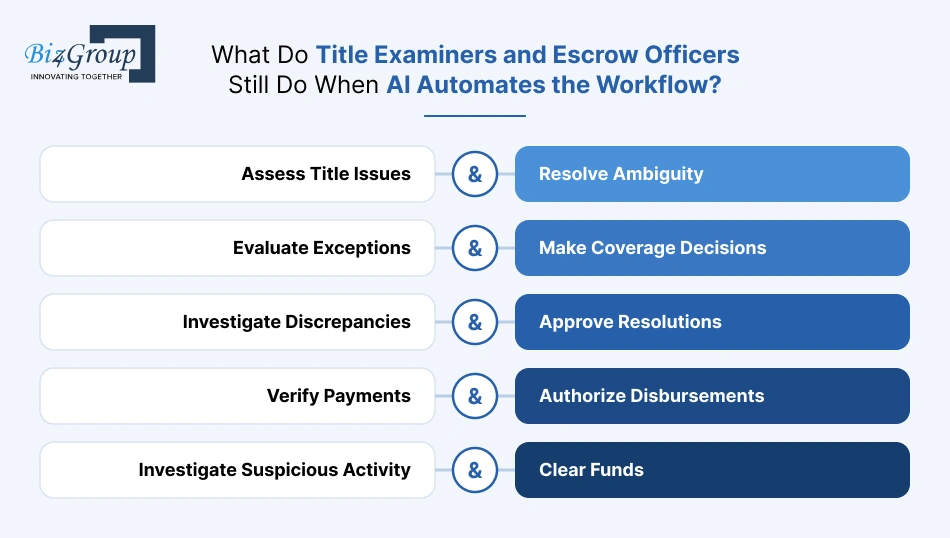
AI can handle document extraction, classification, data checks, and routine workflow steps. Title examiners and escrow officers still handle decisions that require professional judgment, exception resolution, and control over financial risk.
|
Area |
What AI can handle |
What the professional still handles |
|---|---|---|
|
Title examination |
Extract ownership data, identify liens, compare records, flag inconsistencies |
Determine whether an issue affects title, resolve ambiguity, decide what requires further examination |
|
Underwriting |
Surface potential exceptions and organize relevant documents |
Apply underwriting requirements, evaluate unusual situations, make final coverage decisions |
|
Escrow exceptions |
Detect missing documents, mismatched amounts, unusual instructions, and incomplete tasks |
Investigate discrepancies, contact relevant parties, approve resolution, decide whether the transaction can proceed |
|
Funds approval |
Check transaction data, identify changes, flag payment anomalies |
Verify payment instructions, follow approval controls, authorize disbursement |
|
Fraud verification |
Detect unusual patterns, compare identity and transaction information, trigger alerts |
Perform required verification, investigate suspicious activity, determine whether funds can safely move |
Examiner and Underwriting Judgment: AI can flag liens, ownership discrepancies, and underwriting exceptions, but title examiners still interpret those findings and make the final determination. First American Title made this distinction explicit when it introduced AI review of title search packages in April 2026, noting that “final title determinations remain with the title professional.” As Paul Bandiera, SVP of Agent Technology at First American Title, explained, AI can support the review process without replacing the professional judgment required to determine insurability.
Escrow Officer Exception Handling: Escrow automation handles routine tasks, while escrow officers investigate mismatches, missing documents, changed instructions, and other exceptions. AI detects → system flags → officer reviews → action proceeds.
Funds Approval and Fraud Verification: AI can flag payment anomalies and support identity checks, but escrow professionals still verify high-risk instructions, investigate fraud signals, and approve fund disbursement.
The goal of AI title and escrow technology is to reduce repetitive work while keeping consequential decisions under human control.
Which Integration, Security, and Compliance Requirements Matter for AI Settlement Technology?
An AI settlement system needs to fit the existing transaction stack, protect sensitive information, and support the controls already required for title and escrow operations. The three areas should be evaluated together because a system that extracts documents accurately but cannot integrate with production systems, protect nonpublic information, or support required approvals is difficult to deploy in production.
1. Integration With Your Production System, Banks, Lenders, Payoff Sources, and Recorders
Integration should be tested at the transaction level, not just through a vendor's list of API connections. The system should be able to receive the right data, return validated information, preserve transaction status, and maintain an audit trail across the systems involved in a closing.
|
Integration |
What to verify |
|---|---|
|
Title production system |
API access, order creation, field updates, document exchange, status synchronization |
|
Banks and payment systems |
Payment verification, account information, authorization controls, reconciliation |
|
Lenders / LOS |
Order data, borrower information, closing documents, status updates |
|
Payoff sources |
Request creation, document retrieval, payoff data extraction, exception handling |
|
County / recording systems |
Record retrieval, document submission, recording status |
|
Identity and fraud providers |
Identity results, risk signals, verification status, audit history |
A useful vendor test is to take one transaction from intake through funding and map every system-to-system handoff. If employees still have to download, rename, re-enter, and upload information between systems, the automation is incomplete.
This matters even more for fraud controls, where title firms often use several tools rather than relying on one. ALTA’s 2026 seller impersonation study of 245 title professionals found that 94% of firms use multiple fraud-detection tools, averaging 5.3 per firm.
ALTA General Counsel Steve Gottheim described this as “an almost all-of-the-above approach”. That makes integration part of the control itself, every added tool creates another handoff to test. Identity and fraud results should therefore flow back into the transaction record, where they can inform the workflow, rather than remain isolated in a separate dashboard.
2. Data and Document Readiness
AI performs only as well as the data it receives and the controls around that data. Title and escrow teams should assess document formats, naming conventions, historical data quality, missing fields, duplicate records, and access permissions before deploying an AI workflow.
Key requirements include:
- Document formats: PDFs, scans, emails, images, spreadsheets, and other formats used in actual transactions.
- Data quality: Consistent names, addresses, legal descriptions, loan information, and transaction identifiers.
- Document relationships: The system should know which documents belong to which transaction and party.
- Access controls: Users and AI services should only access information required for their role.
- Auditability: Changes, AI actions, approvals, and exceptions should be traceable.
- Retention: Data and documents should follow the organization's retention and deletion requirements.
For AI specifically, ask whether customer data is used to train a vendor's models, where processing occurs, how long data is retained, and whether the vendor uses third-party AI providers.
3. ALTA Best Practices, GLBA, State Rules, and FinCEN Reporting
Compliance needs to be part of the AI settlement technology workflow, not a separate review after deployment. The main areas to check are:
- ALTA Best Practices: ALTA Best Practices 4.2, published in August 2025, covers areas including licensing, escrow trust accounting, protection of non-public personal information, settlement processes, and third-party oversight.
- GLBA Safeguards Rule: For financial institutions covered by the FTC's rule, the Safeguards Rule requires a written information security program. Required safeguards include access controls, encryption, multifactor authentication, application security assessments, monitoring, and incident response.
- State requirements: Title, escrow, privacy, licensing, recording, and settlement requirements can differ by state. A workflow designed for one jurisdiction should therefore be reviewed before being deployed nationally.
- FinCEN reporting: FinCEN's Residential Real Estate Reporting Rule requires reporting persons to file Real Estate Reports for reportable transfers closing on or after March 1, 2026, subject to the rule's definitions and exceptions.
The purpose is to use AI to make compliance controls easier to enforce, document, and audit, while keeping regulated and high-risk decisions with the appropriate professionals.
Should You Adopt, Integrate, or Build AI Title and Escrow Automation?
The right path depends on what you need to change. If the core platform is the problem, adopt a new one. If the platform works but certain workflows are manual, integrate AI. If your workflows or integrations are highly specific, build around them.
1. Adopt an End-to-End Platform
Adopt when your core title and escrow system needs to change.
This approach makes sense when you need to:
- Consolidate title, escrow, closing, and accounting workflows
- Standardize processes across offices
- Replace fragmented or outdated systems
- Centralize permissions, reporting, and audit trails
- Bring automation and integrations into the core platform
The trade-off is implementation. Migration can involve data, users, integrations, workflows, accounting processes, and training.
2. Integrate a Specialist AI Layer
Integrate when your existing system works, but specific workflows are too manual.
Good candidates include:
- Order opening
- Contract and document extraction
- Title search-package processing
- Document indexing
- Payoff processing
- Email classification
- Exception detection
- Routine communications
The AI layer should connect directly to the existing workflow and return structured, usable results. Otherwise, it simply creates another manual handoff.
Order opening is a practical starting point because it is repetitive, document-heavy, and occurs on every file. Qualia CEO Nate Baker has said it takes “30 minutes to an hour” for the average title company. That figure is a vendor estimate, so use your own processing time as the baseline before investing.
Also check what your existing platform already provides. Qualia says its AI Order Opener is available at no additional cost to Core customers, which means a separate AI layer may not be necessary if your current platform already covers the workflow.
3. Build a Custom AI Solution
Build when the workflow itself is too specific for standard platforms.
Custom development can make sense when you need:
- Proprietary workflows
- Complex system integrations
- Custom approval rules
- Specialized AI agents
- Custom fraud controls
- Unique lender or client workflows
- Specialized reporting or reconciliation
The trade-off is greater responsibility for architecture, security, testing, integrations, maintenance, and ongoing AI updates. Custom development gives you more control, but it also means owning more of the technology over time.
4. What Should You Choose?
|
If your main problem is... |
Consider... |
|---|---|
|
The core platform is outdated or fragmented |
Adopt |
|
A working platform has too many manual tasks |
Integrate |
|
A workflow needs capabilities standard platforms do not provide |
Build |
|
You need broad workflow consolidation |
Adopt |
|
You need automation in a few targeted areas |
Integrate |
|
Your workflows, integrations, or controls are highly specific |
Build |
Cost should follow the same logic. Platform replacement brings migration and implementation costs; AI integration depends largely on workflow and integration scope; custom development adds architecture, security, testing, and ongoing ownership.
A simple rule to keep in mind is to replace the platform when the platform is the problem. Integrate AI when specific workflows are the problem. Build when the workflow itself needs to be different.
How to Build a Shortlist of AI Closing Technology Vendors?
Choosing an AI closing technology vendor should start with the workflow you need to improve, not the AI features a vendor wants to demonstrate. The shortlist should show what the technology can automate, how it connects to your existing title and escrow systems, what happens when automation fails, and where human approval remains necessary.
What to Ask Every Vendor?
Use the first conversation to separate genuine workflow automation from isolated AI features.
|
What to ask |
What a credible answer should cover |
|---|---|
|
Which closing tasks can your AI actually automate? |
Specific workflows such as order opening, document extraction, title search support, payoff processing, reconciliation, exception routing, or closing coordination |
|
Which steps still require a person? |
Clear approval points for title exceptions, escrow decisions, identity verification, fund release, and other high-consequence actions |
|
What systems can you integrate with? |
Title production systems, LOS platforms, banks, payoff providers, recording systems, identity services, and existing APIs |
|
Can the AI write validated information back into our workflow? |
Structured data transfer, field validation, transaction updates, and auditability rather than another manual copy-and-paste step |
|
What happens when the AI is uncertain? |
Confidence thresholds, exception queues, human review, escalation rules, and the ability to override or correct results |
|
Which actions can AI perform without approval? |
Defined permissions and controls for creating records, sending communications, changing transaction data, or initiating downstream actions |
|
How are AI actions recorded? |
Logs showing what the AI processed, what it changed, what a person approved, and when each action occurred |
|
How is transaction data protected? |
Access controls, encryption, retention policies, third-party AI providers, data-processing terms, and security practices |
|
Which capabilities are available today? |
A clear distinction between production features, pilots, beta capabilities, and roadmap items |
|
What implementation work will we own? |
Integration, data mapping, configuration, testing, training, workflow changes, and ongoing support |
A strong vendor should be able to answer these questions in terms of your closing workflow, not just describe its AI models.
Claims to Verify Before a Demo
Vendor claims become more useful when you turn them into measurable questions.
|
Vendor claim |
What to verify |
|---|---|
|
"AI-powered title automation" |
Which title tasks are automated, what documents are supported, and where examiner review is required |
|
"70% less manual work" |
Which workflow was measured, against what baseline, across how many transactions, and which steps remained manual |
|
"AI agents automate closing" |
Which actions the agent can execute, what systems it can access, what permissions it has, and where approval is required |
|
"Seamless integrations" |
Which integrations are live, which require custom work, and whether the technology can write data back into the production workflow |
|
"High AI accuracy" |
Accuracy by document type, validation method, sample size, exception rate, and treatment of low-confidence results |
|
"Fraud protection" |
What signals are checked, what verification occurs, and how suspicious transactions are escalated |
|
"Enterprise security" |
Access controls, encryption, retention, audit logging, subprocessors, security assessments, and applicable certifications |
|
"Fast implementation" |
Actual integration dependencies, data migration, configuration, testing, training, and production-readiness requirements |
The goal is not to challenge every marketing statement. It is to determine what the technology actually does inside a live transaction.
How Should You Roll Out AI Closing Technology?
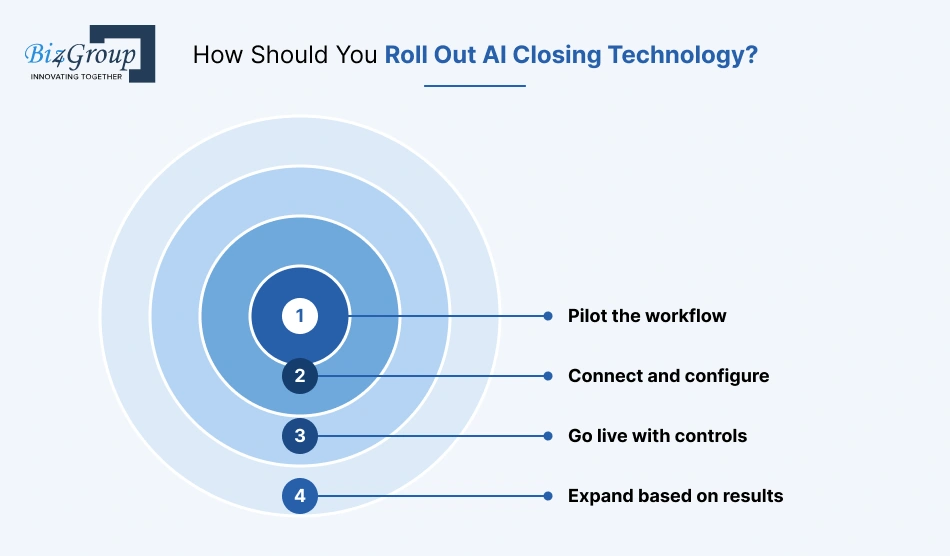
Start with one workflow where the vendor can demonstrate measurable value without exposing the entire closing operation to unnecessary implementation risk.
1. Pilot the workflow Choose a defined use case such as order opening, document processing, payoff handling, or reconciliation. Measure the current baseline for processing time, manual touches, errors, and exception rates.
2. Connect and configure Integrate the required title, escrow, lender, payment, or document systems. Set permissions, approval points, exception handling, and audit requirements before production use.
3. Go live with controls Start with a defined transaction type, team, or volume. Monitor AI outputs, exceptions, overrides, integration failures, and human approvals alongside productivity metrics.
4. Expand based on results Add workflows only after the pilot demonstrates acceptable accuracy, control, reliability, and ROI. Treat each new workflow as a separate implementation rather than assuming one successful use case proves the entire system.
It matters because this gives buyers a way to test whether an AI vendor works in their actual closing environment before committing to a broader rollout.
Where Biz4Group Fits in the AI Title and Escrow Technology Landscape?
If your existing title or escrow technology works but a specific workflow is still slowing the team down, a custom AI layer can address that gap without rebuilding everything around it.
Biz4Group, a Real Estate AI Platform Development Company, helps design AI solutions around the workflow, systems, and data you already use, with capabilities such as document processing, transaction-data extraction, workflow automation, AI agents, and integrations.
The starting point is simple:
- What takes too much manual effort?
- Where does information get stuck or re-entered?
- Which systems need to work together?
- Where must a person remain in control?
From there, the scope can stay focused on one workflow, such as document processing or transaction intake, before expanding to additional use cases.
With 20+ years of technology development experience and 1,000+ projects delivered for 750+ clients, Biz4Group brings the development and integration experience needed to turn that workflow into a working AI solution.
The goal is not more technology. It is less friction in the workflow you already have.
Your workflow doesn't have to fit the box.
If your title or escrow process needs something more specific, let’s explore what can be built around the way your team already works.
Explore a Custom AI SolutionFinal Thoughts
AI can take a lot of the repetitive work out of title, escrow, and closing, but the goal is not to automate everything. It is to make the workflow faster, cleaner, and easier to control.
The right AI solution should help you:
- Cut repetitive work across documents, data entry, and transaction updates.
- Catch issues earlier with validation and exception detection.
- Keep people in control of approvals, title decisions, and fund-related actions.
- Connect existing systems without creating more manual handoffs.
- Measure real value through processing time, manual touches, errors, and ROI.
At Biz4Group, we help title and escrow businesses turn these opportunities into custom AI solutions built around their workflows, integrations, and business rules.
Ready to make your closing workflow more efficient? Talk to Biz4Group and explore what AI can do for your operation.
Frequently Asked Questions
1. Can AI title and escrow technology work with the systems we already have?
Usually, yes. The key is how deeply the technology can connect with your existing production, accounting, lender, payment, and document systems. A useful integration should reduce re-entry and duplicate work rather than create another place for staff to manage transactions.
2. What happens if an AI system makes a mistake on a live closing?
A well-designed workflow should not let one AI error move silently through the transaction. The system can flag low-confidence results, preserve the original document or data, route the issue to a designated reviewer, and record what was changed and approved.
3. Can we keep our existing title production platform and add AI around it?
Yes. This is often a practical approach when the core platform already works but certain workflows remain manual. An AI layer can handle defined tasks around the existing environment without requiring a complete platform replacement.
4. Who owns a custom AI title and escrow solution?
That depends on the development agreement. Before starting, clarify ownership of the source code, integrations, workflows, configurations, transaction data, documentation, and AI components, along with data-export rights if the relationship ends.
5. Can AI work with our historical title and escrow files?
Potentially, yes. Historical files can be useful for testing, evaluation, search, workflow configuration, or model improvement. They should first be reviewed for data quality, permissions, sensitive information, and whether they accurately represent the transactions the system will encounter in production.
6. How do we avoid getting locked into one AI provider?
Design the architecture so the application and workflow logic are not unnecessarily dependent on one model or provider. Using modular AI services, structured APIs, reusable evaluation datasets, and portable workflow logic can make future model or provider changes easier.
7. Is custom AI development practical for a smaller title or escrow company?
It can be, particularly when the project starts with one high-value workflow instead of attempting to build an entire platform. A focused automation project can establish measurable value before the company expands into additional workflows.
8. What if our title or escrow workflow needs something off-the-shelf platforms don't provide?
A custom AI solution can be built around your specific workflow, integrations, and business rules. Biz4Group can help identify where AI can reduce manual work without disrupting the controls your team already relies on.
