 Location :
Orlando, FL, USA
Location :
Orlando, FL, USA +1 (407) 714-1616
 info@biz4group.com

 AI Summary Powered by Biz4AI
- AI title and escrow MVP development costs $50K to $100K and typically covers document extraction, workflow automation, dashboards, and human-reviewed processes.
- Production AI title and escrow platform development costs $100K to $250K and includes broader workflows, AI document intelligence, integrations, security, reporting, and production readiness.
- Enterprise AI title and escrow platform development costs $250K to $500K+ and can include advanced AI agents, extensive integrations, high transaction volumes, multi-tenant architecture, and enterprise governance.
- AI title and escrow development costs can be controlled through phased development, reusable architecture, existing-system integration, and usage-based AI controls, with implementation scope commonly adding $30K to $100K+.
- Biz4Group can build and integrate AI-powered title and escrow platforms for $50K to $300K+ depending on AI capabilities, integrations, security, platform scope, and ongoing support requirements.
Why can two AI title and escrow platforms have completely different development costs? Because the expensive part is rarely just the AI. The real budget is shaped by how many workflows you want to automate, how much human judgment remains in the loop, which systems must connect, and how much control the platform needs around sensitive transactions.
An AI title & escrow automation platform is a digital platform that uses artificial intelligence and workflow automation to streamline title production, escrow operations, document processing, transaction management, and related closing activities while keeping critical decisions under human oversight.
So, what should you actually budget? A practical U.S. planning range is $50K-$500K+ for an AI title and escrow automation platform, depending on the scope and level of automation. These are scope-based planning estimates, not fixed market prices. A focused platform for document processing and task routing will sit at a very different cost level from an enterprise platform handling title examination, escrow reconciliation, advanced AI, extensive integrations, and high transaction volumes.
That complexity shows up in the industry itself. ALTA's 2026 study found that more than 80% of purchase transactions require reviewing at least 11 documents, while 21% involve more than 50 records tied to a property's ownership history. Nearly 60% also require clearing three to five title issues before closing. Those numbers help explain why AI title & escrow automation platform cost can rise quickly as automation moves from simple document processing into title examination, exception handling, curative work, and closing workflows.
Beyond AI platform development cost, you also need to account for integrations, property data, cloud infrastructure, security, testing, human review, and ongoing AI usage.
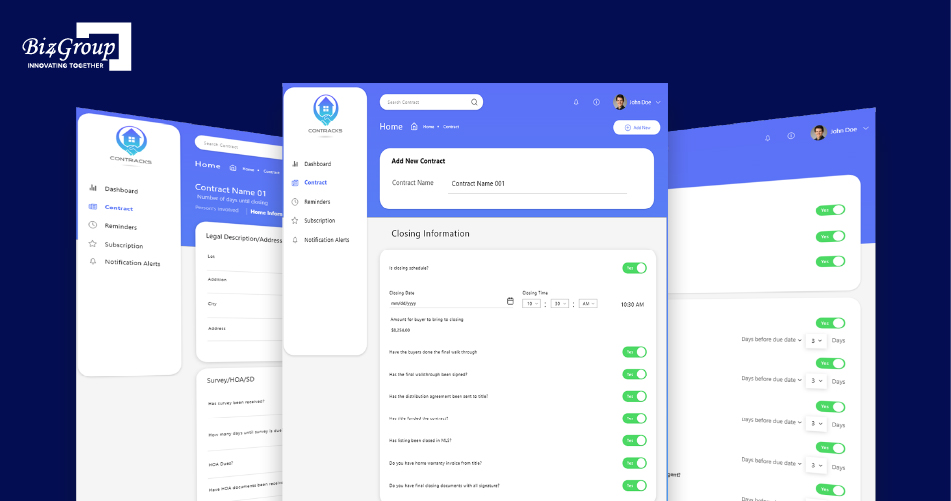
Biz4Group's work on ConTracks offers a practical lesson here: extracting information from documents is only part of the value. Connecting that information to deadlines, financial details, alerts, stakeholders, and downstream actions is where workflow automation becomes genuinely useful.
So, how do you know which capabilities belong in your budget before the development estimate starts climbing? Let's break down where the cost actually goes.
How Much Does It Cost to Build an AI Title & Escrow Platform in 2026?
An AI title & escrow automation platform is a digital platform that uses artificial intelligence and workflow automation to streamline title production, escrow operations, document processing, transaction management, and related closing activities while keeping critical decisions under human oversight.
So, what does it cost to build one? A practical U.S. planning range is $50K-$100K for an AI automation MVP, $100K-$250K for a production platform, and $250K-$500K+ for an enterprise implementation. These are scope-based planning estimates, not fixed market prices.
|
Platform scope |
2026 planning range |
Typical timeline |
Typical scope |
|---|---|---|---|
|
AI Automation MVP |
$50K-$100K |
2-4 weeks |
1-2 workflows, document intelligence, dashboard, human review, limited integrations |
|
Production Platform |
$100K-$250K |
4-6 weeks |
Multiple title and escrow management workflows, deeper integrations, security, testing, monitoring |
|
Enterprise Platform |
$250K-$500K+ |
6-8 weeks |
Advanced AI, extensive integrations, high-volume processing, governance, enterprise architecture |
The range is broad because an MVP, production platform, and enterprise platform involve very different levels of automation, integration, and operational control.
That is why the final cost depends on workflow depth, AI capabilities, integrations, data, security, transaction volume, and scalability, rather than simply the number of features included.
For example, Biz4Group built ConTracks, a real estate contract management platform with AI-powered summarization and data extraction. It also handles escrow and earnest-money tracking, deadline alerts, and dashboard reporting.
According to the project page, ConTracks reduced paperwork time by up to 50%, lowered error margins by more than 30%, and sped up document processing by more than 20%.
These results come from contract management, not title examination. So, they're best used as a reference point, not a forecast for title insurance platforms.
Now, let's break down the estimated cost for all three development levels and what each one typically includes.
1. AI Automation MVP: $50K-$100K
A $50,000-$100,000 MVP development can focus on one or two high-value workflows.
What's included:
- Document upload, AI OCR, and data extraction
- Document classification
- Order intake and workflow routing
- Basic title or escrow dashboard
- User roles and permissions
- Notifications and task management
- Human review of AI results
- One or two integrations
- Basic reporting and audit history
Here's a simple example. A title company receives a new purchase order by email. The platform captures it, classifies the title documents, extracts key property and transaction details, creates the file, and assigns tasks to the right team member. It also flags missing information for human review.
The title professional still reviews the extracted information and handles title issues that require judgment.
This estimate assumes limited workflow coverage, moderate AI complexity, existing data sources, and controlled transaction volumes. Custom business rules, additional integrations, or more advanced document intelligence can push costs higher.
The goal is to prove one measurable workflow first, then expand into deeper title and escrow automation.
2. Production Platform: $100k-$250k
A $100,000-$250,000 production platform can support multiple operational workflows and move beyond a controlled pilot.
The scope may include:
- Title search and examination assistance
- Exception identification
- Commitment preparation
- Escrow instructions
- Funds tracking and reconciliation
- Closing coordination
- Reporting and analytics
- Multiple external integrations
- Stronger security and audit controls
- Production monitoring and support capabilities
Here's a typical workflow: a new transaction enters the platform, which pulls available property data, organizes title documents, and helps the examiner spot potential exceptions.
As the transaction moves forward, the platform can prepare commitment details, route escrow instructions, track incoming funds, support reconciliation, and manage closing tasks. Data can also move between title production, accounting, e-signature, identity, and other connected systems. Human reviewers still approve key findings and financial actions before anything moves forward.
At this level, integration and operational requirements become major cost drivers. Connecting title production, property records, underwriting, banking, accounting, e-signature, identity, and fraud-prevention systems can require substantial engineering and testing.
3. Enterprise Platform: $250K-$500K+
A $250,000-$500,000+ enterprise platform typically supports higher transaction volumes, multiple teams, extensive integrations, advanced AI, and stronger governance.
Potential capabilities include:
- AI-assisted title examination
- Semantic search
- Predictive analytics
- Generative AI copilots
- AI agents with controlled tool access
- Automated exception routing
- Multi-tenant architecture
- High-availability infrastructure
- Model evaluation and monitoring
- Advanced permissions and auditability
- Disaster recovery
- Enterprise identity integration
Consider a national title and settlement organization handling thousands of transactions across teams and jurisdictions. AI can analyze title records, flag potential exceptions, and give title professionals source-grounded findings.
A generative AI copilot can answer questions about transaction files. Controlled AI agents can route tasks, request missing documents, and trigger approved workflow actions.
Behind the scenes, the platform also needs enterprise identity controls, audit trails, model monitoring, disaster recovery, and high-availability infrastructure.
At this scale, costs can exceed $500,000. Extensive state-specific workflows, large-scale data migration, two-way integrations, complex AI orchestration, and strict availability or governance requirements can all drive the cost higher.
Calling something an "MVP" does not make two projects comparable. A $75,000 MVP with document extraction and two integrations has a very different scope from an MVP involving multiple property-data providers, state-specific rules, financial controls, and bidirectional integrations.
The costs can climb pretty quickly when title and financial workflows become core parts of the platform.
So, what's the best way to get a realistic title insurance system development estimate? Start with the details that actually drive the cost. The clearer these requirements are, the easier it is to compare development proposals without getting surprised by the fine print later.
What Should Be Included in the AI Title & Escrow Automation Platform Scope?
The platform scope should match the title and escrow workflows you want to automate. Core costs come from title production, escrow operations, intelligent document processing, workflow automation, and the operational controls needed to run the platform reliably.
Order intake → document collection → extraction → examination → exceptions → commitment → escrow → funds → closing → post-closing, with human-review checkpoints marked
1. Title Production: $30K-$80K+
Title production can cover order intake, document collection, title search, record extraction, chain-of-title analysis, examination support, exception identification, and commitment preparation.
A basic implementation may focus on intake and document extraction. A more advanced one can add AI-assisted examination, rules-based validation, exception prioritization, and property-record integrations.
Main cost drivers: document types, jurisdictions, business rules, data sources, integrations, and human-review requirements.
2. Escrow Operations: $30K-$75K+
Escrow functionality can include file opening, instructions, document management, funds tracking, reconciliation, closing coordination, disbursement, and post-closing.
Basic workflow management costs less than functionality involving financial controls. Reconciliation logic, approval rules, wire verification, audit trails, and restricted access add development and testing effort.
Main cost drivers: transaction controls, accounting requirements, payment integrations, approval layers, and transaction volume.
3. Intelligent Document Processing: $15K-$50K+
Intelligent document processing can extract parties, dates, legal descriptions, amounts, liens, exceptions, and other structured information from title and closing documents.
Supporting a small set of consistent documents is relatively straightforward. Costs rise when the platform must handle varied layouts, poor scans, tables, handwritten content, legal descriptions, and documents from multiple sources.
Human review should remain available when extraction errors could affect title or financial decisions.
Main cost drivers: document diversity, extraction fields, validation rules, accuracy requirements, and AI model complexity.
4. Workflow Automation: $15K-$50K+
AI workflow automation connects extracted information to tasks, approvals, notifications, deadlines, escalations, and exception handling.
A basic workflow may move a completed document to the next user. A more advanced workflow can evaluate conditions, trigger multiple actions, request approvals, update external systems, and escalate unresolved exceptions.
Main cost drivers: business rules, exception paths, approval stages, workflow dependencies, and integrations.
5. Operational Features: $20K-$60K+
A production-ready platform also needs user management, dashboards, reporting, search, auditability, notifications, administration, and security controls.
These capabilities directly affect custom AI system development cost because title and escrow teams need controlled access, traceable actions, searchable records, and visibility into transaction status.
Main cost drivers: user roles, reporting requirements, security controls, audit depth, configuration options, and organizational complexity.
These component ranges shouldn't be added up as a final project quote. Shared architecture, authentication, data pipelines, dashboards, infrastructure, and testing can support multiple capabilities.
The actual AI platform development cost depends on how these pieces fit together and integrate with the target workflows.
Also Read: How to Use AI for Real Estate in 2026
Still Copy-Pasting? Your AI Is Getting Impatient.
Got a title or escrow workflow drowning in documents, tabs, and repetitive clicks? Let's give it something smarter to do.
Let's Automate ItWhich Title and Escrow Workflows Increase Development Complexity?
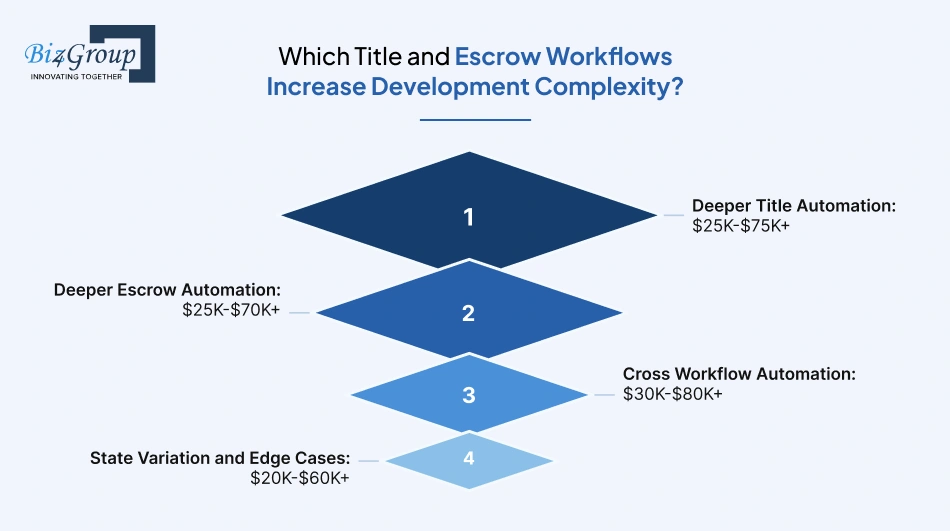
Workflow depth is one of the biggest drivers of title and escrow automation development cost. A document-routing workflow may require relatively little custom logic, while title examination, escrow reconciliation, and disbursement introduce more rules, integrations, exceptions, approvals, and testing.
1. Deeper Title Automation: $25K-$75K+
Automating title search, record extraction, examination support, exception identification, and commitment workflows can add $25,000-$75,000+ depending on scope.
The lower end can cover structured record extraction, search assistance, and human review. Costs rise when the platform must analyze chain of title, liens, judgments, legal descriptions, exceptions, and jurisdiction-specific rules.
Main cost drivers: document and record types, chain-of-title complexity, state and jurisdiction coverage, business rules, exception categories, and human-review requirements.
AI-assisted title examination generally requires more validation and human oversight than basic document extraction.
2. Deeper Escrow Automation: $25K-$70K+
Escrow workflows can add $25,000-$70,000+ when the platform moves beyond task management into funds tracking, reconciliation, approvals, disbursement, and wire verification.
Financial workflows require stronger transaction controls, permission management, approval sequences, audit trails, and safeguards against unauthorized actions.
Main cost drivers: accounting rules, transaction volume, banking integrations, reconciliation logic, approval layers, and financial controls.
3. Cross Workflow Automation: $30K-$80K+
Connecting title, escrow, closing, and post-closing workflows can add $30,000-$80,000+ because information must move reliably across multiple stages.
For example, title information may need to update a closing workflow, trigger an approval, populate a document, or notify an escrow professional.
Main cost drivers: shared data models, workflow orchestration, API integrations, state management, synchronization, and end-to-end testing.
4. State Variation and Edge Cases: $20K-$60K+
State-specific rules and edge cases can add $20,000-$60,000+ to a project, with broader geographic coverage potentially pushing the cost higher.
Each additional jurisdiction can introduce different workflows, validation rules, document requirements, approval paths, and testing scenarios. Unusual transactions also require defined escalation paths when automation cannot confidently proceed.
Main cost drivers: number of jurisdictions, validation rules, document requirements, approval paths, and test scenarios.
A single-state platform will have different requirements from a multi-state enterprise system.
How Does AI Complexity Affect Development Cost of AI Title & Escrow Automation Platform?
AI complexity can significantly change development cost because Optical Character Recognition (OCR), Natural Language Processing (NLP), predictive analytics, generative AI, and AI agents require different data, architecture, testing, and monitoring. For a title and escrow platform, the important question is how much decision-making you want AI to handle.
1. Optical Character Recognition (OCR): $10K-$25K
AI Optical Character Recognition (OCR) can add $10,000-$25,000 when the platform needs to convert scanned title, escrow, or closing documents into machine-readable data.
Main cost drivers: document volume, image quality, supported formats, extraction fields, and validation requirements.
2. Natural Language Processing (NLP) and Document Intelligence: $20K-$50K
Natural Language Processing (NLP) and document intelligence can add $20,000-$50,000 for document classification, entity extraction, semantic search, and structured data creation.
A title platform may need to identify parties, dates, legal descriptions, liens, judgments, exceptions, and financial information across different document types.
Main cost drivers: number of document categories, extraction fields, validation rules, data sources, and accuracy requirements.
3. AI-Assisted Title Examination: $40K-$100K+
AI-assisted title examination can add $40,000-$100,000+ because the platform moves beyond extraction into analysis and decision support.
The system may compare records, identify potential title issues, apply business rules, explain findings, flag uncertainty, and route questionable results to a title professional.
This requires stronger evaluation, grounding, human-review controls, auditability, and exception handling than basic document processing.
4. Predictive Analytics: $25K-$75K+
Predictive analytics can add $25,000-$75,000+ when the platform uses historical transaction data to identify patterns, forecast outcomes, prioritize files, or detect anomalies.
Development can include data preparation, feature engineering, model development, validation, deployment, and monitoring.
Data readiness is a major cost factor. Large datasets do not automatically produce useful models if historical records are incomplete, inconsistent, or poorly structured.
5. Generative AI Copilot: $25K-$75K+
A generative AI copilot can add $25,000-$75,000+ for document questions, workflow assistance, case summaries, exception explanations, or natural-language search.
Production implementation requires more than connecting a Large Language Model (LLM) to a chat interface. The platform may need retrieval and grounding, permission-aware data access, output validation, evaluation, logging, and security controls.
6. AI Agents: $50K-$150K+
AI agent development can add $50,000-$150,000+ because they introduce orchestration, tool use, workflow state, permissions, escalation logic, and controlled execution.
For example, an agent could collect missing documents, check transaction information, trigger a workflow, update an integrated system, and escalate an unresolved exception.
The main engineering challenge is controlling what an AI agent can do. Every action may need authorization, validation, logging, and human approval. The ranges shouldn't simply be added together. A production platform can reuse data layers, authentication, AI infrastructure, evaluation tools, and workflow components. The final AI development cost depends on the architecture and how deeply each capability connects to title and escrow operations.
Also Read: AI Agent Development Cost
What Integration Requirements Drive Title & Escrow Platform Cost?
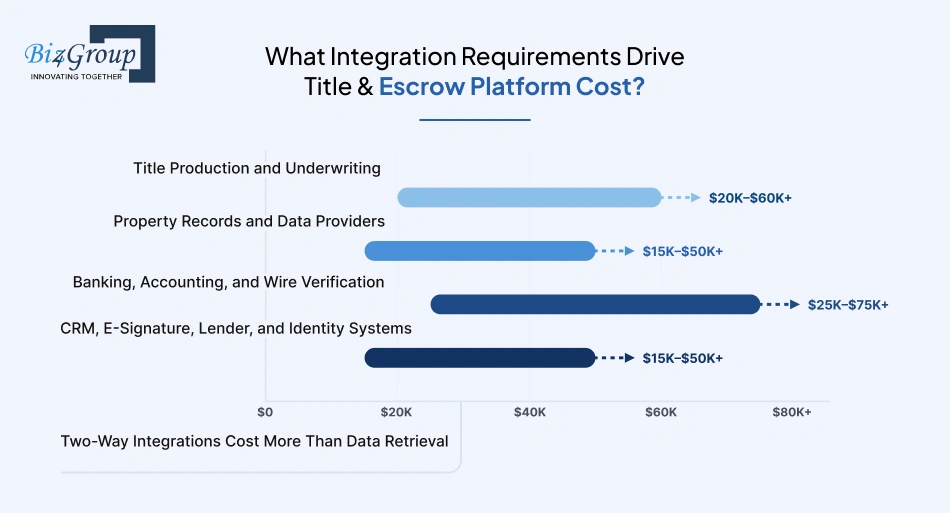
Integrations can add $60,000-$200,000+ to a title and escrow platform when the project requires several external systems, bidirectional data exchange, and transaction-level controls. The actual title and escrow platform development cost depends on the systems involved, API maturity, data mapping, synchronization requirements, authentication, and vendor constraints.
Layers: data sources and documents → integration layer → AI services → workflow engine → human review → dashboards, with an audit log across the layers
1. Title Production and Underwriting Systems: $20K-$60K+
Integrating title production, settlement, and underwriting systems can cost $20,000-$60,000+ per integration group.
The work may include order creation, status synchronization, document exchange, data mapping, authentication, error handling, and workflow updates. Mature APIs can reduce development effort, while limited or poorly documented APIs can require additional custom handling.
2. Property Records and Data Providers: $15K-$50K+
Property-record and title-data integrations can cost $15,000-$50,000+ depending on provider coverage, API structure, data formats, and licensing terms.
Multiple providers often return similar information in different structures. Normalizing property identifiers, ownership records, legal descriptions, and other fields adds implementation effort.
Data-provider fees are separate from development cost and may depend on searches, transactions, users, or geographic coverage.
3. Banking, Accounting, and Wire Verification: $25K-$75K+
Banking, escrow accounting, payment, and wire-verification connections can cost $25,000-$75,000+ because they involve transaction-sensitive data and controlled financial workflows.
Development may include reconciliation, payment status, approval chains, verification steps, audit records, and secure data exchange.
These integrations typically require more testing than simple read-only data connections.
4. CRM, E-Signature, Lender, and Identity Systems: $15K-$50K+
Connecting customer relationship management (CRM), e-signature, document management, lender, identity verification, and fraud-prevention systems can add $15,000-$50,000+, depending on the number and depth of connections.
Each system introduces its own authentication method, data structure, API limits, error conditions, and maintenance requirements.
5. Two-Way Integrations Cost More Than Data Retrieval
A read-only property lookup may require one request and a mapped response. A two-way integration may create an order, exchange documents, receive status updates, update records, and recover from failed synchronization.
That difference can materially increase AI platform development cost because every write operation needs validation, error handling, permissions, logging, and additional test scenarios.
For a more accurate AI title insurance platform cost estimate, define each integration by system, data exchanged, data flow, API availability, transaction criticality, licensing, and expected volume.
What Data, Infrastructure, and Third-Party Costs Need to Be Budgeted?
An AI title and escrow platform has costs beyond development. Budget for data, AI usage, cloud infrastructure, third-party services, security, and ongoing maintenance. Some are initial implementation costs, while others recur after launch.
1. Property Records and Title Data: $10K-$50K+
Licensed property records, title data, and external datasets can add $10,000-$50,000+ when the platform requires data mapping, normalization, or multiple sources.
Ongoing provider fees may be based on searches, transactions, users, geographic coverage, or subscription terms.
2. AI Model Usage: $10K-$40K+ Annually
AI usage costs depend on document and transaction volume. Basic extraction and classification generally require fewer resources than workflows using large language models, semantic search, generative AI, or AI agents.
Budget for:
- Model inference
- Document processing
- Embeddings and vector search
- AI API calls
- Evaluation workloads
Higher automation and transaction volume increase AI processing costs.
3. Cloud Infrastructure and Storage: $10K-$50K+ Annually
Cloud costs cover compute, databases, document storage, networking, backups, monitoring, and recovery.
Higher transaction volumes, concurrent users, document processing, redundancy, and availability requirements increase infrastructure costs.
4. Third-Party Services: $10K-$50K+ Annually
Recurring charges can come from property data, identity verification, fraud detection, e-signatures, payments, banking connectivity, notifications, and document processing.
Integration development is separate from provider fees, which may be charged per API call, document, search, user, or transaction.
5. Data Preparation and Normalization: $15K-$60K+
Data preparation can add $15,000-$60,000+ when historical or external data contains inconsistent formats, duplicate records, missing fields, incompatible identifiers, or unstructured documents.
Typical work includes data cleaning, deduplication, field mapping, format conversion, validation, transformation, and document preprocessing.
Better data quality reduces downstream validation and human-review requirements.
6. Security, Support, and Maintenance: $15K-$50K+ Annually
Ongoing costs can include security monitoring, vulnerability updates, bug fixes, performance optimization, access management, technical support, and platform upgrades.
Changes to connected title systems, banking services, property-data providers, or APIs can also require additional engineering.
7. AI Evaluation and Model Maintenance: $10K-$40K+ Annually
Production AI requires monitoring of extraction accuracy, classification quality, false positives, false negatives, AI responses, and human overrides.
Model, prompt, retrieval, or workflow changes require evaluation and testing before production use.
For AI title insurance platform development cost, separate the initial build from total cost of ownership. A moderate development budget can still produce higher ongoing costs when data licensing, AI usage, cloud infrastructure, third-party services, security, and maintenance scale with transaction volume.
What Security and Compliance Requirements Affect Development Cost?
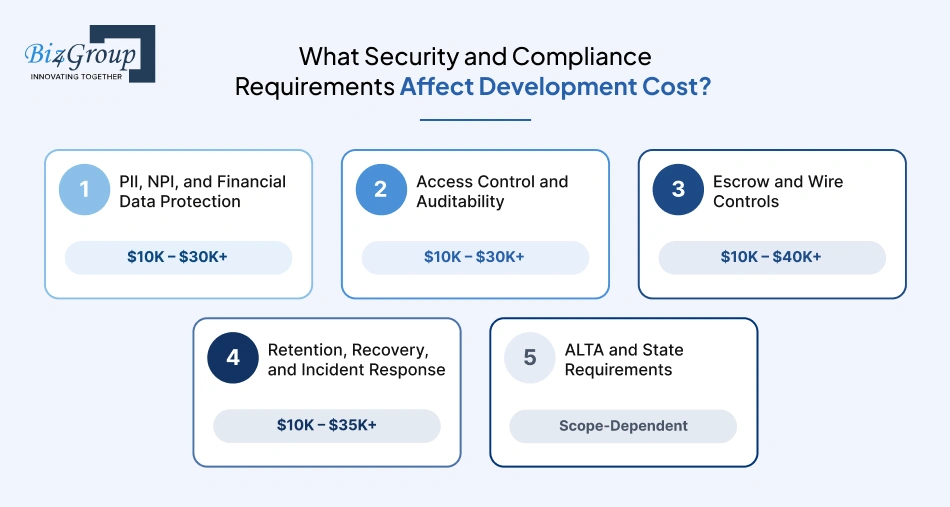
Security and compliance can add $25,000-$100,000+ to an AI title and escrow platform, depending on data sensitivity, user count, integrations, audit requirements, and operational controls. The scope should account for Personally Identifiable Information (PII), Nonpublic Personal Information (NPI), financial data, transaction records, documents, access controls, and state-specific requirements.
1. PII, NPI, and Financial Data Protection: $10K-$30K+
Protecting PII, NPI, financial information, property records, and transaction documents can add $10,000-$30,000+ to the platform's security scope.
Controls may include encryption at rest and in transit, secure document storage, secrets management, data segregation, controlled access, and secure data transfer.
The required controls depend on what information the platform stores, processes, and exchanges with external systems.
2. Access Control and Auditability: $10K-$30K+
Think about a transaction where several people need access, but not to everything. An escrow officer may need to manage funds, a title examiner may need title records, while an administrator may need broader access.
That's where role-based access control (RBAC), multi-factor authentication (MFA), access logging, session controls, and audit trails come in. Together, these controls can add $10,000-$30,000+ to development costs.
The platform should also keep a clear audit trail. Teams should be able to see who accessed what, what changed, when it changed, and which actions were approved.
3. Escrow and Wire Controls: $10K-$40K+
Escrow accounting, disbursement, and wire-verification workflows can add $10,000-$40,000+ because financial actions require stricter validation and approval controls.
The platform may need separation of duties, approval thresholds, verification steps, transaction logging, reconciliation, and escalation when information does not match expected records.
4. Retention, Recovery, and Incident Response: $10K-$35K+
Data retention, backup, disaster recovery, access monitoring, incident response, and recovery testing can add $10,000-$35,000+ to development and deployment.
The cost depends on recovery objectives, data volume, backup frequency, redundancy, monitoring requirements, and business continuity expectations.
5. ALTA and State Requirements: Scope-Dependent
ALTA Best Practices can help title and settlement organizations structure controls around areas such as escrow accounting, information security, consumer privacy, settlement procedures, and vendor management. ALTA's current best practices resources should be considered alongside applicable state requirements.
There is no single U.S. compliance configuration that fits every title and escrow operation. Geographic coverage, business structure, underwriter requirements, transaction type, and data practices can change the required controls.
For AI title insurance platform development cost, security should be scoped before development begins. Retrofitting access controls, audit trails, data protection, or transaction safeguards after core workflows are built can require architectural changes and additional testing.
What Costs Are Commonly Missed in an Initial AI Platform Estimate?
An initial AI title and escrow platform development cost estimate can miss implementation work that appears after the core build is scoped. Budget $30K-$100K+ for data preparation, exception handling, testing, deployment, migration, and user adoption, depending on project complexity.
1. Data Cleanup and Preparation: $15K-$60K+
Inconsistent historical files and transaction data may require deduplication, normalization, field mapping, document preprocessing, and validation before AI document processing or analytics can perform reliably.
2. Edge Cases and Exception Workflows: $10K-$40K+
Title defects, missing documents, conflicting records, reconciliation differences, failed integrations, and unusual ownership structures require additional business rules, escalation paths, human review, and testing.
3. Quality Assurance and User Acceptance Testing: $15K-$50K+
Testing should cover AI extraction accuracy, workflow routing, permissions, integrations, calculations, exceptions, human overrides, and end-to-end title and escrow scenarios. User Acceptance Testing (UAT) validates the platform against real operating procedures.
4. Migration and Production Handover: $10K-$40K+
Moving into production may require data migration, environment configuration, deployment, monitoring, backup validation, integration testing, documentation, and go-live support.
5. Training and Process Change: $5K-$25K+
Title examiners, escrow officers, and managers may need training on new workflows, AI recommendations, approval rules, and escalation procedures. This is especially important when AI outputs require human validation.
Should You Build, Buy, or Partner Existing Title & Escrow Technology?
The right approach depends on what you already have, what needs to be differentiated, and how much control you need over the resulting platform. In many cases, the practical answer is a combination rather than a single option.
|
Approach |
Best Fit |
Planning Range |
|---|---|---|
|
Build |
Maximum control and proprietary capabilities |
$150K-$500K+ |
|
Buy |
Mature, standardized capabilities |
$50K-$250K+ annually |
|
Partner |
Extend internal technical capacity |
$75K-$300K+ |
1. Build: $150K-$500K+
- Develop proprietary title, escrow, AI, workflow, and integration capabilities.
- Provides greater control over business rules, data flows, user experience, and differentiated processes.
- Works when automation is a strategic capability or existing platforms cannot support critical workflows.
- Requires higher internal ownership for development, testing, infrastructure, and maintenance.
2. Buy: $50K-$250K+ Annually
- Use established title production, settlement, escrow, or transaction platforms for mature capabilities.
- Reduces custom development and implementation effort.
- Licensing, configuration, integrations, users, and transaction volume can affect total cost.
- May provide less flexibility when proprietary workflows or custom AI capabilities are important.
3. Partner: $50K-$300K+
- Work with an experienced AI or platform development partner to design, build, integrate, and support capabilities that your internal team does not want to own alone.
- Useful when you have domain expertise but need additional engineering, AI, integration, or cloud expertise.
- The partner should be able to work with your existing title and escrow environment rather than assuming everything needs to be replaced.
- Evaluate partners based on relevant implementation experience, technical depth, security practices, integration capability, communication, documentation, and post-launch support, not simply hourly rates.
For example, Biz4Group has experience building AI-enabled platforms and real estate transaction technology, including its work on ConTracks and more. That experience is relevant to a title and escrow initiative because document intelligence becomes more valuable when extracted information feeds deadlines, financial details, alerts, stakeholders, and downstream workflows. For a buyer, the useful question is not simply whether a partner can add AI, but whether it can connect AI to the operational workflow around it.
You Bring the Closing. We'll Bring the Clever.
Have the workflow figured out but not the AI, integrations, or engineering? Let's turn that big idea into a platform your team can actually use.
Let's Build ItHow Can You Reduce AI Title & Escrow Platform Costs Without Cutting Corners?
The biggest savings come from scope decisions made before development starts, not from cutting quality later. Phasing the build, integrating with existing systems, and controlling AI usage can help a first release stay near the MVP range ($50K-$100K) instead of drifting into production-tier spend ($100K-$250K). Each deferral below avoids cost in Phase 1, using the ranges from earlier sections.
1. Start With One High-Value Workflow: $30K-$80K+ Deferred
Automating one workflow, such as document intake and extraction, is far cheaper than connecting title, escrow, closing, and post-closing on day one. Cross-workflow automation can wait until the first workflow shows measurable results.
Trade-off: teams keep some manual handoffs between title and escrow until Phase 2.
2. Launch in One State First: $20K-$60K+ Deferred
Each added jurisdiction brings its own rules, document requirements, and test scenarios. A single-state launch proves the model before geographic expansion.
Trade-off: each new state needs its own validation and testing later.
3. Begin With Read-Only Integrations
Reading property data or order status is simpler than writing back to production systems. Add write-back after the workflow is proven, because every write operation adds validation, permissions, logging, and error handling.
Trade-off: users may re-key some updates until two-way sync is built.
4. Add AI in Stages: $25K-$150K+ Deferred
Start with OCR and document classification. Defer the generative AI copilot ($25K-$75K+), predictive analytics ($25K-$75K+), and AI agents ($50K-$150K+) until data quality, accuracy, and permissions are proven.
Trade-off: professionals keep making examination and exception decisions manually.
5. Reuse Shared Architecture
Authentication, audit logging, workflow orchestration, data pipelines, and evaluation tooling can be built once and shared across capabilities. This is why component ranges in this guide should not be added together.
Trade-off: shared foundations need more design effort upfront.
6. Control Usage-Based AI Costs
Route routine tasks such as classification to smaller, cheaper models and reserve larger models for exception analysis. Cache repeated lookups, batch non-urgent processing, and set per-file usage limits with monitoring. This protects the $10K-$40K+ annual AI usage line.
Trade-off: routing logic and evaluation add some build effort.
7. Clean Data Before Development Starts: $15K-$60K+ at Risk
Sample historical files early and standardize formats, identifiers, and duplicates before AI work begins. Discovering data problems mid-build is more expensive than finding them in discovery.
Trade-off: adds a short discovery step ($5K-$20K+).
8. Use Confidence Thresholds to Right-Size Human Review
Let high-confidence extractions flow through and route low-confidence or high-risk fields, such as amounts and legal descriptions, to reviewers. This lowers ongoing review effort rather than build cost.
Trade-off: thresholds need measured accuracy data before you can trust them.
Security, audit trails, wire controls, and testing aren't areas to cut corners. Adding them later can mean reworking the architecture and repeating tests.
These are planning estimates, and the cost savings can overlap. So, they shouldn't simply be added together.
How Should You Calculate the ROI of Title & Escrow Automation?
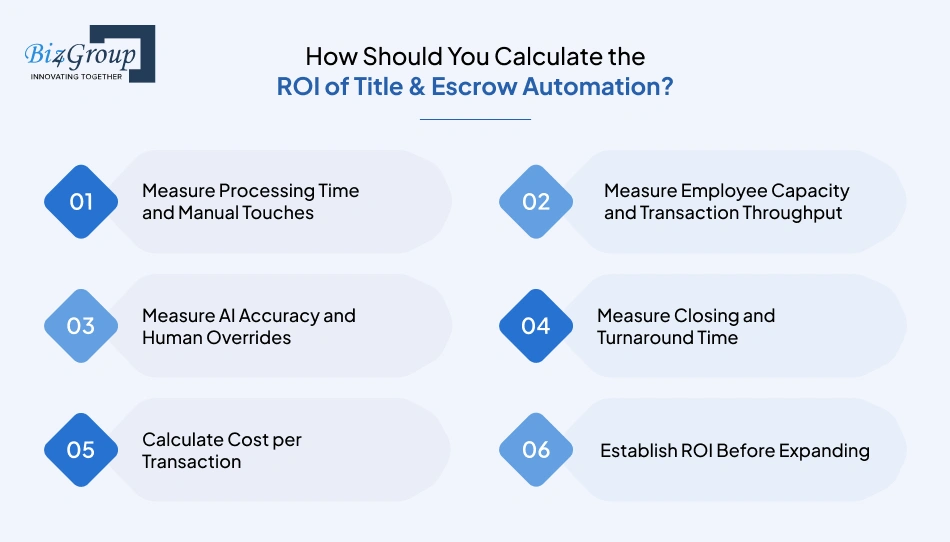
ROI should be calculated from measurable operational changes, not from the number of AI features deployed. Establish a baseline before automation, then compare the same metrics after implementation.
1. Measure Processing Time and Manual Touches
- Track average time spent processing a file, document, title search, or escrow task.
- Count how many manual handoffs, reviews, and data-entry steps each transaction requires.
- Compare pre-automation and post-automation performance.
2. Measure Employee Capacity and Transaction Throughput
- Track files handled per employee or team.
- Measure transactions completed within a defined period.
- Increased capacity can show value even when headcount remains unchanged.
3. Measure AI Accuracy and Human Overrides
- Track document classification and extraction accuracy.
- Measure exception rates, false positives, false negatives, and human overrides.
- For AI-assisted title examination, track how often professionals accept, modify, or reject AI findings.
4. Measure Closing and Turnaround Time
- Compare order-to-search, examination, escrow, and closing cycle times.
- Identify where automation removes delays between teams, systems, or approval stages.
- Faster turnaround can be evaluated alongside transaction volume and service-level performance.
5. Calculate Cost per Transaction
Use a consistent formula:
Cost per Transaction = Total Operating Cost ÷ Completed Transactions
Then compare the baseline with the automated process. Include AI usage, third-party APIs, infrastructure, support, and maintenance, not just development cost.
6. Establish ROI Before Expanding
- Define baseline metrics before implementation.
- Set target improvements for processing time, throughput, accuracy, exceptions, and cost per transaction.
- Use measured results to determine whether additional workflows or AI capabilities justify further investment.
For an AI title and escrow platform, ROI is strongest when technical metrics such as extraction accuracy are connected to business outcomes such as lower processing costs, higher transaction capacity, faster turnaround, and fewer manual touches. The same principle applies to an AI insurance automation platform, where automation should ultimately be measured by the operational and financial value it creates, not simply by the number of AI capabilities deployed.
What Should You Give a Development Partner to Get an Accurate Cost Estimate?
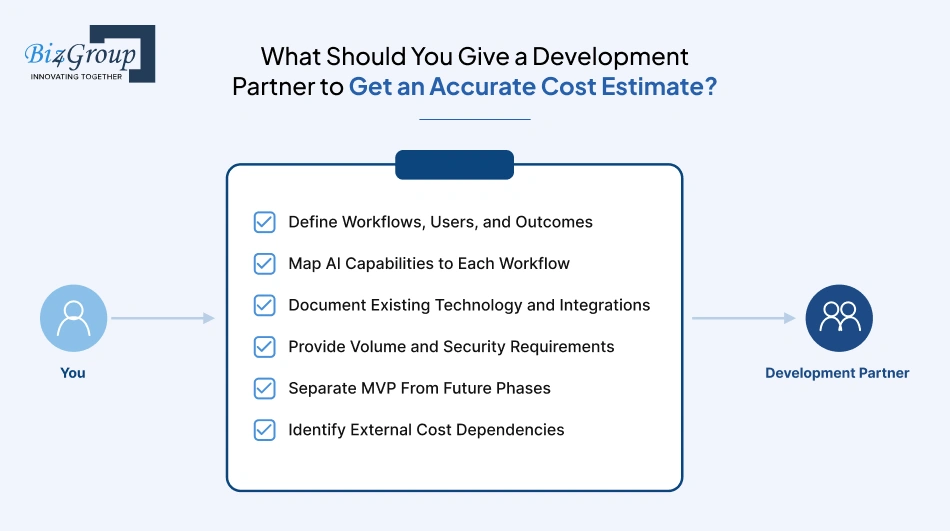
A development partner can estimate AI title and escrow platform development cost more accurately when the business, technical, and operational requirements are defined upfront. A typical discovery and solution-planning phase may cost $5K-$20K+, depending on the platform's complexity.
1. Define Workflows, Users, and Outcomes
- List the title, escrow, closing, and post-closing workflows to be automated.
- Identify users such as title examiners, escrow officers, underwriters, managers, and administrators.
- Define measurable outcomes such as faster processing, fewer manual touches, or higher transaction capacity.
- Clear workflow definition reduces rework and scope changes during development.
2. Map AI Capabilities to Each Workflow
- Specify where you need OCR, document intelligence, NLP, predictive analytics, generative AI, or AI agents.
- Identify which decisions remain with human reviewers.
- Define accuracy, validation, escalation, and approval expectations.
- This helps distinguish basic AI implementation from more expensive custom AI development.
3. Document Existing Technology and Integrations
- Provide current title, escrow, accounting, CRM, document, banking, lender, and property-data systems.
- List available APIs, data formats, authentication methods, and integration constraints.
- Identify which systems require two-way data exchange.
- Integration discovery can materially change the estimated title and escrow automation development cost.
4. Provide Volume and Security Requirements
- Share expected transaction volume, document volume, users, geographic coverage, and growth expectations.
- Specify requirements for PII, NPI, financial data, RBAC, MFA, encryption, audit trails, retention, and recovery.
- Include applicable operational, underwriter, and state-specific requirements.
- These inputs help estimate infrastructure, security, testing, and ongoing operating costs.
5. Separate MVP From Future Phases
- Mark each requirement as MVP, production, or future phase.
- Identify must-have workflows versus optional features.
- Define acceptance criteria for each phase.
- This prevents an initial estimate from quietly expanding into an enterprise-scale platform.
6. Identify External Cost Dependencies
- List property-data providers, AI APIs, banking services, identity providers, e-signature platforms, and other third-party services.
- Separate development costs from licensing, usage, data, infrastructure, and recurring API fees.
- Clarify which existing vendor contracts or preferred providers must be retained.
Conclusion
Building an AI Title & Escrow Automation Platform is not really a question of how much AI you can add. It is a question of how much of the title and escrow workflow you want to change, how deeply AI needs to participate, and what must remain under professional control.
That distinction is already visible in the industry. In a HousingWire interview, Marty Frame, President of MyHome at Williston Financial Group, described the opportunity as automating specific "moments in our production process", rather than treating AI as a blanket replacement for existing operations.
For a title company, that means starting with the work that creates the most friction: document-heavy processes, repetitive data entry, exception routing, status coordination, reconciliation, or other measurable bottlenecks. Then connect AI to the systems and people already handling the transaction.
The best starting point is not a feature list. It is a workflow map.
Biz4Group LLC can help turn that workflow map into a practical AI architecture, phased development roadmap, integration plan, and cost estimate. Its experience with AI-enabled platforms and real estate transaction technology, including ConTracks, provides relevant experience in connecting documents, transaction data, users, and downstream actions.
Got a title or escrow workflow that is still doing things the hard way? Let's map them, automate the busywork with AI, keep key decisions human-led, and plug it into your existing tech stack with Biz4Group.
Frequently Asked Questions
1. Can an AI title platform write information back into our existing production system?
Yes, if the existing platform supports APIs, webhooks, file interfaces, or another integration method. This allows the AI platform to read data, perform approved actions, update records, and maintain workflow state instead of functioning as a separate tool.
2. What happens when the AI encounters a title file it cannot confidently process?
The system should flag the uncertainty and route the file to the appropriate title professional. It can provide the supporting records, explain the issue, and preserve the human approval step instead of forcing an unreliable AI decision.
3. Can we see exactly where an AI-generated title finding came from?
Yes. Production AI should provide source traceability, linking findings to the relevant document, record, field, or transaction data. This lets title professionals verify AI-generated findings before taking action.
4. Who owns the AI platform, integrations, and data after development?
Define ownership contractually before development. Clarify rights to the source code, custom workflows, integrations, configurations, proprietary data, documentation, and application architecture, along with data-export rights if the relationship ends.
5. Can an AI title platform learn from our historical files?
Yes, depending on the architecture. Historical files can support evaluation, retrieval, configuration, or model improvement, but they should first be checked for quality, consistency, permissions, sensitive information, and representative coverage.
6. How do we know whether an AI pilot is actually working?
Set measurable baselines before launch. Track processing time, manual rework, AI findings accepted or corrected, exception rates, turnaround time, and cost per file to compare the AI workflow with the existing process.
7. What happens if our title or escrow vendor changes its API?
A well-designed integration layer can isolate vendor changes from the rest of the platform. It should account for API version changes, authentication, schema changes, rate limits, failed requests, and provider replacement.
8. Can we start with AI assistance and introduce AI agents later?
Yes. Start with document extraction, search, summarization, or workflow recommendations, then introduce AI agents as the platform matures. Before agents perform actions, establish permissions, validation, audit logging, and escalation rules.
9. How do we avoid getting locked into one AI model or provider?
Use an architecture that allows AI components to be replaced or combined where practical. Model abstraction, structured APIs, reusable evaluation datasets, and portable workflow logic can reduce dependence on a single AI provider.
10. What should a title company ask a development partner before signing?
Choose a partner that understands title and escrow workflows, AI, integrations, security, and production operations. Biz4Group fits this model by combining AI engineering with custom platform development, helping companies automate existing workflows without rebuilding everything from scratch.
