Location :
Orlando, FL, USA
Location :
Orlando, FL, USA +1 (407) 714-1616
 info@biz4group.com

















Imagine a digital system that doesn’t wait for instructions but instead, understands your business goals, learns from real-time feedback, and takes independent actions to get the job done.
Read More

 AI Summary Powered by Biz4AI
Could a single HIPAA violation cost your organization a few thousand dollars, hundreds of thousands, or even millions?
The answer depends on more than the violation itself. HIPAA violation fines are influenced by factors such as the type of violation, the organization's level of responsibility, and whether the issue was corrected after it was discovered. That's why two organizations facing similar incidents can end up with very different financial outcomes.
Understanding those differences is important because HIPAA penalties aren't based on a single fixed fine. Regulators use penalty tiers, enforcement guidelines, and case-specific findings to determine how much an organization may ultimately owe. For healthcare providers, business associates, and health tech companies, that can make the difference between a manageable compliance issue and a major financial setback.
A HIPAA violation and a HIPAA fine also aren't always the same thing.
So, does every HIPAA violation automatically result in a fine?
No. Regulators look at the full picture before deciding whether penalties are necessary. In some situations, organizations may be required to address compliance gaps. In others, the consequences can be significantly more expensive.
For healthcare organizations planning HIPAA compliant AI app development, understanding how HIPAA fines and penalties work has become increasingly important. As patient data moves across more systems, vendors, and AI-powered tools, even a small compliance mistake can create substantial financial and operational risk.
At Biz4Group LLC, we've helped healthcare organizations and health tech companies build HIPAA-compliant platforms where privacy, security, and compliance requirements are considered from the start. That hands-on experience has provided valuable insight into the challenges organizations face and the mistakes that can ultimately lead to enforcement actions and penalties.
Understanding HIPAA penalties isn't just about knowing the numbers. It's about understanding what triggers them and how to reduce the risk before a compliance issue turns into a costly problem.
*This content is for informational purposes only and does not constitute legal or compliance advice. Organizations should consult qualified professionals to assess HIPAA requirements and potential liabilities.*
HIPAA violation fines are financial penalties that can be imposed when organizations fail to protect patient information or comply with HIPAA requirements. And despite what many people assume, these penalties aren't limited to hospitals and clinics. Healthcare organizations and third-party vendors that handle patient data can both face HIPAA fines and penalties.
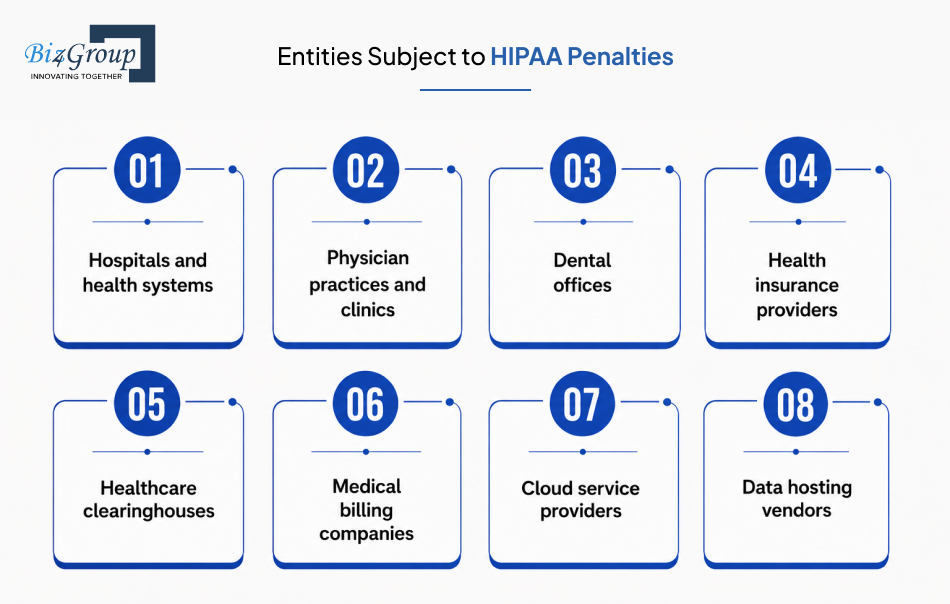
If you're running a hospital, clinic, dental practice, or health insurance organization, there's a good chance HIPAA applies to you as a covered entity. In simple terms, covered entities are the organizations that work directly with patient information as part of providing or managing healthcare services.
Common examples include:
Many smaller healthcare organizations assume HIPAA enforcement is mainly a concern for large hospitals with massive amounts of patient data.
Does that mean a small clinic has less to worry about?
Not really. HIPAA applies to organizations of all sizes. While a small practice may not face the same financial exposure as a large health system, it can still face HIPAA compliance fines and other penalties if patient information isn't properly protected.
Very few healthcare organizations do everything themselves. Patient information often passes through billing companies, cloud providers, software vendors, and other service providers that help keep healthcare operations running. When these companies handle patient data on behalf of a healthcare organization, they're generally considered business associates under HIPAA.
Common examples include:
That's where many healthcare leaders and startup founders get caught off guard.
If a company isn't providing healthcare, why would HIPAA penalties apply to it?
Because HIPAA isn't only concerned with the organizations delivering care. It also applies to companies that handle patient information behind the scenes. If a business associate fails to protect that information, it can face HIPAA violation fines just like a healthcare organization can.
HIPAA violation penalties are divided into four tiers based on what an organization knew about the violation and how it responded after discovering it. In general, the less control an organization had over the issue, the lower the penalty tier. The more preventable the violation was, the greater the potential financial exposure.
One concern comes up repeatedly among healthcare startups and compliance teams:
"We are a healthcare startup and I keep seeing different HIPAA penalty tiers mentioned online and I want to understand exactly what separates an unknowing violation from willful neglect because I need to know which category our recent compliance gap would fall under."
The distinction usually comes down to three things: what your organization knew, what it reasonably should have known, and whether it took timely action to fix the problem after it was discovered.
Tier 1 is the lowest penalty category. It applies when an organization was genuinely unaware of a violation and could not reasonably have discovered it despite making reasonable efforts to comply with HIPAA. Think of this as a situation where a problem existed, but the organization had no realistic way of knowing about it beforehand.
Tier 2 applies when an organization should have known about the issue but the violation wasn't caused by willful neglect. In simple terms, the problem could have been avoided, but there is no evidence that the organization knowingly ignored its HIPAA responsibilities.
Tier 3 is where things become more serious. Regulators determine that willful neglect occurred, but the organization identified the problem and corrected it within the required timeframe.
So if the issue was fixed quickly, does that mean penalties disappear?
Not necessarily. Prompt corrective action helps significantly, but organizations can still face HIPAA civil penalties when willful neglect is involved.
Tier 4 represents the highest level of HIPAA noncompliance penalties. It applies when an organization shows willful neglect and fails to correct the issue within the required period.
This is the category most commonly associated with the largest HIPAA fines and penalties because regulators view the violation as both preventable and unaddressed.
One reason organizations pay close attention to HIPAA violation penalty tiers is the enormous difference in potential financial exposure. A Tier 1 violation may start at just $145 per violation, while a Tier 4 violation can reach as high as $2,190,294.
Penalty Tier |
Violation Category |
2026 Penalty Range Per Violation |
|---|---|---|
Tier 1 |
Lack of Knowledge |
$145 to $73,011 |
Tier 2 |
Reasonable Cause |
$1,461 to $73,011 |
Tier 3 |
Corrected Willful Neglect |
$14,602 to $73,011 |
Tier 4 |
Uncorrected Willful Neglect |
$73,011 to $2,190,294 |
These figures reflect the 2026 inflation-adjusted HIPAA civil monetary penalty amounts published by HHS and Annual Civil Monetary Penalties Inflation Adjustment. Actual penalties depend on the specific facts of each case and OCR's enforcement determination.
For organizations looking to build AI software that processes protected health information, understanding these penalty tiers helps put compliance risk into perspective before a small oversight turns into a costly enforcement issue.
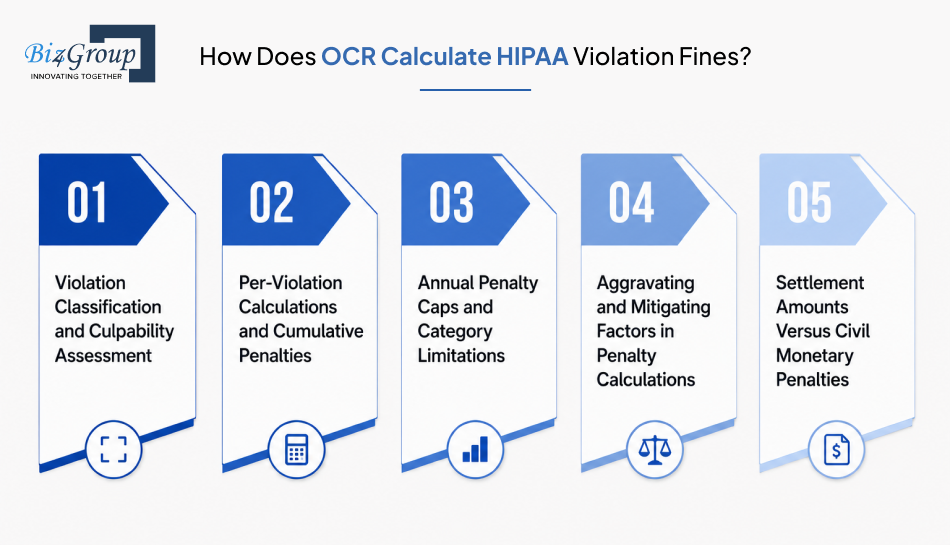
OCR (Office for Civil Rights) does not calculate HIPAA violation fines using a single formula. At a high level, regulators are trying to determine two things: how serious the violation was and how much responsibility the organization bears for it. That's why two organizations can experience similar incidents but face very different HIPAA fines and penalties.
One concern healthcare leaders often have is: "I am a healthcare administrator and I keep seeing different numbers for the maximum HIPAA fine and I want to understand how the annual penalty cap actually works when an organization has multiple violations in the same category within one year."
The reason you see different numbers is that OCR considers several layers when calculating HIPAA civil penalties, including penalty tiers, the number of violations involved, annual limits, and the specific facts of the case.
Factor |
What OCR Evaluates |
Why It Matters |
|---|---|---|
Violation Classification and Culpability Assessment |
Whether the violation falls into Tier 1, Tier 2, Tier 3, or Tier 4 |
Higher levels of responsibility generally lead to higher HIPAA penalties |
Per-Violation Calculations and Cumulative Penalties |
The number of individual violations involved |
A single breach affecting thousands of records may result in multiple violations being considered during enforcement |
Annual Penalty Caps and Category Limitations |
Annual limits that apply within a violation category |
In 2026, the highest annual penalty limit can exceed $2.19 million for the most serious HIPAA violations |
Aggravating and Mitigating Factors in Penalty Calculations |
Compliance history, duration of the violation, harm caused, and corrective actions |
These factors can increase or reduce the final penalty amount |
Settlement Amounts Versus Civil Monetary Penalties |
Whether the case is resolved through a negotiated settlement or a formal penalty process |
A settlement is negotiated, while a civil monetary penalty is formally imposed by the government |
Many organizations assume OCR focuses only on the breach itself. In reality, regulators spend just as much time examining the compliance failures behind the incident.
That's why two healthcare organizations can experience similar breaches yet face very different HIPAA violation penalties. OCR isn't only evaluating what happened. It's also evaluating why it happened and whether the organization could have reasonably prevented it.
For organizations adopting AI integration services, understanding how OCR calculates HIPAA fines and penalties can help put compliance risks into perspective before a compliance gap turns into an expensive enforcement action.
Strengthen risk assessments, access controls, and vendor governance before they become costly HIPAA violations.
Explore Your Compliance Strategy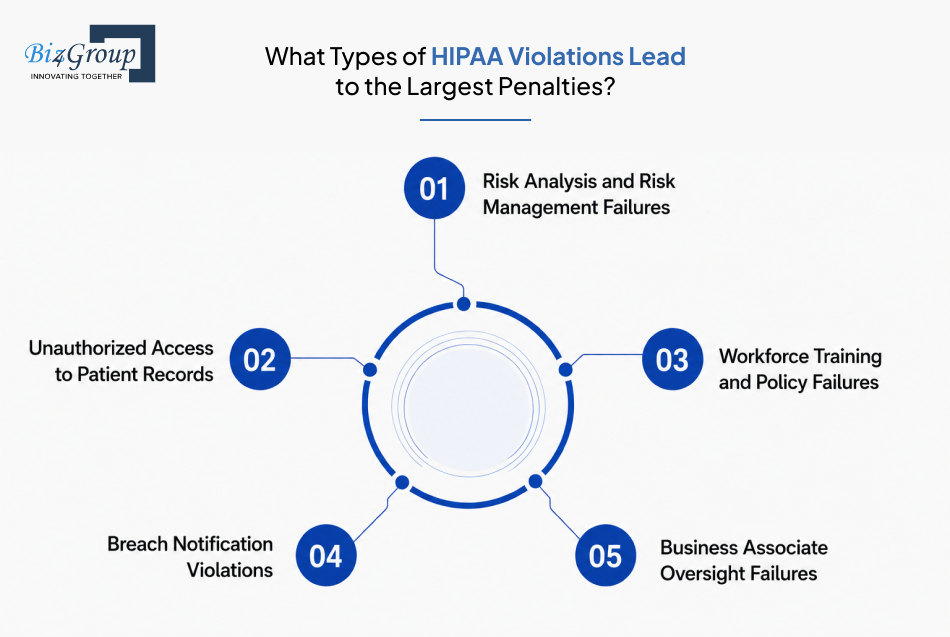
The HIPAA violations that lead to the largest penalties typically involve failures in risk analysis, workforce oversight, breach notification, patient record access controls, and business associate management. These issues appear repeatedly in OCR enforcement actions because regulators often view them as preventable compliance failures.
Risk analysis and risk management failures remain one of the most common issues identified in HIPAA enforcement. Organizations are expected to understand where protected health information is stored, how it is accessed, and what risks could compromise it.
The problem isn't always the lack of security tools. In many cases, organizations either fail to conduct a HIPAA risk assessment or fail to address risks they've already identified.
This is one reason OCR continues to emphasize the HIPAA risk assessment requirement in its enforcement and guidance activities.
Not every HIPAA violation involves hackers or ransomware. Sometimes the issue comes from inside the organization.
Unauthorized access to patient records occurs when employees access health information without a legitimate work-related reason. This is often referred to as "snooping" and remains one of the most common HIPAA Privacy Rule violations reported across the healthcare industry.
Many organizations focus heavily on external threats while underestimating internal access risks.
What if the employee was simply curious and didn't share the information with anyone?
That can still be a HIPAA violation. Accessing patient records without a legitimate business purpose may trigger compliance and disciplinary consequences, even when the information is not further disclosed.
Even the strongest policies have limited value if employees don't understand them.
Workforce training violations often involve employees mishandling patient information, using unapproved communication methods, or failing to follow established privacy and security procedures. In many cases, the issue is not malicious behavior but a lack of awareness.
That's why OCR consistently expects organizations to provide ongoing workforce training rather than treating compliance as a one-time exercise.
HIPAA requires organizations to notify affected individuals, regulators, and, in some cases, the media after certain breaches involving protected health information. Problems arise when organizations delay reporting, underestimate the scope of an incident, or wait too long to investigate what happened.
Can an organization face penalties even if the breach itself was unavoidable?
Yes. OCR evaluates breach notification obligations separately from the underlying incident. An organization that responds improperly after a breach may create additional compliance exposure, even if the original event was outside its control.
Very few healthcare organizations operate entirely on their own. Patient information often passes through billing vendors, cloud providers, software platforms, and other third parties that support daily operations.
That's where business associate oversight becomes critical. Common problems include missing business associate agreements, weak vendor due diligence, and limited visibility into how patient information is handled once it leaves your environment.
As healthcare organizations adopt enterprise AI solutions, vendor oversight becomes even more important. The more organizations rely on external platforms and partners, the more important it becomes to understand who has access to patient data and how that information is being protected.
Violation Type |
Why It Commonly Leads to Penalties |
|---|---|
Risk Analysis and Risk Management Failures |
Known risks are not identified or addressed |
Unauthorized Access to Patient Records |
Patient information is accessed without a valid business reason |
Workforce Training and Policy Failures |
Employees lack the knowledge needed to follow HIPAA requirements |
Breach Notification Violations |
Required notifications are delayed or mishandled |
Business Associate Oversight Failures |
Vendors handling patient data are not properly managed |
A common thread runs through all of these violations: they are rarely caused by a single mistake. More often, they stem from gaps in oversight, documentation, training, or risk management that go unaddressed over time. That's exactly why these categories continue to appear in major HIPAA enforcement actions year after year.
Protect patient data while reducing exposure to HIPAA fines and penalties through smarter architecture decisions.
Discuss Your Project With Our ExpertsIf you've ever tried to explain HIPAA risk to leadership, you've probably realized that quoting maximum penalty amounts rarely changes minds. Most executives want to know what organizations similar to theirs have actually paid and, more importantly, what led to those enforcement actions.
They're got questions like: "I am a compliance officer at a hospital and I want to see real examples of HIPAA violation fines that were actually issued to similar sized organizations so I can show our leadership team what realistic financial exposure looks like instead of just citing the maximum penalty numbers"
That's a fair concern because real-world enforcement actions provide a much clearer picture of regulatory risk than theoretical penalty ranges. The examples below show how OCR has applied HIPAA fines and penalties across different types of organizations and compliance failures.
Large healthcare organizations often make headlines because of the scale of the incidents involved, but OCR rarely focuses on the breach alone. Investigations frequently uncover compliance failures that existed long before the security incident occurred.
Case Example: Premera Blue Cross
What's the takeaway?
Large HIPAA settlement amounts are often driven by underlying compliance weaknesses, not just the size of the breach itself.
One of the most persistent myths in healthcare compliance is that OCR only targets large organizations. In reality, smaller providers regularly face enforcement actions when they fail to meet HIPAA requirements.
Case Example: Children's Hospital & Medical Center
Does OCR really pursue smaller organizations?
Absolutely. Enforcement actions have repeatedly shown that provider size does not determine whether OCR will investigate or impose penalties
Many healthcare leaders still assume HIPAA enforcement mainly applies to providers and health plans. OCR's enforcement history tells a different story.
Case Example: Catholic Health Care Services
This case reinforced an important point: business associates have direct HIPAA compliance responsibilities and can face enforcement actions when those obligations are not met.
In recent years, OCR has consistently prioritized patient access to health information through its Right of Access Initiative.
Case Example: Memorial Healthcare System
Can an organization really face penalties over a records request?
Yes. Multiple OCR enforcement actions have resulted from delays in providing patients with access to their own health information, even when no data breach occurred.
While the organizations, industries, and settlement amounts differ, the underlying themes are remarkably consistent.
Enforcement Pattern |
Common Compliance Gap |
|---|---|
Large breach settlements |
Weak risk analysis and risk management practices |
Small provider penalties |
Failure to meet basic HIPAA requirements |
Business associate enforcement |
Inadequate security controls and oversight |
Right of Access settlements |
Delayed or incomplete patient record responses |
The lesson becomes even more relevant when organizations work with vendors that may require access to protected health information. Across major HIPAA enforcement actions, regulators consistently focus on the same question: were reasonable safeguards in place before the incident occurred?
This is an area where Biz4Group LLC, a reliable software development company in Florida, has worked extensively with healthcare organizations. Having helped clients develop HIPAA-conscious healthcare platforms and AI-driven solutions, the team understands that compliance risks are often easier and less expensive to address during development than after a regulatory investigation or data incident occurs.
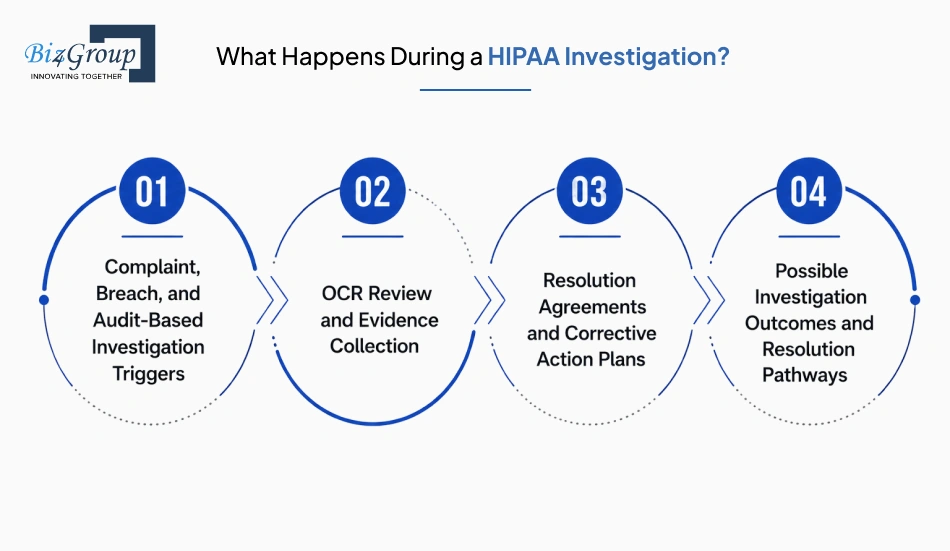
A HIPAA investigation typically begins when OCR receives a complaint, learns of a reported breach, or identifies potential compliance concerns through an audit or review process. From there, OCR gathers information, evaluates whether HIPAA requirements were met, and determines whether corrective action, a settlement, or other enforcement measures are necessary.
How long does a HIPAA investigation usually take?
There is no fixed timeline. Some investigations are resolved in a matter of months, while more complex cases can remain open for years depending on the scope of the review and the issues involved.
Investigation Stage |
What Happens |
|---|---|
Complaint, Breach, and Audit-Based Investigation Triggers |
OCR receives a complaint, breach report, referral, or audit finding that warrants further review |
OCR Review and Evidence Collection |
Investigators request policies, risk assessments, training records, security documentation, audit logs, and other evidence |
Resolution Agreements and Corrective Action Plans |
Organizations may agree to corrective measures designed to address identified compliance gaps |
Possible Investigation Outcomes and Resolution Pathways |
OCR may close the case, require corrective action, negotiate a settlement, or pursue additional enforcement measures |
Healthcare organizations are operating in an increasingly high-risk environment. According to recent healthcare cybersecurity research, 697 large healthcare data breaches were reported to the HHS OCR breach portal in 2025 alone, affecting at least 61.5 million individuals. Healthcare also recorded an average breach cost of $7.42 million per incident, the highest of any industry.
A common misconception is that OCR only reviews the incident that triggered the investigation.
If the complaint was about one issue, does OCR only investigate that issue?
Not necessarily. Once OCR begins an investigation, it may review broader compliance practices related to privacy, security, breach notification, training, documentation, and risk management. As a result, organizations are often asked to provide extensive compliance documentation.
One challenge organizations often discover during an OCR review is that proving compliance can be harder than implementing it. Security controls may exist, but investigators frequently ask for evidence showing when safeguards were implemented, how access is monitored, whether workforce activity is logged, and how third-party vendors are governed.
This becomes even more important for healthcare organizations involved in AI model development, where patient information may move across multiple systems, integrations, and external services. Through its experience building HIPAA-conscious healthcare platforms, Biz4Group LLC understands that compliance readiness extends beyond the application itself. In practice, audit logs, role-based access controls, activity tracking, and vendor governance records are often reviewed alongside the technology itself.
OCR investigations examine both the incident itself and the organization's ability to demonstrate compliance. That's why documentation, auditability, and accountability play such a central role in enforcement reviews.
When a business associate causes a breach, responsibility does not automatically fall on just one party. Business associates can face direct HIPAA penalties for their own compliance failures, while covered entities may still face scrutiny if they failed to properly manage, oversee, or contract with the vendor.
For those asking: "I am running a health tech company and we work with several third party vendors who handle patient data and I want to know if we are liable for HIPAA violation fines if one of our business associates causes a data breach."
Responsibility Area |
What OCR Typically Evaluates |
|---|---|
Direct Liability for Business Associates |
Whether the business associate complied with applicable HIPAA Privacy, Security, and Breach Notification Rule requirements |
Continuing Liability for Covered Entities |
Whether the covered entity exercised reasonable oversight and fulfilled its own compliance responsibilities |
Business Associate Agreement Limitations |
Whether a valid agreement existed and whether it addressed required HIPAA obligations |
AI Vendor and Third-Party Technology Risks |
Whether external platforms, service providers, or technology partners introduced compliance or security gaps |
If there's a Business Associate Agreement in place, doesn't the vendor become fully responsible?
Not necessarily. A Business Associate Agreement helps define responsibilities, but OCR may still evaluate whether the covered entity exercised reasonable oversight and fulfilled its own HIPAA obligations.
This becomes especially important when organizations integrate AI into an app or rely on external healthcare technology vendors. Through its experience building healthcare solutions, Biz4Group LLC has found that many compliance risks originate not from the application itself, but from how patient data moves between systems, vendors, and integrations. Decisions made during architecture planning, data access design, and vendor selection often play a major role in determining an organization's HIPAA exposure.
The key takeaway is simple: a vendor-caused breach does not automatically transfer all responsibility to the vendor. OCR may evaluate both the business associate and the covered entity when determining HIPAA compliance responsibilities.
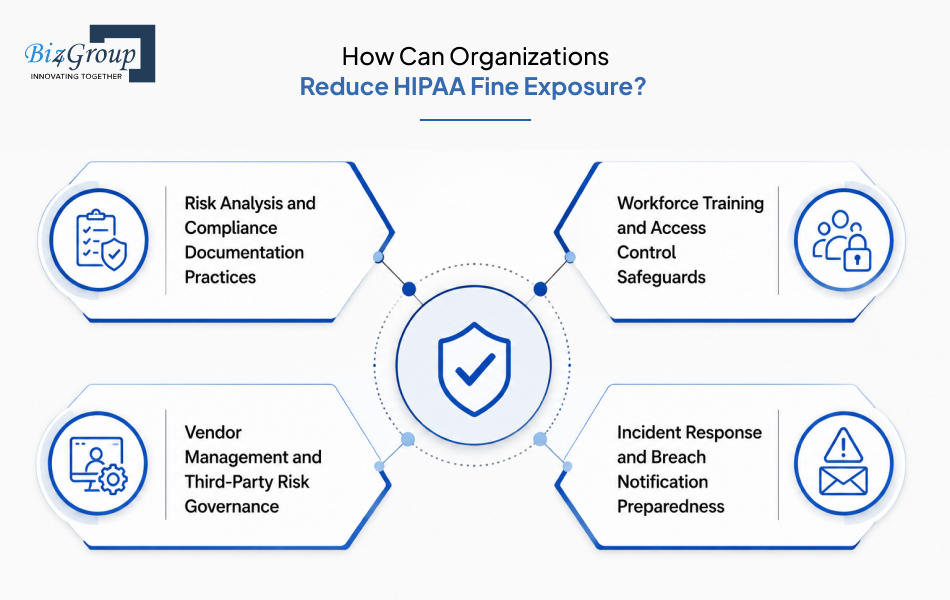
The most effective way to reduce HIPAA fine exposure is to identify risks before they become violations, document compliance efforts, train employees consistently, manage third-party risks, and prepare for incidents before they happen. Organizations that can demonstrate these practices are typically in a much stronger position if OCR ever reviews their compliance program.
A good compliance program starts with understanding where the risks actually are. That's why a documented HIPAA risk assessment is one of the most important steps an organization can take. Key practices include:
According to HHS, conducting an accurate and thorough risk analysis remains a core requirement of the HIPAA Security Rule.
Where should organizations start if compliance resources are limited?
For most organizations, a risk assessment is the best starting point because it helps identify which compliance gaps need attention first instead of treating every issue as equally urgent.
Many HIPAA violations don't start with hackers. They start with everyday mistakes, unnecessary access, or employees who simply weren't aware of the risk their actions created. Key practices include:
A simple rule works well here: if someone doesn't need access to patient information to do their job, they shouldn't have it.
Bringing in a vendor doesn't transfer HIPAA responsibility. Organizations still need to understand how patient information is being stored, accessed, processed, and protected.
Key practices include:
As healthcare organizations rely on more cloud services, software vendors, and external partners, vendor oversight becomes just as important as internal security controls.
No healthcare organization can prevent every incident. What matters is how quickly and effectively it responds when one occurs. Key practices include:
What if a breach occurs despite having safeguards in place?
OCR may still investigate, but organizations that can demonstrate documented compliance efforts, timely response actions, and adherence to breach notification requirements are generally in a stronger position than those with little or no supporting evidence.
Healthcare organizations implementing solutions that involve AI chatbot integration often face additional considerations around data access, auditability, and third-party services. Through its experience building healthcare applications that handle protected health information, Biz4Group LLC has found that compliance issues rarely originate from a single feature or screen. More often, they emerge where patient data moves between applications, third-party services, user roles, and automated workflows. That's why architecture planning, access controls, audit logging, and vendor governance are typically addressed early in the development process rather than after launch.
The goal isn't to eliminate every possible risk. It's to build a compliance program that can identify risks, address them appropriately, and demonstrate accountability when regulators review the organization's practices.
Develop secure healthcare applications that align with HIPAA requirements without slowing innovation.
Schedule a Call With Our AI ExpertsHIPAA violation fines rarely happen because of one isolated mistake. More often, they result from compliance gaps that go unnoticed or unaddressed over time, whether that's weak risk management, inadequate employee training, poor vendor oversight, or delayed responses to security incidents. Understanding how HIPAA penalties work is important, but reducing your exposure starts with taking a proactive approach to compliance.
As healthcare organizations adopt more AI tools, cloud platforms, and third-party technologies, protecting patient data becomes even more critical. The earlier compliance is considered, the easier it is to avoid costly issues down the road.
If you're planning to build or enhance a healthcare platform, Biz4Group LLC can help. As an experienced AI product development company, we've helped healthcare organizations develop secure, HIPAA-conscious digital solutions while addressing compliance considerations from the start. If you're exploring a new healthcare technology initiative, our team would be happy to discuss how to build it with security, privacy, and compliance in mind.
HIPAA itself does not give individuals a private right to sue for violations. However, patients may pursue legal action under applicable state laws if a data breach or privacy incident causes harm. HIPAA enforcement actions and private lawsuits are separate legal matters.
There is no fixed deadline for OCR investigations. The timeline depends on factors such as the complexity of the case, the amount of evidence involved, and whether additional compliance issues are uncovered during the review process. Some investigations are resolved within months, while others may take significantly longer.
Yes. Beyond regulatory fines, HIPAA violations can damage an organization's reputation, impact patient trust, complicate vendor relationships, and raise concerns during accreditation reviews or contract negotiations. The business consequences often extend beyond the financial penalty itself.
In many situations, government-imposed fines and penalties are not tax deductible. However, tax treatment can vary depending on the nature of the payment and applicable laws. Organizations should consult qualified tax professionals regarding their specific circumstances.
Some cyber liability insurance policies may provide coverage for certain regulatory investigations, legal expenses, breach response costs, or penalties where permitted by law. Coverage varies significantly by policy, so organizations should carefully review policy terms and exclusions.
Yes. An investigation may uncover additional compliance failures beyond the original complaint or breach report. If OCR identifies broader issues during its review, the scope of enforcement actions and potential penalties may expand accordingly.

with Biz4Group today!
Our website require some cookies to function properly. Read our privacy policy to know more.