 Location :
Orlando, FL, USA
Location :
Orlando, FL, USA +1 (407) 714-1616
 info@biz4group.com

- To develop an AI contract writing tool for real estate agents, focus on structured inputs, clause libraries, and validation.
- Start simple with an MVP and expand gradually, this is often the most practical way to create AI contract drafting tool for real estate without overbuilding early.
- Core system means giving preference to clause logic, AI drafting, basic compliance checks, everything else can be layered later.
- AI works best when combined with rules and data, not alone. This is key when you build AI contract generator for real estate businesses that needs accuracy.
- Cost typically ranges from $20,000 to $150,000+, depending on features, integrations, and scale.
Real estate deals move fast, but contract drafting often does not. Agents and teams still rely on templates, manual edits, and repeated reviews, which slows down transactions and increases the chances of errors. That is why many businesses are starting to develop an AI contract writing tool for real estate agents to make contract creation faster, more consistent, and easier to manage.
This shift is not just about saving time. It is about improving how contracts are created in the first place. With AI contract writing tool development for real estate, inputs like property details, deal terms, and client information can be turned into structured contracts without starting from scratch each time. This approach is becoming a key part of real estate AI software development, where systems are built to handle repetitive work while keeping outputs controlled and reliable.
For teams planning to build such systems, the focus usually comes down to a few things: accuracy, compliance, and how well the tool fits into existing workflows. Working with an experienced AI development company can help ensure that the system is practical to use and aligned with how real estate transactions actually happen.
In this blog, we will break down how these tools work, what it takes to build them, and the key decisions involved if you plan to develop AI contract writing software for real estate agents.
What Problems Does Developing an AI Contract Writing Tool for Real Estate Agents Address?
Real estate contracts are important, but the way they are created is often slow and repetitive. Teams still depend on templates, manual edits, and back-and-forth reviews. This is why many businesses choose to develop an AI contract writing tool for real estate agents to simplify how contracts are drafted and managed.
Why Contract Drafting Slows Down Real Estate Transactions?
Drafting a contract is not a one-step task. Agents collect details, adjust clauses, and review documents before finalizing them.
This slows things down because:
- The same data is entered multiple times
- Templates need constant editing
- Reviews take time before approval
To reduce this effort, many teams look to create AI contract drafting tool for real estate that can turn inputs into a ready draft without starting from scratch each time.
Where Manual Processes Introduce Risk and Inconsistency
Manual work often leads to small mistakes that can create bigger issues later.
Common problems include:
- Missing or outdated clauses
- Incorrect deal or property details
- Different formats across documents
These issues make contracts less reliable. Systems designed to build AI contract generator for real estate businesses help standardize how contracts are created, so outputs stay consistent.
What Changes When Contract Generation Becomes System-Driven?
When contract generation is system-driven, the process becomes more structured. Instead of editing templates, users enter key details and the system generates a draft based on those inputs.
This changes the workflow by:
- Reducing manual editing
- Improving consistency across contracts
- Making it easier to handle more transactions
Many organizations exploring AI automation services see this shift as a way to manage contracts more efficiently without increasing manual workload.
Understanding Contract Writing Tool Development for Real Estate
When businesses plan to develop an AI contract writing tool for real estate agents, they are moving away from manual drafting and fixed templates. Instead, contracts are created using inputs, predefined clauses, and AI to produce structured and consistent documents.
Definition
AI contract writing tool development for real estate means creating systems that generate contracts using inputs, clause libraries, and AI, instead of writing documents manually each time, while keeping outputs consistent and aligned with legal requirements.
Core Components of an AI Contract Writing System
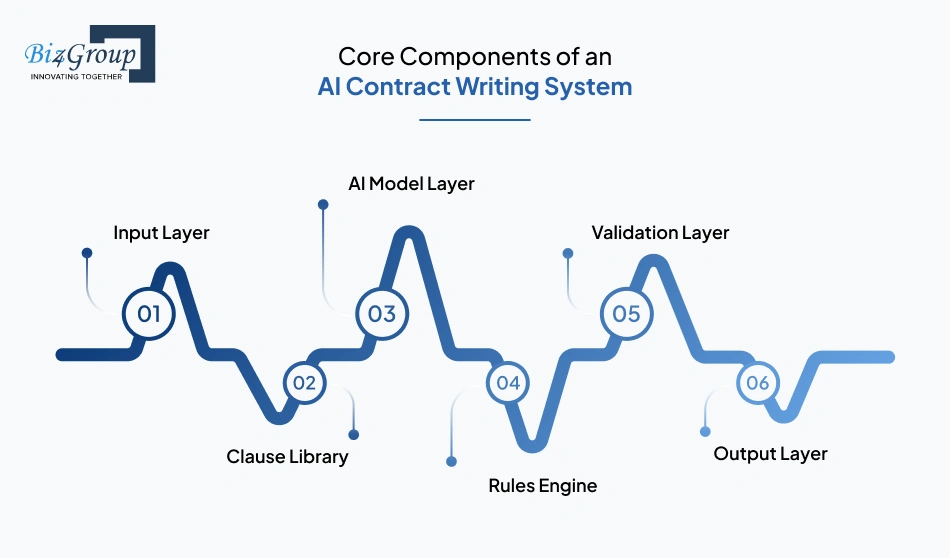
An AI contract writing system is built from a few simple parts that work together to create contracts.
Key components include:
- Input Layer: Collects deal details like property, price, and parties
- Clause Library: Stores standard clauses used across contracts
- AI Model Layer: Generates draft content based on inputs
- Rules Engine: Applies basic logic like required clauses or conditions
- Validation Layer: Checks for missing or incorrect information
- Output Layer: Produces the final contract in a usable format
These components form the base when teams look to make AI contract automation tool for property deals, especially when the goal is to reduce repeated manual work without changing the overall workflow too much.
Portfolio Spotlight

Contracks is a real estate contract management platform designed by Biz4Group to track agreements, deadlines, and contract progress in one place. It helps users manage contract data, receive alerts for key events, and monitor deal status. This reflects how structured systems can support and scale AI-driven contract drafting workflows.
How AI Legal Document Generation Development for Real Estate Works End-to-End
At a simple level, AI contract generation follows a clear flow from input to output. Each step helps turn raw information into a usable contract.
|
Stage |
What Happens |
|---|---|
|
Input |
Users enter deal and property details |
|
Structuring |
The system organizes the data |
|
Clause Selection |
Relevant clauses are picked |
|
Drafting |
AI generates the contract draft |
|
Validation |
The system checks for errors or gaps |
|
Output |
The final contract is generated |
This process is part of AI legal document generation development for real estate, where the focus is on making contract creation faster and more consistent. It also reflects how many teams approach building systems using generative AI, where the goal is to support drafting without fully replacing human review.
Still Editing Contracts Line by Line?
There’s a better way to develop an AI contract writing tool for real estate agents that handles drafting without the chaos.
Fix My Contract WorkflowAI Contract Writing Tool vs AI Lease Agreement Generator Platform
When businesses look to develop an AI contract writing tool for real estate agents, they often compare it with lease agreement generators. Both help create documents, but they are not built for the same purpose.
|
Aspect |
AI Contract Writing Tool |
AI Lease Agreement Generator Platform |
|---|---|---|
|
Scope |
Works across different types of real estate contracts |
Mostly limited to lease agreements |
|
Flexibility |
Adjusts content based on deal details |
Follows fixed templates with small changes |
|
Inputs |
Uses detailed inputs like deal terms and parties |
Uses basic, predefined fields |
|
Logic |
Handles clause conditions and dependencies |
Limited or no conditional logic |
|
Use Case |
Used for varied and complex transactions |
Used for standard rental documents |
|
Output |
Creates dynamic, editable contracts |
Generates simple, repeatable documents |
A lease generator is useful for quick and standard agreements. But as deal types increase, its limits become clear. It cannot easily handle different scenarios or changing requirements.
An AI contract writing tool is built for that flexibility. It can adapt to different deal structures and support more complex workflows. This is why teams exploring AI for real estate agents often move beyond lease tools once their needs grow.
In most cases, businesses that want long-term value choose systems that can build AI agreement writing tool for real estate agents, especially when they need more control and consistency across contracts.
What Makes Real Estate Contracts Difficult for AI to Generate?
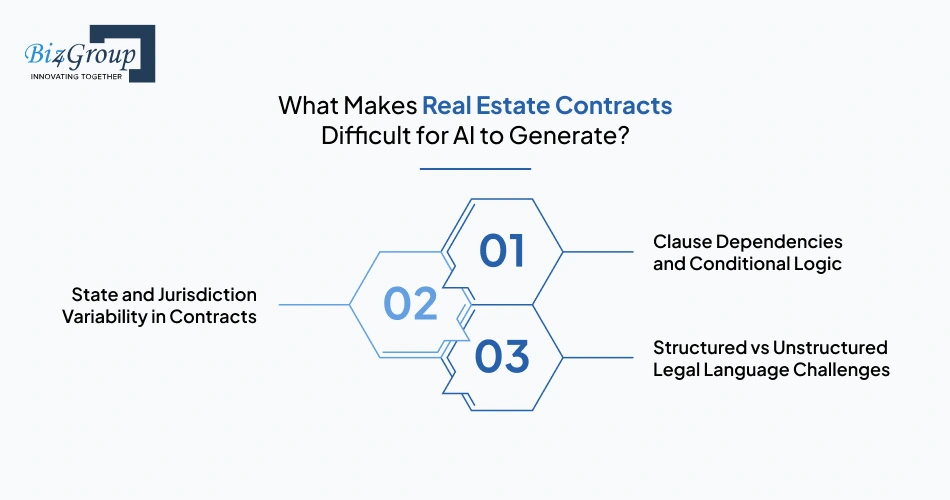
Real estate contracts look simple on the surface, but they are not easy to generate correctly. They include rules, conditions, and variations that change from one deal to another. This is why teams trying to develop an AI contract writing tool for real estate agents often find that basic automation is not enough.
1. Clause Dependencies and Conditional Logic
Real estate contracts are made up of clauses that depend on each other. A clause may only apply if a certain condition is met, and missing that link can change the meaning of the contract. This makes it harder to create AI tool for real estate document drafting that can handle all combinations correctly.
2. State and Jurisdiction Variability in Contracts
Contract rules are not the same everywhere. Each state or region can have its own legal requirements, formats, and mandatory clauses. This creates an extra layer of complexity when trying to build systems that work across multiple locations.
3. Structured vs Unstructured Legal Language Challenges
Some parts of contracts follow a fixed structure, while others are written in flexible legal language. AI systems need to manage both at the same time without losing meaning or accuracy. This is where AI model development becomes important to balance structure with natural language.
Because of these factors, generating real estate contracts is not just about filling templates. It requires systems that can handle conditions, variations, and language together. This is why businesses working to develop AI real estate contract automation platform focus on combining rules with AI for better results.
System Design Behind an AI Contract Automation Tool for Real Estate
To develop an AI contract writing tool for real estate agents, the system needs to follow a simple flow. It takes inputs, processes them using AI and rules, and then generates a contract. The difference lies in how these steps are connected and controlled.
|
Layer |
What It Does |
Key Inputs/Outputs |
Why It Matters |
|---|---|---|---|
|
Input Layer |
Collects deal and property details |
Buyer, seller, price, property info |
Ensures correct context before drafting |
|
Processing Layer |
Generates and validates content |
Clauses, rules, AI outputs |
Handles logic, conditions, and accuracy |
|
Output Layer |
Creates final contract draft |
Structured, editable document |
Makes the contract usable and review-ready |
This structure keeps the system predictable while still allowing flexibility in how contracts are generated. It also supports how teams build real estate AI software that can handle repeated drafting without starting from zero each time.
What makes this system different from generic AI tools is the use of structured inputs, clause logic, and validation steps together. These tools are not just generating text, they are following rules tied to real transactions. This is why businesses focus on systems designed to make AI powered contract writing system for real estate that can produce consistent and usable outputs.
Not Sure If AI Fits Your Contract Process?
Let’s map how you can create AI contract drafting tool for real estate based on your actual deal flow, not assumptions.
Evaluate My Use CaseCore Features Needed to Build AI Contract Generator for Real Estate Businesses
To develop an AI contract writing tool for real estate agents, you only need a few core features to get started. These features focus on turning inputs into usable contracts without adding too much complexity early on.
|
Feature |
What It Does |
Why It Matters |
|---|---|---|
|
Input Structuring and Deal Data Standardization |
Organizes deal details into a consistent format |
Helps the system understand and use inputs correctly |
|
Clause Generation and Contextual Drafting |
Creates clauses based on deal-specific inputs |
Ensures contracts match each transaction |
|
Data Extraction from Property and Transaction Inputs |
Captures key details like property and pricing |
Reduces repeated manual entry |
|
Basic Compliance Validation and Rule Checks |
Ensures required fields and clauses are present |
Helps avoid simple errors |
These features are enough to make the system useful from the start. They allow teams to generate drafts faster and keep outputs consistent. This is often how teams begin when they implement generative AI in real estate for contract workflows.
Once this base is stable, it becomes easier to expand and develop intelligent contract writing tool for property management with more advanced capabilities.
Advanced Features to Develop in Intelligent Contract Writing Tool for Property Management
Once the basics are working, teams that develop an AI contract writing tool for real estate agents usually add features that improve accuracy and control. These features are not required at the start, but they become important as usage grows.
1. Multi-Level Compliance and Jurisdiction Handling
Advanced systems can adjust contracts based on state or regional rules automatically. They apply the right clauses and formats without manual changes. This is important when building an AI contract writing tool for real estate contracts that needs to work across different locations.
2. Clause-Level Explainability and Traceability
The system can show why a clause was included and what input triggered it. This makes it easier to review and trust the generated contract. It also helps teams working to add AI in real estate development understand how outputs are created.
3. Workflow-Based or Multi-Step Drafting
Instead of generating everything in one step, the system breaks drafting into stages. One step creates the draft, while another checks or improves it. This makes the output more reliable, especially in complex deals.
4. Advanced Validation Beyond Basic Checks
The system can go beyond simple rules and check for deeper issues like missing dependencies or conflicting clauses. It can also flag risks before the contract is finalized. This becomes useful when following the best way to create AI contract drafting software for property deals.
These features help move the system from basic automation to a more controlled and scalable setup. They are usually added after the core system is stable and handling real-world transactions.
How to Develop an AI Contract Writing Tool for Real Estate from Idea to Deployment? A Step-by-Step Process
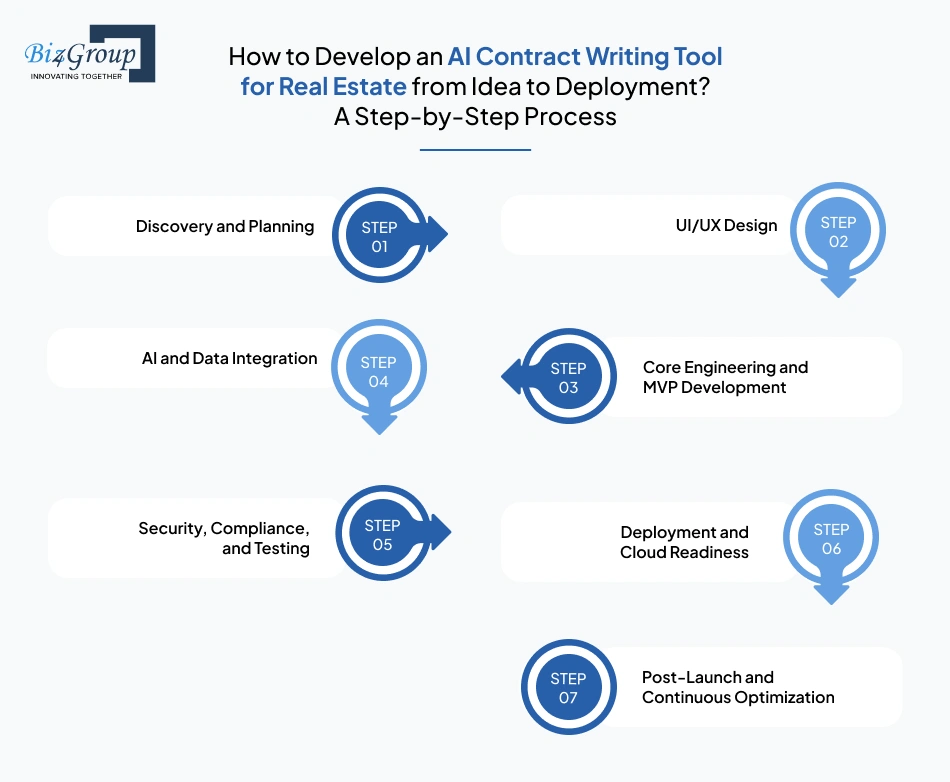
Building a contract system for real estate is not just a technical task. It requires aligning AI with how deals actually move from offer to closing. This is why businesses that develop an AI contract writing tool for real estate agents follow a structured approach that reflects real transaction workflows, not generic software steps.
Step 1: Discovery and Planning
Start by understanding how contracts are created in your current process. Look at where agents spend time, where revisions happen, and which documents are used most often.
- Identify delays in drafting, edits, and approvals
- List high-frequency contracts like purchase agreements and addendums
- Review how clauses vary across deals and regions
- Set clear goals like reducing drafting time or improving consistency
Step 2: UI/UX Design
The system should feel familiar to agents, that’s why majority of business hire a UI/UX design company for it. If the interface is complex, it will slow them down instead of helping them.
- Design simple steps for entering deal details and generating drafts
- Keep the workflow focused on input, generation, and review
- Test with real users like agents and transaction coordinators
- Make editing and reviewing contracts easy within the tool
Also read: Top 15 UI/UX Design Companies in USA (2026 Edition)
Step 3: Core Engineering and MVP Development
Start small MVP development services that handle a limited set of contracts well. This helps validate whether the tool works in real deal scenarios.
- Build structured input forms for deal and property details
- Create a focused clause library for selected contracts
- Enable basic draft generation and editing
- Keep the backend flexible for future expansion
Also read: Top 12+ MVP Development Companies to Launch Your Startup in 2026
Step 4: AI and Data Integration
At this stage, the system should start generating contracts based on actual inputs. The focus is on accuracy and relevance.
- Organize contract data into structured formats
- Train models on real estate clauses and agreements
- Connect clause libraries with AI for better drafting
- Add feedback loops to train AI models over time
This is where teams begin to how to create AI tool for real estate agreement drafting that reflects real deal conditions instead of generic templates.
Step 5: Security, Compliance, and Testing
Contracts involve sensitive information, so the system must be secure and reliable before it is used in production.
- Test contracts across different deal types and edge cases
- Ensure required clauses are always included
- Set role-based access for agents and legal teams
- Validate compliance with regional requirements
Also Read: 15+ Software Testing Companies in USA in 2026
Step 6: Deployment and Cloud Readiness
Once the system is stable, it should be ready to handle real usage across teams and transactions.
- Deploy on scalable infrastructure
- Monitor system performance and contract generation
- Ensure smooth usage during high transaction periods
- Provide simple onboarding for new users
This step becomes important when planning how to develop scalable AI contract tool for property businesses that can handle growth.
Step 7: Post-Launch and Continuous Optimization
After launch, the system should improve based on real usage. Contracts and requirements change over time, so the tool must adapt.
- Collect feedback from agents and legal teams
- Expand clause libraries as new deal types appear
- Improve drafting accuracy using real transaction data
- Track metrics like time saved and reduction in errors
Over time, this approach helps businesses build AI contract automation tool for real estate that can handle complex workflows while staying consistent and reliable.
Your Deals Move Fast, Do Your Contracts?
It might be time to build AI contract generator for real estate businesses that keeps up with your transaction speed.
Speed Up My DraftingTech Stack for Building an AI Contract Writing Tool for Real Estate Agents
The tech stack should support how contracts are actually created in real estate workflows. This means handling structured deal data, connecting with external systems, and generating reliable drafts without slowing down users.
|
Label |
Preferred Technologies |
Why It Matters |
|---|---|---|
|
Frontend Framework |
ReactJS, Angular |
Builds clean interfaces for agents to input deal data, through ReactJS development |
|
Server-Side Rendering & SEO |
NextJS, Nuxt.js |
Improves performance and usability for web apps, often handled with NextJS development |
|
Backend Framework |
NodeJS, Python (Django/FastAPI) |
Manages deal logic, clause flow, and integrations, NodeJS development supports APIs while Python development powers backend and AI logic |
|
API Development & Integration |
REST, GraphQL, Express.js |
Connects with CRMs, MLS, transaction tools, and more |
|
AI & Data Processing |
TensorFlow, OpenAI APIs |
Generates contract drafts and selects clauses based on inputs |
|
Retrieval Layer (RAG) |
Pinecone, Weaviate |
Fetches relevant clauses and improves drafting accuracy |
|
Data Management |
PostgreSQL, MongoDB |
Stores deal data, clause libraries, and generated contracts |
|
Document Processing |
PDF libraries, OCR tools |
Enables contract generation, editing, and export |
|
Authentication & Access Control |
OAuth, JWT |
Controls access for agents, brokers, and legal teams |
|
Cloud & Deployment |
AWS, Azure, GCP |
Supports scaling across multiple users and transactions |
This stack reflects what is needed to build a system that fits into real estate workflows, not just generate text. It ensures contracts are created with the right data, validated properly, and integrated with the tools agents already use.
What Data Is Required to Create AI Contract Drafting Tool for Real Estate?
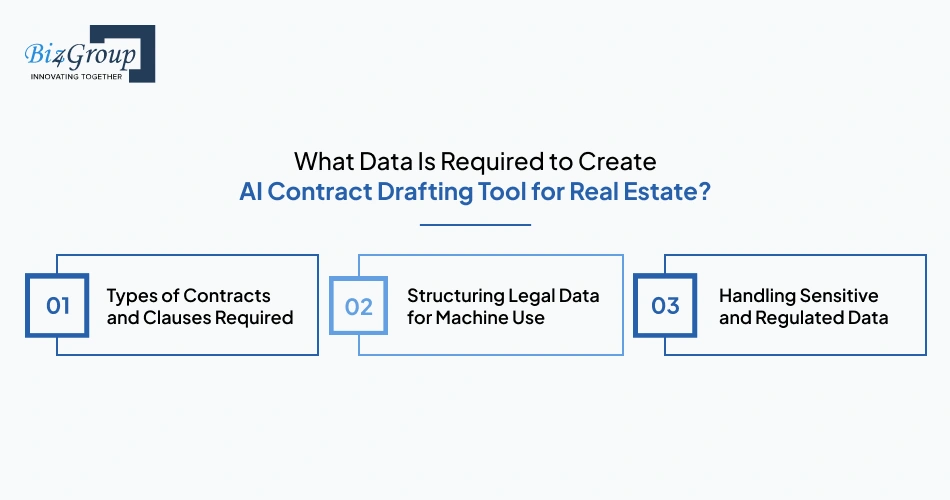
The quality of the system depends on the data it uses. If the data is not clear or complete, the contracts will not be reliable. This is why teams that develop an AI contract writing tool for real estate agents focus on getting the data right from the start.
1. Types of Contracts and Clauses Required
The system needs access to the main types of real estate contracts used in daily transactions. This includes purchase agreements, lease agreements, and addendums. Each contract should be broken into smaller clauses so the system can reuse them based on deal details.
2. Structuring Legal Data for Machine Use
Contracts cannot be used as raw documents. They need to be organized into clear fields and categories so the system can understand them. This step is important in business app development using AI, where structured data helps generate better and more consistent drafts.
3. Handling Sensitive and Regulated Data
Real estate contracts include personal and financial details, so the data must be handled carefully. The system should control who can access or edit the data and follow basic data protection rules. This becomes important when teams integrate AI into an app used by multiple users.
When the data is clear and well-structured, the system becomes easier to use and more reliable. This is often the starting point for real estate business owners asking how can I develop an AI contract writing tool for my real estate business.
How Is AI Used to Develop Scalable AI Contract Tool for Property Businesses?
When teams develop an AI contract writing tool for real estate agents, AI is used to handle drafting, improve accuracy, and support growth as more contracts are created. The focus is not just on generating text, but on making the system work reliably across different deal types.
Role of Large Language Models in Drafting
Large language models are used to turn deal details into contract drafts.
They help generate readable legal content without writing everything manually.
This is a key part of AI contract writing tool development for real estate, especially for creating first drafts quickly.
Retrieval-Augmented Generation for Accuracy
Instead of generating everything from scratch, the system pulls the right clauses from a stored library.
This helps keep contracts aligned with real documents used in transactions.
- Uses pre-approved clauses
- Matches clauses with deal inputs
- Reduces missing or incorrect content
This approach is often used in enterprise AI solutions where accuracy matters more than speed.
Rule-Based Systems for Compliance Enforcement
AI works alongside simple rules that make sure contracts follow required conditions.
These rules check for missing fields, required clauses, and basic compliance needs.
This becomes important when teams build AI software that needs to stay consistent across multiple deals.
When to Use Fine-Tuning vs Prompt Engineering
In the early stage, prompt-based setup is enough to guide how contracts are generated.
As the system grows, fine-tuning helps improve consistency and output quality.
In simple terms:
- Prompts help you get started quickly
- Fine-tuning helps you improve over time
Together, these approaches help the system handle more users, more contracts, and more variations. This is important for teams looking to develop AI contract writing software for real estate agents that can scale with business needs.
How to Minimize Errors in AI Contract Automation Tool for Real Estate?
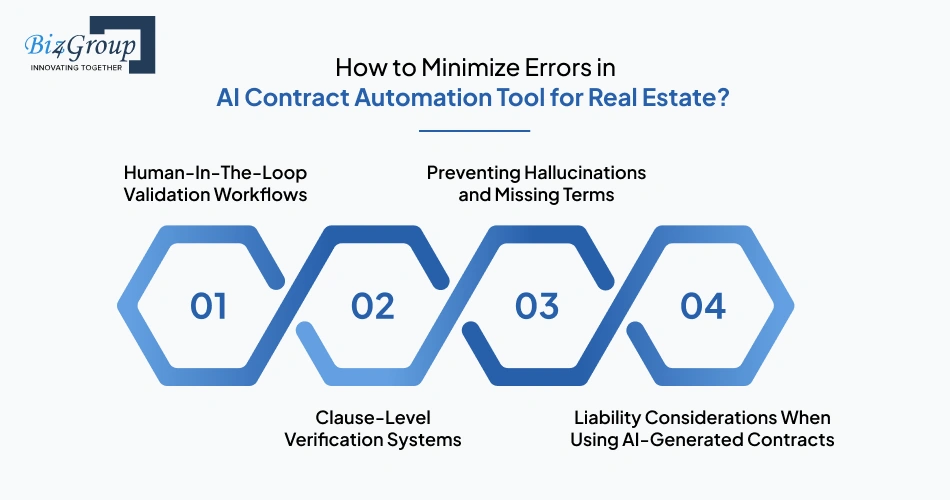
Errors in contracts can slow down deals or create bigger issues later. That is why teams that develop an AI contract writing tool for real estate agents focus on adding simple checks and review steps instead of relying only on AI output.
1. Human-In-The-Loop Validation Workflows
AI can generate drafts quickly, but human review is still important before finalizing a contract. Agents or legal teams can check if the details match the actual deal and make necessary changes. This balance helps teams create AI contract drafting tool for real estate that is both fast and reliable.
2. Clause-Level Verification Systems
Instead of checking the whole contract at once, it is better to verify each clause. The system can match clauses with deal inputs and ensure the right ones are included. This reduces the chances of missing or incorrect terms in the final document.
3. Preventing Hallucinations and Missing Terms
AI may sometimes generate content that sounds correct but is not valid for the deal. Using predefined clause libraries and structured inputs helps avoid this problem. This is often seen in systems built using how to use AI for real estate, where accuracy is more important than flexibility.
4. Liability Considerations When Using AI-Generated Contracts
Even if AI helps draft the contract, the responsibility still lies with the business using it. Clear approval steps and review workflows should be in place before final use. This becomes important when teams build AI contract generator for real estate businesses that are used in real transactions.
Adding these checks does not slow the system down. Instead, it makes the output more dependable and easier to trust in real-world use.
What Would Your Contracts Look Like If They Built Themselves?
Explore how to develop AI contract writing software for real estate agents that turns inputs into ready drafts.
Show Me How It WorksBuild vs Buy Decisions for AI Contract Writing Tool Development for Real Estate
When businesses plan to develop an AI contract writing tool for real estate agents, one common question is whether to build a system or use an existing one. The answer usually depends on how complex your contracts are and how much control you need over them.
Here’s all you need to know to make the right decision:
|
Decision Area |
Build (Custom System) |
Buy (Existing Tools / Integration) |
|---|---|---|
|
When It Makes Sense |
When deals, clauses, and rules vary a lot |
When contracts follow a standard format |
|
Setup Time |
Takes longer to build and test |
Faster to start and use |
|
Control |
Full control over how contracts are created |
Limited control over templates and logic |
|
Cost |
Higher upfront, better long-term value |
Lower upfront, ongoing costs |
|
Scalability |
Can grow with your business needs |
May need replacement as needs grow |
Buying is often the easier starting point. It works well when contracts are simple and do not change much. Many teams begin this way while exploring real estate AI apps ideas and understanding what they actually need.
Building becomes useful when contracts are more detailed and vary across deals or regions. It gives you control over how contracts are generated and updated. This matters more in AI legal document generation development for real estate, where small differences can affect outcomes.
In simple terms, buy if your needs are basic and immediate. Build if you need flexibility and long-term control. This is how most businesses decide when to make AI contract automation tool for property deals that fits their workflow.
How to Scale AI Contract Automation Tool for Real Estate?
As usage grows, the system should handle more users and contracts without slowing down. Teams that develop an AI contract writing tool for real estate agents need to think about scaling early so the tool keeps working smoothly as adoption increases.
1. Multi-User and Multi-Region Scalability
The system should support many agents using it at the same time without delays. It should also handle different regions where contract rules and formats may change. This becomes important when businesses develop AI real estate contract automation platform that works across multiple locations.
2. Handling High Transaction Volumes
Real estate deals do not come at a steady pace, there are busy periods where contract volume increases quickly. The system should generate drafts without slowing down during these times. Many teams exploring AI integration services focus on making sure performance stays stable even with higher demand.
3. Infrastructure and Deployment Considerations
The way the system is set up affects how well it scales. Cloud-based systems make it easier to handle more users and data without interruptions. This helps businesses build AI agreement writing tool for real estate agents that can grow along with their operations.
Scaling is about keeping the system consistent as more people start using it. With the right setup, it can handle growth without affecting how contracts are created.
What Does It Cost to Make AI Powered Contract Writing System for Real Estate?
The cost to develop an AI contract writing tool for real estate agents can vary based on features, complexity, and scale. As a ballpark figure, most projects fall between $20,000 to $150,000+, depending on whether you are building a basic MVP or a more advanced system with automation and compliance layers.
|
Level |
What It Includes |
Estimated Cost |
|---|---|---|
|
MVP AI Powered Contract Writing System |
Limited contract types, basic clause generation, simple UI, minimal validation |
$20,000 – $40,000 |
|
Advanced-level AI Powered Contract Writing System |
Multiple contract types, clause logic, AI drafting, basic compliance checks, integrations |
$40,000 – $90,000 |
|
Enterprise-grade AI Powered Contract Writing System |
Multi-region support, advanced validation, workflow automation, full integrations, scalability |
$90,000 – $150,000+ |
Many businesses start with an MVP to test how well the system fits into their workflow. This approach is similar to how to build AI real estate app MVP, where the goal is to validate value before investing more.
As requirements grow, costs increase due to added features, integrations, and scalability needs. This is why teams planning to create AI tool for real estate document drafting often begin small and expand based on real usage.
Handling More Deals Than Your System Can Support?
You can make AI contract automation tool for property deals that grows with your business without adding manual work.
Scale My Contract SystemKey Challenges When You Create AI Contract Drafting Tool for Real Estate
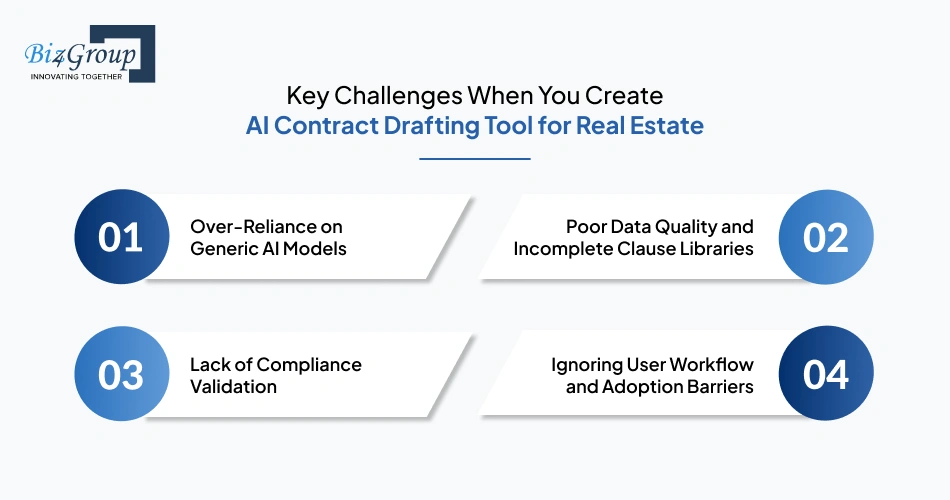
Building a contract tool for real estate is not just about adding AI. There are a few common challenges that can affect how well the system works. Even teams that develop an AI contract writing tool for real estate agents run into these if they are not planned for early.
|
Challenge |
What It Means |
Why It Matters |
|---|---|---|
|
Over-Reliance on Generic AI Models |
Using general AI without real estate-specific context |
Can generate content that does not match actual contracts |
|
Poor Data Quality and Incomplete Clause Libraries |
Missing or unstructured clauses and contract data |
Leads to gaps or inconsistent drafts |
|
Lack of Compliance Validation |
No checks for required clauses or deal conditions |
Increases the risk of errors in contracts |
|
Ignoring User Workflow and Adoption Barriers |
Tool does not match how agents create and review contracts |
Makes the system harder to use in daily work |
These challenges are common when teams focus only on generation and not on how contracts are actually used. Many businesses choose to hire AI developers who understand both AI and real estate workflows to avoid these issues.
Handling these areas early makes the system more reliable and easier to adopt. It also helps when you make AI powered contract writing system for real estate that works in real deal scenarios.
What Does the Future of AI Contract Writing Software for Property Deals Look Like?
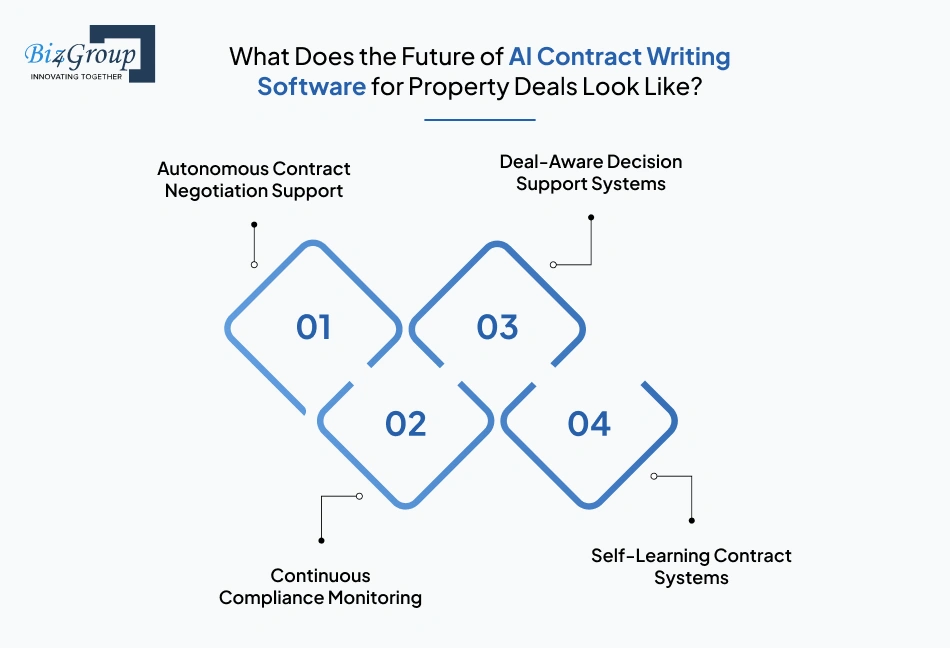
AI contract tools are expected to move beyond drafting and into systems that actively manage contracts. The focus will shift from generating documents to guiding decisions. This is where the next stage of evolution is heading.
1. Autonomous Contract Negotiation Support
Future systems will not just draft contracts but also suggest negotiation changes. They will recommend clause edits based on market patterns and past deals. This can reduce back-and-forth between parties during negotiations.
2. Continuous Compliance Monitoring
Instead of checking compliance only during drafting, systems will monitor contracts throughout the deal lifecycle. They will flag risks as conditions change or deadlines approach. This helps prevent issues before they impact the transaction.
3. Deal-Aware Decision Support Systems
AI will start acting as a support layer for decision-making, not just drafting. It can highlight risks, suggest alternatives, and guide next steps based on deal progress. This shifts the tool from document creation to deal assistance.
4. Self-Learning Contract Systems
Future systems will improve automatically based on past contracts and outcomes. They will learn which clauses work best in different situations. Over time, this makes the system more accurate without manual updates.
As these capabilities develop, the focus will move from building basic tools to choosing the right partner who can design and scale such systems effectively.
Planning Long-Term Contract Automation?
Start building a system that evolves, not breaks, as you develop AI real estate contract automation platform for your business.
Build For The FutureWhy Choose Biz4Group for Developing an AI Contract Writing Tool for Real Estate Agents?
When you plan to develop an AI contract writing tool for real estate agents, the challenge is not just building the technology, it is making sure it fits real workflows. That is where Biz4Group stands out as a custom software development company with experience in real estate systems.
Projects like Contracks show how contract workflows can be structured, tracked, and managed in one place. This kind of experience becomes useful when building AI tools that need to handle real contracts, not just generate drafts.
What you can expect:
- Systems designed around how agents and teams actually work
- Strong focus on accuracy, structure, and usability
- Scalable solutions that grow with your business
- Practical approach without unnecessary complexity
If you are building for real use and not just testing ideas, working with an experienced AI app development company can make the process smoother and more reliable.
Wrapping Up
At its core, building a contract tool for real estate is about removing friction. Less back-and-forth, fewer errors, and faster deal movement. That is the real value behind choosing to develop an AI contract writing tool for real estate agents.
You do not need to build everything at once. Start with one contract type, get the workflow right, and improve from there. The systems that work best are the ones that stay simple at the start and grow with actual usage.
If you are figuring out the next step, having the right support through product development services and AI consulting services can help you move forward with clarity instead of guesswork.
Want to simplify how your contracts are created with the help of AI? Let’s map out a practical approach.
FAQs
1. How long does it take to build an AI contract writing tool for real estate agents?
It usually takes 8 to 20 weeks depending on the scope. A basic version with limited contract types can be built faster, while a system with multiple workflows, validations, and integrations takes longer. Timelines also depend on data readiness and testing cycles.
2. Do I need legal experts involved when building an AI contract tool?
Yes, legal input is important. AI can generate drafts, but the structure, clauses, and compliance rules should be reviewed by legal professionals. This helps ensure the system produces contracts that are usable and aligned with actual requirements.
3. Can an AI contract writing tool work across multiple states or regions?
It can, but it requires additional setup. Each region may have different rules, formats, and required clauses. The system needs to be designed to handle these variations, usually through rule-based logic and region-specific data.
4. What is the estimated cost to develop an AI contract writing tool for real estate agents?
The cost typically ranges between $20,000 to $150,000+, depending on complexity. A basic MVP falls on the lower end, while advanced systems with compliance checks, integrations, and scalability features move toward the higher range.
5. How accurate are AI-generated real estate contracts?
Accuracy depends on the data and system design. Tools that use structured inputs, clause libraries, and validation checks tend to produce more reliable drafts. However, human review is still recommended before finalizing any contract.
6. Can this tool integrate with existing real estate software like CRMs or transaction platforms?
Yes, most systems can be integrated using APIs. This allows contract data to flow between tools like CRMs, listing platforms, and transaction management systems, reducing manual entry and keeping information consistent.
