Location :
Orlando, FL, USA
Location :
Orlando, FL, USA +1 (407) 714-1616
 info@biz4group.com


















Imagine a digital system that doesn’t wait for instructions but instead, understands your business goals, learns from real-time feedback, and takes independent actions to get the job done.
Read More

Most real estate leaders do not wake up thinking about ERP systems. They wake up thinking about delayed reports, disconnected leasing data, messy financial close cycles, and teams working in silos. When every department runs on its own tools, visibility suffers and decisions slow down. That daily operational friction is why AI real estate ERP software development has become a serious strategic conversation.
Do these questions seem familiar?
Well, rightfully so, because the business case is getting louder, globally:
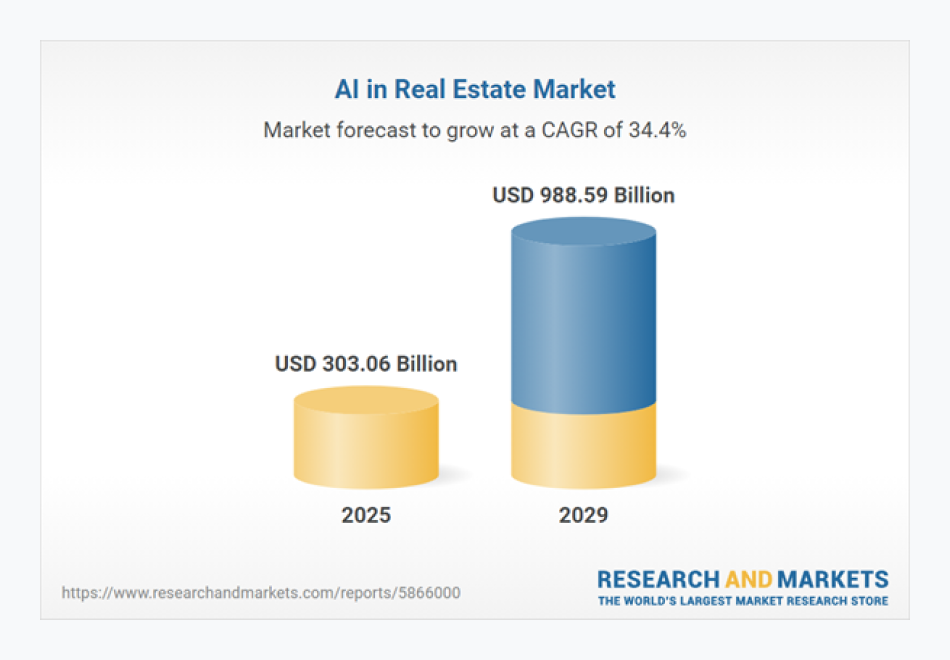
The global AI in real estate market is expected to grow from about USD 303 billion in 2025 to nearly USD 989 billion by 2029, driven by demand for smarter analytics and automation.
At its core, this shift reflects a broader move toward real estate AI software development that does more than store data. Leaders are looking for systems that connect operations, surface insights in real time, and reduce the manual work that slows teams down. Naturally, conversations are turning toward how to develop AI powered real estate ERP system architectures that align with complex portfolios instead of fighting them.
When leadership reviews numbers that do not match across teams, or when insights arrive weeks too late to matter, trust takes a hit. Operations leaders, finance heads, and technology teams all feel that tension. It is often this shared frustration, that drives serious interest in rethinking core systems.
This is where AI real estate ERP software development services begin to matter. With the right foundation and an experienced AI development company, organizations can move toward systems that support confident decisions, consistent reporting, and scalable growth without turning transformation into another operational burden.
An AI powered real estate ERP system is a single platform that brings all core real estate operations together and adds intelligence on top. It helps teams replace disconnected tools with one system that supports daily work and decisions.
Simply put, AI real estate ERP software development is about building software that makes real estate operations easier to manage, easier to trust, and easier to scale.
At its core, AI real estate ERP software development turns everyday operational data into something usable in real time. Instead of reacting to reports after the fact, teams work inside systems that continuously process what is happening across the business.
Leasing activity, rent schedules, expenses, maintenance logs, and asset data are captured as they occur. This removes delays caused by manual uploads or reconciliation and gives leadership a live operational picture.
Instead of exporting data to separate tools, intelligence sits inside the ERP itself. Through AI model development, the system identifies trends, flags issues, and supports planning without users needing to interpret raw data.
Insights are tied directly to workflows. When something changes, the system triggers updates, tasks, or approvals automatically. This is often the moment teams realize what it really means to integrate AI into an app they already rely on.
As portfolios expand, the ERP integrates with accounting tools, CRMs, and property platforms. This makes it easier to build AI real estate ERP platform capabilities without rebuilding the stack every year.
How It Works in Practice
|
Step |
What Happens |
Why It Matters |
|---|---|---|
|
Data capture |
Operational data updates continuously |
Fewer reporting gaps |
|
Intelligence |
Patterns and risks are identified early |
Better decisions |
|
Automation |
Tasks and workflows trigger automatically |
Less manual work |
|
Integration |
Systems stay aligned as scale increases |
Long term stability |
When teams create AI driven ERP software for real estate, the system becomes part of daily operations rather than another tool to manage. That clarity naturally pushes leaders to think about the business case behind adopting it.
Explore how AI real estate ERP software development can unify finance, leasing, and property data into one system your teams actually trust.
Plan My AI ERP Strategy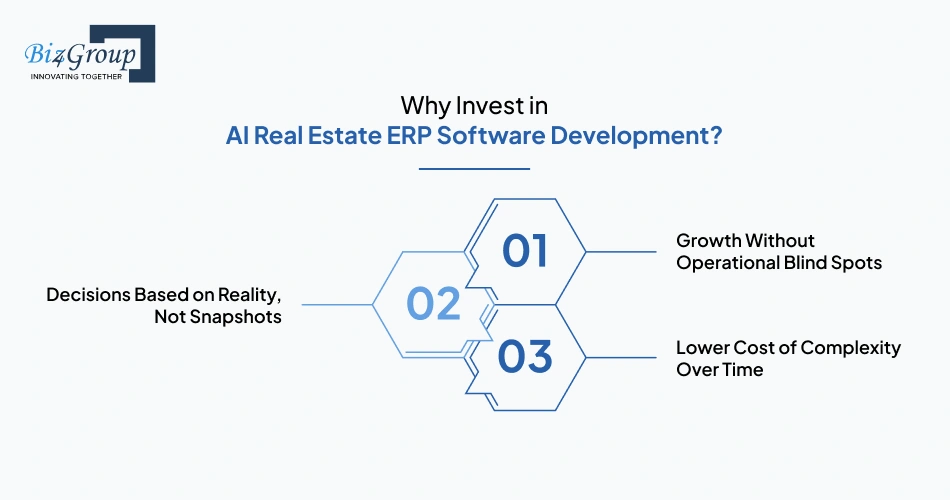
Most real estate leaders do not invest because systems are broken. They invest because systems cannot keep up. AI real estate ERP software development becomes relevant when growth exposes gaps that manual processes and legacy tools can no longer hide.
As units, leases, and vendors increase, small reporting delays turn into big risks. With real estate ERP software development with AI, leadership sees cash flow, occupancy, and exceptions as they happen, not weeks later.
Traditional systems capture what already happened. With enterprise AI solutions, patterns emerge while activity is still unfolding, helping teams adjust pricing, leasing strategy, or maintenance priorities in time.
More properties usually mean more staff and more coordination. Through AI integration services, processes scale without proportional headcount growth, reducing the long term cost of managing complexity.
For many organizations, the next question is not whether to modernize, but how far to go. Teams that build AI enabled property management ERP solutions often start uncovering practical use cases that extend naturally into daily operations.
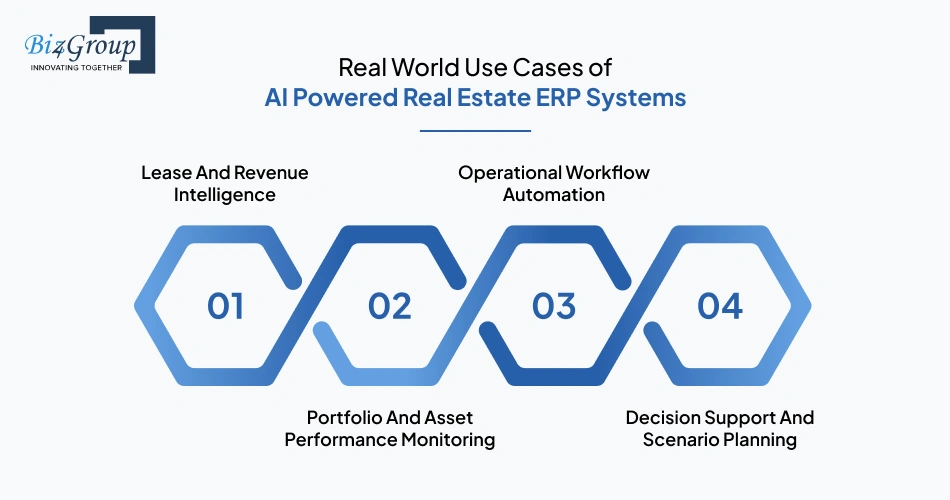
As portfolios grow, real value shows up when intelligence is applied to everyday work. AI real estate ERP software development becomes practical when it solves repeatable operational problems across finance, leasing, and property management, which is where the following use cases come into play.
AI analyzes lease terms, escalations, renewals, and payment behavior continuously. This supports forecasting accuracy and reduces revenue leakage across portfolios using AI real estate lease management software.
Operational and financial data are evaluated together to surface underperforming assets early. This is a core outcome of AI property asset management software development inside ERP platforms.
Routine approvals, reporting, and task assignments are handled without manual follow ups. Teams often choose to develop AI property management app features directly within ERP workflows.
Live operational data feeds planning models that evolve as conditions change. This is where teams develop intelligent ERP systems for real estate companies that support real decisions, not static reports, often enhanced through generative AI.
Use Cases at a Glance
|
Use Case Area |
What Improves |
Business Outcome |
|---|---|---|
|
Leasing |
Renewal visibility |
Higher retention |
|
Asset Management |
Performance tracking |
Risk reduction |
|
Operations |
Workflow speed |
Lower overhead |
|
Planning |
Forecast accuracy |
Better decisions |
When organizations invest in custom AI real estate ERP development, these use cases tend to expand as confidence grows. As adoption deepens, expectations naturally shift toward what the platform should support next.
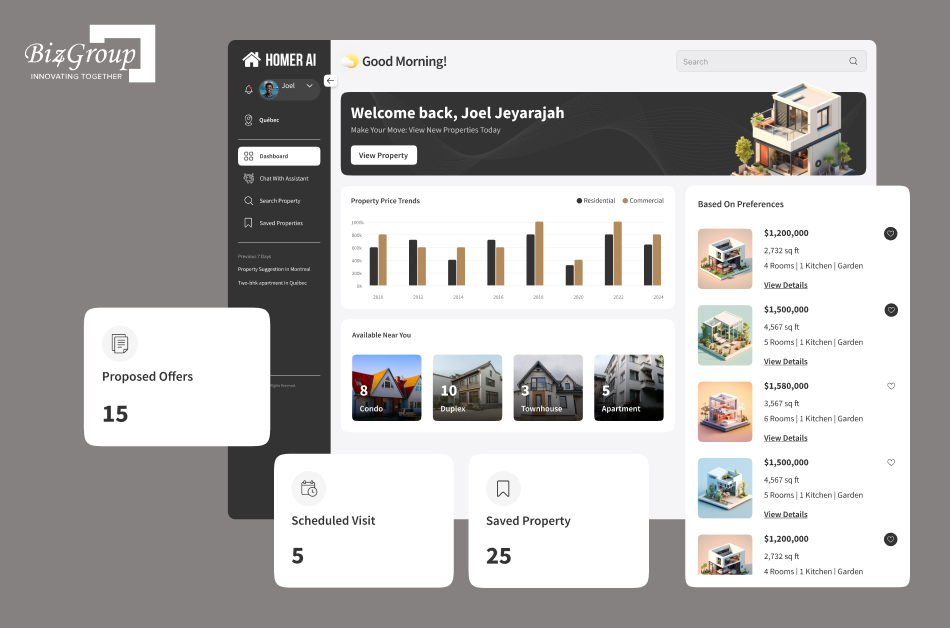
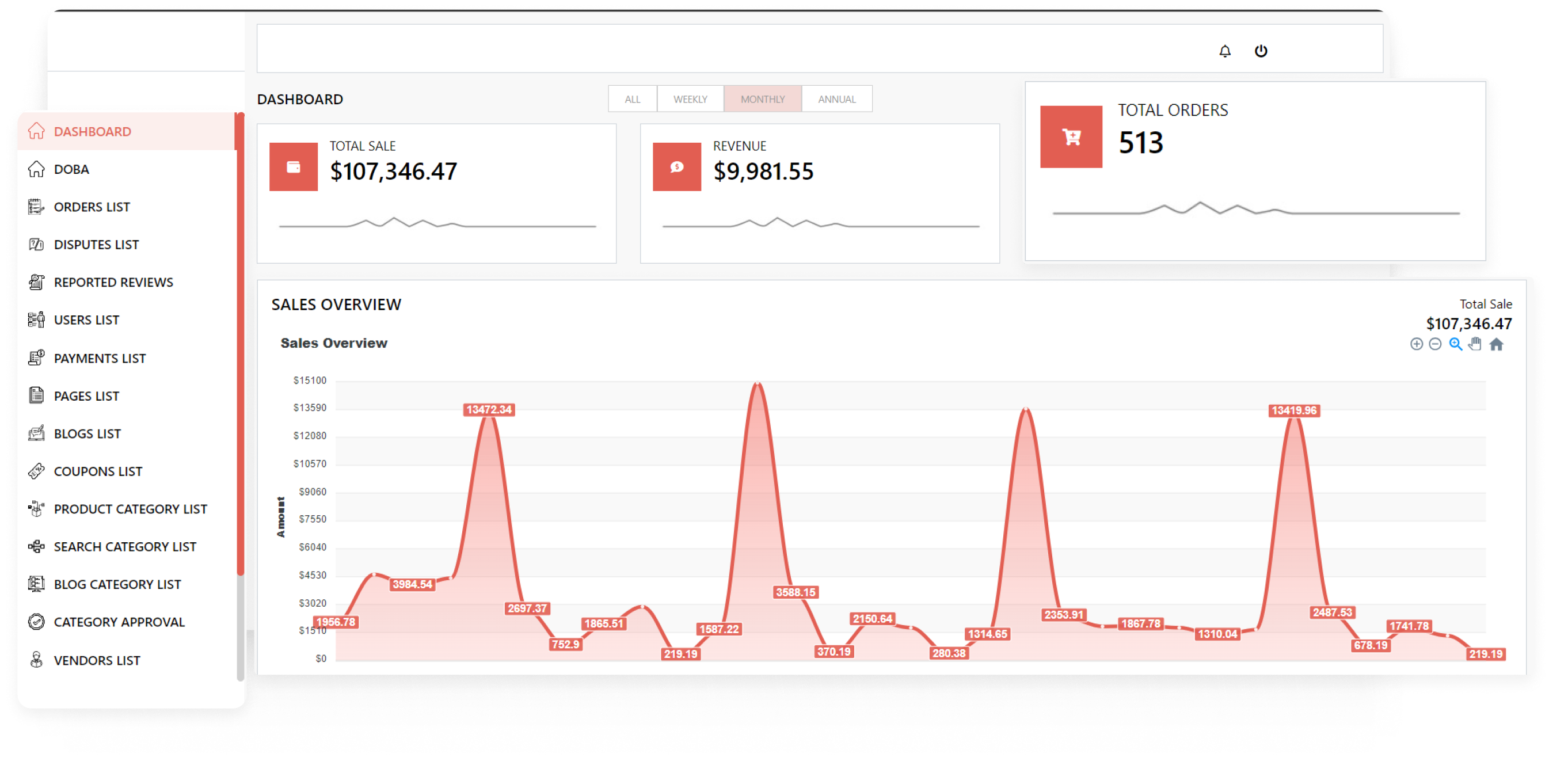
This AI-based property management platform built by Biz4Group brings buyers and sellers together on a single interface, using conversational AI to filter preferences, schedule visits, and streamline property discovery. Placing this in the Use Cases section illustrates practical ways AI can enhance operational workflows and decision support in real estate technology.
Design AI real estate ERP solutions for developers and property managers that reduce manual work and improve real time visibility across assets.
Explore ERP Use CasesAt the foundation, AI real estate ERP software development focuses on getting the basics right before anything intelligent is layered on top. These core features ensure stability, accuracy, and coordination across everyday real estate operations, much like teams first build AI software to solve fundamental problems:
|
Core Feature |
What It Supports |
Why It Matters |
|---|---|---|
|
Centralized Data Management |
Finance, leasing, and property records |
One consistent source of truth |
|
Financial Management |
Accounting, invoicing, budgeting |
Reliable financial control |
|
Lease Management |
Lease terms, renewals, escalations |
Accurate revenue tracking |
|
Property Operations Tracking |
Maintenance and vendor activity |
Smooth daily operations |
|
Tenant Records Management |
Tenant data and communication |
Consistent service delivery |
|
Basic Workflow Routing |
Task assignments and approvals |
Fewer operational delays |
|
Standard Reporting |
Routine operational reports |
Faster reviews and audits |
|
User And Role Control |
Permissions and access rules |
Security and accountability |
|
System Integrations |
Accounting and CRM connectivity |
Continuity across systems |
This stable core allows teams to operate with confidence every day. Once these essentials are in place, organizations can begin to create scalable AI real estate ERP platform designs that support deeper intelligence and optimization without disrupting what already works.
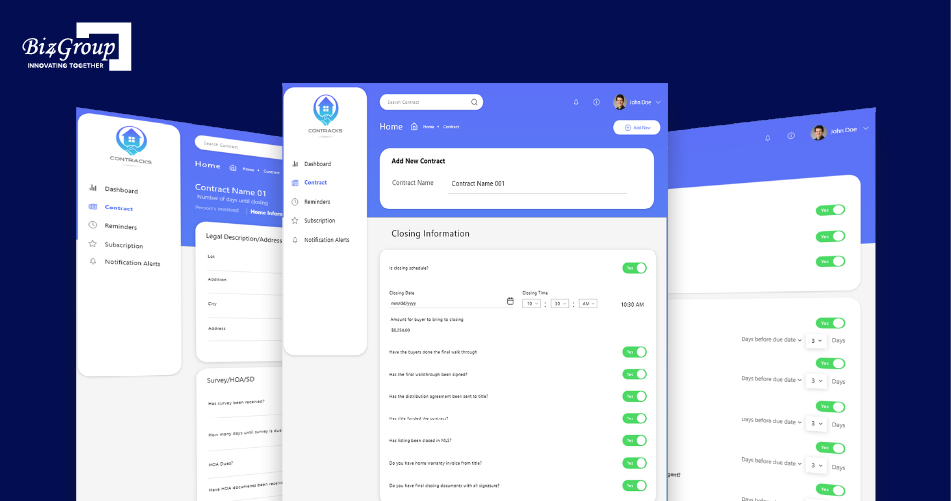
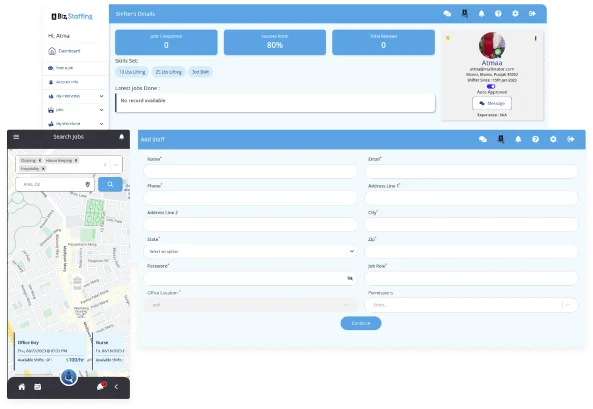
Contracks is a contract management portal designed to organize real estate contract data, provide alerts for key dates, and track completion status. Integrating this example in the Core Features section shows how an intelligent system can handle complex document workflows and alerts, reinforcing automation capabilities within real estate ERP platforms.
Once the basics are working well, advanced features help teams move from tracking activity to acting on it. AI real estate ERP software development starts adding more value when the system can support decisions, not just store information.
The system reviews past and current data to flag trends in occupancy, revenue, and costs. This makes it easier for teams to understand how to use AI for real estate without digging through reports.
As more data flows in, the platform improves its recommendations automatically. This is especially useful when teams develop AI real estate ERP software for enterprise portfolios with large and diverse assets.
Lease data is reviewed continuously to highlight renewals, pricing gaps, and risk areas. Using AI real estate lease management software, teams stay ahead of issues instead of reacting late.
Workflows adjust based on real outcomes rather than fixed rules. This helps organizations create AI enabled ERP platforms for real estate growth as operations become more complex.
Users can ask questions and get answers directly from the ERP. A develop ERP AI chatbot setup reduces time spent searching dashboards or requesting reports.
Most teams do not roll out these features all at once. They usually add them gradually after the core system proves reliable, often guided by what feels right rather than chasing what looks impressive.
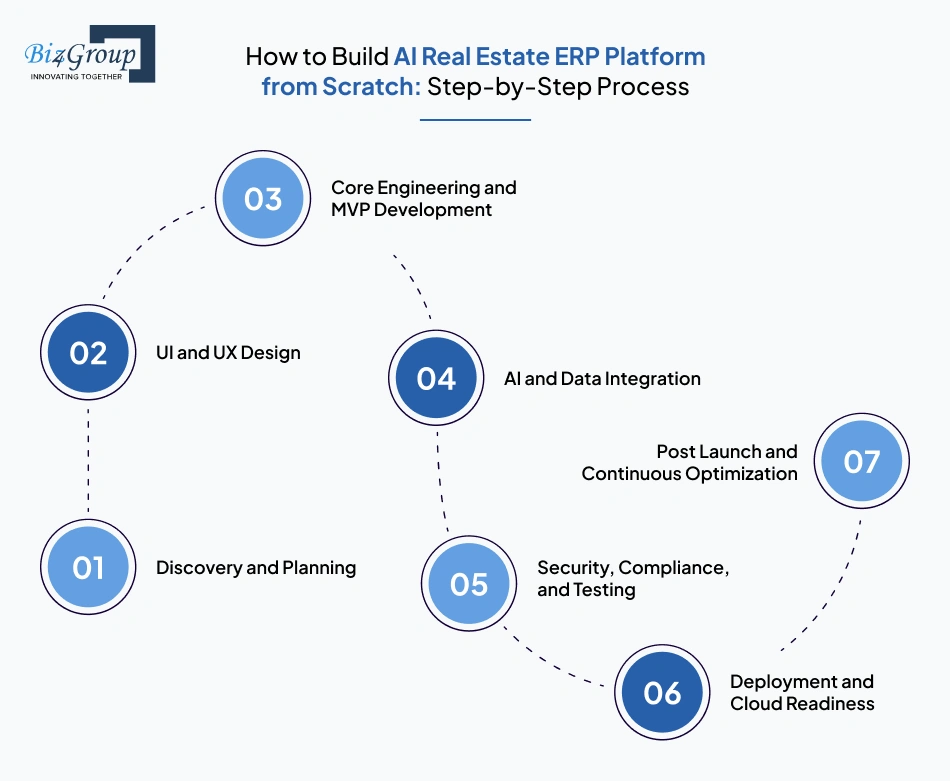
Building an ERP that truly supports real estate operations is about sequencing the right decisions at the right time. AI real estate ERP software development works best when discovery, design, engineering, and intelligence are aligned with how portfolios actually operate.
This stage is about identifying where real estate operations struggle as scale increases. Leadership teams look closely at reporting delays, fragmented leasing data, and manual processes to define what success should look like.
Adoption depends on how natural the system feels to use. ERP UI/UX design must support finance teams, asset managers, and on site staff without slowing daily work, especially for teams relying on AI real estate ERP solutions for developers and property managers.
Also read: Top UI/UX Design Companies in USA
Rather than building everything upfront, teams validate the foundation first. MVP development services focus on core workflows and system stability before intelligence is layered in.
Also read: Top 12+ MVP Development Companies to Launch Your Startup in 2026
Once the system is stable, intelligence is introduced carefully. This phase prepares clean data and aligns models with real operational decisions rather than theoretical outputs.
Trust is critical when systems manage financial and tenant data. This phase ensures the platform meets enterprise expectations through rigorous controls and real world testing, often required in AI real estate ERP software development services engagements.
Also Read: Software Testing Companies in USA
Real estate operations change quickly due to acquisitions and leasing cycles. Cloud ready deployment ensures the ERP remains reliable as demand shifts.
After launch, the system evolves alongside the business. Continuous improvement ensures the ERP remains aligned with growth and changing operational patterns, a core part of custom AI real estate ERP development services.
This disciplined approach helps organizations build AI real estate ERP platform capabilities that scale predictably, support real operations, and avoid the rework that often follows rushed implementations.
Move beyond off the shelf tools and invest in custom AI real estate ERP development tailored to your workflows, data, and growth plans.
Design My Custom ERPAn AI driven real estate ERP depends on far more than just frontend and backend code. It needs strong APIs, reliable data movement, and infrastructure that supports constant change across portfolios. This stack is purpose built for AI real estate ERP software development, not generic ERP platforms:
|
Label |
Preferred Technologies |
Why It Matters |
|---|---|---|
|
Frontend Framework |
ReactJS, VueJS |
ERP users work inside dashboards all day. ReactJS development supports responsive, component based interfaces suited for complex real estate workflows |
|
Server-Side Rendering & SEO |
NextJS, NuxtJS |
Faster initial loads matter when navigating large portfolios. NextJS development improves performance and routing for data heavy ERP views |
|
Backend Framework |
NodeJS, Python |
ERP backends handle real time operations and intelligence. NodeJS development supports concurrency, while Python development enables analytics and AI logic |
|
REST, GraphQL |
APIs allow leasing, finance, AI models, and third party systems to communicate cleanly without tight coupling |
|
|
AI & Data Processing |
TensorFlow, PyTorch |
These frameworks support forecasting, pattern detection, and learning models embedded into ERP workflows |
|
Database Layer |
PostgreSQL, MongoDB |
Structured financial data and flexible property records require different storage models |
|
Data Pipelines & Messaging |
Kafka, RabbitMQ |
Keeps data flowing reliably between modules as transactions and events increase |
|
Cloud Infrastructure |
AWS, Azure |
Elastic infrastructure supports acquisitions, portfolio growth, and reporting spikes |
|
Integration Layer |
Webhooks, ETL Tools |
Enables smooth connectivity with accounting, CRM, and property systems |
|
Security & Access Control |
OAuth, RBAC |
Protects sensitive financial and tenant data across teams and roles |
This expanded stack reflects how real estate ERP systems actually operate in production. It also explains why costs and complexity increase as platforms mature, which brings us to the next concern - how budgets differ from MVP to enterprise scale.
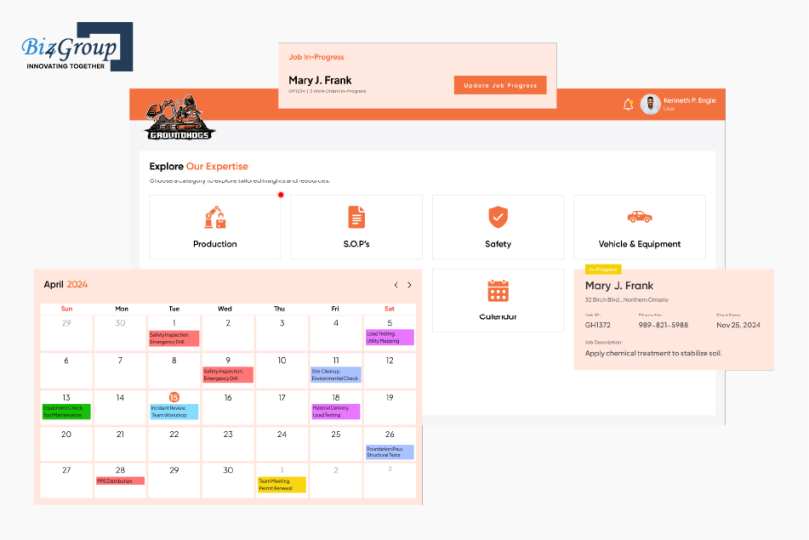
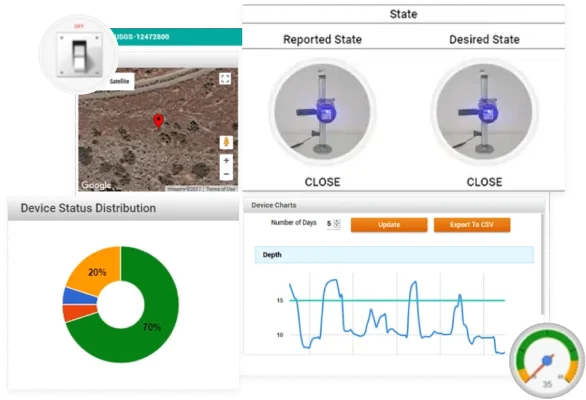
Built for construction site oversight, Groundhogs centralizes daily activity logs, safety compliance, and resource tracking. Highlighting this in the Tech Stack section can demonstrate how real estate systems extend beyond leasing and finance to include operational visibility, a key driver for next generation AI ERP solutions.
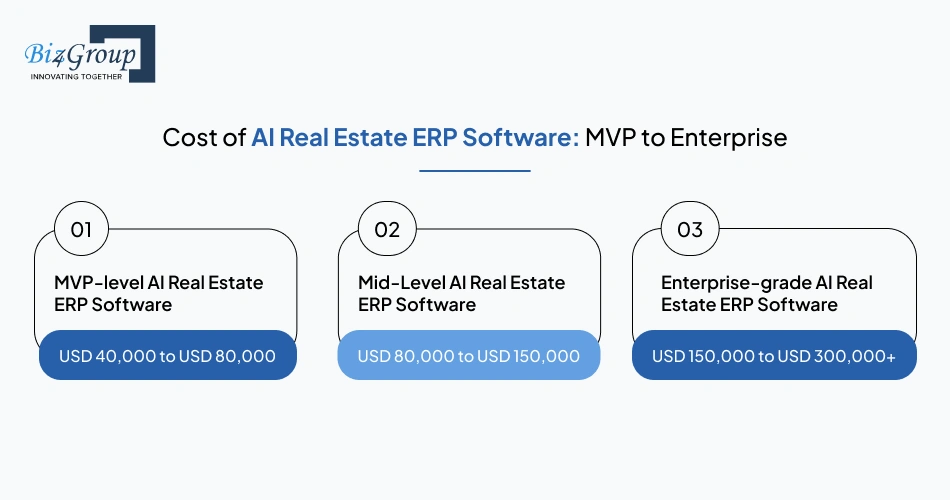
The cost of AI real estate ERP software development typically falls between USD 40,000 to USD 300,000 and beyond. This is a ballpark figure, not a fixed price, because scope, data complexity, and scale all play a major role in shaping the final investment.
|
Build Level |
What It Usually Includes |
Typical Cost Range |
Who It Fits |
|---|---|---|---|
|
MVP-level AI Real Estate ERP Software |
Core modules like finance, lease tracking, basic reporting, and limited AI logic |
USD 40,000 to USD 80,000 |
Teams validating ideas or planning phased rollouts |
|
Mid-Level AI Real Estate ERP Software |
Expanded workflows, integrations, role-based access, and early intelligence features |
USD 80,000 to USD 150,000 |
Growing portfolios needing better visibility |
|
Enterprise-grade AI Real Estate ERP Software |
Full scale automation, advanced AI models, security layers, and performance optimization |
USD 150,000 to USD 300,000+ |
Large portfolios with complex operations |
Several factors influence where a project lands within these ranges. Data quality, number of integrations, security requirements, and the depth of intelligence all add cost. Teams exploring how to build AI real estate app MVP versions often start lean to test assumptions before committing to larger builds.
Another key driver is how much customization is required. Off the shelf tools may reduce upfront cost, but organizations that create AI driven ERP software for real estate often invest more initially to avoid long term limitations and rework.
Cost discussions usually lead to another important question. Once the platform is built, how does it create ongoing value and justify the investment over time. That is where monetization and ROI enter the picture.
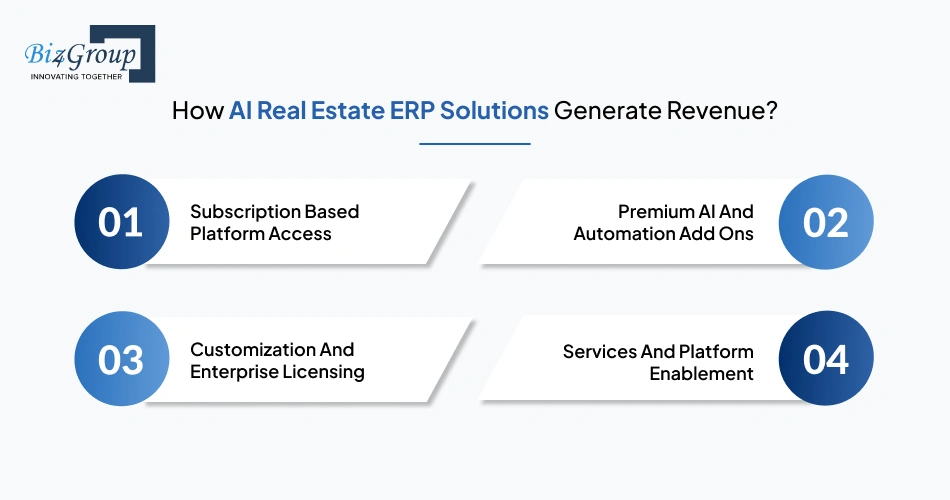
Revenue strategy becomes part of the product blueprint early on. AI real estate ERP software development allows platforms to monetize not just access, but intelligence and operational scale, which is reflected in how these solutions are typically packaged.
Most platforms rely on recurring subscriptions tied to portfolio size, users, or enabled modules. This creates predictable revenue while allowing customers to scale gradually through real estate ERP software development with AI.
Advanced capabilities are often offered separately once customers see value in the core system. Features shaped by AI in real estate development are positioned as optional upgrades rather than mandatory costs.
Large organizations often require tailored workflows, integrations, and governance. This is where custom AI real estate ERP development generates significant one time or long term revenue.
Beyond software access, many platforms generate revenue through implementation and optimization services. This fits naturally with business app development using AI and long term platform adoption.
In practice, organizations that build real estate AI software with monetization in mind tend to think carefully about sustainability. That naturally leads into discussions around development discipline and best practices that keep the platform viable as it grows.
Follow a proven path to develop AI powered real estate ERP system architectures that scale without disrupting daily operations.
Map My ERP Roadmap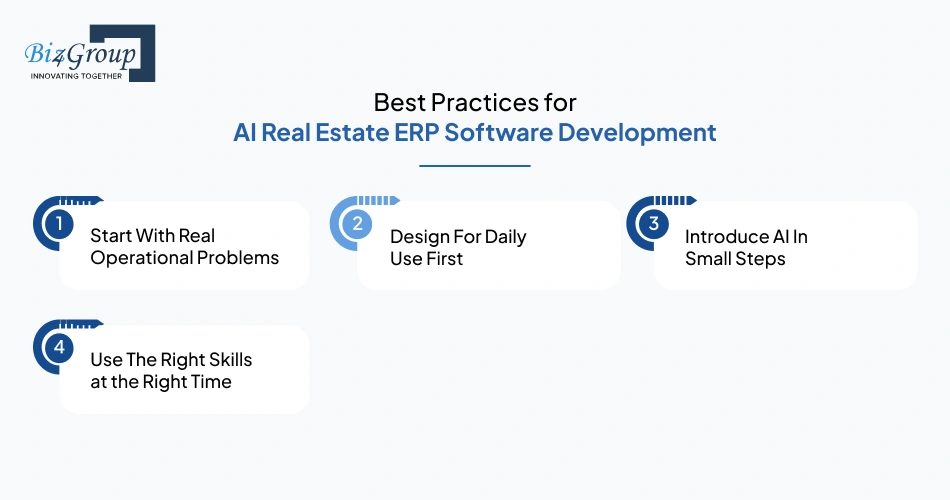
Strong outcomes come from doing the basics well. AI real estate ERP software development works best when teams stay focused on real operational needs, keep systems easy to use, and allow intelligence to grow naturally over time.
The best ERP projects begin by fixing everyday issues across finance, leasing, and property operations. Teams that develop intelligent ERP systems for real estate companies focus on gaps that slow decisions or create confusion, not features that only look good on paper.
If the system feels complicated, teams will avoid it. When organizations create AI based real estate ERP platform foundations, they prioritize clear screens, simple workflows, and role-based access that works for executives and AI for real estate agents alike.
AI delivers value when users trust it. Teams that implement generative AI in real estate roll it out gradually, letting models learn from real usage while teams stay comfortable with the system. This avoids disruption and builds confidence over time.
ERP platforms need both technical and domain knowledge. Many organizations choose to hire AI developers while keeping real estate experts closely involved so the system reflects how work actually gets done.
Following these practices keeps projects steady and predictable. As usage grows and operations become more complex, teams naturally begin to focus on the challenges that show up at scale and how to solve them early.
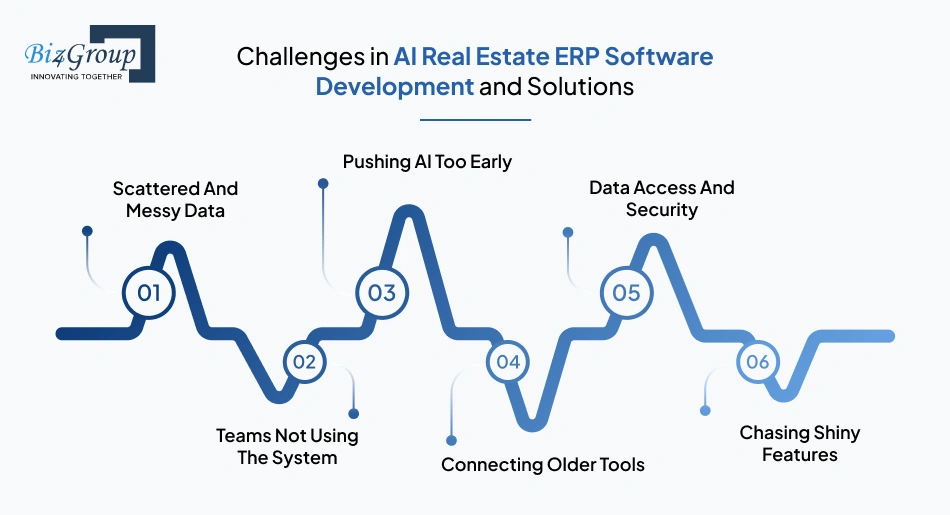
Most challenges show up once real teams start using the system. AI real estate ERP software development often runs into a few common roadblocks, especially when older processes meet new technology.
|
Top Challenges |
How to Solve Them |
|---|---|
|
Scattered And Messy Data |
Clean and align finance, leasing, and property data before adding any intelligence. Good data comes first. |
|
Teams Not Using The System |
Keep screens simple and workflows familiar so teams can use the ERP without extra training. |
|
Pushing AI Too Early |
Start small with intelligence and expand only after teams trust the system and data improves. |
|
Connecting Older Tools |
Use phased integrations so existing systems keep running during upgrades. |
|
Data Access And Security |
Set clear user roles and permissions from the start to protect sensitive information. |
|
Chasing Shiny Features |
Avoid adding features like an AI conversation app unless there is a real operational need. |
When teams plan for these issues early, projects stay on track. Solving them upfront makes it easier to create AI enabled ERP platforms for real estate growth that improve steadily instead of struggling at scale.
Understand scope, tradeoffs, and budget ranges before you build AI enabled property management ERP solutions at MVP or enterprise scale.
Get a Cost Breakdown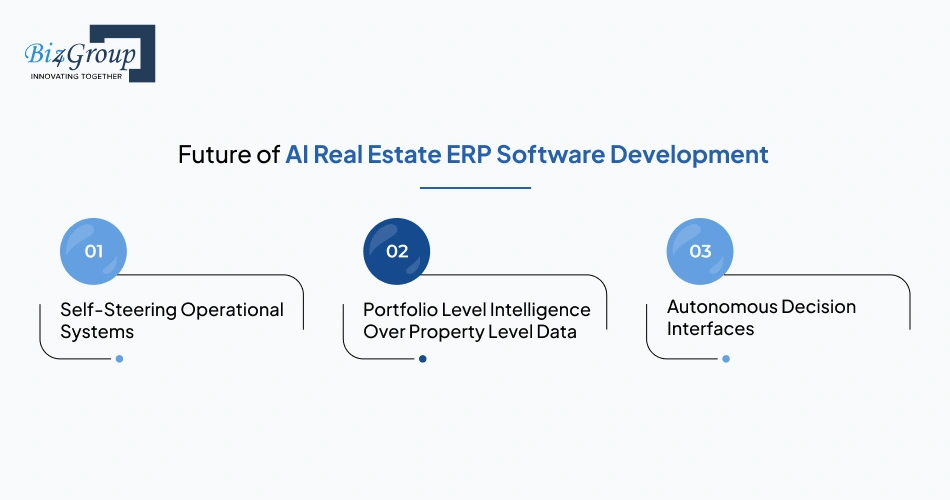
The future is not about smarter dashboards. It is about systems that quietly run parts of the business on their own. AI real estate ERP software development is moving toward platforms that think in terms of outcomes, not tasks, which changes how real estate operations are managed.
Future ERP platforms will not wait for inputs or approvals. They will continuously rebalance budgets, maintenance priorities, and leasing strategies based on live portfolio behavior, stepping in only when human judgment is truly needed.
Instead of managing buildings one by one, ERP systems will reason across entire portfolios. As organizations develop AI real estate ERP software for enterprise portfolios, the system will optimize trade offs between assets, markets, and timelines automatically.
Interfaces will shift from dashboards to conversations with the system itself. Not chatbots, but decision layers inspired by real estate AI apps ideas that explain why something happened and what will happen next, replacing static reports and alerts entirely.
As these systems move closer to autonomy, the question stops being about features. It becomes about who understands how to design and govern such platforms responsibly, which is why many leaders start evaluating the best company to develop AI real estate ERP software long before they need it.
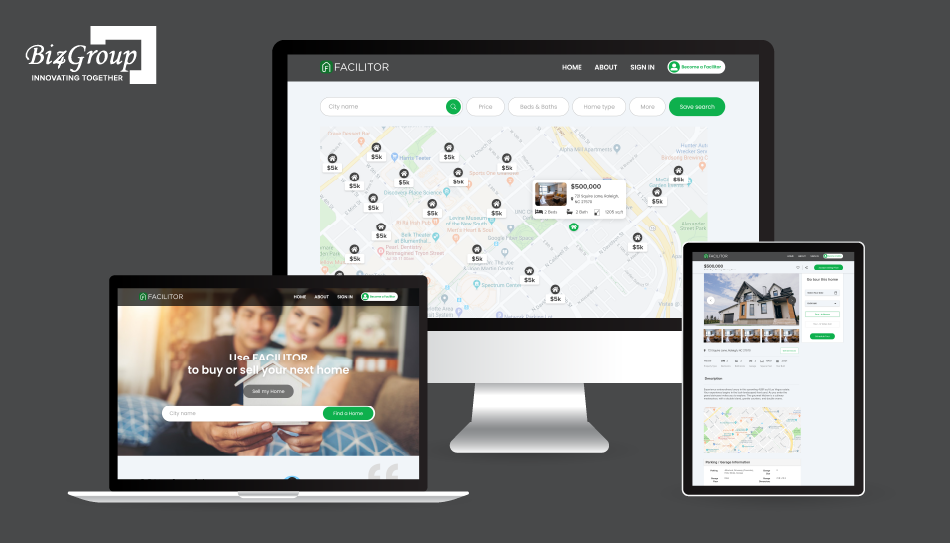
Facilitor guides users through secure property search and purchase with AI support, simplifying discovery and client communication. Adding this in the Future section underscores how conversational and decision support features will shape the next wave of intelligent real estate platforms.
Choosing a development partner for a real estate ERP is less about promises and more about proof. Biz4Group LLC brings hands on experience building AI driven real estate platforms that deal with real data, real users, and real operational complexity through AI real estate ERP software development.
The platforms highlighted earlier in this guide show how Biz4Group approaches different parts of the real estate ecosystem. From AI powered property interaction in Homer AI to contract intelligence in Contracks, operational oversight in Groundhogs, and guided discovery in Facilitor, each solution reflects a deep understanding of how real estate systems actually function at scale.
What sets Biz4Group apart is how these experiences translate into ERP execution.
For teams planning serious ERP investments, working with a partner that has already built and deployed real world AI real estate platforms reduces risk and shortens the path from idea to impact.
Future ready teams create AI enabled ERP platforms for real estate growth by planning for scale, intelligence, and long term adaptability.
Launch My AI ERPIf you are considering an AI driven ERP, chances are something already feels off in your current setup. Reports take too long. Teams work in silos. Decisions rely more on experience than data. That is usually the real trigger.
An ERP built with AI should not feel like a big technology shift. It should quietly remove friction from finance, leasing, and property operations. When backed by the right product development services and grounded AI consulting services, the system evolves with your business instead of forcing change overnight.
When that happens, the work (in general) just gets easier.
Timelines vary based on scope, integrations, and data readiness, but most projects take between four to nine months. A phased approach using AI real estate ERP software development services often helps teams launch faster without locking into long build cycles.
Yes, modern ERP architectures are designed for integration. When teams develop AI powered real estate ERP system frameworks with APIs in mind, they can connect accounting, CRM, and property tools without replacing everything at once.
AI driven ERP platforms are no longer limited to large portfolios. Many mid sized firms choose AI real estate ERP solutions for developers and property managers to gain visibility early and avoid the operational debt that comes with growth.
Customization depends on how the system is built. Teams that invest in custom AI real estate ERP development can tailor workflows, reporting, and intelligence around their operating model instead of adapting to rigid software constraints.
AI does not require perfect data to start, but it does need consistency. Companies that develop intelligent ERP systems for real estate companies focus on aligning financial, lease, and asset data first, then improve intelligence as usage grows.
Costs typically range between USD 40,000 and USD 300,000 or more, depending on scope and scale. The final AI real estate ERP software development cost estimate is influenced by features, integrations, security needs, and long term scalability goals.

with Biz4Group today!
Our website require some cookies to function properly. Read our privacy policy to know more.