Location :
Orlando, FL, USA
Location :
Orlando, FL, USA +1 (407) 714-1616
 info@biz4group.com


















Imagine a digital system that doesn’t wait for instructions but instead, understands your business goals, learns from real-time feedback, and takes independent actions to get the job done.
Read More

Why does drafting a simple enterprise contract still slow down business operations?
Legal teams handle procurement agreements, vendor contracts, HR documents, and compliance paperwork every day. Each document demands careful wording and legal validation. Even experienced teams spend hours preparing contracts that follow company policies and regulatory requirements.
This challenge is pushing organizations to rethink how legal documentation is created and managed. Many enterprises are now exploring enterprise AI contract generator platform development to simplify contract drafting while maintaining legal accuracy.
Here’s what the market has to say: The AI contract generator market reached $1.59 billion in 2025 and is projected to approach $5 billion by 2035. Analysts expect a steady 12.1% CAGR between 2025 and 2035, driven by growing enterprise demand for automated legal workflows.
Several factors are shaping the adoption across industries:
Many organizations now work with an experienced AI development company to design platforms that match internal legal workflows. These initiatives often lead to custom enterprise AI contract platform development, where structured templates, clause intelligence, and secure AI integration help legal teams generate contracts with greater efficiency.
This guide will walk you through the key aspects enterprises should understand before building such platforms, including development steps, required features, technology stack, security considerations, and development cost.
An enterprise AI contract generator platform is a software system that helps legal teams create structured contracts using predefined templates and intelligent clause suggestions. The platform uses business inputs such as party details, contract type, and agreement terms to produce legally formatted documents quickly. Organizations pursuing enterprise AI contract generator platform development focus on building systems that align with internal legal policies and approval workflows. Many teams also integrate capabilities powered by generative AI to assist with drafting contract clauses and adapting templates for different agreement scenarios.
Enterprise AI contract generator platforms simplify contract drafting through structured templates, automated clause selection, and guided workflows that help legal teams create accurate agreements faster.
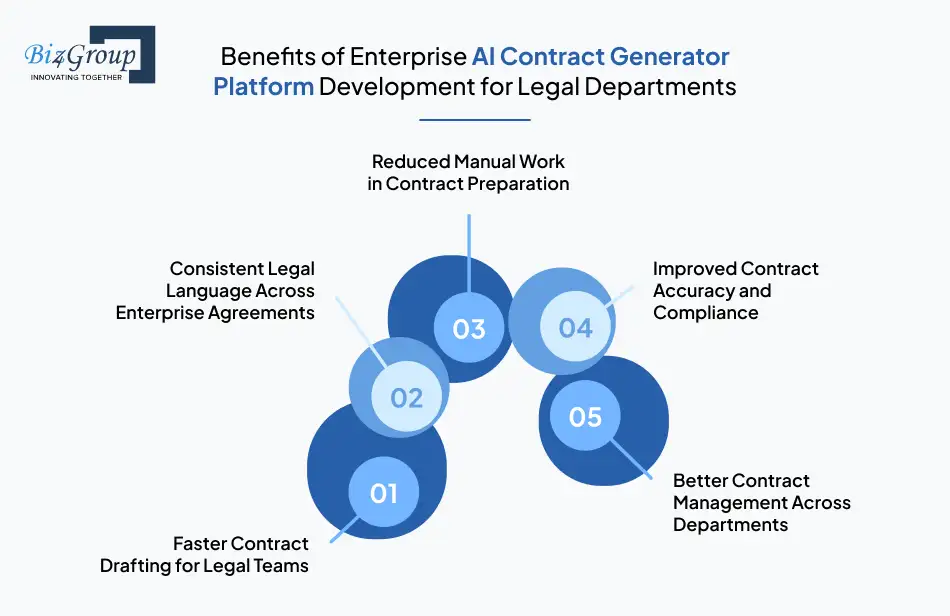
Legal departments manage a constant flow of agreements across procurement, partnerships, and compliance processes. Preparing each document carefully takes time and attention. Many organizations are now investing in enterprise AI contract generator platform development to bring structure to contract drafting while supporting faster and more reliable legal documentation across departments.
Preparing agreements manually often slows legal operations when multiple contracts require attention at the same time. AI-driven drafting platforms help legal teams generate documents quickly while maintaining structured templates and approved clauses.
This helps legal professionals spend more time reviewing contract risks rather than preparing initial drafts.
Large organizations manage contracts across different departments and regions. Maintaining consistent legal wording across agreements becomes difficult when documents are drafted independently. Integrated AI model recommend approved clauses based on contract type and context.
Consistent legal language improves reliability across enterprise documentation.
Legal teams spend considerable time adjusting templates and updating clauses for each agreement. Platforms designed with AI automation reduce this repetitive work and streamline document preparation.
This allows legal teams to focus on contract validation and approval workflows.
Enterprise agreements must follow internal policies and regulatory requirements. AI contract generator platforms help legal departments maintain consistent documentation standards across all contracts.
This structured drafting process strengthens compliance within enterprise legal operations.
Contracts often originate from procurement teams, HR departments, or partnership divisions. Centralized drafting platforms allow legal teams to maintain visibility across these agreements.
Centralized contract creation helps maintain stronger oversight over enterprise agreements.
These operational benefits show why enterprises invest in platforms that help legal teams generate accurate agreements faster. Many organizations now develop enterprise AI contract drafting software to streamline documentation and support reliable legal workflows.
Legal teams shouldn't spend hours preparing agreements when automation can structure them instantly
Talk to Our AI Contract ExpertsContracts sit at the center of many revenue activities. Sales agreements, vendor partnerships, licensing deals, and procurement arrangements all require formal documentation before transactions move forward. Businesses that invest in enterprise AI contract generator platform development often aim to reduce financial friction in these processes while supporting faster commercial operations.
Market adoption patterns also reflect where this transformation is happening fastest.
Contract preparation frequently delays the final stage of many business deals. Sales agreements, vendor contracts, and partnership documents require careful drafting before approval. A system supported by a trained AI model helps businesses generate structured contracts faster.
Faster contract readiness helps organizations recognize revenue sooner when deals reach the signing stage.
Manual contract drafting requires significant legal effort. Businesses often allocate large budgets for document preparation, review, and revisions. Enterprise AI contract generator platforms reduce the cost of repetitive legal drafting tasks.
These savings accumulate across hundreds of enterprise agreements each year.
As companies grow, the number of agreements also increases. Contract preparation becomes difficult to manage without structured systems. AI contract generator platforms designed as enterprise AI solutions support high volumes of contracts without increasing legal workload.
Scalable contract generation directly supports expanding business operations.
Errors in agreements can lead to costly disputes, renegotiations, or delayed deals. AI automated systems reduce such risks through structured document generation.
Lower contract risk helps organizations avoid potential financial losses.
Businesses that invest in enterprise contract automation should focus on financial impact. Many organizations also create secure enterprise AI contract management systems to protect agreements while supporting scalable contract generation and stronger revenue operations.
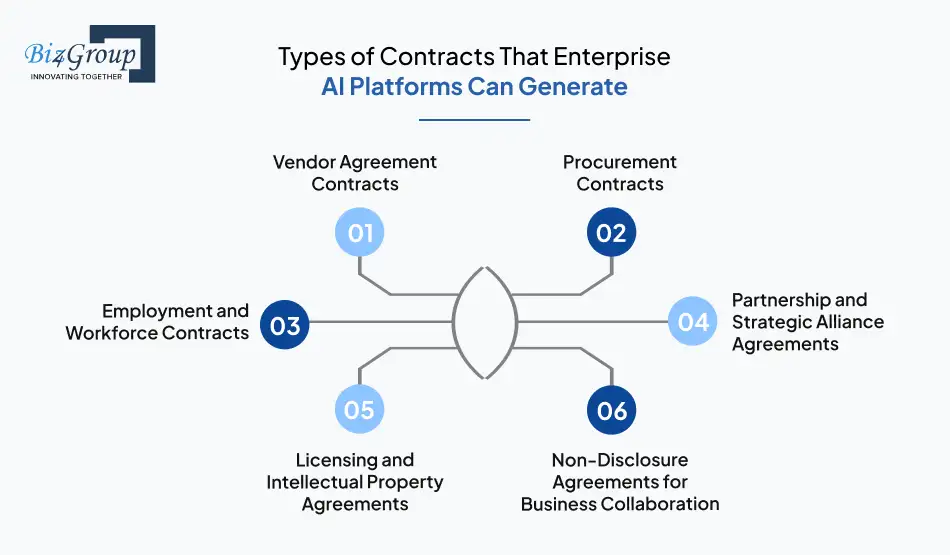
Enterprise legal teams manage many types of agreements that support daily operations across departments. Organizations investing in enterprise AI contract generator platform development often aim to automate these recurring legal documents while maintaining structured templates and internal policy alignment.
Vendor agreements define the terms between enterprises and external suppliers. AI contract platforms generate structured vendor contracts by inserting supplier details, payment terms, delivery obligations, and service expectations within predefined legal templates.
Procurement contracts outline purchasing terms between organizations and vendors. Through enterprise legal contract software development using AI, legal teams can generate procurement agreements that clearly define product specifications, pricing conditions, delivery timelines, and compliance obligations.
Legal departments often prepare employment agreements for new hires and executive roles. AI-driven platforms help generate structured employment contracts that include compensation terms, confidentiality clauses, and employment conditions based on internal legal templates.
Enterprises frequently formalize partnerships with other organizations. Contract generation platforms create partnership agreements that define collaboration scope, shared responsibilities, financial arrangements, and operational commitments between participating businesses.
Enterprises that license technology or intellectual property require structured agreements. An integrated AI document analyser reviews contract clauses and ensures licensing terms align with intellectual property policies and usage permissions.
Non-disclosure agreements protect confidential business information during vendor discussions, partnerships, and internal collaborations. Enterprise platforms generate NDAs using structured templates, allowing legal teams to prepare confidentiality agreements quickly for business engagements.
Enterprise contract platforms automate many recurring agreements across procurement, workforce management, partnerships, and compliance processes. Automating these document types allows legal teams to generate structured contracts faster while maintaining consistent enterprise legal standards.
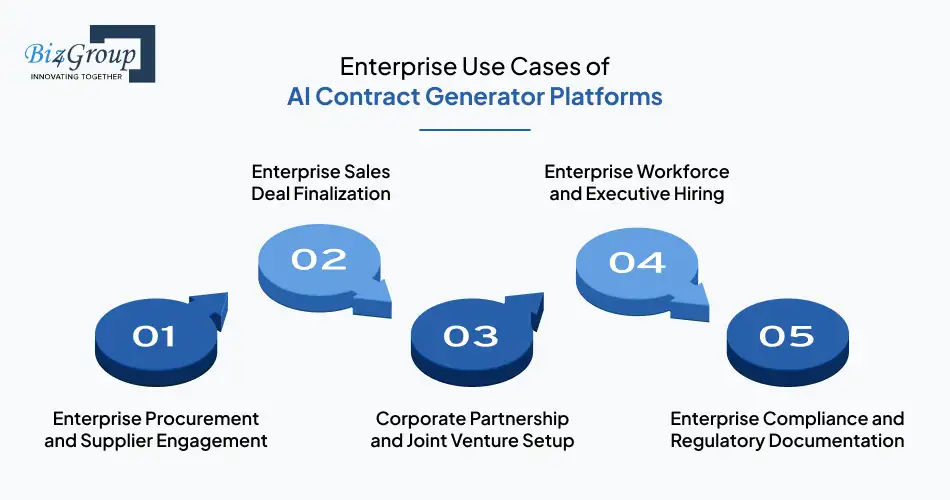
Enterprise legal teams support many business functions where agreements must be prepared quickly and accurately. Organizations investing in enterprise AI contract generator platform development often focus on operational scenarios where automated contract creation supports daily enterprise activities.
Large organizations onboard hundreds of suppliers each year. Procurement teams rely on legal departments whenever supplier agreements must be prepared during vendor onboarding or sourcing activities.
Sales teams often reach the final negotiation stage before legal documentation begins. At this point legal departments must quickly prepare agreements that reflect negotiated terms.
Enterprises frequently establish collaborations with technology partners, service providers, or strategic allies. Legal departments prepare partnership documentation during these business arrangements.
Organizations prepare formal employment agreements during executive hiring and leadership appointments. Legal departments work closely with HR during these processes.
Many industries require documented agreements during regulatory audits or compliance procedures. Legal teams generate these documents when organizations must demonstrate operational accountability.
Enterprise contract generator platforms support real business scenarios across procurement, sales, partnerships, workforce management, and compliance operations. Many organizations also develop enterprise AI contract automation platforms for operational efficiency to support these workflows.
Also Read: 10 AI Automation Use Cases for Enterprises to Scale Faster
Let's identify real workflows in your organization where AI can generate contracts faster
Discuss Your Use CaseLegal teams manage contracts through several stages that include drafting, internal review, approvals, and document tracking. Businesses that create AI contract lifecycle management platform for enterprises focus on practical capabilities that support how legal departments actually prepare and manage agreements within daily operations.
|
Core Feature |
What the Feature Does |
|---|---|
|
AI-Powered Contract Drafting and Clause Generation |
Generates a complete contract draft after users enter details such as contract type, parties, payment terms, and obligations. The system automatically inserts required clauses into the correct sections of the document. |
|
Centralized Legal Template Libraries |
Stores approved contract templates in one location so legal teams can generate agreements using standardized structures for procurement, vendor onboarding, partnerships, and employment documentation. |
|
AI Clause Recommendation and Smart Suggestions |
Recommends clauses based on the contract category and entered information. The system suggests appropriate legal wording for liability terms, payment conditions, or service obligations. |
|
Contract Risk Detection and Compliance Validation |
Reviews the generated contract and flags for missing clauses, unusual language, or policy conflicts. Legal teams receive alerts before the agreement moves to internal approval. |
|
Automated Contract Review and Redlining Assistance |
Allows reviewers to modify contract language directly inside the platform. The system highlights edits and maintains a structured record of clause changes during the review process. |
|
Workflow Automation for Legal Approvals |
Routes the contract automatically to the next reviewer based on predefined approval rules such as legal review, compliance verification, or department authorization. |
|
Document Version Control and Audit Trails |
Tracks every update made to the contract. The platform records who edited the document, what changes were made, and when revisions occurred. |
|
Enterprise Integration With CRM, ERP, and Procurement Platforms |
Pulls specific records such as vendor names, client company details, billing addresses, and service dates from CRM or ERP systems and inserts them into the correct sections of the contract draft. |
|
Enterprise Security and Role-Based Access Control |
Controls which users can view, edit, approve, or download contracts. Access permissions protect confidential agreements and restrict document visibility to authorized roles only. |
Many legal departments access the contract platform through an internal dashboard that functions as a web application to automate the legal services, allowing teams to generate agreements, review edits, and move documents through approval workflows within the same system.
These capabilities shape how modern contract platforms support enterprise legal operations. Organizations pursuing enterprise AI contract generator platform development typically implement these features to manage contract drafting, review workflows, and documentation governance within structured legal systems.
Enterprise contract platforms now include intelligent capabilities that assist legal teams during drafting, clause evaluation, and agreement review. Law firms that create scalable enterprise AI contract automation systems often introduce these capabilities to strengthen contract intelligence across legal workflows.
|
Advanced AI Capability |
What the Capability Does |
|---|---|
|
Generative AI for Automated Contract Drafting |
Generates complete contract drafts after users enter details such as parties, contract purpose, payment terms, and obligations. The system produces structured legal sections rather than filling isolated document fields. |
|
Natural Language Processing for Legal Language Understanding |
Reads contract text and identifies clauses, obligations, deadlines, and financial terms. This allows the platform to interpret document structure and understand legal meaning within agreements. |
|
AI Clause Intelligence and Contract Knowledge Graphs |
Analyzes previously executed contracts and builds connections between commonly used clauses. Legal teams can retrieve relevant clauses when preparing new agreements for similar contractual situations. |
|
Predictive Risk Detection in Legal Agreements |
Scans contracts and flags unusual clause wording, missing obligations, or incomplete terms. The system identifies potential legal risks using patterns derived through predictive analysis from prior agreements. |
|
AI-Powered Contract Negotiation Assistance |
Examines edits proposed by external parties during negotiation and suggests alternate clause wording using language patterns learned from previously approved enterprise agreements. |
|
Self-Learning AI Models for Contract Optimization |
Tracks clause edits, negotiation outcomes, and approved agreements so the system improves future recommendations. This evolving intelligence represents a practical AI model use case within enterprise legal operations. |
|
AI-Based Legal Workflow Intelligence |
Observes how contracts move through review and approval stages and identifies workflow delays. Legal teams use these insights to improve operational efficiency across contract processes and related areas like AI legal billing automation. |
These intelligent capabilities allow contract platforms to analyze agreements, detect potential risks, and support smarter drafting workflows. Many organizations pursuing enterprise AI contract generator platform development implement these functions to strengthen enterprise contract intelligence.
Also Read: NLP vs LLM: Choosing the Right Approach for Your AI Strategy
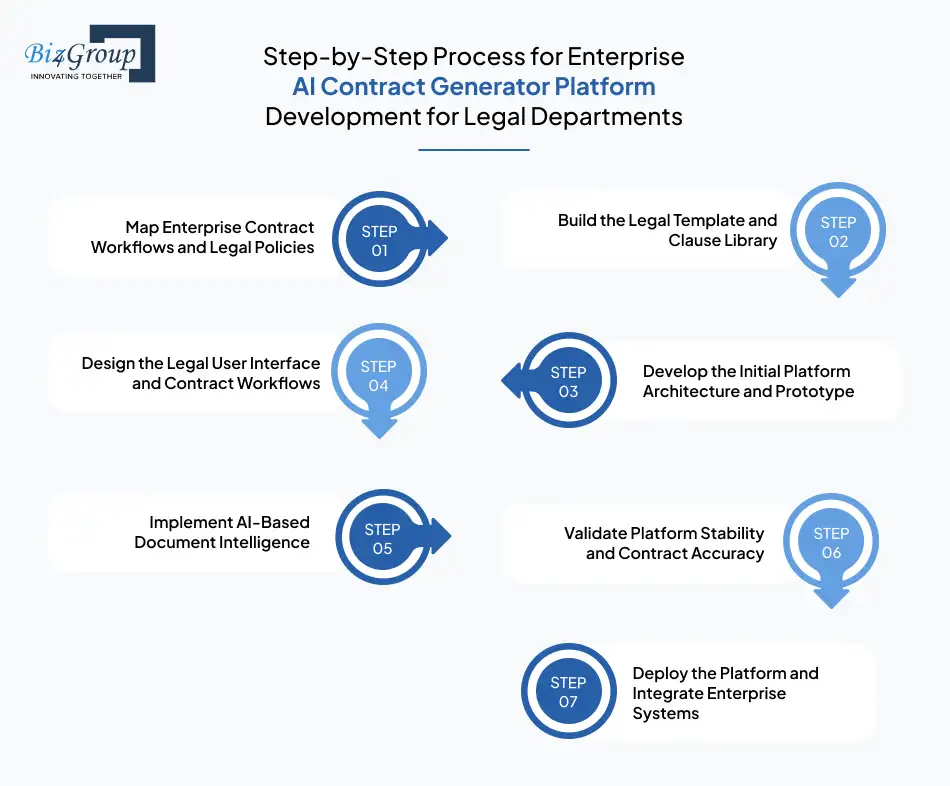
Legal teams depend on structured contract workflows that match internal approval policies and documentation standards. Organizations planning enterprise AI contract generator platform development for large organizations usually follow a staged process that aligns legal requirements, document intelligence, and enterprise system integration.
Also Read: Top MVP Development Companies in USA
Also Read: Top UI/UX design companies in USA
A structured development approach ensures legal teams receive reliable contract automation tools. Organizations that follow these steps can build custom enterprise AI contract generator for legal departments that align with internal policies and enterprise legal workflows.
Also Read: MVP vs Full Scale Legal Tech Platform Development Guide
Let's map your legal workflows and design a contract generator platform around them
Start Platform PlanningEnterprise contract platforms rely on several specialized layers that manage document processing, clause intelligence, contract drafting, and workflow approvals. Organizations that develop enterprise grade AI contract management platforms usually design these systems through coordinated full stack development so AI engines, document services, and enterprise integrations operate together.
|
Architecture Layer |
Recommended Technology |
Purpose |
|---|---|---|
|
Contract Authoring Interface |
React.js / Next.js |
Provides structured legal dashboards where legal teams generate agreements, edit clauses, and manage approvals through interfaces typically implemented using ReactJS and NextJS development. |
|
Contract Workflow & Approval Engine |
Node.js / Express |
Controls document approval routing, role permissions, review stages, and contract lifecycle tracking through backend services commonly built with NodeJS development. |
|
AI Contract Drafting Engine |
Python, HuggingFace Transformers, OpenAI APIs |
Generates contract clauses and agreement sections using trained language models and legal datasets through pipelines commonly built with Python development. |
|
Legal Document Intelligence Layer |
spaCy, LangChain, Legal-BERT models |
Reads uploaded contracts, detects clauses, identifies obligations, and extracts legal terms from agreements to support automated drafting and document analysis. |
|
Clause Retrieval & Knowledge Graph Layer |
Vector Databases (Pinecone / Weaviate / Milvus) |
Stores embeddings of approved legal clauses and retrieves relevant clauses during drafting so contracts use previously validated legal language. |
|
Contract Template & Document Assembly Engine |
Docx Templates, Pandoc, Docassemble |
Converts structured templates and clause selections into formatted contract documents ready for legal review and negotiation. |
|
Enterprise Integration Layer |
REST APIs / GraphQL / Webhooks |
Connects the contract platform with CRM systems, procurement platforms, and document repositories, so business information flows into agreements through structured API development. |
|
Secure Contract Storage & Version Control |
AWS S3, Azure Blob Storage, PostgreSQL |
Stores generated contracts, clause libraries, and document revisions with encryption and controlled access for enterprise compliance. |
|
AI Training & Model Operations Layer |
MLflow, Kubernetes, Docker |
Manages training, deployment, and monitoring of AI models used for contract drafting, clause recommendation, and legal document analysis. |
A structured architecture ensures AI contract platforms can process documents, generate agreements, and manage approvals reliably at scale. Organizations investing in enterprise AI contract generator platform development often implement these technologies alongside broader mobile and web app development initiatives supporting enterprise legal systems.
Also Read: Why to Choose the Full Stack Development for Modern Business
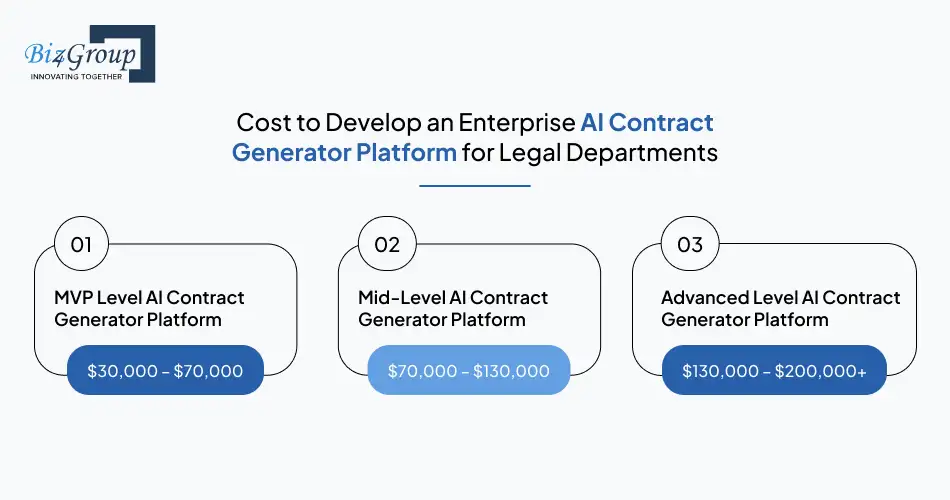
Enterprises aiming to build AI powered enterprise contract lifecycle platforms often plan development in phases. The development cost of an AI contract generator platform ranges between $30,000 and $200,000+, depending on system capabilities, document intelligence functions, and integration requirements.
|
Development Level |
Scope |
Estimated Cost Range |
|---|---|---|
|
MVP Level AI Contract Generator Platform |
Basic contract generation system with template libraries, clause insertion logic, and simple approval workflows used to validate automated contract drafting processes. |
$30,000 – $70,000 |
|
Mid-Level AI Contract Generator Platform |
Adds clause recommendations, contract review tools, document intelligence features, and integrations with enterprise systems |
$70,000 – $130,000 |
|
Advanced Level AI Contract Generator Platform |
Includes predictive contract analysis, negotiation assistance, multi-system integrations, and higher infrastructure capacity that increases development effort and overall AI integrations costs. |
$130,000 – $200,000+ |
Several practical development factors influence how much organizations actually spend on building these platforms.
Cost planning is essential when organizations automate contract workflows. Law firms that approach enterprise AI contract generator platform development through phased implementation strategies can control investment while gradually expanding contract automation capabilities.
Also Read: AI Software Development Cost
Share your legal workflow requirements and get a realistic development estimate
Get Cost EstimateEnterprise contracts contain confidential agreements, financial commitments, and regulatory obligations. Organizations that make enterprise AI contract generator with compliance controls design the platform with strong safeguards. This helps legal teams generate and manage contracts without exposing sensitive business information.
Legal agreements often include confidential financial terms, intellectual property details, and partner information. Protecting these documents requires strong encryption and controlled storage environments.
Secure storage ensures contracts remain protected throughout the contract lifecycle.
Contract platforms often involve multiple departments such as procurement, HR, and legal teams. Role based access helps maintain strict control over who can view or edit agreements.
Organizations that build enterprise AI contract automation systems usually implement layered access control to maintain strong oversight over enterprise agreements.
Legal contracts frequently contain personal and financial information that must follow regulatory standards. Compliance mechanisms help organizations manage this data responsibly.
Enterprises often work with specialists who provide AI consulting services to ensure legal automation systems follow regulatory guidelines.
Automated contract systems must provide transparency into how documents are generated and edited. Audit trails allow legal teams to monitor every change made within the platform.
Audit records ensure contract activities remain traceable within enterprise systems.
Enterprise contract platforms must align with internal governance frameworks that regulate legal documentation workflows.
Organizations implementing these controls often hire AI developers who understand enterprise compliance requirements and legal automation workflows.
Security architecture and regulatory compliance must remain central when designing legal AI platforms. Enterprises investing in enterprise AI contract generator platform development must ensure contract automation systems protect confidential agreements while maintaining strong governance and compliance controls.
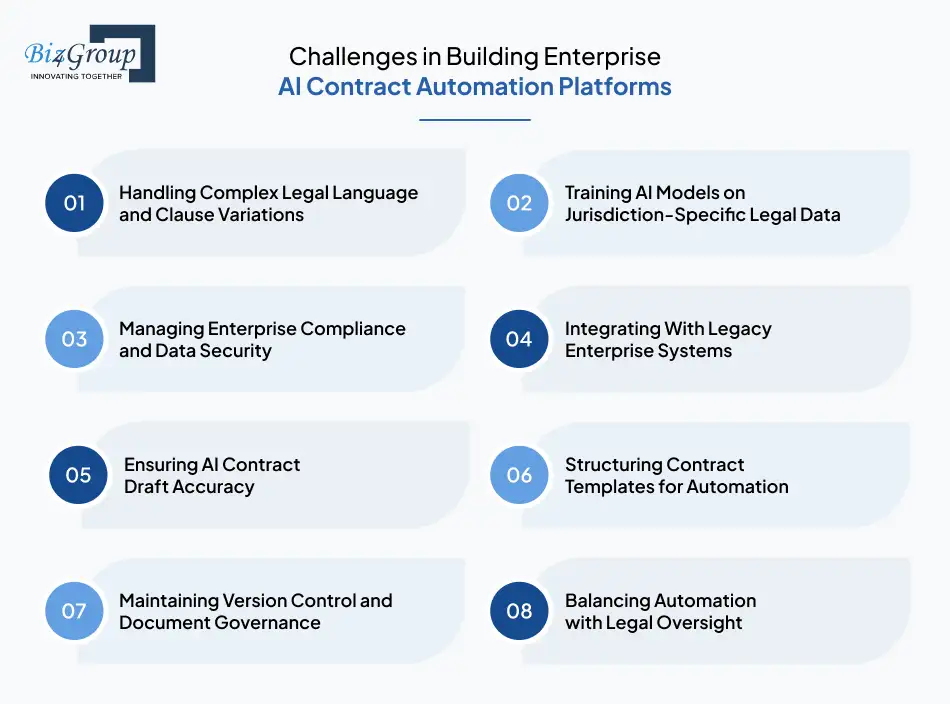
Organizations planning to develop enterprise AI contract management platform capabilities often discover that legal automation involves more than generating documents. Contract intelligence systems must understand legal language, integrate with enterprise infrastructure, and operate within strict compliance frameworks used by corporate legal departments.
|
Challenge |
Practical Solution |
|---|---|
|
Handling Complex Legal Language and Clause Variations |
Enterprise agreements contain clauses written in different styles and structures. Building reliable clause libraries and structured templates helps the platform identify similar clauses and generate consistent agreements. |
|
Training AI Models on Jurisdiction-Specific Legal Data |
Contracts often follow different regulatory rules across regions. Training the system on curated legal datasets from multiple jurisdictions helps the platform generate agreements aligned with regional legal requirements. |
|
Managing Enterprise Compliance and Data Security |
Legal platforms handle sensitive agreements and confidential business terms. Implementing encrypted document storage, role-based permissions, and compliance monitoring protects enterprise contract data. |
|
Integrating With Legacy Enterprise Systems |
Large organizations often rely on older procurement, CRM, or document management systems. Developing integration connectors allows contract platforms to exchange information with these systems without disrupting existing workflows. |
|
Ensuring AI Contract Draft Accuracy |
Contract automation systems must generate legally structured documents. Legal teams often review generated drafts during early deployment phases to ensure templates and clause logic produce accurate agreements. |
|
Structuring Contract Templates for Automation |
Many existing enterprise agreements exist as unstructured documents. Legal teams must convert them into structured templates before the platform can generate contracts automatically. |
|
Maintaining Version Control and Document Governance |
Enterprise contracts go through multiple revisions during negotiation. Implementing document version tracking helps legal teams maintain clear records of edits and approvals across contract workflows. |
|
Balancing Automation with Legal Oversight |
While AI can assist with drafting, final legal review remains essential. Designing systems that keep lawyers involved in approval stages helps maintain legal accountability within automated contract processes. |
In many enterprise implementations, organizations partner with an experienced custom software development company to design legal automation platforms that align with internal workflows and enterprise infrastructure. Building reliable legal automation platforms requires careful planning around legal data, integrations, and governance. Enterprises planning enterprise AI contract generator platform development must address these challenges early to ensure contract automation systems operate accurately within enterprise legal environments.
Our team helps enterprises design contract platforms that handle real legal complexity
Speak With Our Legal AI TeamThe development of legal automation platforms requires more than developing software features and Biz4group LLC understands that well. As a legal software development company, we help organizations create enterprise AI contract generation software that aligns with real enterprise legal operations.
Our team has worked on platforms within legal tech where contract drafting, document workflows, and compliance validation are central requirements. This experience helps us design systems that support structured enterprise contract operations.
Let's take a look at how this works in practical implementation

Enterprise legal teams require systems that manage drafting, document review, and approvals together. Our experience with AI contract management software allows us to design platforms supporting complete contract lifecycle workflows.
Every organization manages contracts differently across procurement, HR, and partnerships. Through custom enterprise AI contract platform development, we build systems that align with internal approval processes and operational contract workflows.
Many enterprises now introduce intelligent document assistance into legal platforms. Our experience building solutions like an AI legal consultation platform helps integrate AI capabilities within contract drafting and document review environments.
Our engineering approach focuses on building systems that fit enterprise environments. We prioritize reliability, integration, and structured workflows so contract automation platforms support everyday legal operations across organizations.
Building reliable legal automation platforms requires structured engineering and workflow understanding. Our team focuses on delivering solutions that support enterprise legal processes through enterprise AI contract generator platform development aligned with operational requirements.
Enterprise legal teams today operate in environments where contract volumes grow across procurement, partnerships, hiring, and compliance functions. This operational reality explains the increasing interest in enterprise AI contract generator platform development. Instead of drafting each agreement manually, organizations now rely on structured platforms that standardize legal language, manage clause libraries, and maintain consistent contract workflows across departments.
AI is gradually reshaping how legal teams manage documents. Systems that analyze clauses, assist drafting, and maintain approval workflows allow lawyers to focus on review and decision making rather than repetitive document preparation. Many enterprises now collaborate with an AI product development company to design platforms that fit existing legal processes and integrate with enterprise systems used across operations.
Scalable platforms ensure contracts remain organized even as agreement volumes increase across business units. If your organization is planning to build secure enterprise AI contract drafting software, feel free to connect with us and discuss how such platforms can support your legal workflows.
Enterprise AI contract generator platform development usually involves designing structured contract templates, building clause libraries, implementing document intelligence, and integrating approval workflows. For large organizations, platforms must also connect with procurement systems, CRM tools, and compliance monitoring processes so contracts move through controlled enterprise workflows.
Organizations that develop enterprise AI contract management platform capabilities typically start by mapping legal approval processes and identifying common contract types. The platform is then built with template repositories, clause intelligence systems, and review workflows that match internal legal operations.
Enterprise legal contract software development using AI usually combines document intelligence systems, clause retrieval engines, and workflow automation tools. These platforms rely on natural language processing to analyze legal text and generate structured agreements.
The cost of enterprise AI contract generator software development typically ranges between $30,000 and $200,000+ depending on platform capabilities. Systems that include document intelligence, enterprise integrations, and compliance monitoring generally require larger development investments.
Enterprises that create scalable enterprise AI contract automation systems usually design centralized clause libraries and template repositories that serve procurement, HR, and partnership teams. Workflow automation ensures contracts follow the same approval process across departments.
Many organizations now build AI powered enterprise contract lifecycle platforms because AI can assist with clause suggestions, contract drafting, and document analysis. These capabilities help legal teams manage large volumes of agreements while maintaining structured legal review processes.

with Biz4Group today!
Our website require some cookies to function properly. Read our privacy policy to know more.