 Location :
Orlando, FL, USA
Location :
Orlando, FL, USA +1 (407) 714-1616
 info@biz4group.com

 AI Summary Powered by Biz4AI
- AI claim denial management analyzes denial information, claim details, payment data, and supporting documentation to structure the next recovery step.
- Automated claim appeal generation can reduce the manual effort involved in assembling appeal information while keeping validation and approval with authorized reviewers.
- AI appeal generation platforms turn case-specific denial and evidence information into structured, editable appeal drafts and packages.
- AI payer denial analysis helps connect denial reasons with relevant payer, contract, and reimbursement context when the required sources are available.
- Bill Matters, developed by Biz4Group, connects denial intelligence, claim and payment data, evidence intelligence, contract intelligence, appeal generation, and post-appeal tracking within one recovery workflow.
When a medical claim is denied by the payer, the appeal letter is rarely the hardest part, especially when hospitals spent nearly $18 billion in overturning claims denials alone.
The real work is figuring out why the claim was denied, what information supports a reconsideration, which payer requirements apply, and how that evidence should shape the appeal.
That is where AI can take on meaningful work without taking the decision away from your team.
So, if you're asking, "I spend hours reviewing denied claims and writing appeal letters manually. Can AI handle the initial appeal drafting for me?"
Yes. An AI claim denial management platform can help you move from denial analysis to an initial, structured appeal draft by:
- Reviewing denial, claim, and payment information.
- Identifying relevant supporting evidence and documentation gaps.
- Incorporating applicable payer requirements into the appeal rationale.
An AI appeal generation platform can then turn that analysis into an AI appeal your team can examine and refine. It does not mean the system decides whether the argument is accurate, whether the evidence is sufficient, or whether the appeal should be submitted.
That distinction matters. The goal is not to replace your denial team with automated letters. It is to reduce the manual work required to get from denial to a reviewable appeal draft, while keeping consequential decisions with your authorized reviewers.
Let's dive in together for more insights.
How Does an AI Claim Denial Management and Appeal Generation Platform Work?
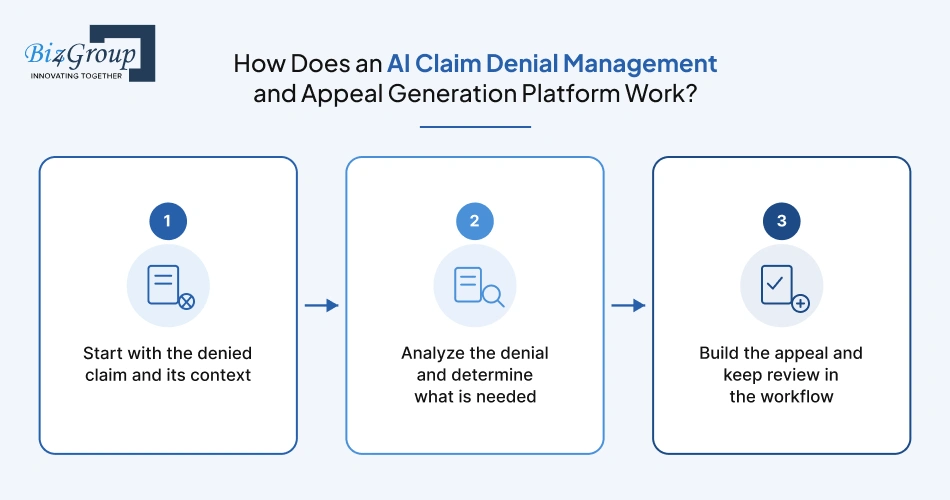
AI medical claim denial management works by moving a denied claim through several connected stages before an appeal draft reaches your team. It first establishes what happened to the claim, then determines what information is needed to support recovery, and finally turns that analysis into a structured draft for review.
Start With the Denied Claim and Its Context
Once a denied claim or EOB enters the workflow, the AI claim denial platform:
- Classifies the incoming document and extracts relevant fields.
- Brings together the claim, bill, payment, and EOB/ERA context.
- Interprets denial or adjustment codes and translates the payer's response into understandable terms.
This gives you a case view rather than asking your team to interpret the denial in isolation. The product workflow specifically calls for assembling bill/claim, contract, and payment context before denial interpretation.
Analyze the Denial and Determine What Is Needed
From there, AI payer denial analysis moves into understanding what could support recovery. The workflow then uses historical payer and denial knowledge, identifies missing documentation, and recommends relevant evidence.
For a denied EOB, the defined workflow is:
Denial response → payer/denial knowledge → missing documentation → recommended evidence → appeal rationale.
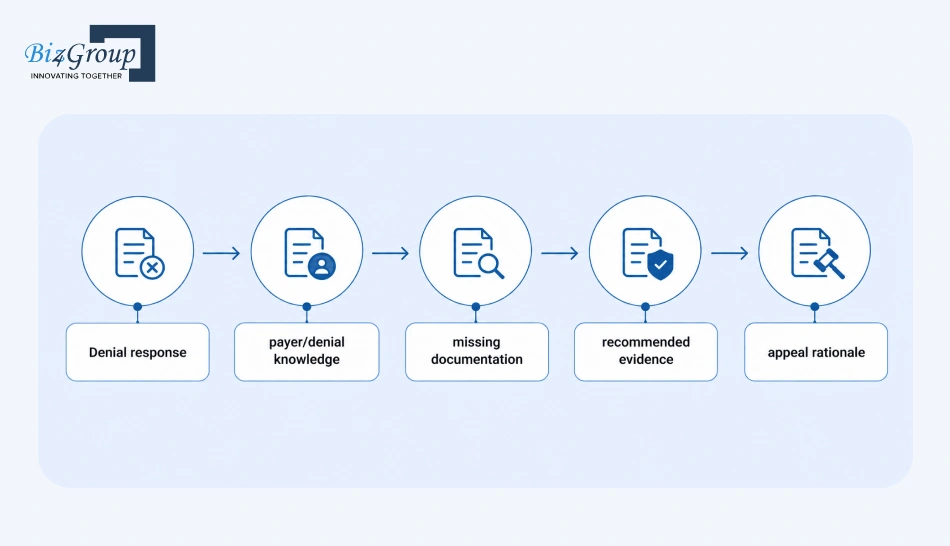
That matters because your team is not starting an appeal from a blank page. The analysis is intended to establish what the denial says, what information is available, and what is still needed.
Build the Appeal and Keep Review in the Workflow
Once the relevant information has been assembled, the platform moves into claim appeal automation by generating:
- Structured appeal rationale and arguments.
- A supporting-document checklist.
- An evidence-backed AI appeal draft or package.
The workflow also includes AI validation and confidence assessment before the human review stage. Your authorized reviewer can then accept, edit, or reject the output before the appeal package is finalized and submitted.
So, when you evaluate an AI denial management platform for healthcare, look at the entire chain, not just its ability to generate text. The real question is whether it can take you from denial → analysis → evidence → appeal draft → human review without losing the case-specific information along the way.
What Goes Into an AI-Generated Appeal Draft?
It brings the denial, claim facts, supporting evidence, applicable rules, and reconsideration rationale into one structured appeal package. With automated medical claim appeals, you are not getting a generic letter with a few claim fields inserted; the draft is built around the specific case and the information supporting it.
If you are asking, "Our denial management team spends too much time gathering claim details and supporting documentation. Can AI pull the relevant information together for an appeal?"
Yes. An AI claim appeal generator brings the relevant case information together and carries that context into the appeal. In Bill Matters, a product by Biz4Group, the appeal builder is the point where the intelligence gathered across the denial and evidence workflow becomes a structured, evidence-backed appeal package ready for review.
The Denial and Issue Being Challenged
The draft starts with the issue that needs to be addressed: what was denied and why?
Rather than restating a denial code without context, the appeal carries the identified denial issue into the argument for reconsideration. The denial intelligence establishes the issue earlier in the workflow; here, that understanding becomes part of the actual appeal.
Relevant Claim and Case Facts
The AI appeal is built around the claim being challenged, not a generic appeal scenario. The structured output brings together:
- Bill and claim information
- Patient or member information
- Date of service
- Financial details
- Relevant contract information
- DWC Fee Schedules in case of WC
- Other case-specific facts
This is where an AI healthcare appeal generator moves beyond generic writing. The information already assembled around the case becomes part of the draft rather than forcing your team to reconstruct it while writing.
Supporting Evidence and Documentation
The appeal also needs to show what supports the position being presented, which means the evidence workflow feeds directly into the appeal package:
Evidence identified → evidence reviewed → gaps identified → supporting documents assembled → appeal prepared
The resulting package includes a supporting-document checklist and the relevant attachments, giving your reviewer visibility into what is supporting the appeal rather than leaving the evidence gathering as a separate manual exercise.
Applicable Payer and Contractual Context
A strong appeal also needs the rules that actually apply to the claim. The draft incorporates relevant payer, contractual, statutory, or rule-based context when that information is properly grounded.
That distinction is important: the system is not there to make an appeal sound authoritative by adding unsupported references.
The Rationale for Reconsideration
This is where the information gathered for the case becomes the actual argument. The AI-drafted appeal brings together the denial, supporting evidence, relevant rules, and available case context to explain why reconsideration is being requested.
That is the core of AI denial appeal automation: moving from information gathered during denial handling to a structured rationale instead of asking your team to start writing from a blank document.
The Complete, Editable Appeal Package
The output does not stop at the body of a letter. The appeal builder produces a structured package that includes:
- Formal appeal letter
- Claim and case information
- Denial rationale
- Requested reconsideration
- Relevant grounded references
- Supporting-document checklist
- Supporting documents
- Editable output
- Version history
- Reviewer decision record
That is the practical difference between an AI claim appeal generator and a basic AI writing tool. The output is designed around the work your denial team needs to complete, not simply around generating paragraphs.
|
What Goes Into the Draft |
What Your Team Gets |
|---|---|
|
Denial and issue |
Clear basis for the appeal |
|
Claim and case facts |
Case-specific context |
|
Supporting evidence |
Evidence-backed argument |
|
Payer/contractual context |
Relevant grounded requirements |
|
Reconsideration rationale |
Structured basis for challenging the denial |
|
Requested action |
Clear reconsideration request |
|
Supporting documentation |
Organized appeal package |
|
Editable output |
Draft ready for human review |
What Doesn't AI Decide, Validate, or Guarantee in an AI Claim Denial Management and Appeal Generation Platform?
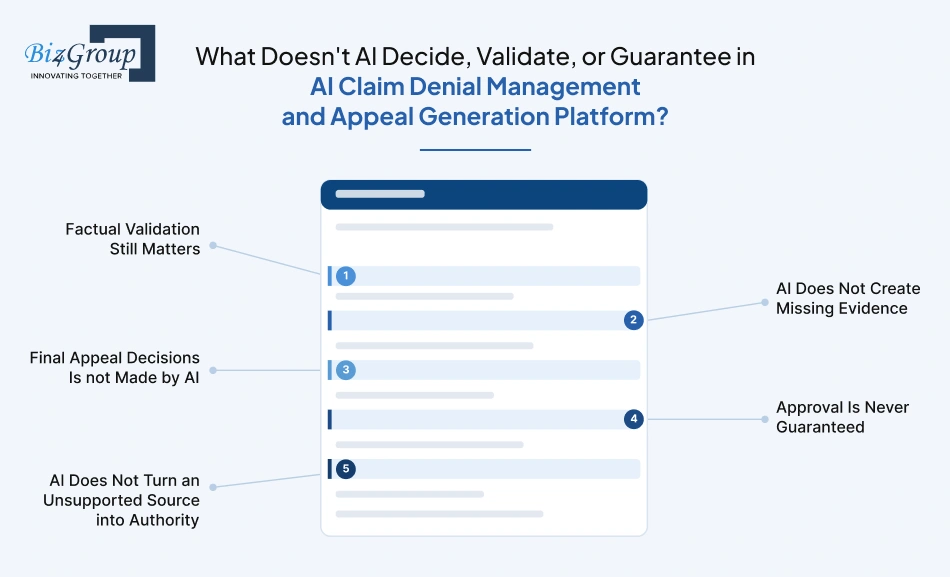
AI does not have the authority to turn an AI-generated recommendation into a verified fact or a guaranteed recovery outcome. In automated healthcare claim denial management, the system can process and reason over available information, but unsupported information remains unsupported, and the final appeal decision stays with your organization.
Factual Validation Still Matters
An AI-generated appeal still has to be checked against the underlying claim record.
If the case contains a CARC/RARC code, EOB, payment detail, clinical documentation, or other claim information, the system cannot treat an extracted or generated value as correct simply because it appears plausible.
For example, if a claim contains conflicting information, AI can flag or reason over the issue; it cannot invent the correct value to resolve it.
AI Does Not Create Missing Evidence
Generated text is not evidence.
If an appeal requires an operative note, authorization record, medical record, EOB, contract provision, or another supporting document that is not available, AI cannot create one and present it as part of the case.
The same applies to DWC forms, fee schedules, payer documentation, or other source material: if the required source is unavailable, the gap has to remain visible rather than being filled with fabricated information.
Final Appeal Decisions Are Not Made by AI
The system can prepare the recommendation and appeal draft, but it does not independently decide that an appeal is ready to go.
Your team remains responsible for:
- Verifying the facts.
- Reviewing the supporting evidence.
- Confirming the appeal position.
- Approving the final action.
Approval Is Never Guaranteed
An AI denial management solution can strengthen the preparation and consistency of an appeal; it cannot guarantee that a payer will overturn the denial.
The payer still makes the adjudication decision. AI builds the case from the information available to it, but it cannot promise the outcome of that case.
AI Does Not Turn an Unsupported Source into Authority
This is particularly important when an appeal references payer rules, contracts, statutes, or regulations.
If the applicable source is not available or cannot be properly grounded, the system cannot legitimately present a citation as authoritative. AI claim denial management system's product framework explicitly treats unsupported references as a grounding issue rather than filling the gap with an invented authority.
The boundary is simple in AI claim denial navigation: AI can generate and recommend; it cannot manufacture facts, evidence, authority, or outcomes.
Where Does Human Review Fit in the AI Appeal Workflow?
Human review sits at the final quality-control stage, after the appeal draft and supporting package have been prepared and before anything is approved for submission.
For Healthcare Practice Owners and Administrators wondering, "I want to use AI for claim appeals, but I do not want it making the final decision or submitting an appeal without human approval. How does human review work?"
The reviewer checks the generated appeal, verifies the supporting information, makes necessary edits, and records the final decision.
Review the Generated Appeal
Your reviewer examines the:
- Appeal rationale and requested reconsideration
- Claim and financial information
- Supporting documentation
- Payer or contractual references
- Any flagged gaps or low-confidence information
For medical billing appeal management, this creates a clear checkpoint between AI-generated output and the final appeal action.
Accept, Edit, or Reject
The reviewer then determines what happens to the draft and can likewise accept, edit, or reject the appeal generated by AI.
The appeal builder maintains the version history and reviewer decision record, giving your team an auditable trail of how the appeal progressed.
Keep Submission Under Approval
The generated appeal does not move directly to the payer simply because the draft is complete. Submission remains an approved action, preserving control over the final claim appeal.
That is the practical role of human review in AI claim denial management services: not rewriting the appeal from scratch but providing the final validation and authorization before it moves forward.
What Happens When the Information Needed for an Appeal Is Missing?
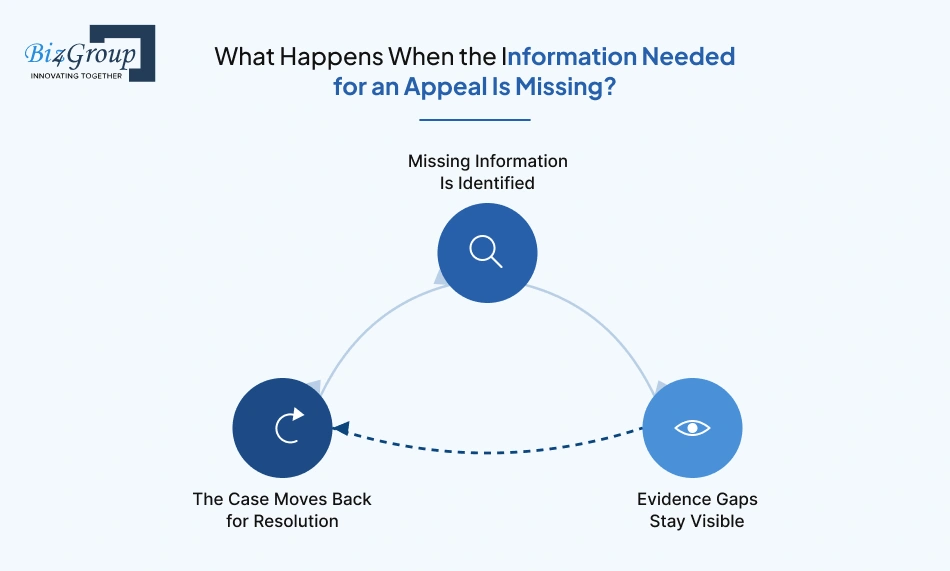
The case is held at the point where information is insufficient, with the missing documentation or evidence identified before the appeal moves forward.
Missing Information Is Identified
The gap may be in the claim record, payment information, or supporting documentation. For example:
- EOB/ERA information is incomplete
- A required clinical record is unavailable
- Authorization documentation is missing
- A contract provision or payer requirement is not available
- Supporting evidence identified for the denial is absent
For AI insurance claim denial management, this distinction matters: an incomplete case remains incomplete until the required information is obtained or verified.
Evidence Gaps Stay Visible
The AI claim denial management and appeal generation platform does not treat generated language as a substitute for a missing source document.
If an appeal requires an EOB, medical record, authorization, contract provision, or other supporting material, that item remains an evidence gap until it is available. The workflow of the AI appeal generation platform specifically incorporates missing-documentation identification and evidence completeness into the recovery process.
This is particularly important when the case involves payer-specific requirements, CARC/RARC codes, or documentation tied to the denial.
The Case Moves Back for Resolution
Once the missing input is identified, your team can address that specific gap instead of repeatedly reviewing the entire claim.
The workflow then resumes when the required information is available and verified. That keeps automated healthcare claim denial management tied to the actual case record rather than allowing an incomplete file to move forward on assumptions.
The practical outcome: missing information becomes a clearly identified resolution item, not something the system silently fills in.
What Should Healthcare Organizations Look for in an AI Appeal Generation Platform?
When you evaluate an AI claims denial management platform, look beyond whether it generates an appeal letter. The more useful question is whether it can handle the information and controls surrounding that appeal from the original denial through recovery tracking.
Denial-Specific Analysis
Start by checking whether the platform understands why the claim was denied and can work with the actual denial information rather than applying the same logic to every case.
Look for:
- CARC/RARC interpretation
- AI denial prioritization and categorization
- AI claim denial prediction
- Payer-specific denial patterns
- Identification of the issue requiring resolution
Claim, Payment, and Document Context
The platform needs access to the information that gives the denial its context. Without that connection, appeal generation becomes disconnected from the underlying claim.
Check whether it can work across:
- Claim and bill records
- Payment information
- EOBs and ERAs
- DWC Fee Schedules and State WC Statutes
- WC Carrier Rules
- Clinical and administrative documents
- Relevant claim-level metadata
Evidence Intelligence
Evidence handling deserves its own evaluation. The platform should help your team understand whether the available documentation actually supports the case and where additional evidence is required.
Look for:
- Missing-document identification
- Evidence completeness status
- Supporting-document organization
- Document-to-claim association
- Evidence provenance
Payer and Contract Intelligence
Payer requirements and reimbursement terms can materially affect how a denial is addressed. Evaluate whether the platform can bring the relevant contractual and payer context into the case.
Check for the ability to work with:
- Contracted reimbursement terms
- Payer-specific requirements
- Fee schedules
- Applicable rules or policies
- Effective dates and contract versions
Case-Specific Appeal Generation
The output should reflect the individual's denial, and the information assembled for that case, not simply produce another templated letter.
A useful platform should provide:
- Structured appeal rationale
- Requested reconsideration
- Relevant claim and financial information
- Supporting-document checklist
- Editable appeal output
- Complete appeal package
Human Review and Control
Automated claim appeal generation is only one part of the workflow. Evaluate how much control your authorized reviewers have before an appeal moves forward.
Important controls include:
- Accept, edit, or reject actions
- Reviewer decision records
- Version history
- Confidence or exception handling
- Approval before submission
Post-Appeal Tracking
Do not stop your evaluation at the point where the letter is generated. The recovery process continues after submission, so the platform should give your team visibility into what happens next.
Look for tracking across:
- Submission status
- Expected versus actual recovery
- Ageing and SLA
- Follow-up activity
- Payer communication
- Appeal outcomes
- Re-appeal workflow
This evaluation criteria now gives you a more useful standard: do not ask whether an AI platform can write an appeal; ask whether it can support the complete denial-to-recovery workflow around that appeal.
How Does Biz4Group's Bill Matters Fit These Requirements?
It brings the key capabilities needed to manage the denial-to-recovery workflow together under one roof. Instead of treating them as separate activities, the platform connects them through its defined product modules:
- Denial Intelligence
- Bill/Claim Management
- Payment/EOB/ERA Management
- AI Document & EOB Processing
- Billing Packet & Evidence Intelligence
- AI Contract Intelligence
- Appeal/Re-Appeal Builder
- Appeal Tracker & Follow-up
Together, these modules provide the foundation for analyzing the denial, working with the relevant claim payment context, and tracking the recovery process.
Your Appeal Workflow Can Do More
Connect denial analysis, evidence, appeals, and recovery in one place.
Explore the PlatformWrapping Up
AI can take much of the manual work out of claim denial management and appeal preparation, but its value is not simply in writing an appeal faster. The real advantage comes from connecting the information behind the denial, supporting evidence, payer requirements, and appeal rationale into a reviewable workflow.
For your team, that means less time spent assembling information and starting appeals from scratch, while keeping factual validation, approval, and submission decisions where they belong with authorized reviewers.
This approach is reflected in Bill Matters, developed by Biz4Group LLC, an AI product development company in USA, with a focus on practical AI solutions that support complex business workflows.
If you are exploring how AI can strengthen your denial and appeal operations, schedule a strategy call with our team to discuss how an AI claim denial management and appeal generation platform can fit your organization's workflow.
FAQ's
1. What can AI automate in the healthcare claim denial and appeals process?
AI can automate document intake, denial-code interpretation, claim and payment information review, evidence-gap identification, denial prioritization, appeal rationale generation, supporting-document checklists, and appeal tracking. Human reviewers still control final approval and submission.
2. How does AI identify the reason behind a medical claim denial?
AI can process denial information from sources such as EOBs and ERAs, interpret CARC/RARC codes, and connect those findings with claim and payment context. This helps distinguish the stated denial code from the underlying issue requiring resolution.
3. How does AI determine what evidence should be included in a claim appeal?
AI can compare the denial issue with the documentation available for the case and identify evidence gaps or supporting records relevant to that denial. It can then produce a documentation checklist and organize the available evidence around the appeal.
4. Can AI tailor an appeal based on the payer, denial code, and clinical documentation?
Yes. A specialized AI healthcare appeal generator can use payer context, denial information, claim details, and available clinical documentation to build a case-specific appeal rather than relying on a generic template. Applicable contract or rule references can also be incorporated when properly grounded.
5. What parts of an AI-generated claim appeal still require human review?
Human review covers the accuracy of the case information, supporting evidence, clinical or contractual assertions, appeal rationale, requested action, and final package. An authorized reviewer can edit, accept, or reject the output before the appeal is approved for submission.
6. How can healthcare organizations use AI to prioritize which denied claims to appeal first?
AI can evaluate open denials against factors such as denial characteristics, claim value, recovery opportunity, deadlines, and available evidence. This allows AI denial prioritization to surface higher-priority cases instead of leaving teams to work through a denial queue manually.
7. We have hundreds of denied claims waiting for review, so how can AI help us identify which denials are worth appealing first?
AI can assess the denial queue, identify the underlying denial issue, consider claim value and recovery potential, and surface higher-priority opportunities. This helps your team direct limited appeal capacity toward denials that warrant attention first.
8. I am worried that an AI-generated appeal could contain incorrect clinical or payer information. How can I verify what the AI drafts?
Review the draft against the underlying claim, EOB/ERA, clinical records, payer requirements, and approved contract or policy sources. AI-generated information should remain traceable to available case evidence, with an authorized reviewer validating the draft before submission.
