 Location :
Orlando, FL, USA
Location :
Orlando, FL, USA +1 (407) 714-1616
 info@biz4group.com

- AI cost reduction begins with understanding true cost drivers such as infrastructure, data, integration, and ongoing model upkeep.
- Clear AI cost reduction strategies are essential to prevent overspending and ensure AI initiatives scale with measurable business value.
- The most reliable way to reduce AI project costs is by focusing on high ROI use cases, lean architectures, and cost-efficient AI solutions.
- Tracking business aligned metrics allows leaders to optimize AI investment costs and make confident decisions about scaling or stopping AI initiatives.
- With deep experience in AI cost optimization for businesses, Biz4Group helps organizations plan, build, and govern AI systems that deliver value without unnecessary spending.
If you're investing in AI right now, you're probably excited about what it can do. Smarter decisions. Faster operations. New revenue streams.
But there's a quieter reality many teams run into after the first few months.
- Costs start creeping up.
- Cloud bills spike without warning.
- Projects that looked reasonable on paper suddenly feel expensive to maintain.
You're not alone. We see this pattern often when businesses move fast on AI without clear cost guardrails.
According to recent research, the average monthly AI expenditure is projected to increase by 36 percent in 2025, as organizations expand AI use beyond pilots into production. Yet only about half of business leaders say they can clearly measure ROI from those investments.

Another data point highlights how widespread AI adoption has become. In 2025, nearly 78 percent of companies globally are using AI in some form, making cost control a growing concern for leadership teams.
These numbers explain why AI cost reduction is now a priority for executives, not just technical teams.
Without clear AI cost reduction strategies and intentional planning, costs can climb quickly. Cloud usage expands. Models require frequent updates. Teams experiment without clear success metrics. Before long, you may struggle to reduce AI project costs or explain how spending connects to business value.
You have probably felt this tension already. You want innovation. You want speed. But you also want predictability and control.
We have worked with many US-based organizations facing this exact challenge. As an experienced AI development service provider, we see that the difference between successful AI initiatives and expensive missteps often comes down to early decisions around scope, budgeting, and governance.
This guide is built to help you avoid those mistakes.
We will break down what truly drives AI costs, where overspending usually starts, and how you can apply practical AI cost optimization for businesses without slowing innovation. You will also learn how to track value, manage budgets across teams, and invest confidently in enterprise AI solutions that scale responsibly.
Let's start by looking at the real reasons AI projects become expensive in the first place.
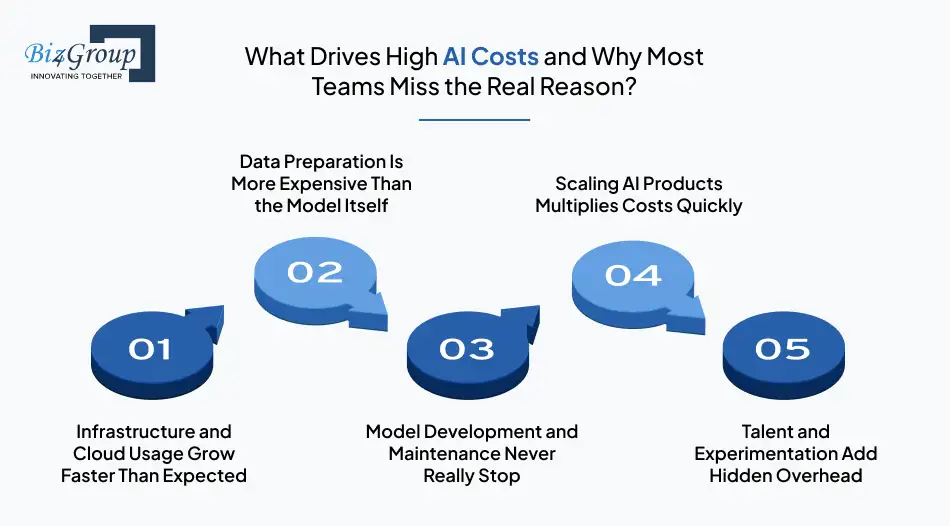
What Drives High AI Costs and Why Most Teams Miss the Real Reason?
When AI projects start going over budget, it rarely happens all at once. Costs build quietly. Many teams only notice the problem when monthly bills spike or timelines stretch.
To achieve real AI cost reduction, you first need to understand where the money actually goes. Most businesses underestimate these cost drivers because they sit outside traditional software planning.
Let's break them down clearly.
1. Infrastructure and Cloud Usage Grow Faster Than Expected
AI systems consume resources continuously. Training AI models, running inference, storing data, and scaling environments all add up quickly.
As usage increases, cloud bills rise in ways that feel unpredictable. This is one of the biggest reasons leaders struggle to reduce AI project costs after launch.
Many teams also overlook AI integration costs. Connecting AI systems with existing tools, data sources, and workflows often requires more effort and infrastructure than planned.
2. Data Preparation Is More Expensive Than the Model Itself
AI does not run on clean data by default. Data collection, cleaning, labeling, and maintenance demand time, tools, and people.
These activities continue long after deployment. If data pipelines are not designed carefully, ongoing costs can quietly drain budgets and limit AI cost optimization for businesses.
3. Model Development and Maintenance Never Really Stop
Initial builds are only the beginning. Models need updates, tuning, and retraining as data changes.
This ongoing work is a major contributor to long-term spending. Many teams underestimate the effort involved in AI model development and fail to plan for it as a recurring cost.
4. Scaling AI Products Multiplies Costs Quickly
AI behaves very differently at scale. What works for a pilot can become expensive in production.
Inference volume grows. Storage expands. Performance expectations rise. Businesses building AI-powered platforms often see costs increase sharply as user adoption grows.
This is especially common in SaaS environments, where AI SaaS product development cost can escalate if scalability is not considered early.
5. Talent and Experimentation Add Hidden Overhead
AI teams need specialized skills. Hiring, onboarding, and retaining that talent is expensive.
On top of that, experimentation without clear guardrails leads to duplicated efforts and unused models. These patterns make AI cost reduction strategies harder to apply later.
Is Your AI Spend Growing Faster Than Your Results?
In 2025, over 70% of businesses using AI say cost control is their biggest challenge, and nearly half struggle to measure ROI clearly. AI cost reduction works best when it is planned early, not patched later.
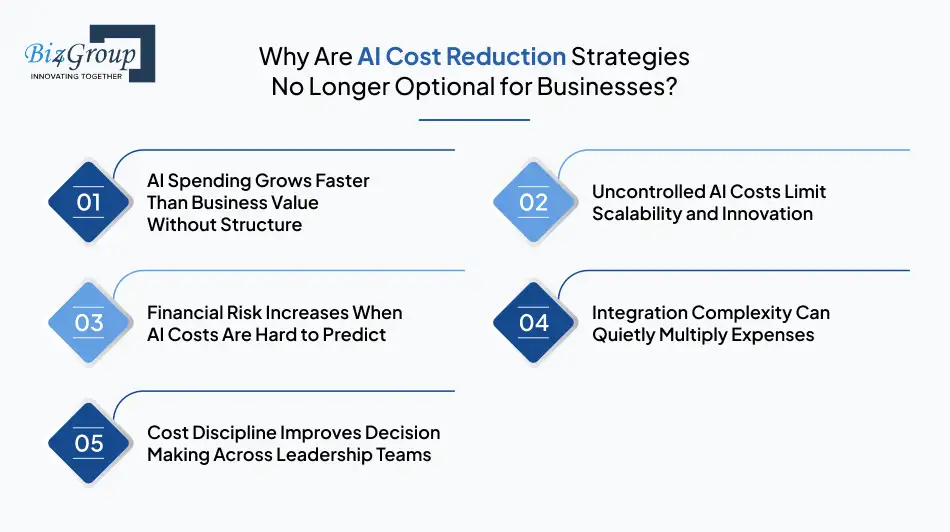
Contact Biz4GroupWhy Are AI Cost Reduction Strategies No Longer Optional for Businesses?
AI initiatives no longer sit on the sidelines. They now influence revenue, operations, customer experience, and long-term competitiveness. That shift changes how leaders must think about spending. AI cost reduction is no longer about saving money. It is about protecting the business from financial risk while scaling responsibly.
1. AI Spending Grows Faster Than Business Value Without Structure
As AI adoption expands, spending often accelerates before value becomes visible. Teams deploy tools quickly, experiment freely, and scale infrastructure without clear checkpoints. Without AI cost reduction strategies, it becomes difficult to connect AI spend to outcomes, making it harder to justify continued investment or course correction.
2. Uncontrolled AI Costs Limit Scalability and Innovation
When budgets spiral early, leaders are forced to slow down or cancel promising initiatives later. This creates hesitation around future AI projects. Businesses that focus on AI cost optimization for businesses early can scale with confidence, knowing their foundation supports growth instead of restricting it.
3. Financial Risk Increases When AI Costs Are Hard to Predict
AI costs fluctuate based on usage, data volume, and system behavior. Without planning, these fluctuations create forecasting challenges for finance teams. Applying structured approaches such as AI automation services helps reduce manual inefficiencies and stabilize operational costs over time.
4. Integration Complexity Can Quietly Multiply Expenses
AI rarely works in isolation. It must connect with existing systems, workflows, and data sources. Each integration introduces ongoing cost and maintenance overhead.
Businesses that ignore this reality often underestimate long-term spending, while those investing in structured AI integration services gain better visibility and control from the start.
5. Cost Discipline Improves Decision Making Across Leadership Teams
When AI spending is transparent and intentional, leadership teams make better choices. They prioritize use cases with measurable value and stop funding low impact initiatives sooner. This discipline is essential for leaders who want to reduce AI project costs without slowing progress or stalling innovation.
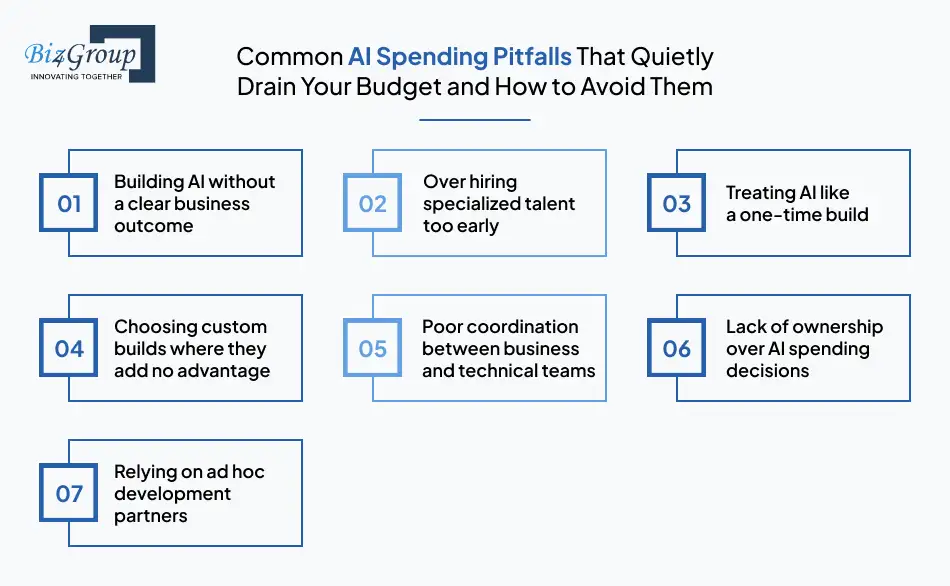
Common AI Spending Pitfalls That Quietly Drain Your Budget and How to Avoid Them
Many AI projects do not fail because of bad technology. They fail because of small decisions that compound over time. These mistakes often feel harmless early on, but they directly block AI cost reduction and make it harder to reduce AI project costs once systems are live.
The table below highlights the most common pitfalls businesses face and what you can do differently.
|
AI Spending Pitfall |
Why It Drives Overspending |
How to Avoid It |
|
Building AI without a clear business outcome |
Teams start projects based on curiosity or pressure rather than value. This leads to ongoing spending with no measurable return and weak AI cost optimization for businesses. |
Define success metrics before development starts and tie funding to specific business outcomes. |
|
Over hiring specialized talent too early |
Bringing in large AI teams before validation increases payroll costs and creates idle capacity. Many leaders rush to hire AI developers without confirming long term needs. |
Start lean. Validate use cases first, then scale talent based on proven demand. |
|
Treating AI like a one-time build |
AI systems require updates, monitoring, and tuning. Assuming costs stop after launch causes budget shocks later and weakens AI cost reduction strategies. |
Plan for AI as an ongoing product with allocated operational budgets. |
|
Choosing custom builds where they add no advantage |
Custom development increases complexity and maintenance costs. Many teams over engineer solutions when simpler approaches work. |
Evaluate whether differentiation truly requires custom development before committing it. |
|
Poor coordination between business and technical teams |
Misalignment causes rework, duplicated tools, and wasted experimentation. This makes AI spending control methods difficult to enforce. |
Align leadership, finance, and engineering teams around shared goals and spending limits. |
|
Lack of ownership over AI spending decisions |
When no one owns the budget, costs spread across teams without accountability. This slows AI cost saving efforts and creates blind spots. |
Assign clear budget ownership and approval responsibility for every AI initiative. |
|
Relying on ad hoc development partners |
Short-term vendors often optimize for speed, not sustainability. Working without a long-term Custom software development company mindset increases technical debt and future costs. |
Choose partners who plan for scalability, governance, and cost control from day one. |
Avoiding these mistakes early gives you a real advantage. When you recognize where overspending begins, you gain the clarity needed to apply AI cost reduction strategies that actually work. This awareness makes it easier to reduce AI project costs, strengthen AI spending control methods, and build a foundation for long term AI cost optimization for businesses.
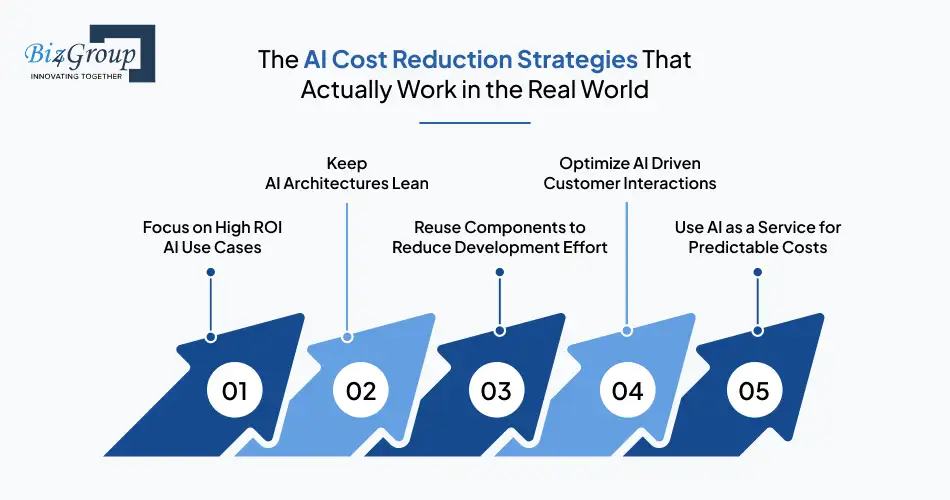
The AI Cost Reduction Strategies That Actually Work in the Real World
Strong execution is where AI cost reduction becomes real. Once priorities are clear and mistakes are avoided, the focus shifts to making smart build and deployment decisions that help you reduce AI project costs without slowing innovation or sacrificing quality.
1. Focus on High ROI AI Use Cases
Spreading budgets across too many ideas weakens outcomes and increases waste. Teams that commit early to a small number of high value initiatives see better results and stronger AI cost optimization for businesses. Clear prioritization keeps investment aligned with measurable impact.
Key actions:
- Rank use cases by financial and operational return
- Fund fewer initiatives with clearer success criteria
- Pause or stop low impact experiments quickly
2. Keep AI Architectures Lean
Overbuilt systems increase development time and long-term maintenance costs. Many teams design for scale before it is needed, which works against AI cost reduction strategies. Partnering with an experienced AI app development company helps align architecture choices with real demand.
Cost control steps:
- Right size models and infrastructure
- Avoid unnecessary customization
- Design for simplicity first
3. Reuse Components to Reduce Development Effort
Building everything from scratch multiplies cost and delays delivery. Reusable pipelines, models, and services help lower spending and improve consistency. Working with an AI product development company supports repeatable and cost-efficient execution.
Ways to apply this:
- Standardize data workflows
- Share models across teams
- Build modular AI systems
4. Optimize AI Driven Customer Interactions
Customers facing AI systems often generate continuous usage and recurring costs. Without careful control, these expenses grow quickly. Teams that collaborate with an AI chatbot development company can manage interaction volume while protecting experience quality.
Optimization actions:
- Control inference frequency
- Route requests intelligently
- Track cost per interaction
5. Use AI as a Service for Predictable Costs
Not every AI workload needs owned infrastructure. Consumption-based services help businesses manage variability and improve AI budget management strategies. Using AI as a service APIs allows teams to scale usage while keeping spending transparent and flexible.
Best practices:
- Pay only for what you use
- Avoid idle infrastructure costs
- Adjust capacity based on demand
This tighter structure keeps the focus on what matters most and makes the strategies easier to scan and apply.
Are You Building AI That Scales or AI That Gets Expensive?
The right strategies can lower AI development and deployment costs without slowing innovation. The wrong ones quietly lock you into long term spending.
Talk to an AI Cost Optimization ExpertHow to Measure ROI and Optimize AI Investment Costs Over Time?

Reducing AI spend is only half the job. To make AI cost reduction sustainable, you need proof that your investments are delivering real business value. Without clear measurement, even well-planned initiatives can lose support or drift into waste.
1. Define ROI in Business Terms, Not Technical Metrics
Many teams track model accuracy or system uptime but struggle to explain how AI improves revenue, efficiency, or decision quality. To optimize AI investment costs, ROI must be tied to outcomes leadership cares about. This clarity helps you decide which initiatives deserve more funding and which ones should stop.
2. Track Cost per Outcome, Not Just Total Spend
Total AI spend rarely tells the full story. What matters is how much value you get for every dollar invested. Measuring cost per prediction, cost per automated task, or cost per customer interaction gives you insight into whether your AI cost reduction strategies are actually working.
3. Evaluate AI Performance as Behavior, Not Just Output
Advanced AI systems act over time, not in single responses. Monitoring how systems adapt, respond, and make decisions helps you understand long term value. Solutions built around an AI agent allow teams to evaluate performance based on outcomes achieved, not just actions taken.
4. Optimize Investment Based on Real World Usage Patterns
AI systems rarely behave as expected once users interact with them at scale. Usage data reveals where resources are underused or overconsumed. Teams working with agentic AI development approaches can refine system behavior dynamically, which supports ongoing AI cost optimization for businesses.
5. Decide When to Scale and When to Stop
Not every AI initiative should grow indefinitely. ROI tracking gives leaders confidence to expand successful systems and shut down those that fail to deliver. This discipline is essential to reduce AI project costs and prevent long term budget drain from low impact experiments.
Best Practices to Manage AI Budgets Effectively Across Teams
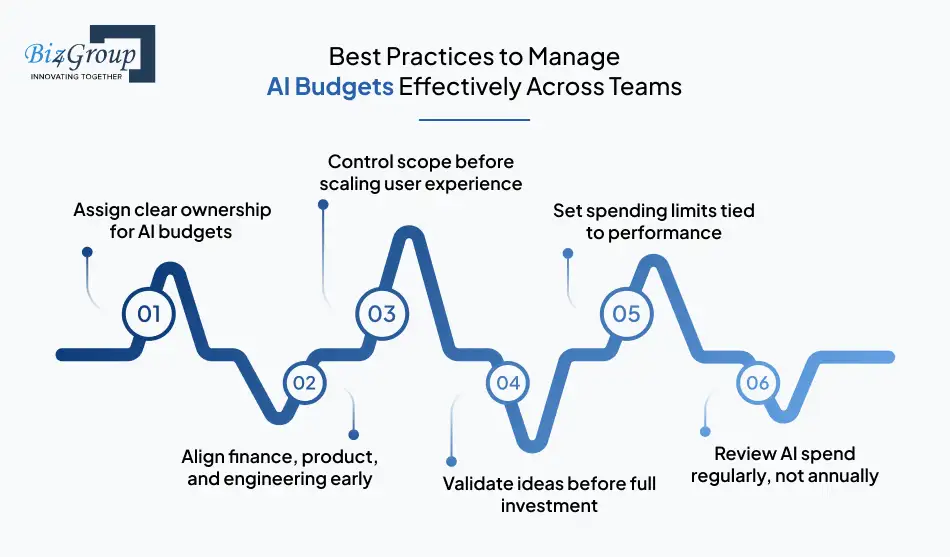
Once AI initiatives prove value, the challenge shifts from execution to control. Without shared ownership and visibility, even high performing systems can drift into overspending. Strong AI budget management strategies help organizations maintain AI cost reduction as AI adoption spreads across teams.
The table below outlines proven practices that support long term AI cost optimization for businesses.
|
Best Practice |
Why It Matters for AI Cost Reduction |
How Teams Can Apply It |
|
Assign clear ownership for AI budgets |
When no single owner is accountable, costs spread across departments and become difficult to track. Clear ownership strengthens AI spending control methods and speeds up decision making. |
Assign budget responsibility at the product or initiative level with defined approval authority. |
|
Align finance, product, and engineering early |
Misalignment causes rework, delays, and duplicated tooling. This directly increases spending and weakens AI cost saving techniques. |
Establish shared planning sessions and regular cost reviews across teams. |
|
Control scope before scaling user experience |
Poorly planned interfaces increase usage friction and operational load. Investing early in UI/UX design helps manage demand and prevent unnecessary system calls. |
Design interfaces that guide users toward efficient interactions and reduce repeated requests. |
|
Validate ideas before full investment |
Scaling unproven ideas locks in long term costs without guaranteed returns. Lean validation supports ways to prevent overspending on AI projects. |
Use MVP development to test value before committing full budgets. |
|
Set spending limits tied to performance |
Unlimited experimentation creates financial risk. Guardrails help teams innovate responsibly while maintaining AI cost reduction planning for enterprises. |
Define cost thresholds that trigger review or optimization actions. |
|
Review AI spend regularly, not annually |
AI costs change quickly as usage patterns evolve. Infrequent reviews delay corrective action and inflate spend. |
Conduct monthly or quarterly reviews focused on usage, value, and efficiency. |
These practices turn cost control into a shared responsibility instead of a bottleneck. When teams operate with visibility and alignment, AI cost saving becomes part of everyday decision making rather than a reaction to budget overruns.
How Biz4Group Helped Businesses Save Cost While Delivering Impactful Results?
Delivering robust technology that also controls spending is not accidental. It requires planning, reuse, smart architecture, and an execution mindset focused on measurable outcomes. Below are a few projects where AI cost reduction strategies made a meaningful difference in results and budget.
1. Quantum Fit – AI Personal Development App

Project Overview
Quantum Fit is a comprehensive mobile platform designed to help users improve across six key wellness areas, including physical, mental, social, and sleep health through personalized insights and progress tracking. The solution integrates smart guidance, habit monitoring, and tailored plans into one package.
Key Aspects of the Project
- Unified wellbeing support across multiple life dimensions
- Personalized habit and goal tracking backed by data
- Visual analytics showing progress and patterns
- Interactive AI chatbot for real time motivation and advice
How We Optimized Cost
We implemented a token cost management strategy that prioritized cost effective AI solutions interactions, reducing expensive model calls. Frequent requests were cached to limit repetitive AI consumption, lowering spending while maintaining a dynamic, responsive user experience.
2. AI-Powered Social Media App

Project Overview
This social media application leverages advanced technology to enable users to create engaging images and videos from text prompts and share them with their network. It blends creative AI capabilities with traditional social features to offer a fresh, intuitive content experience.
Key Aspects of the Project
- Text to image generation using state of the art models
- Text to video creation for richer content formats
- Integrated user accounts and media sharing
- Backend content reuse for faster user experiences
How We Optimized Cost
A smart content caching mechanism was put in place to store previously generated media assets, reducing repeated calls to expensive AI services. This approach significantly lowered token-based costs and improved system responsiveness without sacrificing quality or creativity.
3. Coach AI - Automation for Coaches and Educators
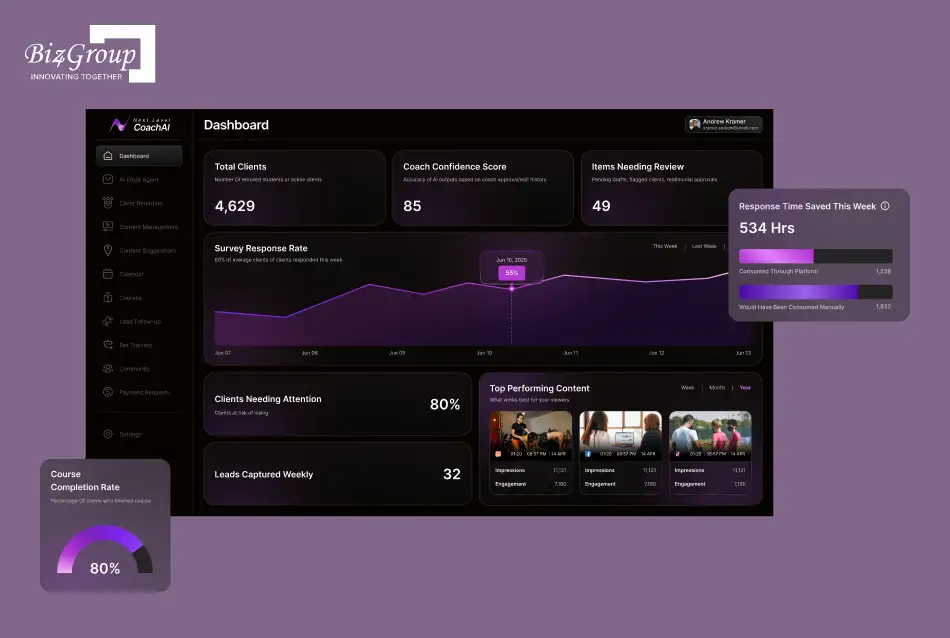
Project Overview
Coach AI is a workflow automation solution built for coaches, educators, and content creators. It combines powerful automation capabilities with user-friendly design to reduce time spent on repetitive tasks and enhance client engagement through personalized content and workflow intelligence.
Key Aspects of the Project
- Multiple AI agents managing diverse workflows
- Automated content generation for outreach and engagement
- Integrated performance tracking across platforms
- Custom task automation tailored to coaching needs
How We Optimized Cost
By designing specialized AI agents for task automation, repetitive manual work was eliminated, reducing operational overhead and client servicing costs. The modular agent approach also made it easier to reuse components across tasks, which kept development and maintenance expenses under control.
What These Projects Show
Across different industries and use cases, cost control doesn't require sacrificing capability.
With structured design, intelligent reuse of services, and smart integration, you can:
- Manage AI workload costs without limiting user experience
- Reduce unnecessary API and model calls
- Reuse components to shorten development cycles
- Deliver high value products without excessive operational spending
These examples highlight how cost efficient AI solutions can drive both performance and financial sustainability.
Want Similar Cost Savings in Your AI Projects?
What you saw in these projects was not luck. It was the result of deliberate planning, disciplined execution, and experience across industries.
Contact Biz4Group TodayConclusion: Building AI That Delivers Value Without Breaking the Budget
AI success is not defined by how advanced your models are. It is defined by how well your investments translate into measurable business outcomes. Teams that treat AI as a long-term capability, not a short-term experiment, are the ones that achieve lasting AI cost reduction and sustainable growth.
Throughout this guide, we have shown how thoughtful planning, disciplined execution, and shared accountability help businesses reduce AI project costs, strengthen AI cost optimization for businesses, and avoid the common traps that lead to overspending.
When cost control is built into decisions from day one, AI becomes a strategic asset instead of a financial liability.
At Biz4Group, we have spent years helping startups and enterprises turn ambitious AI ideas into production ready systems that scale responsibly. Our experience across product development, automation, integration, and enterprise grade delivery allows us to approach every AI initiative with financial discipline and technical depth.
If you are serious about building AI that delivers results without unnecessary spending, working with a partner who understands both innovation and cost control makes all the difference.
FAQ
1. What is AI cost reduction and why does it matter for businesses today?
AI cost reduction refers to the process of controlling, optimizing, and lowering the total cost of building, deploying, and maintaining AI systems. It matters because unchecked AI spending can quickly erode ROI and slow innovation. Businesses that apply structured AI cost reduction strategies are better positioned to scale responsibly and achieve long term AI cost optimization for businesses.
2. How can business leaders reduce AI project costs without slowing innovation?
You can reduce AI project costs by prioritizing high impact use cases, avoiding over engineered solutions, and aligning AI initiatives with measurable outcomes. Smart planning, lean execution, and continuous review help leaders apply AI cost saving techniques while still delivering innovation that supports growth.
3. What are the biggest cost drivers that prevent AI cost saving?
The most common cost drivers include infrastructure usage, data preparation, model retraining, and integration complexity. These costs often increase over time if not monitored closely. Addressing these areas early supports AI cost reduction planning for enterprises and prevents unnecessary spending across the AI lifecycle.
4. How do companies control AI infrastructure and cloud costs effectively?
To reduce AI infrastructure and cloud costs, companies need visibility into usage patterns, realistic capacity planning, and regular performance reviews. Rightsizing resources and monitoring consumption helps improve AI budget management strategies and strengthens AI spending control methods across teams.
5. What metrics should be used for AI cost optimization for businesses?
Effective AI cost optimization for businesses focuses on business aligned metrics such as cost per outcome, cost per automated task, and value delivered over time. These metrics make it easier to optimize AI investment costs and decide which initiatives deserve further funding.
6. How can startups apply AI cost reduction strategies with limited budgets?
Startups can apply AI cost reduction strategies for startups by validating ideas early, limiting scope, and using scalable services instead of heavy custom builds. Lean execution combined with disciplined reviews helps startups prevent overspending on AI projects while still proving value to investors and stakeholders.
7. What are the best practices to manage AI budgets effectively as teams scale?
The best practices to manage AI budgets effectively include assigning clear ownership, setting spending limits, reviewing costs regularly, and aligning finance with engineering teams. These steps support long term AI cost reduction and ensure AI initiatives remain financially sustainable as adoption grows.
