 Location :
Orlando, FL, USA
Location :
Orlando, FL, USA +1 (407) 714-1616
 info@biz4group.com

- AI demand forecasting software development helps businesses predict demand accurately, optimize inventory, reduce operational risk, and support data-driven planning.
- Businesses across industries choose to build AI-powered demand forecasting software to handle demand volatility, improve cash flow visibility, and respond faster to market changes.
- Practical use cases show how organizations create AI-driven demand forecasting platforms for retail, manufacturing, and enterprise planning with measurable business impact.
- From MVP to enterprise scale, companies follow a clear process to develop AI demand forecasting systems, balancing speed, accuracy, and long-term scalability.
- $30,000-$200,000+ is the AI demand forecasting software development cost estimate, which allows leaders to plan budgets realistically while maximizing ROI through optimization and monetization strategies.
- Biz4Group LLC is a USA based partner trusted by businesses to deliver custom AI demand forecasting solutions that drive growth, reliability, and decision confidence.
What happens when your sales forecasts look right on paper but fail the moment real demand shifts? Many business leaders face this gap every quarter. AI demand forecasting software development has become a serious priority because manual forecasts struggle with volatility, seasonality, and fast changing customer behavior. Planning today requires systems that learn continuously and adapt as markets move.
In fact, companies that use advanced analytics in supply chain planning can reduce forecast errors by 20-50%, according to reports. This is why more organizations want to build AI-powered demand forecasting software that connects sales data, market signals, and inventory trends into one reliable decision layer.
As competition tightens, spreadsheets and static models slow teams down. Leaders now prefer to develop AI demand forecasting systems that respond to demand changes in near real time. These systems help teams plan procurement better, reduce excess inventory, and protect cash flow when demand becomes unpredictable.
Yet many executives still ask where to begin and what the real path looks like. This guide breaks down how to develop AI demand forecasting software for businesses in a practical way. You will see what works, what to avoid, and how the right forecasting foundation supports long-term, data-driven growth.
Understanding AI Demand Forecasting Software Development
AI demand forecasting software development refers to building intelligent systems that analyze historical data, real time signals, and external factors to predict future demand with higher accuracy. These systems learn patterns, adjust forecasts continuously, and support better planning decisions across sales, inventory, and operations.
Unlike basic forecasting tools, AI based systems are designed to grow smarter over time. They adapt as customer behavior changes, markets fluctuate, and new data becomes available.
How AI Demand Forecasting Software Works in Practice
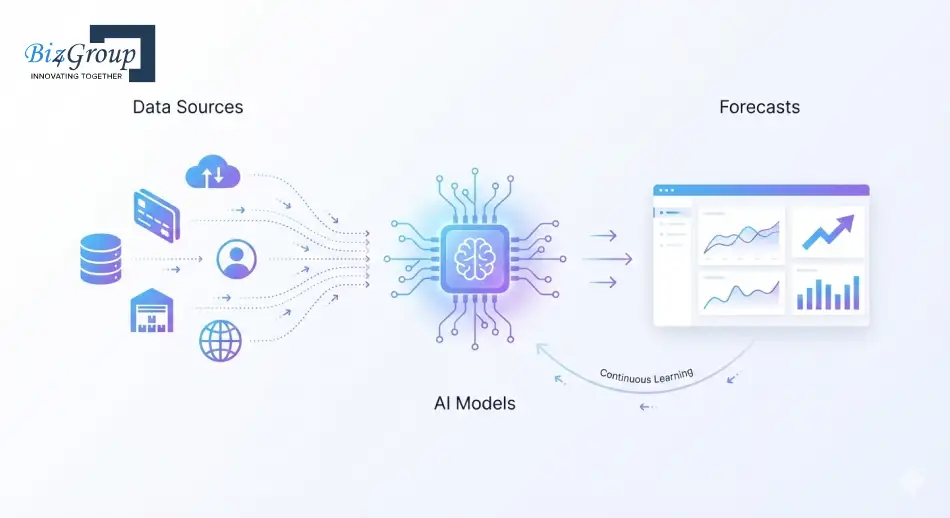
Before results show up on dashboards, there is a structured flow behind the scenes. This process starts with data and ends with actionable forecasts that business teams can trust.
Core Working Flow
- Data is collected from internal systems such as ERP, POS, CRM, and inventory tools
- External data like seasonality, pricing changes, promotions, and market trends is added
- Machine learning models analyze patterns and correlations
- Forecasts are generated at product, location, or channel level
- Models retrain automatically as new data flows in
The outcome is a forecasting engine that improves accuracy over time instead of staying static.
Core Components of AI Demand Forecasting Software
To understand how these systems scale, it helps to break them into components.
Key Components
- Data ingestion pipelines for structured and unstructured data
- Forecasting models using machine learning and time series analysis
- Prediction engines that generate short and long-term forecasts
- Dashboards for business users to review and act on forecasts
- Feedback loops that refine models based on outcomes
Each component plays a role in turning raw data into confident demand planning decisions.
AI Demand Forecasting vs Traditional Forecasting Models
Many organizations still rely on traditional forecasting. The difference becomes clear when demand volatility increases.
|
Aspect |
Traditional Forecasting Models |
AI Demand Forecasting Software |
|---|---|---|
|
Data usage |
Limited historical data |
Large historical and real time datasets |
|
Adaptability |
Static and rule based |
Continuously learning models |
|
Accuracy |
Declines with volatility |
Improves as more data is added |
|
Scenario handling |
Manual adjustments |
Automated scenario simulations |
|
Scalability |
Hard to scale across SKUs |
Scales across products and locations |
This shift explains why more companies choose to develop intelligent demand planning applications instead of relying on manual forecasts.
Forecasting accuracy affects more than planning. It impacts cash flow, customer satisfaction, and operational stability. Understanding how AI powered forecasting works sets the foundation for building systems that support consistent, data driven growth.
Why Businesses Are Investing in AI Demand Forecasting Software Development Today?
Demand patterns are no longer predictable. Customer behavior shifts faster. Supply chains face constant disruption. For many businesses, forecasting errors now cost more than delayed decisions.
This is the core reason why AI demand forecasting software development services are gaining traction across industries.
The Market Reality Driving This Shift
Business leaders are not adopting AI forecasting because it sounds innovative. They are doing it because the numbers force the decision.
According to reports, poor demand forecasting can increase inventory costs by up to 10% while reducing customer service levels.
At the same time, PwC reports that data driven organizations are three times more likely to see significant improvements in decision making.
These figures explain why forecasting accuracy has become a board level concern.
Key Pain Points Pushing Businesses Toward AI Forecasting
Traditional forecasting methods struggle under modern pressure. The gaps show up quickly in operations.
Common Challenges Businesses Face
- Overstocking that locks working capital
- Stockouts that damage customer trust
- Inaccurate seasonal planning
- Delayed reaction to demand spikes
- Manual forecasting processes that do not scale
These pain points create friction across sales, procurement, and operations teams.
Business Benefits of AI Demand Forecasting Software Development
When companies invest in develop AI demand forecasting systems, the benefits extend beyond better predictions.
Core Business Outcomes
- Improved inventory turnover and reduced holding costs
- Stronger cash flow planning
- Better coordination between sales and supply chain teams
- Faster response to market changes
- Lower risk during demand volatility
The value lies in decision confidence. Teams plan with clarity rather than assumptions.
Why Now Is the Right Time to Build AI Powered Demand Forecasting Software
Waiting often increases costs instead of reducing risk. Here is why timing matters today.
|
Business Factor |
Impact Without AI |
Impact With AI Forecasting |
|---|---|---|
|
Demand volatility |
Frequent forecast errors |
Adaptive and responsive planning |
|
Data volume |
Underutilized data |
Full data utilization |
|
Planning speed |
Slow manual cycles |
Near real time insights |
|
Scalability |
Limited growth support |
Enterprise scale forecasting |
This shift explains why organizations across retail, manufacturing, and enterprises are moving toward intelligent forecasting foundations now rather than later.
Use Cases of AI Demand Forecasting Software Development Across Industries
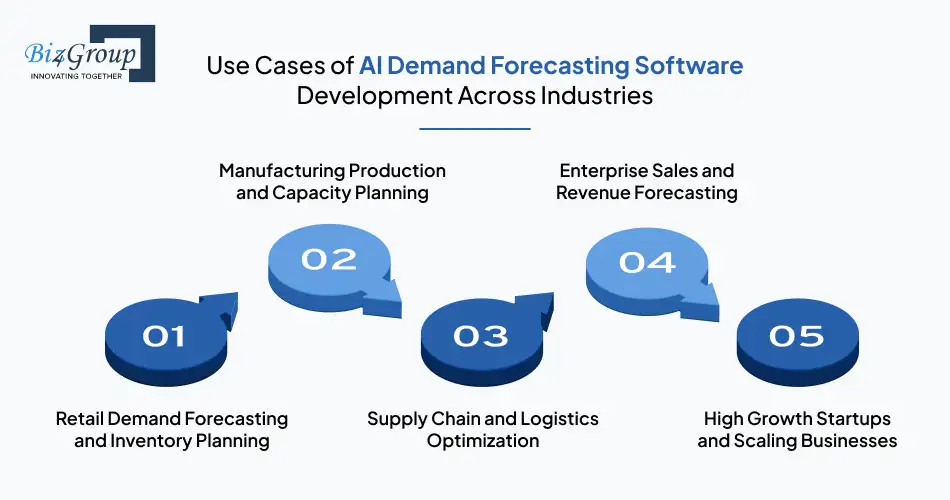
AI demand forecasting creates value when it is applied to real operational problems. Below are the most common and high impact use cases where businesses choose to build predictive demand forecasting solutions tailored to their workflows.
1. Retail Demand Forecasting and Inventory Planning
Retailers deal with seasonality, promotions, regional preferences, and fast-moving SKUs. Manual forecasts often fail to capture these shifts.
When retailers create AI-driven demand forecasting platforms, they gain visibility into demand at store, product, and channel level. Forecasts update as promotions launch or customer behavior changes.
This leads to better shelf availability, fewer stockouts, and tighter inventory control across physical and digital channels.
Also read: A complete guide to AI inventory management software development
2. Manufacturing Production and Capacity Planning
Manufacturers rely on accurate demand signals to plan production schedules, raw material procurement, and labor allocation.
By choosing to develop AI demand forecasting applications for data driven decision making, manufacturers align production output with real market demand. AI models account for lead times, supplier constraints, and historical order patterns.
This reduces excess production, avoids last minute scheduling changes, and improves plant utilization.
Also read: Guide to AI predictive maintenance software development for manufacturing
3. Supply Chain and Logistics Optimization
Supply chain teams struggle when demand forecasts are inaccurate or delayed.
Companies that build AI-powered demand forecasting software use it to predict shipment volumes, warehouse capacity needs, and transportation requirements. Forecasts adjust as orders fluctuate or disruptions occur.
This improves route planning, reduces logistics costs, and prevents bottlenecks across distribution networks.
4. Enterprise Sales and Revenue Forecasting
Large enterprises manage complex sales pipelines across regions, products, and customer segments.
When organizations create AI-enabled sales forecasting systems, they connect sales data with demand trends and market signals. Forecasts become more realistic and less dependent on manual inputs.
This improves revenue predictability, quota planning, and executive decision making.
5. High Growth Startups and Scaling Businesses
Startups face rapid demand swings with limited historical data.
By opting for custom AI demand forecasting software development, growing businesses design systems that evolve as data maturity improves. Forecasts help founders plan inventory, hiring, and cash flow without overcommitting resources.
This supports controlled growth while reducing financial risk.
Across industries, the common thread remains the same. Businesses adopt AI forecasting to replace assumptions with evidence and react faster to demand signals that matter.
Also read: A guide to real estate AI predictive analytics software development
Seeing Your Industry Here?
Companies using demand forecasting analytics reduce inventory errors by up to 50%. Are you still guessing demand?
Build Smart with Biz4GroupKey Features to Build AI Powered Demand Forecasting Software
Strong forecasting outcomes depend on the features built into the system. When businesses invest in AI demand forecasting software development, these core features ensure accuracy, scalability, and real business usability.
The table below highlights the foundational capabilities required to develop AI demand forecasting systems that support reliable planning and growth.
|
Feature |
What It Is |
What It Does |
|---|---|---|
|
Multi source data integration |
AI integration services connects ERP, POS, CRM, inventory, and external datasets |
Brings all demand related data into a single forecasting engine |
|
Historical data analysis |
Uses past sales and demand patterns |
Identifies trends, seasonality, and recurring behaviors |
|
Machine learning forecasting models |
Algorithms trained on large datasets |
Generates accurate demand predictions across products and locations |
|
Real time data processing |
Continuous ingestion of new data |
Updates forecasts as demand signals change |
|
Forecast granularity control |
Forecasting at SKU, category, or location level |
Enables precise planning instead of broad assumptions |
|
Scenario planning support |
Simulates demand changes based on variables |
Helps teams prepare for promotions, price changes, or disruptions |
|
User friendly dashboards |
Visual interfaces for business users |
Makes forecasts easy to interpret and act upon |
|
Forecast accuracy tracking |
Performance monitoring metrics |
Shows how predictions improve over time |
|
Integration with planning systems |
Connects to ERP, WMS, and supply chain tools |
Turns forecasts into execution ready actions |
|
Scalability architecture |
Cloud ready and modular design |
Supports growth without system rework |
These features form the baseline for demand forecasting software development with AI. Once these are in place, businesses can layer advanced capabilities to gain deeper forecasting intelligence and competitive advantage.
Also read: AI fashion trend forecasting assistant development guide
Advanced Capabilities in Custom AI Demand Forecasting Software Development
Once the core features are in place, advanced capabilities separate basic forecasting tools from systems that truly guide business decisions. These capabilities help organizations develop AI demand forecasting systems that handle complexity, uncertainty, and scale with confidence.
Below are advanced features that businesses prioritize when they build predictive demand forecasting solutions for long term growth.
1. Demand Sensing Using Near Real Time Signals
Advanced systems analyze short-term demand signals such as recent sales velocity, order frequency, and customer behavior changes.
This allows businesses to adjust forecasts faster instead of waiting for monthly or quarterly cycles. It is especially valuable during promotions or sudden market shifts.
2. Multi Variable Forecasting Models
Basic forecasts rely mainly on sales history. Advanced models include pricing, promotions, lead times, weather patterns, and regional demand drivers.
When companies create AI driven demand forecasting platforms, these variables help models understand why demand changes, not only when it changes.
3. Forecast Explainability for Business Teams
Advanced forecasting systems include explainability layers that show which factors influenced predictions.
This helps planners, sales leaders, and executives trust the output rather than treating it as a black box.
4. Hierarchical Forecasting Across Levels
Demand forecasts often need alignment across product, category, region, and enterprise levels.
With custom AI demand forecasting software development, businesses ensure forecasts stay consistent across all planning layers.
5. Exception Based Forecast Alerts
Advanced systems flag unusual demand patterns automatically instead of requiring constant manual monitoring.
Alerts notify teams when demand deviates from expected ranges so action can be taken early.
6. Cross-Functional Forecast Collaboration
Advanced platforms allow multiple teams to contribute context such as upcoming campaigns or supplier constraints.
When organizations develop intelligent demand planning applications, this collaboration improves forecast accuracy without overloading the model.
These advanced capabilities help businesses move from reactive planning to confident execution. They also prepare forecasting systems to support larger datasets, complex operations, and faster decision cycles.
Are Your Forecasts Smart Enough to Keep Up?
Advanced forecasting features help businesses react to demand shifts weeks earlier than traditional planning methods.
Book a Strategy Call NowTech Stack, Security, and Compliance in AI Demand Forecasting Software Development
Behind every accurate forecast sits a solid technical foundation. When businesses invest in demand forecasting software development with AI, the right tech stack ensures performance, scalability, and long-term reliability. At the same time, security and compliance protect sensitive business and customer data.
This section breaks down the technology choices and compliance requirements that support enterprise grade forecasting systems.
Recommended Technology Stack for AI Demand Forecasting Software Development
The tech stack determines how well forecasting models perform, scale, and integrate with existing systems. Below is a practical stack used to build AI-powered demand forecasting software for modern businesses.
|
Layer |
Technologies Used |
Purpose |
|---|---|---|
|
Data ingestion |
Apache Kafka, AWS Kinesis, Airflow |
Collects real time and batch data from multiple sources |
|
Data storage |
PostgreSQL, Amazon Redshift, Snowflake |
Stores structured historical and transactional data |
|
Data processing |
Python, Spark, Pandas |
Cleans, transforms, and prepares data for modeling |
|
Machine learning |
TensorFlow, PyTorch, Scikit learn |
Trains forecasting and predictive models |
|
Forecasting models |
Time series, regression, ensemble models |
Generates short and long-term demand forecasts |
|
Backend services |
FastAPI, Node.js |
Handles business logic and model execution |
|
Frontend dashboards |
React, Next.js |
Visualizes forecasts for planners and executives |
|
Cloud infrastructure |
AWS, Azure, Google Cloud |
Ensures scalability, availability, and cost control |
|
Integration layer |
REST APIs, webhooks |
Connects ERP, CRM, and inventory systems |
This modular stack allows businesses to develop AI demand forecasting systems that evolve as data volume, users, and forecasting complexity increase.
Security and Regulatory Compliance Considerations
Forecasting platforms handle sensitive operational and sales data. Security and compliance cannot be afterthoughts in AI demand forecasting software development services.
Key Security and Compliance Requirements
- Data encryption at rest and in transit to protect sensitive information
- Role-based access control to limit data exposure
- Secure API authentication and authorization
- Regular vulnerability testing and monitoring
- Audit logs for traceability and accountability
Regulatory Standards Commonly Addressed
- SOC 2 for enterprise data security practices
- GDPR for handling customer data in global operations
- CCPA for privacy compliance in the United States
- ISO 27001 for information security management
Addressing security and compliance early builds trust with stakeholders and supports enterprise adoption without friction.
A strong tech stack paired with robust security practices ensures forecasting systems remain reliable, scalable, and compliant. This foundation allows businesses to focus on extracting value from forecasts rather than managing technical risks.
How to Develop AI Demand Forecasting Software for Businesses Step by Step?
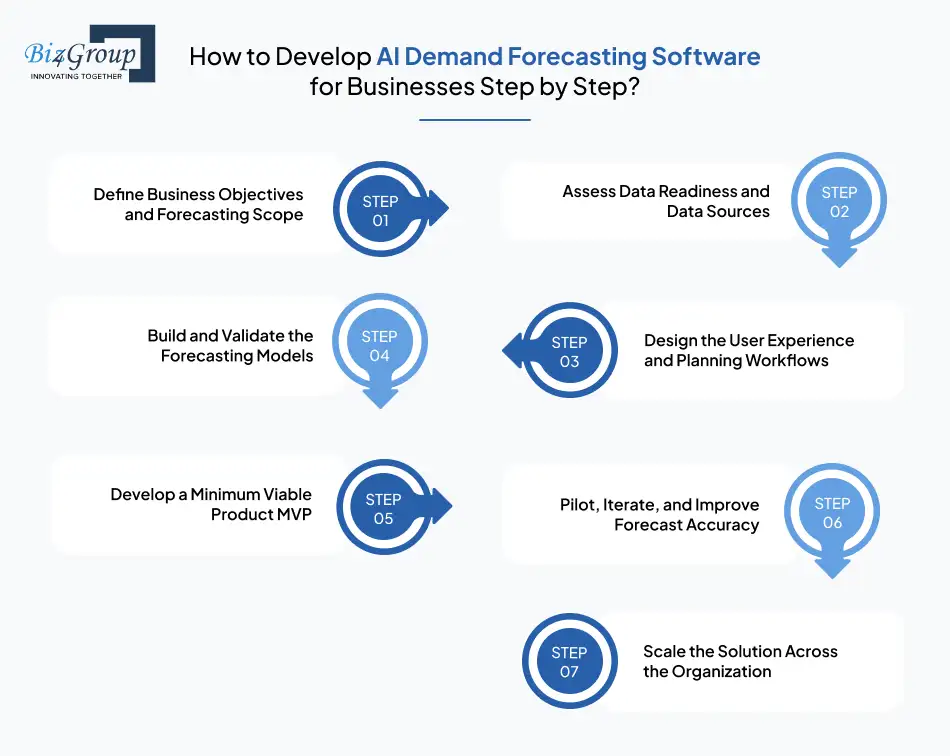
Building forecasting software requires more than strong models. The process must align business goals, data readiness, and user adoption. Below is a practical seven step approach businesses follow when they develop AI demand forecasting systems that deliver measurable outcomes.
Step 1. Define Business Objectives and Forecasting Scope
Start by clarifying why forecasting is needed and what success looks like.
This includes identifying products, regions, planning horizons, and decisions that forecasts will support.
Clear objectives prevent scope creep and ensure forecasting aligns with real operational needs.
Step 2. Assess Data Readiness and Data Sources
Before development begins, teams review historical data availability, quality, and consistency.
Sales data, inventory records, demand signals, and external factors must be mapped clearly.
This step reduces rework and sets realistic expectations for forecast accuracy.
Step 3. Design the User Experience and Planning Workflows
Forecasts only create value when teams use them.
An experienced UI and UX design company focuses on clarity, usability, and workflow alignment for planners, managers, and executives.
When businesses create AI-powered demand planning tools for business growth, intuitive dashboards drive faster adoption and better decisions.
Also read: Top 15 UI/UX design companies in USA
Step 4. Build and Validate the Forecasting Models
Models are developed, trained, and tested using historical demand patterns and business variables.
Validation ensures forecasts meet accuracy benchmarks before wider rollout.
This stage turns raw data into actionable demand insights.
Step 5. Develop a Minimum Viable Product MVP
Developing an MVP helps businesses test forecasting assumptions with limited risk. It includes essential features, core forecasts, and basic reporting.
MVPs allow teams to gather feedback early while controlling cost and complexity.
Also read: Top 12+ MVP development companies in USA
Step 6. Pilot, Iterate, and Improve Forecast Accuracy
The MVP is tested with real users and live data. Feedback highlights gaps, usability issues, and improvement areas.
Iterative refinement ensures the system evolves with business needs.
Step 7. Scale the Solution Across the Organization
Once validated, forecasting capabilities expand across products, locations, and teams.
Performance is monitored continuously to maintain accuracy as demand patterns change.
This step transforms forecasting into a long-term planning asset.
Following this structured process helps organizations build AI-powered demand forecasting software that balances speed, accuracy, and adoption while supporting long-term growth.
Also read: How to build AI software?
Why Wait Months to Validate Your Forecasting Idea?
Most MVPs take 6-8 weeks. Biz4Group can deliver one in 2-3 weeks using reusable AI components.
Contact Biz4Group TodayUnderstanding AI Demand Forecasting Software Development Cost Estimate for Businesses
One of the first questions business leaders ask is about budget. In most real-world scenarios, an AI demand forecasting software development cost estimate falls between $30,000-$200,000+, depending on scope, complexity, and scale.
To set expectations early, here is how costs typically progress as systems mature.
|
Stage |
Scope Overview |
Typical Investment Range |
|---|---|---|
|
MVP |
Core forecasting, limited data sources, basic dashboards |
$30,000-$60,000 |
|
Advanced Level |
Multiple data inputs, higher accuracy models, scenario planning |
$60,000-$120,000 |
|
Enterprise Level |
Large scale forecasting, multi region support, advanced intelligence |
$120,000-$200,000+ |
These ranges help businesses plan realistically while aligning investment with forecasting maturity.
Key Cost Drivers in AI Demand Forecasting Software Development
Costs vary because forecasting systems are built around business needs. Below are the main factors that influence budgets when companies build AI-powered demand forecasting software.
|
Cost Driver |
What It Covers |
Typical Cost Impact |
|---|---|---|
|
Business complexity |
Number of products, locations, planning horizons |
$8,000-$25,000 |
|
Data preparation |
Cleaning, structuring, and validating historical data |
$6,000-$20,000 |
|
Forecasting model development |
Training and testing demand prediction models |
$10,000-$40,000 |
|
UI and UX design |
Dashboards, workflows, usability testing |
$5,000-$15,000 |
|
MVP development |
Core features and validation cycles |
$12,000-$35,000 |
|
Iteration and tuning |
Improving accuracy based on feedback |
$8,000-$30,000 |
|
Scaling and optimization |
Supporting higher volumes and users |
$15,000-$50,000 |
Understanding these drivers helps leaders allocate budgets where forecasting impact matters most.
Hidden Costs Businesses Often Overlook
Many cost overruns happen not because development failed, but because indirect expenses were ignored during planning.
Common Hidden Cost Areas
- Data Gaps and Rework
Incomplete or inconsistent data can add $5,000-$20,000 in reprocessing and revalidation efforts. - Extended Iteration Cycles
Additional testing and tuning can increase costs by $8,000-$25,000 if not planned upfront. - User Adoption Challenges
Redesigning workflows or dashboards post launch may add $4,000-$12,000. - Scope Expansion During Pilots
Feature additions during MVP phases can push budgets up by $10,000-$30,000.
Accounting for these costs early reduces budget surprises and improves delivery timelines.
A clear understanding of costs allows decision makers to align investment with business goals. When budgets are planned around outcomes, AI forecasting becomes a growth enabler rather than a financial risk.
How Businesses Maximize ROI From AI Demand Forecasting Software Development?
Building forecasting software is only the first step. Real value shows up when forecasts improve decisions, reduce waste, and unlock new revenue opportunities. Businesses that approach ROI deliberately often recover a large part of their investment within 12-18 months, depending on scale and adoption.
This section explains how companies create AI powered demand planning tools for business growth by optimizing costs and monetizing forecasting intelligence.
Cost Optimization Levers in AI Demand Forecasting Software Development
Well implemented forecasting systems generate savings across inventory, operations, and planning cycles. The table below highlights where most ROI comes from when organizations develop AI demand forecasting systems.
|
Optimization Area |
How It Creates Savings |
Typical Impact |
|---|---|---|
|
Inventory holding reduction |
More accurate demand signals lower excess stock |
10%-30% reduction in carrying costs |
|
Stockout prevention |
Better forecasts improve product availability |
5%-15% revenue recovery |
|
Procurement planning |
Optimized order quantities reduce rush buying |
8%-20% cost savings |
|
Forecasting labor efficiency |
AI automation services reduce manual effort |
30%-50% time savings |
|
Production alignment |
Demand driven planning reduces overproduction |
10%-25% waste reduction |
|
Working capital optimization |
Lower inventory levels free up cash |
5%-12% cash flow improvement |
These savings compound over time as forecast accuracy improves and teams rely more on data driven planning.
Monetizing AI Demand Forecasting Capabilities
For product-based businesses and platforms, forecasting intelligence itself becomes a monetizable asset. Companies that build AI-powered demand forecasting software often extend value beyond internal use.
- Smarter Pricing and Promotion Strategies
Accurate demand forecasts help businesses plan promotions without eroding margins. Better timing and targeting can improve promotional ROI by 5%-10%, especially in retail and ecommerce environments.
This allows teams to drive volume while protecting profitability.
- Subscription Based Forecasting Insights
Organizations that develop intelligent demand planning applications for multiple brands or partners can package forecasting insights as premium services. Forecast dashboards, alerts, or reports are often offered as add-ons, generating recurring revenue streams.
Depending on scale, this can add 8%-15% incremental revenue annually.
- Improved Customer Fulfillment and Retention
Reliable demand planning improves order fulfillment rates. Higher service levels reduce churn and increase repeat purchases, particularly in B2B supply chains.
Retention improvements of 3%-7% often translate into meaningful lifetime value gains.
- Data Driven Expansion Decisions
Forecasting insights guide expansion into new regions or product lines. Better demand visibility lowers the risk of overexpansion and failed launches.
Avoided losses from poor planning often offset a significant portion of development investment within the first year.
When forecasting systems are tied to clear business outcomes, ROI extends far beyond cost reduction. Companies that focus on optimization and monetization turn AI demand forecasting software development into a long-term growth engine rather than a one-time technology expense.
What If Forecast Accuracy Paid for Itself?
Better demand planning can cut inventory costs by 10%-30% while improving cash flow.
Let's Talk NumbersWhen to Invest in Custom AI Demand Forecasting Software Development vs Off the Shelf Solutions?
One of the most common decision points for business leaders is whether to invest in a custom solution or buy an existing tool. Both approaches serve different goals. The right choice depends on data complexity, growth plans, and the level of control required.
The table below compares custom AI demand forecasting software development with off-the-shelf tools across business-critical factors.
|
Evaluation Area |
Custom AI Demand Forecasting Software Development |
Off the Shelf Forecasting Tools |
|---|---|---|
|
Business fit |
Built around specific workflows and planning logic |
Generic workflows designed for broad use |
|
Forecast accuracy |
Tailored models trained on business specific data |
Standard models with limited customization |
|
Data integration |
Integrates deeply with internal systems and data sources |
Limited integration options or predefined connectors |
|
Scalability |
Scales with products, regions, and complexity |
Scaling may increase licensing and usage costs |
|
Flexibility |
Full control over features and forecasting logic |
Feature set restricted to vendor roadmap |
|
Competitive advantage |
Forecasting becomes a proprietary capability |
Same capabilities available to competitors |
|
Long term cost |
Higher upfront cost, lower long-term dependency |
Lower entry cost, higher recurring fees |
|
Customization speed |
Built in phases based on priorities |
Faster initial setup, slower deep customization |
|
Ownership |
Full ownership of system and data |
Vendor controlled platform and updates |
|
Strategic value |
Supports long term growth and innovation |
Best suited for standardized forecasting needs |
This comparison helps align technology decisions with business strategy rather than short-term convenience.
Summary Decision Guide
Choose custom AI demand forecasting software development when:
- Forecasting plays a strategic role in revenue, inventory, or operations
- Business data and workflows are complex or unique
- Long-term scalability and ownership matter
- Competitive differentiation is a priority
Choose off the shelf tools when:
- Forecasting needs are basic and standardized
- Speed of deployment is more important than customization
- Budget constraints favor subscription-based tools
- Forecasting is a supporting function rather than a core capability
Understanding this tradeoff ensures businesses invest in forecasting solutions that match their growth ambitions and operational realities.
Challenges and Risks When You Develop AI Demand Forecasting Systems and How to Mitigate Them
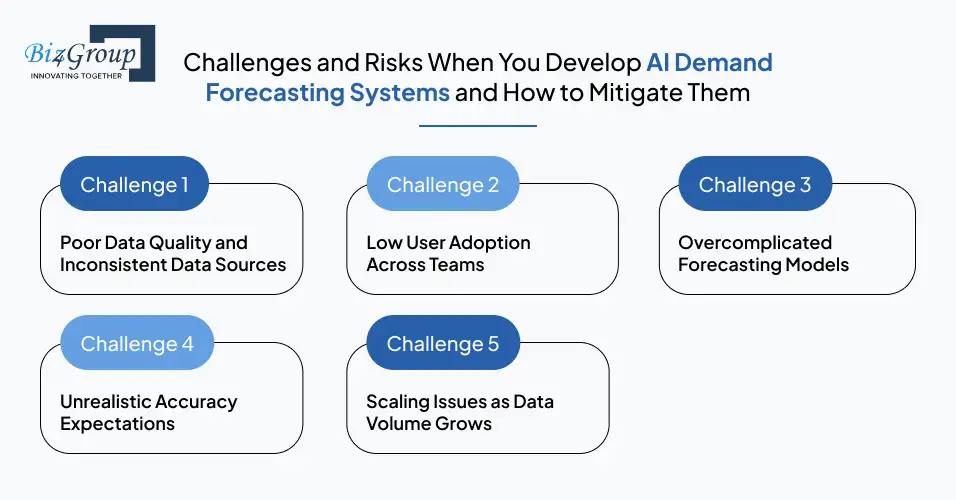
Even well-planned forecasting initiatives face hurdles. Most challenges appear during execution, adoption, or scaling. Recognizing these risks early helps businesses develop AI demand forecasting systems with fewer delays and better outcomes.
Below are the most common challenges, followed by clear mitigation strategies.
Challenge 1. Poor Data Quality and Inconsistent Data Sources
Forecast accuracy depends heavily on data reliability. Inconsistent formats, missing values, or outdated records can distort predictions.
How to mitigate:
- Standardize data formats across all sources
- Validate historical data before model training
- Introduce data quality checks early in the project
Challenge 2. Low User Adoption Across Teams
Even accurate forecasts fail when teams do not trust or use them.
How to mitigate:
- Design intuitive workflows and dashboards
- Involve users early during MVP testing
- Provide visibility into forecast logic and drivers
Challenge 3. Overcomplicated Forecasting Models
Complex models can slow development and confuse users without improving accuracy.
How to mitigate:
- Start with simpler models and expand gradually
- Prioritize interpretability over complexity
- Test accuracy improvements before adding variables
Challenge 4. Unrealistic Accuracy Expectations
Forecasting always involves uncertainty. Expecting perfect predictions creates disappointment.
How to mitigate:
- Set realistic accuracy benchmarks early
- Communicate forecast confidence ranges clearly
- Use forecasts as decision guides, not guarantees
Challenge 5. Scaling Issues as Data Volume Grows
Systems that work at small scale may struggle as products, regions, or users increase.
How to mitigate:
- Plan scalability during initial design
- Expand forecasting scope in phases
- Monitor performance metrics continuously
Addressing these challenges proactively allows organizations to build AI powered demand forecasting software that remains reliable, trusted, and scalable as business needs evolve.
Avoid Costly Forecasting Mistakes Before They Happen
Poor forecasting decisions silently drain revenue and customer trust. Fix the risks early.
Talk to Biz4Group's ExpertsWhat Lies Ahead in AI Demand Forecasting Software Development
Demand forecasting continues to evolve as businesses seek faster, more adaptive planning systems. The next phase focuses less on prediction alone and more on decision readiness. Below are the key trends shaping how organizations will build predictive demand forecasting solutions in the coming years.
1. Shift From Forecast Accuracy to Decision Impact
Future systems will focus on how forecasts influence decisions rather than accuracy metrics alone. Businesses will evaluate forecasting success based on inventory turns, service levels, and margin improvement.
This shift aligns AI predictive analytics software development for demand directly with business outcomes.
2. Wider Use of External Demand Signals
Forecasting models will increasingly include external data such as economic indicators, competitor pricing, and regional demand drivers. This broader context improves demand anticipation during uncertain market conditions.
Organizations that develop AI demand forecasting systems with external signals gain stronger resilience.
3. Demand Forecasting as a Shared Intelligence Layer
Forecasting will move beyond supply chain teams. Sales, finance, and operations will access the same demand intelligence through shared platforms.
This shift supports cross-functional planning and reduces decision silos. For a deeper look at how this plays out in practice, refer to our guide on AI financial forecasting platform development.
4. Faster Forecast Cycles Across Shorter Time Horizons
Businesses are moving toward weekly and even daily forecasting cycles. Shorter cycles help teams respond faster to market changes and operational disruptions.
This evolution favors organizations that build AI-powered demand forecasting software with continuous learning capabilities.
5. Greater Focus on Forecast Governance and Accountability
Future systems will include clearer ownership, auditability, and performance tracking. Leaders will demand visibility into forecast quality and decision outcomes.
This supports responsible and scalable AI demand forecasting software development across large organizations.
These trends point toward forecasting systems that guide action, not only prediction. Businesses that adapt early position themselves to plan with confidence in increasingly dynamic markets.
Why Businesses Across the USA Trust Biz4Group for AI Demand Forecasting Software Development?
Biz4Group LLC is a USA-based software development company that builds intelligent software solutions for entrepreneurs and businesses that take growth seriously. We work with founders, operators, and enterprise leaders who want clarity in decision making and systems that scale with confidence.
As a seasoned AI development company, our strength lies in custom AI demand forecasting software development that aligns directly with business realities. We do not approach forecasting as a technical exercise. We treat it as a planning capability that affects inventory, cash flow, customer satisfaction, and long-term profitability.
What sets us apart in AI demand forecasting software development services is our ability to translate complex forecasting needs into practical systems. We understand how retail, manufacturing, and enterprise planning differ. Our teams design enterprise AI solutions that reflect those differences instead of forcing generic models onto unique operations.
Why Businesses Choose Biz4Group LLC
- Proven expertise in building scalable AI forecasting systems for USA-based businesses
- Strong understanding of demand planning challenges across retail, manufacturing, and enterprises
- Custom development approach aligned with business goals and operational workflows
- Experienced AI developers for hire that balance speed, accuracy, and long-term scalability
- Transparent communication and outcome driven delivery
- Full ownership and control over forecasting platforms and data
Biz4Group LLC earns trust because we stay involved beyond delivery. We work closely with leadership teams to ensure forecasting systems support real decisions, not theoretical insights. Our AI app and web development solutions grow with your data, your teams, and your market presence.
When businesses look for the best company to develop AI demand forecasting software in the USA, they look for credibility, execution strength, and partnership mindset. That is exactly what Biz4Group LLC brings to every engagement.
If you still don’t trust words, see us in action.
Get in touch.
Wrapping Up
AI demand forecasting has moved from a planning support function to a strategic capability for modern businesses. Accurate demand visibility helps organizations plan inventory, align production, and respond faster to market changes. When forecasting is powered by intelligent systems, decisions become proactive rather than reactive, reducing risk and improving operational confidence across teams.
Businesses that invest in AI demand forecasting software development gain more than better predictions. They build a foundation for smarter planning, stronger cash flow control, and scalable growth. From retail to manufacturing and enterprise operations, AI driven forecasting supports consistent performance even in uncertain demand environments.
This is where Biz4Group LLC stands out. As a software development company, we help businesses design and build custom AI demand forecasting systems that reflect real operational needs. Our focus remains on clarity, accuracy, and long term value, ensuring forecasting becomes a trusted decision layer rather than a static reporting tool.
Want forecasting that actually drives business results?
Connect with Biz4Group LLC and start building an AI demand forecasting solution designed for growth, confidence, and control.
FAQs
How much historical data is needed to build reliable AI demand forecasting systems?
Most businesses can start with 12-24 months of clean historical data. For seasonal or complex demand patterns, 24-36 months delivers better stability. Even with limited data, teams can still develop AI demand forecasting systems by starting small and improving accuracy as more data is collected.
Can AI demand forecasting software work with highly volatile or unpredictable demand?
Yes. AI models are well suited for volatile demand because they adapt as patterns change. Businesses dealing with frequent spikes or drops often build AI-powered demand forecasting software to react faster than traditional models, especially in fast-moving markets.
How long does it take to build AI demand forecasting systems from scratch?
Most MVPs take 6-8 weeks to build, depending on scope and data readiness. However, Biz4Group LLC can deliver a functional MVP in 2-3 weeks. We use reusable AI components, proven forecasting modules, and pre-built workflows that significantly reduce development time and overall cost.
Is AI demand forecasting suitable for mid-sized businesses or only large enterprises?
Mid-sized businesses often benefit the most. Custom solutions allow them to focus on high impact areas without enterprise level overhead. Many companies create AI driven demand forecasting platforms specifically to scale efficiently as they grow.
Can AI demand forecasting software adapt to new products with no sales history?
Yes. AI models use proxy data such as similar products, pricing, category trends, and market signals. This helps businesses build predictive demand forecasting solutions even when direct historical data is limited.
How often should AI demand forecasting models be updated or retrained?
Most systems retrain models weekly or monthly, depending on data flow and volatility. Frequent retraining helps forecasts stay relevant without disrupting planning cycles. This flexibility is a key reason companies develop intelligent demand planning applications.
What internal teams should be involved in an AI demand forecasting initiative?
Successful projects involve supply chain, sales, finance, and operations teams. Early collaboration ensures forecasts align with real decisions and improves adoption across the organization.
