Location :
Orlando, FL, USA
Location :
Orlando, FL, USA +1 (407) 714-1616
 info@biz4group.com

















Imagine a digital system that doesn’t wait for instructions but instead, understands your business goals, learns from real-time feedback, and takes independent actions to get the job done.
Read More

 AI Summary Powered by Biz4AI
What if the most expensive denial in your revenue cycle is the one your system had enough information to prevent but only analyzed after the payer rejected it?
That is the gap AI is starting to address. AI denials in medical billing is shifting denial management upstream, where the goal is not simply to process a rejected claim faster, but to identify risk while the claim can still be corrected. That matters because denial pressure is moving in the wrong direction: 41% of providers now report that more than 10% of their claims are denied, according to a survey by Experian Health.
For RCM leaders, the issue is bigger than denial volume. It is whether existing workflows can interpret the growing mix of claim data, payer requirements, coding details, eligibility information, and documentation quickly enough to prevent avoidable rework.
The 2026 shift is therefore less about adding another automation layer and more about making claim management more intelligent by:
Before we examine the major AI trends in medical billing shaping 2026, let’s first look at why denial rates continue to rise despite the automation already in place.
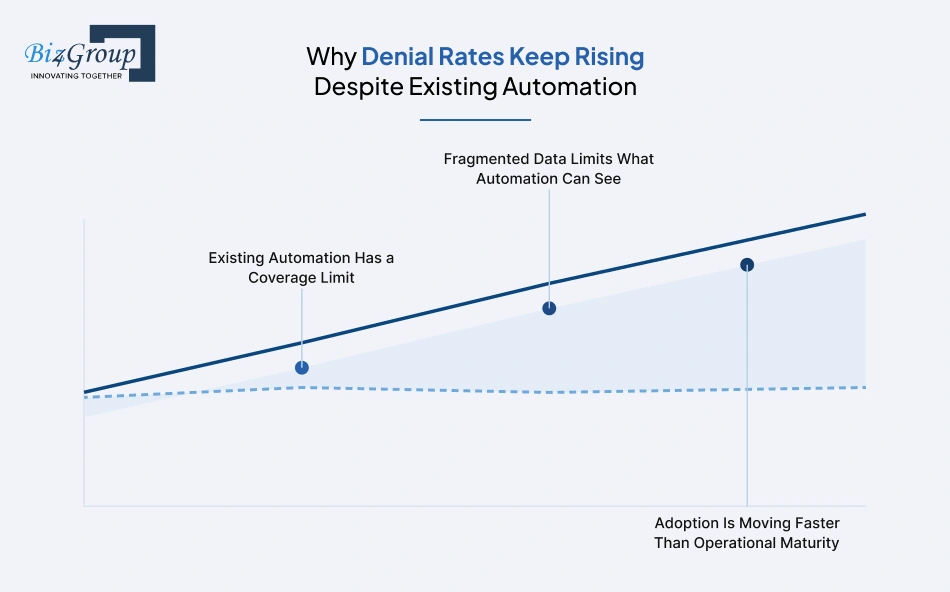
Denial rates keep rising because existing automation is designed to process established rules, while claim environments themselves keep changing. Payer requirements, reimbursement policies, documentation expectations, and claim conditions do not remain static, creating gaps that rule-based systems cannot always identify or adapt to.
Most traditional automation is built around predefined edits, transaction rules, and known exception conditions. These controls are effective when the triggering condition is already defined and consistently identifiable.
They become less effective when denial risk depends on changing payer behavior, multiple data elements, or patterns that are difficult to encode as fixed rules. As claim complexity increases, expanding rule libraries can create more maintenance work without proportionately improving denial performance.
Claim-related information often sits across separate billing, payer, administrative, and clinical systems. Automated processes can move data between systems without necessarily connecting the information needed to assess the full claim context.
Incomplete or inconsistent information can limit the reliability of automated checks and downstream decisions. This fragmentation makes health insurance claim management harder to standardize across payers, workflows, and claim types.
American Journal of Managed Care claims that 67% of providers believe AI can improve the claims process, yet adoption remains at just 14%.
That gap points to a clear market reality:
The challenge is no longer simply processing more claims with greater speed. It is creating claim-management processes that can keep pace with changing requirements, fragmented information, and increasingly complex denial environments.
The next section examines the AI trends emerging in response to that gap.
AI denials in medical billing is taking shape through practical changes across prevention, coding, eligibility, workflow, oversight, authorization, and market adoption.
For RCM leaders and billing managers asking, “we are facing frequent health insurance claim denials because of coding errors, missing documentation, eligibility issues, and authorization problems. We want to know whether AI can help us detect these issues before claims are submitted.”
Yes, it can, and these top trends will justify how. Let’s have a look at them:
Denial management is moving upstream. Instead of waiting for a payer to reject a claim, AI can identify patterns associated with denial risk before submission, giving billing teams an opportunity to address issues earlier.
What AI Evaluates Before Submission
AI can assess claim information against historical denial patterns to flag potential risk, including:
This is where AI denial detection in medical billing becomes preventive rather than purely reactive. The goal is not to predict every payer decision, but to identify claims that deserve review before they enter the denial cycle.
Why It Matters
For RCM teams, earlier risk detection can shift attention toward claims with a higher likelihood of denial instead of relying on broad post-denial rework. That makes predictive analytics for claim denials a practical part of pre-submission review.
Among providers that have adopted AI in claims processing, 69% report that AI has reduced denials and/or improved resubmission success.
AI-assisted coding is moving beyond a secondary QA function and into the first-pass review of medical coding. By interpreting clinical notes with natural language processing, AI can suggest or assign ICD-10, CPT, and HCPCS codes before claims move forward.
What Changes for Coding Teams
Documentation and coding is the leading AI application in the revenue cycle, used by 48% of surveyed organizations, ahead of every other RCM function.
The practical shift is clear: AI is taking on more of the initial coding workload, while certified professionals concentrate on the cases where review, validation, and exception handling matter most.
Also Read: Medical Coding Standards: How AI Optimizes Claims & RCM
Eligibility verification is moving beyond a single intake check. AI can support continuous re-verification at key points in the patient journey, helping teams identify coverage changes and eligibility anomalies before they create downstream billing issues.
Where Continuous Verification Fits
Instead of treating eligibility as a one-time administrative task, organizations can extend verification across:
Automated risk scoring can flag coverage anomalies when patient information or coverage status changes between these touchpoints.
Reducing Front-Desk and Billing Coordination Gaps
Eligibility information often moves between front-desk and billing teams, creating opportunities for outdated information to carry forward. AI medical billing automation can help maintain verification across these handoffs instead of relying on separate manual checks.
For organizations evaluating AI for health insurance claim denials, the financial case extends beyond denial prevention: replacing manual eligibility and administrative processes with automated technology could save the U.S. healthcare industry at least $20 billion.
The operational shift is straightforward: eligibility becomes an ongoing verification process rather than a single checkpoint.
The shift is from automating isolated revenue cycle tasks to orchestrating them around the claim. Instead of managing separate tools for separate functions, RCM teams are increasingly evaluating whether one system can coordinate work across multiple stages.
An orchestrated workflow can connect:
The advantage is not simply having more automation. It is reducing the manual effort required to move work between disconnected tools and giving staff a clearer path for handling exceptions and higher-risk decisions.
That shift is also changing how organizations evaluate technology. The question is moving from “Which point tool performs this task best?” to “Which platform can supervise the broader workflow effectively?”
For AI denial management for hospitals and medical practices, that makes workflow coordination a core evaluation factor rather than an optional add-on.
AI enablement of the revenue cycle could reduce cost-to-collect by 30–60% and accelerate cash realization, according to the McKinsey analysis cited in the February 2026 HFMA report.
For RCM leaders, the practical shift is toward managing the claim as a connected process rather than managing a collection of separate automation tasks.
As AI takes on a larger role in claims decisions, fully automated denial decisions are facing a stronger requirement for human review. The emerging model keeps qualified professionals in the decision path when AI influences a consequential claim outcome.
Human-in-the-loop becomes part of the decision process as:
The change is already reflected in state-level action. More than 10 U.S. states now restrict or ban AI-only claim denials without review by a licensed clinician, including six states that enacted such laws in a single nine-week period between March and May 2026.
For organizations using AI claim management for healthcare providers, this reinforces a broader operating principle: AI can support claim decisions, but consequential outcomes increasingly require human accountability.
That makes AI for preventing insurance claim denials less about removing people from the process and more about placing AI within a controlled decision framework where professional judgment still matters.
Prior authorization is becoming more automated as regulatory requirements make the process more structured, time-sensitive, and accountable. The shift is turning PA from a largely administrative task into a technology-dependent part of health insurance claim management.
The regulatory change is measurable. Under the CMS prior authorization rule, impacted payers must decide:
These requirements increase the pressure for systems that can support timely processing, documentation, and status visibility rather than relying on loosely connected manual steps.
The next phase is increasingly electronic. Full FHIR-based API requirements for electronic prior authorization submission and real-time status checks are scheduled to phase in by January 1, 2027. That makes 2026 an important transition period for more automated PA workflows.
This is a clear example of how AI is changing medical billing in 2026: regulatory pressure and digital infrastructure are converging to make prior authorization faster, more standardized, and less dependent on fragmented manual processing.
Taken together, these AI denials in medical billing trends point to a broader shift in how claims are managed: earlier risk detection, connected processes, stronger oversight, and more technology-driven health insurance claim management.
Identify denial risks, uncover missing evidence, prepare stronger appeals, and track recovery with AI-powered claim intelligence.
Try Bill Matters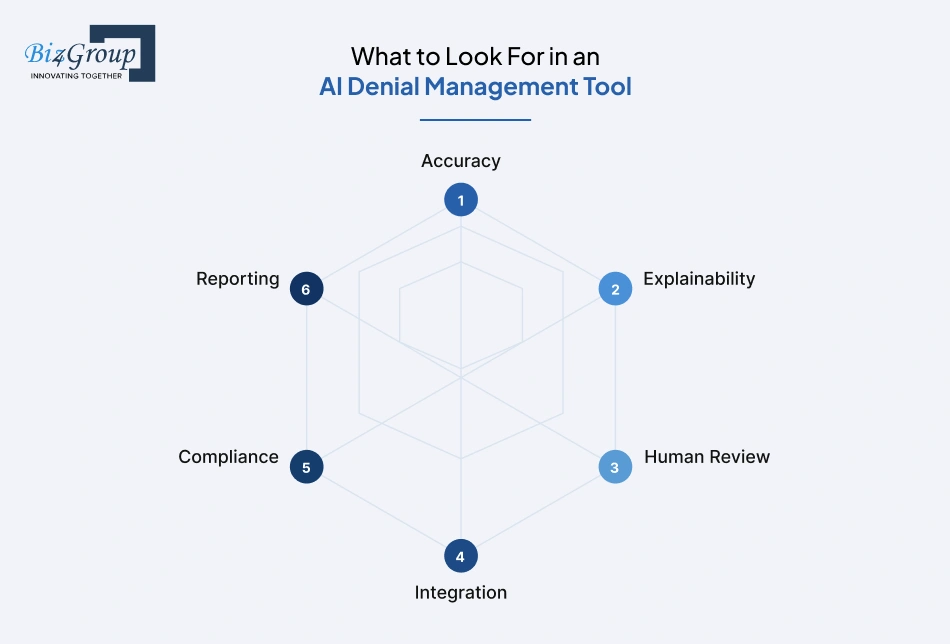
A reliable AI denial management tool should combine measurable accuracy, explainability, human review, integration, compliance, and reporting with clear operational controls.
So if you’re asking, “I am comparing AI-powered claim management solutions for our healthcare business, but I do not know how to evaluate their accuracy, denial prediction capabilities, compliance measures, ease of integration, and human review processes.”
Focus on whether the platform performs consistently across real claims, fits existing infrastructure, and maintains accountable decision pathways. Have a look:
Evaluate how consistently the system identifies relevant denial patterns and produces reliable outputs. For AI claim denial prediction, look for measurable performance across claim types, payers, and real operating conditions rather than broad accuracy claims.
AI outputs should be understandable to the people reviewing them. The system should show the reasoning, relevant claim information, and supporting factors behind a recommendation so users can assess the result without treating the model as a black box.
Human review should be built into the workflow, with clear points for intervention, approval, escalation, and exception handling. The technology should support professional judgment rather than create a process where questionable outputs move forward unchecked.
Assess whether the tool can work with your existing claims, billing, documentation, and revenue cycle environment. Strong AI solutions for health insurance claim denials should fit established systems and workflows instead of creating another operational silo.
Review how the technology handles sensitive healthcare information, access controls, auditability, and required oversight. For AI-powered medical billing denial prevention, compliance cannot sit outside the workflow; it needs to be considered alongside how the system processes and influences claim decisions.
Reporting should provide actionable visibility into denial activity, system performance, workflow outcomes, and areas requiring attention. Look for reporting that helps RCM leaders measure operational impact and identify where the technology is actually improving denial-management performance.
With these six criteria in place, evaluating AI denials in medical billing becomes far more practical. The right solution should strengthen health insurance claim management without compromising accuracy, control, or visibility.
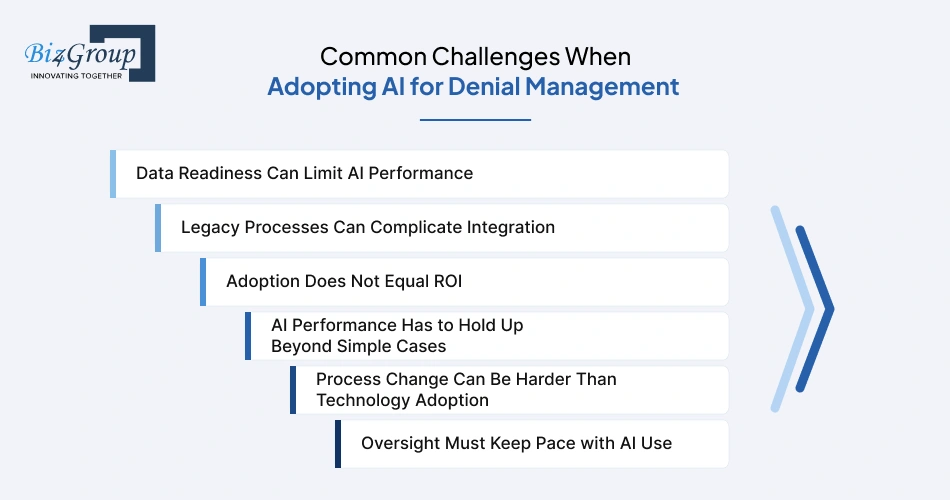
AI adoption can stall when the surrounding revenue cycle is not ready for the technology. The practical barriers usually involve data, operational change, measurable value, and ongoing oversight.
AI needs consistent, usable information to produce dependable outputs. In fragmented revenue cycle environments, incomplete or inconsistent data can limit what the system can reliably interpret.
Disconnected systems can make AI in medical billing harder to operationalize. Technology may be available, but moving relevant information across existing billing, administrative, and clinical environments can still require significant process coordination.
Organizations may deploy or pilot AI without seeing immediate financial returns. Current healthcare revenue cycle automation adoption shows that implementation can move faster than demonstrated ROI, making outcome measurement essential.
AI outputs can vary with encounter complexity and operating conditions. Vendor-reported accuracy figures should therefore be treated cautiously rather than assumed to represent consistent performance across every claim environment.
Introducing AI changes how revenue cycle teams divide work, review outputs, and handle exceptions. Without operational alignment, even capable technology can create additional friction instead of improving medical claim denial prevention.
As AI influences consequential claim decisions, organizations need clear accountability around where human review remains necessary. The challenge is maintaining appropriate oversight without turning every automated process back into a fully manual one.
AI adoption delivers value when organizations address the operational conditions around it, not just the technology itself. Strong data, aligned processes, measurable outcomes, and appropriate oversight determine whether AI can perform effectively at scale.
Start with a focused use case, confirm data readiness, connect existing systems, establish oversight, then pilot the workflow against measurable operational outcomes.
For chief revenue cycle officers and RCM directors asking, “We want to adopt AI for our medical billing operations, but our existing systems are disconnected. I need to understand which integrations, data sources, security controls, and implementation steps are required.”
The path below answers how to implement AI for medical billing denial management:
Choose a specific operational problem with measurable outcomes rather than introducing AI across the entire revenue cycle at once. A focused scope makes performance easier to assess.
Identify where claims, documentation, payer information, and related revenue-cycle data reside. Then determine how disconnected systems will exchange the information required for the intended workflow.
Define review points for AI-influenced decisions, assign responsibility for exceptions, and keep qualified professionals involved wherever claim decisions require judgment or accountability.
Run a controlled pilot and compare results with the existing process. Track how AI reduces denials in medical billing alongside operational efficiency, rather than treating adoption itself as success.
Expand after the pilot shows reliable performance and measurable value. The same approach can then extend across additional revenue-cycle functions or higher claim volumes. The research brief emphasizes that adoption is currently outpacing proven ROI, making measurement essential.
Now with that on table, the real test of AI adoption is how well its capabilities work together within an existing denial-management operation. When data, intelligence, workflow, and human review are connected, AI becomes part of the process, not another disconnected tool.
This approach is already emerging across denial-management platforms.
One such example is Bill Matters, an AI-powered healthcare billing intelligence and revenue-recovery platform built around denied and underpaid claims. It works with claims, EOBs, denial information, and supporting documentation to help teams move from denial analysis to recovery action.
What it does:
Ultimately, successful AI adoption depends on more than implementation alone. AI denials in medical billing delivers greater value when intelligence, workflow, oversight, and measurable outcomes work together.
Use AI to spot claim risks earlier, reduce avoidable rework, and give your RCM team better control over the claims process.
Explore AI Denial ManagementAI is becoming a more practical part of denial management, but its value depends on how well intelligence, automation, data, and human oversight work together. AI denials in medical billing is moving the industry toward earlier intervention, more connected claim processes, and more controlled decision-making.
For RCM leaders, the opportunity is not to automate for automation’s sake. It is to adopt capabilities that fit existing operations, address real denial-management gaps, and produce measurable operational value.
Developed by Biz4Group LLC, an AI product development company in the USA, Bill Matters brings denial intelligence, evidence analysis, appeal preparation, human review, and recovery tracking into a connected workflow for denied and underpaid claims.
As the future of AI in medical billing and claim management takes shape, organizations that approach adoption strategically can turn AI from an experiment into a practical operational capability. When you're ready to move forward, connect with us to explore the possibilities.
AI is shifting denial management earlier in the claims lifecycle. Instead of relying mainly on post-denial review, organizations are using AI for pre-submission risk detection, first-pass coding review, continuous eligibility checks, and coordinated claim workflows, while human oversight remains part of consequential decisions.
AI can identify claim characteristics associated with higher denial risk before submission. This can include missing modifiers, diagnosis-procedure mismatches, stale eligibility information, documentation gaps, and patterns associated with specific payer histories.
Look for six fundamentals: accuracy, explainability, human review, integration, compliance, and reporting. A useful solution should produce reliable outputs, fit the existing RCM environment, make AI decisions understandable, preserve appropriate human review, and provide measurable operational visibility.
The primary value is operational: earlier risk identification, less reliance on repetitive manual review, better coordination across claim-management functions, and greater consistency in handling exceptions. The benefit is strongest when AI supports measurable improvements rather than simply increasing automation volume.
The direction is toward more predictive, continuous, and orchestrated claim management. AI is increasingly moving from isolated task support toward earlier risk detection, connected workflows, and decision support that remains subject to appropriate human oversight.
Common drivers include missing or inaccurate claim information, coding and documentation problems, eligibility issues, authorization failures, and other payer-specific claim requirements. The exact mix varies by payer, claim type, and operating environment.
AI can evaluate available claim information against known denial patterns and relevant conditions, while coding systems can interpret clinical notes for coding review and eligibility systems can reassess coverage at multiple points rather than only at intake.
Effective prediction depends on access to the information surrounding the claim, including claim data, documentation, eligibility information, and payer-specific historical denial patterns. Integration is equally important because fragmented systems can limit the context available to automated analysis.
Organizations need controls that support accurate outputs, accountable human review, appropriate handling of sensitive healthcare information, and auditable decision processes. Human oversight is particularly important where AI influences consequential claim decisions, with state-level requirements increasingly reinforcing that expectation.

Our website require some cookies to function properly. Read our privacy policy to know more.