Location :
Orlando, FL, USA
Location :
Orlando, FL, USA +1 (407) 714-1616
 info@biz4group.com

















Imagine a digital system that doesn’t wait for instructions but instead, understands your business goals, learns from real-time feedback, and takes independent actions to get the job done.
Read More

 AI Summary Powered by Biz4AI
Why do healthcare organizations still struggle with insurance claim denials even after following established medical coding standards?
Because accurate codes alone don't guarantee accurate claims. A single coding inconsistency, missing documentation, or mismatch between diagnosis and procedure can delay reimbursements, increase administrative effort, and quietly impact revenue.
That's why healthcare providers, medical billing companies, and healthcare software product managers are turning to AI medical coding to strengthen claim accuracy before claims reach the payer.
Instead of replacing existing coding practices, AI helps healthcare organizations make better use of ICD, CPT, and HCPCS codes to support cleaner claims, stronger reimbursement accuracy, and a more efficient RCM process.
If you're evaluating AI for healthcare insurance claims, you may already be thinking along these lines:
The answers begin with understanding how AI works with medical coding standards throughout the claims journey. In this guide, you'll learn where AI fits, how it supports healthcare insurance claims, and why it has become a strategic part of modern Revenue Cycle Management.
ICD, CPT, and HCPCS codes power every healthcare insurance claim because they give every participant in the reimbursement process a common way to represent patient care.
Instead of relying on lengthy clinical notes that can be interpreted differently, healthcare organizations submit claims using standardized medical coding standards that insurers, government payers, and healthcare providers all recognize.
Every insurance claim must communicate enough information for a payer to understand the patient's encounter without reviewing the complete medical record. That requires a structured format that identifies why care was needed, what care was delivered, and which additional products or services were associated with the treatment.
ICD, CPT, and HCPCS each contribute a different part of that picture, allowing every claim to follow the same reporting structure regardless of the healthcare organization submitting it.
|
Medical Coding Standard |
Role in Every Healthcare Insurance Claim |
|---|---|
|
ICD |
Identifies the patient's diagnosis or medical condition |
|
CPT |
Identifies the medical services or procedures performed |
|
HCPCS |
Identifies billable supplies, equipment, medications, and other healthcare services beyond CPT |
Working together, these coding standards create a complete representation of a patient's care that can move through the healthcare insurance claims process in a structured and consistent manner. They establish the foundation every claim depends on before questions of coding accuracy, claim quality, or reimbursement can even be addressed and thats exactly where AI starts to add value.
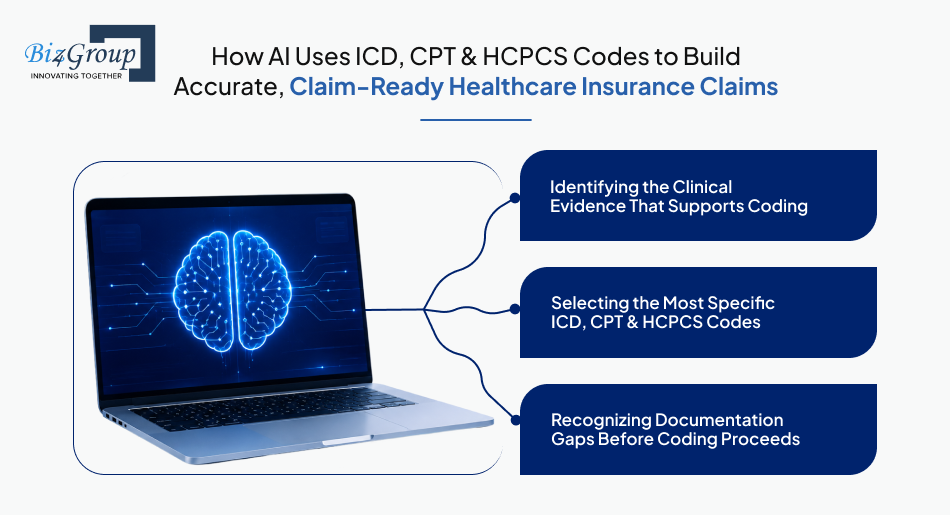
AI builds accurate, claim-ready codes by reading clinical documentation as care is recorded, identifying the correct ICD, CPT, or HCPCS code for each diagnosis and procedure. It then applies the specificity a claim needs to hold up once it enters AI revenue cycle management.
Let's dive deep to understand the specifications:
Clinical documentation contains everything needed to describe a patient's care, but that information is recorded for treatment rather than claim preparation. AI bridges that gap by converting documented clinical evidence into standardized coding that forms a complete healthcare insurance claim.
Instead of reviewing documents independently, it analyzes the complete patient encounter to determine which documented details are relevant for accurate coding.
To establish that clinical foundation it identifies:
Once the relevant clinical evidence has been identified, AI has the information required to apply standardized coding accurately.
After the clinical evidence has been identified, AI maps it to the most appropriate ICD, CPT, and HCPCS codes based on the documented patient encounter. The objective is not simply to find a matching code but to represent the documented care with the highest level of specificity supported by the available information.
AI doesn't evaluate ICD, CPT, and HCPCS codes in isolation. It connects them, so the documented diagnosis, the care provided, and the associated billable services represent one clinically consistent patient encounter.
To strengthen coding accuracy, AI:
This connected coding approach produces a complete representation of the patient's encounter instead of isolated coding decisions.
When the available information does not support a specific coding decision, AI identifies the missing details instead of forcing a recommendation that lacks sufficient clinical evidence.
During this review, AI highlights:
By combining documented clinical evidence with ICD, CPT, and HCPCS coding standards, AI creates a structured, claim-ready foundation. The next stage focuses on confirming that this completed claim is ready to move forward for submission.
Every coding decision shapes claim quality long before payer review. See how intelligent healthcare AI can strengthen every claim
Build Smarter Claims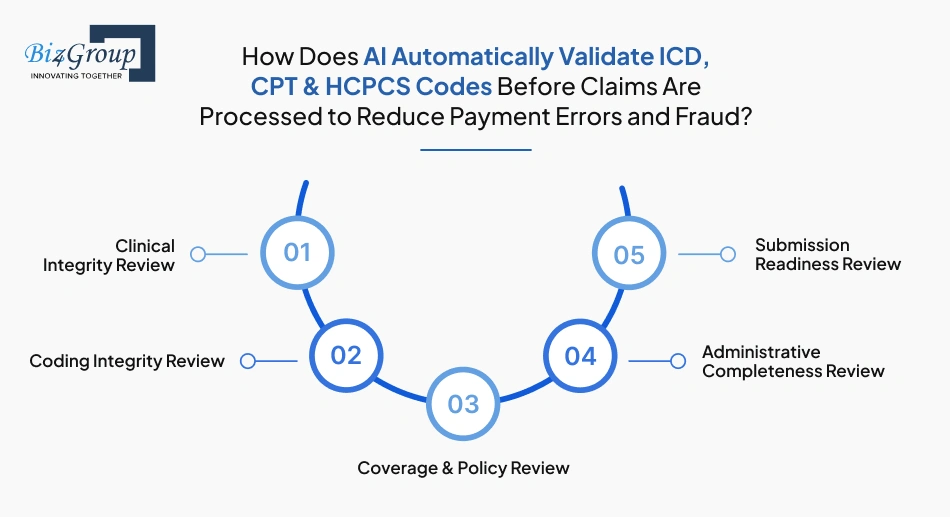
AI automatically validates ICD, CPT, and HCPCS codes within a completed healthcare insurance claim by executing a structured pre-submission review. It verifies clinical support, coding integrity, payer requirements, and more before the claim reaches the payer.
Each validation layer examines a different aspect of the completed claim, helping identify issues that could otherwise result in payment errors, preventable denials, or suspicious billing activity before submission.
The first validation layer confirms that every ICD diagnosis, CPT procedure, and HCPCS service is fully supported by documented clinical evidence. Unsupported services, incomplete documentation, and missing medical necessity indicators are identified before they affect claim accuracy or reimbursement eligibility.
The next layer evaluates whether ICD, CPT, and HCPCS codes work together as a clinically valid combination. NCCI edits, modifier usage, mutually exclusive procedures, bundled services, diagnosis-to-procedure relationships, and unusual billing patterns are reviewed to prevent payment errors and identify potential billing anomalies before submission.
Every completed claim is then evaluated against payer-specific billing requirements. LCD/NCD policies, coverage limitations, authorization requirements, frequency edits, and plan-specific billing rules are checked to identify services that may not qualify for reimbursement despite being coded correctly.
Organizations implementing AI prior authorization workflows can also verify that approved services align with the final billed claim.
Administrative validation focuses on the information required to process a claim successfully. Provider identifiers, place-of-service codes, patient demographics, required attachments, referring provider details, and other mandatory claim elements are verified for completeness before submission.
The final validation layer performs a comprehensive AI claim scrubbing to detect duplicate claims, incompatible billing combinations, invalid claim formatting, missing mandatory fields, and other billing inconsistencies that frequently contribute to preventable denials or require additional investigation.
This structured review also strengthens downstream AI claim denial navigation by preventing many avoidable issues from reaching the payer in the first place.
Reducing claim denials with intelligent coding validation
By validating ICD, CPT, and HCPCS codes through independent review layers before claims are processed, AI helps healthcare organizations reduce payment errors, reducing claim denials with intelligent coding validation, and submit cleaner claims with greater confidence.
AI connects medical coding with revenue cycle management and payer workflows by carrying a coded claim from the EHR through the billing system, the clearinghouse, and into the payer's system, without anyone re-entering the same data twice.
That connection is what turns accurate coding into a claim that actually moves, and it's where integrating AI with revenue cycle management and payer systems starts to matter in practice, not just on paper.
Once a code is finalized, it needs to leave the EHR and land inside the billing or RCM platform without losing any of its supporting detail. AI integration services are what make this handoff reliable, carrying the diagnosis, procedure, and any linked supply or equipment codes into the billing system as one connected record.
Getting this step right depends on:
A break at this single step can stall a claim before it even reaches a payer, which is why this handoff has to hold up every time, not most of the time.
Also Read: How to Integrate Healthcare Platforms with AI EHRs
From the billing system, a claim moves through a clearinghouse before it ever reaches a payer, and this is where medical claims processing shifts from an internal task to an external transaction.
AI manages this transmission by formatting the claim to match what the clearinghouse and payer expect, then tracking it as it moves rather than treating submission as a one-way handoff. Things that get monitored during this AI medical claim processing include:
This transaction layer is what actually gets a claim in front of a payer, separate from whether the claim itself was coded or validated correctly.
After submission, a claim doesn't just disappear until a decision arrives. AI keeps track of its status and brings that visibility back into systems people already use daily. Healthcare operations executives rely on this visibility to know where a claim stands without chasing updates across multiple platforms.
Once a payer responds, AI also connects the remittance details back to the original claim, so the outcome:
This closes the loop between submission and outcome, giving teams a clear line back to the original coding decision instead of a payment that shows up disconnected from its claim.
Accurate AI coding improves financial performance because reimbursement depends on how accurately documented care is translated into billable value. As reimbursement expectations continue to rise, coding quality directly influences how efficiently healthcare organizations convert delivered care into realized revenue.
Around $262 billion in medical claims are initially denied every year, and 65% of those denials are never resubmitted. At the same time, payer requirements continue to tighten under the CMS Interoperability and Prior Authorization Final Rule (CMS-0057-F), making manual denial management increasingly expensive and difficult to sustain.
The financial impact extends across several measurable performance indicators, each reflecting a different aspect of how reimbursement contributes to long-term financial health.
Lower Days in Accounts Receivable (Days in A/R) improve working capital by reducing the time revenue remains outstanding.
Also Read: Top 10 AI Automation Companies in USA
Accurate AI coding strengthens financial performance by improving the quality of revenue generated from patient care and giving healthcare organizations a more dependable financial foundation for future growth and investment.
Transform accurate coding into faster reimbursements, stronger revenue, and measurable financial outcomes with purpose-built healthcare AI
Improve Reimbursement Outcomes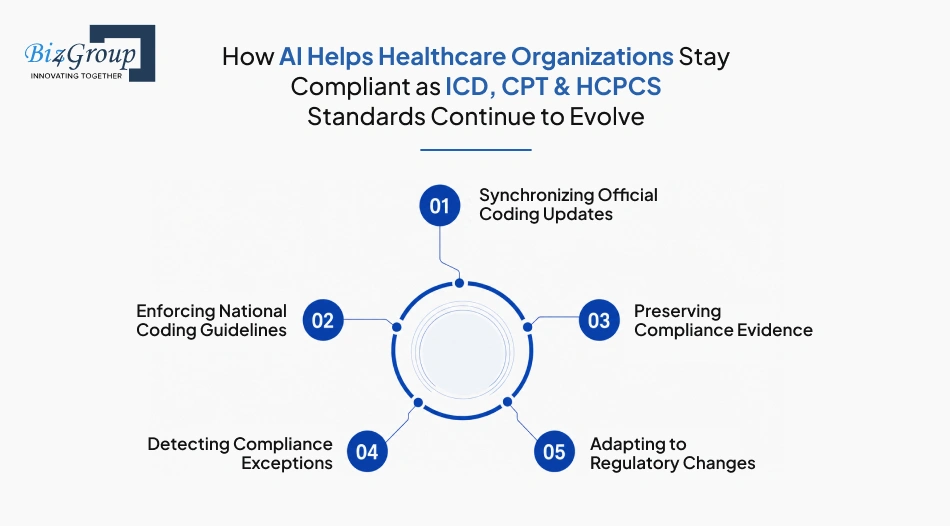
Staying compliant becomes increasingly challenging as medical coding standards continue to change. AI helps healthcare organizations keep pace by applying updated coding knowledge, enforcing standardized rules, maintaining compliance evidence, monitoring governance, and supporting regulatory updates without disrupting day-to-day coding operations.
Each compliance mechanism addresses a different regulatory responsibility, allowing organizations to maintain long-term compliance as ICD, CPT & HCPCS codes and industry requirements continue to evolve.
By synchronizing coding libraries with annual ICD-10-CM, CPT, and quarterly HCPCS Level II releases, AI replaces retired codes, introduces newly published codes, and keeps coding references aligned with official coding updates.
By applying configurable rule sets based on the ICD-10-CM Official Guidelines for Coding and Reporting and the NCCI Policy Manual, AI helps organizations enforce the same coding requirements across departments without relying on individual interpretation.
Every coding recommendation, rule revision, and user action is automatically recorded, allowing organizations to maintain audit trails, version history, and documentation that support HIPAA requirements and OIG Compliance Program Guidance.
Also Read: HIPAA-Compliant AI Healthcare Software Development
Rather than waiting for periodic reviews, AI continuously compares coding activity against approved organizational policies to identify unauthorized coding practices, governance exceptions, and outdated internal coding references requiring corrective action.
Configurable compliance rules allow organizations to incorporate regulatory updates such as the CMS Interoperability and Prior Authorization Final Rule (CMS-0057-F) without rebuilding existing workflows.
Organizations working with an experienced AI development company help health insurance companies, and Revenue Cycle Management (RCM) leaders maintain compliance as regulatory expectations evolve.
Putting compliance-ready healthcare AI into production requires more than technical implementation. It calls for a partner who understands how evolving medical coding standards influence healthcare insurance claims, AI medical billing, and long-term regulatory compliance. That level of expertise helps organizations adopt new requirements with confidence instead of repeatedly reworking existing systems.
Now do we know of a company that fits the picture?
Yes, Biz4Group LLC.
As a USA-based, HIPAA-compliant AI healthcare development company, Biz4Group brings 20+ years of technology experience in building intelligent healthcare platforms that align technical architecture with real-world clinical and reimbursement requirements.
This healthcare-first approach helps organizations modernize claims operations while keeping compliance, coding governance, and long-term regulatory readiness at the center of every solution.
Maintaining compliance becomes a continuous governance effort rather than a periodic update. This also supports the future trends in AI-driven healthcare insurance claims automation as regulatory expectations continue to evolve.
Accurate healthcare insurance claims begin with strong medical coding standards, but lasting results come from using ICD, CPT & HCPCS codes intelligently throughout the claims lifecycle. When AI supports coding quality, compliance, and reimbursement accuracy together, healthcare organizations are better equipped to improve operational efficiency while protecting long-term financial performance.
The opportunity isn't simply about automating existing processes. It's about creating a reliable foundation that helps your organization adapt as healthcare requirements continue to evolve. That's where an enterprise AI grade solution delivers lasting value by supporting consistent, scalable, and compliant claims operations.
At Biz4Group LLC, we help healthcare organizations build AI-powered platforms that align with real-world coding and claims requirements. If you're planning to modernize your healthcare insurance claims ecosystem, connect with our team to build a solution designed for long-term success.
ICD, CPT, and HCPCS should be implemented as separate but connected coding layers within the platform. The system should maintain updated coding libraries, map diagnosis-to-procedure relationships, support configurable business rules, synchronize with payer requirements, and keep version-controlled code references so future coding updates can be adopted without redesigning the platform.
Yes. AI platforms can integrate with EHRs, practice management systems, clearinghouses, and payer platforms through standards such as HL7, FHIR, X12 EDI, and secure APIs. These integrations enable clinical information and standardized coding data to move automatically between systems while reducing manual data entry and improving operational efficiency.
ICD, CPT, and HCPCS codes create a standardized structure for representing diagnoses, procedures, supplies, and services. This common language allows providers, clearinghouses, and payers to interpret healthcare insurance claims consistently, making claim review, adjudication, and payment processing more accurate and efficient.
Enterprise platforms typically include intelligent coding assistance, configurable business rules, real-time claim editing, audit trails, role-based access control, analytics dashboards, API integrations, scalable cloud architecture, reporting tools, and support for multi-location healthcare organizations. These capabilities help the platform grow alongside operational and regulatory requirements.
ICD-10-CM code updates are generally released annually, CPT codes are updated annually, and HCPCS Level II codes receive quarterly updates. An AI claims platform should support timely code library synchronization and version management so organizations can adopt official coding revisions without disrupting ongoing operations.
Organizations should evaluate coding library management, interoperability with existing EHR and billing systems, scalability, security, audit capabilities, configurable business rules, reporting features, regulatory readiness, vendor healthcare expertise, and the platform's ability to support future operational growth without extensive redevelopment.

Our website require some cookies to function properly. Read our privacy policy to know more.