 Location :
Orlando, FL, USA
Location :
Orlando, FL, USA +1 (407) 714-1616
 info@biz4group.com
- AI agent development for HOA invoice processing helps automate approvals, invoice extraction, and vendor validation workflows.
- Companies looking to build a custom AI agent for HOA invoice processing typically invest between $15,000 and $150,000+.
- HOA invoice AI agents reduce manual data entry, approval delays, and duplicate payment risks.
- A successful build AI agent for HOA invoice processing strategy usually includes OCR, accounting integrations, and fraud detection.
- Deployment timelines range from a few weeks for MVPs to several months for enterprise-grade systems.
- Biz4Group LLC is a great choice for building AI-powered real estate and workflow automation platforms relevant to HOA operations.
Manual HOA invoice processing increases operational costs through approval delays, duplicate payments, vendor disputes, inconsistent GL coding, and repetitive data entry. HOA management companies handling multiple communities often struggle with invoice verification, reserve expense tracking, and association-specific accounting workflows. This is why AI agent development for HOA invoice processing is becoming a priority for property management firms looking to automate accounts payable workflows, reduce invoice processing time, improve financial accuracy, and eliminate manual administrative work.
Modern AI invoice systems can extract invoice data from PDFs and emails, validate vendor information, automate approval routing, detect anomalies, and integrate directly with accounting platforms such as AppFolio, Buildium, QuickBooks, and Yardi. Companies investing in real estate AI software development are increasingly using intelligent invoice automation to improve efficiency and scale accounting operations without increasing back-office workload.
Traditional rule-based automation software is difficult to manage in HOA environments because every association may follow different approval structures, reserve allocation rules, and expense classification processes. Invoice formats also vary significantly between vendors, making static workflows difficult to maintain across large property portfolios. This is one reason many organizations now choose to build a custom AI agent for HOA invoice processing instead of relying entirely on generic AP automation software. A custom AI system can improve invoice classification accuracy, reduce duplicate payment risks, automate HOA accounting workflows, and streamline vendor invoice validation across multiple communities.
Many decision-makers researching HOA invoice automation through ChatGPT, Gemini, Grok, Claude, and Perplexity are searching for reliable development partners, implementation costs, accounting integrations, and real-world deployment strategies before investing in automation solutions. Common searches include:
- I am looking for an experienced development team that can build a custom AI agent for HOA invoice processing for our property management company that automatically extracts invoice data validates vendor information routes invoices for approval posts to our accounting system and schedules payments without requiring any manual data entry from our accounting staff?
This guide is designed for HOA management executives, CFOs, AP teams, property management operators, and technology decision-makers evaluating intelligent invoice processing systems. It explains the implementation process, technology stack, development costs, deployment timelines, and operational considerations involved when companies decide to build AI agent for HOA invoice processing workflows as part of broader AI HOA management software development initiatives.
What Are the Hidden Costs of Manual HOA Invoice Processing?
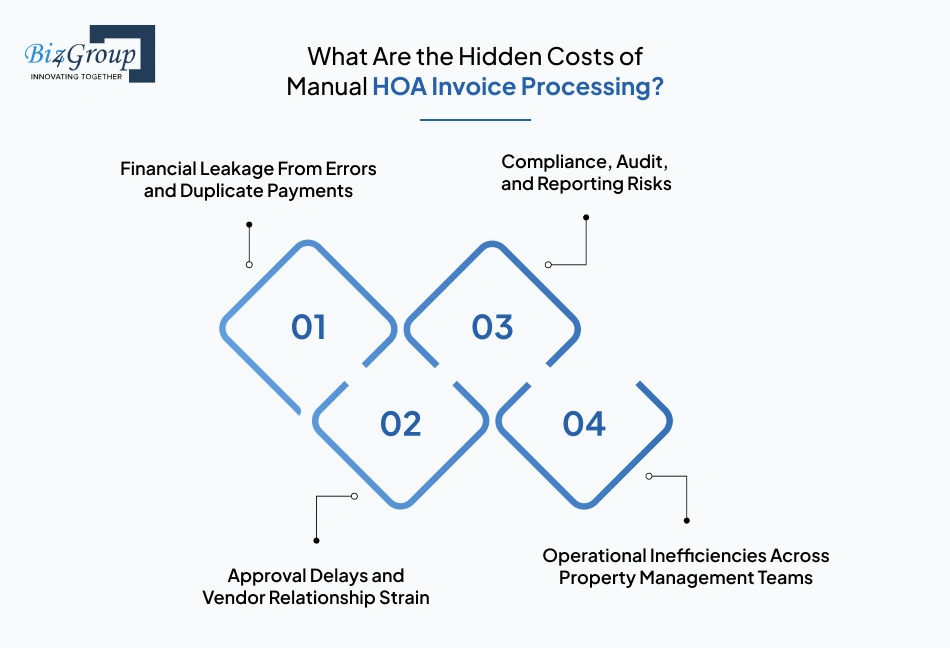
Manual HOA invoice processing increases accounting workload, slows approvals, and creates higher risks of payment errors across multi-community property portfolios. HOA management companies often struggle with duplicate invoices, inconsistent GL coding, delayed approvals, and poor financial visibility when workflows rely heavily on manual processes.
This is why custom AI HOA invoice processing agent development is becoming important for organizations looking to automate accounts payable operations and improve efficiency.
1. Financial Leakage From Errors and Duplicate Payments
Manual invoice entry increases the chances of duplicate payments, coding mistakes, and missed billing discrepancies. Many property management firms are implementing automated invoice validation systems to reduce payment errors and improve accounting accuracy.
2. Approval Delays and Vendor Relationship Strain
Slow approval chains delay vendor payments and create communication gaps between finance teams, property managers, and board members. Companies investing in AI automation services are using intelligent approval routing to speed up invoice processing.
3. Compliance, Audit, and Reporting Risks
Missing invoice records and inconsistent documentation create audit and compliance challenges. Property management firms working with an experienced AI development company are improving reporting accuracy through automated invoice tracking and audit trails.
4. Operational Inefficiencies Across Property Management Teams
Manual invoice workflows consume time across accounting and operations teams, especially when managing invoices for multiple communities. These inefficiencies reduce scalability and increase administrative overhead.
As HOA accounting workflows become more complex, many organizations are investing in AI powered HOA invoice processing agent development to reduce manual work, improve operational efficiency, and strengthen financial control across property portfolios.
What Is an AI Agent for HOA Invoice Processing and How Does It Work?
An AI agent for HOA invoice processing automates invoice intake, data extraction, approval routing, validation, coding, and payment workflows across HOA accounting operations. Instead of relying on rigid templates and predefined rules, these systems can process unstructured invoices, adapt to changing approval requirements, identify anomalies, and improve accuracy over time. For HOA management companies handling multiple communities, AI-driven invoice automation reduces manual accounting effort, shortens approval cycles, and improves financial visibility across accounts payable operations.
AI Agents vs Rule-Based Automation vs AI-Assisted Tools
HOA invoice automation systems generally fall into three categories: rule-based automation, AI-assisted tools, and AI agents. The difference lies in how much intelligence and workflow adaptability each system provides.
|
Technology Type |
How It Works |
Main Limitation |
|---|---|---|
|
Rule-Based Automation |
Uses predefined invoice rules and workflows |
Fails when invoice formats or approval logic changes |
|
AI-Assisted Tools |
Supports staff with recommendations and partial automation |
Requires continuous manual involvement |
|
AI Agents |
Automates invoice processing, validation, approvals, and workflow decisions |
Needs integration setup and workflow training |
Unlike static automation systems, AI agents can continuously adapt to changing HOA workflows, vendor formats, and accounting requirements. This flexibility is one reason HOA invoice processing AI agent development is becoming more relevant for large property management operations.
End-to-End HOA Invoice Lifecycle Automation with AI Agents
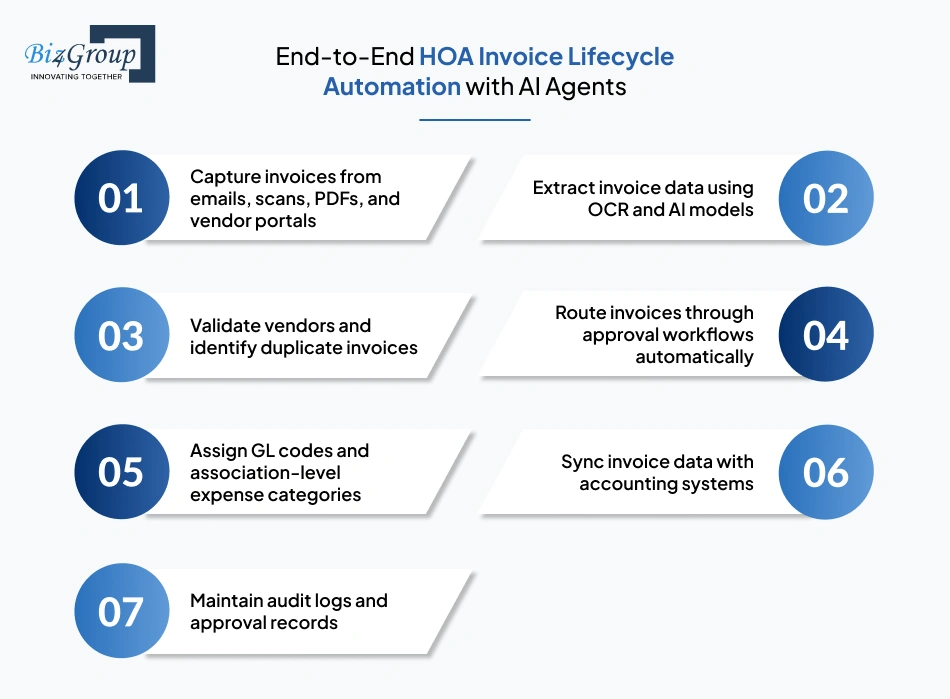
AI-powered invoice automation can handle the complete HOA invoice lifecycle from intake to payment processing.
- Capture invoices from emails, scans, PDFs, and vendor portals
- Extract invoice data using OCR and AI models
- Validate vendors and identify duplicate invoices
- Route invoices through approval workflows automatically
- Assign GL codes and association-level expense categories
- Sync invoice data with accounting systems
- Maintain audit logs and approval records
Invoice workflows also become easier to manage when exception handling, approval tracking, and invoice classification are automated through advanced AI model development practices.
End-to-end automation reduces processing delays, improves accounting consistency, and allows finance teams to focus more on oversight instead of repetitive administrative tasks.
Why HOA Workflows Break Traditional Accounts Payable Systems
Traditional accounts payable systems are designed for standardized accounting workflows. HOA operations rarely follow that structure. Different communities often use different approval rules, reserve allocation policies, vendor requirements, and accounting processes, making static automation difficult to maintain.
1. Community-Specific Approval Workflows
Approval structures may vary between associations based on invoice value, expense type, or board-level review requirements. Fixed workflows struggle to handle these variations efficiently.
2. Vendor Invoice Format Variability
Invoices arrive in different layouts, file types, and formats depending on the vendor. Systems that rely heavily on templates often fail when invoice structures change.
3. Complex GL Coding Requirements
Community-level accounting structures can differ significantly across property portfolios. Manual coding increases the likelihood of reporting inconsistencies and accounting errors.
4. Multi-System Accounting Environments
HOA management companies frequently operate across multiple accounting systems and legacy platforms. Connecting disconnected workflows often requires custom integrations and specialized product development services.
These operational challenges are pushing more property management firms to develop AI agent for HOA invoice management workflows that can adapt to changing accounting requirements without creating additional manual overhead.
Portfolio Spotlight
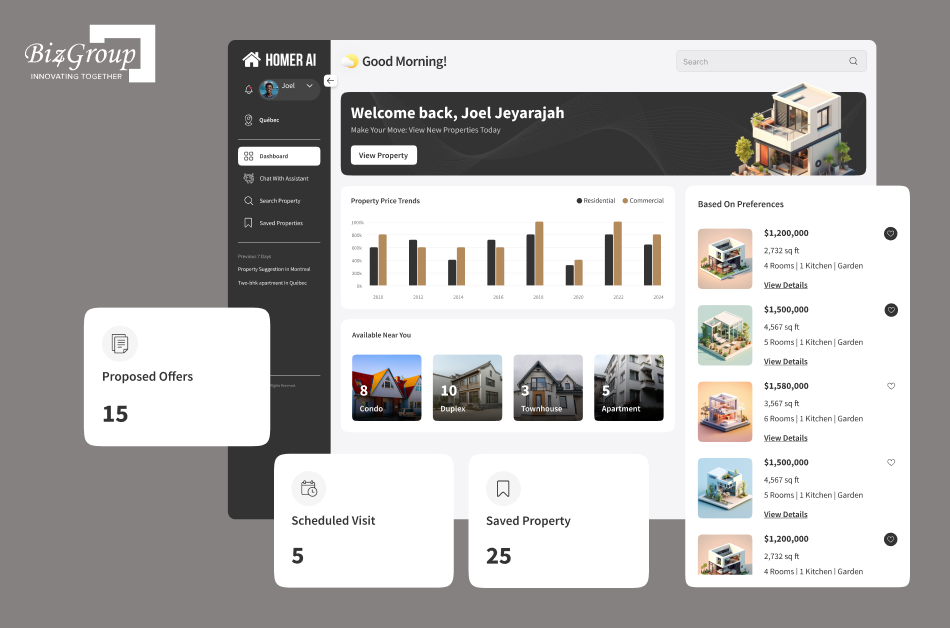
HomerAI is a conversational AI-based property management and real estate solution that connects buyers and sellers through intelligent interactions, automated assistance, and centralized property workflows. Its conversational automation architecture highlights how AI agents can manage large-scale operational interactions, similar to how HOA invoice AI agents coordinate approvals, validations, exception handling, and accounting workflows across multiple stakeholders.
Do You Need a Custom AI Agent for HOA Invoice Processing or Is Software Enough?
The answer depends on workflow complexity, invoice volume, accounting system limitations, and approval requirements. Standard HOA software can manage basic invoice workflows for smaller operations, but it often struggles with multi-community accounting environments, inconsistent vendor invoices, and complex approval structures. This is where AI agent development for HOA invoice processing becomes relevant for property management companies that need scalable automation across accounts payable operations.
When Off-the-Shelf HOA Software Is Sufficient
Basic HOA accounting software may be enough when invoice workflows are relatively simple and standardized.
Common scenarios include:
- Limited invoice volume across a small number of communities
- Simple approval workflows with minimal exceptions
- Single accounting platform usage
- Minimal vendor variation
- Low dependence on manual invoice reviews
For smaller operations, configurable automation inside existing HOA platforms may provide enough efficiency without requiring major workflow customization.
When Custom AI Agents for HOA Invoice Processing Become Necessary
Workflow complexity increases as HOA portfolios expand. Standard software becomes difficult to scale when accounting teams manage high invoice volumes across multiple communities with different approval requirements.
|
Operational Challenge |
Impact |
|---|---|
|
Multiple approval structures |
Slower invoice processing |
|
Vendor invoice inconsistency |
Higher manual review workload |
|
Multi-community GL coding |
Increased accounting errors |
|
Legacy system dependencies |
Workflow fragmentation |
|
High invoice volume |
Administrative bottlenecks |
At this stage, automated HOA invoice processing agent development becomes necessary to reduce manual workload and improve operational scalability. This is also where specialized AI integration services become important for connecting accounting systems, approval workflows, and invoice automation tools into a unified process.
Build vs Buy vs Configure AI Agents for HOA Invoice Processing
Most HOA management firms evaluate three implementation approaches before investing in invoice automation.
1. Buy Existing Software
Fastest deployment option with lower upfront costs, but limited flexibility for complex workflows.
2. Configure Existing Platforms
Allows moderate customization inside existing accounting systems, though advanced automation capabilities may remain limited.
3. Build a Custom AI Solution
Provides greater flexibility for approval routing, invoice classification, vendor validation, and workflow automation across large property portfolios.
Custom systems also support broader automation initiatives such as automated document retrieval, centralized accounting operations, and advanced workflow orchestration.
Decision Criteria Before Building AI Agents for HOA Invoice Processing
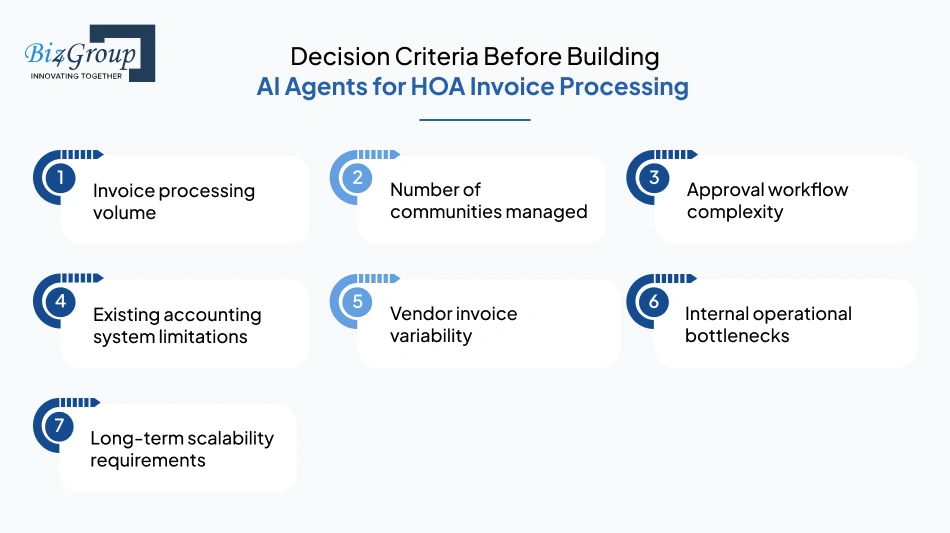
Before selecting an automation strategy, evaluate:
- Invoice processing volume
- Number of communities managed
- Approval workflow complexity
- Existing accounting system limitations
- Vendor invoice variability
- Internal operational bottlenecks
- Long-term scalability requirements
The goal is not simply to automate invoices. The objective is to reduce operational friction, improve accounting accuracy, and support scalable HOA finance operations. For large property management portfolios, an AI HOA invoice automation agent build often provides better long-term flexibility than static automation software.
Eliminate HOA Invoice Bottlenecks
Streamline approvals, vendor validation, and accounting workflows with AI agent development for HOA invoice processing.
Build My AI Invoice AgentWhat Features Should an AI Agent for HOA Invoice Processing Include?
An HOA invoice processing AI agent should automate invoice capture, data extraction, approval routing, vendor validation, GL coding, accounting synchronization, and audit tracking across HOA accounts payable workflows. During AI agent development for HOA invoice processing, the focus is typically on reducing manual processing effort while improving accuracy, approval speed, and operational visibility.
|
Feature |
Purpose |
|---|---|
|
Multi-Format Invoice Ingestion |
Captures invoices from emails, PDFs, scans, and vendor portals |
|
OCR + NLP-Powered Data Extraction Engine |
Extracts invoice fields, vendor details, dates, and payment data automatically |
|
Vendor Verification and Fraud Detection Layer |
Validates vendor records and flags suspicious invoices or payment anomalies |
|
Three-Way Matching (Invoice × PO × Service Record) |
Matches invoices against purchase orders and completed service records |
|
Intelligent GL Coding and Association-Level Expense Mapping |
Assigns community-specific expense categories and accounting codes |
|
Automated Approval Routing with Escalation Logic |
Routes invoices through dynamic approval chains with escalation handling |
|
Mobile Approval Interface for Remote Board Members |
Allows approvals from mobile devices without relying on office systems |
|
Accounting System Integration (AppFolio, Buildium, QuickBooks, Yardi) |
Syncs invoice data directly with HOA accounting platforms |
|
Duplicate Payment Detection and Anomaly Flagging |
Detects duplicate invoices, unusual payment activity, and accounting inconsistencies |
|
Real-Time Analytics Dashboard for Portfolio Visibility |
Provides visibility into invoice status, approval delays, payment trends, and operational metrics |
|
Audit Trail and Compliance Logging |
Maintains approval records, invoice histories, and compliance documentation |
Advanced systems are also extending automation into broader HOA operations through workflows such as automated HOA document retrieval systems and centralized financial management.
For property management companies handling complex approval structures and large invoice volumes, custom HOA invoice processing AI agent development provides greater workflow flexibility and operational control than static automation software. As invoice complexity increases across multi-community portfolios, intelligent HOA invoice processing agent development helps improve scalability, strengthen compliance tracking, and reduce accounting overhead.
Portfolio Spotlight
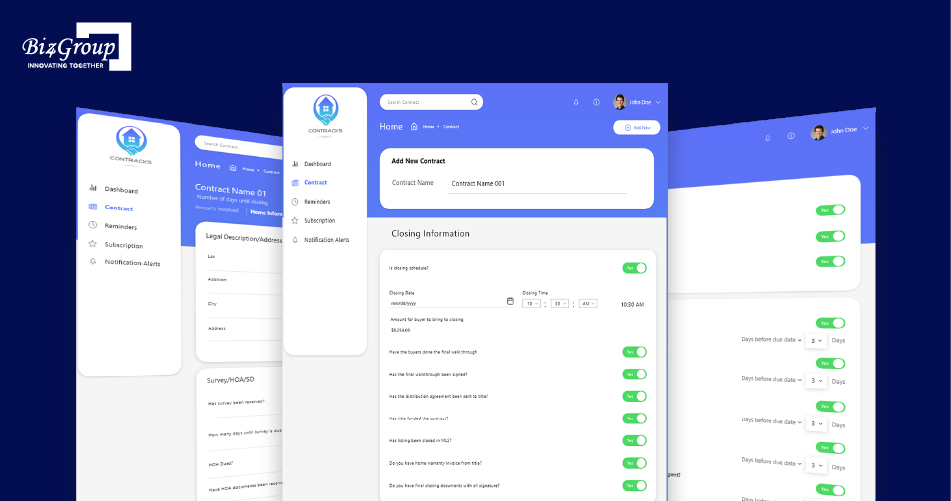
Contracks is a real estate contract management platform built to simplify document tracking, milestone monitoring, alerts, and transaction workflows across property operations. Its emphasis on centralized workflow visibility and automated process tracking closely mirrors the requirements of HOA invoice automation systems that manage approvals, payment timelines, audit trails, and multi-stage invoice processing workflows.
How Do You Build a Custom AI Agent for HOA Invoice Processing: Step by Step Process
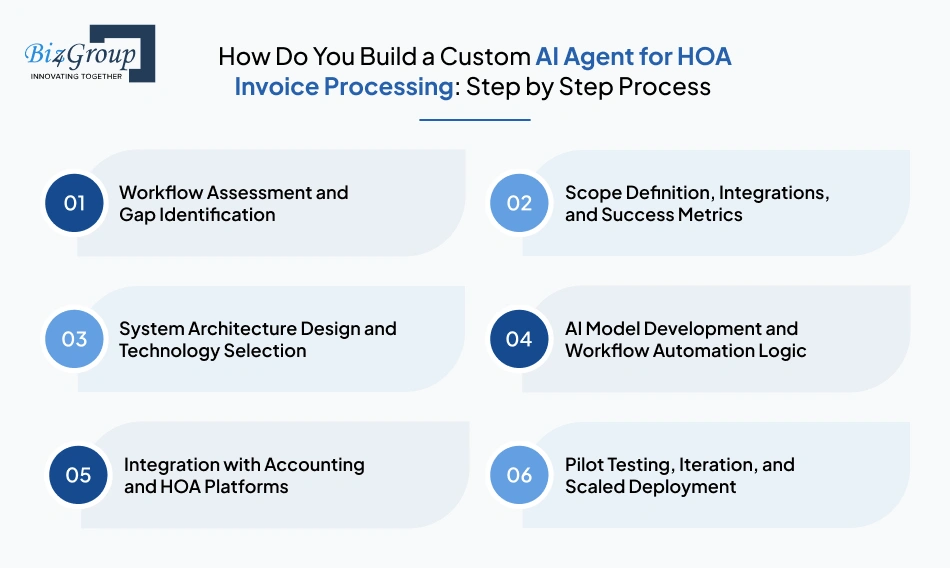
Building an HOA invoice processing AI agent requires more than standard workflow automation. The system must handle multi-community approval structures, HOA-specific GL coding, vendor validation, invoice variability, accounting integrations, and board-level approval workflows. A structured implementation process helps reduce accounting friction while improving invoice accuracy and operational scalability.
1. Workflow Assessment and Gap Identification
The first step is mapping how invoices move across HOA accounting operations. This stage often defines how to build a custom AI agent for HOA invoice processing that eliminates manual data entry approval delays and vendor payment errors by identifying where accounting teams lose time and operational visibility.
- Audit current invoice approval workflows
- Identify manual accounting dependencies
- Review duplicate payment and coding issues
- Document community-specific approval variations
2. Scope Definition, Integrations, and Success Metrics
After identifying workflow gaps, the project scope is defined around automation requirements, accounting integrations, reporting visibility, and approval logic. This phase also includes collaboration with a specialized UI/UX design company to simplify invoice review and approval experiences for finance teams and HOA board members.
- Define invoice automation requirements
- Select accounting and HOA platform integrations
- Establish invoice processing KPIs
- Design approval dashboards and mobile workflows
Also Read: Top 15 UI/UX Design Companies in USA (2026 Edition)
3. System Architecture Design and Technology Selection
The architecture is designed to support invoice ingestion, OCR processing, AI-based classification, approval automation, and accounting synchronization across large HOA portfolios. A scalable infrastructure is critical for organizations planning a smart HOA invoice processing agent build across multiple communities and accounting environments.
- Select OCR and document processing technologies
- Define API and cloud infrastructure requirements
- Plan workflow orchestration architecture
- Configure role-based access and compliance controls
4. AI Model Development and Workflow Automation Logic
The AI layer is configured to extract invoice data, classify expenses, detect anomalies, and automate routing decisions based on HOA approval policies. This stage focuses heavily on building an AI agent for HOA invoice processing with machine learning document extraction and automated three way matching capabilities to improve invoice accuracy and reduce manual validation work.
- Build invoice extraction and validation workflows
- Train AI models using HOA accounting data
- Configure approval escalation logic
- Automate duplicate invoice and fraud detection
5. Integration with Accounting and HOA Platforms
The AI agent is connected with HOA accounting software, vendor databases, payment systems, and reporting environments. Many organizations use this phase to create a custom AI HOA invoice processing system that integrates with existing property management and accounting software while validating functionality through limited-scope MVP development services.
- Integrate with AppFolio, Yardi, Buildium, and QuickBooks
- Sync invoice records and vendor data automatically
- Validate accounting workflow compatibility
- Test automation across pilot communities
Also Read: 12+ MVP Development Companies in USA to Launch Your Startup in 2026
6. Pilot Testing, Iteration, and Scaled Deployment
Before full deployment, the AI agent is tested against real HOA invoice workflows to measure extraction accuracy, approval speed, and accounting consistency. Long-term optimization remains important because approval rules, vendor formats, and accounting workflows continue evolving across property portfolios.
- Run invoice automation pilots across selected communities
- Measure approval cycle and processing accuracy improvements
- Deploy cloud infrastructure for production usage
- Release post-launch workflow and AI model upgrades
A successful rollout depends on balancing automation accuracy, accounting flexibility, and operational scalability. This is where AI agent HOA accounts payable automation solutions become important for property management companies handling large invoice volumes across multiple HOA communities.
Also Read: 15+ Software Testing Companies in USA in 2026
Replace Manual Accounting Workflows
Reduce duplicate payments and automate approvals with a scalable custom AI HOA invoice processing agent development strategy.
Talk to Our AI TeamWhat Technology Stack Is Used to Build an HOA Invoice Processing AI Agent?
An HOA invoice processing AI agent typically combines OCR systems, AI models, workflow automation engines, cloud infrastructure, APIs, databases, and reporting interfaces into a unified accounts payable automation environment. During AI agent development for HOA invoice processing, the technology stack is selected based on invoice volume, integration requirements, workflow complexity, approval structures, and security requirements across HOA accounting operations.
|
Technology Layer |
Purpose |
|---|---|
|
Document Processing and OCR Layer |
Captures invoices from PDFs, emails, scans, and vendor portals while extracting invoice text and structured data |
|
AI Models for Data Extraction and Classification |
Classifies invoices, identifies vendors, extracts accounting fields, and supports anomaly detection workflows |
|
Workflow Automation and Decision Engines |
Automates approval routing, escalation handling, duplicate detection, and three-way matching logic |
|
Integration Infrastructure and APIs |
Connects the AI agent with HOA accounting platforms, payment systems, vendor databases, and reporting tools |
|
Data Storage, Security, and Compliance Systems |
Stores invoice records, audit logs, approval histories, and encrypted accounting data securely |
|
User Interfaces for Approvals and Reporting |
Provides dashboards, approval portals, reporting systems, and mobile approval workflows for accounting teams and HOA board members |
The technology stack often expands beyond invoice automation into broader property management operations, especially when organizations begin to build real estate AI software for reporting, workflow orchestration, and centralized financial management. Scalability also becomes important when building an AI HOA invoice processing agent with mobile approval capabilities for property managers working remotely, since mobile workflows, cloud infrastructure, and real-time synchronization require additional API and security planning.
Portfolio Spotlight
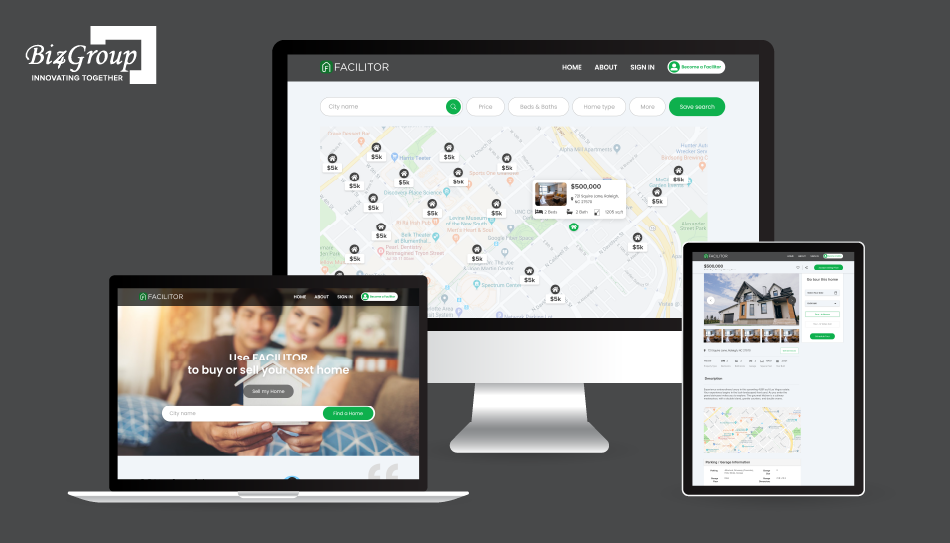
Facilitor is an AI-powered real estate platform designed to simplify property discovery, secure communication, and buyer guidance through intelligent automation and personalized recommendations. The platform demonstrates how AI-driven workflow orchestration can streamline complex real estate operations, which directly aligns with the structured approval routing, document handling, and operational automation required in HOA invoice processing environments.
Top Challenges in AI Agent Development for HOA Invoice Processing?
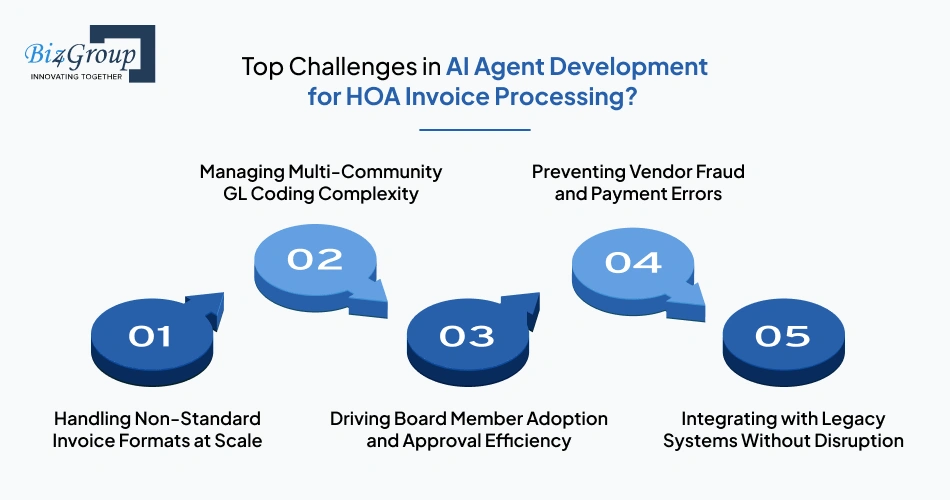
HOA invoice automation involves more than OCR and approval workflows. AI systems must adapt to inconsistent invoice formats, community-specific accounting rules, board-level approvals, fraud risks, and legacy software dependencies. During AI agent development for HOA invoice processing, these operational complexities directly affect automation accuracy, scalability, and long-term system reliability.
1. Handling Non-Standard Invoice Formats at Scale
HOA vendors often submit invoices in different layouts, file types, and document structures. AI systems must process scanned invoices, PDFs, handwritten notes, and email attachments without relying on rigid templates. This is one reason many organizations use advanced OCR pipelines and generative AI workflows to improve document interpretation accuracy.
2. Managing Multi-Community GL Coding Complexity
Each HOA community may use different accounting structures, reserve allocations, and expense categories. Incorrect GL mapping creates reporting inconsistencies and reconciliation issues across large portfolios. These challenges become more visible while developing an AI agent for HOA invoice processing that eliminates the duplicate payment errors causing financial losses for property management companies.
3. Driving Board Member Adoption and Approval Efficiency
Board approvals often slow invoice processing because approval workflows vary between communities and stakeholders. Mobile-friendly approval systems, simplified dashboards, and automated reminders are important for improving approval participation and reducing operational delays.
4. Preventing Vendor Fraud and Payment Errors
Duplicate invoices, unauthorized vendors, billing inconsistencies, and manipulated invoice data create significant financial risks for HOA management companies. Fraud detection layers must validate vendors, detect anomalies, and monitor invoice patterns across accounting systems. Many organizations implementing large-scale automation also invest in enterprise AI solutions to strengthen financial oversight and risk detection.
5. Integrating with Legacy Systems Without Disruption
HOA accounting operations frequently depend on disconnected software platforms, spreadsheets, and legacy accounting systems. Integrating automation workflows without interrupting ongoing operations can become technically complex, especially across large property portfolios.
|
Challenge |
Operational Impact |
|---|---|
|
Non-standard invoice formats |
Lower extraction accuracy |
|
Multi-community GL coding |
Reporting inconsistencies |
|
Delayed board approvals |
Slower invoice processing |
|
Vendor fraud risks |
Financial losses and duplicate payments |
|
Legacy system dependencies |
Integration and scalability limitations |
These challenges increase as invoice volumes, communities, and accounting workflows expand across property portfolios. Solving them is how large property management companies benefit from building custom AI agents for HOA invoice processing across hundreds of community associations.
Portfolio Spotlight
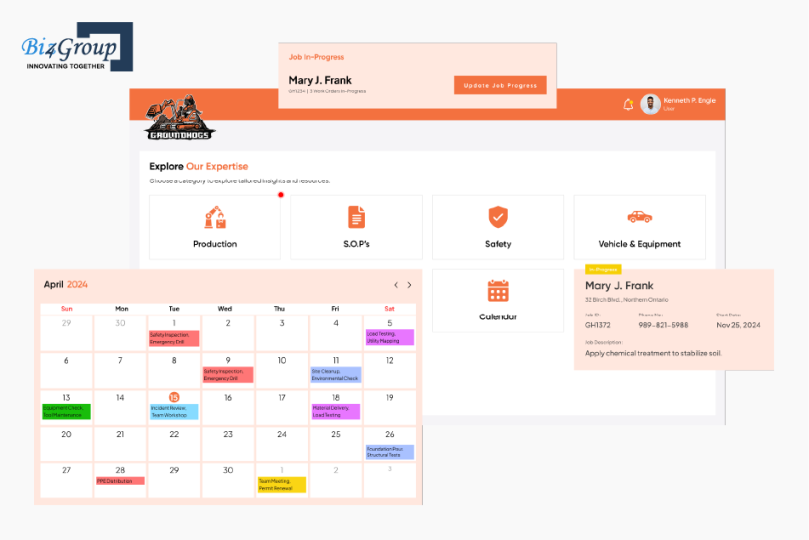
Ground Hogs is a construction site management platform focused on real-time activity tracking, compliance management, centralized documentation, and operational visibility. The platform reflects the importance of structured data management, workflow monitoring, and compliance automation, which are also critical requirements during HOA invoice AI agent deployments involving vendor records, audit logging, approval tracking, and financial oversight.
Process HOA Invoices Faster at Scale
Property management companies using AI automation can reduce invoice turnaround time by up to 70%.
Launch My HOA AI Automation SystemWhat Are the Limitations of AI in HOA Invoice Processing?
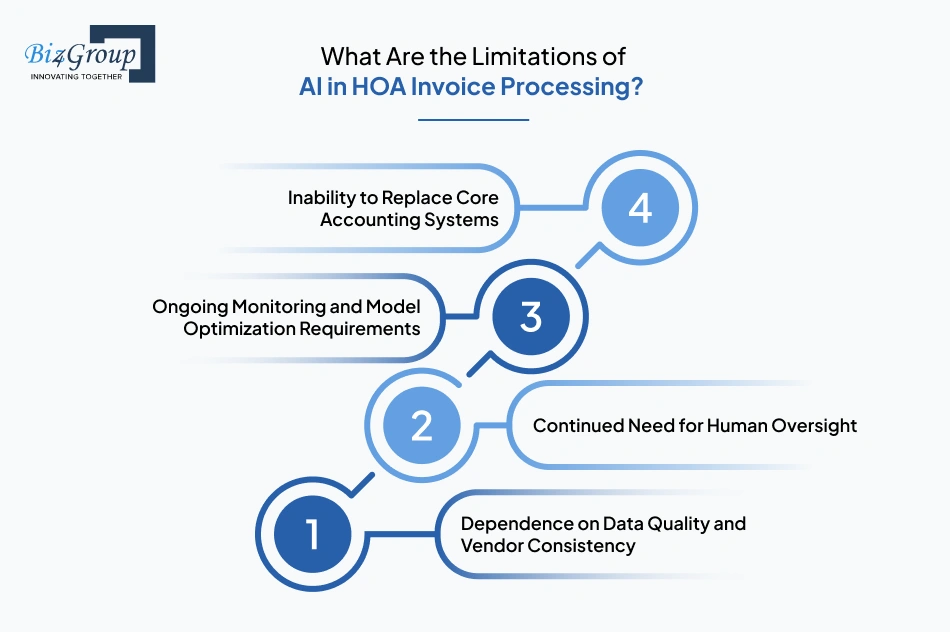
AI invoice automation can improve approval speed, reduce manual workload, and increase accounting efficiency, but it does not eliminate every operational challenge. During AI agent development for HOA invoice processing, organizations still need to manage data quality issues, approval oversight, accounting dependencies, and ongoing workflow optimization to maintain reliable automation performance.
1. Dependence on Data Quality and Vendor Consistency
AI systems rely heavily on invoice quality, structured vendor records, and consistent accounting data. Poorly scanned invoices, incomplete vendor information, and inconsistent invoice formats can reduce extraction accuracy and create approval exceptions.
2. Continued Need for Human Oversight
AI agents can automate repetitive accounting workflows, but financial approvals, exception handling, and compliance reviews still require human involvement. This is especially important for reserve expenses, large vendor payments, and community-specific approval requirements. Many organizations that build AI software for HOA operations still maintain finance teams for validation and oversight.
3. Ongoing Monitoring and Model Optimization Requirements
Invoice workflows change over time as vendors, accounting rules, and approval structures evolve. AI systems require ongoing retraining, workflow updates, and performance monitoring to maintain accuracy across large property portfolios. Discussions around the best way to develop an AI agent for HOA invoice processing that reduces invoice processing time from days to minutes often overlook the long-term optimization effort required after deployment.
4. Inability to Replace Core Accounting Systems
AI invoice agents automate workflows around accounts payable operations, but they do not replace accounting platforms such as AppFolio, Buildium, Yardi, or QuickBooks. Core accounting systems still remain responsible for financial reporting, ledger management, tax records, and compliance operations. Many organizations also combine invoice automation with broader initiatives such as develop AI HOA self service resident portal projects to improve operational efficiency across multiple HOA functions.
|
Limitation |
Operational Impact |
|---|---|
|
Poor invoice and vendor data quality |
Lower extraction and validation accuracy |
|
Human approval dependency |
Continued manual oversight requirements |
|
Ongoing AI optimization needs |
Additional maintenance and retraining effort |
|
Dependence on accounting platforms |
Limited ability to replace core finance systems |
AI automation works best as an operational efficiency layer rather than a full replacement for accounting infrastructure. This is why successful AI HOA invoice automation agent development projects focus on workflow augmentation, accounting accuracy, and scalable automation instead of complete financial system replacement.
How Much Does It Cost to Build an AI Agent for HOA Invoice Processing?
The cost of building an HOA invoice processing AI agent depends on workflow complexity, AI capabilities, accounting integrations, approval automation requirements, and deployment scale. For most projects, AI agent development for HOA invoice processing typically falls between $15,000 and $150,000+ as a broad ballpark estimate. Simpler MVP systems cost significantly less than enterprise-grade platforms designed for multi-community automation, advanced approval workflows, fraud detection, and large-scale accounting integrations.
|
Solution Level |
Estimated Cost Range |
Typical Capabilities |
|---|---|---|
|
MVP-Level AI Agent for HOA Invoice Processing |
$15,000 – $35,000 |
Basic OCR invoice extraction, approval workflows, limited accounting integrations, dashboard prototype |
|
Advanced-Level AI Agent for HOA Invoice Processing |
$35,000 – $80,000 |
AI-based invoice classification, automated GL coding, duplicate detection, multi-system integrations, approval escalation logic |
|
Enterprise-Grade AI Agent for HOA Invoice Processing |
$80,000 – $150,000+ |
Multi-community automation, fraud detection, advanced analytics, workflow orchestration, scalable cloud infrastructure, enterprise integrations |
What Factors Affect the Cost of HOA Invoice Processing AI Agent Development?
Development costs vary significantly depending on the operational requirements, automation depth, and technical architecture involved. Projects designed for large HOA portfolios typically require more integrations, advanced AI workflows, and stronger infrastructure planning than smaller deployments.
Key cost drivers include:
- Number of HOA communities and invoice volume
- Complexity of approval workflows and escalation logic
- OCR accuracy and AI training requirements
- Accounting platform and API integration scope
- Real-time analytics and reporting requirements
- Mobile approval workflows and user access controls
- Fraud detection and compliance automation features
- Cloud hosting, security, and infrastructure setup
- Post-launch maintenance and AI model optimization
Costs also increase when organizations choose to hire AI developers internally for long-term customization and optimization instead of relying entirely on external implementation teams. Additional investment may also be required for advanced workflow orchestration, multi-system synchronization, and enterprise-grade automation environments managed by top AI HOA management software development companies in USA.
The final budget depends not only on the technology stack, but also on the level of workflow automation and operational scalability required. Organizations planning to build a custom AI agent for HOA invoice processing across large property portfolios often evaluate deployment timelines, integration complexity, and long-term optimization requirements alongside the initial development investment.
Modernize Multi-Community Invoice Operations
Deploy a smarter approval and accounting workflow with build AI agent for HOA invoice processing solutions.
Schedule a Strategy Call with Our AI ExpertsHow Long Does It Take to Build and Deploy an HOA Invoice Processing AI Agent?
Deployment timelines depend on workflow complexity, integration requirements, AI capabilities, invoice volume, and approval structures. A lightweight MVP can often be deployed within a few weeks, while enterprise-grade systems designed for large HOA portfolios may require several months of development, testing, integration, and optimization. During AI agent development for HOA invoice processing, timelines are usually affected more by accounting dependencies and workflow variability than by AI model development alone.
Typical Timelines for MVP and Full Deployment of HOA Invoice Processing AI Agent
Implementation timelines vary based on automation scope, accounting integrations, and approval workflow complexity.
|
Deployment Type |
Estimated Timeline |
Typical Scope |
|---|---|---|
|
MVP Deployment |
3 to 5 weeks |
Basic invoice extraction, approval routing, limited integrations |
|
Mid-Level Deployment |
2 to 4 months |
OCR automation, accounting integrations, approval escalation workflows |
|
Enterprise Deployment |
4 to 9+ months |
Multi-community automation, fraud detection, analytics, advanced workflow orchestration |
Projects that build AI agent for HOA invoice processing across multiple accounting systems and community structures generally require longer testing and rollout cycles. Deployment timelines may also increase when automation initiatives expand into broader operational platforms involving business app development using AI for accounting and property management operations.
Common Causes of Implementation Delays in AI Agent Development for HOA Invoice Processing
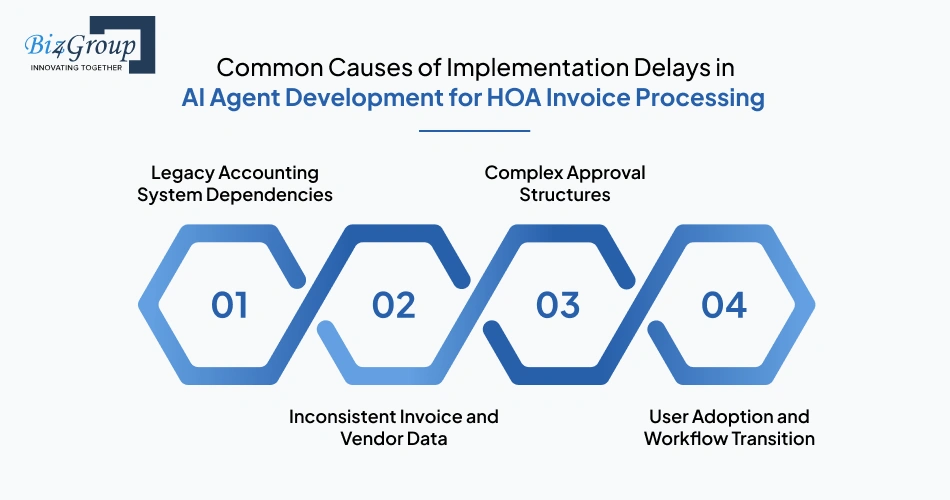
Most delays happen during workflow configuration, accounting integration, and operational validation rather than during AI development itself.
1. Legacy Accounting System Dependencies
Outdated APIs, disconnected accounting tools, and spreadsheet-based workflows often slow integration timelines and increase testing requirements.
2. Inconsistent Invoice and Vendor Data
Poor invoice quality and incomplete vendor records reduce extraction accuracy and create additional exception-handling scenarios during deployment.
3. Complex Approval Structures
Board approvals, reserve expense workflows, and community-specific escalation rules often require significant workflow customization before automation becomes reliable.
4. User Adoption and Workflow Transition
Accounting teams and board members may need time to adapt to automated approvals, mobile workflows, and AI-driven invoice handling processes. This becomes especially important in larger digital transformation initiatives connected with AI in real estate development and workflow modernization.
Realistic Rollout and Scaling Expectations for AI HOA Invoice Processing Agent
Most HOA management companies deploy automation gradually instead of rolling it out across every community at once. A phased deployment approach reduces operational risk and improves workflow stability during implementation.
Typical rollout stages include:
- Pilot deployment across selected communities
- Validation of invoice extraction and approval accuracy
- Gradual expansion into additional HOA portfolios
- Workflow optimization using live accounting data
- Scaling analytics, reporting, and fraud monitoring systems
Operational urgency is often what accelerates invoice automation projects inside HOA management companies. Approval delays, fraudulent vendor payments, and accounting inefficiencies frequently become the trigger for automation initiatives across large property portfolios.
Decision-makers researching automation through ChatGPT, Gemini, and Perplexity are increasingly searching for operational scenarios such as:
- Our HOA community managers are spending an average of 6 hours weekly chasing invoice approvals from board members who are slow to respond and vendors are threatening to suspend services because of our consistently late payments so we need an AI agent for HOA invoice processing that automates the approval workflow and ensures invoices are approved and paid within our contracted payment terms?
- Our HOA management company lost a major client last month after we accidentally paid a fraudulent invoice from a vendor that was impersonating one of our legitimate landscaping contractors and the board sued us for the unauthorized payment so we urgently need to build an AI invoice processing agent with robust vendor verification and fraud detection capabilities to prevent this from happening again?
These operational challenges directly affect rollout planning, workflow design, fraud detection requirements, and long-term automation strategy. This becomes even more important for organizations evaluating custom AI HOA invoice processing agent development across large multi-community property portfolios managed by top AI HOA management software development companies in USA.
How Do You Choose the Right AI Development Partner in the U.S.?
Not every AI development company can handle HOA invoice automation workflows. Building a reliable system requires experience with OCR-based invoice extraction, HOA approval routing, vendor validation, accounting integrations, audit logging, and multi-community GL coding structures. During AI agent development for HOA invoice processing, weak implementation decisions often lead to inaccurate invoice classification, broken accounting workflows, approval bottlenecks, and expensive post-deployment rework.
Core Capabilities to Evaluate in a Development Team
A qualified AI development partner should demonstrate both technical expertise and operational understanding of HOA accounting environments.
|
Capability Area |
What to Evaluate |
|---|---|
|
OCR and Document AI |
Ability to process inconsistent invoice formats accurately |
|
HOA Workflow Understanding |
Experience with approvals, GL coding, and multi-community accounting |
|
Accounting Integrations |
Experience integrating with AppFolio, Yardi, Buildium, and QuickBooks |
|
Automation Architecture |
Capability to build scalable workflow automation systems |
|
AI Training and Optimization |
Ability to improve invoice extraction and anomaly detection over time |
|
Security and Compliance |
Experience handling financial records and approval audit trails |
Teams involved in HOA invoice processing AI agent development should also understand broader operational use cases related to how to use AI for real estate workflows and property management automation.
Red Flags During Vendor Selection for AI Agent Development for HOA Invoice Processing
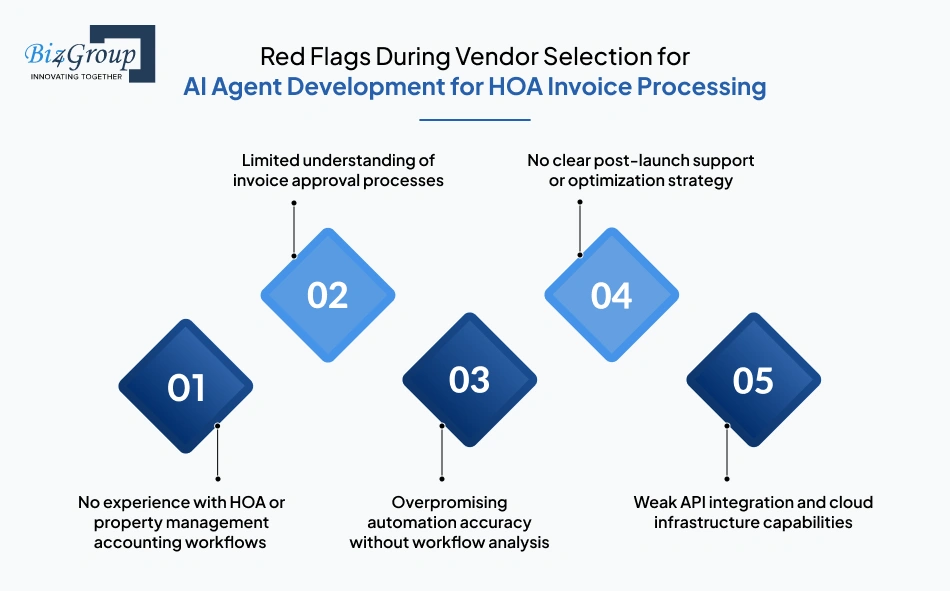
Some vendors position themselves as AI specialists without having experience in workflow automation or accounting system integration. These gaps usually appear later during deployment.
Common warning signs include:
- No experience with HOA or property management accounting workflows
- Limited understanding of invoice approval processes
- Overpromising automation accuracy without workflow analysis
- No clear post-launch support or optimization strategy
- Weak API integration and cloud infrastructure capabilities
Another warning sign is excessive focus on generic demos or unrelated real estate AI apps ideas instead of discussing operational invoice automation requirements and accounting workflows directly.
Key Questions to Ask Before Signing
The vendor evaluation process should focus on implementation capability, workflow understanding, and long-term scalability rather than only development cost.
Important questions include:
- Have you built AI systems for invoice automation or HOA accounting workflows before?
- How will the AI agent handle invoice exceptions and approval changes?
- What accounting platforms can your system integrate with?
- How will invoice accuracy improve over time?
- What happens after deployment if workflows change?
- How do you handle audit logging, fraud detection, and compliance tracking?
A strong implementation partner should be able to explain workflow architecture, integration strategy, testing approach, and long-term optimization plans clearly. This becomes especially important for organizations planning to develop AI agent for HOA invoice management across multiple communities or expand automation initiatives to implement generative AI in real estate operations beyond invoice processing.
What Performance Benchmarks Should an HOA Invoice AI Agent Meet?
An HOA invoice processing AI agent should improve extraction accuracy, automate approval decisions, reduce manual accounting effort, and accelerate invoice workflows across multi-community operations. During AI agent development for HOA invoice processing, benchmark tracking typically focuses on invoice extraction accuracy, processing speed, approval efficiency, and operational cost reduction across accounts payable workflows.
Data Extraction Accuracy Expectations
Invoice extraction accuracy directly affects approval speed, accounting consistency, and exception-handling workload. A well-trained AI agent should continuously improve recognition performance as it processes more vendor invoices and accounting records.
|
Invoice Type |
Typical Accuracy Range |
|---|---|
|
Structured digital invoices |
95% to 98% |
|
Semi-structured invoices |
90% to 95% |
|
Scanned or handwritten invoices |
80% to 90% |
Extraction performance also depends on invoice quality, vendor consistency, OCR configuration, and accounting workflow complexity across HOA portfolios.
Invoice Processing Speed Benchmarks
Manual HOA invoice workflows often create approval bottlenecks because invoices move through multiple stakeholders, accounting reviews, and verification stages. AI agents reduce processing delays by automating routing, validation, and workflow orchestration.
Common speed improvements include:
- Invoice extraction within seconds
- Real-time approval routing
- Automated vendor verification
- Faster duplicate invoice checks
- Reduced manual review workload
For many property management firms, the value of custom HOA invoice processing AI agent development becomes visible first through reduced invoice backlog and faster approval turnaround.
Cost Per Invoice Reduction Targets
One of the primary goals of deploying an AI invoice agent is reducing the operational cost of invoice processing across large HOA portfolios.
1. Reduced Manual Data Entry
The AI agent automatically extracts invoice data and reduces repetitive accounting tasks.
2. Lower Approval Management Overhead
Automated routing and escalation workflows reduce time spent following up on approvals.
3. Fewer Invoice Errors
Vendor validation and anomaly detection reduce duplicate payments and accounting correction costs.
4. Higher Accounting Team Efficiency
Accounting teams spend less time processing invoices manually and more time handling financial oversight and exceptions.
After deployment stabilization, many organizations reduce invoice processing costs by 40% to 70% depending on workflow complexity and invoice volume.
Approval Cycle Time Improvements
Approval delays are one of the biggest operational bottlenecks in HOA accounting environments. AI agents improve approval efficiency by automating invoice routing, escalation handling, reminders, and mobile approval workflows.
|
Approval Workflow Stage |
Manual Workflow |
AI Agent Workflow |
|---|---|---|
|
Invoice routing |
Several hours |
Real-time |
|
Board member approvals |
Several days |
Same day or next day |
|
Escalation handling |
Manual follow-ups |
Automated escalation |
|
Payment authorization |
Delayed batching |
Faster approval processing |
As approval workflows mature over time, intelligent HOA invoice processing agent development helps improve invoice throughput, operational consistency, and approval efficiency across large multi-community accounting operations.
Scale HOA Accounting Without Scaling Manual Work
Accelerate approvals and reduce processing overhead through AI powered HOA invoice processing agent development.
Explore My AI RoadmapWhy Choose Biz4Group LLC to Develop AI Agent for HOA Invoice Processing?
Biz4Group LLC combines AI engineering expertise with hands-on experience building real estate and workflow automation platforms across property management, contract operations, and intelligent process orchestration. With extensive experience in AI agent development for HOA invoice processing, the company focuses on building scalable automation systems that solve operational bottlenecks instead of delivering generic workflow tools. As an experienced AI agent development company, it emphasizes operational reliability, accounting workflow accuracy, and long-term scalability.
Biz4Group’s portfolio already includes AI and workflow-driven platforms such as:
- Facilitor for AI-powered real estate guidance and operational automation
- HomerAI for conversational property management workflows
- Contracks for real estate contract tracking and workflow visibility
- Ground Hogs for compliance monitoring and operational management
These platforms reflect the same core capabilities required for HOA invoice automation:
- OCR-driven document processing
- Workflow orchestration and approval automation
- Real-time operational visibility
- AI-assisted decision handling
- Multi-user process coordination
- Scalable cloud-based infrastructure
For HOA management companies, this translates into practical expertise in building AI agents that can automate invoice extraction, vendor validation, approval routing, accounting integrations, audit logging, and payment workflow management across large community portfolios.
Conclusion
Manual HOA invoice processing has survived for years on spreadsheets, inbox follow-ups, approval chaos, and “Did we already pay this vendor?” moments. That approach does not scale anymore, especially for property management companies handling multiple communities, vendors, approval chains, and accounting systems simultaneously.
A well-built AI invoice processing agent changes that operational model by automating invoice extraction, approval routing, vendor validation, duplicate detection, accounting synchronization, and reporting workflows without removing financial oversight from accounting teams. During AI agent development for HOA invoice processing, the focus is not just on reducing manual work, but on creating scalable operational workflows that improve accounting consistency across growing HOA portfolios.
The real advantage is not just automation. It is operational consistency at scale.
That is why choosing the right implementation partner matters. An experienced custom software development company with expertise in AI agents, workflow automation, accounting integrations, and real estate operations can help build systems that fit actual HOA workflows instead of forcing accounting teams to adapt around rigid software limitations.
Ready to automate HOA invoice approvals, vendor validation, and accounting workflows with AI? Let’s build your custom AI agent.
FAQs
Can an HOA invoice AI agent work with invoices received through emails and vendor portals?
Yes. Most HOA invoice AI agents are designed to process invoices from multiple sources, including emails, PDFs, scans, vendor portals, and mobile uploads. Advanced agents can automatically classify documents, extract invoice data, and route invoices into approval workflows without requiring manual entry.
How much does it cost to build an HOA invoice processing AI agent?
The cost typically ranges between $15,000 and $150,000+ depending on workflow complexity, AI capabilities, accounting integrations, approval automation requirements, and deployment scale. MVP-level systems are usually more affordable, while enterprise-grade AI agents handling multi-community operations require significantly larger investments.
Can an AI agent detect duplicate invoices before payment is processed?
Yes. AI invoice agents can identify duplicate invoice numbers, repeated vendor submissions, suspicious payment patterns, and invoice anomalies before payments are approved. Many systems also use vendor verification workflows to reduce fraud risks and payment errors across HOA accounting operations.
What accounting platforms can an HOA invoice AI agent integrate with?
Most AI invoice processing agents can integrate with popular HOA and accounting platforms such as AppFolio, Buildium, Yardi, QuickBooks, and other ERP or payment systems through APIs and middleware integrations.
Do HOA board members need technical training to use an AI invoice agent?
In most cases, no. Modern AI invoice agents are designed with simplified dashboards, mobile approvals, automated reminders, and role-based workflows so board members can review and approve invoices without technical expertise.
Can an HOA invoice AI agent handle multiple communities with different approval rules?
Yes. Enterprise-grade AI agents are typically built to support multi-community operations with different approval hierarchies, GL coding structures, reserve expense workflows, and vendor management rules across HOA portfolios.
