Location :
Orlando, FL, USA
Location :
Orlando, FL, USA +1 (407) 714-1616
 info@biz4group.com


















Imagine a digital system that doesn’t wait for instructions but instead, understands your business goals, learns from real-time feedback, and takes independent actions to get the job done.
Read More

How long can your HOA team keep up with nonstop resident requests before something starts breaking?
Take a moment and think about your day.
How much of your team’s time goes into answering:
If you’re honest, it’s probably a huge chunk of the day and the pressure is only increasing.
According to Gartner, 91% of customer service leaders are under pressure to implement AI in 2026.
Now compare that to how most HOAs operate today. Everything still runs through calls, emails, and manual follow-ups even when teams rely on AI HOA management software, the workload doesn’t actually go away. Your staff still has to respond, track, and follow up manually.
That’s the gap and this is exactly where AI HOA self service resident portal development starts to change things.
Instead of your team responding to every request, you create a system where residents can find answers, track updates, and submit issues on their own.
So, the real question becomes simple: Are you going to keep scaling your team, or finally scale your system?
Have you ever wondered why your HOA team still spends hours handling tasks that residents should be able to manage on their own? That’s exactly what AI HOA self service resident portal development is designed to solve.
It’s the process of building a smart digital platform where residents can submit complaints, track maintenance requests, pay dues, access documents, book amenities, and get updates without constantly calling or emailing the HOA office.
At the same time, AI handles repetitive work in the background like complaint routing, automated responses, reminders, request tracking, and resident support.
Think about it this way - if residents can already book flights, manage banking, and schedule appointments from their phones, why are HOA teams still buried in manual communication?
This is why more companies are investing in HOA resident portal development integrating AI instead of relying on systems that still require constant human involvement.
You’ve probably heard concerns like: “Our HOA management team is spending 6 hours a day answering the same resident phone calls and emails about maintenance status, dues payments, and community rules, how can we automate this with AI?”
That’s no longer a future problem. It’s happening right now across HOA management companies managing hundreds or even thousands of homes.
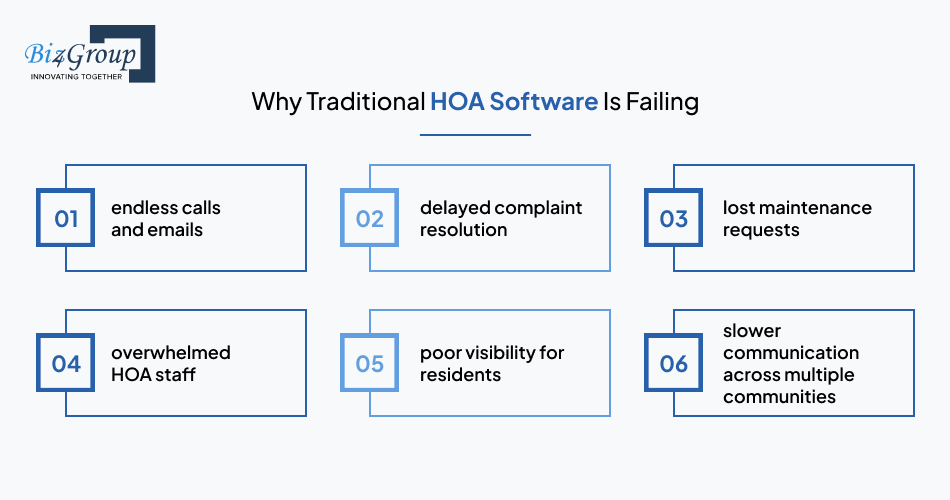
Most traditional HOA platforms were built to store information, not reduce workload and that becomes a problem when resident expectations keep growing every year.
Residents want instant updates. They expect self-service access. They don’t want to wait for office hours just to check a payment or report an issue but traditional systems still depend heavily on manual workflows.
That usually leads to:
Now ask yourself this: How much time does your team lose every week simply answering repetitive questions?
Or worse, how many complaints escalate because residents don’t have visibility into what’s happening?
That’s why many companies now choose to develop self service HOA resident portal to eliminate manual complaints and reduce operational pressure before it starts affecting resident satisfaction and staff retention.
You can already see this shift happening across the property management industry where businesses are investing in AI property management software to automate communication, maintenance coordination, and support operations.
Implement automated HOA document retrieval system development to reduce delays and streamline real estate transactions.
Start My AI Document SystemMost HOA teams don’t struggle because they lack software. They struggle because every request still depends on manual action.
That’s where HOA resident portal development integrating AI changes the workflow completely. Instead of your team managing every complaint, payment question, or maintenance follow-up manually, AI handles repetitive interactions automatically while residents get faster responses and real-time visibility.
Let’s break down how the system actually works behind the scenes.
When residents submit a question through the portal, AI understands the request and responds instantly based on community rules, resident data, and previous interactions. This removes the need for staff to repeatedly answer the same questions every day. Residents get immediate support while your team focuses on higher-priority work.
Key functions include:
This is one of the biggest reasons companies are investing in implementing AI automation in real estate to reduce repetitive communication and improve operational efficiency.
One of the biggest problems in HOA operations is complaint overload. AI solves this by automatically identifying the type, urgency, and category of each complaint at the moment it’s submitted. Instead of complaints sitting in inboxes, the system routes them directly to the right department, property manager, or vendor.
Key functions include:
This is especially useful for companies trying to make AI HOA portal for resident complaint automation without increasing operational overhead.
Residents can submit maintenance requests directly through the portal along with photos, descriptions, and location details. AI then routes the issue to the appropriate maintenance team or vendor automatically. At the same time, residents receive live updates instead of repeatedly calling the HOA office for status checks.
Key functions include:
This workflow is a major part of companies looking to develop custom HOA resident portal with maintenance request tracking for larger residential communities.
Late payments and manual reminders create unnecessary administrative work for HOA teams. AI helps automate the entire dues management process through reminders, payment tracking, and resident notifications. Residents can pay dues directly through the portal while the system automatically handles recurring communication.
Key functions include:
AI also helps HOA teams manage operations across multiple communities from a single dashboard. Instead of switching between spreadsheets, emails, and disconnected tools, everything becomes centralized and easier to monitor. This becomes critical when teams start building a HOA resident portal with AI for communities handling high resident volume and constant service requests.
Key functions include:
You’ve probably heard operations teams ask: “Residents in our gated community keep calling the HOA office after hours about noise complaints, parking violations, and amenity bookings and we have no system to handle these requests automatically.”
That’s exactly the kind of operational bottleneck AI is designed to remove.
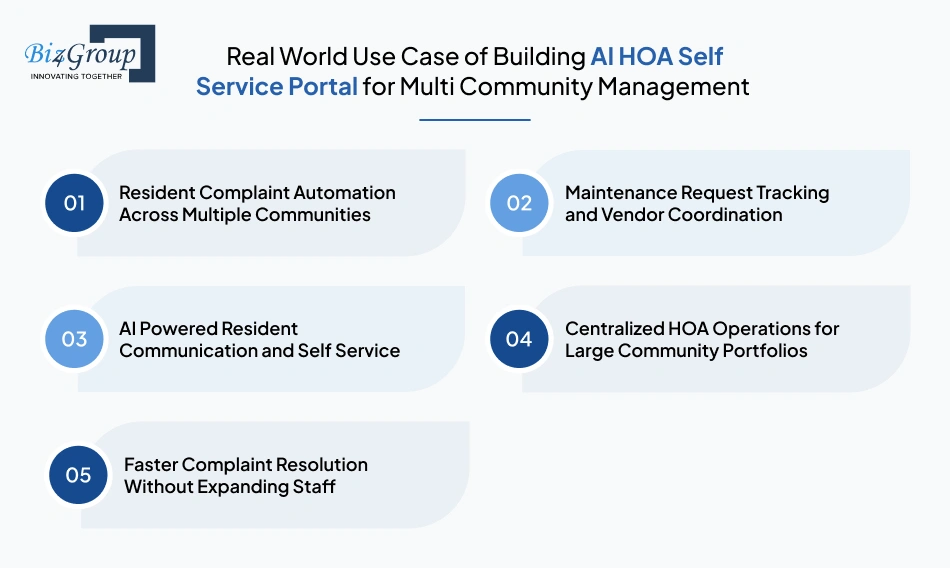
As HOA management companies grow, operational pressure increases fast. More communities mean more complaints, more maintenance requests, more resident communication, and more follow-ups for your staff to handle every single day.
That’s why more companies now build AI HOA self service portal solutions to automate repetitive operations and manage multiple communities without constantly expanding internal teams.
Managing complaints manually becomes almost impossible when your team handles several residential communities at once. Emails get missed, complaints sit unresolved, and residents keep calling for updates. By making AI HOA portal for resident complaint automation, AI automatically categorizes complaints, assigns priority levels, routes issues to the right teams, and updates residents without manual coordination.
Example:
Associa, one of the largest HOA management companies in North America, uses digital resident platforms and automation systems to streamline resident communication, service requests, and operational workflows across thousands of communities.
Maintenance management becomes difficult when requests come from emails, phone calls, or scattered systems. Staff often spends more time tracking updates than solving the actual problem. That’s why companies now develop custom HOA resident portal with maintenance request tracking to centralize maintenance workflows, automate vendor assignment, and give residents real-time status visibility.
Example:
FirstService Residential uses resident portal technology to help communities manage maintenance requests, communication, and service coordination across large residential portfolios more efficiently.
Residents expect instant responses today. They don’t want to wait for office hours just to ask about dues, amenity bookings, or community rules. With building HOA resident portal with AI, residents receive instant support through AI chat systems while repetitive communication gets automated behind the scenes.
Example:
CINC Systems provides AI-enhanced resident communication tools that help HOA management teams reduce manual support requests and improve resident response time.
This is becoming especially important for teams saying: “We are losing good HOA staff because they spend all day answering repetitive resident questions instead of doing meaningful work, what AI self service portal can we build to fix this?”
Managing operations across multiple communities usually means switching between disconnected tools, spreadsheets, emails, and vendor systems. This is why companies are now focused on building custom AI self service portal for HOA management companies that centralize resident requests, operational workflows, payment tracking, and reporting into one system.
Example:
Large property operations companies are increasingly investing in implement generative AI in real estate workflows to centralize communication, automate administrative work, and improve operational visibility across residential communities.
Hiring more staff doesn’t solve operational inefficiency. It only increases operational cost while repetitive work continues growing. This is where building AI resident portal to speed up HOA complaint resolution time creates measurable impact. AI reduces manual involvement by automating intake, routing, updates, reminders, and resident communication from a single platform.
Example:
AppFolio uses AI-driven communication and workflow automation to help property management teams handle high resident interaction volume without proportionally increasing support staff.
This is exactly why more operations teams are asking: “Our HOA management company handles 15 residential communities and our staff is completely overwhelmed with resident complaints, maintenance requests, and dues collection, what software can solve this?”
You can’t solve operational overload with basic portals anymore. Residents expect instant updates, self-service access, faster complaint resolution, and real-time communication. At the same time, HOA teams need systems that reduce manual work instead of adding more administrative pressure.
That’s exactly why companies investing in AI HOA self-service resident portal development focus heavily on features that automate repetitive operations while improving the resident experience across every touchpoint.
Let’s look at the features that actually make a difference.
The resident dashboard becomes the central place where homeowners manage everything related to their community experience. Instead of calling the HOA office for updates, residents can track requests, review payments, access documents, submit complaints, and receive community announcements from one system. This is one of the first things companies prioritize when they build AI HOA self-service portal solutions for large residential communities because it reduces communication overload and gives residents more operational visibility.
Complaint handling is one of the biggest operational pain points for HOA teams. Without automation, complaints quickly pile up across emails, calls, and spreadsheets, making response times slower and resident frustration higher. This is where making AI HOA portal for resident complaint automation becomes important. AI automatically categorizes complaints, assigns urgency levels, routes issues to the right department, and updates residents throughout the process without requiring constant manual involvement.
Maintenance coordination becomes difficult when requests come from disconnected channels. Staff often spends more time organizing requests than resolving them.With developing custom HOA resident portal with maintenance request tracking, residents can submit issues directly through the portal while AI automatically assigns vendors, tracks progress and sends updates in real time. This creates faster resolution workflows and significantly reduces follow-up communication.
Residents no longer want to wait for office hours just to ask basic questions about dues, maintenance timelines, amenities, or community policies. That’s why building HOA resident portal with AI now includes AI-powered chat systems that provide instant responses 24/7. Instead of staff answering repetitive questions all day, AI handles routine conversations automatically while your team focuses on operational priorities. Businesses using AI receptionist avatar for hospitality are already adopting similar AI-driven communication experiences to improve customer support and reduce repetitive interactions.
Manual payment tracking creates unnecessary administrative work for HOA teams. Residents also become frustrated when they don’t have visibility into payment status, reminders, or late fees. An AI-powered portal automates dues reminders, recurring payments, late fee notifications, and payment tracking so residents can manage everything digitally without depending on office staff for updates. This becomes especially valuable for companies exploring how to build HOA management software with AI automation that can reduce repetitive financial administration.
Poor communication often creates more complaints than the actual operational issue itself. Residents want timely updates, emergency alerts, meeting notices, and announcements without constantly reaching out to management teams. A centralized communication system allows HOA teams to manage all resident communication from one platform while keeping every community member informed in real time.
As operations grow, HOA teams need complete visibility into complaints, maintenance requests, vendor coordination, payments, and staff workload across multiple communities. This is why companies focused on building custom AI self service portal for HOA management companies prioritize centralized admin dashboards that simplify operational oversight and improve team efficiency.
HOA operations involve constant sharing of bylaws, notices, compliance forms, meeting records, and policy documents. Managing these manually creates delays and unnecessary administrative work. A centralized document system allows residents to securely access important files anytime without depending on staff for document requests or approvals.
AI doesn’t just automate workflows. It also helps HOA teams identify operational patterns before they become larger problems. This includes identifying recurring complaints, delayed maintenance trends, payment issues, and resident engagement gaps across different communities. That’s one of the biggest reasons companies are increasingly working with a real estate AI software development company to build smarter and more scalable HOA platforms. And once these core features are in place, the next step becomes even more important.
How do you turn a standard portal into an intelligent system that predicts issues, speeds up decisions, and improves operations automatically?
From complaint automation to maintenance tracking, the right portal can reduce operational chaos faster than you think.
Build Your AI HOA PortalBasic automation is no longer enough for growing HOA operations. Today, companies want systems that can predict issues, prioritize complaints automatically, understand resident behavior, and reduce operational delays without depending on constant staff involvement.
That’s exactly why more companies are now building AI resident portal to speed up HOA complaint resolution time instead of relying only on traditional workflow automation.
The real advantage of AI HOA self service resident portal development comes from making the portal intelligent enough to take action before operational bottlenecks grow into larger resident problems.
|
Advanced AI Feature |
How It Helps HOA Operations |
|---|---|
|
AI Complaint Prioritization |
AI automatically identifies high-priority complaints such as security concerns, maintenance emergencies, or recurring resident disputes and moves them to the top of the queue. This is becoming a core part of making AI HOA portal for resident complaint automation strategies for large residential communities. |
|
Sentiment Analysis |
AI analyzes resident messages, emails, and complaints to detect frustration, urgency, or dissatisfaction levels. This helps HOA teams respond faster to situations that could escalate publicly or affect resident satisfaction. |
|
Smart Escalation Workflows |
Instead of waiting for staff intervention, AI automatically escalates unresolved complaints based on response time, severity, or policy rules. This reduces delays and improves accountability across teams and vendors. |
|
Predictive Maintenance Alerts |
AI studies maintenance history, recurring repair patterns, and asset conditions to identify issues before they become expensive community problems. This is especially useful for companies trying to develop custom HOA resident portal with maintenance request tracking across multiple residential properties. |
|
Residents can report issues, ask questions, or request updates through voice-enabled AI systems without needing to call HOA staff directly. Similar AI communication experiences are already becoming common in customer service automation systems across service-heavy industries. |
|
|
Generative AI Resident Communication |
AI automatically creates personalized responses, notices, reminders, payment follow-ups, and community updates based on resident activity and operational data. This helps companies exploring how to build HOA management software with AI automation reduce repetitive communication work significantly. |
|
AI Based Vendor Assignment |
AI automatically assigns maintenance vendors based on location, urgency, availability, performance history, and repair category. This speeds up maintenance resolution and reduces manual coordination effort. |
|
Community Behavior Analytics |
AI identifies recurring complaint patterns, amenity usage trends, payment behavior, and operational bottlenecks across different residential communities. This gives management teams stronger operational visibility while building HOA resident portal with AI for large-scale community operations. |
|
AI helps detect unusual payment activity, policy violations, duplicate maintenance claims, or suspicious operational behavior that may require management review. |
|
|
Multi Community Operational Intelligence |
Companies managing several communities can monitor complaints, maintenance performance, resident satisfaction, and operational trends from one centralized AI dashboard instead of disconnected systems. This is becoming essential for teams building custom AI self service portal for HOA management companies handling large resident volumes. |
|
AI recommends operational improvements based on resident activity, complaint history, maintenance trends, and engagement behavior. This helps HOA teams improve efficiency continuously over time. |
|
|
Smart Document Search and Retrieval |
Residents can instantly find bylaws, policies, meeting records, and compliance documents using conversational AI search instead of manually searching through files or contacting staff. |
|
AI Amenity Booking Management |
AI automatically handles clubhouse bookings, parking reservations, visitor approvals, and amenity scheduling while preventing conflicts and duplicate reservations. |
|
Automated Resident Onboarding |
New residents receive automated onboarding flows including payment setup, community rules, amenity access instructions, and document verification without manual staff coordination. |
|
AI Driven Condo Association Management |
Many companies are now creating AI powered resident self-service portal for condo associations to automate resident communication, maintenance coordination, amenity management, and operational reporting across large residential buildings. |
Many HOA operators are already asking: “Can AI automate resident complaint management, maintenance request routing, and dues payment reminders for a homeowners association managing 500 to 2000 homes?”
That’s exactly why more companies are investing in custom AI HOA self-service software development instead of relying on traditional HOA systems that still depend heavily on manual workflows.
But advanced AI features alone are not enough. The real challenge is understanding how to build AI powered HOA resident portal from scratch that can scale reliably across multiple communities and operational workflows.
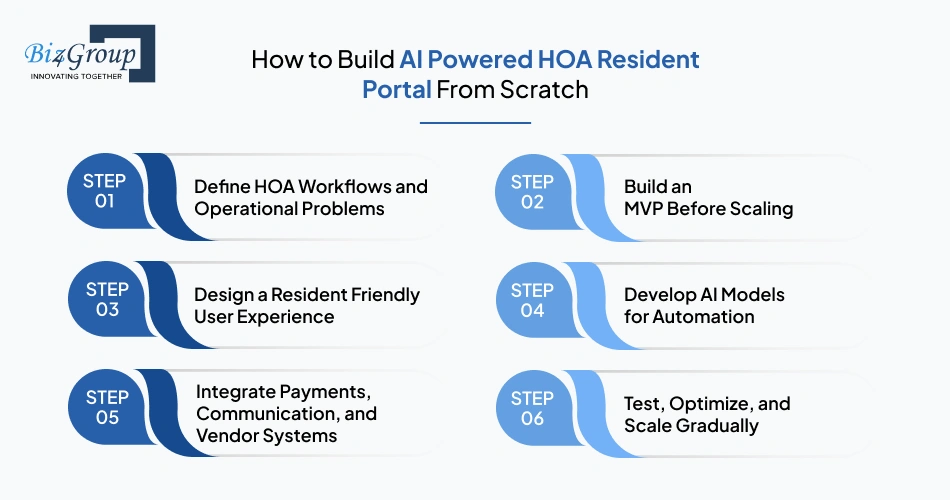
Building an HOA portal is not just about adding AI features into an existing system. The real challenge is creating a platform that fits actual HOA workflows, scales across multiple communities, and reduces operational pressure instead of increasing complexity.
That’s why companies investing in AI HOA self service resident portal development and custom AI HOA self service software development follow a structured development process instead of rushing into development blindly.
Many decision-makers are now asking: “Which real estate software development companies specialize in building custom AI self service resident portal software for HOA management companies managing multiple residential communities?”
The answer depends on choosing a team that understands both AI automation and large-scale HOA operations before starting how to build AI powered HOA resident portal from scratch.
Before development starts, you need a clear understanding of the operational issues your HOA team is facing daily. This includes complaint handling, maintenance coordination, resident communication, payment collection, and approval workflows. Without identifying these bottlenecks first, even advanced AI features won’t solve the real operational problems.
Key focus areas include:
Trying to launch a fully loaded platform from day one usually increases development cost, delays deployment, and creates unnecessary complexity. That’s why many companies start with a smaller functional version focused on the most critical workflows like complaint automation, resident communication, and maintenance tracking. This helps validate workflows before scaling the platform further. Businesses investing in MVP development often reduce development risk while identifying which AI features actually deliver operational value early.
Key focus areas include:
Even the best AI system fails if residents struggle to use the platform. The portal should feel simple, intuitive, and easy to navigate for residents of all age groups. This becomes especially important when building HOA resident portal with AI because the goal is to reduce support requests, not create new usability problems. A strong UI/UX design strategy improves adoption rates while making resident interactions smoother and faster.
Key focus areas include:
AI functionality depends heavily on how well the underlying models are trained and integrated into the platform. This includes complaint classification, automated responses, maintenance prioritization, sentiment analysis, and workflow automation. Poor AI implementation creates inaccurate responses and operational confusion, which is why model quality matters significantly in AI HOA self service resident portal development. Companies investing in AI model development focus on training AI systems using real operational workflows and resident interaction data.
Key focus areas include:
A disconnected portal creates more operational work instead of reducing it. That’s why integrations play a major role in custom AI HOA self service software development. The platform should connect with payment gateways, vendor systems, communication tools, accounting software, and maintenance workflows so everything operates from one centralized system.
Key focus areas include:
Launching without proper testing often leads to resident frustration, broken workflows, and support overload. AI systems need continuous monitoring and optimization after deployment to improve accuracy and operational efficiency over time. This becomes especially important for companies building custom AI self service portal for HOA management companies managing multiple communities simultaneously.
Key focus areas include:
Once the development process is planned correctly, the next major decision becomes technical. What technologies, frameworks, and AI infrastructure should you choose to build a scalable HOA resident portal?
Choosing the right tech stack is not just a technical decision. It directly affects platform scalability, AI performance, resident experience, security, maintenance cost, and long-term operational efficiency.
That’s why companies investing in custom AI HOA self service software development focus on building a technology foundation that can handle high resident activity, real-time automation, multi-community operations, and future AI expansion without performance issues.
|
Technology Layer |
Recommended Technologies |
Why It Matters for HOA Portals |
|---|---|---|
|
Frontend Development |
These frameworks help create fast, responsive, and mobile-friendly resident portals where users can manage complaints, payments, maintenance requests, and community communication smoothly across devices. |
|
|
React Native, Flutter |
HOA residents expect mobile access for reporting complaints, tracking requests, and receiving notifications. Cross-platform frameworks reduce development time while maintaining consistent user experience. |
|
|
Backend Development |
Backend systems manage complaint routing, payment processing, resident data, AI workflows, and multi-community operations. Strong backend architecture becomes essential when building HOA resident portal with AI at scale. |
|
|
AI and Automation Layer |
OpenAI, TensorFlow, LangChain, Dialogflow |
These technologies power complaint automation, AI chat support, sentiment analysis, predictive maintenance, and workflow intelligence inside AI HOA self service resident portal development platforms. |
|
Database Management |
PostgreSQL, MongoDB, MySQL |
HOA portals process large amounts of resident, payment, maintenance, and operational data. Scalable databases help maintain fast system performance and reliable data access. |
|
Cloud Infrastructure |
AWS, Microsoft Azure, Google Cloud |
Cloud platforms help HOA systems scale across multiple residential communities while supporting AI workloads, data security, storage, and system uptime. |
|
Real Time Communication |
WebSockets, Firebase, Twilio |
Real-time notifications help residents receive complaint updates, payment reminders, maintenance alerts, and emergency announcements instantly. |
|
Payment Integration |
Stripe, PayPal, Plaid |
Secure payment gateways simplify dues collection, recurring payments, transaction tracking, and financial reporting for HOA teams and residents. |
|
AI Chat and Voice Systems |
ChatGPT API, Amazon Lex, Google Dialogflow |
AI-powered communication tools automate resident support and reduce repetitive questions related to dues, maintenance requests, and community policies. |
|
Security and Compliance |
OAuth 2.0, JWT, SSL Encryption, MFA |
HOA systems manage sensitive resident and financial data, making security and access control critical for platform trust and compliance. |
|
Analytics and Reporting |
Power BI, Tableau, Google Looker Studio |
AI-driven reporting helps HOA teams identify complaint trends, maintenance bottlenecks, payment delays, and operational inefficiencies across communities. |
|
Third Party Integrations |
QuickBooks, Buildium APIs, CRM systems |
Integrations help connect accounting systems, communication platforms, vendor tools, and operational software into one centralized workflow. |
Many companies already building platforms like an AI house rental app are adopting similar AI infrastructure and automation frameworks to improve user experience and reduce manual operations across property management workflows.
The technology stack also plays a major role in determining scalability, AI capability, maintenance complexity, and long-term development cost.
That’s why the next question becomes critical - what does it actually cost to build an AI-powered HOA resident portal with all these capabilities?
The cost of AI HOA self service resident portal development usually ranges between $20,000 to $150,000+ depending on platform complexity, AI capabilities, integrations, number of communities, automation requirements, and customization level.
A basic resident portal with limited automation costs significantly less than a fully customized platform with AI complaint routing, predictive maintenance, analytics, multi-community management, and advanced workflow automation.
That’s why companies planning custom AI HOA self service software development need to evaluate both immediate development cost and long-term operational value before starting the project.
Many businesses researching the cost to develop AI HOA management software quickly realize that pricing varies heavily based on AI functionality and operational scale.
|
Development Component |
Estimated Cost Range |
What Impacts the Cost |
|---|---|---|
|
UI/UX Design |
$3,000 to $12,000 |
Custom dashboards, mobile responsiveness, resident experience complexity, accessibility requirements |
|
Resident Dashboard Development |
$5,000 to $15,000 |
User roles, notifications, community modules, personalization features |
|
AI Complaint Management System |
$8,000 to $25,000 |
AI routing logic, complaint categorization, automation workflows, escalation systems |
|
Maintenance Request Tracking |
$5,000 to $18,000 |
Vendor management, real-time updates, file uploads, workflow automation |
|
AI Chat and Resident Support |
$7,000 to $30,000 |
AI chatbot complexity, NLP capabilities, multilingual support, voice AI integration |
|
Payment and Dues Management |
$4,000 to $15,000 |
Payment gateways, recurring billing, transaction tracking, financial integrations |
|
Admin and Analytics Dashboard |
$6,000 to $20,000 |
Reporting complexity, operational analytics, multi-community visibility |
|
AI Predictive Analytics Features |
$10,000 to $35,000 |
Predictive maintenance models, behavioral analytics, operational intelligence |
|
Mobile Application Development |
$10,000 to $40,000 |
Native vs cross-platform development, mobile feature complexity |
|
Third Party Integrations |
$3,000 to $15,000 |
Accounting systems, CRM tools, vendor systems, HOA software integrations |
|
Cloud Infrastructure and Security |
$5,000 to $20,000 |
Hosting architecture, compliance requirements, storage, security implementation |
|
Testing and Deployment |
$3,000 to $10,000 |
QA complexity, AI testing, deployment environments, performance optimization |
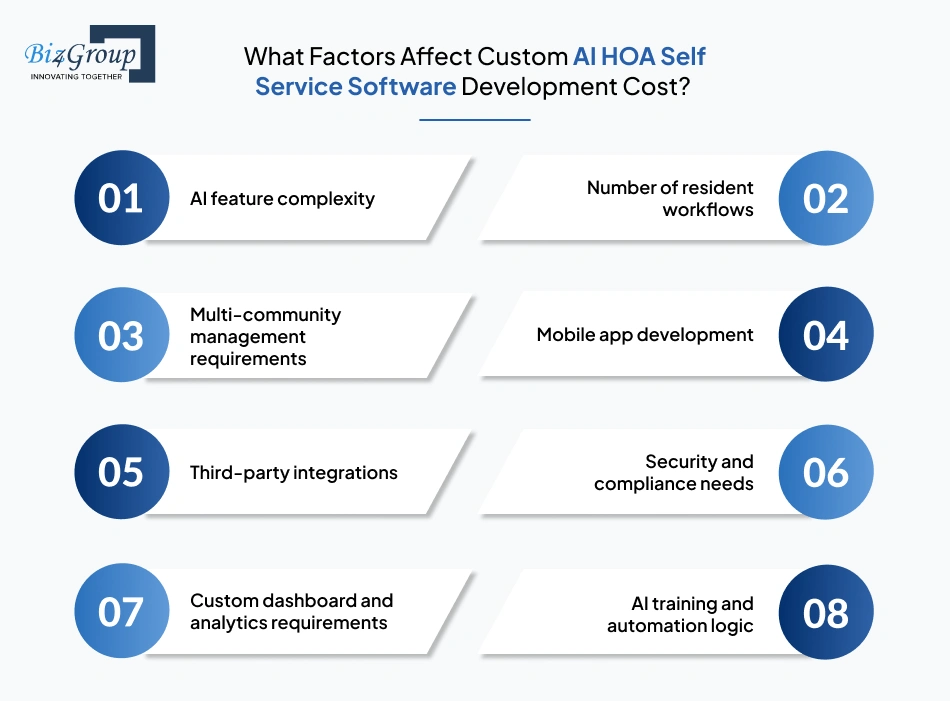
The final cost depends heavily on the type of platform you want to build and how advanced the automation needs to be. For example, a portal designed for a single residential community will cost significantly less than a multi-community AI platform handling thousands of residents, vendors, complaints, and payments simultaneously.
Major cost factors include:
This becomes especially important for companies exploring how to build HOA management software with AI automation that can scale operationally over time.
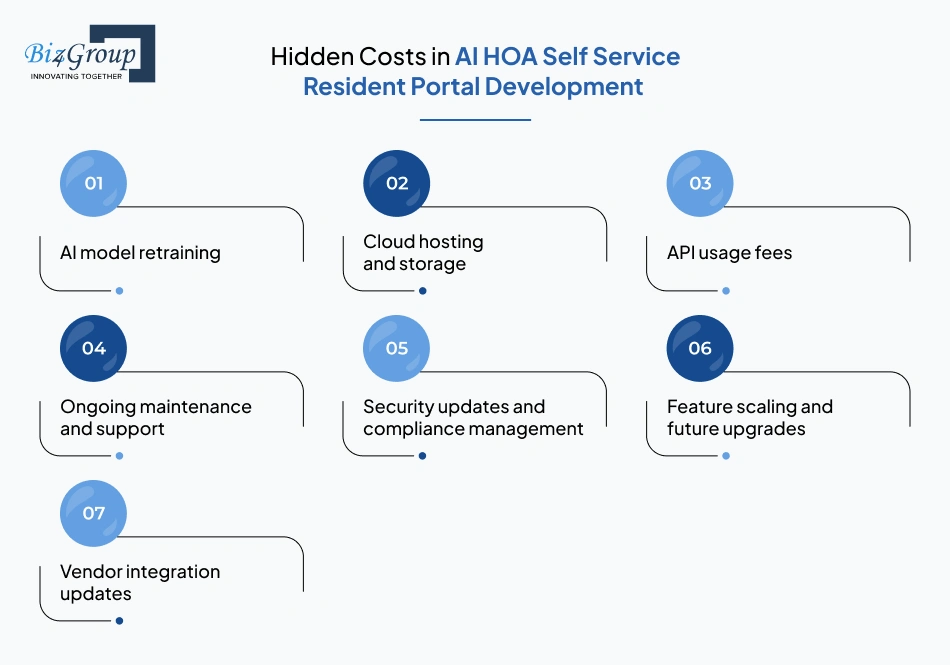
Many companies only estimate development cost and overlook long-term operational expenses that impact total investment later. AI systems require ongoing optimization, monitoring, infrastructure management, and model updates after launch.
Common hidden costs include:
Ignoring these costs early often creates budgeting problems after deployment.
The smartest way to reduce development cost is not cutting important features. It’s prioritizing the right features first. Many companies start with core workflows like complaint automation, resident communication, and maintenance tracking before expanding into advanced AI functionality later.
This approach reduces initial investment while validating operational impact early.
Cost optimization strategies include:
This is one of the biggest reasons companies investing in building custom AI self service portal for HOA management companies often scale gradually instead of launching every advanced feature at once.
And once cost planning is clear, the next challenge becomes equally important. What operational and technical challenges can slow down AI HOA portal development, and how do you solve them before they affect the project?
The fastest way to avoid overspending is building the right features first. Let’s map out a smarter development plan together.
Get a Cost Estimate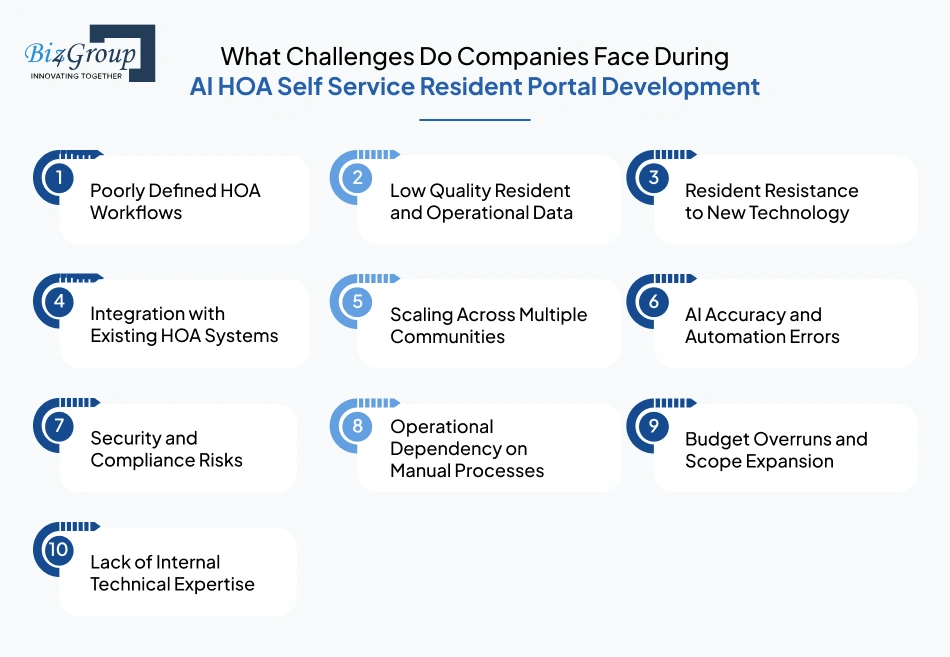
Building an AI-powered HOA portal can significantly improve operations, but the development process comes with its own challenges.
Many HOA management companies struggle with disconnected systems, poor data quality, low resident adoption, and operational workflows that were never designed for automation in the first place.
That’s why successful AI HOA self service resident portal development requires more than just adding AI features. The platform needs to align with real HOA operations, resident behavior, and long-term scalability goals.
In fact, many companies start with concerns like: “We are looking for an experienced AI development company that understands HOA operations and can build a custom self service portal tailored to our community management workflows.”
This becomes especially important for teams exploring custom AI HOA self service software development handling multiple residential communities.
|
Challenge |
Why It Becomes a Problem |
How to Solve It |
|---|---|---|
|
Poorly Defined HOA Workflows |
Many HOA teams still rely on manual processes, emails, spreadsheets, and disconnected tools. Automating unclear workflows usually creates more operational confusion instead of reducing it. |
Start by mapping complaint handling, maintenance workflows, approvals, payments, and communication processes before starting how to build AI powered HOA resident portal from scratch. |
|
Low Quality Resident and Operational Data |
AI systems depend heavily on structured and accurate data. Incomplete complaint records, inconsistent maintenance logs, and outdated resident information reduce automation accuracy. |
Clean and organize operational data before implementing AI workflows. This improves complaint routing, reporting accuracy, and automation performance. |
|
Resident Resistance to New Technology |
Some residents may avoid using new systems if the portal feels complicated or unfamiliar. This slows adoption and forces staff to continue handling requests manually. |
Focus on simple onboarding, intuitive user experience, and mobile accessibility while creating AI-powered resident self-service portal for condo associations and HOA communities. |
|
Integration with Existing HOA Systems |
HOA companies often use accounting tools, payment systems, communication platforms, and vendor software that don’t connect easily with new AI platforms. |
Businesses investing in AI integration services can centralize disconnected systems and reduce operational silos through structured integrations. |
|
Scaling Across Multiple Communities |
Workflows become harder to manage when one platform needs to support several communities with different policies, resident volumes, and operational structures. |
Build flexible architecture that supports multi-community configurations, centralized reporting, and scalable automation workflows from the beginning. |
|
AI Accuracy and Automation Errors |
Poorly trained AI systems can misclassify complaints, send inaccurate responses, or trigger incorrect workflows, which creates operational trust issues. |
Continuous AI monitoring, model training, and workflow optimization are essential for maintaining automation accuracy over time. |
|
Security and Compliance Risks |
HOA platforms manage sensitive resident data, financial records, and payment information. Weak security creates legal, financial, and reputational risks. |
Implement role-based access control, encryption, secure authentication, compliance monitoring, and regular security audits throughout development. |
|
Operational Dependency on Manual Processes |
Many HOA teams struggle to transition away from manual communication and approval systems because staff workflows are deeply dependent on traditional processes. |
Companies adopting AI automation services often reduce operational dependency on manual tasks through phased automation strategies. |
|
Budget Overruns and Scope Expansion |
Adding too many AI features too early often increases cost, delays deployment, and creates unnecessary technical complexity. |
Start with high-impact features first, validate operational value, and scale AI functionality gradually based on actual workflow needs. This approach works especially well for companies focused on building AI resident portal to speed up HOA complaint resolution time without overspending early. |
|
Lack of Internal Technical Expertise |
HOA management companies usually don’t have in-house AI expertise to manage architecture, automation workflows, integrations, and AI optimization properly. |
Work with experienced AI and property technology development teams that understand both operational workflows and scalable AI implementation. |
Many HOA operators eventually reach a point where they ask: “We are losing good HOA staff because they spend all day answering repetitive resident questions instead of doing meaningful work, what AI self service portal can we build to fix this?”
That’s exactly where developing self service HOA resident portal to eliminate manual complaints becomes more than a technology investment. It becomes an operational necessity.
Because when implemented correctly, AI doesn’t just automate tasks.
It gives HOA teams back the time, visibility, and operational control they’ve been missing for years.
Choosing the right development partner can directly impact how successful your HOA platform becomes after launch.
A portal may look good on the surface, but if the workflows, AI automation, integrations, and resident experience are not planned properly, the operational problems usually continue behind the scenes.
That’s why businesses looking for AI HOA self service resident portal development need a team that understands both technology and real HOA operational challenges.
As an experienced AI development company, Biz4Group helps businesses build AI-driven platforms focused on automation, scalability, and operational efficiency instead of basic feature implementation.
From intelligent complaint routing and resident communication to maintenance automation and workflow optimization, the focus stays on building systems that reduce manual workload while improving day-to-day operations.
Many companies investing in custom AI HOA self service software development struggle because their platforms are built without understanding how HOA teams actually operate across multiple residential communities.
That’s where operational understanding becomes just as important as technical expertise.
Biz4Group also brings strong experience in building scalable AI product solutions that combine AI models, cloud infrastructure, workflow automation, analytics, integrations, and resident-facing experiences into one connected ecosystem.
This becomes especially valuable for businesses focused on building custom AI self service portal for HOA management companies that need scalable automation without increasing operational complexity.
Because in the end, the goal is not just to launch another resident portal.
It’s to build a system that actually reduces operational pressure, improves resident satisfaction, and helps HOA teams manage communities more efficiently at scale.
Biz4Group helps HOA companies build AI-powered resident portals designed for real operational challenges, not generic workflows.
Schedule a Free ConsultationHOA management is becoming harder to scale with manual processes, disconnected systems, and rising resident expectations.
That’s why more companies are investing in AI HOA self service resident portal development to automate repetitive operations, improve complaint resolution, simplify maintenance workflows, and give residents faster access to the information they need.
Businesses exploring custom AI HOA self service software development are realizing that traditional HOA systems can no longer handle the operational demands of modern residential communities.
But building a successful AI-powered platform requires more than adding automation features. It takes the right strategy, scalable architecture, operational understanding, and AI expertise to create a system that actually improves day-to-day HOA management.
With deep experience in AI automation, workflow optimization, and property technology solutions, Biz4Group helps businesses build AI HOA self service portal platforms designed for long-term operational efficiency and scalable growth across multiple communities.
AI HOA self service resident portal development is the process of building a digital platform that allows residents to handle complaints, maintenance requests, dues payments, amenity bookings, and community communication without depending on manual HOA support for every task. AI automates workflows like complaint routing, resident communication, reminders, maintenance tracking, and operational reporting to reduce workload and improve response time.
HOA resident portal development integrating AI helps automate repetitive operational tasks that usually consume hours of manual work every day. AI can automatically classify complaints, assign maintenance vendors, send payment reminders, respond to resident questions, and provide real-time updates without requiring constant staff involvement. This improves operational efficiency while reducing delays and resident frustration.
The cost of custom AI HOA self service software development typically ranges between $20,000 to $150,000+ depending on feature complexity, AI capabilities, integrations, mobile applications, and multi-community management requirements. Platforms with predictive analytics, AI chat support, workflow automation, and advanced reporting usually require higher development investment than basic resident portals.
Companies focused on building HOA resident portal with AI should prioritize features that directly reduce operational pressure and repetitive communication.
The most important features usually include:
Yes. Many companies are now using AI to automate complaint routing, maintenance coordination, resident communication, payment reminders, and operational workflows across large residential communities. This is one of the main reasons businesses are building AI resident portal to speed up HOA complaint resolution time while improving visibility for both residents and HOA teams.
The timeline for how to build AI powered HOA resident portal from scratch depends on feature complexity, AI automation requirements, integrations, and scalability goals. A basic MVP platform may take a few weeks, while a fully customized enterprise-grade HOA portal with AI workflows, analytics, and multi-community management can take several months.
Companies specializing in building custom AI self service portal for HOA management companies should have expertise in AI automation, workflow management, cloud infrastructure, resident communication systems, and property technology development. The right development partner should understand real HOA operational challenges instead of only focusing on software development.

with Biz4Group today!
Our website require some cookies to function properly. Read our privacy policy to know more.