Location :
Orlando, FL, USA
Location :
Orlando, FL, USA +1 (407) 714-1616
 info@biz4group.com
 AI Summary Powered by Biz4AI
- AI mood tracking app development cost typically ranges between $30,000–$250,000+, depending on product scope, AI maturity, and business objectives.
- AI emotion recognition app development cost increases with personalization depth, mood intelligence, wearable data, and recommendation accuracy rather than feature count alone.
- A realistic budget for AI mood tracker app comes from aligning product scope, platform strategy, and architecture before development starts to avoid expensive rework later.
- Hidden expenses such as AI refinement, emotion datasets, response validation, and third-party licensing should be planned from the beginning.
- Cost to develop an AI mood tracking app can be reduced through phased AI rollout, focused integrations, and validating core capabilities before expansion.
- Biz4Group LLC helps businesses estimate practical budgets, prioritize investments, and build scalable AI mood tracking app with predictable development planning.
Why do two AI mood tracking apps built for the same purpose end up with completely different development budgets?
That uncertainty is where most businesses pause. You may already know the user experience you want to deliver, but estimating the AI mood tracking app development cost can still feel unclear before the first line of development begins.
Whether you're planning a wellness platform, an employee well-being solution, or a mental health product, understanding the expected investment helps you set realistic goals from the start. In most cases, the overall budget for AI mood tracking app development ranges from $30,000 to $250,000+, depending on the product vision.
The timing also makes this investment increasingly relevant. More than 1 billion people worldwide live with a mental health condition, while the global mental health apps market is projected to reach $17.5 billion by 2030.
So, if you're someone asking, "I want to develop a mood tracking app with mood journaling, emotion analytics, reminders, and wearable integration, but I am confused about how much each feature will increase the overall cost. Can you break down the development budget and recommend a reliable AI app development company for this type of project?" Then the following guide will walk you through every stage of the investment so you can plan your project with confidence.
AI Mood Tracking App Development Cost Estimator-Get a Quick for Your AI App
Budget planning becomes challenging when your product idea is clear, but the investment behind it is not. You may already have the experience you want to build, yet estimating the AI mental health tracker app development cost can still feel uncertain before speaking with a development team.
An early estimator gives you a practical starting point by connecting your product vision with a realistic budget based on AI capabilities, platform scope, integrations, privacy requirements, and user experience expectations.
AI Mood Tracking App Cost Estimator Formula
A reliable estimate starts by looking at the major development components together instead of treating them as separate expenses. The formula below offers a practical framework for calculating the expected AI mental health tracker app cost during the initial planning stage.
Estimated Cost = Base App Development Cost + AI Feature Cost + AI integrations cost + UI/UX design cost + AI model development + Security & Compliance Cost
What Each Cost Variable Includes
- 1. Base App Development Cost: Covers the foundation of your application, including user registration, mood logging, journaling, dashboards, reminders, profile management, and the core workflows required for daily app usage.
- 2. AI Feature Cost: Includes intelligent capabilities such as mood detection, emotion analysis, personalized wellness insights, behavioral trend recognition, and AI-powered recommendations that make the app more engaging.
- 3. AI integrations cost: Covers connections with wearable devices, health platforms, calendars, notification services, cloud storage, and other third-party systems that expand the app's functionality.
- 4. UI/UX design cost: Includes user journeys, mood logging screens, accessibility improvements, responsive layouts, intuitive navigation, and visual experiences that encourage consistent user engagement.
- 5. AI model development: Covers data preparation, model training, testing, performance tuning, and continuous refinement to improve prediction quality and personalization over time.
- 6. Security & Compliance Cost: Includes encrypted data storage, secure authentication, user consent management, access controls, audit logging, and privacy safeguards required for handling sensitive mental wellness information.
Illustrative Example for a Mid-Scale AI Mood Tracking App
- Base App Development Cost: $42,000
- AI Feature Cost: $26,000
- AI integrations cost: $16,000
- UI/UX design cost: $13,000
- AI model development: $24,000
- Security & Compliance Cost: $9,000
Estimated Cost = $42,000 + $26,000 + $16,000 + $13,000 + $24,000 + $9,000 = $130,000
Why This Quick Quote Estimator Helps Early Budget Planning?
An early estimate helps transform rough ideas into a realistic investment plan before detailed technical discussions begin. It also makes feature prioritization easier, supports internal budgeting, and creates more productive conversations with development partners. That foundation becomes valuable before exploring the detailed AI mood tracker app development cost across different product scopes and platforms.
AI Mood Tracking App Development Cost Breakdown by Product Scope and Platform
The budget for AI mood tracking app is influenced by more than the features you plan to include. The biggest decision comes from defining the product you actually need to launch. Many founders ask, "I already have an idea for a mood tracker app, but I am not sure whether I should build an MVP first or invest in a full-featured application. Can you compare the development costs, timelines, and long-term benefits?"
Well, the answer starts with understanding how product scope shapes the initial investment before platform decisions come into play.
1. Cost Breakdown by Product Scope
Product scope for AI mood tracking app establishes the baseline investment before any platform decisions are made. Expanding from an MVP to an enterprise-grade product increases the budget because the application must support broader user journeys and more extensive validation before launch.
A) MVP Level AI Mood Tracking App
Estimated Cost Range: $30,000–$60,000
This investment level for AI mood tracking app is intended for businesses that want to validate demand before committing to a larger budget. Instead of building a feature-rich product from the beginning, the focus is on delivering a reliable user experience that proves the concept, collects user feedback, and identifies where future investment will create the greatest impact.
What Is Typically Covered:
- User registration and secure login
- Mood check-ins and daily mood logging
- Mood journaling
- Basic emotion insights, sentiment analysis and history
- Reminder notifications
- Personal progress dashboard
- Cloud-based data storage and admin controls
How It Differs: The MVP level AI mood tracking app keeps the investment focused on validating the core product rather than expanding into advanced AI capabilities and broader operational workflows. By limiting the initial scope, businesses reduce financial risk while gaining real user insights that guide future development decisions.
B) Mid-Level AI Mood Tracking App
Estimated Cost Range: $60,000–$150,000
It is suited for businesses that have already validated their concept and are ready to deliver a more engaging, data-driven experience. The budget for mid-level AI mood tracking app increases because the product is expected to support higher user activity, richer personalization, and AI capabilities that provide meaningful wellness insights instead of simply recording user input.
What Is Typically Covered:
- Everything included in the MVP level
- AI-powered mood pattern recognition
- Personalized wellness recommendations
- Emotion trend analytics and visual reports
- Wearable device integration
- Custom reminder and habit-building workflows
- Enhanced user and admin dashboards
- Multi-language support and richer user settings
How It Differs from the MVP Level: The additional investment is driven by greater AI depth, more connected user experiences, and broader product capabilities that require additional validation before release. Rather than focusing only on proving the idea, mid-level is designed to improve user retention, increase engagement, and support sustainable business growth.
C) Advanced Level AI Mood Tracking App
Estimated Cost Range: $150,000–$250,000+
AI mood tracking app investment at advanced level is for organizations planning a large-scale mental wellness platform that supports diverse user groups, advanced AI experiences, and enterprise operations. The higher budget reflects the need for a product that delivers consistent performance at scale while supporting more sophisticated business workflows and user expectations.
What Is Typically Covered:
- Everything included in the Mid-Level product
- Advanced emotion recognition and predictive analysis mood insights
- Personalized wellness journeys powered by AI
- Therapist, coach, or care team connectivity
- Organization and employee wellness management
- Role-based administrative controls
- Advanced analytics and reporting dashboards
- Multi-region deployment and higher user capacity
How It Differs from the Mid-Level App: This level transforms the AI mood tracking app into a business platform rather than a standalone wellness solution. The investment increases because the application must support larger user volumes, more intelligent decision support, broader operational oversight, and enterprise-ready scalability from the outset.
Quick Summary by Product Scope
|
Product Scope |
Estimated Cost |
What This Investment Helps You Achieve |
|---|---|---|
|
MVP Level |
$30,000–$60,000 |
Validate the product idea with essential mood tracking, gather user feedback, and reduce early investment risk. |
|
Mid-Level |
$60,000–$150,000 |
Deliver AI-powered personalization, improve user engagement, and prepare the product for commercial growth. |
|
Advanced Level |
$150,000–$250,000+ |
Launch an enterprise-ready mental wellness platform with advanced AI capabilities and support for large-scale operations. |
2. How Platform Choice Changes the Budget
Product scope sets the baseline investment, but it is only one part of the budgeting process. The next decision is platform strategy, which can significantly change the overall development cost. Let's see how different platform choices influence the investment required for the same product vision.
A) Cross-Platform
Estimated Cost Impact: Moderate
Cross-platform development delivers the best balance between investment and market reach by supporting both iOS and Android through a shared development approach. For businesses entering the market, it offers wider user coverage without the cost of maintaining two independent mobile products from the start.
When It Makes Business Sense:
- Launching on both iOS and Android with a controlled budget.
- Validating the product before committing to larger investments.
- Prioritizing faster commercialization and user acquisition.
B) Native iOS + Android
Estimated Cost Impact: High
Native development requires dedicated applications for iOS and Android, increasing the overall investment from the outset. The additional budget for AI mood tracking app support platform-specific experiences, stronger wearable connectivity, and greater flexibility as user expectations and product capabilities continue to expand.
When It Makes Business Sense:
- Premium user experience is a business objective.
- Wearable integrations play a central role in the product.
- Long-term product expansion is planned from the beginning.
C) Mobile + Web Admin Portal
Estimated Cost Impact: Highest
Many AI mood tracking apps extend beyond the mobile experience by including a web-based portal for operational management. This additional interface allows administrators, clinicians, or wellness teams to monitor activity, manage users, review reports, and oversee platform operations, making it a significant contributor to the overall budget.
When It Makes Business Sense:
- The product serves healthcare providers or wellness organizations.
- Operational teams require centralized management.
- Reporting and administrative oversight are essential from the first release.
Quick Comparison by Platform Strategy
|
Platform Strategy |
Initial Investment |
Primary Budget Advantage |
Recommended For |
|---|---|---|---|
|
Cross-Platform |
Moderate |
Reaches iOS and Android while keeping the initial budget controlled. |
Startups and businesses validating a commercial product. |
|
Native iOS + Android |
High |
Supports premium experiences and long-term product expansion. |
Businesses investing in advanced AI capabilities and wearable experiences. |
|
Mobile + Web Admin Portal |
Highest |
Adds operational management alongside the mobile product. |
Healthcare providers, enterprises, and wellness organizations managing users at scale. |
Estimating the budget becomes much easier when product scope and platform strategy are evaluated together. An MVP does not always require native applications, and an enterprise product does not always need every platform on day one. Aligning both decisions with business stage helps avoid unnecessary investment while ensuring the product supports current objectives and future growth.
Know Your Ideal AI Mood Tracker App Development Budget?
Turn your product vision into a realistic investment roadmap with expert guidance before committing development resources
Get My Cost EstimateHow Architecture Decisions Affect the Development Budget of AI Mood Tracking App
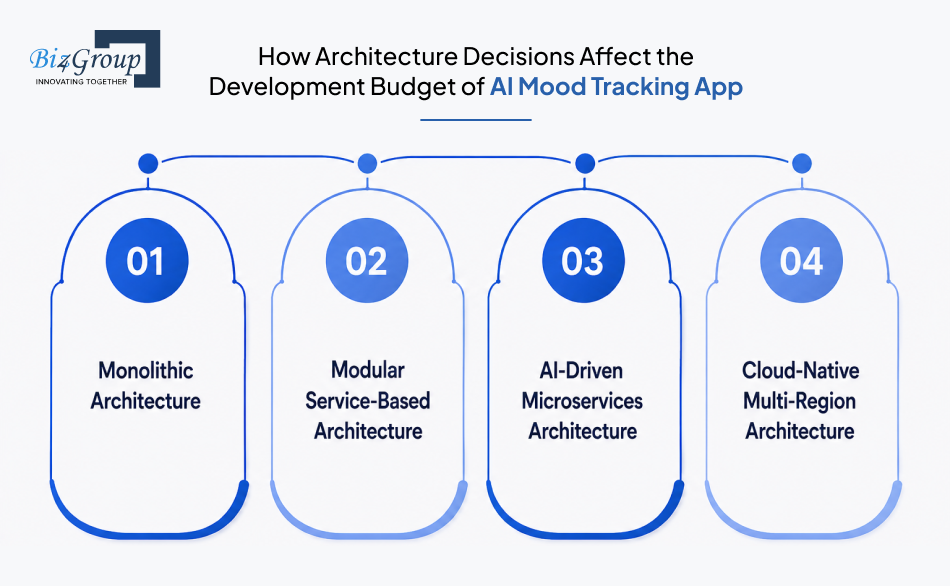
Architecture planning influences the budget long before development begins. The structure behind your product determines how AI features, user data, and future enhancements are managed as the platform grows. That is why the custom mood tracking app development cost should be evaluated alongside architecture decisions rather than after the project scope is finalized.
1. Monolithic Architecture
A monolithic architecture keeps the entire AI mood tracking platform within one connected system. Core business functions, AI processing, and user workflows operate together, making it the simplest architecture to develop and manage during the initial stages.
Cost You Can Expect: $30,000–$70,000
Best Fit When You Need:
- Faster product rollout
- Lower initial development investment
- Centralized business workflows
- Basic AI-powered mood insights
- Limited third-party integrations
The investment remains lower because the entire platform is built and managed as one application, reducing implementation effort during the first development cycle. This architecture is best suited for businesses focused on validating the product before investing in a more scalable structure.
2. Modular Service-Based Architecture
A modular service-based architecture separates major business functions into connected modules while keeping the platform working as one system. This allows individual capabilities to evolve without rebuilding the entire product.
Cost You Can Expect: $70,000–$130,000
Best Fit When You Need:
- Faster feature expansion
- Independent AI workflows
- Better operational flexibility
- Growing user demand
- Moderate third-party integrations
The investment increases because every module requires separate planning, testing, and deployment. However, it reduces the need for expensive structural changes as the product expands.
3. AI-Driven Microservices Architecture
This architecture separates every major function into independent services while introducing dedicated AI processing for mood analysis, recommendations, and real-time intelligence. Each service operates independently but communicates continuously across the platform.
Cost You Can Expect: $130,000–$200,000
Best Fit When You Need:
- Advanced AI-driven experiences
- Real-time mood intelligence
- Higher user volumes
- Continuous feature expansion
- Large-scale AI processing
The budget increases because multiple independent services require stronger coordination, testing, and infrastructure planning. It is commonly adopted when AI becomes a core business capability rather than a supporting feature.
4. Cloud-Native Multi-Region Architecture
A cloud-native multi-region architecture distributes the platform across multiple cloud environments to improve availability, business continuity, and regional deployment. It is generally adopted by organizations planning large-scale digital mental wellness services.
Cost You Can Expect: $200,000–$250,000+
Best Fit When You Need:
- Enterprise-scale deployment
- Multi-region user support
- High platform availability
- Business continuity planning
- Long-term infrastructure scalability
This carries the highest investment because the platform operates across multiple cloud environments while supporting higher operational resilience and future expansion.
Architecture Choice Comparison for Better Budget Decisions
|
Architecture Choice |
Best Business Situation |
Cost Range |
|---|---|---|
|
Monolithic |
Early product validation with controlled investment |
$30,000–$70,000 |
|
Modular Service-Based |
Growing products requiring flexible feature expansion |
$70,000–$130,000 |
|
AI-Driven Microservices |
AI-first platforms supporting higher user growth |
$130,000–$200,000 |
|
Cloud-Native Multi-Region |
Enterprise mental wellness platforms with large-scale operations |
$200,000–$250,000+ |
How to Decide Which Architecture Fits Your Budget?
Architecture should support the product roadmap rather than increase the budget unnecessarily. Products validating market demand often control costs better with simpler structures, while growing platforms benefit from architectures that support continuous expansion without major redevelopment. Matching architecture to long-term business goals keeps infrastructure spending aligned with actual growth instead of future rework.
Architecture determines how your investment scales as the product evolves. Aligning the structure with long-term business goals creates a more realistic budget and makes it easier to evaluate the overall AI mood tracker app market cost with greater confidence.
AI Mood Tracking App Development Cost: Complete Timeline and Phase-Wise Breakdown
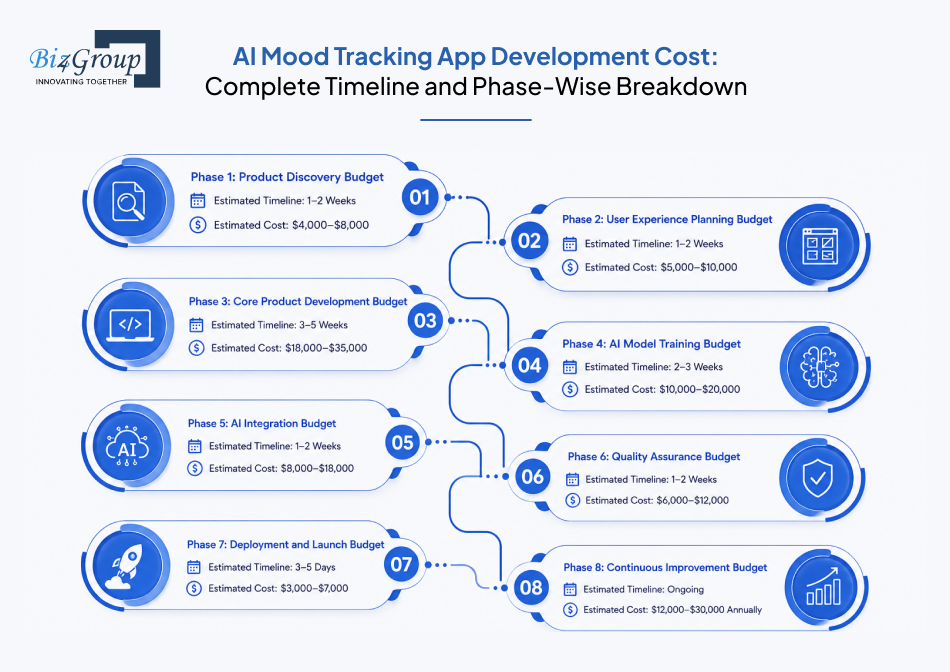
A single project estimate rarely shows where the budget is actually spent. Breaking the AI mood tracking app development cost into individual phases makes it easier to understand which activities require the highest investment before moving from planning to product delivery.
Phase 1: Product Discovery Budget
Estimated Timeline: 1–2 Weeks
Estimated Cost: $4,000–$8,000
The first investment goes into defining business objectives, validating product scope, prioritizing features, and documenting requirements. Budget allocation at this stage supports discovery workshops, market validation, user research, and planning activities that reduce expensive scope changes during later phases.
Phase 2: User Experience Planning Budget
Estimated Timeline: 1–2 Weeks
Estimated Cost: $5,000–$10,000
A large share of the budget during this phase is spent refining the mood logging experience because user retention depends on how quickly people can record emotions, journal their thoughts, and review progress. Businesses often work with an experienced UI/UX design company at this stage since redesigning these experiences after development begins usually results in significantly higher project costs.
Also Read: Top UI/UX Design Companies in USA
Phase 3: Core Product Development Budget
Estimated Timeline: 3–5 Weeks
Estimated Cost: $18,000–$35,000
This phase typically consumes the largest portion of the project budget because the product's core experience is implemented here. Most of the investment goes toward mood tracking, mood journaling, reminder workflows, user accounts, progress dashboards, and backend services that support daily user activity. Businesses using MVP development services often control spending by prioritizing only the features required to validate the first commercial release, avoiding unnecessary functionality that can increase the initial budget.
Also Read: Top MVP Development Companies in USA
Phase 4: AI Model Training Budget
Estimated Timeline: 2–3 Weeks
Estimated Cost: $10,000–$20,000
This phase introduces a dedicated AI budget because the model must be trained to recognize mood patterns, interpret journal entries, and generate relevant emotional insights. Most of the investment is allocated to AI model training, data preparation, performance validation, and refinement. The budget increases when the product supports multiple mood signals, personalized recommendations, or higher prediction accuracy requirements.
Phase 5: AI Integration Budget
Estimated Timeline: 1–2 Weeks
Estimated Cost: $8,000–$18,000
A considerable portion of the budget is allocated to connecting AI capabilities with the core product, so mood predictions, recommendations, and personalized insights work reliably within existing user workflows. Investment during this stage primarily covers AI integration services, AI model integration, API connectivity, wearable synchronization, and validation across integrated systems. More external data sources typically result in higher integration costs.
Also Read: A Complete Guide to OpenAI API Integration for AI Applications
Phase 6: Quality Assurance Budget
Estimated Timeline: 1–2 Weeks
Estimated Cost: $6,000–$12,000
A dedicated testing budget ensures mood tracking workflows, AI-generated insights, journal synchronization, reminder schedules, and wearable data function consistently before release. Most of the investment supports functional testing, AI output validation, performance checks, bug resolution, and user acceptance testing. Products with broader AI capabilities or multiple integrations generally require higher validation costs.
Phase 7: Deployment and Launch Budget
Estimated Timeline: 3–5 Days
Estimated Cost: $3,000–$7,000
Budget during this stage is allocated to production deployment, cloud environment configuration, app store submission, release verification, monitoring setup, and launch support. The investment increases when the product is released across multiple platforms or requires coordinated rollout activities for different user groups.
Phase 8: Continuous Improvement Budget
Estimated Timeline: Ongoing
Estimated Cost: $12,000–$30,000 Annually
Post-launch investment is reserved for AI performance improvements, feature enhancements, model updates, cloud hosting, user feedback implementation, and ongoing platform support. Products that frequently introduce new wellness features, expand AI capabilities, or integrate additional health services typically require a higher annual budget.
Phase-Wise Cost Breakdown at a Glance
|
Development Phase |
Estimated Timeline |
Estimated Cost |
|---|---|---|
|
Product Discovery Budget |
1–2 Weeks |
$4,000–$8,000 |
|
User Experience Planning Budget |
1–2 Weeks |
$5,000–$10,000 |
|
Core Product Development Budget |
3–5 Weeks |
$18,000–$35,000 |
|
AI Model Training Budget |
2–3 Weeks |
$10,000–$20,000 |
|
AI Integration Budget |
1–2 Weeks |
$8,000–$18,000 |
|
Quality Assurance Budget |
1–2 Weeks |
$6,000–$12,000 |
|
Deployment and Launch Budget |
3–5 Days |
$3,000–$7,000 |
|
Continuous Improvement Budget |
Ongoing |
$12,000–$30,000 Annually |
A phase-wise budget gives stakeholders a clearer view of where the investment is allocated throughout the project. Breaking spending into individual milestones makes the cost of mood tracking app development easier to estimate, prioritize, and justify before committing to the full product roadmap.
Ready to Turn Planning into Progress?
Validate your delivery roadmap with realistic timelines and milestone-based budgeting before development begins
Plan My Development RoadmapCompliance, Privacy, and Security Costs You Must Budget for in AI Mood Tracking App Development
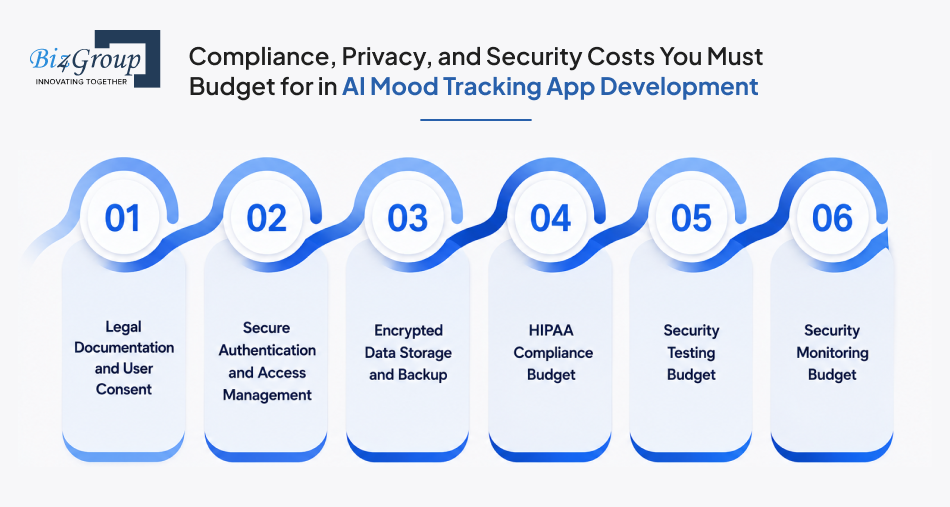
Privacy and security requirements often increase the budget after core features have already been estimated. The HIPAA compliant mental health app development cost should be considered early because compliance requirements become a planned investment rather than an unexpected expense.
1. Legal Documentation and User Consent
Estimated Cost: $2,500–$7,000
A portion of the budget is allocated to preparing the legal documentation required before the product reaches users. Products handling mental wellness information typically require additional spending on privacy disclosures, consent management, and data usage policies, all of which contribute to the overall AI mood tracking app cost.
Common spend areas include:
- Privacy policy preparation
- Terms of service documentation
- User consent workflows
- Data collection and usage disclosures
- Data retention policy documentation
2. Secure Authentication and Access Management
Estimated Cost: $4,000–$10,000
A dedicated security budget is required to protect access to mood journals, emotional insights, and personal health information. The investment increases as the product supports multiple user roles, therapist access, or administrative controls, requiring stronger identity verification and access management.
Common spend areas include:
- Secure authentication
- Multi-factor authentication (MFA)
- Role-based access controls
- Session management
- Password security and recovery controls
3. Encrypted Data Storage and Backup
Estimated Cost: $6,000–$15,000
Mood journals, emotional assessments, and AI-generated wellness insights require secure storage throughout the product lifecycle. A considerable share of the budget is allocated to protecting sensitive user data, maintaining reliable backups, and reducing the risk of data loss or unauthorized access.
Common spend areas include:
- Encrypted databases
- Protected cloud storage
- Automated backup systems
- Disaster recovery planning
- Secure data access controls
4. HIPAA Compliance Budget
Estimated Cost: $10,000–$25,000
Products intended for healthcare providers, therapists, or clinical wellness programs usually require additional compliance spending before deployment. The investment increases as reporting requirements, audit controls, and regulatory safeguards become part of a HIPAA compliant AI app designed to protect sensitive mental health information.
Common spend areas include:
- Audit logging
- User activity tracking
- Compliance reporting
- Risk assessment
- Vendor compliance review
5. Security Testing Budget
Estimated Cost: $5,000–$12,000
A dedicated testing budget helps identify security gaps before the product goes live. The investment typically increases as AI capabilities, third-party integrations, wearable connectivity, and user volume expand, requiring broader validation across the entire platform.
Common spend areas include:
- Penetration testing
- Vulnerability assessment
- API security validation
- Security configuration review
- Risk assessment
6. Security Monitoring Budget
Estimated Cost: $8,000–$20,000 Annually
Security costs continue after deployment to maintain a protected and compliant product environment. Annual spending typically increases with user growth, expanding AI capabilities, and additional integrations that require continuous monitoring and regular security updates.
Common spend areas include:
- Threat monitoring
- Security patch management
- Incident response support
- Access review
- Continuous security logging
Compliance, privacy, and security spending should be treated as part of the core development budget rather than an afterthought. Planning these investments early makes emotion tracking app development pricing more predictable while reducing expensive compliance upgrades as the product and user base continue to grow.
What Key Factors Influence AI Mood Tracking App Development Cost?
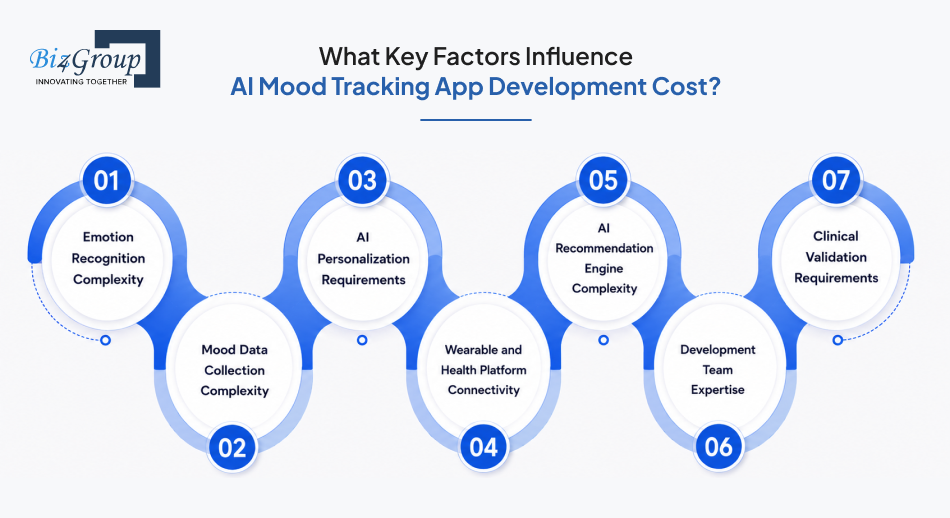
The final budget is rarely influenced by one decision alone. Several business and product decisions shape the investment long before development begins. That is why the AI mood tracking device development cost can vary considerably, even between products designed for the same mental wellness audience.
1. Emotion Recognition Complexity
Development cost increases with the level of emotional intelligence the product is expected to deliver. Identifying basic moods requires a smaller investment, while contextual emotion recognition, behavioral interpretation, and more accurate AI predictions require additional model refinement, testing, and validation.
Typical Cost Impact: $15,000–$45,000
Budget typically increases through:
- Context-aware emotion recognition
- Journal sentiment interpretation
- Behavioral pattern analysis
- Multi-emotion classification
- AI prediction accuracy improvements
2. Mood Data Collection Complexity
Development cost also depends on how many emotional data sources the product processes. Capturing moods through simple check-ins requires less investment, while combining journals, wearable data, questionnaires, sleep patterns, and daily activities increases implementation, AI validation, and data processing effort.
Typical Cost Impact: $12,000–$35,000
Budget typically increases through:
- Mood journal processing
- Wearable health data
- Sleep and activity tracking
- Self-assessment questionnaires
- Multi-source data validation
3. AI Personalization Requirements
Higher levels of personalization increase development spending because AI must generate recommendations based on individual mood history, emotional patterns, and user behavior instead of predefined rules. Products offering adaptive wellness experiences generally require additional refinement, validation, and optimization, increasing the mood analytics app development cost.
Typical Cost Impact: $15,000–$40,000
Budget typically increases through:
- Personalized wellness recommendations
- Adaptive mood insights
- Individual behavior analysis
- Goal-based recommendations
- Context-aware AI responses
4. Wearable and Health Platform Connectivity
Each additional wearable device or health platform increases the development budget because every connection requires separate implementation, data mapping, synchronization, and validation. Products supporting multiple health ecosystems require a larger investment than those operating without external health data.
Typical Cost Impact: $10,000–$30,000
Budget typically increases through:
- Apple Health integration
- Google Fit connectivity
- Fitbit synchronization
- Garmin device support
- Samsung Health integration
5. AI Recommendation Engine Complexity
Development spending increases as recommendations become more intelligent and personalized. AI models that identify mood triggers, recommend wellness activities, adapt to user behavior, or generate proactive emotional guidance require additional development effort. Businesses often seek AI consulting services during this stage to define the right recommendation strategy before implementation.
Typical Cost Impact: $15,000–$40,000
Budget typically increases through:
- Predictive mood recommendations
- Personalized wellness guidance
- Trigger identification
- Context-aware recommendation logic
- Recommendation accuracy tuning
6. Development Team Expertise
Project cost also depends on the experience of the delivery partner. Businesses investing in AI automation services and hiring dedicated AI development team usually allocate a larger budget upfront to reduce implementation risks, improve delivery quality, and avoid expensive rework during later stages.
Typical Cost Impact: $10,000–$30,000
Budget typically increases through:
- AI product specialists
- Mental wellness domain expertise
- Dedicated AI engineers
- Cross-functional delivery teams
- Technical consulting and planning
7. Clinical Validation Requirements
Development cost increases when the product is expected to support therapists, behavioral health providers, or clinical wellness programs instead of general consumer use. Clinical-grade AI requires stronger validation, more accurate outputs, and additional evaluation before deployment, increasing the overall investment.
Typical Cost Impact: $15,000–$45,000
Budget typically increases through:
- Clinical AI validation
- Therapist workflow support
- Evidence-based recommendation review
- AI output evaluation
- Healthcare-grade quality standards
Summary of Key Cost Factors
|
Cost Factor |
Budget Impact |
Why It Changes Pricing |
|---|---|---|
|
Emotion Recognition Complexity |
High |
More AI refinement and emotion analysis |
|
Mood Data Collection Complexity |
Medium–High |
Additional emotional data sources require more processing |
|
AI Personalization Requirements |
High |
Greater recommendation accuracy and adaptive experiences |
|
Wearable & Health Platform Connectivity |
Medium |
More external systems increase implementation effort |
|
AI Recommendation Engine Complexity |
High |
Advanced recommendation logic requires deeper AI development |
|
Development Team Expertise |
Medium |
Specialized AI expertise improves delivery and planning |
|
Clinical Validation Requirements |
High |
Higher accuracy and validation standards increase development effort |
Understanding these cost factors before development begins makes budgeting far more predictable. Evaluating each investment against business objectives helps establish a realistic AI mood tracker app cost while reducing unnecessary spending on capabilities that may not deliver immediate business value.
Hidden Expenses in AI Mood Tracking App Development You Must Plan for
A project estimate usually covers the planned scope, but some expenses only appear after implementation begins. Budgeting for these early keeps the AI mood tracking app development cost realistic and helps avoid unexpected spending during delivery. Let's take a look at them:
|
Hidden Expense |
How It Impacts the Budget |
Estimated Cost Impact |
|---|---|---|
|
LLM usage during development |
AI testing and prompt iterations consume paid model credits long before the product is launched. |
$2,000–$8,000 |
|
Licensed emotion datasets |
Commercial datasets may be required to improve AI accuracy beyond publicly available data. |
$3,000–$12,000 |
|
Content moderation setup |
AI-generated wellness responses require additional safeguards before public release. |
$3,000–$10,000 |
|
Third-party API pricing changes |
Paid API plans often become necessary as testing volume grows during development. |
$2,000–$8,000 |
|
Accessibility improvements |
Usability enhancements for broader user accessibility are frequently identified late in the project. |
$2,000–$7,000 |
|
App Store review revisions |
Store feedback may require additional development before approval is granted. |
$1,000–$5,000 |
|
Knowledge base creation |
AI recommendations often require curated wellness content before they deliver meaningful guidance. |
$3,000–$10,000 |
|
Release readiness activities |
Final deployment, production configuration, and launch support are commonly underestimated during budgeting. |
$2,000–$8,000 |
Hidden expenses rarely change the project vision, but they often change the final budget. Accounting for them early makes the cost to develop an AI mental wellness app easier to estimate while reducing unexpected financial surprises before launch.
Cost Optimization Strategies That Actually Reduce Budget Risk of AI Mood Tracking App
1. Roll Out AI Capabilities in Phases Instead of All at Once
Many products exceed the planned budget by introducing emotion recognition, AI recommendations, mood forecasting, journaling intelligence, and chatbot support in the first release. Releasing only the AI capabilities that directly support the core user journey keeps implementation focused and reduces unnecessary early investment.
Savings usually come from:
- Smaller AI implementation scope
- Lower model validation effort
- Reduced AI testing cycles
A phased rollout can reduce AI development spending by 15%–25% (approximately $10,000–$25,000 on a $120K implementation). It also allows future AI capabilities to be introduced using real user behavior instead of assumptions.
2. Start with Pre-Trained AI Models Before Custom Model Development
Custom AI models require significantly more time, data preparation, validation, and optimization than proven foundation models. Many businesses reduce the initial investment by validating the product with pre-trained AI models before deciding whether custom model development is commercially justified.
Savings usually come from:
- Lower AI development effort
- Reduced model training costs
- Faster product validation
Using pre-trained AI models can reduce AI implementation spending by 20%–35% (approximately $12,000–$30,000 on a $120K AI project), while shortening the first development cycle.
3. Limit Wearable Integrations During the First Release
Supporting every wearable platform from day one often increases development costs without improving early product validation. Integrating only the platforms most relevant to the target audience keeps the implementation focused and avoids unnecessary integration work.
Savings usually come from:
- Fewer API integrations
- Lower testing effort
- Reduced integration maintenance
Limiting the first release to essential wearable platforms can reduce integration spending by 10%–20% (around $5,000–$15,000 on mid-scale implementations), while leaving room for future platform expansion based on user demand.
4. Prioritize High-Engagement AI Features Before Advanced Capabilities
Many first-time products allocate budget to AI capabilities that users rarely adopt during the initial release. Prioritizing features such as mood logging, AI-powered mood insights, and personalized recommendations before adding predictive analytics or advanced coaching reduces unnecessary development spending.
Savings usually come from:
- Smaller first-release scope
- Reduced AI implementation effort
- Lower feature validation costs
Focusing on high-engagement AI capabilities first can reduce initial development spending by 10%–18% (approximately $8,000–$18,000 on a $100K project) while delivering faster product validation.
5. Expand AI Personalization After User Data Becomes Available
Highly personalized recommendations depend on real user behavior. Implementing advanced personalization before sufficient mood history is available often increases AI refinement costs without improving recommendation quality during the initial launch.
Savings usually come from:
- Lower AI refinement effort
- Fewer personalization revisions
- Reduced recommendation tuning
Expanding personalization after collecting real user data can reduce AI optimization costs by 10%–15% (around $5,000–$12,000 during the first optimization cycle).
6. Introduce Clinical Workflows in Later Releases
Clinical assessments, therapist collaboration, treatment documentation, and healthcare workflows significantly increase development complexity. Many businesses validate the consumer product first before extending it for clinical or provider-based use.
Savings usually come from:
- Smaller compliance scope
- Reduced workflow complexity
- Lower implementation effort
Delaying clinical capabilities can reduce first-phase development spending by 15%–25% (approximately $10,000–$25,000 depending on product scope), while creating a shorter path to market.
7. Partner with Experienced Healthcare AI Specialists
Projects often exceed budget because delivery teams spend additional time understanding mental wellness workflows and AI implementation requirements. Businesses that hire healthcare AI app developers with healthcare AI experience usually reduce planning errors, redesign effort, and implementation delays.
Savings usually come from:
- Better requirement planning
- Fewer redevelopment cycles
- Lower project correction costs
Working with an experienced healthcare AI team can reduce implementation-related spending by 5%–12% (approximately $3,000–$10,000 across mid-sized projects) through more accurate planning and delivery.
Budget optimization comes from making better implementation decisions, not reducing product quality. Applying these strategies early makes mental health mobile app development pricing more predictable while keeping investment focused on capabilities that deliver measurable business value from the first release.
What's Next?
With everything we've covered so far, you should now have a much clearer understanding of what drives the development cost of an AI mood tracking app and where smart planning can help you avoid unnecessary expenses.
This brings us to the final piece of the puzzle: How do you make sure the cost-saving decisions are actually implemented throughout development? The answer largely comes down to choosing the right development partner like Biz4Group LLC, that can turn a well-planned budget into a well-executed product.
As a HIPAA-compliant AI healthcare software development company in the USA, we help businesses turn well-planned budgets into scalable AI healthcare products without losing sight of long-term business goals. Here's how we can help:
- Validate the product scope early to reduce expensive requirement changes later.
- Prioritize high-impact AI capabilities before expanding into advanced functionality.
- Build a scalable roadmap that supports future growth without unnecessary redevelopment.
Now, you must be wondering have to ever applied this to real world implementation?
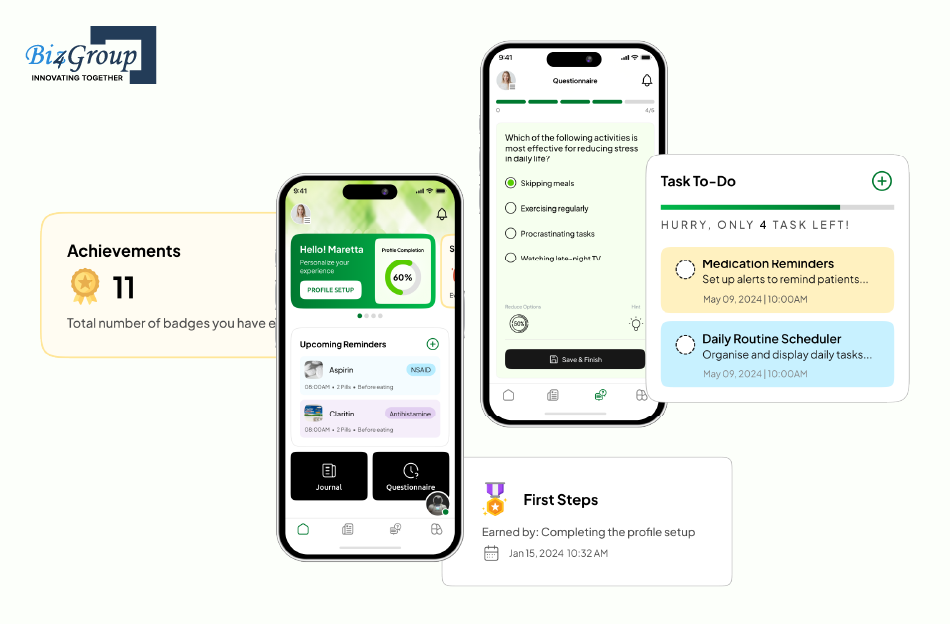
Yes, we have during CogniHelp which is an AI-powered cognitive wellness platform that helps users monitor cognitive health through intelligent assessments and personalized support. We reduced development costs by releasing essential AI capabilities first, postponing lower-priority modules, and validating the product before expanding functionality. This kept the initial investment focused and commercially practical.
Smart budgeting delivers results only when every development decision supports it. That is exactly how we approach every AI healthcare product, turning realistic cost planning into scalable, commercially successful solutions.
Want to Build More While Spending Less?
Identify the smartest opportunities to reduce development costs without compromising long-term product quality
Optimize My Development BudgetConclusion
By this point, you should have a much clearer picture of what shapes the AI mood tracking app development cost and why accurate budget planning matters before a single development milestone begins. The right investment is not about spending more. It is about knowing where your budget creates the greatest business value while avoiding unnecessary costs that can delay your roadmap.
As you define your product vision, every budgeting decision should support your long-term goals instead of limiting them. Working with an experienced AI development company can help you prioritize investments, reduce budget risks, and plan a scalable product from the outset. At Biz4Group LLC, we work closely with businesses to create practical development roadmaps backed by transparent cost planning. Let's connect and discuss your idea to build a budget that aligns with your product goals from day one.
FAQ's
1. What is the typical AI mood tracking app development cost for a commercial-grade product?
The overall investment typically ranges from $30,000 to $250,000+. The final budget depends on the product's AI capabilities, personalization depth, wearable connectivity, regulatory requirements, and long-term business objectives. A commercial wellness platform with advanced AI generally requires a higher investment than a basic mood tracking solution.
2. How much does AI-powered mood prediction increase the overall development budget?
AI-powered mood prediction usually adds $15,000–$45,000 to the project budget, depending on the prediction accuracy, historical data analysis, personalization level, and the amount of AI validation required before launch.
3. Can an AI mood tracking platform be expanded after the initial launch without rebuilding the entire product?
Yes. A well-planned product can be expanded gradually by introducing additional AI capabilities, wearable integrations, therapist modules, or enterprise features without rebuilding the complete platform. Planning for future expansion early usually reduces redevelopment costs.
4. Is it more cost-effective to build a consumer wellness product first and add clinical capabilities later?
For many businesses, yes. Validating the consumer product before introducing therapist workflows or clinical functionality helps reduce the initial investment while allowing future expansion based on user adoption and business demand.
5. What business information should be prepared before requesting an AI mood tracking app development estimate?
A more accurate estimate usually requires information such as your target audience, business model, AI use cases, supported devices, preferred launch timeline, expected user volume, and the primary outcomes you want the product to deliver.
6. How can I compare proposals from different AI development companies without focusing only on price?
Compare each proposal based on project scope, AI implementation approach, scalability planning, post-launch support, estimated delivery timeline, and pricing transparency. A lower quotation may exclude critical capabilities that increase the overall investment later.