Location :
Orlando, FL, USA
Location :
Orlando, FL, USA +1 (407) 714-1616
 info@biz4group.com

 AI Summary Powered by Biz4AI
- An AI patient engagement platform contacts patients first, adapts each message and hands off to staff, which matters because patient experience carries 25% of a participating hospital’s Value-Based Purchasing score.
- Start with six core features on SMS and web, built around a journey engine and a channel gateway that connect to your EHR.
- AI patient engagement platform development runs in seven steps, from one goal and a baseline to a pilot with a control group, with BAAs, patient consent and AI disclosure built in from the start.
- The estimated cost to build is $35,000 to $250,000, with a pilot at $35,000 to $76,500, and custom AI patient engagement system development suits unique workflows while buying suits standard needs.
- Prove the ROI of an AI patient engagement platform in healthcare against a baseline, plan for predictable challenges like low response and EHR delays and pick a partner with healthcare proof such as Biz4Group.
Your hospital probably sends patients plenty of messages already. Reminders, discharge instructions, survey links, portal invites. So why do so many go unread?
You have likely asked that in a budget meeting. The tools are in place, yet patients still miss visits and skip follow-ups. That gap is where AI patient engagement platform development starts.
Where are patients going instead? A KFF poll fielded in February and March 2026 found that 32% of US adults used AI for health information or advice in the past year. Most of them (65%) named quick, immediate answers as a major reason. That is the speed patients now get elsewhere.
Health systems are catching up. A March 2026 Eliciting Insights survey of 120 health systems, reported by Fierce Healthcare, found that 75% now use at least one AI application, up from 59% in 2025.
There is a payment angle too. Under CMS Hospital VBP scoring, the Person and Community Engagement domain carries 25% of a hospital’s Total Performance Score. That domain is built on HCAHPS patient surveys. So, a quarter of the score that adjusts your Medicare payments comes from how patients rate their experience.
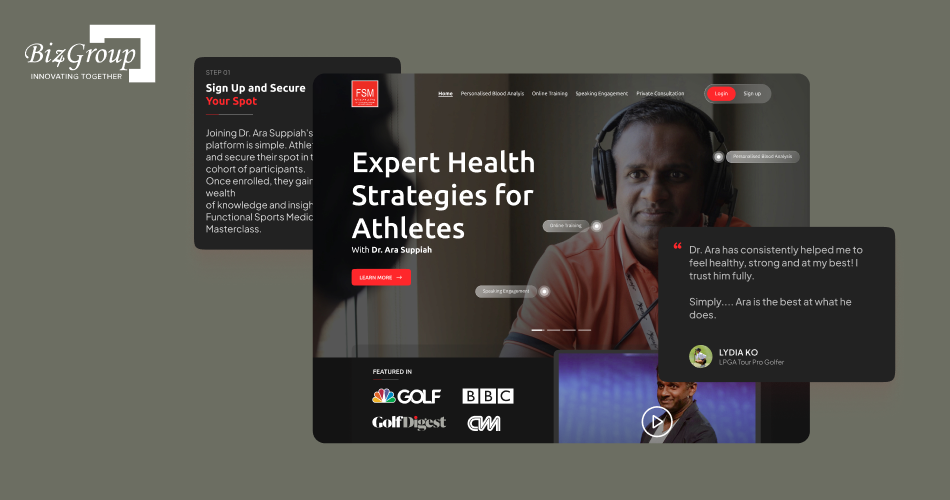
We have watched the engagement problem up close. When we built Dr. Ara, an AI health platform for athletes, many users uploaded one blood report and never came back. We added visible trend tracking and follow-up prompts. Within three months, 71% of athletes had uploaded a second report. It was not a hospital deployment, but the lesson carried over: patients return when you give them a reason.
That raises three questions. Should you build, buy or extend what you already run? How do you create an AI patient engagement platform that patients answer and clinicians trust? And how much will it cost?
This guide answers them. Our team has delivered 100+ healthcare AI projects. We will show you how to build an AI patient engagement platform inside a real hospital, with the build steps, the architecture, the cost and an ROI model your CFO can test. Where the evidence is mixed, we will say so.
First, the basics. What is a patient engagement platform, and why is your board suddenly asking about one?
What Is an AI Patient Engagement Platform, and Why Are Hospital Boards Suddenly Asking About One?
An AI patient engagement platform is software that reaches patients before, during and after care, adapts each message to the patient’s behavior, language and preferred channel, and hands off to staff when a person is needed. It connects to your EHR and tracks results such as response rates, no-shows and survey scores.
Think of it as the part of your patient engagement system that works between visits, when your staff cannot call everyone.
Patient Portal, Patient Management System or Patient Engagement Platform: Which One Do You Actually Need?
The quickest way to tell them apart is to ask who makes the first move.
|
Tool |
Who moves first |
Main job |
Measured by |
|---|---|---|---|
|
Patient portal |
The patient |
Self-service records, bookings and messages |
Logins, bookings made |
|
Patient management system |
Your staff |
Scheduling, intake and documentation |
Wait times, hours saved |
|
Patient engagement platform |
The platform |
Reaching the right patient, at the right time, on the right channel |
Response rate, no-shows, survey scores |
Most hospitals end up running more than one of these tools. An AI patient portal gives patients a place to book visits and read results. An AI patient management system helps your staff with scheduling and intake. Neither one reaches out first, and that gap is the job of an engagement platform.
Why Is AI Patient Engagement Platform Development on Your Board’s Agenda?
The CMS weight you saw earlier hides a detail most articles skip. For fiscal years 2027 through 2029, CMS scores six HCAHPS dimensions: communication with nurses, communication with doctors, communication about medicines, discharge information, cleanliness and quietness, and overall hospital rating. From fiscal year 2030, it plans nine, according to the HCAHPS and Hospital VBP guidance (as of October 2026).
A platform cannot clean a room. In our view, it can reinforce what patients heard about their medicines and discharge plan. You test that with a baseline, and we show you how in the ROI section.
Where Does Engagement Happen in an AI Patient Engagement Platform for Hospitals?
Engagement runs along the whole patient journey. This map shows where a platform acts and what to measure.
|
Stage |
What the platform does |
KPI to track |
|---|---|---|
|
Before the visit |
Intake reminders, prep instructions, reschedule offers |
Confirmation rate, no-show rate |
|
After discharge |
Medicine and follow-up reinforcement, check-ins |
Follow-ups completed, check-ins answered |
|
Chronic care |
Adherence nudges, symptom check-ins, escalation |
Refills on time, check-in completion |
|
Feedback |
Survey follow-up and issue flagging |
Survey response rate, dimension trends |
Pick one row to start, ideally the one where you can record a baseline today.
Are Your Patient Messages Getting Read, or Just Getting Sent?
Share one goal and today’s baseline number. We will point to the first workflow an AI patient engagement platform could improve.
Find My First WorkflowWhich Features Should an AI Patient Engagement Platform for Hospitals Have, and Which Can Wait?
A complete AI patient engagement platform has five feature groups: reach, personalization, patient journeys, staff workflow and measurement. All five sit on an integration and safety foundation. Ship a small core first. Then add features as your pilot shows what moves response and no-show rates.
|
Group |
Feature |
What it does |
Phase |
|---|---|---|---|
|
Reach |
Omnichannel messaging with two-way replies |
Sends SMS, email, voice or app messages; patients reply to confirm or reschedule |
MVP |
|
Consent and preference center |
Stores opt-ins, language, channel and quiet hours |
MVP |
|
|
Language and accessibility support |
Adds translation, large text and screen reader support |
Baseline |
|
|
Chat assistant |
Answers routine questions from approved content |
Phase 2 |
|
|
Voice assistant |
Handles inbound and outbound calls, with handoff |
Phase 3 |
|
|
Personalize |
EHR connection and unified profile |
Pulls schedules, medications and preferences into one record |
MVP |
|
No-show and engagement risk scoring |
Ranks patients by risk of missing visits or going quiet |
MVP |
|
|
Next-best-action engine |
Chooses message, channel and send time per patient |
Phase 2 |
|
|
Personalized education |
Matches content to diagnosis and reading level |
Phase 2 |
|
|
Medication and refill nudges |
Adjusts reminder timing and flags missed refills |
Phase 2 |
|
|
Journeys |
Journey builder |
Sets up pre-visit, discharge and follow-up sequences without code |
Phase 2 |
|
Post-discharge follow-up |
Sends risk-based check-ins and escalates unanswered ones |
Phase 2 |
|
|
Chronic care and monitoring triggers |
Starts outreach when check-ins or wearable readings change |
Phase 3 |
|
|
Enrollment and activation flows |
Invites patients and prompts them to finish setup |
Phase 2 |
|
|
Survey follow-up |
Collects feedback and flags issues by HCAHPS dimension |
Phase 2 |
|
|
Staff and safety |
Human escalation with summary |
Passes the conversation to staff with context |
MVP |
|
Urgent-symptom detection |
Routes messages like “chest pain” to a nurse |
Baseline |
|
|
Clinical content approval |
Requires clinician sign-off before messages go live |
Baseline |
|
|
AI guardrails and disclosure |
Limits AI to approved content and labels AI use |
Baseline |
|
|
Staff worklists |
Ranks open items by urgency |
Phase 2 |
|
|
Measure and govern |
Engagement dashboard |
Tracks response, completion and no-shows against your baseline |
MVP |
|
Test groups and ROI tracking |
Compares messages with a control group and ties cost to results |
Phase 2 |
|
|
Access control and audit log |
Limits access by role and logs every message and AI action |
Baseline |
|
|
Contact center and CRM link |
Shares patient context with call agents |
Phase 2 |
|
|
Model monitoring and bias checks |
Tracks accuracy, drift and group-level performance |
Phase 2 |
The MVP is the core six: messaging, consent, EHR profile, risk scoring, escalation and the dashboard. Baseline rows are not optional. Any system that handles patient data needs them from day one, so they ship alongside the MVP.
Next-best-action is where AI personalization in healthcare starts to pay off. Begin with simple rules, such as texting after 6 p.m. when a patient never answers calls. Add models once you have response data.
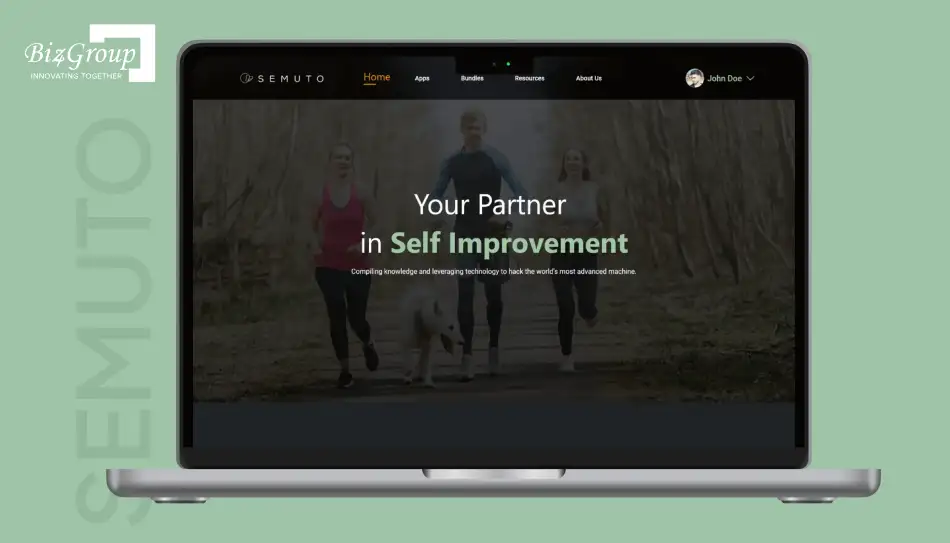
On Semuto, a recommendation platform we built, users answer questions about their health interests before the engine matches them to apps. Case study reports 67% sales growth for partner businesses. It is not a hospital project, but preferences came first there too.
Should Your AI Patient Engagement App Development Start With SMS, Voice or a Mobile App?
Start with the channel your patients already answer. For most hospitals, that is SMS. Add voice and a mobile app once your data shows who needs them.
An app only helps patients who download it. So, in AI patient engagement app development, reach comes first and features second.
Which Channel Fits Which Patient?
|
Channel |
Works best for |
Watch for |
|---|---|---|
|
SMS |
Confirmations, reschedules, short reminders |
Opt-in rules and message length |
|
Voice |
Older patients, urgent or sensitive follow-ups |
Calls that go unanswered |
|
|
Longer instructions and forms |
Slow replies |
|
Mobile app |
Ongoing programs such as chronic care |
Patients who never download it |
|
Web portal |
Patients who already log in |
It waits for the patient to act |
Reach matters more than most teams expect.
A 2026 JAMIA Open study at the University Hospital of Zurich had staff phone patients at high risk of missing an MRI. 42.3% of them never answered. The no-show rate stayed flat (21.9% against 22.0% for the control group). Among patients who picked up, it was 18.4%.
Unanswered calls were not retried. That is the gap to close. If a call goes unanswered, send a text with one-tap rescheduling.
Good AI patient engagement solutions development plans the second channel before the first message goes out.
How Do You Get Patients to Enroll and Stay?
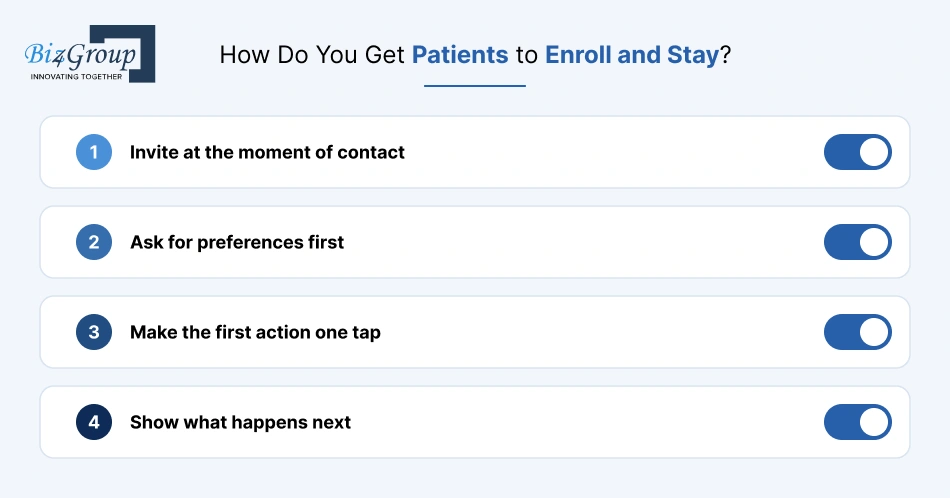
Enrollment is a design problem, not a marketing one. Four habits help:
- Invite at the moment of contact. Ask during scheduling or discharge and explain the benefit in one sentence.
- Ask for preferences first. Capture channel, language and best time to reach them. On the MBI Marketing platform, a HIPAA-compliant healthcare site we built, patients enroll in programs based on their healthcare preferences.
- Make the first action one tap. A form on day one loses people.
- Show what happens next. Replying should feel worth the effort.

Who Gets Left Out, and How Do You Reach Them?
Digital programs tend to reach the patients who already reach you. The same KFF poll from the intro found that adults ages 18 to 29 were at least three times as likely as adults 50 and older to use AI for mental health advice (28% against 8%). A platform built around apps and chat can miss older patients by default.
Plan for them from the start:
- Offer a phone path with a real person on the other end.
- Support the languages your patients speak, plus large text and screen readers.
- Keep one non-digital option for patients without a smartphone or data plan.
Trust is part of this. 77% of adults in that KFF poll were concerned about the privacy of medical information given to AI tools. Say when AI is involved and show how to reach a person.
What Should the Architecture of an AI Patient Engagement Platform Look Like Before Anyone Writes Code?

An AI patient engagement platform needs six working layers inside one security layer: data and consent, a journey engine, AI, a channel gateway, staff queues and EHR integration.
In our view, design the journey engine and the channel gateway first. They decide whether the right message reaches the right patient.
What Layers Does Building an AI Patient Engagement Platform Require?
|
Layer |
Job |
Design rule |
|---|---|---|
|
Data and consent |
Holds the patient profile, channel choices and opt-ins |
Check consent before every send |
|
Journey engine |
Runs multi-step outreach with timers and retries |
Version every journey, so audits can trace what a patient received |
|
AI |
Scores risk, picks timing, drafts replies from approved content |
Keep a human review step for anything clinical |
|
Channel gateway |
Sends and receives SMS, voice, email and app messages |
Track delivery and fall back to a second channel |
|
Staff queues |
Hands unresolved items to nurses and schedulers with context |
Escalate on a timer, so nothing sits |
|
EHR integration |
Reads patient data and, where the vendor allows, writes tasks back |
Use standard FHIR APIs where they exist |
|
Security (all layers) |
Controls access, encryption and audit logs |
Log every message and every AI action |
How Does One Message Travel Through the System?
Take a visit two days away that the patient has not confirmed.
- The EHR sends an appointment event.
- The data layer checks consent. The AI layer scores no-show risk and picks a channel, such as SMS at 6 p.m.
- No reply in four hours, and the patient has opted in to calls? The journey engine places a voice call.
- Still nothing? The item lands on a staff worklist with full history.
- Every step is logged with the message version.
Each step is its own service, so you can change one without rebuilding the rest. The four-hour timer is only an example. Set yours from your own response data.
How Does the EHR Connection Work?
Certified EHRs must offer standardized FHIR read access to core patient data, such as medications, under ONC’s API criterion. That requirement covers reading only. Schedules and write-back depend on each vendor’s own APIs, so confirm both early.
This is where AI integration services earn their place: embedding AI into the systems you already run, such as your EHR and scheduling tools, instead of replacing them.
Vendor approvals and per-site setup can set your launch date, so start them while you build. They are easy to miss when you budget for the model, and they are a real cost in AI patient engagement software development.
Will Your AI Patient Engagement System Survive a Compliance Review?
An AI patient engagement system has five compliance areas: HIPAA and vendor agreements, outreach consent, AI disclosure, clinical scope and fairness, and governance records. Outreach consent matters most here, because an engagement platform contacts patients first.
1. HIPAA and Vendor Agreements
Any vendor that handles patient data for you needs a signed business associate agreement. That includes your SMS, voice and AI model providers. Check that each agreement covers the exact service you use, and keep consumer AI tools without one out of the data path.
2. Outreach Consent (TCPA)
The FCC ruled in February 2024 that AI-generated voices count as artificial voices under the TCPA, so AI calls need the patient’s consent, with only narrow exemptions. On September 30, 2026, the FCC adopted new opt-out rules that take effect 30 days after Federal Register publication. Store consent by category, such as reminders and marketing, not as one yes or no.
3. AI Disclosure
California’s AB 3030, in effect since January 1, 2025, requires health facilities and clinics to add a disclaimer and a way to reach a human to generative AI messages about a patient’s health status, unless a licensed provider reviewed them. The California Department of Public Health notice says scheduling, billing and other administrative messages are excluded. Check the rules in every state you serve.
4. Clinical Scope and Fairness
Keep engagement messages administrative and educational. Counsel should review any feature that scores risk or suggests care, since FDA’s clinical decision support rules may apply. Section 1557 (45 CFR 92.210) also required covered entities, such as hospitals, to make reasonable efforts to find decision support tools that use race, sex, age or disability as inputs and to reduce discrimination risk, starting May 1, 2025.
5. Governance and Audit Records
Name one owner for each AI feature, and record what it does, which data it touches and who reviews it. That is the core of AI governance in healthcare, and it is the evidence a regulator or hospital buyer may ask for. Some teams use AI compliance software to map each rule to control and keep time-stamped logs.
This section is general information, not legal advice. Confirm requirements for your states and features with counsel.
How to Build an AI Patient Engagement Platform Without Building It Twice?
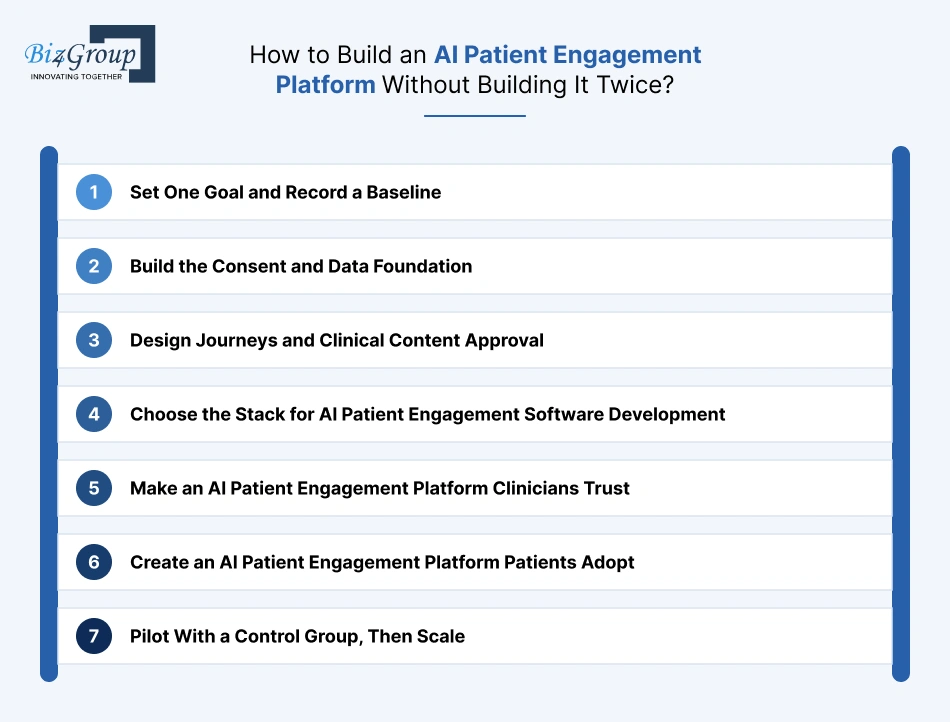
Good AI patient engagement platform development follows seven steps: set one goal, build the consent and data base, design journeys, choose a stack, build in layers, plan enrollment and pilot against a control group. That is how to develop an AI patient engagement platform that holds up inside a real hospital. Run compliance work alongside every step, not after launch.
Step 1: Set One Goal and Record a Baseline
Pick one problem for your patient engagement platform to solve, such as no-shows, follow-up completion or survey response. Record today’s number over several weeks. Without it, you cannot prove a return later.
- Name a clinical owner and an operations owner
- Set a target and a date
Step 2: Build the Consent and Data Foundation
AI patient engagement system development starts with data, not models. Capture each patient’s channels, language and opt-ins before any model runs. Connect read access to your EHR and check which fields are complete.
- Consent stored by category
- Business associate agreements signed
- Key fields checked for gaps
Step 3: Design Journeys and Clinical Content Approval
In digital patient engagement platform development, journeys are the product, so map the pre-visit, discharge and follow-up paths and write each message. A clinician approves the content before it goes live. Running those sequences across SMS, voice and email, including reminders and scheduling, is the work covered by AI automation services.
- Plain-language wording
- A human path for every message
Step 4: Choose the Stack for AI Patient Engagement Software Development
Pick tools by layer, and confirm each one sits inside your business associate agreement. These are typical categories, not a vendor list.
|
Layer |
Typical options |
Compliance note |
|---|---|---|
|
Patient front end |
React or Next.js, React Native or Flutter for mobile |
Keep patient data out of client-side logs |
|
Backend and APIs |
Validate inputs and log access |
|
|
Journey engine |
Workflow engine with a message queue |
Version every journey |
|
Messaging and voice |
HIPAA-eligible SMS, email and telephony providers |
BAA with each, consent per channel |
|
AI layer |
Risk models, a language model with retrieval over approved content |
Zero retention, BAA coverage, human review |
|
Data and EHR |
PostgreSQL, FHIR R4, SMART on FHIR |
Least-privilege access, per-site credentials |
|
Security and audit |
SSO with multi-factor login, encryption, append-only audit log |
Log every message and AI action |
Step 5: Make an AI Patient Engagement Platform Clinicians Trust
When building an AI patient engagement platform, add layers in order: rules first, then risk models, then a language model once the first two prove out. Limit AI to approved content and show reviewers why each message was sent. Anything clinical goes to a person.
- Review queue ready before launch
- Unsafe and off-topic questions tested
Step 6: Create an AI Patient Engagement Platform Patients Adopt
In AI patient engagement solutions development, enrollment is part of the build, not an afterthought. Invite patients at scheduling and discharge and ask for their preferences first. Keep a phone path for patients who will not use an app.
- One-tap first action
- Language and accessibility checked
Step 7: Pilot With a Control Group, Then Scale
Start with one unit of your AI patient engagement platform for hospitals and keep a comparison group, so you can credit results to the platform. Release a focused first version. That is the point of MVP development: prove one workflow before funding the rest.
- Weekly review of overrides and errors
- Go or no-go gate set in advance
What You Have After Seven Steps
You now hold something measurable at every stage: a baseline, a consent record, approved journeys, a tested stack, a reviewed AI layer, an enrollment plan and a pilot result. That evidence is what justifies the budget.
So, what will it cost? Next, we answer how much it costs to build an AI patient engagement platform, and whether buying is cheaper.
How Much Does It Cost to Build an AI Patient Engagement Platform, and Is Buying Cheaper?
Here is how much it costs to build an AI patient engagement platform: an estimated $35,000 to $250,000. That range runs from a focused pilot at the low end to a full multi-site hospital platform at the high end. Your own AI patient engagement platform development cost will differ with scope, EHR connections, AI depth and compliance needs.
Cost Breakdown by Feature in AI Patient Engagement Platform Development
|
Feature |
What it includes |
Estimated cost |
|---|---|---|
|
Messaging with two-way replies |
SMS, email, voice and app channels, delivery tracking |
$5,000 to $12,000 |
|
Consent and preference center |
Opt-ins by category, language, quiet hours |
$2,500 to $5,000 |
|
EHR connection and unified profile |
FHIR read access for the first system, data mapping |
$8,000 to $15,000 |
|
Risk scoring |
No-show and engagement risk from your history |
$5,000 to $12,000 |
|
Escalation and staff worklists |
Handoff with summary, ranked queues |
$3,000 to $7,500 |
|
Engagement dashboard |
Response, completion and no-show tracking |
$3,500 to $8,000 |
|
Security, audit and guardrails |
Access control, audit log, approved-content limits, AI disclosure |
$8,000 to $17,000 |
|
Journey builder and next-best-action |
No-code sequences, channel and timing rules |
$14,000 to $34,000 |
|
Chat and voice assistants |
Approved-content answers, call handling, handoff |
$18,000 to $32,000 |
|
Education, adherence and follow-up flows |
Personalized content, refill nudges, discharge check-ins, enrollment prompts |
$15,000 to $35,000 |
|
Patient mobile app and accessibility |
iOS and Android, languages, large text |
$13,000 to $28,000 |
|
Extra EHR connections |
Each added system, with two assumed in the full-platform total |
$5,000 to $10,000 each |
|
Testing, validation and monitoring |
Clinical testing, bias checks, drift alerts, test groups |
$11,000 to $24,000 |
Adding the rows gives three scopes for your AI patient engagement platform:
- Pilot (rows 1 to 7): $35,000 to $76,500
- Mid-scale (pilot plus journeys, education flows and testing): about $75,000 to $170,000
- Full platform (every row, with two extra EHR connections): about $116,000 to $250,000
The ranges overlap because each row can land anywhere inside its own range. Treat them as planning estimates, because your final number will differ.
Factors That Affect AI Patient Engagement Software Development Cost
- Scope: the number of journeys and channels
- AI depth: rules, risk models, assistants or voice
- EHR connections: each system adds approvals and testing
- Compliance: the states you serve and your consent rules
- Data quality: cleanup before any model can help
- Platforms: SMS and web only, or an app as well
- Team and engagement model: location, seniority, fixed price or time and materials
Hidden Costs in Developing an AI Patient Engagement System
- Message and call fees that grow with patient volume
- AI model usage fees
- EHR vendor fees and per-site setup
- Compliance work: legal review, security testing, audits
- Clinical content: writing and approval
- Staff training and workflow changes
- Yearly maintenance and monitoring, often 15% to 20% of the build cost
Cost Optimization for Building an AI Patient Engagement Platform
- Start with the pilot rows only, and add the rest as results come in
- Launch on SMS and web, and defer AI patient engagement app development until demand is proven
- Use a hosted model under a BAA before paying for private hosting
- Build on FHIR standards, and connect your largest EHR first
- Cap usage with caching and smaller models for simple tasks
- Test with synthetic or de-identified data
- Buy commodity parts such as messaging and identity, and build the journey logic
Buy vs Build: Custom AI Patient Engagement System Development Compared
|
Factor |
Buy |
Build custom |
|---|---|---|
|
Upfront cost |
Lower, with a subscription |
Higher, one build plus upkeep |
|
Launch speed |
Faster to start |
Slower, needs scoping and build |
|
EHR integration |
Limited to what the vendor supports |
Built around your systems |
|
Workflow fit |
Fixed journeys and templates |
Journeys shaped to your service lines |
|
Data and model control |
The vendor sets the roadmap and terms |
You own the data, logic and models |
|
Compliance evidence |
Vendor supplies it, so verify BAAs and audits |
You produce and own it |
|
Best for |
Standard needs and a quick start |
Unique workflows and several systems |
A hybrid path often works well: license the messaging base, then have an AI product development company build the journey and AI layer on top. Biz4Group’s process covers discovery, modeling, integration and optimization after launch.
A budget is only half the story. Next, we calculate the ROI of an AI patient engagement platform in healthcare, so you can test whether these numbers pay back.
Is Your Budget Closer to $35,000 or $250,000?
Your EHR connections, channels and AI depth decide the number. Send us your scope, and we will turn this range into a scoped estimate.
Scope My BudgetWhat Is the ROI of an AI Patient Engagement Platform in Healthcare, and Will Your CFO Believe It?
The ROI of an AI patient engagement platform equals annual benefit minus total cost, divided by total cost. Count only outcomes you can measure against a baseline, such as kept visits and staff hours saved. Leave soft gains out of the math and list them as upside.
The ROI Formula
Benefit is what changes because of the platform, such as no-shows avoided and staff hours saved. Total cost is the build plus yearly run costs: maintenance, message fees and AI usage. Use your baseline from Step 1 for every benefit line.
- Benefit: kept visits times net value per visit
- Benefit: staff hours saved times loaded hourly cost
- Cost: build plus yearly run costs
A Worked Example for an AI Patient Engagement Platform for Hospitals
Here is an illustrative outpatient network. These numbers are examples, not benchmarks, so swap in your own.
|
Input |
Illustrative value |
|---|---|
|
Appointments per year |
60,000 |
|
Baseline no-show rate |
15% (9,000 no-shows) |
|
No-show rate after the platform |
14% (600 fewer) |
|
Net value per kept visit |
$150 |
|
Staff time saved |
400 hours at $35 |
|
Build cost (upper pilot) |
$76,500 |
|
Yearly run cost |
$21,300 (20% maintenance plus $6,000 in fees) |
- Annual benefit: $90,000 from kept visits plus $14,000 in staff time, or $104,000
- Year 1: $104,000 of benefit against $97,800 of cost leaves $6,200, an ROI of about 6%
- Two years: $88,900 net on $119,100 of cost, an ROI of about 75%
- Payback: about 11 months
Year 1 barely breaks even because the build cost lands up front. The example also leaves out any effect on patient survey scores, which is upside you cannot yet count.
KPIs to Track from Day One
Track your patient engagement platform in four groups, from reach to quality. Reach and behavior move first. Survey scores move slowly, so review them on a yearly cycle.
- Reach: enrollment and response rate
- Behavior: confirmations, completed follow-ups, on-time refills
- Operations: calls handled without staff, hours saved
- Quality: survey response and HCAHPS dimension scores
What the Evidence Says About Returns
In the March 2026 Eliciting Insights survey of 120 health systems, more than half of those that could quantify the return on their deployed AI reported at least 2x ROI. That figure is self-reported and covers AI tools in general, not engagement platforms. The same survey found adoption was mixed, with slow implementation and staff hesitation among the challenges.
- Treat any ROI claim, including ours, as a hypothesis
- Confirm it with your own control group
Realistic Payback Timelines
Payback depends on your baseline, your volume and how much of the pilot you keep. In the example above it lands near 11 months. A smaller no-show problem or fewer visits stretches it.
- Faster: a high baseline no-show rate and high visit volume
- Slower: heavy EHR approvals and low enrollment
- Check progress at 90 days against your Step 1 baseline
Want to run this with your own volume and baseline? Bring your numbers, and we will model it with you.
Even a sound ROI model fails if the platform stumbles in the real world. Next, we cover what goes wrong when developing an AI patient engagement system, and how to fix it.
What Goes Wrong When Developing an AI Patient Engagement System, and How Do You Fix It?
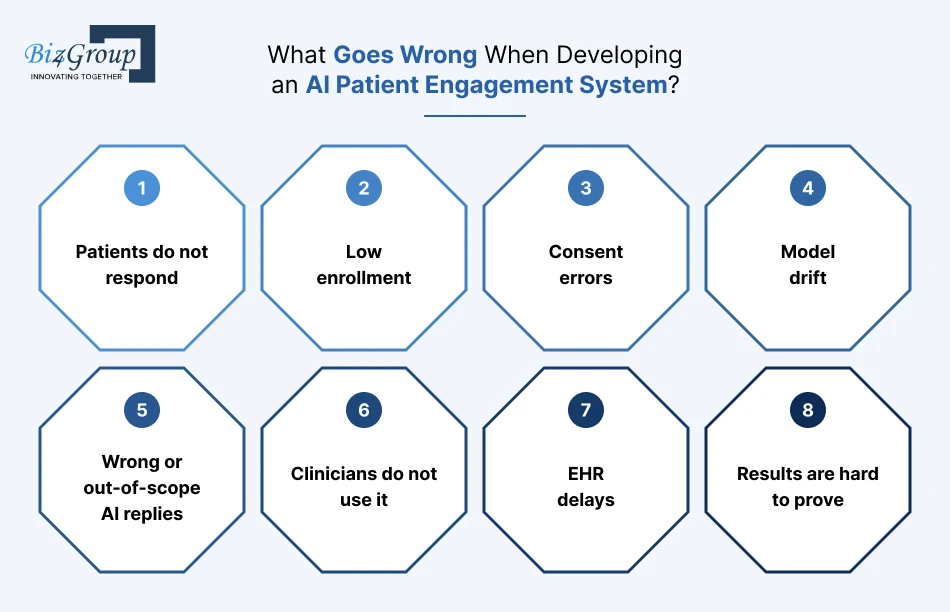
The most common problems in AI patient engagement platform development are low response, low enrollment, consent errors, model drift, wrong AI replies, low clinician use, EHR delays and results nobody can prove. Most are predictable. Plan for each one before you build.
|
Challenge |
Why it happens |
How to solve it |
|---|---|---|
|
Patients do not respond |
Calls and texts go unanswered, or arrive on the wrong channel |
Add a second channel, capture preferences first, test send times |
|
Low enrollment |
Patients are not invited at the moment of contact, or setup takes too many steps |
Invite at scheduling and discharge, make the first action one tap, keep a phone path |
|
Consent errors |
Consent is stored as one yes or no, and opt-outs are missed |
Store consent by category, honor plain-language opt-outs, log every change |
|
Model drift |
Patient mix and appointment types shift. One 2026 hospital study saw a no-show model lose accuracy on newer data |
Monitor accuracy, retrain on a schedule, set a rollback threshold |
|
Wrong or out-of-scope AI replies |
Language models can invent answers or stray into clinical advice |
Limit answers to approved content, test unsafe questions, route urgent messages to a nurse |
|
Clinicians do not use it |
It adds steps, or staff were not consulted during design |
Involve clinicians early, show why each message was sent, track hours saved |
|
EHR delays |
Vendor approvals and per-site setup take time, and write-back varies by vendor |
Start approvals during the build, go read-only first, use staff task queues as a fallback |
|
Results are hard to prove |
No baseline, no comparison group, everything built at once |
Record a baseline, start with the pilot rows, compare against a control group, review at 90 days |
Each row ties back to a step you have already seen. Fix the cause early, and each one becomes a line in your plan, not a surprise in your pilot.
Knowing the risks is easier than avoiding them alone. Next, we look at how to choose a development partner, and where Biz4Group fits.
Which AI Patient Engagement Software Development Companies in USA Should You Shortlist, and Where Does Biz4Group Fit?
Shortlist partners that can show healthcare builds, sign a business associate agreement, connect to your EHR and support the platform after launch. Ask each one for proof. Below are the six questions we would ask, and how we answer them.
Six Questions to Ask Any AI Patient Engagement Platform Development Partner
|
Question |
Why it matters |
What good looks like |
|---|---|---|
|
Have you built patient-facing healthcare software? |
Engagement depends on patient behavior, not only code |
Named projects with results you can read |
|
Will you sign a BAA? |
Every vendor in the data path needs one |
A written BAA, a risk analysis approach, audit log design |
|
How will you connect to our EHR? |
Approvals, not code, can set the launch date |
FHIR experience and a plan for vendor approvals |
|
How do clinicians stay in the loop? |
AI replies need review and escalation |
Review queues and urgent-message routing |
|
How will you prove results? |
A platform nobody measures cannot show a return |
A baseline, a control group and a go or no-go gate |
|
What happens after launch? |
Models drift and rules change |
Monitoring, retraining and support terms in writing |
How Biz4Group Handles AI Patient Engagement Software Development
Biz4Group was founded in 2003 and is headquartered in Orlando, Florida. We have delivered 100+ healthcare AI projects, and our Clutch profile shows a 4.9 rating from 28 reviews. Results are easier to judge when they are written down, which is why we publish them in our AI healthcare case studies.
As a HIPAA-compliant AI healthcare app development company, we cover consulting, custom app development, EHR and EMR integration, rollout and support after launch. Our nine-step process sets up security and compliance before integrations and testing, not after.
You can work with us on a full build, a defined stage, team augmentation or consulting. That suits custom AI patient engagement system development at any size.
What CogniHelp Taught Us About Engagement
On CogniHelp, a daily companion app we built for patients with early to mid-stage dementia, alerts that fired on every dip wore caregivers down. We tuned the thresholds until the app could tell normal variation from a real change, and unnecessary caregiver check-ins fell 41%, according to our case study. We also built for patients who were never comfortable with smartphones, using large touch targets and voice-to-text journaling.
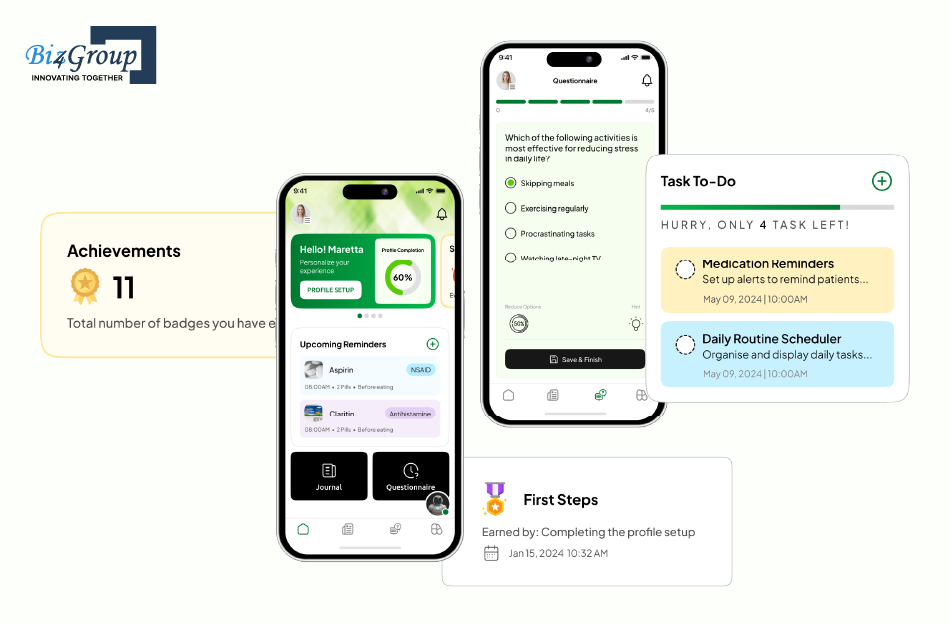
It was not a hospital deployment, but the same rules apply to your staff worklists and your patient messages.
Ready to Test Us Against Those Six Questions?
Bring them to a call. We will answer each one with project proof and tell you what we would leave for phase two.
Put Us to the TestReady to Create an AI Patient Engagement Platform Your Patients Will Actually Open?
For hospitals in the program, a quarter of the Hospital VBP score that adjusts Medicare payments comes from patient surveys. In our view, moving that number takes more than reminders. AI patient engagement platform development works when you start with one goal, record a baseline, build a pilot and measure it against a control group.
Our estimate for that first pilot is $35,000 to $76,500. You now have the steps, the architecture, the compliance checks and an ROI model to test it.
Bring your goal and your baseline number, and we will help you scope the first workflow. Book a strategy call with our healthcare AI team.
FAQ
1. What Is an AI Patient Engagement Platform, and How Is It Different From a Patient Portal?
An AI patient engagement platform is software that contacts patients before, during and after care, adapts each message to their behavior, language and preferred channel, and hands off to staff when needed. A patient portal waits for the patient to log in. An engagement platform reaches out first and connects to your EHR.
2. How Much Does It Cost to Build an AI Patient Engagement Platform?
The estimated cost of AI patient engagement platform development is $35,000 to $250,000. A focused pilot runs about $35,000 to $76,500, and a full multi-site platform reaches the high end. Scope, EHR connections, AI depth and compliance needs drive the difference. Yearly maintenance often adds 15% to 20% of the build cost.
3. How Long Does It Take to Develop an AI Patient Engagement Platform?
At Biz4Group, an MVP for digital patient engagement platform development takes 2 to 4 weeks, and an enterprise build takes 6 to 8 weeks. EHR vendor approvals, BAA negotiation and clinical content review run alongside the build and can push go-live later. Our advice on how to build an AI patient engagement platform is to start them on day one.
4. Is an AI Patient Engagement System HIPAA Compliant?
It can be, but no agency certifies HIPAA compliance. A compliant AI patient engagement system needs signed business associate agreements with every vendor that touches patient data, plus encryption, role-based access, audit logs and a written risk analysis. Automated calls and texts also need patient consent under the TCPA.
5. Can an AI Patient Engagement Platform for Hospitals Integrate with Epic and Other EHRs?
Usually yes. Certified EHRs, including Epic, must offer standardized FHIR read access to core patient data, and Epic lists third-party engagement tools on its Showroom and Connection Hub. Schedules and write-back depend on each vendor’s APIs, and approvals can take time, so confirm them early.
6. Should You Build or Buy an AI Patient Engagement Platform?
Buy when your needs are standard and speed matters. Choose custom AI patient engagement system development when your workflows are unique, you connect several systems, or you need control over data and models. Many hospitals combine both: license a messaging base, then build the journey and AI layer on top.
7. How Do You Measure the ROI of an AI Patient Engagement Platform in Healthcare?
ROI equals annual benefit minus total cost, divided by total cost. Count only measurable gains, such as kept visits and staff hours saved, against a baseline you record before launch, and compare with a control group. The ROI of an AI patient engagement platform in healthcare is easiest to defend when you review it at 90 days.