Location :
Orlando, FL, USA
Location :
Orlando, FL, USA +1 (407) 714-1616
 info@biz4group.com

 AI Powered Summary by Biz4AI
- AI personalization in healthcare tailors the channel, timing, language and next step for each patient across the patient journey, and it works when it is targeted rather than generic.
- An AI-powered personalized healthcare platform combines a unified data layer, a personalization engine, patient and staff apps and human escalation, connected to the EHR through FHIR and HL7.
- A HIPAA compliant AI personalized patient experience platform needs BAAs, encryption, audit logs and AI disclosure, plus compliance with state AI laws, TCPA, FDA and accessibility rules.
- How to build an AI personalized patient experience platform starts with one use case and an MVP pilot, and AI personalized patient experience platform development typically costs $30,000 to $250,000.
- The main challenges are data quality, drift, bias and trust, so adoption grows fastest where teams start small and measure, and Biz4Group, an AI development company with 100+ healthcare AI projects, helps with validation, human handoff and monitoring.
AI personalization in healthcare sounds like a solved problem until you look at what patients actually receive.
One patient gets a mammogram reminder for an appointment she already booked. Another gets the same diabetes newsletter for the third year in a row. A third misses a follow-up because the reminder came by text, and he only ever answers phone calls.
None of those messages was wrong, exactly. They just were not written for the person who got them.
Sound familiar?
The numbers say it should not be this hard. An Eliciting Insights survey of 120 health systems, published in March 2026, found that 75% of US health systems now use at least one AI application, up from 59% in 2025. Adoption is clearly happening. So why do patients still get messages that miss?
Because personalization is where things stall. A survey by Lirio and Sage Growth Partners, found that only 5% of respondents were very satisfied with their technology for supporting medication adherence.
Lirio's chief behavioral officer, Amy Bucher, points out that many tools that claim to personalize do little more than group patients by demographics, like an age band. A first name and an age range are not a patient profile. Real AI personalization in healthcare starts with the individual: what motivates this patient, what gets in their way and how they prefer to hear from you.
We build AI healthcare personalization platforms at Biz4Group, and the pattern is consistent. Agreeing that patients need more personal communication is the easy part. Deciding what to build, what data it needs, what HIPAA allows and what it will cost is where projects stall.
That is where our experience comes in. Biz4Group has delivered software for more than 20 years, and our healthcare AI work spans 100+ projects.
One of them, Dr. Truman, is an AI health companion with a conversational avatar. It gives personalized guidance, keeps a health history, and accepts uploaded records. The project delivered a 40% increase in user engagement, a 25% improvement in marketing conversion and 85% positive customer feedback.
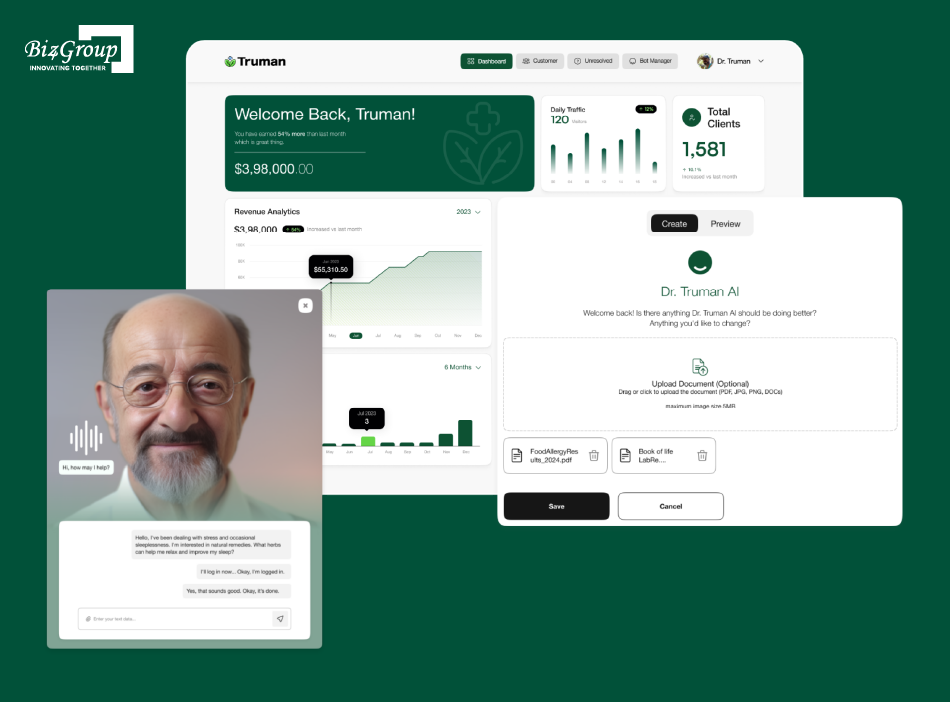
The lesson our Technical Director, Dave Caplis, took from it: people do not want to feel like they are "filling out forms all day." If the experience feels natural, they come back. If it feels like paperwork, they do not.
We are applying the same thinking to hospitals. In April 2026 we introduced agentic AI health assistant platforms built to give hospitals and clinics 24/7 personalized patient engagement without adding staff.
Search for AI personalization healthcare examples and you will mostly find feature lists. So where do you actually start?
Whether you are scoping a standalone AI healthcare app or adding AI-powered personalization in healthcare to a portal you already run, the same questions come up first:
- What does an AI personalized patient experience platform actually do, and how does AI personalize the patient experience day to day?
- Which data does it need, and how can AI personalize the patient journey with it?
- How do you keep it compliant? What does a HIPAA compliant AI personalized patient experience platform require?
- What will AI personalized patient experience platform development cost, and when does it pay back?
It is written for founders, CTOs and technology managers who need to decide whether to build, buy or extend an AI-powered personalized healthcare platform. If that is you, we want you to get direct answers on AI personalization in healthcare before you talk to a vendor.
What Is AI Personalization in Healthcare, and Why Are US Providers Investing in It?
AI personalization in healthcare is the use of machine learning and language models to adapt what each patient sees, hears and is asked to do, based on that patient's own data and behavior. It tailors the message, timing, channel and next step. In this guide it covers the patient experience, not diagnosis or treatment decisions.
Why are providers investing now? Two pressures stand out.
Patients already use AI for health questions. A KFF poll fielded in February and March 2026 found that 32% of US adults used AI for health information or advice in the past year. When a chatbot answers in seconds, a generic reminder from your portal feels slow.
Patient experience also affects payment. In Medicare's Hospital Value-Based Purchasing Program, CMS withholds 2% of base operating payments from participating acute-care hospitals and returns it based on performance. The patient-experience domain, built on the HCAHPS survey, makes up 25% of the score.
How Does AI for Personalization in Healthcare Benefit Patients, Providers, and Payers?
AI for personalization in healthcare benefits each group differently:
- Patients get guidance that fits their situation, in their language, at a time that suits them.
- Providers close care gaps with less manual outreach.
- Payers see more members taking their medication and attending preventive visits.
The gain depends on design, not on adding AI alone. A 2025 JAMA trial of 9,501 patients found that refill text reminders, generic or nudge-style, did not improve medication adherence at 12 months. That is why we treat personalization as more than rewording a reminder.
What Is the Difference Between Personalization and Patient Engagement?
Personalization is how you tailor an interaction to one patient. Patient engagement is the result you want: a patient who takes an active part in their own care. Personalization is one tool for raising engagement. A perfectly tailored message can still be ignored, and an engaged patient can do well on a plain portal.
|
|
Personalization |
Patient engagement |
|---|---|---|
|
What it is |
A method: tailoring content, timing, channel and next step to one patient |
A result: patients, families and clinicians working in active partnership to improve health and care (Carman et al., Health Affairs, 2013) |
|
Who acts first |
The organization adapts to the patient |
The patient acts, with the care team |
|
How you measure it |
Relevance and reach: did the right message arrive the right way? |
Behavior: kept visits, filled prescriptions, portal use |
|
Example |
A reminder in Spanish by text at 7 p.m. with one-tap booking |
The patient books, logs their glucose and brings questions to the visit |
We saw this split while building CogniHelp, one of the projects in our AI healthcare case studies. The app is for people in the early to mid-stages of dementia, and its daily quiz is built from each patient's own life details and journal entries. That is personalization. Getting someone with memory loss to open it every day is engagement, so we added gentle reminders.
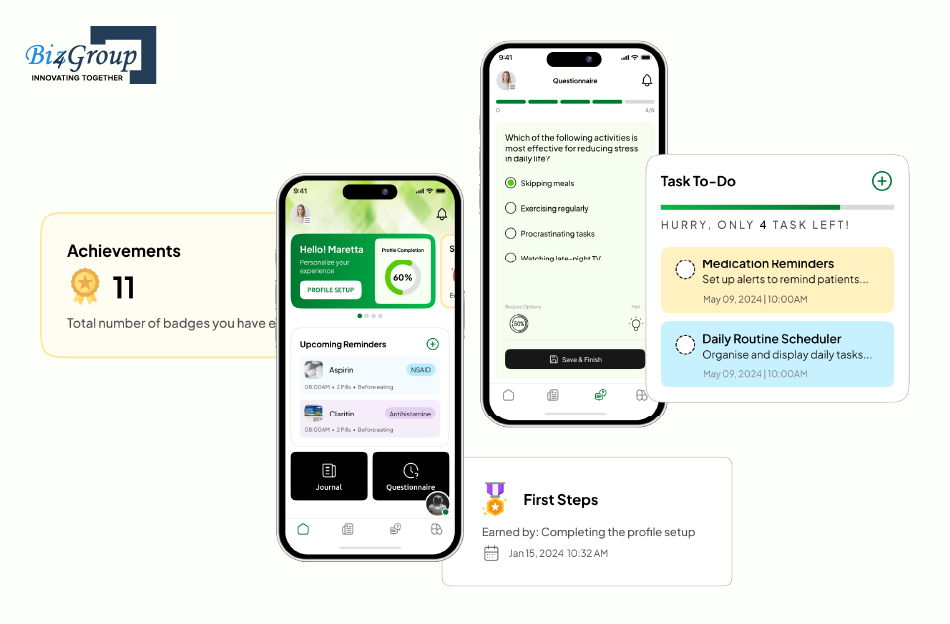
Done well, AI-powered personalization in healthcare gives each of these its own metrics. In any AI healthcare personalization project, track relevance and reach for the first and patient behavior for the second.
Want personalization that goes beyond "Dear [First Name]"?
Most patient messages stop at the name field. Tell us what yours should do, and we will show you what comes after it.
Talk to Our TeamHow Does AI Personalize the Patient Experience? Six Core Capabilities
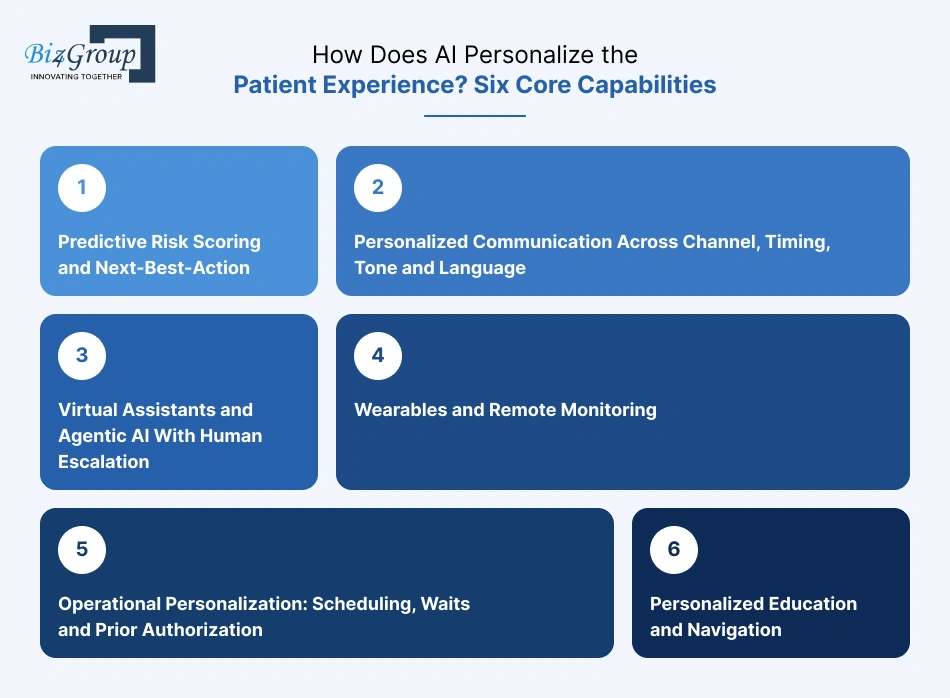
AI personalizes the patient experience through six capabilities: predicting who needs attention, tailoring communication, answering questions through assistants, reading data from wearables, adjusting operations around the patient, and delivering education that fits where the patient is in their care. Each one turns patient data into a decision about what happens next, which is the core of AI personalization in healthcare.
1. Predictive Risk Scoring and Next-Best-Action
Models built with predictive analytics score each patient's risk of a missed visit, a lapsed refill or a readmission using their history and recent activity. The platform then picks a next-best-action for that person, such as a call, a text or a care-team task, instead of sending one campaign to everyone. Scores need monitoring: in a 2026 Zurich hospital study, a no-show model lost accuracy once it ran on newer data.
2. Personalized Communication Across Channel, Timing, Tone and Language
The same message lands differently depending on how and when it arrives. AI chooses the channel, send time, language and reading level for each patient from their past responses and stored preferences, which matters most for refill and adherence reminders. Reach is the hard part: in that Zurich study, 42.3% of the patients selected for a reminder call never answered.
3. Virtual Assistants and Agentic AI With Human Escalation
Assistants answer questions, book visits and collect symptoms. A common build is an AI medical agent for patient interaction & triage that gathers symptoms, gauges severity and routes the patient, with a handoff to staff when a case falls outside its rules.
An agentic AI assistant goes further: it plans a multi-step task, such as rebooking a visit and updating the record, and hands off when unsure. Patients expect transparency: 89% in a 10-country Philips survey said they should be told when AI is used in their care.
4. Wearables and Remote Monitoring
Data from wearables, such as smartwatches and fitness bands, streams heart rate, sleep and activity, and home devices add readings like glucose. AI compares each reading with that patient's own baseline, not a population average.
A well-built AI remote patient monitoring app ranks alerts by risk and sets thresholds per patient, so nurses see the changes that matter instead of a flood. A clinician reviews anything clinical.
5. Operational Personalization: Scheduling, Waits and Prior Authorization
Personalization also covers logistics. AI can offer the appointment slot a patient usually picks or warn staff about a likely long wait, because workflow tools connect scheduling, EHR and billing. One flow in AI healthcare workflow automation can run from symptom intake to analysis to a booked appointment.
Insurance approvals are a common source of delay, and AI prior authorization can check eligibility, assemble the clinical documents and track the request so the patient is not left waiting on paperwork.
6. Personalized Education and Navigation
An AI virtual assistant that keeps a memory of a patient's preferences and past questions can match education to their diagnosis, stage of care and reading level, then point them to the right next service. Our veteran-support chatbot, for example, builds an action plan from each person's eligibility and location and flags signs of crisis in real time.
Together, these six capabilities are what an AI personalized patient experience platform runs on. Next, we map them to the patient journey.
How Can AI Personalize the Patient Journey? Use Cases from Booking to Follow-Up
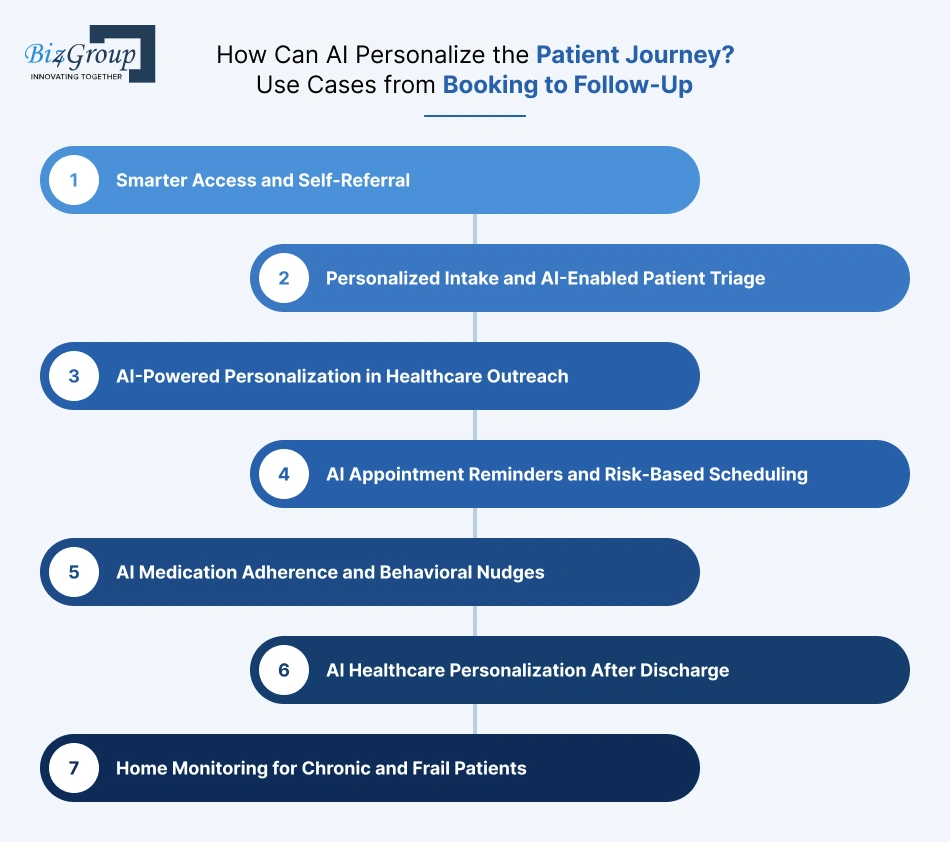
AI can personalize the patient journey at seven points: finding care, preparing for the visit, hearing from the care team before they ask, getting the right reminder, staying on treatment, recovering after discharge and being monitored at home. At each point, the platform uses that patient's own data to decide what happens next. Each use case below ends with a documented real-world example, including one that did not work.
1. Smarter Access and Self-Referral
The first barrier is getting in. AI guides a person through booking or self-referral in their own words, at any hour, and adapts its questions to the service they want. That removes the phone call and the long form that can stop people from starting.
Example
Limbic Access in NHS Talking Therapies (England). A personalized AI chatbot on each service's website tailors its opening message to that service and collects the details needed for a referral. In a Nature Medicine study of 129,400 patients across 28 services, referrals rose 15% in services using the chatbot, versus 6% in comparison services. The tool's developers ran the study, and it was observational, so it shows better access, not better treatment outcomes.
2. Personalized Intake and AI-Enabled Patient Triage
Intake questions adapt to each answer, so a patient with a urinary complaint and a patient with a rash do not fill out the same form. In AI-enabled patient triage, models score urgency from the answers and route the patient to self-care, a virtual visit or in-person care. The system compares answers with the patient's record, and a clinician reviews before any decision is made.
Example
Cedars-Sinai Connect (Los Angeles). Patients log in through an app or website, and a chatbot asks about their symptoms. It compares the answers with the patient's medical record and with data from similar patients, asks follow-up questions and summarizes for a physician, who can disagree with the recommendation. Cedars-Sinai reported in August 2025 that 42,000 patients had used it.
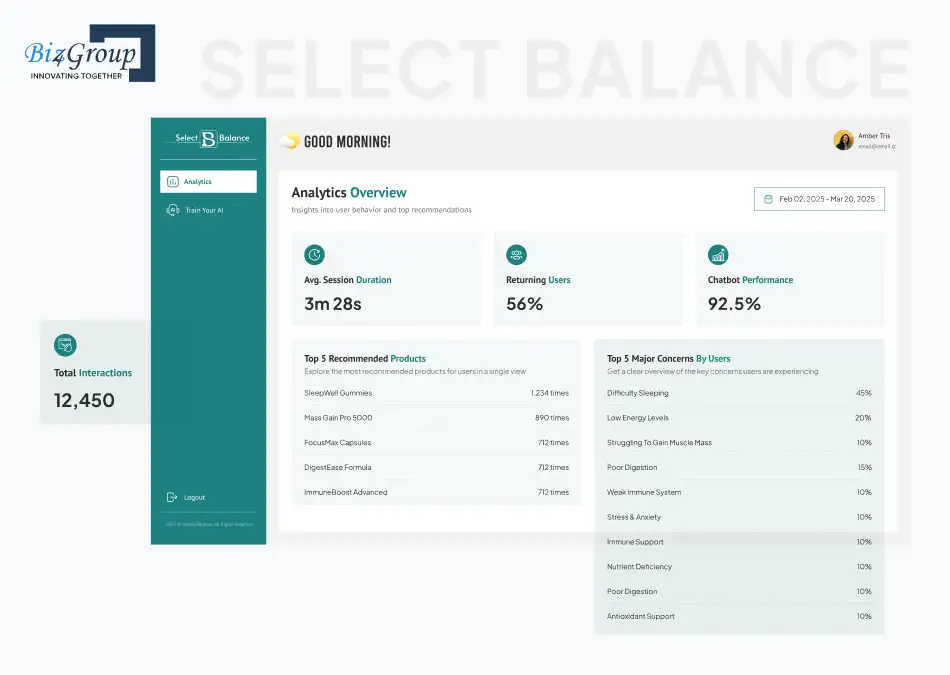
Our build: Select Balance, our supplement chatbot, starts with a guided quiz or an open conversation and asks dynamic follow-up questions to refine each recommendation. It is a wellness tool, not clinical triage, but the adaptive intake pattern is the same.
3. AI-Powered Personalization in Healthcare Outreach
Many patients never log into a portal, so outreach has to come to them. AI agents contact patients who are due for screenings, speak their preferred language, answer common questions and offer a next step such as a mailed test kit. Staff review transcripts and take over when a patient needs a person.
Example
WellSpan Health (Pennsylvania and Maryland), with Hippocratic AI's agent "Ana." A retrospective analysis covered 1,878 screening-eligible patients without active online health profiles, contacted in September 2024. Spanish-speaking patients opted in to colorectal screening kits at 18.2%, versus 7.1% for English speakers. Hippocratic AI funded the study, and it measured opt-in, not completed screenings.
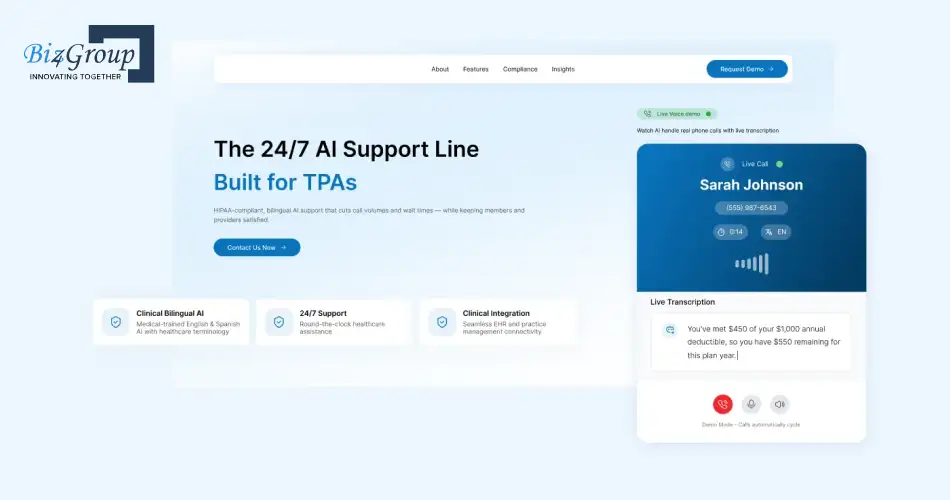
Our build: Our AI-driven IVR platform for third-party administrators answers inbound calls in English and Spanish with live translation. It escalates unresolved calls to a person with a summary of the conversation. It handles inbound calls, not outbound outreach, but the language matching and human handoff are the same design.
4. AI Appointment Reminders and Risk-Based Scheduling
Not every patient needs the same reminder. A model scores each appointment's no-show risk, and staff add a call, a text or a different slot only where the risk is high. In AI-powered patient management software, predictive scheduling can forecast no-shows and send reminders automatically.
A dedicated AI appointment reminder system adds two-way messaging, so patients confirm, cancel or reschedule in their reply, and freed slots go to a waitlist.
Example
MetroHealth primary care clinic (Cleveland). A randomized quality improvement initiative used a random forest model to predict no-show risk, and schedulers phoned patients at 15% risk or higher. Across 5,840 appointments, the no-show rate was 33% in the calling group versus 36% in the standard group. For Black patients it was 36% versus 42%.
5. AI Medication Adherence and Behavioral Nudges
Adherence fails for individual reasons, so one reminder schedule fits few patients. An AI medication adherence app logs taken, missed and delayed doses, adapts reminder timing to each patient's habits and alerts a caregiver or provider when adherence drops. Refill data shows when someone is about to run out, so help arrives before the lapse.
Example
Intermountain Healthcare's ENCOURAGE trial. Machine learning personalized the content, timing, frequency and delivery route of nudges for 182 cardiology patients on statins. At 12 months, 66.3% of the nudge group had adequate statin coverage (at least 80% of days), versus 50.5% of controls. It was a small trial, and the difference in clinical events was not significant. Fixed reminders did not hold up in the larger JAMA trial discussed earlier.
6. AI Healthcare Personalization After Discharge
The first weeks at home are when a return visit is most likely, and staff cannot call everyone. AI ranks patients by risk and sends each the right check-in, whether a text, a call or a nurse visit. The design question is who gets which contact.
Example
Automated post-discharge texting (JAMA Network Open, 2024). A randomized trial of a 30-day automated texting program for primary care patients after hospital discharge found no significant reduction in acute care revisits. We include it because it is a useful warning. Automation alone did not move the outcome, which is why we tie follow-up to patient risk and need.
7. Home Monitoring for Chronic and Frail Patients
AI watches each patient against their own baseline and raises an alert only when a pattern signals risk, so staff are not buried in alarms. A chronic disease management system with AI combines remote monitoring, predictive alerts and care-plan reminders, so an irregular reading reaches both the patient and the provider. People decide what happens after the alert.
Example
PRESAGE CARE (France). Home care aides answer a short smartphone questionnaire after each visit, and a machine learning model flags patients at risk of an emergency visit within 7 to 14 days. In a JMIR Formative Research analysis of 120 older adults (60 per group), the system was associated with a nearly 32% reduction in emergency hospitalizations versus controls. It was a small, retrospective study outside the US.
Our build: Our CogniHelp app for people in the early to mid-stages of dementia pairs AI-powered cognitive assessments and exercises with real-time insights for caregivers and providers. It tracks cognitive performance trends over time, the same baseline-first approach.
AI Personalization Healthcare Use Cases to Start With
If you are planning an AI personalized patient experience platform for hospitals, start where the evidence is strongest. Risk-targeted no-show outreach and adherence nudges have randomized results, while access and proactive outreach tools have observational ones. Treat discharge follow-up and home monitoring as pilots until your own data confirms them.
Next, we look at the features a platform needs to run these use cases together.
Which Features Does an AI-Powered Personalized Healthcare Platform Actually Need?
An AI-powered personalized healthcare platform needs 45 features in six groups: data foundation, personalization engine, patient-facing tools, care team workflows, safety and governance, and analytics. We mark 28 as MVP and 17 as Phase 2. That split is our recommendation, based on what the use cases above require.
1. Data Foundation and Integration Features
|
Feature |
What it does |
Why it matters |
Stage |
|---|---|---|---|
|
Unified patient profile |
Merges EHR, claims, device, survey and engagement data into one record per patient, with duplicate matching and missing-data flags |
Personalization is only as good as the data behind it |
MVP |
|
EHR/EMR integration (FHIR, HL7) |
Reads and writes schedules, medications, problems and results |
Keeps the platform inside the care workflow instead of beside it |
MVP |
|
Consent and preference center |
Stores each patient's channel, language, timing and opt-in choices |
Every message depends on it, and it keeps outreach lawful |
MVP |
|
Identity and proxy access |
Verifies patients and supports caregivers and family proxies |
The right person sees the right data, especially for older and pediatric patients |
MVP |
|
Device and wearable ingestion |
Pulls readings from home devices and wearables |
Monitoring needs a per-patient baseline |
Phase 2 |
|
Interaction history store |
Logs what was sent, opened, answered and ignored |
Gives models training data and gives auditors a trail |
MVP |
2. AI Personalization Engine Features
AI for personalization in healthcare depends on this layer, because it decides what each patient sees, through which channel and when.
|
Feature |
What it does |
Why it matters |
Stage |
|---|---|---|---|
|
Risk scoring |
Scores each patient for no-shows, refill lapses, readmission and deterioration |
Directs effort to where it changes outcomes |
MVP |
|
Next-best-action engine |
Picks the action, channel and time for each patient |
Replaces blanket campaigns |
MVP |
|
Content and language personalization |
Adapts wording, reading level and language |
Spanish-speaking patients opted in at more than double the English rate when outreach matched their language (WellSpan) |
MVP |
|
Conversational understanding |
Reads free text and voice, detects intent and sentiment |
Lets patients reply in their own words |
MVP |
|
Channel and send-time optimization |
Learns which channel and hour each patient answers |
Reach is often the weak link, as flagged patients in the Zurich study never answered the call |
Phase 2 |
|
Care-plan and education recommendations |
Suggests education, programs and services by stage of care |
Gives each patient a relevant next step |
Phase 2 |
|
Experimentation and holdout groups |
Tests messages against control groups |
Fixed reminders did not hold up in a large JAMA trial, so you need your own proof |
Phase 2 |
3. Patient-Facing Features
The patient front door is usually an AI patient portal that ties scheduling, messaging, records and reminders into one login.
|
Feature |
What it does |
Why it matters |
Stage |
|---|---|---|---|
|
Self-scheduling and rescheduling |
Books, changes and cancels visits without a call |
Removes the phone queue |
MVP |
|
Adaptive intake and triage |
Changes questions by answer and routes by urgency, with clinician review |
Collects cleaner information before the visit |
MVP |
|
Conversational assistant (chat and voice) |
Answers questions and completes routine requests, within a set scope |
Gives patients help at any hour |
MVP |
|
Two-way reminders and notifications |
Lets patients confirm, cancel or reschedule in their reply |
Turns a reminder into an action |
MVP |
|
Secure messaging |
Connects patients with the care team, with request sorting |
Keeps communication in one tracked place |
MVP |
|
Multilingual and accessibility support |
Offers multiple languages, voice, large text and screen-reader support |
Reaches patients who skip portals today |
MVP |
|
Records and plain-language summaries |
Shows results and visit notes with simple explanations |
Helps patients understand their own care |
Phase 2 |
|
Medication and refill tracking |
Logs doses, flags missed ones and warns before a refill runs out |
Catches lapses early |
Phase 2 |
|
Remote monitoring view |
Shows readings against the patient's own baseline |
Makes home monitoring understandable |
Phase 2 |
|
Feedback capture |
Collects ratings and patient-reported outcomes |
Feeds models and quality reporting |
Phase 2 |
Our build: Dr. Truman, our AI health companion, pairs a conversational avatar with real-time interaction and recommendations based on each user's health data.
4. Care Team and Workflow Automation Features
Most of this layer comes from AI automation services: workflow orchestration, document processing and API connections to legacy systems.
|
Feature |
What it does |
Why it matters |
Stage |
|---|---|---|---|
|
Clinician dashboard with patient summary |
Shows each patient's risk, recent contacts and open items |
Gives staff context before they act |
MVP |
|
Alert prioritization and per-patient thresholds |
Ranks alerts by risk and adjusts limits by patient |
Stops alarm overload |
MVP |
|
Human escalation and handoff |
Transfers a conversation to staff with a summary |
Patients can always reach a person, and some states require it |
MVP |
|
Crisis and safety detection |
Flags distress or urgent need in real time and alerts staff |
Some messages cannot wait for review |
MVP |
|
Conversation review |
Lets staff read AI transcripts and mark errors |
Finds mistakes before patients do |
MVP |
|
Task routing and worklists |
Sends each request to the right team |
Cuts manual sorting |
Phase 2 |
|
Workflow orchestration |
Runs multi-step flows such as intake, booking and EHR write-back |
Removes re-keying between systems |
Phase 2 |
|
Document processing |
Reads forms, referrals and faxed records |
Removes manual data entry |
Phase 2 |
|
Eligibility and prior authorization automation |
Checks coverage and assembles authorization requests |
Insurance paperwork delays care |
Phase 2 |
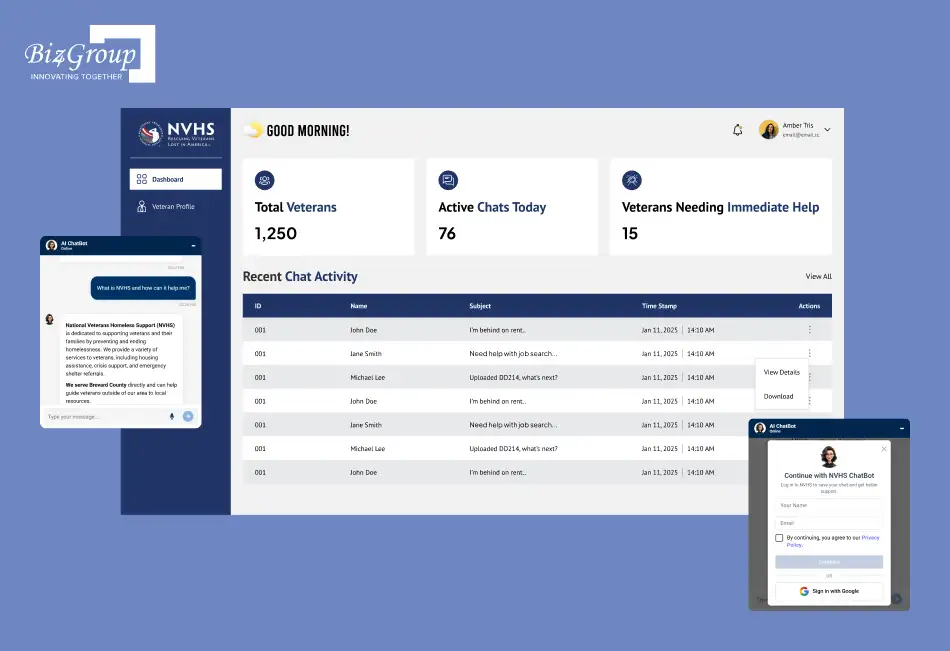
Our build: NVHS, our veteran-support chatbot, flags crisis signals in real time and alerts staff through an admin dashboard that shows chat logs and high-risk users.
5. Safety, Compliance and Governance Features
|
Feature |
What it does |
Why it matters |
Stage |
|---|---|---|---|
|
HIPAA safeguards |
Applies encryption, role-based access, multi-factor login and audit logs |
Baseline for any system touching PHI |
MVP |
|
Vendor and BAA management |
Tracks business associate agreements for every subprocessor (model provider, hosting, telephony) |
No agreement, no PHI |
MVP |
|
AI disclosure and human-contact notice |
Labels AI-generated clinical messages and shows how to reach a person |
Required in California for generative AI messages about clinical information, unless a licensed provider reviewed them |
MVP |
|
Guardrails and scope limits |
Blocks diagnosis, dosing and other out-of-scope answers |
Keeps AI on administrative and educational tasks |
MVP |
|
Explainability and audit trail |
Records which data and rule produced each action |
Builds clinician trust and supports audits |
MVP |
|
Model monitoring and retraining |
Tracks accuracy and drift, and retrains on new data |
A no-show model lost accuracy on newer data in the Zurich study |
MVP |
|
Incident response and security testing |
Runs penetration tests and a breach workflow |
Required for PHI |
MVP |
|
Bias and equity monitoring |
Compares model performance by language, race and age |
The MetroHealth no-show model was validated for fair performance before use |
Phase 2 |
Source for the disclosure row: California Health and Safety Code §1339.75 (AB 3030), in effect since January 1, 2025, per the California Department of Public Health notice.
6. Analytics and Optimization Features
|
Feature |
What it does |
Why it matters |
Stage |
|---|---|---|---|
|
Outcome dashboard |
Tracks no-show rate, adherence, readmissions and engagement |
Shows whether personalization works |
MVP |
|
Cohort and equity reporting |
Splits results by group, language and site |
Shows who benefits and who is missed |
Phase 2 |
|
Engagement analytics by channel |
Reports opens, replies and drop-off per channel |
Guides channel and timing choices |
Phase 2 |
|
ROI and cost tracking |
Links platforms spend to outcomes and staff time |
Supports the business case |
Phase 2 |
|
Feedback loop and admin retraining tools |
Lets staff correct answers and update content and logic |
Keeps the system improving after launch |
Phase 2 |
Select Balance, our supplement chatbot, includes an admin panel for continuous training and improvement of its AI logic.
Plan these as two releases in AI personalized patient experience platform development: ship the 28 MVP features first, then add Phase 2 as your own data confirms each one. Next, we look at the architecture that holds them together.
What Does the Architecture of an AI Personalized Patient Experience Platform for Hospitals Look Like?
An AI personalized patient experience platform for hospitals has eight layers: source systems, integration, data and identity, AI engine, orchestration, experience, security and governance, and analytics. The EHR stays the system of record. The platform reads from it, decides, and writes back through approved interfaces.
1. Eight-Layer Reference Architecture
|
Layer |
Role |
Typical components |
Section 5 features it serves |
|---|---|---|---|
|
Source systems |
Hold the patient facts |
EHR/EMR, scheduling, billing, lab, pharmacy, devices, payer portals |
Data foundation |
|
Integration |
Moves data in and out |
FHIR R4 APIs, HL7 v2 interfaces, SMART on FHIR, bulk export, webhooks, interface engine |
Data foundation |
|
Data and identity |
Holds the unified profile, consent and history |
Relational store, time-series store for device data, vector index for approved content, master patient index |
Data foundation |
|
AI engine |
Scores risk, picks actions, understands language |
ML models, language model with retrieval, rules, model registry |
Personalization engine |
|
Orchestration |
Runs journeys step by step, with human handoffs |
Event bus, workflow engine, rules service, task queues |
Care team and automation |
|
Experience |
Where patients and staff interact |
Portal, mobile app, SMS, voice, clinician dashboard, EHR-embedded apps |
Patient-facing, care team |
|
Security and governance (cross-cutting) |
Protects PHI and records every AI action |
Identity and access management, encryption, key management, audit logs, policy engine |
Safety and governance |
|
Analytics and MLOps |
Measures outcomes and monitors models |
Warehouse, dashboards, drift monitoring, experiment tracking |
Analytics |
2. Integration Layer: EHR, Devices and Payers
Most of the work here is AI integration services: connecting AI to the hospital's existing applications, APIs and databases without replacing the EHR.
|
Connection |
Method |
Direction |
Design note |
|---|---|---|---|
|
Patient, appointment, medication and result data |
HL7 FHIR R4 with US Core |
Read |
Certified EHRs must offer standardized FHIR R4 APIs under ONC's §170.315(g)(10) criterion |
|
Apps inside the clinician's EHR session |
SMART on FHIR (OAuth 2.0) |
Both |
Keeps staff in one screen |
|
Notes, tasks and flags back to the EHR |
FHIR write where supported, otherwise HL7 v2 or vendor APIs |
Write |
The ONC criterion covers read access, so write-back depends on the vendor; confirm early |
|
Admission, discharge and transfer events |
HL7 v2 ADT feed |
Read |
Triggers discharge follow-up |
|
Scheduling |
FHIR Appointment and Slot, or vendor API |
Both |
Needed for self-scheduling and waitlist recovery |
|
Devices and wearables |
Device APIs, gateways, FHIR Observation |
Read |
Feeds per-patient baselines |
|
SMS, voice and email |
Messaging and telephony APIs under a BAA |
Both |
Enforces consent and records delivery |
|
Eligibility and payer data |
Clearinghouse or payer APIs (X12 270/271 for eligibility) |
Both |
Supports prior authorization automation |
Our HIPAA-compliant AI automation platform solutions cover EHR integration alongside patient triage, medical charting, billing and remote patient monitoring.
3. AI Engine and Model Controls
|
Component |
Role |
Design rule |
|---|---|---|
|
Predictive models (risk, no-show, adherence) |
Score patients from structured data |
Validate by subgroup before release and retrain on a schedule |
|
Next-best-action policy |
Combines scores, rules and consent to choose an action |
Hard rules (consent, quiet hours, clinical exclusions) override model output |
|
Language model with retrieval |
Answers questions and drafts messages from approved content |
Answer only from approved sources and refuse out-of-scope clinical questions |
|
Intent and sentiment classifier |
Routes replies and flags distress |
Distress goes to a person, never back to the model |
|
Model registry and versioning |
Stores each model version and its validation |
Every action traces to a model version |
|
Monitoring |
Tracks drift, accuracy, fairness and unsafe outputs |
Alerts trigger rollback; a no-show model lost accuracy on newer data in the Zurich study |
4. Orchestration and Human Escalation
|
Element |
Role |
Design rule |
|---|---|---|
|
Event bus |
Carries events such as discharge, missed visit or new reading |
Process each event once and keep an event log |
|
Workflow engine |
Runs multi-step journeys with timers and retries |
Version and test every journey |
|
Rules service |
Applies consent, quiet hours and clinical exclusions |
Keep rules outside the model so compliance staff can edit them |
|
Human task queues |
Hand cases to staff with context |
Every automated step has a path to a person, and unanswered items escalate on a timer |
|
Write-back service |
Posts results and tasks to the EHR |
Isolate its failures from patient-facing flows |
Our agentic AI health assistant platform, introduced for hospitals and clinics, targets 24/7 patient engagement without adding staff.
5. Security and Privacy Architecture
A HIPAA compliant AI personalized patient experience platform treats security as a layer every other layer passes through.
|
Control |
Design choice |
|---|---|
|
PHI isolation |
Keep PHI in a restricted store, send models only the fields they need, and de-identify where possible |
|
Identity and access |
Multi-factor login, role-based access, least privilege and logged break-glass access |
|
Encryption and keys |
Encrypt in transit and at rest, with managed keys and rotation |
|
Subprocessor control |
Hold a BAA with every vendor in the PHI path (cloud, model provider, telephony, messaging) |
|
Audit logging |
Record who accessed what, which model produced each action and every message sent |
|
Prompt and output controls |
Filter inputs and outputs, and treat patient free text as untrusted to block prompt injection |
|
AI disclosure |
Label AI-generated clinical messages and show a path to a person where required (see Section 5) |
6. Deployment and Multi-Site Scaling
Scaling across departments and sites is where enterprise AI solutions come in: shared services, one governance model and site-level configuration.
|
Pattern |
Fits |
Trade-off |
|---|---|---|
|
Single-tenant cloud on HIPAA-eligible services |
Most health systems and the fastest launch |
Needs a BAA with the cloud provider and careful network design |
|
Hybrid (PHI store in a private environment, AI services in cloud) |
Organizations with data residency rules |
More integration work and added latency |
|
Private cloud or on premises |
Strict policy or limited connectivity |
Higher cost and slower model updates |
|
Multi-site rollout |
Several hospitals or EHR instances |
Shared services with site-level settings for language, consent and EHR connection |
|
Phased rollout (pilot unit, then department, then system) |
Any hospital |
Validates results on one unit before scaling |
7. End-to-End Data Flow for Discharge Follow-Up
|
Step |
What happens |
Layer |
|---|---|---|
|
1 |
A discharge event arrives from the ADT feed |
Integration |
|
2 |
The profile refreshes with medications, follow-up appointment, language and consent |
Data and identity |
|
3 |
Models score readmission and no-show risk |
AI engine |
|
4 |
The policy picks the action, for example a Spanish text at 6 p.m. or a nurse call for high risk, after rules check consent and quiet hours |
AI engine and orchestration |
|
5 |
The message goes out on the patient's channel and the assistant handles the reply |
Experience |
|
6 |
Distress or an out-of-scope question escalates to a nurse queue with a summary |
Orchestration |
|
7 |
The outcome and any task post back to the EHR |
Integration |
|
8 |
Every step is logged with its model version, and results feed the dashboard and retraining |
Security and analytics |
Next, we cover what it takes to launch this with full HIPAA compliance.
What Does It Take to Launch a HIPAA Compliant AI Personalized Patient Experience Platform?
A HIPAA compliant AI personalized patient experience platform has to meet four groups of rules: HIPAA and its companions, federal AI and device rules, state AI laws, and outreach and accessibility rules. Each requirement below says what it covers and what to build. Status is as of October 2026.
1. HIPAA Privacy Rule for AI Healthcare Personalization
The Privacy Rule governs how PHI may be used and disclosed. Appointment reminders and follow-up care are treatment communications, while promotional messages can require patient authorization. For AI healthcare personalization, apply the minimum necessary standard to model inputs, and de-identify training data using HHS's Safe Harbor or Expert Determination methods.
2. HIPAA Security Rule Safeguards
The Security Rule requires a documented risk analysis, administrative, physical and technical safeguards, and policy records kept for six years. The January 2025 proposal to overhaul it is still not final, and HHS's agenda now points to July 2027. Build to the proposal voluntarily, because OCR keeps enforcing the current rule.
NVHS, our veteran-support chatbot, keeps chat history behind a secure login and lists HIPAA-compliant data handling among its core features.
3. Breach Notification Rule and HITECH Act
The Breach Notification Rule requires notice to affected individuals within 60 days of discovery, to HHS for breaches of 500 or more, and to media when more than 500 residents of a state are affected. Business associates must notify the covered entity without unreasonable delay and within 60 days. The HITECH Act created these duties, made business associates directly liable and set tiered penalties, so set shorter internal clocks in your contracts.
4. Business Associate Agreements for AI Vendors
Any vendor that creates, receives, maintains or transmits PHI is a business associate, including cloud hosts, messaging and telephony providers, and the model provider whenever PHI reaches it. HHS's cloud guidance says covered entities may use cloud services for ePHI only under a BAA, and the provider becomes directly liable. In AI personalized patient experience platform development, pass BAAs down to every subprocessor and keep consumer AI tools without a BAA out of the PHI path.
5. 42 CFR Part 2 Substance Use Records
Part 2 sets stricter consent rules for substance use disorder treatment records than HIPAA does, and it applies if your platform ingests records from a Part 2 program. Compliance became mandatory on February 16, 2026, including HIPAA-style breach notification and updated privacy notices. Tag Part 2 data at ingestion so outreach and model training exclude it unless consent allows.
6. FDA Clinical Decision Support Rules
FDA's January 2026 guidance explains when decision-support software for clinicians is not a medical device, such as when it supports rather than directs the clinician and shows its basis. Software aimed at patients or caregivers stays under FDA's existing digital health policies, so scope matters. Keep patient-facing features administrative and educational, and have regulatory counsel review anything that scores risk or recommends treatment.
7. Section 1557 Rule for Hospital Platforms
Section 1557's rule at 45 CFR 92.210 requires covered entities to make reasonable efforts to identify patient care decision support tools that use race, color, national origin, sex, age or disability as inputs. They must also mitigate the risk of discrimination, and this has applied since May 1, 2025. An AI personalized patient experience platform for hospitals should expect buyers to ask for its input variables, subgroup performance and mitigation records.
8. State Laws on AI-Powered Personalization in Healthcare
California's AB 3030, in effect since January 1, 2025, requires an AI disclaimer and a way to reach a human on generative AI messages about clinical information, unless a licensed provider reviewed them. Texas requires providers to disclose AI use in diagnosis or treatment (SB 1188 and TRAIGA), California's AB 489 bars AI from implying a healthcare license, and Illinois and Nevada bar AI from providing therapy. For AI-powered personalization in healthcare, build one disclosure and escalation layer that switches on per state, and track new bills quarterly.
9. TCPA Rules for AI Calls and Texts
The FCC treats AI-generated voices as artificial voices under the TCPA, so AI calls need prior express consent. Appointment reminders and post-discharge follow-up fall under a narrow healthcare exemption. Patients can revoke consent by any reasonable means, honored within 10 business days since April 11, 2025, and the broader "revoke-all" requirement is delayed to January 31, 2027. FCC action on that rule is still moving, so recheck before launch and detect plain-language opt-outs, not just STOP.
10. FTC and State Consumer Health Privacy
If any part of the platform serves consumers outside HIPAA, the FTC's Health Breach Notification Rule applies to health apps, as amended effective July 29, 2024. State laws such as California's CMIA and Washington's My Health My Data Act can reach data HIPAA does not cover. Separate HIPAA data from consumer data in your architecture and consent flows and have counsel map of each state you serve.
11. Section 504 and ADA Accessibility
HHS's Section 504 rule requires websites and mobile apps of HHS funding recipients to meet WCAG 2.1 Level AA. An interim final rule effective May 7, 2026, moved the deadlines to May 11, 2027, for recipients with 15 or more employees and May 10, 2028, for smaller ones. Hospital buyers will expect your patient portal to conform, so test accessibility from the first release.
12. AI Governance Program
Hospitals expect an AI-powered personalized healthcare platform to fit their AI governance in healthcare program: a multidisciplinary committee, an intake review for each tool and go or no-go thresholds set before launch. Give them the evidence, including model documentation, subgroup validation, monitoring results and an incident path. Voluntary frameworks such as NIST's AI Risk Management Framework and ISO/IEC 42001 give both sides a shared vocabulary.
On Dr. Truman, we developed responses with clinical experts and reviewed them for accuracy before they reached patients.
13. Continuous AI Compliance Monitoring
Compliance does not end at launch, and AI compliance software can map rules to controls, monitor data flows and model outputs, and generate time-stamped audit logs. For AI for personalization in healthcare, track who accessed PHI, which model produced each message, every consent change and every disclosure shown. Review the rule list quarterly, since several of these rules changed within the past 18 months.
14. Compliance Dates at a Glance
|
Rule |
Date or status |
Applies when |
|---|---|---|
|
HIPAA Security Rule overhaul |
Proposed January 2025, final action now targeted July 2027 |
Every platform handling ePHI |
|
42 CFR Part 2 |
Compliance required February 16, 2026 |
Substance use disorder records |
|
California AB 3030 |
In effect January 1, 2025 |
Generative AI clinical messages in California |
|
Section 1557, 45 CFR 92.210 |
In effect May 1, 2025 |
Hospital customers using decision support tools |
|
Texas SB 1188 |
In effect September 1, 2025 |
Texas providers using AI in care |
|
Texas TRAIGA and California AB 489 |
In effect January 1, 2026 |
AI disclosure and implied licensure |
|
FDA CDS guidance |
Issued January 2026 |
Clinician-facing decision support |
|
TCPA revocation by any reasonable means |
In effect April 11, 2025 |
Automated calls and texts |
|
TCPA revoke-all |
Delayed to January 31, 2027 |
Informational calls and texts |
|
Section 504 WCAG 2.1 AA |
May 11, 2027 (15+ employees), May 10, 2028 (fewer) |
HHS-funded customers |
|
FTC Health Breach Notification amendments |
In effect July 29, 2024 |
Consumer health data outside HIPAA |
If your team lacks in-house compliance engineering, a HIPAA-compliant AI healthcare app development company can build these controls into the architecture from the first sprint. Next, we walk through the build steps.
This section is general information, not legal advice.
How to Build an AI Personalized Patient Experience Platform, Step by Step
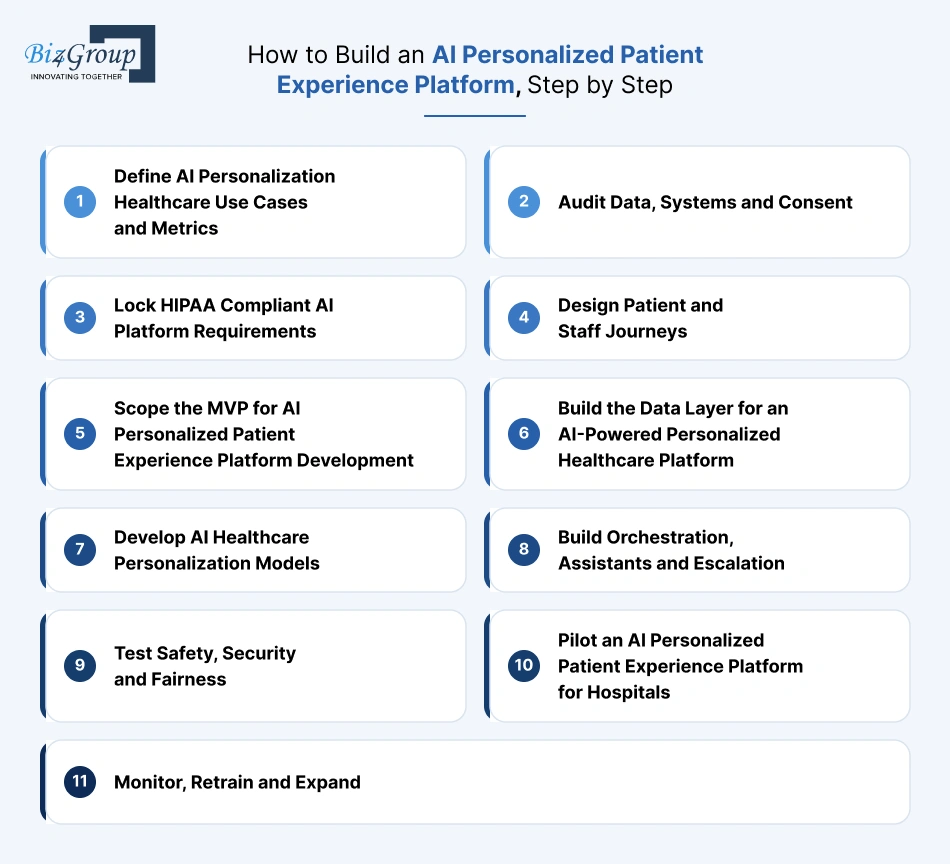
Here is how to build an AI personalized patient experience platform in eleven steps: set the use case, audit data and consent, lock compliance requirements, design the journeys, scope an MVP, build the data layer, validate the models, wire the workflows, test, pilot and monitor. Each step below lists what to do and four checkpoints.
Step 1: Define AI Personalization Healthcare Use Cases and Metrics
Start with one or two use cases from the list above, such as risk-based reminders or discharge follow-up, not the whole patient journey. Record today's baseline for each, for example the current no-show rate, so you can prove change later. Name one clinical owner and one operations owner.
- Pick one use case first
- Record the current baseline
- Set a target and a date
- Assign clinical and operations owners
Step 2: Audit Data, Systems and Consent
List the sources the AI will need, including the EHR, scheduling, device feeds and messaging channels. Check data quality, because missing records produce wrong nudges, and confirm you hold patient consent and channel preferences. Sign BAAs with every vendor that will touch PHI.
- List every data source
- Test quality and completeness
- Capture consent and language preferences
- Sign BAAs before PHI moves
Step 3: Lock HIPAA Compliant AI Platform Requirements
A HIPAA compliant AI personalized patient experience platform starts with written requirements, so turn the compliance list above into specifications before design begins. Decide which rules apply to your sites, states and patient groups, and set up a governance owner with an intake review. Plan the AI disclosure, human-contact path and audit logging now, because adding them later costs more.
- Map federal and state rules
- Appoint a governance owner
- Specify AI disclosure and handoff
- Plan audit logs and retention
Step 4: Design Patient and Staff Journeys
Map the journey for your chosen use case, including every handoff to a person. Design for accessibility, plain language and the languages your patients speak, as we did in CogniHelp, app for early to mid-stage dementia patients. Test the flows with real patients and staff before engineering begins.
- Map each touchpoint and handoff
- Write in plain language
- Support voice, large text and translation
- Test with patients and staff
Step 5: Scope the MVP for AI Personalized Patient Experience Platform Development
Scope the first release around one use case and one site, using the MVP features marked in the features section. A team offering MVP development lets you test the core logic and integrations before committing to the full scope. Park everything else for Phase 2.
- One use case, one site
- Core features only
- Define pass or fail criteria
- Park Phase 2 features
Step 6: Build the Data Layer for an AI-Powered Personalized Healthcare Platform
Every later feature depends on the data layer, so build integrations first. Connect the EHR through FHIR where available, create the unified patient profile and set up the consent store. Run read-only first, then add write-back once the data checks out.
- Connect EHR and scheduling
- Build the unified profile
- Store consent per channel
- Add write-back after validation
Step 7: Develop AI Healthcare Personalization Models
Start with a simple no-show or refill-lapse risk score, then put a next-best-action policy on top. Validate each model by subgroup, and let hard rules for consent, quiet hours and clinical exclusions override the model. Teams without in-house machine learning staff can hire AI developers with healthcare data and compliance experience.
- Start with simple risk models
- Validate by language, age and race
- Keep rules above the model
- Compare against a control group
Step 8: Build Orchestration, Assistants and Escalation
AI for personalization in healthcare must never trap a patient in automation, so build the workflow engine, the assistant and the staff queues together. Limit the assistant to approved content and have it refuse out-of-scope clinical questions. Unresolved cases go to staff with a summary, the way our AI-driven IVR platform hands escalated calls to a person.
- Event-driven workflows
- Assistant limited to approved sources
- Staff queues with timers
- Summaries on every handoff
Step 9: Test Safety, Security and Fairness
Test beyond function. Red-team the assistant for prompt injection and unsafe answers, and run security and penetration tests on every integration. Compare outcomes across subgroups, test accessibility against WCAG 2.1 AA, and have clinicians review a sample of AI messages.
- Penetration and integration tests
- Prompt-injection and safety tests
- Subgroup fairness checks
- WCAG and clinician review
Step 10: Pilot an AI Personalized Patient Experience Platform for Hospitals
Pilot on one unit with a control group, so you can attribute results to the platform. Train staff, measure against the baselines from Step 1 and set a go or no-go gate before expanding. Roll out unit by unit, not all at once.
- Pilot one unit
- Keep a control group
- Train staff before launch
- Set a go or no-go gate
Step 11: Monitor, Retrain and Expand
AI-powered personalization in healthcare needs upkeep, because models lose accuracy as patient data shifts. Track accuracy, drift, fairness and opt-out handling after launch, and retrain on a schedule. Add Phase 2 features only when the pilot data supports them, and review the compliance list every quarter.
- Track drift and accuracy
- Retrain on a schedule
- Add Phase 2 features by evidence
- Review rules each quarter
Next, we look at what this build costs.
How Much Does AI Personalized Patient Experience Platform Development Cost?
AI personalized patient experience platform development typically costs between $30,000 and $250,000, depending on the number of use cases, integrations and compliance controls. A focused pilot sits at the low end, and a full multi-site hospital platform sits at the top. These are estimates, and your final cost will differ with your scope.
1. Feature-Wise Cost of an AI-Powered Personalized Healthcare Platform
The figures draw on our published cost guides for reminder systems, triage software, adherence apps and patient portals. "Starting cost" is the price at pilot depth, with one use case and one site. "Upper-end cost" is the price at full depth, with more channels, systems and sites. The totals assume the platform plugs into your existing portal and EHR.
|
Core feature |
Starting cost |
Upper-end cost |
|---|---|---|
|
1. Intake, scheduling and self-service workflows |
$5,000 |
$20,000 |
|
2. Reminders and two-way messaging (SMS, email, voice) |
$5,000 |
$25,000 |
|
3. Symptom intake and triage logic |
$8,000 |
$25,000 |
|
4. Risk scoring and next-best-action models |
$8,000 |
$30,000 |
|
5. Chat and voice assistant interface |
$6,000 |
$18,000 |
|
6. Human escalation and handoff |
$2,500 |
$7,500 |
|
7. EHR, scheduling and payer integrations |
$10,000 |
$45,000 |
|
8. Multilingual and accessibility support |
$5,000 |
$20,000 |
|
9. HIPAA security, access control and audit logging |
$5,000 |
$20,000 |
|
10. Analytics and outcome dashboards |
$3,000 |
$15,000 |
|
11. Testing, QA and clinical validation |
$5,000 |
$25,000 |
|
Total, all 11 core features |
$62,500 |
$250,500 |
|
Pilot subset (features 1, 2, 4, 6, 9, 10, 11) |
$33,500 |
$142,500 |
The headline range runs from the pilot's starting cost ($33,500) to the full platform's upper end ($250,500), rounded to the nearest $10,000. A full core platform at starting depth costs $62,500, and each feature moves toward its upper-end cost as you add channels, systems and sites.
Add-ons priced on top of the range
|
Add-on |
Starting cost |
Upper-end cost |
|---|---|---|
|
Language model assistant with retrieval over approved content |
$10,000 |
$35,000 |
|
Device and remote monitoring integration |
$10,000 |
$35,000 |
|
New patient portal or mobile front end |
$20,000 |
$70,000 |
|
Advanced predictive models (replaces feature 4 when needed) |
$30,000 |
$60,000 |
|
Prior authorization automation (MVP level) |
$40,000 |
$80,000 |
2. Factors Affecting AI Personalized Patient Experience Platform Development Cost
- Scope and use cases: one use case such as no-show reduction costs far less than the full patient journey.
- Integrations: a one-way EHR read costs less than two-way write-back across several systems.
- AI depth: rules and simple risk scores cost less than custom models and language models with retrieval.
- Compliance scope: a HIPAA compliant AI personalized patient experience platform that also handles Part 2 records, state AI laws and accessibility testing needs more design and validation.
- Channels and languages: each added channel or language adds build and testing time.
- Sites and patient volume: multi-site rollouts need shared services, site settings and more infrastructure.
- Data readiness: clean, structured data shortens model work, while messy records add cleanup.
- Team location and expertise: our guides put US and Western European rates at about $100 to $180 per hour, Eastern Europe and Latin America at $60 to $120, and India and Southeast Asia at $30 to $80.
3. Hidden Costs in AI Healthcare Personalization Projects
- Cloud hosting and storage: about $500 to $3,000 per month, growing with data volume.
- Messaging and voice usage: about $200 to $2,000 per month for SMS, email and telephony.
- Model retraining: about $5,000 to $20,000 per year to keep AI healthcare personalization accurate.
- Maintenance and updates: typically 15% to 25% of the initial build per year.
- Compliance reviews and audits: about $5,000 to $20,000 per review cycle.
- Staff training and onboarding: about $3,000 to $15,000 per rollout.
- Data cleaning and preparation: about $5,000 to $15,000 before models can train.
- Pilot and clinical validation support: about $15,000 to $30,000 for a live pilot.
- EHR vendor fees and change requests: vary by vendor, so ask early.
4. Cost Optimization for AI-Powered Personalization in Healthcare
- Start with the pilot subset: features 1, 2, 4, 6, 9, 10 and 11 prove one use case for about $33,500 at starting depth.
- Add AI to what you already run: adding prediction and personalization to an existing portal usually costs less than replacing it, and an AI product development company can scope that choice early.
- Go read-only first: connect the EHR for reads, then add write-back once data checks out.
- Limit channels and languages at launch: add the rest when response data justifies them.
- Buy the commodity parts: use proven messaging and identity services, and spend custom effort on the personalization logic.
- Use one cross-platform front end: avoid separate native builds where one codebase works.
- Plan the architecture for scale early: it avoids a costly rebuild when you add sites.
- Run a proof of concept: test one risky assumption, such as data quality, before the full build.
5. Buy vs Build for an AI Personalized Patient Experience Platform for Hospitals
|
Factor |
Buy an existing platform |
Build custom |
|---|---|---|
|
Upfront investment |
Lower |
Higher |
|
Time to launch |
Faster |
Longer |
|
Custom workflows |
Limited |
High flexibility |
|
EHR integration depth |
Vendor limitations |
Full control |
|
Data and model ownership |
Platform dependency |
Full ownership |
|
AI customization |
Usually limited |
Extensive |
|
Ongoing cost |
Subscription that grows with usage |
Maintenance and retraining |
|
Compliance evidence |
Vendor supplies it, so verify the BAA and audit reports |
You produce and own it |
|
Best for |
Simple needs and a fast start |
Complex workflows and multi-site hospitals |
Many hospitals buy the portal and build the personalization layer on top. That hybrid keeps upfront cost near the low end while keeping your data and models under your control.
Want a number for your own scope? Get a cost estimate for your platform.
Next, we look at the challenges you will face and how to solve them.
Curious where your platform lands between $30,000 and $250,000?
Scope, integrations and AI depth decide it. Share yours and we will price it.
Get My EstimateWhat Challenges Come With AI-Powered Personalization in Healthcare, and How Do You Solve Them?
The biggest challenges in AI-powered personalization in healthcare are poor data, model drift and bias, patients who do not respond, compliance gaps and staff overload. Each is solvable with design choices made early. The tables below pair 19 challenges with their causes and fixes.
1. Data and Integration Challenges in AI Healthcare Personalization
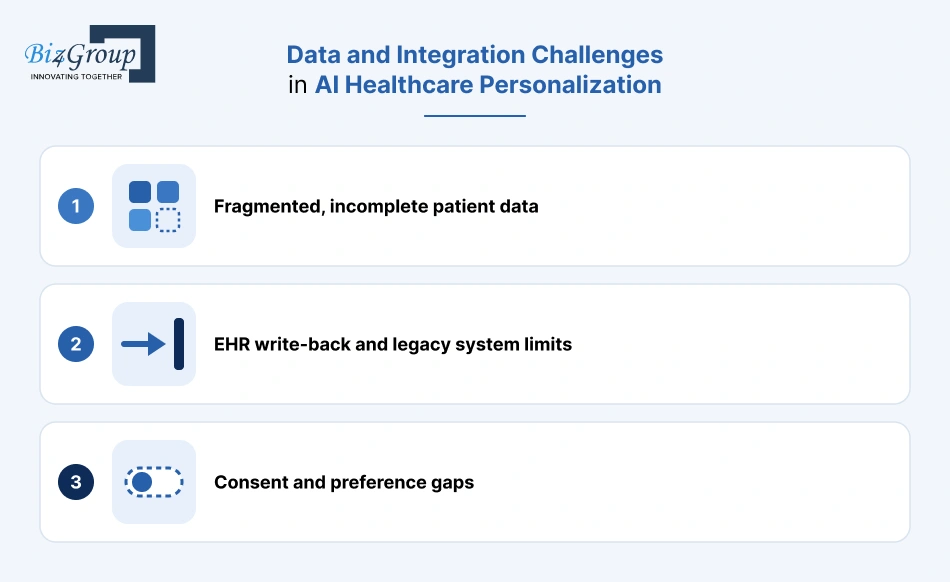
AI healthcare personalization fails quietly when the data behind it is wrong or incomplete.
|
Challenge |
Why it happens |
How to solve it |
|---|---|---|
|
Fragmented, incomplete patient data |
Records sit across the EHR, scheduling, devices and messaging tools, with missing language and channel fields |
Build a unified patient profile, run data-quality checks, and start with only the fields the first use case needs |
|
EHR write-back and legacy system limits |
The standard FHIR API covers read access, so write-back depends on each vendor, and older systems use HL7 v2 or custom interfaces |
Confirm write-back in discovery, go read-only first, and use an interface engine or staff task queues as the fallback |
|
Consent and preference gaps |
Channel, language and opt-in choices are not captured, or go stale |
Build a consent center with per-channel records and refresh it at every visit |
2. Model Accuracy and Fairness Challenges in AI Personalization Healthcare
|
Challenge |
Why it happens |
How to solve it |
|---|---|---|
|
Model drift |
Patient behavior and data change after launch, and the Zurich no-show model lost accuracy on newer data |
Monitor accuracy, retrain on a schedule and set rollback thresholds |
|
Bias and unequal performance |
Training data under-represents some groups, so error rates differ by language, race or age |
Validate by subgroup before release, keep fairness checks in monitoring and document mitigation for Section 1557 |
|
Generative AI errors |
Language models can invent facts or answer outside their scope |
Retrieve from approved content, refuse out-of-scope clinical questions, red-team before launch and have clinicians review a sample |
|
Weak or vendor-run evidence |
Many results come from small trials or studies run by the tool's developers |
Pilot with a control group, fix KPIs and go or no-go thresholds in advance, and treat vendor claims as hypotheses |
3. Patient Engagement and Trust Challenges for an AI Personalized Patient Experience Platform
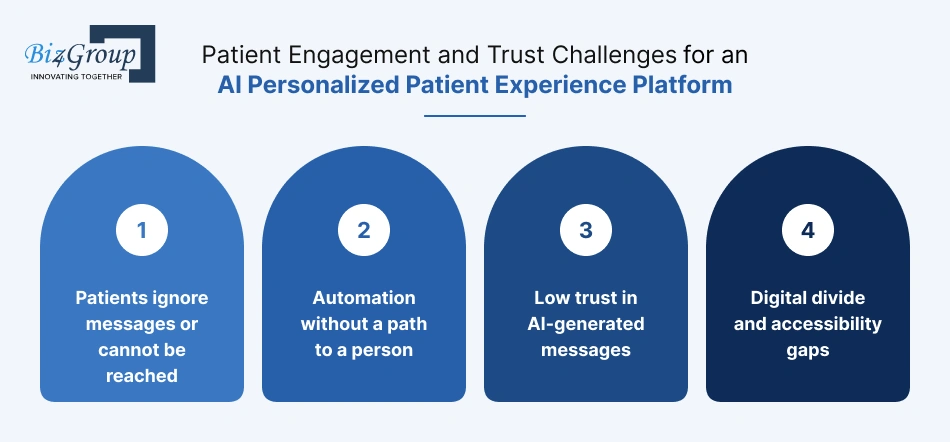
|
Challenge |
Why it happens |
How to solve it |
|---|---|---|
|
Patients ignore messages or cannot be reached |
Fixed reminders did not hold up in a large JAMA trial, and in the Zurich study many flagged patients never answered the call |
Optimize channel and send time per patient, match language, and add a second channel before escalating |
|
Automation without a path to a person |
Generic automated follow-up did not reduce revisits after discharge |
Target follow-up by risk, hand off to staff with a conversation summary, and escalate unanswered items on a timer |
|
Low trust in AI-generated messages |
Patients surveyed say they want to be told when AI is used in their care |
Disclose AI use, show a clear way to reach a person, and write in plain language |
|
Digital divide and accessibility gaps |
Older, low-bandwidth and disabled patients are left out of app-only designs |
Offer SMS and voice paths, large text and translation, test against WCAG 2.1 AA, and keep a non-digital option |
4. Compliance and Safety Challenges for a HIPAA Compliant AI Personalized Patient Experience Platform
|
Challenge |
Why it happens |
How to solve it |
|---|---|---|
|
PHI exposure through vendors and model providers |
Every cloud, messaging and model vendor that touches PHI becomes a business associate |
Sign BAAs down the whole chain, keep consumer AI tools out of the PHI path, apply minimum necessary and de-identify training data |
|
Fast-changing laws |
The HIPAA Security Rule overhaul is pending, and state AI laws and FCC rules keep moving |
Keep a compliance calendar, review it quarterly and use one disclosure layer that switches on per state |
|
Outreach consent violations |
AI voice calls need prior consent, and patients can opt out in plain language |
Store consent per channel, detect natural-language opt-outs and honor them within the required window |
|
Clinical scope creep |
Patient-facing features drift toward diagnosis or treatment advice, which can become regulated device functions |
Keep features administrative and educational, and have regulatory counsel review any risk scoring or treatment recommendation |
5. Operations and Adoption Challenges for an AI-Powered Personalized Healthcare Platform
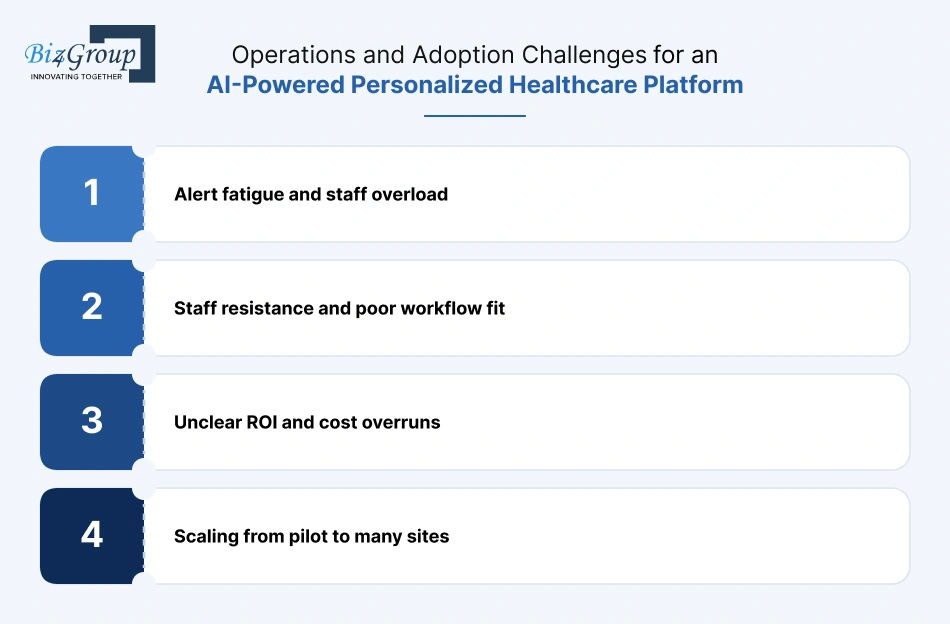
An AI personalized patient experience platform for hospitals succeeds or fails on whether staff use it.
|
Challenge |
Why it happens |
How to solve it |
|---|---|---|
|
Alert fatigue and staff overload |
Every flag becomes a task, so the queue grows faster than staff can clear it |
Rank alerts by risk, set per-patient thresholds and send daily digests for low-risk items |
|
Staff resistance and poor workflow fit |
New tools add steps instead of removing them |
Involve clinicians in design, embed the tool in the EHR where possible and measure time saved |
|
Unclear ROI and cost overruns |
Teams skip baselines and build every feature at once |
Record baselines first, start with the pilot subset and review outcomes against cost each quarter |
|
Scaling from pilot to many sites |
Sites differ in EHR setup, languages and consent practices |
Use shared services with site-level settings, one governance model and a unit-by-unit rollout |
Most of these challenges trace back to three early decisions: how clean your data is, how fairly your models perform, and how easily a patient can reach a person. Teams that settle them before launch spend less on rework, and their AI personalized patient experience platform earns patient and staff trust faster. Getting all three right takes real healthcare delivery experience, so the partner you build with matters as much as the model itself. In the next section, we look at what that partner should bring and how Biz4Group approaches AI healthcare personalization development.
Why Choose Biz4Group for AI Healthcare Personalization Development?
Biz4Group is a US-based AI development company in Orlando, Florida, with 20+ years of delivery experience and 100+ healthcare AI projects. For AI healthcare personalization development, here is what you get.
1. Biz4Group Credentials in AI Healthcare Personalization
|
Credential |
Detail |
|---|---|
|
Experience |
20+ years in software, 100+ healthcare AI projects |
|
Client ratings |
4.9/5 on Clutch, 4.8/5 on Upwork across 120+ reviews, and 5/5 overall across 250+ reviews |
|
Recognition |
Listed on Clutch and GoodFirms among top AI, chatbot and generative AI companies |
|
Healthcare scope |
AI triage, remote monitoring, EHR integration, billing and charting inside HIPAA-compliant frameworks |
|
Enterprise clients |
Google, Adobe, Citibank, Verizon, NOV and Holtec, as listed on our site |
|
Standards |
HL7, FHIR, SMART on FHIR, X12 and DICOM |
|
Compliance approach |
HIPAA controls, encryption, access rules and audit trails specified before development |
|
Headquarters |
7380 W Sand Lake Rd, Orlando, FL 32819 |
2. Why Choose Us for AI Personalized Patient Experience Platform Development
- One team, start to finish: consulting, MVP, integration, launch and ongoing support.
- Works with your stack: we connect to your EHR, scheduling and messaging tools instead of replacing them.
- People stay in the loop: every automated flow has an escalation path to staff, as in the builds above.
- Clear boundaries: we build and integrate the platform, and your compliance counsel and clinicians approve the legal and clinical content.
- Scoped to your size: a pilot, a single product stage, team augmentation or a full build.
Tell us your use case and your current baseline, and we will scope a pilot you can measure. Book a strategy session.
A proven partner shortens the path from pilot to results, but the field keeps moving. Next, we look at where AI personalization in healthcare is headed and what to do first.
Done reading and ready to build?
Bring one use case and one number. We will bring a first-phase plan.
Start the ConversationWhere Is AI Personalization in Healthcare Headed, and What Should You Do Next?
AI personalization in healthcare is becoming everyday infrastructure. The AMA's 2026 Physician Survey (March 2026) found that 81% of physicians use AI, up from 38% in 2023, and the evidence in this guide points the same way: targeted, bilingual outreach with a clear path to a person works, while generic automation does not. Expect agentic assistants, stricter AI disclosure rules and firmer accessibility and security deadlines through 2027.
Here is what to do next:
- Pick one use case and record its baseline.
- Map the rules for a HIPAA compliant AI personalized patient experience platform and sign BAAs before PHI moves.
- Scope an MVP pilot with a control group and a go or no-go gate.
- Plan escalation to staff and model monitoring from day one.
That sequence is the practical answer to how to build an AI personalized patient experience platform that earns trust and shows results. Biz4Group has delivered 1,000+ projects across industries with 300+ consultants, architects and AI specialists, the depth a multi-site AI personalized patient experience platform needs. Share your use case and we will outline a first-phase plan.
FAQ
1. What is AI personalization in healthcare?
AI personalization in healthcare uses patient data and machine learning to tailor what each patient receives, when, through which channel, in which language and with what next step. It differs from personalized medicine, which tailors treatment to genomic or biomarker data. It also differs from patient engagement: personalization is what the system sends, and engagement is how well the patient responds.
2. How does AI personalize the patient experience and the patient journey?
AI scores each patient's risk, picks the next best action, and adapts channel, timing, tone and language. It also powers assistants with human escalation, remote monitoring alerts and tailored education. Across the patient journey, that covers access, intake, reminders, medication adherence, discharge follow-up and chronic care.
3. Does AI healthcare personalization actually improve outcomes?
Yes, when it is targeted, and not when it is generic. Limbic Access raised NHS self-referrals by 15% versus 6% in controls (Nature Medicine, 2024), and MetroHealth's risk-based reminders brought no-shows to 33% versus 36% in the control group (JGIM, 2023). By contrast, a 2025 JAMA trial found generic nudge texts did not improve refill adherence at 12 months.
4. Is AI personalization in healthcare HIPAA compliant?
It can be, but no AI tool is compliant by default and no agency certifies HIPAA compliance. A HIPAA compliant AI personalized patient experience platform needs BAAs with every vendor that touches PHI, plus encryption, access controls and audit logs. At Biz4Group, we specify those controls before development starts, and we advise keeping consumer versions of tools like ChatGPT, which typically have no BAA, out of the PHI path.
5. How much does AI personalized patient experience platform development cost?
It typically costs $30,000 to $250,000, depending on use cases, EHR integrations, AI depth and compliance scope. A focused pilot starts near $33,500, and a full core platform runs to about $250,000. Biz4Group scopes each build by use case, so you can start a pilot at the low end before committing to the full platform. Plan for ongoing costs too: maintenance runs 15% to 25% of the build per year, plus hosting, messaging and model retraining. Your final number will differ with your scope.
6. How long does it take to build an AI personalized patient experience platform?
At Biz4Group, a focused MVP on one use case can take 2 to 4 weeks, and most of our projects go live in 6 to 10 weeks. Larger multi-site platforms with several EHR integrations take a few months. Start with one use case, such as risk-based reminders, record its baseline, and pilot on one unit with a control group before you scale.
7. What are the risks of AI-powered personalization in healthcare, and how do you reduce them?
The main risks are biased models, invented answers from generative AI, privacy exposure, model drift and lost patient trust. Reduce them with subgroup validation, answers limited to approved content, BAAs and minimum necessary data, scheduled monitoring and retraining, and clear AI disclosure with a path to a person.