Location :
Orlando, FL, USA
Location :
Orlando, FL, USA +1 (407) 714-1616
 info@biz4group.com

 AI Summary Powered by Biz4AI
- An AI-powered patient management system automates booking, intake, documentation, and follow-up on top of your EHR, and AI patient management system development is accelerating because most physicians already use AI, with privacy and trust as the main barrier.
- Start with the one workflow that costs your team the most hours, such as scheduling, triage, ambient documentation, or claims, and ship the core modules plus one AI capability, with a clinician reviewing every clinical output.
- A five-layer architecture connects to Epic, Oracle Health, and athenahealth through FHIR, and a HIPAA-compliant AI patient management system needs signed BAAs, a written risk analysis, audit logs, and an FDA check on triage and risk features.
- The cost to build an AI patient management system ranges from $35,000 to $250,000 across eight build steps from workflow mapping to pilot, with an MVP in 2 to 4 weeks and an enterprise build in 6 to 8 weeks.
- The main risks are messy data, EHR delays, low clinician adoption, and model drift, so choose an AI patient management system development company with verifiable healthcare builds and pick custom AI patient management system development only when your workflows are unique, as with the 20+ years and 1,000+ projects behind Biz4Group.
Four in five physicians already use AI at work. The system your front desk logs into every morning, in most cases, does not.
That gap is where your next project lives. If you are a founder, CTO, or tech manager in healthcare, you have likely asked one thing: is AI patient management system development worth it, or will your staff quietly work around it?
Let's start with what the data says.
The AMA's 2026 Physician Survey on Augmented Intelligence found that more than 80% of physicians now use AI professionally. And 76% say AI gives them an advantage in caring for patients, up from 65% in 2023.
Demand is not the problem. Trust is.
In that same report, 86% of physicians said data privacy assurances matter before they adopt an AI tool. Fierce Healthcare's coverage of the survey adds that privacy is the only area where more physicians expect AI to cause harm than good (41% versus 13%).
So, the question is not whether you should build AI patient management system capabilities. It is how you build one your physicians will actually trust and use.
Does any of this sound familiar?
Your front desk is buried in calls and re-keyed forms. Your physicians finish notes at 9 p.m. Your patients sit on hold just to book a follow-up. Then a vendor demo looks great, and you wonder how much of it will survive your real workflows.
We see this pattern across the healthcare teams we work with. A well-built AI-powered patient management system takes repetitive work off all three groups.
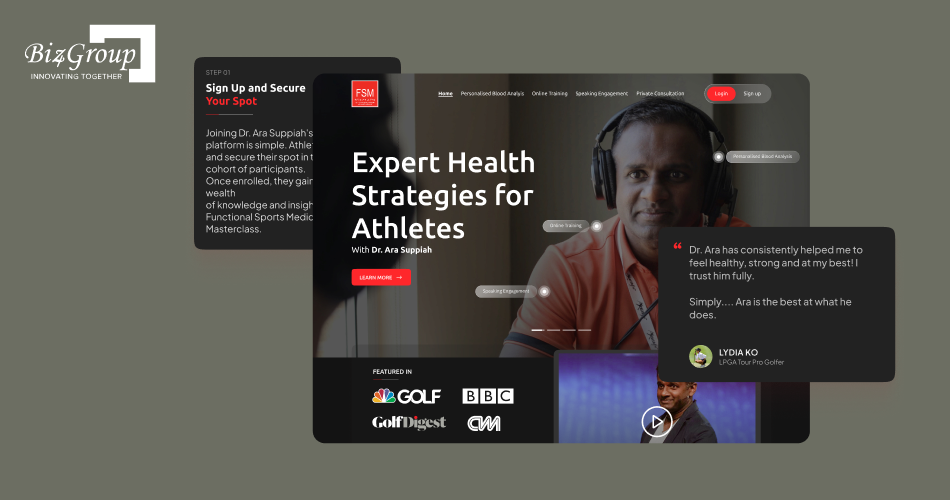
Our team has built this kind of workflow before. After 20+ years and 1,000+ projects, one example that maps closely to this topic is Dr. Ara, an AI health platform with separate admin and patient portals, appointment scheduling, and blood test analysis. Those are the same building blocks you need here, and it shapes how we approach AI patient management system development: workflows first, then features.
In this guide, we will show you how to build an AI patient management system that fits your workflows, holds up under a HIPAA review, and stays inside budget. We will also answer the two questions leaders ask most: how much does it cost to build an AI patient management system in 2026, and when does custom AI patient management system development beat off-the-shelf software?
Whether you are planning an AI patient management platform for healthcare providers or an AI app for patient management for a single department, the same rule applies. Start with one workflow, prove it, then expand.
Most AI patient management software development projects succeed or stall on adoption, not on the model. So, before you commit budget, it helps to run through the questions to ask before AI adoption in healthcare with your clinical and IT leads. Your scope stays tied to the bottlenecks you actually have.
What Is an AI-Powered Patient Management System, and Why Is Demand Rising So Fast in 2026?
An AI-powered patient management system is software that runs the patient journey, from booking and intake to documentation and follow-up. It uses machine learning and language models to automate routine tasks and flag risks early. It also connects to your EHR, so scheduling, records, and communication work from one workflow.
How Is an AI Patient Management System Different From an EHR, Practice Management Tool, or Patient Portal?
|
Tool |
Main job |
Where it falls short alone |
|---|---|---|
|
EHR |
Stores the clinical record |
Passive. It records what happened but does not manage what happens next. |
|
Practice management software |
Handles billing, claims, and basic scheduling |
Rule-based. It cannot predict no-shows or read free-text messages. |
|
Patient portal |
Gives patients access to records and messaging |
Patient-initiated. Staff still answer most messages by hand. |
|
AI patient management system |
Coordinates access, intake, flow, documentation, and follow-up |
Needs clean data and EHR integration to perform well. |
It adds a layer on top of your EHR. It does not replace it.
What Does an AI Patient Information Management System Include?
AI patient information management system development usually covers five capabilities:
- Scheduling and reminders that predict no-shows
- Digital intake and insurance checks
- Queue and capacity management
- Note drafting and chart summaries
- Follow-up messaging and care-gap alerts
Why Is Demand for AI Patient Management Systems Rising in 2026?
Physicians, health systems, and budgets are all moving the same way. Here are the five signals behind it:
|
Demand signal |
2026 data |
What it means for your build |
|---|---|---|
|
Physician use |
Physicians in the AMA's 2026 survey now use 2.3 AI use cases on average, more than double the 2023 average. |
Clinicians expect AI across several workflows, not one. |
|
Administrative relief |
73% of physicians in that survey expect AI to reduce administrative work, and 70% expect it to take on clinical tasks. |
Start with admin tasks. They are the easiest to trust and the quickest to adopt. |
|
Health system adoption |
Of 120 surveyed health systems, 75% use at least one AI application, and 36% use AI to draft replies to patient messages. |
Your peers are already moving, and patient communication is a leading use. |
|
Missed appointments |
Children's Specialized Hospital cut no-shows by 8.5% within three months of deploying a no-show predictor. |
Scheduling often delivers the fastest payback. |
|
Market growth |
The AI in patient management market is projected to grow from $2.35 billion in 2026 to $18.40 billion by 2034. |
More vendors are entering, so a clear build-or-buy decision matters. |
So, the definition is simple, and the demand is real. The harder question is where your first investment should go, and that depends on your setting. A hospital's best starting point is rarely a clinic's.
Next, we'll look at where AI patient management system development pays off first, for hospitals, clinics, and digital health teams.
Not sure which workflow to automate first?
Most teams lose the most hours in one or two places. Tell us where yours are, and we will map the first AI use case worth building.
Map My First Use CaseWhere Does AI Patient Management System Development Create the Most Value for Hospitals and Clinics?
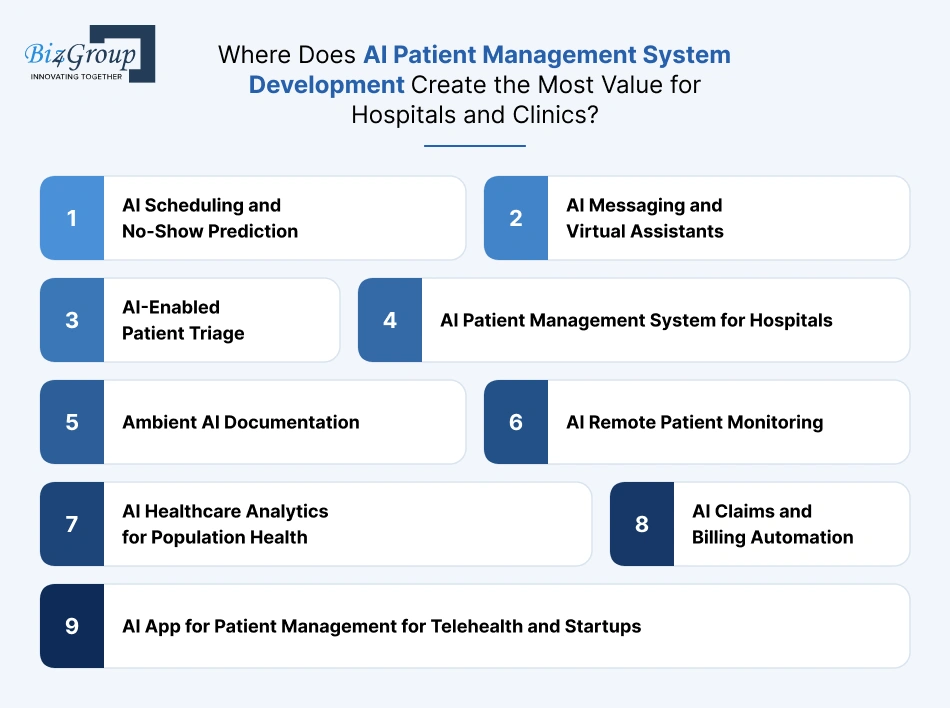
An AI patient management platform for healthcare providers creates the most value where work is repetitive, time-sensitive, and data-heavy. That means scheduling, messaging, triage, hospital patient flow, documentation, monitoring, population health, billing, and patient-facing apps. Start AI patient management system development with the use case that costs your team the most hours.
1. AI Scheduling and No-Show Prediction
AI scheduling predicts which patients are likely to miss a visit. It offers cancelled slots to the next eligible patient by text and tunes reminders to each patient's response pattern. Front-desk work like this carries the least clinical risk, so it is where AI helps you automate your healthcare center fastest.
Example
A 2026 multisite study surveyed 127 U.S. health systems, and 90 of them used automated waitlists. Appointments booked through the waitlist were missed 3.1% of the time, against 6.6% for all appointments. The study found waitlists work best when built into the wider scheduling system. (Journal of Medical Internet Research, 2026)
2. AI Messaging and Virtual Assistants
AI assistants answer routine questions, take booking requests, and draft replies to portal messages. Staff review every draft and handle anything clinical. An AI automation system for clinics often starts here because message volume is easy to measure.
Example
Support teams at healthcare third-party administrators face rising call volumes, and most calls ask the same few questions. Biz4Group built an AI-driven IVR platform for this problem. It answers eligibility, claim-status, and benefits calls in English and Spanish inside a HIPAA-compliant environment. When it cannot resolve a call, it passes it to a person with a summary of the conversation.
3. AI-Enabled Patient Triage
AI-enabled patient triage asks structured questions at intake and scores how urgently a patient needs care. It routes patients to the right queue and flags red-flag symptoms for a nurse right away. Clinicians keep the final call, and every recommendation stays logged for audit.
Example
A study in the Western Journal of Emergency Medicine (February 2026) randomly assigned 18,000 adult patients to three triage methods at a high-volume Istanbul emergency department. Average wait to first physician evaluation was 14.95 minutes with AI-supported triage, against 25.06 minutes with ESI and 34.94 minutes with the Manchester system. Complication rates were 4.42% with AI triage and 10.25% with Manchester. The author cautions that this was a single center over a short period, so causation is not proven.
4. AI Patient Management System for Hospitals
An AI patient management system for hospitals predicts which inpatients are ready for discharge and where beds will open. Teams plan discharges earlier and move waiting emergency patients upstairs sooner. It works best as part of a wider AI hospital management system that also covers staffing and transfers.
Example
Baptist Health in Arkansas used predictive discharge analytics with LeanTaaS to cut ER boarding by about 525 patients a month. More discharge orders now arrive before 9 a.m., so most patients leave by 11 a.m. The rollout started at a couple of hospitals and grew with staff input.
5. Ambient AI Documentation
Ambient AI medical scribe listens to the visit and drafts the note for the clinician to review and sign. It can also summarize prior charts before the next appointment. The time saved depends heavily on how often clinicians actually use it.
Example
A 2026 multisite study in JAMA, led by Mass General Brigham, found that clinicians who used AI scribes in more than half of their visits had twice the drop in total EHR time and three times the drop in documentation time. Only 32% of users reached that level of use. The takeaway: design for daily habit, not just licenses. (Mass General Brigham, April 2026)
6. AI Remote Patient Monitoring
AI reads data from wearables and home devices and flags patients whose readings trend the wrong way. Care teams then call or adjust treatment before a problem becomes an admission. It fits chronic conditions and post-discharge care best, and our guide on AI remote patient monitoring covers the build in detail.
Example
A large, randomized trial from the University of Pittsburgh and UPMC Health Plan tested four remote monitoring models after sepsis or serious respiratory infection. None significantly reduced readmissions compared with standard post-discharge care. Younger patients appeared to benefit, while older patients had higher readmission rates. The lesson: pair monitoring with care coordination and careful patient selection. (Healthcare IT News, June 2026)
7. AI Healthcare Analytics for Population Health
AI scores patients by their risk of admission or emergency use and gives care managers a ranked outreach list. It combines clinical, claims, and social-needs data in one view. AI healthcare analytics works best when its output lands directly in a care team's daily workflow.
Example
Prisma Health, a 19-hospital system in South Carolina, paired an AI population health platform with embedded care teams. Among patients in its 2024 Integrated Care Management cohort, it reported 58% fewer emergency department visits and a 66% reduction in total cost of care. These are system-reported results for an engaged cohort, not its whole patient base.
8. AI Claims and Billing Automation
AI checks eligibility, medical coding, and documentation before a claim goes out, then drafts appeals for denials that still occur. It ties billing to the same system that holds scheduling and records. Fewer reworked claims means fewer hours spent chasing payers.
Example
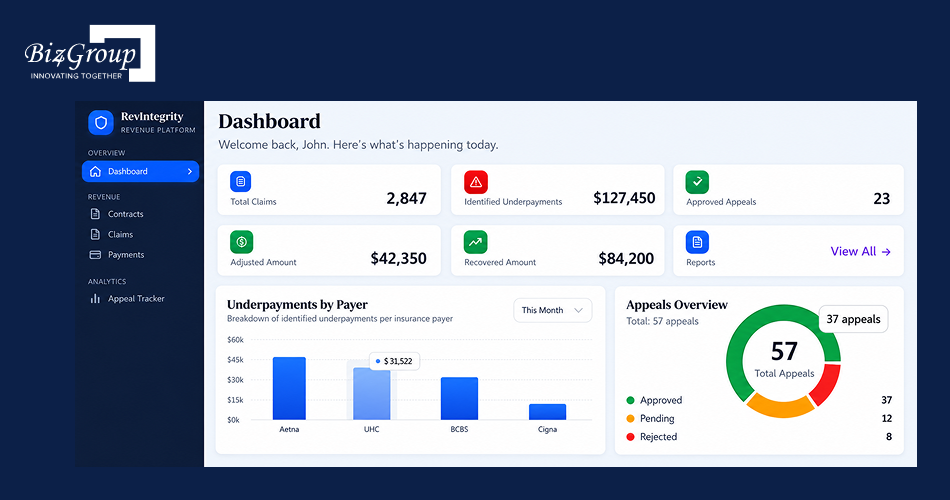
Hospital billing teams often spend hours checking claims against payer contracts to catch underpayments, then write appeals by hand. RevIntegrity, our AI revenue recovery platform, reads payer contracts and flags claims paid below contracted CPT rates. It drafts the appeal and tracks it through resolution, with an append-only audit trail kept for six years.
9. AI App for Patient Management for Telehealth and Startups
An AI app for patient management can launch with one patient-facing flow, such as symptom chat, booking, or health-record access. Starting there keeps AI patient management app development cost and compliance scope in check. You add modules once the first flow proves itself.
Example
Dr. Truman is an AI health companion we built with a lifelike avatar. It combines a generative AI chatbot, personalized health advice, and health record management in one app. It shows how a startup can launch one focused patient-facing product first and grow from there.
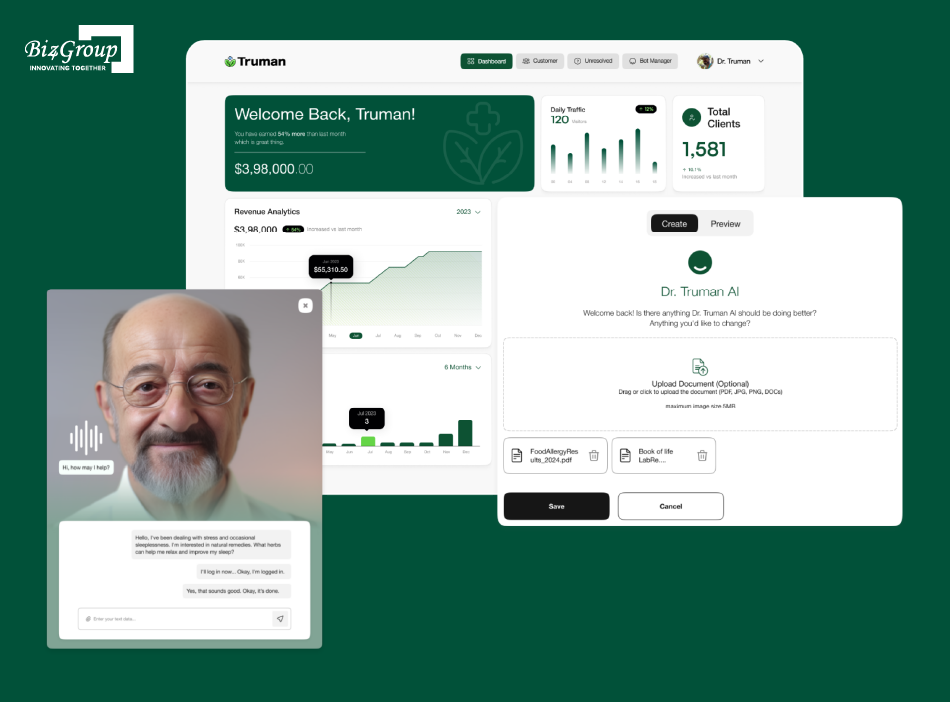
Those nine use cases follow one pattern. The teams that see results pick one workflow, keep a clinician in the loop, and measure it before expanding. When we scope a build, we rank these use cases against your own hours lost, not against a feature list.
Once you know where to start, the next question is what to build into it. Next, we'll look at which features belong in your AI patient management platform development roadmap.
Which Features Belong in an AI Patient Management Platform Development Project?
AI patient management platform development works best in three feature layers: core modules, AI capabilities, and trust controls. Core modules cover registration, scheduling, intake, portal, and billing. AI capabilities add prediction, assistants, documentation, and triage. Trust controls keep a clinician in charge. Ship the core plus one AI capability first.
Core Modules
These are the non-AI foundations. Every AI feature depends on them, so they come first.
|
Feature |
What it does |
Phase |
|---|---|---|
|
Patient registration and profiles |
Captures demographics, history, and consent in one record |
MVP |
|
Appointment scheduling |
Books, reschedules, and manages provider calendars and rooms |
MVP |
|
Digital intake and e-consent |
Collects forms, ID, and signatures before the visit |
MVP |
|
Insurance eligibility check |
Verifies coverage in real time at booking |
MVP |
|
Patient portal and mobile app |
Gives patients booking, records, messages, and payments |
MVP |
|
Secure messaging and reminders |
Sends SMS, email, and in-app notices |
MVP |
|
Reads and writes patient data through FHIR and HL7 |
MVP |
|
|
Role-based access control |
Limits each user to the data their role needs |
MVP |
|
Audit logging |
Records who viewed or changed what, and when |
MVP |
|
Admin console |
Sets rules for scheduling, routing, and permissions |
MVP |
|
Billing and payments |
Handles claims, copays, and patient statements |
Phase 2 |
|
Reporting dashboards |
Shows wait times, no-shows, and throughput by role |
Phase 2 |
|
Telehealth video visits |
Adds secure video and remote check-in |
Phase 2 |
|
Lab, pharmacy, and e-prescribing links |
Connects orders and results |
Phase 2 |
|
Multilingual support |
Serves patients in their preferred language |
Phase 2 |
The EHR link is the hardest row in this table. Most of that work sits in AI integration services: FHIR connections, data mapping, and write-back testing.
AI Capabilities
Each of these needs the core modules underneath it. Pick one for the MVP, not all of them.
|
Feature |
What it does |
Phase |
|---|---|---|
|
Smart scheduling and no-show prediction |
Scores no-show risk and fills cancelled slots from a waitlist |
MVP |
|
Answers routine questions and books visits 24/7, then hands off to staff |
MVP |
|
|
AI triage and symptom intake |
Scores urgency and routes patients to the right queue |
Phase 2 |
|
Ambient documentation and chart summaries |
Drafts notes and prior-chart summaries for clinician sign-off |
Phase 2 |
|
Patient message drafting |
Prepares replies for staff review |
Phase 2 |
|
Document extraction |
Reads faxes, referrals, and insurance cards into structured fields |
Phase 2 |
|
Claims scrubbing and denial prediction |
Flags errors before submission and drafts appeals |
Phase 2 |
|
Assembles and tracks authorization requests |
Phase 3 |
|
|
Risk stratification and care-gap alerts |
Ranks patients by risk of admission or missed care |
Phase 3 |
|
Remote monitoring alerts |
Flags device readings that trend the wrong way |
Phase 3 |
|
Capacity and discharge prediction |
Forecasts bed availability and discharge readiness |
Phase 3 |
|
Demand and staffing forecasts |
Predicts patient volume to plan shifts |
Phase 3 |
|
Clinical decision support |
Shows evidence-based suggestions with visible inputs and rationale |
Phase 3 |
Trust and Governance Controls
Physicians decide whether an AI feature gets used. In the AMA's 2026 survey, 88% said validated safety and efficacy is important for adoption, and 92% want more AI training. These controls answer both.
|
Feature |
What it does |
Phase |
|---|---|---|
|
Clinician review and approval |
Holds clinical AI output until a clinician signs off |
MVP |
|
AI output audit trail |
Logs inputs, model version, output, and reviewer for every AI action |
MVP |
|
Source and rationale display |
Shows the data behind each suggestion |
MVP |
|
PHI minimization and redaction |
Strips identifiers before data reaches any model |
MVP |
|
Guardrails and prompt-injection defenses |
Blocks unsafe inputs and out-of-scope answers |
MVP |
|
Feedback and error reporting |
Lets any user flag a wrong output in one click |
MVP |
|
Patient consent and AI disclosure |
Tells patients when AI is involved and records consent |
Phase 2 |
|
Model monitoring and drift alerts |
Tracks accuracy over time and alerts on drops |
Phase 2 |
|
Bias testing reports |
Compares results across age, language, and other groups |
Phase 2 |
|
Kill switch and manual fallback |
Turns off any AI feature and returns to the manual workflow |
Phase 2 |
|
In-app training |
Teaches staff how each AI feature works |
Phase 2 |
MVP vs Phase Two Priorities
In AI patient management software development, listing features is easy. Deciding what waits is the real work. Treat the first release as MVP development: prove one workflow inside a real clinic, then extend.
|
Phase |
Ship |
Goal |
|---|---|---|
|
MVP |
Core MVP modules, one AI capability (no-show prediction or an assistant), clinician review, AI audit trail, guardrails |
Prove one workflow in one clinic |
|
Phase 2 |
Billing, dashboards, telehealth, triage, ambient notes, claims scrubbing, monitoring and bias reports |
Extend to more teams and sites |
|
Phase 3 |
Prior authorization, risk stratification, monitoring alerts, capacity forecasts, decision support |
Scale across the network |
Most feature lists should shrink before the first sprint. We would rather you ship six rows well than twenty rows halfway, because every row you skip is one less integration, one less review step, and one less thing to validate.
Next, we'll look at the architecture that holds these three layers together.
What Does the Architecture of a Custom AI Patient Management System Look Like?
Custom AI patient management system development builds five layers around one security layer. The experience layer serves staff and patients, the workflow layer runs scheduling and intake, the AI layer runs models behind review, the integration layer connects to your EHR, and the data layer stores everything. Design integration and security first, because every AI feature depends on them.
Five-Layer Architecture
|
Layer |
Job |
Typical components |
Design rule |
|---|---|---|---|
|
Experience |
Serves staff, patients, and callers |
Staff web app, patient portal, mobile app, chat and voice channels, admin console |
One role-aware interface, with no separate AI screen |
|
Workflow |
Runs scheduling, intake, billing, and routing |
Rules engine, appointment and intake services, notification service, message queue |
Keep business rules outside the model |
|
AI |
Predicts, drafts, and answers |
Orchestrator, retrieval over approved records, prediction models, speech-to-text, guardrails, clinician review queue |
Nothing AI-written reaches the chart without review |
|
Integration |
Connects to the EHR, labs, payers, and devices |
FHIR and HL7 gateway, EHR connectors, SMART on FHIR launch |
Read and write through standard APIs only |
|
Data |
Stores records, documents, and logs |
Operational database, document storage, per-tenant search index, de-identified analytics store |
Keep PHI stores apart from model logs and analytics |
|
Security (all layers) |
Protects and records everything |
Identity and SSO, role-based access, encryption with managed keys, append-only audit log, monitoring |
Log every AI input, output, and reviewer |
Each layer can change without breaking the others. Swap a model, and nothing else moves.
Model Hosting Options
You have three ways to host the models. The choice drives cost, compliance scope, and speed.
|
Option |
How it works |
Best for |
Watch for |
|---|---|---|---|
|
Hosted model under a BAA |
Call a cloud model through a covered enterprise or API tier |
Fastest start and the strongest general models |
Zero-retention settings, region, and per-model eligibility |
|
Private hosting |
Run open-weight models inside your own cloud or data center |
Strict data residency, high volume, narrow tasks |
GPU cost, updates, and your own evaluation work |
|
Hybrid routing |
Send sensitive extraction to private models and drafting to hosted ones |
Mixed workloads |
Routing rules and two sets of monitoring |
As of 2026, major model providers including OpenAI, Anthropic, Google, and Microsoft will sign a BAA for their enterprise or API products, but not for free consumer chatbots. A signed BAA does not make a system compliant, and not every model on a cloud platform is HIPAA-eligible. Verify each model and its retention settings before any PHI reaches it.
EHR Integration Paths
Your integration layer has to speak to more than one EHR. KLAS's 2026 acute care report shows Epic with 43.7% of hospitals and 56.9% of beds, Oracle Health with 21.9% and 20.4%, and MEDITECH with 14.7% and 12.5%.
|
EHR |
U.S. acute care share (hospitals / beds) |
Integration route |
Plan for |
|---|---|---|---|
|
Epic |
43.7% / 56.9% |
FHIR R4 and SMART on FHIR. Enroll in the Showroom (formerly App Orchard), test in sandboxes, then deploy site by site. |
Site-by-site activation and security review |
|
Oracle Health |
21.9% / 20.4% |
Developer Program with FHIR APIs, plus Oracle Validated Integration through Oracle PartnerNetwork |
Each customer provisions your app to its own tenant |
|
MEDITECH |
14.7% / 12.5% |
FHIR APIs on Expanse, with a developer sandbox for testing |
Confirm API availability per site |
|
athenahealth (ambulatory) |
Not in the acute care report |
ONC-certified FHIR R4 plus a larger proprietary REST API |
Marketplace Partner Program review and approval before live credentials |
A working FHIR prototype and a live production connection are often months apart, because each vendor adds its own program, security review, and per-customer authorization. Start the vendor program while you build, not after.
Data and Security Design Rules
- Scope retrieval by role and tenant: The assistant should see only what the signed-in user may see.
- Redact before prompting: Strip names, IDs, and contact details before text reaches a model whenever the task allows.
- Keep logs inside the BAA boundary: Prompt logs, tracing tools, and error monitoring can quietly capture PHI.
- Encrypt and separate stores: Use managed keys at rest and in transit, and keep model logs apart from the clinical record.
- Retain audit logs for six years: It is the conservative default hospitals expect.
Design Lesson: Latency Budgets by Channel
Chat tolerates a short pause. A phone call does not. On a healthcare voice assistant we built, upgrading to a more natural voice added delay to every reply. We fixed it by moving speech recognition, synthesis, and audio streaming onto a real-time relay service. Set a latency budget for each channel before you pick models.
Get the integration and security layers right, and every AI feature on top becomes a smaller, safer decision. Skip them, and each feature carries its own risk.
Those layers also decide which rules apply to you. Next, we'll look at the compliance, security, and regulatory requirements that shape AI patient management system development.
Which Compliance, Security, and Regulatory Rules Shape AI Patient Management System Development?
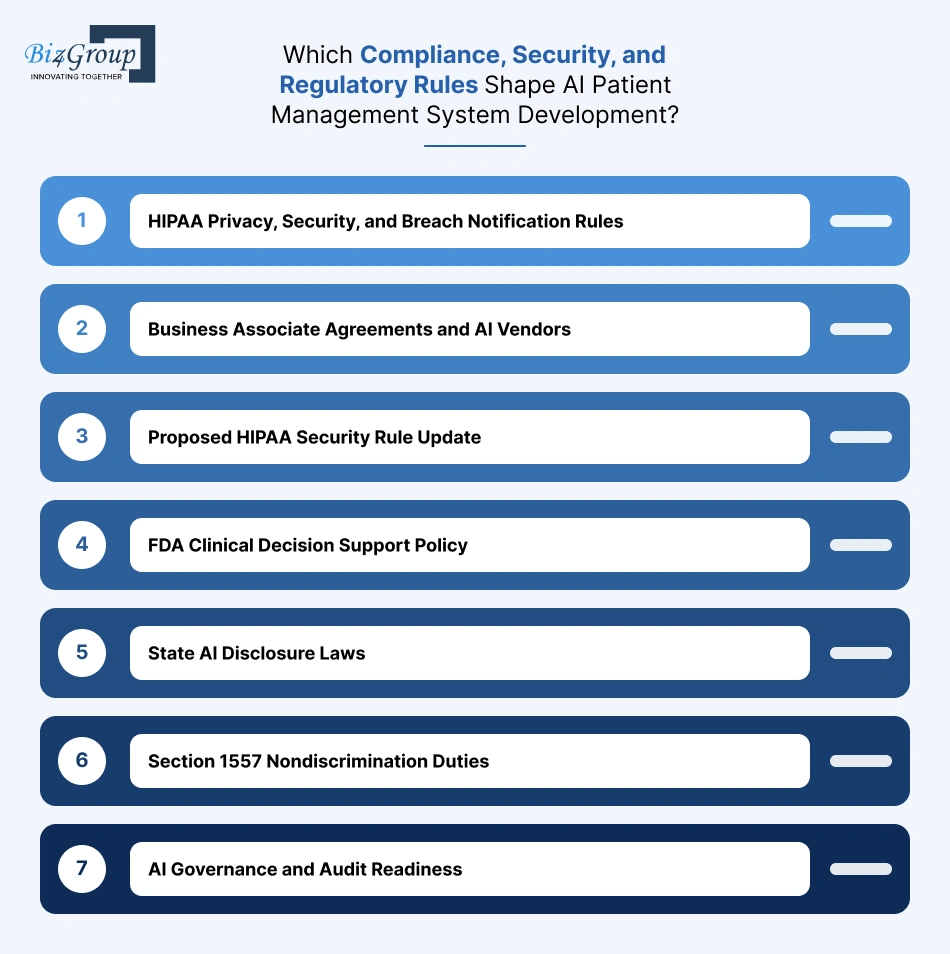
AI patient management system development in the U.S. is shaped by five rule sets: HIPAA today, the proposed Security Rule update, FDA decision support policy, state AI laws, and Section 1557. An AI governance program ties them together. HIPAA is the law now, and the rest decide how you design review, disclosure, and bias testing.
1. HIPAA Privacy, Security, and Breach Notification Rules
HIPAA applies the moment your system creates, stores, or sends PHI for a covered entity. The Privacy Rule limits how PHI is used and shared, the Security Rule requires safeguards and a documented risk analysis, and the Breach Notification Rule sets reporting duties. Add every AI feature and data path to that risk analysis before launch.
2. Business Associate Agreements and AI Vendors
Any vendor that handles PHI on your behalf, including a model provider, needs a signed BAA. A BAA covers only the products and settings it names, so confirm model eligibility and zero-retention terms in writing. Your contracts should also bar vendors from training their models on your PHI.
3. Proposed HIPAA Security Rule Update
HHS published the proposed Security Rule overhaul on January 6, 2025, and OCR has not issued a final rule. The 2026 federal regulatory agenda now lists July 2027 for final action. The current rule stays in force and OCR keeps enforcing it, so build now to the proposal's direction: required encryption, multi-factor authentication, asset inventories, vulnerability scanning, and penetration testing.
4. FDA Clinical Decision Support Policy
FDA issued revised decision support guidance on January 6, 2026, replacing its 2022 version. Software stays outside device regulation only if it meets four criteria, including that a clinician can independently review the basis for each recommendation and is not meant to rely on it alone. Administrative features usually sit outside this test, but triage, risk scoring, and diagnostic suggestions need a classification review, and the guidance is silent on AI and patient-facing tools.
4. State AI Disclosure Laws
Texas requires providers to disclose to patients when AI is used in diagnosis or treatment, under a law effective January 1, 2026. California's AB 3030 requires an AI disclaimer and instructions for reaching a human on generative AI clinical messages. Colorado replaced its broad 2024 AI act with a disclosure-based law in 2026, so confirm current scope and dates for every state you serve.
5. Section 1557 Nondiscrimination Duties
Section 1557 covers patient care decision support tools, including AI that uses inputs such as race, sex, age, or disability. Covered entities must make reasonable efforts to identify those tools and reduce discrimination risk. The compliance date was May 1, 2025, though HHS's future enforcement intentions are less clear after policy and staffing changes. Keep bias testing and mitigation records either way.
6. AI Governance and Audit Readiness
No single law covers every AI risk, so you need a program that does. AI governance in healthcare comes down to a named owner, an inventory of every AI feature and its data paths, review and escalation rules, and incident handling. Many teams automate evidence collection and policy checks with a dedicated AI compliance platform. In the AMA's 2026 survey, physicians ranked clear liability frameworks as the regulatory action that would most increase their trust, so record who is accountable for each AI output.
Any AI healthcare patient management platform development project should have this owner in place before the first sprint.
Compliance Checklist for Your Build
|
Rule |
Status (October 2026) |
What it means for your build |
|---|---|---|
|
HIPAA Privacy, Security, Breach Rules |
In force |
Risk analysis covering every AI data path, minimum necessary access, breach response plan |
|
BAAs with AI vendors |
In force (contract) |
Signed BAA, zero-retention setting, per-model eligibility check, no training on your PHI |
|
Proposed HIPAA Security Rule |
Proposed, final action targeted July 2027 |
Build encryption, MFA, asset inventory, vulnerability scanning, and penetration testing now |
|
FDA decision support guidance |
Revised January 6, 2026 |
Classify each decision support feature, show the basis for recommendations, keep a clinician in the loop |
|
ONC HTI-1 predictive decision support |
In effect for certified health IT since January 1, 2025 |
If you ship certified modules, expect transparency duties. EHR partners may ask for the same details. |
|
State AI disclosure laws |
Varies by state. Texas since January 1, 2026, California AB 3030 since January 1, 2025. |
Build disclosure text, consent capture, and a path to a human |
|
Section 1557 decision support duties |
In effect, compliance date May 1, 2025 |
Inventory tools that use protected inputs, test for bias, keep mitigation records |
|
FTC Health Breach Notification Rule |
Applies to health apps outside HIPAA |
If you are not a covered entity or business associate, notification duties may apply instead |
This section is general information, not legal advice. Confirm requirements for your states and products with counsel.
HIPAA is the law you must meet today, and the other rules decide how much evidence you keep. Teams that document reviews, disclosures, and bias tests as they build avoid a rewrite at audit time.
With the rules mapped, the next step is turning them into a build plan. Now, we'll walk through how to build a HIPAA-compliant AI patient management system, step by step.
How to Build a HIPAA-Compliant AI Patient Management System, Step by Step
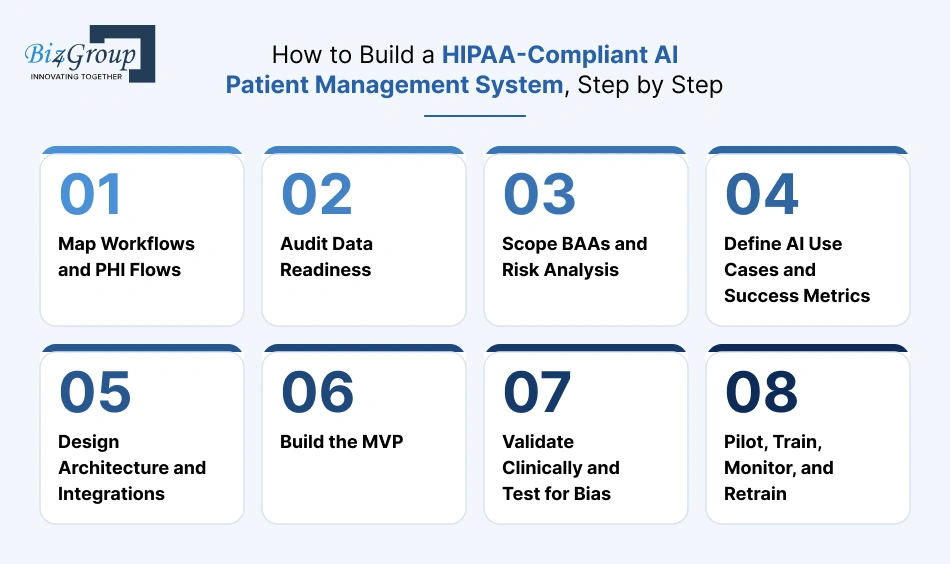
If you are working out how to build an AI patient management system that passes a HIPAA review, follow eight steps. Map workflows and PHI, audit your data, sign BAAs and run a risk analysis, define use cases, design the architecture, build an MVP, validate clinically, then pilot and monitor. Do the compliance work first, so rework stays small.
Step 1: Map Workflows and PHI Flows
Start with how work actually moves through your front desk, clinic, or wards. Mark every point where PHI is created, viewed, or sent. This map becomes the base for your risk analysis and your AI use cases.
- Shadow staff in each role, not just managers
- List every system and data store that touches PHI
- Time each task to find the costliest one
- Deliverable: a workflow and PHI data-flow diagram
Step 2: Audit Data Readiness
AI is only as good as the data behind it. Check quality, formats, and access in your EHR, scheduling, and billing systems. AI patient information management system development depends on clean intake and record data, so decide what is usable now and what needs cleanup first.
- Check completeness of key fields such as appointments, outcomes, and codes
- Find unstructured sources, including notes, faxes, and PDFs
- Confirm FHIR or HL7 access for each source system
- From our builds: payer contracts on RevIntegrity arrived as PDF, DOC, and DOCX files with different layouts, so we built extraction that does not depend on one template
- Deliverable: a data readiness report with gaps ranked by effort
Step 3: Scope BAAs and Risk Analysis
Sign a BAA with every vendor that touches PHI before any data moves, including your cloud and model providers. Then run a written HIPAA risk analysis that lists each AI feature, its data, and its threats. A HIPAA-compliant AI healthcare app development company can run this analysis with you, but your compliance lead should own the sign-off.
- Confirm each model endpoint is covered by the BAA, with zero retention
- Classify data per feature as PHI, de-identified, or non-PHI
- Add AI-specific risks such as prompt injection and wrong outputs
- Deliverable: signed BAAs and a written risk analysis
Any AI patient management system development project that skips this step pays for it later in audits.
Step 4: Define AI Use Cases and Success Metrics
Pick one or two use cases from your workflow map. Write the metric you will move, such as no-show rate, call abandonment, or note time, and record today's baseline. Repetitive front-desk and back-office workflows are the safest starting points and AI automation services typically begin there.
- Choose one workflow with a clear owner
- Record a baseline over a few weeks before launch
- Set a human review rule for every AI output
- Set a stop rule, such as an accuracy or safety threshold that pauses the feature
- Deliverable: a use case brief with metric, baseline, and review rule
Clear metrics also keep AI patient management software development scoped to what you can prove.
Step 5: Design Architecture and Integrations
Use the five-layer design from the architecture section. Choose your model hosting path and your EHR integration route before writing code, and start the EHR vendor program early. Then lock a tech stack in which every service is covered by a BAA.
- Confirm the vendor program and security review for each EHR
- Pick model hosting: hosted under a BAA, private, or hybrid
- Use only HIPAA-eligible cloud services
- Deliverable: an architecture diagram and a stack decision record
Strong AI patient management platform development keeps each layer replaceable, so a new model or EHR does not force a rebuild.
|
Layer |
Recommended options |
Why it fits |
Compliance note |
|---|---|---|---|
|
Frontend |
React or Next.js |
Reusable components for the staff app and patient portal |
Keep PHI out of client-side logs and analytics tags |
|
Backend and APIs |
Node.js or Python (FastAPI) |
Node for real-time services, Python for AI and data work |
Validate every input, rate limit, and log access |
|
Database |
PostgreSQL |
Relational integrity, row-level security, JSON support |
Encrypt at rest and isolate tenants |
|
File storage |
Encrypted object storage with managed keys |
Holds scans, PDFs, and intake documents |
Virus scan uploads, version files, restrict by role |
|
Interoperability |
FHIR R4, SMART on FHIR, HL7 v2 gateway |
Standard EHR connectivity |
Least-privilege scopes and per-site credentials |
|
Cloud |
AWS, Azure, or Google Cloud (HIPAA-eligible services only) |
Scalable infrastructure under a BAA |
Use only services the BAA covers |
|
AI models |
Hosted model under a BAA, or private open-weight models |
Matches the hosting options above |
Zero retention and per-model eligibility check |
|
Retrieval |
pgvector or a managed vector store inside the BAA boundary |
Search over approved records |
Filter by tenant and role on every query |
|
Identity and access |
SSO with OAuth 2.0 and OIDC, phishing-resistant MFA, role-based access |
One sign-in with least-privilege roles |
MFA matches the proposed Security Rule direction |
|
Encryption and keys |
TLS 1.2+ in transit, AES-256 at rest, managed key service, bcrypt or Argon2 for passwords |
Standard, auditable controls |
Rotate keys and store them apart from data |
|
Monitoring and audit |
Application monitoring with PHI scrubbing, append-only audit log |
Catches drift, errors, and misuse |
Retain audit logs for six years |
|
DevOps |
CI/CD, infrastructure as code, containerized services |
Repeatable, reviewable environments |
No real PHI in dev or test |
We follow this pattern in our own builds. Our RevIntegrity platform runs on React, Node.js and Python, PostgreSQL, encrypted object storage, and HIPAA-eligible AWS services. It is secured with TLS 1.2+, strong password hashing, and role-based access.
Step 6: Build the MVP
Ship the core modules plus one AI capability, and nothing more. Build security in from day one: access control, audit logging, encryption, and clinician review. Leaders often ask how to create AI patient management system features that clinicians trust, and the answer is to start small and keep a human in the loop.
- Build core modules first, then add the AI capability behind a feature flag
- Build the review queue and audit trail before AI output reaches any user
- Develop and test with synthetic or de-identified data
- From our builds: on RevIntegrity, six-year audit retention is enforced automatically, so the log stays complete without manual work
- Deliverable: a working MVP in a staging environment
This is where you create AI patient management system capabilities that survive a real clinic. A focused first release is also the best way to build AI patient management system features without overspending.
Step 7: Validate Clinically and Test for Bias
Have clinicians test the system on real scenarios before any patient sees it. Measure accuracy, safety, and fairness across age, language, and other groups, and log every error. Fix and retest until the system meets the stop rule you set in step 4.
- Run scenario tests with clinicians from each role
- Test red-flag inputs, wrong outputs, and prompt injection
- Compare results across patient groups
- Confirm the FDA decision support classification for triage and risk features
- Deliverable: a validation report signed by a clinical lead
Step 8: Pilot, Train, Monitor, and Retrain
Launch with one team or site first. Train staff inside their daily workflow, because physicians in the AMA's 2026 survey asked to be consulted on adoption and preferred training embedded in their existing tools. Then watch accuracy, drift, and user feedback, and retrain on a schedule.
- Set a fixed pilot window with a go/no-go review
- Train in a live sandbox or inside the real workflow
- Review overrides, errors, and complaints every week
- Schedule retraining and revalidation, not just launch
- Deliverable: a pilot report and a go/no-go decision
These eight steps work because each one produces something your compliance lead, clinicians, and engineers can review. Skip a deliverable, and the problem shows up later at higher cost. If you want help turning them into a plan for your organization, talk to our healthcare AI team.
Once the steps are clear, the next question is budget. Next, we'll answer how much does it cost to build an AI patient management system, with ranges by scope and phase.
How Much Does It Cost to Build an AI Patient Management System?
The cost to build an AI patient management system typically ranges from $35,000 to $250,000. Your number will differ based on scope, EHR integrations, AI complexity, and compliance needs. A focused MVP sits at the low end, and a multi-site enterprise platform sits at the high end.
AI Patient Management System Development Cost by Scope
Each tier is the sum of the rows tagged to it in the feature tables below. Tiers stack, so Advanced includes every MVP row and Enterprise includes every Advanced row.
|
Scope |
Rows included |
Total cost |
|---|---|---|
|
MVP |
The 10 rows tagged (MVP), including one AI capability and one EHR connection. For example, an AI app for patient management for one clinic. |
$35,000 to $60,000 |
|
Advanced |
MVP rows plus the 10 rows tagged (Advanced) |
$80,000 to $140,000 |
|
Enterprise |
Advanced rows plus the 8 rows tagged (Enterprise) and two more EHR integrations |
$150,000 to $250,000 |
A build that sits between two tiers adds rows from the next tier one at a time. Rows with no tag are swap-ins. Adding one without removing a row of similar size pushes a build past its tier.
For a number tied to your own scope, try our AI software development cost calculator.
Delivery Timeline for AI Patient Management System Development
At Biz4Group, we deliver an MVP in 2 to 4 weeks and an enterprise build in 6 to 8 weeks. Timelines stretch when EHR vendor approval, BAA negotiation, or clinical validation sits on your side of the plan. Start those workstreams while the build is underway.
Cost Breakdown by Feature for AI Patient Management Platform Development
AI patient management platform development cost depends on which rows you pick. Each range covers design, build, testing, and basic documentation for one feature.
Core modules
|
Feature |
What it includes |
Estimated cost |
|---|---|---|
|
Patient registration, profiles, and e-consent (MVP) |
Demographics, history, consent forms |
$2,000 to $4,000 |
|
Appointment scheduling (MVP) |
Booking, rescheduling, provider calendars, rooms |
$3,000 to $5,000 |
|
Digital intake and eligibility check (MVP) |
Online forms, ID capture, real-time coverage check |
$3,000 to $5,000 |
|
Patient portal, web (MVP) |
Booking, records, messages, payments |
$6,000 to $10,000 |
|
Secure messaging and reminders (MVP) |
SMS, email, and in-app notices |
$2,000 to $3,000 |
|
Role-based access, admin console, audit log (MVP) |
Permissions, rule settings, activity records |
$3,000 to $5,000 |
|
EHR/EMR integration, per system (MVP) |
FHIR and HL7 connectors, data mapping, write-back testing. The first system is in MVP, and Enterprise assumes three. |
$5,000 to $10,000 |
|
Native mobile app (Advanced) |
iOS and Android apps for patients |
$10,000 to $18,000 |
|
Billing, payments, and claims links (Advanced) |
Copays, statements, claim submission hooks |
$6,000 to $14,000 |
|
Reporting dashboards (Advanced) |
Wait times, no-shows, throughput by role |
$4,000 to $7,000 |
|
Telehealth video visits (Enterprise) |
Secure video, remote check-in |
$5,000 to $8,000 |
|
Lab, pharmacy, and e-prescribing links (Enterprise) |
Orders and results, per link |
$4,000 to $7,000 |
|
Multilingual support (Enterprise) |
Patient-facing languages and translated content |
$2,000 to $3,000 |
AI capabilities
|
Feature |
What it includes |
Estimated cost |
|---|---|---|
|
Smart scheduling and no-show prediction (MVP) |
Risk scoring, waitlist fill, tuned reminders |
$5,000 to $8,000 |
|
AI chat assistant (Advanced) |
Routine questions and booking with handoff to staff |
$6,000 to $10,000 |
|
Patient message drafting (Advanced) |
Draft replies for staff review |
$4,000 to $6,000 |
|
Document extraction (Advanced) |
Reads faxes, referrals, insurance cards into fields |
$5,000 to $8,000 |
|
AI triage and symptom intake (Enterprise) |
Structured questions, urgency scoring, routing |
$10,000 to $15,000 |
|
Ambient documentation and chart summaries (Enterprise) |
Draft notes and prior-chart summaries for sign-off |
$10,000 to $15,000 |
|
Claims scrubbing and denial prediction (Enterprise) |
Pre-submission checks, appeal drafts |
$7,000 to $12,000 |
|
Risk stratification and care-gap alerts (Enterprise) |
Ranked outreach lists for care managers |
$10,000 to $15,000 |
|
Capacity and discharge prediction (Enterprise) |
Bed forecasts and discharge readiness for hospitals |
$12,000 to $15,000 |
|
AI voice assistant |
Phone answering, booking, escalation with summary |
$12,000 to $20,000 |
|
Prior authorization automation |
Request assembly and status tracking |
$10,000 to $16,000 |
|
Remote monitoring alerts |
Device data rules and trend alerts |
$8,000 to $13,000 |
|
Clinical decision support |
Evidence-based suggestions with visible rationale |
$12,000 to $20,000 |
Trust and compliance
|
Feature |
What it includes |
Estimated cost |
|---|---|---|
|
Clinician review queue, AI audit trail, guardrails (MVP) |
Sign-off flow, logs of every AI input and output, input filters |
$3,000 to $5,000 |
|
Security baseline (MVP) |
Encryption, key management, MFA, PHI redaction |
$3,000 to $5,000 |
|
Model monitoring and drift alerts (Advanced) |
Accuracy tracking and alerts on drops |
$3,000 to $5,000 |
|
Bias testing and validation reports (Advanced) |
Group comparisons and clinical sign-off packs |
$3,000 to $5,000 |
|
Patient consent and AI disclosure (Advanced) |
Disclosure text, consent capture, path to a human |
$2,000 to $4,000 |
|
Kill switch and manual fallback (Advanced) |
Per-feature off switch and manual workflow |
$2,000 to $3,000 |
Factors That Affect AI Patient Management Software Development Cost
- Scope and feature count: Each added module adds design, build, and test time.
- AI complexity: A no-show model costs far less than a voice assistant or ambient documentation.
- Number of EHR integrations: Each EHR adds its own vendor program, security review, and site activation.
- Compliance depth: Risk analysis, audit logging, and validation scale with the number of AI features that touch PHI.
- Data readiness: Scattered or messy data adds cleanup before any model can help.
- Model hosting: Hosted models start fast, while private hosting adds infrastructure and evaluation work.
- Platforms: Web only costs less than web plus native iOS and Android.
- Customization and scale: Multi-site, multi-tenant, and specialty modules add effort.
- Team and engagement model: Location, seniority, and fixed-price versus time-and-materials change the total.
Hidden Costs in AI Patient Management App Development
- EHR vendor fees and activation: Some programs charge fees, and each customer site may need its own setup.
- Inference and usage charges: Model calls, speech, and SMS fees grow with patient volume.
- Compliance work: Penetration testing, legal review of BAAs, and audits often sit outside the build quote.
- Data cleanup and migration: Legacy records usually need mapping before first use.
- Model upkeep: Monitoring, bias checks, and retraining continue after launch.
- Training and change management: Staff time for training and workflow changes is a real cost.
- Third-party licenses: Telehealth video, e-prescribing, and eligibility checks often carry their own fees.
- Maintenance: Budget roughly 15% to 20% of the build cost each year for hosting, patches, and updates.
Cost Optimization for Custom AI Patient Management System Development
- Start with one workflow: Prove one use case, then add modules.
- Use hosted models first: Move to private hosting only if volume or data rules require it.
- Build on standards: FHIR-based integration lets you reuse connectors across sites.
- Phase EHR integrations: Connect your largest EHR first, then add the others.
- Go web first: Add native mobile after the portal proves demand.
- Test with synthetic data: It cuts compliance overhead during development.
- Cap inference spend: Use caching, smaller models for simple tasks, and usage alerts.
- Use feature flags: Switch features on site by site to control rollout and spend.
Buy vs Build for an AI Patient Management Platform for Healthcare Providers
|
Option |
Best for |
Cost pattern |
Trade-offs |
|---|---|---|---|
|
Buy off-the-shelf |
Standard workflows and a fast launch |
Recurring subscription, little upfront |
Limited customization, and the vendor controls the roadmap and data terms |
|
Extend your EHR's built-in AI |
Sites that run inside one EHR |
License add-ons from your EHR vendor |
Tied to one vendor, with gaps outside documentation |
|
Custom AI patient management system development |
Unique workflows, several systems, control of data and models |
Upfront build plus yearly upkeep |
Needs clear scope, compliance work, and an owner |
|
Hybrid |
A proven core with a custom AI layer or integrations |
Subscription plus a smaller build |
Two vendors to manage and connect |
Buy when your needs are standard and speed matters. Build when your workflows are unique, you must connect several systems, or you need control over data and models. If you plan to buy, shortlist vendors from the top AI healthcare automation companies in USA before you decide.
Treat these ranges as a starting point. The fastest route to a real number is a scoped MVP with a fixed feature list, one EHR, and one AI capability.
A clear budget is easier to hold when you know what can go wrong. Next, we'll look at the challenges teams hit during AI patient management system development and how to solve them.
Want a number that fits your workflow, not just a range?
Ranges are great for planning and terrible for budgets. Share your EHR, first use case, and sites, and we will turn $35,000 to $250,000 into a scoped estimate.
Get My EstimateWhat Challenges Come with AI Patient Management Software Development, and How Do You Solve Them?
AI patient management system development runs into four kinds of challenges: data and integration, AI quality and safety, compliance and security, and adoption and operations. Most are predictable, which means you can plan for them. The tables below show what causes each one and the fix we use.
Data and Integration Challenges
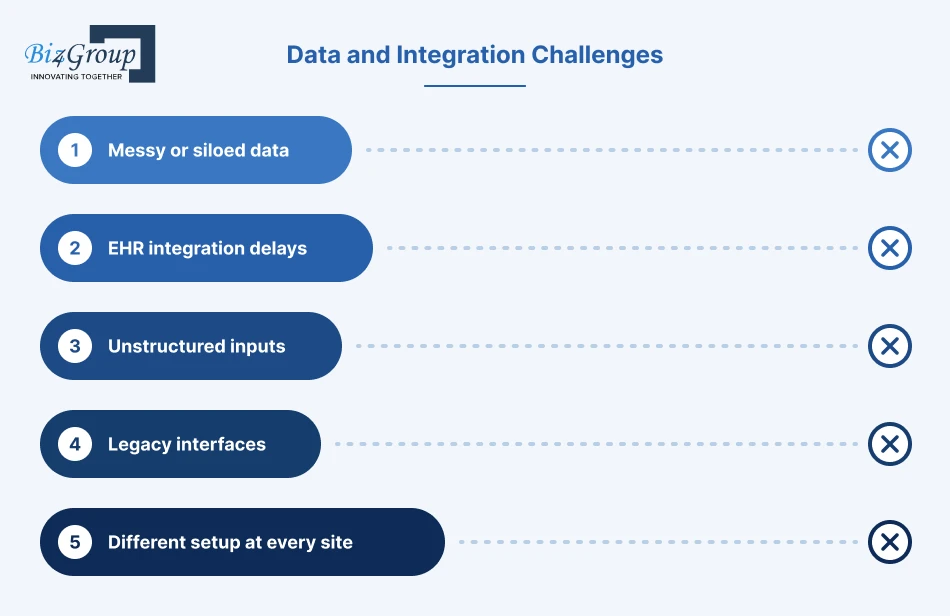
|
Challenge |
Why it happens |
How to solve it |
|---|---|---|
|
Messy or siloed data |
Records sit across the EHR, scheduling, billing, and paper, with inconsistent fields |
Run a data readiness audit first. Fix key fields at the source. Start with the one data set your first use case needs. |
|
EHR integration delays |
In AI patient management platform development, each EHR vendor has its own program, security review, and per-site activation |
Start vendor enrollment on day one. Build to FHIR standards. Connect your largest EHR first, then add the rest. |
|
Unstructured inputs |
Faxes, PDFs, and free-text notes do not map cleanly to structured fields |
Use document extraction without fixed templates. Send low-confidence fields to a person for review. |
|
Legacy interfaces |
Older systems use HL7 v2 or batch files, not modern APIs |
Add an integration gateway that translates between HL7 and FHIR. Keep that logic out of your AI code. |
|
Different setup at every site |
An AI patient management system for hospitals must handle each site's own base URL, scopes, and settings |
Store site settings as configuration. Test each site in a sandbox before go-live. |
AI Quality and Safety Challenges
|
Challenge |
Why it happens |
How to solve it |
|---|---|---|
|
Wrong or incomplete output |
Models can sound right while missing clinical context. A 2026 Dartmouth Health study of AI-drafted portal replies found drafts often needed physician edits. |
Keep a clinician review step on every clinical output. Show the source data beside each suggestion. From our builds: on RevIntegrity, we pre-fill each appeal with the exact contract clause for the claim, and the letter stays editable. |
|
Hallucination and prompt injection |
Models can invent facts or follow instructions hidden in text |
Limit answers to retrieved, approved records. Filter inputs and outputs. Require approval before the assistant takes any action. |
|
Bias across patient groups |
Training data can under-represent some ages, languages, or conditions |
Test accuracy by group before launch and after every update. Record results. Limit or fix features that underperform. |
|
Model drift |
An AI-powered patient management system changes as patient mix, codes, and workflows change |
Monitor accuracy on live data, set alert thresholds, and schedule retraining and revalidation. |
|
Slow responses on voice and chat |
Better models and more natural voices add delay |
Set a latency budget for each channel. Move speech handling onto a real-time relay and use smaller models for simple tasks. |
|
Monitoring without action |
Alerts do not change outcomes unless someone acts on them |
Pair monitoring with named care owners, patient selection rules, and escalation paths. |
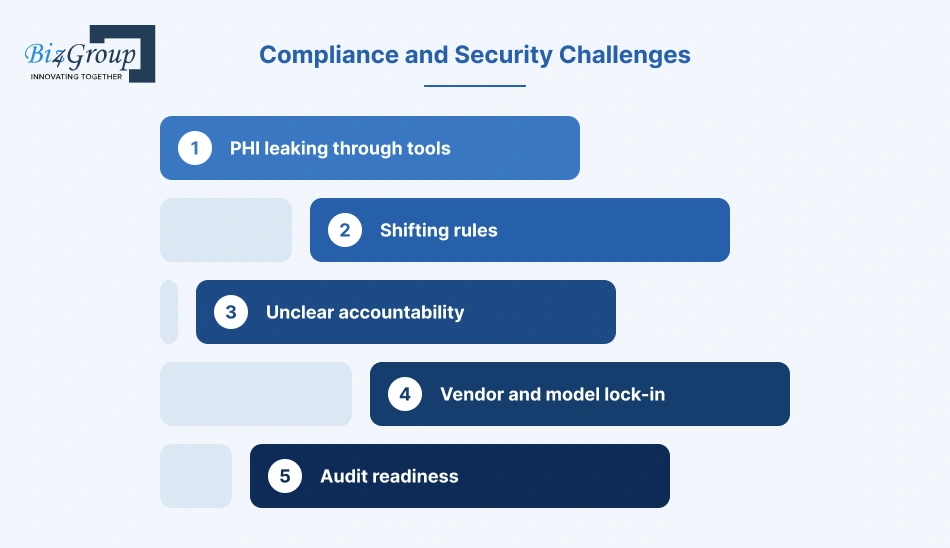
Compliance and Security Challenges
|
Challenge |
Why it happens |
How to solve it |
|---|---|---|
|
PHI leaking through tools |
Prompt logs, tracing tools, and error monitors can capture PHI |
Keep logs inside the BAA boundary. Redact before logging. Use zero-retention model settings. |
|
Shifting rules |
The Security Rule update is still proposed, and state AI laws keep changing |
Build to the stricter standard now. Keep disclosure text and consent rules as configuration by state. |
|
Unclear accountability |
Teams cannot say who owns an AI output when something goes wrong |
Name an owner for each AI feature. Log every input, output, and reviewer. Set up governance before launch. |
|
Vendor and model lock-in |
In custom AI patient management system development, models change and contract terms differ by provider |
Put models behind an abstraction layer. Check BAA terms per model. Keep a fallback model ready. |
|
Audit readiness |
Evidence is scattered across tools and teams |
Keep an append-only audit log, feature inventory, and review records in one place. |
Adoption and Operations Challenges
|
Challenge |
Why it happens |
How to solve it |
|---|---|---|
|
Low clinician use |
Tools fit the workflow poorly, and clinicians were not consulted |
Involve clinicians in design. Train inside the daily workflow. Track active use, not licenses. |
|
Privacy fears among staff and patients |
People worry about how AI uses patient data, especially tools outside their institution |
Explain what the AI sees and stores in plain language. Show disclosures clearly. Offer a path to a human. |
|
Scope creep and cost overruns |
Teams that build AI patient management system features add more before one workflow works |
Ship one workflow first. Use feature flags and phase gates tied to your success metric. |
|
Overbuilt first releases |
AI patient management app development for startups often adds screens before proving demand |
Launch one patient-facing flow. Add modules after the first flow shows results. |
|
Pilots that never scale |
No owner, metric, or go/no-go rule |
Set a fixed pilot window, a baseline, and a review date. Decide to scale or stop. |
|
Upkeep ignored |
Budgets cover the build but not monitoring and updates |
Budget yearly maintenance. Assign owners for monitoring, retraining, and security patches. |
Most of these problems repeat from project to project, which is why they are plannable. Name an owner, set a metric, and keep a clinician in the loop, and each risk becomes a line item instead of a surprise.
Next, we'll look at what to look for in an AI patient management system development company, and how we approach these challenges.
Why Choose Biz4Group as Your AI Patient Management System Development Company?
Biz4Group is an Orlando-based AI development company that builds HIPAA-aware software for U.S. healthcare teams. If you are comparing an AI patient management system development company against other vendors, judge on proof you can verify, not on claims.
Credentials and Track Record
|
Proof point |
Detail |
|---|---|
|
Company |
Founded in 2003 in Orlando, Florida |
|
Delivery |
1,000+ projects for 750+ clients, including 15+ Fortune 500 companies |
|
Independent reviews |
Clutch 4.9 from 28 reviews (18 from verified clients), Google 4.9 from 72 reviews, Upwork 4.8 from 120+ reviews |
|
Leadership |
Sanjeev Verma, Founder and CEO, with 20+ years in IT and past roles at Disney, MasterCard, and Oracle. Dave Caplis, Technical Director, with 40+ years in IT. |
What Dr. Ara Taught Us About Patient-Facing AI
As an AI patient management software development company, we learn the most from builds where patients must trust a tool and keep using it. Dr. Ara, an AI platform that turns blood reports into guidance for athletes, is one of them.
- The problem: Athletes doubted AI advice, uploaded one report and never returned, and consultation requests outgrew the booking process.
- What we built: Plain explanations behind every marker and recommendation, trend tracking with follow-up prompts, and a rebuilt booking flow with automated reminders.
- The result: 71% of athletes uploaded a second report within three months, and the time to book a consultation fell by 58%.
Those lessons carry straight into patient management: explain every AI output, give patients a reason to return, and automate booking and reminders. The full Dr. Ara case study lists the stack and team. For wider context, our guide to the top AI healthcare case studies shows what is working across the field.
Client Feedback
- The owner of Dr. Truman credited our team's "flexibility and proactive communication" for turning his vision into a working AI avatar and chatbot.
- Chris Guiher, founder of ClaimLynk, describes our team as an "extension of your own team."
Compliance and Delivery
- HIPAA has no official certification. Ask any vendor, including us, for BAA terms, a written risk analysis, audit log design, and test reports.
- Our healthcare builds use encryption, role-based access, and append-only audit trails, and every AI feature keeps a clinician in the loop.
- We deliver an MVP in 2 to 4 weeks and an enterprise build in 6 to 8 weeks.
To scope your own build, book a scoping call.
Verify the evidence, then match it to your workflow. Next, a short recap and the first step to take.
What should you ask us before you sign?
Ask for our BAA terms, our risk analysis approach, and a healthcare build you can verify. We will show our work, including what we would not build.
Ask Us the Hard QuestionsReady to Build an AI Patient Management System That Physicians Will Trust?
Physicians want AI that helps them care for patients, as long as it protects patient data and keeps them in charge. The teams that succeed with AI patient management system development pick one workflow, build compliance in from the start, and keep a clinician in the loop on every clinical output.
You now have the steps, the architecture, the rules, and a budget to plan against. The next move is to build AI patient management system capabilities around the one workflow that costs your team the most hours, then prove it before you expand.
Biz4Group can help you scope that first workflow, choose an architecture that fits your EHR, and build it to meet your compliance requirements. Tell us where your team loses the most time, and we will map the shortest path to a working, reviewable system.
FAQ
1. How much does it cost to build an AI patient management system?
The cost to build an AI patient management system typically ranges from $35,000 to $250,000. A focused MVP with one workflow, one AI capability, and one EHR connection sits at the low end, and a multi-site enterprise platform sits at the high end. Scope, EHR integrations, AI complexity, and compliance work drive the difference, and yearly upkeep usually adds 15% to 20% of the build cost.
2. How long does it take to create an AI patient management system?
We deliver an MVP in 2 to 4 weeks and an enterprise build in 6 to 8 weeks. EHR vendor approval, BAA negotiation, and clinical validation run alongside the build, and they often set the real launch date for AI patient management system development. Start them on day one.
3. How do you build a HIPAA-compliant AI patient management system?
Sign a BAA with every vendor that touches PHI, including your model provider, then run a written risk analysis that covers every AI data path. Add encryption, role-based access, append-only audit logs, and clinician review of clinical AI output. Large model providers will sign a BAA for enterprise or API plans, but not for free consumer chatbots, so never paste patient data into a consumer ChatGPT account.
4. Can an AI patient management system integrate with Epic, Oracle Health, and athenahealth?
Yes. An AI patient management platform for healthcare providers connects through FHIR and SMART on FHIR APIs, and each EHR vendor adds its own developer program, security review, and per-site activation. A working prototype is far quicker than a live connection, so begin vendor approval early and connect your largest EHR first.
5. Does an AI patient management system need FDA approval?
Usually not for administrative features such as scheduling, intake, reminders, and documentation support. Triage, risk scoring, and diagnostic suggestions can count as clinical decision support, and FDA's January 2026 guidance lists four criteria for staying outside device regulation, including that a clinician can independently review the basis for each recommendation. Have regulatory counsel classify each of those features before launch.
6. Will an AI-powered patient management system replace front desk staff or clinicians?
No. An AI-powered patient management system takes over repetitive work such as booking, reminders, intake, and draft notes, while staff handle complex requests, and clinicians make every clinical decision. Build in clinician review and a clear path to a human, because physicians expect to stay in charge and some state laws require that path.
7. Should we buy or build a custom AI patient management system, and is it worth it for a small clinic?
Buy when your workflows are standard and speed matters. Custom AI patient management system development pays off when your workflows are unique, you must connect several systems, or you need control of your data and models. A small clinic can start with an AI app for patient management that covers one workflow and judge its return against a baseline of no-show rate, call abandonment, or note time recorded for a few weeks before launch.