 Location :
Orlando, FL, USA
Location :
Orlando, FL, USA +1 (407) 714-1616
 info@biz4group.com

- Rapid US market growth boosts opportunities for AI sports betting predictions app development.
- Quality data collection is essential for developing accurate AI apps for sports betting predictions.
- Choose suitable AI models to ensure precision in sports betting prediction app development.
- Prioritize intuitive UI/UX design in AI sports betting predictions app development for better user retention.
- Manage challenges like real-time data processing, compliance, and security in sports betting prediction app development.
- Combine effective monetization with strategic marketing to grow your AI sports betting prediction app.
Artificial Intelligence (AI) has revolutionized industries worldwide, and sports betting is no exception. With millions of data points generated from every game, AI sports betting predictions apps have become essential tools for analyzing trends, predicting outcomes, and delivering personalized insights. These advanced systems use machine learning algorithms to process historical data, player performance, weather conditions, and other variables to produce highly accurate predictions in real time.
In the fast-growing US market, sports betting platforms are leveraging custom AI sports betting predictions app development to gain a competitive edge. Such solutions not only enhance prediction accuracy but also elevate user engagement and retention through data-driven insights. Developing an AI sports betting predictions app enables companies to automate analysis, minimize bias, and provide users with precise and transparent betting suggestions.
If you are exploring how to build an AI sports betting prediction app, understanding its core components, technical stack, and integration requirements is vital. From real-time data feeds and predictive analytics to intuitive UX and regulatory compliance, each element contributes to building a powerful AI-driven betting platform.
This guide will help you understand every aspect of AI sports betting predictions app development, from initial planning to deployment. Whether you aim to create a custom AI sports betting predictions app for your business or simply wish to learn how these intelligent systems function, you’ll find detailed insights here. You can also explore top sports betting software development companies in the USA to find the right partner for your project.
The Role of AI in Sports Betting Predictions App Development
Integrating artificial intelligence into sports betting apps greatly enhances decision-making by processing large datasets, identifying patterns, and predicting outcomes with impressive precision. In AI sports betting predictions app development, these capabilities form the foundation for delivering smarter, more engaging, and more accurate betting experiences.
How AI Enhances Prediction Accuracy
AI systems have transformed sports betting by providing advanced analytical capabilities. By processing vast amounts of data from past matches, player statistics, team performance, and real-time conditions like weather or injuries, machine learning algorithms can uncover correlations that human analysts often miss. This enables AI sports betting predictions apps to produce more reliable forecasts and support data-driven betting strategies.
A great example of this technology is BetBuddy, an AI system that uses machine learning to deliver personalized betting tips based on each user’s betting history, preferences, and risk profile. This customization makes betting experiences more personalized and accurate, aligning recommendations with user behavior and style. Such features demonstrate how custom AI sports betting predictions app development allows businesses to stand out in a competitive market.
The growing global sports betting industry further underscores the importance of AI. According to Grand View Research, the global sports betting market was valued at approximately USD 100.9 billion in 2024 and is projected to reach USD 187.4 billion by 2030, growing at a CAGR of about 11% from 2025 to 2030. Another Technavio report forecasts an even steeper rise, with an increase of USD 221.1 billion between 2025 and 2029, at nearly 12.6% CAGR.
These statistics highlight the enormous potential for businesses investing in developing AI sports betting predictions apps. AI-driven personalization, predictive analytics, and real-time adaptability are not just enhancing user engagement—they are reshaping the entire sports betting ecosystem.
Overview of the US Sports Betting Market
In recent years, the US sports betting market has exploded, driven by the legalization of betting in multiple states and the rising popularity of online and mobile platforms. For an AI sports betting predictions app to succeed in this competitive space, it’s essential to grasp the unique characteristics of the US landscape. Below is an updated look at key market insights and trends:
1. Growing User Base
- Insight: Legal sports wagers in the US reached approximately US $142.6 billion in 2024. In 2025, the cumulative legal handle surpassed US $93 billion through mid-year, bringing the lifetime regulated handle above US $558 billion.
- Impact: These figures reflect a massive and expanding market, offering a ripe opportunity for new platforms—including custom AI sports betting predictions app development—to meet demand for smarter, data-driven user experiences.
2. Diverse Demographics
- Insight: The US sports betting audience includes various age groups, with a particular emphasis on millennials and Gen Z. These tech-savvy users are drawn to online platforms that provide engaging experiences, such as live updates and personalized interactions.
- Impact: Apps targeting these demographics benefit from AI development services that include personalization and real-time updates, essential for appealing to younger, mobile-first users.
3. Popular Sports and Leagues
- Fan-Favorite Leagues: The most popular betting sports in the US are football, basketball, and baseball, with NFL, NBA, and MLB leading the charge. Additionally, the NHL, MLS, and collegiate leagues like NCAA basketball and football are gaining popularity.
- Emerging Sports: Other sports, such as soccer, golf, and even eSports, are drawing interest, expanding the market reach. Adding these sports to an app can increase user engagement and appeal to a broader audience.
4. Key Trends in User Behavior
- Preference for Mobile Betting: The trend towards mobile betting underscores the importance of a responsive, mobile-friendly app that enables users to enjoy features like live betting, in-play stats, and instant notifications.
- Desire for Real-Time Insights: Modern bettors rely on real-time updates and data. AI-driven predictions and live odds are major differentiators, as users seek apps that provide accurate, timely information.
- Focus on Responsible Gambling: With the rapid growth of sports betting, features promoting responsible gambling—such as spending limits, self-exclusion options, and reminders—are highly valued by users.
5. Competitive Landscape
- Established Players and New Entrants: The US sports betting market is competitive, with established operators like DraftKings, FanDuel, and BetMGM dominating, alongside newer entrants. Successful apps distinguish themselves with unique selling points (USPs), such as personalized AI-driven recommendations or a wide range of betting options.
- Importance of Unique Value Propositions: In this competitive space, an AI-based app with personalized predictions based on user preferences and betting history can be a strong draw. Apps offering highly accurate predictions, an intuitive interface, or exclusive partnerships with data providers will stand out in the market. AI consulting services like Biz4Group like can help you create these unique features.
AI app development company like Biz4Group in the US offers tremendous opportunities for innovative apps that cater to modern user demands for real-time data, personalization, and responsible gambling. With the right approach, a sports betting app can thrive in this dynamic and growing market.
Benefits of AI Sports Betting Prediction App Development
Building an AI sports betting prediction app offers businesses a powerful way to revolutionize user engagement, improve betting accuracy, and gain a sustainable edge in the competitive sports wagering market. Artificial Intelligence brings automation, data-driven insights, and personalization to every layer of sports betting.
Below are six detailed benefits that highlight why it’s vital to develop an AI sports betting prediction app today.
1. Enhanced Prediction Accuracy
One of the biggest advantages of creating an AI sports betting prediction app is its superior ability to deliver highly accurate forecasts. Unlike traditional statistical models, AI analyzes massive datasets that include player performance, past results, team strategies, weather patterns, and even real-time metrics such as player fatigue or game momentum.
Machine learning models recognize subtle correlations and probabilities that human analysts often miss. These insights enable the system to produce data-backed predictions with improved accuracy. The result is a more trustworthy and reliable betting experience for users, helping them make informed decisions rather than relying on luck.
Over time, AI continuously refines its models as it learns from new data, improving its prediction capabilities even further. For businesses, this consistent improvement helps maintain user confidence and long-term engagement with the platform.
2. Real-Time Data Analysis and Insights
When you develop an AI sports betting prediction app, the ability to process data in real time becomes a significant differentiator. AI can instantly analyze live sports data, including ongoing match statistics, player substitutions, injuries, and changing odds, to deliver immediate and actionable insights.
This allows users to make smarter, in-play betting decisions and respond quickly to changing situations during a live game. The AI engine provides continuous updates, ensuring that the information displayed to users is always relevant and up to date.
Additionally, real-time analytics enhance the overall user experience by keeping bettors engaged throughout the event. The integration of live data feeds and AI-powered insights creates a dynamic and immersive platform that users will prefer over traditional betting systems.
3. Personalized User Experience
Creating an AI sports betting prediction app allows developers to tailor experiences to each user’s unique preferences. AI systems analyze individual betting history, behavior patterns, and risk appetite to recommend customized betting options.
For example, if a user typically bets on NBA games or prefers low-risk wagers, the AI will prioritize those suggestions, ensuring that the experience feels personalized and relevant. Over time, as the user interacts with the app, the AI refines its recommendations, leading to even greater personalization.
This approach not only enhances engagement but also increases user retention rates. When bettors feel understood and valued, they are more likely to remain loyal to the platform. Thus, personalization becomes a key driver of long-term success in AI sports betting prediction app development.
4. Risk Management and Fraud Prevention
Integrating AI into your sports betting app also strengthens risk management and security. AI systems can monitor thousands of transactions and betting activities simultaneously, flagging irregular patterns or suspicious activities in real time.
This includes identifying potential fraud, unusual betting spikes, or attempts at manipulation. AI-powered fraud detection algorithms can differentiate between normal fluctuations and malicious behavior, providing operators with early warnings.
In addition to security, AI can help manage financial risks by predicting potential losses, setting optimal odds, and maintaining balance between users’ bets and payouts. Developing an AI sports betting prediction app with such built-in risk intelligence enhances the platform’s credibility and user trust.
5. Improved Business Decision-Making
AI doesn’t just benefit bettors—it also provides valuable insights for business operators. When you make a sports betting prediction app integrating AI, it can track patterns in user engagement, game popularity, and betting behaviors.
This data enables businesses to understand which sports or leagues generate the highest engagement, which promotional campaigns perform best, and how to optimize user acquisition strategies. AI-driven analytics also help in setting competitive odds, managing marketing budgets, and forecasting revenue growth.
By leveraging predictive analytics, business owners can make informed decisions that maximize profitability while minimizing risks. This holistic use of AI ensures that the platform operates efficiently and strategically in an ever-changing market.
6. Competitive Edge and Scalability
In the highly competitive sports betting market, innovation determines survival. Developing an AI sports betting prediction app gives your business a technological edge that helps you stand out from competitors.
AI-driven platforms can scale effortlessly to handle growing user bases and expanding datasets. As more states in the US legalize sports betting, scalability becomes essential for maintaining performance and reliability under high demand.
Additionally, AI’s ability to adapt to new data and evolving market conditions ensures that your app stays relevant. Continuous learning allows the app to refine predictions, introduce new sports or betting types, and align with user preferences seamlessly.
Ultimately, integrating AI into sports betting app development ensures your platform is not only future-ready but also capable of delivering superior performance and user satisfaction.
These benefits clearly show that developing an AI sports betting prediction app is not just about technology—it’s about creating a smarter, safer, and more personalized betting experience that drives user engagement and long-term business growth.
Essential Features for an AI Sports Betting Prediction App
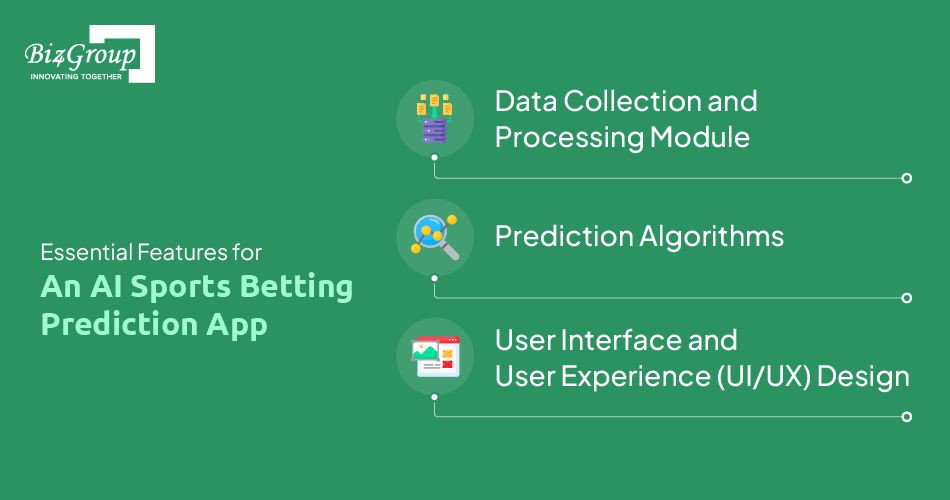
An AI sports betting app is one of the most popular types of conversational applications, requiring a carefully chosen set of features to deliver accurate predictions, a personalized experience, and smooth functionality. Here are the essential components to consider:
1. Data Collection and Processing Module
The foundation of any predictive AI sports betting predictions system is high-quality data, and this is especially true for sports betting apps. To make reliable predictions, the app must access a diverse range of data sources, processed in real time by advanced sports AI prediction software. Key data sources include:
- Historical Data: A well-trained AI betting software uses historical data, such as past game results, player statistics, and previous event outcomes, to identify patterns.
- Real-Time Data: The app should fetch real-time data like in-game statistics, player form, and even external variables like weather conditions to support AI-generated sports picks for live bets.
- User Data: Tracking individual user behaviors allows the app to personalize predictions according to each user’s unique preferences and betting style.
This robust data collection and processing module handles real-time data from RFID and other sources, cleaning and extracting features to prepare data for precise predictions. Without it, the app would lack the ability to provide accurate and timely recommendations.
2. Prediction Algorithms
In an AI-powered sports betting app, advanced machine learning models are essential for predicting outcomes based on both historical and real-time data. Some of the most effective models include:
- Regression Analysis: Ideal for predicting quantitative outcomes, such as potential scores or point spreads.
- Classification Models: Useful for binary outcomes, like win/loss predictions, making these models effective for AI sports prediction.
- Neural Networks: Highly effective for identifying complex patterns in large datasets, allowing for nuanced, adaptable predictions.
With these algorithms, the app can provide data-driven predictions, helping users make more informed betting decisions. These predictions become even more effective when personalized, as seen with systems like BetBuddy, which utilizes Enterprise AI Solutions to deliver tailored betting recommendations based on user behavior and preferences.
3. User Interface and User Experience (UI/UX) Design
A user-friendly AI sports betting predictions app requires a well-designed user interface (UI) and user experience (UX) to maximize engagement. An intuitive design helps display data, predictions, and recommendations clearly, making it easy for users to navigate and interact with the app. Consider incorporating the following elements:
Clear Data Visualizations
- Overview: Complex predictions become easier to interpret when presented visually. Charts, graphs, and summary stats offer users a clear understanding of insights provided by sports betting AI software.
- Benefits: With data visualizations, users can quickly assess predictions and make informed decisions, enhancing the overall betting experience.
Interactive Elements
- Overview: Interactive features, such as clickable odds, betting history dashboards, and customizable lists for favorite teams and sports, make the app more engaging. These elements add a layer of interactivity, encouraging users to explore various aspects of their betting data.
- Examples: Consider options that allow users to track their betting history and monitor favorite teams. Apps powered by AI Integration Services can incorporate these features seamlessly, supporting complex AI-driven insights in a user-friendly format.
Personalized Dashboard
- Overview: A personalized dashboard provides users with tailored predictions and stats, creating a user-specific experience that’s both engaging and relevant.
- Functionality: By leveraging data from AI sports prediction modules, the app can present customized insights and recommendations based on each user's past behaviors and preferences, delivering a highly personalized experience.
Live Notifications and Updates
- Overview: Real-time notifications are crucial in sports betting, especially for live betting scenarios. Notifications alert users to prediction changes, updated odds, and critical in-game events, facilitating fast responses.
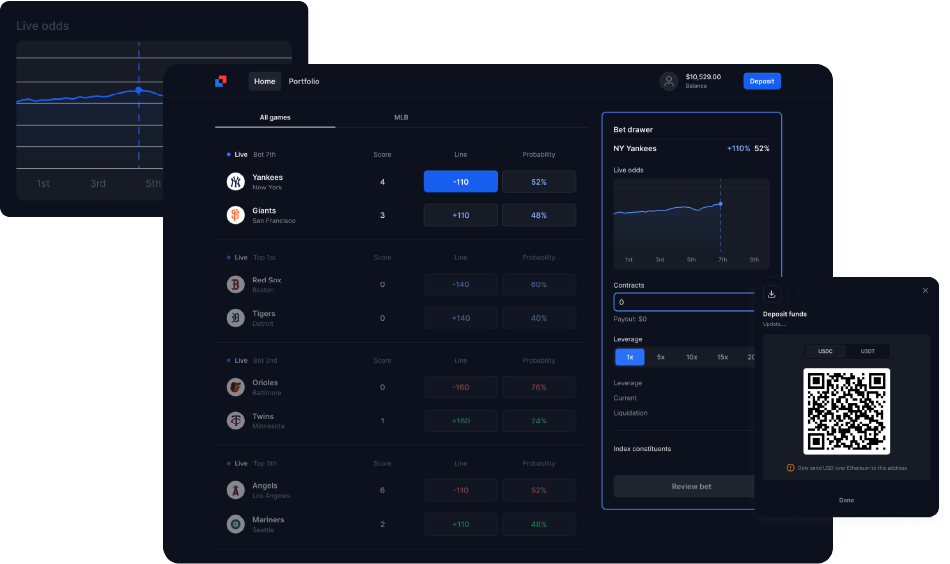
- Benefits: With Real-Time Sports Betting Platform capabilities, live notifications keep users engaged by providing timely information that enhances the betting experience.
Check out one of the real-time sports betting platform developed by our team at Biz4Group
Customizable User Profiles
The app should allow users to create detailed profiles that capture betting preferences, history, favorite sports, and leagues. This data enables the app to leverage AI betting software for peer-based predictions tailored to each user, making the experience feel exclusive and personalized. Comprehensive profiles provide valuable insights that Hire AI Developers can use to refine personalization algorithms, delivering more accurate and relevant predictions over time.
Key Technologies for AI Sports Betting Prediction App Development
Creating an AI-powered sports betting prediction app requires the integration of cutting-edge technologies that enable data processing, prediction, and user interaction. Here are the primary technologies that form the backbone of a successful AI sports betting predictions app:
1. Machine Learning Models
The core of AI sports betting predictions lies in machine learning. Here are some of the most effective models:
- Regression Models: Ideal for predicting quantitative outcomes, such as scores or points.
- Classification Models: Useful for binary outcomes, like win/loss predictions, which is a critical feature in sports AI prediction.
- Neural Networks: Highly effective for complex data analysis, handling large datasets, and recognizing intricate patterns for increased accuracy.
- Reinforcement Learning: Adaptive in dynamic betting environments, particularly beneficial for live or in-play betting scenarios.
These models, when combined, provide comprehensive prediction coverage, supporting diverse betting options for users. With robust AI Development Services, apps can merge these models to deliver a rich predictive experience.
2. Data Management Tools
Efficient data management is essential to maintaining a reliable AI prediction system. Key components include:
- Data Warehousing: Solutions like AWS Redshift, Google BigQuery, and Microsoft Azure support large-scale data storage and retrieval.
- ETL (Extract, Transform, Load) Processes: Built with tools like Apache Kafka and Apache Spark, ETL pipelines handle data cleaning, preprocessing, and transformation.
- Data Lakes: Cloud-based storage solutions that manage structured and unstructured data, providing accessible historical and real-time data for analysis.
Correct data management enables the app to produce accurate predictions, even during high-traffic events. AI Integration Services play a significant role in creating streamlined data flow for such applications.
3. Free to Use APIs for Real-Time Sports Data
For live betting and predictions, access to real-time sports data is crucial. APIs enable integration with data providers who offer up-to-the-minute stats on games, players, scores, and odds. Some prominent providers include:
- Sportradar: Sportradar is known for providing real-time sports data and statistics across various leagues.
- Betgenius: Betgenius offers extensive data and odds services specifically for the betting industry.
- Stats Perform: Stats Perform is renowned for real-time sports data and AI-driven insights.
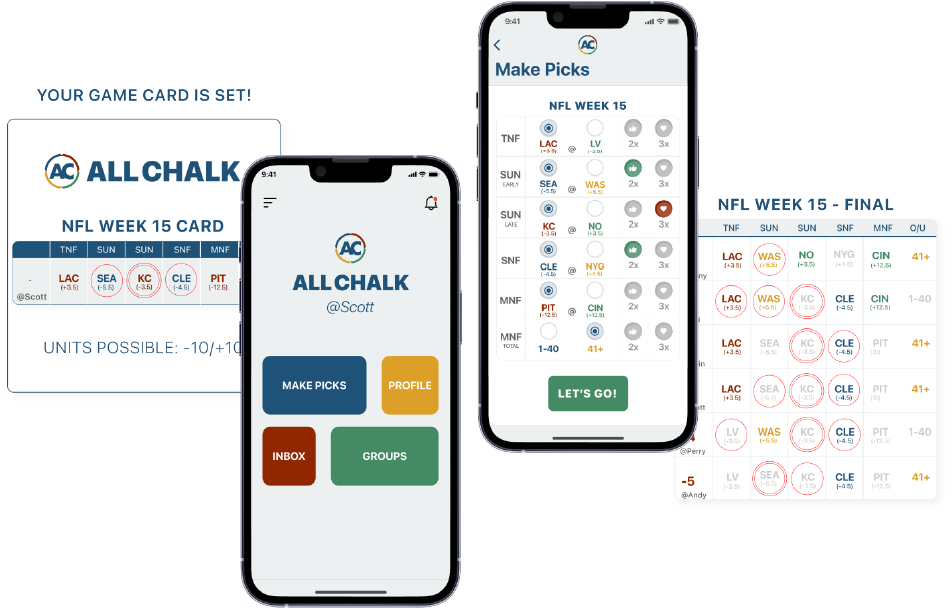
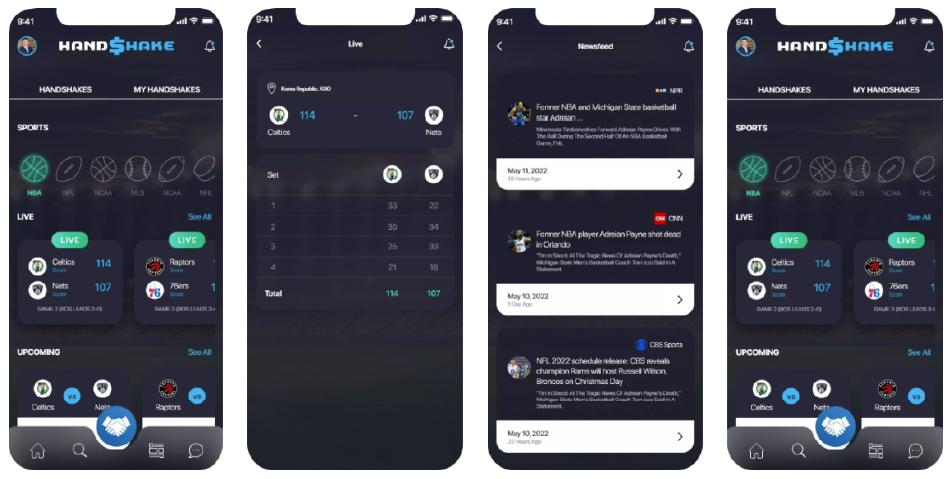
With reliable open-source sports betting software like Sports Pickem & Prediction App, the app can deliver live predictions, update odds, and provide real-time insights, keeping users engaged with real-time data.
Learn how our team developed Sports Pickem & Prediction App at Biz4Group.
4. Compliance and Security Measures
Security and compliance are essential in sports betting, where protecting users’ personal and financial data is paramount. Key security technologies include:
- Data Encryption: Ensures all sensitive data, from personal information to transactions, is securely encrypted during storage and transfer.
- Multi-Factor Authentication (MFA): Adds an extra layer of security to prevent unauthorized access to user accounts.
- Compliance with Regulatory Standards: Adherence to frameworks like the General Data Protection Regulation (GDPR) and California Consumer Privacy Act (CCPA) is crucial for data privacy and user trust.
Failure to comply with these regulations exposes an app to legal risks and could harm its credibility. For a trustworthy betting experience, Enterprise AI Solutions ensure that both compliance and security are built into the app’s foundation.
Looking to Add AI-Driven Predictions to Your Betting Platform?
Unlock the power of AI with our tailored development solutions!
Contact UsAI Sports Betting Prediction App Development: A Step-by-Step Process
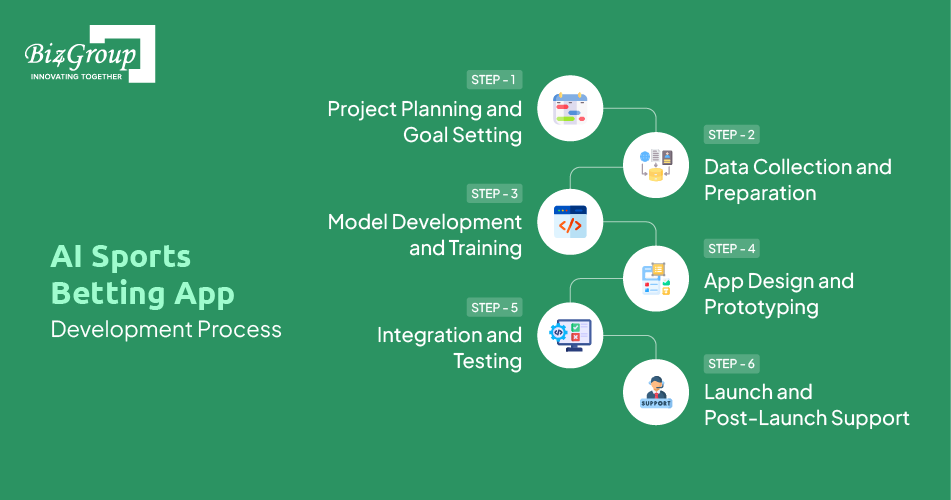
Creating a successful AI-powered sports betting prediction platform involves more than just coding—it requires strategic planning, advanced data integration, and seamless user experience design. Understanding what is the process to build an AI sports betting predictions app can help businesses create a reliable, scalable, and high-performing product.
Below is a complete step-by-step guide to the development of an AI sports betting predictions app, from planning to post-launch optimization.
Step 1: Project Planning and Goal Setting
The foundation of any successful AI sports betting predictions app development project begins with clear objectives and structured planning.
- Identifying the Target Audience:
Start by defining who the app will serve. Understanding your target audience—including their betting habits, favorite sports, and user behaviors—will guide design and feature decisions.
- Setting Clear Goals:
Define what success looks like for your platform. Your goals might include improving prediction accuracy, offering real-time betting recommendations, or enhancing the mobile betting experience.
- Feature Selection:
Outline key functionalities such as live data streaming, predictive analytics, user profiles, and AI-powered betting insights.
This initial planning phase acts as the blueprint for the entire development journey, ensuring every aspect of the app aligns with user expectations and market demand.
Step 2: Data Collection and Preparation
At the heart of AI sports betting predictions app development lies quality data. To create an AI sports betting predictions app that delivers precise outcomes, businesses must prioritize robust data management.
- Gathering Historical and Real-Time Data:
Use trusted APIs like Sportradar, Stats Perform, or Genius Sports to collect extensive datasets on past game results, player performance, and live match updates.
- Data Cleaning and Preprocessing:
Refine and standardize data to remove inaccuracies or duplicates. Clean data ensures that the AI model can process information efficiently and provide accurate results.
- Feature Engineering:
Identify key attributes—like player stats, weather conditions, or head-to-head history—that can significantly impact prediction accuracy.
Partnering with AI Integration Services providers, such as Biz4Group, can streamline data collection and management. These services ensure smooth API integration, scalable cloud storage, and consistent data processing pipelines.
Step 3: Model Development and Training
The development of an AI sports betting predictions app depends heavily on the strength of its machine learning models.
- Model Selection:
Choose algorithms that fit your prediction goals. Regression models are ideal for score predictions, while classification algorithms are suited for win/loss probabilities.
- Model Training:
Train models using historical and real-time datasets to help them learn behavioral patterns, player performance trends, and outcome probabilities.
- Testing and Optimization:
Regularly test the models using validation data and fine-tune parameters to achieve high prediction accuracy. The continuous feedback loop between training and testing helps the model evolve and improve over time.
Through the help of expert AI Integration Services, businesses can ensure smooth model deployment, performance tracking, and long-term optimization for accuracy and reliability.
Step 4: App Design and Prototyping
User experience is critical when building an AI sports betting predictions app. A seamless design helps users navigate easily while interacting with complex AI insights.
- UI/UX Design:
Work with a Top UI/UX Design Company in USA to design intuitive interfaces and engaging visuals. These professionals understand how to present data clearly while maintaining visual appeal. - User-Centric Features:
Incorporate personalized dashboards, clickable odds, live scoreboards, and intuitive navigation flows that simplify the betting journey.
- Prototype Testing:
Before launch, conduct usability tests to gather feedback on app flow, visual hierarchy, and accessibility.
The cost to design UI/UX depends on project complexity, features, and customization needs, but partnering with experienced designers ensures your investment yields long-term engagement and retention. For inspiration, you can explore the Top Sports Betting Software Development Companies in USA that specialize in combining intelligent UX with AI analytics.
Step 5: Integration and Testing
Once your AI models and app design are ready, the next step in the building of an AI sports betting predictions app is integration and testing.
- API Integration:
Connect external APIs for live odds, player stats, and match updates. Reliable data integration ensures that predictions remain accurate and up to date.
- System and Performance Testing:
Run end-to-end tests across different devices and network environments. Ensure that the app maintains high speed and reliability even during peak traffic events like major tournaments.
- User Acceptance Testing (UAT):
Invite beta testers to validate the app’s performance, usability, and prediction accuracy. Gather user feedback to fine-tune performance before public release.
Partnering with experienced AI Integration Services and QA professionals guarantees that your app operates flawlessly, offering users a smooth and trustworthy betting experience.
Step 6: Launch and Post-Launch Support
Once testing is complete, it’s time to launch your AI sports betting predictions app—but the journey doesn’t end there.
- Launch Strategy:
Plan a data-driven launch that includes digital marketing campaigns, influencer collaborations, and social media outreach to attract early adopters.
- Monitor and Optimize Performance:
Use analytics tools to monitor key metrics like engagement, retention, and prediction accuracy. Evaluate model performance regularly to ensure that outcomes remain consistent and dependable.
- Model Updates and Continuous Improvement:
Update your machine learning models as new sports data becomes available. Regular updates keep your predictions relevant, accurate, and competitive.
- Post-Launch Support:
Collaborate with an experienced sports betting app development company like Biz4Group for ongoing updates, technical maintenance, and AI integration support. This ensures that your app continues to perform well as user expectations and market conditions evolve.
Following a structured and data-driven approach to the development of an AI sports betting predictions app ensures long-term success.
Cost and Timeline for AI Sports Betting Prediction App Development
| Development Phase | Description | Estimated Cost | Estimated Timeline |
|---|---|---|---|
|
Project Planning and Goal Setting |
Define objectives, scope, and core features, and conduct market research. |
$5,000 - $10,000 |
2 - 4 weeks |
|
Data Collection and Processing |
Gather historical and real-time data, set up data pipelines and storage. |
$10,000 - $30,000 |
4 - 6 weeks |
|
Machine Learning Model Development |
Develop and train AI models, validate and optimize predictions. |
$15,000 - $50,000 |
8 - 12 weeks |
|
UI/UX Design and Prototyping |
Create a user-friendly interface, conduct usability testing. |
$5,000 - $20,000 |
4 - 6 weeks |
|
Integration and Testing |
Integrate APIs, conduct end-to-end testing, and user acceptance testing. |
$8,000 - $15,000 |
6 - 8 weeks |
|
Launch and Post-Launch Support |
Launch the app, monitor performance, and update models with new data. |
$2,000 - $5,000 per month |
Ongoing |
Creating a high-quality AI-based sports betting prediction app is a complex process that requires careful planning, technical expertise, and significant investment in both time and resources.
The total cost to develop an AI sports betting prediction app generally ranges between $20,000 and $150,000+, depending on the features, technology stack, and level of customization. Understanding these cost drivers and timelines helps in planning an efficient and successful project.
Factors Influencing Cost
1. Data Management and Processing
Collecting and processing large volumes of data, especially when fed to the app in real time, can significantly add to development costs. Data management systems, including storage, ETL processes, and real-time updates, require reliable infrastructure.
- Estimated Cost: Data management systems and real-time API integrations generally cost between $10,000 – $30,000, depending on the provider and data requirements. AI Integration Services help ensure smooth, efficient data handling within your app.
2. Developing Machine Learning Models
Developing and training predictive algorithms requires data scientists and machine learning engineers. The cost depends on model complexity and training data volume, particularly when personalized AI sports prediction is involved.
- Estimated Cost: Prediction models start at around $15,000 and can exceed $50,000 for complex, highly personalized algorithms.
3. UI/UX Design
A well-designed UI/UX is essential for user engagement. The costs associated with designing an intuitive, interactive interface depend on customization, interactivity, and usability testing.
- Estimated Cost: UI/UX design costs range from $5,000 to $20,000, depending on app complexity.
4. Real-Time Data and API Integrations
For live betting and predictions, real-time sports data APIs (like Sportradar and Betgenius) come with subscription fees based on data volume and frequency. API integration also incurs additional development costs.
- Estimated Cost: Annual API subscriptions range from $5,000 to $20,000, with integration costs adding $3,000 to $10,000. Real-Time Sports Betting Platform solutions ensure seamless real-time data integration for live predictions.
5. Security and Compliance
Compliance with data protection regulations (e.g., GDPR, CCPA) and security measures (e.g., data encryption, multi-factor authentication) are essential for a secure, reliable app.
- Estimated Cost: Security and compliance costs range between $10,000 to $25,000, depending on specific requirements and regulatory frameworks.
6. Maintenance and Updates Post-Launch
Prediction models require continuous updates, additional data, and performance optimizations. Regular maintenance also supports seamless user experience and technical support.
- Estimated Cost: Monthly maintenance costs are typically between $2,000 and $5,000 for data updates, model retraining, and technical support. Enterprise AI Solutions built by Biz4Group, for sports betting provide ongoing maintenance and enhancement services.
Typical Development Timeline for AI Sports Betting Prediction App
- Project Planning and Initial Research: 2–4 Weeks
Outline objectives, identify target audience, core features, and conduct market research.
- Data Collection and Processing: 4–6 Weeks
Gather historical and real-time data, set up processing pipelines, and establish data storage systems.
- Machine Learning Model Development: 8–12 Weeks
Develop, evaluate, train, and optimize predictive models.
- UI/UX Design and Prototyping: 4–6 Weeks
Design the user interface, create prototypes, and conduct usability testing.
- Integration and Testing: 6–8 Weeks
Integrate APIs, test the app across devices, and perform end-to-end and user acceptance testing.
- Launch and Post-Launch Support: Ongoing
Plan the launch, monitor app performance, and continually update and maintain the app.
- Estimated Total Development Time: 6 to 9 months
The actual timeline can vary depending on app complexity, resources, and customizations.
Developing a high-quality AI sports betting predictions app is an investment that requires careful planning and resource allocation. Partnering with a Sports betting app development company experienced in AI-driven solutions can streamline the process, ensuring timely delivery and quality results.
Types of Sports Betting Prediction Applications for Various Sports Leagues
ports betting is far from a one-size-fits-all activity—different sports and leagues present unique betting opportunities tailored to the nature of each game. Here’s a look at some popular types of betting prediction apps for various leagues, each of which can enhance the AI sports betting predictions experience:
1. Moneyline Bets
- Overview: A Moneyline bet is a straightforward wager on which team or player will win a game or match.
- Popular In: Moneyline bets are common across major leagues (NFL, NBA, NHL, MLB) and individual sports like boxing and tennis.
- Example: A typical NFL Moneyline bet could be on the New York Giants to win over the Philadelphia Eagles.
2. Point Spread Betting
- Overview: Point spread bets level the playing field by assigning a point “spread,” allowing bettors to wager on whether a team will win by more than the spread or lose by less.
- Popular In: This bet type is most popular in NFL and NBA games and is also commonly used in college sports.
- Example: In the NBA, you might bet on the Lakers to win against the spread by more than 5 points over the Clippers.
3. Totals (Over/Under)
- Overview: Totals bets are wagers on the game’s combined score, with bettors choosing if it will be over or under a predetermined amount.
- Popular In: Widely used in NFL, NBA, NHL, MLB, and international soccer leagues.
- Example: In an MLB game between the Yankees and Red Sox, the total might be set at 8.5 runs. You’d bet on whether the combined score will be over or under this number.
4. Prop Bets (Proposition Bets)
- Overview: Instead of the final outcome, prop bets focus on specific events within a game, like player performance or unique occurrences.
- Popular In: Super Bowl, NBA, and MLB games, where prop bets add extra excitement to high-profile events.
- Example: A popular Super Bowl prop bet could be on who scores the first touchdown, or in the NBA, on whether LeBron James scores over 30 points.
5. Futures Bets
- Overview: Futures bets are wagers on outcomes that will occur in the future, like who will win a championship or become the league MVP.
- Popular In: Common in long-season leagues such as the NFL, NBA, MLB, and major soccer leagues.
- Example: A futures bet could be on the Kansas City Chiefs winning the next Super Bowl or Lionel Messi finishing as the top scorer of the season.
6. Parlay Bets
- Overview: A parlay combines multiple bets into one, with higher risk but potentially greater rewards if all bets win.
- Popular In: Bettors often combine moneylines, spreads, or totals across games for bigger payouts
- Example: You might bet on the Chicago Bulls, New York Knicks, and Los Angeles Lakers all winning their NBA games in a single parlay.
7. Live (In-Play) Betting
- Overview: Live betting allows bettors to wager during the game, with real-time odds that change based on game events, adding an interactive dimension.
- Popular In: Fast-paced sports like NBA, NFL, and international soccer, where momentum shifts quickly.
- Example: In an NFL game, you could place a live bet on the Patriots to score the next touchdown or adjust your final score prediction as the game progresses.
8. Teasers and Pleasers
- Overview: Similar to parlays, but with adjusted point spreads. Teasers allow bettors to adjust spreads in their favor for reduced payouts, while pleasers increase payouts by shifting spreads the other way.
- Popular In: Particularly in NFL and NBA betting, where point spreads are crucial.
- Example: You could shift the betting line on two NFL games for a higher chance of winning with lower payouts in a teaser bet.
Each type of bet offers users a distinct experience, allowing them to explore various betting strategies that AI sports betting prediction apps can further enhance. By incorporating these diverse betting options, Sports Pickem & Prediction App solutions can attract a broad range of users—from beginners to experienced bettors—creating a comprehensive platform for all levels.
Ready to Enter the Sports Betting Market with a Competitive Edge?
Discover how our AI expertise can make your app stand out!
Let’s ConnectChallenges in AI Sports Betting Prediction App Development
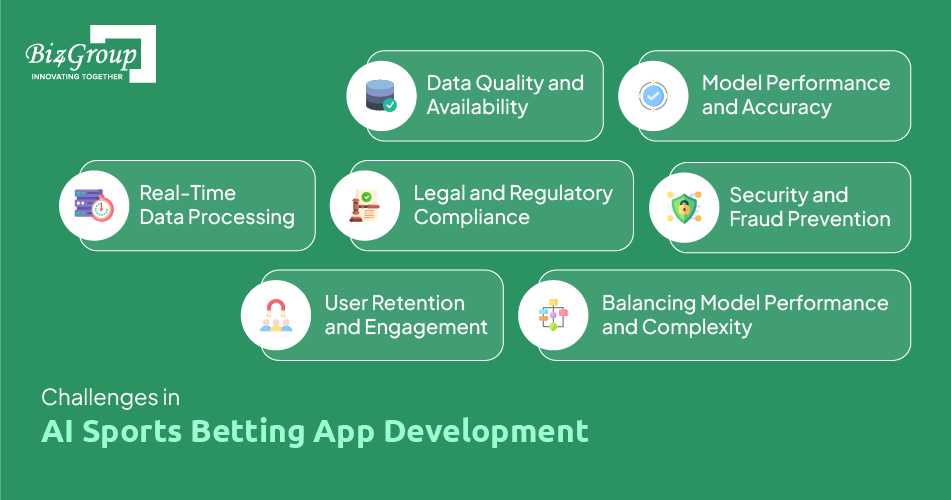
Developing an AI sports betting prediction app comes with its unique set of challenges. From ensuring precise predictions to securing data and complying with stringent regulations, creating a reliable AI sports betting predictions app is complex. Here are some of the primary challenges developers face while building AI sports betting prediction app:
1. Data Quality and Availability
- Challenge: The backbone of accurate AI predictions lies in consistent access to high-quality data. However, real-time feeds and historical statistics from different providers often come in varying formats, making data reliability a challenge.
- Solution: Partner with reputable data providers (e.g., Sportradar, Betgenius) and implement data cleaning processes to ensure data consistency and accuracy. Investing in a robust data infrastructure can improve both reliability and prediction accuracy. AI Development Services can help implement these data processes effectively.
2. Model Performance and Accuracy
- Challenge: The dynamic nature of sports requires AI models to be continually tuned and optimized. Player stats, team performance, and unforeseen events like injuries can all impact model accuracy.
- Solution: Regularly update and retrain models with the latest data, and set up an ongoing evaluation system to monitor performance and fine-tune parameters.
3. Real-Time Data Processing
- Challenge: Real-time data processing is essential for live betting, which requires the app to handle large data volumes quickly and accurately.
- Solution: Use scalable cloud platforms and data processing frameworks like Apache Kafka or Apache Spark for real-time data streams. A strong backend with fast APIs ensures seamless live updates, enhancing user experience.
4. Legal and Regulatory Compliance
- Challenge: The sports betting industry is highly regulated, with strict rules around privacy, security, and fair play. Compliance is critical to avoid penalties and legal issues.
- Solution: Incorporate compliance measures from the start to adhere to regulations like GDPR and CCPA. Consulting legal experts and staying updated on regulations ensures continued compliance.
5. Security and Fraud Prevention
- Challenge: With financial transactions and sensitive user data at stake, sports betting apps are prime targets for fraud and security breaches.
- Solution: Implement robust security measures, including data encryption, multi-factor authentication (MFA), and transaction monitoring. AI-driven fraud detection can identify suspicious activity in real time, protecting users and the platform. Computer Vision Development Company offers advanced solutions for real-time fraud detection.
6. User Retention and Engagement
- Challenge: Keeping users engaged in a competitive market is essential. Poor experiences or lack of engaging features can quickly lead to user churn.
- Solution: Add personalized features leveraging AI to provide betting suggestions and insights tailored to each user. Engaging design, push notifications, and rewards systems enhance user retention.
7. Balancing Model Performance and Complexity
- Challenge: Advanced AI models, though highly accurate, often require substantial computing power, which can slow down app performance during high-usage spikes.
- Solution: Test lighter models that maintain accuracy while reducing processing time. Cloud solutions and optimized code practices help balance model complexity with performance. Enterprise AI Solutions provide support in finding the right balance between accuracy and efficiency.
Leveraging Analytics for Continuous Improvement
Once your AI sports betting predictions app is live, leveraging analytics is essential to refine features, analyze user behavior, and enhance overall satisfaction. Data-driven insights enable you to continuously improve the app—making it more engaging, accurate, and user-friendly. Here are the keyways to use analytics for ongoing improvement:
1. Tracking User Behavior
- Overview: User behavior analytics reveal how users interact with the app, showcasing their patterns, preferences, and potential pain points.
- Metrics to Monitor:
- Session Duration: Track how long users spend on the app, which features they engage with, and any usability issues they encounter.
- Popular Features: Identify top-used features, such as live betting or real-time updates, to prioritize future improvements.
iii. Drop-off Points: Detect where users exit or abandon actions, like placing a bet halfway, to enhance retention and conversion rates.
2. Measuring Prediction Accuracy
- Overview: Analyzing the accuracy of predictions from the AI model compared to actual game outcomes is essential for refining algorithms and building user trust.
- Metrics to Monitor:
- Win/Loss Prediction Accuracy: Track how accurately the model predicts game outcomes, adjusting accordingly.
- Score Prediction Accuracy: Measure the model’s accuracy in predicting scores, identifying areas for improvement.
iii. Adjusting Prediction Algorithms: Adjust parameters, retrain models, or experiment with different models if accuracy data reveals a need for improvement.
3. Understanding User Retention and Engagement
- Overview: Insight into engagement and retention patterns helps identify what keeps users returning and which factors lead to churn.
- Metrics to Monitor:
- Retention Rate: Track repeat visits over time. Low retention may signal a need for more personalized features or engaging notifications.
- Engagement Rate: Assess usage of key features, like in-play betting, to determine what resonates most with users.
iii. Churn Analysis: Analyze behaviors of users who leave to refine features and retention strategies.
4. Personalization and User Segmentation
- Overview: Analytics can segment users based on betting habits, preferences, and engagement levels, allowing for more personalized experiences.
- Strategies:
- User Segmentation: Segment users (e.g., casual, regular, high-stake bettors) to tailor notifications and promotions for each group.
- Personalized Recommendations: Use segmentation data to offer personalized predictions, promotions, or betting tips, increasing loyalty and satisfaction.
5. Real-Time Analytics for In-Play Optimization
- Overview: Real-time analytics during live events can enhance in-play features and optimize user experience.
- Metrics to Monitor:
- In-Play Betting Activity: Track volume and timing of in-play bets to identify peak moments and adjust odds or notifications.
- User Response to Live Notifications: Analyze interactions with live updates to refine timing and relevance, keeping users engaged.
6. Feature Optimization through A/B Testing
- Overview: A/B testing allows you to test variations of app features to determine which versions users prefer, driving data-backed improvements.
- Testing Ideas:
- UI Layouts: Experiment with layouts to improve engagement and ease of use.
- Notification Timing: Test push notification timing to keep users engaged without overwhelming them.
iii. Betting Promotions: Test different promotional offers (e.g., bonus credits) to see which engages users most effectively.
7. Monitoring Revenue and Conversion Metrics
- Overview: Revenue analytics help assess the effectiveness of monetization strategies, guiding adjustments to maximize profitability.
- Metrics to Monitor:
- Conversion Rate: Monitor the percentage of users placing bets or making in-app purchases to gauge monetization success.
- Average Revenue Per User (ARPU): Measure ARPU to determine the app’s value per user and identify engagement or monetization tweaks.
iii. Subscription and Retention Rates: Track subscription retention to gauge the appeal of premium features, adjusting as needed.
8. Continuous Model Evaluation and Feedback Loop
- Overview: Regular evaluation of AI models and user feedback keeps predictions accurate and relevant.
- Implementation:
- Feedback Collection: Enable users to rate predictions and provide feedback on app features, using this data for incremental model improvements.
- Automated Retraining: Set up automated model retraining on new data to keep the app up-to-date with changing sports and betting patterns.
By applying these analytics practices, you can refine your AI sports betting predictions app continuously, ensuring it meets user needs and stands out in a competitive market. AI Integration Services provide support in implementing robust analytics to achieve these ongoing improvements.
Monetization Strategies for Your AI Sports Betting Predictions App
To implement AI sports betting predictions app development, it’s essential to implement effective monetization strategies. Not only does revenue generation maximize profitability, but it also enhances user experience when approached thoughtfully. Here are some of the most popular and effective monetization methods for an AI sports betting predictions app:
1. In-App Betting Fees
- Overview: Charging a small fee or commission for each bet placed is a straightforward monetization method. This can be a percentage of the betting amount or a flat fee.
- Implementation: Transparency is key; display fees clearly before users confirm their bets. Even a small fee can yield significant revenue when applied to high-volume betting, without deterring users.
2. Premium Subscriptions
- Overview: Offer a premium subscription tier that unlocks features like advanced analytics, expert predictions, or a live game feed, while allowing basic access for regular users.
- Features to Include: Premium subscribers could access features like personalized insights, detailed performance stats, and real-time betting odds, building loyalty by offering added value for serious bettors. AI Consulting Services can help strategize the best premium features for user engagement.
3. Affiliate Partnerships and Sponsored Content
- Overview: Partner with sportsbooks, sports leagues, or other betting services. Earn commissions through affiliate partnerships whenever referred users sign up or place bets.
- Example: Integrate sponsored content or suggest partner sportsbooks within your app, earning a commission when users engage with these partners. This is especially effective during high-traffic events, such as major tournaments.
4. In-App Advertising
- Overview: In-app ads are a popular monetization strategy, particularly effective for apps with large audiences. Partner with ad networks or brands looking to reach sports enthusiasts.
- Types of Ads: Use banner ads, video ads, or native ads that blend with the app’s interface. Keep ads unobtrusive and relevant to enhance user experience.
5. Data and Analytics as a Service
- Overview: With anonymized and aggregated data on betting habits and preferences, your app can offer valuable analytics as a service to sports or betting companies.
- Implementation: Provide data insights and analytics reports on a subscription basis to third-party sports platforms and advertisers. Ensure data privacy compliance with regulations like GDPR and CCPA. AI Integration Services can help securely handle data insights.
6. Special Promotions and Microtransactions
- Overview: Users can make small purchases in the app via microtransactions, such as buying tokens for enhanced predictions or advice from specialist bettors.
- Example: Offer limited-time promotions, such as discounted access to prediction tools during major sporting events, or virtual items that boost engagement and interaction within the app.
7. Exclusive Events and VIP Tiers
- Overview: Exclusive access to special events, private betting tournaments, and personalized support can appeal to high-stakes users. VIP tiers
- VIP Benefits: Offer private customer support, early feature access, and customized betting insights to increase loyalty and average revenue per user (ARPU).
8. Cryptocurrency Integration
Overview: Accepting cryptocurrency as a payment method can appeal to users who prefer faster, decentralized payments, especially valuable in sports betting where privacy and quick transactions are important.
Benefits: Reducing processing fees and attracting users who prefer digital assets can be a significant advantage. However, ensure crypto payment setups comply with regulatory standards in each operating state.
By implementing these monetization strategies, your AI sports betting predictions app can drive significant revenue while enriching the user experience. Sports betting app development company like Biz4Group offers services can provide the support needed to integrate these strategies effectively, positioning your app for long-term growth and profitability.
Marketing and Growth Strategies to Promote Your AI Sports Betting App
An effective marketing strategy is essential for attracting and retaining users in a competitive sports betting market. From building brand awareness to fostering long-term engagement, here are some key marketing and growth strategies tailored for AI sports betting prediction apps:
1. Digital Advertising
- Overview: Paid digital advertising is one of the fastest ways to reach your target audience. Use ad platforms where your potential users spend time, such as search engines and social media.
- Strategies: Run targeted ads on Google, Facebook, and Instagram, highlighting features like personalized AI sports betting predictions and real-time betting options. Capture users actively searching for betting apps through Google Ads, and reach sports fans on Instagram and Facebook with engaging ads.
2. Influencer Marketing and Partnerships
- Overview: Influencers from the sports and gaming industries can boost brand awareness by endorsing your app, adding credibility.
- Strategies: Collaborate with sports bloggers, YouTubers, or athletes who can showcase your app. For example, a sports influencer could demonstrate how they use your AI-powered prediction tools, making the app more appealing to their followers.
3. Content Marketing and SEO
- Overview: Publishing high-quality content drives organic traffic and positions your app as a thought leader in the sports betting space.
- Strategies: Post articles, betting tips, and AI-based predictions on your blog. Include keywords like AI sports betting predictions to boost SEO. Add variety with videos and infographics to engage users.
4. Social Media Engagement
- Overview: Social media platforms are great for reaching sports fans and betting enthusiasts. Consistent engagement keeps your audience connected and fosters a community around your app.
- Strategies: Share updates on Twitter, Instagram, and TikTok, including game-related posts, betting tips, and app features. Use polls, questions, and contests to encourage interaction, and host live sessions during big events to demonstrate your app’s features.
5. Referral Programs and Incentives
- Overview: Referral programs encourage users to invite friends, creating a cost-effective, organic growth channel.
- Strategies: Offer incentives like bonus credits or discounts to both the referrer and new user. Make the referral process seamless with in-app links that are easy to share on social networks, turning your users into brand advocates.
6. Promotions Targeted to Major Sports Events
- Overview: Major events like the Super Bowl, NBA Finals, and World Cup bring in high traffic, providing an opportunity for app promotions.
- Strategies: Offer promotions during these events, such as bonus betting credits, free trials of premium features, or special betting options. This increases user acquisition and engagement during peak seasons, helping boost brand visibility.
7. Utilize AI for Personalization and Retargeting
- Overview: Use AI-driven analytics to personalize marketing efforts and increase engagement. Retarget users who haven’t been active recently to improve retention.
- Strategies: Send personalized email campaigns, in-app notifications, or retargeting ads based on user behavior. For example, if a user frequently bets on a particular team, remind them of upcoming games for that team. Retargeting ads on social media helps re-engage inactive users.
8. Transparency and Trust-Building
- Overview: Apps that promote responsible gambling and transparency tend to gain user trust. Highlighting these features can differentiate your app from competitors.
- Strategies: Showcase features like spending limits, self-exclusion options, and access to gambling support resources in your marketing materials. This builds credibility and attracts users who value safe, ethical betting platforms.
9. Push Notifications and In-App Messages
- Overview: Push notifications and in-app messages are effective tools for re-engaging users and encouraging them to try new features.
- Strategies: Send timely notifications about upcoming games, promotions, and personalized betting tips. Ensure that notifications are relevant to enhance the user experience without being intrusive, helping boost retention and app engagement.
By implementing these marketing and growth strategies, your AI sports betting predictions app can attract and retain users effectively, fostering a loyal and engaged user base. For more assistance, consider partnering with an experienced Sports betting app development company to tailor these strategies for optimal growth.
Choosing and Evaluating AI Models for Sports Betting
Selecting the right AI model can make the difference between accurate and inaccurate predictions, and ultimately, a good or bad user experience in development of AI app for sports bet predictions. With various machine learning techniques available for different prediction needs, it’s essential to understand which models align best with your app's goals. Here’s a guide to choosing and evaluating AI models for AI sports betting predictions app:
1. Criteria for Choosing the Most Optimal AI Model
- Prediction Goals: Define what the AI model will predict—game outcomes, player performance, or specific in-game events. For instance, game outcome predictions are well-suited for classification models, while player stats are best handled with regression models.
- Data Availability and Quality: Model reliability depends on data quality. High-quality, comprehensive datasets improve prediction accuracy. Complex models, like neural networks, require large datasets, whereas simpler models, like logistic regression, work with smaller data.
- Computational Requirements: Deep neural networks are computationally intensive and require high-end GPUs. If you need quick prediction updates or have limited resources, lighter models, like logistic regression, are ideal.
- Scalability: For real-time or live betting, use models that handle high-frequency data well, ensuring predictions remain timely and accurate.
2. Common AI Models Used in Sports Betting
-
Regression Models: Suitable for predicting numerical values, such as final scores or player points.
- Linear Regression: Simple and effective for basic score predictions.
- Ridge and Lasso Regression: Good for large datasets, addressing overfitting by penalizing large coefficients.
-
Classification Models: Ideal for binary or categorical outcomes, such as win/loss predictions.
- Logistic Regression: Common for binary outcomes like Win/Loss.
- Decision Trees and Random Forests: Handle complex, non-linear datasets, making them ideal for multi-factor outcome predictions.
-
Neural Networks and Deep Learning Models: Powerful for intricate patterns in large datasets.
- Convolutional Neural Networks (CNNs): Excellent for video analysis, tracking spatial relationships like player movement.
- Recurrent Neural Networks (RNNs): Ideal for time-series data, such as player performance trends.
-
Ensemble Models: Techniques like bagging and boosting combine multiple model predictions for greater accuracy.
- Gradient Boosting: Uses sequential models to refine predictions.
- XGBoost: Known for high accuracy and efficiency, suitable for real-time predictions.
3. AI Model Evaluation Metrics in Sports Betting
- Accuracy: Essential for predicting outcomes like win/loss or final scores.
- Precision and Recall: Useful for event-specific predictions (e.g., high-scoring players), where high precision reduces false positives, and high recall ensures all relevant predictions are captured.
- Mean Squared Error (MSE): Used in regression models to measure the average squared difference between actual and predicted values.
- F1 Score: Balances precision and recall, especially useful with imbalanced datasets.
- ROC-AUC (Receiver Operating Characteristic - Area Under Curve): A classification model metric, where a higher AUC indicates better class separation, like win/loss predictions.
- Latency and Speed: Critical in live betting, as quick predictions enhance the user experience.
4. Continuous Evaluation and Model Optimization
- Model Retraining: Regular retraining ensures the model reflects updated data—new player stats, team compositions, and game conditions.
- Parameter Tuning: Techniques like grid search and random search help optimize model performance by fine-tuning hyperparameters.
- Monitoring for Model Drift: Regularly check for prediction accuracy as data patterns shift over time to maintain reliable results.
5. Explainability and User Trust
- Explainable AI (XAI): Users need to understand and trust AI predictions. Models like decision trees provide transparency, allowing users to see why predictions are made. XAI techniques enhance user confidence in the app’s recommendations.
- User Feedback Integration: Incorporate user feedback on prediction accuracy and experience to refine models and boost satisfaction.
- This guide outlines a framework for selecting and evaluating AI models for sports betting, ensuring your AI sports betting predictions app provides reliable, engaging experiences for users.
Want to Transform Your Betting App with AI Technology?
Our team is here to build a high-performance solution for you!
Schedule a ConsultationThe Future Trends of AI Sports Betting Predictions App Development
With evolving AI technology, sports betting is set for significant transformation. Here are some key trends that will likely shape the future of AI sports betting prediction app:
1. Advanced Predictive Accuracy Using Machine Learning Models
- Trend: With improved machine learning algorithms and computational power, AI models are becoming smarter. Techniques like deep learning and reinforcement learning will make sports predictions more precise.
- Impact: More reliable AI sports betting predictions create a user-friendly experience that betting platforms can leverage to attract users through data-driven insights.
2. Integration of Real-Time Analytics with IoT Data
- Trend: Internet of Things (IoT) devices, such as fitness trackers and environmental sensors, will feed real-time data directly from the field, allowing AI systems to analyze player performance, weather impact, and game dynamics instantly.
- Impact: Real-time data integration enhances the live betting experience by enabling users to react to changing game conditions. Real-Time Sports Betting Platform solutions can facilitate this immersive betting environment.
3. Blockchain Technology for Transparency and Security
- Trend: Blockchain is gaining traction in the sports betting industry due to its ability to provide transparency, security, and traceability. Immutable ledgers prevent fraud and ensure fair play.
- Impact: With blockchain technology, sports betting platforms become more secure and transparent, building user trust and attracting those who value secure, fair betting experiences.
4. Personalization through AI-Based User Profiling
- Trend: By analyzing user behavior and preferences, AI can personalize the betting experience. Apps will soon offer tailored predictions, recommendations, and promotions based on each user’s history and style.
- Impact: Personalization increases engagement and retention, making the app feel customized for each user. Enterprise AI Solutions provide powerful tools for implementing user-specific recommendations and insights.
5. Expansion of Conversational and Voice-Activated AI Betting
- Trend: Voice-activated AI enables users to place bets and check odds through simple voice commands, expanding accessibility to a wider audience.
Impact: This trend will make sports betting more convenient and interactive, attracting new users unfamiliar with digital interfaces. Custom Chatbot Development supports conversational AI features, enhancing the user experience.
6. Focus on Responsible Gambling through AI
- Trend: AI can identify risky betting behavior and promote responsible gambling by recognizing problematic patterns and offering interventions like cooling-off periods.
- Impact: Responsible gambling features help platforms comply with regulations and build a reputation as ethical operators. AI Consulting Services can guide platforms in embedding responsible gaming practices.
7. Growth in In-Play and Micro Betting Markets
- Trend: Faster data processing and real-time analytics will expand in-play betting options, enabling micro bets on events like the next point or pass.
- Impact: This trend enhances the live betting experience and generates additional revenue streams, appealing to users who enjoy quick, high-intensity betting moments.
8. Seamless Cross-Platform Betting Experiences
- Trend: With mobile and wearable devices on the rise, sports betting platforms will prioritize cross-platform integration, enabling users to place bets, check predictions, and track games on multiple devices.
- Impact: Cross-platform integration increases accessibility and user convenience, allowing bets on the go. This integration promotes user satisfaction and loyalty, making AI sports betting predictions more accessible across various platforms.
Why Biz4Group Can Be the Ideal Option for You to Develop an AI Sports Betting Prediction App?
As a leader in AI-powered solutions, Biz4Group offers a team of expert developers, data scientists, and UI/UX designers skilled in creating dynamic, user-centric applications. Our expertise lies in state-of-the-art predictive analytics, fantasy sports web development, real-time data integration, and blockchain for enhanced security. With Biz4Group, you gain access to resources that bring your AI sports betting predictions app development vision to life.
From project planning to post-launch support, Biz4Group’s development process is thorough, ensuring every aspect of your app is crafted to perfection.
Beyond simply building AI sports betting predictions app, we create tools that provide a competitive edge, engage end users, and drive sustainable growth. Biz4Group is committed to quality and innovation, ready to help you lead in this dynamic industry.
Conclusion
AI sports betting prediction app development is transforming the way users interact with sports and data. By leveraging artificial intelligence, businesses can provide accurate insights, personalized recommendations, and real-time predictions that enhance user engagement and profitability. To make an AI sports betting prediction app successful, it’s crucial to combine robust data modeling, intuitive design, and scalable architecture.
Building an AI sports betting prediction application not only improves user experience but also establishes a competitive advantage in the fast-evolving digital betting industry. With the right development strategy and expert technology partners, your platform can become a leading name in this growing market.
Ready to turn your idea into reality? Book an appointment with our AI app development experts today and start building your next-generation AI sports betting prediction app.
FAQ
1. How to develop sports betting prediction app?
Start by defining your target sports and markets. Use historical data to build predictive models with AI/ML algorithms. Develop a secure backend, real-time API integrations, and an intuitive frontend. Ensure compliance with local laws and betting regulations. Prioritize user experience, accuracy, and transparency in predictions.
2. What makes an app with AI sports betting predictions stand out?
An app with AI sports betting predictions is characterized by real time data collection, advanced predictive algorithms, user friendly UI/UX, customized betting suggestions, real time notifications, secure payment methods plus abidance with regulatory standards.
3. How much does AI app development for sports betting predictions cost?
The price of creating an AI sports betting predictions app depends on complexity, number of features and flexibility, so the price usually is in the range of $100,000 to $300,000. It includes the initial development and setting of core features, data integrations, and machine learning model development.
4. How long does it take to build an AI Sports Betting Predictions App?
An AI sports betting predictions app may take 6 to 9 months to build depending on the required data, the required UI/UX design, the time to train a model, and the platform’s integration requirements. After launch, it's suggested to keep the updates and improvements going.
5. What’s the monetization strategies like for an AI sports betting predictions app?
An app with AI sports betting predictions can monetize via in app betting fees, premium subscriptions, affiliate partnerships, in app ads, data analytics services, micro payments and unique VIP functionalities.
6. Can I develop and launch an AI sports betting predictions app in the US?
Yes; however, regulations differ depending on what state you live in. You need to follow your local gambling laws, obey data privacy regulations (for example, GDPR, CCPA), stay secure, amongst others. To comply when developing an AI sports betting predictions app, it is recommended that you consult legal experts.
