 Location :
Orlando, FL, USA
Location :
Orlando, FL, USA +1 (407) 714-1616
 info@biz4group.com

 AI Summary Powered by Biz4AI
- Behavioral analytics platform development involves designing a scalable system that captures, processes, and analyzes user behavior to deliver actionable business insights.
- A successful platform combines core capabilities like event tracking and user segmentation with AI-powered features such as predictive analytics, anomaly detection, and AI recommendation engines.
- The development process includes defining business goals, designing data architecture, selecting the right technology stack, implementing security, and optimizing the platform for long-term scalability.
- Cost of custom behavioral analytics platform development typically ranges from $40,000 to $500,000+.
- With 20+ years of experience in AI and enterprise software development, Biz4Group helps businesses build predictive and future-ready behavioral analytics platforms tailored to their unique business goals.
Ever wondered why some apps seem to know what you'll do next, nudging you to reorder before you even think about it, or flagging a fraudulent login before real damage is done?
That's not luck. Behavioral analytics platform development is the driving force behind these intelligent experiences. In 2026, it has become a strategic investment for organizations that want to understand user intent rather than just track user activity. The global behavior analytics market is projected to grow from $7.05 billion in 2025 to $8.96 billion in 2026, expanding at a remarkable 26.9% CAGR, highlighting the growing demand for solutions that transform behavioral data into business intelligence.
A modern behavioral analytics platform does much more than track clicks and page views. It brings together real-time event tracking, identity resolution, machine learning, and predictive intelligence into a single ecosystem. The goal is straightforward, that is to help businesses understand user behavior and make faster, data-driven decisions.
For many organizations, the next question naturally becomes "how to develop a behavioral analytics platform that is scalable, secure, and built for long-term growth".
Through its experience delivering AI-powered enterprise solutions across healthcare, retail, logistics, and other industries, Biz4Group has observed that successful behavioral analytics initiatives depend on far more than dashboards. They require the right data architecture, AI models, and engineering strategy to work together.
To put everything into perspective, let's start by understanding what a behavioral analytics platform actually is and why it has become a foundational technology for modern digital businesses.
What Is a Behavioral Analytics Platform and Why It Matters?
A behavioral analytics platform is a software solution that collects, processes, and analyzes user interactions across digital channels to uncover behavioral patterns, predict future actions, and generate actionable insights. Instead of only showing what users did, it helps businesses understand why they behaved that way and what they're likely to do next.
Every interaction generates valuable behavioral data. Rather than treating these interactions as isolated events, the platform connects them to create a complete picture of each user's journey.
Some of the most common interactions it analyzes include:
- Clicks and taps
- Page views and navigation paths
- Searches and filter usage
- Form submissions
- Purchases and abandoned carts
- Feature adoption
- Login activity
- Session duration
- Device and location data
This continuous stream of behavioral data enables organizations to identify trends, detect anomalies, personalize user experiences, and make data-driven decisions much faster.
Why Behavioral Analytics Platform Matters?
A behavioral analytics platform helps organizations:
- Understand customer intent beyond clicks and page views.
- Identify friction points across the user journey.
- Predict churn and engagement trends.
- Deliver personalized experiences in real time.
- Detect suspicious or fraudulent behavior early.
- Support faster, evidence-based business decisions.
The growing demand for intelligent behavioral analytics inspired Biz4Group to build an AI product analytics tool that helps organizations convert user behavior into faster, smarter product decisions.
AI product analytics tool is an intelligent analytics platform designed to transform user behavior into actionable product improvements. It collects and analyzes behavioral data from multiple touchpoints and applies AI to identify patterns and growth opportunities. Instead of functioning as a standalone reporting tool, it creates a connected workflow between analytics and execution.
Key capabilities include:
- AI-generated behavioral insights
- Predictive user intelligence
- Intelligent event classification
- Warehouse-native analytics
- Cross-tool orchestration
- Autonomous experimentation
- AI-assisted feature optimization
By combining behavioral analytics with AI-driven intelligence, the platform demonstrates how modern analytics solutions can evolve from helping businesses understand user behavior to helping them improve products with greater speed and confidence.
What is the Difference Between Behavioral Analytics vs. Traditional and Product Analytics?
The primary difference lies in what each approach is designed to analyze. Traditional analytics measures website or application performance, product analytics focuses on how users interact with product features and behavioral analytics connects user interactions across channels and sessions to uncover behavioral patterns that support deeper analysis.
Here's a side-by-side comparison to help you understand where each approach fits.
|
Aspect |
Traditional analytics |
Product analytics |
Behavioral analytics |
|---|---|---|---|
|
Primary focus |
Website and campaign performance |
Product usage and feature adoption |
User behavior across multiple touchpoints |
|
Typical data |
Traffic, page views, bounce rate |
Feature events, in-app interactions |
Behavioral events, contextual signals, user attributes |
|
Time horizon |
Historical reporting |
Product performance analysis |
Continuous behavioral analysis |
|
Scope |
Website or application |
Individual digital product |
Entire customer journey across channels |
|
Primary users |
Marketing teams |
Product teams |
Product, marketing, customer success, security, and business teams |
Each approach serves a distinct purpose, and many organizations use them together to build a more comprehensive analytics strategy.
With the fundamentals in place, let's dive into the essential types of behavioral data within a behavioral analytics platform.
What Are the Types of Behavioral Data in Behavioral Analytics Platform?
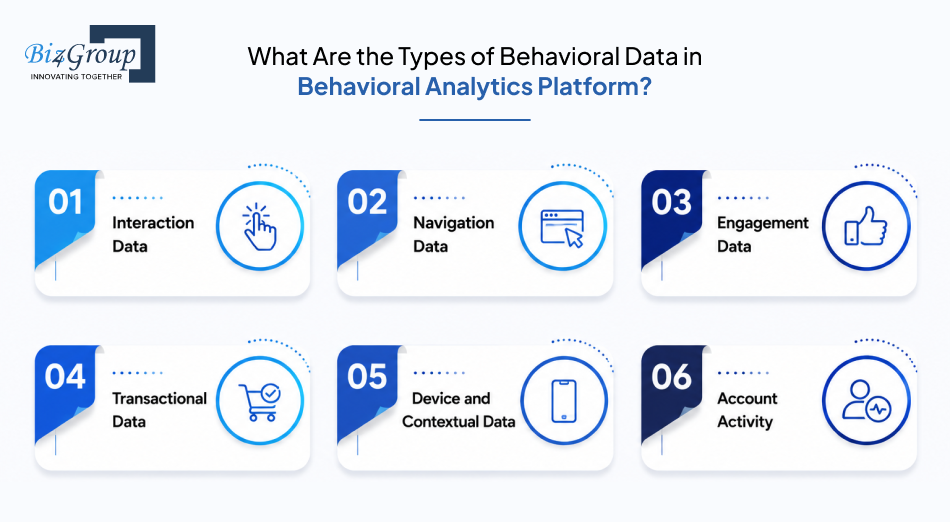
A behavioral analytics platform is only as effective as the data it collects. Every click, search, purchase, or login tells part of the user's story. Individually, these actions provide limited context. When connected over time, they reveal meaningful patterns that help businesses understand user intent, preferences, and engagement.
Most platforms collect behavioral data from multiple touchpoints to create a complete picture of the customer journey. While the exact data varies by industry and business objectives, the following categories form the foundation of behavioral analytics.
1. Interaction Data
Interaction data captures how users engage with a website, mobile application, or digital product. It records the actions users perform while navigating the platform.
This typically includes:
- Clicks and taps
- Scroll depth
- Form submissions
- Searches
- Downloads
- Video plays
These interactions help businesses understand which content or features attract attention and which are being ignored.
2. Navigation Data
Navigation data shows the path users follow as they move through a digital experience. Instead of analyzing isolated actions, it helps businesses understand complete user journeys.
Common examples include:
- Landing pages
- Navigation paths
- Entry and exit pages
- Screen transitions
- User flows
Analyzing navigation patterns helps identify friction points that may prevent users from completing desired actions.
3. Engagement Data
Engagement data measures how actively users interact with a product over time. It helps determine whether users find value in the experience.
Key engagement metrics include:
- Session duration
- Frequency of visits
- Feature adoption
- Time spent on specific pages
- Repeat usage
Strong engagement often indicates that users are successfully finding value in the product or service.
4. Transactional Data
Transactional data captures business-critical actions that directly contribute to revenue or other measurable outcomes.
Examples include:
- Product purchases
- Subscription upgrades
- Renewals
- Cart abandonment
- Payment completion
This data helps organizations understand which behaviors lead to conversions and where customers abandon the buying journey.
5. Device and Contextual Data
User behavior is often influenced by the device, location, or environment in which interactions occur. Contextual data provides additional information that helps explain behavioral patterns.
This may include:
- Device type
- Operating system
- Browser
- Geographic location
- Language
- Referral source
Adding context allows businesses to personalize experiences and optimize performance across different user segments.
6. Account Activity
Account activity captures interactions related to user accounts and authentication. These events provide valuable insights into user engagement, account health, and security.
Typical examples include:
- User registrations
- Logins
- Password resets
- Profile updates
- Preference changes
- Account deletions
Monitoring account activity helps businesses improve user retention while also strengthening fraud detection and account security.
No single behavioral event tells the complete story. A page visit alone offers limited insight, but combining search activity, repeated product views, and an abandoned checkout can reveal strong purchase intent. That's why successful behavioral analytics platforms focus on connecting events into meaningful behavioral journeys rather than analyzing interactions in isolation.
With the basics covered, let's examine the key capabilities of a behavioral analytics platform.
What Are the Essential Components of a Behavioral Analytics Platform?
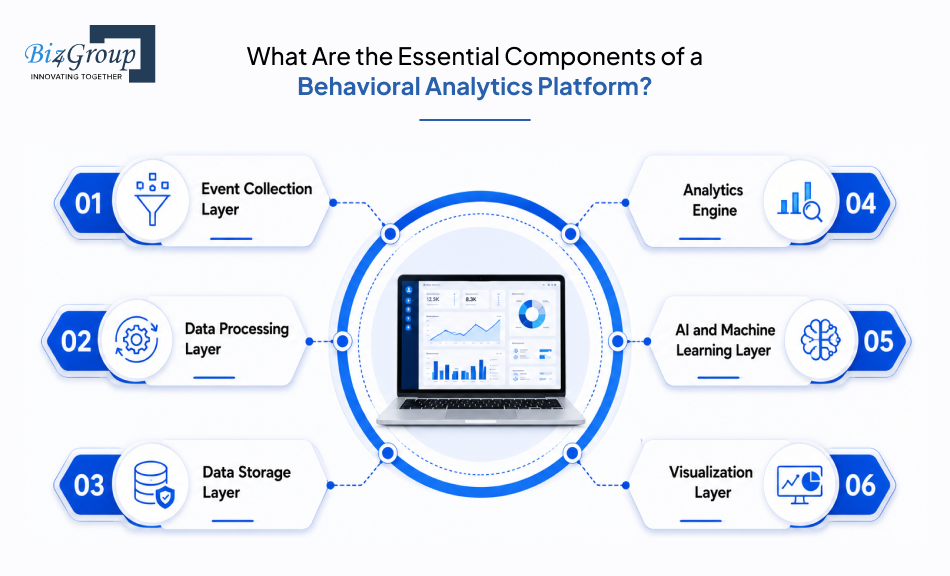
A behavioral analytics platform consists of multiple interconnected components that handle different stages of behavioral data processing. Each component has a specific role, starting from collecting user interactions and ending with presenting meaningful insights.
These components work together as a complete system that converts raw behavioral data into structured information that organizations can analyze and act upon.
1. Event Collection Layer
The event collection layer is the entry point of a behavioral analytics platform. It is responsible for capturing user interactions from different digital touchpoints and converting them into structured events. This layer collects behavioral signals from sources such as websites, mobile applications, software products, APIs, and connected devices.
Its primary responsibilities include:
- Capturing user actions
- Recording event details
- Sending behavioral data to downstream systems
- Maintaining consistency in event formats
Common examples of collected events include clicks, searches, purchases, logins, and feature interactions.
2. Data Processing Layer
The data processing layer is part of the platform that prepares incoming behavioral data for analysis. It cleans, organizes, and transforms raw events into usable datasets.
This layer ensures that collected information is accurate, consistent, and ready for analytics workflows.
Its responsibilities include:
- Validating incoming events
- Removing duplicate records
- Enriching data with additional context
- Organizing events into meaningful structures
Without proper processing, behavioral data can become difficult to analyze and may produce unreliable results.
3. Data Storage Layer
The data storage layer is where processed behavioral data is stored for future analysis and retrieval. It provides the foundation for handling large volumes of user interaction data over time. Organizations may use different storage approaches depending on data volume, access requirements, and analytical needs.
This layer typically manages:
- Historical behavioral records
- User interaction data
- Session information
- Analytical datasets
A well-designed storage layer ensures that teams can access relevant data efficiently when generating insights.
4. Analytics Engine
The analytics engine is the component responsible for examining behavioral data and converting it into meaningful measurements and patterns. It applies analytical methods to identify relationships within user activity and helps teams understand what is happening across their digital platforms.
This component commonly supports:
- Data analysis
- Pattern identification
- Metric calculation
- Report generation
It acts as the interpretation layer between raw behavioral data and business understanding.
5. AI and Machine Learning Layer
The AI and machine learning layer adds intelligence to a behavioral analytics platform by applying advanced AI models to behavioral datasets. This component enables systems to identify complex relationships within user behavior and support advanced analytical capabilities.
It can support areas such as:
- Behavioral classification
- Predictive modeling
- Automated pattern detection
- AI recommendations
This layer becomes especially important for organizations looking to move beyond basic reporting.
6. Visualization Layer
The visualization layer is the presentation component of a behavioral analytics platform. It converts processed analytics into dashboards, reports, and visual interfaces that users can easily understand.
This layer helps different teams access insights in a practical format.
It typically includes:
- Interactive dashboards
- Reports
- Data visualizations
- Monitoring interfaces
Understanding these components provides the foundation for seeing how behavioral analytics platforms are applied in real-world scenarios. Next, let's explore the key use cases where organizations use these platforms to solve business challenges.
Are You Collecting Data or Creating Decisions?
Behavioral data is only valuable when it drives action. Let's build a platform that helps your business do both.
Let's Build It TogetherWhat Are the Practical Applications of Behavioral Analytics Platforms?
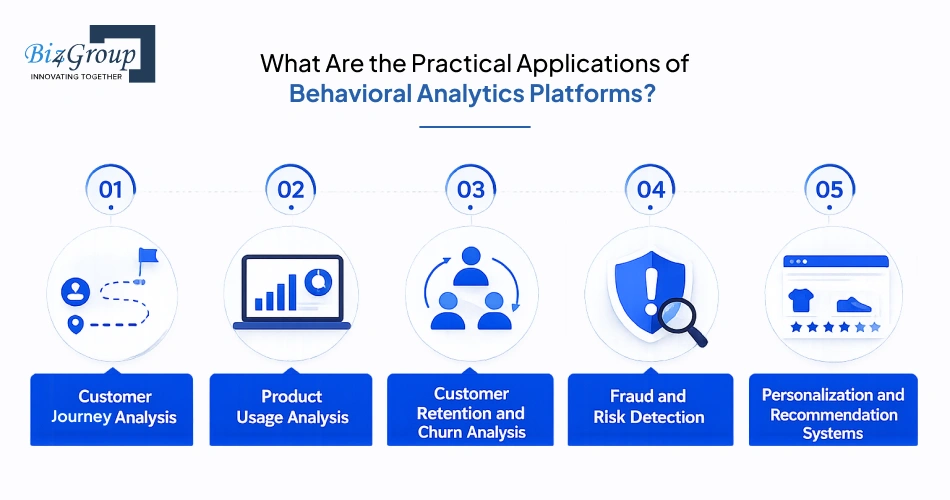
"Which features do customers actually use?", this is the most common questions businesses try to answer using a behavioral analytics platform.
That's exactly where behavioral analytics platforms come in. They help organizations understand user interactions, uncover meaningful behavioral patterns, and apply those insights across product development, marketing, security, and customer experience.
1. Customer Journey Analysis
Customer journey analysis uses behavioral data to understand how users move through different stages of interaction with a business.
A behavioral analytics platform helps organizations examine patterns such as:
- How users discover a product?
- Which touchpoints influence decisions?
- Where users face friction?
- Which actions lead to conversions?
For example, an e-commerce company can analyze browsing behavior, product searches, and checkout activity to identify where customers drop off during the buying process.
2. Product Usage Analysis
Product teams use behavioral analytics to understand how customers interact with software applications and digital products.
Instead of only tracking active users, teams can analyze deeper usage patterns, including:
- Frequently used features
- Features with low adoption
- User engagement trends
- Changes in product usage over time
These insights help product teams identify areas that require improvement and make decisions based on actual user behavior.
3. Customer Retention and Churn Analysis
Behavioral analytics platforms help organizations identify patterns associated with customer engagement and disengagement.
By analyzing changes in user activity, businesses can recognize signals such as:
- Reduced product usage
- Declining engagement frequency
- Lower interaction with important features
- Changes in customer activity patterns
This allows teams to investigate potential retention risks and improve customer engagement strategies.
4. Fraud and Risk Detection
Security teams use behavioral analytics to identify unusual activity that may indicate fraud, account compromise, or policy violations.
The platform analyzes behavioral patterns such as:
- Unusual login locations
- Unexpected access patterns
- Changes in user behavior
- Abnormal transaction activity
This approach helps organizations detect suspicious activity by comparing current behavior with established usage patterns.
5. Personalization and Recommendation Systems
Behavioral analytics supports AI personalization by helping businesses understand individual user preferences and interaction patterns.
Organizations use these insights to improve experiences such as:
- Product recommendations
- Content suggestions
- Customized user journeys
- Targeted engagement campaigns
For example, streaming platforms analyze viewing patterns to recommend content that matches user interests and preferences.
These use cases show how behavioral analytics applies across different business functions. Now, we'll understand the capabilities that make these platforms effective in practice, starting with the core features every platform should include.
What Core Features Should Every Behavioral Analytics Platform Include?
The core features of a behavioral analytics platform define its ability to collect, organize, analyze, and present user behavior data. These capabilities form the foundation of the platform and are essential for organizations that want reliable behavioral insights before adding advanced AI-driven capabilities.
A strong foundation ensures that teams can accurately track user activity, understand engagement patterns, and access meaningful reports. Advanced capabilities such as predictive modeling and autonomous insights build on top of these core functions, but they are not a replacement for the fundamentals.
|
Core feature |
What it does |
Why it matters |
|---|---|---|
|
Event tracking |
Captures user interactions across websites, applications, and digital platforms |
Creates a structured record of user activity for analysis |
|
User identity resolution |
Connects interactions from different sessions and devices to create a unified user profile |
Helps maintain consistency when analyzing user behavior |
|
Session analysis |
Examines individual user sessions, including navigation paths and interaction sequences |
Helps teams understand how users engage during specific visits |
|
User segmentation |
Groups users based on shared characteristics, behaviors, or activity patterns |
Allows teams to analyze different user groups separately |
|
Funnel analysis |
Tracks user progression through predefined steps such as sign-up, onboarding, or checkout flows |
Helps identify where users complete or leave a process |
|
Cohort analysis |
Compares groups of users based on shared attributes or time periods |
Helps measure changes in engagement and retention patterns |
|
Dashboards and reporting |
Presents behavioral data through visual reports and analytics views |
Makes insights easier for teams to monitor and interpret |
|
Data export and integrations |
Allows behavioral data to connect with other business systems |
Supports consistent data usage across different tools and workflows |
These features provide the operational foundation of a behavioral analytics platform. They help organizations collect accurate behavioral data and analyze user activity effectively without relying on complex intelligence layers.
Once these essential capabilities are established, organizations can extend their platforms with AI-powered functions that introduce deeper analysis and automation. The next section explores the advanced features shaping modern AI behavioral analytics solutions.
What Advanced AI Behavioral Analytics Features Should You Consider?
Advanced AI behavioral analytics features add intelligence to behavioral data by helping systems recognize relationships that are difficult to detect through manual analysis.
Core analytics capabilities help organizations understand existing user activity. However, modern platforms are moving beyond historical analysis by using AI to identify complex patterns, generate predictions, and automate decision-making.
These capabilities allow organizations to move from understanding past behavior to preparing for future possibilities.
|
Advanced feature |
What it does |
How it enhances the platform |
|---|---|---|
|
Predictive behavioral modeling |
Uses machine learning models to analyze historical behavior patterns and estimate future outcomes |
Helps identify possible user actions, engagement trends, or risks |
|
AI-powered behavioral clustering |
Uses machine learning algorithms to discover hidden patterns among users based on behavior |
Creates more meaningful behavioral groups beyond predefined categories |
|
Recommendation engines |
Analyzes user preferences and interaction history to suggest relevant actions, products, or content |
Enables personalized experiences across digital platforms |
|
Real-time anomaly detection |
Identifies unusual behavioral patterns that differ from expected activity |
Helps detect potential risks, abnormal usage, or suspicious behavior |
|
Natural language analytics |
Allows users to interact with analytics systems using conversational queries |
Makes behavioral insights accessible without requiring technical expertise |
|
Autonomous insight generation |
Uses AI systems to identify important trends and surface relevant findings automatically |
Reduces manual analysis and helps teams discover overlooked patterns |
These advanced capabilities represent the shift from analytics systems that report information to intelligent platforms that actively help organizations interpret behavioral data. Let's see what kind of tech stack you need to use an accurate behavior analytics platform.
Which Technologies Are Best for Behavioral Analytics Software Development?
Choosing the right technology stack is one of the most important decisions in behavioral analytics software development. The technologies you select influence the platform's scalability, processing speed, maintainability, and ability to support future AI capabilities.
The ideal stack depends on your business requirements, expected data volume, deployment model, and AI maturity. While the exact combination may vary, the technologies below are widely used across modern behavioral analytics platforms.
|
Platform aspect |
Common technologies |
How they're used |
|---|---|---|
|
Frontend development |
React, Angular, Vue.js, Next.js |
Next.js development and more build dashboards, reports, and user interfaces for visualizing behavioral insights. |
|
Backend development |
Node.js, Python, Java, Go, .NET |
Node.js development, Python development and more, develop APIs, business logic, authentication, and communication between platform services. |
|
Event streaming |
Apache Kafka, AWS Kinesis, RabbitMQ, Google Pub/Sub |
Capture, transport, and process behavioral events in real time. |
|
Data processing |
Apache Spark, Apache Flink, Apache Beam |
Clean, transform, enrich, and process large volumes of behavioral data. |
|
Data storage |
PostgreSQL, MongoDB, Cassandra |
Store user profiles, event logs, and operational data. |
|
Data warehouse |
Snowflake, BigQuery, Amazon Redshift, ClickHouse |
Store analytical datasets and support high-speed reporting and large-scale queries. |
|
AI & machine learning |
TensorFlow, PyTorch, Scikit-learn, XGBoost |
Train and deploy models for prediction, classification, and behavioral intelligence. |
|
Data visualization |
Tableau, Power BI, Grafana, Apache Superset |
Present behavioral insights through dashboards, reports, and visual analytics. |
|
Cloud infrastructure |
AWS, Microsoft Azure, Google Cloud |
Host applications, scale infrastructure, and provide managed cloud services. |
|
DevOps & deployment |
Docker, Kubernetes, Terraform, GitHub Actions, Jenkins |
Automate deployment, infrastructure management, and application scaling. |
|
Monitoring & observability |
Prometheus, Grafana, Datadog, ELK Stack |
Monitor application performance, infrastructure health, and system logs. |
Choosing technologies individually is rarely the best approach. Instead, build a technology stack where every component integrates seamlessly with the others and supports your platform's long-term scalability, performance, and maintenance goals.
With the technology stack finalized, the next step is understanding how these platforms are built and what development approach is required to bring these capabilities together.
What If Your Analytics Could Do More Than Report?
Move beyond dashboards and build a platform that predicts behavior, uncovers opportunities, and powers smarter decisions.
Talk to Our ExpertsHow Do You Develop a Behavioral Analytics Platform Step by Step?
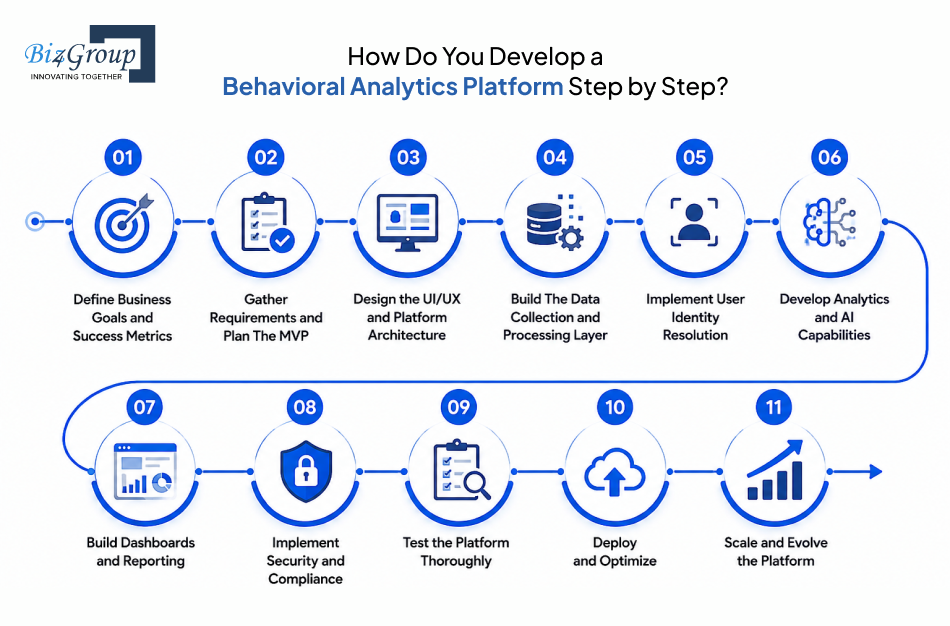
Successful behavioral analytics platform development requires a structured process that aligns business objectives with scalable architecture, reliable data engineering, AI capabilities, and long-term operational planning.
Although every organization has unique requirements, most successful projects follow a similar development lifecycle. The following steps provide a practical roadmap for building a secure, scalable, and future-ready behavioral analytics platform.
1. Define Business Goals and Success Metrics
Defining business goals is the process of identifying what the platform should accomplish and how its success will be measured. Every technical decision made during development should support these objectives.
Before development begins, answer questions such as:
- What business problems will the platform solve?
- Which user behaviors should be analyzed?
- Who will use the platform?
- Which KPIs will define success?
Common KPIs include:
- Customer retention
- Feature adoption
- Conversion rate
- Session engagement
- Customer lifetime value
Establishing measurable goals ensures the platform is built with a clear purpose instead of becoming another reporting tool.
2. Gather Requirements and Plan The MVP
Requirement analysis identifies the functional, technical, and business requirements of the platform, while MVP development planning defines the smallest set of features needed to validate the product before scaling.
Instead of building every capability in the first release, organizations should prioritize features that solve the primary business problem.
An MVP typically includes:
- Event tracking
- User segmentation
- Funnel analysis
- Basic dashboards
- Reporting
Launching with an MVP reduces development risk, accelerates time to market, and provides valuable user feedback before expanding the platform.
3. Design the UI/UX and Platform Architecture
UI/UX design focuses on creating intuitive dashboards and workflows, while architecture design defines how the platform's components communicate, process data, and scale over time.
This stage establishes both the user experience and the technical foundation of the platform.
Key activities include:
- User journey mapping
- Dashboard wireframes
- Information architecture
- System architecture design
- Database planning
- API design
- Scalability planning
Designing both the experience and architecture early reduces costly changes later in development.
4. Build The Data Collection and Processing Layer
The data layer is responsible for collecting, validating, processing, and storing behavioral events generated across digital channels.
This stage forms the backbone of every behavioral analytics platform because every insight depends on reliable behavioral data.
Typical activities include:
- Identifying data sources
- Designing an event taxonomy
- Building event tracking
- Developing data ingestion pipelines
- Data validation
- Data transformation
- Data storage
A well-designed data layer ensures consistent, high-quality behavioral data across the entire platform.
5. Implement User Identity Resolution
Identity resolution is the process of connecting user interactions across multiple devices, browsers, and sessions into a single customer profile.
Without identity resolution, organizations analyze fragmented interactions instead of complete behavioral journeys.
This stage includes:
- Session stitching
- Cross-device identification
- User profile mapping
- Anonymous-to-authenticated user matching
Unified user profiles provide a much more accurate understanding of customer behavior.
6. Develop Analytics and AI Capabilities
Once reliable behavioral data becomes available, the platform can transform that data into meaningful business intelligence.
Depending on project requirements, this stage may include:
- Behavioral analytics
- Predictive analytics
- Recommendation engines
- Churn prediction
- Anomaly detection
- Behavioral clustering
This intelligence layer enables organizations to move beyond descriptive reporting toward proactive decision-making.
7. Build Dashboards and Reporting
Dashboards transform behavioral insights into information that business teams can easily interpret and act upon.
Different stakeholders require different perspectives, so dashboards should be designed according to user roles.
Examples include:
- Executive dashboards
- Product analytics dashboards
- Marketing dashboards
- Operations dashboards
- Security dashboards
Role-based reporting improves adoption and supports faster business decisions.
8. Implement Security and Compliance
Security protects behavioral data throughout its lifecycle, while compliance ensures the platform meets regulatory and industry requirements.
This stage includes:
- Encryption
- Role-based access control
- Consent management
- Audit logging
- Compliance implementation
Embedding security into development reduces long-term operational and regulatory risks.
9. Test the Platform Thoroughly
Testing verifies that every component performs reliably before production deployment.
A comprehensive testing strategy should include:
- Functional testing
- Performance testing
- Security testing
- Data validation
- Scalability testing
- User acceptance testing
Thorough testing improves platform reliability and minimizes production issues.
10. Deploy and Optimize
Deployment makes the platform available to end users, while optimization ensures it continues to perform efficiently as usage grows.
After launch, organizations should continuously monitor:
- Platform performance
- Data quality
- Infrastructure health
- User adoption
- AI model accuracy
Continuous optimization keeps the platform aligned with changing user behavior and business goals.
11. Scale and Evolve the Platform
Behavioral analytics platforms should evolve alongside the business. As user expectations, technologies, and market conditions change, the platform should be enhanced to support new capabilities and use cases.
Future improvements may include:
- Advanced AI models
- Additional integrations
- New behavioral data sources
- Automation capabilities
- Performance enhancements
Treating the platform as an evolving product rather than a one-time project helps maximize its long-term value and return on investment.
Building an intelligent analytics platform is only the beginning. The next priority is ensuring that every behavioral event, customer interaction, and user profile is collected, stored, and processed securely.
How Can You Strengthen the Security of a Behavioral Analytics Platform?
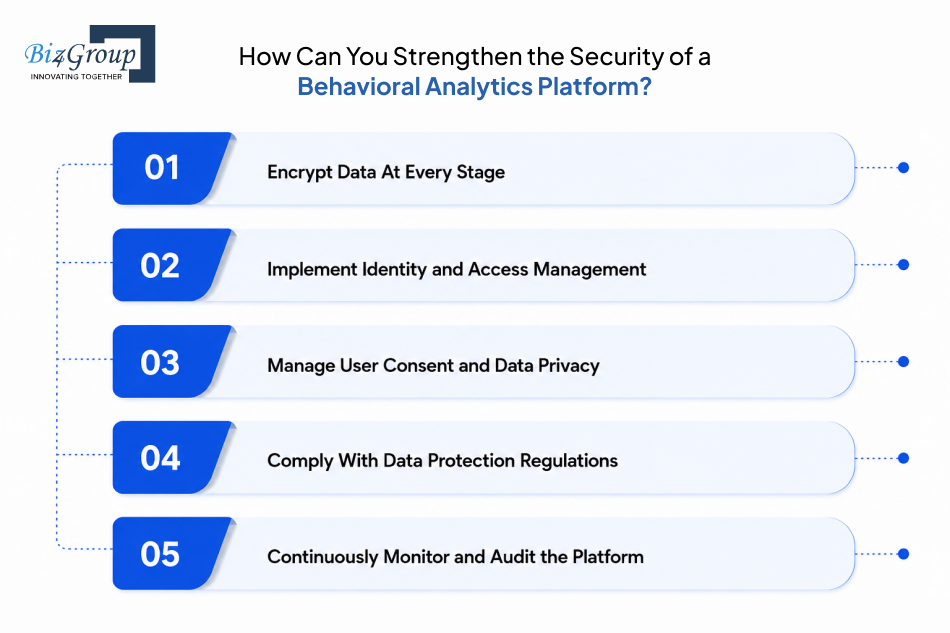
"Can we collect behavioral data without compromising user privacy or regulatory compliance?", as organizations gather more behavioral data, this question has become a top priority for technology leaders.
A behavioral analytics platform handles vast amounts of user interaction data that must be protected against unauthorized access, data breaches, and compliance risks. Building security into the platform from day one helps organizations protect sensitive information while maintaining user trust and meeting evolving regulatory requirements.
1. Encrypt Data At Every Stage
Data encryption is the process of converting readable information into an unreadable format that can only be accessed with the correct encryption key.
Behavioral data should be encrypted:
- During transmission between systems
- While stored in databases and data warehouses
- During backups and archival
This reduces the risk of exposing sensitive information if data is intercepted or compromised.
2. Implement Identity and Access Management
Identity and access management (IAM) controls who can access the platform and what actions they are allowed to perform.
Instead of giving every user the same permissions, organizations should implement role-based access control.
Typical roles include:
- Platform administrators
- Product managers
- Data analysts
- Marketing teams
- Security teams
Applying the principle of least privilege ensures users can only access the information required for their responsibilities.
3. Manage User Consent and Data Privacy
Consent management is the process of collecting, recording, and honoring user permissions for data collection and processing.
Behavioral analytics platforms should provide mechanisms to:
- Capture user consent
- Allow users to withdraw consent
- Manage cookie preferences
- Process data deletion requests
- Maintain consent records
These practices help organizations meet privacy obligations while maintaining user trust.
4. Comply With Data Protection Regulations
Regulatory compliance ensures the platform handles personal and behavioral data according to applicable legal requirements.
Depending on the region and industry, organizations may need to comply with regulations such as:
- GDPR
- CCPA
- HIPAA compliance
- SOC 2
- ISO/IEC 27001
Compliance requirements often influence how data is collected, stored, shared, and retained.
5. Continuously Monitor and Audit the Platform
Security monitoring is the ongoing process of tracking platform activity to identify suspicious behavior, operational issues, or policy violations.
A comprehensive monitoring strategy should include:
- Audit logs
- User activity tracking
- Security alerts
- Failed authentication monitoring
- System health monitoring
Regular audits also help verify that security controls remain effective as the platform evolves.
Strong security creates a trusted foundation for behavioral analytics, but the real value of the platform lies in the outcomes it delivers.
Still Guessing What Your Users Want?
Your users are already telling you through their actions. The right behavioral analytics platform helps you listen and respond.
Start the ConversationWhat Are the Key Benefits of Behavioral Analytics Platform Development?
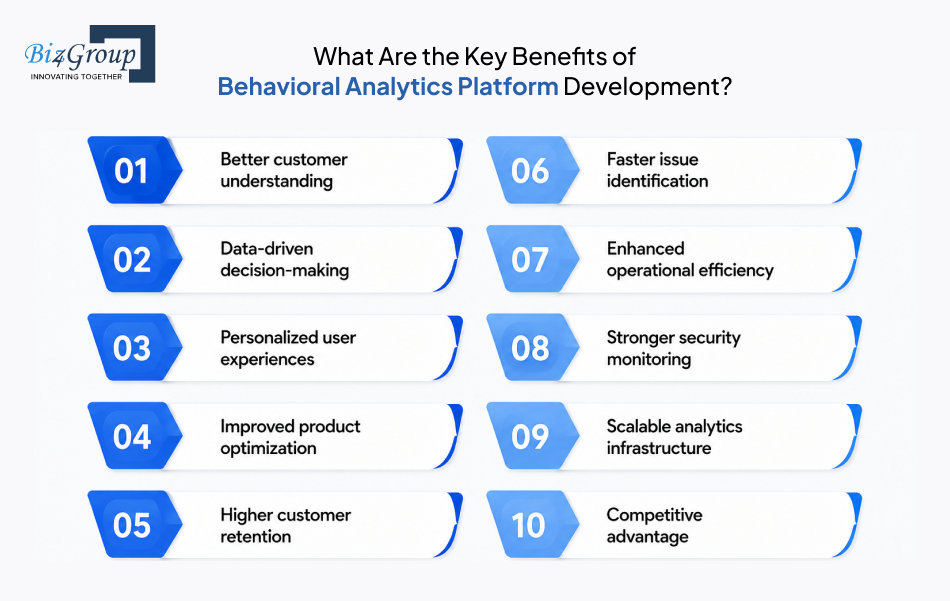
Investing in behavioral analytics platform development enables organizations to transform user interactions into meaningful business intelligence. Instead of relying on isolated metrics or assumptions, teams gain a clearer understanding of user behavior, enabling faster decisions and more effective digital strategies.
The value of a behavioral analytics platform extends beyond customer insights. It supports multiple business functions, including AI product development, marketing, operations, customer success, and security.
|
Benefit |
Business impact |
|---|---|
|
Better customer understanding |
Provides a deeper understanding of user preferences, engagement patterns, and digital interactions to support more informed business decisions. |
|
Data-driven decision-making |
Helps teams make strategic decisions using behavioral data instead of assumptions or fragmented reports. |
|
Personalized user experiences |
Enables organizations to deliver relevant content, product recommendations, and customer journeys based on behavioral insights. |
|
Improved product optimization |
Identifies opportunities to refine digital products by analyzing how users interact with features and workflows. |
|
Higher customer retention |
Helps businesses recognize changes in user engagement and improve retention strategies before customers disengage. |
|
Faster issue identification |
Reveals friction points and unusual behavioral patterns, allowing teams to investigate problems more quickly. |
|
Enhanced operational efficiency |
Centralizes behavioral data, reducing manual analysis and improving collaboration across business teams. |
|
Stronger security monitoring |
Supports early identification of suspicious user activity and unusual access patterns. |
|
Scalable analytics infrastructure |
Provides a foundation that can accommodate growing user bases, larger datasets, and evolving business requirements. |
|
Competitive advantage |
Enables organizations to respond more effectively to changing customer behavior and market dynamics through continuous behavioral insights. |
Organizations that invest in a well-designed behavioral analytics platform gain more than visibility into user activity. They build a reliable foundation for improving customer experiences, supporting strategic decisions, and adapting to changing business needs with confidence.
Next, let's examine the most common challenges and how they affect implementation.
What Challenges Arise During Behavioral Analytics Platform Development?
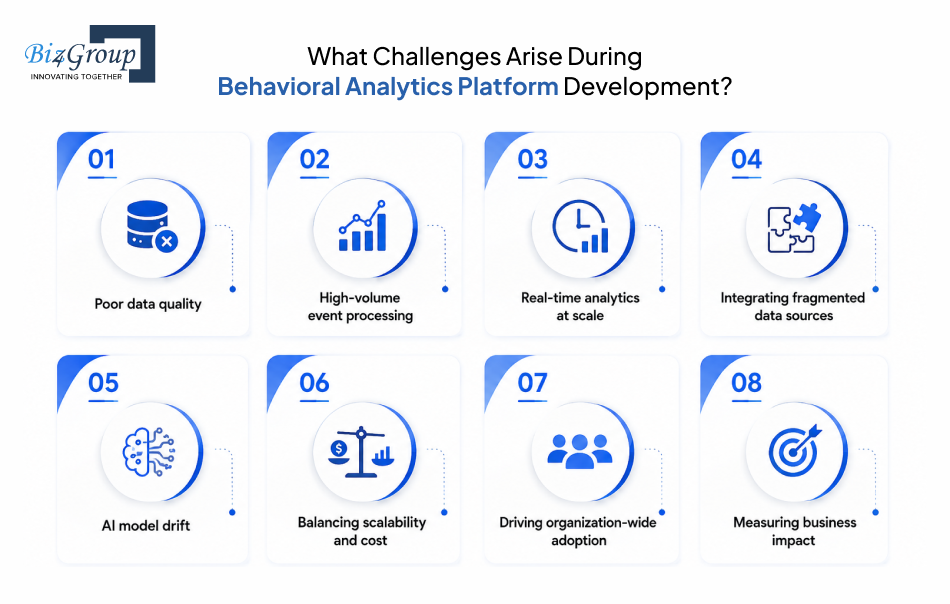
Despite its advantages, behavioral analytics platform development comes with several technical, operational, and organizational challenges. As platforms scale, managing large volumes of behavioral data while maintaining performance, accuracy, and compliance becomes increasingly complex.
Identifying these challenges early allows organizations to plan appropriate mitigation strategies and reduce implementation risks.
|
Challenge |
Why it matters |
Recommended approach |
|---|---|---|
|
Poor data quality |
Incomplete, inconsistent, or duplicate behavioral events reduce the accuracy of analytics and reporting. |
Standardize event definitions, validate incoming data, and perform regular quality checks. |
|
High-volume event processing |
Processing millions of behavioral events can strain infrastructure and slow down analytics. |
Design scalable data pipelines and use distributed processing frameworks. |
|
Real-time analytics at scale |
Delivering low-latency insights becomes more difficult as user traffic and event volumes increase. |
Adopt event-driven architectures and optimize streaming workflows. |
|
Integrating fragmented data sources |
Behavioral data is often spread across websites, mobile apps, CRM platforms, and third-party systems. |
Build standardized APIs and integration pipelines to maintain consistent data flow. |
|
AI model drift |
Changes in user behavior can reduce the accuracy of machine learning models over time. |
Continuously monitor, retrain, and validate models using recent behavioral data. |
|
Balancing scalability and cost |
Expanding infrastructure to support growing data volumes can significantly increase operational expenses. |
Use cloud auto-scaling, storage lifecycle policies, and resource optimization strategies. |
|
Driving organization-wide adoption |
Different teams may struggle to interpret or consistently use behavioral insights. |
Establish governance policies, role-based dashboards, and user training programs. |
|
Measuring business impact |
Without clear KPIs, it becomes difficult to evaluate the platform's effectiveness and ROI. |
Define measurable business objectives before development and track them continuously. |
Every behavioral analytics platform will encounter technical and operational challenges. The difference lies in how early they're anticipated and how effectively they're addressed during development.
Let's explore the best practices that help organizations build platforms designed for long-term success rather than short-term fixes.
What Are the Best Practices for Successful Behavioral Analytics Platform Development?
Building a feature-rich platform is only part of the process. Long-term success depends on how well the platform is designed, maintained, and aligned with business objectives. Following proven best practices helps improve data reliability, platform performance, user adoption, and future scalability.
The following practices can help organizations maximize the value of behavioral analytics platform development projects.
|
Best practice |
Why it matters |
How to implement it |
|---|---|---|
|
Start with a focused use case |
Prevents overengineering and accelerates adoption. |
Solve one high-value business problem before expanding platform capabilities. |
|
Build modular services |
Makes future enhancements easier without affecting the entire platform. |
Separate data collection, processing, analytics, and visualization into independent services. |
|
Treat behavioral data as a product |
Encourages consistency and long-term data quality. |
Define data ownership, documentation, and governance standards. |
|
Continuously validate behavioral insights |
User behavior changes over time and assumptions may become outdated. |
Regularly compare analytics findings with real business outcomes. |
|
Design for interoperability |
Analytics platforms rarely operate in isolation. |
Use APIs and standardized data formats to simplify integrations. |
|
Prioritize user adoption |
Even powerful analytics platforms fail if teams don't use them. |
Build intuitive dashboards and provide role-specific views. |
|
Establish strong governance |
Clear ownership improves accountability and consistency. |
Define responsibilities for data quality, security, and platform maintenance. |
|
Review platform performance regularly |
Business needs evolve continuously. |
Conduct periodic architecture, performance, and scalability reviews. |
Adopting these practices helps organizations build platforms that remain reliable, scalable, and adaptable as user behavior, business priorities, and technology continue to evolve.
With implementation best practices covered, the next logical question is often the one every stakeholder asks first, how much does it actually cost to build a behavioral analytics platform?
How Much Does Behavioral Analytics Platform Development Cost in 2026?
"How much does it actually cost to build a behavioral analytics platform?", it's one of the first questions founders, CTOs, and product leaders ask before starting development.
The answer depends on several factors, including platform complexity, AI capabilities, integration requirements, compliance needs, and the volume of behavioral data being processed. In most cases, behavioral analytics platform development costs range from $40,000 for an MVP to $500,000+ for an enterprise-grade solution with advanced AI, real-time analytics, and large-scale integrations.
Understanding what drives these costs is far more valuable than focusing on a single price tag, as every platform is built around different business goals and technical requirements.
|
Development scope |
Estimated cost (USD) |
Estimated timeline |
Suitable for |
|---|---|---|---|
|
MVP platform |
$40,000 to $80,000 |
2-4 weeks |
Startups, PoCs, and early-stage products |
|
Mid-scale platform |
$80,000 to $180,000 |
4-6 weeks |
Businesses expanding across multiple digital channels |
|
Enterprise platform |
$180,000 to $500,000+ |
6-8+ weeks |
Organizations requiring AI, real-time analytics, enterprise integrations, and high scalability |
These estimates represent custom development costs. Actual budgets vary depending on project scope, development location, infrastructure choices, compliance requirements, and third-party services.
What Factors Affect the Development Cost Behavioral Analytics Platform?
Several factors contribute to the overall cost of behavioral analytics platform development. Understanding their impact helps businesses allocate budgets more effectively and prioritize investments that deliver the greatest long-term value.
|
Cost factor |
Impact on budget |
Estimated share of total cost |
|---|---|---|
|
Platform complexity |
More modules, workflows, and custom capabilities require additional engineering effort. |
20% to 25% |
|
AI capabilities |
Predictive analytics, recommendation engines, and anomaly detection increase development complexity. |
15% to 20% |
|
Data source integrations |
Connecting websites, mobile apps, CRM, ERP, APIs, and third-party platforms requires additional implementation effort. |
10% to 15% |
|
Real-time processing |
Low-latency event streaming and processing demand more sophisticated infrastructure. |
10% to 15% |
|
UI/UX and dashboards |
Interactive dashboards, reporting interfaces, and data visualization require dedicated frontend development. |
8% to 12% |
|
Security and compliance |
Encryption, access controls, auditing, and regulatory compliance add engineering effort. |
8% to 12% |
|
Cloud infrastructure setup |
Initial cloud provisioning, networking, storage, and deployment environments contribute to implementation costs. |
8% to 10% |
|
Testing and deployment |
Functional, performance, security, and user acceptance testing ensure production readiness. |
5% to 8% |
What are the Hidden Costs to Consider for Behavioral Analytics Platform Development?
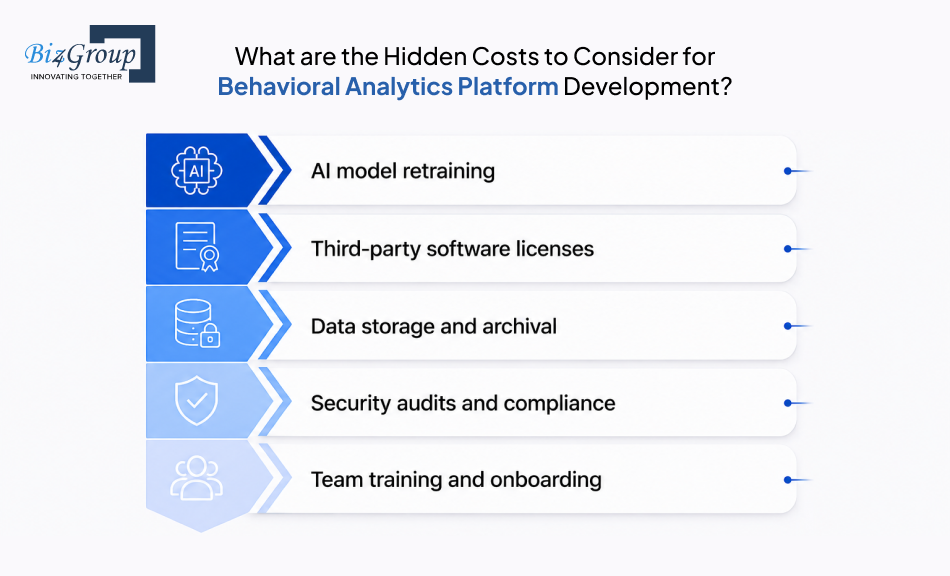
The initial development budget is only part of the overall investment. Once the platform is deployed, organizations must account for recurring operational expenses that support performance, scalability, and long-term reliability.
|
Hidden cost |
Estimated annual cost |
Why it matters |
|---|---|---|
|
Cloud infrastructure scaling |
$12,000 to $120,000+ |
Compute, storage, and bandwidth costs increase as behavioral data grows. |
|
Platform maintenance and upgrades |
$8,000 to $75,000+ per year |
Covers bug fixes, feature enhancements, framework updates, and performance improvements. |
|
$10,000 to $50,000 |
Machine learning models require regular retraining to maintain prediction accuracy. |
|
|
Third-party software licenses |
$5,000 to $60,000 |
Analytics, monitoring, security, and integration platforms often require recurring subscriptions. |
|
Data storage and archival |
$5,000 to $50,000 |
Historical behavioral data must be retained for reporting, compliance, or future analysis. |
|
Security audits and compliance |
$8,000 to $40,000 |
Periodic audits help maintain regulatory compliance and reduce security risks. |
|
Team training and onboarding |
$2,000 to $20,000 |
Teams need continuous training to maximize platform adoption and efficiency. |
What are the Cost Optimization Strategies for Behavioral Analytics Platform Development?
Reducing development costs doesn't mean compromising platform quality. The goal is to invest where it creates the most value while eliminating unnecessary engineering effort and operational expenses.
- Start with an MVP to validate business requirements before investing in advanced AI capabilities and enterprise-scale infrastructure. This approach can reduce initial development costs by 20% to 40%.
- Prioritize high-impact features that deliver immediate business value instead of building every capability in the first release. Focusing on essential features can lower development costs by 10% to 20%.
- Use managed cloud services to minimize infrastructure management, maintenance overhead, and operational complexity. Organizations can typically save 15% to 30% on infrastructure-related expenses by adopting managed cloud offerings.
- Adopt a modular architecture so new capabilities can be added without redesigning the entire platform. This development approach can reduce future enhancement costs by 10% to 25%.
- Reuse existing APIs and integrations whenever possible instead of developing custom connectors from scratch. Leveraging existing integrations can lower implementation costs by 5% to 15%.
- Continuously optimize cloud resources by monitoring infrastructure usage, removing idle resources, and scaling services based on demand. Effective cloud optimization can reduce recurring operational costs by 15% to 35%.
Understanding the financial investment helps organizations plan more effectively. The final decision, however, isn't just about cost. It's about choosing the right implementation strategy, which we'll explore next by comparing whether you should build, buy, or partner for your behavioral analytics platform.
Your Users Leave Clues. Are You Following Them?
Every interaction is a signal. Turn scattered behavioral data into decisions that improve products, experiences, and growth.
Build Your PlatformShould You Build, Buy, or Partner for a Behavioral Analytics Platform?
Choosing the right implementation approach is just as important as selecting the right technology stack. The best option depends on your business goals, available resources, budget, timeline, and the level of customization your platform requires.
The following comparison can help you determine which approach best aligns with your organization's needs.
|
Approach |
Best suited for |
Key advantages |
|---|---|---|
|
Build |
Organizations with unique business requirements and a skilled in-house engineering team |
Complete ownership, full customization, greater flexibility, and long-term scalability |
|
Buy |
Businesses looking for rapid deployment with standard analytics requirements |
Faster implementation, lower upfront investment, vendor support, and ready-to-use capabilities |
|
Partner |
Organizations seeking a custom solution without investing in an in-house development team |
Access to specialized expertise, faster time to market, reduced development risk, end-to-end support, and a scalable solution tailored to business needs |
Why Choose Biz4group as Your Development Partner?
By this stage, you already know that building a behavioral analytics platform is a complex undertaking. It involves AI, data engineering, cloud infrastructure, security, and scalable product architecture. The bigger question is: who can bring all of these pieces together?
That's where Biz4Group comes in. Instead of only building software, Biz4Group, a leading AI development company in USA, focuses on developing AI-powered products that solve real business problems. With experience of working with 500+ global clients, the team has partnered with startups, SMBs, and enterprises to transform ideas into intelligent, scalable digital products.
- AI-first product engineering. Build intelligent platforms powered by AI agents, predictive analytics, and automation.
- Behavioral analytics expertise. Design scalable platforms for real-time event tracking, user behavior analysis, predictive insights, and data-driven decision-making.
- End-to-end development. From product strategy and architecture to deployment, optimization, and long-term support.
- Enterprise-grade delivery. Leverage decades of enterprise technology expertise to build secure, scalable, and future-ready AI solutions.
- Trusted technology ecosystem. Experience working with industry leaders like Google and Adobe while following enterprise development best practices.
Connect with us to choose the right implementation approach to lay the foundation for long-term success.
Next, let's explore the future of behavioral analytics platforms and the trends shaping their evolution in 2026 and beyond.
What Is the Future of Behavioral Analytics Platforms?
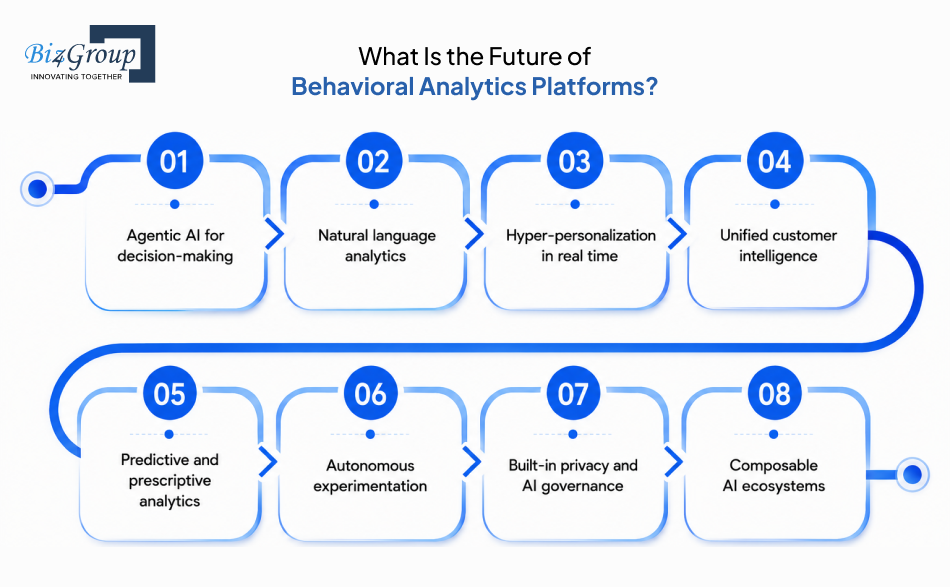
Behavioral analytics platforms are moving toward becoming autonomous, context-aware, and privacy-preserving intelligence systems. Future platforms will not only analyze user behavior but will continuously adapt, reason, and support business decisions with minimal manual intervention.
Organizations planning behavioral analytics platform development should consider these upcoming shifts when designing their long-term strategy.
|
Future capability |
What it means for behavioral analytics platforms |
|---|---|
|
Agentic AI for decision-making |
Agentic AI will move beyond recommending actions to autonomously creating user segments, launching experiments, optimizing journeys, and triggering workflows with human approval. |
|
Natural language analytics |
Business users will interact with behavioral analytics platforms using conversational prompts instead of manually building dashboards or SQL queries. |
|
Hyper-personalization in real time |
Platforms will personalize content, pricing, recommendations, and user journeys instantly based on live behavioral signals. |
|
Unified customer intelligence |
Behavioral data from websites, mobile apps, IoT devices, CRM systems, and offline interactions will merge into a single customer profile for more accurate insights. |
|
Predictive and prescriptive analytics |
Platforms will not only predict user behavior but also recommend the best actions to improve conversions, retention, and customer lifetime value. |
|
Autonomous experimentation |
AI will continuously run, evaluate, and optimize A/B tests without requiring manual configuration from product teams. |
|
Built-in privacy and AI governance |
Future platforms will include automated consent management, explainable AI, bias detection, and compliance monitoring by default. |
|
Composable AI ecosystems |
Behavioral analytics platforms will seamlessly integrate with AI agents, CDPs, CRM systems, marketing automation, and enterprise applications through APIs and orchestration layers. |
The next generation of AI behavioral analytics platforms will likely move from passive observation toward active intelligence. Businesses that design flexible architectures today will be better prepared to adopt these capabilities as technology matures.
Looking Ahead
Your users are already telling you what's working, what's broken, and what they expect next. The real question is whether your business has the right platform to understand those signals and act on them.
That's exactly what successful behavioral analytics platform development enables. When built with scalable architecture, AI-driven intelligence, and a clear product strategy, it becomes more than an analytics solution. It becomes the foundation for smarter decisions, better customer experiences, and sustainable business growth.
Developing such a platform requires the right blend of domain expertise, AI capabilities, and engineering excellence. Biz4Group LLC has helped businesses build intelligent digital solutions that solve complex operational challenges. Our team delivers end-to-end development tailored to each organization's unique requirements.
Ready to build a behavioral analytics platform that delivers real business value? Partner with us to create a secure, scalable, and AI-powered solution that turns behavioral data into smarter decisions, better customer experiences, and sustainable business growth.
Frequently Asked Questions
1. What industries benefit the most from a behavioral analytics platform?
Behavioral analytics platforms are widely used in e-commerce, healthcare, fintech, banking, SaaS, retail, logistics, education, gaming, and telecommunications. Any industry that collects digital user interactions can leverage behavioral analytics to improve customer experiences, optimize operations, and support data-driven decision-making.
2. How long does it take to develop a behavioral analytics platform?
Development timelines depend on the project's complexity. An MVP typically takes 2-4 weeks, a mid-scale platform requires 4-6 weeks, while an enterprise-grade solution with AI capabilities and multiple integrations can take 6-8+ weeks.
3. Can a behavioral analytics platform integrate with existing business systems?
Yes. Modern behavioral analytics platforms can integrate with CRM systems, ERP software, CDPs, marketing automation tools, data warehouses, customer support platforms, and third-party APIs to create a unified view of user behavior.
4. How much does it cost to build a behavioral analytics platform?
The development cost varies based on scope and complexity. An MVP generally costs $40,000 to $80,000, a mid-scale platform ranges from $80,000 to $180,000, and an enterprise-grade solution with AI-powered capabilities can cost $180,000 to $500,000+. Ongoing costs such as cloud infrastructure, maintenance, and AI model optimization should also be considered.
5. Can small businesses use behavioral analytics platforms?
Absolutely. Small businesses often start with an MVP focused on essential analytics capabilities and gradually expand the platform as user data, business requirements, and budgets grow.
6. What metrics should businesses track in a behavioral analytics platform?
Some of the most valuable metrics include customer retention rate, feature adoption, session duration, conversion rate, churn rate, customer lifetime value (CLV), user engagement, and funnel completion rate. The right metrics depend on your business goals.
7. What's the difference between customer analytics and behavioral analytics?
Customer analytics evaluates overall customer performance using demographic, transactional, and engagement data. Behavioral analytics focuses specifically on how users interact with digital products and services to identify behavioral patterns and support more informed decisions.
8. Can a behavioral analytics platform support real-time decision-making?
Yes. Modern platforms process behavioral events in real time, enabling businesses to detect anomalies, personalize user experiences, trigger automated workflows, and respond quickly to changing user behavior.
9. What skills are required to build a behavioral analytics platform?
Developing a behavioral analytics platform typically requires expertise in data engineering, backend development, cloud architecture, AI and machine learning, frontend development, DevOps, cybersecurity, and data visualization.
10. How do you choose the right behavioral analytics development partner?
Choose a partner like Biz4Group with expertise in AI, behavioral analytics, and enterprise software development. The right team should be able to build scalable platforms, integrate complex data ecosystems, ensure security and compliance, and support your product from strategy to deployment and beyond.
