 Location :
Orlando, FL, USA
Location :
Orlando, FL, USA +1 (407) 714-1616
 info@biz4group.com

- Building AI intellectual property management software helps legal teams manage complex portfolios with automation, accurate research, and reliable compliance controls.
- Understanding what AI IP platforms offer shows why companies develop AI intellectual property management software or create AI IP management system tools to centralize data and streamline filings.
- Real use cases include semantic prior art search, global trademark alerts, AI driven due diligence, and AI IP compliance and documentation support across jurisdictions.
- Core and advanced features such as dashboards, routing, AI drafting, predictive analytics, and monitoring form the backbone of scalable AI IP portfolio management software development.
- Costs range from $30,000 to $200,000 plus, and partnering with Biz4Group, a proven leader in legal and AI development, helps you successfully build AI intellectual property management software with secure architecture and custom automation.
You have probably felt the pressure that comes with managing a growing IP portfolio. New inventions increase every quarter. Filing rules shift. Deadlines stack up. Your team still deals with scattered spreadsheets, manual searches, and tools that slow everything down.
If this sounds familiar, you are not the only one dealing with it. Many legal teams feel buried under admin tasks that should not take this much time. Even experienced IP attorneys lose hours every week to routine docketing, document tracking, and compliance checks.
You deserve a smoother process. Your team deserves systems that help you work smarter, not harder.
The need is also rising. Global patent filings reached 3.7 million applications in 2024, a rise of almost 5 percent from the previous year
Patent grants climbed to about 2.1 million worldwide, another year over year increase
More filings mean more complexity, more data to analyze, and more chances for missed deadlines or costly errors.
This is exactly why so many teams are starting to build AI intellectual property management software that can reduce manual work and improve accuracy. When you lean into solutions built to automate and streamline, you gain more control over filings, renewals, research, and portfolio strategy. You also open the door to features that traditional IP tools simply cannot match.
Whether you want to develop AI intellectual property management software, create AI IP management system capabilities, or adopt advanced monitoring tools, you are moving in the right direction. This guide helps you understand the full process, the features that matter, the challenges to expect, and how to approach each step with confidence.
If you prefer a trusted partner to help shape or build your solution, working with an experienced legal software development company can save significant time and reduce risk.
Let’s walk through this together.
Global patent filings hit 3.7 million in the last year and IP related disputes continue to rise. Now is the smartest time to modernize your operations and build AI driven systems that help you stay ahead.
Accelerate My IP TransformationWhat AI Intellectual Property Management Software Is and Why It Is a Game Changer for Legal Teams?
If you handle patents, trademarks, or copyrights regularly, you already know how messy the process can get. Documents sit in different locations. Deadlines sneak up on you. Prior art searches take hours. Even simple updates require several tools and too many steps.
This is where AI intellectual property management software makes a real difference.
AI intellectual property management software is a centralized platform that uses smart automation and machine learning to help you organize, track, analyze, and protect your IP assets. When you choose to build AI intellectual property management software, you create a system that understands complex filings, identifies important deadlines, reviews documents, and connects your entire portfolio in one place.
In simple terms, this software helps your team work faster, manage risk more effectively, and maintain stronger control over growing IP workloads.
Why legal teams rely on it today?
You are not dealing with the same level of IP demand you were dealing with a few years ago. Innovation cycles are shorter. Filing volumes are higher. The pressure to move quickly is stronger. When you choose to develop AI intellectual property management software, you empower your team with tools that make daily responsibilities easier and far more accurate.
Here are a few reasons it has become essential:
- It reduces time spent on repetitive tasks.
- It helps you avoid missed filings or renewal deadlines.
- It supports deeper research through semantic and concept based search.
- It improves collaboration between legal, R&D, and executive teams.
- It strengthens compliance with complex filing rules.
- It gives you a clearer view of risk across your portfolio.
This becomes even more powerful when teams decide to create AI IP management system functions for internal operations. You can shape workflows that fit your process, not someone else's template. You can also expand capabilities over time, such as adding tools that help you build AI trademark monitoring platform features for ongoing surveillance and early warnings.
If your organization already uses multiple tools or databases, connecting everything through strong system links can be a major advantage. Many teams tackle this by adopting professional AI integration services to make sure all data flows cleanly into one reliable platform.
As we move forward, you will learn how these systems work, which features matter most, and how you can build your own solution from the ground up using the right strategy and technology.
Real Use Cases That Show How Companies Develop AI Intellectual Property Management Software for Modern Operations
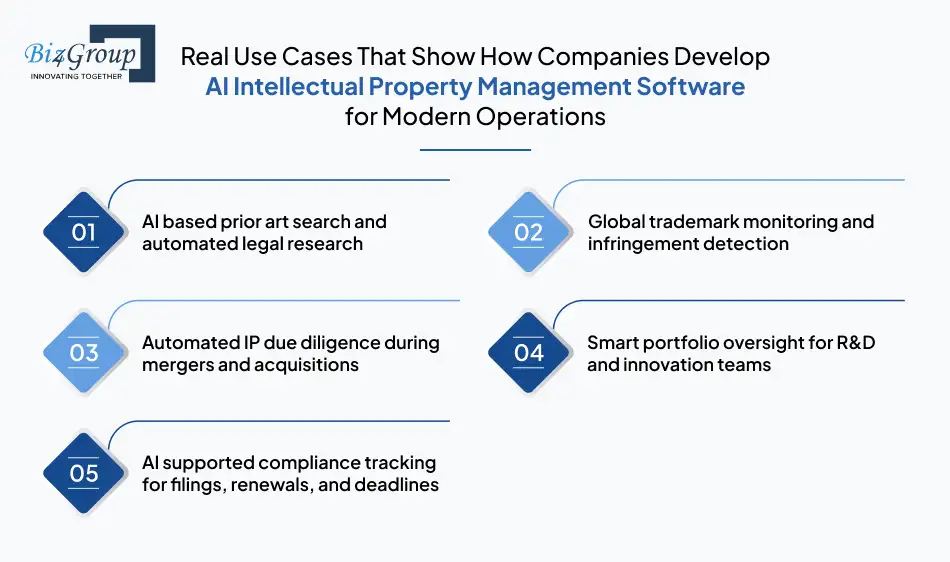
Once you understand the value of AI in IP management, the next step is to see how it actually works in real situations. When organizations choose to develop AI intellectual property management software, they usually start with specific pain points they want to eliminate. Here are the most common and most impactful use cases, each explained with examples, so you can picture how they work in your environment.
1. AI based prior art search and automated legal research
Traditional prior art searches take hours. You manually compare claims, review old filings, and verify technical details. It drains your time and still leaves a margin for error.
When you build AI intellectual property management software, your platform can scan millions of global filings in seconds. Instead of matching only keywords, it recognizes ideas, concepts, and relationships between inventions.
Example:
Your team is preparing a new patent application for a medical device. Instead of manually reviewing 500 references, your system identifies the top 15 most relevant documents and explains why they matter. This speeds up strategy and improves claim clarity.
If you depend heavily on research workflows, you can also rely on an intelligent AI legal research platform to strengthen accuracy and reduce hours spent on review.
2. Global trademark monitoring and infringement detection
Monitoring trademarks across countries is difficult, especially when each registry uses different formats, languages, and rules. AI solves this by continuously scanning trademark databases and online sources for similar marks.
Example:
You create a new product name. Your AI system checks global registries, ecommerce listings, and social platforms, then alerts you if a similar mark appears in a new filing. This gives you time to evaluate conflict and prepare your response.
When organizations create AI IP management system features that handle trademark watch lists automatically, they avoid costly disputes and protect branding proactively.
3. Automated IP due diligence during mergers and acquisitions
During acquisitions, reviewing thousands of IP assets is overwhelming. Buyers want a clear view of ownership, renewals, licensing rights, and potential disputes. Manual review often takes weeks.
AI due diligence tools change this dramatically.
Example:
Your company is acquiring a startup with 140 patents. Your AI system analyzes all assets, checks their statuses, identifies renewal risks, and highlights any disputed ownership. This helps your legal team finalize decisions faster and with more confidence.
This is a major reason enterprise choose to create AI driven IP due diligence and risk assessment platform capabilities inside their IP systems.
4. Smart portfolio oversight for R&D and innovation teams
Your legal team may handle the filings, but R&D carries out the innovation pipeline. When there is no shared visibility, delays and misalignment become common.
AI supported dashboards to help both teams operate on the same page.
Example:
Your R&D team uploads a new invention disclosure. The system compares it with existing filings, identifies potential overlaps, and suggests whether it is patentable. Legal sees this instantly, reducing delay and improving collaboration.
Companies that build AI intellectual property management software often view this as one of the most valuable benefits.
5. AI supported compliance tracking for filings, renewals, and deadlines
Deadlines are unforgiving. Missing one can cost you protection or lead to penalties. AI solves this by tracking every date, rule, jurisdiction requirement, and renewal window.
Example:
Your team manages filings across the United States, Europe, and Asia. Instead of manually checking each jurisdiction, your system reminds you about upcoming filings and highlights documents that need review. Risk becomes far easier to manage.
Organizations often choose to make AI IP compliance and documentation system capabilities a top priority during development because it eliminates one of the biggest sources of stress.
Core Features You Need When You Create an AI IP Management System for Corporate Legal Teams
When you decide to create AI IP management system tools for your organization, the foundation matters just as much as any advanced intelligence layer. These essential capabilities support stronger workflows, cleaner documentation, and the long-term flexibility you need as you continue to build AI intellectual property management software tailored to your legal team.
Below are the must-have components every strong platform should include.
1. Centralized IP repository with secure access controls
A unified repository stores patents, trademarks, copyrights, trade secrets, and invention of disclosures in one place. This reduces scattered files and improves organization across teams. When you develop AI intellectual property management software, this central hub becomes the anchor point for every workflow inside your system.
2. Automated docketing and renewal management
Docketing is one of the most time-consuming tasks in IP operations. Automated tracking handles deadlines, filing dates, maintenance fees, office actions, and renewal cycles without manual effort. Many teams choose to make AI powered patent management software specifically to reduce human error and avoid missing critical milestones.
3. Document storage with metadata extraction and searchable archives
AI can read documents, extract metadata, and classify files based on claims, technology categories, inventors, and jurisdictions. This makes your file library searchable and far easier to manage. This is a key benefit when you make an AI intellectual property software with document automation for faster research and cleaner organization.
4. Workflow routing for filings, office actions, and assignments
IP tasks move through several stages. Smart routing automatically sends drafts, reviews, and approvals to the right person. It ensures that no one loses track of responsibilities. This feature becomes essential when businesses create an AI legal IP management solution that supports high volume activity.
5. Portfolio dashboards that improve visibility and decision making
Dashboards show the health of your IP portfolio at a glance. They highlight risks, upcoming deadlines, active applications, and distributions across markets and categories. This is especially useful when you develop AI patent search and analysis software that needs to translate insights into actionable visuals for attorneys and executives.
6. User roles and permission controls for secure collaboration
Different teams require different levels of access. Role based permissions ensure that sensitive filings or confidential inventions are only visible to the people who need them. This becomes even more important as you build AI intellectual property management software that stores pre-filing innovations and confidential materials.
7. Integration with legal, R&D, and enterprise systems
Your IP system should communicate with the tools your organization already uses. Integrating invoices, research data, contract systems, billing platforms, and inventor portals reduces friction and manual back and forth. Many companies use AI automation services to support smooth multi system connectivity.
8. Audit trails and compliance logs
Your platform should track every action to maintain full traceability. Audit logs create a clear record of edits, approvals, and time stamps. This helps ensure compliance when you make AI IP compliance and documentation system features part of your workflow.
9. Secure data storage with encryption
IP carries some of your most sensitive information. Strong encryption, access control, and regular data backups protect your assets. This level of security is essential when organizations build AI trademark monitoring platform tools that analyze new filings and store confidential patterns.
10. Search and retrieval across patents, trademarks, and documents
AI powered search allows your team to find information quickly by claims, classes, inventors, technologies, and regions. This capability strengthens every workflow and supports faster decision making as you expand into AI IP portfolio management software development.
Want features your old IP tools could only dream about?
If you are tired of juggling documents, deadlines, and databases, it might be time to upgrade to something smarter and far more predictable.
See What We Can Build TogetherAdvanced AI Features That Help You Make AI Powered Patent Management Software for Future Ready Legal Teams
Once your core system is in place, the next step is adding intelligence that helps your legal team work faster, catch risks earlier, and gain stronger control over your entire IP lifecycle. These advanced capabilities are the reason many teams choose to make AI powered patent management software, develop AI intellectual property management software, or expand their platform into full AI intellectual property management software development.
Below is a table that explains each advanced feature in clear detail.
|
Advanced Feature |
How It Helps Your Legal Team |
Example Use Case |
|---|---|---|
|
Semantic and concept-based patent search |
Finds relevant prior art by understanding ideas, not just keywords. Improves accuracy when you build AI intellectual property management software that handles complex technical filings. |
Your team searches for comparable inventions, and the system identifies conceptually similar patents across global databases. |
|
AI generated drafting for applications and office action responses |
Creates structured drafts based on claims, disclosures, and prior art. Saves hours of manual writing time. Essential when you make an AI intellectual property software with document automation. |
Your draft response for a USPTO office action is prewritten, and your attorney only reviews and adjusts legal language. |
|
Knowledge graph insights for citation mapping |
Maps relationships between patents, inventors, companies, and technologies. Useful for portfolio strategy, competitive intelligence, or trend prediction. |
You identify emerging competitors by analyzing repeated citations in a specific technology class. |
|
Predictive analytics for portfolio valuation and risk scoring |
AI forecasts renewal value, market relevance, likelihood of approval, or dispute risk. Enhance strategic decisions when you develop AI patent search and analysis software. |
The system flags low value patents before renewal deadlines, so you can avoid unnecessary fees. |
|
AI powered trademark surveillance with automated alerts |
Monitors global filings, online marketplaces, and digital content for similar marks. Helps you build AI trademark monitoring platform functions that protect your brand. |
Your system alerts you that a similar brand name was filed in another country two days ago. |
|
Automated IP due diligence and risk assessment |
Speeds up reviews during mergers and acquisitions. A key capability when you create an AI driven IP due diligence and risk assessment platform. |
Your legal team receives a full report on ownership gaps, litigation history, and renewal risks before closing a deal. |
|
AI supported classification and tagging of IP assets |
Sorts patents and trademarks into categories automatically. Helps maintain a clean, searchable IP library. |
As soon as a new filing is uploaded, it is tagged by class, technology, and legal status. |
|
Smart document summarization and extraction |
Generates short summaries, extracts claim, identifies inventor names, and pulls key details. Improves review speed across your portfolio. |
Your attorney reviews summaries of 50 foreign filings in minutes rather than hours. |
|
Cross jurisdiction compliance monitoring |
Tracks international filing rules, renewal policies, and process variations. Useful when you make AI IP compliance and documentation system features part of your platform. |
The system informs you that a renewal rule changes in a specific country and adjusts your schedule automatically. |
|
Automated invention disclosure review |
AI screens submitted disclosures and evaluated similarity to existing patents. Helps prioritize which ideas should move forward. |
R&D submits an idea, and the system compares it with past filings and flags potential overlap. |
|
AI powered collaboration tools |
Supports real-time document reviews, task routing, and shared workspaces. Helps teams work faster whether they are remote or onsite. |
Multiple attorneys review a patent draft at once with AI suggestions shown in the sidebar. |
|
Continuous portfolio monitoring for threats and opportunities |
Identifies expiring competitor patents, new market entrants, and shifts in technology fields. Ideal for growing companies. |
Your dashboard highlights that a competitor’s patent family will expire next year, opening new product opportunities. |
|
AI supported contract and licensing insights |
Analyzes IP licenses, obligations, and revenue data. Connect your IP assets and business strategy. |
Your system flags restrictive clauses in a licensing agreement before final approval. |
Organizations often rely on experienced partners who understand both legal workflows and AI architecture. Working with a trusted AI product development company can help you build and refine these advanced modules with long term growth in mind.
Step by Step Process: How to Build AI Intellectual Property Management Software from Concept to Launch
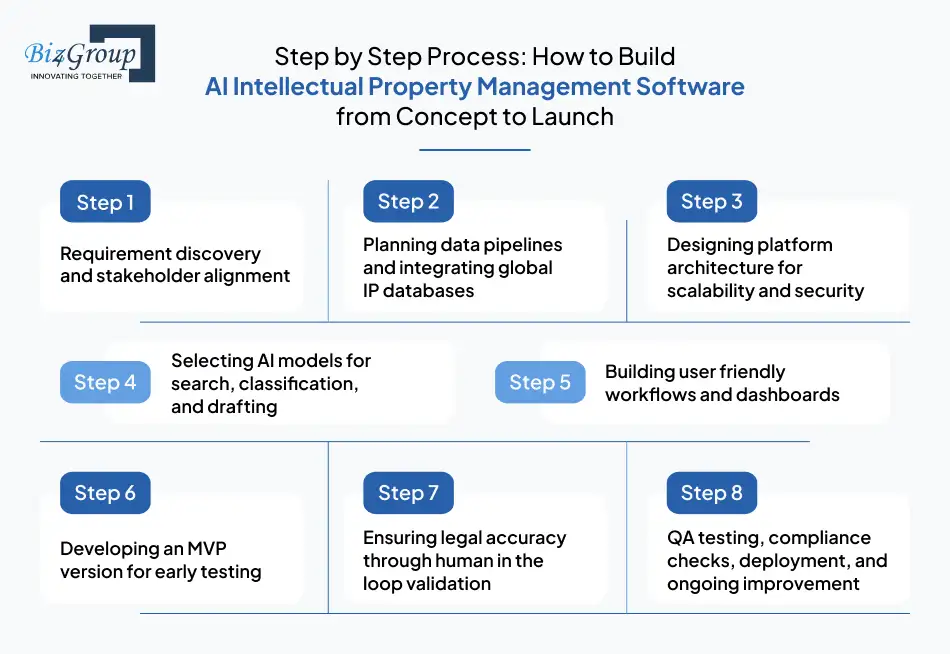
Creating a reliable platform begins with a clear plan. When you choose to build AI intellectual property management software, the right development flow helps you reduce risk, avoid rework, and shape a system that truly supports your legal team. This step-by-step approach works whether you want to develop AI intellectual property management software, create AI IP management system features, or expand into full AI intellectual property management software development over time.
Below are the essential stages.
Step 1: Requirement discovery and stakeholder alignment
This is where you define exactly what your team needs. Attorneys, paralegals, inventors, and R&D leaders each bring unique challenges. When you understand their daily pain points, you can build an MVP that solves the right problems first.
This becomes especially important when planning features such as making AI powered patent management software or building AI trademark monitoring platform tools.
You define goals such as:
- Reduce hours spent on manual searches and filing work
- Strengthen monitoring across patents and trademarks
- Prevent compliance issues with structured workflows
- Support cross team collaboration and visibility
Step 2: Planning data pipelines and integrating global IP databases
Your platform needs a continuous stream of updated data from global registries. Here you map out how filings, documents, and metadata will enter your system. This sets the foundation for tools like automated search, monitoring, and classification when you create an AI legal IP management solution or develop AI patent search and analysis software.
Planning includes:
- Identifying trusted data sources and registry APIs
- Setting up OCR for scanned documents
- Mapping metadata for tagging and structuring
- Deciding which jurisdictions take priority
Step 3: Designing platform architecture for scalability and security
A solid architecture ensures your platform grows with your organization. You plan the backend, frontend, database structure, and AI modules. You also design a clean and intuitive interface so that your team can adapt smoothly. Working with strong UI/UX design support helps you build screens your attorneys and inventors actually enjoy using.
You define elements such as:
- User journeys for filings, reviews, and approvals
- Data security and encryption layers
- Role based permissions for sensitive IP
- Scalable APIs for integration and expansion
Step 4: Selecting AI models for search, classification, and drafting
At this stage, you choose the intelligence that powers your platform. These models help enable features like semantic search, automated drafting, and risk scoring. This step is critical when you make an AI intellectual property software with document automation or create an AI driven IP due diligence and risk assessment platform.
Your model selection covers:
- Concept based prior art search
- AI classification by technology or claim type
- Drafting assistance for filings and responses
- Trademark alert engines for ongoing monitoring
Step 5: Building user friendly workflows and dashboards
Workflows help your team move filings from draft to review to approval without confusion. Dashboards bring visibility into your IP pipeline, portfolio health, and upcoming deadlines. Clear workflows matter no matter what type of system you are building, whether you aim to make AI IP compliance and documentation system features or expand into AI IP portfolio management software development.
Development includes:
- Filing workflows for attorneys and paralegals
- Document upload, tagging, and classification flows
- Portfolio overview dashboards
- Alerts and automated reminders
Step 6: Developing an MVP version for early testing
Instead of building everything at once, you launch a focused version that delivers immediate value. Teams that build AI intellectual property management software often start with search, repository, docketing, and basic automation. A reliable MVP development partner helps you get this version live quickly.
Your MVP typically includes:
- Core document repository
- Initial AI search and tagging
- Basic workflow routing
- Early dashboard insights
Step 7: Ensuring legal accuracy through human in the loop validation
Even the best AI tools require attorney oversight. This step helps your team trust the platform and avoid errors. You create review points, validation checks, and clear approval stages. This structure supports advanced features such as developing an AI solution for patent filing, tracking, and compliance.
Validation includes:
- Attorney review of drafts and summaries
- Claim and classification checks
- Redline comparison tools
- Override permissions for corrections
Step 8: QA testing, compliance checks, deployment, and ongoing improvement
Your system goes through functional testing, security testing, and jurisdiction-based compliance checks. After deployment, continuous tuning helps improve AI accuracy and performance. This phase is essential whether you want to create AI IP management system tools or build full AI intellectual property software development services.
This stage covers:
- Integration and load testing
- Compliance audits for key jurisdictions
- Deployment and team onboarding
- Regular updates for AI models
Recommended Tech Stack to Create an AI Platform for Automated Patent and Trademark Workflows
Choosing the right tech stack helps you create an AI platform for automated patent and trademark workflows that run smoothly, scale with demand, and support advanced intelligence features. The tools you select determine how well your system handles search, automation, monitoring, collaboration, and filing tasks.
Below is a detailed table outlining the tech components you need when you build AI intellectual property management software, develop AI patent search and analysis software, or expand into broader AI intellectual property management software development.
|
Tech Layer |
Tools and Technologies |
Why It Matters |
|---|---|---|
|
Backend frameworks and server architecture |
These frameworks support secure APIs, filing workflows, and automation features. Strong backend architecture is essential when you develop AI intellectual property management software for enterprise use. |
|
|
Frontend frameworks for user portals |
React, Vue, Angular |
A clean and intuitive interface helps your legal team adopt the system quickly. This is key when you create AI IP management system for dashboards and filing screens. |
|
Databases for structured IP data |
PostgreSQL, MySQL, MongoDB |
Stores all patent, trademark, and copyright records. Helps keep your portfolio organized for search, renewal tracking, and reporting. |
|
Vector databases for semantic search |
Pinecone, Weaviate, Milvus |
Powers concept-based retrieval, prior art matching, and similarity detection. This is vital for making AI powered patent management software. |
|
AI and NLP models |
GPT models, BERT, Llama, domain fine-tuned models |
Enables drafting, summarization, claims extraction, classification, and concept search. Supports systems that make AI intellectual property software with document automation. |
|
OCR and document processing tools |
Tesseract, AWS Textract, Google Document AI |
Extracts text and metadata from PDFs and scanned documents. Necessary for foreign filings and legacy documents. |
|
Workflow automation engines |
Temporal, Camunda, Airflow |
Helps build automated routing for filings, reviews, renewals, and approvals. This supports AI IP portfolio management software development at scale. |
|
Cloud infrastructure |
AWS, Azure, Google Cloud |
Delivers of reliability, security, and flexibility for growing IP databases. Cloud architecture is especially important when you build AI trademark monitoring platform functionalities. |
|
Authentication and security layers |
OAuth 2.0, SSO, JWT, multi factor authentication |
Protects confidential inventions and sensitive IP records while ensuring secure access to attorneys, engineers, and partners. |
|
Analytics and visualization tools |
Power BI, Tableau, custom dashboards |
Helps your team interpret portfolio insights, renewal risks, claim strengths, and filing trends. |
|
Integration and API layers |
REST APIs, GraphQL, webhook systems |
Connect your IP platform to billing tools, R&D portals, contract systems, and enterprise software. Many teams rely on professional AI integration services to streamline these connections. |
|
Containerization and deployment tools |
Docker, Kubernetes, CI CD pipelines |
Ensures that updates, new features, and AI model enhancements are deployed smoothly. |
Also Read: React JS Development Services
Cost Breakdown: What It Takes to Develop AI Intellectual Property Management Software from MVP to Enterprise Scale
When you decide to build AI intellectual property management software, the biggest question is usually cost. Most modern platforms fall within $30,000 to $200,000 plus, depending on features, integrations, AI depth, and compliance requirements. Your final investment can differ based on team size, complexity, and long-term goals.
This section helps you understand exactly where that cost comes from, so you can plan your budget with confidence. If you want a deeper comparison, the guide on Cost to Build a Legal AI Chatbot offers helpful parallels for AI driven legal tools.
Below you will find a full cost breakdown to help guide your decisions.
Estimated Cost Breakdown by Feature for AI Intellectual Property Management Software
|
Feature |
Description |
Estimated Cost Range |
|---|---|---|
|
Core repository and document storage |
Centralized storage for patents, trademarks, copyrights, and disclosures with metadata classification. A required component of any AI intellectual property management software development project. |
$5,000 to $20,000 |
|
Automated docketing and renewal tracking |
Tracks deadlines, maintenance fees, office actions, and reminders for global jurisdictions. A must have when you develop AI intellectual property management software. |
$8,000 to $25,000 |
|
AI powered semantic search |
Concept based search across global filings using vector databases. Ideal when you develop AI patent search and analysis software. |
$15,000 to $40,000 |
|
AI assisted drafting and document automation |
Generates drafts, summaries, responses, and structured documents. Supports teams that make an AI intellectual property software with document automation. |
$10,000 to $35,000 |
|
Trademark monitoring and global alerts |
Automated surveillance for conflicting marks. Essential for platforms that build AI trademark monitoring platform features. |
$12,000 to $30,000 |
|
Portfolio dashboards and analytics |
Visualization of filing trends, renewal risks, technology areas, and asset value. Useful when you expand into AI IP portfolio management software development. |
$7,000 to $25,000 |
|
Risk assessment and due diligence AI |
Automated IP risk reviews for mergers, acquisitions, and licensing. Required for a create an AI driven IP due diligence and risk assessment platform. |
$10,000 to $40,000 |
|
AI IP compliance and documentation automation |
Tracks jurisdiction rules, filing requirements, and documentation standards. Supports teams that want to make AI IP compliance and documentation system features. |
$8,000 to $30,000 |
|
Integrations with enterprise tools |
Connections to R&D portals, billing tools, contract systems, and ERP. Often included when businesses create AI IP management system capabilities. |
$5,000 to $50,000 |
|
User roles, permissions, and security |
Encryption, compliance policies, and role management for secure collaboration. |
$3,000 to $15,000 |
Factors Affecting the Cost to Build AI Intellectual Property Management Software
Several variables influence the final cost when you build AI intellectual property management software or expand into full AI intellectual property software development services.
The main factors include:
- Scope of features
- AI complexity
- Third party integrations
- Security and compliance needs
- Team expertise and development timeline
Hidden Costs You Should Plan For
When organizations develop AI intellectual property management software, some expenses are easy to overlook.
Hidden costs include:
- AI model training and tuning
- Data cleaning and normalization
- Compliance variations across countries
- Cloud hosting and storage growth
- Staff training and onboarding
- Long term maintenance and upgrades
Cost Optimization Strategies for AI Intellectual Property Management Software Development
You can reduce expenses without sacrificing quality.
Effective cost saving strategies:
- Start with an MVP
- Reuse proven AI components
- Integrate existing tools before building new ones
- Use modular architecture
- Prioritize the highest ROI AI features first
Curious what your perfect AI IP platform will really cost?
Smart teams invest wisely, not blindly. Get a clear, tailored estimate before you start building and avoid surprises later.
Get My Custom Cost EstimateChallenges in AI Intellectual Property Management Software Development and How to Solve Them
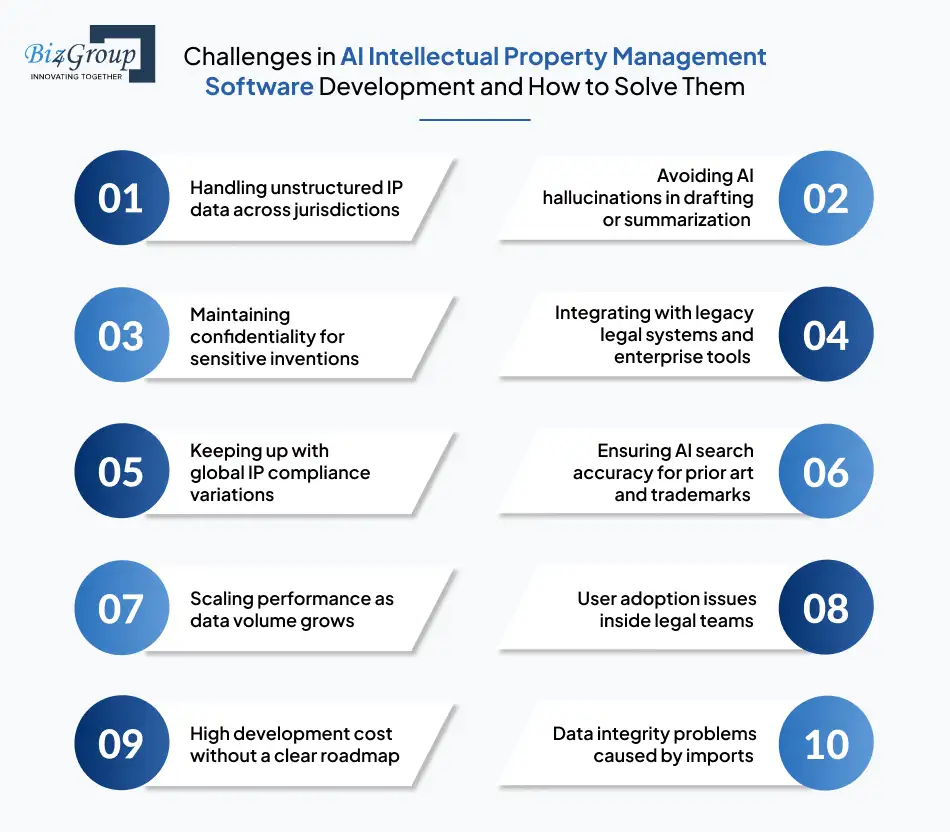
When you decide to build AI intellectual property management software, the development process brings unique challenges. These challenges are very different from typical software projects because IP data is sensitive; rules vary across countries, and legal standards demand absolute accuracy.
This table will help you understand the most common obstacles teams face when they develop AI intellectual property management software, create AI IP management system features, or build advanced tools such as make AI powered patent management software or build AI trademark monitoring platform solutions.
Below is a complete breakdown of challenges and practical solutions.
|
Challenge |
Why It Happens |
How to Solve It |
|---|---|---|
|
Handling unstructured IP data across jurisdictions |
Patent and trademark documents come in different formats, languages, and structures. This makes it difficult to develop AI patent search and analysis software that delivers accurate results. |
Use OCR, multilingual NLP, and metadata standardization. Build preprocessing pipelines that normalize data before analysis. |
|
Avoiding AI hallucinations in drafting or summarization |
AI generated content can sometimes produce inaccurate interpretations, which is risky for legal filings when you make an AI intellectual property software with document automation. |
Implement humans in the loop review, redline comparison tools, and validation prompts. Always require attorney approval before submissions. |
|
Maintaining confidentiality for sensitive inventions |
Pre-filing documents often contain confidential innovations. Security gaps can expose trade secrets. This is critical when companies create an AI legal IP management solution. |
Use role-based access, encryption, secure cloud hosting, and anonymization where possible. Conduct regular security audits. |
|
Integrating with legacy legal systems and enterprise tools |
Many law firms and corporate teams still rely on older tools that do not communicate well with modern platforms. This limits workflows when you create AI IP management system modules. |
Build strong API layers and use professional enterprise AI solutions to connect old and new systems without disruption. |
|
Keeping up with global IP compliance variations |
Filing rules differ by country and change frequently. This affects teams that make AI IP compliance and documentation system features. |
Build jurisdiction-based rule engines, automated updates, and configurable compliance templates. |
|
Ensuring AI search accuracy for prior art and trademarks |
Semantic search requires high quality training data and tuning. Without this, your AI powered patent management software may return irrelevant results. |
Use vector databases, fine tune models on domain datasets, and calibrate ranking algorithms regularly. |
|
Scaling performance as data volume grows |
IP portfolios are growing rapidly. As more documents enter the system, search and monitoring features can slow down. This affects teams that expand into AI IP portfolio management software development. |
Use cloud scaling, caching, microservices, and optimized vector indexing to maintain speed. |
|
User adoption issues inside legal teams |
Attorneys may hesitate to use new systems if they feel the interface is confusing, or the features interrupt their routines. |
Provide training, simplify workflows, and collect user feedback early. Pair development with thoughtful change management. |
|
High development cost without a clear roadmap |
Many teams overspend by adding advanced features too early during AI intellectual property management software development. |
Start with a focused MVP, prioritize essential workflows, and expand gradually. Clearly define ROI metrics. |
|
Data integrity problems caused by imports |
When historical files are imported, missing metadata or inconsistent formats create errors. |
Build a cleanup pipeline, validate metadata, and use automated correction rules to keep records accurate. |
How Biz4Group Can Help You Build a High Performing AI Intellectual Property Management Software?
If you are planning to build AI intellectual property management software, you need more than just an engineering team. You need a partner that understands legal workflows, compliance expectations, security standards, and the pace at which legal teams operate. Biz4Group brings that combination of experience and technical depth through years of building advanced solutions for the legal industry.
Their work across multiple legal sectors shows how they approach complex challenges with clarity, structure, and innovation. Here are a few real client projects that help demonstrate exactly what they can bring to your IP initiative.
1. Integra Ledger: Secure and tamper resistant legal documentation
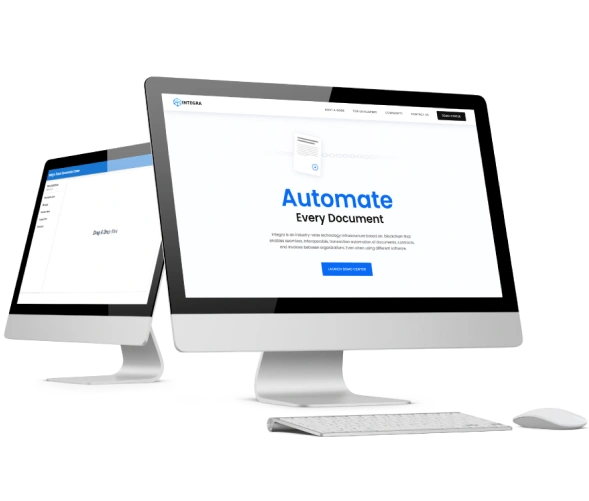
Biz4Group developed Integra Ledge, a blockchain-based platform for document creation, verification, and secure sharing. Integra Ledger gives law firms and enterprise clients a trusted space for storing sensitive materials. This shows Biz4Group’s ability to build systems that protect confidential records, maintain strong identity controls, and preserve document integrity.
When you are planning features like invention disclosure storage or prior art documentation, this level of security becomes essential.
2. Trial Proofer: End to end case preparation and collaboration

Trial Proofer supports attorneys through case mapping, evidence tracking, timeline building, and collaboration with legal teams and clients. The platform handles large datasets, uploads, and structured steps for trial prep.
This experience aligns well with features such as workflow routing, document automation, and case style organization that you may need when you create AI IP management system tools for filings, approvals, or office actions.
3. Compare Legal: Streamlined compliance and legal document workflows

Biz4Group worked on Compare Legal, a system focused on legal process automation, compliance checks, and document versioning. This platform helps legal teams stay ahead of regulatory changes and manage documents more effectively.
This expertise directly supports any initiative where you want to make AI IP compliance and documentation system features, especially global filings and renewal rules.
4. Court Calendar: Scheduling and deadline management for legal teams

Court Calendar is a system that centralizes hearings, case schedules, reminders, and document access for attorneys. It helps legal teams stay organized and avoid missed deadlines.
When you begin to develop AI intellectual property management software, this experience becomes valuable for modules like docketing, renewal alerts, and automated reminders across jurisdictions.
Why Biz4Group Is a Strong Fit for Your IP Software Project
Biz4Group’s work in the legal industry shows a clear pattern. They build software that is secure, structured, user friendly, and adaptable to complex workflows. They understand how attorneys think, how legal teams operate, and what kind of reliability is needed when managing sensitive or time critical tasks.
Here is what they bring to your project:
- Deep experience designing, developing, and scaling legal tech platforms
- Strong understanding of compliance, security, and confidentiality requirements
- Proven track record of document automation, workflow mapping, and deadline management
- Ability to design intuitive interfaces that attorneys and paralegals can adopt quickly
- Experience integrating advanced capabilities like AI search, analytics, and automation
If your goal is to develop AI intellectual property management software that supports patent tracking, trademark monitoring, document automation, and global compliance, you have a partner who already understands the demands of legal operations.
Want a team that actually understands legal tech inside out?
Biz4Group has delivered secure, scalable solutions for legal teams, proving that great tech and real legal insight can work together beautifully.
Talk to the Biz4Group TeamConclusion: Build AI Intellectual Property Management Software with Confidence and the Right Expertise
Modern legal teams cannot afford outdated systems, scattered files, or slow manual research. Innovation moves too quickly, and the risks tied to missed filings or incomplete documentation are too high. That is why more organizations are choosing to build AI intellectual property management software that gives them better accuracy, smarter automation, and complete portfolio visibility.
Throughout this guide, you learned how to evaluate features, plan development steps, understand costs, and navigate the challenges of creating a scalable legal tech solution. The next step is partnering with a team that understands both advanced AI development and the realities of legal operations.
Biz4Group has become a trusted leader for organizations that want to develop AI intellectual property management software, streamline compliance, strengthen research, and modernize their legal workflow. With deep experience in AI engineering, legal system design, workflow automation, and secure data architecture, they offer the end-to-end expertise required to turn complex IP processes into reliable digital systems.
If you plan to expand into automation, Biz4Group’s AI development company capabilities help you build intelligent search, drafting, monitoring, and compliance functions. If your organization prefers flexible team extension, you can also strengthen your project with dedicated specialists through their hire AI developers model.
Your IP operations deserve a platform that supports real growth and smarter decision making. Biz4Group can help you move from concept to a fully functional AI backed system built for accuracy, speed, and long-term value.
FAQ
1. What is AI intellectual property management software and why should legal teams build it now
AI intellectual property management software is a smart platform that helps you organize, track, analyze, and protect patents, trademarks, copyrights, and related documents in one central system. When you decide to build AI intellectual property management software, you give your team faster search, automated deadlines, cleaner documentation, and stronger decision support. With global filings increasing every year, AI backed tools help legal teams stay accurate, compliant, and efficient.
2. Who benefits most when companies develop AI intellectual property management software
Law firms, corporate legal departments, R&D-led companies, and innovation teams all see major advantages. Law firms use it to manage client portfolios with greater accuracy. In-house teams streamline filings, renewals, and compliance tasks. R&D teams gain better visibility into invention disclosures and prior art. When you develop AI intellectual property management software, you create a system that works across departments and supports every stage of the IP lifecycle.
3. What features should we prioritize when we create AI IP management system solutions
Core features include a central repository, automated docketing, secure storage, user roles, workflow routing, and searchable archives. Once the foundation is set, advanced capabilities such as semantic prior art search, automated drafting, global trademark alerts, predictive analytics, and risk assessment bring the biggest impact. These features are essential when you create AI IP management system tools for high volume legal teams or enterprise innovators.
4. How much does it cost to build AI intellectual property management software
Costs depend on features, integrations, AI complexity, and compliance needs. Most projects fall between $30,000 and $200,000 plus. A smaller MVP with core tools such as repository, docketing, and basic search lands on the lower end. Full scale systems with global monitoring, advanced automation, and analytics land on the higher end. This range applies whether you make AI powered patent management software or design a broader enterprise solution.
5. What challenges should we expect during AI intellectual property management software development
The biggest challenges involve handling unstructured IP data, avoiding AI inaccuracies, securing confidential inventions, and integrating with older systems. Compliance variations across countries add another layer of difficulty. When you plan to develop AI patent search and analysis software or integrate monitoring tools, these issues must be addressed early. Structured architecture, clean data pipeline, and human review steps help reduce risks.
6. How do we maintain accuracy when using AI for drafting, research, and compliance tasks
Accuracy comes from combining AI support with expert legal review. Your system should include approval checkpoints, version history, and validation gates. Attorneys or IP specialists should always make the final call on drafts or summaries. This approach works well whether you make an AI intellectual property software with document automation or build monitoring and research tools that require careful interpretation.
7. Is it better to build this system in-house or partner with a legal software development company
Both options work, but partnering with a skilled team helps you move faster and avoid common pitfalls. A trusted legal software development company brings technical depth, legal workflow understanding, and proven frameworks. This support is especially valuable when you want to expand into capabilities such as AI IP portfolio management software development, global trademark monitoring, or automated compliance documentation.
