Location :
Orlando, FL, USA
Location :
Orlando, FL, USA +1 (407) 714-1616
 info@biz4group.com









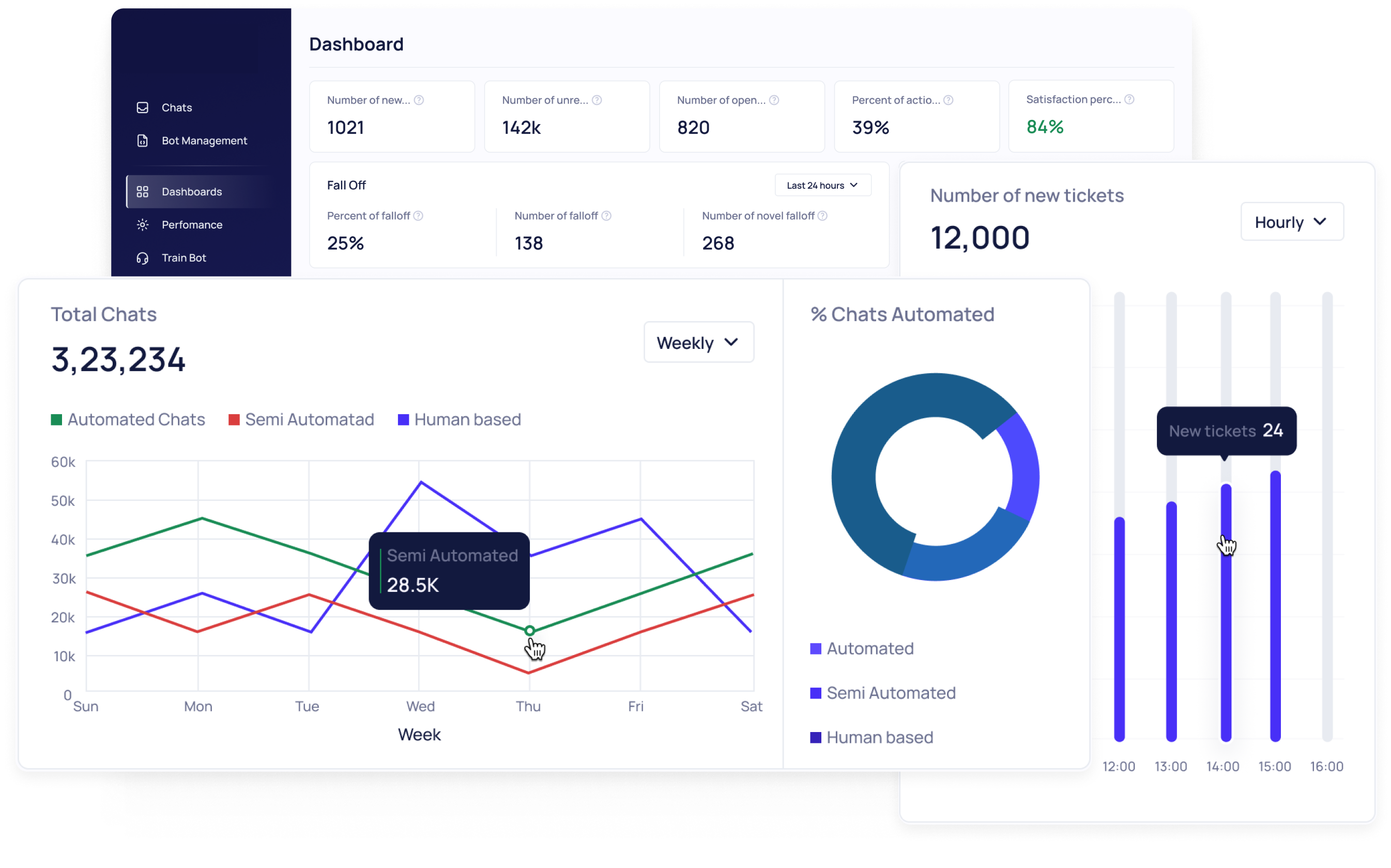









Imagine a digital system that doesn’t wait for instructions but instead, understands your business goals, learns from real-time feedback, and takes independent actions to get the job done.
Read More

 AI Summary Powered by Biz4AI
If you're thinking about how to build an app like Spotify, there's a good chance you've already realized that the idea sounds much simpler than it actually is.
Most people picture a sleek mobile interface, playlists, music search, and a play button. Those features are certainly important, but they're only a small part of what makes a music streaming platform work. The real complexity often reveals itself much later, when questions around content licensing, streaming infrastructure, scalability, user retention, and monetization start demanding answers.
For example, some founders begin the planning process focused on developing scalable app like Spotify with subscription and monetization features because they're thinking about long-term revenue from day one. Others start with a completely different vision, exploring making an app like Spotify with social sharing, podcasts, and live radio features to create a more engaging content ecosystem around their audience.
Neither approach is inherently right or wrong. What matters is understanding how each decision influences the product, the development effort, and the business model behind it.
At Biz4Group, we've worked with businesses exploring audio and content-driven platforms, and one pattern appears repeatedly. Teams often spend a significant amount of time discussing features while postponing conversations around platform architecture, licensing requirements, and scalability planning. Those decisions tend to become much harder to revisit once development is underway. As an AI app development company, we've seen firsthand how establishing the right technical foundation early can prevent expensive course corrections later.
You might be wondering: Do I need to launch with every feature users expect from Spotify?
In most cases, no. The strongest products usually begin with a clear audience, a focused value proposition, and a roadmap that evolves over time. Teams can gradually build AI software for personalization, discovery, and engagement as the platform matures and user behavior data becomes available.
The companies that succeed in this space are rarely the ones chasing the longest feature list. They're the ones making thoughtful product and technology decisions while the platform is still taking shape.
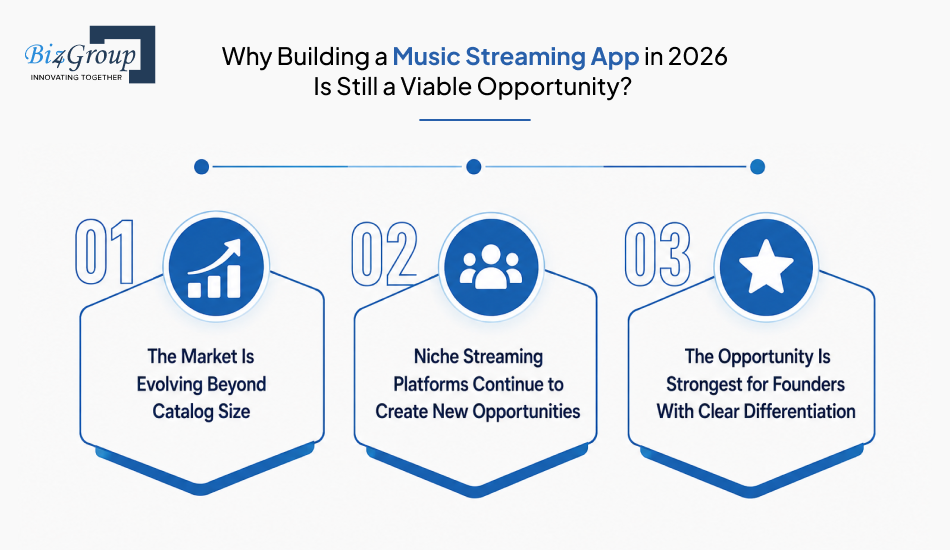
Yes, building a music streaming app in 2026 is still a viable opportunity. The opportunity simply looks different from what it did when Spotify first entered the market. Success today is less about building the largest music catalog and more about creating a platform that serves a specific audience exceptionally well.
Many founders hesitate because Spotify appears to dominate the industry. That's a reasonable concern. At the same time, Spotify isn't the only platform listeners use. YouTube Music, SoundCloud, and several niche audio platforms continue to attract loyal audiences because they deliver experiences that resonate with specific user groups. The real question isn't whether another music platform can exist. It's whether it offers a compelling reason for a particular audience to care.
A decade ago, access to music was a major competitive advantage. Today, listeners can choose from multiple platforms offering access to millions of tracks.
As a result, user expectations have changed. Discovery, personalization, community engagement, creator interaction, and exclusive experiences often influence platform choice as much as the music catalog itself.
You might be wondering: Does this mean a Spotify clone app can still succeed?
Only if it delivers something beyond access to music. Modern music streaming app development like Spotify is increasingly centered around user experience, audience focus, and discovery rather than catalog size alone.
One pattern we've seen repeatedly is that founders often overestimate the importance of scale and underestimate the value of focus.
Large streaming platforms are designed to serve everyone. Niche platforms have the freedom to serve specific communities exceptionally well. That could mean independent artists, regional music audiences, emerging genres, creator-driven communities, or direct-to-fan ecosystems.
A common concern is: Why would users download another music app if they already have Spotify?
Because users don't always choose platforms for the same reasons. Some want better artist access. Some want stronger community features. Others simply want a platform built around their interests rather than the broader market.
This is one reason why building a Spotify competitor for niche music genres continues to attract founders and investors. Relevance often creates more value than scale.
Not every music streaming idea deserves to be built.
Founders who enter the market with a clear audience, a clear problem, and a clear reason for users to switch tend to have a much stronger starting position than those focused primarily on feature parity.
At Biz4Group, one observation has remained consistent across digital product development projects: teams often spend far more time discussing features than validating audience demand. In practice, understanding who you're building for usually has a greater impact on success than deciding which feature gets built next.
As product ideas mature, many founders begin exploring personalization, recommendation systems, and intelligent discovery features. This is often where AI consulting services can help evaluate what is worth building, what should wait until later, and how those decisions align with user behavior and business goals.
Before moving into development, ask yourself one simple question: Can I clearly explain why a specific group of users would choose this platform over the alternatives available today?
If the answer is yes, you're already solving one of the hardest problems in music streaming: differentiation.
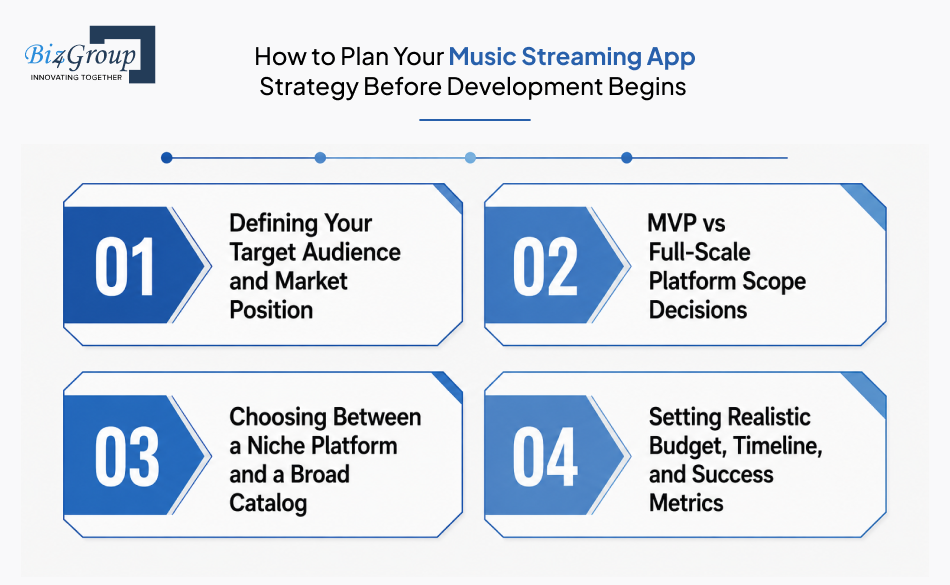
Before you create an app like Spotify, you need clarity on four things: who you're building for, what version of the product you're launching first, how you'll differentiate from existing platforms, and what success actually looks like. Founders often treat these as development questions, but they're business decisions that directly influence costs, timelines, licensing requirements, and product complexity.
Before discussing features, start with a much simpler question: Who is this platform being built for?
Many music streaming startups struggle because their target audience is too broad. "Music lovers" is not a target market. Independent artists, EDM fans, local music communities, faith-based listeners, podcast audiences, and emerging creators all have different expectations and motivations.
The more clearly you define the audience, the easier every other decision becomes.
At Biz4Group, we've seen founders spend weeks debating features that eventually became irrelevant because they hadn't fully identified who the platform was serving. Audience clarity tends to eliminate a surprising number of product decisions before development even begins.
If your first version includes every feature users associate with Spotify, you're probably building too much.
One of the most expensive mistakes in Spotify clone app development is treating the MVP as a finished product rather than a validation tool.
Founders often start with a wishlist that includes smart recommendations, podcasts, social sharing, artist dashboards, offline listening, live streaming, advanced analytics, and premium subscription tiers. While each feature may have value, building all of them before launch significantly increases development costs and time-to-market.
A better question to ask is: What is the smallest version of this platform that still delivers value?
For most projects, that answer includes user accounts, music playback, search, playlists, content management, and a reliable streaming experience. Once users start interacting with the product, real usage data can guide future investments.
The goal isn't to launch a smaller Spotify. The goal is to validate whether the core idea deserves further investment.
This decision influences almost everything that follows, including licensing costs, marketing strategy, content acquisition, and platform architecture.
Many founders assume broader is better. In practice, broad platforms often face a much harder challenge because they need to appeal to many different user groups simultaneously.
Niche platforms have a different advantage. They can create experiences specifically designed around a community's interests and behaviors.
SoundCloud is a useful example. Its early growth came from serving creators and listeners who wanted easier music sharing and discovery. It wasn't trying to become everything for everyone.
The same thinking applies when building a music streaming app in 2026. A platform dedicated to independent artists, regional music, underground genres, or creator communities often has a much clearer path to differentiation than a platform attempting to compete across the entire music market.
Before moving forward, ask yourself: Am I building a music platform, or am I building a platform for a specific community?
The answer will shape many of the decisions discussed throughout this guide.
Most founders ask how much it costs to build an app like Spotify.
A more useful question is: What exactly am I trying to launch?
The answer has a huge impact on cost, timeline, and development complexity.
For example, a focused MVP serving a niche audience may require a fraction of the investment needed for a full-scale music streaming platform with advanced recommendations, artist tools, subscription management, and cross-platform support.
Another mistake is measuring success too vaguely.
"Get users" isn't a useful success metric. Instead, define measurable outcomes before development begins:
These metrics create a clearer framework for evaluating whether the product is moving in the right direction.
As planning becomes more detailed, founders also begin thinking about future capabilities such as personalized recommendations and intelligent discovery. This is often the stage where AI integration services can help evaluate where AI can create meaningful value and where it may simply add unnecessary complexity to an early-stage product.
The strongest music streaming platforms rarely begin with the most features. They begin with the clearest strategy.
A Spotify-like music streaming platform works through a layered system that starts with audio ingestion, moves through processing and storage, and ends with real-time delivery through a CDN to the user’s device. If you're planning music streaming app development like Spotify, the key idea to understand is simple: the mobile app is only the surface layer. Everything that makes playback smooth, fast, and scalable happens in the backend architecture.
A common question at this stage is: Why does streaming architecture feel so complex compared to a regular mobile app?
Because unlike typical apps, audio streaming requires continuous data delivery, adaptive quality handling, global distribution, and strict synchronization across devices. That combination is what makes the architecture unique.
At a high level, the system follows a predictable flow:
You might be wondering: Do I need all of this from day one?
No. Most early-stage music streaming platforms start with a simplified backend and gradually introduce scaling layers as traffic grows. The goal is to design for evolution, not perfection on day one.
Before a song reaches a listener, it goes through a processing pipeline:
This is where scalability decisions matter. Poor encoding strategy leads to buffering issues later, even if the app itself works fine.
Many founders underestimate this step when they hire a custom software development company, assuming audio upload is just file storage. In reality, it is a structured pipeline that defines playback quality across the entire platform.
Adaptive bitrate streaming ensures users don’t experience buffering when network conditions change. Instead of sending a full song file, the system breaks audio into small segments and dynamically adjusts quality.
A simple way to think about it:
So, why not just send one high-quality file?
Because mobile networks are unpredictable. Adaptive streaming ensures uninterrupted playback rather than perfect-but-broken delivery.
Once audio is processed, it is distributed through a CDN (Content Delivery Network). This ensures users in different regions can stream content without delay.
Key idea:
If you're planning to integrate AI into an app later, CDN performance becomes even more important because recommendation systems often rely on real-time playback data.
Offline playback allows users to download music and listen without internet access. However, this introduces two challenges:
So, If users download songs, how do platforms protect content?
That’s where DRM and encryption layers come in. They ensure downloaded content remains tied to the app ecosystem.
Every track in the system depends on metadata. This includes:
Search systems use this metadata to enable fast discovery. Without proper indexing, even a large music catalog becomes difficult to navigate.
You might be wondering: Is search really that important for a streaming app?
Yes. In many platforms, search and discovery directly impact user retention more than the audio playback system itself.
AI recommendation systems are expected to become the core driver of engagement in music streaming apps, shifting focus from manual search to predictive discovery. Instead of users actively looking for songs, AI will anticipate listening intent, build evolving taste profiles, and surface music before users even search for it. This turns streaming platforms into intelligent discovery systems rather than simple audio libraries, significantly improving retention and listening time.
One of the most common mistakes founders make when they build an app like Spotify is assuming that more features automatically create a better product.
In practice, successful music streaming platforms tend to follow a different approach. They focus on delivering a great listening experience first, then expand into engagement features, creator tools, and operational capabilities as the platform grows. Feature prioritization matters because every additional capability affects development cost, timeline, maintenance effort, and overall product complexity.
Before adding advanced functionality, users need a reliable way to discover, play, and organize music. A question that comes up frequently is:
What features are truly essential for an MVP?
The answer is surprisingly short. If users cannot find music, play music, and save music, very little else matters.
|
Feature |
MVP Priority |
Why It Matters |
|---|---|---|
|
User Registration & Login |
Essential |
Enables personalization and account management |
|
Music Search |
Essential |
Allows users to find content quickly |
|
Audio Playback |
Essential |
Core platform functionality |
|
Playlist Creation |
Essential |
Supports content organization and repeat listening |
|
Favorites & Library Management |
Essential |
Improves user convenience and retention |
|
Queue Management |
Essential |
Gives listeners playback control |
|
Streaming Controls |
Essential |
Supports a complete listening experience |
|
User Profiles |
Recommended |
Helps personalize the platform |
|
Multi-Device Access |
Recommended |
Improves convenience across devices |
|
Offline Playback |
Phase 2 |
Requires additional licensing, DRM, and storage considerations |
One pattern we've seen repeatedly is that teams often overestimate the importance of
advanced features during the early stages of development. In many cases, validating demand for the
core listening experience provides far more value than launching with an extensive feature list.
Getting users to install an app is one challenge. Getting them to return consistently is a completely different one.
Most users don't stop using a music app because the player lacks a feature. They stop using it when they stop discovering content worth returning for.
This is where retention-focused features become important.
|
Feature |
Business Impact |
|---|---|
|
Personalized Recommendations |
Improves content discovery and session length |
|
Smart Playlists |
Reduces effort required to find relevant music |
|
Listening History |
Encourages repeat engagement |
|
Social Sharing |
Supports organic user acquisition |
|
Follow Artists |
Strengthens artist-listener relationships |
|
Podcasts Integration |
Expands listening opportunities |
|
Live Audio & Events |
Creates recurring engagement moments |
|
Push Notifications |
Re-engages inactive users |
|
Listening Insights |
Makes the experience feel more personal |
So, should recommendation systems be part of the MVP? Usually not.
Most recommendation engines become valuable only after enough user behavior data has been collected. Launching too early with complex personalization systems often creates additional development work without significantly improving the initial user experience.
As platforms mature, music recommendation algorithm development and AI model development can play a larger role in improving discovery, retention, and personalization.
Many founders focus heavily on listeners and treat artist tools as a future enhancement. That approach can be risky, especially for platforms centered around independent artists, creator communities, or direct-to-fan experiences.
For these business models, artists are not just content suppliers. They are primary users of the platform.
|
Feature |
Why Artists Need It |
|---|---|
|
Music Upload System |
Publishes content to the platform |
|
Artist Profile Management |
Controls public branding |
|
Streaming Analytics |
Tracks audience engagement |
|
Revenue Dashboard |
Provides earnings visibility |
|
Audience Insights |
Helps creators understand fans |
|
Content Management Tools |
Maintains catalog accuracy |
|
Fan Engagement Features |
Supports direct audience interaction |
|
Promotional Tools |
Helps drive discovery |
|
Rights & Ownership Management |
Supports content governance |
We've seen several niche music platform concepts struggle because artist tooling was treated
as a second-phase initiative. In reality, many creators evaluate a platform based on the
visibility, control, and audience insights they receive, not just the number of listeners
available.
Administrative features rarely appear in product demos, yet they become increasingly important as a platform grows. Every uploaded track, subscription payment, royalty report, support request, and moderation decision eventually needs to be managed somewhere.
|
Feature |
Operational Purpose |
|---|---|
|
User Management Console |
Manages user accounts and permissions |
|
Content Moderation Tools |
Maintains platform quality standards |
|
Catalog Management |
Organizes music and metadata |
|
Royalty Reporting System |
Supports payments and compliance |
|
Subscription Management |
Handles billing and plan administration |
|
Licensing Administration |
Tracks rights and agreements |
|
Analytics Dashboard |
Monitors platform performance |
|
Support Ticket Management |
Streamlines customer support |
|
Infrastructure Monitoring |
Tracks reliability and uptime |
You might be wondering: Do I need all of these systems before launch? NO.
Most early-stage platforms start with lightweight operational tools and expand them over time. The important consideration is ensuring that the platform architecture can support future growth without requiring major rework.
Administrative tooling is one of the most underestimated aspects of music streaming app development. Founders naturally focus on user-facing features, but operational efficiency often becomes a major factor in determining whether a platform can scale successfully.
The strongest products aren't defined by the number of features they launch with. They're defined by how effectively those features support listeners, creators, and business objectives at each stage of growth.
Turn your idea into a scalable music streaming app like Spotify with the right architecture, licensing approach, and user experience design.
Start Building My Streaming AppIf you're planning to develop an app like Spotify, licensing will have a bigger impact on the business than most technical decisions. It determines what music you can offer, who you can serve, how royalties are paid, and whether the platform can legally operate. While building the technology is challenging, licensing is often the factor that ultimately determines whether a music streaming platform is commercially viable.
A question many founders eventually ask, “I am building a music streaming app similar to Spotify and I am stuck on how to legally license songs because I do not understand how a new app gets rights to stream music without signing deals directly with every major label.”
The answer starts with understanding how music rights are structured and who controls them.
Most founders spend months discussing features, infrastructure, and user acquisition. Licensing often enters the conversation much later than it should.
The reality is simple: if you cannot legally stream the content your audience wants, the platform has no product to offer. This is why music licensing for streaming apps USA should be validated before significant development investment is made.
A practical way to think about it is this: licensing defines your ceiling before development even begins. It influences catalog size, monetization strategy, and even how your recommendation system will behave later.
One of the first surprises for many founders is that licensing a song is rarely a single permission.
Composition rights cover the lyrics, melody, and songwriting. Sound recording rights cover the actual recorded version of the song. These rights are often controlled by different parties, which means securing one does not automatically grant access to the other.
This split is one of the reasons music streaming app development like Spotify becomes more complex than standard content platforms. A platform can have permission for a composition but still lack rights to stream a specific recorded version.
Many first-time founders assume that obtaining licenses through ASCAP and BMI solves the licensing challenge. It doesn't.
Organizations such as ASCAP and BMI manage performance rights for songwriters and publishers, but they represent only part of the licensing ecosystem. Streaming platforms still need to account for sound recording rights and additional agreements depending on distribution scope.
This is where early assumptions often break down. Teams realize that music licensing is not a single agreement but a layered system involving multiple rights holders.
This is often the point where founders realize licensing can become more expensive than development itself.
Major labels, distributors, and rights holders control access to large portions of commercially released music. If your platform strategy depends on mainstream catalogs, licensing negotiations quickly become part of the business roadmap rather than a legal formality.
One recurring pattern in music platform development is that founders underestimate licensing complexity while overestimating technical complexity. Even teams working with a software development company in Florida often find that licensing discussions shape product direction more than early architecture decisions. The system can usually be engineered, but the content access layer determines what the system is allowed to deliver.
Licensing does not end once music becomes available on the platform.
Every stream generates reporting and royalty obligations that must be tracked accurately. This requires systems capable of recording usage, generating reports, and supporting compliance requirements over time.
A useful way to think about it is this: licensing is not a one-time approval process. It becomes an ongoing operational requirement that directly influences backend design, data tracking, and reporting pipelines.
Not every startup begins by pursuing major-label catalogs.
Many early-stage platforms launch with independent artists, niche communities, creator-driven ecosystems, or direct licensing agreements. This approach reduces initial licensing complexity while allowing founders to validate demand and refine product direction before expanding catalog access.
Many founders treat licensing as something that can be figured out after the product strategy is finalized. In practice, the opposite approach is usually more effective. For music streaming platforms, Biz4Group evaluates licensing assumptions during the discovery phase because content availability influences far more than legal compliance. It affects recommendation quality, monetization options, audience targeting, platform differentiation, and long-term scalability.
This becomes even more important when future roadmaps include personalization systems, recommendation engines, and broader enterprise AI solutions, all of which depend on having reliable and scalable access to content.
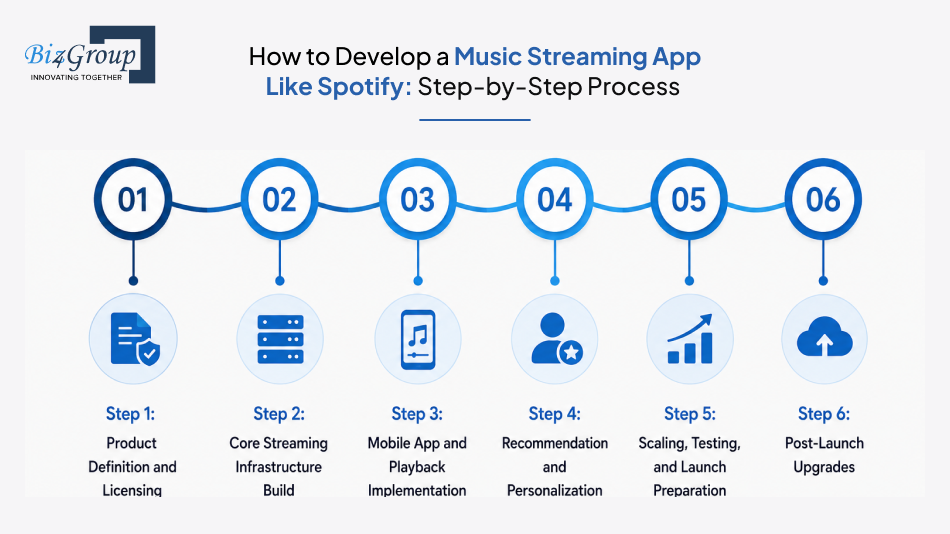
Developing a music streaming app like Spotify typically involves six stages: product definition and licensing validation, streaming infrastructure development, app implementation, recommendation systems, launch preparation, and post-launch optimization. The sequence matters because each phase directly influences the next.
Before any development begins, you need clarity on what you're building, who it's for, and what content can legally be streamed.
This phase typically includes:
Many founders move too quickly into development without locking these fundamentals. In practice, licensing and product strategy decisions often shape the entire direction of the platform more than technical choices do in the early stage.
This is also where many teams explore MVP development services to validate demand before committing to a full-scale build.
A common oversight at this stage is treating licensing as a parallel legal task instead of a product constraint. In reality, the type of catalog you can access directly impacts feature scope, recommendation logic, and even monetization options.
Also Read: 12+ MVP Development Companies in USA to Launch Your Startup in 2026
Once the strategy is defined, the focus shifts to building the backend systems that deliver audio at scale. Key infrastructure components include:
|
Component |
Purpose |
|---|---|
|
Audio Ingestion Pipeline |
Processes uploaded music files |
|
Encoding System |
Generates multiple audio quality versions |
|
Object Storage |
Stores and retrieves audio assets |
|
Streaming Services |
Delivers audio to users efficiently |
|
Metadata Management Layer |
Organizes tracks, albums, and artists |
|
Authentication Services |
Manages user access and security |
This phase lays the foundation for performance, reliability, and future scalability.
A useful rule of thumb: users may forgive missing features, but they rarely forgive buffering.
One reason music streaming infrastructure is treated differently from standard application backends is because performance issues are immediately visible to users during playback. Unlike dashboards or static apps, even small latency issues directly impact user experience in real time.
This phase focuses on how users interact with the platform.
It includes:
Early success depends more on usability than feature count. A technically strong platform can still fail if users struggle to find or play music quickly.
Another practical consideration is that playback behavior is highly sensitive to network conditions. Features like buffering strategy, resume playback, and offline fallback often matter more than adding new UI elements.
Once the core experience is stable, the platform begins focusing on discovery and engagement. This phase typically introduces:
Many founders assume recommendation systems must be highly advanced from day one. In reality, recommendation quality improves gradually as user behavior data accumulates.
As platforms mature, teams may begin to train AI models using listening patterns and engagement signals to improve personalization over time.
One important reality in music platforms is that recommendation systems are only as strong as the listening data they collect. Weak or incomplete tracking at this stage limits long-term personalization quality, regardless of model sophistication.
Before launch, the system must be tested under realistic usage conditions.
This phase includes:
A common mistake is assuming early-stage performance will scale automatically. Systems that perform well under controlled conditions often behave differently under real-world traffic spikes.
Music platforms typically reveal scalability issues during peak listening periods rather than average usage, which makes concurrent stream testing more important than simple user-load testing.
Also Read: 15+ Software Testing Companies in USA in 2026
After launch, development shifts from building the core product to improving it based on real user behavior.
This phase typically includes:
At this stage, product decisions become increasingly data-driven. Instead of relying on assumptions, teams prioritize improvements based on actual user behavior patterns and engagement signals.
Building a Spotify-like platform is ultimately a sequencing challenge. Teams that validate licensing early, prioritize stable streaming infrastructure, and then layer personalization and scaling in phases are generally better positioned to control costs and achieve sustainable growth.
Data-driven music streaming app like Spotify architectures with AI recommendations and adaptive playback can significantly improve session time and retention.
Unlock Higher Engagement NowThe ideal tech stack for a music streaming app depends on your scalability goals, recommendation requirements, playback performance expectations, and development budget. Most successful platforms combine proven frontend technologies, scalable backend services, cloud-native infrastructure, and AI-ready data pipelines to support streaming, discovery, and personalization at scale.
A question many teams face during planning is: “We are developing an app like Spotify and we cannot decide on the right tech stack for audio streaming, offline downloads, and adaptive bitrate playback and I want to know what technologies actual streaming platforms use so we do not pick the wrong architecture early on.”
While there is no single "perfect" stack, the following technologies are commonly used in modern music streaming app development like Spotify.
|
Layer |
Recommended Tech Stack |
|---|---|
|
Frontend (Web) |
Next.js, ReactJS development and server-rendered web experiences |
|
Mobile Apps |
Flutter or React Native (cross-platform), Swift (iOS), Kotlin (Android) |
|
UI/UX Design Layer |
Figma, design systems, reusable component libraries |
|
Backend API Layer |
Go, Java (Spring Boot) and NodeJS development |
|
Audio Streaming Protocols |
HLS, DASH |
|
Media Processing |
FFmpeg for audio encoding and transcoding |
|
Storage Layer |
AWS S3, Google Cloud Storage |
|
CDN Delivery |
CloudFront, Cloudflare, Akamai |
|
Database (Relational) |
PostgreSQL |
|
Database (NoSQL) |
MongoDB, DynamoDB |
|
Cache Layer |
Redis |
|
Search Infrastructure |
Elasticsearch, OpenSearch |
|
Recommendation Systems |
TensorFlow, PyTorch, Scikit-learn for AI workloads and Python development |
|
AI/ML Infrastructure |
Embedding models, vector databases (Pinecone, Weaviate) |
|
Authentication & Identity |
OAuth 2.0, Firebase Auth, Auth0 |
|
Infrastructure & DevOps |
Docker, Kubernetes, Terraform |
|
Monitoring & Observability |
Prometheus, Grafana, ELK Stack |
|
SEO-Friendly Web Experience |
SSR, ISR, and optimized routing through NextJS development |
For teams planning music streaming app development in 2026, technology selection should
focus on reliability, scalability, and future flexibility rather than chasing the newest
frameworks. A well-architected stack can evolve over time, while a poorly planned foundation often
becomes expensive to replace once the platform begins to grow.
The cost to build an app like Spotify in 2026 typically ranges from $40,000 to $250,000+. An MVP sits at the lower end of the range, while a full-scale platform with AI recommendations, artist tools, advanced streaming infrastructure, and scalability requirements falls at the higher end. The final investment depends on factors such as feature scope, licensing strategy, platform coverage, and infrastructure complexity.
If you've been researching this space, you've probably come across questions like “I am running a media startup and I want to build an app like Spotify but every cost estimate I find online is wildly different and I need a realistic breakdown of what it actually costs to develop a music streaming app in 2026 with all the core features included. “
The reason that happens is simple: people are often talking about completely different products. A niche streaming MVP, an artist-focused platform, and a Spotify-scale ecosystem may all be described as a "music streaming app," but their development costs can differ by well over six figures.
|
Platform Type |
Estimated Cost (USD) |
Best Suited For |
|---|---|---|
|
MVP-Level App Like Spotify |
$40,000 - $80,000 |
Market validation and early user acquisition |
|
Mid-Level App Like Spotify |
$80,000 - $150,000 |
Growing platforms with monetization and retention features |
|
Full-Scale Platform App Like Spotify |
$150,000 - $250,000+ |
Large-scale ecosystems with AI, artist tools, and high-concurrency streaming |
The initial development budget is only part of the total investment required to operate a music streaming platform.
Some of the most commonly overlooked costs include:
One important reality in music streaming app development cost USA is that infrastructure and licensing often become larger long-term expenses than the original build itself once the platform gains traction.
When evaluating the cost to build an app like Spotify, focus on the platform you actually need today rather than the platform you hope to have three years from now. Most budget overruns happen because teams estimate an MVP but plan features for a full-scale platform.
When evaluating the cost to build an app like Spotify, focus on the platform you actually need today rather than the platform you hope to have three years from now. Most budget overruns happen because teams estimate an MVP but plan features for a full-scale platform.
The right approach depends on your priorities. White-label platforms offer speed, custom development offers control, and hybrid approaches sit somewhere in the middle. The goal is not to find the universally "best" option, but to choose the one that aligns with your budget, timeline, and long-term product vision.
A situation that many founders find themselves in sounds like: “I am a non-technical founder who wants to make an app like Spotify and I am trying to decide whether to hire an in-house team, work with an AI development company, or use a white label streaming solution and I want a clear comparison of cost, speed, and control for each option.”
The comparison below provides a practical starting point.
|
Approach |
Speed to Market |
Upfront Cost |
Customization |
Long-Term Control |
|---|---|---|---|---|
|
White-Label Platform |
High |
Low |
Limited |
Low |
|
Hybrid Architecture |
Medium |
Medium |
Moderate |
Medium |
|
Fully Custom Platform |
Low |
High |
High |
High |
White-label platforms are often chosen when the goal is to launch a music streaming app quickly without building streaming infrastructure from scratch.
|
Advantages |
Limitations |
|---|---|
|
Fast launch with pre-built streaming functionality |
Limited control over recommendation systems |
|
Lower development investment |
Restricted playback experience customization |
|
Built-in subscription and user management features |
Difficult to create unique music discovery experiences |
|
Faster market validation |
Limited differentiation from competing streaming platforms |
If your goal is to validate demand quickly, a white-label platform can significantly reduce
development effort.
Custom development is typically chosen when the platform itself is expected to become a competitive advantage.
|
Advantages |
Limitations |
|---|---|
|
Full control over recommendation algorithms |
Higher development costs |
|
Complete ownership of streaming architecture |
Longer development timelines |
|
Freedom to build artist ecosystems and creator tools |
Requires dedicated technical expertise |
|
Greater flexibility for monetization and licensing strategies |
Higher infrastructure responsibility |
This approach is typically chosen when the platform itself is expected to become a long-term
competitive advantage.
Hybrid architectures combine custom-built functionality with selected third-party components.
|
Advantages |
Limitations |
|---|---|
|
Use proven streaming infrastructure while customizing the user experience |
Integration complexity |
|
Faster path to launching recommendation and discovery features |
Dependency on external providers |
|
Lower risk than fully custom development |
Some architectural limitations |
|
Better balance between differentiation and speed |
Long-term flexibility depends on vendor choices |
Many music streaming startups choose hybrid architectures because they can focus development
resources on differentiation while relying on proven third-party infrastructure for foundational
capabilities.
For example, a team may build custom artist experiences, playlist discovery systems, or AI chatbot integration features while using managed streaming services underneath.
Every approach eventually reaches a point where its trade-offs become more visible.
|
Approach |
Where It Usually Breaks Down |
|---|---|
|
White-Label Platform |
When advanced recommendations, creator tools, or unique discovery experiences become a priority |
|
Hybrid Architecture |
When multiple streaming, analytics, and personalization services become difficult to coordinate |
|
Fully Custom Platform |
When concurrent streaming volume, CDN costs, and royalty operations begin growing rapidly |
One useful observation is that the point of failure is usually the same area that originally
made the approach attractive. White-label solutions become restrictive, hybrid platforms become
more complex, and fully custom systems become more expensive to operate.
Teams investing heavily in creator ecosystems, personalized discovery, or AI automation services often lean toward hybrid or custom architectures because those capabilities typically require deeper control over the platform than most white-label solutions can provide.
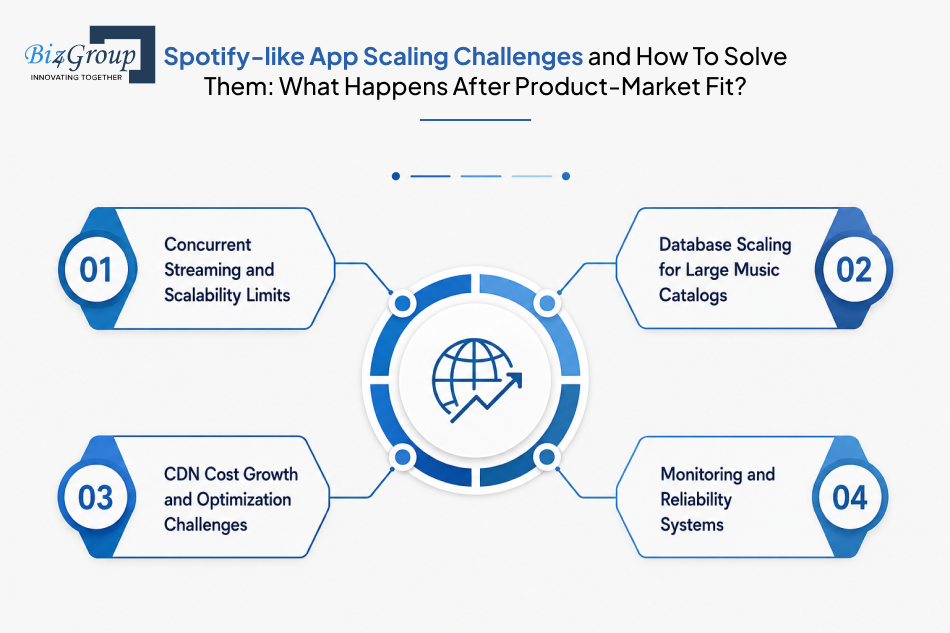
After product-market fit, the challenge shifts from building the platform to keeping it fast, reliable, and cost-efficient as usage grows. For music streaming apps, scaling issues usually show up in four areas: concurrent streaming spikes, growing music catalogs, rising CDN costs, and system reliability under real user pressure.
The first real scaling pressure usually doesn’t come from steady growth. It comes from sudden spikes, like a viral playlist, a new artist release, or a marketing push that drives thousands of users to press play at the same time.
A music streaming app that works smoothly with a few thousand users can start showing buffering or playback delays once concurrent listeners jump sharply.
Will adding more servers fix it instantly? Not always. The real issue is usually how audio is distributed, how traffic is balanced, and how efficiently the playback pipeline is designed under load.
A catalog with 10,000 tracks is easy to manage. A catalog with millions of tracks behaves very differently.
Search becomes heavier, recommendation queries take longer to process, and metadata requests start competing for the same resources. This is usually when teams realize that catalog systems and playback systems need to be separated more carefully than expected.
It’s not the volume alone that affects performance. It’s the number of continuous requests generated by search, playlists, recommendations, and user activity.
Most teams expect infrastructure costs to grow gradually. In music streaming, CDN usage often looks manageable early on, then increases much faster once listening activity reaches scale.
Every stream, replay, skip, and offline download contributes to bandwidth consumption, which is why delivery costs often rise alongside user engagement.
This is usually the point where teams begin optimizing caching strategies and file delivery methods because small inefficiencies become expensive at high listening volumes.
When something breaks in a music streaming app, users notice immediately. A failed payment might be retried. A buffering song usually is not.
That’s why playback monitoring, API tracking, and infrastructure observability become critical as the platform grows. These systems are less about debugging and more about preventing small issues from turning into user churn.
At scale, reliability stops being a backend concern and becomes a retention factor.
Teams introducing advanced personalization, recommendation engines, or creator-facing experiences often choose to hire AI developers once scaling challenges start affecting user experience and system performance.
For growing music streaming businesses, scaling is ultimately about maintaining a consistent listening experience as usage becomes less predictable. Long-term stability depends on how well the platform handles real-world listening behavior, not just planned test scenarios.
There is no single monetization model that works for every music streaming platform. Subscription plans, advertising, artist-focused revenue streams, and hybrid approaches all have different strengths depending on audience size, listening behavior, and content strategy. The most successful platforms typically align monetization with how users actually engage with the product rather than relying on a single revenue source.
“I am running a niche audio platform and I want to create an app like Spotify but with a different monetization model because freemium with ads alone does not work for my audience size and I need to know what other revenue streams actually make sense.”
For many niche platforms, that concern is valid. Advertising alone often requires significant listening volume to become meaningful.
Subscriptions remain the most predictable revenue model for music streaming businesses because they generate recurring income and reduce reliance on advertising performance.
The key question is: Will users pay for access? The answer usually depends on whether the platform offers exclusive content, niche communities, premium listening experiences, or creator-focused value that users cannot easily find elsewhere.
Advertising lowers the barrier to entry by allowing users to access content without paying upfront. However, ad-supported models typically require large listening volumes before they become financially attractive. This is one reason many smaller streaming platforms struggle when they attempt to replicate Spotify's freemium approach without Spotify's scale.
Some platforms generate revenue by helping artists monetize their audience directly rather than relying entirely on listener subscriptions.
Examples include:
This model is particularly effective for independent artist ecosystems where audience engagement is stronger than catalog size.
Platforms investing in creator tools, fan engagement, or AI assistant app design experiences often find artist-focused monetization more attractive than competing directly on subscription pricing.
Many modern streaming platforms combine multiple revenue streams rather than depending on a single one.
|
Revenue Stream |
Typical Purpose |
|---|---|
|
Subscription Plans |
Predictable recurring revenue |
|
Advertising |
Monetize free listeners |
|
Artist Services |
Support creator monetization |
|
Premium Features |
Increase average revenue per user |
|
Events & Communities |
Expand engagement-driven revenue |
Hybrid models provide more resilience because revenue is not dependent on one user behavior
pattern.
This approach is becoming increasingly common among niche audio platforms, creator-focused products, and businesses exploring AI to create premium user experiences that extend beyond music streaming alone.
The best monetization strategy for a Spotify-like app is usually the one that aligns with the platform's audience and content model. In many cases, the strongest revenue opportunities come from combining subscriptions with creator-focused offerings rather than relying solely on advertising revenue.
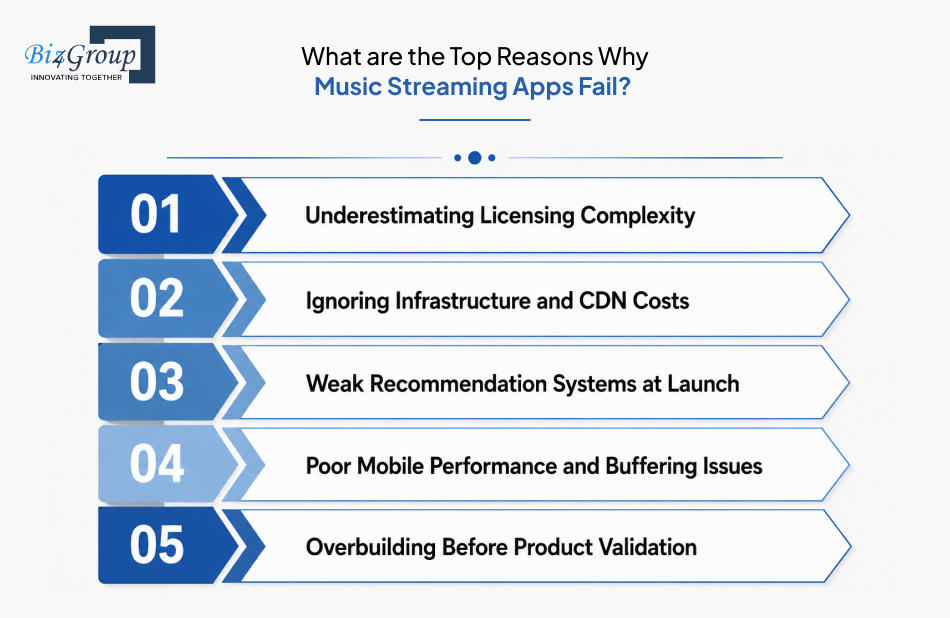
Most music streaming apps do not fail because of a lack of features. They fail because critical business, licensing, infrastructure, and user experience challenges are underestimated early on. The issues below consistently appear across failed or stalled streaming platforms, regardless of whether they target mainstream listeners or niche audiences.
|
Failure Reason |
Why It Causes Problems |
|---|---|
|
Underestimating Licensing Complexity |
Many founders focus on product development first and discover later that licensing requirements are more expensive, restrictive, or time-consuming than expected. Without content rights, even a technically strong platform cannot operate effectively. |
|
Ignoring Infrastructure and CDN Costs |
Early traffic is usually inexpensive to support. As listening volume grows, bandwidth, storage, and content delivery costs can increase much faster than revenue, creating pressure on sustainability. |
|
Weak Recommendation Systems at Launch |
Music discovery is a core user expectation. If users struggle to find relevant content, engagement drops quickly, even when the catalog itself is strong. |
|
Poor Mobile Performance and Buffering Issues |
Users are generally willing to explore new platforms, but they rarely tolerate frequent buffering, playback interruptions, or slow app performance. Poor listening experiences often lead to immediate churn. |
|
Overbuilding Before Product Validation |
Some teams spend months building advanced features before confirming that users actually want the product. This increases development costs and slows learning cycles without guaranteeing adoption. |
One pattern that appears repeatedly across the industry is that technical challenges rarely
exist in isolation. A weak recommendation experience can reduce engagement, lower listening time,
and make monetization harder. Similarly, poor infrastructure planning can turn user growth into an
operational burden rather than a business advantage.
This is one reason many teams invest in creator-focused features, personalization systems, or AI conversation app experiences only after validating that their core streaming experience is working as expected.
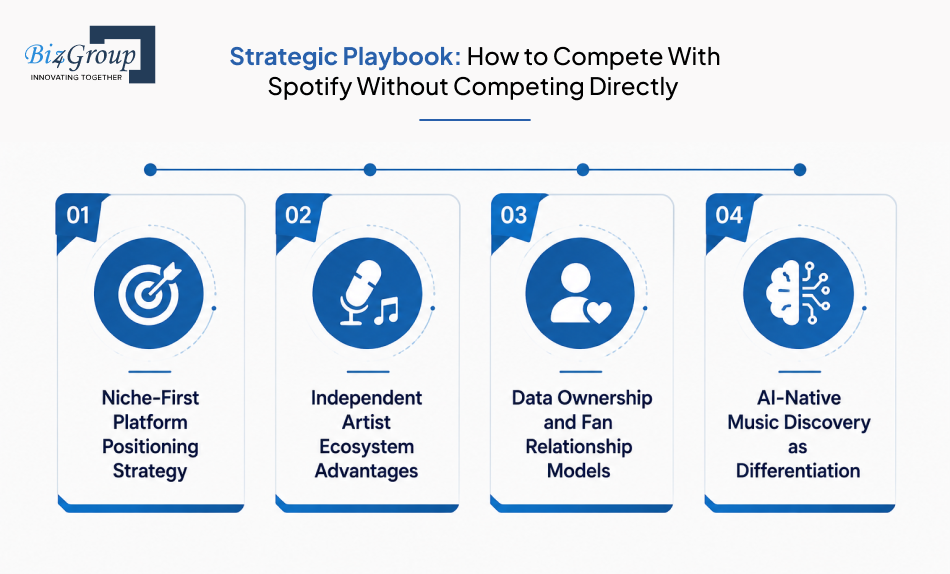
The most successful Spotify alternatives rarely win by offering a larger catalog or a lower subscription price. They win by serving a specific audience better, creating stronger artist relationships, or delivering experiences that larger platforms are not optimized to provide.
Trying to serve every listener from day one is usually a losing strategy. Niche platforms can focus on a specific genre, region, community, creator economy, or listening behavior and build features around those users.
This is one reason platforms such as SoundCloud, YouTube Music, and Bandcamp have continued to grow despite Spotify's scale. They solve different problems for different audiences rather than competing feature-for-feature.
Independent artists often need more than distribution. They need audience growth, fan engagement, and monetization opportunities.
Platforms that provide better visibility, direct fan interaction, exclusive content tools, or community-building capabilities can become valuable to artists even without offering the largest catalog. In many cases, strong creator ecosystems become a competitive advantage that is difficult for larger platforms to replicate at scale.
Most streaming platforms own the listener relationship. Emerging platforms have an opportunity to share more of that value with creators.
Features such as fan segmentation, direct messaging, audience analytics, and community engagement tools allow artists to understand and interact with their listeners more effectively. This creates stronger platform loyalty than simply providing access to music.
Some of the most successful creator platforms today are built around relationship ownership rather than content ownership.
Most recommendation systems focus on helping users find music they are likely to enjoy. AI-native discovery can go further by creating experiences that feel unique to the platform.
Examples include:
These types of features create emotional engagement rather than simple content consumption, which is often a stronger differentiator than adding more tracks to the catalog.
Move beyond basic Spotify-like app development and build niche-first, AI-powered streaming experiences tailored for your audience.
Start My Custom Streaming PlatformBuilding an app like Spotify sounds exciting until you realize you're not just building a music player. You're building a licensing strategy, a streaming infrastructure, a recommendation engine, a monetization model, and a product that needs to keep listeners engaged long after the first song plays.
The good news? You don't need to out-pace Spotify.
The platforms creating the most interesting opportunities today are often the ones focused on a niche audience, a stronger creator ecosystem, a unique discovery experience, or a business model that fits their market better than a generic freemium approach ever could.
If there's one takeaway from this guide, it's this: success in music streaming rarely comes from having the biggest catalog. It comes from making listeners feel like the platform was built specifically for them.
Whether you're validating an MVP, planning a creator-first ecosystem, or exploring AI-powered music discovery, the smartest move is to start with a clear strategy and scale intentionally. That's exactly where experienced product teams and even some of the top AI development companies in Florida like Biz4Group LLC tend to focus their efforts, because the winners in this space are usually the platforms that solve a specific problem exceptionally well.
And who knows? The next platform users obsess over might not be another Spotify clone at all. It might be something Spotify never thought to build.
Building a Spotify-Like App Is Easier When You Know What to Build First – Speak to our AI Experts!
It usually takes 4 to 12 months to build a music streaming app like Spotify. MVPs can often be launched faster, while full-scale platforms with advanced features require a longer development timeline.
The cost to build an app like Spotify typically ranges from $40,000 to $250,000+. The final cost depends on factors such as feature scope, licensing requirements, platform coverage, and infrastructure needs.
Yes. Many streaming platforms start with a focused catalog targeting a specific genre, audience, region, or independent artist community before expanding over time.
Yes, but it is usually more practical to launch in a specific market first. Expanding globally requires additional licensing agreements, infrastructure planning, and operational resources.
An MVP focuses on core features such as music playback, search, playlists, and user accounts. A full platform includes advanced recommendations, monetization systems, creator tools, analytics, and scalable infrastructure.
Yes. AI can improve music recommendations, playlist generation, content discovery, personalization, and user engagement, helping listeners find relevant content more efficiently.

Our website require some cookies to function properly. Read our privacy policy to know more.