Location :
Orlando, FL, USA
Location :
Orlando, FL, USA +1 (407) 714-1616
 info@biz4group.com


















Imagine a digital system that doesn’t wait for instructions but instead, understands your business goals, learns from real-time feedback, and takes independent actions to get the job done.
Read More

 AI Summary Powered by Biz4AI
If you run a real estate portal or brokerage, you probably have plenty of leads. But how many of them are actually ready to buy? A person might fill out a contact form, browse a few listings, and disappear. Another might keep returning to the same property, save homes in a particular neighborhood, and check mortgage estimates without ever reaching out. Treating both buyers the same can make it harder for your team to know where to focus.
That's where custom AI homebuyer journey platform development can make a difference. By bringing preferences, property activity, financing signals, and follow-up history into one place, you can build a clearer picture of what each buyer is looking for. AI can help identify patterns in that activity, so your team has more context when deciding what to recommend or when to reach out. The point isn't to treat every click as proof of purchase intent. It's to understand what those actions mean together. Wouldn't it be useful to know whether someone is casually browsing or narrowing down their options before an agent makes contact?
Getting that right takes more than adding an AI model. Property discovery, buyer profiles, CRM connections, scheduling, and agent handoffs all need to work together.
At Biz4Group LLC, our experts, through their work in AI product development, know that a high intent score doesn't automatically mean a buyer is ready to talk to an agent. Someone might keep checking a property because they love it, or because they're waiting for the price to drop. That's why it helps to show agents what's behind the score, from the homes a buyer keeps coming back to, to changes in their budget or financing plans.
When agents can see the bigger picture, they have a better chance of reaching out with something useful instead of just another "Are you still interested?" message.
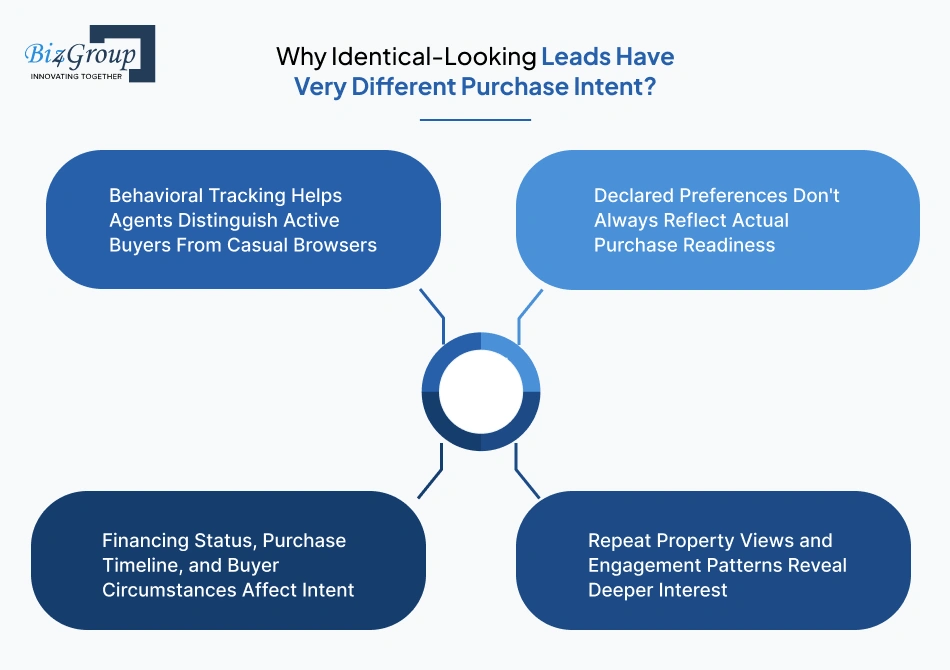
Leads with similar preferences can have very different purchase intent. Their browsing behavior, financing status, and buying timelines help show whether they're ready to act or still exploring.
A buyer's budget, location, and preferred home type tell you what they want, not when they'll buy. They may still be comparing prices or working out affordability. Have you ever had a lead who looked ready on paper but wasn't actually close to buying? Keep buyer profiles updated as their preferences change.
Repeat views, saved listings, and searches in the same area can signal property interest, but they don't guarantee readiness. Buyers may be comparing homes or waiting for a price change. Would you treat someone checking the same listing five times the same as someone who viewed it once? Combining these homebuyer intent signals gives agents more context than clicks alone.
Someone may love a property but still need mortgage prequalification, time to sell their current home, or a firm moving date. These details help agents decide whether to arrange a viewing, offer financing guidance, or follow up later.
Real estate lead qualification should consider recent views, saved searches, listing alerts, and mortgage calculator activity alongside preferences and timing. AI can help spot patterns, but high activity doesn't automatically mean someone is ready to buy. Buyer journey tracking should help agents make relevant follow-ups, not encourage assumptions based on clicks alone.
For teams exploring how to use AI for real estate, buyer intent is a practical place to start: combine activity and context to guide follow-up, rather than assuming a single action proves someone is ready to buy.
A homebuyer journey platform needs to connect what buyers say, what they browse, their financing activity, and their conversations with agents. That gives your team a fuller picture of buyer intent than any single data source can provide.
Basic contact forms capture a buyer's details, but they reveal little about how their needs or interests change over time, which raises questions like:
"We collect buyer preferences through a basic contact form, but it only captures name, email, and phone, so I want to understand how to build a system that tracks ongoing behavior like saved searches and repeat property views to understand true intent."
Connect your contact forms to a buyer profile that updates with relevant activity, such as saved searches, repeat property views, changing filters, listing alerts, and viewing requests. Use reliable account or consent-based identity signals to link activity to the right person, and interpret patterns together because repeat views alone do not confirm purchase readiness.
Think of these as two sides of the same picture:
If a buyer says they want a home under $400,000 but repeatedly explores more expensive listings, that mismatch may be worth discussing. It doesn't automatically mean they're ready to spend more.
A buyer's activity can tell a story over time:
The context matters. Repeat property views alone don't prove someone is ready to buy, so the platform should consider several signals together.
Your platform should also connect information from outside the property search itself:
These details can help explain whether a buyer is still working out affordability, actively comparing homes, or waiting for a specific opportunity. They also help agents pick up the conversation without asking buyers to repeat everything.
A buyer might browse listings before creating an account or contacting an agent. Identity resolution can connect earlier activity to a known profile when there's a reliable identifier, such as a login or an appropriately collected, consent-based signal.
The important part is getting the match right. Don't merge profiles based on guesswork, and respect privacy choices and data-use permissions. A larger profile isn't useful if it contains someone else's activity.
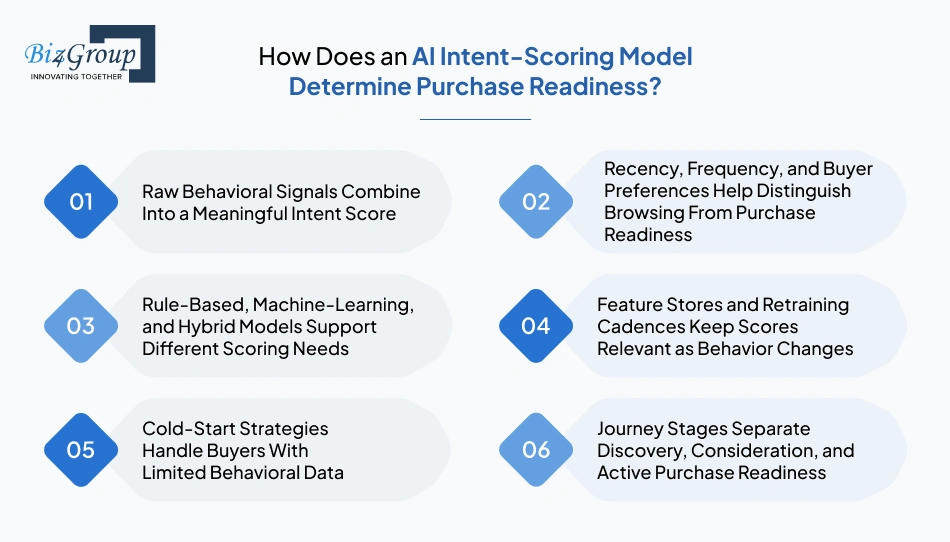
An AI intent-scoring model estimates how close a buyer may be to taking the next step by combining behavior, preferences, and journey context into a score or readiness category. The score is a guide for prioritizing follow-up, not a guarantee that someone will purchase.
A common query among real estate business owners may look like:
"I keep sending my agents leads that look identical on paper, but some are ready to buy and others are just browsing, so I want to know how an AI journey platform can score and separate these buyers automatically."
An AI intent-scoring model can combine behavioral activity, stated preferences, financing context, and timeline information to estimate a buyer's likely next step. The platform can use those estimates to help prioritize follow-up, but scores should remain explainable and be checked against real outcomes because a high score is not a guarantee that someone is ready to buy.
A single click rarely says much. The model combines signals such as repeat property views, saved listings, viewing requests, and mortgage calculator use to estimate buyer interest. Each signal contributes differently, and the score should reflect the combined pattern rather than simply count activity.
Three things help put buyer activity into context:
Recent, repeated activity around suitable properties may indicate stronger intent than occasional browsing, though it still doesn't confirm a buyer is ready to purchase.
|
Approach |
How it works |
|---|---|
|
Rule-based |
Uses defined conditions, like a viewing request or repeated visits. |
|
Machine learning |
Learns patterns from historical buyer activity and outcomes. |
|
Hybrid |
Combines business rules with predictions from a trained model. |
A team with limited historical data may begin with rules, then introduce machine learning as reliable outcome data becomes available.
The right approach to AI model development depends on how much reliable historical data you have. Rules can be a sensible starting point, while machine learning may help identify more complex patterns once there's enough quality data.
A feature store keeps model inputs, such as recent listing views or changes in search activity, organized and ready to use. The model also needs regular checks and updates as buyer behavior, property markets, and business goals change. Retraining should follow data quality and performance needs, not an arbitrary schedule.
New visitors may have little or no browsing history, so the platform shouldn't assign strong intent based on missing information. It can start with declared preferences, use simple rules, and update its assessment as meaningful activity comes in. This cold-start strategy helps avoid treating a new visitor as either highly interested or completely unqualified without enough evidence.
Rather than relying on a score alone, platforms can group buyers into useful homebuyer journey stages:
These stages help agents choose relevant next steps, while allowing buyers to move forward, pause, or return to an earlier stage as their circumstances change.
Contact forms collect basic buyer details quickly, while conversational intake can uncover more about a buyer's needs, timeline, and financing situation.
Generative AI can make conversational intake feel more natural by helping the platform ask relevant follow-up questions about budget, location, property needs, and moving plans. Keep the questions focused and give buyers a way to reach a person when they prefer.
|
What matters |
Contact forms |
Conversational intake |
|---|---|---|
|
Information collected |
Name, contact details, budget, and preferred location |
Can also capture financing, buying timeline, property needs, and preferences |
|
Buyer experience |
Quick and familiar, but can feel impersonal |
Interactive and flexible, but too many questions can frustrate buyers |
|
Intent signals |
Relies mostly on what buyers disclose directly |
Can gather more context about needs and potential purchase readiness |
|
Best suited for |
Quick enquiries and basic lead capture |
Building richer buyer profiles and supporting personalized follow-up |
A website form can capture the basics, while an AI conversation app can ask a few relevant follow-up questions as a buyer's interest develops. Combining both can help build a more useful profile without overwhelming people at the start.
A practical option: Combine both. Use a short form for quick enquiries, then introduce relevant conversational questions when buyers show interest in specific properties or request a viewing.
A custom AI homebuyer journey platform should help your team understand buyer behavior, keep preferences current, identify likely next steps, and get useful context to the right agent or lender. When you integrate AI into an app for homebuyers, it should do more than add a score. It should help connect buyer behavior, current preferences, and next steps with useful context for agents and lenders.
Keep each buyer profile current as people change search filters, save homes, revisit listings, or update their budget. This helps agents work from what buyers want now, not what they entered weeks ago.
Track which properties and neighborhoods attract attention, then recommend listings that match a buyer's preferences and activity. Recommendations should stay relevant as those preferences evolve, rather than repeatedly showing similar homes that no longer fit.
Use short, relevant questions to learn about budget, must-have features, financing, and moving plans. Ask for more detail when it's useful, instead of making buyers complete a long questionnaire upfront.
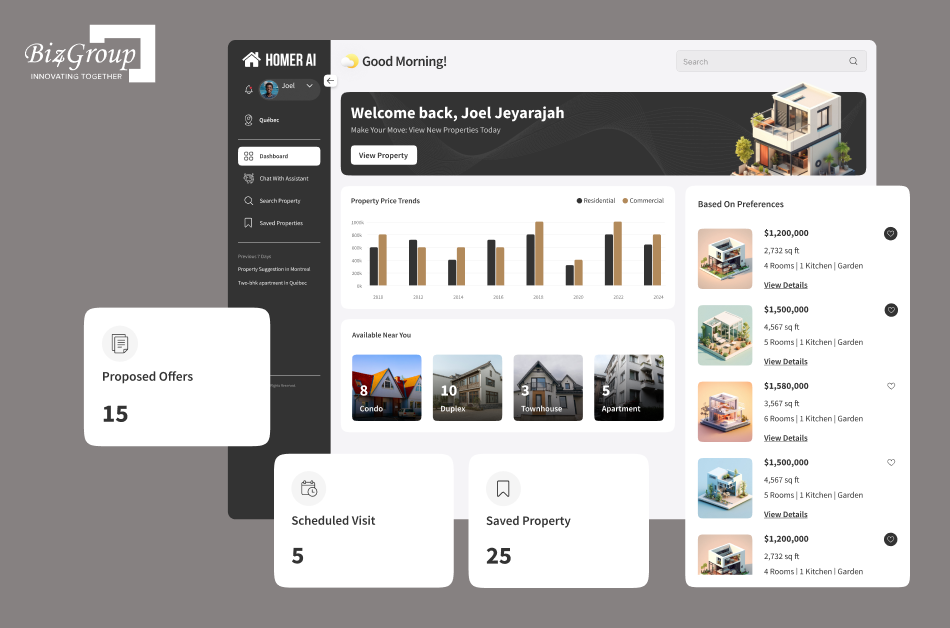
Biz4Group's Homer AI project provides a relevant example of conversational property discovery. The application asks buyers about preferences such as budget and location, filters property options, and supports scheduling visits. That work reflects an important part of a buyer journey platform: turning what someone says they need into property options and a practical next step.
Combine behavior and buyer context to estimate purchase readiness and help teams prioritize follow-ups. Make the signals behind each score visible so agents can understand why a lead was flagged, rather than relying on a number alone.
Connect the platform with your CRM so agents can see buyer history and follow-up activity in one workflow. Routing rules can send qualified leads to the appropriate agent or lender with relevant preferences, property interest, and enquiry details.
Give teams a way to see where buyers drop off, which recommendations lead to viewings, and whether routed leads progress. Agent feedback and conversion tracking can also help reveal when intent scores are useful and when the model needs adjustment.
When every lead looks similar on paper, it's hard for agents to know who needs attention now. We can help you build a custom AI homebuyer journey platform that connects buyer behavior, and financing signals for more informed follow-ups.
Explore Your AI Options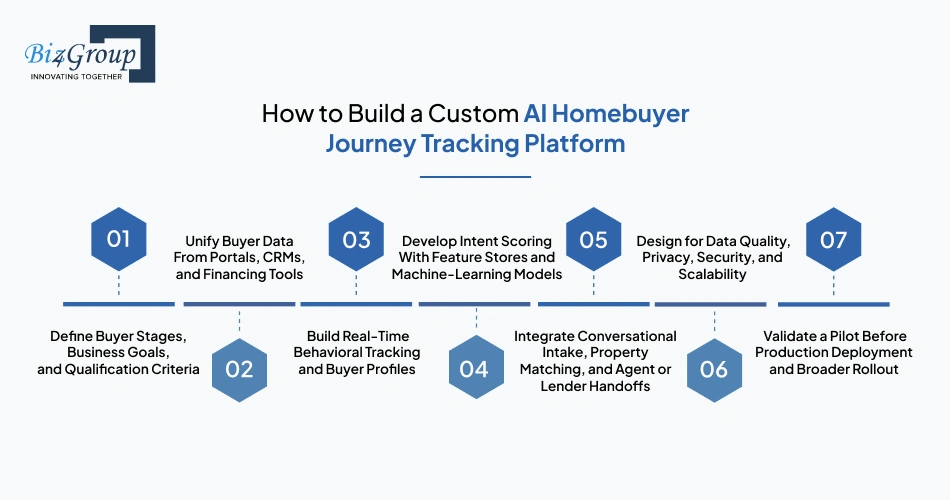
Before you build real estate AI software, decide which buyer and agent decisions the platform should support. That will help you work out what data to connect, which features to prioritize, and how to measure whether the system is useful.
Real estate portal owners often have plenty of listing activity but struggle to tell which buyers are moving toward a purchase. A common question is:
"I run a real estate portal and I can see buyers browsing hundreds of listings, but I have no way to track who is actually close to making a purchase decision, so I want to know how to build a platform that tracks real buyer intent."
Build a platform that brings together buyer preferences, property views, saved listings, search activity, financing signals, and follow-up history. AI can analyze these signals over time to estimate purchase intent, while giving agents the context behind each score rather than treating browsing activity as proof that someone is ready to buy.
First, decide what the platform should help your team improve. If the goal is to increase property viewings, define which buyer actions and circumstances should prompt an agent to follow up.
Set clear buyer journey stages, agree on what qualifies a lead, and choose metrics such as viewing requests, response time, and lead progression.
Before connecting systems, map where buyer information currently lives and how those records relate.
|
Data source |
Information to connect |
|---|---|
|
Property portals |
Searches, saved listings, property views, and viewing requests |
|
CRM systems |
Contact details, agent conversations, and follow-up history |
|
Financing tools |
Available mortgage estimates and relevant prequalification updates |
Clean up duplicate records and inconsistent fields so the platform can build reliable buyer profiles.
Track meaningful actions such as repeat views, search changes, and saved listings. When a buyer takes an action, update their profile and consider it alongside their existing preferences and activity.
The goal of real-time buyer tracking is to keep profiles current without treating accidental clicks or duplicate events as genuine interest.
Choose a scoring approach that matches the data you have. Start with understandable rules if historical buyer outcomes are limited. As reliable data becomes available, machine learning can help identify more complex patterns.
A feature store keeps model inputs organized, while regular performance checks help you spot when scores become less accurate or buyer behavior changes.
Integrate intake, property matching, and agent or lender handoffs into the workflow. The right AI integration services can help connect these pieces, so buyers don't have to repeat information and agents have the context they need.
That way, buyers don't have to explain their needs again at every step.
Build these requirements into the platform from the beginning. Make sure buyer records are accurate, access to personal data is controlled, and tracking follows appropriate permissions and data-use policies. Also, plan for growing activity without making the system unnecessarily complex at launch.
Start with a limited group of users, agents, or locations. Compare intent scores with actual buyer outcomes, gather agent feedback, and track whether viewing requests and lead progression improve. Use those findings to refine the platform before expanding across the business.
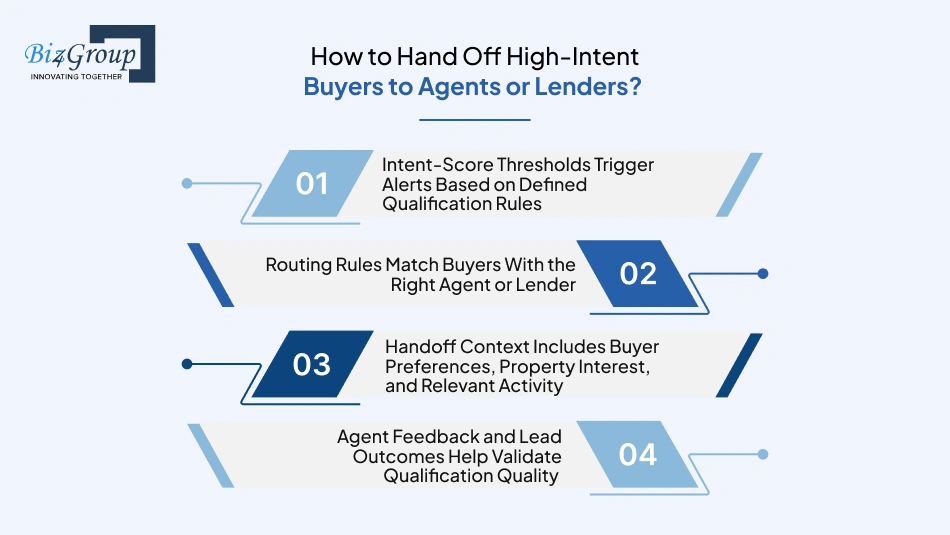
A high-intent buyer handoff should connect a buyer to the right person at the right time, with enough context for a useful conversation. Clear qualification rules, sensible routing, and feedback from real outcomes help make sure promising leads don't get lost or passed around without ownership.
AI for real estate agents should help them understand who to contact, when to reach out, and what the buyer has already shared, while leaving room for agents to use their judgment.
Set clear rules for when a lead should trigger an alert. A score might be considered alongside a viewing request, recent property activity, or a stated buying timeline. Would you want your agents alerted about every active browser, or only when there's enough context to justify a follow-up? Combining signals helps avoid treating high activity as automatic proof of readiness.
Route leads based on their needs, location, financing questions, and agent availability. A buyer requesting a viewing might go to a local agent, while someone seeking mortgage guidance could be connected with a lender. Clear lead routing rules also help prevent enquiries from sitting unassigned.
Agents need more than a name and phone number. Give them the buyer's budget, preferred location, property requirements, saved listings, recent activity, and relevant financing details they've shared. That way, they can start with a useful conversation instead of asking the buyer to repeat everything.
Track what happens after the handoff:
Recording these lead qualification outcomes helps you refine scoring and routing rules over time.
|
Platform capability |
What it helps your team do |
|---|---|
|
Buyer profile tracking |
Keep preferences, searches, and property activity up to date |
|
AI intent scoring |
Identify buyers who may be ready for a viewing or follow-up |
|
Conversational intake |
Capture needs, budget, and purchase timeline |
|
Property matching |
Recommend homes based on buyer preferences and behavior |
|
CRM and lead routing |
Connect qualified buyers with the right agent or lender |
|
Journey analytics |
Track viewings, lead progression, and conversion outcomes |
Off-the-shelf tools may work well for standard buyer journeys, while businesses with specialized data, scoring rules, or workflows may need to build AI software around their own requirements. Compare them across the factors that affect your team's needs, budget, and rollout plans.
|
Factor |
Off-the-shelf tool |
Custom AI platform |
|---|---|---|
|
Setup and launch |
Often quicker to configure and start using |
Requires discovery, development, testing, and deployment |
|
Buyer journey |
Works within the workflows and features the product supports |
Can be designed around your specific buyer journey |
|
Data and integrations |
Uses supported connectors and integration options |
Can connect specialized data sources and internal systems |
|
Intent scoring |
Usually offers predefined or configurable scoring |
Allows scoring logic and models to be tailored to your data and qualification criteria |
|
Flexibility |
Changes depend on the vendor's features and roadmap |
Gives your team greater control over features and future changes |
|
Initial cost |
Typically involves subscription and setup fees |
Includes development, integration, infrastructure, and testing costs |
|
Ongoing costs |
Subscription, usage, and any vendor-specific service fees |
Infrastructure, maintenance, model evaluation, support, and future development |
|
Best fit |
Teams with relatively standard requirements |
Teams with specialized workflows, data, or scoring needs |
The key is fit, not simply the number of features. An existing tool may be enough for a straightforward workflow, while a custom platform may be appropriate when your requirements call for more control.
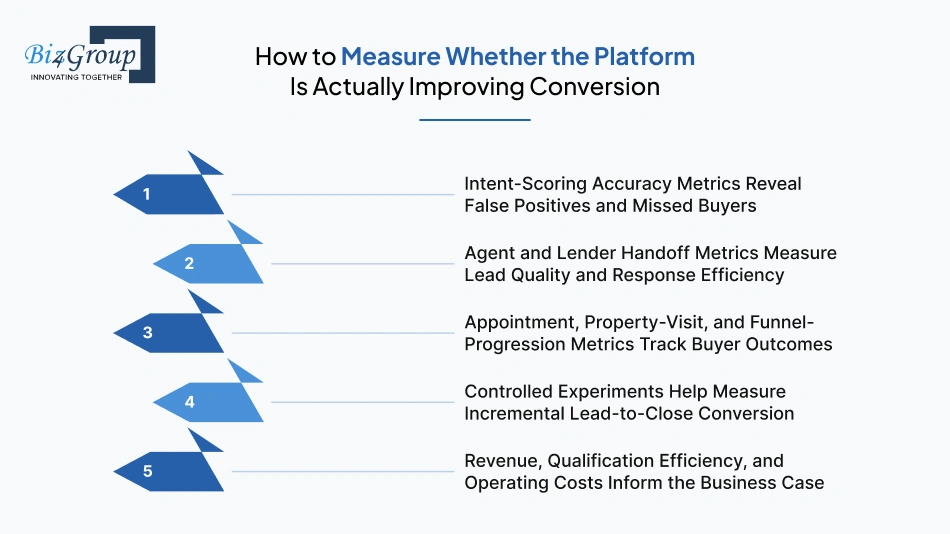
Measure a homebuyer journey platform by checking whether it identifies likely buyers accurately, helps agents and lenders respond effectively, and moves more people toward a purchase. Tracking activity alone isn't enough. The real test is whether the platform improves outcomes compared with your previous process.
An intent score is useful only if it helps your team recognize meaningful buying activity. Compare predictions with what buyers actually do next, such as requesting a viewing, progressing with financing, or going quiet.
|
Metric |
What it tells you |
|---|---|
|
False-positive rate |
How often buyers flagged as high intent don't meet your defined readiness criteria |
|
Missed-buyer rate |
How often buyers who later show strong intent were not flagged earlier |
|
Precision |
How many buyers flagged as high intent actually meet the chosen outcome criteria |
|
Recall |
How many buyers who meet those criteria were successfully identified |
Define the outcome you're predicting first. A model designed to identify likely viewing requests should not be judged as though it predicts completed home purchases.
Track whether qualified leads reach the right person and receive timely follow-up. Useful measures include:
These metrics can help reveal whether the issue is scoring, routing, or the follow-up process itself.
Look beyond clicks and alerts to see whether buyers are taking meaningful next steps. Track viewing requests, scheduled appointments, completed property visits, and progression between journey stages.
For example, if more buyers request viewings but fewer attend, the platform may be improving initial engagement without improving the later part of the journey. Measuring each stage helps you see where buyers are moving forward or dropping off.
A rise in conversions after launch doesn't automatically mean the platform caused it. Seasonality, listing inventory, pricing, and marketing changes may also affect results.
Where practical, compare a group using the platform with a similar group following the existing process. Keep the comparison period and success criteria consistent, and measure outcomes such as viewing completion, qualified lead progression, and lead-to-close conversion. This helps estimate whether the platform is contributing to the change.
Connect conversion metrics to the business results that matter to your organization. Consider revenue from completed transactions, agent time spent qualifying leads, cost per qualified buyer, and the ongoing costs of running the platform.
|
Business measure |
What to examine |
|---|---|
|
Revenue impact |
Whether completed transactions or attributable revenue change |
|
Qualification efficiency |
Whether teams spend less time sorting through unsuitable leads |
|
Cost per qualified lead |
Total relevant costs compared with the number of qualified buyers |
|
Operating costs |
Infrastructure, integrations, support, and model maintenance |
|
Return on investment |
Incremental benefits compared with the platform's total costs |
Review these measures together. A platform might reduce qualification time without immediately increasing closed sales, or improve lead conversion while adding operating costs. Looking at both outcomes and costs gives you a more complete view of its business value.
We can help you bring those data sources together and develop AI-powered scoring and handoff workflows that fit your real estate business.
Discuss Your Platform with Biz4GroupChoose a custom AI development partner by looking at their real estate experience, technical approach, and how clearly they define responsibilities after launch. You're not just buying an AI model. You're choosing a team that needs to connect buyer data, build useful workflows, and support the platform as your business grows.
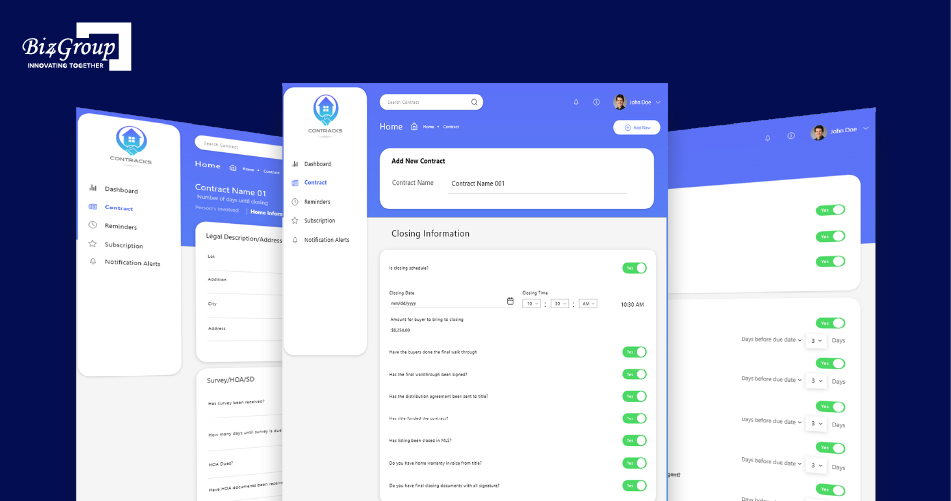
Biz4Group's Contracks project offers an example of the work that can happen after a buyer moves beyond property discovery. The platform helps users manage real estate contract information, track completed and outstanding formalities, and receive notifications about important dates and events. This highlights why a real estate platform may need to account for more than buyer interest alone: the journey can also involve tracking deadlines, paperwork, and the steps required to move a transaction forward.
Look for a partner who understands real estate workflows, has a clear technical approach, and can support the platform after launch, especially if you're building enterprise AI solutions that need to work across teams and systems.
Ask yourself: Have they worked with real estate workflows before, and can they explain how they would handle the specific challenges your team faces?
Ask for examples of relevant work and how the team handled data quality, integrations, and model evaluation. The goal is to understand how they approach problems like yours, not just which technologies they use.
Before development begins, make sure you understand who controls the data, how the intent model reaches its conclusions, and what happens as usage increases.
A partner should be able to explain these decisions in plain language and describe the trade-offs involved.
Get specific about what the partner will deliver and how you'll decide whether the work is complete. If you plan to hire AI developers, make sure you know what they'll deliver, how the work will be tested, who owns the code and data, and what support will be available after launch. A clear agreement should cover:
|
Area |
What to clarify |
|---|---|
|
Project scope |
Which features, integrations, and platform components are included? |
|
Acceptance criteria |
How will tracking, scoring, routing, and other functions be tested? |
|
Documentation and handover |
What technical documentation, training, and access will your team receive? |
|
Maintenance and support |
Who handles bugs, infrastructure issues, model updates, and ongoing support? |
|
Costs and changes |
What is included in the agreed price, and how will additional work be estimated? |
These details help prevent misunderstandings and make it easier to assess the partner's work throughout the project, not just at launch.
A homebuyer's journey is rarely a straight line. Someone might save ten properties, revisit one listing every day, and still be weeks away from making a decision. That's why custom AI homebuyer journey platform development should focus on more than clicks and scores. By connecting buyer preferences, property activity, financing context, and agent feedback, your platform can help teams spot meaningful signals and make follow-ups more relevant. After all, what good is a "hot lead" if nobody knows why it's hot?
At Biz4Group LLC, we approach these platforms with that practical distinction in mind: intent scores need context, and the people acting on them need useful information. From data integration to scoring and handoffs, thoughtful AI consulting services can help shape a platform around your actual workflow. The aim isn't to predict every buyer perfectly. It's to help your team ask better questions, at the right moment.
Ready to turn scattered buyer signals into a clearer picture of purchase intent? Reach out to the AI experts at Biz4Group LLC to discuss a platform built around your real estate business needs.
Combine repeat property views, saved listings, viewing requests, financing activity, and the buyer's stated timeline. An AI intent-scoring model can help interpret these signals, but the score should guide follow-up, not guarantee a purchase.
Start with property searches, listing views, saved homes, buyer preferences, CRM conversations, and relevant mortgage or prequalification updates. Check for duplicate or outdated records, and only use data you're permitted to collect and process.
Yes. A conversational AI can ask about budget, location, property type, financing, and buying timeline, then pass the answers and conversation context to your CRM or sales team. Keep the questions relevant and let buyers request a human agent.
Use reliable identifiers, such as a buyer's login or a consent-based matching method, to connect activity across sessions. Avoid merging records based on uncertain matches, and respect privacy preferences.
Rule-based scoring can be a practical starting point when historical outcome data is limited. Machine learning can help identify more complex patterns when you have enough reliable data. A hybrid approach can combine business rules with model predictions.
Set qualification and routing rules based on factors such as buyer needs, location, financing questions, and agent availability. Send the assigned person the buyer's preferences, relevant activity, and recommended next step so they have context for the conversation.
Compare scored leads with actual outcomes, including contact rates, appointments, completed property visits, and lead-to-close conversion. Where possible, use a controlled comparison with your existing process to estimate whether the platform is contributing to the improvement.
The main factors are data readiness, the number and complexity of integrations, tracking requirements, scoring approach, security needs, and rollout size. A focused pilot can validate core features before you invest in a broader production launch.
Update buyer profiles as new activity and preference information becomes available. Monitor model performance against actual outcomes, review agent feedback, and adjust scoring rules or retrain models when the evidence shows they need updating.
If your CRM already supports your workflows and integrations, adding AI capabilities may be enough. Consider a custom platform when you need specialized tracking, data unification, scoring, or routing that your current systems can't accommodate. Compare implementation effort and ongoing costs before deciding.

Our website require some cookies to function properly. Read our privacy policy to know more.