 Location :
Orlando, FL, USA
Location :
Orlando, FL, USA +1 (407) 714-1616
 info@biz4group.com
- Develop a pet care app like Rover by choosing the right app type, validating demand early, and building trust-first experiences for pet owners and caregivers.
- Strong pet care app development like Rover relies on a clear business model, including commissions, subscriptions, and value-added services.
- Focus first on must-have features such as booking, payments, reviews, and admin controls before layering advanced automation and intelligence.
- The cost to develop an app like Rover typically ranges from $35,000 to $250,000+, based on features, platforms, scalability, and development approach.
- Long-term success comes from solving key challenges like trust, caregiver quality, and retention, while working with an experienced team like Biz4Group LLC to build a pet care marketplace app similar to Rover.
How to Develop a Pet Care App like Rover: Business Model, Steps and Cost
"Can I build a pet care app like Rover without spending years and millions of dollars?"
If you've been asking yourself that question, chances are you've already spent hours exploring Rover, reading competitor blogs, and trying to figure out what it really takes to build a similar platform. The more you research, the more confusing it gets. One article tells you to copy Rover's features. Another suggests adding AI to everything. Before long, you're left wondering where to even begin.
According to sources, American households own at least one pet and the average spending is projected to reach around $165 billion in 2026.
Here's the thing: building a successful pet care app isn't about recreating Rover screen by screen. Anyone can make apps for dog sitters, online payments, and booking calendars. What separates a thriving marketplace from one that struggles after launch is everything happening behind the scenes, from earning users' trust and balancing demand with supply to creating an experience that keeps pet owners and caregivers coming back.
If you're planning to invest your time, budget, and energy into developing a pet care app like Rover, it's worth getting the strategy right before writing the first line of code. After all, every decision you make today, whether it's choosing the right features, defining your business model, or deciding where AI actually adds value, will directly influence how your platform performs once it goes live.
What Is a Pet Care App and Why Rover Continues to Lead the Market
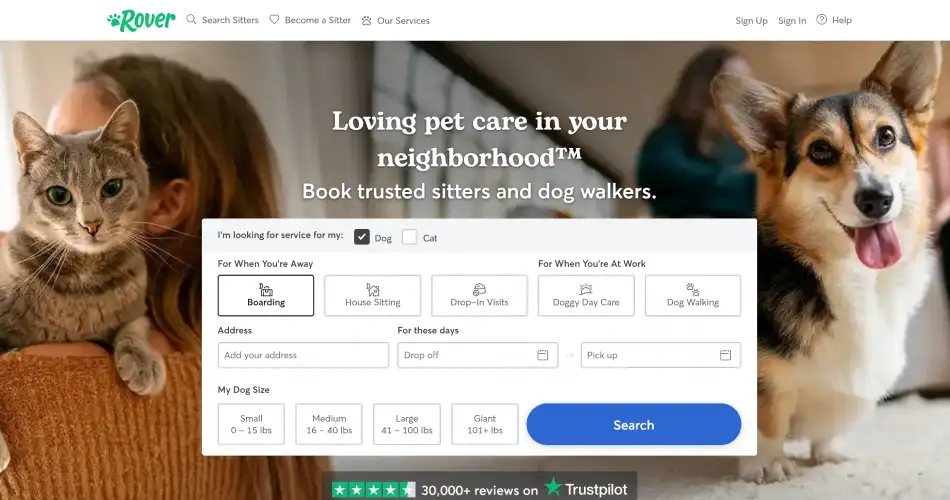
At its core, a pet care app is a digital marketplace. It connects pet owners who need help with walkers, sitters, boarders, or caregivers who offer those services locally.
Sounds simple, right? But if it were that easy, every pet care app would look like Rover.
A successful platform like Rover solves three hard problems at the same time.
- Trust
- Convenience
- Scale
Pet owners worry about safety. Caregivers worry about consistent bookings and fair payouts. The platform has to balance both sides without friction.
That is where most attempts at pet care app development like Rover fall short.
So, what does a modern pet care app actually do?
For pet owners, it removes uncertainty.
- Browse verified caregivers
- Compare pricing and availability
- Read real reviews from other pet owners
- Book services in minutes without phone calls
For walkers and sitters, it creates steady demand.
- Visibility to nearby pet owners
- Scheduling and availability management
- Secure payouts
- Tools to build long-term reputation
For the business owner, it becomes a scalable marketplace.
- Each booking strengthens the network
- Each review builds trust
- Each successful interaction improves retention
Why Rover became the benchmark
Rover did not win because it was first. It won because it focused on what mattered most to pet owners.
- Clear service categories like walking, sitting, and boarding
- Strong identity verification for caregivers
- Insurance coverage that builds confidence
- A review system that influences booking decisions
- Simple booking and payments that reduce drop-offs
These choices made Rover feel safe before it felt fancy. That is an important lesson if you plan to develop a pet care app like Rover. You are not just building features. You are building confidence at scale.
What founders often underestimate
Many teams think copying the interface is enough; it is not. Rover’s advantage comes from how the platform is structured, not just how it looks.
- Booking workflows
- Notifications and reminders
- Data flow between users, caregivers, and admin
- Backend logic that supports growth
That is why serious founders treat this as a long-term platform, not a one-time build. Strong mobile app development foundations matter if you want to support multiple cities and thousands of users without constant rework.
If you are planning Rover like app development, the real question is not whether demand exists. It clearly does.
The real question is which type of pet care app you should build first and how focused your initial version should be.
Thinking About Building the Next Rover
You already see the demand. The real question is how fast you want to move from idea to execution without costly mistakes.
Talk to Our ExpertsWhat Can Your Pet Care App Do Better Than Rover?
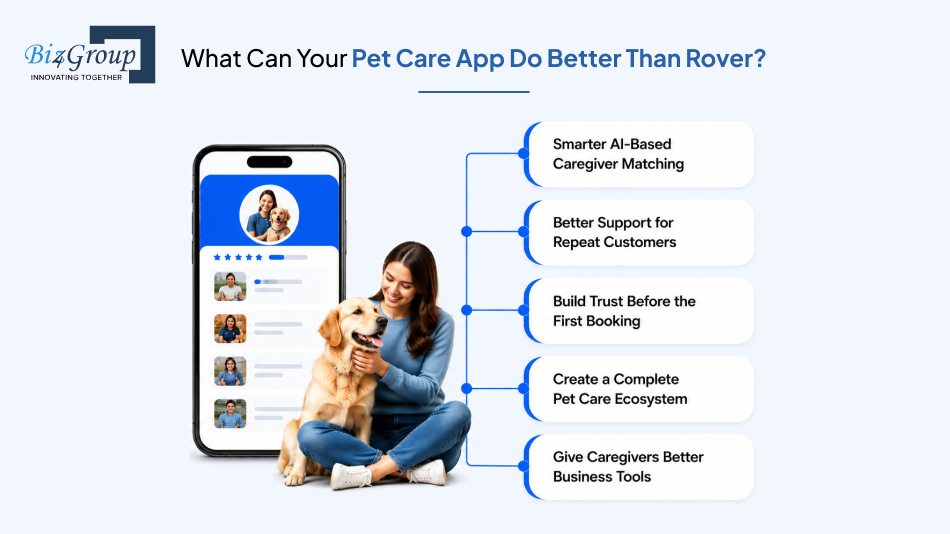
You don't build a successful pet care app by copying Rover feature for feature. While Rover has set the benchmark for online pet care marketplaces, it's far from perfect. In fact, many of the opportunities for new platforms lie in solving the everyday frustrations that users and caregivers continue to experience.
Instead of asking, "How can I build an app like Rover?" ask yourself a more important question:
"What can my platform offer that Rover doesn't?"
Here are a few opportunities worth exploring.
1. Smarter AI-Based Caregiver Matching
Rover primarily relies on location, availability, ratings, and user preferences to recommend caregivers. While effective, it doesn't always account for factors like a pet's personality, medical needs, behavioral traits, or previous booking history.
Your platform can use AI to recommend caregivers based on compatibility instead of just proximity. For example, matching anxious dogs with experienced sitters or recommending caregivers who've successfully handled senior pets or specific breeds can significantly improve customer satisfaction.
2. Better Support for Repeat Customers
Many pet owners prefer booking the same sitter repeatedly. While Rover supports repeat bookings, there's room to create a much more personalized experience.
Imagine automatically reminding users when it's time to book recurring daycare, suggesting their preferred sitter based on past schedules, or generating personalized care summaries after every visit. Small conveniences like these can increase retention without requiring major development effort.
3. Build Trust Before the First Booking
Trust remains the biggest barrier for any pet care marketplace. Ratings and reviews help, but they rarely tell the complete story.
Consider introducing richer trust signals, such as verified certifications, pet care experience badges, response time metrics, completed background checks, video introductions, or AI-generated profile summaries that highlight each caregiver's strengths. Helping users make confident decisions can directly improve booking conversions.
4. Create a Complete Pet Care Ecosystem
Most users create a dog sitting app for a single purpose: finding a sitter or dog walker. But today's pet owners often need much more.
Your platform could connect pet sitting with grooming, veterinary consultations, pet training, boarding, insurance, subscription care plans, or even wearable device integrations. Expanding beyond bookings allows you to increase customer lifetime value while creating additional revenue streams.
5. Give Caregivers Better Business Tools
Successful marketplaces don't just attract customers, they empower service providers.
Instead of treating caregivers as profile listings, give them tools to grow their business. Features like earnings analytics, AI-assisted schedule optimization, automated customer follow-ups, tax reports, pricing recommendations, and loyalty rewards can make your platform more attractive than competitors that focus primarily on pet owners.
Rover has already proven that the business model works. Your competitive advantage doesn't come from replicating its feature set. It comes from identifying the friction points that still exist and solving them better. That's often the difference between building another Rover clone and building a platform with a reason to exist.
At this stage, many founders start thinking beyond Rover itself. Some want to serve underserved niches, while others are looking for a lean MVP before investing heavily. In our conversations with entrepreneurs, we often hear questions like:
"I want to build a pet care app similar to Rover focused on a specific niche like cats and exotic pets that Rover does not serve well, I have a product concept and some savings to invest but I have no idea what features I actually need to build for both pet owners and sitters, what the development steps look like, and how much a realistic MVP is going to cost me working with a US-based development team in 2026."
If that sounds familiar, the next few sections will help you make those decisions with much more confidence.
Types of Pet Care Apps You Can Build Beyond Rover
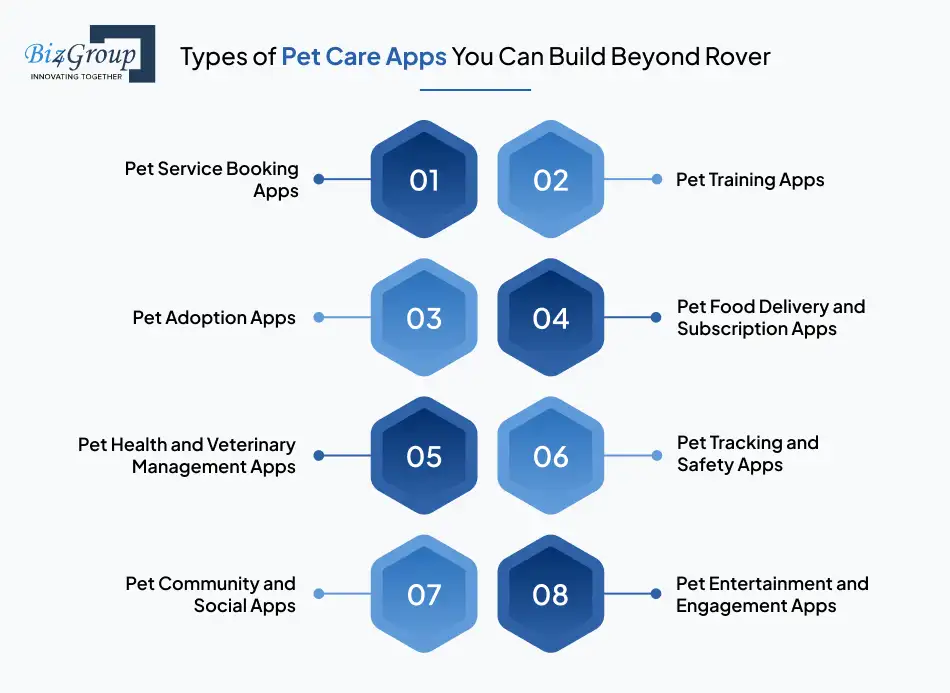
Before you move ahead to develop a pet care app like Rover, it is important to understand that Rover is not a category. It is a successful execution within a much larger pet tech ecosystem. The choices you make at this stage directly influence your feature set, monetization strategy, development cost, and time to market.
Let’s look at the real, industry-recognized types of pet care apps that founders are building today.
Pet Service Booking Apps
This is the category Rover leads and the most common entry point for startups. These apps allow pet owners to book services such as dog walking, pet sitting, boarding, grooming, and training from verified providers. Trust, availability, and seamless payments are the core value drivers here. If your goal is to build pet care marketplace application like Rover, this is the most direct and scalable model to start with.
Pet Training Apps
Pet training apps focus on improving pet behavior through guided programs, videos, progress tracking, and sometimes live trainer access. They are content-driven platforms rather than pure marketplaces. Many founders use this model to complement service-based apps or to create standalone products with strong engagement as part of pet care app development like Rover strategies.
Pet Adoption Apps
These platforms connect shelters, rescue organizations, and adopters. The focus is on discovery, education, and screening rather than transactions. Adoption apps rely heavily on filtering, detailed profiles, and compliance workflows. While not revenue-heavy marketplaces, they are valuable extensions for teams planning custom pet care app development like Rover.
Pet Food Delivery and Subscription Apps
Pet food apps handle scheduled deliveries, subscriptions, and repeat purchases. Retention is high, but logistics and inventory management add complexity. Some founders integrate food delivery after launching service apps to increase lifetime value while building an app like Rover with multiple revenue streams.
Pet Health and Veterinary Management Apps
These apps help pet owners manage vet appointments, medical records, vaccinations, medications, and wellness routines. Some platforms also support clinics on the backend. As digital vet care grows, this category is becoming a strong expansion path for teams offering pet care app solutions for startups and entrepreneurs like Rover.
Pet Tracking and Safety Apps
Tracking apps integrate with GPS collars or wearables to monitor pet location and activity. Hardware integration, real-time data processing, and reliability are key challenges here. These features are often added later when startups develop scalable pet care platforms for startups like Rover.
Pet Community and Social Apps
These apps focus on interaction between pet owners. Users share experiences, reviews, recommendations, and local events. Monetization typically comes from ads or memberships. Community layers are commonly introduced during Rover like app development to improve retention.
Pet Community and Social Apps: Beyond Bookings with Real Engagement
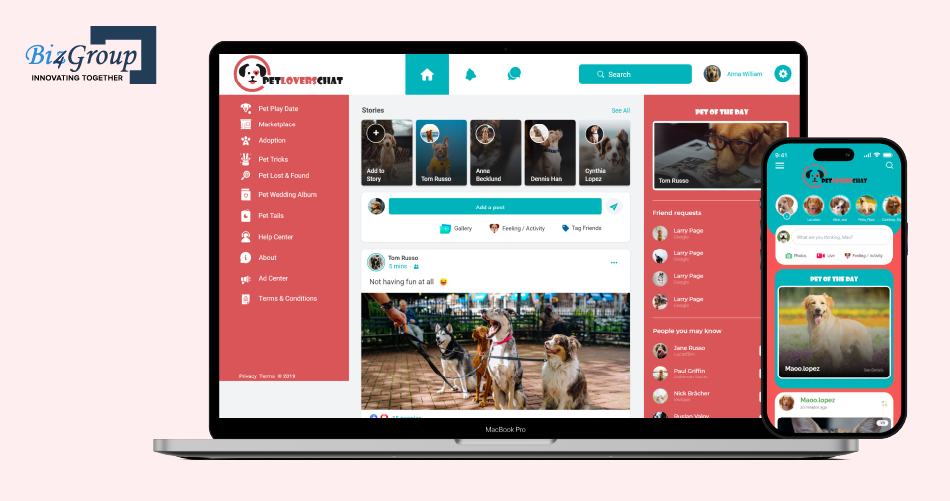
One of the most exciting angles in this space is how social interaction drives deeper engagement than just service booking. A striking example is PetLoversChat, a pet social networking and marketplace platform we built that brings pet owners together with each other and with relevant pet services. This goes beyond pet care app development like Rover by blending social connection with discovery.
Think of it this way. When you give your users a place to share moments, find friends for their pets, and explore goods and services nearby, you build stickiness that keeps them coming back every day.
Here’s what makes PetLoversChat stand out:
- A full social platform for pet lovers available on iOS, Android, and web with features designed around community sharing and interaction.
- Users can create and view stories, post photos and videos, tag friends, and manage profiles with ease.
- Integrated marketplace functionality lets people explore products and services related to pet care right inside the app.
- Location and scheduling features help people connect locally and plan pet play dates or meet ups.
- Sections for lost and found, multi-language support, and vendor/buyer profiles add real practical value.
This project shows that you can build engagement layers around your core to develop a pet care app like Rover functionality. Users don’t just book services; they interact, explore products, and form a community that keeps your platform alive and thriving.
Pet Entertainment and Engagement Apps
Entertainment apps include interactive games, stimulation activities, and virtual engagement tools for pets. While not core booking features, they help increase daily usage and emotional connection when teams build on demand pet care app like Rover with engagement-focused add-ons.
One mistake many founders make is trying to combine too many app types at launch. Successful platforms usually start with a single, high-demand use case, validate it, and then expand gradually. That is why many teams begin with service booking and rely on structured on-demand app development to launch faster without overbuilding.
How Pet Care Apps Like Rover Make Money and Scale Profitably?
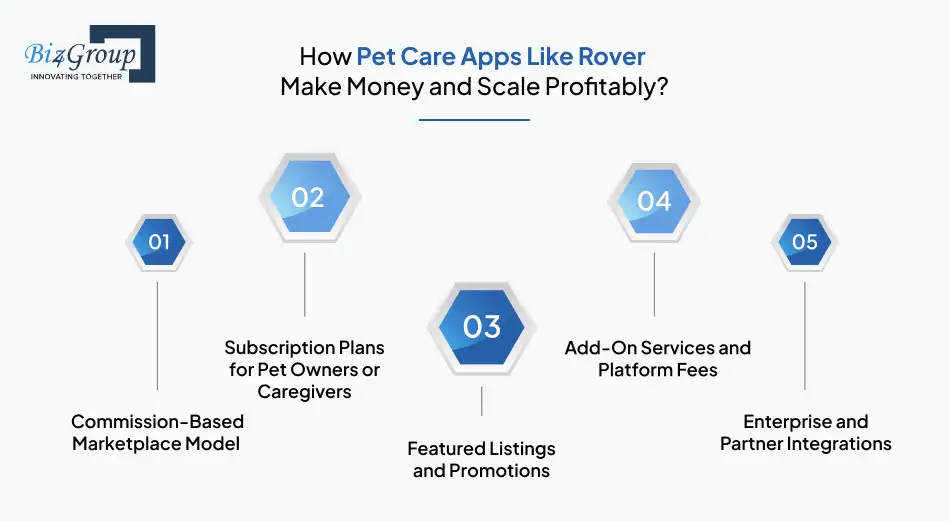
If you are planning to develop a pet care app like Rover, this is the section that really matters. Features attract users, but monetization decides whether your platform survives.
Most founders ask this early, and rightly so. Is it actually profitable to build a pet care app like Rover, or does it only work at massive scale?
The short answer is yes, it can be profitable. But only if your business model is designed intentionally from day one.
Let's break down the most effective monetization strategies used in pet care app development like Rover, and when each one makes sense.
Commission-Based Marketplace Model
This is the core model behind Rover's success. You take a percentage from every completed booking between pet owners and walkers or sitters. It scales well because your revenue grows as usage grows. Most startups choose this when they want to build pet care marketplace application like Rover without charging users upfront.
- The key decision here is balance.
- Too high a commission pushes caregivers away.
- Too low and you struggle to cover operations.
Subscription Plans for Pet Owners or Caregivers
Subscriptions work well when users book frequently. Pet owners might pay monthly for discounted services, while walkers or sitters pay for better visibility or priority listings. This creates predictable revenue and smooths cash flow, which is helpful when you are building an app like Rover for long-term growth. Subscriptions are often layered on top of commissions rather than replacing them.
Featured Listings and Promotions
Caregivers can pay to appear higher in search results or be highlighted in certain areas. This model works especially well in competitive cities where supply is high. It is simple to implement and becomes more effective as your platform grows, making it a popular add-on during Rover like app development.
Add-On Services and Platform Fees
Insurance coverage, background checks, instant payouts, or premium support can all be offered as paid extras. These services increase trust while opening new revenue streams. Many founders underestimate how much value these small fees add when you develop an app like Rover at scale.
Enterprise and Partner Integrations
Some platforms expand by partnering with pet stores, veterinary clinics, or housing communities. This opens the door to bulk bookings or white-labeled solutions. It is a strong option for teams planning pet care app solutions for startups and entrepreneurs like Rover with a B2B angle.
The biggest mistake is copying Rover’s pricing without understanding their own market. Different cities, services, and customer segments behave differently.
Your monetization strategy should match:
- Your target users
- Service frequency
- Local competition
- Operating costs
This is where automation becomes critical. Smart platforms use workflows, payouts, and reporting powered by AI automation services to reduce manual effort and protect margins as volume grows.
When monetization is planned early, profitability becomes a design choice, not a gamble.
Understanding Rover's Marketplace Flywheel
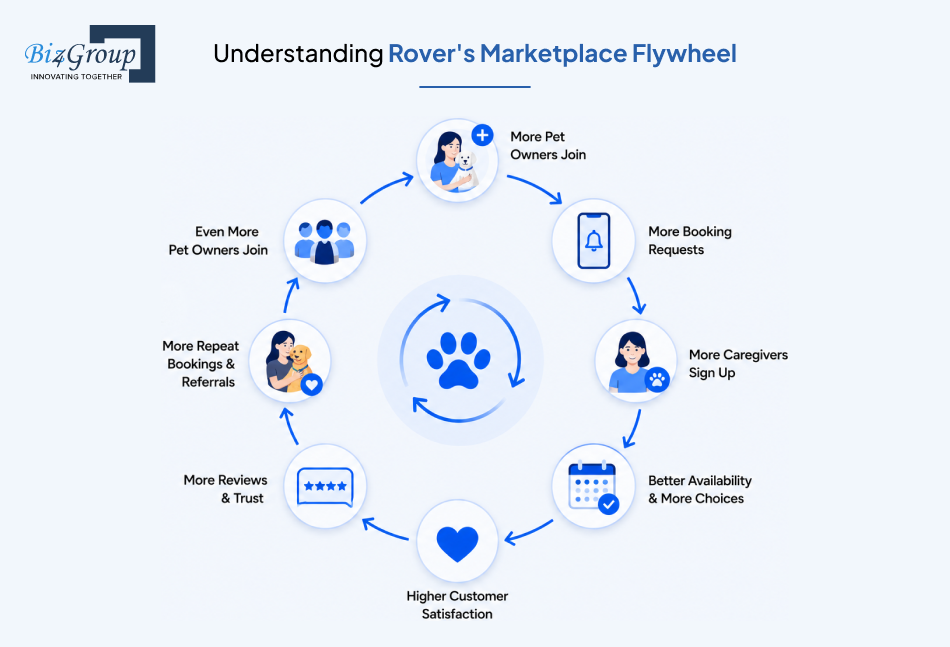
One of the biggest reasons Rover became a market leader isn't because it introduced groundbreaking features. Its real advantage lies in something much harder to replicate: a marketplace flywheel.
Think of it as a cycle where every successful booking makes the platform more valuable for the next user.
It works something like this:
Once this loop gains momentum, the marketplace starts growing on its own. Every new pet owner attracts more caregivers, and every new caregiver improves the experience for future customers.
Why This Matters for Your Pet Care App like Rover?
Many founders spend months deciding which features to build but overlook the one thing that actually drives long-term growth: marketplace liquidity.
A pet care platform with 100 excellent features won't succeed if there aren't enough trusted caregivers available when customers need them. Likewise, caregivers won't stay active if they're not receiving consistent booking requests.
That's why your early product decisions should focus on strengthening this flywheel instead of simply expanding your feature list.
For example, you could:
- Launch city by city instead of targeting an entire country.
- Offer incentives to onboard high-quality caregivers before acquiring pet owners.
- Encourage repeat bookings through subscriptions or loyalty rewards.
- Build trust with verified profiles, reviews, insurance, and transparent pricing.
- Use AI integration services to improve caregiver matching and booking success.
The stronger your marketplace flywheel becomes, the less your business depends on constant marketing spend to generate new bookings.
Must-Have Features to Develop a Pet Care App Like Rover That Users Actually Trust
When you plan to develop a pet care app like Rover, features are not cosmetic decisions. Each one exists to reduce friction, build trust, and keep your marketplace stable as it grows.
A reliable platform balances three experiences at the same time: pet owners, caregivers, and admins. Missing features on any one side eventually weaken the entire product when you build a pet care marketplace app similar to Rover.
One agency recently approached us with a requirement that looked something like this:
"I am a software development agency and a client in the pet care industry wants us to build a two-sided marketplace platform like Rover with real-time GPS tracking for dog walks, in-app messaging, background check integration, and a payment system. What are all the features we need to build on both the pet owner side and the sitter side, what tech stack should we use, and what are the biggest technical challenges we should plan for before we start?"
The first thing we'd point out is that this isn't a feature request, it's a platform architecture question. Before choosing technologies or estimating effort, you need to identify which capabilities belong to each user role and how they'll interact with one another. For a Rover-like marketplace, that means defining dedicated experiences for pet owners, caregivers, and administrators, each with its own responsibilities and workflows.
Must-Have Features for Pet Owners
1. User Registration and Pet Profiles
Pet owners need an easy way to create accounts and manage detailed pet profiles. This includes breed, age, medical notes, feeding routines, and behavior preferences. These details reduce service errors and are foundational when you develop an app like Rover focused on trust.
2. Service Discovery and Smart Search
Advanced filters for location, availability, pricing, and ratings are critical. Pet owners expect fast results that match their needs. This feature directly supports teams aiming to build on demand pet care app like Rover.
3. Booking and Scheduling
Real-time availability, instant confirmations, and flexible scheduling are essential. A smooth booking flow is what differentiates strong pet care app development like Rover from apps that users abandon early.
4. Secure In-App Payments
Cashless payments with transparent pricing, receipts, and refunds protect both parties. This is a non-negotiable requirement when you build pet care apps with booking and payment like Rover.
5. In-App Chat and Notifications
Centralized communication ensures updates, reminders, and service status messages stay within the platform. This improves satisfaction and reduces disputes as you create on demand pet sitting apps like Rover.
6. Ratings and Reviews
Reviews influence booking decisions more than pricing in many cases. This feature strengthens credibility and retention across Rover like app development projects.
Must-Have Features for Walkers and Sitters
1. Caregiver Profiles and Verification
Walkers and sitters need profiles that showcase experience, certifications, and services offered. Identity checks and background verification are critical when you develop pet sitting and dog walking app like Rover.
2. Availability and Service Management
Caregivers must manage schedules, accept or decline requests, and update availability easily. This keeps supply reliable as you build a pet care marketplace application like Rover.
3. Booking Requests and Job Management
Clear visibility into upcoming jobs, pet details, and service expectations helps caregivers deliver consistent care and avoid misunderstandings.
4. Earnings and Payout Dashboard
Transparent dashboards showing completed jobs, commissions, and payout timelines build trust with caregivers and reduce churn while building an app like Rover.
5. Ratings, Reviews, and Reputation Building
Reputation tools help quality caregivers stand out and encourage long-term participation on platforms offering custom pet care app development like Rover.
Must-Have Features for Admin
1. User and Caregiver Management
Admins need full control over onboarding, verification, suspensions, and approvals. This ensures platform quality as you develop scalable pet care platforms for startups like Rover.
2. Commission and Payout Control
Flexible commission rules and payout management are essential to maintain margins when you create pet care marketplace software like Rover.
3. Booking Oversight and Dispute Resolution
Admins must have visibility into bookings, conversations, and payments to resolve conflicts quickly and protect brand trust.
4. Analytics and Reporting
Dashboards showing bookings, revenue, retention, and city-wise growth support smarter decisions across pet care app software development like Rover initiatives.
5. Content and Service Management
Admins should manage services, pricing rules, policies, and FAQs without developer dependency, especially when scaling pet care app solutions for startups and entrepreneurs like Rover.
Features Founders Often Miss Early
Many teams overlook these until problems appear:
- Cancellation and refund workflows
- Multi-city and timezone support
- Customer support tooling
- Legal acknowledgments and policy consent
Planning these early reduces rework when you build a pet care marketplace app similar to Rover.
Are You Building Features or Building Trust
The right features decide whether users book once or keep coming back. Let’s prioritize what actually drives adoption and revenue.
Plan My App FeaturesAdvanced Features That Help You Stand Out When You Develop a Pet Care App Like Rover
Once the core features are in place, advanced capabilities are what separate a usable app from a market leader. If you want to develop a pet care app like Rover that scales, retains users, and competes long term, these features should be planned early, even if they are rolled out in phases.
Below is a clear, founder-friendly view of advanced features, why they matter, and when to prioritize them during pet care app development like Rover.
|
Advanced Feature |
What It Does |
Why It Matters for Rover-Like Apps |
|---|---|---|
|
Smart Matching and Recommendations |
Matches pet owners with the most suitable walkers or sitters based on pet needs, history, location, and availability. |
Improves booking success rates and satisfaction when you build pet care marketplace application like Rover. |
|
Real-Time GPS Tracking |
Allows pet owners to track dog walks or service progress live. |
Builds transparency and trust, which is critical when you build pet care apps with booking and payment like Rover. |
|
Automated Background Checks |
Integrates third-party verification for caregivers. |
Strengthens safety while reducing manual review effort during custom pet care app development like Rover. |
|
Dynamic Pricing and Surge Logic |
Adjusts service pricing based on demand, time, or location. |
Helps optimize revenue and supply balance as you develop scalable pet care platforms for startups like Rover. |
|
Instant and Scheduled Payouts |
Enables faster and flexible payouts for caregivers. |
Improves provider retention in Rover like app development projects. |
|
Multi-City and Multi-Region Support |
Supports multiple locations, time zones, currencies, and service rules. |
Essential for growth when you build a pet care marketplace app similar to Rover. |
|
Tracks demand trends, service performance, and user behavior. |
Enables smarter decisions across pet care app software development like Rover initiatives. |
|
|
Automates FAQs, booking help, and issue resolution using conversational flows. |
Reduces support load and improves response time when backed by an experienced AI chatbot development company. |
|
|
Intelligent Workflow Automation |
Uses decision logic to route bookings, flag issues, and optimize operations. |
Platforms that incorporate an AI agent scale faster with fewer operational bottlenecks. |
|
Fraud Detection and Abuse Monitoring |
Identifies suspicious activity, fake profiles, or payment misuse. |
Protects marketplace integrity as you develop an app like Rover at scale. |
You do not need all of these features on day one. The smartest teams treat them as roadmap, not a launch checklist. Start with features that directly impact trust and bookings, then layer in intelligence and optimization as usage grows.
Planning advanced features early helps avoid expensive rework later and ensures your pet care app development like Rover stays competitive as expectations rise.
A Step-by-Step Approach to Build a Pet Care App Like Rover Without Guesswork
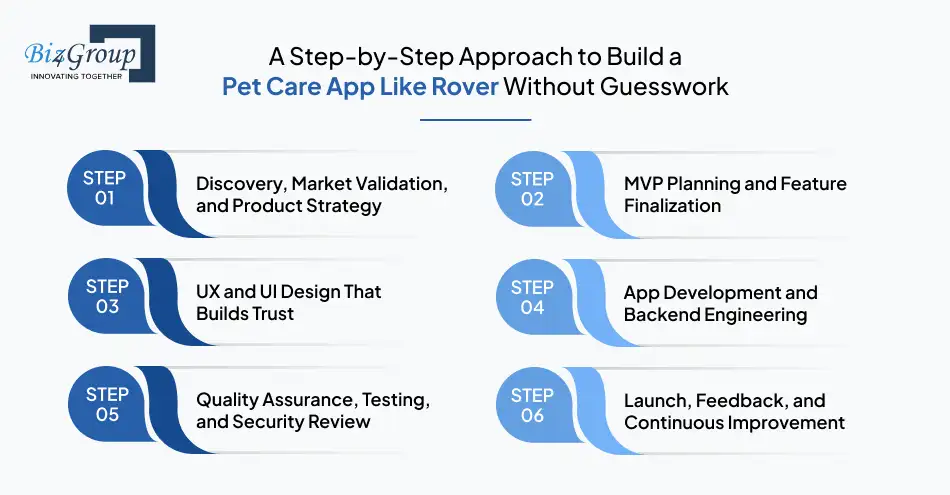
When founders rush straight into development, costs spiral and timelines slip. If you want to develop a pet care app like Rover and avoid expensive rework, the execution path matters as much as the idea itself.
This is a practical roadmap used by teams building pet care app development like Rover, app development similar to Rover, and Rover like app development projects for the US market.
Step 1: Discovery, Market Validation, and Product Strategy
This is where clarity is built. Before committing to code, you define who your users are, what problem you are solving, and whether you want to build on demand pet care app like Rover or a broader marketplace. This step protects you from building features no one uses. It also helps validate whether your idea can evolve into a profitable product.
What happens here
- Market research and competitor analysis
- User personas for pet owners and caregivers
- Validation for pet care app solutions for startups and entrepreneurs like Rover
- Feature prioritization tied to business outcomes
Step 2: MVP Planning and Feature Finalization
This phase answers a critical question. What is the smallest product that proves demand? A strong MVP focuses on bookings, payments, and trust, nothing more. This is essential when you build a pet care marketplace app similar to Rover without overspending early. MVP planning keeps scope controlled while leaving room for future growth.
What happens here
- Core feature selection
- Technical feasibility checks
- Phased rollout planning
- Structured MVP development for faster validation
Step 3: UX and UI Design That Builds Trust
Pet care platforms succeed or fail at the trust layer. If users hesitate during booking, conversion drops. This stage focuses on intuitive flows that guide users confidently through discovery, booking, and payment when you build pet care apps with booking and payment like Rover. Design here reduces friction and increases repeat usage.
What happens here
- User journey mapping
- Wireframes and clickable prototypes
- Usability testing with real users
- Visual systems created by expert UI/UX design teams
Step 4: App Development and Backend Engineering
This is where your product becomes real. Mobile apps, backend systems, and integrations are built together to support bookings, messaging, payments, and admin control. Architecture decisions here affect performance and scalability when you develop scalable pet care platforms for startups like Rover.
What happens here
- iOS and Android development
- Backend APIs and database design
- Payment, maps, and notification integrations
- Scalable mobile app development execution
Step 5: Quality Assurance, Testing, and Security Review
Testing protects your users and your brand. Every workflow is tested under real conditions, including failed payments and last-minute cancellations. This step is often underestimated during pet care app software development like Rover, but it saves significant cost later.
What happens here
- Functional and usability testing
- Payment and data security checks
- Performance and load testing
- Issue resolution and release readiness
Step 6: Launch, Feedback, and Continuous Improvement
Launching your app is the beginning, not the end. Early feedback helps you refine features, improve retention, and prepare for expansion into new services or cities. This phase supports teams planning custom pet care app development like Rover with long-term growth in mind.
What happens here
- App store deployment
- User onboarding and monitoring
- Feedback analysis and iteration
- Continuous optimization using business app development using AI insights
Each step builds on the previous one. Skipping stages leads to wasted budget and delayed launches. A structured approach helps you build a pet care marketplace app similar to Rover with confidence, clarity, and control.
Technology Stack to Develop a Pet Care App Like Rover That Scales Reliably
Choosing the right technology stack is not a technical decision alone. It is a business decision. When you develop a pet care app like Rover, your stack determines how fast you launch, how easily you scale, and how expensive it becomes to maintain the platform over time.
Below is a practical, decision-maker-friendly view of the tech stack commonly used in pet care app development like Rover, along with why each layer matters.
|
Technology Layer |
Common Choices |
Why This Matters for Rover-Like Apps |
|---|---|---|
|
Mobile App Development |
React Native, Flutter, Swift for iOS, Kotlin for Android |
Supports smooth booking, messaging, and payments across devices. This layer directly impacts user trust and retention when you build pet care apps with booking and payment like Rover. |
|
Frontend Web Panel |
React.js, Angular, Vue.js |
Powers admin dashboards and caregiver web access. A clean frontend is critical when you build a pet care marketplace app similar to Rover with operational control. |
|
Backend Development |
Handles bookings, payments, notifications, and user logic. A strong backend is essential to develop scalable pet care platforms for startups like Rover. |
|
|
Database Management |
PostgreSQL, MySQL, MongoDB |
Stores user profiles, pet data, bookings, and transactions securely. Database design affects performance as your platform grows. |
|
Real-Time Communication |
WebSockets, Firebase, Socket.io |
Enables live chat, booking updates, and instant notifications between pet owners and caregivers. |
|
Payments and Payouts |
Stripe, PayPal, Braintree |
Secure and flexible payment handling is non-negotiable when you develop pet service booking application like Rover. |
|
Maps and Location Services |
Google Maps API, Mapbox |
Supports caregiver discovery, distance calculations, and real-time tracking for walks and visits. |
|
Cloud Infrastructure |
AWS, Google Cloud, Microsoft Azure |
Provides scalability, uptime, and security. Cloud-native setups help control cost during Rover like app development. |
|
Security and Compliance |
OAuth, SSL, PCI-DSS standards |
Protects user data and payment information, which is critical for trust-driven marketplaces. |
|
AI and Automation Layer |
Recommendation engines, workflow automation, predictive analytics |
Enhances matching, pricing, and operational efficiency. Many teams rely on an experienced AI development company to implement these capabilities correctly. |
|
System Integrations |
Third-party APIs, verification services, analytics tools |
Enable background checks, analytics, and notifications through robust AI integration services. |
You do not need the most complex setup on day one. What matters is choosing technologies that let you launch fast, validate your ideas, and scale without rebuilding everything later.
Also Read: Next JS Development Company
Cost to Develop a Pet Care App Like Rover: What You Should Budget and Why It Varies
If you are planning to develop a pet care app like Rover, the first question is usually about numbers. So, let’s address it upfront.
The estimated cost to develop a pet care app like Rover typically ranges from $35,000 to $250,000+. This range exists because the final cost depends on feature depth, app type, scalability needs, and the team you choose to work with.
A simple MVP for pet care app development like Rover will sit at the lower end. A multi-city, AI-powered marketplace with advanced workflows can easily move toward the higher end.
Let’s break this down in a way that helps you plan realistically.
Feature-Wise Cost Breakdown to Build a Pet Care App Like Rover
The biggest cost driver is what you decide to build and when. Below is a practical breakdown founders use when building an app like Rover.
|
Feature Category |
What’s Included |
Estimated Cost Range (USD) |
|---|---|---|
|
User Authentication and Profiles |
Signup, login, pet profiles, caregiver profiles |
$3,000 to $8,000 |
|
Service Discovery and Search |
Location-based search, filters, availability |
$4,000 to $10,000 |
|
Booking and Scheduling |
Real-time availability, confirmations, cancellations |
$6,000 to $15,000 |
|
Payments and Payouts |
Payment gateway, refunds, caregiver payouts |
$5,000 to $12,000 |
|
In-App Chat and Notifications |
Messaging, alerts, reminders |
$4,000 to $9,000 |
|
Ratings and Reviews |
Reviews, moderation tools |
$2,000 to $5,000 |
|
Admin Panel |
User management, commissions, analytics |
$6,000 to $18,000 |
|
Advanced Features |
GPS tracking, smart matching, automation |
$10,000 to $40,000 |
|
Testing and Deployment |
QA, security checks, app store launch |
$3,000 to $8,000 |
This modular approach helps you control spend while you build pet care marketplace application like Rover in phases.
Key Factors That Affect the Cost of Rover Like App Development
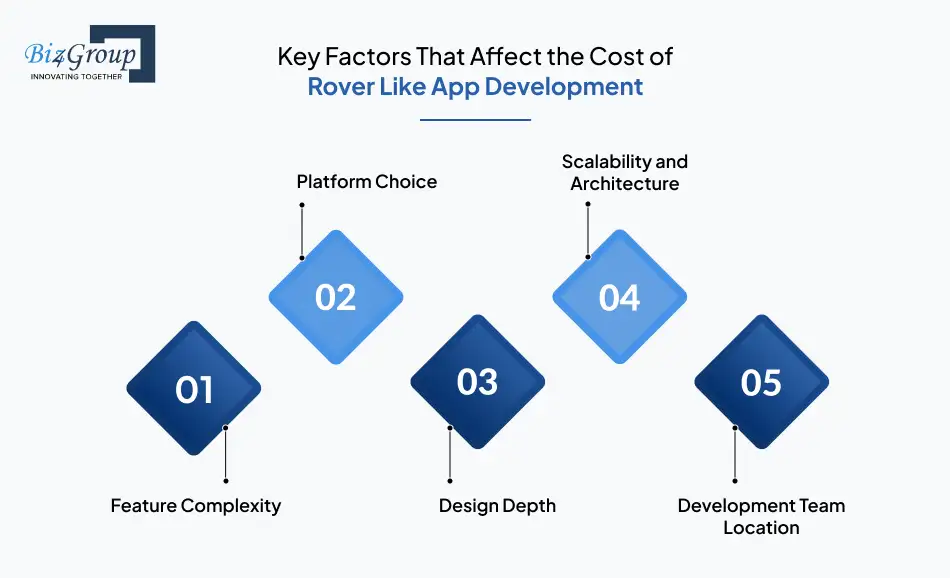
Understanding cost drivers helps you make better trade-offs early.
1. Feature Complexity
The more workflows you add, the more logic, testing, and maintenance is required. A focused MVP costs far less than a feature-heavy launch when you develop pet service booking application like Rover.
2. Platform Choice
Building for iOS, Android, and web simultaneously increases cost. Many founders start with one platform and expand later.
3. Design Depth
High-quality UX design improves trust and conversions but requires more time. Simple design reduces cost but can hurt adoption if usability suffers.
4. Scalability and Architecture
Apps built for one city are cheaper than platforms designed for national expansion. Planning scalability early avoids costly rebuilds.
5. Development Team Location
US-based teams cost more than offshore teams but often reduce communication gaps and rework. Many founders balance this by working with a custom software development company that offers strategic guidance along with execution.
Hidden Costs Founders Often Miss When Building a Pet Care App Like Rover
Even well-planned budgets can miss these.
- App store fees and developer accounts
- Third-party API costs for maps, payments, and verification
- Cloud hosting and scaling expenses
- Ongoing maintenance and updates
- Customer support and moderation tools
These costs grow as usage grows, especially when you develop scalable pet care platforms for startups like Rover.
Cost Optimization Tips for Bespoke Pet Care App Development Like Rover
You do not need to overspend to build a strong product. Smart decisions can save thousands.
Start With an MVP
Launch with core booking, payments, and trust features only. Expand after validating demand.
Reuse Proven Components
Avoid building everything from scratch. Reusable modules reduce development time and risk in Rover like app development.
Plan Features in Phases
Roadmap advanced features instead of launching all at once. This keeps early investment manageable.
Choose the Right Team
A skilled team builds faster and cleaner. Many founders reduce long-term cost by choosing to hire AI developers who understand marketplaces and automation.
Think Beyond Initial Build
Budget for analytics, optimization, and automation early, especially if you plan long-term AI pet care app development.
If your goal is to validate an idea quickly, a $35,000 to $60,000 MVP is realistic. If you are aiming for a full-featured, multi-city platform, expect costs closer to $150,000 to $250,000+. The key is not choosing the cheapest path, but the right one for your growth plan when you build a pet care marketplace app similar to Rover.
Not every company building a Rover-like platform is a funded startup. In fact, many of the conversations we have are with established pet service businesses that already have customers and want to take ownership of their bookings instead of relying on third-party marketplaces. A question we hear quite often is:
"We are a small pet services business in the US and we want to build our own branded app similar to Rover for our local market rather than paying Rover a commission on every booking. I need to understand what it would take to build something with booking, GPS tracking, messaging, and payments and whether it is realistic for a business our size to build this or if we should use a white label solution instead."
If you're weighing the same decision, the next section will help you understand when custom development makes sense, where third-party integrations fit in, and whether a white-label solution is the right starting point for your business.
Wondering Where Your Budget Will Really Go
Costs vary for a reason. Get a clear, realistic estimate tailored to your goals, not a generic number.
Get Cost EstimateBuild vs. Buy: Which Features Should You Build and Which Can You Integrate?
When developing a pet care app like Rover, one of the earliest architectural decisions you'll make is whether to build a feature in-house or integrate an existing solution. There isn't a universal answer. The right approach depends on your budget, timeline, scalability goals, compliance requirements, and how much control you want over the user experience.
While custom development offers greater flexibility and ownership, third-party services can significantly reduce development effort for mature, non-core functionalities. The key is knowing where each approach makes the most sense.
Feature |
Build In-House |
Buy / Integrate |
Recommended When... |
|---|---|---|---|
User Authentication |
Complete control over authentication flows |
Clerk, Auth0, Firebase Authentication |
Use third-party for faster launch; build only if you have unique authentication requirements. |
Payments & Payouts |
Custom payment workflows and settlement logic |
Stripe Connect, PayPal, Adyen |
Integrate unless your business model requires highly customized payment processing. |
Maps & Location Services |
Custom mapping capabilities |
Google Maps Platform, Mapbox |
Third-party APIs are sufficient for most pet care marketplaces. |
Push Notifications |
Full notification engine |
Firebase Cloud Messaging, OneSignal |
Third-party services are reliable and easy to scale. |
SMS & OTP Verification |
Custom messaging infrastructure |
Twilio, MessageBird |
Integration is generally more cost-effective and compliant. |
In-App Chat |
Tailored messaging experience |
Sendbird, Stream Chat, Twilio Conversations |
Build if messaging is central to your product; otherwise integrate. |
Video Calling |
Proprietary communication platform |
Agora, Twilio Video, Zoom SDK |
Integrate unless video is a core differentiator. |
Booking & Scheduling Engine |
Complete business logic control |
Limited third-party options |
Best developed in-house to match your marketplace workflows. |
Pet Owner & Caregiver Profiles |
Custom profile structure |
Limited third-party options |
Build to support your unique marketplace experience. |
AI-Powered Sitter Matching |
Custom recommendation models |
AI APIs can assist |
Build your matching logic while leveraging AI models where appropriate. |
Ratings, Reviews & Trust System |
Fully customizable trust mechanisms |
Limited third-party options |
Building in-house offers greater flexibility and competitive differentiation. |
Admin Dashboard & Analytics |
Tailored operational controls |
BI tools like Metabase or Retool can supplement |
Build core admin functions; integrate analytics where useful. |
There's no one-size-fits-all strategy here. Many successful marketplaces adopt a hybrid approach, combining custom-built features that define their competitive advantage with trusted third-party services for standardized capabilities.
As a rule of thumb, ask yourself a simple question before making each decision: "Will building this feature create a meaningful advantage for my users or my business?"
If the answer is yes, investing in custom development may be worthwhile. If not, integrating a proven solution can help you launch faster while allowing your team to focus on the features that truly differentiate your platform.
Challenges in Developing a Pet Care App Like Rover and How to Solve Them
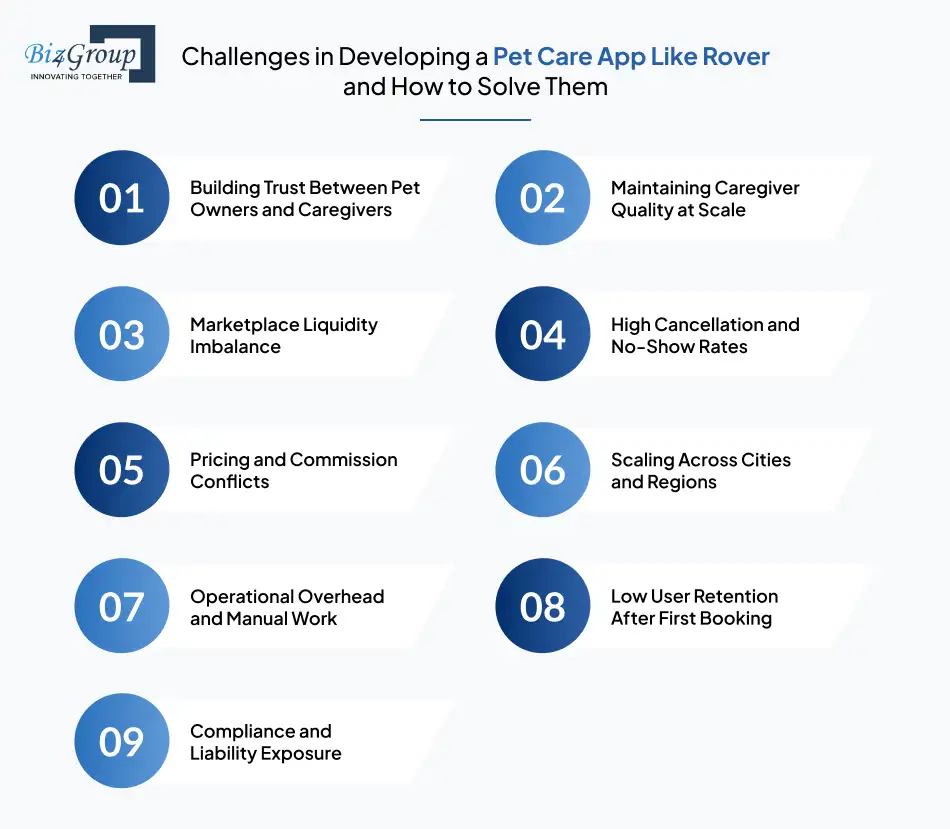
When you develop a pet care app like Rover, the real complexity shows up after the idea feels solid. Marketplaces are hard to balance, trust is fragile, and small operational gaps can quickly turn into user churn.
Below is a clear, decision-maker-friendly breakdown of the most common challenges in pet care app development like Rover, along with practical ways to solve them.
|
Challenge |
Why This Becomes a Problem |
How to Solve It Strategically |
|---|---|---|
|
Building Trust Between Pet Owners and Caregivers |
Pet owners are cautious about leaving pets with unknown caregivers. Without trust, bookings never take off. |
Verified profiles, reviews, insurance options, and transparent policies are essential when you build a pet care marketplace app similar to Rover. |
|
Maintaining Caregiver Quality at Scale |
As platforms grow, manual vetting becomes slow and inconsistent. Poor service damages brand credibility fast. |
Structured onboarding, performance scoring, and automated decision rules powered by enterprise AI solutions help maintain quality consistently. |
|
Marketplace Liquidity Imbalance |
Too many pet owners without caregivers, or vice versa, creates frustration on both sides. |
Launch with a focused geography or service type and expand gradually when you build on demand pet care app like Rover. |
|
High Cancellation and No-Show Rates |
Last-minute cancellations disrupt operations and reduce user satisfaction. |
Smart reminders, cancellation policies, and rebooking flows reduce friction during pet care app software development like Rover. |
|
Pricing and Commission Conflicts |
High commissions push caregivers away, while low commissions hurt revenue. |
Use data-driven pricing and adaptive rules when you develop pet service booking application like Rover. |
|
Scaling Across Cities and Regions |
Each market has different demand patterns, regulations, and service expectations. |
Flexible rule engines and configurable workflows support expansion as you develop scalable pet care platforms for startups like Rover. |
|
Operational Overhead and Manual Work |
Support tickets, payouts, and disputes increase rapidly as usage grows. |
Intelligent workflow orchestration using agentic AI development reduces manual intervention and speeds resolution. |
|
Low User Retention After First Booking |
One-time bookings do not build sustainable revenue. |
Loyalty incentives, reminders, and personalization improve repeat usage when building an app like Rover. |
|
Compliance and Liability Exposure |
Payment handling, data security, and policy gaps create legal risk. |
Secure architecture, audit trails, and policy enforcement are mandatory for pet care app solutions for startups and entrepreneurs like Rover. |
Most pet care platforms fail not because the idea is weak, but because complexity compounds faster than expected. When trust, operations, and scale are designed intentionally, your platform moves from a simple app to a defensible business.
Why is Biz4Group LLC a Leading Company to Develop a Pet Care App Like Rover in the USA?
When you plan to develop a pet care app like Rover, execution quality matters more than promises. Founders across the US choose Biz4Group because we focus on building real, scalable products, not just shipping code.
We are a US-based AI software development company with hands-on experience in marketplaces, on-demand platforms, and community-driven apps. Our strength lies in understanding how trust, engagement, and scalability come together in pet care platforms.
Real Product Experience in the Pet Tech Space
A strong example of our work is PetLoversChat, a pet-focused social community platform we built to help pet owners connect, share content, and discover pet-related services. The project demonstrates how social engagement layers can increase retention and daily usage, which is highly relevant when you are building a Rover-like ecosystem rather than just a booking app.
This experience directly supports founders who want to expand beyond transactions and create long-term user engagement.
Why Founders Work with Biz4Group
We help you move faster with clarity and confidence by combining product thinking with strong engineering. Our teams regularly work on intelligent platforms, including AI pet care app development, where smart matching, automation, and personalization improve marketplace performance.
As pet platforms grow, health and wellness features also become important. Our experience with AI veterinary clinical management software helps founders plan future-ready integrations around vet coordination and pet health data.
If your goal is to build a scalable, trusted pet care marketplace for the US market, Biz4Group brings the product insight, technical depth, and execution discipline needed to make it work.
Ready to Build Something Pet Owners Trust
You have the roadmap. Now you need a partner who knows how to execute it right in the US market.
Build With Biz4GroupWrapping Up!
Building a successful platform takes more than inspiration. When you decide to develop a pet care app like Rover, you are entering a trust-first marketplace where product decisions, execution quality, and scalability determine whether your idea becomes a business or fades out.
In this guide, we covered what truly matters when building an app like Rover. You learned how to choose the right app type, design a strong business model, plan must-have and advanced features, estimate realistic costs, and overcome common challenges in pet care app development like Rover. Each of these decisions shapes how well your platform attracts users, retains caregivers, and grows across cities.
At Biz4Group LLC, we help founders and enterprises build pet care marketplace applications like Rover with a clear focus on performance, security, and long-term growth. As a US-based AI software development company, our experience spans marketplaces, on-demand platforms, and pet-focused digital ecosystems. We understand what it takes to develop scalable pet care platforms for startups like Rover and turn them into revenue-ready products.
If your goal is to build a pet care marketplace app similar to Rover that users trust and investors believe in, the path forward starts with the right partner and a clear roadmap.
The idea is strong. The opportunity is real. Let’s build a pet care platform that stands out and scales with confidence.
FAQ
1. Is it profitable to develop a pet care app like Rover
Yes, it can be profitable if the marketplace is designed correctly. Platforms that develop a pet care app like Rover earn through commissions, subscriptions, featured listings, and add-on services. Profitability depends on demand density, caregiver retention, and how well you control operational costs from the beginning.
2. How long does it take to build a pet care app like Rover
The timeline depends on scope. A focused MVP for Rover like app development usually takes 3 to 4 weeks. A full-featured, multi-city platform can take 6 to 8 weeks or longer. Clear requirements and phased development help reduce delays.
3. What features are essential to build a pet care marketplace app similar to Rover
At a minimum, you need user and pet profiles, service discovery, booking and scheduling, in-app payments, reviews, messaging, and an admin panel. These features form the foundation when you build pet care apps with booking and payment like Rover and establish trust on both sides of the marketplace.
4. What is the cost to develop an app like Rover
The cost to develop an app like Rover typically ranges from $35,000 to $250,000 or more. A basic MVP sits at the lower end, while advanced platforms with AI, multi-city support, and automation fall at the higher end. Feature complexity and scalability are the biggest cost drivers.
5. Should startups build an MVP or a full pet care platform first
Most startups should start with an MVP. Launching lean helps validate demand, test pricing, and refine workflows before scaling. This approach is strongly recommended for teams planning custom pet care app development like Rover with limited early-stage budgets.
6. How do you ensure trust and safety in a pet care app like Rover
Trust is built through caregiver verification, background checks, reviews, insurance options, secure payments, and clear policies. These elements are critical when you develop pet sitting and dog walking app like Rover, where users are trusting caregivers with their pets.
7. Which is the best company to develop a pet care app like Rover in the USA
The best company to develop a pet care app like Rover is one with experience in building scalable marketplaces and trust-driven platforms. US-based teams that understand product strategy, security, and growth deliver better outcomes. Biz4Group is one such company, known for developing reliable pet care and on-demand platforms for startups and enterprises.
