Location :
Orlando, FL, USA
 +1 (407) 714-1616
 info@biz4group.com

 AI Summary Powered by Biz4AI
- Choose an AI sports betting app development company by testing five things. Sportsbook proof, real-time engineering, integrations, US compliance fluency, and commercial terms.
- Verify claims with live products, architecture walkthroughs, load-test evidence, two reference calls, and a paid discovery sprint.
- Hire dedicated developers if you already own product and architecture leadership. Choose an end-to-end company if you need both delivered with the code.
- Expect $40,000 to $300,000+ for the software build and $5,000 to $30,000+ a month to run it. State licenses, gaming taxes, and player acquisition sit outside that figure.
- Biz4Group LLC builds custom AI sportsbook apps and connects them to data, payment, KYC, and geolocation providers, so this guide applies one lens to every proposal, including ours.
What happens when the market stops carrying your sportsbook?
Handle barely grew for months. The American Gaming Association reports near-zero handle growth from December 2025 until the World Cup arrived. July handle then rose 31.9% to $11.60 billion, and revenue rose 27.0% to $1.27 billion, per the AGA’s July 2026 tracker. A single event did the heavy lifting.
When growth depends on the calendar, the product has to do more of the work. And the product starts with the AI sports betting app development company you hire. This guide shows you how to choose one.
Pressure is also building outside the regulated market. The AGA estimates that prediction market platforms offering sports bets have cost states about $1.5 billion in potential gaming taxes since the start of 2025. Regulated operators need products worth choosing. That is why more of them now hunt for a custom AI sportsbook development company with real depth in risk, data, and retention.
Most buyers open with one question... How can I verify a development company’s experience building AI-powered sportsbook platforms? We answer it with a five-step test below.
And if proposals are already on your desk, you will learn how to evaluate AI sports betting app developers before signing a contract. We also cover US compliance, live-traffic engineering, and quote comparison, with a weighted scorecard you can use today.
- See live or recently live products Ask for products that move money or settle outcomes. Ask which parts the team built and which parts it integrated. Vague answers are your first signal.
- Request an architecture walkthrough Insist that the engineers on your project run it. Ask how a price change travels from the data feed to the bet slip. Strong teams draw it from memory.
- Ask for performance evidence Look for load-test reports, failover results, and monitoring screenshots from comparable projects. Numbers beat adjectives.
- Call two references Ask what changed mid-project, how the team handled it, and what broke after launch. The answers reveal more than any case study.
- Run a paid discovery sprint Two to four weeks is enough. You receive an architecture outline, an estimate, and a risk list. Judge the output, then decide.
What Should an AI Sports Betting App Development Company Build Beyond the App?
The full sportsbook behind the screens. The app is only the visible layer. In this guide, “app” means the whole player product across web, iOS, and Android, plus the systems that run it.
Most buyers see screens first. Engineers see six layers. Here is what sits beneath the surface.
|
Layer |
What It Does |
What AI Adds |
What to Ask to See |
|---|---|---|---|
|
Pricing and odds logic |
Sets prices and closes markets |
Adjusts prices from live data and bet flow |
The rules that suspend a market |
|
Risk and exposure |
Caps loss per market, event, and player |
Flags sharp action and unusual patterns early |
How limits change and who can override them |
|
Player experience |
Bet slip, live odds, cash-out, alerts |
Personalizes offers, content, and limits |
How recommendations are tested |
|
Fraud and integrity |
Spots multi-accounting and bonus abuse |
Scores accounts and transactions in real time |
How false positives get resolved |
|
Trading and admin console |
Lets your team run markets and users |
Surfaces alerts and suggested actions |
Audit logs for every override |
|
Data pipeline |
Moves feeds into bets and settlements |
Cleans and normalizes inconsistent feeds |
What happens when two feeds disagree |
Ask whether the company has done AI-driven odds and risk management development in production, or only in prototypes. We walk through these layers with clients during discovery, because a missing layer becomes a mid-project surprise.
An agency that can only demo screens builds apps. A team that can explain every row builds sportsbooks. For the pricing layer in depth, see our guide to real-time odds engine architecture.
What Does “Best” Mean for an AI Sports Betting App Development Company?
The best AI sports betting platform development company is the one that scores highest on the traits you weight to your own risk. Proven sportsbook work, real-time engineering, US compliance fluency, and open terms matter most.
Roundups naming the best sports betting app development company is a fair start. Your own scorecard is a better finish.
Score each trait from 1 to 10. Multiply by its weight. Divide the total by 100.
- Sportsbook proof (20) Shipped products that handle bets, wallets, and settlements. Screens alone do not count.
- AI and risk engineering (15) Models tied to pricing, exposure, and fraud, with measurable results.
- Real-time performance (15) Evidence of stable behavior at peak traffic.
- US compliance fluency (15) Working knowledge of state rules, certification, and audit trails.
- Integration depth (10) Clean connections to data, payment, KYC, and geolocation providers.
- Security and data ownership (10) Strong access control and clear rights to your data.
- Delivery and communication (10) Named leads, sprint demos, and honest status reports.
- Post-launch support (5) Defined response times and an improvement roadmap.
A company scoring under 7.0 overall needs a strong reason to stay on your list. Raise the weights on whatever scares you most, then rescore.
Want a shortlist to score? See our roundup of the top AI sports betting app development companies in the USA.
How Can You Verify a Company’s Experience Building AI-Powered Sportsbook Platforms?
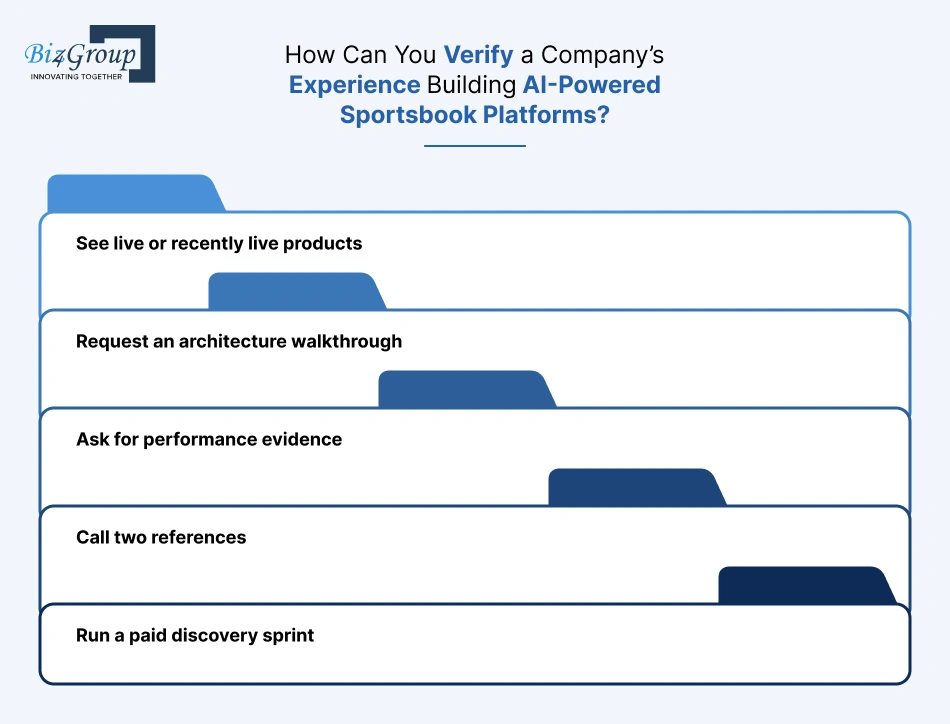
Test their claims in five layers. Live products, architecture walkthroughs, performance evidence, reference calls, and a paid discovery sprint.
Portfolios are marketing. Evidence is engineering. Here is how to tell them apart in AI-powered sportsbook platform development.
- See live or recently live products Ask for products that move money or settle outcomes. Ask which parts the team built and which parts it integrated. Vague answers are your first signal.
- Request an architecture walkthrough Insist that the engineers on your project run it. Ask how a price change travels from the data feed to the bet slip. Strong teams draw it from memory.
- Ask for performance evidence Look for load-test reports, failover results, and monitoring screenshots from comparable projects. Numbers beat adjectives.
- Call two references Ask what changed mid-project, how the team handled it, and what broke after launch. The answers reveal more than any case study.
- Run a paid discovery sprint Two to four weeks is enough. You receive an architecture outline, an estimate, and a risk list. Judge the output, then decide.
Five layers cost you a few weeks. A wrong pick costs far more.
Handshake Shows What Custom Product Proof Looks Like
When a partner claims custom work, look for workflows a template could not produce.
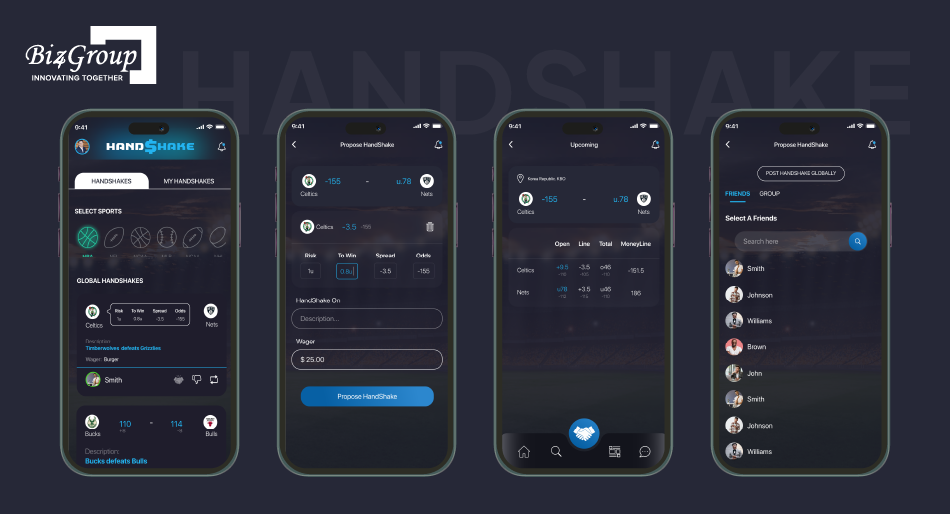
Handshake is a social wagering app where users propose, counter, accept, and settle friendly bets on NFL, NBA, NHL, and PGA games. Players bet one on one or in groups. Settlement ratings add accountability. AI-recommended bets and chat keep people coming back.
Counter-offers and settlement ratings sit inside the product logic. Our team built the app on Ionic 5 and the MERN stack.
Handshake is a social wagering app. We use it to show product thinking, not compliance coverage. Ask any company to show you a comparable workflow they designed from zero.
Which Integrations Should a Sports Betting Development Partner Support?
Your partner should support data and odds feeds, payments, KYC, geolocation, responsible gambling tools, risk and trading systems, and AI services. Every one of them must connect through clean, replaceable interfaces.
Sports betting platform engineering and integration work is where timelines slip and bills grow. Check each layer before you sign.
|
Layer |
What It Connects |
What to Verify |
|---|---|---|
|
Sports data and odds |
Live scores, markets, and settlement results |
Multi-feed support and a plan for feed disagreements |
|
Payments |
Deposits, withdrawals, and reconciliation |
Handling of declines, reversals, and payout holds |
|
Identity and KYC |
Age, identity, and sanctions checks |
Re-verification flows and fallback providers |
|
Geolocation |
Location proof at bet placement |
Border-edge handling and per-state rules |
|
Responsible gambling |
Limits, cool-offs, and self-exclusion |
Hooks into account and betting rules |
|
Risk and trading |
Limits, exposure, and market controls |
Console access and override logs |
|
AI services |
Models for pricing, fraud, and personalization |
Monitoring, retraining, and rollback plans |
Data is the hardest row. Read why top US betting apps rely on multiple sports data providers before you brief any partner.
How Do You Integrate All of This Without Creating Long-Term Debt?
Four design rules prevent most scalability and compliance problems.
- Put an adapter layer between your product and every provider You can then replace a provider without rewriting the app.
- Normalize data once Use one internal format for every feed.
- Log every cross-system call Audits and debugging both depend on it.
- Test each integration to failure Cut the feed, delay the payment, and watch what happens.
PredictEX Shows What Integration Depth Looks Like
Official data feeds make or break live products.
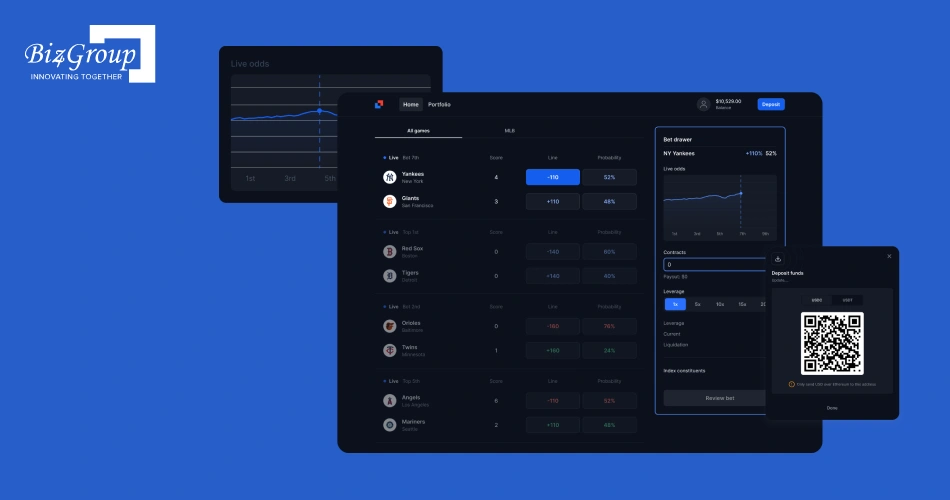
PredictEX delivers real-time betting across MLB, CFB, and NFL games on official sports data delivered through real-time sockets. Our team worked directly with the data provider’s engineers during integration. An eight-layer architecture and a microservices design kept Next.js, Node.js, C#, Go, and Python services in sync.
The case page reports 78% lower live data latency, 42% higher betting engagement, and 35% more live bet participation.
Ask any partner what they did when a feed misbehaved. Real teams always have a story.
Want an Architect to Review Your Integration Plan?
Share your feeds, payments, and KYC stack. We will point out gaps before they reach production.
Talk to an ArchitectHow Do You Keep Live Betting Fast and Stable During Traffic Spikes?
Demand evidence, not promises. Ask for game-day load tests, feed failover design, autoscaling rules, graceful degradation plans, and live monitoring.
Sportsbook scalability and performance engineering gets tested on playoff Saturday, not in a demo. These five questions reveal whether your partner planned for it.
How do they prove low latency? Ask for load-test results at your expected peak concurrency, plus the test plan. A real report names the scenario, the tooling, and the pass criteria.
What happens when a data feed fails? Look for automatic failover to a second feed and a rule that suspends markets when data goes stale. Betting on stale odds costs real money.
How does the system scale? Ask about autoscaling triggers, database strategy, and caching. The answer should cover reads, writes, and socket connections separately.
What happens under overload? Good systems degrade gracefully. They protect bet placement first and delay lower-priority features such as stats panels.
Who watches it on game day? Ask for named on-call owners, alert thresholds, and a habit of post-incident reviews.
Our analysis of why most betting apps fail at real-time match accuracy shows what weak answers look like in production.
Quick Start Bets Shows Low-Latency Design in Practice
Small design choices remove whole classes of live-betting bugs.
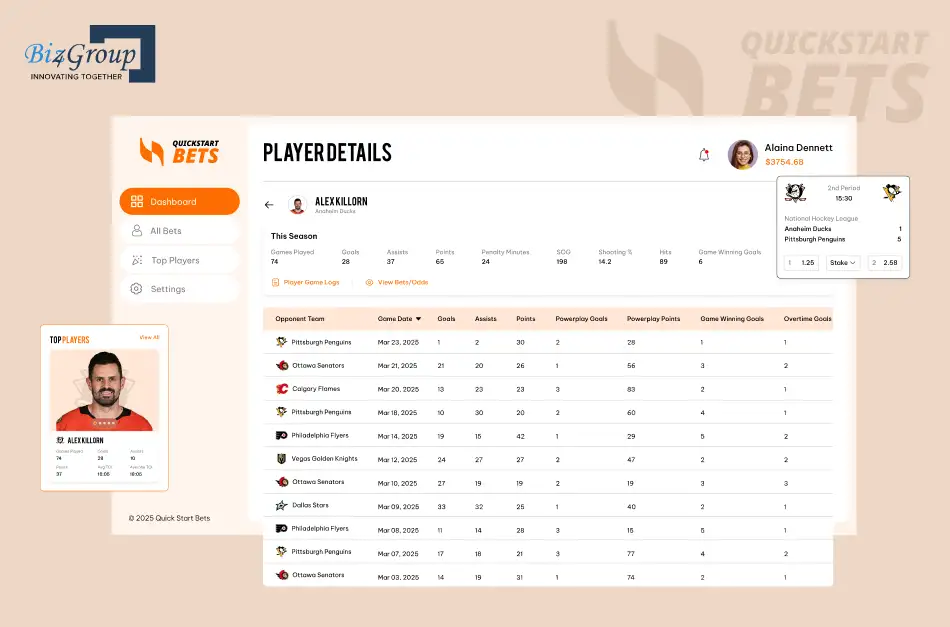
Quick Start Bets delivers live NHL odds, player and team stats, and bet tracking in one dashboard. Persistent WebSocket connections keep odds current. A normalization layer standardizes data from several providers, and caching cuts API load. It runs on Next.js, Node.js, and MySQL.
Ask your candidate which equivalent choices they made, and why.
What US Licensing, Geolocation, KYC, and Responsible Gambling Requirements Should a Partner Understand?
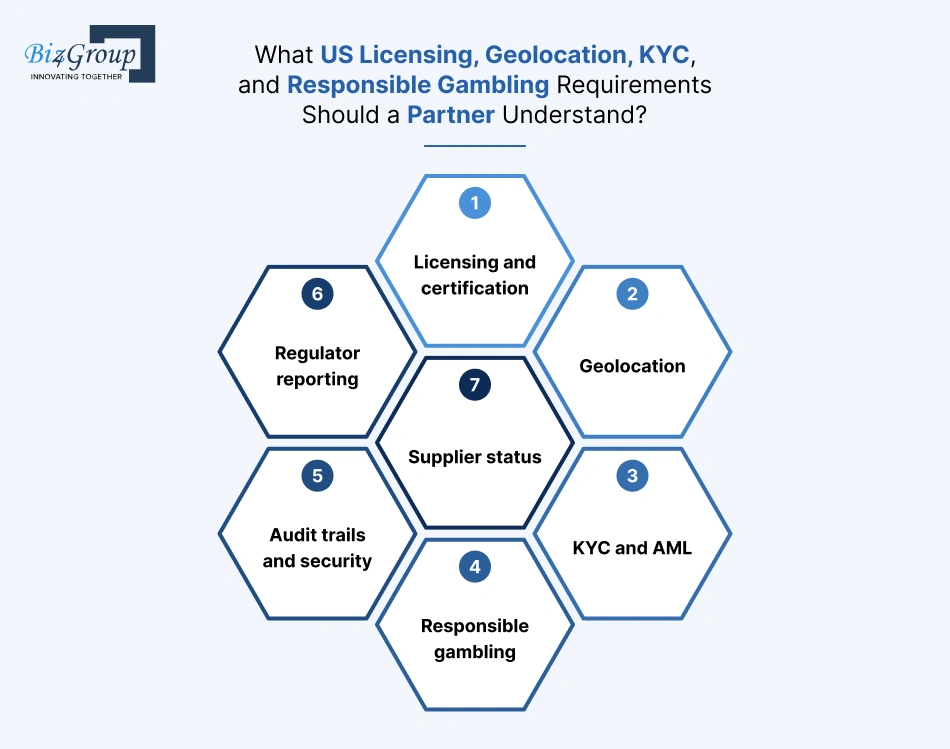
They should understand how state rules shape the platform. Your license and obligations remain yours. Your partner builds the product that has to satisfy the regulator.
A partner does not need to be your lawyer. They do need to know where the rules touch the code. Ask for sports betting platform compliance and security solutions that already run in production.
- Licensing and certification Rules vary by state, and several regulators require independent testing before launch. Ask which approvals and test cycles the team has supported.
- Geolocation Location must be verified when a wager is placed, with rechecks at set intervals. Timing rules differ by state, and some regulators require lab-certified geolocation. Ask how the platform handles border cases and spoofing attempts.
- KYC and AML Age, identity, and sanctions checks apply at signup and again around payouts. Ask how failed verifications flow back to the player.
- Responsible gambling Deposit limits, cool-offs, and self-exclusion must hook into betting rules. Ask how the platform detects risky patterns.
- Audit trails and security Every admin action, limit change, and settlement needs a log. Ask about encryption, access roles, and incident response.
- Regulator reporting States expect structured reports. Ask to see sample exports.
- Supplier status Some states license or register platform providers and suppliers directly. Ask whether your partner holds that status or has worked under it.
Our guide to geofencing in sports betting apps explains why a one meter error can matter. For player protection, see our guide to responsible gambling monitoring platform development.
Rules change state by state, so brief your partner with our state-by-state guide to US sports betting regulations.
Should You Hire Dedicated Sports Betting App Developers or an End-to-End Company?
Hire dedicated developers if you already own product direction, architecture, and QA. Choose an end-to-end company if you need those delivered together with the code.
Both models work. They fill different gaps.
|
Factor |
Dedicated Developers |
End-to-End Company |
|---|---|---|
|
Best when |
You have a product owner and a technical lead |
You are starting from an idea |
|
Who designs the architecture |
You or your lead |
The company |
|
QA and release management |
Yours |
Included |
|
Management load |
High |
Low |
|
Speed to start |
Fast |
Slower, because discovery comes first |
|
Cost shape |
Monthly, scales with team size |
Scoped fee or milestones |
|
Main risk |
Gaps nobody owns |
Less day-to-day control |
Many operators land in between. A dedicated pod works under a delivery manager who owns architecture and quality. You keep control without hiring a full team.
Before you hire dedicated AI sports betting app developers, ask each person which live betting systems they have worked on. General AI skill is not sportsbook skill. If you already know your roadmap, you can hire dedicated AI developers from our team and plug them into your sprints.
Decide who owns architecture first. The model follows.
What Should You Ask an AI Sports Betting App Development Company Before Hiring Them?
Ask about model governance, delivery process, team structure, and post-launch care. These questions show how the company works, not what it sells.
You have already tested proof, performance, and compliance. These twelve questions cover the rest.
AI and Models
1. Which decisions will AI make, and which will a human approve?
2. How do you test recommendation and risk models before real players see them?
3. How do you detect model drift and roll back a bad model?
For personalization depth, see our guide to bet recommendation agent development.
Delivery Process
4. How is the work split into milestones, and what do I see at each demo? 5. How do you handle scope changes, and what do they cost? 6. How does your QA cover settlement edge cases such as abandoned or corrected matches?
Team
7. Who are the named lead engineer, delivery manager, and QA owner? 8. What happens if a key engineer leaves mid-project? 9. How much overlap do you offer with US working hours?
After Launch
10. What is your response time for a production incident during a live event? 11. Who keeps models and integrations current after launch? 12. How do you document architecture and decisions as work progresses?
Write the answers down. Compare them side by side, which is what the next section helps you do.
How Do You Compare Vendor Quotes, Code Ownership, Ongoing Support, and Total Cost of Ownership?
Put every quote into the same template. Compare scope, exclusions, assumptions, third-party costs, ownership terms, support terms, and three-year cost.
Two quotes that look alike can describe different products. A shared template exposes the gap. Use it to compare AI-powered sports betting platform development vendors on equal terms.
|
Line |
What to Capture |
Why It Matters |
|---|---|---|
|
Scope and exclusions |
Features included and features deferred |
Deferred scope returns as change orders |
|
Assumptions |
Number of states, sports, providers, and users |
Wrong assumptions break estimates |
|
Third-party costs |
Data, KYC, geolocation, hosting, and licenses |
Often missing from fixed quotes |
|
Timeline and milestones |
Dates tied to deliverables |
Payment should track delivery |
|
Code ownership |
IP assignment, repository access from day one, and a third-party license list |
Protects you if the relationship ends |
|
Support terms |
Response times, warranty period, and game-day coverage |
Defines what “support” means |
|
Change orders |
Rate card and approval flow |
Controls budget drift |
|
Three-year cost |
Build, run, support, and third-party fees |
The only number that compares fairly |
Score each quote from 1 to 10 on every row. The lowest total price rarely wins the comparison.
Holding Proposals You Cannot Compare?
Send them over. We will line them up against the same template.
Request a Side-by-Side ReviewHow Much Does It Cost to Hire a Company to Develop a Custom AI Sports Betting Platform?
Plan on $40,000 to $300,000+ for the software build and $5,000 to $30,000+ a month to run it. Scope, live betting depth, AI modules, and state count decide where you land.
Three buyers show how that range plays out.
The founder One sport, core markets, web and mobile apps, and basic risk tools. This lean MVP costs $40,000 to $80,000+. It proves demand before bigger spending.
The regional operator Two or three states, live betting, a custom risk console, and several integrations. Expect $80,000 to $180,000+. Most of the extra cost is integration and testing.
The multi-state operator Broad sports coverage, advanced AI risk and personalization, and high concurrency. Expect $180,000 to $300,000+. AI modules should appear as separate line items.
These figures cover application and platform software only. State licenses, gaming taxes, and player acquisition sit outside them.
|
One-Time Line Item |
Typical Range |
|---|---|
|
Data and odds feed setup |
$3,000 to $20,000+ |
|
Geolocation |
$1,000 to $10,000+ |
|
Identity and KYC |
$2,000 to $10,000+ |
|
Responsible gambling tools |
$2,000 to $15,000+ |
|
Payment setup |
$2,000 to $8,000+ |
|
Security testing |
$3,000 to $15,000+ |
Pricing varies widely across the market. Published 2026 guides place a single-state real-money sportsbook at $300,000 to $600,000. 2026 rate surveys put US onshore agencies at $80 to $150+ an hour and India-based teams at $20 to $50. Scope explains most of the gap, so compare scope before price.
For a feature-by-feature budget, read our sports betting app development cost guide.
Need a Number for Your Scope?
Tell us your states, sports, and AI needs. We will return a range you can defend.
Call Biz4Group TodayWhat Mistakes Do Buyers Make When Hiring a Sports Betting App Development Company?
Buyers hire before defining the product, skip phasing, delay retention planning, and let one voice decide. Each mistake is avoidable.
Good AI sports betting app development company selection starts with fixing the buyer side. Here are four traps and their fixes.
“We will sort out scope after we hire.” The brief sets the price. Write your product model, target states, and must-have features first.
“Let us launch everything at once.” A focused first release teaches you more per dollar. Our guide to sports betting app MVP development shows how to scope it.
“Engagement can wait.” Notifications, leaderboards, and social features decide whether paid-for players stay. Plan them for release one.
“Engineering can pick alone.” Bring risk, compliance, and finance into the decision. Each sees failure modes the others miss.
A good brief saves more money than a good negotiation.
How Does Biz4Group Approach AI Sports Betting App Development?
Biz4Group LLC build custom and hybrid AI sportsbook apps and connect them to data, payment, KYC, and geolocation providers. We also tell prospects when a different model fits better.
We have been building software since 2003, and our team now includes 300+ engineers. Clients rate us 4.9 across 28 Clutch reviews. Gambling and sports together make up about a quarter of our industry focus on that profile. Our sports betting lead has contributed to more than 50 sports betting solutions for operators in regulated US markets.
These AI sports betting development services for operators start in different places.
|
If You Are |
Start Here |
|---|---|
|
Building a new custom sportsbook |
Our sports betting app development company |
|
Connecting feeds, payments, KYC, and geolocation |
|
|
Planning architecture first |
Our guide to building a proprietary sportsbook platform |
|
Not sure which path fits |
The strategy call link below |
We are not the right fit if you only need a template skin in a few weeks. A turnkey vendor serves that need better.
Final Thoughts
Selecting a partner is a project of its own. Give it a calendar.
Days one and two are for writing your product model, target states, and must-have features. Days three and four are for scoring a shortlist. Days five to seven are for architecture walkthroughs and two reference calls.
Then fund a paid discovery sprint with your top choice. If the output impresses you, you have found your partner. If it does not, you spent a small amount to learn something large.
Ready to put Biz4Group through the same test? Book a strategy call.
FAQs
1. How long should vendor selection take?
Plan four to six weeks. Use one week for the brief, two for vetting, and one to two for a paid discovery sprint. Rushing this stage is the most expensive shortcut in the project.
2. Can I hire a team outside the United States?
Yes, if the team can meet US rules and work with your hours. Some states require the servers that accept wagers to sit inside the state. Ohio, for example, allows data to be stored elsewhere. Confirm hosting rules with counsel before you choose.
3. Do I need in-house data scientists?
Not always. You need a product owner who can read model results and question them. Ask the vendor to deliver dashboards that explain each AI decision in plain language.
4. Can AI change odds or limits without human approval?
It can, within guardrails you set. Most operators let models propose changes and let a trader approve the large ones. Every automated and manual change should leave an audit record.
5. Whose name should sit on the sports data and API contracts?
Yours. Keep data, payment, and verification contracts in your company’s name, so your platform keeps working if you change developers.
6. How many sports should the first release cover?
Start with one or two leagues. Each added league brings new data structures, markets, and test cases. Expand once the first release performs.