 Location :
Orlando, FL, USA
Location :
Orlando, FL, USA +1 (407) 714-1616
 info@biz4group.com

- Companies that hire AI fintech developers successfully focus on production experience, compliance awareness, and financial systems knowledge.
- The best AI-driven fintech software developers understand fraud detection, KYC / AML workflows, payment systems, and production AI infrastructure.
- Fintech software developer hiring should match the actual product use case, not generic AI job templates.
- Senior U.S.-based fintech AI hires usually cost between $120,000 and $300,000+ per year, while freelancers and outsourced developers charge $60 to $400 per hour.
- Demand for machine learning engineers for finance continues to grow faster than the available talent pool in regulated fintech markets.
- Biz4Group LLC has an in-house team of AI fintech software developers experienced in fraud detection systems, payment infrastructure, and compliance-aware AI development.
Hiring AI-driven fintech software developers is very different from hiring general software engineers or even regular AI developers. Fintech AI systems work inside highly regulated environments where KYC / AML compliance, PCI-DSS requirements, fraud prevention, transaction monitoring, and financial data security directly affect how software is built and maintained. Teams building fraud detection systems, credit scoring models, or AI in payments industry platforms need developers who understand both machine learning and financial infrastructure.
This is where many fintech companies run into hiring problems. A developer may have experience with Python, TensorFlow, or machine learning models, but still lack experience with financial workflows, audit requirements, model monitoring, or compliance-aware AI systems. Those gaps usually appear after deployment, when the product starts handling real customer data, live financial transactions, and regulatory checks.
The challenge becomes even bigger for companies working on fintech in wealth management, embedded finance, or automated lending products. These systems depend on AI fintech developers who can manage data pipelines, production infrastructure, explainability requirements, and financial APIs without creating operational or compliance risks later.
For fintech founders, CTOs, and engineering leaders, the real challenge is finding developers who can build AI systems that are reliable, scalable, and ready for regulated financial environments. This guide explains how to hire fintech developers with the right mix of AI engineering skills, fintech domain knowledge, and production experience for modern financial products.
Portfolio Spotlight
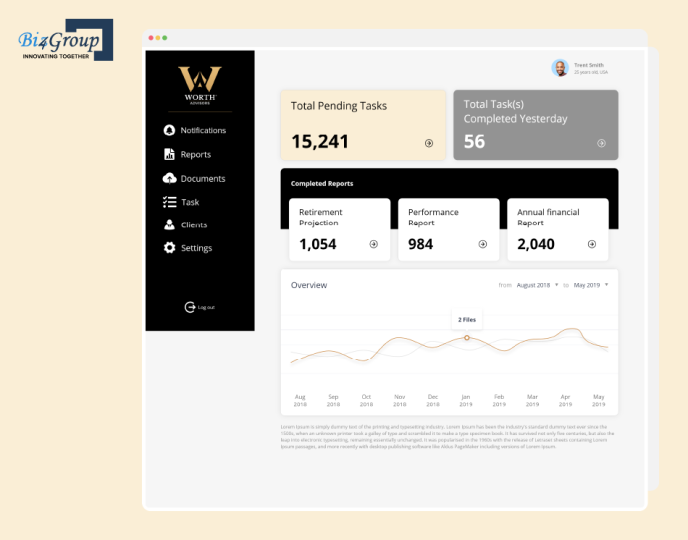
Built as a modern financial planning platform, Worth Advisors helps financial advisors streamline client onboarding, financial questionnaires, modular reporting, and data-driven planning workflows. The platform reflects the kind of production-grade fintech infrastructure and financial domain understanding companies should look for when they hire AI fintech software developers for regulated financial ecosystems.
Data Scientist vs ML Engineer vs AI Engineer in Fintech Software Development
One of the most common questions fintech founders ask is:
what is the actual difference between a data scientist a machine learning engineer and an AI software developer because I need to hire someone for my fintech startup and I have no idea which one I need or if I even need all three of them”.
The confusion usually comes from the fact that these roles overlap in AI projects but handle very different responsibilities inside production fintech systems. Fraud detection platforms, credit scoring engines, and payment infrastructure often require separate ownership across modeling, deployment, and product integration. Understanding these roles helps fintech companies hire AI developers with the right expertise instead of overloading one engineer with unrelated responsibilities.
Who Builds Fraud Detection and Credit Scoring Models?
Data scientists usually build fraud detection algorithms, credit scoring models, and financial risk models. Their work focuses on training models, improving prediction accuracy, and analyzing financial behavior using structured transaction data.
Core responsibilities include:
- Building fraud detection and risk scoring models
- Training machine learning models on financial datasets
- Reducing false positives in transaction monitoring
- Creating customer risk segmentation logic
- Supporting AI model development for lending and payment systems
- Working with underwriting and compliance teams
For fintech products using generative AI or advanced financial analytics, data scientists also help define how models interact with financial data and decision workflows.
Data scientists mainly focus on model quality and financial prediction logic, not production infrastructure
Who Owns Deployment, Monitoring, and Reliability?
ML engineers handle deployment, monitoring, scalability, and infrastructure reliability after models move into production. Their role is critical in AI fintech app development where systems process live financial transactions and real-time risk decisions.
|
Area |
ML Engineer Responsibility |
|---|---|
|
Deployment |
Deploying models into production systems |
|
Monitoring |
Tracking model drift and performance |
|
Infrastructure |
Managing APIs, pipelines, and cloud workflows |
|
Reliability |
Preventing inference failures and downtime |
|
Security |
Supporting financial data security practices |
|
Scalability |
Optimizing systems for growing transaction volumes |
ML engineers also support AI integration services when fintech companies integrate AI into an app connected to existing banking or payment infrastructure.
Strong ML engineering prevents production failures, unstable models, and scaling bottlenecks.
Where AI Engineers Fit Into Modern Fintech Products?
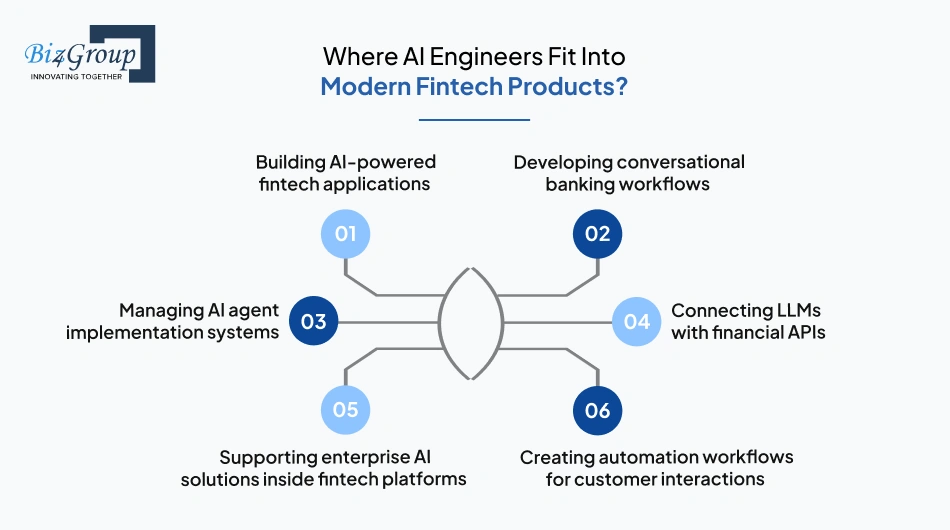
AI engineers focus on integrating AI systems into customer-facing fintech products. Their work combines software engineering, AI workflows, APIs, and application-level automation.
Common responsibilities include:
- Building AI-powered fintech applications
- Developing conversational banking workflows
- Managing AI agent implementation systems
- Connecting LLMs with financial APIs
- Supporting enterprise AI solutions inside fintech platforms
- Creating automation workflows for customer interactions
AI engineers are increasingly involved in products related to use cases of AI chatbot in banking and financial services, especially where real-time interaction and automation matter.
Their role becomes more important as fintech products expand into AI-driven user experiences and workflow automation.
When Fintech Teams Need Specialists Instead of Generalists
Generalist AI developers may work for early-stage prototypes, but production fintech systems usually require specialized ownership across modeling, infrastructure, and compliance workflows.
Fintech teams typically need specialists when:
- Systems process large transaction volumes
- Products require KYC / AML compliance
- Fraud models need continuous monitoring
- Payment infrastructure runs in real time
- Compliance audits require explainability tracking
- Teams scale across multiple fintech products
Companies planning to hire fintech software developers for long-term growth usually benefit from separating AI modeling, infrastructure, and application engineering responsibilities early.
Specialized ownership becomes more important as compliance requirements and production complexity increase.
What Skills Should an AI Fintech Software Developer Have in 2026?
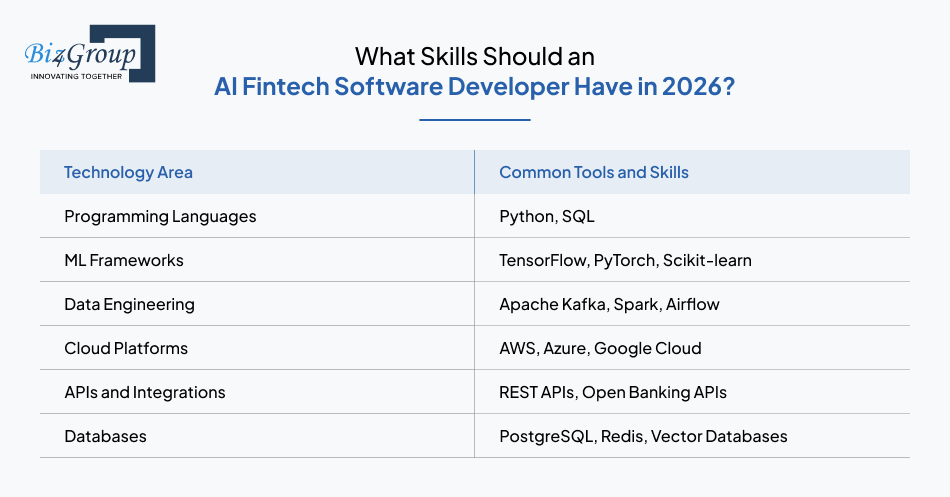
AI fintech developers in 2026 need more than machine learning knowledge. Fintech products operate inside environments shaped by compliance requirements, transaction risk, real-time infrastructure, and financial data security. Developers working on fraud detection systems, lending platforms, embedded finance products, or payment infrastructure need experience with production AI systems, financial workflows, and scalable backend engineering.
The Core Fintech AI Technology Stack
AI fintech software development relies on a mix of machine learning, backend infrastructure, cloud systems, and financial data engineering. Developers are often expected to work across multiple layers of the stack instead of focusing only on model training.
|
Technology Area |
Common Tools and Skills |
|---|---|
|
Programming Languages |
Python, SQL |
|
ML Frameworks |
TensorFlow, PyTorch, Scikit-learn |
|
Data Engineering |
Apache Kafka, Spark, Airflow |
|
Cloud Platforms |
AWS, Azure, Google Cloud |
|
APIs and Integrations |
REST APIs, Open Banking APIs |
|
Databases |
PostgreSQL, Redis, Vector Databases |
A lot of fintech teams underestimate how quickly infrastructure complexity increases once they integrate AI into an app handling live transactions, customer risk scoring, or financial automation workflows.
The strongest AI fintech developers understand how models, infrastructure, and financial systems interact under production conditions.
Why Generic ML Experience Is Not Enough for Fintech?
Generic machine learning experience usually does not prepare developers for the operational realities of financial systems. Fintech AI environments involve transaction monitoring, regulated workflows, risk scoring, and real-time infrastructure that most general AI projects never encounter.
Fintech companies usually prioritize developers with experience in:
- Fraud detection algorithms and transaction monitoring
- Credit scoring models and lending workflows
- Financial data security and encryption practices
- Real-time payment infrastructure
- Open banking APIs and embedded finance systems
- Data pipeline engineering for financial datasets
- High-volume transaction systems
A developer who has only worked on recommendation engines or generic prediction models may struggle with financial compliance, explainability requirements, or risk-sensitive decision systems.
Fintech AI hiring works best when domain experience and production engineering experience exist together.
Why Compliance Knowledge Matters in AI Hiring?
Compliance requirements directly affect how fintech AI systems are built, tested, and deployed. Developers handling regulated financial data need to understand how AI decisions interact with reporting standards, audit workflows, and risk controls.
Important compliance-related skills include:
- KYC / AML compliance workflows
- PCI-DSS security requirements
- Audit logging systems
- Explainability requirements for financial AI decisions
- Access control and data governance
- Model validation and approval processes
This becomes especially important when financial platforms expand into automation-heavy workflows supported by AI automation services, where AI systems influence customer onboarding, transaction reviews, or operational decisions.
Developers who understand compliance constraints usually create more stable and deployment-ready fintech AI systems.
The Production AI Skills Most Teams Overlook
Many AI hiring decisions focus too heavily on model-building experience while ignoring production engineering skills. Most fintech AI failures happen after deployment, especially when systems begin processing live financial traffic.
Production-ready fintech AI developers usually understand:
- Drift detection and model monitoring
- Real-time inference optimization
- MLOps and deployment pipelines
- Infrastructure scaling under transaction load
- Rollback systems and failover handling
- API reliability and latency management
- Production debugging for AI systems
These skills become critical in areas like fraud prevention, underwriting automation, and money transfer app development, where unstable infrastructure can directly affect financial operations.
Production AI expertise determines whether a fintech AI system can operate reliably at scale.
The Emerging AI Skills Fintech Companies Want in 2026
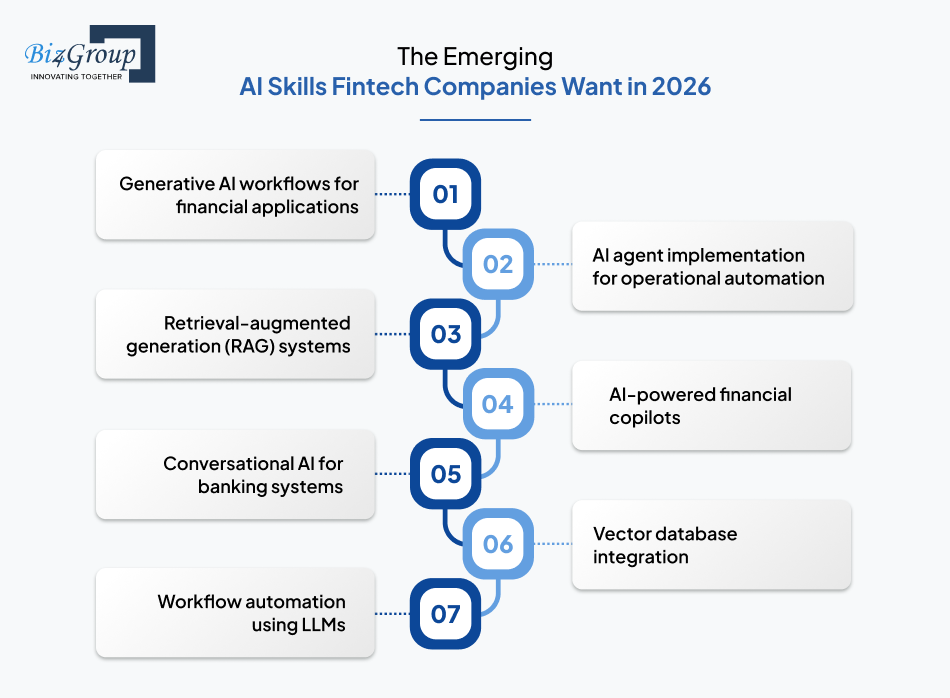
Fintech AI hiring is rapidly shifting toward developers who can work with modern AI architectures, workflow automation, and customer-facing AI systems.
High-demand skills in 2026 include:
- Generative AI workflows for financial applications
- AI agent implementation for operational automation
- Retrieval-augmented generation (RAG) systems
- AI-powered financial copilots
- Conversational AI for banking systems
- Vector database integration
- Workflow automation using LLMs
Hiring expectations also change once fintech products start introducing conversational banking, financial copilots, or AI-driven support systems into customer workflows.
Modern fintech AI teams increasingly value developers who can combine LLM infrastructure, financial APIs, and production-grade engineering inside regulated environments.
Hire AI Fintech Developers Who Understand Real Financial Systems
Build secure fraud detection, payment, and compliance workflows with production-ready fintech AI expertise.
Start Building Your Fintech AI TeamHow to Hire AI Software Developers for Regulated Fintech Products?
Hiring AI software fintech developers for regulated products requires evaluating both technical expertise and compliance awareness. Fintech AI systems operate inside environments shaped by KYC / AML compliance, PCI-DSS requirements, audit workflows, transaction monitoring, and financial data security. Developers working on lending systems, payment infrastructure, or fraud detection platforms need experience handling those constraints inside production environments.
What Compliance-Aware AI Development Actually Looks Like
Compliance-aware AI development means designing AI systems that can operate inside regulated financial workflows without creating reporting, security, or governance risks.
Developers working on regulated fintech systems are usually expected to handle:
- KYC / AML compliance workflows
- PCI-DSS security requirements
- Audit logging systems
- Financial data encryption and access control
- Explainable AI decision flows
- Model validation and approval workflows
- Risk monitoring systems
A lot of hiring mistakes happen when fintech teams treat compliance as a legal review step instead of a product engineering requirement.
Developers with regulated fintech experience usually build systems that are easier to deploy, monitor, and audit.
How to Evaluate Regulatory and Financial Domain Knowledge
Many AI developers can explain machine learning concepts but struggle to discuss how those systems behave inside real financial products or regulated workflows.
Strong fintech AI candidates should be able to explain:
- How fraud detection systems reduce false positives
- How financial risk models are monitored after deployment
- How transaction monitoring systems process live activity
- How explainability affects lending decisions
- How AI systems support audit requirements
- How financial data is secured inside production infrastructure
This becomes especially important in products involving AI conversation app workflows, onboarding automation, or customer-facing financial support systems.
The strongest candidates usually explain operational risks, monitoring challenges, and compliance trade-offs clearly.
Why Explainability and Auditability Matter in Fintech AI
Financial AI systems often need to justify how decisions are made, especially in lending, payments, underwriting, and fraud prevention workflows. Explainability and auditability help fintech companies track decisions, investigate issues, and meet regulatory expectations.
Developers working on fintech AI systems should understand:
- Why financial AI decisions need traceable outputs?
- How audit logs support investigations and reporting?
- Why black-box AI models create compliance risk?
- How explainability affects lending and payment systems?
- How governance workflows track model changes over time?
- Why monitoring matters after deployment?
As fintech products expand into enterprise AI solutions, explainability requirements become more important across customer-facing and operational systems.
Systems with strong auditability are easier to scale, review, and maintain over time.
Compliance Red Flags Fintech Teams Should Never Ignore
Some AI candidates have strong ML backgrounds but limited understanding of regulated financial systems. These gaps usually appear after deployment.
|
Red Flag |
Why It Matters |
|---|---|
|
No knowledge of KYC / AML workflows |
Creates compliance and onboarding risks |
|
Focuses only on model accuracy |
Ignores production and governance concerns |
|
Cannot explain audit logging |
Weak understanding of regulated systems |
|
No experience with production monitoring |
Higher operational failure risk |
|
Treats compliance as a legal-only issue |
Misses engineering responsibilities |
|
No understanding of explainability |
Creates risk for lending and payment systems |
Strong fintech AI hiring processes usually identify these gaps before systems move into production.
Why Hire AI Fintech Software Developers From Biz4Group LLC?
Fintech AI products require more than model development. They require production-ready engineering, compliance-aware architecture, and reliable financial infrastructure ownership.
Biz4Group LLC helps fintech companies build and scale AI-driven financial systems with a focus on:
- Fraud detection and risk modeling workflows
- Payment and transaction infrastructure
- AI-powered fintech product development
- Scalable cloud and API architectures
- Compliance-aware development practices
- Production deployment and monitoring support
The focus stays on building stable fintech AI systems that can handle real users, real transactions, and real operational pressure.
In-House vs Freelance vs Outsourced Fintech AI Developers
Choosing between in-house hiring, freelancers, and outsourced fintech AI development depends on compliance exposure, infrastructure complexity, product maturity, and operational ownership. Fintech systems connected to fraud prevention, payments, underwriting, or customer financial data usually require very different hiring decisions from experimental AI features or internal automation tools.
What Fintech AI Systems Should Stay In-House?
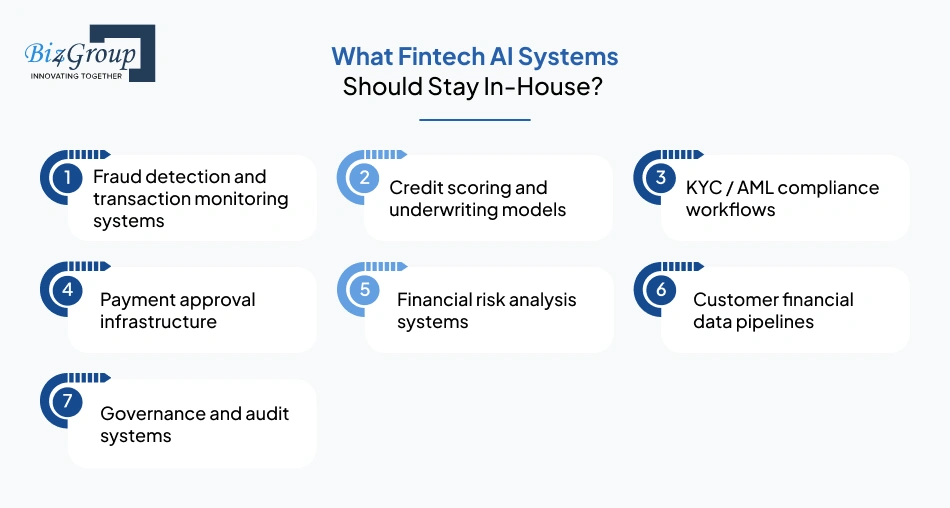
AI systems tied directly to financial risk and compliance usually need internal ownership. These systems influence transaction approvals, fraud detection, customer verification, and financial decision-making, which means engineering visibility and infrastructure control become critical over time.
Fintech products that typically stay in-house include:
- Fraud detection and transaction monitoring systems
- Credit scoring and underwriting models
- KYC / AML compliance workflows
- Payment approval infrastructure
- Financial risk analysis systems
- Customer financial data pipelines
- Governance and audit systems
A fintech startup may outsource UI development or API integrations early on, but core financial logic usually moves internally once production traffic, compliance reviews, and audit requirements increase.
Internal ownership makes it easier to manage deployment standards, infrastructure reliability, and long-term compliance workflows.
Where Freelancers and Agencies Actually Help
Freelancers and external AI teams are usually most effective when the work is clearly scoped and does not require long-term operational ownership.
External support commonly helps with:
- AI prototype development
- Temporary MLOps support
- Data pipeline implementation
- Backend optimization work
- AI integration services for existing fintech platforms
- LLM experimentation and generative AI workflows
- Internal workflow automation projects
A lot of early-stage fintech founders bring in AI consulting services before hiring full-time ML engineers, especially when validating architecture decisions, infrastructure planning, or AI feasibility.
Freelancers and agencies work best when access permissions, infrastructure boundaries, and ownership responsibilities are defined early.
The Trade-Off Between Speed, Cost, and Control
A common founder question is: “is it better to hire full time in-house or outsource to an agency or use freelancers on Toptal and what are the real pros and cons of each option?” The answer depends on how closely the AI system connects to financial operations, compliance workflows, and production infrastructure.
|
Hiring Model |
Speed |
Cost |
Long-Term Control |
Best Use Case |
|---|---|---|---|---|
|
In-House Team |
Slower hiring |
Higher upfront cost |
Highest |
Core fintech AI systems |
|
Freelancers |
Fastest |
Lower short-term cost |
Limited |
Small features and short projects |
|
Outsourced Agency |
Medium |
Medium to high |
Shared ownership |
Specialized development support |
|
Hybrid Model |
Medium |
Balanced |
Moderate to high |
Scaling fintech products |
Questions like “how much should I budget to hire a good AI developer for a fintech product in 2026?” usually depend more on infrastructure complexity, regulatory exposure, and production support requirements than on developer rates alone.
The cheapest hiring option rarely stays the cheapest once systems move into production.
Which Hiring Model Fits Your Fintech Stage?
The right hiring structure changes as fintech products move from MVP development into regulated production infrastructure.
|
Fintech Stage |
Recommended Hiring Model |
Primary Focus |
|---|---|---|
|
MVP Stage |
Freelancers + small internal team |
Prototype validation |
|
Seed Stage |
Hybrid model |
Product development and AI testing |
|
Series A |
Internal AI engineering team |
Production deployment |
|
Growth Stage |
Specialized in-house teams |
Compliance and scaling |
|
Enterprise Scale |
Dedicated AI infrastructure teams |
Governance and optimization |
The hiring model often changes once fintech products move beyond experimentation into full-scale build AI fintech app workflows connected to payments, lending, or compliance systems.
Hiring decisions should follow operational complexity, not just company growth stage.
Scale Faster With AI-Driven Fintech Software Developers
Strengthen your fintech app development team with engineers experienced in KYC, AML, and AI infrastructure.
Hire Fintech AI ExpertsHow Much Does It Cost to Hire AI Software Fintech Developers in 2026?
Hiring AI software fintech developers in 2026 can cost anywhere from $120,000 to $300,000+ per year for senior full-time U.S.-based hires. Freelancers and outsourced fintech AI developers usually charge between $60 and $400 per hour depending on experience, compliance knowledge, and production responsibilities. Actual costs vary based on the type of fintech product, infrastructure complexity, security requirements, and whether the role involves fraud detection, lending systems, payment infrastructure, or regulated financial data.
Salary Benchmarks for Fintech AI Roles
Fintech AI salaries usually increase when the role involves production systems, compliance-heavy workflows, or financial infrastructure ownership.
Typical salary ranges include:
- Data Scientist: $130,000 – $180,000 per year
- ML Engineer: $150,000 – $220,000 per year
- AI Engineer: $160,000 – $240,000 per year
- Senior MLOps Engineer: $170,000 – $250,000 per year
- AI Infrastructure Lead: $200,000 – $300,000+ per year
- Fractional AI Consultant: $150 – $400 per hour
Developers with experience in fraud prevention, transaction monitoring, or financial infrastructure are usually more expensive because those skills are harder to find.
In fintech AI hiring, production experience usually matters more than certifications or framework knowledge.
The Hidden Costs Behind Hiring Fintech AI Software Developers
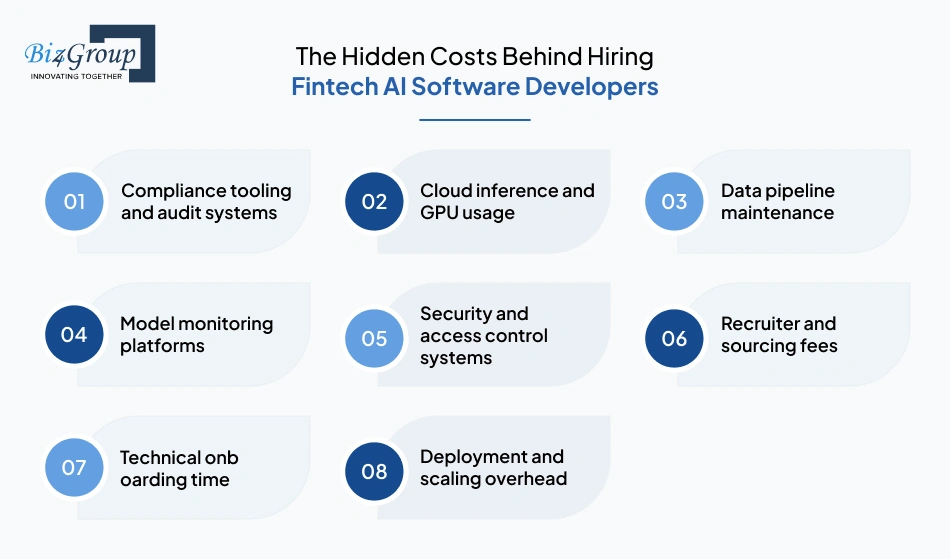
Most fintech companies underestimate the infrastructure and operational costs attached to AI hiring.
Hidden costs often include:
- Compliance tooling and audit systems
- Cloud inference and GPU usage
- Data pipeline maintenance
- Model monitoring platforms
- Security and access control systems
- Recruiter and sourcing fees
- Technical onboarding time
- Deployment and scaling overhead
A lot of founders underestimate how quickly AI fintech app development cost increases after products begin handling live financial transactions and compliance workflows. Operational costs usually scale faster than hiring costs in production fintech AI systems.
What Affects the Cost of Hiring AI Fintech Software Developers
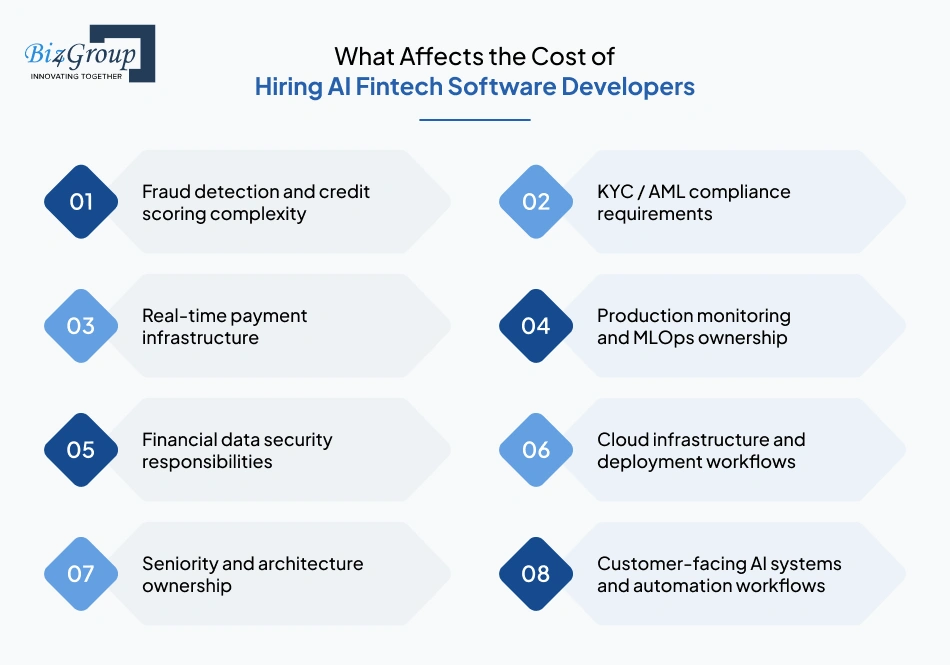
The cost of hiring AI fintech developers depends on the complexity of the system and the level of responsibility attached to the role.
Major cost factors include:
- Fraud detection and credit scoring complexity
- KYC / AML compliance requirements
- Real-time payment infrastructure
- Production monitoring and MLOps ownership
- Financial data security responsibilities
- Cloud infrastructure and deployment workflows
- Seniority and architecture ownership
- Customer-facing AI systems and automation workflows
A developer building internal dashboards usually costs far less than someone managing production lending systems or transaction monitoring infrastructure.
Hiring costs also rise quickly in products involving automation-heavy workflows or use cases of AI chatbot in banking and financial services.
More production ownership usually means higher hiring costs.
Reduce AI Deployment Delays by Up to 40%
Work with machine learning engineers for finance who understand production systems, monitoring, and compliance-heavy fintech environments.
Optimize Your Fintech AI Hiring StrategyIn-House vs Freelance vs Agency Costs for Hiring AI Fintech Software Developers
Different hiring models create different cost structures for fintech companies.
|
Hiring Model |
Typical Cost Range |
Best For |
Main Trade-Off |
|---|---|---|---|
|
In-House Team |
$150K – $300K+ per senior hire annually |
Core fintech AI systems |
Higher long-term cost |
|
Freelancers |
$60 – $180 per hour |
Short-term or specialized work |
Limited long-term ownership |
|
Outsourced Agency |
$25K – $250K+ per project |
Full project execution |
Shared infrastructure control |
|
Hybrid Model |
Mixed cost structure |
Scaling fintech startups |
Coordination overhead |
Many fintech startups begin with freelancers or agencies during early product development, then move critical systems in-house once products start handling live transactions or regulated financial workflows.
Lower upfront cost does not always mean lower long-term cost.
Why Hiring Cheap AI Fintech Software Developers Becomes Expensive Later?
Lower-cost hiring of AI fintech software developers often creates expensive infrastructure and maintenance problems when developers lack fintech production experience.
Common issues include:
- Weak fraud detection performance
- Security vulnerabilities
- Poor infrastructure scalability
- Unstable deployment pipelines
- Compliance failures
- Technical debt from rushed architecture decisions
- High post-deployment maintenance costs
These problems usually appear after deployment, when systems begin processing real financial data and transaction traffic. Fixing unstable fintech AI infrastructure is usually more expensive than hiring experienced engineers early.
Budget Expectations for Fintech Startups and Scale-Ups
AI hiring budgets usually increase as fintech products move from prototype-stage experimentation into regulated production systems.
|
Company Stage |
Typical AI Hiring Budget |
|---|---|
|
MVP Stage |
$50K – $150K |
|
Seed Stage |
$150K – $500K |
|
Series A |
$500K – $2M |
|
Growth Stage |
$2M+ |
|
Enterprise Scale |
Multi-million annual budgets |
Budget planning becomes more demanding once fintech products introduce advanced automation workflows or AI agent implementation tied to financial operations. AI hiring budgets should account for long-term infrastructure, compliance, and production maintenance from the start.
How to Evaluate AI Fintech Software Developers Without a Technical Background?
Many fintech founders struggle to evaluate fintech AI software developers because strong technical vocabulary can hide weak production experience. When hiring fintech AI developers, the goal is to identify developers who understand regulated financial systems, production infrastructure, operational reliability, and risk management, not just machine learning theory.
How to Spot Production-Ready Fintech AI Engineers
Production-ready fintech AI engineers usually talk about deployment, monitoring, infrastructure reliability, and operational trade-offs instead of focusing only on model accuracy.
Common signals include:
- Explaining how models are monitored after deployment
- Discussing model drift and rollback workflows
- Understanding KYC / AML and financial data security requirements
- Explaining latency, infrastructure, and scaling trade-offs
- Talking about production incidents and failure handling
- Understanding APIs, data pipelines, and deployment systems
- Explaining how auditability works in financial AI systems
Candidates with real fintech experience usually describe operational challenges clearly instead of relying on AI buzzwords. Strong engineers discuss systems and trade-offs naturally.
Interview Questions That Reveal Real AI Fintech Experience
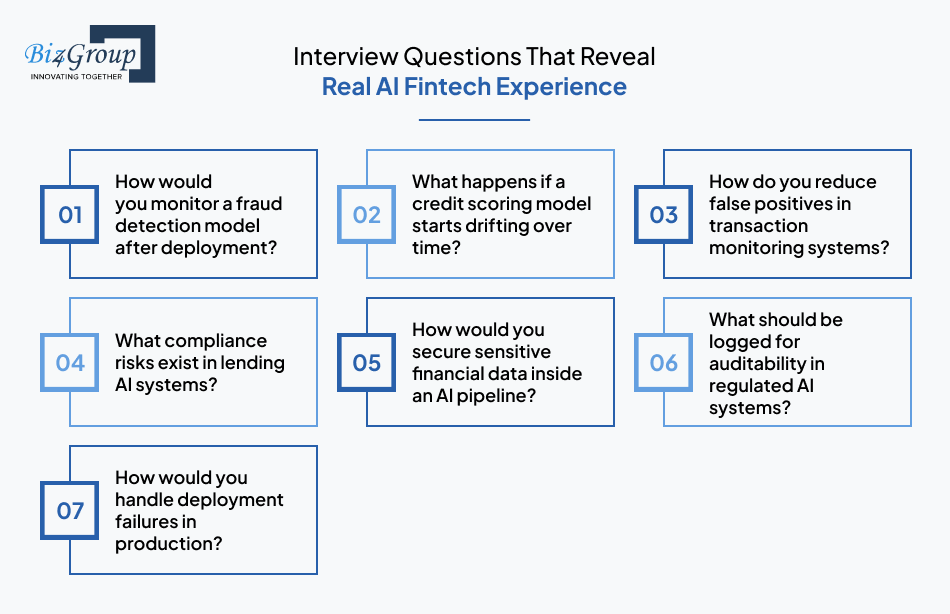
A common founder concern is: “I am a non-technical founder and I have no idea how to evaluate if an AI developer actually knows what they are doing during an interview what questions should I ask and what answers or red flags should I be looking out for”. The most useful interview questions usually focus on production decision-making and financial workflows.
Useful interview questions include:
- How would you monitor a fraud detection model after deployment?
- What happens if a credit scoring model starts drifting over time?
- How do you reduce false positives in transaction monitoring systems?
- What compliance risks exist in lending AI systems?
- How would you secure sensitive financial data inside an AI pipeline?
- What should be logged for auditability in regulated AI systems?
- How would you handle deployment failures in production?
Candidates with weak fintech experience often struggle once conversations move beyond model training and into infrastructure or compliance scenarios.
Strong answers usually include monitoring, operational risk, and deployment thinking.
What Strong Answers and Red Flags Look Like
Strong fintech AI candidates usually explain operational decisions, infrastructure trade-offs, and compliance considerations clearly. Weak candidates often rely on generic AI terminology, theoretical answers, or framework-heavy discussions without showing real production experience.
|
Evaluation Area |
Strong Answer Signals |
Red Flags |
|---|---|---|
|
Production Experience |
Explains deployment, monitoring, rollback plans, and scaling challenges clearly |
Talks only about model training or accuracy metrics |
|
Compliance Awareness |
Understands KYC / AML, audit logging, and financial data security |
Treats compliance as someone else’s responsibility |
|
Infrastructure Knowledge |
Explains APIs, pipelines, cloud systems, and latency trade-offs |
Has experience limited to notebooks or local environments |
|
Problem Solving |
Describes real production failures and how they were resolved |
Gives vague or purely theoretical answers |
|
Communication |
Simplifies technical concepts without losing clarity |
Uses excessive buzzwords without operational detail |
|
Ownership |
Explains engineering decisions and trade-offs confidently |
Cannot describe direct project responsibility |
This becomes especially important when evaluating developers working on automation systems or use cases of AI chatbot in banking and financial services.
Strong fintech AI candidates usually explain operational decisions clearly, while weak candidates stay focused on tools and terminology.
Build Smarter Financial Products With the Right AI Team
From fraud detection to embedded finance, hire AI developers for fintech products built to scale securely.
Talk to Our AI ExpertsHow to Evaluate Portfolios and Architecture Thinking?
Portfolios and project discussions often reveal more than resumes during fintech software developer hiring.
|
What to Look For |
Why It Matters |
|---|---|
|
Real deployment examples |
Shows production experience |
|
Monitoring and infrastructure discussions |
Indicates operational maturity |
|
Financial or compliance-related projects |
Signals fintech familiarity |
|
API and backend architecture explanations |
Reflects system-level thinking |
|
Security and audit considerations |
Important for regulated environments |
Candidates discussing only model training without deployment or infrastructure context may lack real production exposure.
Portfolio reviews should focus on engineering ownership and system thinking.
When to Bring in a Fractional CTO or AI Advisor?
Non-technical founders often benefit from external technical support when hiring fintech AI software developers, especially for senior engineering roles or regulated AI systems.
A fractional CTO or AI advisor can help with:
- Technical interview design
- Candidate screening and evaluation
- Reviewing AI architecture decisions
- Assessing infrastructure scalability
- Identifying compliance and security risks
- Evaluating deployment readiness
This becomes more important once fintech products expand into generative AI workflows or large-scale production systems.
External technical support helps reduce expensive hiring mistakes before deployment.
How to Write a Fintech AI Software Project Description That Attracts the Right Talent?
A strong fintech AI software project description helps filter the right candidates before interviews even begin. The best descriptions explain the actual financial problem, technical ownership, compliance exposure, and production responsibilities clearly. Generic AI job posts usually attract candidates with surface-level ML experience instead of developers who understand fintech systems.
1. Software Project Description Mistake That Attracts Generic AI Applicants
Many fintech companies write AI software project descriptions that sound broad but say very little about the real work involved.
Common mistakes include:
- Listing every AI framework without defining the business problem
- Using vague titles like “AI expert” or “ML ninja”
- Ignoring compliance and financial workflows
- Combining multiple senior roles into one position
- Leaving out deployment and infrastructure responsibilities
- Asking for unrealistic experience across too many domains
A developer building internal analytics tools requires a very different skill set from someone managing fraud detection pipelines or payment infrastructure. That difference becomes obvious quickly in money transfer app development environments where transaction monitoring, latency, and auditability directly affect production systems.
Clear role definitions usually improve applicant quality faster than longer requirement lists.
2. What to Include for Fraud Detection and Compliance Roles
Fraud detection and compliance-focused roles need much more detail than standard AI engineering positions.
Important details to include:
- Type of fintech product being built
- Fraud detection or risk modeling responsibilities
- KYC / AML and PCI-DSS requirements
- Production infrastructure ownership
- Monitoring and deployment responsibilities
- API and transaction system experience
- Explainability and auditability expectations
- Team structure and reporting workflows
Candidates working in regulated fintech environments usually want clarity around infrastructure ownership, compliance exposure, and operational expectations before starting the interview process.
Specific role expectations help attract candidates with real fintech experience.
3. How to Set Compliance Expectations Clearly
A. Define Regulatory Exposure Early
Candidates should know whether the role involves payments, lending, onboarding, underwriting, or transaction monitoring systems.
B. Explain Operational Responsibilities
Strong job descriptions explain whether developers will manage deployment pipelines, monitoring systems, audit workflows, or production infrastructure.
C. Separate Core Skills From Bonus Skills
Large requirement lists usually reduce application quality and create confusion around the actual role.
D. Clarify the Product Environment
A lot of candidates evaluate whether they will work on internal tooling, customer-facing systems, or large-scale financial infrastructure before applying.
E. Explain the AI Workflow Clearly
Many fintech software project descriptions still fail to explain whether the role involves backend infrastructure, automation systems, or customer-facing business app development using AI, which creates confusion around ownership expectations.
Clear compliance expectations usually reduce hiring mismatches later in the process.
4. What Strong Fintech AI Candidates Expect to See
Strong fintech AI candidates usually evaluate job descriptions for technical ownership, infrastructure maturity, and operational clarity before applying.
|
What Candidates Look For |
Why It Matters |
|---|---|
|
Clear business problem |
Helps candidates understand the product direction |
|
Defined AI responsibilities |
Clarifies ownership expectations |
|
Production infrastructure details |
Signals engineering maturity |
|
Compliance expectations |
Important for regulated fintech systems |
|
Realistic skill requirements |
Prevents confusion around the role |
|
Team structure and workflows |
Shows operational organization |
|
Deployment and scaling responsibilities |
Reflects technical depth |
Candidates with strong fintech AI experience usually avoid vague job descriptions with unclear ownership or unrealistic expectations.
Well-structured job descriptions improve both hiring speed and candidate quality.
Need a Stronger Fintech Engineering Team Structure?
Hire remote fintech developers, ML engineers, and AI specialists aligned with your product stage and compliance needs.
Build Your Fintech AI Team TodayFintech AI Software Developer Hiring Process: From Sourcing to Onboarding
Hiring AI fintech software developers usually takes between 4 and 16 weeks depending on role complexity, compliance requirements, and production ownership. Hiring timelines are shorter for prototype-stage projects and longer for systems involving fraud detection, payment infrastructure, customer financial data, or regulated financial workflows.
1. Define the Business Problem Before the Role
Many hiring mistakes happen because teams start recruiting before defining the actual AI fintech use case. A company building fraud detection infrastructure needs different expertise from a startup building onboarding automation or internal analytics tools. Defining the product scope, compliance exposure, infrastructure ownership, and deployment expectations early helps narrow the right candidate profile faster.
2. Choose the Right Hiring Model and Sourcing Channels
The hiring model should match the importance of the AI system. Core fintech infrastructure usually needs stronger in-house ownership, while temporary execution gaps or experimental features can often be handled through external teams or AI integration services. Senior fintech AI engineers are also more commonly sourced through referrals, engineering communities, and fintech recruiters than through generic hiring platforms.
3. Structure Interviews Around Real-World Fintech Scenarios
Generic AI interviews often fail to test production fintech experience. Strong interview loops focus on operational scenarios like fraud detection failures, model drift, payment downtime, audit logging, and financial data security. This becomes even more important in products involving customer-facing automation or use cases of AI chatbot in banking and financial services where infrastructure reliability directly affects user trust and operational stability.
4. What a Fintech AI Technical Assessment Should Test
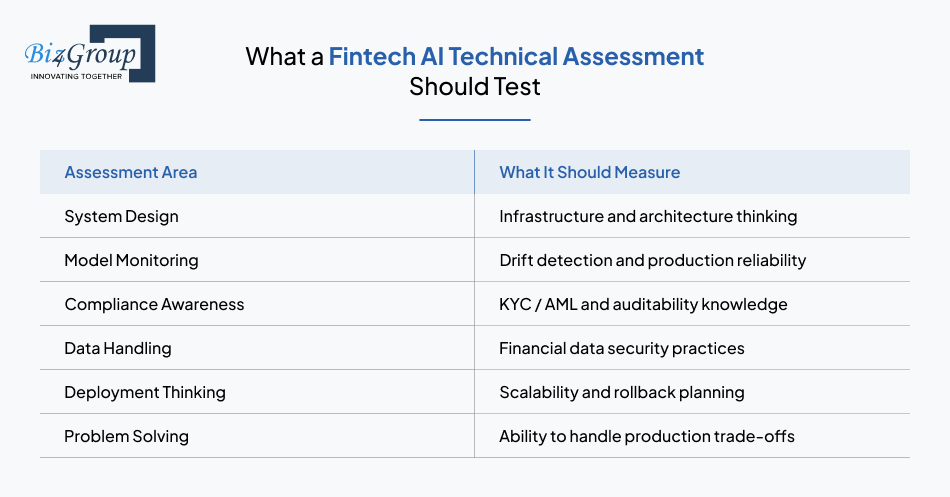
Technical assessments should evaluate production thinking, not just coding ability.
|
Assessment Area |
What It Should Measure |
|---|---|
|
System Design |
Infrastructure and architecture thinking |
|
Model Monitoring |
Drift detection and production reliability |
|
Compliance Awareness |
KYC / AML and auditability knowledge |
|
Data Handling |
Financial data security practices |
|
Deployment Thinking |
Scalability and rollback planning |
|
Problem Solving |
Ability to handle production trade-offs |
Many candidates perform well on generic ML exercises but struggle with real financial workflows and infrastructure constraints. Strong assessments usually reveal operational thinking faster than theoretical AI questions.
5. The First 90 Days for a Fintech AI Hire
The first 90 days should focus on production systems, compliance workflows, and operational ownership inside the fintech environment.
Strong onboarding plans usually include:
- Infrastructure and access setup
- Security and compliance training
- API and data pipeline documentation
- Monitoring and deployment workflows
- Introductions to compliance and operations teams
- Clear ownership expectations for AI systems
Fintech onboarding often takes longer because engineers must understand regulated workflows and production dependencies before shipping changes safely.
Structured onboarding reduces deployment mistakes and improves ramp-up time.
How to Build an AI Fintech Software Engineering Team?
Building a fintech AI software engineering team requires balancing AI expertise, financial systems knowledge, infrastructure ownership, and compliance responsibilities. The right structure depends on the product stage, transaction volume, regulatory exposure, and how much of the AI system already runs in production.
1. Who Fintech Startups Should Hire First
Most fintech startups do not need a large AI team early on. The first hires should focus on production stability and infrastructure ownership instead of pure model experimentation.
Early fintech AI hires usually include:
- Senior ML engineer with deployment experience
- Backend engineer familiar with APIs and financial systems
- Data engineer for pipelines and infrastructure support
- Fractional technical advisor for architecture guidance
Many startups hire junior AI developers too early and later struggle with deployment reliability, monitoring, and infrastructure scaling.
The first hires should strengthen production systems before expanding the team.
2. The Minimum Viable Fintech AI Team Structure
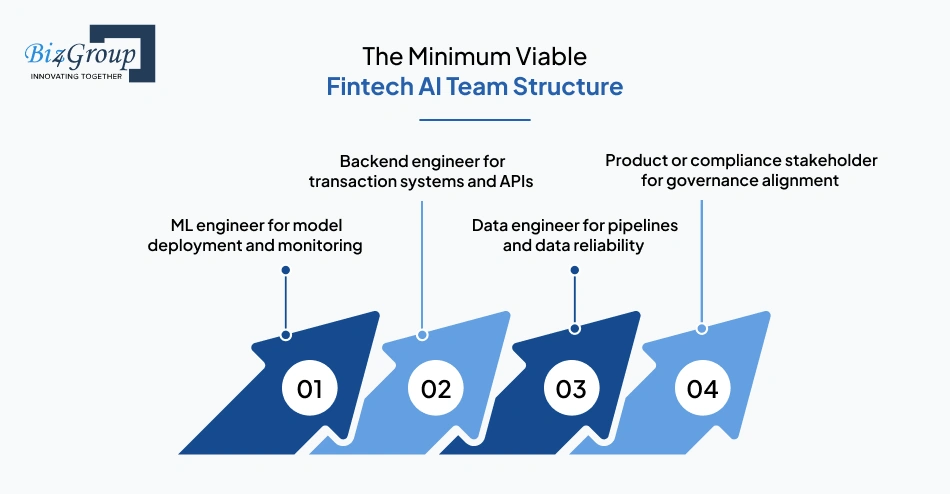
A small fintech AI team usually works best when responsibilities are clearly separated across infrastructure, data, and AI systems.
A minimum viable team often includes:
- ML engineer for model deployment and monitoring
- Backend engineer for transaction systems and APIs
- Data engineer for pipelines and data reliability
- Product or compliance stakeholder for governance alignment
A smaller team with strong production experience is usually more effective than a larger team with unclear ownership.
This becomes especially important for startups figuring out how to monetize AI app features tied to fraud detection, lending workflows, or financial automation.
Clear ownership matters more than team size during early growth stages.
3. When to Add MLOps, Data, and Governance Specialists
Fintech AI teams usually need specialized roles once production systems become harder to manage through general engineering ownership alone. As transaction volume, compliance requirements, and infrastructure complexity increase, teams often need dedicated support for deployment reliability, data pipelines, monitoring, governance, and security workflows.
A. Add MLOps Specialists When Production Systems Start Scaling
Monitoring, rollback planning, deployment reliability, and infrastructure scaling usually become too complex for ML engineers alone once fintech AI systems move into production.
B. Add Data Engineers When Data Pipelines Become Critical
Dedicated data engineering support becomes important when products depend on real-time transaction data, multiple financial APIs, or large-scale data processing.
C. Add Governance Specialists When Compliance Requirements Expand
Governance specialists help manage auditability, approval workflows, reporting requirements, and operational controls inside regulated fintech environments.
D. Add Security-Focused Roles for Sensitive Financial Systems
Security-focused infrastructure support becomes more important when systems handle customer financial data, payment workflows, or identity verification processes.
Specialized roles usually become necessary as fintech infrastructure, compliance requirements, and transaction volume grow.
4. Centralized AI Teams vs Embedded Product Teams
Fintech companies often choose between centralized AI teams and product-specific embedded teams.
|
Team Structure |
Best For |
Main Advantage |
Main Challenge |
|---|---|---|---|
|
Centralized AI Team |
Shared infrastructure and governance |
Standardized systems and tooling |
Slower product execution |
|
Embedded Product Teams |
Product-specific AI features |
Faster delivery and ownership |
Harder infrastructure coordination |
|
Hybrid Model |
Scaling fintech platforms |
Better balance between speed and governance |
More operational coordination |
Many larger fintech platforms eventually move toward hybrid structures where infrastructure stays centralized while product teams own feature-level AI systems.
This structure is also common across enterprise fintech environments and top AI development companies in Florida managing multiple AI products and financial workflows.
Turn Fintech AI Ideas Into Production-Ready Systems
Strengthen your fintech engineering team building strategy with scalable AI infrastructure and domain-focused development support.
Start Your AI Fintech ProjectConclusion
Hiring AI fintech software developers gets expensive very quickly when fintech companies hire for “AI talent” instead of hiring for the actual financial problem they need solved. Fraud detection systems, credit scoring models, transaction monitoring pipelines, underwriting automation, and payment infrastructure all require different engineering strengths, different compliance awareness, and very different levels of production ownership.
That is usually where the hiring process for fintech software developers starts breaking down.
A software developer who can train AI models is not automatically someone who can manage audit logging, rollback planning, model drift, financial APIs, KYC / AML workflows, or production reliability under live transaction traffic. Hiring works best when teams evaluate operational thinking, infrastructure experience, and financial systems knowledge together instead of treating AI as a standalone skill set.
The strongest fintech teams also avoid overbuilding early. They hire around infrastructure bottlenecks, compliance exposure, and product maturity instead of assembling oversized AI teams too soon. In many cases, one strong ML engineer with production experience creates more value than five disconnected junior hires experimenting in notebooks.
Whether you work with a custom software development company or build an internal fintech AI team from scratch, the long-term goal stays the same: build AI software that can survive production traffic, compliance reviews, scaling pressure, and operational failures without turning every deployment into a mini heart attack.
Frequently Asked Questions
1. How Long Does It Usually Take to Hire AI Fintech Software Developers?
Hiring timelines usually range from 4 to 16 weeks depending on the role, seniority, compliance exposure, and hiring model. Production-focused roles involving fraud detection, payment infrastructure, or financial risk systems often take longer because candidates need both AI and fintech experience.
2. What Is the Difference Between Hiring a General AI Developer and a Fintech AI Software Developer?
A general AI developer may understand machine learning frameworks and model training, but fintech AI software developers also need experience with regulated financial systems, transaction monitoring, auditability, financial APIs, KYC / AML workflows, and production reliability under live transaction traffic.
3. How Much Does It Cost to Hire AI Fintech Software Developers in 2026?
Senior full-time U.S.-based AI fintech software developers typically cost between $120,000 and $300,000+ per year depending on infrastructure ownership, compliance expertise, and production experience. Freelancers and outsourced fintech AI software developers usually charge between $60 and $400 per hour based on specialization and project complexity.
4. Should Fintech Startups Hire One Senior AI Engineer or Build a Larger Team Early?
Most early-stage fintech startups benefit more from hiring one strong senior engineer with production experience instead of building a large AI team too early. Infrastructure ownership, deployment reliability, and compliance workflows usually matter more than team size during the first stages of fintech AI software development.
5. What Skills Matter Most When Hiring AI Software Developers for Fintech Products?
The most important skills usually include fraud detection systems, financial data security, production deployment, model monitoring, API infrastructure, cloud systems, KYC / AML compliance awareness, and experience working with regulated financial workflows.
6. What Is the Biggest Mistake Companies Make When Hiring AI Fintech Developers?
One of the biggest mistakes is hiring based only on AI frameworks or model-building experience without evaluating production infrastructure knowledge, operational reliability, and fintech domain expertise. Many hiring problems appear after deployment, not during interviews.
