Location :
Orlando, FL, USA
 +1 (407) 714-1616
 info@biz4group.com


 AI Summary Powered by Biz4AI
- An iGaming PAM provider supplies the system that holds your player records, wallets, limits, and audit trail, so the choice shapes every product you launch.
- Score each vendor on ten weighted criteria, and let the total decide instead of the demo’s polish.
- Verify compliance claims with the certificate, the configuration tested, and the states where the system is live.
- Test a demo with real scenarios, such as failed logins, limit changes, exclusions, and a full data export.
- Put data export, exit help, and service credits in the contract before you sign.
- Biz4Group LLC builds PAM-ready platforms and offers its own AI-Powered PAM, shown in a live demo.
This guide is for business planning and education. It is not legal advice, financial advice, or an endorsement of any vendor. Gaming rules change often, so confirm requirements with your state regulator and a gaming attorney. Vendor names are examples of provider types, based on each company’s own website, and are not rankings. You must be 21 or older to gamble in most US states. If you or someone you know needs help, call 1-800-GAMBLER or 1-800-MY-RESET. Last verified October 29, 2026.
How do you tell a great PAM provider from a great PAM demo?
Choosing an iGaming PAM provider is a decision you will live with for years. This guide gives you a seven-step process, a ten-point weighted scorecard, demo tests, compliance checks, and the contract terms that protect you if you ever leave.
A weak account system becomes the operator’s problem fast. Pennsylvania fined BetMGM $260,905 for 152 instances in which people on the state’s self-exclusion list were allowed to gamble, according to the Pennsylvania Gaming Control Board. Enforcing exclusions is a core PAM job.
So, what should an iGaming PAM platform be able to prove before you sign? And how do you choose a PAM provider for a US online casino without relying on a sales deck? The sections below answer both.
If you need the basics first, start with our player account management system guide.
How we built this guide: Biz4Group has guided 50+ sports betting solutions and builds PAM-ready platforms, so we see both sides of this table. Standards, regulations, and statistics come from official sources. Vendor facts come from each vendor’s own website.
What Does an iGaming PAM Provider Actually Provide?
An iGaming PAM provider supplies the system that holds player identity, wallets, limits, bonuses, and audit records. Providers fall into four types, and each type changes your cost, control, and exit options.
|
Provider Type |
What You Get |
Main Trade-Off |
Examples |
|---|---|---|---|
|
Bundled platform PAM |
A PAM inside a full casino or sportsbook platform |
Fast launch, but leaving means leaving the platform |
Bragg, EveryMatrix, PlaylogiQ |
|
Standalone or modular PAM |
A PAM with open APIs that connects to the providers you choose |
More integration work for you |
Pragmatic Solutions |
|
AI-assisted PAM |
A PAM where AI does the first pass on routine checks and people make the calls |
Check the status of each AI workflow |
Biz4Group’s AI-Powered PAM |
|
Custom-built PAM |
A PAM built by your team or a development partner |
Highest control and highest upkeep |
Built to your specification |
Each company describes itself differently. Bragg markets a unified wallet and account across casino, sportsbook, and lottery. EveryMatrix describes a PAM that covers onboarding, identity verification, wallet operations, and responsible gaming. PlaylogiQ says its PAM scales across brands and markets from a single control panel. Pragmatic Solutions says it built its PAM around an open, modular API so operators keep control of player data.
Biz4Group’s iGamingPlatform ships as Turnkey or White Label. Its AI-powered PAM pre-checks KYC, withdrawals, and support queues, and its workflows are shown in the live demo.
Still weighing build against license? Our custom vs white-label casino guide covers the trade-offs for casinos. Our build vs buy sportsbook framework covers them for sportsbooks.
How Do You Choose an iGaming PAM Provider?
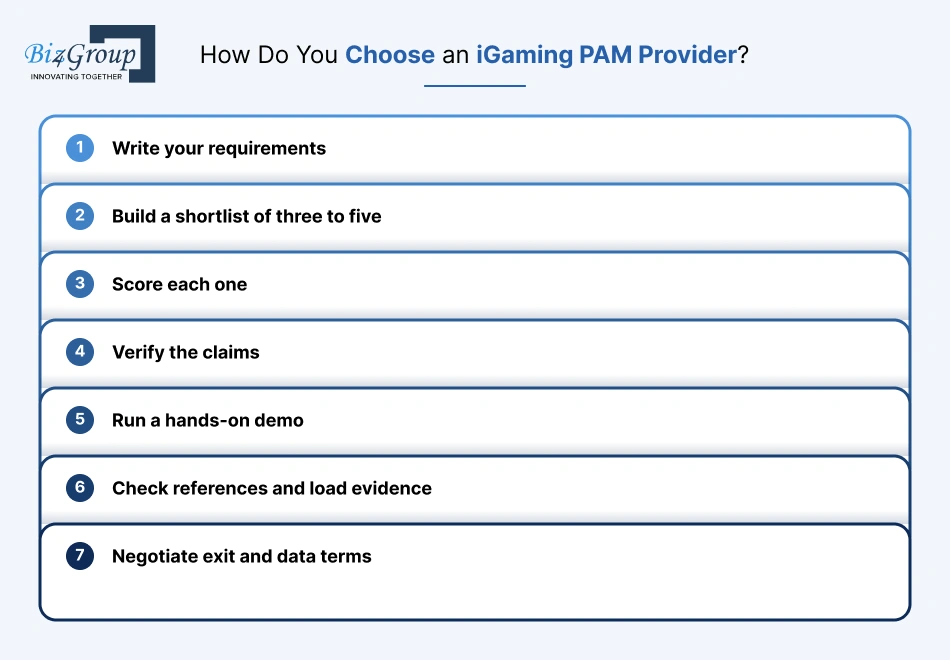
Strong PAM provider selection follows a fixed process. Define your needs, shortlist providers, score them, verify their claims, run a hands-on demo, check references, and negotiate exit terms before you sign. Follow these seven steps in order.
- Write your requirements
List your products, states, brands, payment methods, volumes, and launch date. - Build a shortlist of three to five
Mix provider types from the table so you compare approaches as well as vendors. - Score each one
Use the scorecard in the next section. - Verify the claims
Ask for certificates, tested configurations, and live states. - Run a hands-on demo
Drive the system yourself with the scenarios below. - Check references and load evidence
Speak to operators in your markets. - Negotiate exit and data terms
Settle export, exit help, and service credits before you sign.
What Should an iGaming PAM Provider Scorecard Include?
A good scorecard has ten weighted criteria that total 100 points. Compliance, data ownership, and wallet integrity carry the most weight, because they are the hardest to fix after launch.
|
|
Criterion |
Weight |
What to Look For |
Evidence to Request |
|---|---|---|---|---|
|
1 |
Compliance and certification coverage |
15 |
Standards and states already covered |
Certificates, tested configuration, state approvals |
|
2 |
Data ownership and portability |
12 |
You own player data and can export it |
Contract clause, sample export |
|
3 |
Wallet and ledger integrity |
12 |
Separate cash, bonus, and pending balances with full history |
Ledger demo, reconciliation reports |
|
4 |
Open APIs and integrations |
10 |
Documented APIs for payments, KYC, and games |
API docs, sandbox access |
|
5 |
Performance and uptime at peak |
10 |
Proof from live events |
Load results, incident history |
|
6 |
KYC, location, and responsible gaming controls |
10 |
Age and identity checks, location checks, limits, exclusions |
Demo scenarios |
|
7 |
Reporting and audit trail |
8 |
Daily reports and change logs |
Sample reports |
|
8 |
Multi-product and multi-brand support |
8 |
One account across products and brands |
Architecture review |
|
9 |
Security and access controls |
8 |
Multi-factor authentication, role-based access, account locks |
Security assessment |
|
10 |
Support, roadmap, and commercial terms |
7 |
Response times, roadmap, fee clarity |
SLA, roadmap review |
|
Total |
100 |
These weights are our suggestion for US operators. Adjust them to your business.
Three weights deserve a note.
Security gets eight points because account takeover is a measured threat. The FBI’s 2025 Internet Crime Report lists about 4,700 account takeover complaints and $359.7 million in losses, within $20.877 billion in total reported losses.
Player protection gets ten points because the need is real. The National Council on Problem Gambling estimates that about 1% of US adults meet criteria for severe gambling problems in a given year, and another 2% to 3% have mild or moderate problems. Our responsible gambling monitoring guide covers the tools in depth.
Integrations get ten points because every connection adds work. Our sports betting API integration services cover that work. Sportsbooks often need more than one feed, and you can see why US betting apps rely on multiple data providers.
Want Help Scoring Your Shortlist?
Get the weighted PAM provider scorecard and score your shortlist in minutes.
Score My ShortlistHow Do You Verify a PAM Provider’s Compliance Claims?
Ask for the certificate, the exact configuration that was tested, and the list of states where the system is live. A badge on a website is not evidence.
Which standard should a casino PAM meet?
GLI-19 version 3.0, a technical standard from Gaming
Laboratories International, covers interactive gaming systems, including player account management,
location requirements, and reporting.
Does GLI-19 cover sportsbooks?
No. The standard says it does not apply to
systems that support wagering on sports and points to GLI-33 for event wagering systems. Sportsbook
operators should ask for the right certificate.
Why ask which configuration was tested?
GLI-19 says that when testing is
requested for a white-label version, a specific configuration is tested and reported. A certificate
may not cover your setup.
Which states is it live in? Ask for state approvals and operator references by state. Rules differ, and our state-by-state betting laws guide shows how.
What about anti-money laundering?
FinCEN’s casino rules, in 31 CFR 1021.320, require suspicious activity reports for
transactions of at least $5,000 that meet the rule’s conditions. Reports are due within 30 days of
detection, and records must be kept for five years. Confirm with counsel how these rules apply to
your license. Your PAM must surface and retain the data.
What Should You Test in a PAM Demo?
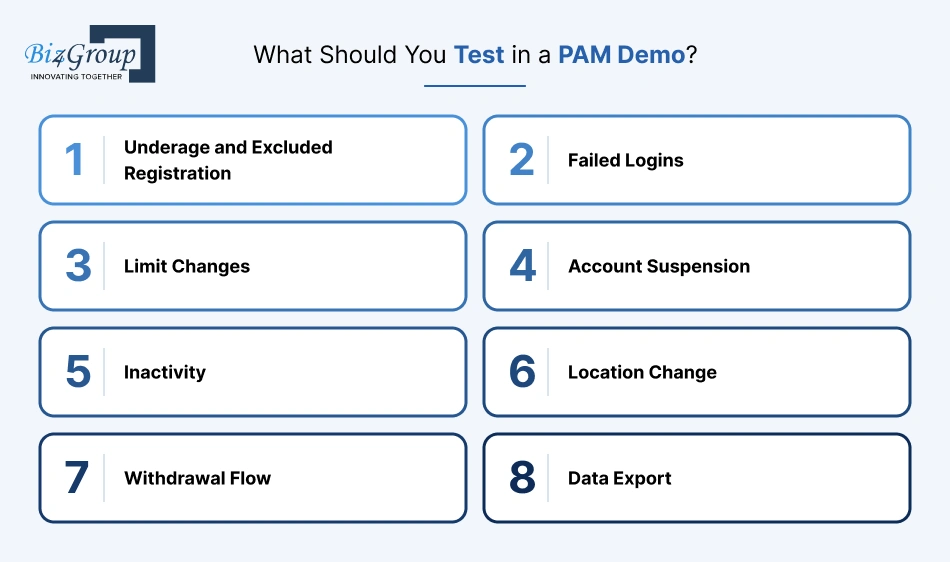
Drive the system yourself with eight scenarios. A scripted demo hides the edge cases where a PAM fails.
1. Underage and Excluded Registration
Try to register an underage player and a self-excluded player. GLI-19 requires age and identity checks before play and denies registration when the birth date shows a minor.
2. Failed Logins
Enter three wrong passwords. GLI-19 supports locking an account after suspicious activity, such as three consecutive failed attempts in thirty minutes. New Jersey’s published rules disable an account after three failed attempts and require strong authentication to recover it.
3. Limit Changes
Lower one limit and raise another. Under New Jersey’s published rules, a decrease takes effect no later than the next login, and an increase waits until the earlier period ends and the player reaffirms.
4. Account Suspension
Suspend an account. New Jersey’s rules set a minimum 72-hour suspension when a player asks, and the system must block deposits and wagering while it lasts.
5. Inactivity
Leave a session idle. GLI-19 requires re-authentication after thirty minutes of inactivity, or the period your regulator sets.
6. Location Change
Move a test device outside the permitted area and confirm wagers stop. GLI-19 repeats location checks after an IP change or thirty minutes. Our geofencing guide explains why accuracy at the state line matters.
7. Withdrawal Flow
Request a withdrawal with a bonus balance open. Check identity, bonus terms, and destination checks, then look for a full ledger entry.
8. Data Export
Export a player’s full history. GLI-19 expects a way to export recorded data for analysis and audits, in formats such as CSV or XLS. Ask for the file.
Stackr, Age Checks, Payments, and Redemptions Under One Account

Stackr is a social casino where our team handled age authentication before players could buy or redeem coins, along with AgeChecker verification, three payment gateways, and location restrictions across US states.
Two coin wallets sit behind each account, and the platform keeps a full history of gaming activity, coin use, and transactions. Those are the scenarios above in production form.
How Do You Test a PAM Provider’s Uptime and Scale?
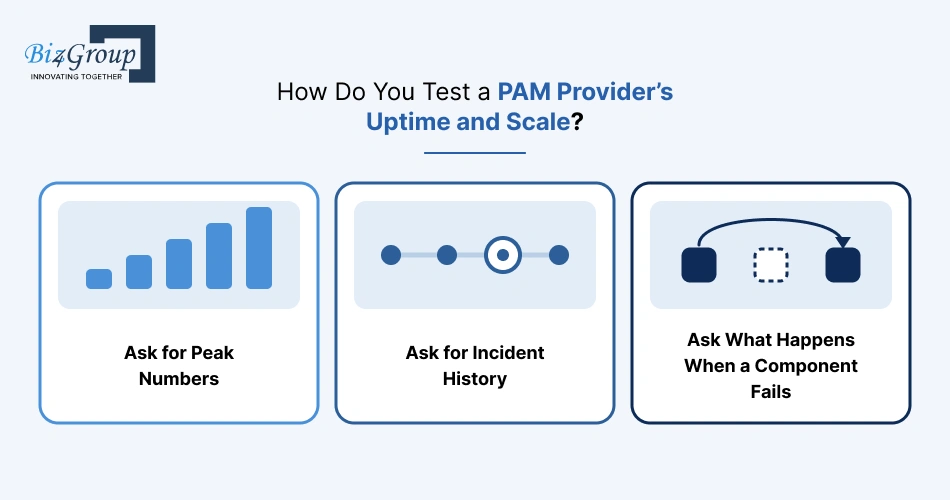
Ask for evidence from live events, not a promise. Request load results, incident history, and references from operators with similar peak traffic.
Ask for Peak Numbers Request concurrent sessions, transactions per second, and the date of the event they came from.
Ask for Incident History GLI-19 lists long periods of unavailability as a significant event the system must record. A provider should show how it logs, reports, and recovers from them.
Ask What Happens When a Component Fails New Jersey’s published rules require a server-based gaming system to recover to its state before an outage. Ask the provider to show what happens to balances and open bets.
JuicySlots, Live Balances Across Many Provider Connections

JuicySlots aggregates games from several third-party casinos, each with different APIs. Our team used a middleware layer to standardize the data and WebSockets to keep balances and transactions in sync.
Horizontal scaling and load balancing handle traffic spikes. The project page reports a 99.8% transaction success rate. That is the kind of live-balance evidence to ask any provider for.
What Contract and Exit Terms Should You Demand From a PAM Provider?
Demand written terms on data ownership, export, exit help, service credits, pricing changes, and audit support. These terms decide what leaving costs.
|
Term |
What to Ask For |
Why It Matters |
|---|---|---|
|
Data ownership |
You own all player and transaction data |
New Jersey’s published rules say data held in the approved data warehouse belongs to the permit holder |
|
Export format and timing |
A full export in a standard format on request and at exit |
GLI-19 expects exportable data |
|
Exit assistance |
A parallel run, cutover help, and read-only access |
Avoids downtime and lost balances |
|
Service levels and credits |
Uptime targets, response times, and credits for misses |
Gives promises teeth |
|
Change and pricing terms |
Caps on fee increases and clear triggers for revenue share changes |
Keeps costs predictable |
|
Audit and certification support |
Access for regulator audits and lab testing |
GLI-19 includes operational audits at the regulator’s chosen frequency |
|
Third parties |
A list of subprocessors that touch your data |
GLI-19 audits cover cloud, payment, and location providers |
Price terms live in the quote. Our player account management cost guide shows how to compare quotes line by line.
Need a Second Opinion on Your Shortlist?
Our team will review your scores, demos, and contract terms with you.
Review My ShortlistWhat Does “Best” Mean for an iGaming PAM Provider?
The best iGaming PAM provider is the one that scores highest on your weighted scorecard for your markets, products, and volume. No single provider wins for every operator.
Different operators weigh the criteria differently. A casino startup may weigh launch speed and bundled compliance. A sportsbook-heavy operator needs the right certificate and live stake handling. A multi-brand operator weighs portability and brand separation most.
Be careful with lists of the best iGaming PAM providers. They mix vendor marketing with real comparison, so treat them as a starting point for a shortlist and score each name yourself.
If you run several brands, our multi-tenant sports betting platform guide shows how brands share a core while keeping rules apart.
What Red Flags Should Make You Walk Away from a PAM Provider?
Walk away when a provider cannot prove its claims, will not let you test, or will not put data and exit terms in writing.
- A certificate that covers a different configuration than yours
- A recorded or scripted demo with no hands-on access
- No ledger entries to show for a balance change
- No commitment to data export at exit
- Closed or undocumented APIs
- No live-event load evidence or references in your markets
- Fees that rise with volume and no cap
- No review trail for manual balance adjustments, which New Jersey’s published rules treat as supervised activity
How Do You Compare iGaming PAM Provider Finalists and Decide?
Score each finalist from 1 to 5 on every criterion. Multiply each score by its weight divided by 5, add the results, and review the gaps. The scorecard ranks fit, and your team still makes the call.
|
Criterion |
Weight |
Provider A |
Provider B |
|---|---|---|---|
|
Compliance and certification |
15 |
5 |
4 |
|
Data ownership and portability |
12 |
3 |
5 |
|
Wallet and ledger integrity |
12 |
4 |
4 |
|
Open APIs and integrations |
10 |
3 |
5 |
|
Performance and uptime |
10 |
4 |
3 |
|
KYC, location, and responsible gaming |
10 |
5 |
4 |
|
Reporting and audit trail |
8 |
4 |
4 |
|
Multi-product and multi-brand |
8 |
3 |
4 |
|
Security and access controls |
8 |
4 |
3 |
|
Support, roadmap, and terms |
7 |
3 |
4 |
|
Weighted total (out of 100) |
100 |
77.6 |
80.8 |
Illustrative scores for two imaginary providers, not real vendors.
Provider A wins on compliance, but Provider B wins overall on data ownership and open APIs. Set a floor before you start. A score of 1 on compliance or data ownership should disqualify a provider no matter the total.
Ready to Choose Your PAM Provider?
Book a free call and leave with a clear shortlist and next steps.
Plan My ShortlistKey Takeaways on Choosing an iGaming PAM Provider
Choosing an iGaming PAM provider is a fit decision, not a feature race. Score vendors on weighted criteria, verify their compliance claims, test the demo with hard scenarios, and write data and exit terms into the contract.
Treat “best” as the highest score for your markets and volume. Use any list of named vendors as a starting point, never as the answer.
If you want to work with the best, you know who to call!
FAQs
1. Can I use more than one PAM provider?
You can use different providers for different brands or licenses. For a single player, though, the record should live in one place. Splitting one player’s balances across systems creates reconciliation work and raises audit risk.
2. How should I evaluate an AI-assisted PAM?
Ask for the list of AI workflows with their status, such as live, in the demo, or planned. Ask which decisions need a person’s approval and whether every automated decision is logged. You can see one approach in our AI-Powered PAM, where the workflows are shown in the demo.
3. Do regulators approve my PAM provider?
Many states license or register gaming suppliers and certify systems, and the operator stays responsible for compliance. Ask the provider which approvals it holds in your states and who is responsible for each one in the contract.
4. What should a PAM reference call cover?
Ask how long the launch took, how incidents were handled, how fee changes worked, and what support looked like after year one. Ask whether they would sign again. Choose references from operators with markets and volume like yours.
5. Do I need a different provider for sportsbook and casino?
Not necessarily. A multi-vertical PAM can serve both with one account and wallet. Ask for the right certificate for each product, because casino and sportsbook systems are tested against different standards.