Location :
Orlando, FL, USA
Location :
Orlando, FL, USA +1 (407) 714-1616
 info@biz4group.com

- Develop a multi-tenant AI sports betting platform to power multiple sportsbook brands, regions, and operators from a single scalable system while maintaining separate tenant environments.
- Multi-tenant AI sports betting platform development enables enterprises to launch new sportsbook brands faster, reduce infrastructure costs, and manage betting operations through centralized governance.
- Successful platforms rely on multi-tenant sports betting platform architecture that includes event-driven systems, AI prediction models, real-time data pipelines, and cross-tenant analytics.
- Enterprises develop multi-tenant sports wagering platforms using AI to improve odds prediction, analyze betting patterns, detect fraud, and personalize wagering experiences.
- Biz4Group LLC helps enterprises build high-performance multi-tenant AI sportsbook platforms, combining AI expertise, scalable architecture, and real-world betting platform experience to deliver enterprise-ready sportsbook ecosystems.
What happens when a sportsbook operator wants to launch ten betting brands across different regions, each with unique:
- Regulations
- Currencies
- Audiences
... without rebuilding the platform every time?
That question sits at the heart of modern sportsbook engineering. The global sports betting market alone is predicted to increase from USD 124.88 billion in 2026 to approximately USD 325.71 billion by 2035. This shift explains why many organizations now aim to develop a multi-tenant AI sports betting platform that can support multiple operators, brands, and markets from a single scalable ecosystem.
The scale of opportunity continues to grow alongside technology adoption. Artificial intelligence has become deeply embedded in betting platforms, with industry reports showing that nearly 48% of bets across major operator networks in 2025 were priced using AI trading models.
This means platforms must combine predictive analytics, automation, and flexible infrastructure now. As a result, many organizations now invest in multi-tenant AI sports betting platform development to deliver smarter odds modeling, real-time insights, and faster expansion into new markets.
Also, traditional sportsbook systems struggle with scaling across regions, managing multiple brands, and maintaining regulatory compliance across jurisdictions. A unified architecture changes that equation. Companies now develop enterprise multi-tenant sports betting platform ecosystems that centralize operations, streamline data management, and enable rapid deployment of new sportsbook brands.
Now, this guide is here to answer how to build and scale multi-tenant AI sports betting platform infrastructure that supports global expansion and long-term profitability.
Let’s begin with the basics.
Understanding the Core Concept Behind Multi-Tenant AI Sports Betting Platform Development
Sports betting platforms have evolved far beyond simple wagering websites. Operators today manage thousands of betting markets, live odds updates, real-time match data, and millions of wagers during major sporting events.
Supporting this level of activity requires infrastructure designed for scale.
Traditional sportsbook systems were built for one operator at a time. That model worked when betting platforms served a single region or brand. Enterprise sportsbooks now operate across multiple jurisdictions, launch new betting products regularly, and manage several brands under one organization.
This shift explains why many companies now choose to develop a multi-tenant AI sports betting platform. Instead of creating separate infrastructure for every sportsbook brand, operators run multiple betting platforms through one centralized ecosystem.
The result is faster expansion, lower operational overhead, and more efficient platform management.
What Is a Multi-Tenant AI Sports Betting Platform?
A multi-tenant AI sportsbook platform allows several operators or brands to run sportsbooks from the same core platform while maintaining independent environments.
Each operator becomes a tenant inside the platform.
Every tenant can maintain unique elements such as:
- Branding and user interface
- Betting markets and odds configuration
- Payment systems
- Regulatory compliance rules
- Reporting dashboards
Behind the scenes, the platform shares core infrastructure including the betting engine, AI analytics systems, and sports data integrations.
Single-Tenant vs Multi-Tenant Sports Betting Platforms
Understanding the difference between these two models helps explain why enterprise operators are rapidly shifting toward multi-tenant systems.
|
Platform Model |
Description |
Operational Impact |
|---|---|---|
|
Single-Tenant Sportsbook |
One platform infrastructure supports one sportsbook operator or brand |
Expansion requires separate platforms for every new brand or region |
|
Multi-Tenant Sportsbook |
A single platform supports multiple operators or betting brands through isolated tenant environments |
Operators can launch new sportsbooks quickly while sharing the same infrastructure |
|
Infrastructure Usage |
Dedicated infrastructure per platform |
Shared infrastructure across tenants |
|
Scalability |
Limited scalability and higher infrastructure cost |
Highly scalable and cost efficient |
|
Data Insights |
Data limited to one operator |
Cross-tenant insights and analytics improve decision making |
How Multi-Tenant Sportsbook Platforms Operate?
A multi-tenant sportsbook platform functions as a shared wagering infrastructure that supports multiple sportsbook operators.
The core platform handles shared services such as odds processing, wager validation, and data analytics. Individual operators configure their own sportsbook environments while relying on the shared backend system.
A simplified workflow often looks like this.
- Sports data feeds deliver real-time match statistics and odds updates.
- AI models analyze betting patterns and player performance.
- The betting engine processes wagers placed by users across multiple brands.
- Each tenant manages branding, betting markets, and operational settings.
- The system maintains strict isolation between tenant data and transactions.
Enterprise sportsbooks depend heavily on reliable sports data feeds to maintain accurate betting lines during live games. Most operators integrate data providers such as SportRadar, Genius Sports, and Sports.io to ensure continuous real-time updates for wagering markets.
Core Components of a Multi-Tenant AI Sports Betting Platform
A scalable sportsbook ecosystem contains several interconnected modules. Each component supports a specific part of the betting experience while allowing the platform to serve multiple operators.
|
Component |
Role in the Platform |
Value for Enterprises |
|---|---|---|
|
Sports Data Integration |
Connects APIs from providers to deliver match statistics and odds data |
Enables accurate real-time wagering markets |
|
AI Prediction Engine |
Analyzes historical data, player performance, and betting behavior |
Improves odds modeling and risk management |
|
Odds and Trading Controls |
Allows operators to configure spreads, betting markets, and wagering limits |
Provides flexibility for each sportsbook tenant |
|
Multi-Tenant Management Console |
Admin dashboard for managing brands, users, and operational settings |
Centralizes platform governance |
|
Betting Engine |
Processes wagers, validates odds, and manages payouts |
Supports high volume betting activity |
|
Player Account Management |
Handles user registration, wallet management, and betting history |
Ensures secure account operations |
|
Analytics and Reporting |
Tracks betting patterns, user activity, and operator performance |
Enables data-driven decision making |
These components combine to create a unified sportsbook platform capable of supporting multiple operators while maintaining separate betting environments.
Why Real-Time Data Accuracy Matters?
In sports betting, every second counts.
Live wagering markets react immediately to events like touchdowns, penalties, home runs, and player substitutions. Delays in match data can create incorrect betting lines or mismatched odds.
Therefore, enterprise sportsbooks rely on multiple sports data providers to maintain consistent data streams.
Reliable data pipelines help ensure that betting markets remain accurate and responsive during high traffic events such as the Super Bowl, March Madness, or the World Series.
The next section will explain why companies are increasingly choosing to develop enterprise multi-tenant sports betting platform infrastructure to expand faster in competitive wagering markets.
Also read: Why most betting apps fail at real-time match accuracy (and how top apps fix it)?
Why Build 5 Sportsbooks When One Platform Can Run Them All?
Top operators cut development costs by 40-60% using multi-tenant sportsbook systems.
Build Smart with Biz4GroupWhy Should Enterprises Develop a Multi-Tenant AI Sports Betting Platform Today?
The sports betting industry has entered a new phase of expansion. What began as regional wagering platforms has evolved into global betting ecosystems serving millions of users across multiple markets.
Enterprises entering this space face a clear question... Should they launch separate sportsbooks for every brand and region, or build one scalable platform that powers all of them?
Many operators now choose the second approach. They develop a multi-tenant AI sports betting platform capable of supporting multiple operators, brands, and jurisdictions under one system.
The decision is driven by three major forces. Market growth, operational complexity, and competitive pressure.
Rising Demand for Multi-Brand Sportsbook Platforms
The betting market is no longer limited to a single sportsbook brand per operator. Large betting companies frequently operate:
- Regional sportsbooks
- Partner betting brands
- Affiliate wagering platforms
- Media-driven betting products
Launching these products independently requires separate infrastructure, development teams, and compliance processes.
A multi-tenant sportsbook architecture changes this model.
Instead of launching multiple standalone systems, operators build scalable multi-tenant AI sports betting systems that support multiple brands through one centralized platform.
This approach allows companies to launch new sportsbooks in weeks instead of months.
Operational Challenges of Traditional Sportsbook Platforms
Many legacy betting platforms struggle to support modern sportsbook operations. Here are the most common issues enterprises face.
Infrastructure Duplication
Each sportsbook brand requires a separate backend system.
Higher Operational Costs
Independent systems require separate development, infrastructure, and maintenance teams.
Fragmented Analytics
Betting insights remain isolated within individual platforms.
Slower Market Entry
Launching new betting products requires rebuilding features repeatedly.
These problems make it difficult for operators to scale efficiently.
Multi-tenant architecture solves these issues by centralizing core systems such as the betting engine, data pipelines, and AI analytics modules.
AI Is Transforming Sportsbook Operations
Artificial intelligence has become one of the biggest advantages in modern betting platforms. Sportsbooks now rely on machine learning to process enormous amounts of sports data and wagering activity.
AI systems assist with several critical sportsbook operations.
- Predicting match outcomes and player performance
- Detecting suspicious betting patterns
- Optimizing betting odds dynamically
- Analyzing bettor behavior and engagement
Many sportsbooks now integrate predictive models into their trading systems. Operators building intelligent betting ecosystems frequently rely on enterprise AI solutions to manage complex prediction models, risk analysis, and behavioral analytics.
These capabilities improve decision making for operators while creating a more engaging wagering experience for bettors.
Also read: How to use AI for sports betting?
Enterprise Data Infrastructure Is Becoming a Competitive Advantage
Accurate sports data sits at the heart of every sportsbook platform. Operators rely on real-time data streams to update odds, calculate spreads, and process wagers during live games.
Enterprise platforms connect to premium sports data networks that deliver live statistics, player metrics, and wagering market feeds used by trading systems.
Many sportsbook operators prioritize data infrastructure because platform valuations often depend heavily on data reliability and API integrations. Reliable sports data enables faster odds updates, accurate wagering markets, and stronger user trust.
Also read: How enterprise-grade sports APIs power $10M+ betting app valuations
Business Benefits of Multi-Tenant Sports Betting Platforms
For enterprises planning long-term sportsbook growth, multi-tenant architecture offers clear advantages.
|
Business Benefit |
Impact for Operators |
|---|---|
|
Faster market expansion |
Launch new sportsbook brands without rebuilding infrastructure |
|
Reduced development cost |
Shared platform lowers engineering and operational expenses |
|
Centralized governance |
Operators manage multiple brands through one platform |
|
Cross-tenant analytics |
Aggregated data improves betting insights and trading strategies |
|
Simplified compliance |
Regulatory configurations can be managed per tenant |
This model allows organizations to create enterprise grade multi-tenant AI sports betting systems capable of expanding across jurisdictions while maintaining operational control.
The next section explores real-world scenarios where enterprises build multi-tenant AI sports betting software to support different business models.
Use Cases That Require Enterprises to Build Multi-Tenant AI Sports Betting Software
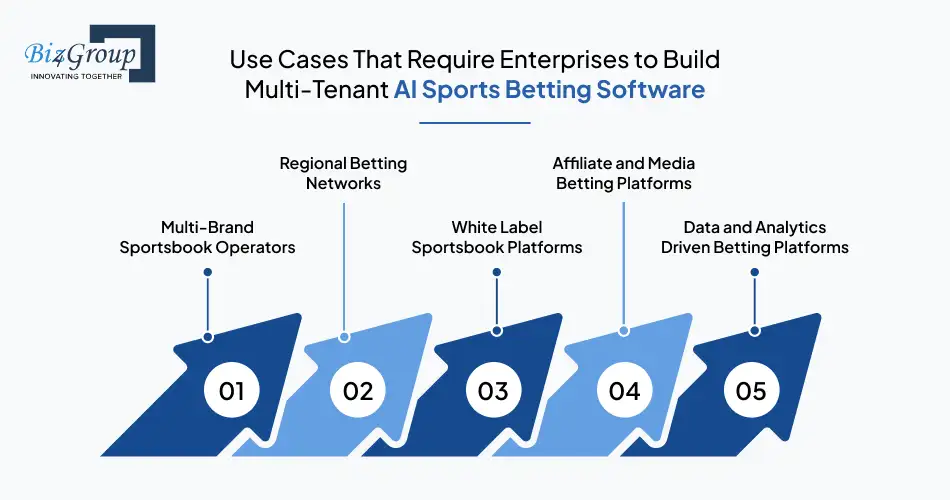
Enterprise operators now manage multiple betting products, brands, and regional platforms simultaneously. This shift explains why many organizations choose to build multi-tenant AI sports betting software that supports several business models within a single ecosystem.
Below are some of the most common enterprise scenarios where companies develop multi-tenant sports wagering platforms using AI to scale operations and launch new betting products.
1. Multi-Brand Sportsbook Operators
Large sportsbook operators often run several betting brands targeting different user segments. One brand may focus on professional leagues such as the NFL, NBA, and MLB. Another may specialize in niche markets like esports or college sports wagering.
Managing these products independently creates operational friction. Multi-tenant infrastructure allows operators to launch new brands under the same core platform while maintaining separate user databases, betting markets, and regulatory configurations.
This model enables companies to create enterprise grade multi-tenant AI sports betting systems while keeping tenant data and wagering operations fully isolated.
2. Regional Betting Networks
Sports betting regulations vary widely across U.S. states. Operators expanding into multiple jurisdictions often require localized betting markets, payment systems, and compliance workflows.
A multi-tenant sportsbook platform allows operators to deploy separate tenants for each region. Each tenant can configure wagering rules, betting limits, and tax structures based on state regulations.
This approach allows companies to build scalable multi-tenant AI sports betting systems that operate across regulated markets without duplicating infrastructure.
3. White Label Sportsbook Platforms
Many technology providers build sportsbook infrastructure and license it to multiple operators. These platforms often support independent betting brands powered by a shared backend system.
This model is commonly known as a white-label sports betting platform.
Each tenant represents a different sportsbook operator using the same technology stack while maintaining its own branding and betting configuration.
Multi-tenant architecture makes this possible by separating tenant data while sharing platform services such as odds engines, trading tools, and reporting systems.
4. Affiliate and Media Betting Platforms
Sports media companies and affiliate networks increasingly launch betting products to monetize their audience.
These platforms typically combine sports content with wagering opportunities, creating a hybrid experience where fans can read analysis, track game stats, and place bets from the same ecosystem.
Many affiliate-driven platforms begin as prediction or odds comparison portals before expanding into wagering products. You can start by building a sports betting affiliate website that aggregates betting markets across operators.
5. Data and Analytics Driven Betting Platforms
Modern bettors increasingly rely on analytics before placing wagers.
Platforms that deliver player statistics, historical trends, and predictive insights attract experienced bettors looking for deeper analysis. Many enterprises build multi-tenant AI sports betting systems that integrate advanced analytics engines capable of processing player performance data, team statistics, and historical match outcomes.
These platforms often combine prediction models with automated insights powered by intelligent systems such as AI automation and predictive modeling pipelines.
Project Spotlight: Ingenious Betting App for Sports Enthusiasts
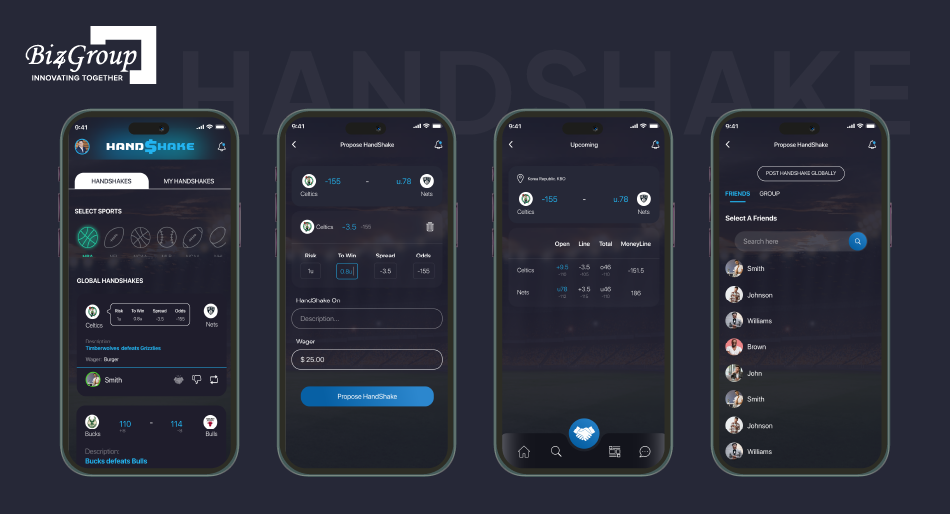
Using seasoned AI app development services, Biz4Group developed a social betting platform designed for sports fans who enjoy wagering with friends and communities. The platform demonstrates how modern betting ecosystems combine wagering mechanics with social engagement.
Key highlights of the project include.
Social Wagering Experience
- Users can challenge friends to wagers on NFL, NBA, NHL, and other leagues
- Peer-to-peer betting encourages friendly competition rather than traditional sportsbook betting
Real-Time Sports Insights
- Live scores and match updates keep users informed during games
- Bettors can analyze current match conditions before accepting wagers
Interactive Engagement Tools
- One-on-one and group chat for discussing bets
- Push notifications for game updates and betting activity
Flexible Wager Types
- Bets can involve money, rewards, or other agreed outcomes between users
- Users negotiate bet terms before accepting wagers
This project demonstrates how enterprises can build high performance multi-tenant AI sportsbook platforms that blend social interaction with sports wagering mechanics.
These use cases highlight the growing demand for scalable sportsbook ecosystems. The next section explores the must-have features enterprises need when they create multi-tenant AI sportsbook platforms designed for large-scale betting operations.
Multi-Brand Operators Are Scaling 3x Faster!
One platform. Multiple brands. Unlimited market expansion.
Launch Your Multi-Brand Sportsbook with Biz4GroupKey Features Needed to Develop a Multi-Tenant AI Sports Betting Platform
A modern platform must handle millions of wagers while maintaining compliance, reliability, and personalized user experiences.
Organizations that develop a multi-tenant AI sports betting platform must therefore integrate intelligent systems that support multiple operators while maintaining strong performance and platform governance.
The following capabilities form the backbone of enterprise multi-tenant sports betting software development.
|
Feature |
What It Is |
What It Does |
|---|---|---|
|
Multi-Tenant Management Console |
A centralized control dashboard that allows administrators to manage multiple sportsbook tenants |
Enables operators to configure brands, betting markets, and compliance rules from one platform |
|
Real-Time Sports Data Integration |
API connections to sports data providers such as SportRadar, Genius Sports, and Sports.io |
Delivers live scores, player statistics, and odds updates for wagering markets |
|
AI Odds Prediction Engine |
Machine learning models trained on historical game data and betting trends |
Generates predictive odds and assists trading teams with pricing strategies |
|
Live Betting Engine |
Core wagering engine that processes in-game bets during live matches |
Allows bettors to place wagers while games are in progress with updated odds |
|
Dynamic Odds Adjustment |
Algorithmic system that adjusts betting lines based on betting activity and game events |
Helps sportsbooks manage risk while maintaining competitive betting markets |
|
Player Account and Wallet System |
User account infrastructure that handles registrations, wallets, and betting history |
Supports secure transactions, deposits, and withdrawals |
|
Cross-Tenant Analytics Dashboard |
Analytics platform that aggregates betting data across tenants |
Helps operators analyze wagering trends and improve trading strategies |
|
Fraud Detection and Risk Monitoring |
AI models that monitor suspicious betting patterns and unusual wagers |
Prevents match fixing risks and protects sportsbook integrity |
|
Personalized Betting Recommendations |
AI-driven recommendation engines that analyze bettor behavior |
Suggests wagers based on user history and preferences |
|
Conversational Betting Assistant |
Intelligent chatbot interface integrated into the sportsbook |
Guides users through betting markets and provides match insights |
When these features operate together, enterprises can build high performance multi-tenant AI sportsbook platforms capable of handling large betting volumes and supporting multiple sportsbook brands simultaneously.
Project Spotlight: Quick Start Bets
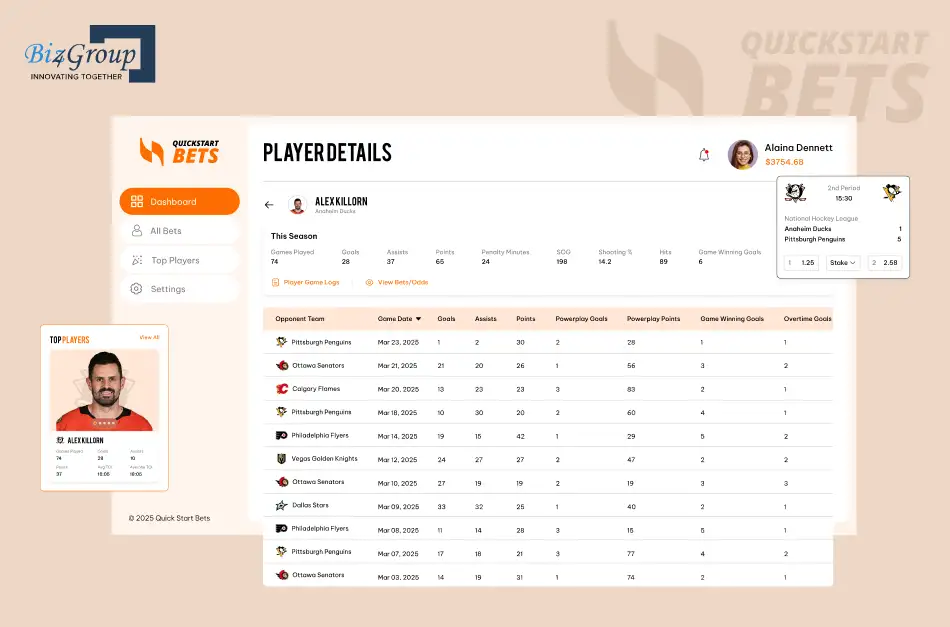
Quick Start Bets is a real-time sports analytics platform built by Biz4Group to help bettors analyze game performance and track wagers with greater accuracy. The platform focuses on delivering fast insights for NHL games while presenting betting data in a clear and accessible interface.
Key highlights include.
Real-Time Betting Insights
- Displays live odds updates for NHL games
- Provides team and player-based betting options
Advanced Player and Team Analytics
- Detailed player statistics and historical performance metrics
- Game logs and matchup insights to support betting decisions
Interactive Betting Dashboard
- Centralized dashboard showing betting history and upcoming games
- Tracks bet outcomes and user performance trends
Low Latency Data Updates
- Optimized data pipelines ensure fast odds updates
- Real-time synchronization keeps bettors informed during live matches
Quick Start Bets demonstrates how enterprises can combine sports analytics and predictive insights to create multi-tenant AI sportsbook platforms that enhance the betting experience for data driven users.
With the feature layer defined, the next step involves understanding how these capabilities are structured at the system level.
Architecture Required to Develop a Multi-Tenant AI Sports Betting Platform for High Performance
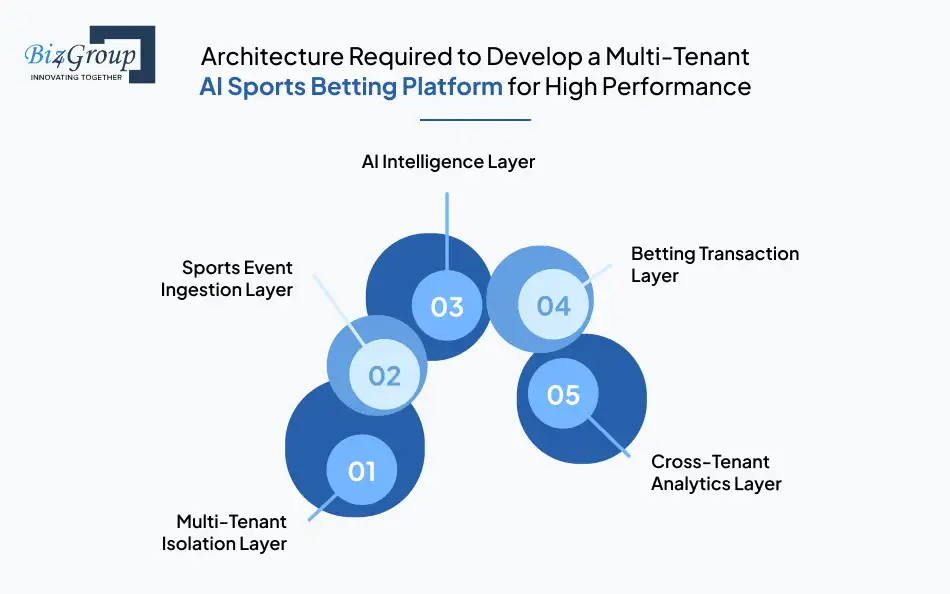
A successful sportsbook platform depends heavily on architecture. When enterprises develop a multi-tenant AI sports betting platform, the architecture must support high wagering volumes, real-time betting markets, and strict data isolation between operators.
Major sporting events such as the Super Bowl, March Madness, and the NBA Playoffs generate massive betting traffic within minutes. A platform built for enterprise operators must therefore maintain reliability while processing thousands of bets per second.
The architecture of enterprise multi-tenant sports betting software development focuses on three priorities:
- Tenant isolation
- Real-time event processing
- Scalable service orchestration
Below are the architectural layers that support these goals.
Multi-Tenant Isolation Layer
The foundation of a multi-tenant sportsbook platform is the isolation layer. This component ensures that every sportsbook operator runs within its own logical environment.
Each tenant has independent configurations including:
- Sportsbook branding
- Wagering markets
- Regulatory rules
- Payment gateways
- Reporting dashboards
Even though tenants share the same platform infrastructure, their user data, betting records, and operational settings remain isolated.
This structure allows operators to create enterprise grade multi-tenant AI sports betting systems while maintaining strict separation between brands and jurisdictions.
Sports Event Ingestion Layer
Sportsbook platforms must continuously receive and process live sports data to maintain accurate wagering markets. The event ingestion layer collects real-time match updates and player statistics from premium sports data providers.
These data feeds power several critical sportsbook operations including:
- Odds updates
- Player statistics
- Match event tracking
- Betting market creation
Also read: Why enterprise sports data APIs like SportRadar matter more than features?
AI Intelligence Layer
Artificial intelligence forms the analytical core of modern sportsbook ecosystems. When enterprises develop multi-tenant sports wagering platforms using AI, machine learning models analyze massive volumes of sports data and wagering activity.
This layer typically supports:
- Predictive outcome modeling
- Betting risk analysis
- Player behavior insights
- Wagering trend detection
Advanced AI platforms may also incorporate conversational intelligence tools such as a sports betting AI agent that assists bettors with odds insights and wagering recommendations.
Betting Transaction Layer
The betting transaction layer manages the core wagering workflow. This component handles the lifecycle of every wager placed on the platform.
Key responsibilities include:
- Validating betting odds
- Processing wagers
- Recording betting transactions
- Calculating potential payouts
- Resolving bet settlements after games conclude
Because wagering activity can spike during major sporting events, this layer must process transactions with extremely low latency while maintaining transactional integrity.
Cross-Tenant Analytics Layer
Enterprise sportsbook platforms generate enormous volumes of operational data. The analytics layer aggregates information from multiple tenants and converts it into actionable insights.
Operators can analyze:
- Betting volume across different sports
- Wagering trends by region
- Player engagement patterns
- Profitability of betting markets
Cross-tenant analytics provide a major strategic advantage because operators can compare performance across sportsbook brands and adjust trading strategies accordingly.
These insights help enterprises refine betting markets and optimize long-term sportsbook profitability.
Project Spotlight: Real-Time Sports Betting Platform for Major Global League Games
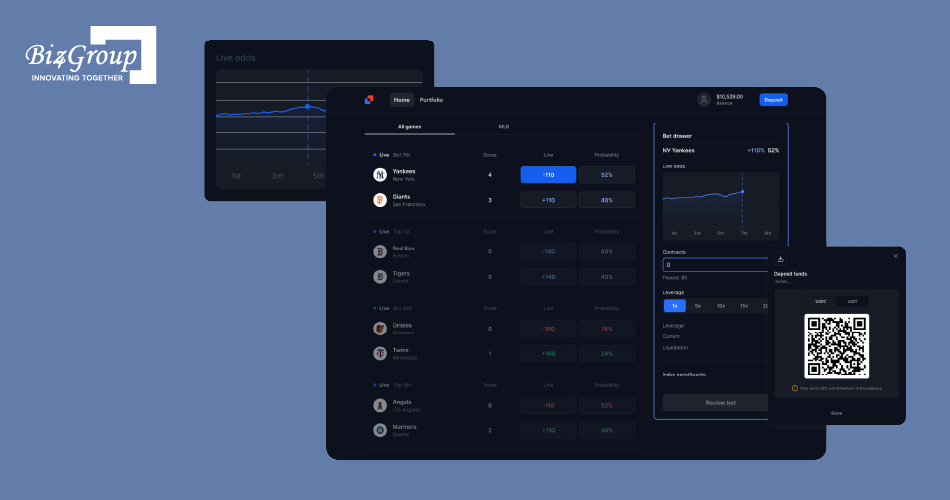
Biz4Group developed a real-time sports betting platform designed to handle high traffic wagering activity across major sports leagues. The platform demonstrates how scalable architecture supports real-time betting environments.
Key highlights of the project include.
Real-Time Data Synchronization
- Live sports data streams deliver continuous updates during games
- Real-time socket communication ensures synchronized odds updates
Multi-League Coverage
- Supports major leagues such as MLB, CFB, and NFL
- Enables bettors to track multiple sports events from one platform
Scalable Platform Design
- Multi-layer architecture supports high concurrency during live matches
- Optimized data pipelines maintain platform responsiveness
Predictive Insights
- Analytical models assist bettors with team performance evaluation
- Real-time data visualization helps users analyze betting markets
This project demonstrates how enterprises can build high performance multi-tenant AI sportsbook platforms that deliver fast wagering experiences while maintaining reliability during high traffic sporting events.
A well-designed architecture forms the backbone of any sportsbook ecosystem. Once the architectural foundation is defined, the next step involves selecting the technologies required to support these systems.
The Super Bowl Can Trigger 20x Traffic Spikes!
If your platform cannot scale instantly, bettors leave within seconds.
Contact Biz4Group for a Game-Day Ready PlatformRecommended Technology Stack to Build Scalable Multi-Tenant AI Sports Betting Software
Enterprises that develop a multi-tenant AI sports betting platform must prioritize technologies capable of handling real-time wagering, high user concurrency, and predictive analytics.
Below is a recommended technology stack used to build scalable multi-tenant AI sports betting systems.
Frontend Technologies for Sportsbook Platforms
The frontend layer handles the user experience for bettors. It displays betting markets, odds movements, live scores, and account dashboards.
|
Technology Layer |
Tools / Frameworks |
What It Enables |
|---|---|---|
|
Web Frontend |
React.js, Next.js, Angular |
Interactive sportsbook dashboards and responsive betting interfaces |
|
Mobile Applications |
Flutter, React Native, Swift, Kotlin |
Cross-platform betting apps for iOS and Android |
|
Real-Time Data Updates |
WebSockets, Socket.io |
Instant odds updates during live betting |
|
UI Component Systems |
Tailwind CSS, Material UI |
Consistent and scalable user interface design |
Backend Technologies for Betting Engines
The backend layer manages sportsbook operations including wager processing, odds management, and account services.
|
Technology Layer |
Tools / Frameworks |
What It Enables |
|---|---|---|
|
Application Backend |
Node.js, Go, .NET Core, Java Spring Boot |
High performance services that process wagers and betting transactions |
|
API Layer |
REST APIs, GraphQL |
Communication between betting apps, services, and external systems |
|
Authentication Systems |
OAuth 2.0, JWT, Auth0 |
Secure user authentication and account management |
|
Payment Integration |
Stripe, PayPal, Square |
Secure deposit and withdrawal processing |
AI and Machine Learning Technologies
Artificial intelligence powers prediction models, fraud monitoring, and bettor behavior analysis in modern sportsbooks.
|
Technology Layer |
Tools / Frameworks |
What It Enables |
|---|---|---|
|
Machine Learning Frameworks |
TensorFlow, PyTorch, Scikit-learn |
Predictive models for match outcomes and wagering patterns |
|
Data Processing Pipelines |
Apache Spark, Pandas |
Large-scale sports data processing and analysis |
|
AI Model Deployment |
Kubernetes ML pipelines, Docker |
Deployment and scaling of predictive models |
|
AI Assistants |
NLP models, conversational AI systems |
Intelligent betting assistants and analytics tools |
Real-Time Data and Event Streaming Technologies
Sports betting platforms rely on event-driven systems to process live match updates and betting activity.
|
Technology Layer |
Tools / Frameworks |
What It Enables |
|---|---|---|
|
Event Streaming |
Apache Kafka, RabbitMQ |
Real-time processing of sports data and wagering events |
|
Sports Data Integrations |
SportRadar API, Genius Sports API, Sports.io API |
Real-time match data, player stats, and odds feeds |
|
Data Synchronization |
Redis Streams, Pub/Sub systems |
Instant propagation of betting updates across services |
|
Message Processing |
Apache Pulsar, AWS Kinesis |
High throughput event processing during peak betting events |
Cloud Infrastructure and Scalability Tools
Enterprise sportsbooks require scalable infrastructure that can handle sudden traffic spikes during major sporting events.
|
Technology Layer |
Tools / Frameworks |
What It Enables |
|---|---|---|
|
Cloud Platforms |
AWS, Microsoft Azure, Google Cloud |
Global infrastructure for scalable sportsbook operations |
|
Containerization |
Docker |
Consistent deployment of sportsbook services |
|
Container Orchestration |
Kubernetes |
Automated scaling and management of platform services |
|
Load Balancing |
NGINX, HAProxy |
Traffic distribution across multiple services |
Data Storage Technologies
Sports betting systems generate enormous volumes of data ranging from user transactions to real-time sports events.
|
Technology Layer |
Tools / Frameworks |
What It Enables |
|---|---|---|
|
Relational Databases |
PostgreSQL, MySQL |
Secure storage for transactional betting data |
|
NoSQL Databases |
MongoDB, Cassandra |
Scalable storage for large sports datasets |
|
Caching Systems |
Redis, Memcached |
Fast retrieval of frequently accessed betting data |
|
Data Warehousing |
Snowflake, BigQuery |
Advanced analytics and reporting across sportsbook operations |
A well-designed technology stack ensures that sportsbook platforms remain reliable, scalable, and capable of supporting multiple betting operators.
How to Build and Scale a Multi-Tenant AI Sports Betting Platform in 7 Steps?
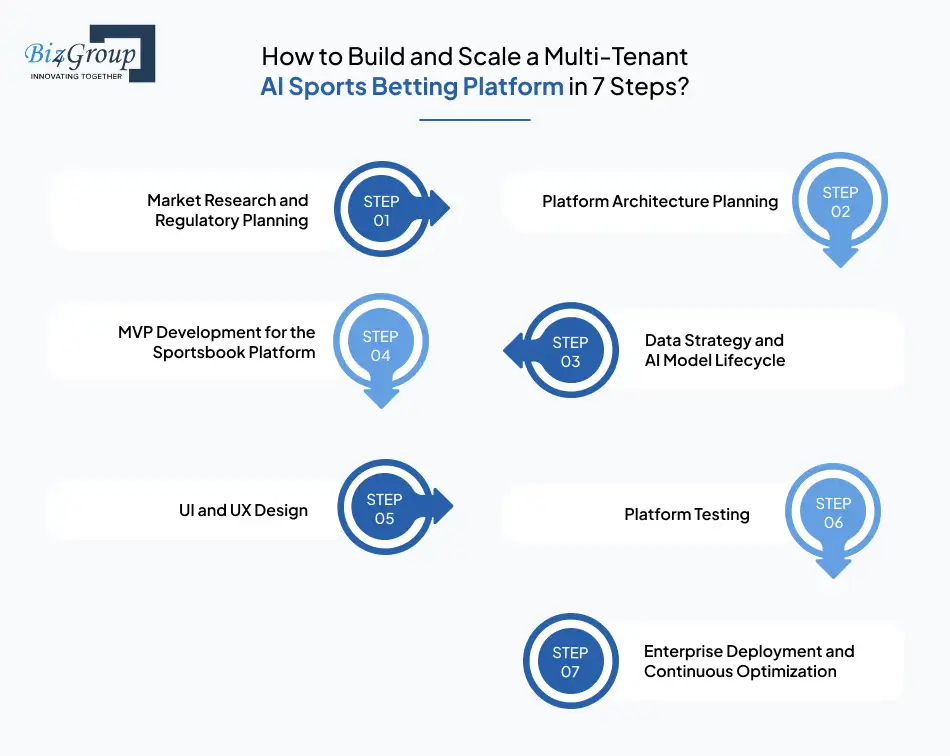
Building a sportsbook platform that supports multiple operators requires careful planning. Enterprises that develop a multi-tenant AI sports betting platform must combine product strategy, regulatory planning, AI model development, and scalable infrastructure.
Below is a step-by-step process used by organizations that build scalable multi-tenant AI sports betting systems.
Step 1. Market Research and Regulatory Planning
The first step involves understanding the betting landscape and compliance requirements before writing a single line of code.
Sports betting regulations vary widely across jurisdictions. Operators must review licensing requirements, taxation rules, and compliance policies for each region where the platform will operate.
During this stage, product teams typically analyze:
- Target betting markets and user segments
- Regulatory requirements for each jurisdiction
- Sports leagues and wagering markets to support
- Payment and KYC compliance needs
Step 2. Platform Architecture Planning
This phase focuses on designing the platform foundation that will support multiple sportsbook tenants. Product architects determine how tenants will operate within the system while maintaining data isolation and operational independence.
A clear architecture roadmap ensures that enterprises can create multi-tenant AI sportsbook platforms capable of supporting future growth.
Step 3. Data Strategy and AI Model Lifecycle
Artificial intelligence plays a central role in modern sportsbook platforms. AI systems process large volumes of sports data and betting activity to generate predictive insights.
During this stage, development teams design the data pipelines and machine learning workflows that power the platform.
Key activities include:
- Collecting historical sports data and match statistics
- Building datasets for predictive modeling
- Training machine learning models for odds prediction
- Creating pipelines for model retraining and updates
Enterprises often use AI integration to ensure that prediction engines work seamlessly with betting engines and analytics systems.
Step 4. MVP Development for the Sportsbook Platform
Before building a full enterprise ecosystem, many organizations start with a minimum viable product. Developing an MVP allows operators to validate product concepts, test wagering mechanics, and gather user feedback while minimizing development risk.
Typical MVP capabilities include:
- User registration and account management
- Basic betting markets for major leagues
- Wallet and payment functionality
- Simplified odds display and wager placement
Early-stage MVP launches help organizations validate their betting experience before scaling to multi-tenant infrastructure.
Also read: Top 12+ MVP development companies in USA
Step 5. UI and UX Design
Bettors expect clear odds displays, fast bet placement, and intuitive navigation between games and wagering markets. An experienced UI/UX design team focuses on building interfaces that make betting markets easy to understand and navigate.
Important UI design elements include:
- Real-time odds boards for ongoing games
- Simple wager placement workflows
- Player statistics and match insights
- Account dashboards showing bet history and balances
A well-designed interface significantly improves the usability of sportsbook applications.
Also read: Top 15 UI/UX design companies in USA
Step 6. Platform Testing
Once the platform features are implemented, the system must undergo rigorous testing. It ensures that the sportsbook performs reliably during high traffic sporting events.
Development teams typically test:
- Real-time odds synchronization
- Wager processing accuracy
- Payment transaction reliability
- AI prediction accuracy
- Cross-tenant data isolation
This phase helps identify performance issues before the platform launches publicly.
Step 7. Enterprise Deployment and Continuous Optimization
The final stage focuses on launching the sportsbook platform and continuously improving its capabilities. After deployment, operators monitor platform performance and analyze betting activity to refine trading strategies and platform features.
Post launch optimization typically includes:
- Monitoring betting traffic and wagering volume
- Retraining AI prediction models with new data
- Launching additional sportsbook tenants
- Expanding betting markets and sports coverage
Enterprises that develop enterprise multi-tenant sports betting platform ecosystems often evolve their platforms continuously as new betting markets and technologies emerge.
Project Spotlight: All Chalk
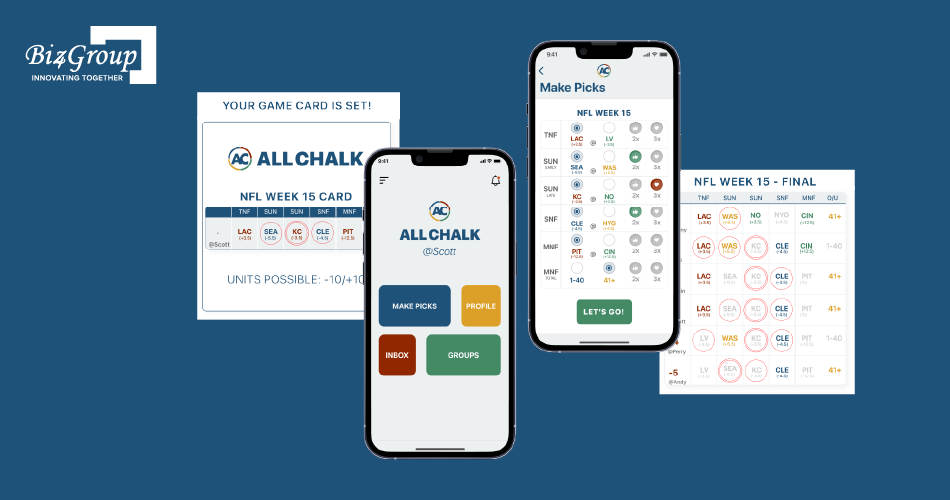
Biz4Group developed All Chalk, a sports Pick’em platform designed for fans who enjoy predicting game outcomes and competing on leaderboards. The application demonstrates how sports engagement platforms can combine prediction mechanics with real-time sports data.
Key highlights of the project include.
Weekly Prediction Contests
- Users predict outcomes for major leagues including NFL, NBA, NCAAFB, and MLB
- Weekly scoring systems track wins, losses, and prediction accuracy
Interactive Leaderboards
- Global leaderboards rank participants based on prediction performance
- Players can track their weekly standing among competitors
Game Schedule Tracking
- The platform displays upcoming match schedules across supported leagues
- Users receive timely updates before games begin
Smart Game Reminders
- Notification systems alert users about upcoming matches and prediction deadlines
- Helps maintain engagement throughout the sports season
All Chalk demonstrates how sports engagement platforms can evolve into predictive betting ecosystems that support scalable sports data experiences.
With the development process defined, the next step involves understanding security requirements and regulatory compliance considerations for enterprises that build multi-tenant AI sportsbook platforms.
Also read: How to build an enterprise AI sports betting platform?
Your Sportsbook MVP Could Be Live in 2-4 Weeks!
Most companies spend months planning. Smart teams launch fast and iterate.
Schedule a Call NowCompliance Considerations When Enterprises Develop a Multi-Tenant AI Sports Betting Platform
Regulation plays a major role in the sports betting industry. Enterprises that develop a multi-tenant AI sports betting platform must design their systems around strict regulatory and security frameworks. Without strong compliance controls, even the most advanced sportsbook technology can face operational shutdowns or heavy penalties.
Below are the most important compliance and security factors organizations must address when they develop multi-tenant sports wagering platforms using AI.
Regulatory Licensing and Jurisdiction Management
- Maintaining separate regulatory settings for each tenant
- Supporting state level licensing requirements
- Enabling geo-restrictions for regulated markets
- Configuring betting rules based on local laws
Enterprises planning to launch sportsbooks across the United States must carefully review sports betting regulations across US states before expanding into new jurisdictions.
Know Your Customer (KYC) and Identity Verification
- Identity verification using government issued IDs
- Age verification to prevent underage gambling
- Document validation and fraud checks
- Continuous monitoring of suspicious user accounts
These processes help sportsbook operators prevent fraud and ensure compliance with gambling regulations.
Anti-Money Laundering (AML) Monitoring
- Monitoring unusual deposit and withdrawal patterns
- Tracking large wager amounts or rapid bet placements
- Flagging suspicious account activity
- Maintaining transaction records for regulatory audits
Responsible Gambling Controls
- Self-exclusion options for players
- Betting limits and deposit caps
- Time reminders for active sessions
- Behavioral alerts for high-risk betting activity
These tools help ensure that sportsbook platforms operate ethically while protecting vulnerable users.
Data Protection and Platform Security
- End-to-end encryption for user data and transactions
- Secure authentication protocols for user accounts
- Tenant-level data isolation mechanisms
- Secure API gateways for sports data providers
Platforms that experiment with predictive systems using generative AI models must ensure that these systems operate within strict compliance boundaries.
Audit Trails and Regulatory Reporting
- Complete wager history tracking
- Operator activity logs
- System level event monitoring
- Automated regulatory reporting dashboards
These logs allow regulators and operators to review betting activity and investigate suspicious transactions.
Secure Integration with Sports Data Providers
- Accurate betting market creation
- Reliable real-time match updates
- Consistent odds calculations across operators
These integrations play a major role in maintaining the integrity of modern sportsbook platforms.
Compliance is a critical foundation for enterprise sportsbook ecosystems. Once regulatory frameworks are established, organizations must evaluate the financial investment required to build and scale these systems.
How Much Does It Cost to Develop a Multi-Tenant AI Sports Betting Platform?
One of the first questions enterprise operators ask is how much investment is required to develop a multi-tenant AI sports betting platform.
The answer depends on the platform’s scope, the number of sportsbook tenants, AI capabilities, regulatory requirements, and infrastructure scale.
On average, the cost to build scalable multi-tenant AI sports betting systems can range between $30,000-$300,000+, depending on platform complexity and feature depth.
The table below provides a simplified overview of how development costs typically evolve as the platform scales.
|
Platform Stage |
Typical Scope |
Estimated Investment |
|---|---|---|
|
MVP Platform |
Basic wagering features, limited sports markets, simplified AI predictions |
$30,000-$70,000 |
|
Advanced Platform |
Multiple betting markets, improved analytics, multi-tenant management tools |
$70,000-$150,000 |
|
Enterprise Platform |
Full sportsbook ecosystem with AI prediction engines, large-scale infrastructure, compliance modules |
$150,000-$300,000+ |
Enterprises that develop enterprise multi-tenant sports betting platform systems often begin with a sports betting app MVP to validate the product and gradually expand into a full-scale sportsbook platform.
Below are the major factors that influence the total cost.
Key Cost Drivers in Multi-Tenant AI Sports Betting Platform Development
Several technical and operational components influence the overall investment required to build high performance multi-tenant AI sportsbook platforms. Each component contributes to development complexity and long-term scalability.
|
Cost Driver |
What It Involves |
Estimated Cost Impact |
|---|---|---|
|
Platform Architecture |
Designing tenant isolation layers, event-driven systems, and scalable infrastructure |
$10,000-$40,000 |
|
Betting Engine Development |
Building wager processing systems, odds management tools, and transaction workflows |
$15,000-$60,000 |
|
AI Prediction Systems |
Developing machine learning models for match prediction, player analytics, and risk monitoring |
$20,000-$70,000 |
|
Sports Data Integration |
Integrating APIs for real-time match data |
$10,000-$40,000 |
|
Multi-Tenant Management Console |
Creating operator dashboards to manage sportsbook brands and tenant configurations |
$10,000-$35,000 |
|
Payment and Wallet Systems |
Secure deposit systems, withdrawal mechanisms, and financial compliance features |
$8,000-$25,000 |
|
Compliance and Security Systems |
KYC, AML monitoring, and regulatory reporting tools |
$10,000-$30,000 |
These components collectively determine the complexity of multi-tenant AI sportsbook application development.
Hidden Costs Enterprises Should Expect
While the core development budget covers platform features and infrastructure, several hidden costs often emerge as sportsbook platforms scale.
- Premium sports data providers such as SportRadar, Genius Sports, and Sports.io charge licensing fees for access to real-time match statistics and betting market feeds. These fees can range from $20,000-$100,000 annually, depending on league coverage and data usage.
- Another overlooked expense involves AI model maintenance and retraining, which can cost $10,000-$40,000 per year depending on the scale of the platform.
- Major sporting events generate traffic spikes that require additional cloud resources. Infrastructure expansion for high traffic periods can add $5,000-$30,000 annually depending on platform usage.
- Licensing renewals, compliance audits, and legal reviews can add $15,000-$50,000 per year for enterprise sportsbook operators.
Understanding these hidden costs helps enterprises plan long-term investment strategies when they create enterprise grade multi-tenant AI sports betting systems.
Techniques to Optimize Sportsbook Development Costs
Although sportsbook platforms can require substantial investment, several strategies help organizations control development costs while maintaining scalability.
- Start with an MVP approach
Launch a simplified sportsbook platform or a sports betting website MVP first and expand features after validating the betting model. - Use modular platform architecture
Building modular services allows development teams to scale components independently. - Prioritize essential betting markets initially
Supporting fewer leagues during early stages reduces data integration costs. - Use scalable cloud infrastructure
Cloud-based platforms allow operators to pay for infrastructure based on actual usage. - Automate trading and risk monitoring
AI automation tools reduce manual trading workloads and improve operational efficiency.
These strategies allow enterprises to gradually scale their sportsbook ecosystem while maintaining controlled development budgets.
Understanding the cost structure helps organizations plan their sportsbook investment strategy effectively.
The next section explores monetization models used by enterprises that create multi-tenant AI sportsbook platforms, including how operators generate revenue from wagering ecosystems.
Also read: How much does it cost to develop an AI sports betting app like Rithmm?
Sportsbook Projects Often Overspend by 3x.
A smart MVP strategy can reduce development costs by up to 50%.
Let's Talk NumbersMonetization Strategies for Enterprises That Create Multi-Tenant AI Sports Betting Platforms
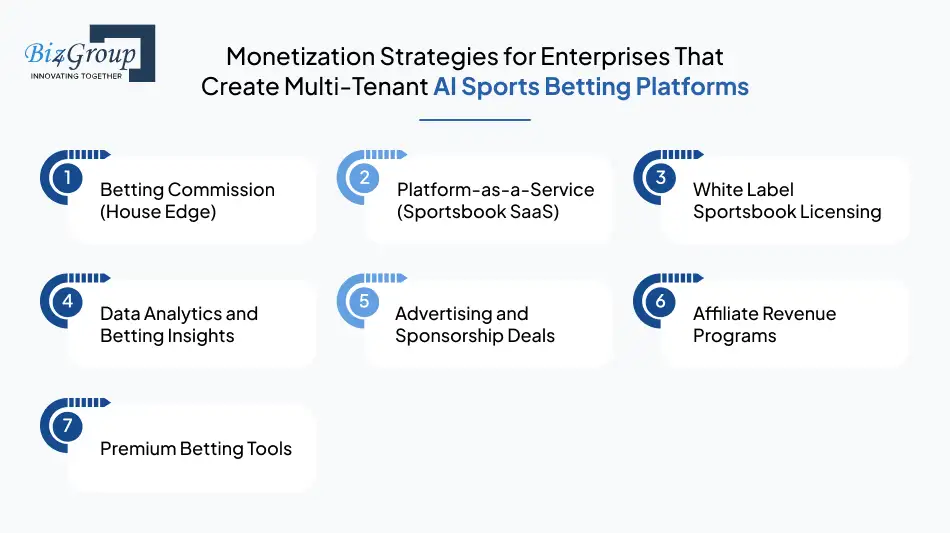
Unlike single sportsbook apps that rely only on betting margins, enterprise multi-tenant sports betting software development enables multiple operators, brands, and partners to generate revenue through the same infrastructure.
Below are the most common monetization models used by companies that build scalable multi-tenant AI sports betting systems.
|
Monetization Model |
How It Works |
Earning Potential |
|---|---|---|
|
Betting Commission (House Edge) |
The platform takes a margin from every wager placed on the sportsbook. Odds are structured so the operator retains a small percentage regardless of the match outcome. |
Most sportsbooks retain 5%-10% margin per betting market, which can generate $5M-$50M+ annually for large operators depending on wagering volume |
|
Platform-as-a-Service (Sportsbook SaaS) |
Technology providers license their sportsbook infrastructure to multiple operators. Each operator becomes a tenant on the platform and pays subscription or revenue sharing fees. |
Enterprise sportsbook SaaS providers typically charge $10,000-$50,000 per operator per month plus 5%-20% revenue share |
|
White Label Sportsbook Licensing |
The platform offers turnkey sportsbook solutions that partners can launch under their own brand. The core platform provider manages technology while partners focus on marketing. |
White label agreements can generate $50,000-$200,000 per partner annually depending on traffic and betting volume |
|
Data Analytics and Betting Insights |
Advanced analytics platforms sell predictive insights, player analytics, and betting trend data to professional bettors or affiliate platforms. |
Premium sports analytics subscriptions often range from $50-$300 per user per month |
|
Advertising and Sponsorship Deals |
Sportsbooks generate advertising revenue from sportsbook promotions, betting partners, and sports media sponsorships within the platform. |
Advertising partnerships can generate $500,000-$5M+ annually for high traffic betting platforms |
|
Affiliate Revenue Programs |
The platform partners with affiliate websites that refer bettors to sportsbook operators. Affiliates earn commission for each registered bettor. |
Affiliate programs often pay $100-$300 per new player signup or 20%-40% lifetime revenue share |
|
Premium Betting Tools |
Advanced betting tools such as predictive models, automated bet tracking, or AI assistants are offered as premium subscriptions. |
Premium betting tools typically generate $20-$100 per user monthly depending on feature depth |
These monetization models allow enterprises to create enterprise grade multi-tenant AI sports betting systems capable of generating revenue from several sources simultaneously.
The next section will examine the challenges, risks, and common mistakes enterprises encounter when they build multi-tenant AI sportsbook platforms, along with strategies to mitigate those risks.
Also read: How do AI sports betting apps like FanDuel make money?
Challenges and Risks When Enterprises Build Enterprise Multi-Tenant AI Sports Betting Software Solutions
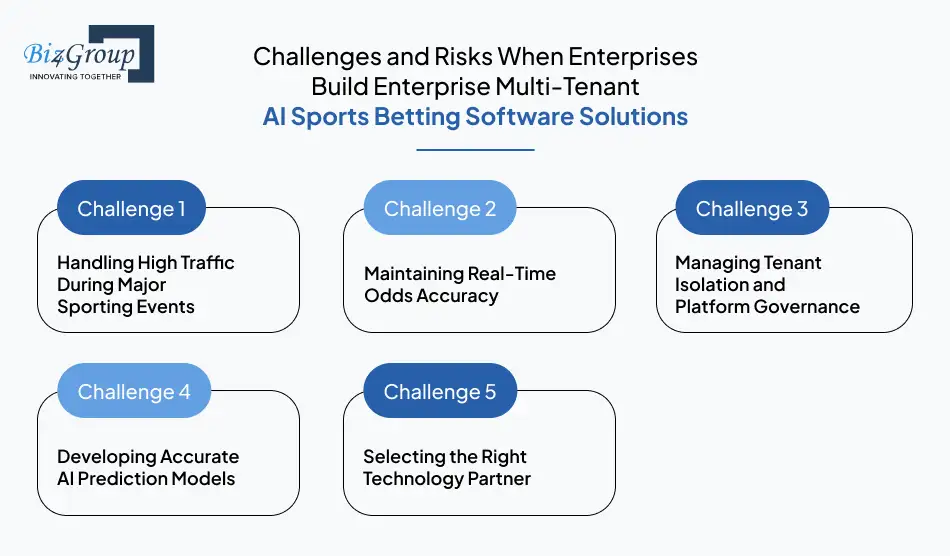
Building a sportsbook platform that supports multiple operators comes with technical and operational complexities. Even well-funded operators encounter challenges during enterprise multi-tenant sports betting software development, especially when scaling the platform across multiple markets and sportsbook brands.
Below are some of the most common challenges organizations face while they build scalable multi-tenant AI sports betting systems, along with practical strategies to mitigate them.
Challenge 1. Handling High Traffic During Major Sporting Events
Sports betting platforms experience massive traffic spikes during major events such as the Super Bowl, NBA Finals, or March Madness.
During these events, thousands of bettors may place wagers within seconds. Without scalable infrastructure, platforms can experience latency issues or failed transactions.
Solutions
- Design event-driven architectures that scale automatically during traffic spikes
- Distribute wagering workloads across multiple processing services
- Implement real-time monitoring tools to detect performance bottlenecks
- Conduct load testing before major sports seasons
Challenge 2. Maintaining Real-Time Odds Accuracy
Live betting markets depend on instant odds updates. Delayed sports data feeds or inconsistent odds calculations can lead to incorrect betting markets.
When sportsbooks operate multiple tenants, maintaining synchronized odds across all brands becomes even more complex.
Solutions
- Integrate multiple sports data providers such as SportRadar, Genius Sports, and Sports.io
- Implement real-time event streaming pipelines
- Deploy automated odds monitoring systems
- Establish fallback data feeds to prevent downtime
Challenge 3. Managing Tenant Isolation and Platform Governance
Multi-tenant platforms must maintain strict isolation between sportsbook operators. Without proper governance controls, data leaks or configuration conflicts could occur between tenants.
This risk becomes more significant as the number of sportsbook operators grows within the platform.
Solutions
- Implement strong tenant isolation frameworks
- Create role-based access controls for operator administrators
- Monitor tenant activity through centralized governance dashboards
- Conduct security audits for cross-tenant access vulnerabilities
Challenge 4. Developing Accurate AI Prediction Models
AI prediction systems are a major competitive advantage for sportsbooks. However, building accurate predictive models requires high quality datasets and continuous model refinement.
Poorly trained models can generate inaccurate predictions or misinterpret wagering trends.
Solutions
- Train AI models using large historical sports datasets
- Continuously retrain prediction models with new match data
- Evaluate model performance across multiple sports leagues
- Hire AI developers who specialize in machine learning systems
Challenge 5. Selecting the Right Technology Partner
Many sportsbooks fail during early development because they choose inexperienced technology vendors. A development partner without deep sportsbook expertise may struggle with real-time data processing, betting engine design, or regulatory compliance.
Choosing the top AI sports betting software development company is a critical step when organizations develop enterprise multi-tenant sports betting platform ecosystems.
Solutions
- Evaluate development partners with proven sportsbook project experience
- Review previous betting platform case studies
- Analyze technical expertise in AI and sports data integrations
Also read: Top 14 sports betting software development companies in the USA
These challenges highlight the complexity of building large-scale sportsbook ecosystems. However, with the right architecture, experienced development teams, and strong AI infrastructure, enterprises can successfully create multi-tenant AI sportsbook platforms capable of supporting global betting operations.
Also read: Challenges in modern sports betting app development
Over 70% of Betting Platforms Fail Before Scale!
The difference between failure and success is the right technology partner.
Talk to Biz4Group's ExpertsWhy Biz4Group LLC Is a Leading USA Partner for Multi-Tenant AI Sports Betting Platform Development
When enterprises plan to develop a multi-tenant AI sports betting platform, they look for a partner that understands sports wagering mechanics, regulatory frameworks, real-time data systems, and AI-driven betting intelligence.
This is where Biz4Group stands out.
Biz4Group LLC is a USA-based sports betting app development company known for building advanced digital platforms powered by artificial intelligence, automation, and scalable architecture. Our experience in building betting platforms, AI-driven analytics systems, and scalable digital ecosystems gives us a unique advantage when it comes to enterprise multi-tenant sports betting software development.
Modern sportsbooks rely heavily on high-quality sports feeds and accurate match statistics. Our teams specialize in building reliable integrations through advanced sports betting API integration services, enabling operators to connect seamlessly with industry leading sports data providers.
Why Businesses Choose Biz4Group LLC
Businesses across the USA and global markets partner with Biz4Group for several reasons.
Deep Expertise in AI-Powered Betting Platforms
Our team designs advanced AI prediction models and betting analytics systems that help operators optimize odds, analyze wagering trends, and detect fraudulent betting behavior.
Proven Experience with Sports Betting Ecosystems
Biz4Group has delivered multiple betting related platforms ranging from social wagering applications to real-time sports analytics platforms.
Enterprise Grade Architecture Design
We build systems designed for scale. Our multi-tenant platform architectures support multiple sportsbook brands while maintaining strict data isolation and operational efficiency.
Real-Time Sports Data Engineering
Our developers specialize in building high performance systems capable of processing live sports data streams from major providers.
AI-Driven Product Innovation
Beyond traditional betting platforms, we help enterprises design intelligent systems powered by predictive models, automation, and advanced analytics.
Long-Term Technology Partnership
Biz4Group focuses on building lasting relationships with clients by supporting platform evolution, feature expansion, and continuous optimization.
As a seasoned AI development company, Biz4Group combines deep technical expertise with industry knowledge to help businesses create enterprise grade multi-tenant AI sports betting systems that deliver performance, scalability, and innovation.
If your organization plans to develop a multi-tenant AI sports betting platform capable of powering multiple brands and markets, partnering with the right technology team can make all the difference.
We are that team for you.
Let’s build something amazing together.
Let’s talk.
To Summarize...
The sports betting industry is evolving rapidly as operators expand across regions, launch multiple sportsbook brands, and integrate advanced analytics into wagering platforms. Enterprises entering this space must think beyond single sportsbook applications and invest in infrastructure that supports scale, flexibility, and intelligent decision making. That is why many organizations now choose to develop a multi-tenant AI sports betting platform capable of serving multiple operators, jurisdictions, and betting products from a unified ecosystem.
A well-designed platform allows businesses to build scalable multi-tenant AI sports betting systems that combine real-time sports data, predictive analytics, and efficient platform governance. With the right architecture, AI models, and compliance strategy, enterprises can launch new sportsbook brands faster, manage betting markets more effectively, and create long-term revenue opportunities in a competitive wagering landscape.
For organizations planning to enter or expand in the sports betting industry, choosing the right development partner is critical. Biz4Group LLC, a USA-based software development company, brings deep experience in enterprise multi-tenant sports betting software development, AI-powered analytics systems, and high-performance betting platforms. Our team helps businesses design intelligent sportsbook ecosystems that support multi-brand operations, real-time wagering, and long-term scalability.
If you are ready to develop a multi-tenant AI sports betting platform that can power multiple sportsbook brands and deliver real business growth, Biz4Group is here to help.
Let’s build your next-generation AI powered sportsbook platform together.
Get in touch.
FAQs
1. Can one platform support multiple sportsbook brands at the same time?
Yes. A multi-tenant sportsbook platform allows several betting brands to operate on the same core system while maintaining separate environments for users, branding, and operations. This structure allows enterprises to launch and manage multiple sportsbook products without building independent systems for each brand.
2. How long does it take to build a multi-tenant AI sports betting platform?
Most sportsbook platforms take around 4-8 months to reach a stable production stage depending on features, AI capabilities, and regulatory integrations. Biz4Group, however, can deliver a functional sportsbook MVP within 2-4 weeks by using reusable platform components that significantly reduce development time and cost.
3. Can enterprises customize each sportsbook tenant differently?
Yes. Each tenant can be configured independently with its own branding, betting markets, bonus systems, payment integrations, and operational settings. This flexibility allows operators to tailor each sportsbook brand for different audiences or regions while still running everything from one centralized system.
4. What sports are typically supported in enterprise sportsbook platforms?
Most enterprise sportsbook platforms support major betting markets such as NFL, NBA, MLB, NHL, and college sports in the United States. Many platforms also expand into international sports such as soccer, cricket, tennis, and esports depending on the target audience.
5. Do sportsbook platforms support live in-game betting?
Yes. Live betting allows users to place wagers while a game is in progress. The platform continuously updates betting odds as events occur during the match, creating dynamic wagering opportunities throughout the game.
6. Can media companies or sports communities launch their own betting platforms?
Yes. Many sports media brands and online communities launch betting platforms to engage their audiences. These platforms can integrate sports news, analytics, and prediction tools alongside wagering markets to create a more interactive experience for fans.
7. How do sportsbooks manage different currencies and payment methods?
Modern sportsbook platforms integrate multiple payment gateways that support different currencies, payment methods, and withdrawal options. This allows operators to serve users across different regions while maintaining smooth financial transactions.
8. What should enterprises prioritize when selecting a sportsbook development partner?
Enterprises should prioritize partners with experience in sports betting platforms, real-time data systems, and AI-driven analytics. Proven expertise in scalable architecture and regulatory compliance is also important for building a reliable sportsbook ecosystem.