Location :
Orlando, FL, USA
 +1 (407) 714-1616
 info@biz4group.com


 AI Summary Powered by Biz4AI
- Player account management (PAM) is the system that holds each player’s identity, wallet, limits, and history in one record.
- A PAM has nine core jobs, from registration and KYC to wallets, bonuses, responsible gaming, and audit trails.
- It differs from a CRM and a game platform. The PAM owns the account, and the other systems read from it.
- US rules vary by state, but every state expects clean records, verified players, working limits, and location checks.
- AI can pre-check routine work inside a PAM. People should still own the sensitive calls.
- A custom PAM usually costs $25,000 to $200,000+, plus yearly upkeep.
- Biz4Group LLC builds PAM-ready wallets, KYC flows, and compliance controls, and shows them in our AI-Powered PAM demo.
This guide is for business planning and education. It is not legal advice, financial advice, or a tip service. Gaming rules change often, so confirm requirements with your state regulator and a gaming attorney. Cost figures are planning ranges, not quotes. You must be 21 or older to gamble in most US states. If you or someone you know needs help, call 1-800-GAMBLER or 1-800-MY-RESET. Last verified October 29, 2026.
Which system tells you the truth about a player when the wallet, the KYC vendor, and the CRM each show a different story?
Player account management (PAM) is that system. A player account management system holds each player’s identity, wallet, limits, and history in one record. This guide explains what a PAM does, its core modules, how it handles wallets and US compliance, what it costs, and how to build, buy, or switch one.
The market gives the topic weight. The AGA reports that iGaming revenue across seven legal states rose 27.6% in 2025 to a record $10.7 billion. You can read the coverage in Intergame’s report on the AGA data.
So, what does a gambling PAM do that your CRM and game platform cannot? You will get plain answers in the sections below. You will also see how to choose a PAM system for a US online casino, and how to switch providers without losing player data.
How we wrote this guide: We drew on public regulations, our own builds, and the sources linked in each section. Cost ranges come from Biz4Group's experience and estimates.
What Is a Player Account Management System in iGaming?
A player account management system is the central system that holds the player record, wallet, transactions, KYC status, bonuses, and responsible gambling controls.
PAM stands for player account management.
Operators use several names for it. You will hear gambling PAM, PAM gaming, PAM software, or PAM iGaming platform. A PAM system in online gaming is the one place every other system asks who a player is and what that player may do.
A healthy account record holds six things:
- Identity and verification status
- Cash, bonus, and pending balances
- Deposit, withdrawal, and wager history
- Limits, time-outs, and self-exclusion flags
- Bonus eligibility and wagering progress
- Support notes and a full audit trail
A weak account record shows up everywhere else. It appears as stuck withdrawals, support tickets, and failed audits. For the bigger picture of how a PAM fits inside a full build, see our iGaming platform development guide.
Why Does Player Account Management Matter for Operators Now?
Player account management matters now because operators sell more products, in more states, to players who expect fast payouts. A weak account system gets exposed quickly under that pressure. Three forces explain why.
More Money Flows Through Each Account
Pennsylvania and New Jersey both saw online casino revenue pass land-based casino revenue for the first time in 2025. Every dollar needs a clean ledger entry that you can defend in an audit.
More States, More Rule Sets
Gambling.com’s state tracker shows online sports betting in 31 states plus DC, and each state writes its own account rules. Our state-by-state betting laws guide maps those differences.
More Products on One Player
Casino, sportsbook, fantasy, and social products now chase the same wallet. A PAM keeps those products from fighting over one balance.
What Are the Core Modules of an iGaming PAM Platform?
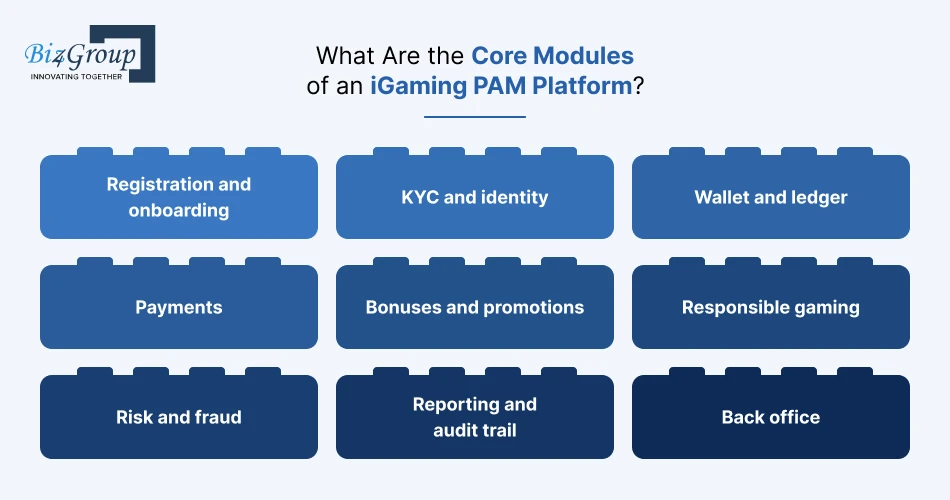
An iGaming PAM platform covers registration, identity checks, wallet, payments, bonuses, responsible gaming, risk, reporting, and back office tools. Vendors such as EveryMatrix describe the same scope, from onboarding and identity verification to wallet operations and responsible gaming. Packaging differs, but the jobs stay the same.
|
Module |
What It Does |
Why Operators Care |
|---|---|---|
|
Registration and onboarding |
Creates the account and collects consent and identity data |
First impression and first compliance check |
|
KYC and identity |
Verifies age, identity, and exclusion status |
Blocks prohibited players before a deposit |
|
Wallet and ledger |
Tracks cash, bonus, and pending balances |
Balances must match every transaction |
|
Payments |
Routes deposits and withdrawals through providers |
Speed and fraud control |
|
Bonuses and promotions |
Applies rules, wagering terms, and eligibility |
Stops abuse and costly mistakes |
|
Responsible gaming |
Sets limits, time-outs, and self-exclusion |
Regulators require it and players need it |
|
Risk and fraud |
Flags odd deposits, devices, and withdrawals |
Protects revenue and players |
|
Reporting and audit trail |
Logs every change and builds regulator reports |
Audits and dispute handling |
|
Back office |
Manages roles, permissions, and support tools |
Keeps teams on one record |
The responsible gaming module deserves its own attention. Our responsible gambling monitoring guide covers limits and alerts in depth.
Is Your Player Record Split Across Systems?
Our team will map your wallet, KYC, and CRM data flows in one session.
Map My Data FlowsHow Is a PAM Different from a CRM and a Game Platform?
A PAM manages the player account itself. A CRM manages how you talk to players, and a game platform runs the games. Each system does its own job, and the PAM is the source of truth for the other two.
Is a PAM the same as a CRM? No. A CRM manages how you communicate with players, while a PAM manages the player account itself. The CRM reads account data to build segments and campaigns.
Is a PAM the same as a game platform? No. The game or sportsbook engine runs bets and settles results. It asks the PAM about balance and status before every wager.
What about a data warehouse or CDP? They analyze behavior. The PAM records it. Analytics tools should read from the PAM and never write balances back.
Which system wins when the numbers disagree? The PAM does. Every other system should treat its record as the final answer.
How Does a PAM Handle Wallets and Balances?
A PAM tracks every balance a player holds and records each change as a ledger entry. Balances are never edited by hand. They are the sum of the entries. Most operators track three balance types:
- Cash balance: Money the player can withdraw.
- Bonus balance: Funds with wagering rules attached.
- Pending balance: Funds held for an open bet or withdrawal.
Here is what a single withdrawal should pass through:
- Identity is verified and current.
- Funds are available and not locked by bonus terms.
- The payout destination matches the deposit method.
- Limits and risk rules pass.
- A ledger entry posts and the payment provider is instructed.
How does a casino wallet work? A casino wallet system holds the player’s balance as ledger entries. A bet places a hold, a win adds funds, and a withdrawal removes them after checks.
A well-built iGaming wallet system adds ledger design, retry safety, and daily reconciliation.
Stackr, an AI-Powered Social Casino with Two-Coin Wallets

Stackr gives players two coin wallets, one for real currency and one for fun currency, and checks user age before coins can be bought or redeemed. The platform also keeps detailed records of gaming activity, coin use, and transaction history.
Payments run through Authorize, with AgeChecker for verification and Paynote for cash redemption. Our team also handled location restrictions across US states. That is a PAM workload in everything but name.
For the business side, read how social casinos make money.
How Does a PAM Connect to Payments, KYC, and Game Providers?
A PAM connects to outside systems through APIs, webhooks, and real-time sockets. Each connection either feeds the player record or reads from it. Clean connections keep balances and statuses in sync.
|
System |
What Passes to and from the PAM |
Typical Method |
|---|---|---|
|
Payment providers |
Deposits, withdrawals, refunds, chargebacks |
API and webhooks |
|
KYC and age checks |
Verification results and document status |
API and webhooks |
|
Geolocation |
Location pass or fail per session |
SDK and API |
|
Game providers |
Balance checks, bets, wins, rollbacks |
API or WebSocket |
|
Sportsbook engine |
Stake holds, settlements, limits |
API or WebSocket |
|
CRM and marketing |
Segments, consent, bonus triggers |
API and batch export |
|
Reporting and BI |
Transactions, balances, audit logs |
Batch export |
Connections multiply as you add products. Our sports betting API integration services cover that work. Sportsbooks also add data feeds, and you can see why US betting apps rely on multiple data providers.
JuicySlots, a Casino Platform with Provider Middleware and Live Balances

JuicySlots aggregates games from several third-party casinos, each with different APIs and rules. Our team built a middleware layer that standardizes the incoming data and used WebSockets to sync game states, balances, and transactions in real time.
The project page reports a 99.8% transaction success rate. Wallet management, coin purchases, redemptions, and a transaction history view all sit on top of that layer.
Can One PAM Run Casino and Sportsbook Together?
Yes, if the PAM holds one account, one wallet, and one set of limits that every product reads. Bragg, for example, markets a unified wallet and account across casino, sportsbook, and lottery. You can see the approach on Bragg’s PAM page. A casino and sportsbook PAM works only when the shared parts and the separate parts are drawn clearly.
Some things must be shared. Others must stay separate.
- Share: Identity, KYC status, wallet, deposit limits, and self-exclusion.
- Keep separate: Product rules, bonus terms, settlement timing, and tax reporting by product.
Sportsbook bets can stay open for days, while casino rounds settle in seconds. The PAM must hold stakes correctly for both. It must also apply one limit across products so a player cannot dodge a cap by switching games.
Multi-brand operators face a similar choice. Our multi-tenant sports betting platform guide shows how brands share a core while keeping rules apart.
Planning One Account for Every Product?
Our architects will review your wallet, limits, and product rules in one working session.
Review My ArchitectureWhat Compliance Duties Does a PAM Support in the US?
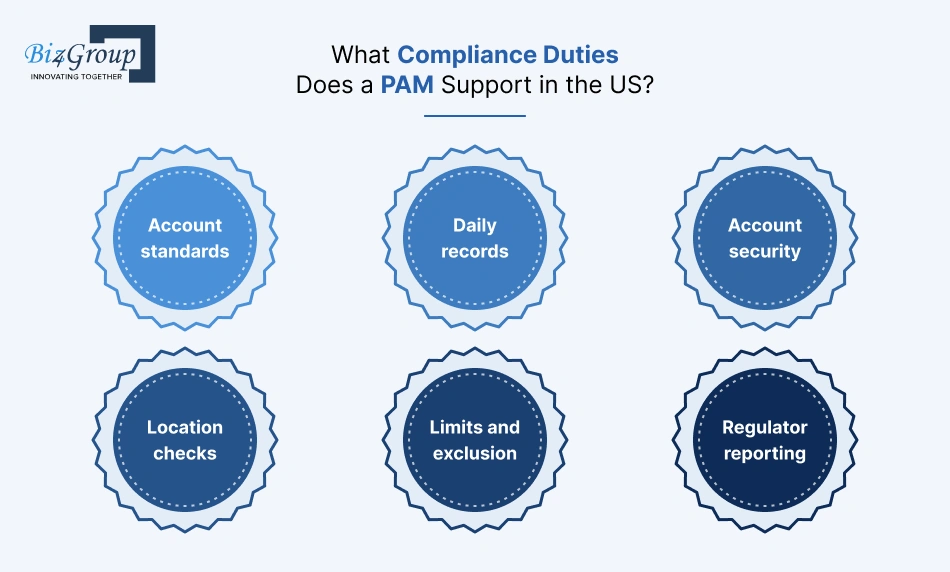
A PAM supports account standards, record keeping, account security, location checks, player limits, and regulator reporting. Each state sets its own rules, but the duties repeat. The table shows examples, not a legal checklist.
|
Duty |
What the PAM Must Support |
Example |
|---|---|---|
|
Account standards |
Registration, account controls, and location handling that labs can certify |
GLI-19 version 3.0 has sections on player account management and location requirements, and Michigan’s planned rule changes point to it |
|
Daily records |
Account summaries, daily review of account adjustments, and dormant account lists after a year of inactivity |
|
|
Account security |
Multi-factor authentication tied to KYC |
|
|
Location checks |
A pass or fail result before play |
State internet gaming rules |
|
Limits and exclusion |
Deposit limits and self-exclusion honored on every product |
New Jersey and Michigan rules |
|
Regulator reporting |
Reports that tie back to ledger records |
State filings and audits |
Rules differ by state, so treat this as a map and not legal advice. Strong iGaming PAM compliance reporting starts with ledger records that tie to every filing.
Biz4Group’s teams have delivered geolocation and KYC systems for operators in regulated US markets, and they build these controls into the account record from the start. Our geofencing guide explains why accuracy at the state line matters.
What Can AI Do Inside a PAM, and What Can’t It?
AI can do the first pass on routine checks. It cannot hold a license, make final calls on flagged players, or promise any outcome. AI player account management works best as a fast assistant, not a decision maker.
What AI does well: It checks documents and scores risk on arrival. It flags unusual payment patterns before a withdrawal clears. It answers routine account questions and summarizes player activity for staff.
What AI should not do: It should not decide sensitive actions alone. KYC outcomes, withdrawal holds, and account restrictions should require a person to approve them. It should also not target at-risk players or reward loss-chasing.
Biz4Group’s AI-Powered PAM follows that line. In the live demo, it pre-checks identity, payment destination, bonus terms, and risk signals on a withdrawal, then sends exceptions to the payments team with full context. You can explore the workflows in our AI-Powered PAM. Those workflows are shown in the demo, so ask for the current status of each one.
If you plan to add AI to an existing platform, our AI integration services connect models to your account data. For custom models, our AI development company team can scope the work.
Should You Build or Buy a PAM System?
Build when the account record is your edge and you need control of data and roadmap. Buy when speed and proven compliance matter most. Many operators pick a hybrid. This choice is worth costing out in full, and the short version follows.
Build: You own the code, the data model, and the roadmap. You also own the upkeep, audits, and hiring. Our custom vs white-label casino guide lays out the trade-offs.
Buy: You launch faster and lean on a vendor’s certified modules. You pay recurring fees and live within their roadmap. Sportsbook-focused operators can start with our build vs buy sportsbook framework.
Hybrid: You license core account functions and build the layers that set you apart. Biz4Group’s iGamingPlatform ships as Turnkey or White Label, so we see both sides of this choice. A turnkey sports betting solution can also shorten the first launch.
How Much Does Player Account Management Cost to Build or License?
The player account management cost for a custom build usually falls between $25,000 and $200,000+, based on our published component pricing. A lean MVP sits at the low end. Licensing swaps the build fee for setup costs and recurring platform fees. Our cost guide compares both paths line by line.
|
Tier |
What it usually includes |
Planning range |
|---|---|---|
|
Core (MVP) PAM |
One product, one payment gateway, one KYC vendor, standard limits, basic admin and reports |
$25,000 to $50,000+ |
|
Mid-market PAM |
Bonus balances and engine, two or more gateways, fraud rules, full responsible gaming tools, regulator reports |
$50,000 to $110,000+ |
|
Advanced multi-vertical PAM |
Shared wallet across products, multi-state rules, advanced reporting, AI-assisted operations |
$110,000 to $200,000+ |
These are our planning estimates, built from the component pricing in our platform cost guide.
Five cost drivers move a PAM budget.
- Scope: More products and balance types add logic.
- Integrations: Each payment, KYC, and data connection adds work.
- Compliance: More states mean more rules and testing.
- Scale: Peak traffic needs stronger architecture.
- Team model: Delivery speed and location change monthly burn.
Hidden costs matter too. Our platform guide puts licensing, audits, and compliance maintenance at $5,000 to $50,000+ a year, and monitoring and support at $1,000 to $10,000+ a month. Maintenance usually runs 15% to 25% of the build cost each year. On a $100,000 PAM, that is $15,000 to $25,000 a year. For whole-platform budgets, see our iGaming platform development cost guide.
Do You Know Your Real PAM Budget?
Get a scoped estimate covering build, integrations, compliance, and first-year ownership costs.
Scope My PAM BudgetHow Do You Choose an iGaming PAM Provider?
Start with five questions and make every vendor answer them in writing. The questions below reveal most weak providers early. Our full guide goes deeper on how to rate an iGaming PAM provider and compares the best iGaming PAM providers by type.
- Who owns the player data, and can you export it? Ask for export formats and exit help in the contract.
- Which states and standards does the PAM already support? Ask for certification evidence, not a promise.
- How open are its APIs? You will connect payments, KYC, and games, so closed systems slow you down.
- What happens at peak traffic? Ask for load results from a live event.
- Can it show an audit trail for every balance change? Regulators and disputes will test this.
If you want a second opinion on your stack, our sports betting app development team can review it with you.
How Do You Switch PAM Providers Without Losing Player Data?
Treat player data like money. Validate it, deduplicate it, import it, and reconcile it. Light & Wonder’s engineering team describes four phases, which are validating incoming data, comparing it with existing players to find duplicates, importing it with final checks, and validating again after migration.
iGaming PAM migration adds a few rules of its own.
- Freeze changes: Pause bonus and limit edits during cutover.
- Move limits and exclusions first: A missing self-exclusion flag is a compliance failure.
- Reconcile balances to the cent: Match old and new totals before launch.
- Keep the old system read-only: You may need it for disputes.
If you are leaving a white-label setup, our guide on moving from white-label to a custom sportsbook walks through the planning.
Key Takeaways on Player Account Management for iGaming
Player account management is the record of truth behind every wager, deposit, and withdrawal. A good PAM keeps identity, balances, limits, and audit trails in one place, and every other system reads from it.
Get the basics right first. Pick the build, buy, or hybrid path with eyes open. Budget for upkeep, not just launch. Keep people in charge of sensitive calls, even when AI does the first pass.
Bring your account design to a team that has built wallets, KYC flows, and compliance controls before. Early reviews find weak spots while they are still cheap to fix.
That team is us. Reach out to Bi4Group for a strong build.
FAQs
1. Do regulators require a PAM system?
Regulators write rules around functions, not product names. They expect verified players, accurate records, working limits, and audit trails. A PAM is the usual way to deliver all of that in one place. Confirm your state’s exact requirements with counsel.
2. How long does it take to launch a PAM?
Biz4Group can develop a functioning PAM MVP in 2 to 4 weeks. That MVP covers core accounts, a wallet, KYC hooks, and standard limits. Adding more products, states, and integrations extends the timeline, so scope sets the final date.
3. Does a social or sweepstakes casino need a PAM?
Yes, in practice. Social and sweepstakes platforms still manage accounts, virtual currency balances, age checks, and purchase and redemption history. Rules for these products vary by state and keep changing, so confirm your approach with counsel.
4. Is an iGaming PAM the same as Privileged Access Management?
No. The two share an acronym only. In iGaming, PAM means player account management. In cybersecurity, PAM means privileged access management, which controls administrator logins. Search results for “PAM system” often mix them up.
5. Which metrics show a PAM Is working?
Track KYC approval time, withdrawal processing time, the share of cases that need manual review, reconciliation breaks, and support tickets per 1,000 players. Falling numbers in each area usually mean the account record is getting cleaner.