Location :
Orlando, FL, USA
Location :
Orlando, FL, USA +1 (407) 714-1616
 info@biz4group.com
 AI Summary Powered by Biz4AI
- Build vs. buy a sportsbook platform comes down to three paths. Build a custom platform, buy a white-label or turnkey sportsbook solution, or go hybrid.
- Buying wins on speed and low setup cost. Building wins on control, differentiation, and long-run margin.
- In our three-year model, a vendor taking a 20% revenue share costs less below roughly $2 million in annual net gaming revenue. Custom costs less above it.
- Setup costs run $10,000 to $100,000+ for white-label, $30,000 to $180,000+ for hybrid, and $40,000 to $300,000+ for custom.
- Biz4Group LLC builds custom and hybrid sportsbook platforms and integrates them with vendor systems, so our advice follows your numbers, not our preference.
What if the fastest-growing cost in your sportsbook is the platform you rent?
It is a fair question. US sportsbooks earned $16.96 billion in revenue on $166.94 billion in handle in 2025, according to the American Gaming Association. Revenue rose 22.8%. Handle rose 11.0%. Operators now keep more from every wager, and any vendor on a revenue share keeps more right along with them.
That is why build vs. buy a sportsbook platform has moved from the IT team to the boardroom. This guide gives you a 12-criteria scorecard, a three-year cost model, and plain answers on lock-in, player data, and vendor choice.
Most operators ask one blunt question first. Is building a sportsbook platform cheaper than paying a vendor revenue share in the long run? Short answer, yes, past a certain size. We show the break-even point below.
Timing matters too. 2025 was the first year since the Supreme Court struck down PASPA in 2018 that no state enacted legislation to authorize sports betting, reports Legal Sports Report. Growth now comes from markets you already serve. Margin and speed decide who wins them.
So we compare a custom sportsbook platform vs. white-label solution on cost, control, speed, and risk. We also run the three-year total cost of ownership for custom and white-label sportsbook platforms, side by side. You will leave with numbers you can defend in a board meeting.
What Is the Difference Between a Custom, Turnkey, and White-Label Sportsbook Platform?
A custom sportsbook platform is product you own. A turnkey sportsbook solution is a ready-to-run product you license. A white-label sportsbook platform is a vendor’s engine with your brand on top. Hybrid pairs a vendor core with modules you own.
Operators swap these terms in meetings, then wonder why quotes do not match. Here is the plain version.
|
Model |
Who Owns the Code |
What You Get |
Setup Cost |
Best For |
|---|---|---|---|---|
|
Custom sportsbook platform |
You |
Betting engine, risk rules, apps, and admin built for your product |
$40,000 to $300,000+ |
Unique products and high volume |
|
Vendor |
A ready-to-run product that often bundles data, payments, and trading |
$10,000 to $100,000+ plus fees |
Fast launches with a small team |
|
|
White-label sportsbook platform |
Vendor |
The vendor’s engine and tools under your brand |
$10,000 to $100,000+ plus fees |
Startups testing a market |
|
Hybrid |
Shared |
Vendor core plus custom modules such as front end, trading, or analytics |
$30,000 to $180,000+ plus a vendor fee |
Speed with a few unique features |
“Buy” covers two products with different scope. Ask every vendor which one they are quoting. For more on the vendor side, read our guide to the white-label sports betting platform.
For the build side, see how to build a proprietary sportsbook platform.
A quick note on the word “licensing”
It means two things here. Product licensing is what you pay a vendor to use their platform. A gaming license is what a state grants you to take bets.
Sportsbook platform development vs. licensing is an important question. State licensing is a regulatory one. For the second, read our guides to the Illinois sports betting license, the New York sports betting license, and Ohio sports betting rules.
Don’t Guess, Decide Strategically!
85% of new sportsbooks fail within the first year due to unclear platform strategy. Are you ready to secure yours?
Analyze My Platform NowHow Do You Choose Between a Turnkey and a Proprietary Sportsbook Platform?
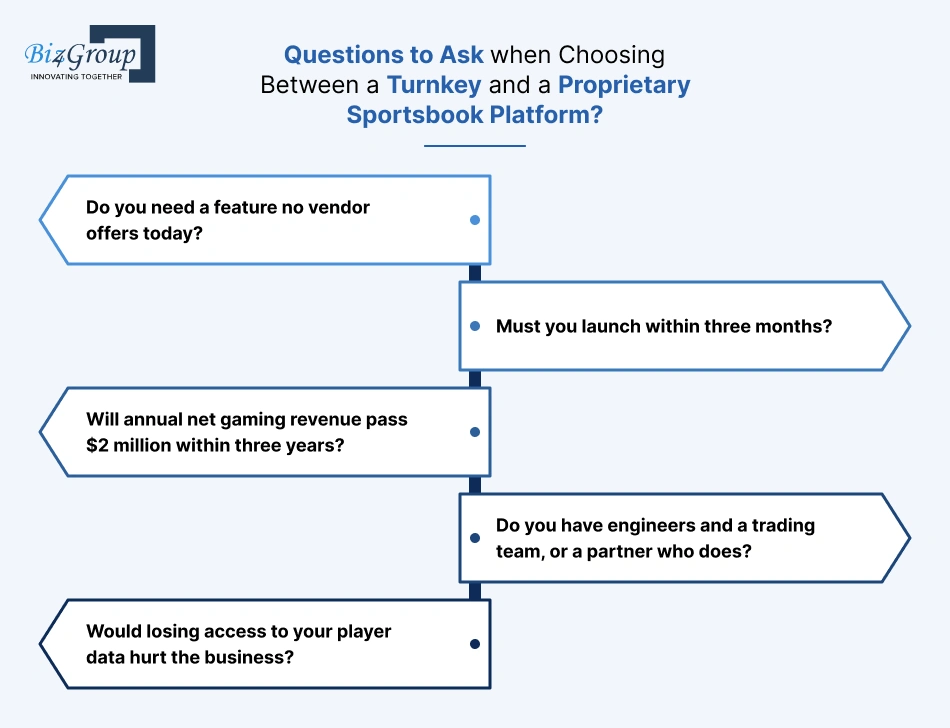
Answer five questions. If most answers point the same way, you have your starting path. Then confirm it with the scorecard below.
- Do you need a feature no vendor offers today? “Yes” points to build or hybrid. “No” points to buy.
- Must you launch within three months? “Yes” points to buy or hybrid.
- Will annual net gaming revenue pass $2 million within three years? “Yes” points to build or hybrid. Our cost model puts the crossover near this number.
- Do you have engineers and a trading team, or a partner who does? “No” points to buy, or to a build with a partner.
- Would losing access to your player data hurt the business? “Yes” points to build, or to a hybrid with strong data rights.
Mixed answers are normal. They usually mean hybrid. And if every answer says “yes, please,” you are describing a hybrid, which is fine.
How Do Build, Buy, and Hybrid Sportsbook Platforms Compare in 2026?
Buying launches fastest and costs least upfront. Building gives the most control and the best long-run margin. Hybrid sits in the middle on both.
This is the build vs buy vs hybrid sportsbook platform comparison, row by row. It is also the buy vs. build sports betting platform debate in one table.
|
Factor |
Build |
Buy (White-Label or Turnkey) |
Hybrid |
|---|---|---|---|
|
Ownership and control |
You own the code and roadmap |
Vendor owns the code and roadmap |
Vendor core, your modules |
|
Setup cost |
$40,000 to $300,000+ |
$10,000 to $100,000+ |
$30,000 to $180,000+ |
|
Ongoing cost |
Hosting, data, support, maintenance |
Revenue share or license fee |
Vendor fee plus module upkeep |
|
Customization |
Highest |
Limited |
High where it matters |
|
Compliance load |
You build and certify each layer |
Vendor supplies a certified base |
Shared |
|
Vendor lock-in |
Low |
High |
Medium |
|
Player data control |
Full |
Depends on the contract |
Strong for your modules |
|
Technical risk |
High |
Low |
Medium |
|
Scalability |
Designed for your volume |
Limited by vendor architecture |
Mixed |
No column wins every row. That is why the next section scores them.
How Do You Decide With the 12-Criteria Sportsbook Platform Framework?
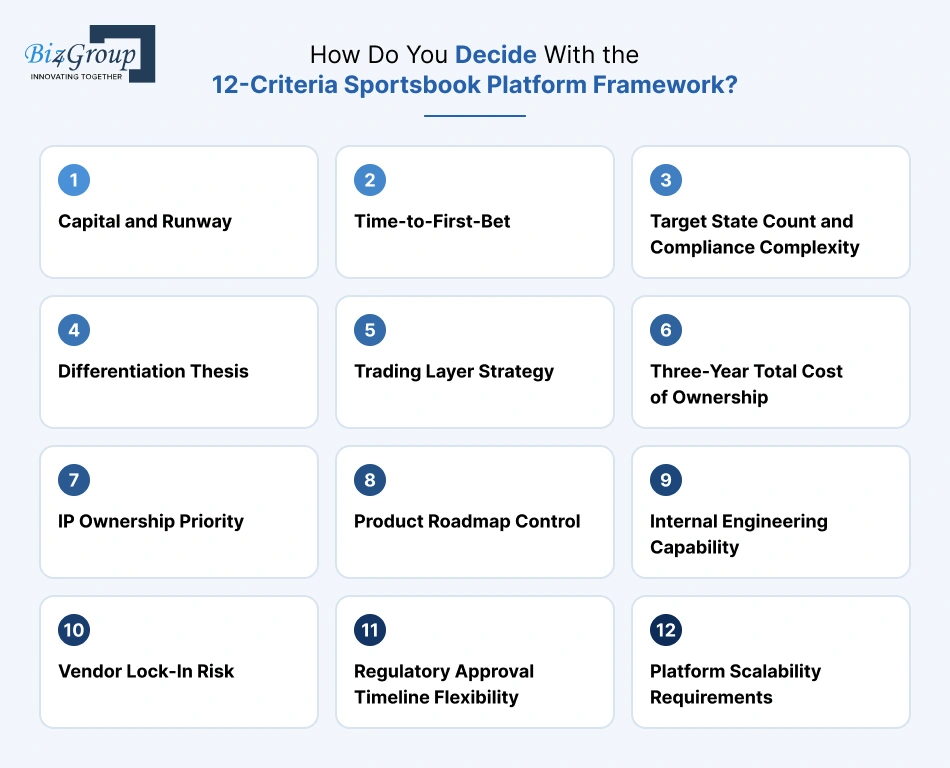
Score each criterion for build, buy, and hybrid. Weight each by how much it matters to you. Add the totals. The highest score is your starting path.
Here are the 12 criteria, with the signal that points each way.
1. Capital and Runway
Operators must examine available budget and cash flow tolerance. A custom build requires significant upfront investment, whereas a vendor license spreads cost over time.
- Consider three-year burn rate and contingency planning.
- Evaluate opportunity cost if capital is deployed toward growth instead of technology.
Choose buy if cash is tight. Choose build if you can fund 18 to 24 months of platform spend.
2. Time-to-First-Bet
Speed to market is critical in competitive states. Vendors offer the fastest launch, builds take the longest, and hybrid sits in between.
- Factor in regulatory approvals per state.
- Incorporate internal team capacity for feature deployment.
Choose buy if a season window is closing. Choose build if you can wait for a launch that fits your product.
3. Target State Count and Compliance Complexity
Compliance burden grows with multiple US states.
- Build allows custom compliance layers.
- Buy gives you a certified base, but you stay accountable as the licensee.
- Hybrid mixes base certification with state-specific add-ons.
Choose buy for one or two states. Choose build or hybrid for many states with different rules.
Also read: How to build an AI sports betting app that passes state-by-state regulatory approval in USA
4. Differentiation Thesis
Some operators need features vendors cannot replicate. This drives build or hybrid adoption.
Choose build if your edge lives in the product. Choose buy if your edge is brand or audience.
5. Trading Layer Strategy
Operators decide between licensed odds and proprietary risk models.
- Proprietary trading enables unique product offerings and predictive analytics.
- Vendor-provided trading offers proven accuracy with less operational overhead.
Choose buy for licensed odds and managed trading. Choose build for proprietary pricing and risk models.
6. Three-Year Total Cost of Ownership
TCO includes development, licensing, maintenance, and opportunity costs.
- Evaluate cost across build, buy, and hybrid paths.
- Consider Year 2–3 costs, including feature velocity delays and potential vendor migration.
Compare totals, not setup quotes. The TCO section below shows how.
7. IP Ownership Priority
Owning code and algorithms can enhance enterprise value and exit options.
- Build retains full IP
- Buy leaves ownership with the vendor
- Hybrid retains IP for custom modules
Choose build if you plan to raise money or sell the company. Investors value owned code.
8. Product Roadmap Control
Operators need influence over feature development.
- Internal teams can iterate rapidly in build
- Vendor platforms follow fixed roadmaps
- Hybrid allows select modules to evolve independently
Choose build if you ship features monthly. Choose buy if you can live on the vendor’s calendar.
9. Internal Engineering Capability
Assess internal team skills and capacity to execute the platform.
- Build requires high technical capability
- Buy relies on vendor expertise
- Hybrid demands integration skills
Choose build only with a strong team or a trusted build partner.
10. Vendor Lock-In Risk
Evaluate long-term dependency on vendor architecture.
- Consider migration costs, account portability, and re-certification.
- Build mitigates risk but increases operational burden.
Read the lock-in section below before you sign anything.
11. Regulatory Approval Timeline Flexibility
Time to approval affects launch strategy.
- Build and hybrid require planning for state-by-state approval.
- Vendors offer faster baseline approvals.
Choose buy for faster baseline approvals. Choose build if you can plan around the calendar.
12. Platform Scalability Requirements
Projected user volumes dictate system design and architecture.
- Build allows tailored scaling solutions
- Vendor platforms handle baseline load, may limit growth
- Hybrid requires integration of scalable custom modules
Choose build if peak-event traffic is your biggest fear.
Twelve criteria sounds like a lot. In practice, three or four decide the outcome. The scoring below shows which.
How Do You Score the 12 Criteria Without Fooling Yourself?
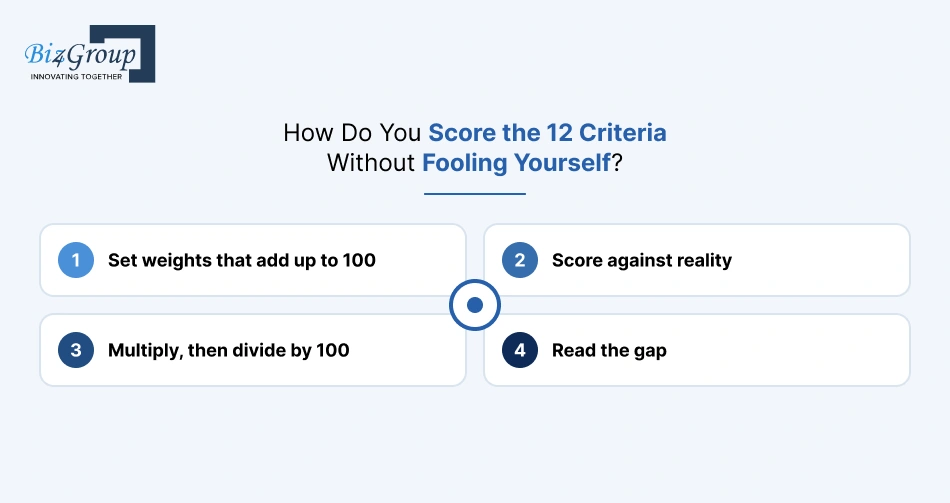
Give each criterion a weight. Score each path from 1 to 10. Multiply, add, and compare. The path with the highest total leads.
- Set weights that add up to 100 Put the most weight on what hurts most if it goes wrong.
- Score against reality Rate each path on what you can do, not what you hope to do.
- Multiply, then divide by 100 Each weight times each score, added up.
- Read the gap A gap under 0.5 is a tie.
Here is a worked example. Picture a regional operator in two states with a small tech team and a plan to stand out.
|
Criterion |
Weight |
Build |
Buy |
Hybrid |
|---|---|---|---|---|
|
Capital and runway |
15 |
4 |
9 |
7 |
|
Time-to-first-bet |
10 |
3 |
10 |
7 |
|
Compliance complexity |
10 |
5 |
8 |
7 |
|
Differentiation thesis |
15 |
10 |
3 |
8 |
|
Trading layer strategy |
10 |
8 |
5 |
7 |
|
Three-year TCO |
10 |
7 |
5 |
7 |
|
IP ownership |
5 |
10 |
1 |
7 |
|
Roadmap control |
10 |
10 |
3 |
8 |
|
Engineering capability |
5 |
4 |
9 |
6 |
|
Vendor lock-in risk |
5 |
9 |
3 |
7 |
|
Regulatory timeline flexibility |
3 |
5 |
8 |
7 |
|
Scalability requirements |
2 |
9 |
6 |
7 |
|
Weighted score |
100 |
6.88 |
5.91 |
7.20 |
Hybrid scores 7.20. Build scores 6.88. Buy scores 5.91. The 0.32 gap between hybrid and build counts as a tie. Capital and engineering capability break it, so this operator starts hybrid and moves modules to custom as volume grows.
Expect a bootstrapped startup to score buy highest. Expect a multi-state operator with a product edge to score build highest. Your weights decide the rest.
Do not fall in love with your first result. Change two weights and see if the answer holds. If it flips, the decision is closer than you think. The scorecard download does this math for you.
Which Biz4Group Projects Show Build, Hybrid, and Integration in Practice?
Three of our sports platforms show the trade-offs. PredictEX builds the core and licenses the data. Quick Start Bets shows how to handle many data sources. Handshake shows why a new product can justify a custom build.
Numbers on paper are useful. Real builds are better teachers.
PredictEX Shows What Build the Core, License the Data Looks Like
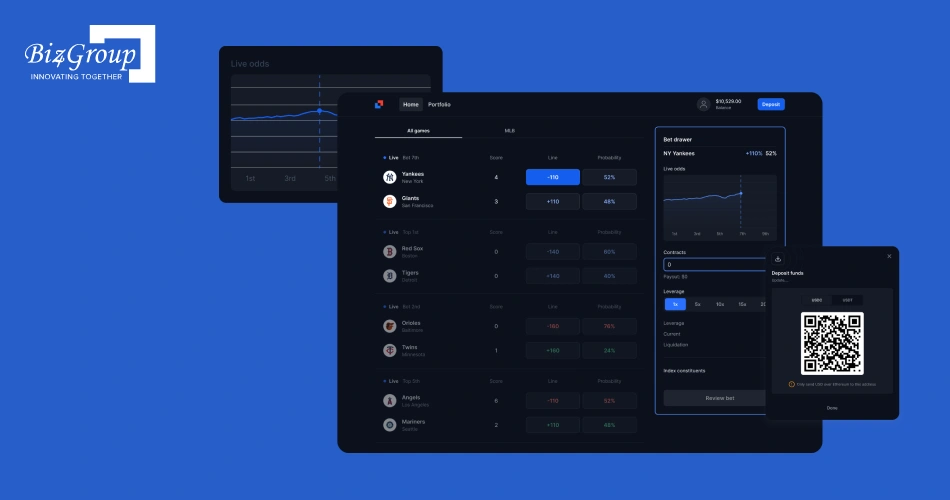
PredictEX is a real-time prediction and betting platform for MLB, CFB, and NFL games. We owned the engine and licensed official Sportradar data through real-time sockets.
What we built
- A Next.js front end and a back end in Node.js, C#, Go, and Python
- A C# admin panel and a microservices design
- Real-time charts and market-based pricing
What it teaches
- The case page reports 78% lower live data latency, 42% more betting engagement, and 35% more live bet participation.
- Own the engine. Rent the data. That is hybrid thinking, and it maps to criteria 5 and 12.
Quick Start Bets Shows How to Handle Sports Analytics and Many Data Feeds
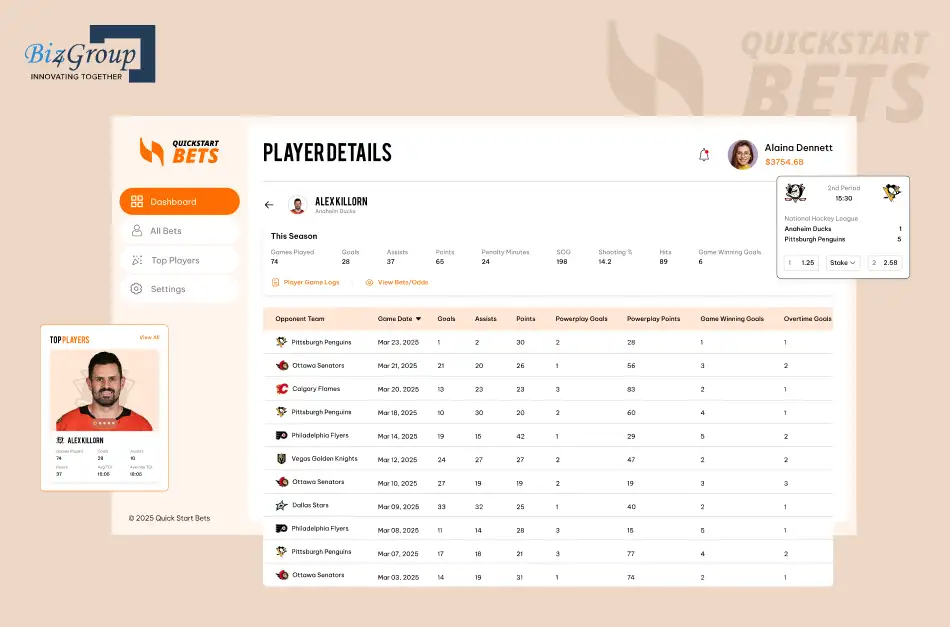
Quick Start Bets is a real-time NHL analytics platform. It combines live odds, player and team stats, game logs, and a bet-tracking dashboard.
What we built
- Persistent WebSocket connections for live odds
- A normalization layer that standardizes data from different providers
- Caching to cut API load, on Next.js, Node.js, and MySQL
What it teaches
- A normalization layer is cheap lock-in insurance. If a data provider changes, you change the layer, not the product.
- It is a clear example of sports analytics solutions built around data you control.
Handshake Shows When a New Product Justifies Building
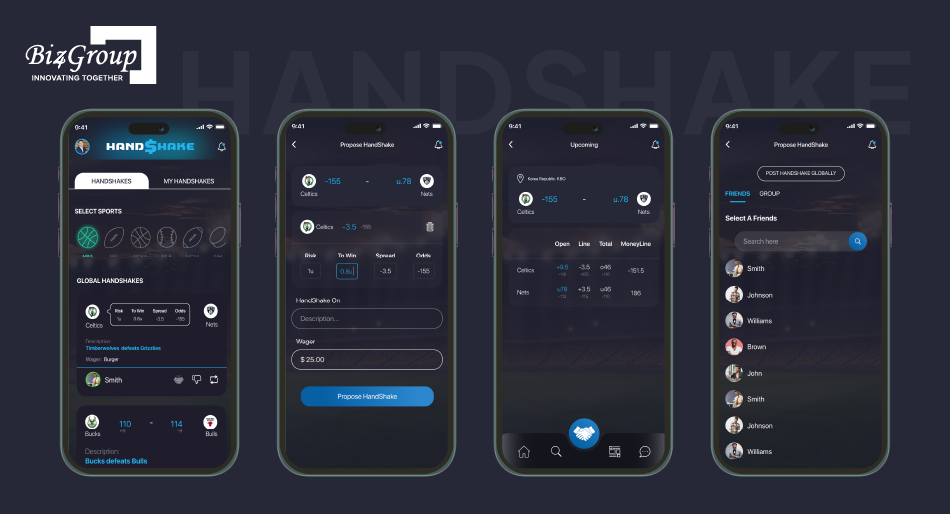
Handshake is a social wagering app. Users propose friendly bets to friends or groups on NFL, NBA, NHL, and PGA games. Stakes can be money or anything players agree on.
What we built
- One-on-one and group wagers with accept, reject, and counter flows
- AI-recommended bets, chat, and push alerts, on Ionic 5 and MERN
What it teaches
- Peer-to-peer wagers do not fit a standard vendor sportsbook. The product was the differentiator, so building made sense.
- Handshake is a social wagering app, not a regulated sportsbook. Use it as a product example, not a compliance template.
Each project answers a different question. Together they show that build, buy, and hybrid are tools, and the right one depends on your product.
How Do You Calculate the Total Cost of Ownership of a Sportsbook Platform?
Add setup cost, one-time launch costs, and three years of run costs and vendor fees. Do it for every path, then compare totals. That is your sportsbook platform total cost of ownership (TCO).
The sportsbook platform build vs. buy cost question has two halves. What you pay to start. What you pay to stay.
|
Cost Line |
Build |
Buy |
Hybrid |
|---|---|---|---|
|
Platform setup |
$40,000 to $300,000+ |
$10,000 to $100,000+ |
$30,000 to $180,000+ |
|
One-time launch costs (data setup, geolocation, KYC, responsible gaming, payments, security testing) |
$15,000 to $80,000+ |
Mostly bundled by the vendor |
Between build and buy |
|
Monthly run costs (hosting, support, maintenance, staff) |
$5,000 to $30,000+ |
Included in the vendor fee |
Between build and buy |
|
Data licensing |
$5,000 to $20,000 a year |
Often bundled |
Varies by contract |
|
Vendor fee |
None |
Revenue share or license fee |
Smaller fee for the vendor core |
|
Exit or migration reserve |
Low |
$35,000 to $120,000 |
Medium |
What Does a Three-Year Comparison Look Like?
Here are three illustrative operators. Each uses ranges from our cost guides.
|
Operator |
Annual Net Gaming Revenue |
Build 3-Year TCO |
Buy 3-Year TCO |
Cheaper Path |
|---|---|---|---|---|
|
Early stage |
$500,000 |
$403,000 |
$310,000 |
Buy, by $93,000 |
|
Growing |
$2 million |
$1,166,000 |
$1,250,000 |
Build, by $84,000 |
|
Scaled |
$6 million |
$1,880,000 |
$3,700,000 |
Build, by $1.82 million |
Assumptions behind the table
- Build setup uses the top of each tier in our proprietary platform guide, at $80,000, $180,000, and $300,000.
- Launch extras are $20,000, $50,000, and $80,000.
- Monthly run costs are $8,000, $25,000, and $40,000.
- Data licensing is $5,000, $12,000, and $20,000 a year.
- Buy setup is $10,000, $50,000, and $100,000, with a 20% revenue share, the low end of the range.
- Costs both paths share, such as marketing, payment fees, taxes, and state license fees, are left out.
Under these assumptions the lines cross close to $2 million in annual net gaming revenue. A higher revenue share pulls the crossover lower. A lower share pushes it higher.
Treat this as a map, not a quote. Trading staff, odds rights, and a longer build can move the lines. A custom build also launches months later, and those months of lost revenue are not in the table. Your own numbers go into the scorecard. For a line-by-line app budget, read our sports betting app development cost guide.
Want These Numbers with Your States, Sports, and Volume?
We will model your three-year TCO with you, line by line.
Get My TCO ModelHow Do Sportsbook Platform Licensing Fees and Revenue-Sharing Models Compare with Custom Development Costs?
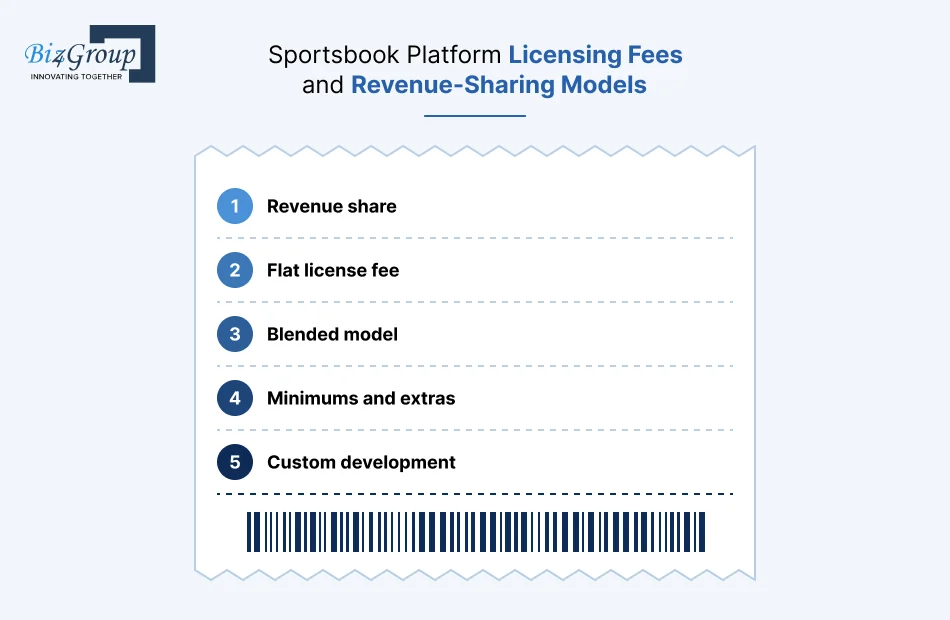
Vendors charge a share of revenue, a flat license fee, or a blend. Custom development charges you once to build, then monthly to run. Vendor fees grow with your revenue. Most build costs do not.
Sportsbook platform development vs. licensing is a choice between paying once and paying forever. Here are the models you will meet.
- Revenue share The vendor takes a percentage of net gaming revenue. The bill rises as you grow.
- Flat license fee You pay a fixed monthly or annual amount. Costs are predictable and can be higher at launch.
- Blended model A smaller share plus a fixed fee. Ask which parts of the platform the lower share covers.
- Minimums and extras Watch for minimum monthly fees, per-state fees, and charges for new markets.
- Custom development One setup cost, then run costs that grow slowly with volume.
Read the revenue definition first. A share of gross revenue and a share of net revenue can differ by a lot.
Is Building a Sportsbook Platform Cheaper Than Paying a Vendor Revenue Share in the Long Run?
Yes, once you pass a certain size. In our three-year model, building costs less when annual net gaming revenue climbs past roughly $2 million. Below that, buying usually wins.
Meet two operators.
Operator One earns $500,000 a year. A 20% share costs $100,000 a year. Building would cost more than renting, so they rent. Sensible.
Operator Two earns $6 million a year. The same 20% share costs $1.2 million every year. Over three years, building saves about $1.82 million. That buys a very good engineering team and still funds the holiday party.
The vendor’s invoice grows with every win. Your own servers do not send percentage invoices.
What the math leaves out
- Launch delay Months of lost revenue while you build.
- Trading and risk staff People you must hire or outsource.
- Execution risk A build that misses the mark costs more than a rental.
Cheaper is not always better. If speed matters more than margin today, buy now and plan your exit.
What Hidden Costs Do Operators Miss When Comparing Build and Buy?
Operators most often miss launch extras, monthly operations, exit costs, and compliance work. Together they can add $15,000 to $80,000+ one time and $5,000 to $30,000+ a month.
Quotes show the build. They rarely show the bills around it. Here are the five questions to ask.
What launch costs hide outside the quote? Data feeds, geolocation, KYC, responsible gaming tools, payment setup, and security testing. Combined, they run $15,000 to $80,000+. See our responsible gambling monitoring platform guide for that piece.
What does it cost to run a sportsbook each month? Small operations run $5,000 to $12,000. Growing platforms run $12,000 to $30,000. Large ecosystems run $30,000+. That covers hosting, monitoring, support, maintenance, analytics, and staff.
What can lock-in cost you? Vendors can raise fees at renewal. A vendor switch runs $35,000 to $120,000, plus $5,000 to $20,000 per state for re-certification.
What does a slow vendor roadmap cost? Every month a feature waits is a month of lost engagement. Put a price on that delay before you sign.
Does a vendor remove compliance costs? No. You remain the licensee. Legal review and state updates still apply.
Add these lines to both columns before you decide. Surprises are lovely at birthdays and terrible in budget meetings.
How Can You Avoid Vendor Lock-In When Buying a Sportsbook Platform?
Negotiate exit rights before you sign and keep key systems behind your own interfaces. Sportsbook vendor lock-in is mostly a contract problem and an architecture problem.
Fix both and switching stays possible.
Contract Checklist
- You own your player data and can export it in a standard format at any time.
- The contract defines an exit assistance period.
- Revenue share cannot rise without your consent.
- No long minimum term without a performance exit.
- You can add or switch data providers.
- Uptime commitments cover major game days.
- Software escrow covers critical modules where the vendor allows it.
Architecture Checklist
- Keep your own player account and wallet layer if you can.
- Put an adapter layer between your front end and the vendor’s APIs.
- Normalize every data feed into your own format, as we did in Quick Start Bets.
- Store analytics and CRM data in your own warehouse.
- Document every integration.
Lock-in is cheap to prevent and expensive to cure.
Not Sure Your Setup Leaves You a Way Out?
Book a lock-in risk review with our sportsbook architects.
Book a Lock-In ReviewWhat Happens to Player Data If You Switch Sportsbook Platform Providers?
Your player data moves only if your contract says it can. Without export rights, you can lose betting history, balances, and preferences, or pay to get them back.
Treat data portability as a launch-day task, not an exit-day task. Sportsbook platform integration and migration succeed or fail on data mapping. Here is the sequence.
- Confirm data ownership in the contract.
- Request a full export in a standard format, such as CSV or an API feed.
- Map every field between the old and new systems.
- Move accounts, balances, bet history, limits, and self-exclusion flags.
- Re-verify KYC where the new vendor or regulator requires it.
- Run both systems in parallel for a short period.
- Notify your regulator and players as the rules require.
Skip a step and a player’s balance becomes a very awkward support ticket.
What Should Operators Evaluate Before Choosing a Sportsbook Platform Vendor?
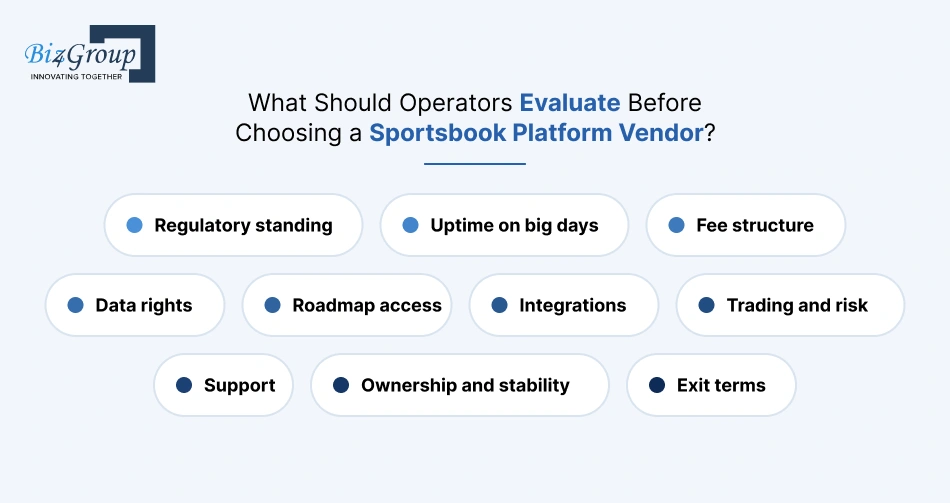
Check regulatory standing, uptime record, fee structure, data rights, roadmap access, and exit terms. Score each one before you sign.
A vendor demo shows the best day. These questions show the worst one.
|
What to Check |
What to Ask |
Red Flag |
|---|---|---|
|
Regulatory standing |
Which states approve you as a supplier? |
Vague answers or pending approvals |
|
Uptime on big days |
Can we see reports from major game days? |
No reports available |
|
Fee structure |
Is the share on gross or net revenue? Any minimums? |
Fees that vary by market without notice |
|
Data rights |
Who owns player and betting data? What is the export format? |
Data held back “for security” |
|
Roadmap access |
How do you handle our feature requests? |
A fixed roadmap with no operator input |
|
Integrations |
Which data, payment, KYC, and geolocation providers connect? |
A closed ecosystem |
|
Trading and risk |
Do we get managed trading or our own tools? |
Unclear who sets limits |
|
Support |
What are response times during live events? |
Business-hours support only |
|
Ownership and stability |
Who owns the company, and what changes if that changes? |
Evasive answers about ownership |
|
Exit terms |
What happens to our data and brand on termination? |
Heavy exit fees |
Score each row from 1 to 10. A vendor under 6 on data rights or exit terms gets a polite no.
When Should a Sportsbook Operator Switch from a White-Label Platform to a Custom Platform?
Switch when vendor fees, roadmap delays, or performance limits cost you more than a migration would. Most operators see three or more warning signs first.
Here are the signs, with a rule of thumb for each.
- Fees Your annual vendor bill exceeds what a custom platform would cost to run, plus its setup spread over three years.
- Roadmap Vendor delays have blocked your product plan for two or more quarters.
- Performance Latency or outages hurt you during peak games.
- Data You cannot reach player data or analytics at the depth you need.
- States Your target states need features the vendor cannot certify.
- Team You now have engineers, or a partner, who can run a platform.
How Do You Know Your Sportsbook Has Outgrown Its White-Label Platform?
When three or more of these signs appear together. One sign is a complaint. Three is a pattern.
Not every problem needs a custom build. If price or support is the only pain, a new vendor can fix it for $35,000 to $120,000 plus $5,000 to $20,000 per state. If control is the pain, move in phases and run both platforms in parallel. Our white-label to custom migration guide shows the seven steps.
Is a Custom Sportsbook Platform Worth the Investment for a Startup?
Usually not at the start. Most startups should launch with a white-label or turnkey platform, or a lean MVP, then build custom modules once demand is proven. The exception is a product no vendor can offer.
Picture a founder with a big idea and $150,000. Spending it all on a custom engine before one bettor signs up is brave. It is also risky. A vendor platform or a lean sports betting app MVP tests demand for a fraction of the cost.
Now picture a founder whose idea is the product itself. Handshake, our social wagering app, is a good example. No vendor sold peer-to-peer bets, so building was the only path.
Skip the custom build if you have no engineering team, less than twelve months of runway, or a standard sportsbook with a better brand. Build early only if the product is the business.
Rule of thumb. Rent the commodity. Build the difference.
Why Do Operators Choose Biz4Group LLC for Sportsbook Platform Development?
Biz4Group LLC builds custom and hybrid platforms and integrate with vendor systems, so our advice follows your numbers. We have no reason to push one path.
Our sports betting lead has contributed to more than 50 sports betting solutions for operators in regulated US markets. Biz4Group, a sports betting app development company brings more than 20 years of experience. Here is where to start, based on your score.
|
If Your Scorecard Says |
Your Next Step |
Where to Start |
|---|---|---|
|
Build |
We scope and build a proprietary platform |
|
|
Hybrid |
We connect a vendor core to custom modules |
|
|
Buy |
We help you vet vendors and add your analytics and data layers |
Turnkey sportsbook solution |
|
Not sure |
We run the numbers with you |
Final Thoughts
Build vs. buy a sportsbook platform is a money question, a speed question, and a control question. Buy when speed and cash matter most. Build when the product and the margin matter most. Go hybrid when both do.
Run the scorecard. Run the three-year math. Then check lock-in and player data before you sign anything.
Ready to see which path your numbers support? Book a call today and we will run them with you.
FAQs
1. Is building a sportsbook platform cheaper than paying a vendor revenue share in the long run?
Yes, past a certain size. In our three-year model, building costs less once annual net gaming revenue passes roughly $2 million. Below that, buying usually wins. Run your own numbers in the scorecard.
2. How can I avoid vendor lock-in when buying a sportsbook platform?
Secure data ownership, exit assistance, and fee caps in the contract. Keep your own wallet and analytics layers. Normalize every data feed into your own format.
3. What happens to player data if I switch sportsbook platform providers?
It moves only if your contract allows an export. Map the fields, move balances and limits, re-verify KYC where required, and run both systems in parallel first.
4. How do I know when my sportsbook has outgrown its white-label platform?
When three or more signs appear together. Look at fees, roadmap delays, peak-game performance, data access, state needs, and team capacity.
5. Is a custom sportsbook platform worth the investment for a startup?
Usually not at launch. Start with a vendor platform or a lean MVP. Build early only when your product is the business.
6. Can I start with white-label and move to custom later?
Yes. Many operators do. Plan for $30,000 to $200,000+, move in phases, and run both platforms in parallel. Our migration guide has the steps.
7. Does a vendor handle compliance for me?
A vendor supplies a certified base, but the licensed operator stays accountable. Confirm the split with your compliance counsel before you sign.