 Location :
Orlando, FL, USA
Location :
Orlando, FL, USA +1 (407) 714-1616
 info@biz4group.com

 AI Summary Powered by Biz4AI
- An Illinois sports betting license got cheaper in 2026. Senate Bill 3019 removed the three-license cap on online-only licenses and cut the initial fee from $20 million to $15 million, with the $250,000 application fee unchanged.
- The Illinois sportsbook tax is graduated, from 20% on the first $30 million of adjusted gross receipts to 40% above $200 million, with Cook County adding 2% and Chicago 10.25%.
- The Illinois per-wager tax (the per-bet tax) charges $0.25 per online wager, then $0.50 after 20 million, even on pushes, and a 2026 repeal bill died in committee.
- Illinois sportsbook operators number ten, and the Illinois sports betting market size stays in billion-dollar territory, with $1.05 billion in July 2026 handle. DraftKings and FanDuel took about 63% of May's handle.
- How to launch a sportsbook in Illinois: pick a route (online-only license, tethered partner or supplier), confirm the Gaming Board is accepting applications, and model the full tax stack before budgeting.
- Biz4Group LLC builds compliance-first sportsbook technology, including wager-level tax tracking, location-aware rules and audit-ready reporting, for operators and suppliers entering regulated markets. Licensing advice stays with the Gaming Board and Illinois counsel.
Regulatory disclaimer: This article is for business planning and informational purposes, not legal or tax advice. Confirm licensing eligibility, application availability, tax obligations and implementing rules with the Illinois Gaming Board and qualified Illinois counsel before committing capital Last verified: October 9, 2026.
You are in THE pitch meeting. The deck is polished, the funding is lined up, and your team has finally agreed on a sportsbook name nobody hates. Then someone asks, "So what does an Illinois sports betting license actually cost?" and the room goes quiet, because the honest answer comes in two parts.
The good news comes first. Senate Bill 3019, signed on June 16, 2026, removed the three-license cap on online-only licenses and cut the initial license fee from $20 million to $15 million. The $250,000 application fee stayed put. (Sources: Illinois General Assembly bill status for SB 3019; Taft Law; Gambling.com)
The less good news arrives right behind it. The Illinois sportsbook tax bill includes a graduated state tax of 20% to 40% and the Illinois per-wager tax, the per-bet tax operators love to complain about, which taxes even bets that end in a push. Cook County and Chicago add their own levies on top. (Source: 230 ILCS 45/25-90) The door got a markdown sticker. The rent never got the memo.
So the real question isn't only how to get a license. It's whether a new operator can walk in and still make the numbers work.
At Biz4Group LLC, we build sportsbook technology for regulated markets, so this guide looks at Illinois from the spot where licensing, tax rules and platform design collide. We'll walk through the fees, the tax stack, the market and the technology a sportsbook needs to survive all three.
How Did the Illinois Sports Betting License Get Cheaper in 2026?
The change arrived tucked inside the state budget bill, which is where Illinois tends to hide its most consequential gaming news. Senate Bill 3019 passed both houses of the General Assembly on June 1, 2026, and the governor signed it on June 16, amending the Illinois Sports Wagering Act. (Sources: Taft Law; Gambling.com)
A little history helps. Illinois launched regulated sports wagering in 2019 with a 15% flat tax on adjusted gross sports wagering receipts. Most operators got in through licenses tied to casinos, racetracks or sports facilities. A separate category of online-only licenses was capped at three.
That cap applied to online-only licenses, not to online betting as a whole. DraftKings, FanDuel and BetRivers, for example, entered through partnerships with established gaming licensees such as Casino Queen, Fairmount Park and Midwest Gaming. (Source: iGaming Business, August 2024)
Here is how the cost structure evolved:
|
Period |
Regulatory or Tax Change |
|---|---|
|
2019 |
Regulated sports wagering launched with a 15% flat state tax and a tethered market-access structure. |
|
July 2024 |
Graduated state tax rates replaced the flat rate. |
|
July 2025 |
The per-wager tax took effect for online and mobile sports wagers. |
|
June 2026 |
Senate Bill 3019 removed the online-only license cap and cut the initial license fee to $15 million. |
The licensing door is wider. It is not cheap. And the new framework doesn't tell you whether applications are being accepted today. Confirm the Board's current application process, eligibility criteria and implementing rules before committing capital.
Also read: State-wise sports betting regulations guide
$15M Sticker Price. Zero Idea What Comes Next?
Three tax layers, one license fee. Let's map your route before the meter starts.
Call Us NowWhat Are the Illinois Sports Betting License Entry Paths?
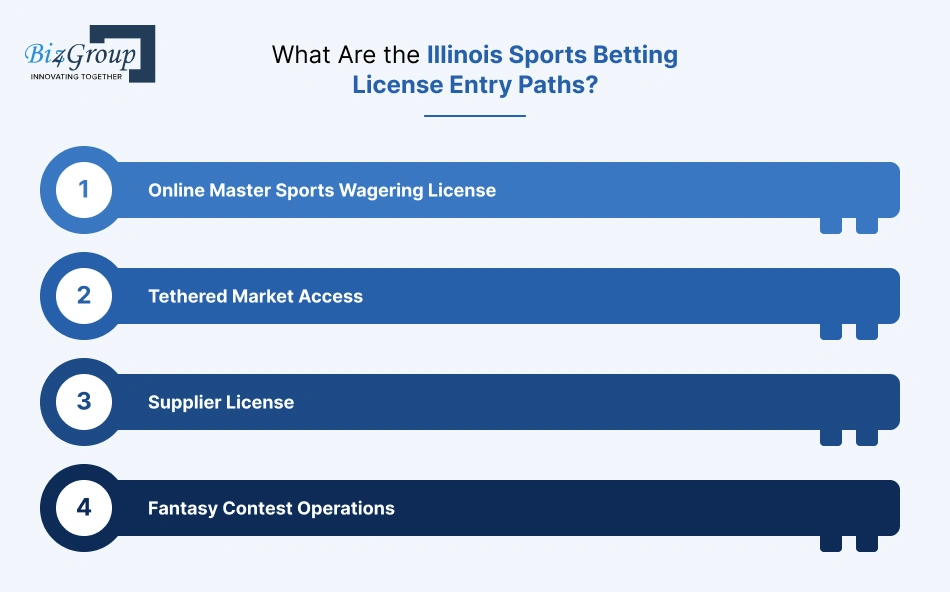
Illinois offers more than one way in, depending on whether you want to run a sportsbook or build the technology behind one.
Online Master Sports Wagering License
This is the direct route: your own brand, your own customer relationships and your own product, under a four-year license. (Source: 230 ILCS 45/25-45, as amended by SB 3019)
Without the numerical cap, there is more room for entrants. But the fee alone makes this a capital-intensive option, and it is only the cover charge. Applicants also need to budget for legal support, compliance, technology, data, payments, customer acquisition and operating reserves.
Tethered Market Access
A sportsbook can also enter through a qualifying casino, racetrack or sports facility licensee, subject to applicable law and Gaming Board approval.
That can mean access to an established partner, but the commercial agreement is where the story is written. Revenue sharing, branding, customer ownership, technology responsibilities and compliance obligations can all change the economics.
Supplier License
If you would rather build the engine than own the car, a supplier license may be relevant. It covers companies selling or leasing sports wagering equipment, systems, other gaming items, related services or data to a master sports wagering licensee.
The supplier application and license fee is $150,000 for the initial four-year term. Beginning four years after issuance, the holder pays a $150,000 annual license fee. Systems and services must also meet regulatory standards and pass required testing. (Source: 230 ILCS 45/25-50)
For technology providers, this can be a more natural fit than carrying the financial and regulatory weight of operating a sportsbook. The exact licensing category depends on what you supply and the role you play. A vendor that conducts wagering operations for a licensee may need a different license entirely. (Source: Fox Rothschild summary of the Illinois gaming expansion law)
Fantasy Contest Operations
Fantasy contests are a separate regulated category, not a side door into sports wagering. Illinois now licenses them under a two-tier structure, requires participants to be 21 or older, and applies a 15% state tax on adjusted gross fantasy contest receipts. (Sources: Taft Law; Gambling.com)
Fantasy products depend on contest mechanics such as scoring rules, leaderboards and entry controls, so those mechanics and the compliance rules need to be designed together. Verify the license category, geolocation requirements, tax start date and current rules before treating fantasy as a lower-cost way into the market.
How Much Does an Illinois Sports Betting License Cost?
The direct cost depends on which seat you want at the table.
|
License Type |
Fee and Term |
|---|---|
|
Online master sports wagering license |
$250,000 application fee plus $15 million initial license fee; four-year term |
|
Online master license renewal |
$1 million for another four-year term |
|
Casino owner master license |
5% of prior-year adjusted gross receipts, capped at $10 million; four-year term; $1 million renewal |
|
Racetrack organization master license |
5% of handle, capped at $10 million; four-year term |
|
Supplier license |
$150,000 initially for a four-year term, then $150,000 annually after the initial term |
(Sources: 230 ILCS 45/25-35, 25-45 and 25-50)
For casinos licensed after 2019, the initial master license fee is $5 million, adjusted after the first 12 months under the statute. Don't treat the casino and racetrack figures as interchangeable: one is calculated on adjusted gross receipts, the other on handle.
These are regulatory fees, not the price of entering Illinois. You also need legal and compliance support, platform development or integration, data feeds, geolocation, identity verification, payments, testing, responsible gambling controls, customer support and marketing. The supplier's initial fee is lower than an operator's, but its annual fee belongs in the model too, and so does confirming that your exact activities don't trigger other approvals.
What Is the Illinois Sportsbook Tax Rate in 2026?
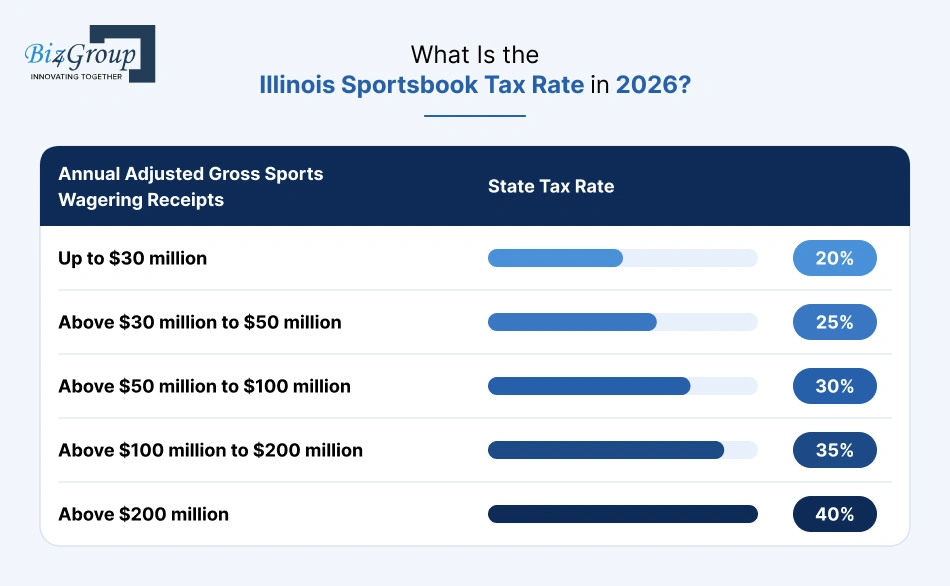
The Illinois sportsbook tax, sometimes called the Illinois sports betting tax, starts with a graduated state scale on annual adjusted gross sports wagering receipts. The rates are marginal: each rate applies only to the slice of receipts inside its bracket, like income tax, not to the whole pile. (Source: 230 ILCS 45/25-90)
|
Annual Adjusted Gross Sports Wagering Receipts |
State Tax Rate |
|---|---|
|
Up to $30 million |
20% |
|
Above $30 million to $50 million |
25% |
|
Above $50 million to $100 million |
30% |
|
Above $100 million to $200 million |
35% |
|
Above $200 million |
40% |
A newcomer starts in the 20% bracket, which is the one piece of good news in this section.
The state tax is only part of the tab. Illinois also imposes an additional 2% tax on adjusted gross receipts from wagers placed in Cook County, with the proceeds paid to the county. The statute applies this tax to wagers placed in a home rule county of more than 3 million residents, which describes Cook County. (Source: 230 ILCS 45/25-90(a-5))
The Chicago sports betting tax is a separate 10.25% levy on adjusted gross sports wagering receipts from wagers placed within city limits, including qualifying mobile wagers. It took effect on January 1, 2026, alongside a city licensing requirement with annual fees reported at $5,000 to $50,000. (Sources: Illinois Lawyer Now; CasinoBeats)
The Sports Betting Alliance sued the city in Cook County Circuit Court (Sports Betting Alliance v. City of Chicago, No. 2025 CH 12984), arguing that only the state may license and tax online sports wagering. It dropped its request for a temporary restraining order after Chicago issued licenses to its members, but the challenge to the tax continued in the latest reports available, from early 2026. Check the docket for the current status before building a plan around the outcome.
A sportsbook's financial model therefore needs to separate:
- State graduated tax exposure.
- The per-wager tax.
- The additional 2% Cook County tax, where applicable.
- Chicago's 10.25% tax and city license fees, where applicable.
- Other operating and compliance costs.
Promotional spending needs care too. Illinois mobile operators are not currently permitted to deduct promotional spend from adjusted gross receipts, according to InGame's reporting. With no promotional deduction to soften the bill, effective tax rates run well above the headline brackets. Check the statutory definition before modeling.
How Much Tax Do Sportsbooks Pay in Illinois?
Here is the whole stack in one place:
|
Layer |
Rate |
Applies To |
|---|---|---|
|
Graduated state tax |
20% to 40%, marginal |
Adjusted gross receipts |
|
Per-wager tax |
$0.25, then $0.50 after 20 million |
Every online wager, including pushes |
|
Cook County tax |
2% |
Receipts from wagers placed in the county |
|
Chicago tax |
10.25% |
Receipts from wagers placed in the city, plus city license fees |
|
Promotional spend |
Not deductible |
Adjusted gross receipts |
For a Chicago-placed wager in the lowest state bracket, the percentage taxes alone stack to 32.25% (20% + 2% + 10.25%), before the per-wager tax. (Biz4Group calculation.) For the largest operators, InGame reported in May 2026 that the effective tax rate on adjusted gross revenue exceeds 50%.
How Does the Illinois Per-Wager Tax Work, and What Does It Do to Sportsbook Margins?
Illinois's per-wager tax, also called the per-bet tax and described by the Gaming Board as a per-wager privilege tax, took effect on July 1, 2025. It applies to every online or mobile sports wager, regardless of outcome or payout. That includes pushes, which means Illinois taxes even the bets that end in a shrug. Retail wagers are not subject to it. (Sources: 230 ILCS 45/25-90(d-7); Illinois Gaming Board FAQ)
The schedule:
- $0.25 per wager for the first 20 million qualifying wagers in the fiscal year.
- $0.50 per wager for each wager above 20 million.
Unlike a percentage-of-revenue tax, this one follows wager count. A sportsbook taking many small bets can face a heavy tax burden from bets that contribute very little revenue.
A Worked Illinois Sports Betting Tax Example
Assume a sportsbook generates $25 million in annual adjusted gross receipts and accepts 15 million online or mobile wagers.
- State tax at the 20% rate: $25 million × 20% = $5 million.
- Per-wager tax: 15 million × $0.25 = $3.75 million.
Combined state taxes in this simplified example: $8.75 million.
$25M in Receipts, $8.75M to Springfield. Still Profitable?
That's 35% gone before Chicago. See what your own numbers look like.
Calculate My Illinois ROIThat is an effective state burden of 35% on $25 million in receipts, before Cook County, Chicago and operating costs. (Biz4Group illustration assuming $25 million in adjusted gross receipts and 15 million wagers.)
Put per bet, $0.25 is 2.5% of a $10 stake and 0.5% of a $50 stake. That is a stake-relative comparison, not a profit margin, but it shows why the charge bites hardest on small-stake betting.
The market has a lot to say about this. In October 2025, Illinois handle rose 11% year over year while the number of wagers fell 15.9%. (Source: InGame) In May 2026, handle was $1.14 billion, down 10.2% year over year, wagers were down 21%, and the per-wager tax alone raised $10.4 million that month. (Source: Covers) July 2026 then told a different story: a World Cup-driven handle of $1.05 billion, up 21.7% year over year, with $116.5 million in adjusted revenue, up 30%. (Source: Covers)
Basically, handle can recover while the per-wager tax keeps collecting its cut. Operators have responded with surcharges and minimum bets, though policies and customer reactions vary. Model both handle and wager count.
A bill to repeal the per-wager tax, HB 5143, died in committee in March 2026, and Senate Bill 3019 did not repeal it. As of October 9, 2026, it remains part of the framework. (Sources: Illinois General Assembly bill status; Taft Law)
What Did the Per-Wager Tax Raise, and Who Pays It?
The per-wager tax raised about $60 million in the first six months of fiscal year 2026, above the $40 million estimate. (Source: iGaming Business) FanDuel and DraftKings together paid $51.2 million, or 82.3% of all per-wager tax receipts at the time of that report. (Source: InGame) FanDuel introduced a per-bet surcharge for customers and DraftKings followed, and Caesars added a 25-cent fee on September 1, 2025. (Sources: Gambling Insider; SBC Americas) Surcharge policies vary by operator and change, so check current terms.
Who Are the Illinois Sportsbook Operators, and What Is the Illinois Sports Betting Market Size?
Illinois is a big market with a crowded dining room.
The Illinois Gaming Board's authorized list shows ten online sportsbook brands: bet365, BetMGM, BetRivers, Caesars, Circa, DraftKings, theScore Bet, Fanatics, FanDuel and Hard Rock Bet. (Source: Illinois Gaming Board list, as reported in July 2026)
For scale, Illinois ranked second only to New York in sports betting handle in 2025. (Source: Covers) In March 2026, bettors placed 21.4 million wagers totaling $1.39 billion in handle, and operators reported $196.1 million in adjusted gross revenue and paid $57 million in state and local taxes. (Source: InGame) July extended the streak to twelve consecutive months above $1 billion in handle, and DraftKings led online operators with $42.5 million in adjusted revenue. (Source: Covers)
May's 10.4% hold sounds generous until the tax stack takes its bite out of operator margin, and FanDuel's 14.5% hold that month shows how uneven margins can be. (Source: Covers, May 2026)
DraftKings and FanDuel together accounted for roughly 63% of May 2026 handle. (Biz4Group calculation from Covers' figures.)
Two things follow. Demand is established, and the people already serving it have brand recognition, large customer bases and acquisition budgets that can make a new entrant's marketing plan look like a lemonade stand.
Model acquisition costs alongside license fees and taxes, and test different wager sizes and volumes. A strategy built on many small bets pays a very different per-wager bill from one built on fewer, larger ones.
What Does an Illinois Sportsbook Need to Track Taxes Correctly?
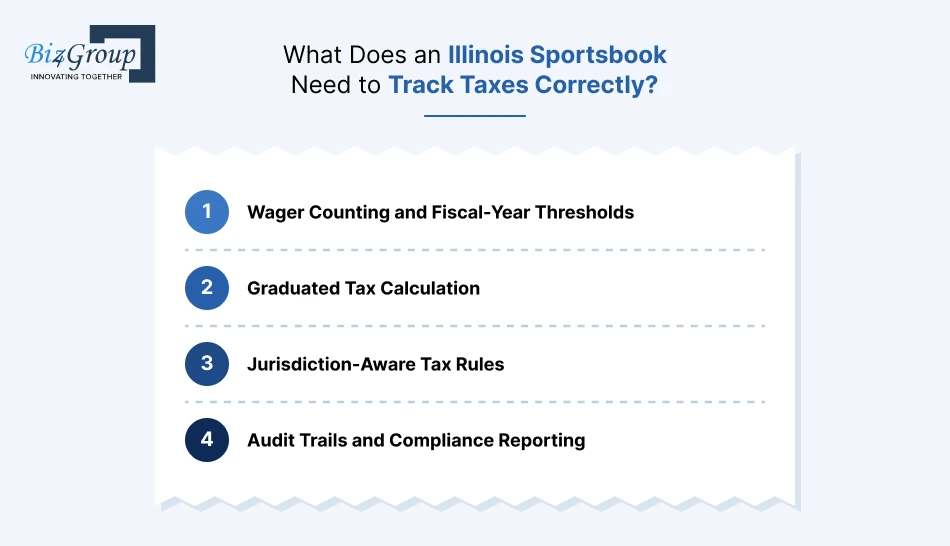
An Illinois sportsbook needs technology that records every relevant wager, calculates the right tax treatment and produces auditable reports. Tax logic belongs inside the operating architecture, not in a spreadsheet someone reconciles at 11 p.m. on the last day of the month.
Wager Counting and Fiscal-Year Thresholds
The platform should count qualifying online and mobile wagers consistently and track the combined annual count that determines when the per-wager rate flips from $0.25 to $0.50. It should keep records that explain how every tax amount was calculated.
Graduated Tax Calculation
A tax engine should apply each rate to its marginal band and account for the reporting period and the statutory definition of adjusted gross sports wagering receipts.
Jurisdiction-Aware Tax Rules
The platform needs reliable location data to determine when Chicago's tax or the Cook County tax applies. Geolocation, tax calculations and reporting records should be connected, so the operator can show exactly how a wager was classified. Biz4Group's geofencing guide for sports betting apps covers related considerations.
Audit Trails and Compliance Reporting
A sound system preserves transaction-level records, tax calculations, settlement events, adjustments and reporting outputs. Role-based access, reconciliation tools and change logs help finance and compliance teams investigate discrepancies without reconstructing events from disconnected systems.
Quick Start Bets and Real-Time Data Architecture
Tax logic is only as good as the data feeding it, and that is where Biz4Group's Quick Start Bets earns its keep. The platform brings real-time odds, detailed player analytics, historical statistics, centralized dashboards and tracking systems together on low-latency infrastructure. The hard part was keeping odds, analytics and dashboards synchronized continuously, which is the same discipline a regulated sportsbook needs when every wager must tie back to a clean, auditable record.
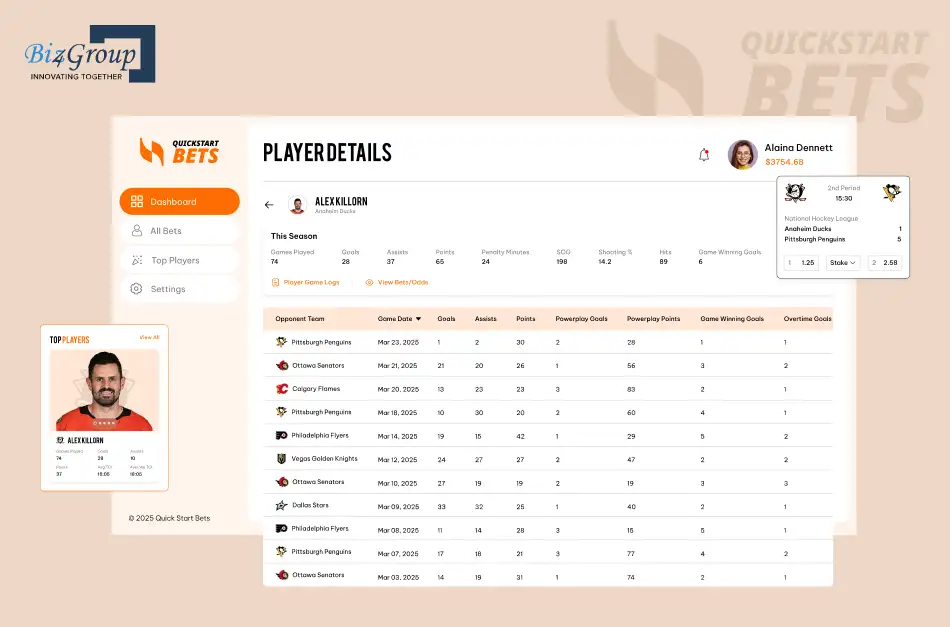
For an Illinois build, that foundation extends naturally. Event and odds data connect to wager records, settlement logic and financial reporting, and the Illinois layer adds tax thresholds, jurisdiction-aware calculations and audit-ready records. Biz4Group builds the technology layer, and licensed operators hold the licenses.
All Chalk and Prediction Product Mechanics
Biz4Group, an experienced sports betting app development company, built All Chalk as a multi-sport pick'em app covering the NFL, NBA, college football and MLB. Users make weekly predictions on spreads and totals and follow real-time leaderboards ranked by wins, losses and net points. Behind the screens sit game schedules, customized reminders and real-time data synchronization, running on Ionic and React.js, Express.js, PostgreSQL and AWS, with one consistent experience across iOS and Android.
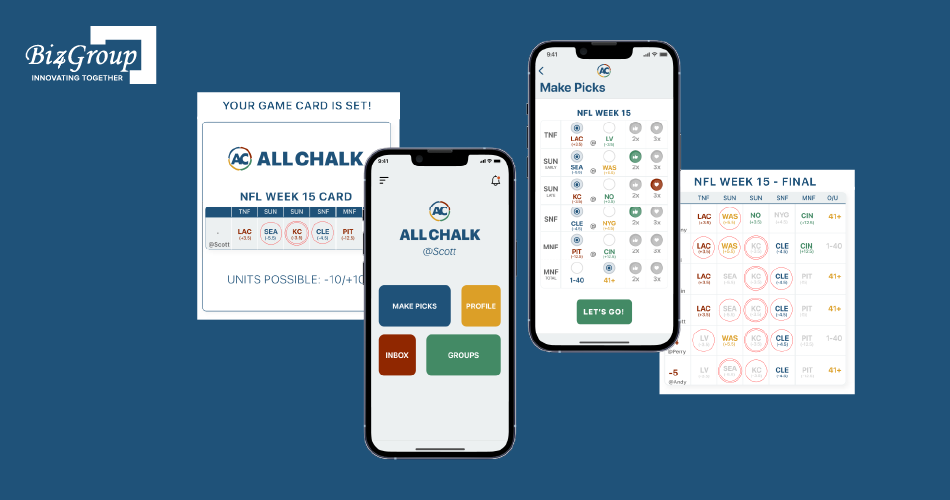
Keeping live leaderboards smooth for a large pool of active users, especially during peak game hours, is the kind of engineering that fantasy and prediction products depend on. Those mechanics become even more valuable in Illinois, where fantasy contests are now licensed under their own framework with a 21+ age limit and a 15% state tax. Contest rules, entry controls, age checks and geolocation sit alongside the leaderboards from day one. Fantasy contests have their own licensing path in Illinois, while prediction-market-style products fall under sports wagering, so confirm the right category before you build.
What Should an Illinois Sportsbook Tax Engine Test?
These test cases turn Illinois's rules into practical platform checks:
|
Test Case |
Expected Result |
|---|---|
|
Wager number 20,000,000 in the fiscal year |
Taxed at $0.25 |
|
Wager number 20,000,001 |
Taxed at $0.50 |
|
Pushed wager |
Still subject to the per-wager tax |
|
Retail wager |
No per-wager tax |
|
The $30,000,001st dollar of adjusted gross receipts |
Taxed at 25%, not 20% |
|
Wager placed in Cook County |
Additional 2% tax on applicable receipts |
These are the kinds of scenarios a tax engine should pass before launch, and again whenever statutes, location rules or reporting processes change. Tax logic should be traceable and testable.
Wager #20,000,001 Costs Double. Does Your Platform Know?
Counting every bet, push included, is a build problem, not a spreadsheet problem.
Book a Tax-Engine ReviewHow to Launch a Sportsbook in Illinois: The Short Version
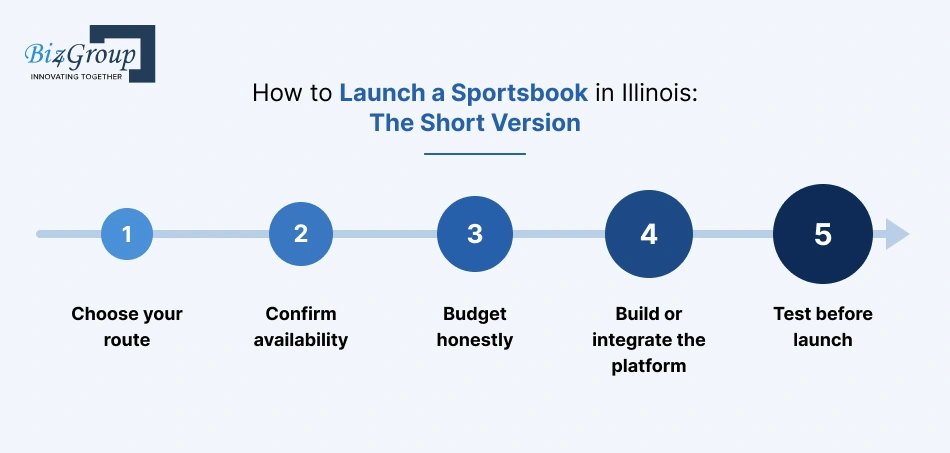
Can a new sportsbook enter Illinois? Yes, in law, through an online-only license, a tethered partnership or a supplier role. Here is how to launch a sportsbook in Illinois, step by step.
- Choose your route: online-only master license, tethered partnership or supplier role.
- Confirm availability: ask the Illinois Gaming Board whether applications are open and what the current requirements are.
- Budget honestly: count the fees and the full tax stack, not just the license fee.
- Build or integrate the platform: geolocation, identity checks, wager counting and a tax engine.
- Test before launch: run the tax logic against known scenarios, then retest whenever the rules change.
Also read: Sports betting app development cost in 2026
Should You Enter the Illinois Sports Betting Market in 2026?
Illinois may suit a well-capitalized operator or a technology supplier with a clearly defined role. The decision should rest on unit economics, regulatory access and your ability to operate inside the state's tax structure.
Before committing capital, ask five questions:
- Can you afford the entry route? Count the license fee, legal work, platform costs and operating reserves.
- Have you modeled the full tax stack? Include the graduated state tax, the per-wager tax and applicable local taxes.
- Can your platform calculate taxes accurately? Confirm wager counting, threshold handling, geolocation, reporting and audit requirements.
- Can you compete for customers? Model acquisition costs, wager size, customer behavior and the effect of surcharges or minimum bets.
- Have you confirmed the current licensing process? Verify application availability and requirements directly with the Illinois Gaming Board.
The verdict: Illinois rewards operators who win on efficiency. The 20% bracket is friendly to a newcomer, but the per-wager tax and local levies are not, so a plan built on thin margins and small stakes gets tight fast. With a differentiated product, strong acquisition economics and a platform that counts every wager correctly, the cheaper door is a real opening. Technology suppliers face a different calculation entirely: a lower entry fee and no customer-acquisition bill.
Illinois vs. New York for New Sportsbook Operators
|
Factor |
Illinois |
New York |
|---|---|---|
|
Online-only entry |
$15 million initial license fee, with no numerical cap under the 2026 framework |
Highly restricted licensing structure; no open application window as of October 2026 |
|
State tax |
Graduated rates from 20% to 40% |
51% tax on mobile sports wagering gross gaming revenue |
|
Per-wager tax |
$0.25 for the first 20 million qualifying wagers, then $0.50 |
None |
|
Main business question |
Can the operator make the economics work under multiple taxes? |
Can the operator get access to a tightly restricted market? |
Also read: New York sports betting license: Is the market closed to new operators in 2026?
For operators serving several jurisdictions from shared infrastructure, Biz4Group's guide to developing a multi-tenant sports betting platform offers a related technical view.
Biz4Group builds the technology that licensed operators and suppliers run on. Real-time odds and data pipelines feed wager-level records, and tax logic is built into the architecture from day one, so thresholds, jurisdiction rules and reporting never depend on a month-end spreadsheet. For an Illinois project, the work starts with a scoped review of licensing responsibilities, tax calculations, integrations, location controls and reporting needs. That way the build is priced against the real requirements, not against guesses. Operators get a platform designed for the tax bill they will actually face, with audit-ready records behind every wager.
Planning an Illinois launch? Let's turn the tax rules into a spec before they turn into a surprise.
FAQs
1. When did sports betting become legal in Illinois?
Governor Pritzker signed the Sports Wagering Act on June 28, 2019, as part of Public Act 101-0031, the state's gaming expansion law. The first legal wager was placed in person on March 9, 2020, and online wagering followed on June 18, 2020. (Sources: Taft Law; Muddy River News)
2. Who issues sports betting licenses and regulates sportsbooks in Illinois?
The Illinois Gaming Board issues master sports wagering licenses and regulates sports wagering, casinos and video gaming. The Illinois Racing Board oversees horse racing and licensed advance-deposit wagering providers. (Sources: 230 ILCS 45; Muddy River News)
3. Why did Illinois add a per-wager tax?
Revenue. Lawmakers wrote the tax into the budget on May 31, 2025, effective July 1, 2025, after the state moved from a flat 15% tax to a graduated scale in 2024. The governor had floated a flat 35% rate in February 2024, and lawmakers settled on the 20% to 40% scale instead. (Sources: Illinois Gaming Board FAQ; SBC Americas; Ryan)
4. Is Illinois's sports betting tax the highest in the country?
Not on the headline rate. When the graduated scale took effect, Taft ranked Illinois second behind New York among comparable privately operated markets, and Pennsylvania charges 36%. What sets Illinois apart is the combination: it remains the only state with a per-wager tax, and unlike Pennsylvania it doesn't let operators deduct promotional credits. (Sources: Taft Law; SBC Americas; InGame)
5. Can Illinois sportsbooks take bets on Illinois college teams?
Not through mobile apps. Illinois bars betting apps from taking wagers on in-state teams such as the Illini, though out-of-state college teams remain available. Section 25-25 of the Sports Wagering Act sets the exceptions, which have changed over time, so operators should check the current text before configuring markets. (Sources: WGN; Taft Law)
6. What are the advertising rules for Illinois sportsbooks?
Rules that took effect on August 1, 2025 ban advertising on college campuses and require prominent responsible gaming messages, including the problem gambling text set by the Department of Human Services. Operators must also let patrons opt out of marketing and keep copies of all ads along with a log of when and how each one ran. (Sources: Illinois Gaming Board press release; 11 Ill. Adm. Code 1900.340)
7. Are sportsbooks leaving Illinois because of taxes?
Not so far. The Sports Betting Alliance, whose members include bet365, BetMGM, DraftKings, FanDuel and Fanatics, threatened to pull out of Chicago and possibly the state, but its members stayed live after Chicago issued them licenses on December 31, 2025. In July 2026, all six of the top online operators reported year-over-year revenue growth. (Sources: SBC Americas; Gambling Insider; Covers)
8. Do you pay taxes on sports betting winnings in Illinois?
Yes. Illinois taxes gambling winnings, including sports wagering winnings, and nonresidents owe Illinois tax on winnings earned in the state. Payers must withhold Illinois income tax on payouts over $5,000 that are subject to federal withholding. Check with the Illinois Department of Revenue or a tax professional for your situation. (Source: Illinois Department of Revenue, Pub-130 and Q&A)
Sources
- Illinois Sports Wagering Act, 230 ILCS 45, Section 25-35, casino owner master license: https://www.ilga.gov/legislation/ilcs/documents/023000450K25-35.htm
- Section 25-45, online master sports wagering license: https://www.ilga.gov/legislation/ilcs/documents/023000450K25-45.htm
- Section 25-50, supplier license: https://www.ilga.gov/legislation/ilcs/documents/023000450K25-50.htm
- Section 25-90, tax and Sports Wagering Fund: https://lrb.ilga.gov/legislation/ilcs/documents/023000450K25-90.htm
- Senate Bill 3019, bill status: https://www.ilga.gov/Legislation/BillStatus?DocNum=3019&GAID=18&DocTypeID=SB&LegId=165557&SessionID=114
- House Bill 5143, per-wager tax repeal bill status: https://my.ilga.gov/ftp/legislation/104/BillStatus/XML/10400HB5143.xml
- Illinois Gaming Board, FAQs on the new statutory sports wager tax: https://igb.illinois.gov/content/dam/soi/en/web/igb/documents/press-releases/additional-news/20250617-faqs-on-new-statutory-sports-wager-tax.pdf
- Illinois Gaming Board: https://igb.illinois.gov. Authorized sportsbook list as reported by Muddy River News (July 2026): https://muddyrivernews.com/gambling/is-online-gambling-legal-in-illinois/20260731080246/
- Taft Law, "Illinois Gaming Update: Prediction Markets, Fantasy Contests, and Casino Operations in Senate Bill 3019" (June 9, 2026): https://www.taftlaw.com/news-events/law-bulletins/illinois-gaming-update-senate-bill-3019/
- Gambling.com, "Illinois' First-Ever DFS Framework Takes Effect": https://www.gambling.com/us/news/illinois-first-ever-dfs-framework-takes-effect-operators-have-until-sept-to-comply
- The Lines, "Illinois Representative Files Bill to End Sports Betting Tax" (HB 5814): https://www.thelines.com/legal-betting/illinois-representative-files-bill-to-end-sports-betting-tax
- Covers, Illinois May 2026 market report: https://www.covers.com/industry/illinois-sports-betting-handle-down-10-percent-in-may-amid-ongoing-decline-july-14-2026
- Covers, Illinois July 2026 market report: https://www.covers.com/industry/world-cup-helps-illinois-sports-betting-handle-revenue-spike-in-july-sept-29-2026
- Covers, Illinois per-wager tax repeal bill report (February 2026): https://www.covers.com/industry/illinois-lawmaker-aims-to-end-online-sports-betting-per-wager-tax-feb-6-2026
- InGame, Illinois October 2025 market report: https://www.ingame.com/?p=40399
- InGame, Illinois March 2026 revenue roundup: https://www.ingame.com/?p=49836
- InGame, Illinois per-wager surcharge payments (February 2026): https://www.ingame.com/?p=43794
- InGame, Illinois per-wager tax and promotional spend (2025): https://www.ingame.com/?p=24911
- iGaming Business, Illinois gaming tax coverage (per-wager tax first-half revenue): https://igamingbusiness.com/finance/tax/illinois-table-game-taxes/
- iGaming Business, Illinois August 2024 operator partnerships: https://igamingbusiness.com/sports-betting/illinois-sports-betting-handle-revenue-august/
- Gambling Insider, Illinois per-bet tax repeal bill and surcharges: https://www.gamblinginsider.com/news/110781/illinois-repeal-per-bet-tax-wagers-decline-hb5143
- SBC Americas, Caesars Illinois per-wager fee: https://sbcamericas.com/2025/08/26/caesars-illinois-25-cent-per-wager-fee/
- Chicago tax litigation, Sports Betting Alliance v. City of Chicago, No. 2025 CH 12984. Illinois Lawyer Now: https://www.illinoislawyernow.com/2026/02/chicago-sports-betting-tax-lawsuit-can-the-city-balance-its-budget-by-taxing-online-wagering/. Gambling Insider: https://www.gamblinginsider.com/news/100020/sportsbooks-remain-operational-chicago-sba-drops-tro-request. CasinoBeats: https://casinobeats.com/2026/01/02/chicago-online-sportsbooks-will-stay-live-into-2026-as-court-fight-over-city-tax-continues/
- Fox Rothschild, summary of the original Illinois gaming expansion law: https://www.foxrothschild.com/publications/illinois-oks-sports-wagering-in-expansive-new-gaming-law/
- Taft Law, "Summary of Illinois Historic Gaming Expansion Bill": https://www.taftlaw.com/news-events/law-bulletins/summary-of-illinois-historic-gaming-expansion-bill-updated/
- Taft Law, "Illinois' Wagering Woes: Tax Hikes and the End of Wagering on Illinois College Sports": https://www.taftlaw.com/news-events/law-bulletins/illinois-wagering-woes-tax-hikes-and-the-end-of-wagering-on-illinois-college-sports/
- SBC Americas, Pritzker 2024 budget proposal: https://sbcamericas.com/2024/02/22/pritzker-illinois-sports-betting-tax-hike/
- Ryan, July 2024 changes to the Illinois sports wagering tax: https://ryan.com/about-ryan/news-and-insights/2024/july-changes-illinois-sports-wagering-tax/
- WGN, "Why Illinois residents can't legally bet on the Illini": https://wgntv.com/news/illinois/why-illinois-residents-cant-legally-bet-on-the-illini-in-march-madness/amp/
- Illinois Gaming Board advertising rules press release (August 4, 2025): https://www.illinois.gov/content/dam/soi/en/web/illinois/iisnewsattachments/31575-080425-r-advertisingrulesfinalaug2025.pdf.pdf
- 11 Ill. Adm. Code 1900.340: https://www.ilga.gov/ftp/JCAR/AdminCode/011/011019000C03400R.html
- SBC Americas, Chicago issues sports betting licenses: https://sbcamericas.com/2026/01/01/chicago-issues-sports-betting-licenses/
- Illinois Department of Revenue, Pub-130: https://tax.illinois.gov/research/publications/pubs/who-is-required-to-withhold-illinois-income-tax/withholding-illinois-income-tax-for-lottery-or-gambling-winnings.html
- Illinois Department of Revenue, gambling winnings Q&A: https://tax.illinois.gov/questionsandanswers/answer.468.html
Cost figures, worked examples and market-share percentages in this article are Biz4Group illustrations or calculations, not official figures.
