 Location :
Orlando, FL, USA
Location :
Orlando, FL, USA +1 (407) 714-1616
 info@biz4group.com

 AI Summary Powered by Biz4AI
- AI property search helps real estate marketplaces understand buyer intent, not just search queries, making property discovery more relevant and conversational.
- AI can combine search behavior, buyer preferences, and listing interactions to generate better property recommendations and identify high-intent prospects.
- Conversational AI for real estate can qualify leads, answer questions, capture context, and route buyers to agents at the right moment.
- Integrating an AI real estate marketplace layer with existing listings, MLS/IDX data, and CRM systems is often more practical than rebuilding the platform.
- For complex AI real estate marketplace integration, an experienced AI development team like Biz4Group can help connect data, workflows, conversational experiences, and production systems into one scalable solution.
Why does a buyer spend 20 minutes comparing homes, save three listings, change the budget twice, and still leave without saying a word? Because most marketplaces capture the activity, not the intent. An AI property search can change that by understanding what buyers want, learning from their interactions, and turning the next search into a useful conversation.
The shift is already here. 20% of prospective buyers and current homeowners used AI tools or chatbots for homebuying research in the past year, according to Bank of America’s 2026 Homebuyer Insights Report.
And you know why we get a say in this? We’ve spent more than 20 years building technology for the real estate industry, including Homer AI, a conversational property platform that captures buyer preferences, filters and recommends relevant properties, and supports property-visit scheduling.
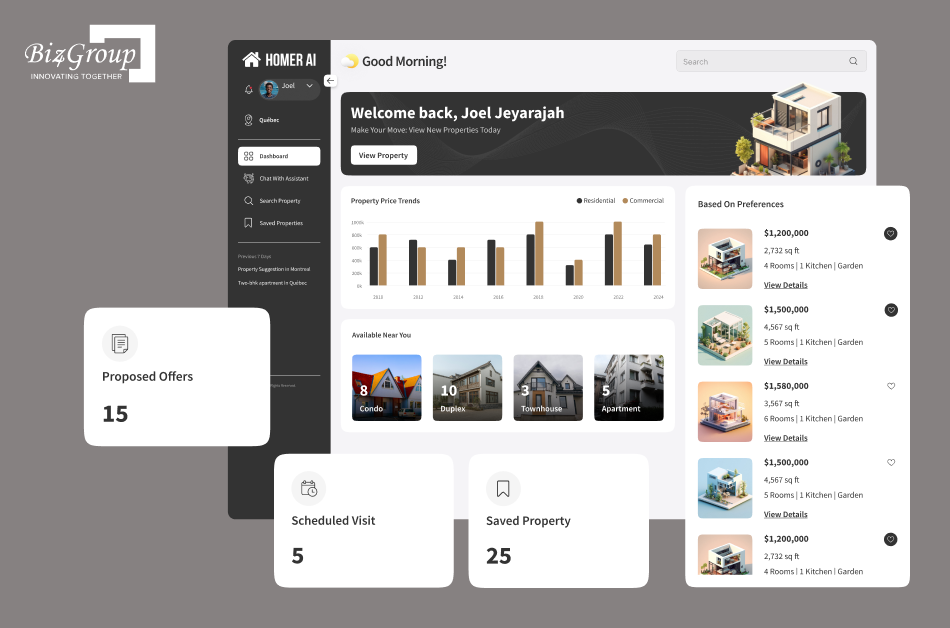
So, we’re not looking at AI property search from the outside. We’ve already worked through the messy part of turning buyer preferences and property data into a digital buying journey. Now, let’s look at what it takes to turn that search activity into a conversation that actually moves the buyer forward.
Why Do Real Estate Marketplaces Lose Buyers Between Search and Conversation?
Real estate marketplaces often lose buyers in the gap between finding a property and feeling ready to talk to someone. The buyer may browse, compare, save, revisit, and even narrow down a shortlist, but the marketplace still waits for them to click “Contact Agent.” That is a lot of useful intent sitting quietly in the background.
1. Contact Forms Leave the Buyer to Start the Conversation
A contact form works when the buyer is already ready to raise their hand. The problem is that many serious buyers are not there yet.
They may have questions like:
- “Is this neighborhood actually right for me?”
- “Do I have enough budget for what I want?”
- “Are there similar homes I should compare?”
- “Can I see this property this weekend?”
A form answers none of those questions. It simply asks the buyer to take the next step.
An AI real estate lead generation layer can make that step feel much smaller. Instead of pushing a buyer toward a generic form, the marketplace can offer useful assistance based on what the buyer is already doing.
2. Search activity goes unused after the session
This is where marketplaces often leave money on the table.
A buyer who searches for “3-bedroom homes under $700K,” views eight listings, saves two, and returns the next day has already provided a surprisingly useful picture of their preferences. Yet traditional search systems may treat each session as another isolated visit.
AI can connect those signals into a buyer profile and identify patterns such as:
Search → Listing views → Saves → Comparisons → Repeat visits → Conversation
The important distinction is that AI should not treat every click as buying intent. A single listing view means little. A consistent pattern across searches, saves, comparisons, and conversations is much more useful.
3. The fix: an intelligence layer between search activity and human sales action
The practical fix is not replacing the marketplace with an AI chatbot. It is adding an intelligence layer that sits between the existing search experience and the sales workflow.
That layer can:
- Understand intent from searches and interactions.
- Improve matching by connecting preferences with relevant listings.
- Start conversations when the buyer has unanswered questions or shows meaningful intent.
- Qualify the opportunity using information already available instead of asking the same questions again.
- Route the buyer to the right agent or next action with useful context attached.
Think of it as turning the marketplace from a property catalog into an active buying assistant.
The real win is not getting more people to fill out forms. It is helping the right buyers reach the right conversation with less friction.
What Does AI Property Search Do Inside a Real Estate Marketplace?
An AI property search turns a marketplace from a filter-driven listing directory into a search experience that can understand intent, refine results through conversation, and learn what matters to the buyer. Done well, it connects three things that traditionally sit apart: what the buyer says, what the buyer does, and which properties are actually available.
1. Natural-Language and Conversational Search Interpret What Buyers Describe
Traditional filters are great when a buyer already knows exactly what to ask for. Real buyers are rarely that tidy.
When someone types, “I want a quiet three-bedroom near Austin, under $750K, with a decent backyard and an easy commute downtown.”
A conventional search engine has to translate that into a stack of filters. A conversational system can interpret the request as a combination of structured requirements and softer preferences, then ask a useful follow-up when something is unclear.
That creates a more natural loop:
Describe → Search → Refine → Compare → Ask → Search again
The important technical detail is that the LLM should not be the listing database. The AI interprets the request, while the marketplace's search and data systems remain the source of truth for price, availability, property attributes, and other structured facts.
That separation matters. It keeps the experience conversational without allowing an LLM to invent a property that does not exist.
2. Personalized Recommendations Rank By Fit, Explain The Match, And Adapt As Preferences Change
AI property recommendations become useful when they do more than return another list of listings. The system should be able to explain why a property fits and adjust when the buyer changes their mind.
For example, when a buyer initially prioritizes a short commute. After seeing several homes, they might decide that an extra bedroom matters more. A good recommendation engine should recognize that shift instead of stubbornly optimizing for the original search.
A practical recommendation stack can combine:
|
Signal |
What it can tell the system |
|---|---|
|
Explicit preferences |
Budget, location, bedrooms, property type |
|
Search behavior |
What the buyer repeatedly looks for |
|
Listing interactions |
Properties viewed, saved, compared, or rejected |
|
Conversation |
New preferences, questions, objections |
|
Listing context |
Price, features, location, freshness, availability |
The AI can then rank properties based on fit while keeping hard constraints separate from softer preferences.
That distinction is important. “Must be under $750K” is not the same kind of signal as “I'd really like a bigger kitchen.” Treating both as simple keywords produces mediocre recommendations.
The strongest AI property matching engine also explains the recommendation: “This home matches your budget and commute preference, and it has the larger yard you mentioned.” That explanation gives the buyer something useful to react to, which creates another opportunity to refine intent.
3. AI Property Search Should Connect Discovery with the Next Best Action
The real value of conversational search is not making property discovery feel more like ChatGPT. It is helping the buyer move from “show me homes like this” to “here’s what I want to do next.”
That next action could be:
- Compare two properties
- See similar listings
- Ask about a property
- Save a shortlist
- Schedule a tour
- Speak with an agent
This is where an AI real estate marketplace can go beyond smarter search. The AI can use the conversation and search behavior to understand what the buyer needs next, while the marketplace handles the actual property data and transaction workflow.
For example, if someone says, “I like this one, but I need something closer to downtown and with a bigger yard,” the system should not simply generate another generic search. It should understand the change in priorities, retrieve matching inventory, explain the differences, and keep the conversation moving.
That is the distinction worth designing around: Search finds properties. AI helps buyers decide what to do next.
For an existing marketplace, that shift is often more valuable than adding another AI feature that simply makes the search box look smarter.
Also Read: Custom AI Residential Property Marketplace Development for Differentiated Buyer Experiences
Your search bar can do more than search.
Give it the ability to understand what buyers actually mean, not just what they type.
Explore AI Property Search SolutionsWhich Buyer-Intent Signals Can AI Extract from Marketplace Behavior?
AI can identify buyer intent from three signal types: explicit signals buyers provide directly, behavioral signals generated through marketplace activity, and conversational signals revealed through questions and responses. Combining them gives the marketplace a more reliable picture of buyer preferences, readiness, and next steps than any single data point can provide.
1. Explicit Signals: Budget, Location, Timeline, And Must-Haves
Explicit signals come directly from the buyer, making them the strongest starting point for personalization and search.
Typical inputs include:
- Budget: target price, maximum price, or financing range
- Location: preferred areas, commute boundaries, or geographic radius
- Timeline: when the buyer expects to purchase or move
- Must-haves: property type, bedroom count, parking, accessibility, or other requirements
AI can convert these natural-language preferences into structured search criteria while preserving the difference between a constraint and a preference.
That distinction matters. A maximum budget may be a firm filter, while a preference such as a home office should influence ranking without automatically eliminating otherwise suitable listings.
2. Behavioral Signals: Listing Views, Saves, Comparisons, And Repeat Visits
Behavioral signals show what buyers actually do after entering the marketplace. They can reveal preferences that were never stated explicitly.
Useful signals include:
|
Signal |
Potential insight |
|---|---|
|
Listing views |
Topics or properties attracting attention |
|
Saves |
Stronger interest worth retaining |
|
Comparisons |
Active evaluation between alternatives |
|
Repeat searches |
Changing or narrowing preferences |
|
Return visits |
Continued interest or unresolved needs |
An AI buyer intent analysis system can combine these actions instead of treating each event independently. A pattern across several sessions is generally more informative than a single click.
The important qualification is that behavior indicates interest, not certainty. A buyer repeatedly viewing luxury listings may be researching prices rather than preparing to purchase. Good systems use these signals to improve relevance and decide what to ask next, rather than automatically labeling someone as a hot lead.
3. Conversational Signals: Urgency, Financing Status, Objections, And Questions Asked
Conversational signals add context that marketplace analytics usually cannot capture. A buyer's questions can reveal their stage in the decision process, concerns, and remaining information gaps.
For example, questions about financing, inspection requirements, HOA fees, or closing timelines can indicate what is holding the buyer back. A request to arrange a showing provides a much stronger readiness signal.
AI can extract structured attributes such as:
- Urgency
- Financing status
- Purchase timeline
- Decision criteria
- Objections
- Unanswered questions
- Readiness for human assistance
The real advantage comes from combining all three signal types rather than relying on a single lead score.
What buyers tell you + what they repeatedly do + what they ask = a stronger picture of buyer intent.
That context gives the marketplace a basis for the next decision: refine the experience, ask a useful question, or introduce a human at the right moment.
How Does Conversational AI Turn Property Searches into Qualified Leads and Agent Conversations?
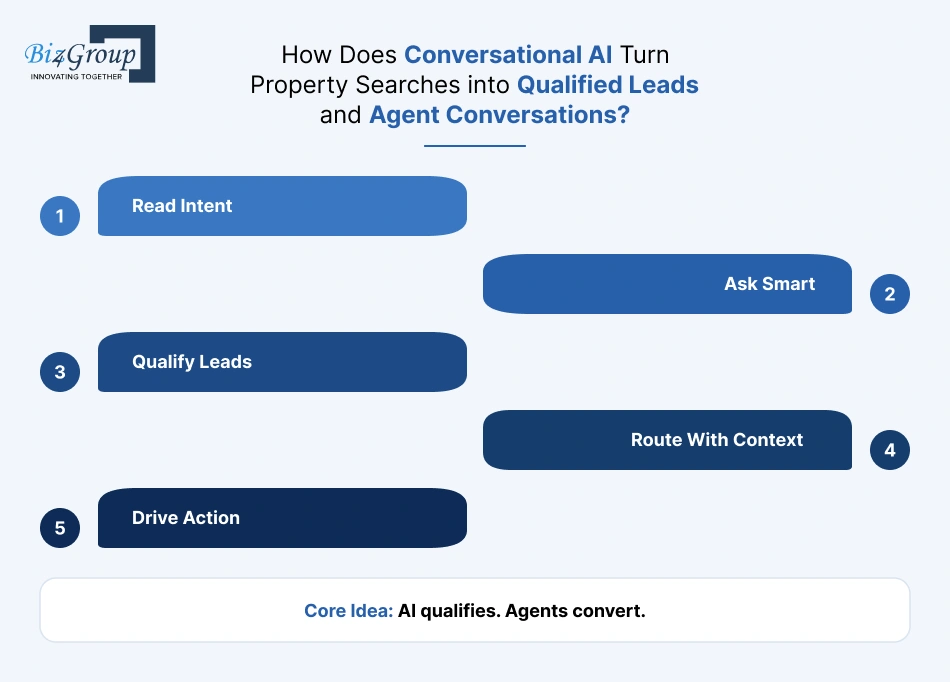
Conversational AI turns property searches into qualified leads by using the buyer context already available, asking only the questions that matter, and handing the opportunity to a human when there is a clear reason to do so. The goal is not to make every visitor talk to an AI. It is to identify who needs help, what kind of help they need, and when an agent should step in.
1. Score Readiness, Fit, And Urgency to Decide Who Gets a Conversation and When
Not every interested buyer deserves the same follow-up. A useful AI real estate lead qualification system should evaluate several dimensions rather than relying on one generic lead score.
|
Signal |
What it helps determine |
|---|---|
|
Readiness |
Is the buyer actively moving toward a decision? |
|
Fit |
Do their requirements align with available inventory? |
|
Urgency |
Does the buyer need assistance soon? |
|
Engagement |
Are they actively evaluating properties? |
|
Information gaps |
Is missing information preventing the next step? |
These dimensions can produce different actions. A buyer with strong property fit but low urgency may need better recommendations, while someone with a defined timeline and strong inventory match may be ready for an agent conversation.
The scoring model should also remain explainable. Sales teams should be able to see why a lead was prioritized instead of receiving an unexplained “92/100” score.
2. Run The Conversation: Ask Only What the Signals Leave Unknown
The best conversational AI does not interrogate buyers with a 15-question form disguised as a chatbot.
It should use existing context first, then ask targeted questions where information is genuinely missing.
For example, if the marketplace already knows the buyer's preferred property type, location, and price range, asking for those details again adds friction. A better question might clarify something the system cannot infer, such as purchase timing or a specific requirement affecting the shortlist.
This approach makes AI real estate lead generation more useful because the conversation has a purpose. Each question should either:
- Improve property matching
- Clarify buyer readiness
- Resolve an objection
- Identify the next action
- Determine whether human assistance is appropriate
The AI should also know when to stop asking questions. Qualification is useful only until the buyer has enough context to take the next step.
3. Route To the Right Agent or Book the Appointment, With Context Passed On
Once a buyer is ready, the system should make the handoff feel like a continuation of the conversation, not a reset.
An effective AI lead routing for real estate workflow can pass information such as:
- Buyer requirements and priorities
- Relevant properties viewed or saved
- Stated timeline
- Questions or objections raised
- Qualification signals
- Requested next action
The agent then receives context instead of a vague notification saying, “New lead submitted.”
Depending on the marketplace workflow, the next action could be an agent handoff, property showing, phone call, video consultation, or appointment booking.
That final handoff is where conversational AI proves its business value. The AI does not need to replace the agent. It needs to make sure that when the agent enters the conversation, they already know what the buyer cares about and why they are talking now.
How Do You Integrate AI with Your Marketplace's Platform, Listing Data, and CRM?
You can integrate AI into an existing real estate marketplace by adding an intelligence layer between the marketplace, listing systems, buyer data, and CRM. The AI handles natural-language understanding, recommendations, conversations, and orchestration, while your existing systems remain the source of truth for listings, users, and sales workflows.
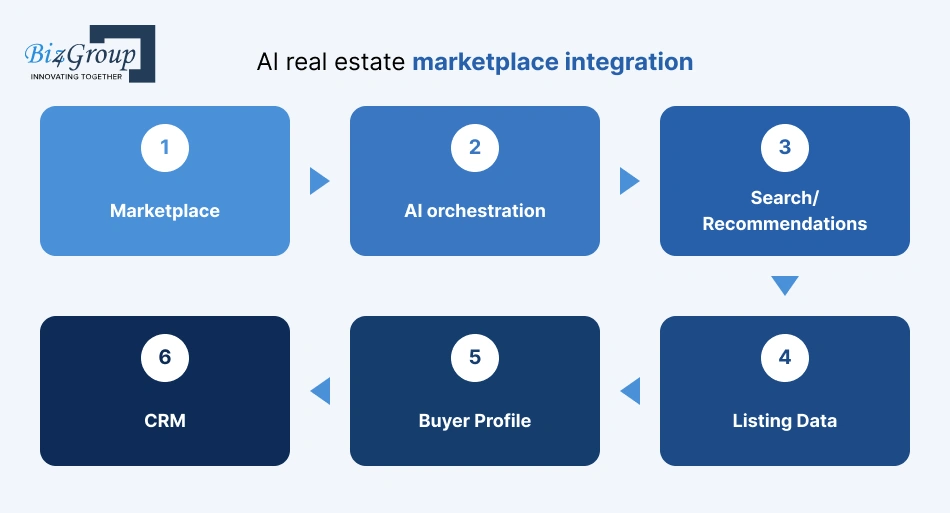
1. The AI Layer Alongside Your Existing Platform: Components And Orchestration
The AI layer should sit between the marketplace experience and the services that provide search, recommendations, listing data, and customer workflows.
A typical AI real estate marketplace integration looks like:
Marketplace → AI orchestration → Search/Recommendations → Listing Data → Buyer Profile → CRM
|
Component |
Responsibility |
|---|---|
|
Marketplace |
User experience and existing business logic |
|
Search engine |
Filtering and retrieval |
|
Recommendation engine |
Property ranking and matching |
|
LLM |
Natural-language understanding and conversation |
|
AI orchestration |
Coordinates tools, context, and actions |
|
CRM |
Lead records, ownership, and sales activity |
|
Listing system |
Property facts and status |
Keep the LLM away from authoritative business data. It can interpret a buyer's request and decide which service to call, but structured systems should determine whether a property is available, what it costs, and which attributes it has.
2. Listing Data: MLS, IDX, And Feed Access, And the Rules on AI Use
An AI property search integration needs controlled access to MLS, IDX, or other listing feeds. The integration must account for applicable licensing terms, permitted uses, attribution requirements, refresh rules, and access restrictions.
A reliable retrieval flow is:
Buyer query → intent interpretation → listing search → current property data → response
This keeps price, availability, listing status, and other changing facts tied to the source system instead of relying on information stored in an LLM.
3. Buyer Data: A Unified Profile Across Sessions, Searches, And Conversations
A unified buyer profile allows the marketplace to retain useful context across sessions.
Relevant data can include:
- Search criteria and changes
- Viewed and saved properties
- Property comparisons
- Explicit preferences
- Conversation history
- Qualification information
- Previous agent interactions
The profile should distinguish stated preferences from inferred behavior. Repeatedly viewing homes with pools indicates interest, for example, but does not necessarily make a pool a requirement.
4. CRM And Agent Systems: APIs, Webhooks, And Outcome Data That Feeds Back Into Scoring
The CRM connects AI activity to the agent workflow. APIs can create or update lead records, while webhooks can trigger qualification, appointment, assignment, and status events.
A typical workflow is:
AI qualification → CRM update → agent routing → appointment → outcome → scoring feedback
This feedback makes AI real estate lead qualification more useful over time. Agent outcomes can reveal which AI-generated signals actually correlate with appointments, conversations, and successful conversions.
What Are the Risks of AI Property Recommendations and Lead Qualification?
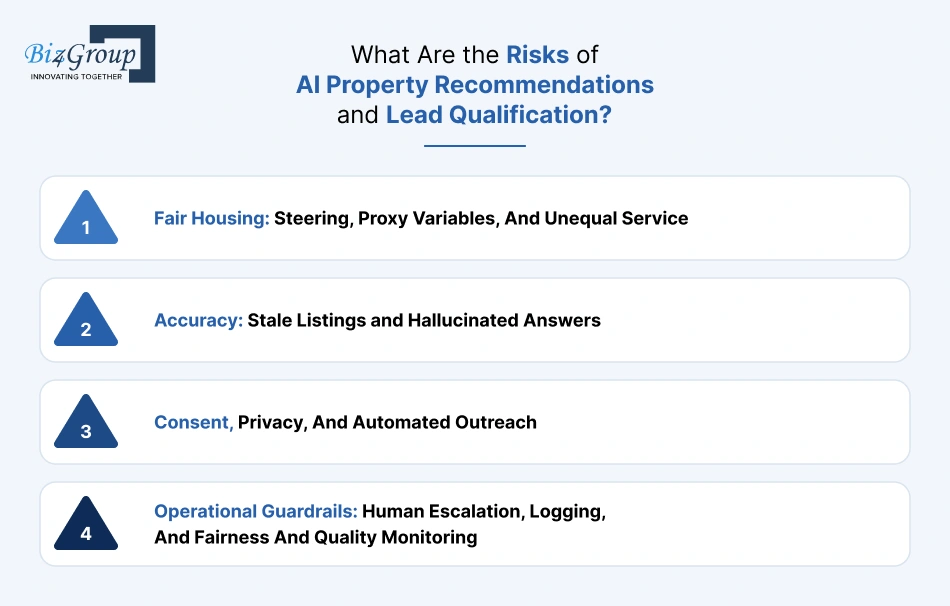
The main risks in AI property recommendations and lead qualification are discriminatory recommendations, inaccurate listing information, weak data controls, and poorly supervised automation. These risks can be reduced by limiting what AI can infer or decide, grounding responses in current data, and monitoring outcomes after deployment.
1. Fair Housing: Steering, Proxy Variables, And Unequal Service
Fair housing is a critical consideration when AI influences property recommendations or buyer treatment. An AI model can create problems even without directly using protected characteristics if it learns proxy signals that produce discriminatory outcomes.
For example, recommendation logic should not use demographic patterns to decide which communities a buyer should see. Lead qualification should also never result in different service levels, response times, or agent access based on protected characteristics or their proxies.
Teams should define permitted recommendation criteria, restrict sensitive inputs, test outputs for disparate patterns, and regularly review both recommendations and lead-routing outcomes.
2. Accuracy: Stale Listings and Hallucinated Answers
AI hallucination can happen when AI generates a convincing answer based on outdated or incomplete information. In real estate, that can mean quoting an incorrect price, describing an unavailable property, or presenting an outdated listing status.
Use the marketplace's authoritative data sources for changing property facts. The AI should retrieve current information rather than relying on model memory.
Production controls should include:
- Listing freshness checks
- Real-time or scheduled data synchronization
- Structured retrieval for property facts
- Clear handling of missing information
- Logging of important AI responses
The LLM should interpret and explain verified listing data, not become the source of truth.
3. Consent, Privacy, And Automated Outreach
An AI marketplace can process search history, saved listings, conversations, contact information, and qualification data. That makes privacy and consent part of the integration design, not an afterthought.
Buyers should know when they are interacting with AI and how their information is being used. Automated outreach also needs appropriate consent and communication controls.
A practical rule is to collect only the data required for the intended workflow, define retention rules, restrict access, and give users appropriate control over their information.
4. Operational Guardrails: Human Escalation, Logging, And Fairness And Quality Monitoring
AI should have clear boundaries for when it must stop and involve a human.
Escalation can be triggered when the system lacks reliable information, the buyer requests an agent, or the interaction requires judgment outside the AI's permitted role.
Monitor the system for:
- Incorrect listing information
- Recommendation errors
- Lead-routing mistakes
- Escalation rates
- User complaints
- Agent feedback
- Fairness indicators
- Appointment and conversion outcomes
This turns AI real estate lead qualification into a monitored production process rather than a one-time model deployment.
Should You Integrate AI into Your Existing Marketplace or Build One?
For most established real estate marketplaces, integrating AI into the existing platform is the better starting point. Rebuilding only makes sense when the current architecture cannot reliably support the data, APIs, search infrastructure, or workflows the AI experience requires. The right choice depends on how much of your existing platform can be reused without creating technical debt.
1. Add A Vendor Conversational AI Or Lead Qualification Component
A third-party component can be the fastest way to test conversational search or AI real estate lead qualification without building the entire AI stack.
This approach works well when your marketplace already has reliable listing data, search APIs, user authentication, and CRM connectivity.
Best fit when:
- You need a pilot quickly.
- The use case is relatively focused.
- Your team has limited AI engineering capacity.
- The vendor supports your data sources and integration requirements.
The trade-off is control. Vendor limitations around customization, data handling, model choice, pricing, and integration depth can become more significant as usage grows.
2. Partner With an Experienced AI Team To Build the Custom Layer
Building a custom AI layer doesn’t mean your team has to become an AI infrastructure company overnight. The right partner can handle the messy middle, from understanding your existing platform and connecting listing data and APIs to building AI search and recommendations, integrating CRM workflows, adding guardrails, and taking everything through testing and production.
This is where Biz4Group’s real estate AI platform development expertise comes in. From AI strategy and product development to integrations, conversational experiences, and production support, Biz4Group helps bring the entire AI journey together under one roof.
For a real estate marketplace, that means more than adding an AI feature. It means creating a connected system where property data, buyer preferences, search, recommendations, conversations, and lead workflows work together.
That’s what a strong development partner should deliver, not just a model, but an AI-enabled real estate platform that’s built to run, scale, and deliver real business value.
3. Rebuild The Platform Only When Legacy Architecture Blocks Integration
A full rebuild should be the exception, not the default response to an AI initiative.
Consider it when the existing platform has fundamental constraints such as:
- No reliable APIs
- Fragmented or inaccessible listing data
- Outdated search infrastructure
- Duplicate or inconsistent customer records
- Systems that cannot support real-time workflows
- Vendor dependencies that prevent required integrations
If the marketplace can expose reliable data and business functions through APIs, rebuilding the entire platform simply to add AI usually creates unnecessary cost and migration risk.
4. What Drives Cost and Timeline, From Pilot to Production Go-Live to Full Rollout
AI integration cost is driven less by the chatbot itself and more by the systems it has to connect to.
The main variables are:
|
Factor |
Impact on cost and timeline |
|---|---|
|
Listing data integration |
Feed complexity, synchronization, permissions |
|
Search and recommendation changes |
Retrieval and ranking requirements |
|
Buyer-profile architecture |
Identity resolution and data modeling |
|
CRM integration |
APIs, workflows, routing, write-back |
|
AI complexity |
Number of tools, workflows, and models |
|
Security and compliance |
Access controls, auditing, data handling |
|
Evaluation and monitoring |
Testing, quality measurement, production oversight |
|
Rollout scope |
One workflow versus marketplace-wide deployment |
A sensible rollout usually starts with one measurable workflow, such as conversational property discovery or lead qualification. Once the data, integrations, and evaluation process are working reliably, additional capabilities can be added without turning the first release into a marketplace-wide migration.
The goal is not to choose between “AI vendor” and “custom AI” in isolation. It is to choose the smallest architecture that can prove the business case without limiting the production system you eventually need.
Got the marketplace but missing the AI muscle?
Let’s connect your listings, buyer data, search, and CRM without turning your existing platform upside down.
Talk to Biz4GroupHow Do You Measure Whether AI Is Converting Searches into Conversations?
Measure an AI property search by what happens after the search, not just by how often buyers use the AI feature. The strongest measurement framework connects discovery, conversation, qualification, appointments, and agent outcomes so you can see whether AI is creating better opportunities or simply generating more activity.
1. Discovery Metrics: Search Engagement and Recommendation Engagement
Discovery metrics show whether AI is helping buyers find and evaluate relevant properties.
Track metrics such as:
|
Metric |
What it tells you |
|---|---|
|
AI search usage |
How often buyers choose AI-assisted search |
|
Search refinement rate |
Whether buyers continue refining results |
|
Listing engagement |
Whether recommended properties generate meaningful interaction |
|
Save rate |
Whether buyers find properties worth returning to |
|
Comparison rate |
Whether recommendations support active evaluation |
|
Repeat search rate |
Whether buyers continue using the experience |
These metrics are useful for diagnosing the experience, but they are not the business outcome. Higher AI usage does not automatically mean better conversion.
For example, if recommendation clicks increase but saved-property or inquiry rates remain flat, the ranking system may be generating curiosity without improving buyer fit.
2. Conversion Metrics: Search-To-Conversation Rate, Qualified-Lead Rate, Appointment Rate, And Agent Outcomes
The commercial measurement layer starts when search activity becomes a meaningful sales interaction.
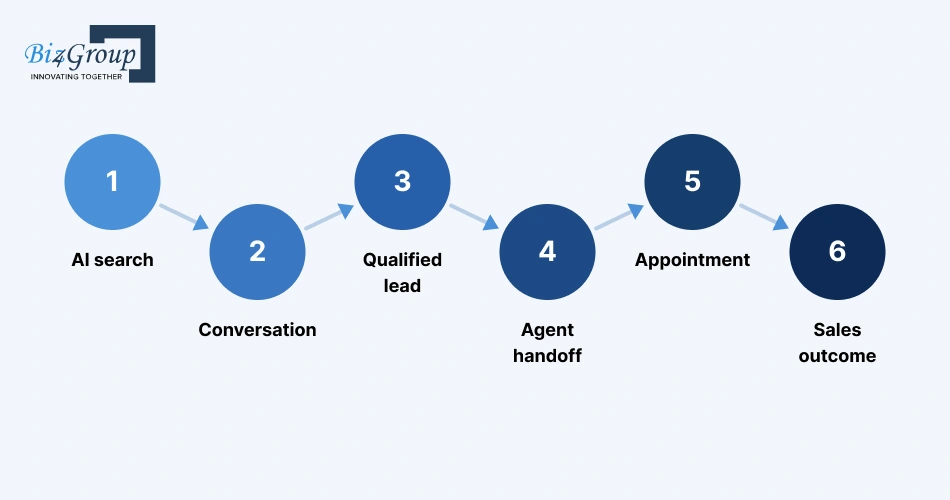
A useful funnel is:
AI search → Conversation → Qualified lead → Agent handoff → Appointment → Sales outcome
Track each transition separately:
- Search-to-conversation rate: percentage of AI-assisted searches that result in a meaningful buyer conversation.
- Qualified-lead rate: percentage of conversations meeting defined qualification criteria.
- Appointment rate: percentage of qualified leads that schedule a call, showing, or other sales interaction.
- Agent outcomes: response time, accepted leads, completed conversations, appointments, and downstream conversions.
This separation helps identify where the system is actually working.
If search-to-conversation is strong, but qualified-lead rate is weak, the problem may be the qualification logic. If qualified leads are strong, but appointment rates are low, the issue may sit in agent routing, follow-up, or buyer readiness rather than the AI search itself.
For AI real estate lead generation, the most useful KPI is therefore not “How many people used AI?” It is how much better the marketplace converts relevant buyer intent into useful human action.
That is the metric that connects an AI feature to marketplace revenue.
Final Takeaway
The question for a real estate marketplace isn’t “Where can we add AI?” It’s “Where are buyers dropping off, and can AI help without adding another disconnected system?”
Buyers are open to AI, but they still want people for the big moments. Bank of America's 2026 Homebuyer Insights Report found that buyers prefer human expertise for touring homes (55%) and for legal or contractual advice (54%). Agents, meanwhile, are adopting technology with the client in mind: 71% cited improving the client experience as a reason, according to NAR's 2026 REALTORS® Technology Report. AI property search can become the bridge between property discovery and agent action.
The smart way to approach it? Start small, integrate first, and measure what happens. Pick one high-intent journey, such as natural-language search, property recommendations, or lead qualification. Keep your listing and CRM systems as the source of truth, and let AI handle the part it’s good at: understanding context, connecting the dots, and moving the conversation forward.
And don’t make AI the only player on the field. As McKinsey real estate partner Alex Wolkomir puts it, “AI when you want it, human when you do not, confidence by default.” For real estate, that means AI can handle discovery and routine questions, while a human steps in when the decision gets serious.
The bottom line? Don’t rebuild your marketplace to make it “AI-ready.” Build on what you already have, add AI where it creates real value, and measure what actually moves the business.
That’s where Biz4Group LLC comes in. We build AI solutions for real estate that connect data, understand buyer intent, and turn property search into meaningful conversations and conversions.
Planning your next step? Talk to us about building and integrating an AI property search solution around your existing real estate marketplace, listing data, and CRM.
Frequently Asked Questions
1. Can AI property search work with a marketplace that has millions of listings?
Yes, provided the search infrastructure can retrieve and rank listings efficiently. A scalable setup typically combines structured filters, keyword or vector search, and a ranking layer that prioritizes relevant properties. Caching, indexing, and incremental data updates help maintain performance as inventory grows.
2. How can AI property search handle vague or conflicting buyer preferences?
AI can ask clarifying questions, distinguish firm requirements from flexible preferences, and present trade-offs when no listing matches everything. For example, it might offer properties with a longer commute but more space, provided the buyer agrees to broaden the search.
3. How do you prevent AI property search from recommending the same listings repeatedly?
Use recommendation diversity, exposure history, and feedback from listing interactions. The system can balance strong matches with relevant alternatives, while excluding properties the buyer has dismissed. Monitor repeated impressions and recommendation fatigue to determine whether personalization is actually improving discovery.
4. Can an AI property search system support multiple real estate markets and languages?
Yes, but each market may require different listing schemas, currencies, location formats, terminology, and data permissions. Multilingual support also requires testing local property terminology and search relevance, rather than relying on translation alone. Plan for market-specific validation before expanding internationally.
5. How can a real estate marketplace tell whether AI is genuinely improving conversion rather than just increasing engagement?
Compare AI-assisted journeys with a suitable control group and measure downstream outcomes, including qualified inquiries, completed appointments, and agent-accepted leads. Account for differences in traffic sources and buyer readiness. More clicks or longer sessions alone do not establish that AI is generating incremental business value.
6. What happens when a buyer changes preferences halfway through an AI property search?
The system should update the active search criteria and rerank results without forcing the buyer to start over. It should preserve relevant context while allowing buyers to correct earlier assumptions or remove outdated preferences. Clear preference controls help prevent personalization from becoming restrictive.
7. How can real estate marketplaces evaluate AI vendors without getting locked into one provider?
Assess whether the vendor supports portable data, documented APIs, configurable models, exportable conversation histories, and clear ownership terms. Test how easily you can replace the LLM or recommendation service without rebuilding the entire product. Include data migration, exit costs, and ongoing usage fees in the evaluation.
8. How can Biz4Group help businesses looking for an AI development partner for real estate marketplaces?
Businesses looking for an AI development partner for real estate marketplaces can work with Biz4Group to plan, build, and integrate custom AI solutions, from intelligent property search and recommendations to conversational AI and CRM workflows. Its end-to-end approach helps clients connect existing systems, streamline buyer journeys, and build scalable AI-powered experiences around their business needs.
