Location :
Orlando, FL, USA
Location :
Orlando, FL, USA +1 (407) 714-1616
 info@biz4group.com

















Imagine a digital system that doesn’t wait for instructions but instead, understands your business goals, learns from real-time feedback, and takes independent actions to get the job done.
Read More
An AI system does not need to break to create a business problem. A hiring model can quietly filter out qualified candidates. A forecasting tool can produce reasonable-looking predictions that lead to costly inventory decisions. A customer service chatbot can provide inaccurate information with complete confidence. In many cases, the system continues operating exactly as expected while the consequences build in the background.
That dynamic is one reason the risks of artificial intelligence in business are different from many traditional technology risks. The challenge is often not identifying a failure. The challenge is recognizing that a failure is happening in the first place.
As organizations invest more heavily in generative AI, questions about accountability, bias, compliance, security, and financial exposure are moving beyond IT departments and into boardrooms, legal teams, and operational leadership. Decisions about AI adoption increasingly involve questions of risk tolerance, oversight, and responsibility.
This guide is for business leaders, technology decision-makers, compliance teams, and operational stakeholders who need a practical understanding of where AI risks emerge, how they affect business outcomes, and what can be done to reduce exposure before those risks become expensive mistakes.
Most business software follows a defined set of instructions. The same input produces the same result, which makes performance easier to predict and monitor.
AI works differently. It learns from data, identifies patterns, and generates responses based on probabilities rather than fixed rules. That difference changes how organizations evaluate reliability, oversight, and accountability.
Before looking at specific risk categories, it is important to understand why AI behaves differently from the software businesses have used for decades.
Traditional software is designed to produce consistent results when the same conditions are met. AI systems are more flexible, but that flexibility can also introduce uncertainty.
For business teams, this creates several challenges:
Many of the risks of artificial intelligence in business start with this lack of predictability. Organizations cannot assume that successful performance in one scenario guarantees identical behavior in every future situation.
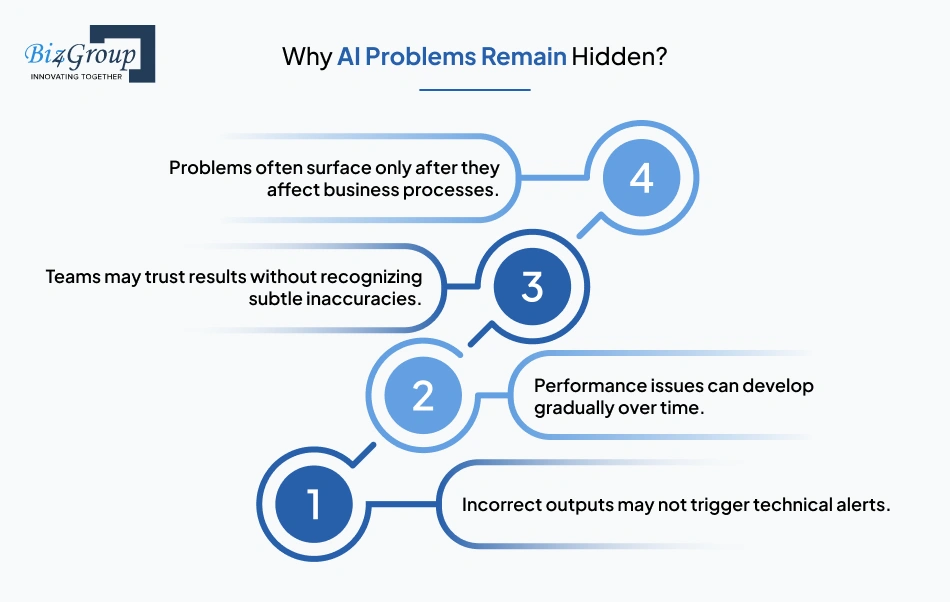
Software issues are often easy to detect. A system may crash, display an error message, or stop performing a task. AI-related problems are often less visible because the system continues functioning while producing results that appear reasonable.
This makes detection more difficult because:
This is one reason AI risks in business require a different level of attention. The challenge is not always system failure. The challenge is identifying when the system is quietly moving away from expected performance.
Many organizations treat deployment as the final step of a technology project. AI systems require ongoing observation because the conditions around them are constantly changing.
Several factors can influence performance after launch:
Companies implementing enterprise AI integrations often discover that maintaining performance requires continuous monitoring rather than occasional reviews. Trained AI model that performs well today may produce different results months later as business conditions change.
This is where some of the dangers of AI in business become easier to understand. The system itself may remain operational while the quality of its outputs gradually changes. Unlike traditional software, those shifts are not always immediately visible.
AI introduces capabilities that traditional software cannot offer, but it also introduces uncertainty that businesses are not accustomed to managing. Understanding these differences creates the foundation for evaluating AI-related risks and making informed decisions about where AI should and should not be used.
Many costly AI problems begin long after deployment and long before detection
Assess Your AI Exposure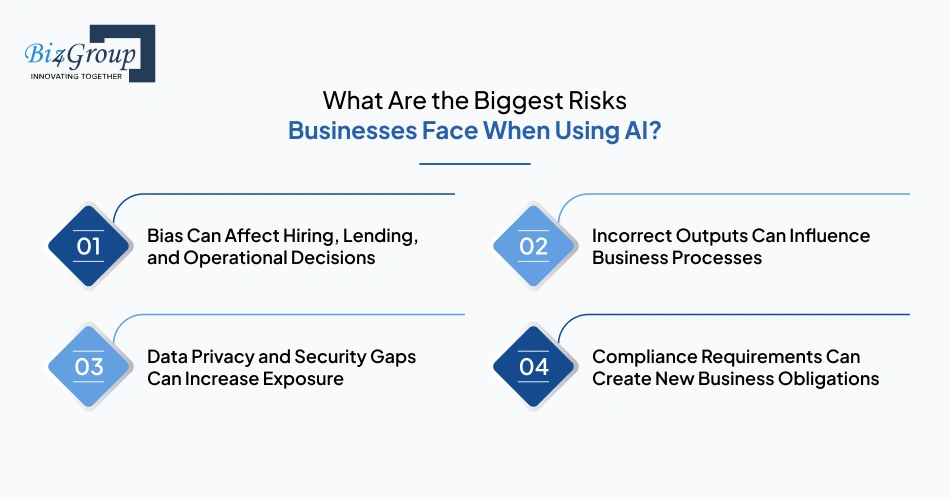
Hearing about AI mistakes in finance and healthcare can make any leadership team pause before expanding AI initiatives. That hesitation is often justified. AI can improve efficiency and support decision-making, but it can also introduce risks that are easy to overlook during early adoption.
If you are thinking along the lines, “I keep hearing about AI making mistakes in finance and healthcare, but my CEO wants us to go all in on AI this year. So, what are the actual real-world risks I should bring up to slow this down and make sure we do it right.” Then here are the main categories of risk that appear when AI becomes part of everyday business operations.
Not every AI system treats every situation equally. The quality of decisions often depends on the information used to train the system. When past data reflects imbalances, those patterns can influence future recommendations.
This risk commonly appears in areas where AI evaluates people, applications, or transactions:
Many organizations first encounter this issue through algorithmic bias in hiring. What appears to be an objective screening process can sometimes favor certain profiles over others. The same concern exists in lending, insurance, and operational workflows where machine learning bias can influence recommendations without being immediately obvious.
Many businesses now rely on AI to summarize information, generate content, support research, and provide recommendations. The challenge is that AI can produce incorrect information while presenting it in a convincing way.
Organizations should pay attention to risks such as:
AI hallucinations in enterprise environments have increased as AI becomes more involved in day-to-day work. Not only this these issues sit at the center of many generative AI risks for companies, especially when employees begin relying on AI outputs without independently validating the information. Over time, these situations can contribute to business AI decision-making errors across different departments.
AI systems often require access to internal information to deliver useful results. As adoption expands, more data moves through AI-powered workflows, increasing the importance of proper data handling practices.
Several risk areas deserve attention:
Also Read: 10 AI Automation Use Cases for Enterprises to Scale Faster
Concerns around AI data privacy violations continue to grow because a single mistake can expose customer information, employee records, financial data, or proprietary business knowledge. The risk is not limited to technology teams. It affects every department that works with sensitive information.
Many organizations focus on what AI can do and spend less time considering the obligations that come with using it. Once AI influences business activities, questions around accountability, transparency, and documentation become much more important.
This is especially relevant when AI supports:
AI in finance risk discussions continue because financial institutions operate under strict oversight requirements. Concerns about AI workforce displacement risks are also pushing companies to examine where automation should support employees and where human judgment should remain part of the process.
The biggest risks businesses face when using AI are not concentrated in one area. They appear across decisions, data, operations, and compliance responsibilities. Understanding these categories early makes it easier to evaluate where AI can create value and where additional caution may be needed.
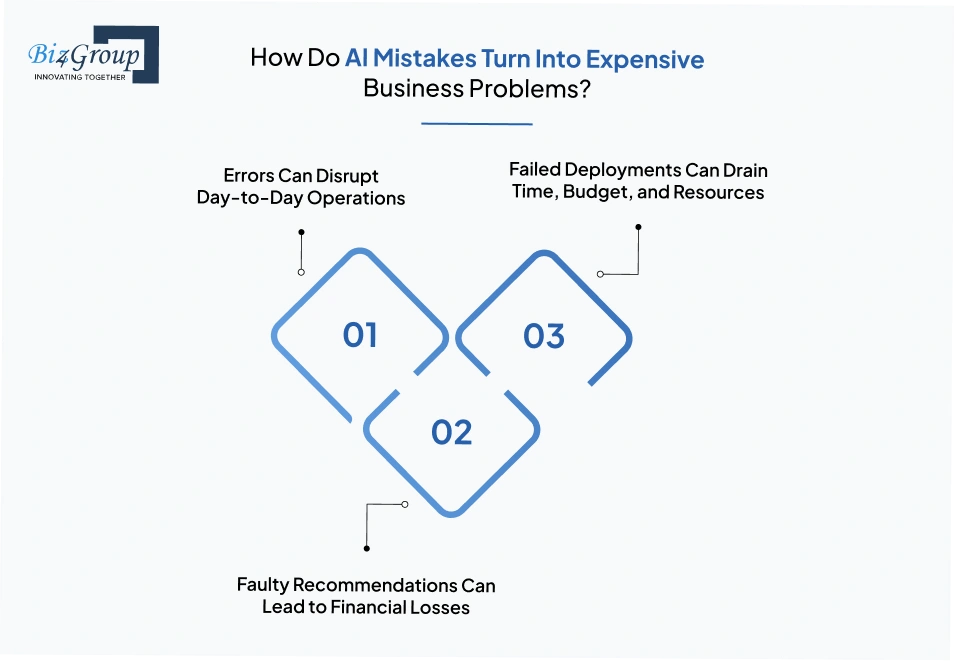
One company spent nearly $2 million implementing an AI system for supply chain planning. The system continued making inaccurate predictions, and the business lost a significant amount of money before the problem was fully understood.
No, this is not common across every AI initiative, but it happens often enough to deserve attention. AI mistakes rarely stay isolated inside a system. They usually spread into operations, budgets, and business performance.
Here is how AI mistakes turn into expensive business problems, so you can recognize them before they consume time, money, and resources.
AI mistakes become expensive when they move beyond the technology itself and start affecting operations, finances, and business priorities. Many artificial intelligence business risks are not defined by a single failure. They emerge when small mistakes continue long enough to consume valuable time, budget, and organizational resources.
Small AI errors often become budget drains before leadership teams notice
Identify Hidden Cost Drivers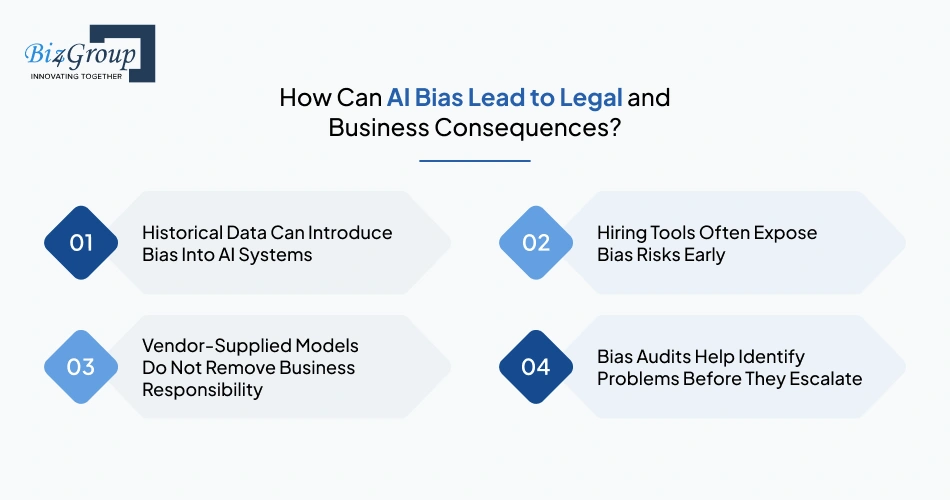
Bias becomes a business concern when AI-supported decisions produce outcomes that affect employees, customers, applicants, patients, or other stakeholders differently. At that stage, the consequences are no longer limited to system performance. They can affect trust, accountability, compliance exposure, and business reputation.
When biased patterns influence AI-supported decisions, organizations can face questions about fairness, consistency, and accountability. The issue is often not a single decision. It is the appearance of repeated outcomes that affect certain groups differently.
Some common consequences include:
As organizations rely more heavily on predictive analysis to support decisions, expectations around AI fairness in corporate decisions continue to grow. This is also why AI transparency and explainability have become important business considerations when AI influences outcomes that directly affect people.
Hiring decisions are highly visible and directly tied to employment laws. As a result, bias-related concerns often emerge in recruitment before they appear elsewhere in the business.
Organizations may experience:
These concerns have drawn attention to broader automated decision-making risks because hiring outcomes are often easier to measure and challenge than many other AI-supported decisions.
Using third-party AI tools does not remove accountability for the outcomes those tools produce. Customers, employees, regulators, and stakeholders generally hold the business responsible for decisions made under its name.
This can create consequences such as:
The same accountability concerns can emerge through AI-powered mistakes in customer service, especially when different customers receive inconsistent treatment. Similar issues can also contribute to AI misinformation in business context situations where biased outputs influence recommendations, communications, or customer interactions.
Many organizations review AI systems because bias-related issues often become more expensive after they affect employees, customers, or business operations. The goal is not simply to improve model performance. The goal is to reduce exposure before concerns escalate into larger business problems.
Several practices are commonly used for this purpose:
Organizations investing in reliable AI integration services and AI automation services often place greater emphasis on identifying bias-related concerns before they affect operations, employees, or customers.
Bias-related issues rarely remain isolated within a technology system. Once they influence business decisions, the consequences can affect reputation, accountability, stakeholder trust, and regulatory exposure. Understanding those consequences helps organizations evaluate AI use more responsibly across the business.
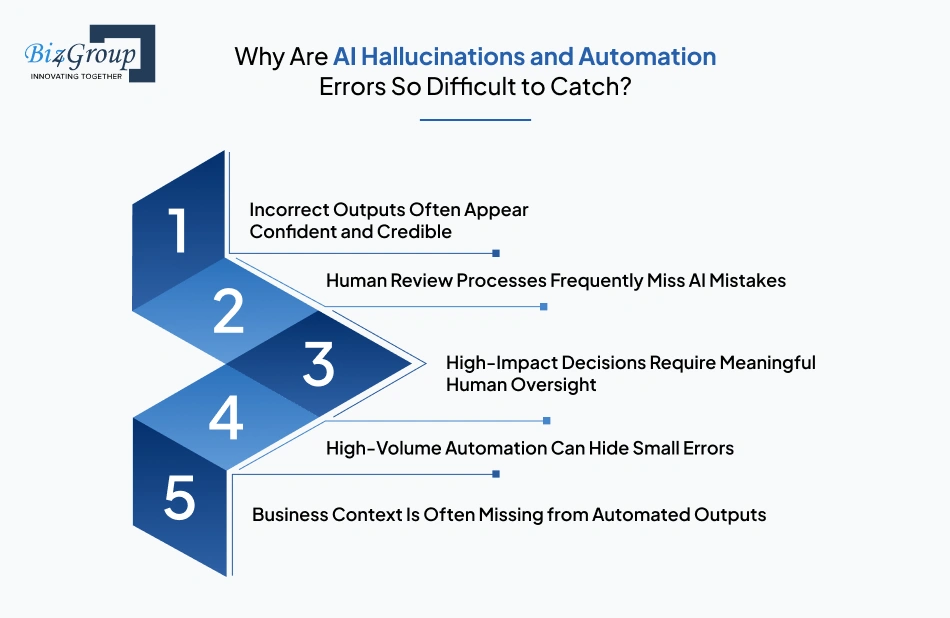
Many artificial intelligence dangers for companies do not come from obvious system failures. Hallucinations and automation errors are difficult to detect because the output often appears believable at first glance. That makes it harder to identify during routine work and easier to trust than they should be.
One reason AI hallucinations are difficult to catch is that the information is often presented with confidence. The response may look complete, well-structured, and convincing even when parts of it are inaccurate. This is why AI output inaccuracies are frequently overlooked during normal business activities. Similar concerns sit at the center of many large language model risks business leaders are now evaluating.
Many organizations assume human review will automatically catch AI errors. In practice, reviewers often focus on speed and efficiency, especially when large volumes of content or recommendations are involved. As AI becomes more common across operations, these gaps are emerging as one of the more common AI technology adoption pitfalls affecting business teams.
Automation can support productivity, but not every decision should be handled without review. The risks of AI automation in the workplace become more significant when automated outputs influence hiring, lending, healthcare, financial approvals, or customer-facing actions. These situations often require stronger human judgment than routine administrative tasks.
A single incorrect output may have a limited impact. The challenge appears when the same error is repeated thousands of times through automated workflows. This is one reason AI in business decision-making risks often increase as organizations expand automation across multiple departments. Small inaccuracies can spread quickly before anyone notices a pattern.
AI systems can generate responses based on patterns in data, but they do not always understand the full business context behind a situation. As a result, recommendations may appear reasonable while overlooking factors that matter to the organization. This is a common characteristic of AI model failure in enterprise environments where business complexity exceeds what the model can interpret.
Organizations investing in AI consulting services often discover that reducing hallucinations requires more than technical improvements. It also depends on responsible AI for businesses, trustworthy AI in enterprise environments, and practical AI governance for businesses that keeps human judgment involved where it matters most.
Discover where automation needs verification before inaccurate outputs spread further
Review Your AI Safeguards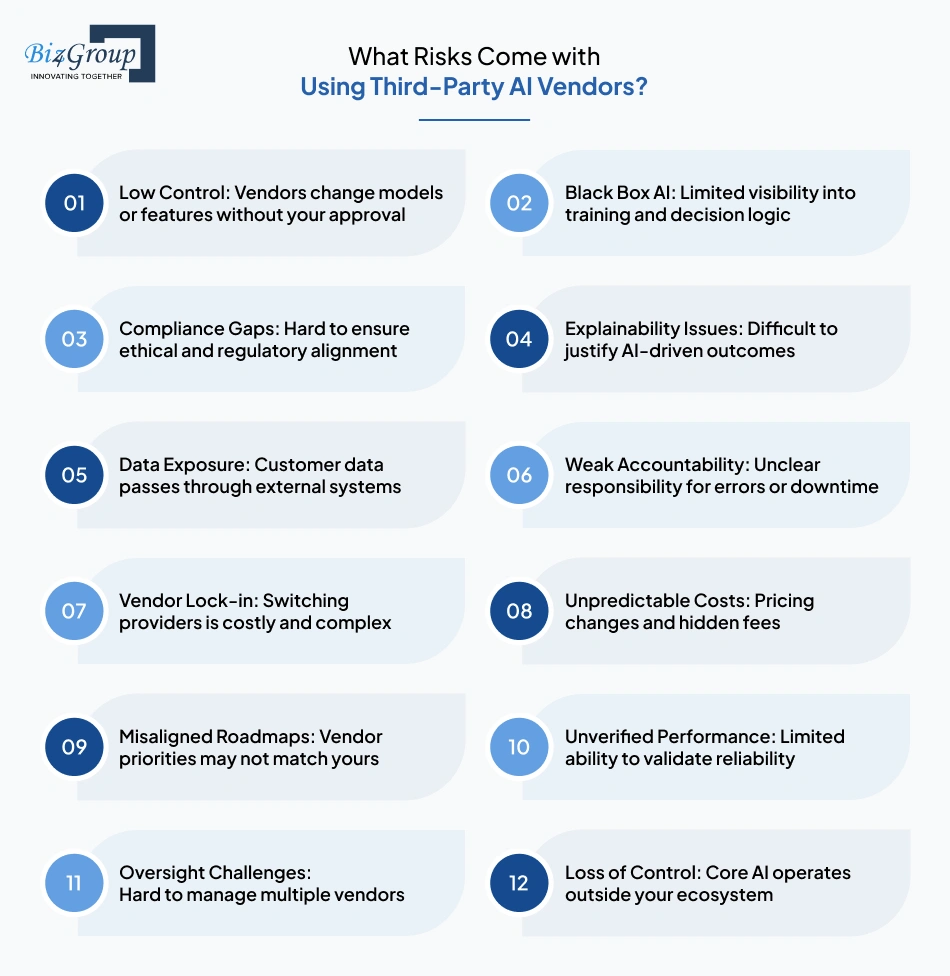
Many organizations adopt external AI platforms because they offer faster deployment and lower development effort. That convenience can also introduce a different set of challenges.
Understanding AI third-party vendor risks helps businesses evaluate where external dependencies may create operational, financial, security, or oversight concerns before those issues become difficult to manage.
Third-party AI vendors can accelerate adoption, but they also introduce dependencies that businesses cannot fully control. Visibility, accountability, security, vendor stability, and long-term flexibility often become just as important as the technology itself when evaluating external AI providers.
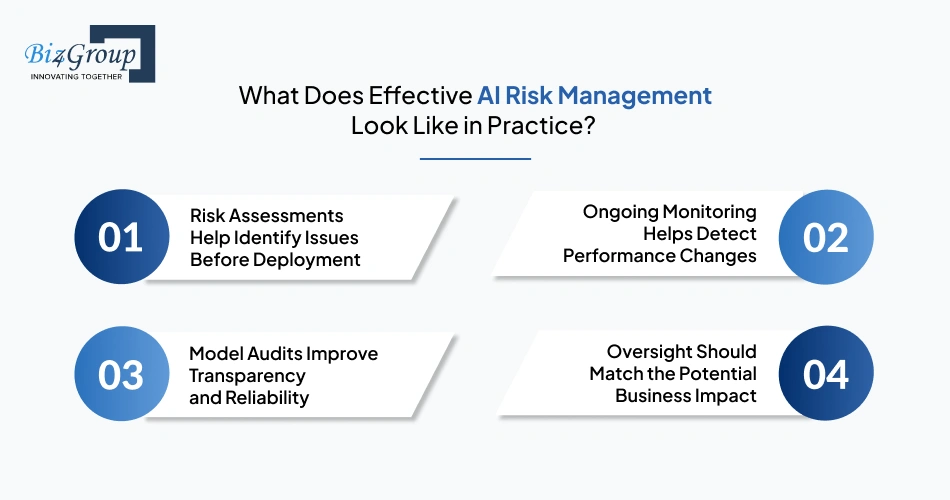
Effective AI risk management is usually built around four activities: assessing risk before deployment, monitoring performance after launch, auditing results periodically, and applying oversight where business impact is highest.
Together, these activities help organizations manage AI more consistently while strengthening AI accountability in business operations.
Risk assessments focus on understanding potential concerns before an AI system becomes part of business workflows. The objective is to identify areas that may require additional controls, review processes, or operational safeguards before deployment begins.
Typical assessment activities include:
Monitoring focuses on what happens after deployment. AI systems operate in changing environments, which means performance should be reviewed continuously rather than assumed to remain stable.
Organizations commonly monitor:
Audits provide a structured review of how an AI system is performing at a specific point in time. Unlike monitoring, which is continuous, audits are periodic evaluations used to confirm that systems remain reliable and aligned with business expectations.
Audit activities often include:
The level of oversight should reflect the importance of the decisions being supported. Higher-impact decisions generally require stronger review processes and greater human involvement.
Organizations often increase oversight when AI influences:
Effective AI risk management works best when assessments identify potential concerns, monitoring tracks ongoing performance, audits validate reliability, and oversight reflects business impact. Together, these activities help organizations manage AI more responsibly while maintaining visibility into how systems perform over time.
Put practical controls in place before AI becomes harder to govern
Build A Smarter AI Strategy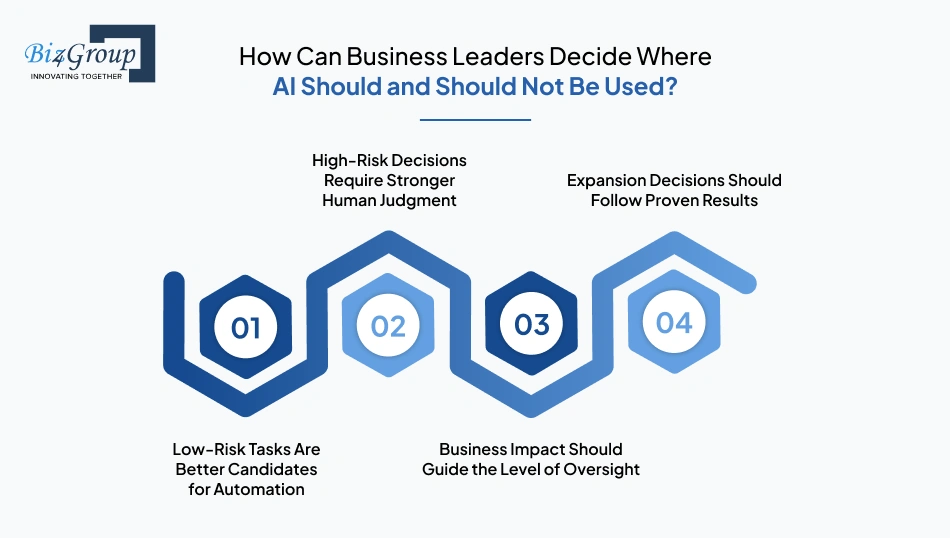
The most effective AI decisions usually begin with the work itself rather than the technology. Business leaders often evaluate how much judgment a task requires, how important the outcome is, and whether the process benefits more from speed, consistency, or human expertise. These factors help determine where AI belongs and where people should remain directly involved.
Tasks that follow clear rules and require limited judgment are often the easiest places to introduce AI. Activities such as document classification, scheduling, data organization, and routine support requests can usually be automated without changing how important business decisions are made.
Decisions involving hiring, lending, healthcare, legal matters, or employee outcomes often require context that extends beyond automated recommendations. Human judgment remains important because these situations involve interpretation, discretion, and accountability that cannot always be captured through predefined rules.
Oversight should reflect the importance of the outcome rather than the complexity of the technology. A routine administrative task may need minimal review, while decisions connected to revenue, operations, workforce management, or AI and corporate liability concerns often require greater involvement from business leaders.
Organizations often achieve better outcomes by expanding AI gradually rather than all at once. Many teams begin with limited use cases, measure performance, and then extend adoption based on proven results. This approach helps reduce AI implementation risks while giving leaders time to identify unintended consequences of AI before expanding usage further.
Business leaders do not need to apply AI to every process to create value. Strong decisions come from matching AI to the right tasks, keeping people involved where judgment matters most, and scaling adoption only after results demonstrate consistent business value.
AI is becoming part of everyday business operations, but successful adoption requires more than implementing new technology. Understanding where AI fits, where human judgment should remain involved, and how decisions are monitored can make a significant difference in long-term outcomes.
Many of the risks of artificial intelligence in business do not appear overnight. They often emerge through everyday decisions, operational dependencies, and assumptions that go unchallenged. That is why business leaders benefit from taking a deliberate approach instead of treating AI as a solution for every process.
The goal is not to avoid AI. The goal is to use it where it creates measurable value while maintaining visibility, accountability, and control. Doing so helps organizations gain the benefits of AI without being caught off guard by the unintended consequences of AI.
If your organization is evaluating new AI initiatives and wants practical guidance on reducing risk from the start, our team can help. Book an appointment today to discuss your goals, challenges, and the right path forward with an experienced AI development company.
Businesses should regularly review hiring outcomes, evaluate candidate selection patterns, and test AI-supported processes for consistency. Early reviews help identify unfair trends before they affect recruitment decisions, employee trust, or workplace compliance obligations.
Yes. A business can face legal action when an AI-supported decision affects employment, lending, or customer outcomes. For example, an AI system that contributes to denying a loan or terminating a protected employee can create legal exposure. In most cases, the company using the AI remains responsible for the final decision.
Business conditions, user behavior, and data patterns change over time. An AI system that performs well during testing may struggle later when real-world conditions differ from the environment in which it was originally evaluated.
Organizations can define business objectives, evaluate data readiness, establish performance expectations, and identify areas requiring human review. A structured planning process helps teams address potential concerns before AI becomes part of critical operations.
Incorrect outputs can influence planning, customer interactions, operational decisions, and internal workflows. When inaccurate information is accepted without verification, businesses may experience inefficiencies, poor decisions, and reduced confidence in AI-supported processes.
Review frequency should reflect the importance of the business function being supported. High-impact systems often require more frequent evaluation, while lower-impact applications may only need periodic reviews to confirm consistent performance.

with Biz4Group today!
Our website require some cookies to function properly. Read our privacy policy to know more.