 Location :
Orlando, FL, USA
Location :
Orlando, FL, USA +1 (407) 714-1616
 info@biz4group.com

- AI automation in 2026 reflects enterprises moving beyond pilots toward systems that support daily operational execution.
- Adoption is strongest in workflows that are repeatable, rule-driven, and tied to measurable cost or productivity outcomes.
- For large organizations, the core challenge is no longer AI capability but deploying automation reliably across systems and teams.
- Generative and agentic AI have expanded automation potential, yet enterprise deployments remain governed, controlled, and execution focused.
- Return on investment is increasingly measured through execution of metrics such as cycle time reduction, error rates, and operational throughput.
- Biz4Group LLC delivers enterprise AI automation by aligning these execution metrics with real-world workflow constraints at scale
AI automation has shifted from pilot projects to real business impact, with enterprises now using intelligent systems to streamline workflows and cut operational costs. Recent AI Adoption Statistics shows that 78% of organizations use AI in at least one business function, which is a significant jump from 55% just a year earlier, highlighting rapid adoption across departments.
Enterprises confident in AI automation are reporting measurable results. Leading adopters expect:
- 60% higher revenue growth than peers by 2027
- nearly 50% greater cost reductions from AI-led initiatives, including automation of core business processes
Looking ahead, enterprise automation investment is set to accelerate sharply. The global AI-powered enterprise automation market, which underpins systems that automate workflows and business processes, was valued at USD 20.24 billion in 2025. It is projected to reach USD 135.06 billion by 2034, growing at a 23.5 % CAGR.
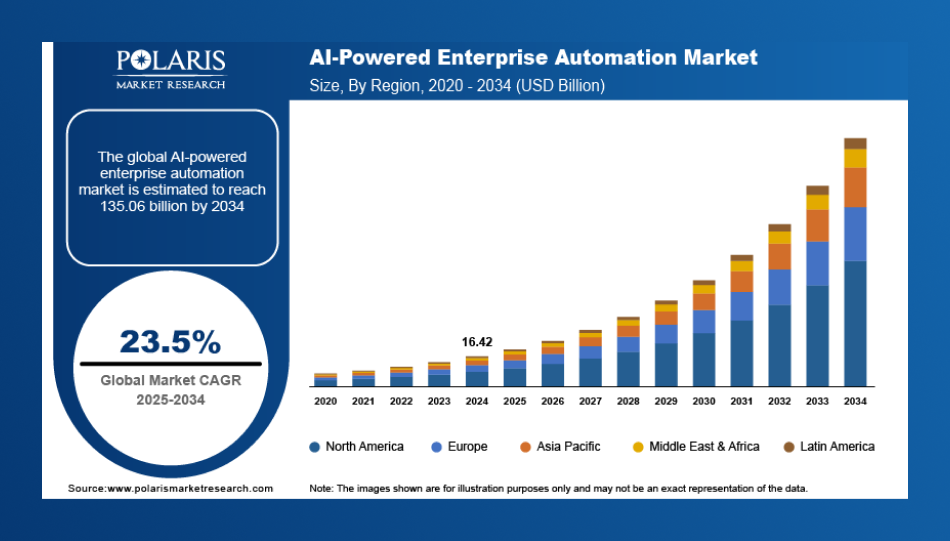
This growth trajectory shows that organizations worldwide are betting on AI automation to reduce operating costs and scale their core operations.
Now what follows isn’t abstract technology talk, rather it’s a quantifiable shift in how businesses run work. Therefore, leaders can no longer treat AI automation services as a technical experiment. They must think of it as a strategic lever for reducing waste, improving throughput, and scaling without increasing headcount.
In this blog, we focus solely on AI automation use cases for enterprises that deliver measurable outcomes. Each example ties back to operational efficiency, cost control, and scalability.
Why Should Businesses Invest in AI Automation for Their Workflows?
Enterprises are under constant pressure to improve efficiency while controlling costs at scale. AI automation addresses this challenge by transforming how workflows operate across functions. It enables faster execution, lower operational overhead, and consistent outcomes without adding organizational complexity.
1. Direct Cost Reduction Across Core Enterprise Operations
AI business process automation reduces the cost of running repetitive and high-volume processes. When enterprises apply business process automation with AI for enterprises, they minimize manual effort and process errors. This leads to lower operational spending and predictable cost structures across departments.
2. Scalable Operations Without Headcount Expansion
Growth often increases workflow volume and staffing requirements. AI automation for enterprise operations allows organizations to scale output without linear workforce growth. Automated workflows handle increased demand while existing teams focus on higher-value initiatives.
3. Faster Workflow Execution and Improved Productivity
Manual workflows slow execution and create bottlenecks. AI workflow automation tools for enterprises accelerate task completion and reduce handoffs. Faster workflows improve productivity across finance, HR, sales, and support functions.
4. More Consistent and Data-Driven Decision Making
AI-driven workflows use real-time data to guide actions. This improves consistency and reduces dependency on individual judgment. Many enterprise AI strategies focus on embedding intelligence directly into workflows to improve operational decisions.
5. Stronger Process Control and Compliance Readiness
Automated workflows enforce standard processes and audit trails. This reduces risk and supports compliance requirements. Real-world implementations of AI automation solutions for enterprises show how workflow automation improves governance without slowing operations, as demonstrated in this example of AI-driven business process automation.
6. Long-Term Operational Resilience and Future Readiness
Enterprises investing in AI automation applications in enterprises build a foundation for long-term adaptability. Automated workflows are easier to optimize, extend, and integrate with future technologies as business needs to evolve.
AI automation is not a short-term efficiency tactic. It is a strategic investment in operational resilience and sustainable growth. Enterprise AI solutions that modernize workflows today are better positioned to control costs, scale efficiently, and maintain competitive advantages.
Also Read: The Future of AI: Why 75% of Enterprises Are Investing in AI-Powered Solutions?
Top 10 AI Automation Use Cases for Enterprises
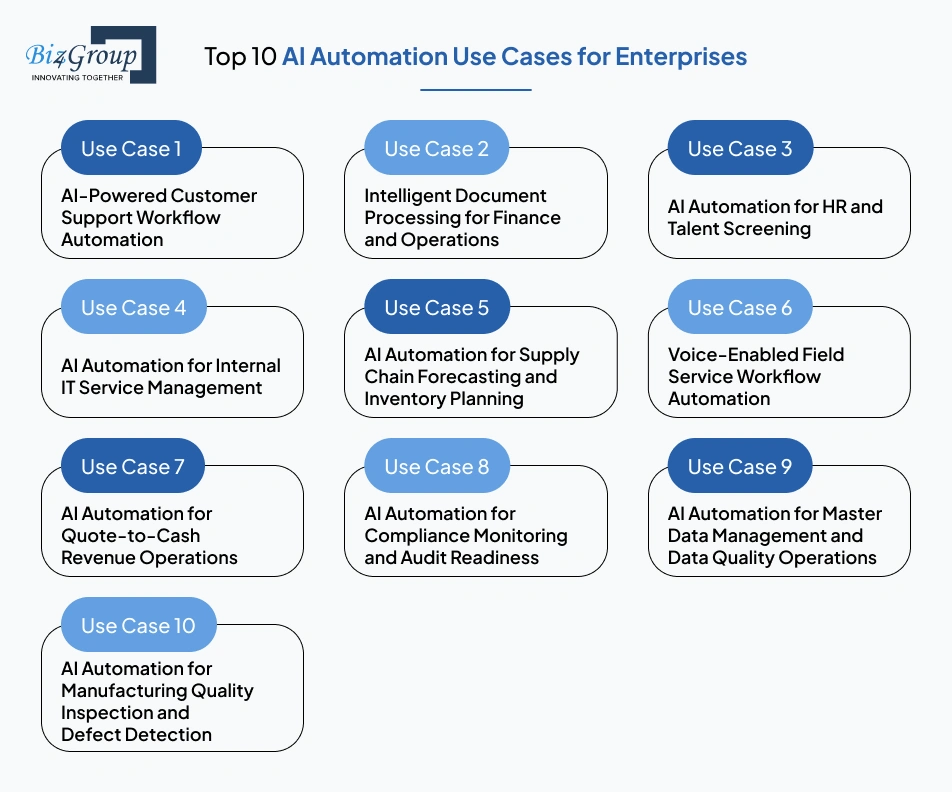
If you are exploring AI automation, the real question is where it makes business sense. Enterprises do not automate everything at once. They start with workflows that create delays, errors, or unnecessary costs.
The most effective AI Automation Use Cases for Enterprises usually share a few traits:
- High-volume and repetitive workflows
- Clear rules with predictable outcomes
These use cases reduce manual effort, improve consistency, and support cost reduction while scaling operations.
Use Case 1: AI-Powered Customer Support Workflow Automation
Customer support is often where enterprise workflows feel the most pressure. Ticket volumes rise quickly, response times slow down, and costs increase with every added agent. This makes customer support one of the most practical AI Automation Use Cases for Enterprises.
AI workflow automation helps enterprises handle growing support demand without expanding teams. It focuses on removing repetitive work while keeping human agents involved where judgment matters.
What this use case actually automates
This use case applies AI business process automation for enterprises across daily support workflows. Automation works behind the scenes to keep operations running smoothly.
Typical automation areas include:
- Automatic ticket categorization and prioritization
- Intelligent routing to the right support teams
- Handling repetitive customer queries
- Escalating complex issues to human agents
- Updating CRM and support systems automatically
At Biz4Group LLC, these automations come together in real deployments, such as in Custom Enterprise AI Agent
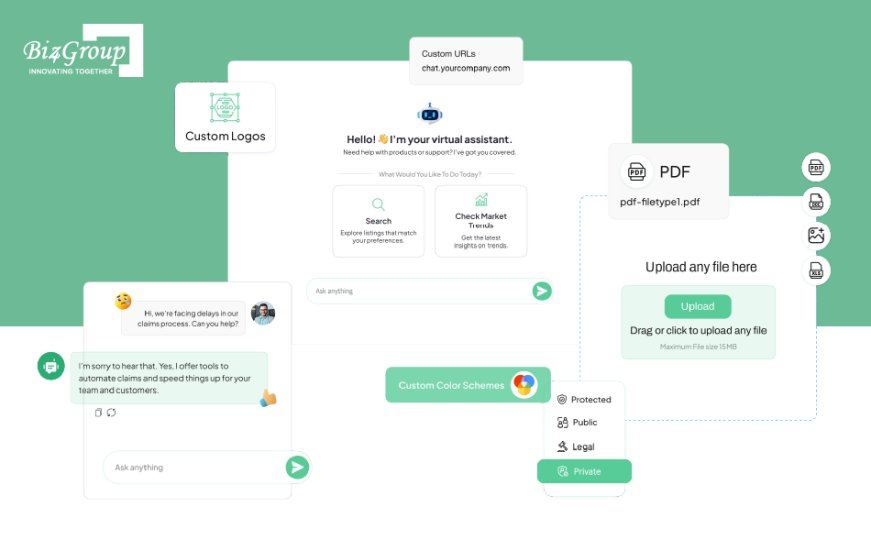
This solution automates customer support and internal inquiries using intelligent workflow automation. It handles repetitive questions, retrieves accurate information, and routes complex requests to the right teams. The implementation shows how AI automation can streamline support operations while maintaining security and compliance.
Why this use case fits enterprise operations
Customer support workflows are high-volume, and rule driven. That makes them ideal for automation as AI systems learn from past interactions and improve response quality over time.
This use case directly strengthens AI automation for enterprise operations. It integrates easily with CRM, helpdesk, and knowledge systems already in place. Results appear early, which is why many large organizations start here.
Key benefits
- Lower support costs through reduced manual handling
- Faster response times across channels
- Higher agent productivity with fewer repetitive tasks
- Scalable operations without linear headcount growth
Therefore, customer support automation delivers quick wins while creating a foundation for broader automation initiatives.
Use Case 2: Intelligent Document Processing for Finance and Operations
Finance and operations teams handle documents every day. Invoices, purchase orders, contracts, and approvals move across systems constantly. Manual processing slows teams down and increases the risk of errors. That is why this remains one of the most reliable AI Automation Use Cases for Enterprises.
AI automation helps enterprises manage document-heavy workflows and build AI invoicing platforms without adding manual effort. It focuses on accuracy, speed, and consistency across financial and operational processes.
What this use case actually automates
This use case applies to AI automation applications in enterprises that rely on structured and unstructured documents. AI systems read files, extract relevant data, and route information through existing workflows.
Common automation areas include:
- Invoice data extraction and validation
- Matching invoices with purchase orders
- Contract data classification and indexing
- Exception handling and approval routing
- Updating ERP and finance systems automatically
Through training AI models improve over time by learning from corrections and historical data. This reduces manual review while keeping financial controls intact. For teams exploring how document automation foundations work, the overview of AI document analysis tool development explains how extraction and classification workflows are structured at scale.
Why this use case fits enterprise operations
Document-heavy workflows are predictable and rule-driven. That makes them well suited for automation as AI reduces processing delays and improves accuracy. It also helps teams handle document anomalies more effectively, supporting risk-aware analysis like what is covered in AI document fraud detection software development.
This use case strengthens AI automation for enterprise operations by integrating with ERP, accounting, and procurement systems already in place. Enterprises often see faster processing cycles and fewer errors early. This early impact is why it frequently appears among the best AI automation use cases for enterprises.
Key benefits
- Lower processing costs through reduced manual data entry
- Faster document turnaround times across finance workflows
- Improved accuracy and compliance with fewer exceptions
- Scalable operations without increasing finance headcount
Intelligent document processing helps enterprises regain control over high-volume workflows. It delivers measurable efficiency gains while supporting long-term operational scalability.
Also Read: Finance AI Agent Development: A Roadmap to Building Intelligent Systems
Use Case 3: AI Automation for HR and Talent Screening
Hiring becomes difficult as organizations grow. Recruiters review large resume volumes, coordinate interviews, and manage follow-ups manually. These steps slow hiring and increase cost, which is why this remains one of the most practical AI Automation Use Cases for Enterprises.
AI automation helps enterprises streamline hiring workflows without removing human decision-making. It focuses on repetitive tasks so HR teams can spend more time evaluating candidates, a shift many organizations are already making based on broader HR technology adoption trends.
What this use case actually automates
This applies to AI-driven automation across early-stage recruitment workflows. AI systems handle tasks that require time and consistency rather than judgment.
Typical automation areas include:
- Resume screening and candidate shortlisting
- Skill matching against role requirements
- Interview scheduling and coordination
- Candidate communication and status updates
- Updating applicant tracking and HR systems
Teams exploring structured hiring automation often look at approaches used to automate recruitment process with AI to understand how these workflows scale. Candidate communication also becomes more efficient when automated updates and responses replace manual follow-ups, similar to how HR chatbot supports routine candidate interactions.
At Biz4Group LLC, we brought these recruitment automations together in practical enterprise hiring systems like DrHR
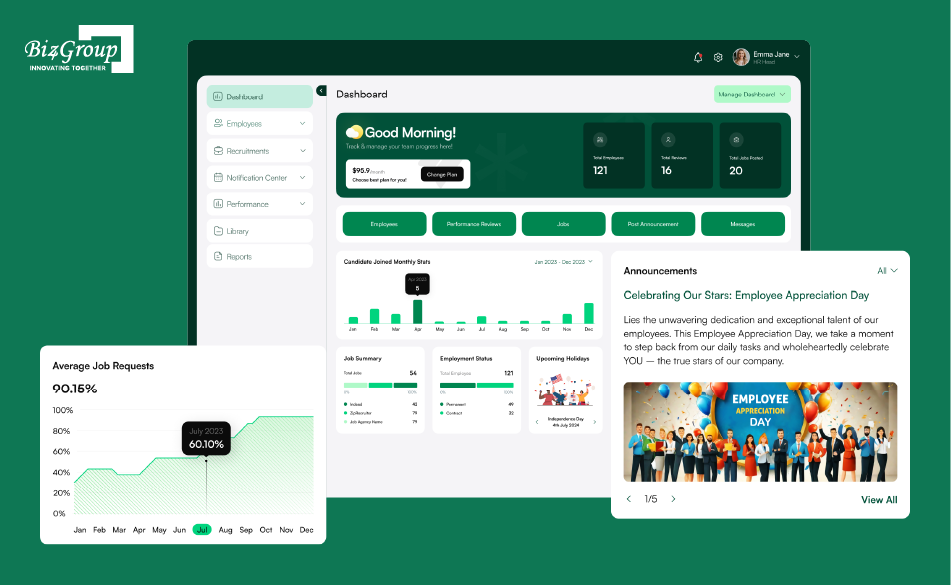
DrHR is an AI-assisted recruitment platform designed to automate high-volume hiring workflows. It handles resume intake, candidate tracking, and interview coordination within a single system.
The platform reduces manual HR effort by organizing applicant data, managing hiring stages, and supporting consistent communication across teams. It helps enterprises streamline recruitment operations while maintaining visibility and control over the hiring pipeline.
Why this use case fits enterprise operations
Hiring workflows are repetitive and time sensitive, which makes them suitable for AI automation. It reduces manual screening effort and shortens hiring cycles without lowering quality standards.
This use case supports enterprise automation strategies using AI by reducing operational load on HR teams. It integrates smoothly with HRMS and applicant tracking systems already in place, especially when combined with thoughtful HR software integration planning.
Key benefits
- Shorter time-to-hire through automated screening and scheduling
- Lower recruitment costs by reducing manual effort
- More consistent hiring decisions across teams
- Scalable recruitment operations without expanding HR headcount
AI-driven HR automation helps enterprises grow their workforce efficiently while maintaining control and transparency across hiring processes.
Also Read: HR Chatbot Development Cost Explained: Factors, and Optimization Tips
Enterprise Automation Readiness Assessment
Identify which enterprise workflows are ready for AI automation and how they integrate with existing systems.
Explore Automation ReadinessUse Case 4: AI Automation for Internal IT Service Management
As organizations scale, internal IT support becomes harder to manage. Employees raise access requests, system issues, and software tickets throughout the day. When teams handle these manually, delays increase and costs rise quietly in the background.
This is where AI automation becomes valuable for internal operations. Instead of reacting to every request, enterprises automate routine IT workflows so support teams can focus on system reliability and complex issues.
What this use case actually automates
This applies to AI powered workflow automation for enterprises across internal IT service management. AI systems handle predictable requests and guide users through resolution steps without manual intervention.
Typical automation areas include:
- Access provisioning and permission requests
- Password resets and account unlock
- Software installation and configuration requests
- Ticket categorization and routing
- Knowledge base recommendations for common issues
Many enterprises start by testing self-service for routine IT queries through an AI chatbot PoC for internal operations, which helps validate automation impact before rolling it out across the service desk.
Why this use case fits large enterprise environments
Internal IT workflows are repetitive, and volume driven. AI reduces response times and improves consistency across internal workflows by automating common IT support tasks at scale, a core focus of the AI service desk guide.
For many large organizations, this becomes one of the most effective AI automation use cases to reduce enterprise costs. Automating routine IT support cuts manual workload and minimizes downtime-related productivity loss.
Unlike customer support automation, this use case serves employees. The value shows faster issue resolution, fewer disruptions, and more resilient internal systems.
Key benefits
- Lower IT support costs by automating repetitive service requests
- Faster employee issue resolution through self-service workflows
- Improved system reliability with consistent request handling
- Scalable internal operations without expanding IT headcount
AI-driven IT service automation helps enterprises support growth from the inside. It quietly removes friction from daily operations while enabling teams to scale without hidden cost increases.
Also Read: How to Create an AI Avatar for an IT Support Agent?
Use Case 5: AI Automation for Supply Chain Forecasting and Inventory Planning
Supply chain teams face constant pressure as demand patterns shift faster than planning cycles. Forecast errors lead to excess inventory, stock shortages, and missed delivery commitments and manual planning struggles to keep pace with real-time signals. Supply chain planning is one area where AI automation use cases for enterprises deliver measurable value without disrupting existing operations.
AI automation helps enterprises plan demand and inventory using continuous data inputs instead of fixed assumptions. It improves forecast accuracy while reducing the manual effort required to manage complex supply networks.
What this use case actually automates
This use case automates demand forecasting and inventory planning workflows that depend on historical trends and live operational data. AI systems analyze sales patterns, seasonality, supplier lead times, and demand volatility to generate updated forecasts continuously.
Typical automation areas include:
- Demand forecasting across regions and sales channels
- Inventory optimization and replenishment planning
- Supplier lead time analysis and risk identification
- Stockout and excess inventory prediction
- Scenario modeling for demand fluctuations
Modern supply chain teams rely on real-time forecasting engines that process transactional and external data continuously, using AI demand forecasting software development to adjust projections as market conditions change. Forecast accuracy also improves when demand signals connect directly with transportation and warehousing workflows shaped by AI in logistics and supply chain operations.
Why this use case fits enterprise operations
Supply chain decisions directly affect operating costs and service levels. Small forecasting errors can scale into significant losses as order volumes grow. AI reduces this risk by identifying patterns across data sets that manual planning often misses.
This approach works particularly well in large organizations, where inventory complexity spans multiple locations, suppliers, and fulfillment channels. Inventory control at this scale depends on predictive planning and automated replenishment logic built into AI inventory management software development across enterprise environments.
These systems operate alongside ERP, warehouse, and order management platforms through robust AI integration services, ensuring planning automation fits within existing operations. This makes supply chain planning one of the most practical AI automation use cases for large organizations focused on cost control and operational stability.
Key benefits
- Lower inventory holding costs through improved demand alignment
- Reduced stockouts with proactive replenishment signals
- Higher forecast accuracy across products and regions
- Scalable planning operations without increasing analyst workload
AI-driven supply chain automation helps enterprises move from reactive planning to predictive control while keeping inventory decisions aligned with real business demand.
Also Read: Everything you need to know about a Courier or Logistics App Development
Use Case 6: Voice-Enabled Field Service Workflow Automation
Field service operations often experience delays during post-service reporting and system updates. Technicians complete jobs on site, but operational data reaches enterprise systems later than required. This makes field service a relevant area within AI automation use cases for enterprises where execution speed and data consistency directly affect cost control and scalability.
Enterprises close this gap by embedding automation directly into daily work using autonomous task flows that reflect patterns discussed in agentic AI use cases operating across multi-step enterprise processes.
What this use case actually automates
This use case automates work order updates through voice inputs captured during field activity. Technicians speak about job status, service notes, and parts usage while performing the task.
Typical automation areas include:
- Creating work orders through voice input at job start
- Updating service status without logging into systems
- Capturing parts usage and syncing inventory immediately
- Triggering billing workflows once work is completed
- Updating asset maintenance records as tasks progress
These workflows reflect how modern teams apply AI across operations, as seen in recent AI success stories focused on execution efficiency.
Why this use case fits enterprise operations
Field service workflows repeat daily across regions, assets, and teams. Manual reporting introduces delays that increase as operations scale. Voice-enabled execution supports mobile workforce planning focused on operational consistency.
Existing service rules already provide the structure of AI automation that needs to be run reliably. This places field service among practical enterprise AI automation use cases for distributed operations.
Key benefits
- Faster service reporting without adding technician effort
- Shorter billing cycles through immediate system updates
- More accurate inventory data from real-time usage capture
- Consistent service records across locations and teams
- Better maintenance planning supported by reliable execution data
This automation model works well alongside intelligent task handling approaches used in enterprise AI assistant development supporting coordinated system actions.
Also Read: A Guide to Enterprise AI Agent Development
Execution-First AI Automation Design
Design AI automation that operates reliably within real enterprise workflows, approvals, and system constraints.
Discuss Automation StrategyUse Case 7: AI Automation for Quote-to-Cash Revenue Operations
Revenue delays often originate between deal approval and order creation. Quotes move across sales, finance, and legal teams for validation while pricing approvals wait in inboxes. These gaps slow revenue recognition and introduce avoidable errors as deal volume increases.
Quote-to-cash workflows reflect the kind of cross-team execution work that AI automation use cases for enterprises are designed to handle. AI automation helps revenue teams remove manual coordination from this process. Instead of relying on follow-ups and rework, execution rules run automatically as deals progress using agentic AI workflow automation system for business.
What this use case actually automates
This use case automates the operational steps that convert approved deals into executable orders. AI evaluates quotes against pricing policies, approval thresholds, and contractual conditions before triggering downstream actions.
Typical automation areas include:
- Validating discounts against margin and pricing rules during quote creation
- Routing approvals based on deal value, risk, and exception criteria
- Ensuring approved quote data matches contract and order records
- Detecting missing fields or conflicting terms before order submission
- Triggering order creation once commercial and compliance checks pass
- Automation focuses on enforcing execution logic, not influencing sales decisions.
Why this use case fits enterprise operations
Quote-to-cash processes follow defined approval hierarchies and pricing rules. AI automation works well because decision rules already exist, and by deploying AI agents in enterprises across revenue operation systems are tightly connected.
This makes quote-to-cash one of the more practical enterprise AI automation use cases for scaling revenue without adding operational overhead.
Key benefits
- Faster deal execution without increasing back-office workload
- Reduced pricing and order entry errors
- Consistent enforcement of discount and approval policies
- Improved revenue visibility across CRM, CPQ, and ERP systems
- Scalable revenue operations as deal volume grows
This use case helps enterprises convert demand into revenue efficiently while maintaining control as operations scale.
Also Read: How to Develop an AI Automotive CRM Software for Dealers, OEMs, and Mobility Brands?
Use Case 8: AI Automation for Compliance Monitoring and Audit Readiness
Compliance challenges rarely come from missing policies; instead, they usually come from inconsistent execution. Compliance teams rely on periodic reviews, manual evidence collection, and post-fact audits to confirm adherence.
AI automation helps compliance teams shift from reactive audits to continuous control monitoring. Instead of checking compliance after issues occur, enterprises automate how evidence is collected, validated, and tracked across operations.
What this use case actually automates
This use case automates ongoing compliance checks and audit preparation across enterprise systems. AI automation monitors transactions, access logs, and operational activities against predefined compliance rules. The system flags deviations as they occur and maintains audit-ready records automatically.
Typical automation areas include:
- Monitoring transactions against regulatory and internal control rules
- Tracking user access changes and privilege escalations
- Collecting compliance evidence from operational systems continuously
- Flagging policy violations or anomalies for review
- Maintaining audit trails without manual documentation effort
Automation focuses on control enforcement and evidence of readiness, not regulatory interpretation.
Why this use case fits enterprise operations
Compliance requirements are rule-based and repeated across departments and systems. Manual audits create blind spots between review cycles. AI automation works well because compliance rules, thresholds, and controls already exist in structured form which supports a structured AI implementation roadmap.
Enterprise systems generate the data needed for continuous monitoring without additional tooling. This positions compliance monitoring among effective enterprise AI automation use cases for risk reduction and operational transparency.
Key benefits
- Reduced compliance risk through continuous control monitoring
- Faster audit preparation without last-minute evidence collection
- Lower manual workload for compliance and risk teams
- Improved visibility into operational policy adherence
- Scalable compliance operations as regulations and systems expand
This use case helps enterprises maintain control and audit readiness while supporting growth without increasing compliance overhead.
Use Case 9: AI Automation for Master Data Management and Data Quality Operations
Enterprise operations depend on accurate master data as customer records, vendor profiles, product catalogs, and pricing attributes flow across CRM, ERP, finance, and supply chain systems. When this data becomes inconsistent or outdated, errors spread quickly and are difficult to trace.
AI automation helps enterprises move from reactive data cleanup to continuous data quality enforcement. Instead of fixing issues after they impact operations, automation applies rules and validations as data enters and changes across systems.
What this use case actually automates
This use case automates master data validation, enrichment, and synchronization across enterprise platforms through enterprise AI integration. AI monitors data changes, detects inconsistencies, and applies correction rules before errors propagate downstream.
Typical automation areas include:
- Validating customer, vendor, and product records against defined data standards
- Detecting duplicate or conflicting master data entries across systems
- Enriching records using trusted internal or external data sources
- Synchronizing approved master data changes across connected platforms
- Flagging exceptions that require human review or approval
Why this use case fits enterprise operations
Master data workflows are rule-driven and repeat continuously. Manual governance struggles as the number of systems and data touchpoints increases. AI automation works well because data standards, validation rules, and ownership models already exist.
Enterprise platforms generate constant signals that automation can monitor in real time. This places master data management among practical enterprise AI automation use cases for operational reliability and scale.
Key benefits
- Improved data accuracy across enterprise systems
- Fewer downstream errors in finance, sales, and supply chain operations
- Reduced manual effort spent on data cleanup and reconciliation
- Faster onboarding of customers, vendors, and products
- Scalable data governance without increasing administrative overhead
This use case helps enterprises protect operational decisions by ensuring the data driving those decisions remains consistent and reliable as the organization grows.
Use Case 10: AI Automation for Manufacturing Quality Inspection and Defect Detection
Manufacturing quality issues often originate during production rather than at final inspection. Enterprises rely on sampling, visual checks, and operator judgment to identify defects. Quality inspection therefore becomes an area where execution-focused AI automation delivers measurable impact.
AI automation enables manufacturers to move quality checks into real-time production workflows. Instead of inspecting a subset of output, systems evaluate every unit without slowing throughput. This reflects how AI driven automation use cases remove scale limitations from manual quality control.
What this use case actually automates
This use case automates quality inspection using visual and sensor-based data during manufacturing. AI models analyze images, video streams, or machine signals to detect deviations from quality standards through AI computer vision development services. The system identifies defects immediately and triggers predefined responses without human review.
Typical automation areas include:
- Detecting surface defects, misalignments, or dimensional variations
- Identifying anomalies in machine output or production patterns
- Comparing components against defined quality benchmarks
- Flagging defective units for rework or removal automatically
- Recording inspection data for traceability and reporting
Why this use case fits enterprise operations
Manufacturing quality standards are clearly defined and repeated across production cycle, a pattern widely addressed in the AI in manufacturing industry. Manual inspection does not scale reliably with high-volume output. AI automation works because inspection criteria already exist, and sensor data is continuously available.
Manufacturing systems can act immediately when defects are detected. This makes automated quality inspection a practical option for enterprises to scale production.
Key benefits
- Reduced scrap and rework through early defect detection
- Consistent inspection results across shifts and facilities
- Lower inspection costs without reducing coverage
- Faster response to quality issues during production
- Scalable quality control as output volumes grows
This use case helps enterprises maintain product quality while expanding manufacturing capacity.
Measuring ROI from AI Automation Use Cases for Enterprise Operations
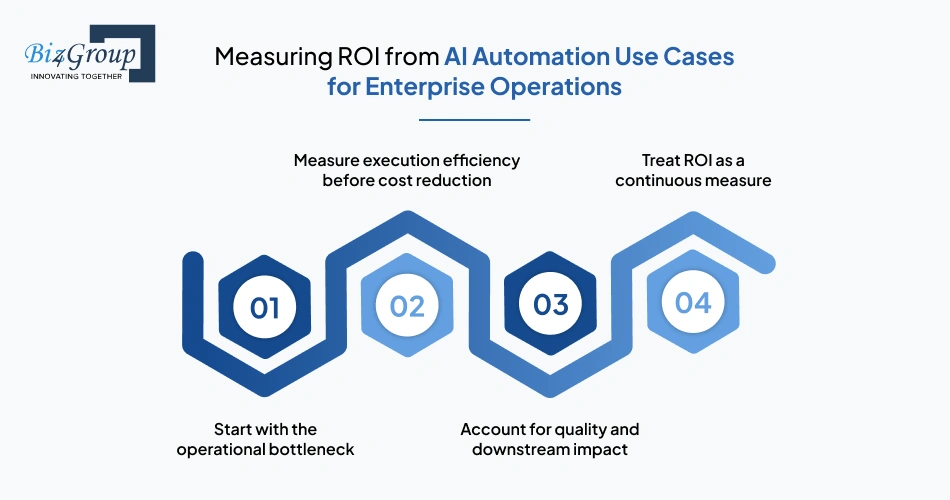
Measuring ROI from AI automation works best when enterprises focus on execution outcomes, not technology performance. Value appears when automation removes friction from daily work and allows teams to handle more volume without adding overhead.
This is why AI automation use cases for enterprises should always be evaluated against operational constraints that already affect cost and scale.
1. Start with the operational bottleneck
ROI becomes visible when AI automation targets a bottleneck that has a measurable operational cost. This often shows up as high cost per transaction, long processing times, or frequent rework.
Before AI automation, enterprises document how long a task takes end to end, how many manual steps are involved, and how often exceptions occur. These baselines make post-automation improvements clear and defensible.
2. Measure execution efficiency before cost reduction
Early ROI rarely shows up as immediate headcount reduction. It shows up when average processing time drops, exception handling volume declines, or teams process more transactions per day with the same staff.
For example, approval of workflows that previously took days may be completed in hours once manual handoffs are removed. This is how organizations identify top AI automation use cases for enterprises that scale operations without linear cost growth.
3. Account for quality and downstream impact
AI Automation also delivers ROI by improving execution quality. Lower error rates reduce rework, billing corrections, and compliance follow-ups. Consistent data handoffs between systems reduce delays caused by mismatched records or missing fields. Over time, fewer exceptions mean less time spent on firefighting downstream issues.
4. Treat ROI as a continuous measure
ROI from AI automation increases as coverage expands and workflows mature. Early gains come from faster execution and lower manual effort per transaction. Later gains appear to be improved in predictability, fewer operational surprises, and smoother system-to-system handoffs. Enterprises that track these metrics continuously make better decisions about where to automate next.
ROI from AI automation, clear ROI emerges when AI automation decisions stay grounded in operational reality. Enterprises that review results continuously gain sharper insight into where AI automation delivers lasting impact and where future expansion makes the most sense.
ROI-Focused AI Automation Roadmap
Define an enterprise AI automation roadmap tied to execution metrics, cost reduction, and scalable operational outcomes.
Plan Automation ROIHow Biz4Group Delivers Enterprise AI Automation Solutions at Scale?
Biz4Group, one of the top AI automation companies in USA, understands how work actually flows across enterprise systems today. We account for approvals, integrations, exceptions, and compliance requirements before designing AI-driven automation that fits into existing technology stacks instead of disrupting them.
This execution-first mindset translates into production-grade AI automation across functions such as operations, customer support, analytics, and quality control. In practice, this has resulted in enterprise projects where AI automation directly reduced manual effort, improved turnaround times, and enabled scalable growth.
We have delivered a variety of AI automation in projects that include but are not limited to:
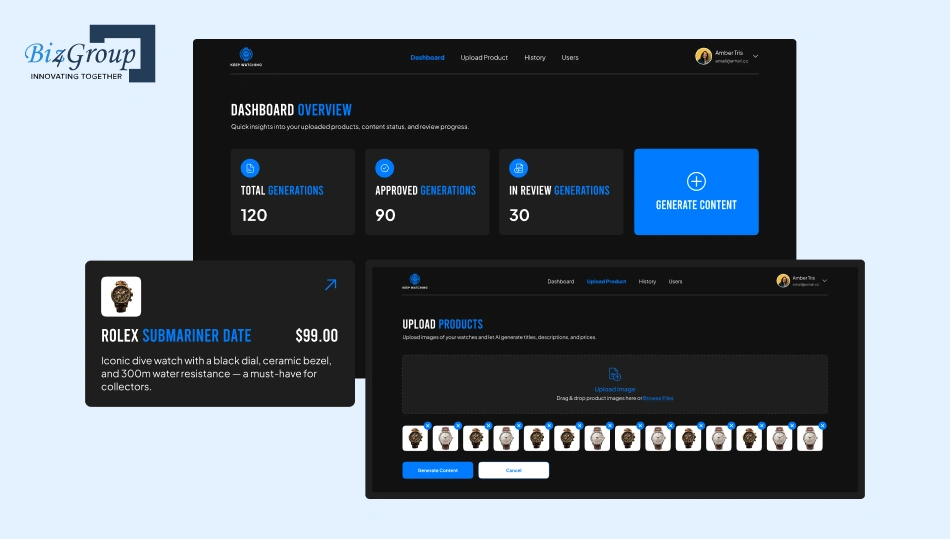
- Keep Watching, where we automated large-scale eCommerce product listing workflows by generating and publishing listings automatically, removing the need for repetitive manual catalog updates., where we automated large-scale eCommerce product listing workflows by generating and publishing listings automatically, removing the need for repetitive manual catalog updates.
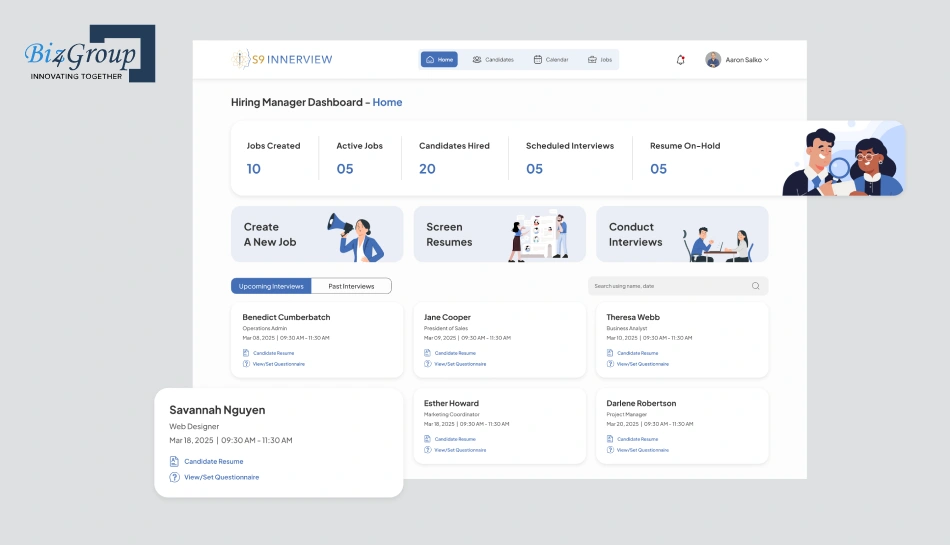
- Stratum 9 InnerView, where AI was applied to automate candidate screening and interview scheduling logic, reducing coordination effort while keeping human judgment in hiring decisions., where AI was applied to automate candidate screening and interview scheduling logic, reducing coordination effort while keeping human judgment in hiring decisions.
Our work frequently combines Generative AI Development Services with workflow automation. This allows content generation, data interpretation, and structured outputs to happen directly inside business processes rather than as disconnected AI features.
Through our AI consulting services, we help enterprises decide:
- Where AI automation should act autonomously
- Where human review remains essential
- How to integrate AI into existing platforms without disrupting operations
This execution-first approach allows Biz4Group LLC to deliver enterprise AI automation examples that scale across teams without losing control or trust.
Also Read: How To Build Agentic AI: Experience Insights by Biz4Group
Conclusion
Building future-ready enterprises is not about chasing the next AI automation trend. It is about making steady, practical improvements in how work gets done every day. Organizations that move ahead treat AI automation use cases for enterprises as operational decisions tied to efficiency, scale, and reliability, not short-term technology experiments. They often work with an experienced AI development company to align automation initiatives with real business workflows.
Enterprises focus on removing friction, improving consistency, and creating systems that scale without adding hidden complexity. Over time, this mindset shapes enterprise automation strategies using AI that feel natural to teams and resilient to change. Automation becomes part of how the business runs, not something layered on top.
The real shift happens when leaders stop asking what AI can do and start asking where execution slows them down today. If you’re exploring how automation can support your enterprise in a realistic, scalable way, a short conversation often brings clarity faster than research alone. Therefore, booking a call can be a simple first step toward that direction.
Frequently Asked Questions (FAQ’s)
1. What are the most impactful AI Automation Use Cases for Enterprises today?
The most impactful use cases focus on automating repeatable, execution-heavy workflows such as customer support operations, internal IT service management, supply chain planning, revenue operations, compliance monitoring, and manufacturing quality control.
2. How does Enterprise AI automation use cases help reduce operational costs at scale?
Enterprise AI automation use cases reduce costs by removing manual handoffs, lowering error and rework rates, shortening cycle times, and allowing teams to handle higher volumes without proportional headcount growth.
3. How is business process automation with AI for enterprises different from traditional automation?
Business process automation with AI for enterprises goes beyond rule-based scripts by handling exceptions, learning from patterns, and executing multi-step workflows across systems with minimal human intervention.
4. How do organizations measure ROI from AI automation for enterprise operations?
ROI is measured through operational metrics such as cost per transaction, average processing time, exception handling volume, error rates, and system-to-system handoff efficiency rather than short-term technology savings.
5. What are some real enterprise AI automation examples that deliver long-term value?
Enterprise AI automation examples that deliver long-term value include AI-powered workflow automation for internal IT services, automated compliance monitoring, master data quality enforcement, and manufacturing defect detection systems.
6. How should large organizations approach AI automation use cases for sustainable scale?
AI automation use cases for large organizations should start with clearly defined operational bottlenecks, integrate with existing systems, apply automation incrementally, and maintain human oversight where judgment remains critical.
