Location :
Orlando, FL, USA
Location :
Orlando, FL, USA +1 (407) 714-1616
 info@biz4group.com

















Imagine a digital system that doesn’t wait for instructions but instead, understands your business goals, learns from real-time feedback, and takes independent actions to get the job done.
Read More

 AI Summary Powered by Biz4AI
"Is your AI working for you or being worked against you?"
If you're not actively securing it, there's a good chance you can't answer that question with confidence. AI is not just a productivity tool. It's becoming part of how businesses make decisions, interact with customers, and automate operations. And as its role expands, so does the number of ways it can be manipulated, abused, or exploited.
That's why security for AI has become one of the most important conversations organizations need to have in 2026.
According to recent reports, 97% of organizations that experienced an AI-related security incident acknowledged that they lacked proper AI access controls. And 63% had no AI governance policies in place whatsoever. These organizations are not the ones that were ignoring security. They were organizations that deployed AI faster than they secured it.
The cost of that gap is growing. Shadow AI contributed to 20% of data breaches in 2025 and increased breach costs by an average of $670,000 per incident. In nearly two-thirds of those cases, personally identifiable information was exposed.
Besides that, attacks aren't just happening through AI anymore. They're happening against it. Organizations affected by AI-related security incidents face average breach costs exceeding $4.4 million, while companies without AI-powered security and AI automation capabilities experience significantly higher losses than those with mature AI security programs.
For founders, CEOs, CTOs, and security leaders, the takeaway is unmistakable, that is, Security for AI isn't a future consideration. It's a present emergency with a dollar sign attached.
At Biz4Group, we've worked with organizations building AI-powered products, workflows, and enterprise solutions, and one lesson consistently stands out, that is, security is far easier to build in from the start than to retrofit after deployment.
The good news is that these risks can be managed. The question isn't whether your organization will use AI. It's whether your organization can use it securely. Now, let's explore what security for AI actually means.
Security for AI is the practice of protecting artificial intelligence systems which includes their AI models, training data, inference pipelines, and deployment infrastructure from unauthorized access, manipulation, exploitation, and failure.
It means making sure:
Basically, it's about protecting everything that makes an AI system work.
When many leaders first hear the term security for AI, they assume it's just an extension of traditional cybersecurity. That's a reasonable assumption, but it's not entirely accurate.
Traditional cybersecurity was designed to protect systems that behave predictably. AI systems don't. They interpret context, generate responses, make recommendations, and increasingly take actions with varying outcomes depending on the information they're given.
Therefore, securing AI systems requires organizations to think beyond code, networks, and infrastructure. They must also consider how AI models behave, make decisions, and interact with users and data.
The table below highlights some of the key differences:
Aspect |
Traditional Cybersecurity |
AI Security |
|---|---|---|
System Behavior |
Deterministic and rule-based |
Non-deterministic and context-driven |
Primary Focus |
Protecting code, networks, devices, and infrastructure |
Protecting models, data, behavior, and decision-making processes |
Expected Outputs |
Consistent outputs for the same inputs |
Outputs may vary based on context, prompts, and available data |
Attack Surface |
Applications, endpoints, networks, databases |
Models, prompts, training data, agents, APIs, and infrastructure |
Common Threats |
Malware, phishing, ransomware, credential theft, exploits |
Prompt injection, adversarial attacks, model theft, data poisoning, agent manipulation |
Security Objective |
Prevent unauthorized access and system compromise |
Prevent manipulation, misuse, data exposure, and unsafe AI behavior |
Monitoring Approach |
Detect deviations from known system behavior |
Monitor outputs, model behavior, context, and autonomous actions |
Risk Assessment |
Focused on vulnerabilities and exploits |
Focused on vulnerabilities, model behavior, intent, and decision outcomes |
Traditional cybersecurity is designed to stop attackers from getting in. Whereas AI security makes sure AI systems behave as intended.
That's important because attackers don't always need to compromise the system itself. Sometimes, influencing what the AI sees or how it interprets information is enough to change the outcome.
A useful way to think about security for AI is through three interconnected layers.
Layer |
What It Includes |
Why It Needs Protection |
|---|---|---|
Data |
Training datasets, fine-tuning data, customer information, internal documents, knowledge bases, and real-time inputs |
If data is exposed, altered, or poisoned, the AI can generate inaccurate outputs, make poor decisions, or leak sensitive information. |
Models |
Foundation models, fine-tuned LLMs, proprietary models, and embedded AI services |
Attackers may attempt to steal models, manipulate outputs, extract training data, or compromise model behavior. |
Infrastructure |
Cloud environments, APIs, vector databases, agent frameworks, development pipelines, identity systems, and third-party integrations |
Infrastructure keeps AI systems running. Weaknesses here can expose data, disrupt operations, or provide attackers with access to connected AI services. |
Organizations are rapidly deploying AI-powered applications, AI copilots, and autonomous AI agents into critical workflows. Protecting those systems is becoming just as important as using AI to defend the business. As AI adoption accelerates, understanding what needs protection is only the first step.
The next question is even more important: What exactly are attackers targeting, and why are AI systems becoming such an attractive target in the first place? Let's take a closer look.
For years, cybercriminals primarily targeted networks, endpoints, databases, and user credentials. Today, they're targeting something much more valuable thing, that is, Your AI systems.
Why? Because modern AI sits at the center of business operations. It has access to customer data, internal knowledge bases, proprietary information, business workflows, APIs, and most importantly, the authority to take actions on behalf of users.
In many organizations, AI has become a high-value concentration point for data, access, and decision-making. That's exactly what makes it attractive to attackers. And unlike traditional cyberattacks, many modern AI security risks and threats don't require attackers to breach a network or exploit software vulnerability. In some cases, influencing how an AI system interprets information is enough to achieve their objective.
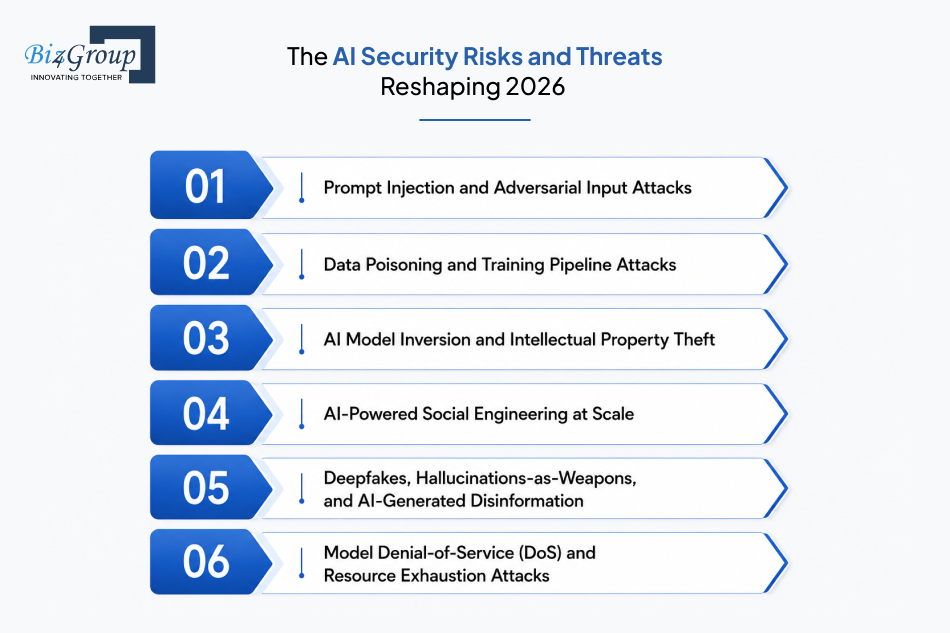
Let's look at the threats security leaders are prioritizing in 2026.
Prompt injection remains the number one vulnerability in the OWASP Top 10 for LLM Applications because it targets the instructions and reasoning process of the AI model itself.
In a prompt injection attack, a malicious actor embeds instructions within user inputs or external data sources, which causes the AI model to ignore its original instructions and behave in unintended ways.
There are two primary forms:
The second category is often more dangerous because the attack remains invisible to both users and administrators.
If you are asking question like "We are building a customer facing AI chatbot and I am worried about prompt injection attacks where someone manipulates our AI into leaking sensitive information or behaving in unintended ways and I want to know what protection strategies actually work against this", then here is your answer for it.
How to Defend Against It
"We are a company building our own AI models and I am concerned about data poisoning attacks corrupting our training data and I want to know how organizations actually detect and prevent this before it affects our AI model outputs in production."
If this question has crossed your mind as well, then you must know that this attack involves inserting malicious, manipulated, or biased data into an AI system training pipeline.
The objective may be to:
What makes these attacks particularly dangerous is their ability to remain dormant. A poisoned model may pass standard testing and validation while behaving normally for months before an attacker activates the hidden trigger.
Today's attackers target multiple stages of the AI lifecycle:
This is one reason protecting AI infrastructure, training pipelines, and knowledge repositories has become a critical part of modern enterprise AI security strategy.
How to Defend Against It
Many organizations invest millions of dollars in building proprietary AI capabilities, and attackers are aware of that.
AI Model inversion attacks attempt to reconstruct information used to train AI model, this can expose:
A closely related threat is AI model extraction, where attackers repeatedly query a system and use its responses to train a separate model that mimics the original's behavior. This can enable adversaries to recreate capabilities developed through years of research and investment without direct access to the underlying model.
The implications extend beyond security concerns, as they can threaten valuable intellectual property and the competitive advantage of organizations developing custom AI products.
How to Defend Against It
Not every AI threat targets AI itself, some use AI as the weapon. Generative AI has transformed social engineering by making it faster, cheaper, and dramatically more convincing.
Attackers can now generate:
What once required significant effort can now be executed at scale. The combination of AI-generated content, publicly available data, and automation has fundamentally changed how organizations must think about identity verification and trust. For many enterprises, the human element remains the most vulnerable layer in the security stack.
How to Defend Against It
Deepfake technology has evolved far beyond internet novelty. Today, attackers use AI-generated audio, video, and images to impersonate executives, manipulate employees, influence decisions, and commit financial fraud.
With that, another threat is emerging, that is, the deliberate exploitation of AI hallucinations. Most organizations view hallucinations as accuracy problems, and attackers view them as opportunities.
By carefully crafting inputs, threat actors can induce AI systems to generate:
Organizations that are relying on AI-assisted decision-making, the consequences can extend far beyond technical security.
How to Defend Against It
Some attacks are not designed to steal information. Instead, they aim to disrupt AI systems and make them unusable.
Model Denial-of-Service attacks exploit the computational cost of AI inference by submitting inputs specifically designed to consume excessive resources. These are often called "sponge attacks" because they absorb processing power, memory, and tokens at a disproportionate rate.
The consequences can include:
As organizations rely more heavily on AI, maintaining availability becomes as essential as safeguarding confidentiality and integrity.
How to Defend Against It
The challenge does not end there, the future of cyber threats may involve autonomous systems that can identify, adapt, and execute attacks on their own. That's where agentic AI security risks begin to reshape the conversation entirely.
So far, we've discussed threats that target AI models, data, and infrastructure.
Now comes the bigger challenge. What happens when AI doesn't just generate answers? What happens when it starts taking action?
That's where the conversation around agentic AI security risks begins. And it's where the threat landscape in 2026 starts to look very different from anything security teams have dealt with before.
Traditional AI systems are largely reactive. You ask a question, and the model generates a response. A human reviews that response and decides what to do next.
Agentic AI changes that equation. Instead of responding to prompts, agentic systems can plan, reason, and execute multi-step tasks with minimal human intervention. An agentic AI can:
The shift from assistant to actor introduces an entirely new category of AI security risks and threats.
The rate of AI adoption continues to accelerate. According to Gartner, nearly 40% of enterprise applications are expected to incorporate task-specific agentic AI by the end of 2026.
Major technology providers are already integrating agentic AI into productivity tools, customer platforms, software development environments, and business workflows. However, adoption is progressing faster than security readiness, which is leaving many organizations without mature strategies to secure autonomous AI systems.
Growing use of agentic AI is expanding the risk landscape. The same capabilities that make agentic AI powerful such as autonomy, decision-making, and system interaction, are also introducing new security challenges. Some of these challenges were addressed during the development of an Enterprise AI Agent by Biz4Group, designed to support secure data processing and reliable AI operations across regulated industries.
We developed a enterprise AI agent for customer support, employee assistance, legal information retrieval, document processing, and multilingual interactions across healthcare, finance, and legal industries.
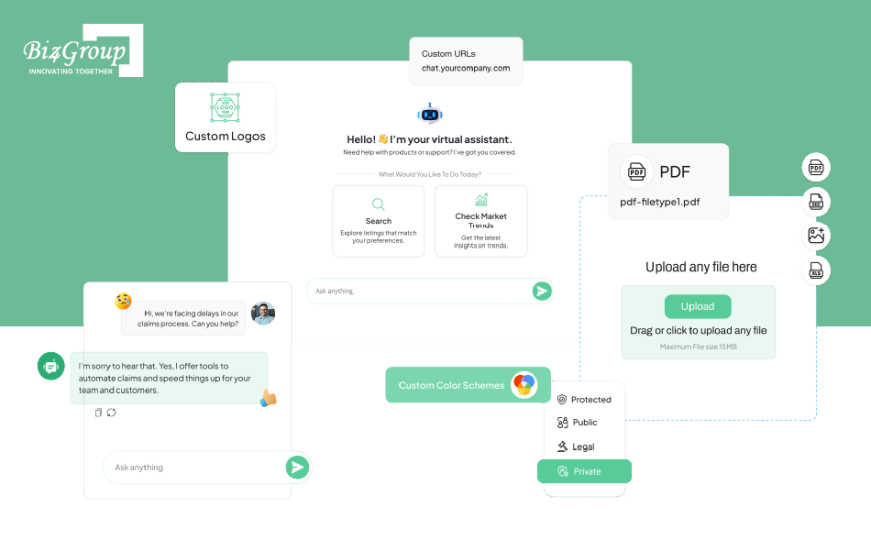
While developing the solution, we faced several agentic AI security challenges. Here's how we approached and resolved them:
This project demonstrated that as AI agents become more integrated into business operations, privacy, compliance, and data protection become essential parts of the solution.
As organizations scale their use of AI agents, four key risks require careful attention.
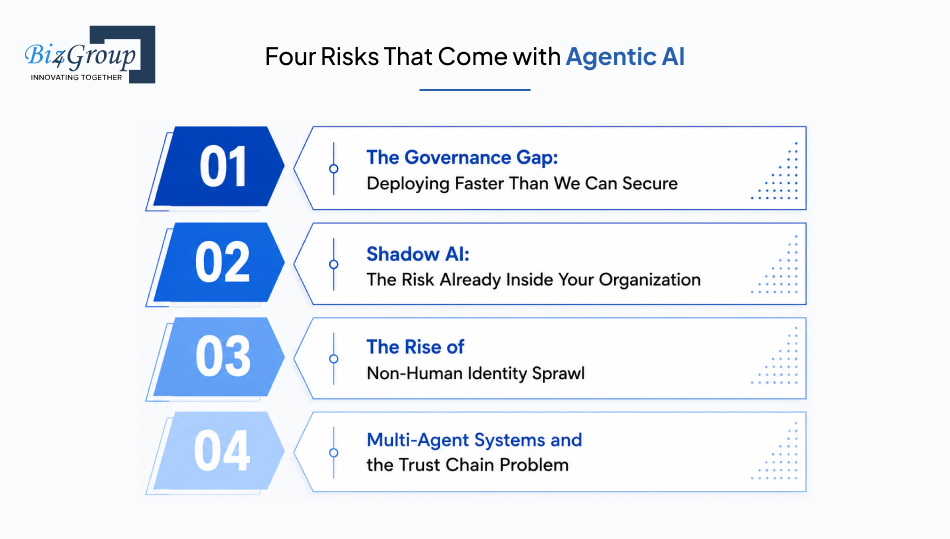
As AI systems gain greater autonomy, organizations must pay closer attention to the security and governance challenges that come with it.
One of the biggest challenges in enterprise AI adoption is the gap between deployment speed and governance maturity. Many organizations have confidence in their AI governance frameworks, yet many deployed agents still operate without consistent monitoring, oversight, or clear accountability.
As AI systems gain greater autonomy and access to business resources, organizations often lack visibility into what these agents can do, which systems they can interact with, and how decisions are being made. This makes agentic AI security not just a technology challenge, but a governance challenge.
One of the most common questions business leaders are asking today is:
"I am running a mid-sized company and our employees have started using AI tools across different departments without IT approval. How do I actually detect shadow AI usage and secure it before it becomes a real data exposure problem?"
It is a growing security blind spot known as shadow AI.
Shadow AI refers to employees using unauthorized or unmanaged AI tools without security oversight. Many AI capabilities are now embedded directly into applications employees use every day, and it is making them difficult for traditional monitoring tools to detect.
Why Is It a Growing Risk?
The risk isn't usually malicious intent. It's convenience. Employees trying to summarize contracts, analyze customer data, generate code, or accelerate research may unknowingly expose sensitive information to systems operating outside approved governance controls.
Consequently, confidential business information, intellectual property, customer records, and personally identifiable information are increasingly flowing into AI tools that organizations neither manage nor monitor. This is creating a growing attack surface outside the official security programs.
How Do You Address It?
Organizations need visibility into where AI tools are being used, what data is being shared, and whether those tools operate within approved governance policies. Once AI usage is identified, organizations can implement governance controls, approve secure alternatives, and monitor usage to reduce risk.
The goal isn't to eliminate AI adoption, it is to replace unmanaged AI usage with governed solutions that provide the same value while operating within approved security, privacy, and compliance frameworks.
As AI becomes more integrated into business workflows, privacy, compliance, and secure data handling become essential requirements instead of optional considerations.
Every agentic AI introduced into an organization requires access to applications, access to APIs, access to databases, and access to business systems.
To function efficiently, AI needs credentials, permissions, authentication tokens, and service accounts. Collectively, these are known as non-human identities and they're multiplying rapidly.
Unlike employees, AI systems don't recognize suspicious behavior, question unusual requests, or report compromised credentials. If an attacker gains control of a non-human identity, they inherit every permission attached to it. In many cases, that level of access exceeds what any individual employee possesses.
This is creating a new challenge for organizations focused on protecting AI infrastructure and maintaining visibility across increasingly complex AI ecosystems.
Many organizations aren't deploying a single AI agent. They're deploying teams of agents.
One agent gathers information, another analyzes it, a third executes tasks, and a fourth validates outcomes. Together, they form multi-agent AI system that is capable of automating increasingly complex business processes.
The challenge that occurs in the multi-agent system is trust. Each agent assumes that the information it receives from another agent is legitimate. If one agent becomes compromised, malicious instructions, permissions, or actions can propagate throughout the workflow. A single compromised agent can influence downstream systems that trust its outputs, creating what security researchers describe as a trust chain attack.
This is one of the reasons the OWASP Agentic Top 10 identifies multi-agent trust relationships as a growing security concern. As AI systems become more autonomous and interconnected, organizations must verify not only users but also AI agents communicating with one another.
Understanding these risks requires looking beyond theory and into real-world implementations. Biz4Group developed Coach AI, a platform powered by five specialized AI agents, providing practical insights into managing autonomy, coordination, and security challenges. Let's explore the approach we took to overcome these challenges and build a robust multi-agent AI solution.
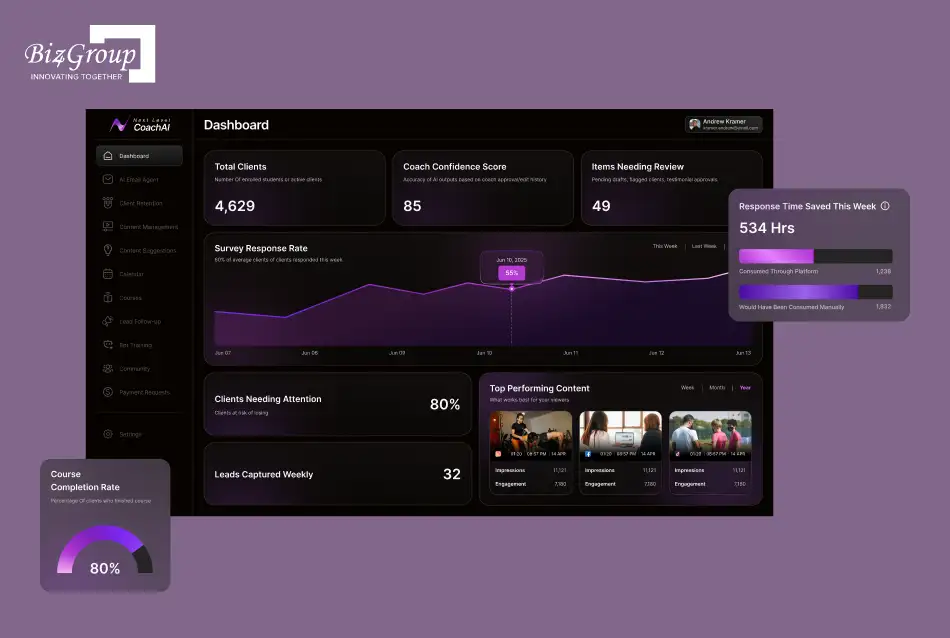
We developed Coach AI, it is a system where each agent performed a specific role while contributing to a shared workflow, introducing challenges around consistency, coordination, and oversight common in multi-agent systems.
Building it introduced several challenges. Here's how we approached and solved them:
Challenge: Each AI agent handled a different function but needed to replicate the coach's tone, style, expertise, and communication approach consistently across interactions.
Approach: We created custom training datasets using the coach's past content, coaching materials, and common client interactions to help agents deliver personalized and consistent responses.
Challenge: AI agents needed access to coaching materials and historical interactions to provide relevant and meaningful responses.
Approach: We trained the agents using a combination of coaching resources, past content, and client interaction data to improve personalization and response quality.
Challenge: The platform required AI agents to support diverse functions, including content creation, email management, lead follow-ups, client retention insights, and client interactions.
Approach: We developed five specialized AI agents, each focused on a specific business function within the coaching workflow.
Challenge: Ensuring that AI-generated responses remained aligned with the coach's style and expectations required ongoing refinement.
Approach: We implemented continuous learning algorithms, regular testing, and feedback loops to help improve agent performance and maintain response quality over time.
The project reinforced an important lesson that is as organizations deploy more specialized AI agents, security extends beyond individual models.
The biggest shift in 2026 is not a smarter AI, but a more autonomous AI. And for that, organizations need security strategies that go beyond protecting data and infrastructure. Governance, oversight, and control are becoming just as important. So how do you build an enterprise AI security architecture that can keep up?
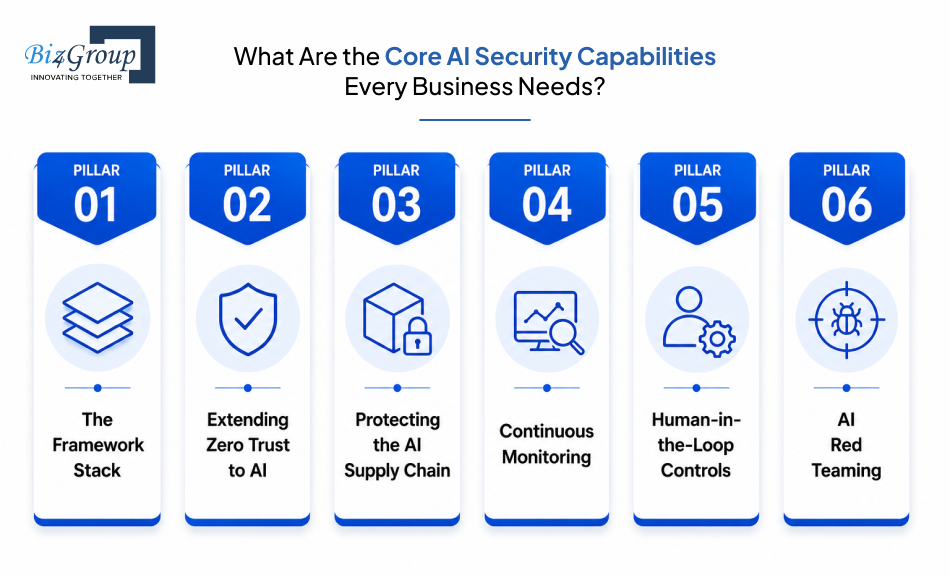
Understanding AI security risks is only the first step. The next is building the capabilities needed to manage those risks consistently as AI adoption grows.
Each capability plays a different role in protecting AI systems, either it is governance, access control to monitoring or testing. Together, they create the foundation for a scalable and resilient AI security program.
Rather than relying on a single framework or tool, organizations should focus on building a set of core capabilities that work together. The six pillars below form the foundation of a mature AI security program and help organizations secure AI systems throughout their lifecycle.
Create a foundation for governance, risk management, compliance, and security decision-making.
Many organizations view AI security frameworks as competing options when they are actually designed to solve different problems. Some focus on governance, others on technical vulnerabilities, threat intelligence, compliance, or secure development practices. The most effective approach is to use them together rather than choosing one over another.
Framework |
Primary Focus |
What It Helps With |
|---|---|---|
NIST AI RMF |
Risk management and governance |
Identifying, assessing, and managing AI risks throughout the AI lifecycle |
OWASP LLM Top 10 |
Application security |
Addressing vulnerabilities such as prompt injection, data leakage, and insecure integrations |
MITRE ATLAS |
Threat intelligence and adversarial testing |
Understanding attack techniques, threat modeling, and red teaming scenarios |
ISO 42001 |
AI governance and compliance |
Establishing auditable AI management systems and governance processes |
Google SAIF |
Secure AI development |
Embedding security throughout AI development, deployment, and operations |
Governance frameworks help organizations understand what must be managed, security frameworks highlight what must be protected, and compliance standards provide accountability and consistency across the organization.
Continuously verify identities, permissions, and actions across AI systems and agents.
Most Zero Trust programs were built around human users, devices, and applications. AI introduces a new category of identities that also require governance, which includes AI models, agents, APIs, and automated workflows. As organizations deploying autonomous systems, implicit trust becomes a growing risk.
For AI environments, Zero Trust means:
These controls become especially important for agentic systems, where it may interact with customer data, internal applications, development environments, and business-critical workflows.
The principle remains the same: trust should never be assumed. Every user, system, and AI agent must continuously earn it.
This pillar secures the external models, datasets, tools, and dependencies that power AI systems.
Most organizations rely on foundation models, open-source frameworks, public repositories, third-party APIs, external datasets, and fine-tuning services. While these dependencies accelerate innovation, they also expand the attack surface.
Unlike traditional software supply chain attacks, compromised AI models can remain dormant until specific inputs trigger malicious behavior. This makes detection more difficult and increases the importance of proactive verification.
A strong supply chain security strategy should include:
The goal is not to eliminate external dependencies, but to ensure every component entering the environment can be trusted.
This pillar helps with the detection of abnormal behavior, misuse, and emerging threats in real time.
Traditional security assessments provide only a point-in-time view of AI systems. However, AI deployments operate in dynamic environments where inputs, integrations, user behavior, and system dependencies continuously change. A model that performs safely during initial testing may produce unexpected outcomes as its operational context evolves. That's why organizations are moving beyond periodic reviews and adopting continuous monitoring practices.
Effective monitoring typically includes:
Rather than focusing only on whether an AI system was secure at deployment, organizations need continuous visibility into how it behaves in production. This helps detect unusual activity early and respond before it becomes a larger security issue.
With this pillar, we ensure critical decisions remain subject to appropriate oversight.
One of the biggest misconceptions about AI adoption is that greater autonomy reduces the need for human involvement. But the more authority an AI system receives, the more important governance becomes.
Organizations should establish clear boundaries around which actions AI systems can perform independently and which require human approval. Activities involving large financial transactions, production deployments, security policy changes, legal communications, or large-scale data modifications should remain subject to review regardless of how confident the system appears.
Human-in-the-loop controls create accountability, reduce operational risk, and provide an additional safeguard when AI systems encounter situations, they were not designed to handle. The objective isn't to slow down AI adoption. It's to ensure autonomy operates within clearly defined guardrails.
The purpose of this pillar is to identify weaknesses before attackers can exploit them.
Even the strongest security controls need testing. And to do so, AI red teaming helps organizations understand how models, agents, and workflows behave when exposed to adversarial conditions and unexpected inputs.
A mature red teaming program typically includes:
These exercises reveal weaknesses that traditional security assessments often miss because they focus on manipulating AI behavior rather than exploiting infrastructure alone.
The objective is not just to uncover vulnerabilities. It's to understand how AI systems fail, how those failures could impact the business, and how resilience can be improved before attackers have the opportunity to exploit them.
A strong enterprise AI security strategy is built on layers, not single solutions. The organizations getting AI security right are the ones treating it as an ongoing capability, not a one-time project.
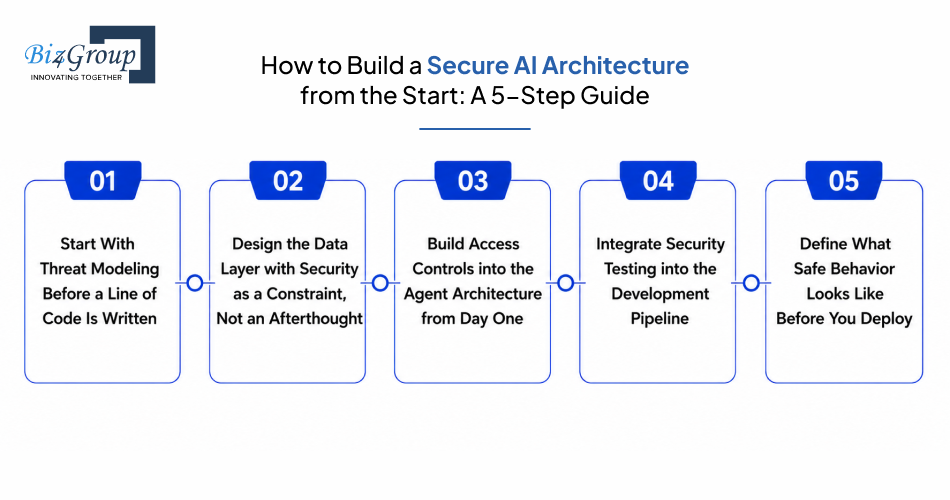
Most AI security problems don't start with a sophisticated attack. They start with a moment that feels completely harmless, that is, "Let's just ship this and tighten security later."
A team launches a feature, and an agent gets access to internal systems. A model is trained on proprietary data, and everything works. But the security quietly slips to the next sprint.
Then the system grows and connects to more data, more workflows, and more decisions. By the time someone asks, "Wait, how secure is this?". It's already deeply embedded in places you can't easily unwind.
That's the pattern, but it is not inevitable. Most of these risks are entirely preventable, only if security shows up early, when decisions are still easy to change.
Here's how organizations are building security into AI systems from the start.
Most AI security issues can be traced back to decisions made during design. Before discussing models, prompts, or infrastructure, take the time to understand what could go wrong and where the biggest risks are likely to emerge.
Run a structured threat-modeling exercise focused specifically on the AI components involved. Ask questions such as:
Threat modeling at the design stage takes an hour. And fixing the same issues after deployment costs significantly more in engineering effort, incident response, and potential breach impact. The OWASP LLM Top 10 is a practical framework to use as a design checklist rather than a post-launch audit.
Every AI system is only as trustworthy as the data it operates on. If data governance is weak, securing the model alone won't solve the problem.
Many decisions that determine exposure to data leakage, poisoning, and unauthorized access are made during architecture design, way before attackers become a concern.
At this stage, establish:
These are architectural decisions that are relatively easy to make early and far more expensive to retrofit later.
As AI systems become more autonomous, permissions become one of the most important security controls. The question shifts from what the AI can see to what the AI can do.
A common mistake is granting broad permissions to get an agent working, with plans to tighten access later. But later rarely comes.
If an AI agent can access business systems, call APIs, execute workflows, or interact with customer data, access control needs to be designed into the architecture from the beginning.
Build these controls in from day one:
These controls reduce the blast radius of both mistakes and malicious activity while creating accountability across autonomous workflows.
Traditional software can often be tested before it is released and revisited later. AI systems don't work that way. Because AI models evolve, prompts change, retrieval sources are updated, and integrations expand. Each change can introduce new security risks that functional testing alone may not uncover.
That's why AI security testing belongs inside the development pipeline rather than at the end of it.
It includes:
Every significant AI change should be treated as both a product event and a security event.
Many organizations invest in monitoring but never define what they're actually monitoring for. Before an AI system enters production, establish a clear definition of acceptable behavior. Without that baseline, it's difficult to determine whether unusual activity represents a harmless variation or a genuine security issue.
Document:
This becomes the behavioral baseline used by monitoring, auditing, and incident response teams. It should be treated as a living document and updated whenever the system changes significantly.
The organizations are integrating governance, access controls, testing, and monitoring into the AI development process from the beginning to build a strong safeguard.
Not every AI security capability needs to be built from scratch. Understanding where to build, where to buy, and where to partner can significantly accelerate your security maturity.
Almost every organization eventually faces the same question: "Should we build AI security capabilities internally or buy existing solutions?"
The answer is usually a mix of both. The table below shows where each approach makes the most sense.
Approach |
Best Used For |
Why It Makes Sense |
|---|---|---|
Buy |
Prompt monitoring, input/output filtering, AI governance platforms, compliance reporting, and security monitoring |
These capabilities are widely available and mature enough that building them internally rarely provides a competitive advantage. |
Build |
Custom behavioral baselines, model-specific detection capabilities, proprietary monitoring workflows, and industry-specific risk controls |
These requirements are often unique to your AI environment, business processes, and risk profile. |
Partner |
AI red teaming, adversarial robustness testing, AI governance assessments, ISO 42001 readiness, and agentic AI security reviews |
Specialized expertise can accelerate implementation, reduce risk, and help avoid costly trial-and-error efforts. |
The key is to start with the capabilities that deliver the most immediate value. Most organizations don't need to build everything from scratch. A balanced mix of buying proven solutions, building what's unique to your environment, and partnering for specialized expertise is often the fastest path to a stronger AI security posture. Let's take a look at what the future holds for AI security.
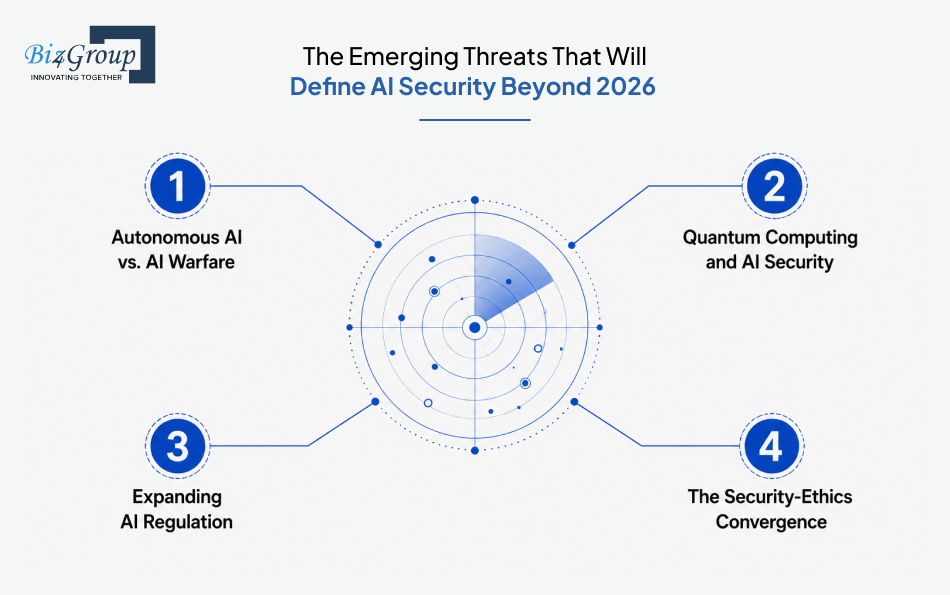
Technology rarely stands still. By the time most organizations become comfortable defending against one generation of threats, the next generation has already started taking shape.
The future of AI security won't be defined solely by better models or more sophisticated attacks. It will be shaped by entirely new operating environments where AI systems interact with each other, make decisions independently, and increasingly influence critical business processes without direct human involvement.
The question isn't whether the threat landscape will evolve. It is about how prepared organizations will be when it does.
Emerging Development |
What to Watch Beyond 2026 |
Potential Impact |
|---|---|---|
Autonomous AI vs. AI Warfare |
AI agents attacking and defending systems without direct human intervention |
Machine-speed attacks and responses could outpace traditional security operations. |
Quantum Computing and AI Security |
Advances in quantum computing challenge today's encryption standards |
Long-term protection of AI models, data, and intellectual property will require post-quantum security planning. |
Expanding AI Regulation |
Governments continue introducing AI-specific compliance requirements |
Organizations will face greater accountability around AI governance, transparency, and risk management. |
The Security-Ethics Convergence |
Security, fairness, accountability, and transparency become increasingly interconnected |
Businesses will need unified governance models rather than treating these as separate initiatives. |
While these developments may not represent immediate risks for every organization, they're already shaping the future of security for AI. Understanding them today can help businesses make better decisions about governance, infrastructure, and long-term AI security investments.
One pattern we see repeatedly is that AI security isn't intentionally ignored. It gets postponed. Teams launch AI features, deploy agents, or integrate models into existing workflows with plans to address security later. But as those systems become business-critical, "later" rarely comes.
At Biz4Group, a leading AI development company in the USA with 20+ years of experience, 1,000+ projects delivered, and 500+ global clients, we've seen how quickly AI systems become interconnected with business data, workflows, and third-party platforms.
Projects such as the Enterprise AI Agent and Next Level Coach AI reinforced an important lesson that security for AI works best when it's built into the development process from the start. Our approach focuses on evaluating risks early, designing secure architectures, incorporating AI-focused testing, and addressing governance requirements throughout the AI lifecycle.
As organizations adopt more autonomous systems, we also help establish the controls needed to manage them responsibly, from secure agent workflows and access controls to governance frameworks and enterprise AI security strategies.
Our main objective is to help businesses deploy, scale, and manage AI securely while continuing to innovate with confidence.
AI is evolving faster than most businesses can govern, secure, and monitor it. What began as a productivity tool is quickly becoming part of the decision-making and operational fabric of modern enterprises.
The organizations that thrive in this next phase of AI adoption won't be the ones with the most models, agents, or automation. They'll be the ones that can trust what they've built.
That's why security for AI is not just a technical consideration. It's a business capability. It enables organizations to innovate faster, scale responsibly, and adopt AI with confidence rather than caution.
At Biz4Group LLC, we've seen firsthand that the most successful AI initiatives aren't necessarily the most ambitious. They're the ones built on a strong foundation of governance, visibility, and security from day one.
The future belongs to businesses that treat AI security as a foundation, not a feature.
Ready to assess your AI security posture or build a secure foundation for your next AI initiative? Connect with us to explore how we can help you develop, secure, and scale AI solutions with confidence.
There's no universal number, but investment in security for AI should scale with the sensitivity of the data, the level of AI autonomy, and the business impact of the systems being deployed.
Yes. Many AI security risks affect organizations of all sizes, and smaller businesses often have fewer governance controls and less visibility into AI usage.
Treating AI security as a post-deployment task instead of addressing security, governance, and risk management during planning and development.
Not necessarily. The security of AI systems depends more on implementation, monitoring, and AI governance than whether the model is open-source or proprietary.
An AI security assessment should be conducted whenever significant model updates, integrations, or workflow changes occur, alongside regular security reviews.
Yes. Securing AI agents requires stronger governance because they can access systems, perform actions, and interact with external tools autonomously. Unlike traditional chatbots that primarily generate responses, AI agents can execute tasks and influence business workflows, making access controls, monitoring, and permission management significantly more important.
Healthcare, finance, insurance, legal services, and critical infrastructure organizations typically face elevated AI security risks due to sensitive data and regulatory requirements.
Absolutely. Organizations with mature AI governance and security practices often gain greater customer trust and encounter fewer barriers to AI adoption.
Effective AI risk management and security is a shared responsibility involving leadership, security teams, developers, data scientists, compliance stakeholders, and business units.
Start by identifying where AI is already being used across the organization. Visibility is the foundation of every successful enterprise AI security strategy.

Our website require some cookies to function properly. Read our privacy policy to know more.