Location :
Orlando, FL, USA
 +1 (407) 714-1616
 info@biz4group.com


 AI Summary Powered by Biz4AI
- Agentic AI in healthcare goes beyond generative AI and traditional automation by planning tasks, using tools, and executing multi-step workflows within defined limits.
- Healthcare use cases include prior authorization, denial management, patient scheduling, clinical documentation, and care coordination, with administrative workflows often offering a practical starting point.
- Implementing agentic AI in healthcare requires seven steps, from selecting the right workflow and designing the architecture to integrating systems, testing, piloting, and monitoring performance.
- Production readiness and ROI depend on reliable EHR integration, human oversight, HIPAA safeguards, audit trails, and measurable outcomes such as cost per task, accuracy, and time saved.
- Scaling agentic AI in healthcare requires a well-defined workflow, supervised testing, and measurable safety and performance targets. Biz4Group brings healthcare AI development experience through initiatives such as Bill Matters and its announced agentic AI health assistant solutions for hospitals and clinics.
Your pilot worked. Staff got real hours back, the demo impressed the board, and the results looked great on a slide.
Then someone asked, “So when does this go live?” and the room went quiet.
If you’ve sat in that meeting, you’re in the majority. The question behind that silence deserves to be asked out loud: why do so many agentic AI pilots in healthcare never reach production?
Microsoft and The Health Management Academy put numbers on it in early 2026. In their agentic AI readiness research with senior U.S. health system executives, 43% of respondents were piloting or testing agentic AI in healthcare, yet only 3% had deployed agents in live workflows.
One third had no plans to explore agentic AI for healthcare in the next one to two years.
Production data from outside healthcare points the same way. A March 2026 survey of 650 enterprise technology leaders found 78% running AI agent pilots and only 14% at production scale. Healthcare posted the lowest production rate of any sector in that survey, at 8%.
That survey spans several industries, so read the 8% as a direction, not a healthcare census. It still matches what we see.
So, what is going wrong? In most agentic AI healthcare pilots, the model is rarely the problem.
Healthcare agentic AI that shines on clean demo data runs into mismatched patient records and EHR systems that resist write-backs. It also runs into exceptions that nobody owns. Then a compliance review that starts after the build slows everything further.
Let’s settle on a plain definition, because the term gets stretched a lot.
Agentic AI in healthcare is software that pursues a goal, plans the steps, acts across your systems, and hands the case to a person when judgment is needed. A single healthcare AI agent can carry a prior authorization from the first request to a decision. A chatbot can only explain how prior authorization works.
That gap in responsibility is what separates intelligent healthcare agents from a chatbot. An autonomous AI agent for hospitals works on the same logic, whether it is summarizing transfer requests, preparing infusion charts, or chasing a denied claim.
We’ve worked on this problem from the build side. Biz4Group has more than 20 years in software and over 100 healthcare AI projects behind it. In April 2026, we announced an agentic assistant for U.S. hospitals and clinics, built to keep patient engagement running around the clock without adding staff.
Our Technical Director, Dave Caplis, described the need this way: “Healthcare teams are stretched thin, and adding more staff is not always the answer.”
The lesson that stuck with us came from a smaller project. We built an AI voice agent for a third-party administrator to handle member and provider calls. The first version sounded robotic on real calls. A more natural voice fixed the tone, but it added delay, and conversations felt stilted.
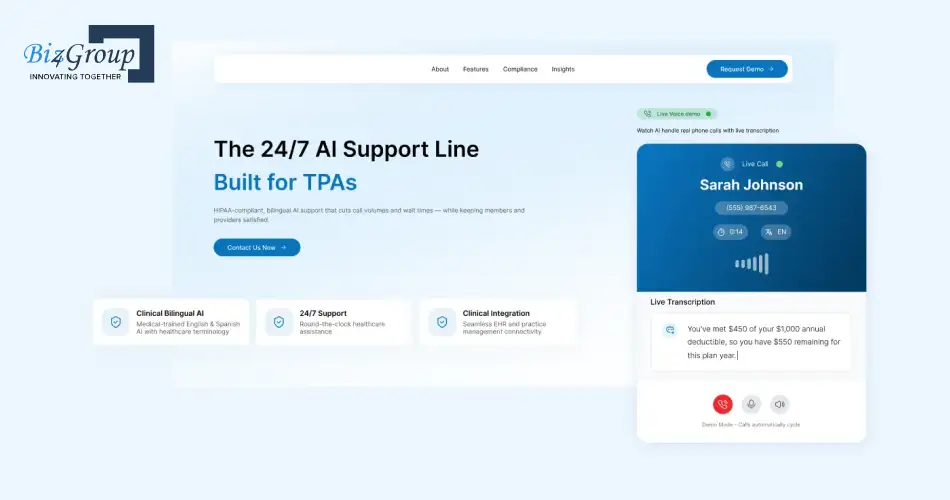
We solved it by moving real-time speech handling to Twilio’s ConversationRelay service. We also built a smart escalation path, so when the agent can’t resolve a question, a human gets a short summary of the call before picking up.
Problems like these rarely show up in a demo. They show up on live calls, with real callers.
Here is what this guide answers, step by step:
- How is agentic AI being used in healthcare today, and which results are documented?
- Why does implementing agentic AI in healthcare stall at the pilot, and what fixes each failure?
- Which compliance rules apply to an agentic AI healthcare system in the U.S.?
- How to develop agentic AI in healthcare that holds up in production, with a reference architecture
- Which eight checks should agentic AI systems for healthcare pass before go-live?
- How do you prove ROI before finance asks?
Let’s start with what you are actually deploying.
Key Takeaways
- Agentic AI in healthcare means software that completes multistep work toward a goal, not software that only answers prompts.
- Only 3% of surveyed health systems run agentic AI in healthcare in live workflows, while 43% are piloting it (Microsoft and The Health Management Academy, 2026).
- Most agentic AI healthcare pilots stall on data quality, EHR integration, exception ownership, and late compliance review.
- A production-ready healthcare agentic AI system has named owners, a tested escalation path, and live monitoring.
- Start with a low-risk operational workflow. Expand autonomy as your evidence builds.
What Is Agentic AI in Healthcare, and What Does It Actually Deliver?
Agentic AI in healthcare is software that takes a goal, plans the steps, acts across your clinical and administrative systems, and hands off to a person when judgment is needed. A 2026 scoping review in npj Digital Medicine from a Mayo Clinic team sets the minimum bar at three traits: autonomous operation, goal-directed behavior, and action initiation through tools or APIs.
Picture a stalled prior authorization. An agent handles it in five steps:
- It reads the request and the goal: get approval from the payer.
- It pulls the clinical evidence from the EHR.
- It matches that evidence against the payer’s requirements and fills the gaps.
- It submits the package, tracks status, and re-plans if the payer asks for more.
- It escalates a denial to a named person with the full history attached.
A chatbot can only explain how prior authorization works. That difference in responsibility is why agentic AI healthcare projects behave so differently from earlier tools.
These five steps follow the same loop that any agentic AI system runs: sensing, planning, acting, and learning. Healthcare changes two things. Step 2 touches protected health information, so access has to be scoped to the task. And step 5 has to end with a named person, not a generic queue.
1. How Does Agentic AI Differ from Generative AI and RPA?
Three kinds of software often get called agents, and they are not the same. Agentic AI in healthcare sits at the far end of this table.
|
Aspect |
RPA bot |
Generative AI tool |
Agentic AI |
|---|---|---|---|
|
What it does |
Follows fixed rules across systems |
Creates text or summaries when prompted |
Plans and carries out multistep work toward a goal |
|
What starts it |
A schedule or a rule |
A person’s prompt |
A goal plus live context |
|
When something unexpected happens |
Usually stops or breaks |
Waits for the next prompt |
Re-plans or escalates |
|
Healthcare example |
Copying claim data between portals |
Drafting a visit summary |
Managing a prior authorization to a decision |
|
Who owns a failure |
The process owner |
The reviewing clinician or staff member |
Needs a named workflow owner and escalation path |
|
Main risk |
Breaks when rules change |
Wrong or invented content |
A wrong action in a live system |
Gartner calls the relabeling of assistants, chatbots, and RPA as agents “agent washing.” In its June 2025 release, it estimated that only about 130 of the thousands of vendors claiming agentic AI are real.
Here is a four-step test you can run on any vendor demo:
- Does the software pursue a goal across several steps, not a single prompt?
- Does it act inside your systems through APIs, or only draft text for someone to paste?
- Does it adapt when something unexpected happens, such as a missing document?
- Does it escalate to a named human with context?
If you answer no to two or more, you are likely looking at automation or a chatbot.
One point vendors rarely volunteer: the same npj review notes that in fixed, predictable workflows, the cost and delay of agentic systems can outweigh the benefit, and simpler automation can win. If a workflow never changes, RPA may be the better choice.
We apply this test to our own work. The voice agent we built for a healthcare third-party administrator pursues a goal (resolve the call) and handles eligibility and claim status questions. When it can’t resolve a call, a human receives a summary. We would still call it a narrow healthcare agentic AI system, not a fully autonomous one.
2. Intelligent Healthcare Agents: Which Benefits Hold Up in Practice?
Start with the pressure. In the AMA’s 2025 physician survey of 1,000 physicians, physicians completed an average of 40 prior authorizations a week. That consumed about 13 hours of physician and staff time, and 94% said it contributes to burnout.
That is why intelligent healthcare agents draw so much attention. The harder question is what has been measured.
Most results come from vendors, so the table labels how much weight each one deserves.
|
Benefit |
What is documented |
|---|---|
|
Faster prior authorization |
Summit Health cut medication prior authorization submission time by 42%. 92% of AI-generated responses were accepted without edits. |
|
Fewer denials, faster appeals |
Coding-related denials fell by more than 20% at the heaviest users. Appeal letters were created 23% faster. |
|
Less chart review |
ECU Health reports about 20 hours saved each week with chart summaries across nine hospitals. |
|
Lighter patient messaging load |
Rush cut billing-related messages by 58%. Ochsner patients rescheduled more than 14,900 appointments, saving almost 750 staff hours. |
|
Diagnosis and treatment support |
Seven eligible studies, one trial with patients, six of seven not yet in real-world use |
At the hospital level, an autonomous AI agent for hospitals is already live at Advocate Health, where Epic reports agents handling inpatient pharmacy work and infusion chart prep. No outcome figures were published for that deployment.
The evidence for agentic AI for healthcare is strongest in operations and weakest in clinical care.
People matter as much as software. In the Microsoft and Health Management Academy research, 57% of executives expected productivity gains, while 60% named reskilling as a top challenge.
Physicians are wary too. Six in ten told the AMA they worry AI may push denial rates higher. Trust is part of what an agent has to deliver.
3. Where Does the Agentic AI in Healthcare Market Stand in 2026?
Spending on agentic AI in healthcare is small today, and every forecast expects steep growth. The forecasts disagree on how big the agentic AI in healthcare market is.
|
2026 estimate |
Forecast |
Growth rate |
|---|---|---|
|
USD 1.14 billion |
USD 33.66 billion by 2035 |
45.6% a year |
|
USD 1.83 billion |
USD 19.71 billion by 2034 |
34.61% a year |
|
Not in the public summary |
USD 6.92 billion by 2030 |
Not in the public summary |
The gaps likely reflect scope. Each firm defines “agent,” picks its own segments, and uses a different horizon. Treat the figures as direction, not precise measurements.
Two details from the Towards Healthcare report matter for buyers:
- Single-agent systems held 62% of the market in 2025, and ready-to-deploy agents held 58%.
- Build-your-own agents are expected to grow fastest.
Most agentic AI systems for healthcare sold today are narrow and pre-built, with custom builds coming next.
Market revenue counts spending, and spending includes pilots. So, these forecasts don’t conflict with the 3% live-deployment figure from the intro.
Agents are one piece of a wider shift. Forecasts also assume the plumbing around the agent keeps pace. FHIR-based data exchange, cloud modernization, and AI governance all appear among the top healthcare IT trends to watch, and agents lean on every one of them.
Next, we’ll look at how agentic AI is being used in healthcare today, and which results are documented.
Is Your Healthcare AI Pilot Ready to Grow Up?
A promising demo is only the beginning. Discover how the right agentic AI in healthcare strategy can turn a promising pilot into a production-ready solution.
Talk to Our ExpertsHow Is Agentic AI Being Used in Healthcare Today? Use Cases and Real-World Examples
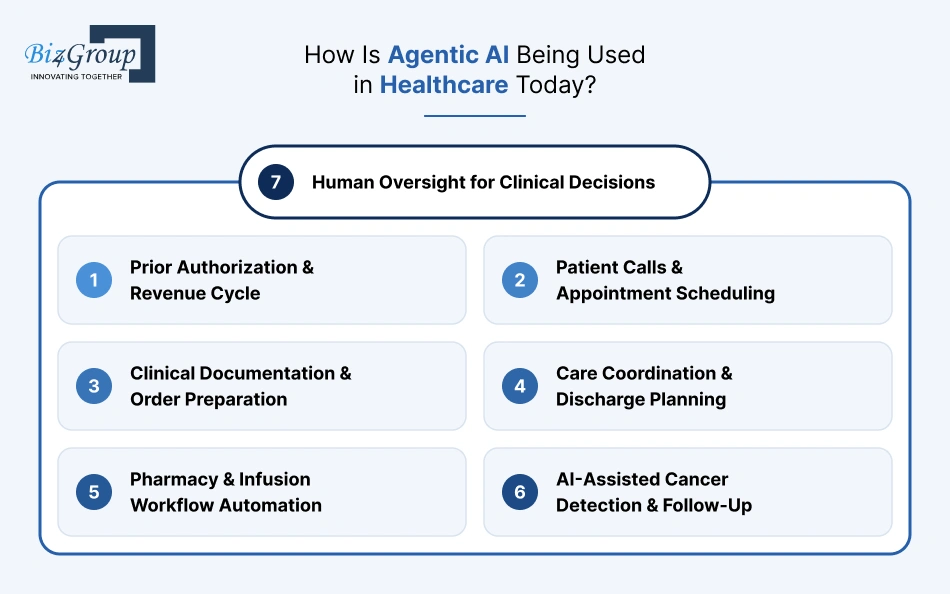
The documented agentic AI applications in healthcare cluster in operations: prior authorization and revenue cycle, patient calls and scheduling, clinical documentation, chart summaries for care coordination, and pharmacy prep. Clinical diagnosis and treatment uses are still mostly research. WellSpan, ECU Health, and Advocate Health already run agents in live workflows.
Each example below names its source and says how much weight it deserves.
1. Agentic AI Use Cases in Healthcare Operations: Prior Authorization, Denials, and Revenue Cycle
An agent pulls clinical evidence from the EHR, matches it to payer rules, and assembles the request. It then tracks status and drafts appeals from past denial patterns, so staff review a finished package instead of building one. These agentic AI use cases in healthcare lead executive priority lists: in Deloitte’s survey of 100 US health care technology executives, more than 80% of health systems prioritize agentic AI for clinical operations, care delivery, and revenue cycle, and 70% of health plans for prior authorization and claims.
Example
At Summit Health, Epic’s revenue cycle assistant, Penny, cut medication prior authorization submission time by 42%. 92% of its AI-generated responses were accepted without edits.
At the health systems using Penny most, coding-related denials fell by more than 20%, and appeal letters were created 23% faster.
These are vendor-reported figures from Epic’s March 2026 report, cited earlier. The 92% acceptance rate also shows that staff still review the output.
2. Patient Access and Outreach: Voice Agents for Calls, Scheduling, and Care Gaps
A voice agent answers inbound calls, schedule appointments, and calls patients first when a gap in care appears. It keeps context through the conversation and hands off to staff when it can’t finish. Patients should always be told they are talking to AI.
Example
WellSpan Health’s voice agent, Ana, was built with Hippocratic AI. WellSpan executives told Fierce Healthcare in July 2026 that Ana handles more than 160,000 patient calls a month, over 7,000 hours of conversation.
WellSpan is extending Ana to post-discharge follow-up and chronic disease check-ins. Each new use follows a governance and safety structure set with its clinical teams. At launch in 2024, WellSpan made sure patients knew they were speaking with an AI agent, according to HealthLeaders.
MUSC Health took a similar path on an Epic system. Becker’s reports that its agent, Emily, built on SoundHound’s platform, now also handles pharmacy refill requests and status updates. The company says Emily has supported more than 2.2 million patient calls since 2024.
One more data point comes from Epic. Ochsner patients rescheduled more than 14,900 appointments with Epic’s patient assistant, saving almost 750 staff hours.
Ana is one agent with one job. Single-agent systems held 62% of the market in 2025, per Towards Healthcare, and multi-agent systems are expected to grow quickly. The split makes sense when monitoring, risk scoring, and outreach must run continuously and hand off to each other, which is the pattern behind an AI multi-agent preventive care ecosystem.
3. Clinical Documentation: Ambient Agents That Draft Notes and Queue Orders
An ambient agent listens during a visit, drafts the clinician’s note, and prepares orders for review. The clinician edits and signs, so the agent never finalizes anything alone. It is also where generative and agentic AI blur: a scribe that only writes is generative, and one that also queues orders starts to act.
Example
Epic’s March 2026 report says Chart with Art listens during visits, drafts the note, and queues up orders from the conversation. It launched in February across several outpatient specialties.
Clinicians at multiple organizations also complete discharge summaries 20% to 30% faster with Art’s drafted hospital course notes.
These are vendor-reported figures, and clinicians still review every draft.
4. Care Coordination: Transfer Summaries and Discharge Planning
An agent reads the full chart and writes a short summary for the nurse or case manager, which removes manual chart review before transfer decisions and discharge rounds. People still make the decisions. It can only summarize data that already moves through defined handoffs, so where those do not exist, build the AI healthcare workflow automation first and add the agent second.
Example
ECU Health deployed AI-generated chart summaries across all nine of its hospitals, as Healthcare IT News reports. Case managers use them in daily discharge rounds. ECU’s Jacob Parrish says the tool has cut chart review time by about 20 hours a week.
After launch, users said the discharge planning summaries were too long. ECU adjusted the agent right away, and satisfaction improved, according to a HLTH report on the rollout.
The lesson: budget time for tuning after go-live. Launch is the start of the work, not the end.
5. Autonomous AI Agent for Hospitals: Pharmacy and Infusion Workflows
An autonomous AI agent for hospitals can review a patient’s history, medications, clinical activity, and progress notes. It writes a concise summary so a pharmacist can verify a medication order faster. A second agent prepares infusion charts and messages patients through MyChart before treatment.
Example
Advocate Health is live on Epic’s Agent Factory with agents for inpatient pharmacy and infusion chart prep, per Epic’s July 2026 newsroom post. Hundreds of its pharmacists verify medication orders every day, so the pharmacy agent has a large daily workload to support.
Becker’s Hospital Review reported that a three-day Epic workshop in March produced four working prototypes, slated to go live in July.
Advocate has not published outcome figures yet. Treat this as a live deployment, not a proven result.
6. Agentic AI in Healthcare Diagnosis and Treatment: What the Evidence Supports
Research systems use agents to plan radiotherapy, reason over medical images, and flag cancer signals. Almost all of that work is experimental, and only one of the seven studies in the npj review enrolled patients. Where AI is live in clinical care today, it mostly surfaces findings and triggers follow-up while clinicians decide.
Example
In a retrospective feasibility study, LLM agents called GPT-Plan matched expert radiotherapy plans for cervical cancer and exceeded them for lung cancer, per the npj review. It ran on past cases and was not used in clinical care.
In live care, The Christ Hospital reports an early lung cancer detection rate of 69%, against a 46% national average. It uses Epic’s Art, which extracts incidental findings from radiology results and drives follow-up.
That figure is vendor-reported. It reflects AI-assisted follow-up, not an agent making treatment decisions.
7. Agentic AI in Healthcare Examples: Which Use Case Should You Start With?
The examples above point the same way: agentic AI in healthcare is strongest where actions are easy to reverse and a person reviews the result. You will also see insurance verification, supply chain, workforce scheduling, and remote monitoring on vendor lists. Agent-specific evidence for those is thinner today, so we left them out of the table.
Use these five steps to choose where to start:
- List the workflows that cost your team the most hours each week.
- For each, ask what the agent can change. Drafts and summaries are easy to reverse. Orders and patient-facing messages are not.
- Check data readiness. Can the agent identify the right patient and reach the right system?
- Compare each workflow with the evidence in the table below.
- Pick one workflow. Set a baseline metric and a named owner, then run it in shadow mode, where the agent proposes actions beside staff but takes none.
|
Use case |
Can actions be reversed? |
Evidence today |
Our starting-point view |
|---|---|---|---|
|
Prior authorization, denials, revenue cycle |
Mostly, with staff review |
Live results, vendor-reported |
Strong first choice |
|
Patient calls and scheduling |
Yes, with a staffed escalation path |
Live at scale (WellSpan, MUSC) |
Strong, if escalation is staffed |
|
Clinical documentation |
Yes, clinician reviews and signs |
Live at many sites, mostly vendor-reported |
Strong, but check whether the tool acts or only drafts |
|
Transfer and discharge summaries |
Yes, read-only output |
Live, about 20 hours a week at one system |
Strong, low risk |
|
Pharmacy and infusion prep |
Partly, touches medication workflows |
Live, no published outcomes |
Second wave |
|
Diagnosis and treatment |
Low, affects patient outcomes |
Research stage, one patient trial |
Not yet |
The last column is our assessment, not a published benchmark. It comes from the same workflow and data-readiness review we run at the start of healthcare AI engagements.
The same rule shows up outside healthcare. Finance and customer service teams also start with high-volume, repetitive work and keep a person in the loop, a pattern that repeats across the real-world use cases for agentic AI in other industries.
Whichever workflow you pick, your agentic AI healthcare system needs an owner for exceptions. That gap is where most pilots stall, which is the subject of the next section.
Why Does Implementing Agentic AI in Healthcare Stall at the Pilot? Six Failure Modes and Fixes
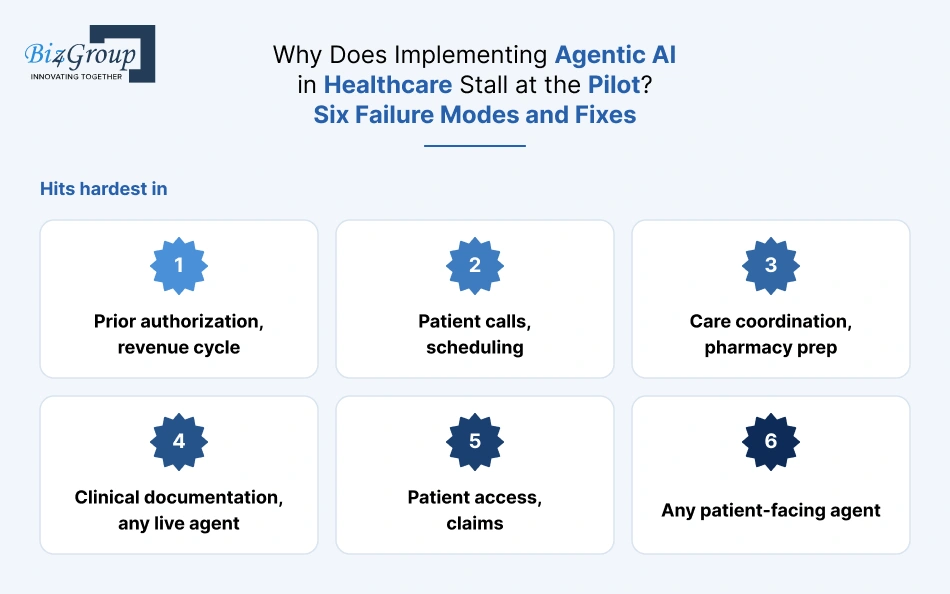
Agentic AI pilots stall for six reasons, and none of them is the model: no measured baseline, messy patient data, weak EHR integration, no monitoring, no owner for exceptions, and compliance review that starts too late. Gartner expects over 40% of agentic AI projects to be canceled by the end of 2027, mostly over cost, unclear value, and weak risk controls.
Every one of the agentic AI use cases in healthcare, from prior authorization to patient calls, runs into the same walls. Each wall has a fix you can start this month.
|
# |
Failure mode |
Hits hardest in |
One-line fix |
|---|---|---|---|
|
1 |
No baseline, no owner |
Prior authorization, revenue cycle |
Measure for 30 days before launch |
|
2 |
Messy patient data |
Patient calls, scheduling |
Test on real records |
|
3 |
EHR integration gaps |
Care coordination, pharmacy prep |
One typed integration layer |
|
4 |
No monitoring |
Clinical documentation, any live agent |
Test set plus four live metrics |
|
5 |
Unowned exceptions |
Patient access, claims |
Name an owner per exception type |
|
6 |
Late compliance |
Any patient-facing agent |
Map data and disclosure first |
1. How Do You Prove an Agentic AI Pilot Worked? Start With a Baseline
Picture the budget meeting. The pilot saved time, everyone felt it, and finance asks for the number. Nobody measured the starting point, so there is no number. That is how promising pilots lose funding.
Example
A result like Summit Health’s 42% cut in prior authorization submission time only exists because someone measured submission time before the agent arrived. No baseline, no claim. Epic reported that figure.
Fix
Teams implementing agentic AI in healthcare can close this gap in five steps:
- Pick one metric tied to time or money, such as turnaround time or denial rate.
- Measure it for 30 days before the agent starts. If your reports can’t show it by cause, build that view first. An AI healthcare analytics platform that pulls claims and operations data into one place gives you the baseline before you spend on the agent.
- Name one business owner with budget authority, not only an IT sponsor.
- Write the promotion criteria and the stop criteria before launch.
- Track cost per completed task from day one.
Measure
Your baseline metric and cost per completed task, reviewed weekly.
2. Why Does Patient Matching Break When an Agent Meets Real Data?
Pilot data is usually tidy. Real data has duplicate charts, missing fields, and notes typed in a hurry. An agent that can’t tell which patient a request belongs to either stalls or, worse, acts on the wrong chart.
Example
Picture this (an illustration, not a client case). A prior authorization agent handles 500 curated requests perfectly. In production, 1 in 100 requests has a name variant or a missing date of birth. At 2,000 requests a month, that is 20 requests pointing to the wrong chart or none. Each one is a safety and privacy question.
Fix
- Test on a sample of real, messy records, not a curated set.
- Confirm identity with two or more identifiers before any action.
- Let the agent act only when a match is certain. Everything else goes to a person.
- Keep a correction queue so staff fixes feed back into testing.
Measure
Wrong-patient match rate and unmatched rate. Catch wrong matches before action, because the goal for acted-on wrong-patient matches is zero.
3. Why Can the Agent Read the Chart but Not Act on It? EHR Integration
In a pilot, the agent reads a test feed. In production, healthcare agentic AI must read and write across the EHR, payer portals, and phone systems. Each connection can fail, and the worst failures are silent, like a timeout that returns a confident wrong answer. Integration was the most-cited blocker (63%) in the 2026 survey from the introduction.
Example
Advocate Health runs an autonomous AI agent for hospitals on Epic’s Agent Factory, and ECU Health built its chart summaries there too. Epic keeps those agents integrated inside the EHR environment, which sidesteps most integration work. The trade-off is vendor lock-in, and broader availability is expected in 2027.
On our own healthcare builds, we have seen the bottleneck sit in the client’s legacy systems, not in the AI.
Prior authorization agents will get easier too. Payers must expose FHIR-based prior authorization APIs by January 1, 2027, which gives agents a cleaner path than portal screens.
Fix
- List every system the agent reads from or writes to, with its API type and login method.
- Put one typed integration layer between the agent and those systems. The agent never calls legacy systems directly.
- Make failures loud. Log every call and alert on timeouts.
- Test write-back in a sandbox first, with a rollback plan.
- Choose FHIR wherever it exists.
Measure
Failed call rate, and the number of calls that returned without a confirmed result.
4. How Do You Know Your Healthcare AI Agent Is Still Accurate After Launch?
During the pilot, people checked every output. After launch they don’t. Accuracy can slide for weeks before a complaint arrives, and by then you can’t say when it started.
Example
ECU Health adjusted its discharge planning agent right after launch because users said the summaries ran too long, and satisfaction improved, per HLTH’s report. That fix happened because a feedback path existed.
Fix
Strong agentic AI systems for healthcare run on four habits:
- Build a labeled test set from real cases before go-live, including difficult ones.
- Set pass thresholds per task, signed off by the clinical or operations owner.
- Track the four metrics below once the agent is live.
- Pin the model version, and re-run the test set before any upgrade.
Measure
|
Metric |
What it catches |
Healthcare example |
|---|---|---|
|
Task completion rate |
Errors, timeouts, refusals |
Prior authorizations that finish without staff rework |
|
Quality score on sampled outputs |
Quiet accuracy drift |
Sampled appeal letters scored against a labeled set |
|
Cost per completed task |
Runaway usage |
Rising cost per request with no change in complexity |
|
Escalation and override rate |
Trust and scope problems |
Share of drafts staff rewrite |
The 92% of AI-generated responses accepted without edits at Summit Health is an override-rate figure. It tells you how often staff change the agent’s work.
5. Who Owns the Case When the Agent Cannot Finish?
Every agent hits cases it can’t close. In a pilot the builders catch them. In production the case lands in a queue nobody owns, and staff were never taught how to supervise an agent. In the Microsoft and Health Management Academy research, 60% of executives named reskilling as a top challenge.
Example
The voice agent we built for a healthcare third-party administrator hands unresolved calls to a person with a short summary, so the exception has an owner by design. WellSpan takes a similar approach: each new use of its agent follows a governance structure built with clinical teams, per Fierce Healthcare.
Fix
Good intelligent healthcare agents come with named owners. Assign each row below before you scale. This is our suggested starting point, not a published standard.
|
Responsibility |
Suggested accountable role |
|---|---|
|
Quality metrics in production |
AI product owner |
|
Exception queue and escalation time |
Workflow owner (revenue cycle or access manager) |
|
Model and prompt changes |
AI product owner, with clinical sign-off |
|
Integration maintenance |
Integration engineer |
|
Incident response |
IT or security lead, with a clinical contact |
|
Staff and patient feedback review |
Workflow owner |
Then train supervisors on what to review and when to override. Review exceptions weekly for the first 90 days.
Measure
Time from escalation to a person picking up, and the number of exceptions older than your set limit.
6. When Should Compliance Enter an Agentic AI Project? Before the Architecture
Pilots often run on limited data, so legal review waits. Production touches protected health information, patient messages, and coverage decisions. A late review can mean redoing data flows and logging.
Example
WellSpan made sure patients knew they were talking to an AI agent at launch and worked through every scenario and patient question with its vendor, according to HealthLeaders. In our own projects, the overruns trace back to the same skipped step: compliance mapping pushed past the architecture decision.
Fix
For any agentic AI healthcare system, compliance comes first:
- Map every data element the agent touches and apply minimum necessary access.
- Confirm a Business Associate Agreement covers every vendor in the chain, including model hosting.
- Decide disclosure wording and human review points before you build.
- Design audit logs that show what the agent did and why.
- Run failure drills: wrong patient, outdated payer rule, missing data.
Measure
The share of agent actions with a logged reason, and how fast you can answer an auditor’s question about one case.
Six Questions to Answer Before You Scale
Use this checklist before you add volume. A “no” to any of them is your next task.
- Do we have a 30-day baseline for the metric we plan to claim?
- Have we tested on messy, real records?
- Can the agent write back safely, and do failures show up loudly?
- Do we have a test set and four live metrics?
- Does every exception type have a named owner?
- Did compliance shape the design, not just review it?
Getting these right is what turns agentic AI for healthcare from a demo into daily operations. The next section covers the rules that apply in the U.S., from HIPAA to state disclosure laws and the FDA’s August 2026 discussion paper.
What Compliance Rules Apply to an Agentic AI Healthcare System in the US?
An agentic AI healthcare system in the US answers to HIPAA first, then to state AI disclosure and review laws. CMS rules apply if it touches prior authorization, and FDA oversight applies if it influences clinical decisions. No single federal law covers agents yet, so the rules that apply depend on what your agent does and who it talks to.
This is general information, not legal advice. Have counsel review before you rely on it.
|
What your agent does |
Rules that usually apply |
|---|---|
|
Back office work (prior authorization, claims, billing) |
HIPAA, CMS prior authorization rules for payers, state review laws |
|
Patient calls, chat, and outreach |
HIPAA, state AI disclosure laws |
|
Drafts notes or summaries for clinicians |
HIPAA, state rules on AI-generated records |
|
Influences diagnosis or treatment |
HIPAA, possible FDA device rules, state laws |
1. Does HIPAA Apply to an AI Agent? Yes, and the Rules Are the Same
HIPAA has no separate chapter for AI. The Privacy and Security Rules cover any system that touches protected health information, and an agent is one. That means minimum necessary access, a Business Associate Agreement with every vendor in the chain, and audit logs of what the agent did and why.
Picture an agent that books appointments. It should see schedule and coverage data, the way a front-desk employee does, not the full chart. That is an illustration, not a client case. The same logic covers model hosting: if patient data reaches a model provider, that provider needs BAA coverage too.
A proposed Security Rule update would make encryption and multi-factor authentication mandatory. It isn’t final, and HHS now targets July 2027 for final action. Teams building agentic AI in healthcare to that standard now avoid a retrofit later. Whoever builds your agent, whether an in-house team or a HIPAA-compliant AI healthcare app development company, should be able to show how privacy, access controls, encryption, and audit trails are designed into the architecture, not added after launch.
2. When Does an Agent Become a Medical Device? What the FDA Is Asking Now
FDA regulates software by what it does, not by whether it uses AI. Agents that handle scheduling, billing, or prior authorization generally don’t make medical claims. An agent that suggests a diagnosis or drives a treatment decision may count as a medical device. An autonomous AI agent for hospitals that stays on admin work rarely raises that question.
On August 18, 2026, FDA published a discussion paper on generative AI-enabled devices that includes agentic systems, meaning software that plans and carries out multistep tasks, uses outside tools, or acts across a sequence of steps. It is not draft or final guidance, and comments close October 19, 2026.
It floats a risk-based framework, a premarket review modeled on how clinicians are evaluated, and monitoring after release, including periodic benchmarking and sample-based clinician review. It also notes that some agentic systems may fall outside device rules, depending on what they do.
Write down each agent’s intended use in one sentence. That sentence decides which rules apply, and counsel should review it before you build anything clinical. On our healthcare builds, we treat HIPAA, FDA, and state requirements as inputs to the architecture, not a final review.
3. Which State Laws Cover AI in Patient Care? Disclosure and Human Review
Congress hasn’t passed an AI law for healthcare, so states have, and the rules differ. A December 2025 executive order directs federal agencies to challenge state AI laws, but it doesn’t override them, and state laws remain in effect. The table shows the ones that matter most for patient-facing and review agents.
|
State law |
What it covers |
Date |
|---|---|---|
|
California AB 3030 |
Generative AI patient messages about clinical information need a disclaimer and a way to reach a human, unless a provider reviews them |
In effect since January 1, 2025 |
|
California SB 1120 |
Health plans using AI for utilization review keep a licensed clinician in charge of medical necessity decisions |
In effect since January 1, 2025 |
|
Texas HB 149 (TRAIGA) |
Providers using AI in health care services or treatment must disclose it to patients in plain language |
In effect since January 1, 2026 |
|
Texas SB 1188 |
Practitioner review duties for AI-generated records, and electronic health records kept physically in the US |
In effect since September 1, 2025 |
|
Colorado SB 26-189 |
Narrower, notice-based law on consequential automated decisions. It replaced the 2024 AI Act before that law took effect. |
Takes effect January 1, 2027 |
A patient-call agent in Texas must disclose that it is AI by the first date of service. In California, a generative AI message about clinical information needs a disclaimer and a route to a human unless a provider reviews it first. AB 3030 turns on clinical information, so check whether your agent’s messages count.
For healthcare agentic AI that talks to patients, the safest design discloses everywhere and always offers a person. Payers face a separate rule: in California, a licensed clinician stays in charge of medical necessity decisions.
4. What Do CMS Prior Authorization Rules Mean for Your Agent?
CMS-0057-F applies to payers: Medicare Advantage plans, Medicaid and CHIP programs, and exchange plans. Since January 1, 2026, most must send prior authorization decisions within 72 hours for urgent requests and seven calendar days for standard ones and give a specific reason when they deny. FHIR-based APIs, including a Prior Authorization API, are due beginning January 1, 2027, per the CMS fact sheet.
For a prior authorization agent, a standard API replaces screen scraping of payer portals, and the structured denial reason gives the agent clean data for appeals. For payers, the 72-hour and seven-day clocks become service levels for the agent’s queue.
Two limits matter. The rule excludes drugs, and it doesn’t address how payers use AI to decide requests. Separately, CMS guidance to Medicare Advantage plans allows AI but says coverage decisions must rest on each patient’s individual circumstances, not a generic algorithm alone. That is why a clinician should stay in the loop on denials.
5. What Do Hospital Buyers Expect on Governance? The Joint Commission Checklist
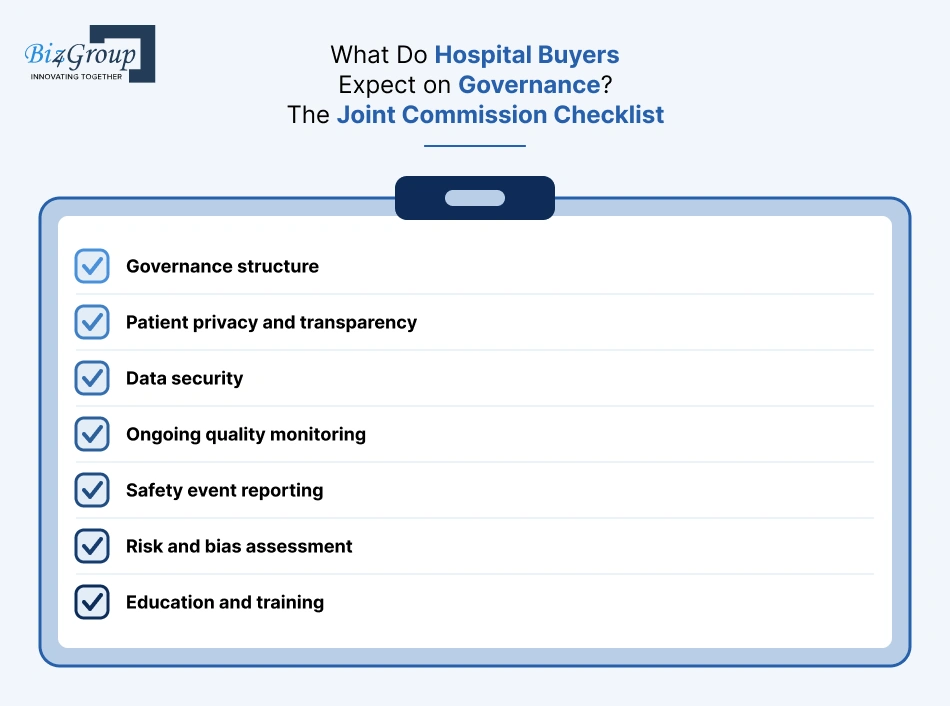
This one isn’t law, but hospital buyers use it. In September 2025, the Joint Commission and the Coalition for Health AI released voluntary guidance with seven elements for responsible AI use. Legal commentators expect it to influence accreditation and procurement, so expect it in your vendor questionnaires. The table maps each element to what you build, using the controls from the earlier sections.
|
Element |
What you build |
|---|---|
|
Governance structure |
An approval committee and named owners, like the RACI from the last section |
|
Patient privacy and transparency |
Disclosure wording and minimum necessary access |
|
Data security |
Encryption, access controls, BAA coverage |
|
Ongoing quality monitoring |
The four live metrics and pinned model versions |
|
Safety event reporting |
A short, known path for staff to report agent errors |
|
Risk and bias assessment |
Tests on your own patient mix, compared across subgroups |
|
Education and training |
Training for the people who supervise the agent |
Treat agentic AI systems for healthcare like any clinical tool. A committee of clinical, IT, compliance, and legal leaders approves each agent before it touches patient care, pause thresholds are set before launch, and every approval and review goes into a decision log. That is what AI governance in healthcare looks like as a routine instead of a binder.
Dates to Put on Your Calendar
|
Date |
What happens |
|---|---|
|
October 19, 2026 |
FDA comment deadline on the generative AI discussion paper |
|
January 1, 2027 |
CMS prior authorization APIs due, and Colorado’s SB 26-189 takes effect |
|
July 2027 |
HHS target for final action on the HIPAA Security Rule update, an estimate, not a deadline |
Before go-live, ask three questions: Which rules touch this agent? Who owns each one? Where is the proof? The next section turns these rules into a build plan.
Will Your AI Agent Pass the Compliance Test?
Build HIPAA safeguards, human oversight, and audit trails into your healthcare AI system before production puts them to the test.
Schedule a Free CallHow Do You Develop Agentic AI in Healthcare That Is Ready for Production?
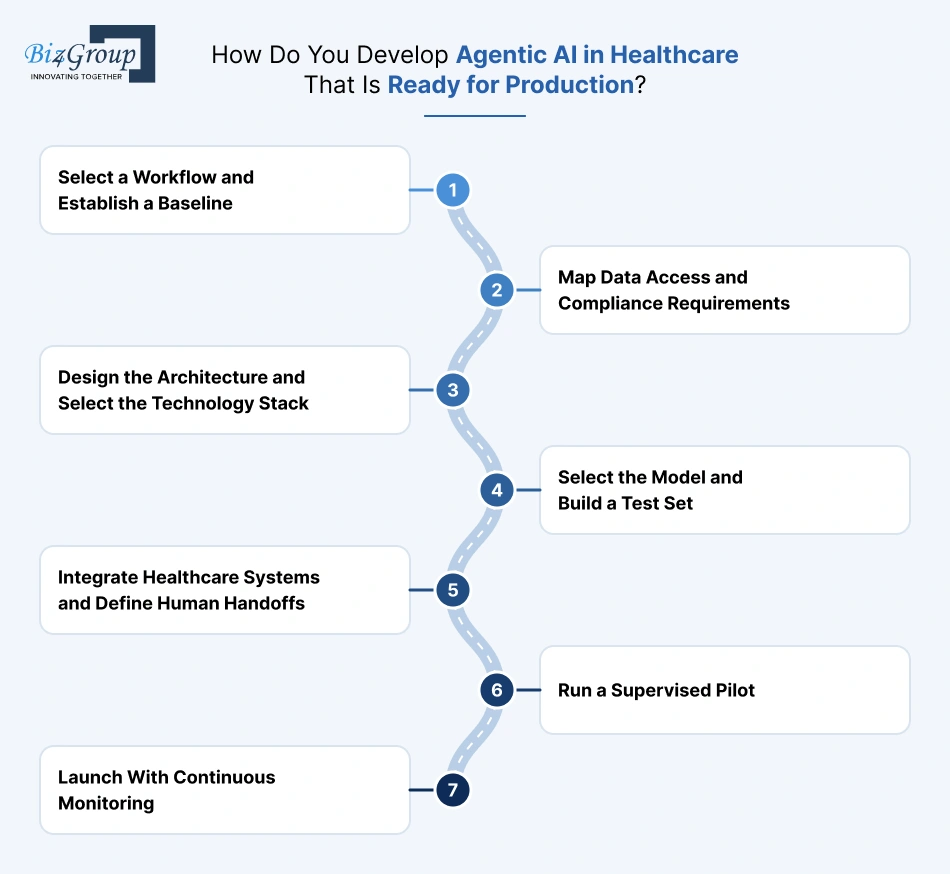
Developing agentic AI in healthcare requires seven steps: select a workflow, map data access, design the architecture, test the model, integrate healthcare systems, run a supervised pilot, and monitor production performance.
Step 1. Select a Workflow and Establish a Baseline
Choose a repetitive, measurable task, such as prior authorization checks, denial documentation, or appointment follow-ups.
- Measure current turnaround time, error rate, and cost per task.
- Assign a business owner.
- Define success criteria and conditions that would stop the pilot.
- Include human review and exception-handling costs.
The baseline establishes whether the agent improves the workflow after deployment. If you are developing a new healthcare product, use a defined MVP development approach to validate one workflow before expanding its scope.
Step 2. Map Data Access and Compliance Requirements
Identify the information the agent needs and the actions it can perform.
- Inventory protected health information (PHI).
- Apply role-based permissions and minimum-necessary access.
- Confirm applicable Business Associate Agreements (BAAs).
- Define audit logging, patient disclosure, and human-review requirements.
Build these controls into the architecture and align them with AI governance in healthcare requirements.
Step 3. Design the Architecture and Select the Technology Stack
A production-ready agentic AI healthcare system needs controlled data access, validated outputs, action limits, and traceable execution. The following technologies are examples to evaluate, not mandatory components.
|
Architecture layer |
Example tools and technologies |
Purpose |
|---|---|---|
|
Agent orchestration |
LangGraph, Microsoft Semantic Kernel |
Manage task sequences, state, retries, and stop conditions |
|
AI model |
Approved hosted or privately deployed language model |
Interpret requests and generate proposed actions |
|
Context and retrieval |
PostgreSQL, vector search, retrieval-augmented generation (RAG) |
Retrieve approved policies, payer rules, and relevant records |
|
Healthcare integration |
FHIR R4, HL7 v2, SMART on FHIR, vendor APIs |
Exchange data with EHRs and connected systems |
|
Output validation |
JSON Schema, Pydantic |
Validate structured responses before execution |
|
Access and action controls |
Role-based access control (RBAC), policy engines |
Restrict permissions and require approval for sensitive actions |
|
Monitoring and audit |
OpenTelemetry, application logs, audit-event storage |
Track failures, performance, and agent actions |
|
Human review |
Work queues, EHR review workflows |
Route exceptions to accountable staff |
Choose the stack based on your existing healthcare environment, security requirements, and workflow complexity. A single agent may be sufficient; multi-agent orchestration is only necessary when tasks require distinct roles or coordinated decisions.
Keep three controls in place:
- The model cannot grant itself additional permissions.
- Sensitive actions require validation or human approval.
- Failed actions can be detected, escalated, and safely stopped.
For broader architecture considerations, Biz4Group's guide to AI model development provides related context on model selection and development.
Step 4. Select the Model and Build a Test Set
Choose a model based on accuracy, latency, cost, and data-handling requirements. Start with retrieval and structured outputs before considering fine-tuning.
Test the model against:
- Typical cases and incomplete records.
- Conflicting data and unusual payer rules.
- Cases requiring escalation or refusal.
- Incorrect outputs and unauthorized actions.
Set acceptance thresholds before testing. Repeat evaluations after changing the model, prompts, integrations, or business rules.
For intelligent healthcare agents, measure both response accuracy and action accuracy. A correct summary does not guarantee that an agent will update the right field or route a case correctly.
Step 5. Integrate Healthcare Systems and Define Human Handoffs
Connect the agent to the EHR, claims platform, scheduling system, or payer tools required by the workflow.
- Prefer supported APIs and healthcare interoperability standards where available.
- Test read and write permissions in a sandbox.
- Validate patient identifiers, required fields, timeouts, and duplicate requests.
- Confirm whether each action succeeded before proceeding.
- Send exceptions to a named team with the case context and next required action.
These controls are essential when building AI healthcare workflow automation systems that interact with clinical or financial records.
Step 6. Run a Supervised Pilot
Start with one workflow and limited permissions. Use shadow mode to compare proposed actions with staff decisions, then move to supervised execution when results meet predefined thresholds.
- Require approval for sensitive actions during initial testing.
- Track accuracy, overrides, escalations, and cost per task.
- Review failures with the workflow owner.
- Train staff to identify errors and manage exceptions.
Expand only when the agent meets agreed performance and safety criteria under real operating conditions.
Step 7. Launch With Continuous Monitoring
Monitor the agent after deployment because new records, policy changes, and integration failures can affect performance.
|
Metric |
What to measure |
|---|---|
|
Task completion |
Percentage of workflows completed successfully |
|
Output quality |
Error rate from sampled reviews |
|
Cost per task |
Model, integration, and human-review costs |
|
Override rate |
Frequency of staff corrections or intervention |
Assign owners for quality, exceptions, model changes, and incidents. Set alert thresholds, maintain a way to pause the agent, and re-test after significant changes.
Should You Build, Buy, or Extend an Existing Agentic AI Platform?
Choose the approach that fits your workflow, integration needs, and requirements for control.
|
Approach |
Best suited for |
Main trade-off |
|---|---|---|
|
Extend an existing platform |
Workflows already supported by an EHR or healthcare system |
Platform limitations and vendor dependence |
|
Buy a ready-made agent |
Standard tasks such as patient calls or scheduling |
Integration flexibility and control over exceptions |
|
Build a custom agent |
Specialized workflows, multiple system integrations, or a product-specific requirement |
Greater control, with more responsibility for testing and maintenance |
Custom development is appropriate when existing solutions cannot meet the workflow's requirements. Reuse existing infrastructure where possible and build custom orchestration or controls where they add value.
For teams assessing implementation partners, agentic AI development companies in the USA can be compared on healthcare integration experience, security practices, testing methods, and documented production results. For healthcare-specific requirements, also evaluate agentic AI development companies for the healthcare industry in the USA against the systems and workflows you need to support.
What Does a Production-Ready Agentic AI System for Healthcare Look Like? The 8-Point Readiness Gate
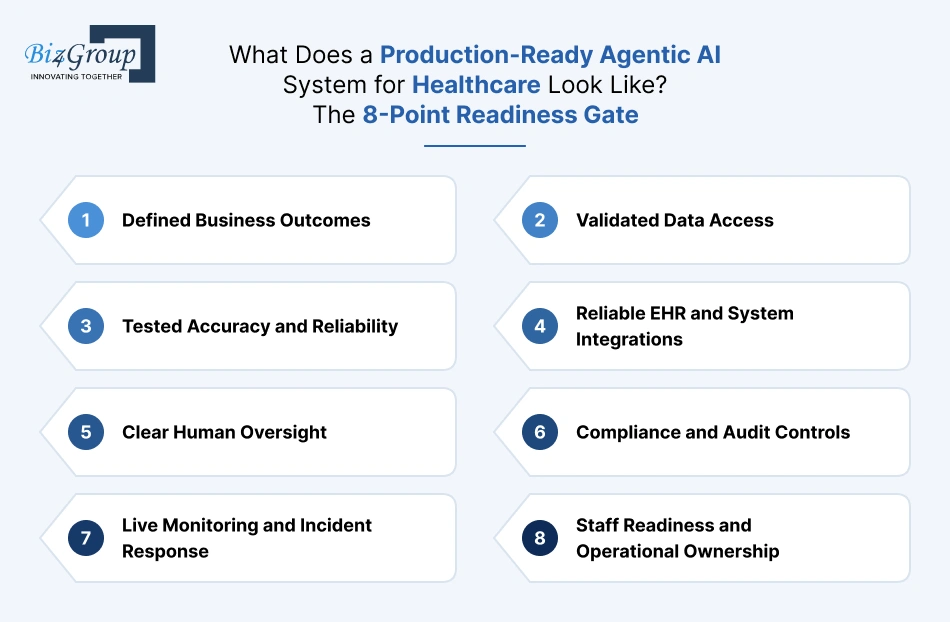
Before deploying agentic AI in healthcare, assess whether the system can complete its assigned workflow, protect patient data, and handle exceptions safely. Use this eight-point checklist to evaluate agentic AI systems for healthcare before expanding beyond the pilot.
1. Defined Business Outcomes
Every agentic AI healthcare system should target a measurable workflow problem, such as prior authorization turnaround time, claim rework, or patient call handling. Record the baseline before deployment and compare it with post-launch results. Track cost per completed task alongside time saved to establish whether the system delivers operational value.
2. Validated Data Access
Verify that the agent retrieves the correct patient information and accesses only the data required for its assigned task. Test mismatched identifiers, incomplete records, conflicting information, and unauthorized access. Document permissions and applicable HIPAA safeguards before allowing the agent to interact with production data.
3. Tested Accuracy and Reliability
Evaluate intelligent healthcare agents against representative cases, edge cases, and scenarios requiring escalation. Measure response accuracy separately from action accuracy, since a correct recommendation does not guarantee a correct EHR update or claim action. Retest after changes to models, prompts, integrations, or workflow rules.
4. Reliable EHR and System Integrations
Confirm that the agent can exchange information with EHRs, payer platforms, and other required systems through validated interfaces. Test API failures, timeouts, duplicate requests, and incomplete transactions. Where supported, standards such as FHIR and HL7 can help structure healthcare data exchange, but each integration still needs workflow-specific validation.
5. Clear Human Oversight
Define which actions the agent can complete independently and which require staff approval. Every exception should reach a named owner with the relevant case details and action history. For clinical decisions and other high-impact workflows, establish oversight according to the intended use, risk, and applicable requirements.
6. Compliance and Audit Controls
Document data access, permissions, approvals, and agent actions so authorized reviewers can reconstruct what happened. Assess applicable HIPAA obligations, Business Associate Agreements, patient disclosure rules, and clinical oversight requirements. Assign responsibility for compliance reviews and incident response before production deployment.
7. Live Monitoring and Incident Response
Monitor task completion, sampled output quality, cost per task, and staff override rates after launch. Set thresholds that trigger investigation, restricted operation, or shutdown when performance falls outside acceptable limits. Record incidents and review recurring failures before expanding the agent's permissions or workload.
8. Staff Readiness and Operational Ownership
Train staff to review outputs, correct errors, and manage escalations before the system goes live. Assign owners for workflow performance, data access, model changes, and ongoing maintenance. Expand agentic AI applications in healthcare only when teams can manage the system reliably under normal operating conditions.
Production readiness rule: If a critical check fails, keep the deployment limited until the gap is resolved. A successful demonstration is not proof of production readiness; the system must meet defined performance, safety, and operational criteria in its intended environment.
Passing the readiness gate establishes that your agentic AI in healthcare system is ready for controlled deployment. The next step is to prove its business value with measurable results.
How Do You Prove the ROI of Agentic AI in Healthcare Before Finance Asks?
For agentic AI in healthcare, the business case can fail even when the agent works as intended. A system may process cases faster but still cost more once you include staff review, integration maintenance, failed actions, and exceptions.
The better approach is to calculate ROI at the workflow level, not from the number of tasks an agent completes. Before deployment, agree with finance and operations on what counts as a completed task, which costs belong in the calculation, and what level of risk is acceptable.
1. Measure the Costs That Pilots Often Leave Out
Do not calculate savings using model or API costs alone. A healthcare agent also creates costs around integration, supervision, exception handling, testing, and ongoing maintenance.
- Build costs: development, EHR integration, security reviews, and initial testing.
- Operating costs: model usage, hosting, monitoring, and vendor fees.
- Human costs: reviewing outputs, correcting errors, and handling escalations.
- Failure costs: duplicate work, incorrect updates, delayed cases, and recovery from failed actions.
Track these costs against the same workflow and reporting period. Otherwise, a reduction in staff handling time may look like a saving even when the work has simply shifted to another team.
2. Choose Metrics That Connect Agent Performance to Financial Value
A high task-completion rate does not automatically translate into savings. Connect each agentic AI healthcare metric to a financial or operational outcome that your organization can verify.
|
Measurement area |
Metric to track |
How it connects to ROI |
|---|---|---|
|
Operational |
Minutes per completed case |
Measures staff capacity recovered |
|
Financial |
Cost per completed case |
Shows whether automation reduces total processing costs |
|
Revenue cycle |
Denial rate, appeal turnaround, payment recovery |
Measures changes in rework and revenue collection |
|
Quality and safety |
Error rate, correction rate, inappropriate actions |
Captures the cost and risk of failures |
|
Adoption |
Human override and escalation rates |
Shows how much work still requires staff intervention |
For example, if an agent processes prior authorization requests faster but staff spend the saved time correcting its outputs, the net benefit may be small. Measure the complete workflow, including the work that remains with people.
3. Use Real Healthcare Results as Benchmarks, Not Guaranteed Outcomes
Published deployments can help establish what is measurable, but their results should not become your forecast without considering differences in workflow, volume, and implementation.
- Prior authorization: At Summit Health, Epic reported that its Penny AI tool reduced medication prior authorization submission time by 42%, with 92% of AI-generated responses accepted without edits.
- Revenue cycle: Epic reported that health systems using Penny most actively saw coding-related denials fall by more than 20%. This is a reported result from higher-use organizations, not a guaranteed outcome for every deployment.
- Healthcare AI ROI: A September 2026 Bessemer Venture Partners report, based on a survey of 226 healthcare executives covering 65 use cases, reported an average realized ROI of 3.5x across surveyed healthcare AI use cases. Provider revenue cycle led at 4.0x, and 54% of use cases generated material returns within their first year. These figures cover healthcare AI broadly, not exclusively agentic AI.
The takeaway for agentic AI in healthcare is to benchmark the outcome, not copy the percentage. Prior authorization submission time, coding-related denials, and staff correction rates are useful starting metrics because they can be measured against an existing workflow.
4. Calculate Net ROI Before Scaling
Use a consistent formula that includes both the costs of running the agent and the value it creates.
ROI = (Net Benefit ÷ Total Cost) × 100
Where:
- Net benefit = verified financial gains and cost savings minus total implementation and operating costs.
- Total cost = development, integrations, model usage, monitoring, human review, maintenance, and failure recovery.
For example, suppose a prior authorization agent generates $120,000 in verified annual savings, while its total first-year cost is $80,000.
ROI = ((120,000 − 80,000) ÷ 80,000) × 100 = 50%
This example is illustrative, not an industry benchmark. Count staff time as financial savings only when it reduces actual expenditure or creates measurable capacity that the organization can put to productive use. Do not count the same benefit twice as both time saved and labor cost avoided.
5. Build a 90-Day ROI Review Before Expanding
Use the first 90 days to establish whether the agent performs reliably and produces measurable value. The timeline below is a suggested evaluation plan, not a claim that every healthcare deployment will prove ROI within three months.
|
Period |
What to measure |
Decision |
|---|---|---|
|
Days 1–30 |
Baseline costs, completion rate, errors, and staff effort |
Confirm whether the original business case is measurable |
|
Days 31–60 |
Actual operating costs, overrides, exceptions, and rework |
Identify where expected savings are being lost |
|
Days 61–90 |
Net benefit, cost per completed task, quality, and adoption |
Continue, revise, expand, or stop the deployment |
At the end of the review, compare actual results with the baseline and the financial assumptions approved before the pilot. Expand only if the workflow meets its performance, safety, and cost thresholds.
Once you can measure the value of agentic AI in healthcare, the next decision is who can build and support the system beyond the pilot.
Why Choose Biz4Group for Agentic AI Applications in Healthcare?
Taking agentic AI in healthcare from pilot to production requires healthcare workflow expertise, secure data handling, reliable system integrations, and clear human oversight. Biz4Group reports 20+ years of healthcare AI expertise and 100+ healthcare AI projects across its portfolio.
For organizations evaluating a HIPAA-compliant AI healthcare app development company, relevant experience includes designing around sensitive health data, integrating with existing systems, and defining how automated actions are reviewed and controlled.
Two Biz4Group initiatives are relevant to this work:
- Bill Matters: Biz4Group's AI-powered denial and appeal management platform analyzes denial codes, payer responses, and claim details to prepare evidence-backed appeals for review. This demonstrates experience with healthcare revenue cycle workflows, although it should not be described as a fully autonomous agent without evidence confirming that capability.
- Agentic AI health assistant platform: Biz4Group has announced agentic AI health assistant solutions for hospitals and clinics. These are relevant to patient interactions and healthcare workflow automation, but the announcement alone does not establish clinical outcomes or prove deployment at scale.
When assessing agentic AI applications in healthcare, focus on whether the proposed solution can integrate with your EHR and other systems, enforce action-level permissions, route exceptions to staff, and measure results after launch. These implementation details provide a more meaningful basis for evaluating a development partner than broad claims about AI expertise.
Ready to Give Your AI Agent a Real Job?
Turn your healthcare AI concept into a production-ready solution with Biz4Group, backed by thoughtful workflow design, system integration, and safeguards built for real-world use.
Contact UsWhat Should Healthcare Leaders Do Next?
Taking agentic AI in healthcare from pilot to production starts with one well-defined workflow, measurable success criteria, and clear limits on what the agent can do independently. Test it against real cases, validate its integrations, and monitor accuracy, cost, and human interventions before expanding to higher-risk tasks.
Biz4Group's work across healthcare AI products, including its medical denial management platform, Bill Matters, and its announced agentic AI health assistant solutions, provides relevant context for organizations exploring healthcare automation. The next step is to evaluate each proposed solution against your workflow, data security requirements, integration needs, and production-readiness criteria.
Your healthcare AI deserves more than a convincing demo. Let's build it for the real world with Biz4Group.
FAQ
1. What Are Some Real-World Applications of Agentic AI in Healthcare?
Agentic AI in healthcare can support prior authorization, claims and denial management, patient scheduling, appointment follow-ups, clinical documentation, and care coordination. These applications vary in autonomy: some agents retrieve information and prepare recommendations, while others execute approved actions across connected systems. Clinical diagnosis and treatment require more stringent validation and oversight than routine administrative workflows.
2. How Is Agentic AI Different from Generative AI in Healthcare?
Generative AI primarily creates content, such as clinical summaries, patient messages, and draft appeal letters. Agentic AI in healthcare can use models, tools, and workflow rules to plan and execute multiple steps toward a defined goal. For example, a generative AI tool may draft an appeal, while an agentic workflow could retrieve claim details, prepare the appeal, validate required information, and route it for human approval.
3. How Do You Develop Agentic AI in Healthcare for Production?
Developing agentic AI in healthcare involves selecting a measurable workflow, mapping data access and compliance requirements, designing the architecture, evaluating models, integrating healthcare systems, running a supervised pilot, and monitoring production performance. Start with a limited use case and define success metrics before development. Expand only after testing accuracy, integration reliability, exception handling, and operating costs.
4. How Can Agentic AI Integrate with Existing EHR Systems?
An agentic AI healthcare system can connect to electronic health records through supported APIs and healthcare interoperability standards, including FHIR and HL7. The integration must define which data the agent can retrieve, which fields it can update, and which actions require approval. Test permissions, patient matching, failed requests, and audit logging in a controlled environment before enabling production write access.
5. How Can Healthcare Organizations Make Agentic AI Safe and HIPAA-Compliant?
HIPAA-compliant agentic AI development requires appropriate safeguards for protected health information, access controls, vendor agreements where applicable, auditability, and incident-response procedures. Organizations should also test incorrect actions, establish human escalation paths, and assess applicable clinical oversight and disclosure requirements. HIPAA compliance depends on the complete system and how it is operated, not simply the model or hosting provider.
6. How Much Does It Cost to Develop an Agentic AI Healthcare System?
The cost to develop an agentic AI healthcare system typically ranges from $40,000 to $250,000, depending on workflow complexity, model selection, EHR and payer integrations, security requirements, and the level of autonomy. A limited administrative MVP will generally cost less than a multi-agent platform connected to several healthcare systems. Budget for development, integration, testing, hosting, human review, maintenance, and ongoing monitoring rather than model development alone.
7. How Do You Measure the ROI of Agentic AI in Healthcare?
Measure agentic AI in healthcare ROI using cost per completed task, turnaround time, error and rework rates, human intervention, and verified financial impact. Compare these metrics with a pre-deployment baseline and include integration, maintenance, and exception-handling costs. Time saved is not automatically financial savings, so distinguish recovered staff capacity from actual expenditure reductions or measurable additional output.