 Location :
Orlando, FL, USA
Location :
Orlando, FL, USA +1 (407) 714-1616
 info@biz4group.com
- To build an AI multi-agent preventive care ecosystem for healthcare, start with one clear use case, then expand agents and workflows gradually.
- Systems work best when monitoring, prediction, and intervention are handled by separate agents working together.
- Most teams build AI multi agent system for healthcare startups by focusing on real-time data, simple decision logic, and strong integrations first.
- Typical cost ranges from $25,000 to $200,000+, depending on scope, number of agents, and system complexity.
- Preventive care systems can help reduce hospitalizations and improve early detection, especially when continuous data is used effectively.
- Many teams create AI preventive care platform for healthcare by starting small, validating outcomes, and scaling step by step.
- Biz4Group holds expertise in building comprehensive AI Multi-agent preventive care ecosystems for healthcare startups in the USA.
Healthcare is moving from treating illness to preventing it. This shift requires systems that can track patient data continuously, identify risks early, and act at the right time. To build an AI multi-agent preventive care ecosystem for healthcare, the focus is on creating a system where multiple AI agents handle different tasks but work together to support ongoing care.
In AI multi-agent preventive care ecosystem development for Healthcare, each agent has a clear role. One may track patient data, another may detect risks, and another may trigger actions. This structure helps manage complexity and allows the system to respond as patient conditions change over time. It also makes it easier to expand the system without rebuilding everything.
This approach fits how modern AI healthcare solutions are expected to work. Healthcare data comes from many sources and changes frequently. A multi-agent setup helps organize this data, process it efficiently, and support consistent decision-making across the system.
For healthcare startups, the top agentic AI development companies in USA provide the best ways to support preventive care. As AI multi agent healthcare ecosystem development grows, systems built this way can help move care toward early detection, timely intervention, and better long-term outcomes.
Understanding An AI Multi-Agent Preventive Care Ecosystem For Healthcare?
Healthcare is gradually moving toward prevention instead of just treatment. That means systems need to do more than store data or run occasional analysis. They need to watch, understand, and respond over time. To build an AI multi-agent preventive care ecosystem for healthcare, the idea is to create a setup where multiple AI components handle different parts of care, but still work together as one system.
Instead of relying on a single model, this approach spreads decision-making across smaller, focused units. This makes the system easier to manage and better suited for continuous care.
What Defines An “AI Agent” In A Healthcare System?
Think of an AI agent as a small, focused worker inside a larger system. It has one job, and it does that job consistently.
For example, one agent might keep track of incoming patient data, while another looks at that data to spot risks. What matters is that each agent stays within its role and produces a clear output that the rest of the system can use.
A simple way to understand it:
- it takes in data
- it processes that data
- t produces a result
The system becomes easier to build and maintain when these roles are clearly separated. This is why teams that develop AI preventive care ecosystem for healthcare often start by defining what each agent should and should not do.
How Preventive Care Changes System Design Requirements
Preventive care changes when and how decisions are made. In a traditional setup, action happens after a patient visit. In a preventive setup, action needs to happen before problems become serious.
This means the system needs to stay active all the time. It cannot wait for a trigger like an appointment or a report. It needs to keep checking for changes, even small ones.
Because of this, systems are designed to:
- keep processing data continuously
- make decisions more often
- act earlier, sometimes automatically
To handle this without increasing manual workload, teams often rely on AI automation services to manage routine monitoring and simple decision flows.
How Multi-Agent Systems Differ From Traditional AI Platforms
Traditional AI systems are usually built around one main model. Everything goes through that model, and it produces an output. This works when the problem is simple.
But preventive care is not a single-step problem. It involves monitoring, predicting, deciding, and acting at different times.
That’s where multi-agent systems come in.
|
Aspect |
Traditional Approach |
Multi-Agent Approach |
|---|---|---|
|
How work is done |
One system handles everything |
Multiple agents share the work |
|
Flexibility |
Limited |
Easier to adjust and expand |
|
Updates |
Often require system-wide changes |
Can update one agent at a time |
|
Use case fit |
Works for isolated tasks |
Works for continuous care |
This structure becomes useful when teams make AI multi-agent preventive care ecosystem for healthcare, because it allows the system to grow step by step instead of all at once.
How Do Multi-Agent AI Systems For Preventive Care Work?
At a high level, the system works like a loop that never really stops.
Data comes in from different sources. One part of the system watches that data. Another part tries to understand if something is changing. If a risk is detected, the system decides what to do next, and then takes action.
A simple way to look at it:
- data comes in
- something notices a change
- something evaluates the risk
- something decides what to do
- something acts
- the result is tracked
Each step is handled by a different agent, but they all stay connected.
Over time, the system also improves by learning from outcomes. As AI multi agent healthcare ecosystem development continues to grow, these systems are built to handle more data, support more use cases, and keep decisions consistent across different situations.
Map Your Preventive Care Strategy
Figure out how to build an AI multi-agent preventive care ecosystem for healthcare with the right starting point and roadmap.
Plan My ApproachWhy Build AI Multi Agent System For Healthcare Startups Focused On Preventive Care?
For healthcare startups, the question is not just whether to use AI, but how to structure it so it actually supports real-world care workflows. Preventive care introduces ongoing responsibility, not one-time interactions. To build an AI multi-agent preventive care ecosystem for healthcare, the system needs to handle multiple decisions across time without becoming rigid or difficult to maintain. This is less about adding more models and more about structuring how decisions are made.
What Problems Single-Model Systems Cannot Solve
A single model can predict a risk, but it is not designed to manage an ongoing care process. Preventive care requires continuous tracking, repeated decisions, and timely actions, which quickly becomes difficult to handle within one system. This is why teams build AI multi agent system for healthcare startups, so different parts of the workflow can operate independently without overloading a single model.
- Handles prediction but not the full care flow
- Becomes difficult to manage as more logic is added
- Cannot easily adapt to changing patient conditions
- Struggles with continuous, real-time data inputs
- Makes updates risky because everything is tightly connected
- Does not scale well across multiple use cases
Because of these limits, single-model systems often become rigid over time, while preventive care requires systems that can stay flexible and responsive.
How Continuous Care Requires Distributed Intelligence
Preventive care works over time, not at a single moment. The system needs to keep processing data, re-evaluating conditions, and responding as things change. If all decisions depend on one central system, it becomes slower and harder to scale. Distributing intelligence across multiple agents allows different parts of the system to operate in parallel, which is often supported through AI integration services to keep everything connected.
What Business Outcomes This Architecture Enables
This architecture changes how startups deliver care. Instead of reacting to issues, they can act earlier and more consistently. It also helps reduce operational pressure by automating routine decisions and making workflows more predictable. These advantages become clearer as teams create AI preventive care platform for healthcare, where the system is expected to support ongoing care rather than isolated interactions.
For startups, the value of this approach is not just technical flexibility. It is the ability to build systems that can grow with the business, handle increasing complexity, and still remain manageable as new care pathways and use cases are introduced.
Core Components Needed To Develop AI Preventive Care Ecosystem For Healthcare
When you break this system down, it is not one big piece of technology. It is a set of parts that work together, each handling a different responsibility. To build an AI multi-agent preventive care ecosystem for healthcare, the focus is on getting these parts right and making sure they connect smoothly. If one layer is weak or disconnected, the whole system starts to lose reliability.
|
Component |
What It Does |
Why It Matters |
|---|---|---|
|
Data Ingestion Layer (Clinical, Behavioral, Device Data) |
Brings in data from records, devices, and user inputs |
Without steady data, the system cannot track changes or detect risks |
|
Intelligence Layer (Prediction, Classification, Risk Scoring) |
Looks at incoming data and makes sense of it using models |
Turns raw data into signals the system can act on |
|
Agent Layer (Specialized Decision-Making Units) |
Splits the work across different agents, each with a clear role |
Keeps the system simple instead of overloading one part |
|
Orchestration Layer (Coordination And Workflows) |
Connects everything and decides how actions move from one step to another |
Helps avoid confusion or conflicting decisions |
|
Interface Layer (Patient, Clinician, Admin Systems) |
Shows outputs through apps, dashboards, or alerts |
Makes sure decisions actually reach the people who need them |
In simple terms, these components help move the system from just collecting data to actually doing something useful with it. This is where custom healthcare software development becomes important, as each layer needs to be designed to fit specific workflows instead of using a one-size-fits-all setup. Teams working on AI healthcare ecosystem development for startups focus on keeping these layers clear and connected, so the system can stay reliable as it grows and handles more real-world scenarios.
Types Of Agents In AI Multi Agent Healthcare Ecosystem Development
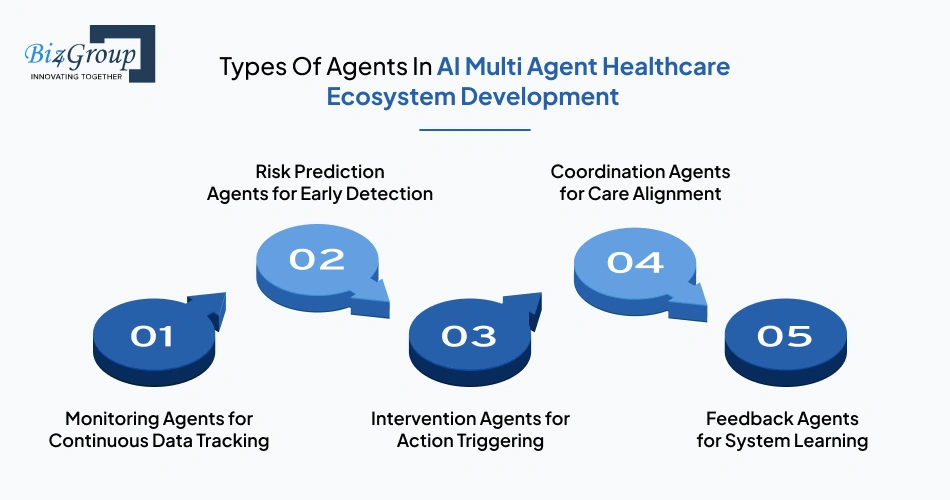
A multi-agent system is structured around clear roles. Each agent handles one part of the care process, and together they form a continuous loop of monitoring, decision-making, and action. To build an AI multi-agent preventive care ecosystem for healthcare, it is necessary to define these roles upfront so the system remains predictable and scalable as more use cases are added.
|
Agent Type |
What It Does |
Where It Fits In The System |
|---|---|---|
|
Monitoring Agents for Continuous Data Tracking |
Collect and track incoming data from devices, clinical systems, and user inputs in real time |
Acts as the entry point, ensuring the system always has updated information |
|
Risk Prediction Agents for Early Detection |
Evaluate incoming data using models to detect patterns and assign risk levels |
Converts raw signals into decisions about whether attention is needed |
|
Intervention Agents for Action Triggering |
Execute actions such as alerts, care plan updates, or task assignments based on system decisions |
Connects system outputs to real-world responses |
|
Coordination Agents for Care Alignment |
Manage how different agents interact, ensuring actions are sequenced correctly and do not conflict |
Critical when teams develop AI care coordination platform for healthcare to maintain consistency across workflows |
|
Feedback Agents for System Learning |
Capture outcomes of actions and feed them back into the system for evaluation and improvement |
Helps refine decision accuracy and adjust system behavior over time |
Each agent is designed to do one job well, which keeps the system easier to maintain and extend. Monitoring feeds prediction, prediction informs intervention, and feedback improves future decisions. This separation also allows teams to update models or logic in one agent without affecting the entire system, which is important as data patterns change.
This structure depends on reliable AI model development, since each agent must process data and produce consistent outputs within its role. As systems expand, organizations often hire AI developers to refine these agent boundaries and ensure coordination remains stable.
Teams that build AI patient monitoring ecosystem for preventive care use this approach to support continuous tracking and timely action, while keeping the system modular enough to handle new workflows and patient scenarios.
Portfolio Spotlight
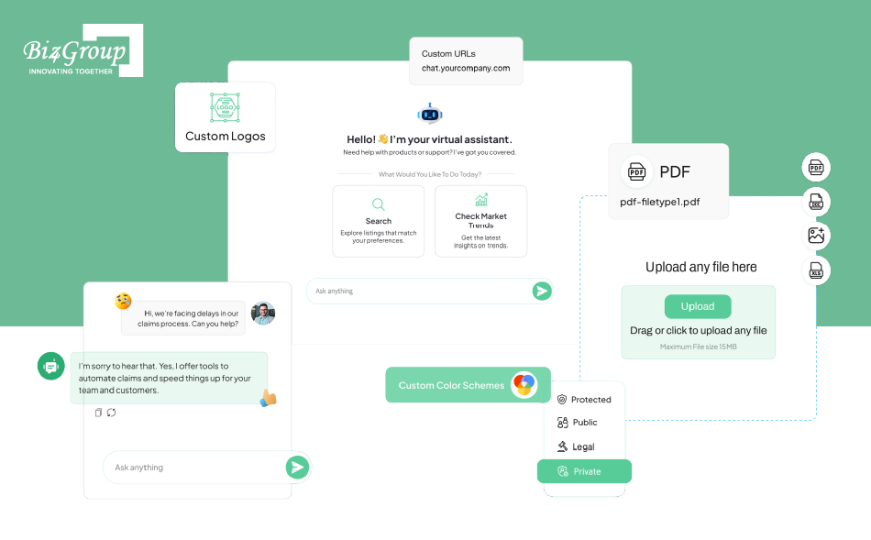
Custom Enterprise AI Agent is an AI-powered enterprise agent built to automate workflows like customer support, internal queries, and information retrieval across business functions. It shows how agents can operate independently while still staying connected to shared data and systems.
In the context of preventive care, this kind of agent design directly maps to healthcare use cases, where multiple agents handle monitoring, risk detection, and interventions while working as part of a coordinated system.
Ready to Build Your First Use Case?
Start small and build AI multi agent system for healthcare startups that delivers measurable outcomes early.
Launch My MVPCommunication Models In AI Multi Agent Preventive Care Ecosystem For Healthcare
Once agents are defined, the next question is how they talk to each other. Communication is what turns separate agents into a working system. If this part is unclear, even good agents can produce delays or conflicting actions. To build an AI multi-agent preventive care ecosystem for healthcare, the system needs simple and reliable ways for agents to pass signals, trigger actions, and stay aligned.
Event-Driven Vs Request-Response Communication
There are two basic ways agents interact, and most systems use a mix of both.
- Event-driven: An agent reacts when something changes, like a new data point or a risk signal. This works well for continuous monitoring where quick response matters.
- Request-response: An agent asks for input and waits for a reply before moving forward. This is useful when a decision needs confirmation or more context.
In systems that create AI health risk prediction system, event-driven flows help catch changes early, while request-response flows add control where needed. Using both keeps the system responsive without making decisions too loosely.
Central Orchestration Vs Decentralized Coordination
This is about where control sits in the system.
|
Approach |
What It Means In Practice |
Trade-Off |
|---|---|---|
|
Central Orchestration |
One layer decides how agents interact and in what order |
Easier to manage, but can slow things down |
|
Decentralized Coordination |
Agents react and interact on their own based on events |
Faster and more flexible, but needs stronger rules |
There is no single right choice. Many systems mix both. For example, critical workflows may stay controlled, while routine signals move freely. This balance is often defined with the help of AI consulting services when systems become more complex.
Conflict Resolution Between Agents
When multiple agents are active, they can suggest different actions at the same time. Without clear rules, this can lead to duplicate alerts or conflicting decisions.
To avoid that, systems usually:
- set priorities for different types of actions
- define which agent has the final say in certain cases
- delay or combine actions when signals are unclear
These rules keep the system predictable, especially as more agents are added over time.
Ensuring Consistency Across Decisions
Consistency means the system behaves the same way for similar situations. This becomes harder when multiple agents are making decisions in parallel.
To keep things aligned:
- agents use the same data or updated shared state
- decision rules follow common thresholds or logic
- outputs are checked before actions are triggered
This is where AI in healthcare administration automation helps keep workflows structured, so decisions do not vary unnecessarily as the system scales.
In simple terms, communication is what keeps the system from breaking into isolated parts. As teams make AI powered preventive healthcare platform, defining how agents interact becomes just as important as defining what each agent does, because coordination directly affects how reliable the system feels in real use.
AI Multi Agent Preventive Care Ecosystem for Healthcare: Workflow Explained
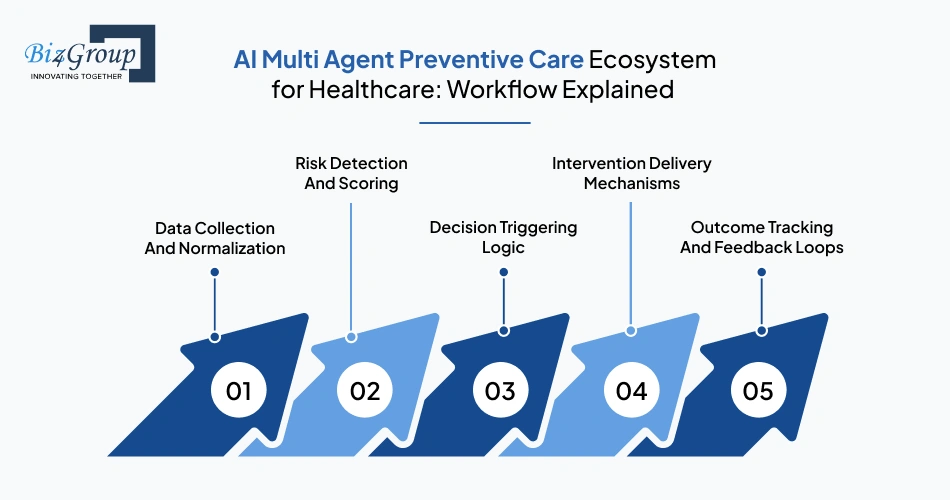
Once all the parts are in place, the system starts to follow a simple flow. Data comes in, something checks it, something decides what it means, and something acts on it. To build an AI multi-agent preventive care ecosystem for healthcare, this flow needs to stay clear so the system can keep running without confusion as more data and use cases are added.
|
Stage |
What Happens |
Why It Matters |
|---|---|---|
|
Data Collection And Normalization |
Data comes in from devices, records, and user inputs, then gets cleaned and organized |
Makes sure the system is working with consistent data instead of scattered inputs |
|
Risk Detection And Scoring |
The system looks for patterns and assigns a level of risk based on what it sees |
Helps spot issues early instead of waiting for them to grow |
|
Decision Triggering Logic |
The system checks if the risk is high enough to take action |
Avoids overreacting while still acting when needed |
|
Intervention Delivery Mechanisms |
Actions are taken, like sending alerts or updating care plans |
Turns system decisions into something useful in real life |
|
Outcome Tracking And Feedback Loops |
The system watches what happens next and learns from it |
Helps improve future decisions over time |
This flow is not something that runs once and stops. It keeps repeating as new data comes in and conditions change. That is why teams that develop multi agent AI system for healthcare services focus on keeping each step simple and connected, so nothing breaks as the system grows.
In real use, this flow also needs to handle scale without slowing down. Many teams use enterprise AI solutions to keep performance steady as more data is processed, and in some cases, AI chatbot integration is used in the intervention step to make communication with patients easier.
The main idea is to keep the flow easy to follow and reliable in practice. Teams that build AI digital health ecosystem for preventive care rely on this loop to make sure the system keeps working the same way, even as more patients, data, and scenarios are added.
Essential Features In AI Multi-Agent Preventive Care Ecosystem Development For Healthcare
At a relatively later stage, the system becomes bigger than an idea. It needs to handle real data, real users, and real decisions. Features are what make that possible. To build an AI multi-agent preventive care ecosystem for healthcare, the focus should be on a small set of capabilities that keep the system running smoothly as data flows in and actions need to be taken.
|
Feature |
What It Does |
Why It Matters |
|---|---|---|
|
Continuous Data Ingestion And Normalization |
Takes in data from different sources and keeps it usable |
Helps avoid gaps or confusion in incoming data |
|
Real-Time And Batch Processing Pipelines |
Handles both live updates and past data together |
Supports quick reactions and better long-term decisions |
|
Risk Prediction And Scoring Engine |
Looks at data and flags possible risks with a level of severity |
Gives the system a clear signal on when to act |
|
Agent-Based Decision Layer |
Splits decisions across different agents instead of one system |
Keeps things manageable as the system grows |
|
Event-Driven Orchestration System |
Triggers actions when something changes |
Makes sure the system responds at the right time |
|
Intervention Delivery Mechanisms |
Sends alerts or updates based on decisions |
Ensures actions actually reach users |
|
Feedback And Learning Loop |
Tracks outcomes and feeds them back into the system |
Helps improve future decisions |
|
Human-In-The-Loop Controls |
Lets humans step in when needed |
Adds a safety layer for important decisions |
|
Integration Layer With Healthcare Systems |
Connects with existing tools and platforms |
Keeps everything working together |
|
Security, Privacy, And Compliance Framework |
Protects data and meets required standards |
Needed for real-world use in healthcare |
In reality, these features are usually built in layers, not all at once. Teams often rely on an AI app development company to put these pieces together in a way that fits how the system will actually be used, and use AI assistant app design when interaction with users is part of the flow.
The goal is to keep things simple and reliable. When creating an AI multi agent preventive care ecosystem for healthcare, these features act as the base that supports everything else, making sure the system can keep running as it grows and handles more scenarios.
Advanced Features In AI Healthcare Ecosystem Development For Startups
Once the system is stable and handling real workflows, the next step is improving how it adapts and scales. To build an AI multi-agent preventive care ecosystem for healthcare, these advanced capabilities are added gradually, based on actual usage and gaps observed over time. They are not required on day one, but they help the system become more precise and easier to expand.
1. Adaptive Personalization Engine
This allows the system to adjust decisions based on how each patient behaves over time. Instead of using the same thresholds for everyone, it learns patterns and adapts gradually. This helps reduce unnecessary alerts and makes interventions more relevant in AI multi-agent preventive care ecosystem development for Healthcare.
2. Predictive Intervention Timing Optimization
Here, the focus is on choosing the right moment to act. The system looks at past responses and identifies when an intervention is most likely to be effective. This avoids acting too early or too late, which can reduce impact even if the prediction itself is correct.
3. Digital Twin Of Patient Health State
A digital twin is a running snapshot of a patient’s condition that updates as new data comes in. It helps the system compare possible outcomes before taking action. In some setups, generative AI is used to simulate different scenarios and support better decision-making.
4. Autonomous Care Pathway Optimization
Care pathways often start as fixed steps, but over time, they need to adjust based on what works. This feature allows the system to refine those steps automatically using past outcomes. It reduces the need for manual updates and keeps workflows aligned with real usage.
5. Cross-Agent Learning And Shared Intelligence
Agents improve faster when they share what they learn. If one agent finds a better way to handle a situation, others can apply the same logic. This keeps decisions consistent and avoids repeating the same mistakes across different parts of the system.
6. Simulation And Scenario Testing Environment
Before making changes, teams can test how the system behaves under different conditions. This helps identify problems early and avoids disrupting real workflows. It is often used when evaluating changes in logic or estimating cost before scaling.
7. Population-Level Intelligence Layer
This feature looks at patterns across groups instead of just individuals. It helps identify trends and adjust strategies at a broader level. This becomes more useful as the system handles more users and more varied conditions.
8. Plug-And-Play Agent Expansion Framework
As new needs come up, new agents can be added without breaking what already works. This keeps the system flexible and allows gradual expansion instead of large redesigns. Teams can extend capabilities without slowing down existing workflows.
9. Multi-Modal Data Fusion
This combines different types of data into a single view. Instead of looking at signals separately, the system uses them together to form better insights. This becomes important as data sources increase in AI multi agent healthcare ecosystem development.
The idea is to improve how the system behaves without making it harder to manage. Over time, they help the system move from basic operation to something that can adapt, scale, and stay consistent across different scenarios.
How To Build an AI Multi Agent Preventive Care Ecosystem for Healthcare? Step-By-Step Process
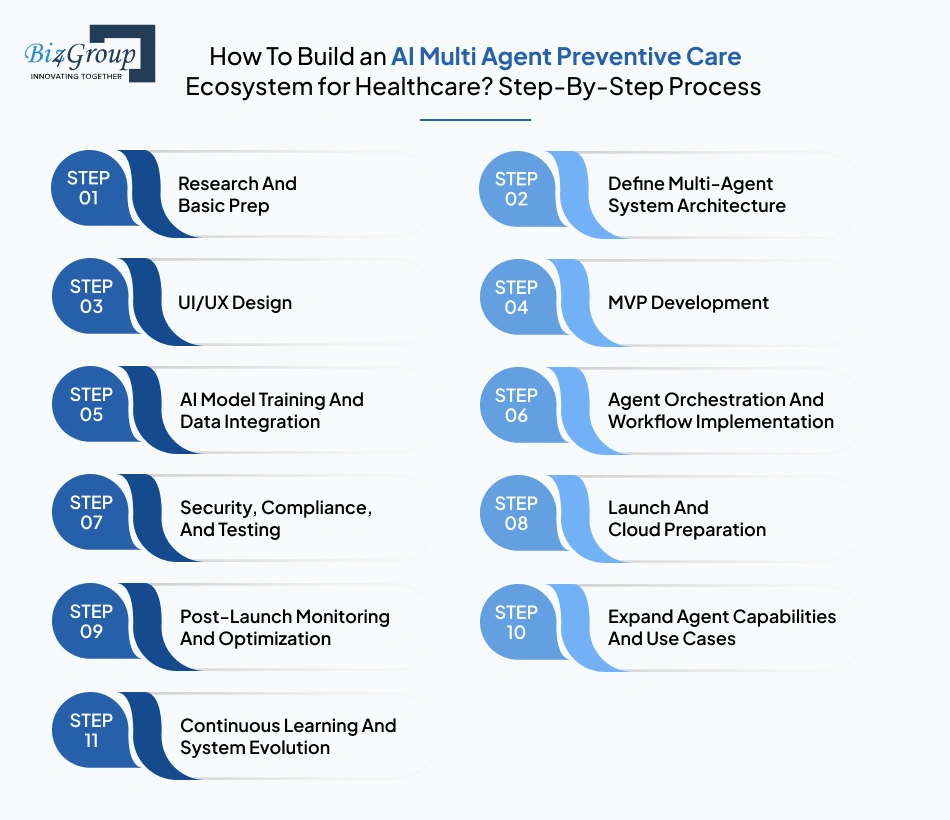
Building a preventive care system is different from building a typical healthcare app. You are designing a system that watches patient signals continuously, detects early risk, and decides when to act. To build an AI multi-agent preventive care ecosystem for healthcare, each step must reflect how care actually happens over time, not just how data is processed.
Step 1: Research And Basic Prep
Start by identifying where preventive care is breaking down today. This could be missed early symptoms, lack of follow-ups, or delayed interventions. The system should directly address these gaps, which is central to how to build an AI multi agent preventive care ecosystem for healthcare.
- Identify where early risk signals are currently missed
- Map gaps between detection and intervention
- Define what “early action” looks like in your use case
- Align system goals with clinical and operational outcomes
Step 2: Define Multi-Agent System Architecture
In preventive care, decisions happen at different stages. You need separate agents for monitoring, risk evaluation, and action. Without this structure, the system becomes slow or inconsistent.
- Define agents for continuous monitoring vs episodic decisions
- Separate real-time agents from analytical agents
- Define how agents hand off decisions across stages
- Ensure agents can operate without blocking each other
Step 3: UI/UX Design
Preventive care depends on timely action, so users must understand what to do immediately. The UI/UX design should highlight risk, urgency, and next steps without requiring interpretation.
- Design alerts with clear severity and action guidance
- Show trends instead of raw data where possible
- Reduce steps between alert and action
- Support both clinician and patient views differently
Also read: Top UI/UX design companies in USA
Step 4: MVP Development
Focus on one preventive workflow, such as early detection of a specific condition. Build only what is needed to monitor, detect, and act within that flow. This is a key aspect when planning how to develop AI preventive care platform for healthcare startups.
- Choose one condition or risk category via MVP development services
- Implement monitoring, then prediction, and then intervention loop
- Limit number of agents to essential roles
- Validate whether early signals lead to action
Also read: Top 12+ MVP Development Companies to Launch Your Startup in 2026
Step 5: AI Model Training And Data Integration
Models should focus on identifying early changes, not just obvious risks. Preventive care depends on detecting weak signals before they become critical.
- Train AI models on longitudinal patient data
- Focus on pattern changes, not static thresholds
- Combine clinical and behavioral data signals
- Validate predictions against early-stage outcomes
Step 6: Agent Orchestration And Workflow Implementation
Preventive care requires timing. The system must decide when to act, not just what to detect. This step ensures agents trigger each other correctly in make AI multi-agent preventive care ecosystem for healthcare.
- Define timing rules for interventions
- Ensure monitoring agents trigger prediction agents continuously
- Prevent repeated alerts for the same condition
- Align workflows with care escalation paths
Step 7: Security, Compliance, And Testing
Preventive systems handle continuous patient data, which increases risk exposure. Testing should focus on both data safety and decision reliability.
- Validate secure handling of continuous data streams
- Test system behavior under real patient scenarios
- Ensure decisions can be audited and traced
- Check consistency across different patient profiles
Also Read: Software Testing Companies in USA
Step 8: Launch And Cloud Preparation
Preventive systems must run continuously without downtime. The system should handle constant data flow and unpredictable usage patterns.
- Use infrastructure that supports continuous data ingestion
- Monitor latency in decision-making pipelines
- Ensure system can handle spikes in alerts
- Prepare onboarding for clinicians and patients
Step 9: Post-Launch Monitoring And Optimization
After launch, focus on how well the system detects and acts early. The goal is to improve timing and accuracy, not just model performance in develop AI preventive care ecosystem for healthcare.
- Track how early risks are detected
- Measure intervention effectiveness
- Reduce unnecessary or low-value alerts
- Adjust thresholds based on real outcomes
Step 10: Expand Agent Capabilities And Use Cases
Once one workflow works well, expand to additional conditions or risk types. Each new use case should follow the same structure to maintain consistency.
- Add agents for new conditions (e.g., cardiac, metabolic)
- Extend monitoring to new data sources
- Reuse existing workflows where possible
- Maintain consistency in decision logic
This is where teams begin to build AI multi agent system for healthcare startups across multiple care pathways.
Step 11: Continuous Learning And System Evolution
Over time, the system should improve how it detects and responds to risk. Preventive care systems become more effective as they learn from outcomes.
- Refine models using outcome-based feedback
- Improve timing of interventions
- Enable agents to adapt based on patient response
- Maintain performance across growing datasets
This stage reflects how can I build an AI multi agent preventive care ecosystem for my healthcare startup in a way that supports long-term preventive care delivery.
Turn Care Workflows Into Scalable Products
Design and create AI preventive care platform for healthcare that fits real clinical and patient workflows.
Design My PlatformTech Stack for Building an AI Multi Agent Preventive Care Ecosystem for Healthcare
Choosing the right tech stack directly affects how well your system handles continuous monitoring, agent coordination, and real-time interventions. In preventive care, systems must stay reliable under constant data flow while integrating with existing healthcare infrastructure.
|
Label |
Preferred Technologies |
Why It Matters |
|
Frontend Framework (Patient + Clinician Interfaces) |
React, Vue.js |
Supports real-time dashboards and alert visibility; ReactJS development helps build responsive care interfaces |
|
Server-Side Rendering & SEO |
Next.js, Nuxt.js |
Improves performance and scalability; NextJS development enables faster delivery of healthcare apps |
|
Backend Framework (APIs + Workflows) |
Node.js, Express, Python (FastAPI, Django) |
Handles agent workflows and decision pipelines; NodeJS development supports async processing, while Python development powers data-heavy logic |
|
API Development & Management |
REST, GraphQL, API Gateway |
Enables structured communication between agents, apps, and external systems; critical for modular system design |
|
AI & Data Processing (Prediction + Pipelines) |
TensorFlow, PyTorch, Apache Spark |
Drives risk prediction and pattern detection across continuous patient data streams |
|
Data Streaming & Messaging |
Apache Kafka, RabbitMQ |
Ensures real-time event flow between agents without delays or data loss |
|
Database (Structured + Time-Series) |
PostgreSQL, MongoDB, InfluxDB |
Stores clinical records and time-series data like vitals and device inputs |
|
Agent Orchestration Layer |
Temporal, Kubernetes, Microservices |
Coordinates how agents interact, trigger actions, and scale independently |
|
Integration Layer (EHR + Devices) |
HL7, FHIR APIs, REST APIs |
Connects with EHRs and wearables, ensuring smooth data exchange |
|
Cloud Infrastructure |
AWS, Azure, GCP |
Provides scalability for continuous processing and multi-agent workloads |
|
Security + Compliance |
OAuth2, HIPAA-compliant cloud, encryption tools |
Protects patient data and ensures regulatory compliance across workflows |
|
Monitoring + Observability |
Prometheus, Grafana, ELK Stack |
Tracks system health, agent performance, and real-time decision latency |
|
Data Governance & Quality Layer |
Great Expectations, dbt |
Ensures data consistency, validation, and reliability across pipelines |
The goal is to choose technologies that support continuous care, real-time decisions, and multi-agent coordination. For healthcare startups, starting with a lean stack and expanding based on real usage is the most practical approach.
Data Requirements for AI Multi Agent Healthcare Ecosystem Development
Data is the foundation of any preventive care system. In a multi-agent setup, data does not just feed models, it drives continuous decisions across agents. To build an AI multi-agent preventive care ecosystem for healthcare, the system must handle different data types, speeds, and quality levels without breaking workflows or delaying actions.
1. Structured Vs Unstructured Healthcare Data
Healthcare data comes in multiple formats, and both structured and unstructured data play different roles in preventive care. The system should be designed to use both without forcing everything into a single format.
- Structured data includes lab results, vitals, and coded records that are easy to process
- Unstructured data includes clinical notes, messages, and reports that require interpretation
- Preventive care systems often combine both to detect early signals
- Ignoring unstructured data can lead to missed context and incomplete decisions
Handling both effectively is important when teams create AI preventive care platform for healthcare, as real-world care depends on more than just structured inputs.
2. Real-Time Vs Batch Data Processing
Preventive care depends on timing, so the system must decide what needs to be processed instantly and what can be processed later. Not all data requires real-time handling, but some signals do.
- Real-time data includes device streams and alerts that need immediate action
- Batch data includes historical trends used for deeper analysis
- A mix of both helps balance speed and accuracy
- Over-reliance on real-time processing can increase system complexity
In many cases, teams integrate AI into an app to handle real-time signals while batch systems support long-term insights.
3. Data Quality And Normalization Challenges
Data from different sources often comes in inconsistent formats, which can affect how agents interpret it. Without proper normalization, the system may produce unreliable outputs.
- Data formats may vary across devices, systems, and providers
- Missing or incomplete data can affect risk predictions
- Normalization ensures all agents work with consistent inputs
- Validation rules help maintain data reliability over time
These challenges become more visible as systems scale, especially when working with top use cases of agentic AI that rely on continuous and accurate data flows.
4. Privacy, Compliance, And Governance Requirements
Healthcare data is sensitive, and preventive systems handle it continuously. This increases the need for strong governance and compliance practices from the start.
- Ensure data is encrypted during storage and transmission
- Define access controls based on roles and responsibilities
- Maintain audit trails for all decisions and actions
- Align with healthcare regulations such as HIPAA or regional standards
Teams often work with a custom software development company to ensure compliance requirements are built into the system from the beginning.
Data decisions directly affect how well the system performs over time. For teams that build AI multi agent system for healthcare startups, the focus should be on keeping data reliable, timely, and secure so agents can make consistent and accurate decisions as the system grows.
Fix Your System Architecture Before It Breaks
Get clarity on how to develop AI preventive care ecosystem for healthcare with stable agent coordination and data flow.
Review My ArchitectureHow To Design Decision Logic In AI Multi Agent Preventive Care Ecosystem For Healthcare?
Decision logic is what connects data to action. In a multi-agent preventive care system, it determines when to trigger alerts, when to wait, and when to escalate. To build an AI multi-agent preventive care ecosystem for healthcare, this logic must stay consistent across agents while still adapting to changing patient conditions.
1. Threshold-Based Vs Model-Driven Decisions
Not all decisions need complex models. Some work better with clear thresholds, while others require pattern-based predictions.
|
Approach |
When It Works Best |
Limitation |
|
Threshold-Based |
Known conditions (e.g., heart rate limits) |
Rigid, may miss subtle changes |
|
Model-Driven |
Pattern detection and early risk signals |
Requires training and validation |
- Use thresholds for immediate, safety-critical triggers
- Use models for detecting gradual or hidden risks
- Combine both to balance reliability and flexibility
This balance is important in AI healthcare ecosystem development for startups, where systems need to stay simple but effective early on.
2. Timing And Frequency Of Interventions
In preventive care, timing is often more important than the decision itself. Acting too early or too often can reduce effectiveness.
- Define minimum intervals between repeated alerts
- Trigger actions only when risk persists or increases
- Adjust timing based on patient response patterns
- Prioritize interventions based on severity levels
Some systems use top use cases of agentic AI to refine when actions should occur based on past outcomes.
3. Personalization Based On Patient Profiles
Not all patients respond the same way to interventions. Decision logic should adapt based on individual behavior and history instead of using fixed rules.
- Adjust thresholds based on patient baseline conditions
- Factor in lifestyle, adherence, and past responses
- Modify intervention type based on engagement patterns
- Use patient history to reduce unnecessary alerts
In many cases, teams use a healthcare conversational AI guide to design interaction flows that align with patient behavior and improve response rates.
Avoiding Alert Fatigue And Over-Intervention
Too many alerts reduce trust in the system and can lead to ignored signals. Decision logic should focus on relevance, not volume.
- Filter low-risk or repetitive alerts
- Group related signals into a single actionable alert
- Prioritize high-impact interventions
- Continuously review alert effectiveness
Here’s a simple way to think about it:
- fewer alerts = higher attention
- clearer actions = better outcomes
Decision logic is not fixed once implemented. It evolves with data, outcomes, and user behavior. Teams that make AI driven preventive care ecosystem focus on refining this logic over time so the system stays accurate, actionable, and aligned with real-world care needs.
Cost To Build An AI Multi Agent Preventive Care Ecosystem For Healthcare
The cost really depends on how far you want to go in the first version. If you start small with one use case, it stays manageable. If you try to build a full system from day one, costs go up quickly. In most cases, it falls between $25,000 to $200,000+, but this is just a ballpark. To build an AI multi-agent preventive care ecosystem for healthcare, most teams start small and expand once things work in real use.
|
Level |
Estimated Cost |
What You’re Paying For |
|
MVP-Level AI Multi Agent Preventive Care Ecosystem for Healthcare |
$25,000 – $60,000 |
One condition, basic monitoring, simple risk detection, a few agents, minimal integrations |
|
Advanced-Level AI Multi Agent Preventive Care Ecosystem for Healthcare |
$60,000 – $120,000 |
Multiple agents, better decision logic, real-time data handling, integrations with systems and devices |
|
Enterprise-Grade AI Multi Agent Preventive Care Ecosystem for Healthcare |
$120,000 – $200,000+ |
Multiple conditions, full agent coordination, scalable setup, compliance layers, continuous improvements |
A simpler way to think about it: start with one problem, make it work well, then build on top of it. That approach keeps agentic AI development costs under control and avoids rework later.
Should You Build Or Buy AI Multi Agent Healthcare Ecosystem Development Solutions?
Choosing between building and buying depends on how much control you need over workflows, data, and decision logic. To build an AI multi-agent preventive care ecosystem for healthcare, you need to evaluate where customization matters and where existing tools are sufficient.
|
Scenario |
When It Makes Sense |
Trade-Off |
|
Build Custom Agent Systems |
When workflows are unique, such as condition-specific monitoring or care pathways |
High control, but longer development time and higher cost |
|
Use Existing Platforms Or APIs |
When basic capabilities like data ingestion or alerts are standard |
Faster setup, but limited flexibility in decision logic |
|
Hybrid Approach |
When core logic is custom but supporting layers use third-party tools |
Balanced approach, but requires careful integration planning |
|
Cost Consideration |
Building requires upfront investment, while buying spreads cost over time |
Trade-off between capital expense and ongoing fees |
|
Speed To Market |
Buying helps launch faster, building takes more time but offers long-term flexibility |
Short-term speed vs long-term scalability |
|
Control Over Data And Logic |
Building gives full control over patient data and decision-making rules |
Buying may restrict customization and ownership |
For example, startups working with a software development company in Florida often choose custom builds when their care workflows are tightly defined, while others may rely on APIs for faster deployment. Similarly, teams looking to build AI software for healthcare often adopt hybrid approaches to balance speed and control.
The right choice depends on how critical your workflows are to your business model. Teams that develop AI care coordination platform for healthcare usually lean toward custom or hybrid approaches, since coordination logic and patient data handling often require more control than off-the-shelf solutions can provide.
Key Challenges In Building AI Multi Agent System For Healthcare Startups And Solutions
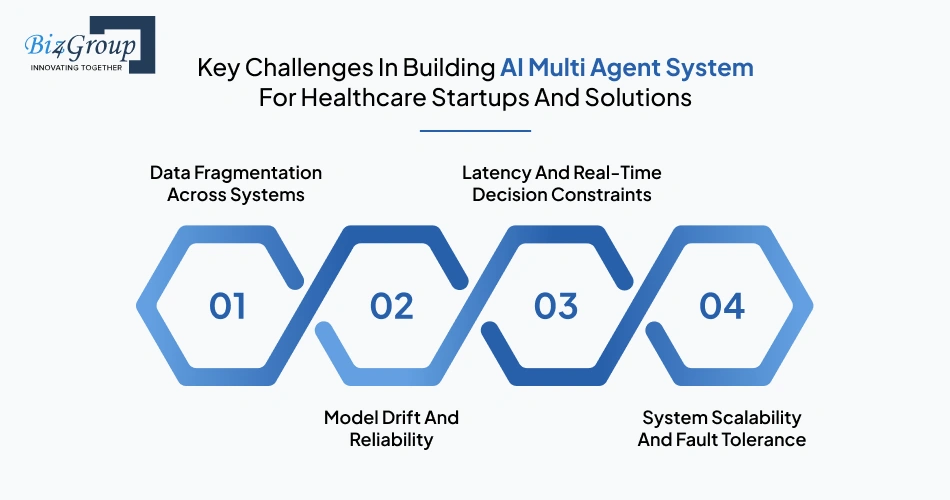
Once the system starts handling real patients and real data, a few challenges show up quickly. These are not edge cases, they are part of how healthcare systems behave in practice. To build an AI multi-agent preventive care ecosystem for healthcare, startups need to account for these early so the system does not break as it grows.
|
Challenge |
What Actually Happens |
How Teams Handle It |
|
Data Fragmentation Across Systems |
Patient data lives in different places like EHRs, apps, and devices, so agents never see a complete picture |
Bring data into one layer using APIs, standardize formats, and ensure all agents read from the same source |
|
Model Drift And Reliability |
Models that worked initially start giving weaker signals as patient behavior or data patterns change |
Track model performance regularly and retrain using recent data instead of relying on static models |
|
Latency And Real-Time Decision Constraints |
Delays in processing mean alerts come too late to be useful, especially in continuous monitoring setups |
Prioritize critical signals, use event-driven flows, and reduce dependency on slow batch processes |
|
System Scalability And Fault Tolerance |
As more users and agents are added, parts of the system slow down or fail, affecting overall performance |
Break the system into smaller services, scale components independently, and isolate failures |
These issues usually become visible when teams build AI patient monitoring ecosystem for preventive care, especially once the system moves beyond a single use case. Some teams also choose to hire agentic AI developers early to structure the system in a way that avoids rework later.
Make Preventive Care Actually Preventive
Build systems that detect early signals and act on them by learning how to make AI multi-agent preventive care ecosystem for healthcare.
See How It WorksLegal And Compliance Factors In AI Multi Agent Preventive Care Ecosystem Development
In the U.S., compliance is part of how healthcare systems actually run, not just a legal step at the end. It affects how data moves, how decisions are made, and whether providers will even use your system. To build an AI multi-agent preventive care ecosystem for healthcare, these constraints need to be factored in early, otherwise they slow you down later.
1. Data Protection Requirements
Most healthcare data in the U.S. falls under HIPAA, which means you cannot treat it like normal app data. Preventive systems make this harder because data is constantly flowing, not just stored once. This becomes more critical when teams create AI health risk prediction system, since the same data is reused to generate ongoing insights.
2. Clinical Safety Standards
If your system is influencing care decisions, you cannot rely only on model outputs. In some cases, FDA rules may apply depending on how the system is positioned. Teams working on business app development using AI usually add simple checks so the system supports decisions instead of taking full control.
3. Documentation And Audit Trails
In the U.S., you need to be able to explain what the system did and why. If an alert is triggered, there should be a clear path showing how that decision was made. Some startups hire AI experts to build this traceability in a way that does not slow down the system.
4. Deployment Constraints Across Regions
Even within the U.S., things are not uniform. Different providers, states, and partners may have their own requirements. This becomes important when trying to make AI powered preventive healthcare platform that works across multiple healthcare networks.
Overall, compliance affects whether your system can actually be used, not just whether it can be built. Handling it early makes it much easier to move from a working product to something that providers are willing to adopt.
How To Scale AI Multi Agent Healthcare Ecosystem Development?
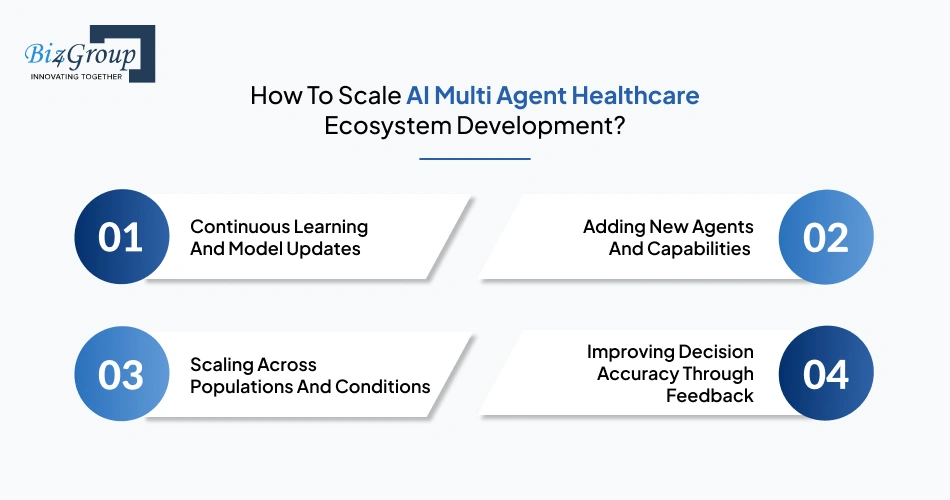
Scaling an AI multi-agent system is all about keeping things steady as usage grows. More patients, more data, and more conditions can quickly make the system harder to manage. To build an AI multi-agent preventive care ecosystem for healthcare, scaling should feel like an extension, not a rebuild.
Continuous Learning And Model Updates
As the system runs, data patterns start to shift. What worked earlier may not stay accurate over time, especially in preventive care. Teams that develop multi agent AI system for healthcare services usually update models in small steps so the system keeps improving without sudden changes in behavior.
Adding New Agents And Capabilities
Scaling often means adding new agents for new use cases, like a new condition or monitoring need. The key is to add them without breaking what already works.
- Keep new agents independent from existing ones
- Reuse existing workflows where possible
- Avoid changing core logic when adding features
Some teams extend systems using a build agentic AI assistant approach to keep interactions consistent as new capabilities are added.
Scaling Across Populations And Conditions
As more users are added, the system needs to handle different behaviors and health patterns. A setup that works for one group may not work for another.
- Adjust thresholds based on population differences
- Avoid one-size-fits-all decision logic
- Keep workflows consistent even as inputs vary
Improving Decision Accuracy Through Feedback
Over time, the system learns from what works and what does not. This helps improve both timing and relevance of decisions.
- Track which interventions actually help
- Reduce repeated or low-value alerts
- Adjust decisions based on patient response
- Use feedback to improve coordination across agents
This is also where AI conversation app flows help capture user responses and refine system behavior.
Scaling works best when the system grows in layers, not all at once. Teams that build AI digital health ecosystem for preventive care focus on keeping the system stable while gradually adding new capabilities and use cases.
Mistakes To Avoid When Building AI Preventive Care Ecosystem For Healthcare
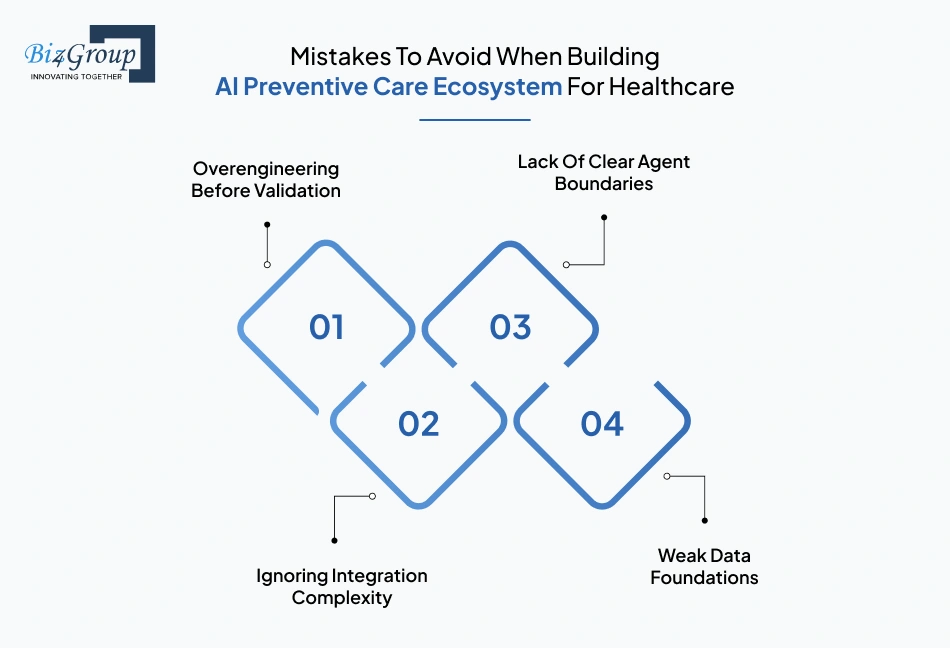
Most issues in AI preventive care ecosystem for healthcare do not come from models or tools, but from early decisions that make the system harder to manage later. Preventive care adds continuous data and ongoing decisions, so small mistakes compound quickly. To build an AI multi-agent preventive care ecosystem for healthcare, it is important to avoid patterns that slow down progress or create rework.
|
Mistake |
What It Looks Like In Practice |
What To Do Instead |
|
Overengineering Before Validation |
Building multiple agents, complex models, and workflows before testing a single use case |
Start with one clear workflow and validate outcomes before expanding |
|
Ignoring Integration Complexity |
Assuming systems will connect easily without planning for data formats and APIs |
Plan integrations early and test data flow between systems step by step |
|
Lack Of Clear Agent Boundaries |
Agents overlapping in responsibilities, causing duplicate or conflicting actions |
Define clear roles for each agent and keep responsibilities separate |
|
Weak Data Foundations |
Using inconsistent, incomplete, or unvalidated data across the system |
Normalize data early and ensure all agents use the same reliable inputs |
These mistakes often show up when teams move too quickly without validating how the system behaves in real use. Some startups even consult top AI development companies in Florida to identify these gaps early and avoid costly changes later.
Teams working on solutions to build healthcare ecosystem with multiple AI agents usually succeed when they focus on clarity first and complexity later.
From One Use Case to Full Ecosystem
Scale smarter with a structured approach to AI healthcare ecosystem development for startups without losing control.
Scale My SystemWhy Partner with Biz4Group LLC For AI Multi-Agent Preventive Care Ecosystem Development?
Building a preventive care system is all about getting multiple agents to work together without breaking workflows. That is where execution matters. As an AI development company, Biz4Group LLC focuses on designing systems that are practical, connected, and ready for real healthcare environments.
The custom enterprise AI agent built by Biz4Group above shows how individual AI agents can handle specific responsibilities while staying aligned with a larger system. The same approach is applied when we build an AI multi-agent preventive care ecosystem for healthcare, where coordination across agents is as important as individual intelligence.
What makes the approach work:
- Clear separation of agent roles to avoid overlap and confusion
- Strong focus on real-world data flow across healthcare systems
- Orchestration-first design to keep decisions consistent
- Gradual scaling from single use case to full ecosystem
- Built-in compliance awareness for U.S. healthcare environments
The focus point of Biz4Group LLC stays simple: build systems that work towards better healthcare efficiency, and stay compliant.
Wrapping Up Multi-Agent Preventive Care Ecosystem Development
Preventive care is not about reacting faster, it is about acting earlier. That shift changes how systems are built. Instead of one model doing everything, you now need multiple agents working together, each handling a specific part of the care journey.
To build an AI multi-agent preventive care ecosystem for healthcare, the focus should stay on clarity: clear data flow, clear agent roles, and clear decision logic. The more predictable the system is, the more useful it becomes in real care settings.
The good news? You do not need to build everything at once. Start small, validate what works, and expand step by step. That is how these systems actually scale, without turning into something unmanageable.
As an AI product development company, we build systems that do not just sound advanced, but actually help teams catch risks earlier and act with confidence.
Planning to build an AI multi-agent preventive care ecosystem for healthcare? Let’s map out a strategy together.
FAQs: AI Multi-Agent Preventive Care Ecosystem For Healthcare
1. How long does it take to build an AI multi-agent preventive care ecosystem?
Timelines usually range from 3 to 9 months depending on scope. A focused MVP can be built faster, while systems with multiple agents, integrations, and compliance layers take longer due to testing and validation requirements.
2. What is the biggest technical risk in multi-agent healthcare systems?
The biggest risk is inconsistency between agents. If agents interpret data differently or trigger conflicting actions, the system becomes unreliable. Clear decision rules and strong orchestration are critical to avoid this.
3. Can small healthcare startups realistically adopt multi-agent systems?
Yes, but only if they start small. Most startups begin with one use case, a few agents, and limited integrations. Expanding gradually is more practical than trying to build a full ecosystem from the start.
4. How do you ensure accuracy in preventive care predictions?
Accuracy comes from combining good data, continuous model updates, and feedback loops. Instead of relying on one model, systems improve over time by learning from outcomes and adjusting decision logic accordingly.
5. What kind of data sources are most valuable for preventive care systems?
The most useful data comes from a mix of clinical records, wearable devices, and patient-reported inputs. Combining these sources helps detect early signals that may not be visible in a single dataset.
6. How much does it cost to build an AI multi-agent preventive care ecosystem?
Costs typically range from $25,000 to $200,000+, depending on complexity. A basic version with one use case is on the lower end, while systems with multiple agents, integrations, and compliance features fall on the higher end.
