 Location :
Orlando, FL, USA
Location :
Orlando, FL, USA +1 (407) 714-1616
 info@biz4group.com
- Healthcare IT trends 2026 are shifting from experimentation to execution, with leaders prioritizing automation, interoperability, security, and scalability to fix real operational pain points.
- Agentic AI, AI-driven automation, analytics, and remote patient monitoring are among the top healthcare IT trends driving smarter, more efficient healthcare operations.
- Digital care models, including telehealth 2.0, mental health platforms, and personalized care, are improving access, outcomes, and patient engagement at scale.
- Modern healthcare IT foundations, such as cloud-native systems, FHIR-based interoperability, cybersecurity-first architectures, and smart hospitals, enable long-term growth and compliance.
- Biz4Group helps organizations execute these healthcare IT trends shaping smarter healthcare operations through real-world solutions like CogniHelp, turning strategy into measurable impact.
When organizations like Mayo Clinic invest heavily in automation, advanced analytics, and integrated digital systems, it sends a clear signal. This is no longer about experimenting with technology. It is about fixing how healthcare actually runs.
You have probably felt the same pressure.
Healthcare operations are under strain from every direction. Staff shortages. Systems that do not talk to each other. Rising operational costs. Patients expecting faster, more connected care. And every year, a new wave of tools claims to be the solution.
That is exactly why healthcare IT trends matter right now. They help you cut through the noise and focus on what genuinely improves workflows, cost control, and patient experience.
Let’s ground this in what is actually happening today.
According to recent data, the global Healthcare IT Market is projected to surpass $354.04 billion in 2025, with digital solutions accelerating across care delivery and administrative functions.
At the same time, adoption of advanced intelligence tools in US health systems is no longer experimental. In 2025, nearly 22% of healthcare organizations have already implemented AI-driven solutions, a sharp rise compared to previous years.
So here is the real question - If adoption is rising, why do daily operations still feel fragmented?
Because chasing latest healthcare IT trends without a clear execution plan leads to disconnected systems and stalled outcomes. What actually matters in 2026 is choosing healthcare IT trends that fix workflows, scale operations, and reduce manual effort.
That is where focused AI integration services help connect new intelligence with existing clinical and administrative systems, instead of adding more complexity.
In this guide, we break down the top healthcare IT trends shaping smarter healthcare operations, so you know exactly what to prioritize and why.
Drowning in healthcare IT trends and short on clarity?
Skip the noise. Focus on what actually fixes workflows, costs, and scalability.
Contact UsWhat Really Defines Healthcare IT Trends in 2026? Hint: It’s Not Just New Technology
If you are scanning headlines, it can feel like healthcare IT trends change every few months. New tools, new platforms, new promises. But when you step back, the patterns that define healthcare IT trends in 2026 are actually very clear.
The trends that matter are not driven by novelty. They are driven by outcomes. Healthcare leaders are prioritizing technology that fixes day-to-day operational pain, not solutions that only look good in demos.
So, what really separates meaningful trends from noise?
- Operational impact: If a solution does not reduce manual effort, speed up decisions, or remove workflow bottlenecks, it does not survive. This is why healthcare IT automation trends and digital healthcare IT trends continue to gain budget approval. In fact, 80% of hospitals now use AI to support patient care and operational efficiency.
- Scalability: Healthcare systems are expanding across locations, services, and patient volumes. Healthcare IT modernization trends focus on platforms that grow without breaking workflows or overwhelming teams.
- Integration-first thinking: Replacing core systems is rarely realistic. The future of healthcare IT is about connecting what already exists, which is also why emerging healthcare IT technologies that integrate cleanly with EHRs and operational systems are gaining traction fast.
- Security and trust: With rising cyber threats, healthcare IT security trends are no longer an IT-only concern. They are now tied directly to business continuity, compliance, and reputation.
- Clear ROI: Leaders want proof. Healthcare IT investment trends for 2026 are centered on measurable gains in efficiency, cost reduction, and patient experience. If value cannot be tracked, interest fades quickly.
This shift explains why strategic healthcare IT trends for healthcare leaders look very different from trend lists written just a few years ago. The focus has moved from experimentation to execution, often supported by well-scoped AI automation services that turn ideas into working systems instead of stalled pilots.
With that context in place, it is time to look at the trends that are actually shaping smarter healthcare operations in 2026.
Top Healthcare IT Trends in 2026 That Are Reshaping Smarter Healthcare Operations

The top healthcare IT trends in 2026 are not isolated tools you buy and plug in. They are connected capabilities designed to remove friction from healthcare operations, support clinical teams, and help organizations scale without adding complexity. Some trends focus on automation, others on data, security, or patient engagement, but all of them share one thing in common. They are being adopted because they solve real problems.
Let’s break down the healthcare IT trends shaping smarter healthcare operations and why they matter for your 2026.
Agentic AI for Autonomous Healthcare Operations
Healthcare leaders are moving beyond basic task automation toward systems that can make decisions and take action across complex workflows. This is where agentic AI in healthcare stands out, especially for healthcare organizations managing scale, complexity, and cost pressure.
Why this trend matters
Healthcare operations depend on thousands of daily decisions across scheduling, care coordination, discharge planning, billing, and workforce allocation. Traditional automation only executes predefined rules. Agentic AI works toward outcomes. It understands context, prioritizes actions, and operates within clinical, operational, and compliance boundaries.
What the data shows
- Autonomous AI agents will play a central role in orchestrating enterprise workflows across industries, including healthcare.
- Healthcare organizations are applying advanced AI-driven automation that can reduce administrative and operational costs by20 to 30%, particularly in coordination-heavy processes.
Where agentic AI is already being applied
- Care coordination across departments
- Discharge planning and follow-up orchestration
- Patient routing and prioritization
- Staff and resource allocation
- Billing and claims follow-ups
Example
A multi-hospital network in the US implemented an agentic AI system to manage patient discharge workflows. The AI agent monitored clinical readiness, verified prescriptions, scheduled follow-ups, coordinated transport, and updated care teams automatically. As already implemented by similar large health systems, this approach reduced discharge delays by around 30% and improved bed availability without adding staff.
Benefits healthcare leaders see
- Faster patient throughput
- Reduced manual coordination
- Lower operational costs
- Better staff utilization
- Improved patient experience
Why this belongs on your 2026 roadmap
Agentic AI directly supports healthcare IT trends shaping smarter healthcare operations because it connects systems, people, and decisions into a single operational flow. Instead of piling up dashboards and alerts, it takes action where it matters.
Healthcare organizations exploring this shift often begin with structured agentic AI development to ensure autonomy, compliance, and scalability are designed correctly from the start.
AI-Driven Clinical and Administrative Automation
Healthcare organizations continue to lose time and money on repetitive clinical and administrative work. Documentation delays, billing backlogs, manual scheduling, and data entry still slow teams down. This is exactly why healthcare IT automation trends are getting priority attention going into 2026.
Why this trend matters
AI-driven automation focuses on removing friction from daily operations, not just speeding up individual tasks. Instead of staff jumping between systems, automation connects workflows across clinical, financial, and administrative teams. This makes it a foundational pillar of healthcare IT trends in 2026, especially for organizations under pressure to do more with fewer resources.
What the data shows
- 74% of healthcare executives reported measurable efficiency gains after implementing AI-based automation, primarily in documentation and revenue cycle workflows.
- Automation in healthcare administration can reduce billing cycle times by up to 40%, directly improving cash flow and reducing claim backlogs.
How AI-driven automation is applied
- Clinical documentation assistance
- Claims processing and billing workflows
- Prior authorization handling
- Appointment schedulingand reminders
- Data validation and error reduction
Example
A large US health system implemented AI automation to support clinical documentation and coding. The system analyzed physician notes, suggested structured entries, and flagged missing information before submission. As already implemented by similar integrated delivery networks, this approach reduced documentation time by nearly 30% while improving coding accuracy.
Benefits you can expect
- Faster turnaround across administrative processes
- Reduced manual workload for clinicians and staff
- Improved revenue cycle performance
- Fewer errors caused by repetitive data entry
- Better alignment between clinical and operational teams
Why this belongs on your roadmap
AI-driven automation directly supports healthcare IT trends shaping smarter healthcare operations by turning high-volume, low-value work into reliable digital workflows. It also creates a strong base for advanced analytics, intelligent staffing, and future automation initiatives.
Healthcare organizations often approach this step by step, starting with pilot workflows and expanding gradually. Many teams work with a specialized AI development company to ensure automation aligns with compliance requirements, existing systems, and long-term scalability.
Remote Patient Monitoring as a Core Care Delivery Platform
Remote patient monitoring has moved far beyond pilot programs and post-discharge experiments. In 2026, it is becoming a core part of how care is delivered, especially for chronic conditions, aging populations, and value-based care models. This shift is a key driver of digital healthcare IT trends in 2026.
Why this trend matters
Healthcare organizations are under pressure to reduce readmissions, manage chronic patients more effectively, and extend care beyond hospital walls. Remote patient monitoring allows clinicians to track patient health continuously without increasing in-person visits, which directly impacts cost, outcomes, and capacity.
What the data shows
- Hospitals using remote monitoring programs have reported up to a 38% reduction in hospital readmissions, particularly for chronic disease management.
- Remote monitoring solutions can lower the cost of care by 15 to 20% by reducing emergency visits and avoidable admissions.
How remote patient monitoring is used today
- Chronic disease monitoringfor diabetes, cardiac, and respiratory patients
- Post-discharge monitoring to prevent complications
- Behavioral health and medication adherence tracking
- Early detection of patient deterioration
Example
Large health systems such as Kaiser Permanente have expanded remote monitoring programs for chronic care patients, using connected devices to track vitals and trigger alerts for care teams. As already implemented by similar organizations, this approach has helped clinicians intervene earlier and reduce unnecessary hospital visits.
Benefits healthcare leaders see
- Fewer readmissions and emergency visits
- Betterpatient engagement and satisfaction
- Continuous visibility into patient health
- Reduced strain on clinical staff
- Stronger support for value-based care models
Why this trend fits long-term strategy
Remote patient monitoring plays a direct role in healthcare IT trends shaping smarter healthcare operations by shifting care from reactive to proactive. It allows organizations to scale care delivery without scaling physical infrastructure or staffing at the same pace.
Telehealth 2.0 and Virtual-First Care Models
Telehealth in 2026 looks very different from the video-call-only model most organizations adopted a few years ago. What leaders are building now is a virtual-first care layer that supports patients before, during, and after clinical interactions. This evolution reflects broader healthcare technology trends as care delivery shifts toward convenience, continuity, and scale.
Why this shift is happening
Video visits alone solved access issues but left many operational gaps. Patients still need follow-ups. Care teams still had to chase information. Telehealth 2.0 focuses on designing the entire care journey, not just the appointment.
What the data shows
- Up to 30% of outpatient care in the US can be delivered virtually without affecting quality, especially for follow-ups and routine consultations.
- In 2025, more than 70% of patients prefer providers who offer virtual care as part of ongoing treatment, not just one-off visits.
How virtual-first care is being applied
- Digital triage before appointments
- Virtual consultationsintegrated with care plans
- Automated follow-ups and symptom checks
- Continuous communication between visits
- Coordination with in-person care when needed
Example
Cleveland Clinic has expanded its virtual care programs to include structured follow-ups and remote symptom tracking alongside teleconsultations. As already implemented by leading providers, this approach reduces unnecessary in-person visits while maintaining continuity and clinical oversight.
Benefits for healthcare organizations
- Better access without expanding physical infrastructure
- Lower no-show rates and missed follow-ups
- Faster decision-making for routine cases
- Improved patient satisfaction and engagement
- More efficient use of clinician time
Why leaders are investing here
Virtual-first care supports healthcare IT trends 2026 by allowing organizations to manage growing patient volumes without increasing operational strain. When designed correctly, it becomes a long-term care delivery model, not a temporary convenience layer.
Many organizations strengthen this approach by deploying an AI virtual healthcare assistant to support triage, scheduling, and patient communication at scale.
Also Read: AI Telehealth Chatbot PoC Development
Digital Mental Health Platforms and AI-Enabled Behavioral Care
Mental health is no longer treated as a side service. In 2026, it is becoming a core part of care delivery, driven by digital platforms that improve access, continuity, and early intervention. This shift is closely tied to digital healthcare IT trends in 2026.
Why this trend matters
Healthcare organizations are facing rising demand for behavioral care while struggling with limited specialist availability. Traditional in-person models cannot scale fast enough. Digital mental health platforms help close this gap by offering continuous support, early risk detection, and structured care pathways that integrate with broader clinical workflows.
What the data shows
- Nearly 1 in 5 adults in the US experience a mental health condition each year, increasing pressure on healthcare systems to expand access.
- Digital behavioral health solutions can improve care access by up to 40% while reducing overall treatment costs when combined with virtual care models.
How digital mental health platforms are being used
- Virtual therapyand counseling sessions
- AI-assisted symptom tracking and risk flagging
- Continuous patient engagement between visits
- Integration with primary care and telehealth programs
- Early intervention for high-risk patients
Example
Several large US health systems have partnered with digital mental health providers to embed behavioral care into primary and virtual care workflows. As already implemented by organizations like Kaiser Permanente, patients can access mental health support digitally while care teams receive structured insights to guide follow-ups and referrals.
Benefits healthcare leaders see
- Expanded access to behavioral care without hiring constraints
- Earlier identification of mental health risks
- Reduced emergency visits related to unmanaged conditions
- Better continuity between mental and physical care
- Improved patient engagement and satisfaction
Why this trend fits operational strategy
Digital mental health platforms support healthcare IT trends shaping smarter healthcare operations by reducing bottlenecks in specialty care and improving care coordination. They also align well with value-based care goals by focusing on prevention and long-term outcomes.
Many organizations strengthen patient engagement and triage in behavioral care using a chatbot for healthcare that guides patients, gathers symptom data, and routes them to the right level of care without overwhelming clinical teams.
AR and VR for Clinical Training, Therapy, and Patient Engagement
AR/VR in healthcare are no longer experimental tools. In 2026, they are being used to train clinicians faster, support patient therapy, and improve understanding of complex medical procedures. This shift reflects broader healthcare IT innovation trends that focus on experience and outcomes.
Why this trend matters
Healthcare training is expensive, time-consuming, and difficult to scale. At the same time, patients often struggle to understand diagnoses, treatment plans, and rehabilitation steps. AR and VR address both challenges by creating immersive, repeatable, and measurable experiences for clinicians and patients alike.
What the data shows
- VR-based training can be completed up to 4 times faster than traditional classroom training while improving knowledge retention.
- Healthcare AR and VR market is growing at over 30% annually, driven by adoption in medical training and therapy.
How AR and VR are being used in healthcare
- Clinical and surgical training simulations
- Physical rehabilitation and pain management
- Exposure therapy for anxiety and PTSD
- Patient education before procedures
- Remote guidance for complex medical tasks
Example
Organizations like Johns Hopkins Hospital have used VR simulations to train surgeons and clinical teams in complex procedures. As already implemented by leading academic medical centers, immersive training environments allow clinicians to practice repeatedly without risk to patients, improving confidence and outcomes.
Benefits healthcare organizations see
- Faster and more consistent clinician training
- Improved skill retention and performance
- Better patient understanding and engagement
- Reduced training costs over time
- Safer learning environments for complex procedures
Why this trend fits 2026 priorities
AR and VR support healthcare IT trends shaping smarter healthcare operations by improving workforce readiness and patient engagement without increasing physical infrastructure or training overhead. When paired with strong design principles, these tools become practical assets rather than novelty experiences.
Healthcare organizations often invest in intuitive interfaces and immersive experiences with the help of expert UI/UX design teams to ensure AR and VR solutions are usable, accessible, and effective for both clinicians and patients.
Cloud-Native Healthcare IT Modernization
Many healthcare systems are still running on infrastructure built for a very different era. In 2026, cloud-native modernization is less about migration and more about enabling speed, resilience, and scale. This shift sits at the core of healthcare IT modernization trends and directly impacts how organizations grow without breaking operations.
Why this trend matters
Legacy systems slow down innovation. They limit interoperability, complicate updates, and increase maintenance costs. Cloud-native platforms allow healthcare organizations to deploy updates faster, scale on demand, and support new digital services without constant infrastructure firefighting.
What the data shows
- Over70% of healthcare organizations are now using cloud services for at least one core workload, with adoption accelerating across clinical and administrative systems.
- Healthcare organizations moving to cloud-based platforms can reduce IT infrastructure costs by up to 30% while improving system reliability.
How cloud-native modernization shows up
- Modular, microservices-based applications
- Faster deployment of new digital features
- Improved system uptime and disaster recovery
- Easier integration with AI and analytics tools
- Secure access across locations and teams
Example
Large providers like Mayo Clinic have adopted cloud-based platforms to support data analytics, remote care, and research initiatives. As already implemented by leading healthcare organizations, cloud-native architectures allow teams to scale services quickly while maintaining performance and compliance.
Benefits healthcare leaders see
- Faster innovation cycles
- Lower infrastructure and maintenance costs
- Improved system performance and availability
- Better support for multi-site operations
- Easier adoption of future technologies
Why this trend supports long-term strategy
Cloud-native systems make it easier to adopt other healthcare IT trends 2026, from automation to AI and advanced analytics. They also provide the flexibility needed to respond to regulatory changes and evolving patient expectations.
Many healthcare organizations approach modernization incrementally, rebuilding critical components instead of replacing everything at once. This is often supported by a trusted custom software development company that understands healthcare compliance, scalability, and integration challenges.
CTA
The trends look good on slides. But will they work in your systems?
Execution is where most strategies break. Ours is where they finally work.
Contact Us
Interoperability and FHIR-Driven Data Exchange
Interoperability is no longer a long-term aspiration. In 2026, it is a practical requirement for healthcare organizations that want smoother workflows, better clinical decisions, and scalable digital operations. This is a defining part of healthcare IT trends in 2026 and a major driver of smarter care delivery.
Why this trend matters
Fragmented data slows everything down. Clinicians waste time searching for information. Administrators struggle with incomplete records. Patients experience delays and repeated tests. Interoperability addresses these issues by allowing systems to exchange data securely and in real time, instead of operating in silos.
What the data shows
- Over 75% of US hospitals now support FHIR-based APIs, reflecting strong momentum toward standardized data exchange.
- Organizations with mature interoperability frameworks report up to 20% faster clinical decision-making, driven by easier access to complete patient records.
How interoperability is applied in real operations
- Seamless data sharing between EHRs and specialty systems
- Faster referrals and care transitions
- Real-time access to lab results and imaging
- Better coordination across providers and locations
- Support for analytics, reporting, and population health
Example
Large health systems participating in national data exchange networks are using FHIR standards to share patient records across hospitals, clinics, and partner providers. As already implemented by organizations like CommonWell Health Alliance members, clinicians can access critical patient information without manual record requests or delays.
Benefits healthcare leaders see
- Less time spent chasing data
- Improved care coordination
- Fewer duplicate tests and procedures
- Faster workflows across departments
- Better patient experience
Why this trend belongs on your roadmap
Interoperability is foundational to healthcare IT trends shaping smarter healthcare operations because it enables automation, analytics, and AI to work with complete and accurate data. Without it, even advanced systems struggle to deliver value.
Healthcare organizations often focus on integrating EHR/EMR platforms early to ensure data flows smoothly across clinical and administrative systems while maintaining compliance and security.
Advanced Healthcare Data Analytics and Predictive Intelligence
Healthcare organizations are sitting on massive amounts of data, but data alone does not improve outcomes. In 2026, the focus is on turning clinical, operational, and financial data into forward-looking insight. This shift is central to healthcare technology trends in 2026.
Why this trend matters
Most healthcare decisions are still reactive. Leaders respond after costs rise, staff shortages hit, or patient outcomes decline. Predictive analytics changes this by helping you anticipate risks, demand, and resource needs before they become problems.
What the data shows
- Healthcare organizations using advanced analytics and AI can improve clinical outcomes by up to 15% while reducing operational costs by 10 to 20%.
- Predictive analytics adoption in healthcare is growing rapidly, with analytics-driven decision support becoming a priority for executive leadership.
How predictive intelligence is applied
- Forecasting patient demand and capacity needs
- Identifying patients at risk of readmission
- Predicting staffing shortages and scheduling gaps
- Detecting revenue leakage and claim denials early
- Supporting population health management
Example
Health systems like Mount Sinai have applied predictive analytics to identify patients at high risk of readmission and intervene earlier with targeted care plans. As already implemented by leading providers, this approach has helped reduce avoidable readmissions while improving care coordination.
Benefits healthcare leaders see
- Better decision-making backed by data
- Fewer surprises in operations and staffing
- Improved patient outcomes through early intervention
- Lower costs through proactive planning
- Stronger alignment between clinical and business teams
Why this trend supports smarter operations
Advanced analytics strengthens healthcare IT trends shaping smarter healthcare operations by moving organizations from reactive management to proactive strategy. It also creates a foundation for automation, personalization, and intelligent care delivery.
Healthcare organizations operationalize these capabilities through scalable enterprise AI solutions that connect analytics, machine learning, and real-time data across the organization.
Personalized and Precision Care Platforms
Healthcare is moving away from one-size-fits-all treatment models. In 2026, care is increasingly shaped around individual patient data, risk profiles, and behavior patterns. This shift defines healthcare technology trends and plays a growing role in healthcare IT trends in 2026.
Why this trend matters
Standardized care pathways often miss early warning signs or fail to adapt to patient-specific needs. Personalized and precision care platforms use data to tailor interventions, improve outcomes, and avoid unnecessary treatments. For healthcare leaders, this means better results without increasing operational burden.
What the data shows
- Precision medicine approaches can improve treatment effectiveness by 20 to 30% in certain chronic and complex
- Healthcare organizations using personalized care models see higher patient engagement and improved adherence, leading to lower long-term care costs.
How personalized care platforms are applied
- Risk-based patient stratification
- Tailored treatment and care plans
- Continuous monitoring using patient data
- Personalized follow-ups and engagement
- Predictive interventions for high-risk patients
Example
Organizations like Intermountain Healthcare have applied data-driven care pathways that adjust treatment based on patient-specific data. As already implemented by leading providers, this approach has improved outcomes for chronic disease patients while reducing unnecessary interventions.
Benefits healthcare leaders see
- More effective treatments
- Higher patient engagement and adherence
- Reduced waste from unnecessary procedures
- Better outcomes for chronic and complex care
- Stronger alignment with value-based care models
Why this trend fits long-term planning
Personalized care platforms support healthcare IT trends shaping smarter healthcare operations by combining analytics, automation, and patient engagement into a single care strategy. They also prepare organizations for future reimbursement models that reward outcomes over volume.
Organizations build these capabilities using integrated AI healthcare solutions that connect patient data, analytics, and care workflows while maintaining compliance and scalability.
Low-Code and No-Code Healthcare Application Development
Healthcare teams are under constant pressure to move faster, but traditional software development cycles rarely keep up with operational needs. In 2026, low-code and no-code platforms are helping organizations build and adapt applications quickly without waiting months for custom development.
Why this trend matters
Many operational challenges do not require large, complex systems. They need lightweight apps for approvals, reporting, care coordination, or internal workflows. Low-code and no-code platforms allow healthcare teams to solve these problems faster while IT maintains oversight and governance.
What the data shows
- Over 70% of new applications will be developed using low-code or no-code technologies, up from less than 25 percent in 2020.
- Organizations using low-code platforms reduced application delivery time by up to 50%, especially for internal workflow tools.
How low-code and no-code are used in healthcare
- Internal workflow and approval tools
- Patient intake and administrative forms
- Operational dashboards and reporting
- Simple care coordination applications
- Rapid prototyping of new digital ideas
Example
Several US hospital systems have used low-code platforms to quickly build internal apps for bed management and staff coordination during periods of high demand. As already implemented by large providers, these tools were rolled out in weeks instead of months and adjusted continuously as needs changed.
Benefits healthcare leaders see
- Faster solution delivery
- Lower development and maintenance costs
- Reduced dependency on full development cycles
- Better alignment between business teams and IT
- More flexibility to respond to operational changes
Why this trend supports smarter operations
Low-code and no-code platforms support healthcare IT trends shaping smarter healthcare operations by enabling rapid problem-solving without compromising security or compliance. They also complement larger systems by filling gaps that traditional software cannot address quickly.
Organizations often supported by experienced teams offering MVP development to validate ideas quickly before scaling them across the organization.
Cybersecurity-First Healthcare IT Architectures
Security is no longer something healthcare organizations bolt on after systems are live. In 2026, cybersecurity is shaping how platforms are designed, integrated, and scaled from day one. This shift is central to healthcare IT security trends and increasingly influences executive technology decisions.
Why this trend matters
Healthcare data is among the most valuable and most targeted. A single breach or identity threat can disrupt operations, trigger regulatory scrutiny, and erode patient trust. As systems become more connected through cloud platforms, interoperability, and AI, security must be embedded into the architecture itself.
What the data shows
- The average cost of a healthcare data breach reached $10.93 million, the highest in any industry.
- There is a continued rise in large healthcare breaches in 2024 and 2025, driven largely by ransomware and compromised credentials.
How cybersecurity-first architectures are applied
- Zero-trust access controls across systems
- Continuous monitoring and threat detection
- Encryption of data at rest and in transit
- Secure identity and access management
- Built-in compliance controls for audits and reporting
Example
Large health systems such as HCA Healthcare have invested heavily in enterprise-wide security frameworks that combine identity management, continuous monitoring, and strict access controls. As already implemented by major providers, this approach helps reduce attack surfaces while maintaining system usability for clinicians and staff.
Benefits healthcare leaders see
- Reduced risk of data breaches and downtime
- Stronger compliance posture
- Greater trust from patients and partners
- Fewer disruptions to clinical operations
- Better visibility into system access and activity
Why this trend belongs on every roadmap
Cybersecurity underpins healthcare IT trends shaping smarter healthcare operations because even the most advanced digital systems fail if trust and availability are compromised. Security-first design ensures that modernization, automation, and data sharing can scale safely.
Healthcare organizations often align their security strategy with regulatory requirements by building HIPAA compliant architectures that support innovation while protecting sensitive patient data.
Smart Hospitals, IoT, and Connected Medical Devices
Hospitals are becoming increasingly instrumented environments. In 2026, smart hospitals are using connected devices and IoT systems to gain real-time visibility into assets, patient safety, and facility operations. This shift reflects emerging healthcare IT technologies and plays a growing role in healthcare IT trends in 2026.
Why this trend matters
Lack of visibility creates waste. Equipment goes missing. Beds sit unused. Maintenance issues escalate into downtime. Connected systems help hospitals understand what is happening on the ground in real time, allowing faster decisions and more efficient use of resources.
What the data shows
- Hospitals using IoT-enabled asset tracking can reduce equipment search time byup to 30%, improving staff productivity and patient flow.
- The global smart hospital market grows at over 19% annually, driven by adoption of connected medical devices and automation.
How smart hospital systems are applied
- Real-time tracking of medical equipment and supplies
- Patient monitoring through connected bedside devices
- Predictive maintenance of critical infrastructure
- Environmental monitoring for safety and compliance
- Automation of facility operations
Example
Hospitals like Mount Sinai have implemented IoT-based systems to track equipment usage and monitor patient vitals continuously. As already implemented by large academic medical centers, these systems help reduce delays in care while improving operational visibility across departments.
Benefits healthcare leaders see
- Better utilization of high-value assets
- Faster response to patient needs
- Reduced operational waste
- Improved safety and compliance
- More efficient facility management
Why this trend supports operational efficiency
Smart hospitals strengthen healthcare IT trends shaping smarter healthcare operations by connecting physical infrastructure with digital intelligence. They also provide the data foundation needed for automation, analytics, and proactive decision-making.
Healthcare organizations building connected environments often rely on purpose-built AI healthcare app solutions to unify device data, user workflows, and clinical systems into a single operational view.
AI Governance, Compliance, and Responsible Innovation
As AI becomes embedded across clinical and operational workflows, governance is no longer optional. In 2026, healthcare leaders are focusing on how AI is designed, monitored, and controlled just as much as what it can do. This focus is central to healthcare IT security trends and the future of healthcare IT.
Why this trend matters
Unmanaged AI creates risk. Models can drift, decisions can become opaque, and compliance gaps can emerge quietly. For healthcare organizations, the consequences include regulatory exposure, clinical risk, and loss of trust. Governance ensures AI systems remain transparent, auditable, and aligned with clinical and ethical standards.
What the data shows
- 55% of healthcare executives list governance and regulatory risk as their top concern when scaling AI across operations.
- Organizations with formal AI governance frameworks are 40% more likely to scale AI successfully across departments without compliance setbacks.
What AI governance looks like in practice
- Clear ownership of AI modelsand decisions
- Ongoing AI model training and validation
- Explainability and auditability of AI outputs
- Data privacy and consent controls
- Alignment with clinical, legal, and ethical standards
Example
Large health systems such as Kaiser Permanente have established centralized AI oversight committees that review models before deployment and monitor performance after rollout. As already implemented by leading providers, this approach reduces risk while allowing innovation to continue at scale.
Benefits healthcare leaders see
- Reduced regulatory and compliance risk
- Safer deployment of AI across clinical and admin use cases
- Faster approvals for new AI initiatives
- Greater trust from clinicians and patients
- Stronger alignment between IT, legal, and clinical teams
Why this trend is critical for scaling AI
Responsible governance enables healthcare IT trends shaping smarter healthcare operations by ensuring AI can grow without creating hidden liabilities. It also helps leaders plan budgets and timelines more accurately by understanding both technical and regulatory requirements upfront.
Organizations evaluating AI initiatives often start by assessing the cost of implementing AI in healthcare to balance innovation goals with compliance, risk management, and long-term sustainability.
Why Healthcare Organizations Choose Biz4Group LLC to Execute Trends
Understanding healthcare IT trends is one thing. Executing them inside real healthcare environments is where most initiatives struggle.
Healthcare leaders often face stalled pilots, disconnected systems, or AI solutions that look impressive but fail to fit clinical reality. Biz4Group LLC exists to close that gap between strategy and execution.
We work with healthcare organizations that need outcomes, not experiments.
A strong example of this approach is CogniHelp, a healthcare application built by Biz4Group to support early-stage dementia patients.
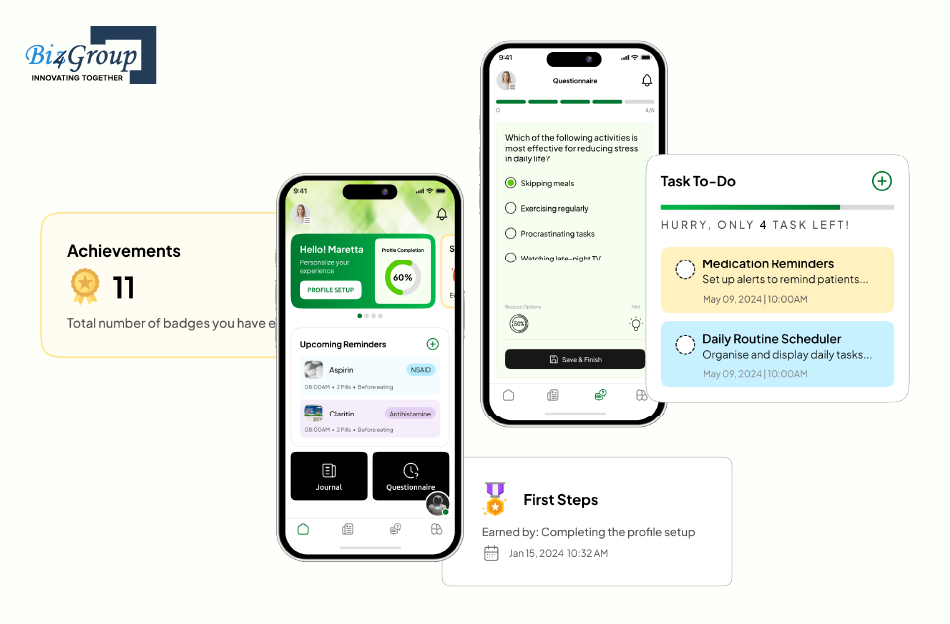
CogniHelp is an AI-powered mobile application designed to help dementia patients maintain daily routines, support cognitive engagement, and stay connected with caregivers. The platform blends intelligent assistance with a simple, empathetic user experience, making it accessible for users who struggle with memory and orientation.
Key highlights
- Personalized cognitive exercises that help reinforce memory and routine
- Smart reminders for medications, daily tasks, and scheduled activities
- Voice-enabled journaling to reduce friction for patients with motor or memory challenges
- Emotional check-ins and conversational support to keep users engaged
- Cognitive pattern tracking that offers long-term insight for caregivers
CogniHelp reflects several healthcare IT trends shaping smarter healthcare operations:
- AI-driven patient engagement outside clinical settings
- Digital health platforms that reduce caregiver burden
- Personalized care delivered through intelligent applications
- Scalable healthcare software products built with compliance and usability in mind
This type of solution shows how healthcare IT trends translate into real value when executed correctly. It improves patient experience while extending care beyond traditional touchpoints.
As healthcare IT trends 2026 continue to evolve, the real differentiator will not be adoption speed. It will be execution quality. That is why large healthcare organizations choose Biz4Group LLC as a long-term technology partner.
Tired of pilots that never leave the lab?
Let’s turn healthcare IT trends into systems your teams actually rely on.
Let’s TalkClosing Perspective!
The healthcare IT trends shaping 2026 are not about chasing tools or experimenting with disconnected technology. They are about building systems that reduce friction, scale responsibly, and support better care without overloading teams. Organizations that succeed are the ones aligning healthcare IT trends in 2026 with real operational goals, not surface-level innovation.
Across automation, agentic systems, interoperability, analytics, digital care, and security, one pattern stands out. Execution matters more than intention. The latest healthcare IT trends only create value when they fit real workflows, real regulations, and real users inside healthcare environments.
Biz4Group has earned its authority by helping healthcare organizations move from strategy to execution. Our work focuses on building scalable, secure, and practical solutions that support healthcare IT trends shaping smarter healthcare operations and deliver measurable outcomes. Projects like CogniHelp show how the right mix of technology, usability, and operational understanding leads to real impact.
As the future of healthcare IT continues to evolve, leadership will not be defined by who adopts the most innovation. It will be defined by who executes the right solutions, at the right time, and at the right scale.
Build smarter healthcare operations with confidence. Let execution be your advantage with Biz4Group.
FAQ
1. What are the key healthcare IT trends executives should prioritize in 2026?
Healthcare leaders should focus on healthcare IT trends that deliver measurable operational impact. These include healthcare IT trends in 2026 such as AI-driven automation, interoperability through FHIR, remote patient monitoring, advanced data analytics, and integrated digital care platforms. These latest healthcare IT trends are shaping how care is delivered, how costs are controlled, and how healthcare operations scale efficiently.
2. How can agentic AI improve healthcare operations beyond traditional automation?
Agentic AI goes beyond task execution by enabling autonomous decision-making across workflows. As part of emerging healthcare IT technologies, agentic AI supports care coordination, discharge planning, clinician task prioritization, and follow-up workflows. These healthcare IT automation trends help organizations move toward smarter, self-optimizing operations.
3. Why is interoperability essential for healthcare IT modernization?
Interoperability allows systems such as EHRs, lab platforms, and analytics tools to share data in real time. It plays a critical role in healthcare IT modernization trends by reducing data silos and improving care transitions. Strong interoperability is also foundational to the future of healthcare IT, enabling automation, analytics, and AI at scale.
4. What impact does remote patient monitoring have on healthcare delivery models?
Remote patient monitoring supports continuous care outside traditional clinical settings. As part of digital healthcare IT trends, it helps reduce readmissions, improve chronic care management, and lower operational costs. These capabilities make it one of the most important healthcare IT trends shaping smarter healthcare operations in 2026.
5. How are AI governance and compliance shaping the adoption of new healthcare technologies?
As AI adoption increases, governance and compliance frameworks are becoming essential. These healthcare IT security trends ensure transparency, auditability, and regulatory alignment. Strong governance also influences healthcare IT investment trends for 2026, helping leaders scale AI safely across clinical and administrative use cases.
6. Are telehealth and virtual care models still relevant for 2026 operations?
Yes. Telehealth has evolved into virtual-first and hybrid care models that handle triage, follow-ups, monitoring, and patient engagement. These healthcare technology trends support better access and efficiency while reducing in-person demand, making them central to healthcare IT trends for scaling healthcare operations.
7. What role does cybersecurity play in modern healthcare IT strategies?
Cybersecurity is now a core business priority. As part of healthcare IT security trends, modern strategies focus on zero-trust architectures, continuous monitoring, and secure data exchange. These measures protect patient data, ensure compliance, and support the future of healthcare IT in highly connected environments.
