 Location :
Orlando, FL, USA
Location :
Orlando, FL, USA +1 (407) 714-1616
 info@biz4group.com

- Agentic AI POC development gives enterprises a safe way to test autonomous decision making, evaluate workflow accuracy and validate real business value before scaling.
- A POC helps teams develop agentic AI POC models, measure performance and understand how an agent behaves inside a controlled workflow environment.
- Teams that want to build agentic AI prototypes benefit from a structured seven step process that includes workflow mapping, UX design, controlled testing and refinement.
- Budget expectations range from $10,000 to $50,000, depending on workflow complexity, integrations and evaluation depth.
- Successful scaling requires a clear plan to move from POC to pilot, then to production while managing governance, reliability and organizational readiness.
- Biz4Group LLC helps enterprises build fast, secure and high performing agentic AI POCs with proven expertise, reusable components and strong delivery discipline.
Most enterprise teams are racing to claim their place in the next wave of intelligent automation. Enterprise AI adoption keeps climbing while internal experiments still live in scattered slides and one-off demos. McKinsey’s latest global AI survey reports that 78% of organizations already use AI in at least one business function, and that number keeps rising every year.
In that kind of market, agentic AI POC development becomes more of a survival move. The companies that move ahead are the ones that test real workflows in a controlled way, learn fast and then scale with confidence. Leaders who want to develop agentic AI POC initiatives want proof that autonomous decision making can handle real complexity without turning their operations into a lab experiment.
At the same time, teams on the ground want to create agentic AI proof of concept projects that feel understandable to non-technical stakeholders and still excite engineering, AI product and data teams. That blend is where momentum appears.
It is also where many efforts quietly stall.
This guide walks through how modern enterprises can build a real-world agentic AI POC for business workflows that actually speaks the language of the business. So, without further ado, let’s begin.
Understanding the Working of Agentic AI POC
Agentic AI is gaining attention because it helps businesses move from simple automation to systems that make decisions on their own. Leaders want clarity about what this technology can actually achieve before they invest in pilots or enterprise deployment.
Agentic AI works through a layered structure that allows an AI agent to take in information, analyze the context, and complete tasks without constant human input. This layered model helps teams understand what it takes to build agentic AI systems that operate with clarity and consistency.
Key Components That Shape Agentic AI Behavior
These core components define how an agent thinks, reacts, and completes tasks.
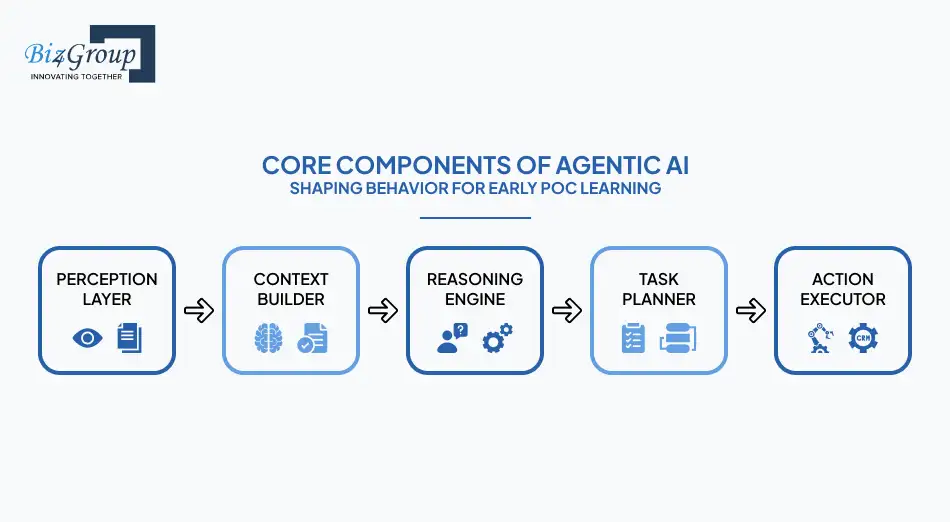
Perception Layer
The perception layer allows the agent to understand input from documents, messages, APIs or enterprise tools. It creates structured meaning from raw data and forms the starting point for every task.
Context Builder
This component pulls together past interactions and present goals so the agent can respond with clarity rather than randomness. It helps teams test how well the system stays consistent across tasks for customer support, HR or operations.
Reasoning Engine
This is where the “thinking” happens. The reasoning engine lets the agent decide the next action based on business rules and the task objective.
Task Planner
The planner breaks complex work into smaller steps. It creates order, prioritizes actions and keeps the agent focused on completion. This allows teams to analyze workflow accuracy early in the POC process.
Action Executor
The executor connects the agent to external tools. It sends instructions to CRM systems, HR platforms, knowledge bases or internal APIs. This is one of the most important elements to study in a POC because it helps you see how well the agent handles real enterprise interactions.
Understanding these pieces helps you evaluate whether your environment is ready to develop agentic AI POC initiatives that can grow into scalable solutions.
Ready to See Autonomous Logic in Action?
Nearly 8 out of 10 enterprises already use AI somewhere.
Build Your POC with Biz4GroupWhy a Proof of Concept Matters in Agentic AI Platform Development?
Teams across industries want to explore autonomous systems, yet they face pressure to validate results before investing in full scale builds. A proof of concept helps leaders understand how a workflow might behave when real decisions are handed to an autonomous system. This is important for organizations that want to develop agentic AI POC projects with measurable gains.
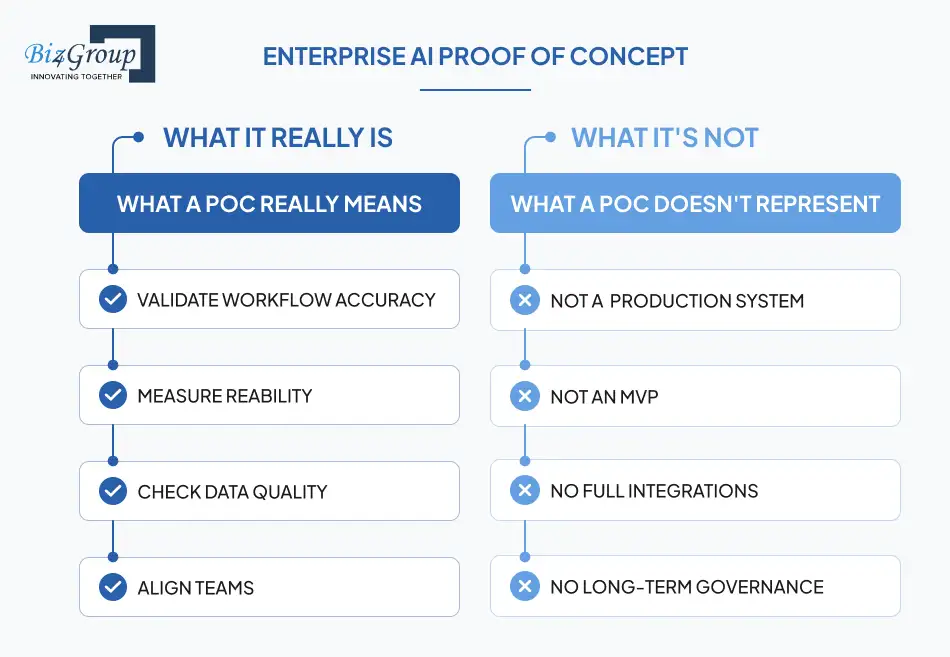
What a PoC Really Means in the Enterprise
A POC acts as a controlled testing space. A strong PoC helps you:
- Validate workflow accuracy
- Measure reliability within a defined task
- Check data quality before deeper investments
- Align technical teams and business teams
- Build support among decision makers
Each of these outcomes helps reduce uncertainty and speeds up early adoption cycles.
What a PoC Does Not Represent
A PoC is not a production system and it is not an MVP. It does not include full integrations or long term governance. It does not represent a complete pilot either. These differences give teams the freedom to experiment without operational pressure.
Benefits You Gain from a Well Planned PoC
The right strategy pays off quickly. Here is a simple view of how a POC supports enterprise goals when you build a real-world agentic AI POC for business workflows.
|
Enterprise Priority |
How a POC Helps |
Outcome |
|---|---|---|
|
Operational clarity |
Tests one workflow in a focused way |
Reliable insights |
|
Technology readiness |
Reveals integration limits |
Stronger architecture |
|
Cost predictability |
Highlights real resource needs |
Smarter budgeting |
|
Stakeholder alignment |
Creates shared understanding |
Faster approvals |
|
Implementation success |
Confirms feasibility |
Confident scaling |
A POC creates a starting point that feels practical and manageable. It helps your organization move from early curiosity to structured progress when you decide to develop agentic AI POC projects with clear business impact.
Real Enterprise Use Cases That Guide Strong Agentic AI POC Development

Organizations explore autonomous systems for very different reasons. Some want smoother daily operations. Others want faster decisions. Many look for a way to free their teams from time consuming tasks.
Real use cases help shape your thinking when you decide to develop agentic AI POC initiatives inside your business.
1. Customer Support Automation with Intelligent Decision Paths
Many enterprises see AI agents in customer service as the ideal entry point. A POC helps teams study how an agent handles structured and unstructured questions, documentation lookup and human handoff. Teams get a clear view of accuracy, speed and tone.
2. HR and Employee Service Workflows
HR teams manage repeated questions every day. A targeted POC shows whether an agent can answer policy questions, retrieve documents or guide employees through tasks. Leaders often use this to evaluate consistency and information safety before developing agentic AI for HR.
3. Legal and Compliance Assistance
Legal and compliance teams rely on precise information. A POC helps validate retrieval accuracy and the agent’s ability to follow strict boundaries. This keeps the workflow controlled while still exploring meaningful automation opportunities for building a legal AI agent.
4. Operations and Supply Chain Coordination
Operations teams test whether implementing an AI agent can handle updates, alert routing or document analysis. A POC shines when the task includes repetitive data checks. It shows how much time the system can save and how reliably it can follow instructions.
5. Data Processing, Document Workflows and Reporting
Teams with heavy documentation loads use a POC to measure how well an agent transforms data into structured formats. This includes reading PDFs, creating summaries or producing reports. Leaders gain clarity about error rates and processing time improvements.
Project Spotlight: Custom Enterprise AI Agent
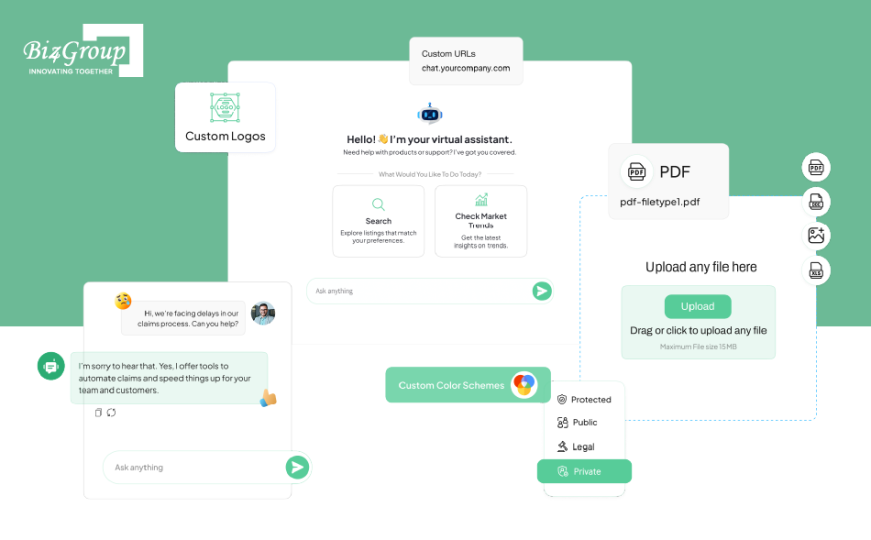
This project is a strong example of what a well planned POC can achieve. Our team built an enterprise AI agent with a focus on privacy, compliance and seamless workflow automation. This engagement focused on creating an AI agent POC that could streamline complex tasks without compromising data protection. The system offers flexibility for different industry needs while maintaining HIPAA and GDPR compliance.
The project delivered features that matched enterprise expectations.
- Customizable interface and branding
- Context aware interactions that support customer and employee queries
- Encrypted private data processing
- Advanced document handling across multiple formats
- Integration with Salesforce, Slack and internal systems
- Multilingual support and voice based interactions
- Scalable architecture that grows with user demand
Challenges We Faced and How We Solved Them:
- Enterprises often face integration complexity. This project required the agent to connect with diverse systems across departments.
We solved this with our bespoke AI integration services and frameworks that made onboarding smooth and reliable. - The agent needed to operate within strict privacy rules.
Our team built a secure environment with encrypted hosting, role based controls and detailed access pathways.
This project gave decision makers a clear view of how an autonomous system would perform in a demanding environment. It served as a model for leaders who want to build a real-world agentic AI POC for business workflows that require accuracy, privacy and measurable efficiency improvements.
A strong set of use cases helps teams move from ideas to practical action. These examples give a clear direction for planning and help you focus on real workflows instead of broad assumptions.
Want an Agent That Works Like This?
You saw what a secure, compliant, multi workflow agent can do. Imagine what a custom version built around your operations could deliver.
Schedule a Strategy Call TodayAlso read: Top real-world use cases for agentic AI
Important Features to Include in Agentic AI POC Development
A well designed POC needs the right mix of features so you can measure performance with accuracy and present reliable findings to your stakeholders. These features act as a foundation for teams that plan to develop agentic AI POC projects with operational goals.
|
Feature |
What It Is |
What It Does |
|---|---|---|
|
Workflow Understanding |
Ability to interpret structured and unstructured inputs |
Helps the agent follow instructions with accuracy |
|
Context Retention |
Short term and session level memory management |
Improves coherence and consistency across steps |
|
Controlled Reasoning |
Guided decision processes aligned with business rules |
Reduces unpredictable outcomes and supports safe testing |
|
Task Sequencing |
Ability to break down work into clear steps |
Keeps the POC workflow structured and measurable |
|
Tool Interaction Layer |
Secure connections to enterprise software |
Allows the agent to perform actions within real systems |
|
Guardrail System |
Boundaries that limit behavior and enforce rules |
Ensures the agent stays within safe operating zones |
|
Monitoring Panel |
Dashboard for tracking decisions and actions |
Gives teams visibility into performance and errors |
|
Access Control |
Permission based usage and data handling |
Protects sensitive information and maintains compliance |
|
Data Interpretation Module |
Ability to read, extract and process documents |
Speeds up document-driven tasks and reduces manual effort |
|
Output Quality Checker |
Validation of generated results |
Helps you measure accuracy and maintain reliability |
These features form a practical framework for early testing. You can study how each one behaves and use the findings to predict long term performance. This helps teams evaluate real world potential before they move deeper into development.
A POC that includes these elements produces more useful insights and creates a smoother path toward scaling. It also gives you meaningful evidence when you decide whether to continue or refine your approach.
Also read: How to build an agentic AI assistant?
Step-by-Step Process to Create Agentic AI Proof of Concept
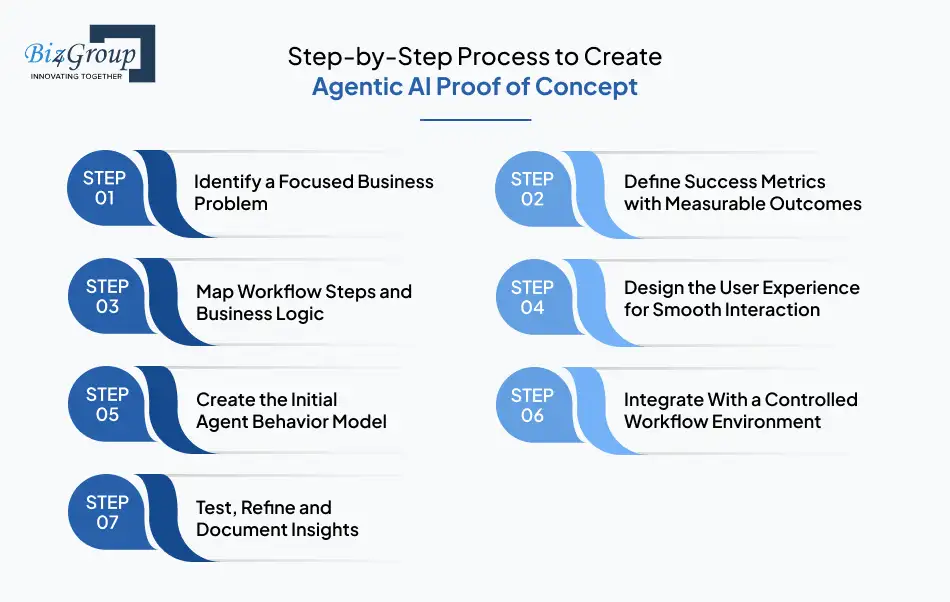
A structured process helps teams reduce uncertainty and plan each phase with purpose. When you follow clear steps, your agentic AI POC development becomes easier to manage and more likely to deliver meaningful results.
Step 1. Identify a Focused Business Problem
Every strong POC begins with a single workflow that needs improvement. Your goal is to find a task that affects productivity or accuracy and carries long term value.
This helps you avoid large scopes and gives your team a clear target. It also creates an early opportunity to communicate expectations across the organization.
Step 2. Define Success Metrics with Measurable Outcomes
Success is easier to evaluate when you set metrics early. These can include completion time, error reduction, workflow accuracy or user satisfaction. Clear metrics allow you to track progress and provide evidence to stakeholders.
This step is important for teams that plan to create agentic AI proof of concept projects that must present tangible value.
Step 3. Map Workflow Steps and Business Logic
Once the problem is defined, outline every step required to complete the workflow. This includes rules, decision points and edge cases. The goal is to prepare a structured process the agent will follow.
A well mapped workflow helps you build a real-world agentic AI POC for business workflows that can be evaluated with precision.
Step 4. Design the User Experience for Smooth Interaction
A POC benefits from simple UI and UX elements. You want testers to interact with the system without confusion. This includes a clean interface, organized prompts, clear instructions and intuitive output formatting.
A good experience, created by a trusted UI/UX design company, improves engagement and helps non technical stakeholders understand the value of the agent.
Also read: Top 15 UI/UX design companies in USA
Step 5. Create the Initial Agent Behavior Model
This step defines how the agent will think and act. You outline how it interprets inputs, applies rules, follows steps and arrives at results. This model becomes the base layer for testing. It helps your team evaluate the logic before moving toward more sophisticated capabilities.
This step is important when you develop agentic AI POC projects that require accuracy and predictable behavior.
Step 6. Integrate With a Controlled Workflow Environment
Once the behavior model is ready, the POC must run inside a controlled environment that matches your workflow. This space allows your team to analyze performance without interfering with actual operations.
You can test edge cases, evaluate responses and observe how the workflow feels in real time. Controlled setups produce cleaner findings and support better decision making.
Step 7. Test, Refine and Document Insights
The final step involves repeated testing, feedback cycles and improvement. You record errors, measure outputs and compare them against your success metrics. This helps you identify gaps and refine agent behavior.
Documenting insights gives your leadership team a clear understanding of feasibility, value and next steps.
A clear seven step process creates steady momentum. It gives your team a predictable path and improves confidence as you progress toward a working POC. When the steps are followed with discipline, the outcome becomes easier to evaluate and the next stages become easier to plan.
Your Workflow Is One POC Away from Leveling Up
Most teams waste 40% of project time on planning. We turn that into progress with a 1-2 week POC build cycle.
Get in TouchTech Stack and Compliance Essentials for Reliable Agentic AI POC Development
A successful POC relies on a full stack foundation that supports both experimentation and controlled execution. The right tools help your team explore agent behavior while keeping the workflow steady and predictable.
Here's what we recommend for your agentic AI POC development:
|
Layer |
Tools or Frameworks |
Purpose |
|---|---|---|
|
Backend Logic Layer |
Runs workflow logic and connects the agent to business rules |
|
|
Model Layer |
OpenAI models, Anthropic models, Llama family models |
Powers reasoning, planning and language processing for the agent |
|
Orchestration Layer |
LangChain, LlamaIndex, custom rule handlers |
Structures tasks, manages sequences and keeps the workflow organized |
|
Memory and Context Layer |
Vector databases, Redis, memory stores |
Maintains context during the session and improves response coherence |
|
Integration Layer |
REST APIs, custom connectors, webhook handlers |
Links the agent to CRMs, HR tools, knowledge systems and internal apps |
|
Data Processing Layer |
PDF parsers, OCR tools, text extraction utilities |
Handles document ingestion and prepares structured inputs |
|
Logging and Monitoring Layer |
Structured log tools, dashboards, event tracking |
Offers visibility into actions, decisions and workflow accuracy |
|
Frontend Interface |
Simple web UI, React.js, HTML based prototypes |
Provides a clear interface for testing and stakeholder reviews |
A full stack approach gives teams a structured way to test agent behavior. It makes experimentation more organized and removes guesswork from early development cycles.
Security and Regulatory Considerations for Enterprise POCs
Enterprises place strong emphasis on security because autonomous agents often interact with sensitive information. Here are the essentials for leaders who want to build a real-world agentic AI POC for business workflows with reliable safeguards.
- Encryption for both stored data and transferred data
- Clear separation between public datasets and private enterprise information
- Authentication rules that match your internal access policies
- Role based controls with restricted permissions
- Secure storage pathways for temporary and long term data
- Document handling rules that comply with privacy regulations
- Audit trails that record agent activity
- Isolation of POC traffic through controlled environments
- Privacy alignment with HIPAA, GDPR or industry specific requirements
- Regular validation of outputs to avoid exposure of confidential information
A strong compliance foundation gives your POC long term credibility. It also builds internal trust so your teams feel confident when proposing expansion into pilots or production systems.
Cost Breakdown That Shapes Realistic Agentic AI POC Development
Planning a budget is one of the first concerns leaders raise when they explore a POC. A well structured agentic project usually falls between $10,000 and $50,000, depending on complexity, workflow depth and evaluation needs. The goal here is to help your team understand how the budget is usually distributed so you can plan with accuracy.
Below is a detailed view of how teams typically allocate their budget during the POC phase.
1. Discovery and Workflow Analysis
- Usual range sits between $1,000 and $6,000
- Includes workflow review, task identification and initial goal confirmation
- Higher cost if the workflow contains several edge cases
2. Requirement Documentation and Acceptance Criteria
- Typically ranges from $800 to $3,000
- Covers documentation of functional requirements and success metrics
- Reduces rework by an estimated 12-18%
3. UX and POC Interface Design
- Usually costs $1,200 to $5,000
- Varies based on number of screens, interactions and branding requests
- UI complexity pushes the range toward $4,000 to $5,000
4. Backend Setup and Workflow Logic Configuration
- Falls between $3,000 and $12,000
- Cost depends on branching logic, rules and workflow depth
- Structured workflows fall on the lower side
5. LLM Integration and Agent Behavior Modeling
- Usually ranges from $2,500 to $10,000
- Influenced by task count and reasoning complexity
- Multi step or advanced planning workflows lean toward the higher range
6. Light Integration With External Tools
- Often ranges from $1,500 to $6,000
- Covers CRM, HR, internal system or data source integrations
- Custom connectors may add $1,500 to $2,000
7. Testing, Fine Tuning and Evaluation Reporting
- Testing and refinement typically range from $1,200 to $8,000
- Reporting adds another $500 to $1,800
- A good testing phase reduces pilot stage costs by 10-20
While the full range of $10,000 to $50,000 might seem broad, most enterprise POCs fall between $18,000 and $32,000. Higher ranges usually apply when the workflow is complex, document heavy or requires detailed interaction rules.
A well planned budget helps leadership evaluate the investment with clarity. It also supports stronger approvals because teams can see the value tied to each cost line.
Also read: How much does it cost to develop agentic AI?
Want a Precise Estimate for Your AI POC?
The smartest enterprises validate before they invest. Get a tailored cost breakdown so you know exactly what your POC will take.
Get Your Custom QuoteKey Considerations in Agentic AI POC Development
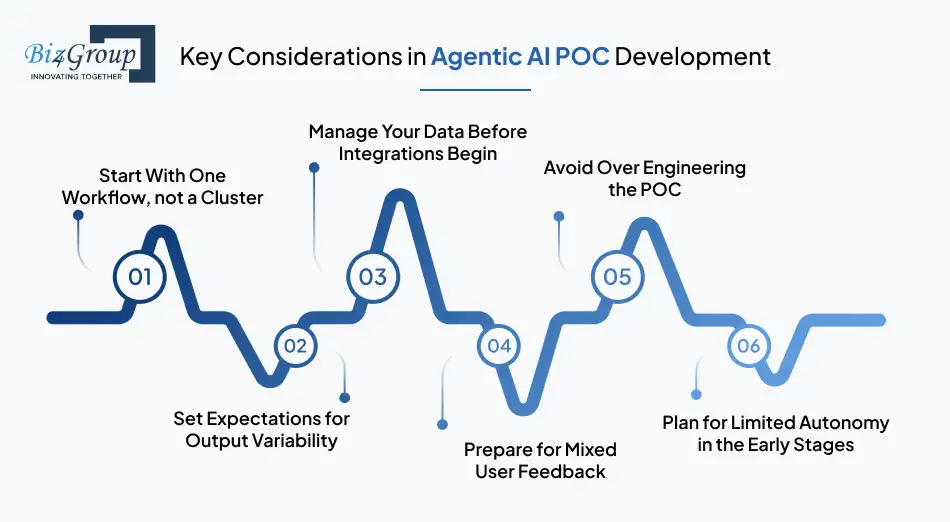
A POC creates a controlled space where ideas can evolve into measurable outcomes. This stage influences the success of everything that comes after it. This section highlights the points that matter most when your team begins to develop agentic AI POC efforts for the enterprise.
Each point below reflects a lesson learned across real projects. The goal is simple. Know what to avoid, understand what to prepare for and build a POC that brings reliable results.
1. Start With One Workflow, not a Cluster
Teams that attempt multiple workflows early often face stalled progress. A focused start gives clarity and reduces early obstacles.
- Choose one workflow with clear boundaries
- Avoid workflows that require heavy branching
- Keep testing cycles short and controlled
- Early simplification lowers rework by an estimated 15%
2. Set Expectations for Output Variability
Autonomous agents behave differently than traditional scripted systems. Early outputs sometimes require tuning.
- Explain that reasoning models mature across iterations
- Present early outputs as learning signals
- Share accuracy benchmarks during reviews
- A prepared team responds with solutions, not frustration
3. Manage Your Data Before Integrations Begin
Data issues delay POCs more than any other factor. Preparing the data early protects your timeline.
- Check file formats, quality and consistency
- Review access permissions for all test data
- Remove sensitive items that do not belong in a POC
- Clean datasets reduce early errors and prevent time loss
4. Prepare for Mixed User Feedback
Different teams evaluate outcomes differently. A plan for feedback collection helps maintain control.
- Offer structured feedback forms
- Collect real examples of failed interactions
- Review comments by category, not by individual opinion
- Structured feedback lowers conflict and accelerates tuning
5. Avoid Over Engineering the POC
Some teams are tempted to build advanced features too early. This increases cost without improving clarity.
- Keep the POC minimal and focused
- Introduce complexity only after the first evaluation
- Freeze new feature requests until initial testing completes
- A simple build produces a cleaner and more reliable analysis
6. Plan for Limited Autonomy in the Early Stages
An early POC benefits from guardrails. Full autonomy is better for later phases.
- Use structured reasoning paths
- Restrict tool access to a few systems only
- Limit long decision chains during the first cycle
- Controlled autonomy protects your workflow during testing
Every strong POC balances preparation with flexibility. When teams understand the risks, avoid common mistakes and follow a thoughtful plan, the project becomes smoother and the findings become more reliable.
Why Fight the Usual POC Errors When You Can Outrun Them?
You’ve seen where POCs usually collapse. We turn every one of those pitfalls into a shortcut to success.
Talk to Our ExpertsFrom POC to Pilot to Scale in Agentic AI POC Development
A POC gives your team clarity. The next stage gives your organization traction. When leaders understand how an agent behaves within a controlled workflow, the focus moves to real usage. This phase requires careful planning because an enterprise pilot and a production system serve very different purposes.
A POC answers feasibility questions. A pilot tests real adoption. Production supports operational scale. Treating each stage with its own plan keeps the process organized and measurable.
|
Stage |
Core Objective |
Focus Area |
Team Involvement |
|---|---|---|---|
|
POC |
Validate feasibility |
Accuracy and workflow fit |
Small technical group |
|
Pilot |
Test controlled usage |
Performance across real users |
Cross functional team |
|
Production |
Deliver scale |
Reliability and governance |
Enterprise wide adoption |
1. Preparing Your POC for a Pilot
A pilot needs more structure than a POC. This step helps teams shift from experiments to controlled real world testing.
What to Focus On
- Identify the target user group and limit the scope to one department
- Review workflow logs from the POC and refine steps that showed weak performance
- Confirm user experience requirements for real usage
- Add guardrails for pilot tasks that involve sensitive data
What Determines Readiness
- Accuracy that stays consistent across multiple sessions
- Stable interactions with two or more enterprise systems
- Clear documentation for repeatable testing
- Agreement from stakeholders about primary pilot goals
2. Running a Strong Pilot with Measurable Structure
Pilots reveal how well the agent performs when real users interact with it. This stage shows organizational value more clearly than any other.
What to Measure
- Completion rates across repeated tasks
- Number of human interventions required
- Workflow time saved per session
- Performance changes across user groups
What Helps the Pilot Succeed
- A feedback channel that routes issues to your core team
- Weekly review cycles that track performance trends
- A fixed improvement plan that adjusts behavior based on findings
- Controlled access to prevent unintended usage
A well designed pilot sets the tone for scaling. It reveals practical strengths and exposes the gaps that matter before production planning begins.
3. Scaling Into Production with Predictability
Production requires more than accuracy. It needs reliability, transparency and support for larger user loads. This step moves the agent from a small group to the broader organization.
What to Prepare
- Planned workflow capacity based on projected usage
- Detailed monitoring for decisions, failures and user interactions
- Clear ownership across engineering, operations and compliance teams
- A defined update cycle for continuous improvements
What Signals Production Readiness
- Stable accuracy across hundreds of interactions
- Smooth performance under increased usage
- Seamless operation within core enterprise systems
- Positive feedback from both technical and non technical teams
4. Planning for Long Term Growth
Once the system enters production, organizations often explore broader opportunities. Scaling does not only mean adding users. It also involves expanding the scope without losing quality.
Natural Expansion Patterns
- Supporting new workflows that follow similar steps
- Adding more decision paths that maintain logic clarity
- Integrating with additional tools that improve workflow speed
- Introducing language support for global teams
Growth Considerations to Keep in Mind
- Every new workflow requires its own evaluation
- Monitoring becomes more important as usage expands
- Documentation helps new teams adopt the system with ease
- Periodic audits keep results predictable over time
A smooth path from POC to pilot to production depends on steady structure and clear expectations. When each stage is handled with focus and intention, the agent evolves into a dependable operational asset.
Why Biz4Group LLC Leads Agentic AI POC Development in the USA?
Enterprise leaders who explore autonomous systems look for a partner who brings clarity, skill and proven execution. Biz4Group LLC has grown into a respected technology company, recognized among the best agentic AI development companies in the USA because of its commitment to building solutions that work in real environments.
We are a USA-based agentic AI development company that supports operational goals without unnecessary complexity. We focus on delivering strong outcomes that feel practical and dependable for the organizations we serve.
Biz4Group LLC works with entrepreneurs and enterprise teams that need custom software solutions. Our experience spans multiple domains, including healthcare, eCommerce, finance, and HR. Over the years, we have helped businesses introduce new digital products, improve internal operations and scale with confidence. That expertise extends naturally into AI agent development services, where structure, precision and execution quality matter the most.
We understand how enterprise workflows behave and why controlled testing is essential before committing to large builds. Our team has delivered secure, compliant and scalable POCs that guide organizations from uncertainty to strategic clarity. Whether it involves complex integrations, document heavy processes, sensitive data handling or multi system orchestration, our engineers approach every project with accuracy and care. This is one reason why organizations across the USA hire our AI developers for initiatives that require reliability.
Why Businesses Choose Us
Teams appreciate our ability to combine strong engineering with practical business insight. We help clients create meaningful progress through the following strengths.
- An AI development team with deep experience in enterprise AI solutions
- Proven delivery methods that keep projects predictable and fast moving
- Skilled designers who shape clean, intuitive POC interfaces for testing
- Engineers who understand integrations across CRMs, HR platforms and internal systems
- Strong alignment with compliance needs in healthcare, finance and legal environments
- Transparent communication that keeps leadership informed at every stage
Our clients describe our work as dependable, collaborative and solution oriented. We continue to refine our approach with every project so that businesses receive solutions that guide real decisions, not temporary experiments.
A strategic partner should help you navigate change with confidence. That is where our experience becomes meaningful. We stand beside organizations as they test ideas, evaluate results and move toward innovation.
If your organization is exploring next steps in agentic AI POC development, our team is ready to guide you through the entire process with clarity and precision.
.
Final Thoughts
Agentic systems are shaping a new era of intelligent automation powered by exceptional AI automation services, and businesses that explore them early gain a measurable strategic edge. A well planned POC reveals whether an autonomous workflow can handle real tasks, maintain accuracy and support operational goals. It also gives organizations a structured way to test value, refine ideas and build internal confidence before expanding into pilots or broader production plans.
A strong agentic AI POC is a learning model that helps teams understand what works, what needs adjustment and how future workflows can evolve. Each step offers clear insights that guide smarter decisions. With the right structure in place, teams can move from exploration to implementation with less risk and more direction.
Biz4Group LLC supports this journey by helping organizations build practical, secure and high impact POC environments. Our experience as an AI app development company positions us as a trusted partner for companies that want clarity and results. We help teams move from conversation to action with a development approach that is steady, strategic and outcome focused.
If your team is considering a move into autonomous workflows, this is the time to act.
Reach out to Biz4Group LLC and build your POC with a partner that knows how to turn ideas into measurable progress.
FAQs
How long does it usually take to complete an agentic AI POC?
Most agentic AI POCs across the industry take 4-8 weeks because teams build everything from scratch. Biz4Group moves much faster. Our engineering framework includes tested workflow components and prebuilt logic patterns which help us deliver a complete POC in 1-2 weeks, without compromising quality. This speed lowers development effort, reduces cost and helps your team reach validation sooner.
Can small and mid-sized businesses benefit from agentic AI POCs?
Yes. Smaller organizations often see faster gains because they have fewer legacy systems and simpler processes. A POC helps them test new capabilities without committing to a full scale investment, making it a practical first step for early adopters.
Do agentic AI POCs require specialized internal teams?
Not always. A POC can run with a small internal group if the partner team provides direction and technical support. The internal role usually involves sharing workflow details, validating outputs and giving clear feedback during the evaluation cycles.
How does leadership measure progress during a POC?
Most teams track progress through weekly summaries, user observations and task level benchmarks. These checkpoints highlight improvement trends, reveal recurring patterns and help leadership understand the direction of the project without needing technical detail.
Can an agentic AI POC be customized for industry specific needs?
Yes. The structure of a POC allows for industry aligned configurations. Teams can adjust prompts, decision patterns and interaction flows to reflect sector requirements, whether it involves public service support, logistics steps or professional service operations.
What happens after the first evaluation round is completed?
Teams usually take the findings and decide whether to extend testing, refine the workflow or prepare for a small pilot. The next step depends on value indicators and stakeholder interest. Early insights often guide the scope of the following phase.
