Location :
Orlando, FL, USA
Location :
Orlando, FL, USA +1 (407) 714-1616
 info@biz4group.com

















Imagine a digital system that doesn’t wait for instructions but instead, understands your business goals, learns from real-time feedback, and takes independent actions to get the job done.
Read More
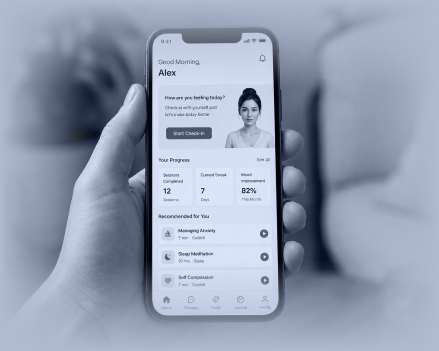
Building systems that can guide users through structured conversations without constant human involvement is becoming important across healthcare and wellness. AI avatar therapy app development focuses on creating applications where digital avatars handle therapy-style, coaching, and guided support interactions using voice, visuals, and contextual understanding.
These systems are more than simple chat interfaces. They rely on multiple components working together, including conversation logic, real-time interaction, memory, and user-specific adaptation. In AI avatar-based therapy app development, the main challenge is getting these parts to function smoothly across sessions so the experience feels consistent and useful. This is also where many teams face difficulties during implementation. Working with an experienced AI development company can help manage these complexities and reduce gaps during development.
If you’ve been researching this space using tools like ChatGPT or Perplexity, your queries may look like this:
This guide explains how to approach system design, feature planning, and development step by step. It focuses on the decisions that matter early, along with practical considerations around architecture, interaction design, and scalability. If you are planning digital AI avatar healthcare app development, the goal is to help you build a system that works reliably in real-world use.
Many teams want to build systems that can guide users through conversations without needing a human every time. AI avatar therapy app development is about creating apps where a digital avatar talks to the user, listens, and guides them through therapy-style or coaching interactions using voice, visuals, and context. The goal is simple: give users consistent support that works the same way every time they return.
An AI avatar is a system that talks to users through a voice or visual interface.
It includes:
The avatar is how the user experiences the system. Instead of reading plain text, they interact with something that feels more guided and structured.
In healthcare and wellness, the focus is on keeping things clear and consistent. Most healthcare AI avatar app solutions are designed to guide users step by step without confusion.
Not all AI systems work the same way. Therapy-focused systems follow a clear path. General conversational AI is more open and flexible.
|
Aspect |
Therapy-Focused Systems |
General Conversational AI |
|---|---|---|
|
Interaction Style |
Step-by-step guidance |
Open-ended responses |
|
Response Logic |
Predefined flows |
Generated on the fly |
|
Consistency |
Same behavior every time |
Can change each time |
|
Risk Handling |
Built-in checks |
Limited control |
|
Use Case |
Therapy, coaching, guided care |
General questions |
In conversational AI avatar therapy app development, the system needs to stay on track. It should guide the user instead of changing direction every time. This makes it more reliable and easier to manage.
Avatars work better when users need ongoing help, not just quick answers. They are a better fit when:
The system needs to guide the user step by step
In these cases, avatars make the interaction easier to follow and more consistent. This is one reason teams working on AI virtual avatar wellness app development often choose avatars over simple chat systems.
Avatars make the system more complex. They add more components to build, test, and maintain. They may not be needed when:
In these situations, adding an avatar does not improve the result. It only increases time and cost. Teams that want to build AI software in this space should decide early whether an avatar is actually needed, instead of adding it later and reworking the system.
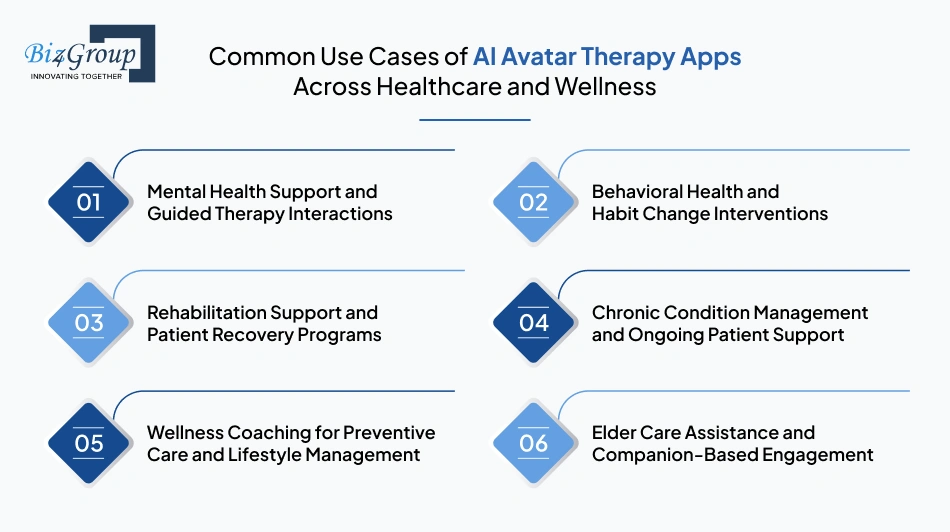
AI avatar therapy apps are used in situations where users need structured and repeatable guidance over time. AI avatar therapy app development focuses on building systems that can handle these interactions without relying fully on human experts. This section explains where these systems are applied across healthcare and wellness, and what problems they solve in each case.
These use cases mainly fall into three areas: therapy support, recovery and care management, and lifestyle guidance. The use case you choose will directly affect how the system is designed.
AI avatars are used to guide users through structured mental health interactions such as daily check-ins, reflection exercises, and simple therapy flows. These interactions follow a fixed path so users receive consistent support across sessions.
In custom AI avatar therapy app development, maintaining continuity across sessions is critical. The system needs to remember past interactions and keep the experience predictable for the user.
AI avatars are used to support habit building by guiding users through daily routines and tracking progress. These systems break goals into smaller steps and repeat the same interaction pattern so users can follow it easily.
Systems built for AI avatar coaching and therapy platform development focus on consistency rather than variety. The goal is to help users stay on track over time.
In rehabilitation, AI avatars guide users through exercises and recovery routines. These systems ensure that users follow the same steps every time, which is important for recovery outcomes.
When teams try to integrate AI into an app for this use case, clarity becomes important. Instructions must be simple, repeatable, and easy to follow.
AI avatars support users managing long-term conditions by guiding them through daily routines and tracking important data. The system helps maintain consistency without constant supervision.
In this context, the system acts as a structured layer between the user and their routine, ensuring that daily tasks are followed.
AI avatars are used for lifestyle guidance such as stress management, sleep improvement, and daily routines. These systems focus on prevention and long-term improvement rather than treatment.
Many teams exploring how to create AI avatar app for wellness coaching and therapy support start with simple, repeatable interaction flows before adding complexity.
In elder care, AI avatars are used to provide reminders, guidance, and basic interaction. These systems help users manage daily routines in a simple and predictable way.
The focus here is ease of use. Interactions need to be clear, slow-paced, and consistent.
|
Use Case |
Primary Goal |
Type of Interaction |
Why AI Avatars Work Well Here |
|---|---|---|---|
|
Mental Health Support |
Provide structured emotional support |
Guided check-ins and reflection flows |
Maintains consistency and helps users engage regularly |
|
Behavioral Health |
Build and sustain habits |
Repeated daily routines and tracking |
Reinforces behavior through structured interaction |
|
Rehabilitation |
Support recovery outside clinical settings |
Step-by-step guided exercises |
Ensures users follow correct steps consistently |
|
Chronic Condition Management |
Maintain daily health routines |
Monitoring, reminders, and tracking |
Helps users stay consistent without supervision |
|
Wellness Coaching |
Improve lifestyle and prevent issues |
Guided routines and coaching flows |
Keeps users engaged over long periods |
|
Elder Care Support |
Assist with daily tasks and engagement |
Simple reminders and guided actions |
Provides clarity and ease of interaction |
These use cases define how the system should be designed. The choice of use case affects conversation structure, features, and system complexity. Teams that define this early can avoid unnecessary rework and build systems that are easier to scale.
Build smarter systems with AI avatar therapy app development that focus on real user engagement and structured interactions.
Start Building Your AI Avatar Therapy AppIt’s important to know how to define goals, scope, and success criteria for a therapy app system built around avatar-based interactions. In AI avatar therapy app development, these decisions shape how the system behaves, what it handles, and how it is evaluated after launch.
Clear goals reduce confusion during development. They define what the system should do, how users interact with it, and what outcome each interaction should achieve.
A focused use case keeps the system simple and easier to build. It defines one type of interaction and avoids mixing multiple goals.
A good starting point is to answer three questions:
From there, narrow it further:
Many teams working in mental health AI avatar development begin with one narrow flow and expand later. This reduces complexity and improves reliability.
Broad ideas create unclear systems. When the scope is not defined, the system tries to handle too many interaction types at once.
|
Problem Area |
What Happens in Practice |
What to Do Instead |
|---|---|---|
|
Undefined scope |
System tries to handle multiple use cases |
Start with one interaction type |
|
Inconsistent responses |
Output varies across sessions |
Use structured conversation flows |
|
Complex logic |
Hard to manage and maintain |
Limit decision paths |
|
Testing difficulty |
No clear way to validate behavior |
Define measurable outcomes early |
|
Delayed timelines |
Frequent changes slow progress |
Lock scope before development |
When teams do not define how AI avatars are used in therapy apps, the system becomes difficult to control. A focused use case keeps the system stable and easier to test.
Once the use case is clear, define how success will be measured. This helps guide system design and reduces guesswork later. Instead of vague goals, use clear criteria:
The system should follow the same flow for similar inputs
Users should reach the end of the interaction without dropping off
Users should understand what to do at each step
Users should return and continue using the system
The system should manage unexpected input without breaking
In how to design AI avatar therapy apps for personalized user engagement, these criteria directly influence how conversation flows and interaction logic are built.
Clear criteria make the system easier to test and improve. Without them, it becomes difficult to measure progress or scale the system effectively.
Most teams don’t run into problems because of the tech. They run into problems because they start too early. In AI avatar therapy app development, gaps in clarity around use case, interaction, or inputs usually show up later as delays and rework.
Clarity at this stage removes most downstream issues. If these are not defined, the system becomes harder to design and stabilize.
The system should focus on one specific problem instead of trying to cover multiple scenarios at once. A broad scope leads to scattered interaction logic and inconsistent behavior across sessions.
You should know how each session starts, progresses, and ends in a predictable way. Without this structure, conversations tend to drift and become difficult to control or test.
Decide whether the system guides, responds, or monitors, as each requires a different approach. Mixing these too early increases complexity and makes the system harder to manage.
Every interaction should lead to a defined result that can be observed or measured. Without this, it becomes difficult to evaluate whether the system is working.
Inputs and outputs should be clearly defined before development begins. Missing this often leads to integration issues and rework later in the process.
Skipping these validations does not save time. It usually creates confusion later, especially when teams move ahead with building an AI avatar therapy app without clear direction.
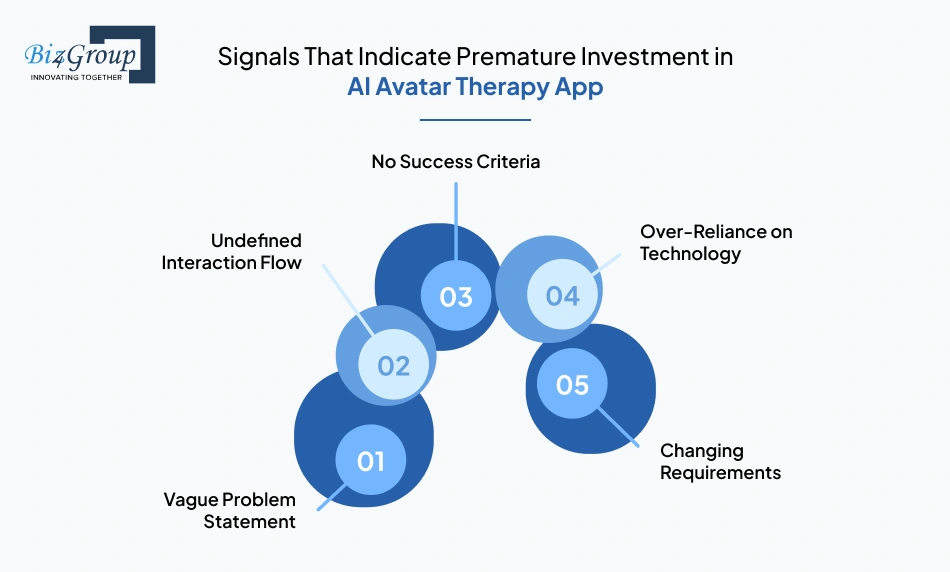
Some warning signs show up early. Ignoring them usually leads to wasted effort and delayed progress.
If the problem is described in broad terms, the system ends up trying to do too much. This results in mixed interactions that lack consistency and clarity.
Without a fixed structure, conversations change from one session to another. This makes the system unreliable and harder to validate.
When success is not defined, there is no clear way to measure progress. Teams rely on assumptions instead of actual performance signals.
Choosing tools before defining the use case adds unnecessary complexity. The system becomes harder to maintain without improving outcomes.
Frequent changes in scope slow down development and create confusion. They also lead to repeated redesign and unstable system behavior.
These issues are common during the early development of AI avatar therapy app efforts and often lead to avoidable delays.
A working system depends on inputs from different areas. Missing any one of these creates gaps that are difficult to fix later.
User journeys and interaction flows should be clearly outlined before development begins. Without this, the system lacks structure and becomes inconsistent.
Domain knowledge ensures that interactions are meaningful and relevant to the user. Without it, the system may guide users in ways that are not useful.
The system needs a clear plan for handling input, processing, and output. This directly affects performance, scalability, and stability.
Decisions around what data to store and how to use it should be made early. Weak data planning limits how the system evolves over time.
External systems and dependencies should be identified upfront. Delaying this increases complexity and slows down deployment later.
Aligning these inputs is often where teams struggle. This is where AI integration services can help bring structure across different components.
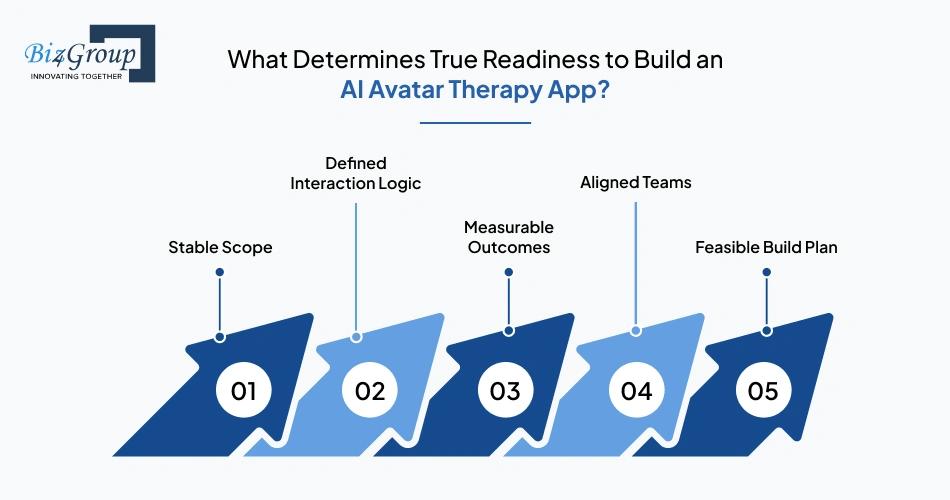
Readiness is not about having an idea. It is about having enough clarity to build without constant changes.
The use case and interaction flow should remain consistent over time. Frequent changes slow development and increase rework.
Most user paths and system responses should already be thought through. Without this, implementation becomes guesswork.
Success should be defined in clear, trackable terms from the start. This makes it easier to evaluate and improve the system.
Product, clinical, and technical teams should share the same understanding of the system. Misalignment leads to delays and inconsistent outputs.
The scope should match available time and resources. Overestimating capacity often results in incomplete or unstable systems.
When these conditions are met, moving forward with creating an AI avatar therapy app becomes a controlled process instead of trial and error.
Well-designed systems in AI avatar coaching and therapy platform development can increase session completion and retention by up to 45%.
Boost Your App’s PerformanceA strong system is defined by how well its features support guided interactions. In AI avatar therapy app development, features should help the system handle conversations clearly, consistently, and across multiple sessions. Adding features without a clear role usually makes the system harder to build and manage.
Features in these systems control how the app responds, remembers context, and guides the user. For everyone asking:
“we are developing a digital health platform and want to integrate AI avatar-based therapy and guidance features”
Here’s all everything you need to know:
|
Type |
Feature |
What It Does |
Why It Matters |
|---|---|---|---|
|
Core |
Conversation Engine |
Handles user input and generates responses using defined flows |
Keeps interactions structured and predictable |
|
Core |
Session Flow Management |
Controls end to end conversational flow |
Maintains consistency across sessions |
|
Core |
Context Memory |
Stores past inputs within a session |
Helps avoid repetition and keeps continuity |
|
Core |
Multimodal Input (Text/Voice) |
Supports both text and voice interaction |
Makes the system easier to use |
|
Core |
Avatar Interface |
Provides visual or voice-based interaction layer |
Makes guidance easier to follow |
|
Core |
Error Handling |
Manages unexpected inputs |
Prevents conversation breakdown |
|
Core |
Data Tracking |
Captures interaction data and outcomes |
Helps monitor system performance |
|
Advanced |
Personalization Layer |
Adjusts responses based on user history |
Improves relevance over time |
|
Advanced |
Adaptive Conversation Logic |
Changes flow based on user responses |
Adds flexibility without losing structure |
|
Advanced |
Emotion/Sentiment Detection |
Detects tone or emotional signals |
Helps adjust responses when needed |
|
Advanced |
Integration Layer |
Connects with external systems |
Expands system functionality |
|
Advanced |
Analytics Dashboard |
Tracks usage and outcomes |
Helps evaluate performance |
|
Advanced |
Real-Time Optimization |
Reduces delays in responses |
Improves user experience |
|
Advanced |
Scalability Infrastructure |
Supports more users and sessions |
Keeps the system stable as it grows |
Core features are required to make the system work. Advanced features improve how the system adapts and scales.
When teams build a personal avatar chatbot for therapy or coaching use cases, they usually start with core features and add advanced ones later. This keeps the system simpler in the early stages. In AI avatar application development for therapy, this approach helps reduce complexity and avoid unnecessary rework, which is why many companies that develop AI avatar therapy app in USA follow it.
The first version should solve one clear interaction and do it well. In AI avatar therapy app development, trying to build too much too early usually creates unstable systems and slows everything down. The goal is simple: make the core interaction work from start to end.
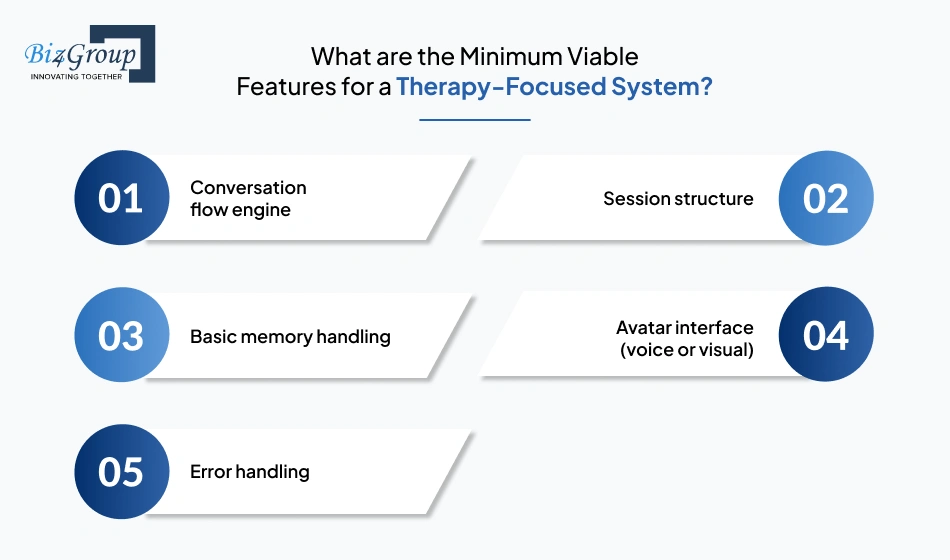
You only need a few features to make the system usable.
The system should follow a fixed path instead of generating random responses. This keeps interactions consistent and easy to manage.
Each session should have a clear start, middle, and end. This helps users understand what to do at each step.
The system should remember key inputs within a session. This keeps the interaction connected and avoids repetition.
The interaction should feel guided through a simple voice or visual layer. This makes the experience easier to follow.
The system should handle unexpected input without breaking the flow. This keeps sessions stable.
In AI avatar-based therapy app development, these features are enough to test whether the system works. If any of these are missing, interactions usually break or feel incomplete.
Some features look useful but are not needed in the first version.
Teams using AI automation services often add these too early and end up increasing cost without improving results. Adding these too soon usually slows development and makes the system harder to manage.
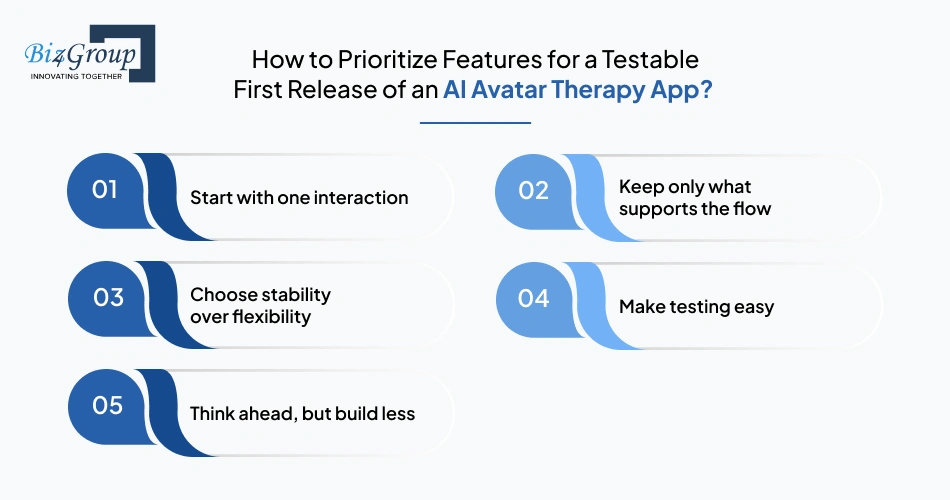
Feature decisions should be based on what helps you test the system quickly.
Focus on a single use case and make sure it works from start to end without failure.
If a feature does not improve the interaction, it can wait.
A simple system that works is better than a complex system that behaves unpredictably.
Features should be simple enough to validate with real users. Complex setups slow down learning.
Plan for future features, but do not include them in the first version.
This approach is common in digital AI avatar healthcare app development, where early validation matters more than feature depth.
A good first version should be stable, testable, and easy to improve. Focus on one use case, make it work reliably, and expand only after that.
The system architecture defines how different components work together during each interaction. In AI avatar therapy app development, this directly affects response speed, stability, and user experience. If the structure is unclear, even simple interactions start breaking down.
A therapy-focused system is built in layers. Each layer handles a specific part of the interaction.
|
Layer |
Role in the System |
What It Handles |
|---|---|---|
|
Input Layer |
Captures user input |
Text, voice, or multimodal signals |
|
Processing Layer |
Interprets input |
Intent detection, context handling |
|
Conversation Layer |
Generates responses |
Structured dialogue and flow control |
|
Memory Layer |
Stores session data |
Context, past inputs, session state |
|
Output Layer |
Delivers response |
Voice, text, avatar animation |
These layers operate in sequence, where the output of one becomes the input for the next. If one layer slows down or fails, the entire interaction is affected.
In conversational AI avatar therapy app development, keeping these layers loosely connected makes the system easier to update without breaking everything.
Every interaction follows the same basic cycle:
User input is captured: The system receives input through text or voice and prepares it for processing.
This cycle repeats for every interaction. If this flow is not well designed, responses become slow, inconsistent, or disconnected. Teams often rely on AI model development to optimize how quickly and accurately this flow works.
Latency directly affects how natural the interaction feels. Even small delays can break the experience.
If responses take too long, users lose focus and the interaction feels unnatural.
If components are not synchronized, voice, text, and visuals can fall out of sync.
Some steps must happen faster than others to keep the interaction smooth.
Adding too many checks or features slows down response time without adding value.
In AI virtual avatar wellness app development, low latency is critical because users expect immediate feedback. Poor latency handling makes the system feel unreliable, even if the logic behind it is correct. A clear architecture keeps all parts of the system aligned. It affects not just performance, but also cost, scalability, and maintenance.
Without a well-defined structure, systems become harder to scale, harder to manage, and more expensive to fix later.
Move beyond basic bots with custom AI avatar therapy app development focused on controlled dialogue and consistent user experience.
Build Better AI ConversationsCompliance decides how user data is handled, how the system behaves, and how everything is tracked. In AI avatar therapy app development, these choices affect safety, risk, and long-term scalability. If you don’t plan this early, fixing it later becomes difficult and expensive.
Healthcare apps must follow rules for data privacy, user consent, and safe interactions. Laws like HIPAA (US) and GDPR (EU) define how user data should be collected, stored, and shared.
In healthcare AI avatar app solutions, this also means making sure the system does not give unsafe or misleading guidance, and that users know how their data is used. If these rules are ignored, the system may fail compliance checks or need major changes later.
Sensitive data should be encrypted when stored and when sent. Access should be limited so only the right systems or users can see it. Systems built for AI avatar coaching and therapy platform development often separate user data, session data, and logs to reduce risk and improve control. If this is not done properly, the system becomes vulnerable to leaks and unauthorized access.
The system should keep records of what users say, how the system responds, and how decisions are made. This helps teams review what happened if something goes wrong. With generative AI, this becomes more important because responses can vary. Without proper logs, it becomes hard to investigate issues or explain system behavior.
Compliance is not just a requirement. It affects how the system is built and how reliable it is. Clear rules for data, access, and tracking make the system safer and easier to manage over time.
Conversation design shapes how users move through sessions, what the system asks, and how it responds at each step. In AI avatar therapy app development, well-structured interactions make the system easier to use, test, and improve over time.
Each conversation should follow a defined structure based on a chosen framework. The system should guide users step by step so the interaction stays focused and predictable. This keeps the flow stable and easier to manage across sessions.
Portfolio Spotlight
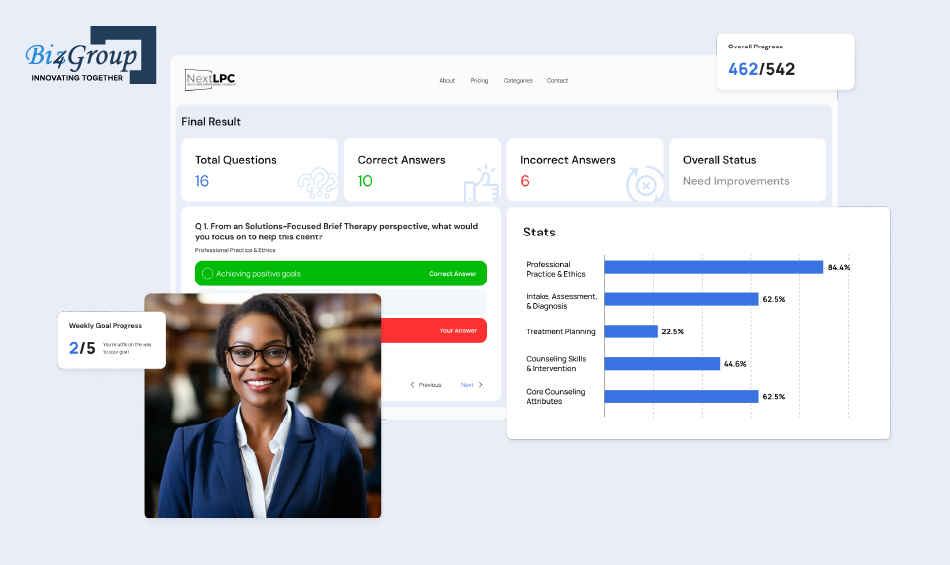
Built as an AI-powered therapy training platform, NextLPC uses avatar-based interactions to guide learners through clinical scenarios and structured case simulations. This kind of system highlights how controlled dialogue design and guided flows are critical when developing therapy-focused avatars.
The system should carry forward key inputs from previous interactions so conversations build over time. This helps maintain continuity and avoids repeating the same questions. Memory should be limited to what improves relevance and clarity.
The system can adjust how it delivers responses based on user patterns such as pacing or response length. The structure stays consistent while small changes improve how relevant the interaction feels. This approach is common in custom AI avatar therapy app development, where stability matters as much as personalization.
Portfolio Spotlight
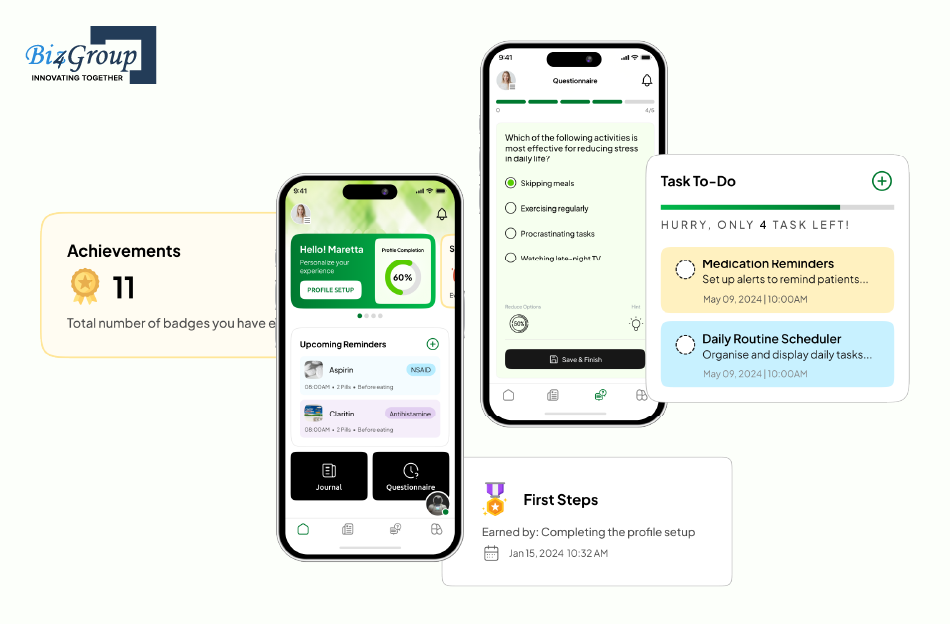
CogniHelp is a mobile healthcare app designed to support dementia patients through cognitive exercises and guided interactions. It demonstrates how AI-driven systems must adapt to user condition, memory limitations, and behavioral patterns, which directly impacts how therapy avatars handle personalization and continuity.
The system should respond to unclear input by asking follow-up questions instead of guessing. It should also recognize when a situation is outside its scope and redirect or escalate when needed. This keeps interactions controlled and within safe limits.
Clear conversation design keeps the system predictable and easier to improve. Teams working on how to create AI avatar app for wellness coaching and therapy support usually focus on structure first, then refine how interactions adapt over time.
In practice, reliable AI conversation app development depends on how well these elements are designed and connected.
Trust depends on how the system looks, responds, and behaves during each interaction. In AI avatar therapy app development, these choices affect user comfort, engagement, and whether users continue using the system. Small inconsistencies in tone, timing, or behavior can reduce trust quickly.
Avatar-based interaction adds voice and visual cues to the conversation. This helps guide users through each step and makes the interaction easier to follow. It also improves response clarity by combining speech, timing, and visual feedback.
The way the avatar looks affects how comfortable users feel during the interaction. A simple and neutral design helps reduce distraction and keeps attention on the conversation. Designs that feel too realistic or too stylized can create discomfort.
Voice, tone, and pacing shape how users experience each session. The system should speak clearly, keep a consistent tone, and adjust pacing based on user behavior. This helps maintain a steady interaction flow.
Portfolio Spotlight
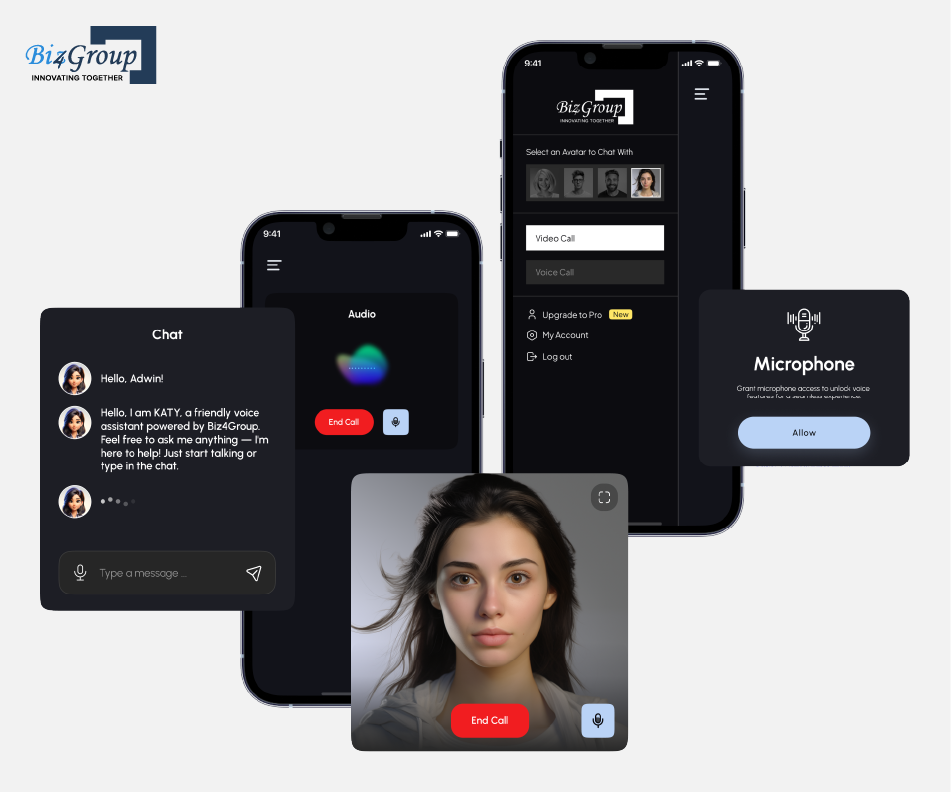
Designed as an avatar-based AI companion, AI Wizard enables real-time voice and video interactions with a focus on empathy and engagement. It reflects how multimodal interaction and emotional response handling are essential for building therapy-oriented avatars that feel natural and responsive.
The system should guide users without becoming a replacement for real-world support. Clear boundaries should be built into the interaction so the system stays within its defined role. This keeps usage balanced and safe.
Designing for trust and safety requires consistent behavior across every interaction. These principles are central to the development of AI avatar therapy app systems, where user experience and system control need to stay aligned. As part of broader initiatives that include business app development using AI, getting these details right improves retention and keeps the system reliable over time.
From architecture to interaction design, get clarity before you invest in AI avatar therapy app development.
Talk to Our AI Experts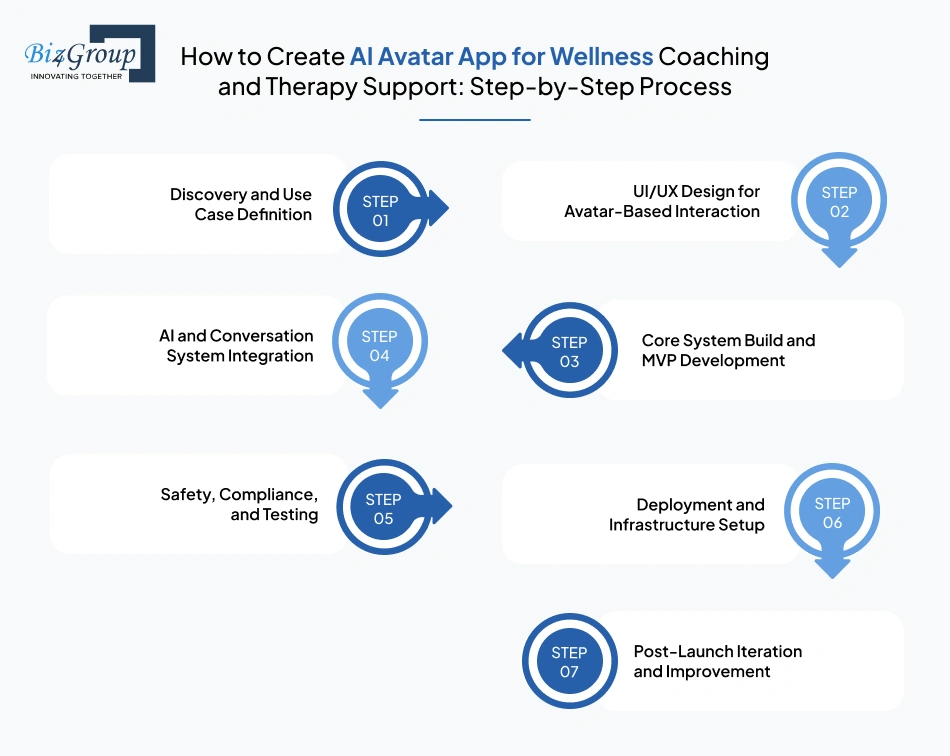
Building a therapy-focused system requires clarity at every stage. Each step should support how users interact, how conversations are structured, and how safety is maintained. In AI avatar therapy app development, a structured approach reduces rework and makes the system easier to scale.
If you're approaching this from a founder’s perspective, you might already be thinking along these lines:
Here’s what you need to keep in mind while you’re at it.
Most projects fail because the use case is too broad. Narrowing it down early helps define how the system will behave during real interactions. This is where teams begin creating an AI avatar therapy app that solves one clear problem instead of trying to handle everything at once.
Users should be able to follow the interaction without thinking about the interface. The design should guide attention, reduce confusion, and support the conversation flow. This is especially important in AI avatar application development for therapy, where engagement depends on how clearly each step is presented.
Work with a UI/UX design company to keep the experience consistent.
Also read: Top 15 UI/UX Design Companies in USA (2026 Edition)
Start small and make sure the system can complete one full interaction without breaking. This helps validate whether the conversation flow actually works in practice. Many teams approach AI avatar-based therapy app development via MVP development services to avoid building features that are never used.
Also read: 12+ MVP Development Companies in USA to Launch Your Startup in 2026
At this stage, the focus shifts to how the system interprets input and generates responses. The goal is to keep responses consistent and aligned with the defined interaction flow. Teams often look at how companies that develop AI avatar therapy app in USA structure this layer to maintain reliability in real-world usage.
The system should behave in a controlled way under different conditions. Testing helps identify where interactions may break or become unclear. Safety checks are especially important when the system is guiding users over multiple sessions.
Also Read: 15+ Software Testing Companies in USA in 2026
Once the system is stable, it needs to handle real-time usage without delays. Infrastructure should support smooth interactions even when multiple users are active at the same time.
After launch, the focus shifts to improving how the system performs in real conditions. Feedback and usage patterns help refine interactions and guide future updates. This is where teams continue creating an AI avatar therapy app that evolves with user needs.
Each step builds on the previous one, so skipping or compressing stages usually creates issues later. Start with a clear use case, validate the interaction early, and expand only after the system works reliably. This approach reduces rework and makes it easier to scale the product over time.
The tech stack defines how the system handles input, processes it, and delivers responses in real time. In AI avatar therapy app development, the right setup ensures stable interactions, low latency, and easier scaling as usage grows.
You may have come across queries like these while researching in AI tools:
Here’s everything that you need to know.
|
Layer |
Components |
What It Handles |
Why It Matters |
|---|---|---|---|
|
Input Layer |
Speech-to-text APIs, text input handlers |
Captures user input from voice or text, often processed through Python development pipelines |
Ensures clean and usable input |
|
Processing Layer |
NLP models, intent detection systems |
Interprets user input and extracts meaning for model execution |
Keeps responses relevant |
|
Conversation Layer |
Dialogue engines, prompt frameworks |
Generates structured responses via NodeJS development for real-time flow control |
Maintains consistency |
|
Memory Layer |
Session storage, context databases |
Stores session data and context using backend systems |
Enables continuity |
|
Avatar Layer |
2D/3D rendering engines, animation tools |
Renders avatar visuals and expressions using ReactJS development |
Improves engagement |
|
Output Layer |
Text-to-speech systems, UI rendering |
Delivers responses via voice and UI using ReactJS development and NextJS development |
Ensures smooth delivery |
|
REST APIs, GraphQL services |
Connects frontend, backend, AI models, and external systems using API development practices |
Enables communication between all components |
|
|
Backend Layer |
APIs, databases, orchestration services |
Handles business logic, system coordination, and data flow |
Keeps system stable |
|
Infrastructure Layer |
Cloud services, load balancers |
Manages deployment, scaling, and availability across environments |
Supports real-time performance |
Each layer should work independently but stay aligned during real-time interaction. In digital AI avatar healthcare app development, this separation makes it easier to scale parts of the system without breaking the overall experience.
A well-defined stack reduces bottlenecks, keeps interactions fast, and makes the system easier to maintain as it grows.
The cost depends on how complex the system is, how many features you include, and how scalable it needs to be. In AI avatar therapy app development, a basic version can start around $30,000, while more advanced systems can go beyond $200,000+. This is a ballpark range, not a fixed number, because cost changes based on scope, tech choices, and long-term requirements.
|
Level |
Estimated Cost |
What’s Included |
When to Choose |
|---|---|---|---|
|
MVP-Level AI Avatar Therapy App |
$30,000 – $60,000 |
Basic conversation flow, simple avatar interface, limited memory, core backend setup |
When validating a single use case |
|
Advanced-Level AI Avatar Therapy App |
$60,000 – $120,000 |
Improved conversation logic, personalization, better UI/UX, integrations, analytics |
When scaling features and improving engagement |
|
Enterprise-Grade AI Avatar Therapy App |
$120,000 – $200,000+ |
Full-scale system, real-time processing, advanced AI models, compliance layers, high scalability |
When building for large user base and long-term growth |
The total cost is not just about development. It also includes infrastructure, updates, and ongoing improvements. In digital AI avatar healthcare app development, most teams start with a smaller version and expand after validating how the system performs.
Cost is mainly driven by how complex the system is and how much scale you need from the start.
|
Factor |
Cost Impact |
When It Increases Cost |
What to Do |
|---|---|---|---|
|
Feature Scope |
High |
Adding multiple use cases or advanced features early |
Start with one use case and expand later |
|
Conversation Complexity |
High |
Moving from structured flows to adaptive interactions |
Keep flows simple in early versions |
|
Avatar Design |
Medium |
Using 3D or highly realistic avatars |
Start with a basic visual or voice avatar |
|
AI Model Setup |
Medium-High |
Custom training and fine-tuning |
Use pre-built models first |
|
Integrations |
Medium |
Connecting to external systems or APIs |
Add only essential integrations early |
|
Infrastructure |
Medium-High |
Supporting real-time and large user load |
Scale infrastructure based on usage |
|
Compliance Requirements |
High |
Handling sensitive healthcare data |
Plan compliance early to avoid rework |
Cost depends on how much you build upfront and how complex the system needs to be. Start with a focused version, validate it, and add features based on real usage. This approach keeps costs controlled and reduces unnecessary development effort.
Create systems that evolve with usage using AI avatar coaching and therapy platform development and continuous feedback loops.
Start Your Scalable AI BuildThe decision comes down to how much control you need, how fast you want to launch, and how the system will evolve over time. In AI avatar therapy app development, building gives you full control over interactions and data, while buying helps you launch faster with fewer upfront decisions.
|
Criteria |
Build (Custom Development) |
Buy (Pre-Built Platform) |
|---|---|---|
|
Control |
Full control over features, data, and interaction flow |
Limited control based on platform capabilities |
|
Time to Launch |
Slower, requires full development cycle |
Faster, ready-to-use setup |
|
Cost |
Higher upfront, lower dependency later |
Lower upfront, ongoing subscription or licensing |
|
Customization |
Can match specific therapy or coaching use case |
Limited to available features |
|
Scalability |
Designed for long-term growth |
Depends on platform limits |
|
Integration |
Flexible integration with other systems |
Limited by platform support |
|
Maintenance |
Requires ongoing development support |
Managed by the platform provider |
|
Best For |
Long-term products with specific requirements |
Early-stage products or quick validation |
Building fits cases where the interaction flow, data handling, or system behavior needs to be defined from scratch. Buying works when the priority is to get a working system in place quickly without investing in full development.
Some teams partner with a custom software development company to test usage patterns via a platform, then move to a custom build once requirements are clearer.
Choose based on what matters more at your current stage: speed of launch or control over the system.
The wrong partner can lead to unstable interactions, delays, and higher development costs. In AI avatar therapy app development, the partner should understand both system design and how therapy-style interactions work in practice.
You may have searched queries like these in AI tools while evaluating options:
A capable team should cover both technical execution and interaction design. Gaps in either area usually show up later as system issues.
|
Area |
What to Look For |
How to Verify |
Why It Matters |
|---|---|---|---|
|
Conversation Systems |
Experience with structured dialogue flows |
Ask for examples of past conversation designs |
Ensures predictable and controlled interactions |
|
AI/ML Capability |
Ability to manage models and response logic |
Review how they handle prompt design or output control |
Keeps responses relevant and safe |
|
Healthcare Context |
Understanding of therapy workflows and user sensitivity |
Ask about prior work in healthcare or wellness |
Reduces risk in user-facing interactions |
|
System Architecture |
Experience with scalable, real-time systems |
Request architecture diagrams or system breakdowns |
Supports performance and reliability |
|
Data Handling |
Knowledge of privacy and compliance |
Ask how they manage sensitive user data |
Protects user information and avoids compliance issues |
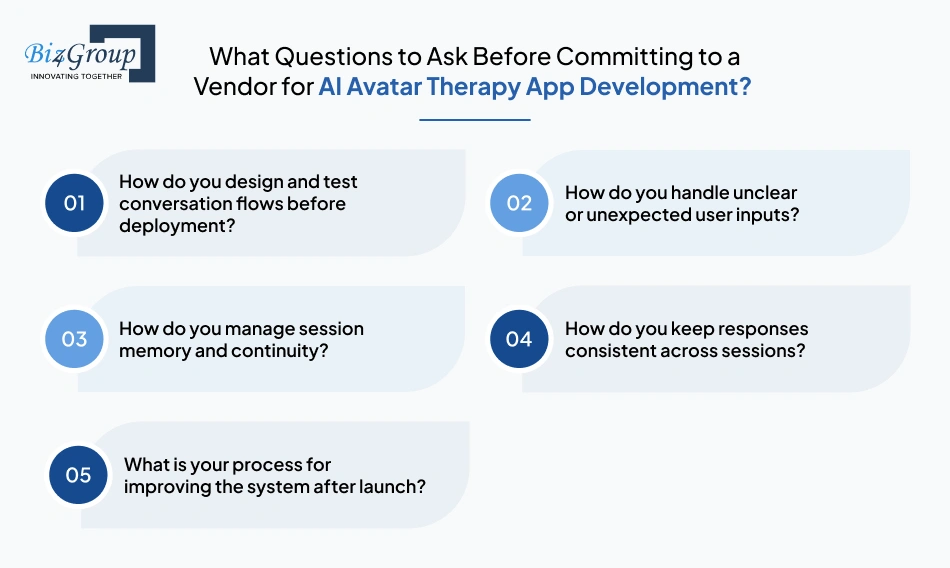
These questions help you understand how the team handles real system behavior, not just development tasks.
Answers to these questions show whether the team has real experience in conversational AI avatar therapy app development, not just basic AI knowledge.
Some early signals can point to problems during development or after launch.
Working with teams focused on healthcare AI avatar app solutions requires clear processes and defined methods, not just technical claims. Teams building enterprise AI solutions usually have structured approaches to handling interaction design, system behavior, and long-term scalability.
Choose a partner who can explain how the system will behave in real use, not just how it will be built.
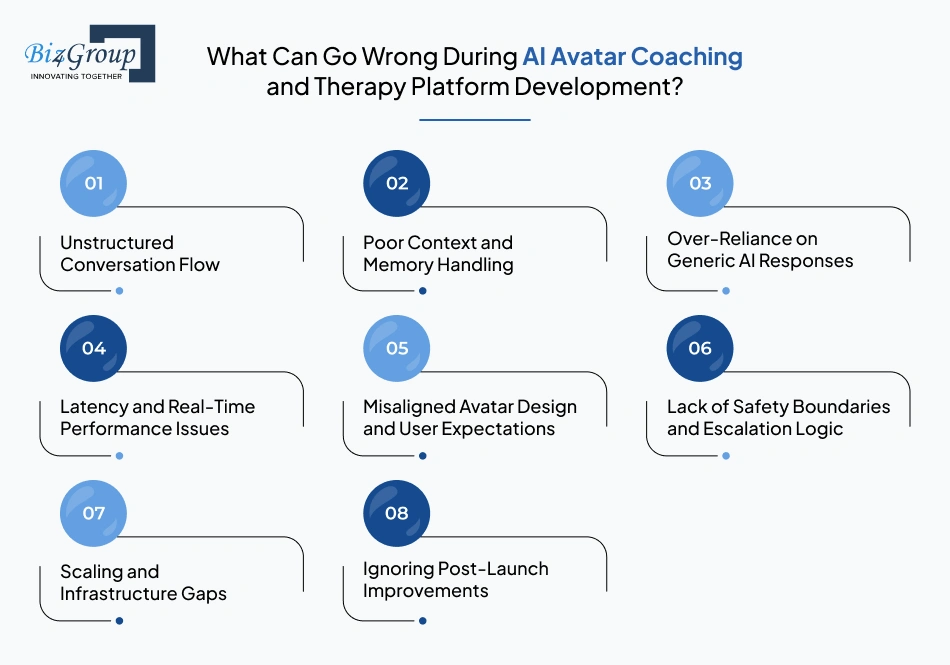
Most issues in these systems come from poor conversation design, weak context handling, or lack of control over responses. In AI avatar therapy app development, these problems affect how users experience the system and how reliable it feels over time.
One of the most common issues is unclear conversation flow. The system may jump between topics or respond inconsistently, which makes the interaction hard to follow. This usually comes from not defining clear steps before building the system.
If the system does not use past inputs correctly, conversations feel disconnected. Users may have to repeat information, which reduces engagement. This is often fixed by limiting what the system stores and using only relevant context.
When responses are not controlled, the system may generate irrelevant or unsafe outputs. In custom AI avatar therapy app development, this leads to inconsistent interactions that are hard to predict. Structured response logic helps keep outputs aligned.
Slow responses break the interaction flow. Even small delays can make the system feel unreliable, especially in voice-based sessions. This is usually addressed by optimizing response pipelines and reducing unnecessary processing.
If the avatar looks or behaves in a way that does not match the use case, users may feel uncomfortable or distracted. This affects how they engage with the system. A simple and consistent design works better in most cases.
Without clear limits, the system may respond to situations it is not designed to handle. This can lead to incorrect guidance or unsafe interactions. Defining boundaries early helps keep the system within its intended role.
Systems that work in testing may fail under real usage. Performance issues start appearing when more users interact at the same time. Planning infrastructure early helps avoid these problems.
If the system is not updated based on real usage, issues remain unresolved and interaction quality does not improve. In AI avatar coaching and therapy platform development, ongoing refinement is required to keep the system useful.
These issues are easier to prevent during design than to fix after launch. Teams that hire AI developers with experience in interaction design and system behavior are more likely to avoid these problems early.
Use the right approach to custom AI avatar therapy app development and reduce rework during growth and scaling.
Get Started With a Clear Roadmap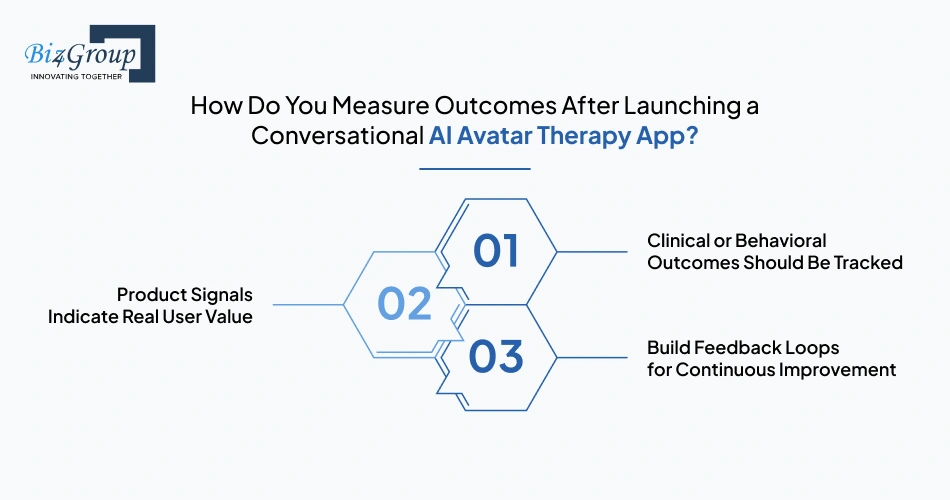
Measuring outcomes means tracking how users interact with the system and whether those interactions lead to consistent usage and meaningful progress. In AI avatar therapy app development, this helps you understand what is working, what needs improvement, and whether the system is delivering real value.
Track measurable changes in user behavior over time. This includes signals like session completion rate, frequency of use, and trends in user-reported inputs such as mood or progress. In AI avatar coaching and therapy platform development, these indicators show whether users are engaging consistently and benefiting from the interaction.
Product-level metrics show how users interact with the system. Track session duration, repeat usage, and where users drop off during interactions. These signals help identify which parts of the system are useful and which need improvement in custom AI avatar therapy app development.
Feedback should come from both user input and system data. This includes direct feedback, usage patterns, and session outcomes. Teams working on how to create an AI avatar for business use this data to update conversation flows, fix weak points, and improve response quality over time.
Portfolio Spotlight
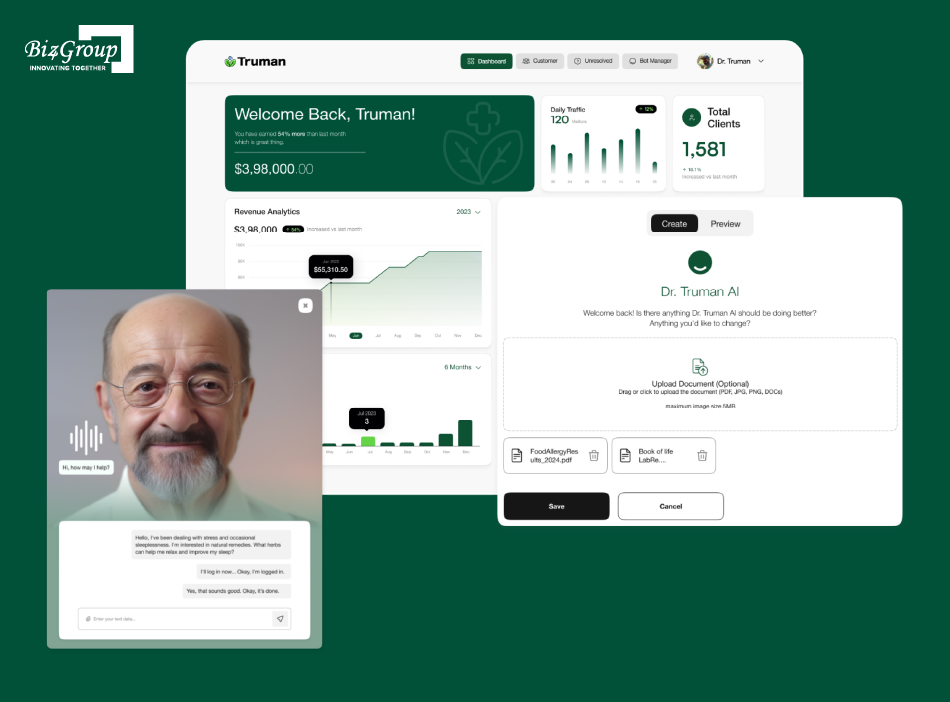
Dr Truman is an AI-enabled wellness app that provides personalized health recommendations, supplement guidance, and user tracking. It shows how integrating user data and behavioral insights can enhance interaction relevance, which is a key part of building scalable therapy and wellness avatar systems.
Outcome measurement should focus on consistent usage, not just one-time engagement. Systems that are regularly tracked and updated are easier to improve and more likely to deliver long-term value.
The next generation of these systems will be shaped by how natural interactions feel, how well they connect with other systems, and how strictly they are regulated. In AI avatar therapy app development, these changes will affect how systems are designed, how they scale, and how users interact over time.
Future systems will combine voice, text, and visual cues into a single interaction flow instead of treating them as separate modes. This reduces reliance on one input type and makes sessions easier to follow. It also requires better coordination between input, processing, and output layers.
Systems will move from standalone tools to connected platforms that use data from multiple sources. This changes how interactions are generated, as responses can be based on real user data instead of isolated inputs. In AI avatar coaching and therapy platform development, this leads to more context-aware and relevant interactions.
Regulations will become more detailed as these systems handle sensitive use cases. This will affect how data is stored, how responses are monitored, and how systems are audited. In custom AI avatar therapy app development, this means building compliance into the system from the start rather than adding it later.
These changes will affect how systems are built, not just how they are used. Teams working on digital AI avatar healthcare app development will need to design for flexibility, integration, and compliance from the beginning to keep their systems reliable over time.
Building these systems involves structured interaction design, real-time performance, and an understanding of how users behave in therapy or wellness contexts. That’s where Biz4Group LLC stands out as an AI avatar development company with hands-on experience across healthcare and avatar-based platforms.
Across projects like NextLPC, CogniHelp, AI Wizard, and Truman, the focus has been on building systems that go beyond basic interaction and deliver consistent, usable outcomes in real environments.
What this means in practice:
From therapy training systems to wellness apps, each product reflects a different layer of interaction design and system behavior.
Emphasis on controlled dialogue flows instead of generic AI responses, ensuring consistency and reliability.
Experience working with user-sensitive applications where behavior, engagement, and safety matter.
Systems are built to handle growth, real-time interactions, and evolving feature requirements.
Focus on feedback loops, usage data, and iterative refinement to improve system performance over time.
In AI avatar therapy app development, working with a team like Biz4Group LLC, that has already built and tested similar systems reduces risk and speeds up execution.
Building an AI avatar therapy app is all about shaping how conversations flow, how users engage, and how the system improves over time. In AI avatar therapy app development, every decision, from use case definition to compliance, directly impacts how reliable and useful the final product feels.
If there’s one thing to take away, it’s this: the systems that work are the ones that are planned with structure, tested with real users, and refined continuously. The rest tend to look good on paper and fall apart in actual use.
Whether you’re starting from scratch or improving an existing product, working with the right AI app development company and leveraging practical AI consulting services can make the difference between a working system and one that actually delivers value.
Want to avoid common pitfalls in AI avatar therapy app development? Find out how our AI experts can help you build it right from the start.
Development timelines usually range from 3 to 9 months, depending on complexity. A basic version with limited features can be built faster, while systems with real-time interaction, personalization, and integrations take longer to design, test, and refine.
The cost usually falls between $30,000 and $200,000+, depending on features, level of customization, and system complexity. MVP-level apps are on the lower end, while advanced or enterprise-grade platforms with real-time AI and integrations cost significantly more.
If the app is intended for healthcare or therapy-related use, some level of validation is often required. This can include expert input, testing with real users, and ensuring the system behaves consistently within defined boundaries.
Yes, some systems use asynchronous interaction, where users engage through delayed responses or structured sessions. However, real-time interaction generally improves engagement and makes conversations feel more natural.
Most systems use encryption, access controls, and secure storage methods to protect user data. Compliance with regulations such as HIPAA or GDPR may also be required depending on the region and use case.
These apps are designed to support, not replace, human professionals. They are typically used for guidance, early support, or structured interaction, while complex or critical cases still require human intervention.

with Biz4Group today!
Our website require some cookies to function properly. Read our privacy policy to know more.