 Location :
Orlando, FL, USA
Location :
Orlando, FL, USA +1 (407) 714-1616
 info@biz4group.com

 AI Summary Powered by Biz4AI
- AI denial management turns a denied claim into a prioritized recovery case by combining the denial reason, claim data, payer context, supporting evidence, and historical outcomes.
- The strongest systems use rules for hard payer constraints, ML for denial and recovery scoring, document intelligence for evidence extraction, and RAG/LLMs for evidence-backed appeal support.
- $35K-$90K typically covers an MVP, $90K-$200K a mid-level system, and $200K-$350K+ an advanced enterprise deployment. Integrations, payer count, data readiness, AI depth, security, and scale drive the difference.
- Success should be measured by recoverable-denial identification, appeal overturn rate, denial-to-payment time, staff effort per case, and revenue actually retained, not the number of AI actions completed.
- Organizations can partner with Biz4Group to develop the platform around real denial workflows, combining AI, healthcare integrations, enterprise architecture, and experience from Bill Matters.
Why are healthcare teams still leaving so many denied claims untouched, even when some of those claims could be recovered?
HFMA reported in 2026 that about 60% of denials had historically gone unworked because the cost of appealing them was too high. HFMA’s data on unworked denials highlights the opportunity for AI denial management. By reducing the effort required to identify, prioritize, and work denials, AI can make more recoverable cases economically practical to pursue and improve overall recovery potential.
We have a reason to get specific here. Biz4Group has already built Bill Matters, an AI-powered denial and appeal generation platform for U.S. healthcare providers and billing companies.
So this is not a theoretical blueprint based on what AI could do. It is a practical look at what we learned from building around an actual denial-management workflow, including where AI helps, where it should stop, and what it takes to make the system usable beyond a demo.
Ready to see what that looks like in practice?
What Data Does an AI Denial Management System Need to Make Reliable Decisions?
An AI denial management system needs more than claim records. Reliable denial analysis depends on connecting claim, remittance, clinical, eligibility, authorization, payer, and historical outcome data so the system can understand what happened, why it happened, and what action is most likely to resolve it. Each denial workflow should have the healthcare data it needs to make informed decisions, with current and traceable information.
1. Claim and Billing Data Establish the Transaction Context
Claim and billing data gives AI the baseline needed to understand what was submitted and how the claim was structured.
Key inputs include:
- Patient and member identifiers
- Payer and plan information
- Date of service
- Billing and rendering provider
- CPT, HCPCS, ICD-10-CM, and modifiers
- Place of service and units
- Charges, allowed amounts, payments, and adjustments
- Claim status and submission history
- Corrected or resubmitted claim records
This data enables the system to connect a denial to the exact claim line, procedure, diagnosis, provider, or billing condition that may have triggered it.
For example, a coding denial cannot be evaluated accurately from the denial reason alone. The system may also need the billed procedure, modifier, diagnosis, provider, and place of service to identify the likely correction.
2. EOB, ERA, and Remittance Data Explain the Payer Adjudication
Claim data shows what the provider submitted. EOB, ERA, and remittance data show how the payer processed that submission.
Important inputs include:
- EOB details
- Electronic remittance data
- Claim Adjustment Reason Codes (CARCs)
- Remittance Advice Remark Codes (RARCs)
- Payment and adjustment amounts
- Denial and partial-payment outcomes
- Payer adjudication messages
This information helps AI distinguish between a complete denial, partial payment, contractual adjustment, and other payment outcomes.
That distinction matters because the right next step may be very different for a claim that was denied entirely versus one that was partially reimbursed because of a coding or contract issue.
3. Clinical and Documentation Data Supply the Evidence Behind the Claim
Clinical and supporting documentation becomes critical when a denial involves medical necessity, documentation requirements, authorization, or appeal support.
Depending on the workflow, relevant sources can include:
- Clinical notes
- Procedure and operative notes
- Discharge summaries
- Diagnosis and treatment records
- Laboratory and imaging results
- Referral documentation
- Prior authorization records
- Supporting claim attachments
The value of this data is not simply giving AI more information. It lets the system connect a denial to the evidence needed to resolve or challenge it.
For example, when evaluating a medical necessity denial, AI can identify the records that support the billed service and flag documentation that is still missing.
4. Eligibility and Authorization Data Add Coverage and Approval Context
Eligibility and authorization records help explain denials that cannot be resolved from the claim itself.
Relevant data may include:
- Coverage status and effective dates
- Member and plan details
- Applicable benefit information
- Authorization number and status
- Approved service or procedure codes
- Approved dates and units
- Referral requirements
- Authorization expiration dates
This enables AI to distinguish between different scenarios, such as:
- The patient was not eligible on the date of service.
- The patient was eligible, but authorization was required.
- Authorization existed, but the billed service or date was outside the approved scope.
That distinction can change the recommended action from appeal to correction, authorization resolution, or resubmission.
5. Payer Policies, Contracts, and Rules Provide the Decision Context
AI needs payer-specific rules to make recommendations that reflect the actual reimbursement environment rather than generic denial patterns.
Relevant sources include:
- Payer medical and coverage policies
- Authorization requirements
- Timely filing requirements
- Appeal and reconsideration rules
- Documentation requirements
- Coding and billing policies
- Provider contract terms
- Reimbursement rules
These sources should also be versioned by their effective dates. A payer requirement that applied when a claim was processed may differ from the current policy.
This data enables the system to answer practical questions such as:
"What documentation does this payer require for an appeal?"
or:
"Is this claim still within the payer's filing window?"
6. Historical Denial and Appeal Outcomes Turn Past Cases Into Predictive Signals
Historical denial and recovery data helps AI identify patterns that are difficult to capture with fixed rules alone.
Useful signals include:
- Denial reason and category
- Payer and plan
- Provider and specialty
- Procedure and diagnosis combinations
- Corrected-claim outcomes
- Appeal outcomes
- Evidence used in successful appeals
- Time to resolution
- Recovered amount
- Recurring denial patterns
These records can support use cases such as:
- Denial prediction
- Recoverability scoring
- Work-queue prioritization
- Appeal recommendations
- Root-cause analysis
For example, if historical data shows that a particular payer frequently overturns a specific denial when a certain document is supplied, that pattern can inform future case prioritization and evidence retrieval.
The quality of the historical labels matters as much as the volume. Inconsistent denial categories or unreliable recovery outcomes can weaken the resulting AI models.
7. Data Quality Determines the Reliability of AI Denial Management
More data does not automatically produce better AI. The system needs data that is complete, accurate, consistent, timely, and traceable.
Before deployment, teams should evaluate:
- Completeness: Are the fields required for the workflow present?
- Accuracy: Does the data reflect the actual claim and payer outcome?
- Consistency: Are codes, payer names, provider records, and statuses standardized?
- Timeliness: How quickly does new claim or remittance data become available?
- Duplication: Are duplicate claims or documents being introduced?
- Traceability: Can an AI recommendation be linked back to its source data?
- Version control: Can payer policies and rules be tied to the correct effective date?
- Label quality: Are denial and recovery outcomes categorized consistently?
The system should also recognize when its evidence is incomplete.
For example, if an appeal requires the denial reason, applicable payer requirement, and supporting clinical documentation, but one of those inputs is unavailable, the system should flag an evidence gap or low-confidence case rather than produce a definitive recommendation.
For healthcare organizations, that distinction is critical, reliable AI denial management depends on relevant, connected, and traceable data, not simply a larger dataset.
Not every denial needs an LLM. That’s the point.
The right AI stack uses each technique where it actually performs best. Let’s map yours.
Design Your AI ApproachWhich AI Techniques Should You Use for Denial Prediction, Classification, and Appeal Support?
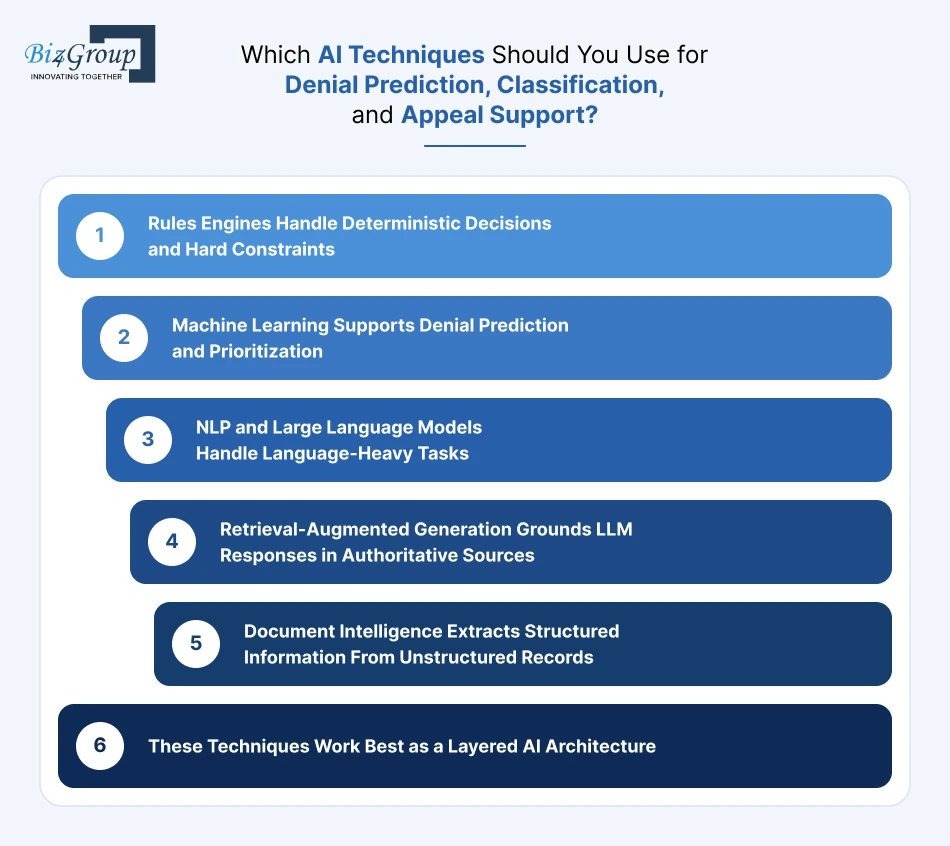
An AI denial management system should use different techniques for different tasks. Rules engines handle deterministic logic, machine learning handles prediction, NLP and LLMs handle language-heavy tasks, RAG retrieves authoritative context, and document intelligence extracts information from unstructured records. The right architecture combines them rather than forcing one model to handle every workflow.
The core rule is... do not use an LLM where a deterministic rule or specialized model is more reliable, explainable, or cost-effective.
1. Rules Engines Handle Deterministic Decisions and Hard Constraints
Rules engines work best when the expected outcome can be defined explicitly.
Use them for:
- Filing deadlines
- Required-field checks
- Fixed payer requirements
- Coding validation
- Workflow routing
- Threshold-based alerts
- Compliance controls
For example, if an appeal deadline has passed, a date-based rule can determine that immediately. An LLM adds unnecessary uncertainty to a deterministic calculation.
Best fit: predictable, auditable logic.
2. Machine Learning Supports Denial Prediction and Prioritization
Machine learning is useful when the system needs to estimate a probability, rank cases, or identify patterns that are difficult to express as fixed rules.
Common applications include:
- Denial prediction
- Recoverability scoring
- Appeal success prediction
- Claim prioritization
- Anomaly detection
- Pattern detection
For example, a rule can identify every claim with a specific denial condition. A machine learning model can rank those cases based on historical recovery patterns, helping teams focus on claims with higher expected value.
Production models require:
- Representative training data
- Reliable outcome labels
- Separate evaluation data
- Performance monitoring
- Threshold calibration
- Drift detection
- Controlled retraining
Best fit: prediction, ranking, probability, and pattern recognition.
3. NLP and Large Language Models Handle Language-Heavy Tasks
NLP and LLMs are most useful when the workflow involves unstructured text, complex language, or content generation.
Practical applications include:
- Summarizing denial cases
- Extracting information from narrative text
- Interpreting complex denial explanations
- Identifying relevant evidence
- Drafting appeal narratives
- Generating reviewer-ready case summaries
For example, an LLM can turn multiple case documents into a concise summary for a denial specialist.
The limitation is factual reliability. Generated text must be grounded in source material and validated before it is used in a consequential workflow.
Best fit: language interpretation, summarization, and controlled generation.
4. Retrieval-Augmented Generation Grounds LLM Responses in Authoritative Sources
RAG is useful when an LLM needs current, source-specific information that should not be assumed from model memory.
A typical workflow is:
Request → retrieve relevant sources → rank evidence → provide context to LLM → generate response
In denial management, this can support questions such as:
"What documentation does this payer require for this appeal?"
or:
"Which policy applies to this denial?"
The retrieval layer should prioritize approved and current sources, with source references preserved for review and audit.
Best fit: payer policies, contracts, documentation requirements, and other source-grounded responses.
5. Document Intelligence Extracts Structured Information From Unstructured Records
Document intelligence converts information from PDFs, scans, forms, letters, and other documents into data that downstream systems can use.
Typical capabilities include:
- OCR
- Document classification
- Field extraction
- Table extraction
- Entity extraction
- Relevant passage detection
- Confidence scoring
For example, an appeal packet may contain several documents. Document intelligence can identify the authorization record, relevant clinical note, or supporting attachment before the system summarizes the case.
Best fit: extracting usable data from documents that are difficult to process as structured records.
6. These Techniques Work Best as a Layered AI Architecture
A production system should assign each task to the technique best suited to it.
A practical flow is:
Rules → Machine Learning → Document Intelligence → Retrieval → LLM → Validation → Human Review
For example:
- Rules apply hard constraints and workflow requirements.
- Machine learning predicts risk or recovery potential.
- Document intelligence extracts information from unstructured records.
- RAG retrieves the relevant payer or policy context.
- LLM/NLP interprets the retrieved information or drafts content.
- Validation rules check required conditions.
- Human reviewers approve, edit, or reject consequential outputs.
This approach is more reliable than using one LLM for prediction, policy checks, document extraction, and appeal generation.
That architecture decides what should happen to each case. When the answer is to appeal, the appeal itself determines whether the money is recovered.
How Does AI Appeal Generation Work, and Why Does Appeal Quality Decide Recovery?
One of the most practical outputs of an AI denial management system is the appeal itself. This is where the system's ability to interpret the denial, find relevant evidence, and understand payer requirements has to produce something a reviewer can actually use.
AI appeal generation takes the denial reason, claim details, payer requirements, and supporting evidence and turns them into a case-specific appeal draft. The reviewer then validates the evidence, refines the argument where needed, and approves the submission.
Why Appeal Quality Matters?
A weak appeal does more than waste a draft. It can consume staff time, miss an appeal window, or give the payer little reason to reconsider the original decision.
That makes the quality of the evidence-to-argument connection critical.
What Should a Strong AI-Generated Appeal Contain?
A useful appeal should:
- Address the specific denial reason
- Reference the payer requirement or policy that applies
- Cite relevant clinical, billing, and supporting evidence
- Explain how that evidence supports reconsideration
- Meet the applicable submission and filing requirements
How Does Bill Matters Generate Evidence-Backed AI Appeals?
A strong appeal starts before the writing begins. The system first needs to understand what the payer rejected, what evidence exists, and what can actually be used to challenge the decision.
That is how we approached Bill Matters. Instead of treating appeal generation as a text-generation problem, we built the workflow around evidence, specialized AI agents, and verification at each stage. Splitting the work across agents helps reduce unsupported assumptions and hallucinated details before they reach the final draft.
- Billing Evidence Finder: Finds relevant evidence and flags gaps.
- Multi-agent AI workflow: Separates denial analysis, evidence gathering, strategy, and drafting into focused steps.
- Evidence-backed generation: Grounds claims in source records.
- Human approval: Reviewer validates and approves the final appeal.
The result is an appeal built around the actual denial reason and supporting evidence, rather than a generic AI-generated argument.
Which Integrations Are Essential for Connecting AI Denial Management to EHRs, Billing, Clearinghouses, and Payers?
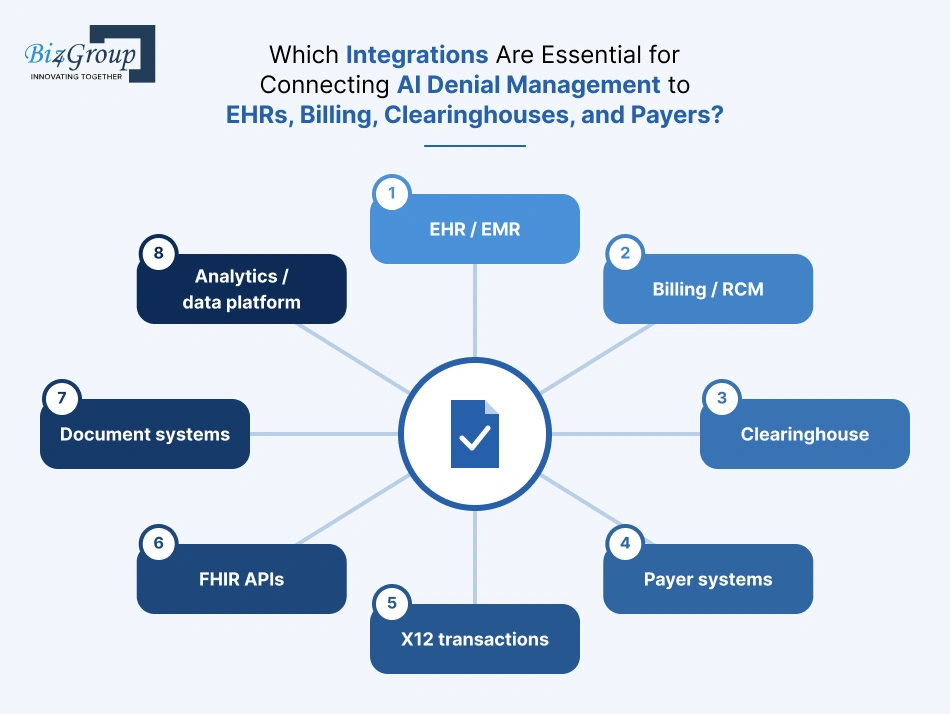
An AI denial management system needs to connect with the systems that create, process, adjudicate, and document healthcare claims. The integration layer should provide the right data to the right workflow while preserving traceability, security, and operational continuity.
|
Integration |
Key data exchanged |
What it enables |
Common technologies / standards |
|---|---|---|---|
|
EHR / EMR |
Patient, encounter, diagnosis, procedure, clinical notes, referrals, authorization records |
Connects denials to clinical context and supporting evidence |
FHIR, REST APIs, interface engines |
|
Billing / RCM |
Claims, claim lines, balances, adjustments, billing status, work queues, resubmissions |
Connects AI recommendations to existing denial and recovery workflows |
APIs, HL7 where applicable, database/integration middleware |
|
Clearinghouse |
Claim submissions, acknowledgments, rejections, payer responses, remittance transactions |
Distinguishes submission errors from payer adjudication outcomes and tracks transaction status |
X12, APIs, secure file exchange |
|
Payer systems |
Eligibility, authorization, claim status, payer responses, appeal requirements and status |
Applies payer-specific rules and supports status checks, authorization, and appeal workflows |
Payer APIs, X12, secure portals |
|
X12 transactions |
Claims, eligibility, remittance, claim status and related administrative transactions |
Standardizes core revenue-cycle data exchange |
X12 270/271, 276/277, 837, 835 |
|
FHIR APIs |
Patient, clinical, administrative, and resource-level healthcare information |
Provides modern application-to-application data exchange |
FHIR REST APIs |
|
Document systems |
PDFs, scanned records, payer letters, medical records, attachments |
Brings unstructured evidence into denial analysis and appeal workflows |
OCR, document APIs, object storage |
|
Analytics / data platform |
Denial trends, recovery outcomes, model outputs, operational KPIs |
Measures performance, ROI, model behavior, and recurring denial patterns |
Data warehouse, APIs, BI platforms |
Integration is about more than getting systems to talk to each other. The real win is making sure the right data moves through the denial workflow reliably, with a clear trail of where it came from and where it went.
What Should the Architecture of an Enterprise AI Denial Management System Look Like?
An enterprise AI denial management system should use a layered architecture in which data processing, business rules, AI models, evidence retrieval, decisioning, workflow orchestration, human review, and analytics have clearly defined responsibilities. The architecture should prevent one model or service from becoming responsible for the entire denial workflow and make each layer independently testable, replaceable, and auditable.
Enterprise AI Denial Management Architecture Workflow
Data enters the platform
↓
Validation and normalization
↓
Unified denial case creation
↓
Rules and policy evaluation
↓
AI analysis and scoring
↓
Evidence retrieval and contextual reasoning
↓
Resolution recommendation
↓
Workflow orchestration
↓
Human review where required
↓
Approved action
↓
Outcome capture and performance monitoring
The architecture should treat AI as a decision-support layer within a controlled workflow, not as the system's entire decision engine.
1. Data Ingestion and Normalization Create a Consistent Internal Data Model
Once information enters the platform, the first architectural responsibility is to convert inconsistent source data into a common structure that downstream services can use.
The normalization layer should handle:
- Field and schema mapping
- Code normalization
- Data validation
- Deduplication
- Record matching
- Timestamp normalization
- Missing-value handling
- Source and transaction tracking
The output should be a consistent internal representation of a denial case rather than source-specific formats.
For example, downstream services should not need separate logic for how different systems represent claim status, denial status, payer identifiers, or provider records.
2. A Unified Denial Case Model Connects Every Event to One Case
The system should maintain a persistent case identifier that connects the denial to its downstream activity.
A unified case can contain:
|
Case component |
Examples |
|---|---|
|
Claim context |
Claim number, line items, billed services |
|
Denial context |
Denial category, reason, status |
|
Financial context |
Charges, adjustments, expected recovery |
|
Evidence context |
Supporting records and evidence status |
|
Resolution context |
Correction, resubmission, appeal, escalation |
|
Review context |
Reviewer actions, overrides, approvals |
|
Outcome context |
Final disposition, recovery, resolution time |
This prevents each service from reconstructing the case independently and gives the platform a single source of operational truth.
3. Rules and Policy Evaluation Establish the Deterministic Control Layer
The rules layer should handle decisions that can be expressed clearly and tested deterministically.
Typical responsibilities include:
- Deadline checks
- Required-condition validation
- Payer-specific workflow rules
- Escalation thresholds
- Mandatory review conditions
- Hard compliance controls
This layer should remain separate from predictive models.
For example, a machine learning model can estimate recovery potential, but a deterministic rule can still require immediate escalation when a filing deadline is approaching.
That separation makes rule changes easier to manage without changing the underlying model.
4. AI Services Perform Prediction, Classification, Scoring, and Language Processing
AI services should be modular rather than built as one monolithic model.
|
AI service |
Primary responsibility |
|---|---|
|
Prediction |
Estimate denial or recovery risk |
|
Classification |
Categorize complex cases |
|
Scoring |
Estimate recoverability or priority |
|
NLP |
Interpret narrative information |
|
LLMs |
Summarize or generate controlled content |
|
Anomaly detection |
Identify unusual patterns |
Each service should produce a structured output such as a score, classification, recommendation, extracted field, or confidence value.
This allows the workflow layer to combine AI outputs with deterministic rules instead of allowing a model to directly trigger every operational action.
5. Evidence Retrieval Supplies the Context Needed for AI Reasoning
Evidence retrieval should be a dedicated architectural capability rather than buried inside the LLM layer.
The retrieval flow can be:
Case context → retrieve relevant evidence → rank evidence → provide context to AI → generate supported output
The system should preserve:
- Source reference
- Evidence type
- Date
- Association with the case
- Retrieval status
- Confidence or relevance information
This gives reviewers a clear path from an AI recommendation back to the information that supported it.
6. Decisioning Converts Rules, AI Outputs, and Evidence Into a Recommended Action
The decisioning layer is where the platform combines the available signals.
For example:
Denial analysis + recoverability score + payer requirements + evidence status + deadline risk
can produce a recommendation such as:
- Correct and resubmit
- Retrieve additional evidence
- Prepare an appeal
- Escalate for review
- Deprioritize
- Review for write-off
This layer should remain separate from the workflow engine so the recommendation logic can evolve independently from task management.
7. Workflow Orchestration Moves the Recommended Action Through the Business Process
The workflow layer manages what happens after a recommendation is produced.
It can control:
- Task creation
- Assignment
- Approval states
- Deadlines
- Escalations
- Notifications
- Status transitions
- Retry handling
- Completion states
For example:
AI recommends appeal → workflow assigns reviewer → reviewer edits and approves → approved action is submitted → case remains open until outcome is recorded.
The workflow engine should always maintain a clear state for the case.
8. Human Review Acts as a Controlled Decision Gate
Human review should be designed into the architecture rather than added as an exception after deployment.
Typical triggers include:
- Low-confidence AI outputs
- Conflicting evidence
- High-value claims
- Complex cases
- Policy exceptions
- Appeal approval
- Financially or operationally significant actions
The reviewer should see the AI recommendation, supporting evidence, relevant case context, and previous actions before approving or changing the recommendation.
9. Outcome and Analytics Layers Close the Operational Feedback Loop
Once a case is resolved, the outcome should flow back into the platform.
Track:
- Final resolution
- Recovery amount
- Time to resolution
- Appeal outcome
- Reviewer override
- Repeated denial
- Prediction accuracy
That information supports two separate functions:
|
Layer |
Purpose |
|---|---|
|
Analytics |
Measure recovery, denial trends, productivity, and ROI |
|
Model evaluation |
Measure prediction quality, identify drift, and determine when models need recalibration or retraining |
New case outcomes shouldn’t flow straight into production models. They should be validated and evaluated first.
Each part of the system has a clear role. Rules handle fixed requirements. AI handles prediction and interpretation. Retrieval brings in the evidence. Decisioning picks the next step. Orchestration moves the workflow forward. Humans step in when the stakes are high.
This keeps the system easier to audit, monitor, change, and scale without turning every workflow update into a model update.
How Should Security, HIPAA Compliance, and Human Oversight Be Built Into AI Denial Management?
An AI denial management system handling ePHI needs more than standard application security. It must control who can access PHI, which AI services can process it, how decisions are recorded, and what happens when an AI output cannot be trusted. HIPAA provides the requirements for protecting ePHI, while AI governance adds controls for model behavior, evidence, and human oversight.
1. Risk Analysis Should Map Every ePHI Exposure Point
The first step is knowing where ePHI exists and where it can be exposed.
Map:
- Data entering the platform
- AI and application services processing it
- Users and service accounts
- Storage and backups
- Third-party AI or cloud providers
- Data leaving the environment
- Failure and incident scenarios
This is a HIPAA requirement, not just a best practice. HHS identifies risk analysis as a foundational Security Rule requirement, and OCR continues to take enforcement action when organizations cannot demonstrate adequate risk analysis. In September 2026, OCR settled an investigation with Ambry Genetics for $1.2 million following a phishing incident affecting potentially 225,370 individuals. The investigation cited, among other issues, inadequate risk analysis and failure to implement unique user identification.
For an AI denial platform, a practical risk question is, “Can you identify exactly which user, model, service, or vendor can access a patient's denial-related PHI?”
2. Minimum-Necessary Access Should Apply to AI Services Too
HIPAA requires reasonable efforts to limit PHI access to what is needed for the intended purpose.
Apply that principle to AI services, not just employees.
For example:
- A denial-classification service may need structured claim and denial information.
- An appeal workflow may need selected supporting documentation.
- A clinical review workflow may require specific clinical records.
An appeal-generation model does not automatically need a patient's complete longitudinal chart.
The benefit is... less PHI exposure without sacrificing the task the AI is performing.
3. Third-Party AI Providers Need More Than a Security Review
When a cloud or AI provider handles ePHI on behalf of a covered entity or business associate, HHS generally treats that provider as a business associate and requires an appropriate Business Associate Agreement. HHS also states that encryption does not by itself remove that obligation.
Before sending PHI to an external AI service, verify:
- BAA requirements
- Data retention
- Training-data use
- Model-provider access
- Deletion terms
- Incident responsibilities
- Subprocessors
- Data residency where applicable
A vendor can have strong infrastructure security and still be the wrong fit if its data-handling terms do not support the healthcare workflow.
4. Encryption and Access Controls Protect the Data Path
The security rule includes requirements covering access control, authentication, audit controls, integrity, and transmission security. The specific safeguards should come from the organization's risk analysis rather than a one-size-fits-all checklist.
For an AI denial management platform, the baseline typically includes:
- Encryption in transit
- Encryption at rest
- Strong authentication
- Role-based access control
- Secrets and key management
- Environment separation
- Access reviews
The practical failure case is, that a compromised credential should not provide unrestricted access to patient records, model endpoints, and denial workflows at the same time.
5. Audit Trails Should Reconstruct the AI-Assisted Decision
HIPAA requires mechanisms to record and examine activity in systems containing or using ePHI.
For AI denial management, record the events needed to reconstruct a case:
- User or service identity
- Case access
- Evidence retrieved
- Model and version
- AI recommendation
- Human changes
- Approval or rejection
- Final action
- Outcome
Consider:
AI recommends an appeal → reviewer changes the rationale → reviewer approves → appeal is submitted.
The system should preserve that sequence.
Without it, an organization may know that an appeal was submitted but not why the system recommended it, what evidence supported it, or what the reviewer changed.
6. Evidence Provenance Keeps AI-Generated Appeals Verifiable
Evidence provenance is an AI governance control rather than a standalone HIPAA requirement.
For material AI output, retain the link to:
- Source record
- Supporting document
- Applicable payer policy
- Source date
- Retrieval date
- Model or workflow version
This matters because NIST identifies confabulation, where generative AI produces false or unsupported content, as a significant generative AI risk.
Suppose an AI-generated appeal states that the clinical record supports medical necessity. The reviewer should be able to open the source record and verify that statement.
If the source does not support it, the appeal should not move forward.
7. Human Review Should Be Triggered by Risk, Not Used as a Checkbox
Not every AI output needs manual approval. High-risk outputs do.
Route cases to human review when they involve:
- High-value claims
- Low-confidence recommendations
- Conflicting evidence
- Missing documentation
- Complex medical-necessity cases
- Payer-rule exceptions
- Final appeal approval
- Material financial or compliance impact
The reviewer should receive the recommendation plus its supporting evidence, not just a button labeled "Approve."
NIST's AI Risk Management Framework emphasizes defined human oversight and ongoing evaluation of AI system performance and risks.
8. Model Governance Should Continue After Deployment
Model validation should not end when the system goes live.
Track:
- Model version
- Training-data version
- Evaluation results
- Prompt or configuration versions for LLM workflows
- Deployment history
- Error patterns
- Human override rates
- Drift indicators
- Retraining or recalibration decisions
Why? Because a model can perform differently as payer behavior, claim mix, coding patterns, or operational workflows change.
9. AI Uncertainty Needs a Defined Exception Path
A mature system needs an answer for the cases AI cannot support confidently.
Trigger an exception when:
- Required evidence is missing
- Sources conflict
- Confidence is below the configured threshold
- A model fails or becomes unavailable
- Output validation fails
- A reviewer rejects the recommendation
For example:
Missing clinical evidence → stop appeal drafting → create evidence-gap task → route to reviewer
Do not let an LLM turn missing information into a plausible-sounding statement. NIST specifically identifies confabulation as a risk that can cause users to act on false information.
Security and AI Governance Controls at a Glance
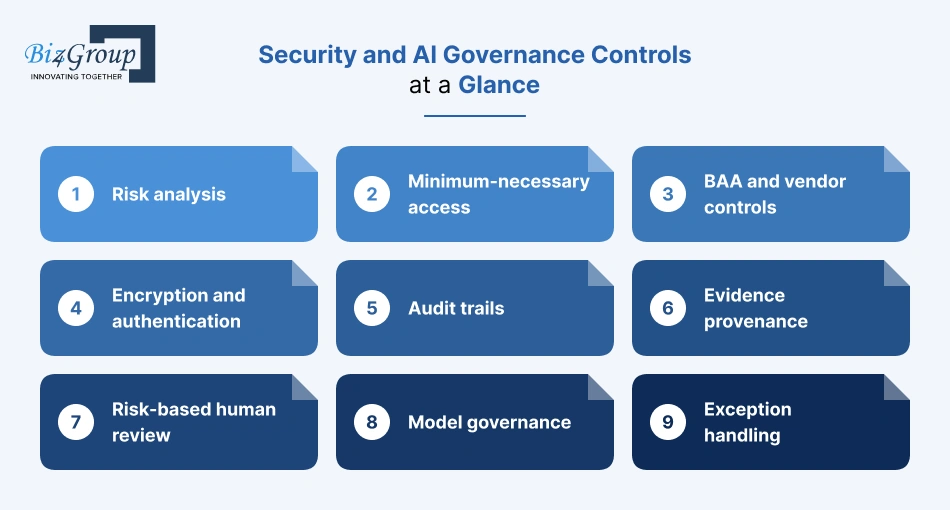
|
Control |
Why it matters |
Risk when missing |
|---|---|---|
|
Risk analysis |
Identifies where ePHI can be exposed |
Unknown security gaps |
|
Minimum-necessary access |
Limits unnecessary PHI exposure |
Excessive data access |
|
BAA and vendor controls |
Defines permitted third-party data handling |
Contractual and compliance exposure |
|
Encryption and authentication |
Protects data and verifies access |
Unauthorized access or interception |
|
Audit trails |
Reconstructs system and user activity |
Weak incident investigation |
|
Evidence provenance |
Verifies AI-generated claims |
Unsupported appeal content |
|
Risk-based human review |
Controls consequential decisions |
High-impact errors reaching production |
|
Model governance |
Detects degradation and drift |
Outdated models influencing decisions |
|
Exception handling |
Stops unsafe automation |
Uncertain cases being processed as fact |
The system should handle predictable work on its own, keep clear evidence behind important decisions, and pause when there isn’t enough information to support a reliable outcome. Humans can then step in where their judgment adds the most value.
How Should You Build and Deploy an AI Denial Management System Step by Step?
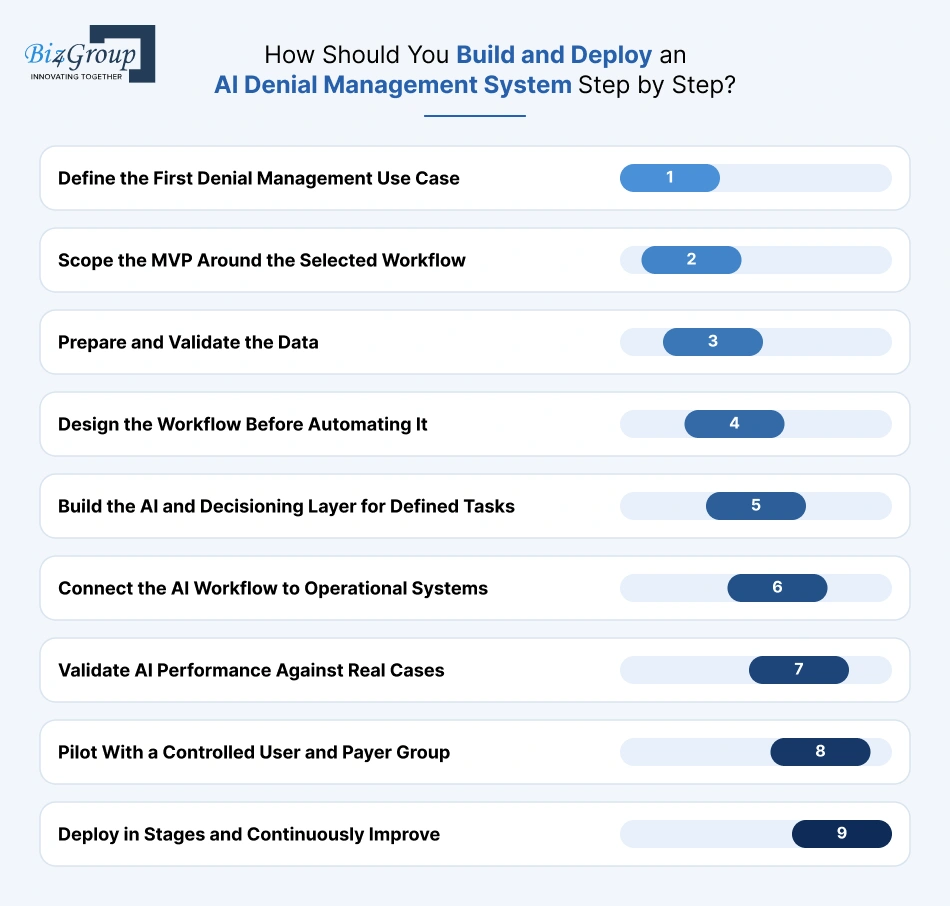
An AI denial management system should be built in controlled stages, with each stage producing something that the next stage needs. The process moves from use-case definition → MVP scope → data preparation → workflow design → AI implementation → system integration → validation → pilot → production optimization.
Step 1: Define the First Denial Management Use Case
Select one denial problem with enough volume, reliable data, and a measurable business outcome.
At this stage, define:
- Denial type or workflow to target
- Payer or business unit in scope
- Current resolution process
- Expected AI role
- Baseline performance
- Success metric
Example: Instead of building an AI system for every denial category, start with medical-necessity denials for one payer and measure appeal turnaround time, recovery rate, and staff effort.
Output: A clearly defined use case with baseline metrics and scope boundaries.
Step 2: Scope the MVP Around the Selected Workflow
Build only the capabilities required to prove the first use case.
For a denial-prioritization MVP development, that include:
- Denial intake
- Classification
- Recoverability scoring
- Priority ranking
- Work-queue assignment
- Human review
- Outcome tracking
Do not add every payer, denial type, integration, or AI capability at this stage.
Example: If the MVP ranks denied claims by recovery potential, automated appeal generation does not need to be part of version one.
Output: A limited feature set, user flow, and technical scope for the first release.
Step 3: Prepare and Validate the Data
Turn the organization's raw denial records into a dataset the system can actually use.
This involves:
- Selecting historical cases
- Standardizing denial categories
- Linking claims to outcomes
- Removing duplicates
- Resolving inconsistent fields
- Defining training and evaluation datasets
- Identifying missing information
Example: A dataset containing 100,000 denials is not automatically useful if the organization cannot reliably determine which cases were recovered, appealed, corrected, or written off.
Output: A validated dataset with defined labels, usable fields, and known data limitations.
Step 4: Design the Workflow Before Automating It
Define exactly what happens from the moment a denial enters the system to its final resolution.
Map:
Denial received → AI analysis → recommendation → human review → action → outcome
Specify which steps are:
- Automated
- Rule-controlled
- AI-assisted
- Human-approved
Example: AI identifies a potentially recoverable denial, retrieves supporting information, and recommends an appeal. The denial specialist reviews the evidence and approves the final action.
Output: A production-ready workflow with decision points, ownership, and exception paths.
Step 5: Build the AI and Decisioning Layer for Defined Tasks
Implement the models and AI services required by the workflow.
Typical allocation:
- Rules: deadlines and hard requirements
- Machine learning: prediction, scoring, and ranking
- Document intelligence: document extraction
- RAG: retrieval of relevant source material
- LLMs: summarization and controlled content generation
The decisioning layer combines these outputs into a recommended action.
Example: A model assigns a 0.82 recoverability score, a rules engine detects that the appeal window is still open, and the retrieval layer finds the relevant payer requirement. The workflow then recommends appeal review.
Output: Tested AI services that return structured, usable signals to the application.
Step 6: Connect the AI Workflow to Operational Systems
Connect the completed workflow to the systems used by the revenue-cycle team and verify end-to-end data movement.
Validate:
- Record matching
- Status synchronization
- Case updates
- Duplicate prevention
- Error handling
- Authentication
- Transaction traceability
Example: When AI marks a denial as high priority, that status should appear in the existing RCM work queue instead of creating a second queue that staff must monitor.
Output: A working end-to-end workflow connected to production data flows.
Step 7: Validate AI Performance Against Real Cases
Run the system against representative cases before allowing it to influence live decisions.
Measure:
- Classification accuracy
- Prediction performance
- Prioritization quality
- Evidence retrieval accuracy
- Generated-content accuracy
- False positives
- False negatives
- Human override rates
For high-impact workflows, review errors by claim value, denial type, payer, and case complexity, not just overall averages.
Example: A model may achieve strong overall classification accuracy while misclassifying a small group of high-value medical-necessity denials. Those cases require separate review before deployment.
Output: Evaluation results, error analysis, and defined production thresholds.
Step 8: Pilot With a Controlled User and Payer Group
Release the system to a limited population before expanding it across the organization.
Define:
- Pilot users
- Payers or denial categories
- Start and end dates
- Baseline metrics
- AI-assisted metrics
- Escalation process
Run the AI workflow alongside the existing process where practical so results can be compared.
Example: A health system may pilot the system with one specialty and two payers, then compare recovery rate, resolution time, and staff workload against the previous process.
Output: Measured evidence of operational and financial value.
Step 9: Deploy in Stages and Continuously Improve
Use pilot results to expand the system gradually.
A typical progression is:
One denial type → additional denial types → additional payers → additional business units → broader automation
After launch, monitor:
- AI performance
- Denial and recovery outcomes
- Human overrides
- Exception volume
- Workflow failures
- Payer behavior changes
- Model drift
- Infrastructure and AI costs
Do not expand automation simply because the model is available. Expand when the data, performance, workflow, and controls are ready for the next scope level.
Output: A scalable production system with controlled releases, ongoing monitoring, and a defined path for adding new denial workflows.
A roadmap is easy. Making it survive production is the real test.
Start with the right denial workflow and build from there. Let’s turn the plan into a working product.
Build It With Biz4GroupWhat Technology Stack Fits an AI Denial Management System in Production?
The production stack needs to handle four things well. It should process healthcare data reliably, run AI predictably, support long-running denial workflows, and provide enterprise-grade observability.
There’s no single stack that fits every setup, but the options below are better suited to this workload than a typical web application stack.
|
Layer |
Practical technology options |
Best fit |
Production consideration |
|---|---|---|---|
|
Frontend |
React, Next.js, TypeScript |
Denial work queues, case review, analytics dashboards |
Prioritize fast case navigation, permissions, accessibility, and audit-friendly UI states |
|
Backend / APIs |
Python with FastAPI, Node.js with NestJS |
AI services, business APIs, workflow APIs |
Separate AI-heavy services from transactional APIs where scaling patterns differ |
|
ML development |
Python, PyTorch, scikit-learn, XGBoost |
Prediction, classification, scoring models |
Keep training and inference pipelines versioned separately |
|
LLM layer |
Managed LLM APIs or self-hosted/open-weight models |
Summarization, controlled generation, language processing |
Choose based on PHI handling, latency, cost, model control, and deployment requirements |
|
Primary database |
PostgreSQL |
Transactional case, workflow, user, and outcome data |
Strong fit for relational healthcare workflows and transactional consistency |
|
Search / retrieval |
Elasticsearch / OpenSearch, PostgreSQL full-text search, vector storage where required |
Payer policies, documents, case search, evidence retrieval |
Use hybrid retrieval when both exact terms and semantic similarity matter |
|
Workflow orchestration |
Temporal or equivalent durable workflow engine |
Long-running cases, retries, deadlines, human approvals |
Useful when workflows must survive failures and wait for external or human events |
|
Caching / queues |
Redis, managed message queues |
Session data, short-lived caching, asynchronous processing |
Do not use cache as the authoritative source for denial state |
|
Containers / deployment |
Docker, Kubernetes, managed Kubernetes |
Multi-service enterprise deployments |
Kubernetes adds operational overhead, so use it when scale, isolation, or deployment complexity justifies it |
|
Cloud infrastructure |
AWS, Azure, Google Cloud, or private infrastructure |
Compute, storage, networking, managed services |
Select based on healthcare requirements, existing enterprise contracts, and operational ownership |
|
Observability |
OpenTelemetry, Prometheus, Grafana, centralized logs |
Application, infrastructure, workflow, and AI monitoring |
Correlate traces, metrics, and logs across a denial case rather than monitoring services separately |
|
CI/CD and infrastructure |
GitHub Actions, GitLab CI/CD, Terraform, cloud-native tooling |
Automated testing and repeatable deployments |
Infrastructure and model changes should be version-controlled and reproducible |
A Real-World Stack Lesson: Change Healthcare, February 2024
When a cyberattack took the claims clearinghouse Change Healthcare offline, payments to providers, prior authorizations, and eligibility checks were delayed across the U.S. healthcare system. The company reportedly processes roughly half of all medical claims nationwide. Some providers submitted paper claims while systems were down, and others had to switch to other claims processors during the outage, adding costs.
No application stack can prevent a vendor outage, but the stack decides what happens next. A denial platform with one integration path for claims and payer responses simply stops seeing new denials when that path fails. The layers described in this section limit the damage:
- PostgreSQL as system of record keeps case state intact and reviewable
- Durable workflow orchestration resumes pending work after recovery, without lost cases or duplicate submissions
- Integration-failure and queue-depth monitoring shows the gap in minutes, not days
- Isolated integration adapters make adding a second connection far less disruptive than a rewrite
In healthcare, a denial platform is only as dependable as the stack beneath it. Start lean to prove the use case, then add durable workflows, isolated integrations, and observability, so one failing dependency never stalls every case.
How Much Does AI Denial Management Development Cost, and What Drives the Budget?
The cost of developing an AI denial management system depends mainly on its scope, integrations, AI capabilities, and operational requirements. For a quick benchmark, Biz4Group’s cost analysis places development in these ranges:
|
Development Level |
Typical Cost Range |
Typical Timeline* |
Typical Scope |
|---|---|---|---|
|
Basic MVP |
$35K-$90K |
2-4 weeks |
Core denial workflow, limited integrations, basic AI assistance, human review |
|
Mid-Level System |
$90K-$200K |
4-6 weeks |
Multiple denial workflows, deeper integrations, predictive AI, document processing, reporting |
|
Advanced / Enterprise |
$200K-$350K+ |
6-8+ weeks |
Multi-payer operations, extensive integrations, advanced AI, complex workflows, enterprise-scale security and infrastructure |
1. What Drives the Development Cost?
The budget mainly depends on integration scope, payer coverage, data readiness, AI sophistication, document intelligence, workflow complexity, security, and scale. More integrations, payers, automation, and enterprise requirements mean more engineering, testing, and infrastructure.
2. What Ongoing Costs Should Buyers Budget For?
Post-launch costs typically include infrastructure, AI model usage, maintenance, monitoring, and integration updates. These should be factored into the total cost of ownership from the start.
3. How Should Healthcare Organizations Measure AI Denial Management ROI?
Cost only makes sense when it is measured against operational and financial outcomes. Before implementation, establish a baseline for:
- Denial rate and recovery rate
- Appeal overturn rate
- Average denial age and resolution time
- Staff hours spent per denial
- Recovered revenue per denial
- Cost per resolved denial
During a pilot, compare AI-assisted cases with the existing workflow using the same metrics. Revenue should be attributed to AI only when the system's recommendation or workflow materially contributed to the recovery.
A successful pilot should show measurable improvement in recovery, resolution speed, staff productivity, or cost per denial, while maintaining accuracy and appropriate human oversight.
Also Read: AI Claim Denial Management Development Cost
What Implementation Risks Can Derail an AI Denial Management Initiative?
Even a well-designed AI denial management system can underperform if the rollout ignores operational risks. The key is identifying where AI can produce the wrong outcome, lose user trust, or create more work than it removes.
1. What Happens When Historical Denial Data Is Poor?
Poor historical labels or inconsistent outcomes can teach AI the wrong patterns. The result may be confident predictions that look accurate technically but perform poorly against real denials.
2. How Can Integration Failures Undermine the Workflow?
When connected systems stop supplying current information, AI may work with an incomplete picture of the case. That can lead to outdated recommendations, duplicate work, or missed actions.
3. What Happens When Payer Rules Change Faster Than the System?
A recommendation can become wrong simply because the underlying payer requirement changed. Systems that cannot adapt quickly may continue applying outdated assumptions across large numbers of cases.
4. How Should Teams Handle False Positives and Low-Confidence Predictions?
Treating every prediction as equally reliable is risky. Low-confidence or unusual cases should remain visible to qualified staff rather than being pushed through automated decisions.
5. How Can Model Drift Affect Denial Predictions?
Denial patterns change over time. A model that performed well during its initial evaluation can lose accuracy as payer behavior, coding patterns, or case mix changes. Performance needs to be reassessed against current outcomes.
6. Why Does Staff Adoption Matter as Much as Model Accuracy?
A technically accurate system can still fail to deliver ROI if denial specialists do not trust or use it. Adoption depends on whether recommendations are understandable, useful, and actually reduce work rather than adding another review step.
7. How Can Over-Automation Create More Risk Than Value?
Automating high-risk decisions can multiply a small error across thousands of claims. The safer approach is to automate predictable, low-risk tasks while keeping consequential decisions subject to appropriate human control.
The focus should be on reliable automation where the expected value justifies the operational risk.
How Should You Evaluate an AI Denial Management Development Partner?
Choosing a development partner is not just about finding a team that can build an AI model. The real question is, can they connect the AI to the messy reality of healthcare claims, payer rules, documents, workflows, and compliance?
1. What Should You Look for in an AI Denial Management Development Partner?
Look for a partner that can demonstrate:
- Healthcare and RCM knowledge: They should understand claims, denials, EOBs/ERAs, payer workflows, appeals, and revenue-cycle operations.
- AI and data engineering: They should know when to use rules, predictive models, document intelligence, retrieval, and generative AI rather than forcing everything through an LLM.
- Healthcare integrations: Experience with EHRs, RCM platforms, clearinghouses, payer systems, APIs, and healthcare data standards matters because the AI is only as useful as the data reaching it.
- Security and compliance: Ask how they handle PHI, access controls, encryption, auditability, vendor risks, and human oversight.
- Production readiness: Look beyond a demo. Ask about monitoring, failure handling, model evaluation, scalability, deployment, and ongoing support.
- Proof of concept: Give the partner a realistic denial scenario and ask them to demonstrate the complete flow from denial analysis to evidence gathering, recommendation, and human review.
And one more thing, do not compare vendors on development cost alone. Compare what you get for that cost, including integration depth, AI capability, security, scalability, ownership, and post-launch support.
2. Why Is Bill Matters Relevant to Biz4Group's Approach?
There is a useful difference between saying “we build healthcare AI” and actually building around a denial workflow.
Biz4Group's Bill Matters platform was developed specifically around denied claims and appeals. It brings together denial intelligence, claim and payment information, evidence identification, contract context, appeal generation, and recovery tracking.
That experience matters when evaluating a development partner because the team has already had to deal with the questions that sound simple on paper but get complicated in production:
- Why was this claim denied?
- What evidence supports an appeal?
- Which payer requirements apply?
- Is the case worth pursuing?
- What should AI prepare?
- And what should a person approve?
Bill Matters keeps the final appeal review with an authorized person, which also reflects the broader approach recommended for enterprise AI denial management: automate the work that AI handles well, but keep consequential decisions accountable.
Final Thought
Denial rates are falling, but providers aren't keeping more of the money. Kodiak Solutions' first-half 2026 analysis found that overall initial and final denial rates declined compared with the first half of 2025. Over the same period, insurer takebacks on already-paid claims rose from 1.38% to 1.57% of accounts receivable.
Commercial payers show the same pattern, their initial denial rate fell, but their final denial rate rose 9.1% year over year, to 2.89% of accounts receivable. Winning a denial isn't the finish line. The case has to be tracked through to final payment.
That is also where AI should earn its place. Mayo Clinic’s Todd Manion says AI can automate repetitive revenue-cycle work “so that we can elevate our people toward more complex patient issues.” Mayo Clinic revenue-cycle AI discussion
For denial management, AI handles the routine work, people make the judgment calls, and the platform keeps every case visible until the financial outcome is secured.
That’s the approach Biz4Group brings to AI denial management. The architecture starts with the recovery workflow and uses AI where it adds real value.
Building an AI denial management platform? Let’s talk about the right architecture, AI approach, and roadmap for your use case.
FAQs
1. Is AI denial management worth it for a mid-sized healthcare provider?
It can be, especially when denial volume is high enough that manual review, follow-ups, and appeal preparation are consuming significant staff time. The business case should be based on recoverable revenue, staff capacity, and resolution time, not AI adoption alone.
2. Can AI denial management help identify which denied claims are actually worth pursuing?
Yes. A useful system can rank cases using factors such as denial reason, claim value, payer behavior, filing deadlines, available evidence, and historical recovery outcomes. This helps teams spend effort where the potential return is highest.
3. How do you prevent AI-generated insurance appeals from containing unsupported information?
The system should ground the appeal in the actual claim, denial, supporting documentation, payer requirements, and other authoritative sources. Generated content should remain editable and subject to human validation before submission.
4. Should AI denial management focus on denial prevention or post-denial recovery?
That depends on where the organization is losing the most value. Some teams need stronger pre-submission risk detection, while others have a large existing denial backlog that makes recovery the better starting point. Mature systems can eventually address both.
5. Can an AI denial management system learn from successful and unsuccessful appeals?
Yes, provided the outcomes are captured reliably. Appeal decisions, payer responses, recovered amounts, and resolution reasons can become feedback signals for prioritization, prediction, and workflow improvement.
6. What does it take to build AI denial management around an existing RCM team?
The system should fit the team's current work rather than force a completely new process. That means understanding existing queues, approval points, payer workflows, user roles, and where staff currently spend time on repetitive denial work.
7. What does it cost to build a custom AI denial management platform?
A current Biz4Group benchmark puts development at $35K-$90K for an MVP, $90K-$200K for a mid-level system, and $200K-$350K+ for an advanced enterprise deployment. The final budget depends heavily on integrations, payer coverage, AI depth, data readiness, security, and scale.
8. Should we build an AI denial management platform in-house or partner with an AI development company?
For organizations without existing healthcare AI and product engineering capabilities, a specialized partner can reduce the time required to bring together RCM workflows, AI, integrations, security, and production infrastructure. A partner such as Biz4Group, which has developed Bill Matters for denial and appeal management, can also bring domain-specific product experience into the build.
