Location :
Orlando, FL, USA
Location :
Orlando, FL, USA +1 (407) 714-1616
 info@biz4group.com

















Imagine a digital system that doesn’t wait for instructions but instead, understands your business goals, learns from real-time feedback, and takes independent actions to get the job done.
Read More

 AI Summary Powered by Biz4AI
Getting your AI healthcare app live is only half the job. What happens after launch, through AI healthcare app maintenance, continuous monitoring, and scaling, decides whether it actually holds up in the real world or quietly fails the people relying on it.
That gap between "it works in the demo" and "it works at 3 AM when a hospital's night shift depends on it" is bigger than most teams expect. Despite more than $50 billion in venture funding flowing into healthcare AI since 2020, roughly 80% of healthcare AI projects never scale beyond pilot, largely because models that pass internal validation on clean, retrospective data collapse once they meet real clinical workflows, messy EHR data, and regulatory demands nobody tested for in the sandbox.
That's not a small-team problem or a funding problem. It's a production-readiness problem, and it shows up after launch, not before.
When things do go wrong post-launch, the cost isn't abstract either. Healthcare IT downtime costs hospitals an estimated $1.9 million per day, and the damage doesn't stay contained to IT. Clinical operations stall. Lab results pile up. Patients wait longer than they should.
So, here's the question worth sitting with: if your AI healthcare app broke silently right now, today, would you know before your users did?
Most founders and CTOs we talk to can't answer that with confidence, and it's rarely a competence problem. It's that AI healthcare app deployment and AI healthcare app maintenance get treated as something you figure out once you're already live, instead of something you plan for before launch day. As Dave Caplis, Technical Director at Biz4Group, puts it: "Healthcare organizations come to us after spending months trying to make generic AI tools fit clinical environments they were never designed for. What they actually need is a partner who understands HIPAA architecture, EHR data models, and how care is delivered on the ground."
We've spent more than 20 years building software for regulated industries, and over that time we've worked with healthcare teams on both sides of this exact problem: the ones building their first AI healthcare app development roadmap, and the ones cleaning up after a launch that wasn't set up to last. What separates them isn't the quality of their initial build. It's whether they treated healthcare app post-launch support as a real discipline or an afterthought.
This guide walks through exactly what that discipline looks like. We'll cover what actually happens during deployment and who owns HIPAA compliance once you're live, what real healthcare app post-launch support includes, the difference between maintenance and AI healthcare app monitoring, what you should realistically budget for healthcare app maintenance cost, where AI healthcare apps tend to break and how to fix it, and how to scale a healthcare app after launch without breaking compliance or patient trust along the way.
If you've already built or are about to launch a healthcare app that leans on AI, whether that's diagnostic support, clinical documentation, or a patient-facing tool, this is the part of the process most guides skip. We're not skipping it.
Deployment isn't a single event. It's a sequence of decisions that either set your app up to run safely in production, or quietly plant problems you won't discover until a hospital's IT director is calling you after hours. If you've been treating "deploy" as synonymous with "push to production and watch the dashboard," this is the section to slow down on.
Here's a ratio worth sitting with: production machine learning systems are roughly 5% algorithm code and 95% everything else, meaning data pipelines, monitoring, versioning, and integration work, according to foundational research from Google published at NeurIPS that continues to hold up across the industry. Most teams spend months perfecting the algorithm and days planning everything else. That ratio is backwards, and it's exactly why AI healthcare app deployment deserves more attention than it usually gets.
Before your AI healthcare app deployment touches a single real patient record, your infrastructure needs to be built for the environment it's entering, not the environment it was tested in.
A few things need to be locked down first:
|
Requirement |
Why it matters |
|---|---|
|
Environment separation |
Staging and production must be genuinely isolated, with production access limited to people who actually need it |
|
Encryption in transit and at rest |
PHI moving through your system needs to be encrypted at every single hop, not just the obvious ones |
|
Access controls and audit logging |
Every read or write to patient data needs to be traceable to a specific user or system |
|
Model versioning and rollback capability |
If your AI model produces a bad output in week three, you need to roll back to the last known-good version immediately |
This is also where cloud infrastructure choices get tested for real. A model that performed fine on a laptop during development behaves differently under concurrent hospital traffic, and that gap is exactly where teams get caught off guard. Getting this right from day one is part of why AI integration services exist as their own discipline rather than something bolted onto general app development after the fact.
We saw this firsthand while building RevIntegrity, an AI-powered healthcare revenue recovery platform designed to catch underpayments and reconcile claims.
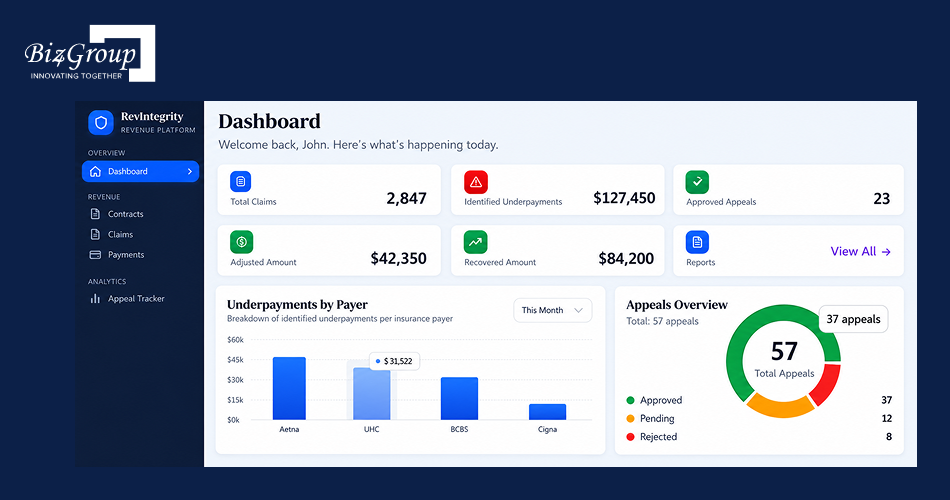
The system needed an append-only audit trail with six-year retention and secure file handling with built-in virus scanning on every upload, not because it looked good on a feature list, but because that's what the compliance and access-control layer actually has to do once real claims data starts flowing through it.
If your app needs to talk to an EHR, and most clinically useful healthcare apps do, this is where deployment timelines usually break down. Epic alone holds roughly 41.3% of US hospital installations as of 2025 data, and integrating with it isn't a plug-and-play exercise. Sandbox access takes a few days, but production go-live typically takes 2 to 4 months for approvals, followed by 12 to 24 weeks of integration work per individual hospital site.
The technical complexity compounds fast. Every EHR vendor implements the FHIR data standard differently, with optional fields and proprietary extensions that vary by vendor. In live environments, an estimated 15 to 30% of key clinical variables turn out missing or inconsistently structured, which is exactly the kind of gap that only shows up once you're inside real hospital data, not a sandbox.
As of January 2026, SMART App Launch v2 became mandatory across all certified US EHRs, which changes how your app authenticates and launches inside a clinician's workflow. If your deployment plan doesn't already account for this, it needs to.
This is the point where a lot of teams treat compliance as a box to check rather than an architectural decision. It isn't. Real HIPAA compliant AI app development for healthcare providers means compliance requirements shaped your data model, your access controls, and your logging from the first sprint, not a security review bolted on right before launch.
Before go-live, you need:
This is the question we hear most often after launch, usually right after something has already gone slightly wrong. The honest answer: responsibility doesn't transfer away from you just because you hired a development partner, and it doesn't transfer away from your development partner just because the app is live and appears to be working.
Here's how it actually breaks down. Under HIPAA, the hospital, clinic, or health system using your app is the covered entity, carrying primary legal responsibility for protecting patient data. But if your company builds, hosts, or has any access to PHI flowing through the app, you're a business associate, and business associates can be held directly liable by HHS's Office for Civil Rights for their own compliance failures. This relationship has to be formalized through a signed Business Associate Agreement before any PHI is shared, and that agreement defines exactly who's responsible for what.
If your business associate role includes subcontractors, a cloud hosting provider, a third-party analytics tool, an SMS notification service, each of those subcontractors becomes a business associate too, and needs its own BAA extending the same obligations down the chain. A signed BAA sitting in a folder doesn't achieve compliance on its own either. It has to be backed by real technical safeguards, and those safeguards have to keep working after launch, not just during the audit that got you the contract.
In practice, compliance ownership after deployment usually splits three ways:
If nobody has explicitly claimed each of those three pieces in writing, you don't have a compliance plan. You have an assumption, and assumptions are exactly what surface during a breach investigation.
Most teams find out the hard way. Get a second pair of eyes before you do.
Talk to a Healthcare AI SpecialistLaunch day feels like the finish line. It isn't. It's the point where your AI healthcare app maintenance work actually starts, and treating it as an afterthought is how healthy-looking apps quietly turn into liabilities six months later.
Most healthcare apps budget for launch and then hope for the best. That's backwards. The long-standing industry benchmark, tracked by CISQ (the Consortium for IT Software Quality), puts ongoing software maintenance at roughly 15 to 20% of your initial development cost every year. But that figure is for general software. Regulated products like healthcare apps run considerably higher, typically 25 to 35% of the original development cost annually, once you factor in the audit requirements and security protocols HIPAA demands on an ongoing basis, according to industry cost analysis published in 2026. If that number surprises you, it's usually because nobody budgeted for it going in.
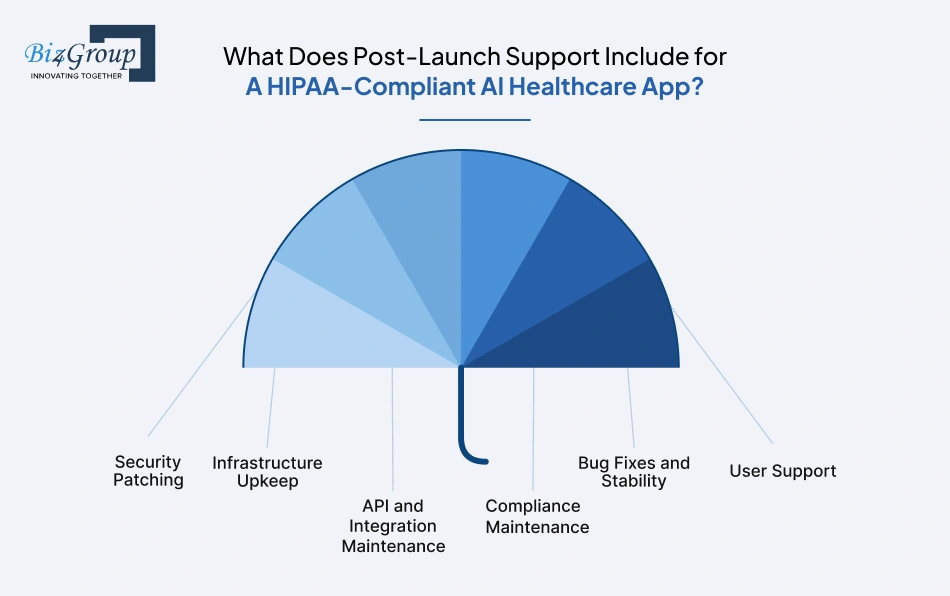
Real healthcare app post-launch support isn't a single line item. It's a set of ongoing obligations that only start once real patients and real clinicians are using your app. Here's what actually falls under it:
|
Category |
What it covers |
|---|---|
|
Security patching |
OS updates, library and SDK patches, response to newly disclosed vulnerabilities (CVEs) |
|
Infrastructure upkeep |
Server and cloud spend, uptime management, backup and disaster recovery testing |
|
API and integration maintenance |
Handling FHIR and EHR API changes as hospital systems update their own software |
|
Compliance maintenance |
Penetration testing, audit prep, updated risk assessments as regulations shift |
|
Bug fixes and stability |
Resolving issues surfaced by real-world usage that testing never caught |
|
User support |
Handling clinician and patient-reported issues with a real feedback loop back to engineering |
This matters more in 2026 than it did even a year ago. Regulators have proposed the most significant HIPAA Security Rule overhaul in twenty years, converting what used to be "addressable" best practices, like mandatory encryption, multifactor authentication, and network segmentation, into hard requirements. An app that was compliant at launch isn't automatically compliant a year later if the underlying rules have moved and nobody updated the app to match. That's precisely what healthcare app maintenance and compliance updates exist to catch.
If you're weighing whether to build this capability in-house or bring in outside support, this is exactly the kind of ongoing work that leads teams to hire AI developers who already understand HIPAA-driven maintenance cycles, not a one-time build, but a standing commitment to keep the app compliant as the ground shifts under it.
This isn't hypothetical. It has a track record, and the record is expensive.
Montefiore Medical Center paid a $4.75 million settlement with HHS's Office for Civil Rights after an investigation found the organization had failed to conduct a comprehensive risk analysis and, critically, failed to implement procedures to regularly review records of information system activity. In plain terms: nobody was watching the system after it was live. That's not a one-time mistake. That's a maintenance failure.
That case isn't an outlier. Current HIPAA civil penalties, updated January 28, 2026, per the Federal Register, run from $145 per violation at the lowest tier up to $73,011 per violation for willful neglect, with an annual cap of $2,190,294 per violation category. Several of 2026's already-recorded settlements, including a $552,250 penalty against OSF Healthcare System and a $375,000 penalty against Assured Imaging, cite the exact same root cause as Montefiore: risk analysis failures and inadequate ongoing review of system activity, not a single catastrophic event, but the slow accumulation of unmaintained gaps.
Beyond the regulatory exposure, there's a quieter cost that doesn't show up in a settlement notice. An AI model that isn't monitored for drift starts producing subtly wrong outputs. A clinician who gets burned by a bad recommendation once stops trusting the tool entirely, and that trust rarely comes back with an apology and a patch note. Unmaintained apps don't usually fail loudly. They fail quietly, and by the time someone notices, the damage, financial, clinical, or reputational, has already been done.
Short answer: yes, and treating AI healthcare app maintenance and AI healthcare app monitoring as the same thing is one of the more common ways healthcare teams end up with a gap nobody catches until it's expensive.
|
Aspect |
AI Healthcare App Maintenance |
AI Healthcare App Monitoring |
|---|---|---|
|
Definition |
Planned, preventive work that keeps the app functional, secure, and compliant over time |
Real-time observation that shows what's actually happening in the app right now |
|
Nature |
Proactive, scheduled |
Reactive/continuous, always-on |
|
Primary question answered |
"Is the app still correct, secure, and compliant?" |
"Is the app working right now, and is something wrong at this moment?" |
|
Typical activities |
Security patching, library and SDK updates, EHR/FHIR API adjustments, healthcare app maintenance and compliance updates, penetration testing, bug fixes |
Uptime tracking, healthcare app performance monitoring, model drift and data drift detection, alert generation, anomaly detection |
|
Trigger |
Scheduled cycles, regulatory changes, vendor updates |
Continuous monitoring for AI healthcare apps, driven by live data and system behavior |
|
Output |
Updated, patched, compliant application |
Real-time alerts, dashboards, drift and incident signals |
|
Team typically responsible |
Engineering and compliance teams |
DevOps, MLOps, and clinical safety teams |
|
Failure mode if skipped |
App becomes outdated, non-compliant, and vulnerable over time |
Problems go undetected until a clinician, patient, or auditor notices them |
|
Real-world example |
Updating access controls after a HIPAA Security Rule change |
Clalit Health Services caught data drift in a hospitalization-risk model in 2023 when a lab switched LDH testing kits, per peer-reviewed research on medical AI monitoring, catching the shift before it degraded clinical accuracy |
|
Why healthcare needs both |
Maintenance without monitoring means bugs and drift go unnoticed between update cycles |
Monitoring without maintenance means known issues get flagged repeatedly but never actually fixed |
Neither one replaces the other. Healthcare app post-launch support depends on maintenance keeping the app correct going forward, while monitoring tells you the moment it stops being correct. This is also where AI app monitoring and incident response healthcare teams earn their keep. A healthcare app running on AI needs both working together to stay safe.
For a mid-sized AI healthcare app, realistic annual healthcare app maintenance cost typically runs $10,000 to $15,000, while AI healthcare app deployment itself, infrastructure setup, EHR integration, and compliance architecture before go-live, typically runs $25,000 to $30,000. Both numbers scale up fast with EHR complexity, patient volume, and how many AI models the app actually runs.
Deployment Cost By Feature
|
Feature |
Estimated Cost |
What It Covers |
|---|---|---|
|
HIPAA-compliant cloud hosting setup |
$6,000 – $7,000 |
AWS/Azure HIPAA-eligible infrastructure, encryption configuration |
|
EHR/FHIR integration (per vendor) |
$8,000 – $10,000 |
Epic, Cerner, or Athenahealth connection, sandbox to production |
|
Risk assessment and BAA setup |
$3,000 – $4,000 |
Initial HIPAA risk analysis, vendor BAAs signed before go-live |
|
Model versioning and rollback infrastructure |
$5,000 – $6,000 |
CI/CD pipeline, staged rollout capability, instant rollback |
|
Penetration testing (pre-launch) |
$3,000 – $3,000 |
Security validation before real patient data flows through the app |
|
Total deployment range |
$25,000 – $30,000 |
|
Maintenance Cost By Feature (Annual)
|
Feature |
Estimated Cost |
What It Covers |
|---|---|---|
|
Security patching and OS/SDK updates |
$2,500 – $3,500 |
CVE response, library updates, platform compatibility |
|
AI healthcare app monitoring and drift detection |
$2,500 – $4,000 |
Uptime, latency, model drift tooling, alerting infrastructure |
|
EHR/FHIR API maintenance |
$2,000 – $3,000 |
Handling vendor API changes and deprecations |
|
Compliance re-audits and updates |
$1,500 – $2,500 |
Annual HIPAA risk reassessment, policy updates |
|
User support and bug fixes |
$1,500 – $2,000 |
Clinician/patient-reported issue resolution |
|
Total maintenance range |
$10,000 – $15,000 |
|
Healthcare app maintenance cost climbs fast once you add more AI models, more EHR integrations, or higher patient volume. A single-model app talking to one EHR sits at the low end of the range. An app running multiple AI models across several hospital systems, each with its own FHIR quirks and its own drift-monitoring needs, pushes well past $15,000 a year, and that's before accounting for retraining.
AI-specific costs sit on top of standard maintenance, not inside it. Model retraining, continuous monitoring for AI healthcare apps, and clinical re-validation are budget lines most teams forget to plan for separately, and they're exactly what turns a $10,000 maintenance year into a $25,000 one once the app has been live for a while.
If you're still scoping the build itself rather than what comes after, it's worth separating that number from maintenance entirely; how much does it cost to develop an AI healthcare app is a different budget conversation from AI app deployment healthcare teams handle once the app is live and running.
Every app is different, so is every invoice. Let's price yours properly.
Get a Custom Maintenance Quote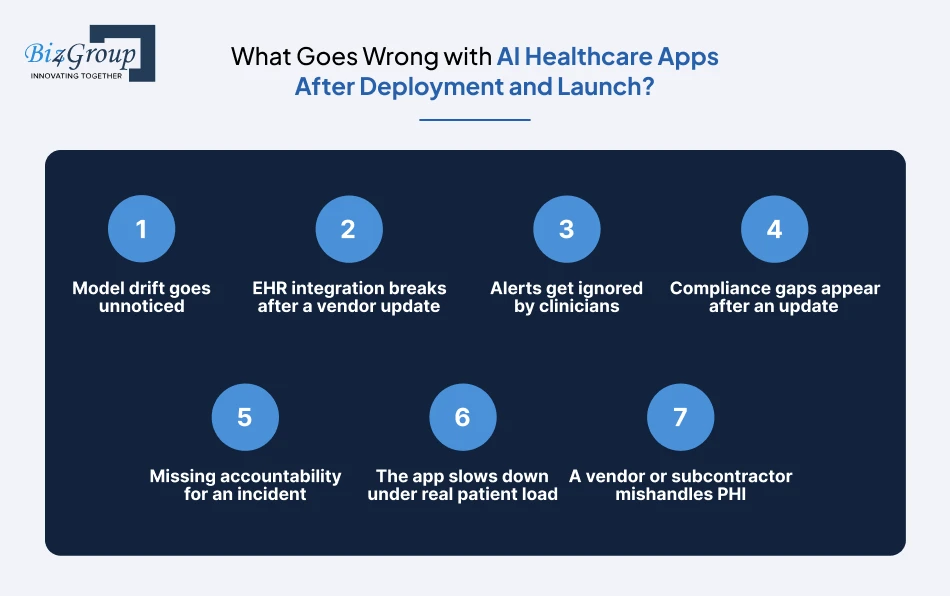
Every AI healthcare app runs into trouble eventually. The difference between a minor hiccup and a serious incident usually comes down to whether the failure mode was anticipated ahead of time or discovered the hard way, in production, with real patients on the other end.
|
What Goes Wrong |
Why It Happens |
How To Fix It |
|---|---|---|
|
Model drift goes unnoticed |
No continuous monitoring for AI healthcare apps in place to catch when input data or outcomes shift from what the model was trained on |
Set up automated drift detection with defined alert thresholds, not manual spot-checks |
|
EHR integration breaks after a vendor update |
Hospital IT updates their EHR or changes an API version without notifying every connected app |
Build integration maintenance into the ongoing AI healthcare app maintenance plan, with vendor update tracking as a standing task |
|
Alerts get ignored by clinicians |
Too many false positives train staff to dismiss every alert, including the real ones |
Tune alert thresholds based on real-world healthcare app performance monitoring data, not just validation-set accuracy |
|
Compliance gaps appear after an update |
A feature update or infrastructure change isn't re-checked against current HIPAA requirements |
Treat every update as a compliance event, not just a shipping event, with a review step before release |
|
Nobody knows who owns an incident when it happens |
No documented escalation path or incident response plan was defined before go-live |
Put AI app monitoring and incident response healthcare protocols in writing before launch, with named owners at each severity level |
|
The app slows down or times out under real patient load |
Load testing only covered ideal conditions, not concurrent hospital traffic or peak hours |
Run load and soak testing that reflects real clinical usage patterns before scaling further |
|
A vendor or subcontractor mishandles PHI |
Business Associate Agreements were signed but never backed by actual technical safeguards |
Audit every vendor in the stack against their BAA terms, not just at signing but on a recurring schedule |
We ran into a version of the alert-and-escalation problem while building an AI-driven IVR and support platform for a healthcare third-party administrator.
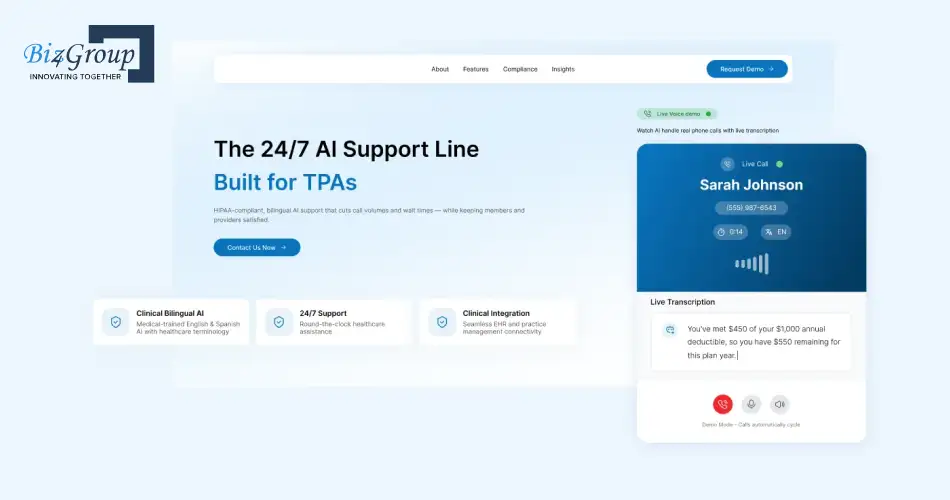
The system had to handle instant call routing and smart escalation for patient calls, and getting that escalation logic wrong meant either overwhelming staff with unnecessary escalations or, worse, letting a genuine issue sit in a queue too long. Getting the thresholds right took real tuning against actual call patterns, not just the initial design spec, which is exactly the kind of problem that only shows up once an app is live.
None of these failure modes are rare or unusual. They're the predictable cost of skipping healthcare app post-launch support, and every one of them is fixable with the right plan in place before launch, not after something breaks.
Going from one hospital to fifty isn't the same problem repeated fifty times. Each stage of growth breaks something different, and a real healthcare app scaling strategy plans for that ahead of time instead of rebuilding under pressure.
Infrastructure scaling means your servers and AI inference systems handle more concurrent users without slowing down. Onboarding scaling means adding new hospitals doesn't require months of custom integration every time. Most teams start with one hospital and a custom build, a pattern that typically moves through four stages: two to six months per hospital, down to two to four weeks, down to one to two weeks, and eventually days, according to 2026 EMR integration scaling analysis. Skipping straight to hospital fifteen with hospital-one's process is where most healthcare app scaling strategy plans break down.
AI models add inference costs and retraining pipelines that grow with usage, not just user count. Every new hospital brings its own patient population, and a model tuned on one facility can behave differently at another. This is where health tech infrastructure scaling has to account for compute, not just storage and bandwidth.
A FHIR abstraction layer, built once, turns each new EHR connection into weeks of work instead of months. A single-vendor connection typically runs $8,000 to $20,000, climbing 30 to 50% higher for a mixed stack like Epic plus Athenahealth, per 2026 healthcare app cost data, real budget line AI app deployment healthcare teams need to plan for.
More hospitals means more PHI flowing through more integration points. Multi-tenant architecture with proper data isolation per clinic keeps growth from becoming a compliance risk, so regulatory-compliant app operations has to scale at the same pace as the user base, not catch up after the fact.
Past roughly 100,000 monthly active users, multi-region architecture and observability tooling typically add $40,000 to $120,000, based on the same 2026 benchmarks, and that's the point where auto-scaling stops being optional. Patient-facing app performance optimization matters as much at scale as on day one, since clinicians notice slowdowns immediately and stop trusting the tool.
Most vendors will tell you they understand healthcare compliance. Few can show it. We've spent more than 20 years building software for regulated industries, and our healthcare practice specifically covers the full lifecycle: HIPAA-compliant AI medical assistants, clinical decision support systems, patient triage platforms, medical imaging analysis tools, and remote patient monitoring, with deep EHR and EMR integration built into every engagement as part of real AI healthcare app deployment, not added as an afterthought.
As Dave Caplis, Technical Director at Biz4Group, put it: "The organizations doing this well are not chasing AI for its own sake. They are asking what specific problem this solves and what the outcome looks like six months from now. That is the conversation we have with every client. It is the only way to build something that actually holds up in a clinical environment."
That six-month framing matters more after launch than before it. AI healthcare app deployment, AI healthcare app maintenance, and monitoring aren't separate problems you solve once and move on from, they're ongoing work that most teams underestimate until something breaks. We built RevIntegrity, an AI-powered healthcare revenue recovery platform, with a six-year audit retention trail and secure file handling from day one, because that's what real HIPAA-compliant app maintenance services require once claims data starts flowing through production, not what gets bolted on after an audit flags a gap.
What this actually looks like in practice:
If your team is weighing whether to handle healthcare app post-launch support internally or bring in a partner who's already solved these exact problems, that's a conversation worth having before something breaks, not after. You can see the kind of AI healthcare app development company work this looks like in practice.
Twenty years, real healthcare platforms, zero polished-demo nonsense. Let's talk.
Book a Free ConsultationAn AI healthcare app that works at launch and an AI healthcare app that still works a year later are two different engineering problems, and most teams only plan for the first one. AI healthcare app deployment gets you live. AI healthcare app maintenance and AI healthcare app monitoring are what keep you live, compliant, and trusted by the clinicians and patients depending on you.
Biz4Group has spent more than 20 years building platforms for regulated industries, and every healthcare engagement we take on, from HIPAA-compliant AI app development for healthcare providers to platforms like RevIntegrity built with audit trails and compliance baked in from day one, comes from the same principle: healthcare app post-launch support doesn't end at go-live. It starts there.
Whether you're trying to figure out what real AI healthcare app support and maintenance looks like, want eyes on your app around the clock, or you're eyeing growth and wondering how to scale a healthcare app after launch without breaking what already works, that's a conversation worth having now, not after something breaks.
Let's build something that's still standing long after launch day is forgotten.
Most healthcare organizations budget $10,000 to $15,000 a year for AI healthcare app maintenance on a mid-sized platform, covering security patching, EHR API updates, and compliance re-audits. Complex or enterprise healthcare apps typically run higher, often 30 to 40% of the original development cost annually, since regulated products carry more audit and security overhead than a standard consumer app.
AI healthcare app maintenance is planned, scheduled work, patching, updates, compliance changes, done proactively. AI healthcare app monitoring is real-time observation that shows what's happening in the app right now, catching drift, downtime, or errors as they occur. Maintenance keeps the app correct going forward, monitoring tells you the moment it stops being correct, and a healthcare app needs both running at once.
Responsibility does not end at launch. The hospital or health system using the app is the covered entity and carries primary responsibility for patient data, while the company that built, hosts, or accesses PHI through the app is a business associate, directly liable under HIPAA for its own compliance failures. This split is formalized in a signed Business Associate Agreement before any PHI is shared.
Unmaintained healthcare apps are directly linked to real HIPAA enforcement actions. Montefiore Medical Center paid a $4.75 million settlement after HHS found it had failed to regularly review records of system activity, a maintenance failure, not a one-time mistake. Skipped healthcare app post-launch support shows up first as missed drift, then as compliance exposure.
Continuous monitoring for AI healthcare apps means constant, not periodic. Uptime, latency, and error rates need real-time tracking, and model drift detection should run continuously rather than on a fixed weekly or monthly check, since patient data and clinical patterns can shift gradually without triggering an obvious alert.
Healthcare companies scale by separating two problems: infrastructure scaling, handling more concurrent users and AI inference load, and onboarding scaling, adding new hospitals without months of custom integration each time. Teams that build a reusable FHIR abstraction layer early can cut EHR onboarding from two to six months per hospital down to one to two weeks at scale.
The three biggest risks are undetected AI model drift producing subtly wrong outputs, HIPAA compliance gaps that trigger OCR penalties up to $2,190,294 per violation category per year, and loss of clinician trust, which rarely returns once a tool has produced a bad recommendation. All three tend to compound quietly before anyone notices.

Our website require some cookies to function properly. Read our privacy policy to know more.