 Location :
Orlando, FL, USA
Location :
Orlando, FL, USA +1 (407) 714-1616
 info@biz4group.com
 AI Summary Powered by Biz4AI
- AI image validation solutions verify image quality and authenticity before approval and reduce manual review workload.
- Rising deepfakes and manipulated photos push businesses toward AI-powered image verification for claims and onboarding decisions.
- Unlike image recognition, validation determines whether an image is trustworthy enough to support a business decision.
- A structured pipeline moves images through quality checks and image authenticity detection AI before a final confidence-based outcome.
- Development cost of AI image validation solution range from $35,000 for MVP builds to $300,000+ for enterprise-grade validation platforms.
- Biz4Group LLC brings 20+ years of computer vision expertise through real builds like KalixQC and IoT heat cable monitoring.
How much confidence do you really have in every image your business approves?
If your answer isn't "100%," you're dealing with a business risk. Every day, businesses approve images for insurance claims, customer onboarding, healthcare documents, eCommerce listings, and compliance checks.
It only takes one manipulated image to trigger financial losses, compliance issues, or poor customer experience. The risk is becoming harder to ignore, with deepfakes accounting for 6.5% of all fraud attempts globally.
That's exactly why AI image validation solutions are becoming a business priority. Instead of relying entirely on manual reviews, they help verify image authenticity, quality, and compliance at scale, giving your teams faster and more consistent decisions.
The momentum is already visible as organizations invest in intelligent image verification capabilities. The global fake image detection market is valued at USD 2.07 billion in 2026 and is expected to reach USD 28.01 billion by 2034, growing at a 38.45% CAGR.
For operations manager and compliance officers looking for answers to questions like:
- Can AI image validation reduce manual image review time?
- How does AI detect manipulated or fraudulent images?
This guide is built for you. You'll find every answer here from understanding AI image validation solutions, their business value to development, and how an experienced AI development company can help align the solution with your business goals from day one.
What Are AI Image Validation Solutions?
AI image validation solutions are intelligent systems that automatically determine whether an image is genuine, complete, compliant, and suitable for a specific business process. Instead of relying on manual reviews, they use AI-powered image verification to evaluate uploaded images against predefined business rules before those images are approved, processed, or stored.
As a result, organizations spend less time reviewing invalid submissions and more time processing images that meet their operational and compliance requirements.
Depending on the business objective, an AI image validation solution can support capabilities such as:
- Assessing image quality by evaluating blur, brightness, resolution, glare, cropping, orientation, and visibility.
- Verifying image authenticity by identifying manipulated, edited, synthetic, or AI-generated images.
- Validating supporting documents by checking whether required information is visible, readable, and complete.
- Detecting duplicate or previously submitted images to reduce repetitive submissions and potential fraud.
- Reviewing image metadata to identify inconsistencies related to timestamps, devices, locations, or file attributes.
- Enforcing business and regulatory validation rules before an image enters downstream workflows.
In simple terms, AI image validation solutions act as the first layer of quality and trust for image-based operations. They help businesses ensure that every image entering their ecosystem is ready for the next stage, making it easier to automate high-volume workflows with confidence.
Why Businesses Are Replacing Manual Image Review with AI Image Validation Solutions
Businesses are replacing manual image review because today's image-driven operations demand faster decisions, stronger fraud protection, and consistent validation at a scale that manual processes struggle to sustain.
Whether you're reviewing customer uploads, insurance claims, identity documents, or product images, every delay affects customer experience and operational efficiency. That's where intelligent image validation starts creating measurable business value.
1. Manual Reviews Slow Down High-Volume Operations
Every image waiting for manual approval adds to your operational backlog. As image volumes grow, review teams spend more time checking quality, authenticity, and completeness instead of focusing on higher-value work.
Automated image quality validation helps standardize these checks, reducing dependency on repetitive manual reviews while improving turnaround time. It enables businesses to:
- Process larger image volumes without expanding review teams.
- Apply the same validation standards across every submission.
- Reduce processing delays caused by manual verification.
- Improve customer response times with faster approvals.
2. Fraud Prevention Has Become a Business Priority
Fraud is no longer limited to forged documents or edited photos. AI-generated content has introduced new risks that are increasingly difficult to identify through manual inspection alone.
This growing challenge is reflected in Deloitte's predicts deep-fake-enabled fraud losses could reach US $40 billion in the United States by 2027, making proactive validation an operational necessity rather than an optional safeguard.
Businesses are increasingly adopting:
- Image authenticity detection AI to identify manipulated or synthetic images.
- Duplicate image validation to detect repeated submissions.
- Metadata verification to uncover suspicious inconsistencies.
- Early fraud screening before images reach downstream systems.
3. Consistency Matters as Much as Speed
Manual reviews often vary from one reviewer to another, creating inconsistent decisions that affect compliance, customer trust, and operational accuracy. AI image validation introduces standardized review criteria, so every uploaded image is evaluated against the same business rules.
Organizations implementing these capabilities through broader AI integration services can also connect validation directly with existing business workflows, reducing unnecessary handoffs and manual intervention.
4. Businesses Are Investing Before the Risk Becomes Costlier
Organizations aren't adopting AI image validation simply because it's an emerging technology. They're investing because image-based fraud, compliance requirements, and growing operational workloads demand a more reliable validation process.
Gartner found that 62% of 302 cybersecurity leaders reported experiencing at least one deep-fake-enabled attack involving social engineering or automated process exploitation, reinforcing why businesses are prioritizing intelligent image validation today.
Replacing manual reviews isn't just about saving time. It's about building image-driven operations that remain accurate, scalable, and trustworthy as business volumes, security expectations, and compliance requirements continue to grow.
What is The Difference Between AI Image Validation and AI Image Recognition?
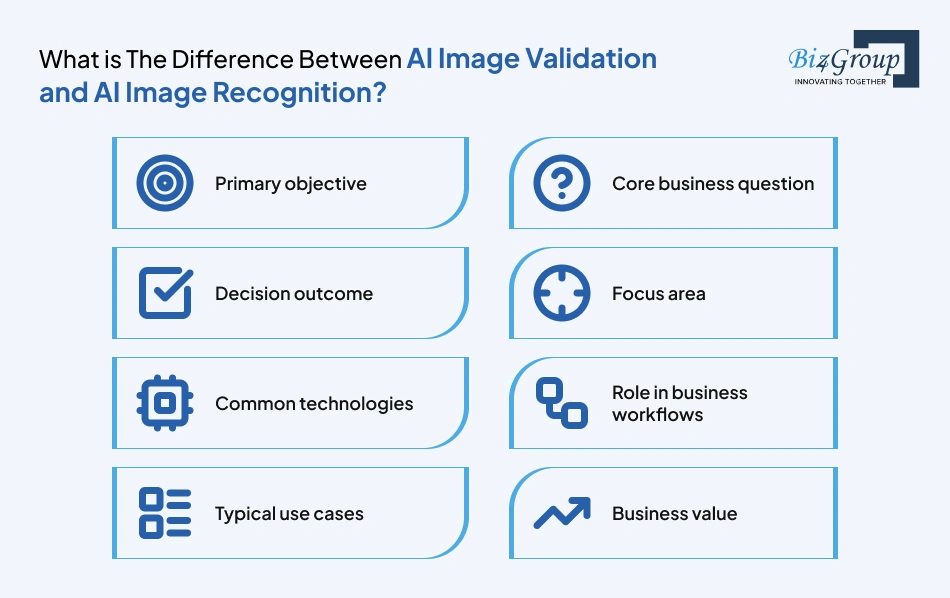
By now, you've seen why businesses are investing in AI image validation solutions. But there's one question that often creates confusion: aren't AI image validation and AI image recognition the same thing?
Well, they aren't.
While both use computer vision, they solve entirely different business problems. Understanding this distinction helps you choose the right solution for your operational goals instead of investing in technology that addresses the wrong challenge.
|
Aspect |
AI Image Recognition |
AI Image Validation |
|---|---|---|
|
Primary objective |
Identifies and classifies objects, people, text, scenes, or visual elements present in an image. |
Determines whether an image meets predefined quality, authenticity, compliance, and business validation requirements. |
|
Core business question |
What is present in this image? |
Can this image be trusted and accepted for the intended business process? |
|
Decision outcome |
Produces labels, categories, object detection results, or image classifications. |
Approves, rejects, or flags images based on validation rules and confidence thresholds. |
|
Focus area |
Image content understanding and object identification. |
Image quality assessment, authenticity verification, document validation, and compliance validation. |
|
Common technologies |
Object detection, image classification, facial recognition, semantic segmentation, and OCR system. |
Image quality analysis, metadata validation, tampering detection, duplicate detection, OCR, and business rule validation. |
|
Role in business workflows |
Extracts information from images to support search, analytics, automation, and categorization. |
Prevents invalid, manipulated, incomplete, or non-compliant images from entering critical workflows. |
|
Typical use cases |
Product recognition, visual search, medical image classification, facial recognition, and inventory identification. |
Insurance claims validation, KYC document verification, healthcare documentation, and user-generated content moderation. |
|
Business value |
Helps businesses understand image content for better automation and insights. |
Reduces fraud, minimizes manual reviews, improves operational consistency, and increases trust in image-driven decisions. |
Also Read: Top 20 Facial Recognition Software in 2026
Although they use similar AI technologies, their purpose is fundamentally different. AI image recognition tells you what an image contains, while AI image validation tells you whether that image is reliable enough to support a business decision.
How AI Image Validation Solutions Work
AI image validation solutions work by passing every uploaded image through a structured validation pipeline before reaching a final decision. For operations managers looking to reduce manual image review time, understanding this workflow makes it easier to evaluate how AI image validation software processes, verifies, and validates every image from upload to approval.
1. Image Intake and Preparation
- Every uploaded image first enters the validation pipeline, where the system verifies the file format, resolution, and upload integrity before processing begins.
- The image is then standardized through orientation correction, noise reduction, brightness normalization, and resizing, ensuring every validation model receives a clean and consistent input.
- Once pre-processing is complete, the image is forwarded to the quality validation engine for detailed assessment.
2. Quality Assessment and Content Verification
- The validation engine evaluates blur, glare, focus, cropping, exposure, shadows, and missing regions to determine whether the image meets predefined quality thresholds.
- Images that satisfy quality requirements move to OCR system and document analysis, where visible text is extracted, and mandatory fields, signatures, identifiers, and document layout are verified.
- Images with critical quality defects or incomplete information are flagged before authenticity verification begins.
Also Read: AI Document Fraud Detection Software Development
3. Authenticity and Fraud Verification
- Images that pass structural validation undergo metadata analysis, where EXIF records, timestamps, device information, and file attributes are checked for suspicious inconsistencies.
- The validation engine then analyzes visual patterns to identify editing traces, deep-fake artifacts, synthetic content, compression anomalies, duplicate submissions, and other indicators of image manipulation.
- Every validation result is combined to generate a comprehensive authenticity profile before the image proceeds to the final evaluation stage.
4. Decision Engine and Workflow Execution
- All validation outputs are evaluated against predefined business rules, compliance requirements, and workflow-specific acceptance criteria to determine the appropriate outcome.
- A confidence score is assigned to every validation result, allowing high-confidence images to proceed automatically while uncertain cases are routed for manual verification.
- The workflow concludes by generating the final validation status: Approved, Rejected, or Manual Review Required, along with complete validation logs and audit records for downstream systems.
Every image follows the same structured validation journey, ensuring compliance and risk teams concerned about fraud, authenticity, and quality control can rely on offering consistent, traceable, and evidence-backed validation decisions.
Seeing Gaps in Your Validation Process?
Turn complex image validation workflows into faster, smarter business decisions with a solution designed around your operational needs
Plan Your AI Validation SolutionDifferent Types of AI Image Validation Solutions
AI image validation solutions come in different types because every business validates images for a different purpose. So, for product managers asking what is the best AI image validation software for large-scale image processing, the answer depends on the validation objective rather than the software itself.
Let's look at the most common types and what each one is designed to do.
1. Image Quality Validation Solutions
These solutions evaluate whether an image meets predefined quality standards by checking blur, glare, brightness, focus, resolution, cropping, and visibility. They ensure only images that satisfy quality requirements move forward for further processing.
2. Image Authenticity Validation Solutions
These solutions determine whether an uploaded image is genuine or manipulated. They analyze editing traces, deepfake artifacts, synthetic media, metadata inconsistencies, and compression patterns to verify image authenticity before acceptance.
3. Document Image Validation Solutions
Designed for document-based workflows, these solutions verify document completeness, readability, and structure. They combine OCR with layout analysis to validate mandatory fields, signatures, identifiers, and supporting information within uploaded images.
4. Identity Verification Image Solutions
Used to validate identity-related images such as passports, driver's licenses, or selfies. They verify document integrity, facial consistency, liveness indicators, and image quality before identity verification workflows continue.
5. Duplicate Image Detection Solutions
These solutions identify repeated or previously submitted images using perceptual hashing, visual fingerprinting, and similarity matching. They help distinguish unique submissions from reused images without relying only on filenames or metadata.
6. Industry-Specific Image Validation Solutions
Some businesses require validation rules tailored to their operations. These solutions combine custom validation logic with AI automation services to support industry-specific requirements across insurance, healthcare, financial services, manufacturing, and other regulated sectors.
Also Read: Top 10 AI Automation Companies in USA
The right solution isn't the one with the longest feature list. It's the one designed to validate the images your business processes every day, giving digital platform owners managing user-uploaded images at scale a validation system that fits their operational requirements.
One important thing to remember: the validation workflow you've seen in the previous section doesn't change. Every AI image validation solution follows a similar process of preparing, analyzing, verifying, and deciding.
What changes is the validation objective.
A quality validation solution focuses on image clarity, while a document validation solution prioritizes document completeness and OCR. An authenticity validation solution gives greater importance to manipulation detection and metadata analysis.
In practice, many enterprise platforms combine several of these capabilities into a single AI image validation solution tailored to specific business requirements.
What Essential Features Should Every AI Image Validation Solution Include
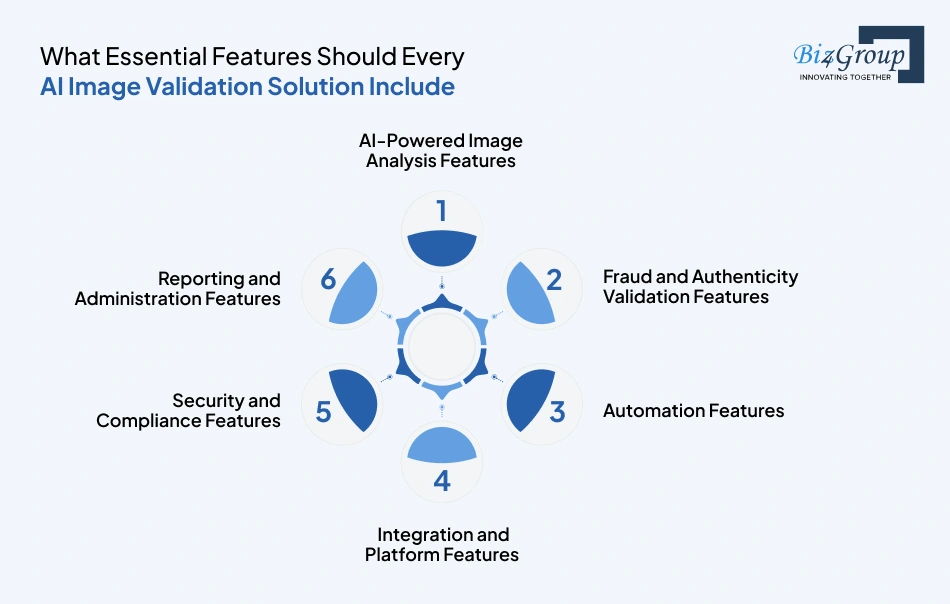
Every AI image validation solution should include a balanced combination of image analysis, fraud detection, workflow automation, integration, security, and reporting capabilities. These features determine how reliably the platform validates images and how well it fits into everyday business operations.
For organizations planning AI image validation software development, understanding these feature sets helps define the right product requirements from the beginning.
1. AI-Powered Image Analysis Features
These features evaluate whether an uploaded image is suitable for processing. They establish the foundation for every validation decision by ensuring the image meets predefined quality and document standards before additional verification begins.
|
Feature |
Purpose |
|---|---|
|
Image Quality Assessment |
Detects blur, glare, poor lighting, cropping, shadows, and low resolution |
|
OCR Engine |
Extracts readable text from documents and image-based records |
|
Document Layout Validation |
Confirms required fields, signatures, and identifiers are present |
|
Image Completeness Check |
Verifies that mandatory pages or image regions have not been omitted |
|
Format Validation |
Accepts only supported file formats, sizes, and image dimensions |
2. Fraud and Authenticity Validation Features
Once an image passes quality checks, the platform should verify whether it can be trusted. These capabilities focus on detecting manipulation, synthetic content, duplicate submissions, and suspicious metadata before the image enters downstream workflows.
|
Feature |
Purpose |
|---|---|
|
Deepfake Detection |
Identifies AI-generated or synthetically manipulated images |
|
Metadata Validation |
Reviews EXIF data, timestamps, and device information for inconsistencies |
|
Image Tampering Detection |
Detects editing traces, cloning, object removal, and altered regions |
|
Duplicate Image Detection |
Finds reused images using perceptual hashing and similarity matching |
|
Authenticity Scoring |
Assigns a confidence score to support validation decisions |
3. Automation Features
A validation engine should do more than analyzing images. It should also automate decision-making and route every image through the appropriate business process with minimal manual intervention.
|
Feature |
Purpose |
|---|---|
|
Business Rule Engine |
Applies predefined validation policies before approval |
|
Confidence-Based Routing |
Sends uncertain results for manual verification |
|
Automated Decision Engine |
Generates approval, rejection, or review outcomes automatically |
|
Workflow Orchestration |
Routes validated images to connected business processes |
|
Validation Queue Management |
Prioritizes and manages large volumes of incoming images |
4. Integration and Platform Features
Even the most advanced validation engine creates limited value without fitting into the systems your business already uses. Integration capabilities ensure image validation becomes part of existing operations instead of a separate process.
|
Feature |
Purpose |
|---|---|
|
REST API Support |
Connects the validation engine with enterprise applications |
|
SDK Support |
Simplifies integration across web and mobile platforms |
|
Cloud Storage Integration |
Retrieves and stores images from connected repositories |
|
Webhook Notifications |
Sends validation outcomes to external systems in real time |
|
Batch Image Processing |
Processes thousands of uploaded images within scheduled workflows |
Also Read: Adopt An API-First Architecture for Business Agility
5. Security and Compliance Features
Image validation frequently handles sensitive documents and regulated data. Security features protect information throughout the validation lifecycle while supporting governance and compliance requirements.
|
Feature |
Purpose |
|---|---|
|
Role-Based Access Control |
Restricts system access based on user roles. |
|
Data Encryption |
Secures images during transmission and storage. |
|
Audit Trail |
Records every validation activity and decision. |
|
Data Retention Controls |
Manages image storage according to business policies. |
|
Compliance Configuration |
Supports organization-specific regulatory requirements. |
6. Reporting and Administration Features
Operational visibility is just as important as validation accuracy. These features help teams monitor system performance, review validation outcomes, and continuously improve business rules over time.
|
Feature |
Purpose |
|---|---|
|
Validation Dashboard |
Displays validation volume, status, and operational metrics. |
|
Performance Analytics |
Tracks processing speed, accuracy, and validation trends. |
|
Exception Reporting |
Highlights failed validations and recurring issues. |
|
Rule Configuration Panel |
Allows administrators to update validation policies. |
|
System Health Monitoring |
Tracks service availability and processing performance. |
A capable solution is defined by how well these feature sets work together, not by the number of capabilities listed in a brochure. That combination gives digital platform owners managing user-uploaded images at scale a validation system that remains accurate, adaptable, and ready for growing business demands.
What Determines the Accuracy of AI Image Validation?
AI image validation doesn't become accurate by chance, and it certainly isn't determined by the model alone. The consistency of its results depends on several business and operational factors working together.
Get these right, and the solution becomes a reliable decision-making tool rather than just another automation initiative.
- The validation criteria should be clearly defined so the solution knows exactly what qualifies as a valid or invalid image.
- Training images should reflect real-world business scenarios instead of ideal examples to improve decision-making under everyday conditions.
- Image submission standards should remain consistent to prevent variations in quality, lighting, angles, or resolution from affecting validation results.
- Business rules should stay aligned with validation logic, so AI decisions consistently support operational objectives.
- Exception cases should be reviewed regularly to identify recurring patterns and refine validation rules over time.
- Feedback from business users should be incorporated continuously to improve validation quality as workflows and requirements evolve.
Ultimately, accurate AI image validation is the outcome of clear business rules, reliable data, and continuous refinement. When these elements stay aligned, the solution delivers results your teams can trust every day.
What are the Top Use Cases of AI Image Validation Across Industries?
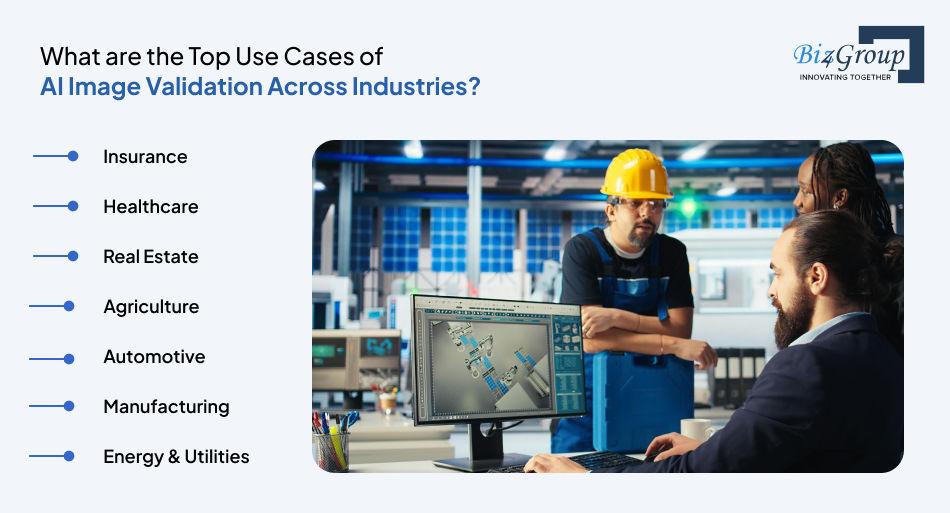
AI image validation solutions are used across industries wherever business decisions depend on images. The validation goal may differ from one sector to another, but the objective remains the same ensuring every image is complete, authentic, and ready for the next business process.
Let's see how different industries put them to work.
1. Insurance
Insurance companies process thousands of claim images every day. The need for AI-powered image verification has grown even stronger as insurance claims have seen a 280% increase in AI-edited claim photos, making fraud screening an operational priority.
Typical use cases include:
- FNOL damage photo screening
- Repair estimate image assessment
- Catastrophe loss documentation
- Duplicate claim evidence detection
- Tamper and deepfake screening
Also Read: Top 12 AI Insurance Software Development Companies in USA
2. Healthcare
Healthcare organizations depend on accurate medical images and supporting documents before clinical or administrative workflows continue. Image quality, document completeness, and patient record consistency directly influence downstream healthcare processes.
Common use cases include:
- Patient identity document capture
- Prescription image screening
- Wound progression documentation
- DICOM image quality assessment
- Insurance card processing
Also Read: AI Medical Claim Processing Software Development Guide
3. Real Estate
Real estate platforms receive large volumes of listing images from agents, builders, and property owners. Maintaining consistent image quality and authentic property representation improves listing accuracy and buyer confidence.
Common use cases include:
- MLS listing photo screening
- Floor plan consistency checks
- Property disclosure documentation
- Virtual tour image review
- Occupancy evidence assessment
Also Read: AI Property Management Software Development
4. Agriculture
Agricultural businesses rely on field images to monitor crops, assess losses, and support insurance decisions. Image authenticity detection AI helps ensure submitted images accurately represent on-ground conditions before further analysis.
Common use cases include:
- Crop scouting image review
- Pest infestation documentation
- Plant disease evidence capture
- Harvest damage assessment
- Drone field survey screening
Now let's look at a real-world implementation of AI image validation in agriculture industry by Biz4Group LLC
Kalix QC: AI-Powered Cannabis Grading & Pricing
Biz4Group developed an AI-powered solution for the cannabis industry that automates product grading, standardizes quality inspections, and minimizes manual review. By combining computer vision with intelligent image analysis, the platform evaluates product images in real time.

This helps businesses achieve consistent grading outcomes, accelerate quality control workflows, and improve operational efficiency across cannabis processing facilities.
Project Highlights:
- AI-powered cannabis grading
- Automated image quality validation
- Real-time visual inspection and analysis
- Consistent and standardized grading outcomes
- Reduced manual quality review
- Computer vision-powered quality control
- Streamlined inspection workflows
- Scalable processing for high-volume operations
5. Automotive
Automotive businesses capture images throughout the vehicle lifecycle, from inspections to resale. Consistent image analysis helps standardize records across dealerships, leasing companies, insurers, and service centers.
Common use cases include:
- Pre-delivery inspection images
- Accident damage documentation
- Lease return assessments
- Odometer photo capture
- Used vehicle condition reports
Also Read: Top 10 AI Automotive Software Development Companies in USA
6. Manufacturing
Manufacturers depend on image-based inspections to monitor production quality and maintain compliance across factories. For organizations adopting AI image validation solutions, automated image screening strengthens quality control without slowing production.
Common use cases include:
- Surface defect inspection
- Weld seam assessment
- Assembly completion checks
- Packaging compliance review
- PPAP documentation screening
Also Read: AI Predictive Maintenance Software Development for Manufacturing: A Complete Guide
7. Energy & Utilities
Energy providers and infrastructure operators rely on images to monitor critical assets, verify equipment conditions, and support preventive maintenance. AI image validation solutions help automate visual inspections, identify anomalies early, and improve operational efficiency across distributed infrastructure.
Common use cases include:
- Utility asset condition monitoring
- Heat cable and power infrastructure inspections
- Equipment anomaly detection
- Maintenance image validation
- Remote visual infrastructure monitoring
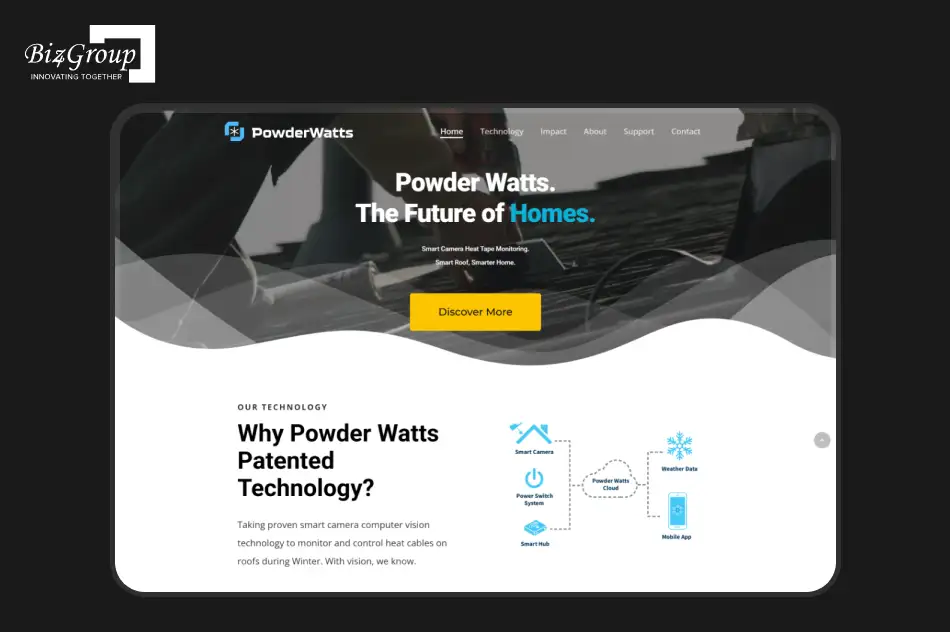
Real World Implementation by Biz4Group: IoT Heat Cable Management System
We developed an AI-powered computer vision and IoT solution that automates heat cable monitoring and optimizes energy consumption across critical infrastructure. Using smart cameras and real-time visual analysis, the platform continuously monitors field conditions, identifies operational issues as they emerge, and supports faster maintenance decisions without requiring constant manual supervision.
Project Highlights:
- Continuous infrastructure surveillance
- Intelligent heat cable performance tracking
- Automated issue identification and escalation
- Integration with connected IoT sensors and devices
- Centralized remote monitoring dashboard
- Reduced manual inspection effort
- Improved winter asset reliability
- Scalable monitoring across multiple locations
Different industries may process different images, but the objective stays remarkably consistent ensuring every image entering a business workflow is accurate, authentic, and ready to support reliable operational decisions.
Which Use Case Fits Your Business?
Every industry solves different challenges with AI image validation discover the right approach before investing in development
Discuss Your Industry Use CaseRecommended Technology Stack for AI Image Validation Solutions
A reliable AI image validation solution combines multiple technology layers, each responsible for a specific part of the system. For CTO's and engineering leaders planning AI image validation software development, and assessing AI architecture, the following technology stack provides a practical foundation.
|
Architecture Layer |
Recommended Tools |
Purpose |
|---|---|---|
|
Frontend |
React, Next.js, Flutter |
Delivers responsive web portals through reactjs development and high-performance server-rendered applications with nextjs development. |
|
Backend Services |
Python (FastAPI), Node.js |
Python development handles business logic, workflow orchestration, authentication, and image processing requests through nodejs development |
|
API Layer |
REST APIs, GraphQL |
Supports secure API development so enterprise systems can exchange images, validation results, and workflow events |
|
AI Models |
YOLOv11, Vision Transformer (ViT), EfficientNet, CLIP |
Detects objects, measures image quality, classifies visual content, and compares image similarity |
|
AI Framework & Inference |
PyTorch, ONNX Runtime, NVIDIA Triton Inference Server |
Trains AI models and delivers high-speed inference for real-time image validation workloads |
|
OCR & Document Intelligence |
PaddleOCR, Azure Document Intelligence, Amazon Textract |
Extracts text, validates forms, and captures structured data from scanned documents |
|
Image Processing Engine |
OpenCV, Pillow, ImageMagick |
Performs image normalization, cropping, resizing, color correction, and format conversion before AI analysis |
|
Similarity Search |
FAISS, Milvus |
Finds duplicate images, near-duplicate submissions, and visual matches using image embeddings |
|
Data Storage |
PostgreSQL, MongoDB, Amazon S3 |
Stores business records, validation history, metadata, AI outputs, and uploaded image files |
|
Messaging & Caching |
RabbitMQ, Apache Kafka, Redis |
Queues high-volume processing jobs, manages asynchronous workflows, and accelerates frequently accessed data |
|
Security & Identity |
OAuth 2.0, JWT, AWS KMS, HashiCorp Vault |
Protects user authentication, encryption keys, API credentials, and sensitive business data |
|
Cloud & DevOps |
Docker, Kubernetes, AWS, Microsoft Azure |
Automates deployment, scales AI workloads, and maintains high availability across production environments |
|
Monitoring & MLOps |
Prometheus, Grafana, MLflow |
Monitors system health, tracks model performance, and manages AI model versioning throughout the lifecycle |
Also Read: A Complete Guide to OpenAI API Integration for AI Applications
A dependable architecture is about selecting technologies that complement one another, allowing automated image quality validation to remain accurate, scalable, and easier to maintain as business requirements continue to evolve.
AI Image Validation Solution Development: A Step-By-Step Process from Strategy to Deployment
Every implementation follows a series of practical decisions that shape how the solution performs after deployment. Understanding these stages helps you evaluate development priorities, avoid costly rework, and invest in capabilities that support long-term business goals.
1. Define Validation Objectives and Business Rules
Every project starts by defining what the solution should validate, how results will be measured, and when an image requires manual review. This planning phase establishes the foundation for reliable AI image validation solutions while helping teams prioritize features for an initial release through MVP development services.
This stage typically includes:
- Validation policies and acceptance criteria
- Confidence score thresholds
- Exception handling rules
- Business success metrics
Also Read: Top MVP Development Companies in USA
2. Prepare High-Quality Image Datasets
Reliable predictions depend on structured, representative datasets rather than image volume alone. Before AI model development begins, teams organize training data, establish annotation standards, and eliminate inconsistencies that could reduce validation accuracy in production.
Key deliverables include:
- Ground truth datasets
- Annotation guidelines
- Metadata and image categorization
- Edge-case image library
3. Design the Validation Pipeline and Review Workflow
The next phase defines how every image moves through the system, from submission to the final validation result. A well-planned workflow supports automated image quality validation while ensuring uncertain predictions are routed for manual verification instead of generating unreliable outcomes.
The workflow is designed around:
- Image preprocessing pipeline
- Validation rules and decision logic
- Exception queue for low-confidence results
- Reviewer approval and audit workflow
4. Train and Evaluate Vision Models
Once the workflow is established, the focus shifts to training models that can recognize validation patterns with consistent accuracy. Multiple evaluation cycles improve prediction quality before the integration of AI models into the application, making AI-powered image verification dependable across real-world operating conditions.
Evaluation focuses on:
- Precision, recall, and F1-score benchmarking
- False positive and false negative analysis
- Confidence score calibration
- Performance validation using unseen datasets
5. Connect Business Systems and Data Sources
After the model is production-ready, it is connected with existing business platforms, so image validation becomes part of daily operations instead of a separate task. This allows AI image validation software to exchange information securely and trigger actions without disrupting established workflows.
Common integration points include:
- ERP, CRM, and document management systems
- Cloud storage and image repositories
- REST APIs and webhook connections
- Authentication and role-based access control
Also Read: Artificial Intelligence in CRM
6. Design User Interfaces for Faster Decision-Making
The interface should help users review results quickly, understand why an image was accepted or flagged, and take the next action with minimal effort. Working with an experienced UI/UX design company ensures dashboards remain intuitive even when handling large image volumes or complex validation cases.
The interface typically includes:
- Validation status and confidence indicators
- Manual review and approval screens
- Search, filters, and audit history
- Alerts and exception management
Also Read: Top UI/UX Design Companies in USA
7. Validate Performance Before Production Deployment
Before release, every component is tested to verify that the solution performs reliably under real operating conditions. Many organizations work alongside experienced software testing companies to evaluate functional accuracy, security, scalability, and overall system stability before production rollout.
Production readiness includes:
- End-to-end workflow validation
- API and integration testing
- Load and performance benchmarking
- Security and compliance verification
Also Read: Top AI Software Development Companies in USA
8. Deploy, Monitor, and Improve Continuously
Deployment marks the beginning of long-term optimization rather than the end of development. Monitoring model performance, reviewing validation outcomes, and retraining with newly approved datasets help maintain consistent results while strengthening image authenticity detection AI as business requirements evolve.
Ongoing activities include:
- Performance monitoring dashboards
- Model retraining with new image data
- Confidence threshold optimization
- Version control and release management
A structured development process turns AI image validation into a dependable business capability. Every phase contributes to higher accuracy, smoother operations, and a solution that continues improving long after deployment.
Implementation Note: The development process outlined above provides a practical framework followed by most AI image validation solutions. However, every implementation is tailored to specific business objectives, industry regulations, image types, validation requirements, integration needs, and operational workflows. Depending on your use case, certain stages may require additional planning, while others can be streamlined to match project priorities.
How Much Does AI Image Validation Software Cost in 2026
AI image validation solution typically costs between $35,000 and $300,000+ in 2026. The estimates below provide a practical starting point for planning your project, have a look:
|
Solution Level |
Estimated Cost Range |
Typical Scope |
|---|---|---|
|
MVP Level AI Image Validation Solution |
$35,000–$90,000 |
Designed for a single validation workflow with one AI model, essential review capabilities, basic integrations, and cloud deployment. |
|
Mid-Level AI Image Validation Solution |
$90,000–$180,000 |
Supports multiple validation workflows, custom business rules, enterprise integrations, workflow automation, and scalable infrastructure. |
|
Enterprise-Grade AI Image Validation Solution |
$180,000–$300,000+ |
Built for large-scale operations with multiple AI models, advanced automation, compliance requirements, high-volume processing, and continuous model optimization. |
Factor Affecting the Cost of AI Image Validation Solution
- The accuracy level your solution must achieve directly affects development costs. Reaching validation accuracy can increase the budget by $20,000–$40,000 due to additional model training and testing.
- The quality and consistency of image datasets significantly impact development costs. Poorly labeled or incomplete datasets can add $8,000–$30,000 for data cleaning, annotation, and validation.
- The number of validation scenarios your platform supports influences the overall budget. Expanding beyond basic quality checks can increase costs by $15,000–$25,000 as AI logic becomes more sophisticated.
- The volume of images processed affects infrastructure and deployment costs. High-throughput platforms may require an additional $10,000–$30,000 for scalable inference and cloud architecture.
- The number of enterprise integrations required for the solution impacts implementation effort. Connecting ERP systems, DAM platforms, cloud storage, and business applications increases costs by $10,000–$20,000.
These factors rarely exist in isolation. Their combined impact determines the overall development cost, making every AI image validation solution unique in both scope and investment.
Building Smart Without Overspending?
Get a realistic development roadmap with features architecture and budget aligned to your business objectives
Estimate Your Project CostCommon Implementation Challenges in AI Image Validation Solution and (How to Avoid Them)
Successful implementation depends on more than deploying the model. These common challenges often determine how reliably an AI image validation solution performs in day-to-day business operations. Organizations that plan ahead with AI consulting services are better prepared to address them before deployment.
|
Common Implementation Challenges |
How to Avoid Them |
|---|---|
|
Different image sources generate inconsistent validation results. |
Standardize image capture guidelines and apply the same preprocessing workflow across every image source before validation. |
|
Validation rules fail to reflect actual business approval criteria. |
Define business rules before deployment and keep validation logic configurable as operational requirements evolve. |
|
Borderline images create growing manual review queues. |
Configure confidence thresholds and route uncertain cases through structured human review instead of manual decision-making. |
|
Image submission standards change after deployment. |
Review validation rules regularly and update reference datasets whenever products, documents, or branding change. |
|
Upstream systems alter images before they reach the validation engine. |
Audit the complete image pipeline and preserve consistent image quality across every connected business system. |
|
Users receive unclear validation outcomes and repeatedly resubmit images. |
Return clear validation feedback with actionable rejection reasons so users can correct issues before uploading again. |
Addressing these implementation challenges early keeps validation consistent, reduces operational friction, and helps enterprise grade AI solutions deliver reliable business outcomes long after deployment.
Who Can Help You Build Reliable AI Image Validation Solutions?
We of course!
Now that you've seen what AI image validation solutions can do, how they deliver business value, and what it takes to build them successfully, the next question is obvious who can help you turn that vision into reality?
That's where Biz4Group LLC, a trusted AI computer vision software development company in USA with 20+ years of expertise, stands apart.
With hands-on experience delivering computer vision solutions such as KalixQC for AI-powered visual quality inspection and IoT heat cable management for intelligent infrastructure monitoring, our team understands that success depends on more than building AI models.
We focus on creating solutions that fit seamlessly into real business workflows and continue delivering value as your operations grow.
What makes Biz4Group different?
- Deep expertise in computer vision technologies across inspection, validation, and image-based automation use cases.
- Practical understanding of business workflows to ensure AI complements existing operations instead of disrupting them.
- Experience integrating AI solutions with enterprise platforms, cloud infrastructure, and third-party business systems.
- A collaborative development approach that keeps you involved from discovery through deployment and ongoing optimization.
Bottom line: you bring the vision; we bring the pixels-to-production know-how. Let's build together an AI image validation that actually works where it matters.
Conclusion
As more businesses rely on images to support critical decisions, choosing the right AI image validation solutions becomes an important step toward improving accuracy, consistency, and operational efficiency. The goal is not simply to automate image verification, but to create a dependable solution that continues to deliver value as your business grows. That is where image authenticity detection AI can make a meaningful difference when applied with a clear understanding of your business needs.
If you're evaluating the right technology partner, look beyond hiring AI developers and focus on proven experience in delivering business-driven AI solutions. At Biz4Group LLC, we work closely with organizations to build AI image validation solutions that solve real-world challenges and support long-term business growth. Let's connect whenever you're ready.
FAQ’s
1. How do AI image validation solutions handle new image formats or business rule changes after deployment?
Modern AI image validation solutions are designed to evolve with your business. New document templates, product images, branding updates, or validation rules can be incorporated through periodic model updates and configurable business logic without rebuilding the entire system. This helps maintain validation accuracy while keeping pace with changing operational requirements.
2. Can image authenticity detection AI distinguish between edited images and AI-generated images?
Yes, but the capability depends on the validation techniques used. Image authenticity detection AI can identify signs of manipulation such as altered metadata, compression inconsistencies, duplicated regions, or synthetic image artifacts. The most effective solutions combine multiple verification methods instead of relying on a single detection model, improving confidence across different image types.
3. What is the typical cost range for AI image validation solutions in 2026?
For most businesses, the investment ranges between $35,000 and $300,000+, depending on the project's scope, image volume, deployment environment, integration requirements, and validation complexity. Smaller MVPs generally fall at the lower end, while enterprise platforms with custom AI models, multiple integrations, and high-volume processing require a larger investment.
4. How long does it take to develop and deploy an AI image validation solution?
Most projects take 4 to 16+ weeks, although the timeline depends on factors such as dataset readiness, business-specific validation requirements, system integrations, testing cycles, and deployment strategy. Projects with well-defined requirements and quality image datasets typically move faster than those requiring extensive customization.
5. How can businesses measure the success of an AI image validation solution after deployment?
The most meaningful metrics include validation accuracy, false acceptance and rejection rates, manual review volume, processing time, user resubmission rate, and operational cost savings. Tracking these KPIs over time provides a clearer picture of business impact than relying solely on AI accuracy scores.
6. What should businesses evaluate before choosing an AI image validation solutions provider?
Beyond technical expertise, evaluate the provider's experience with similar use cases, AI model development capabilities, integration expertise, security practices, post-deployment support, and ability to scale the solution as business needs evolve. Reviewing real-world case studies and discussing long-term support expectations before starting the project can significantly reduce implementation risks.
