 Location :
Orlando, FL, USA
Location :
Orlando, FL, USA +1 (407) 714-1616
 info@biz4group.com
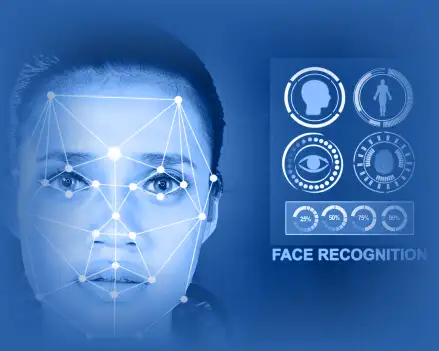
- AI facial recognition software development enables instant identity verification, reduces fraud risks, and improves secure user experiences by embedding recognition directly into everyday digital and operational workflows.
- Businesses develop AI facial recognition system solutions to automate onboarding, strengthen authentication, and maintain consistent identity control across banking, healthcare, retail, workplace, and government environments.
- Successful platforms combine real-time recognition, compliance safeguards, scalable architecture, and user-friendly interfaces that perform reliably under real-world conditions.
- AI facial recognition software development costs typically range between $40,000 and $350,000+, depending on accuracy, integrations, infrastructure scale, and compliance readiness.
- As a trusted technology partner, Biz4Group LLC delivers end-to-end AI facial recognition software development services, helping startups and enterprises build scalable identity platforms ready for long-term growth.
Businesses no longer lose customers because of weak products, rather they lose trust because identity verification fails at critical moments. Password resets, fake accounts, and onboarding fraud quietly damage user confidence and operational efficiency.
This is why organizations are shifting toward AI facial recognition software development, where identity verification happens instantly without adding friction to the user's journey. Instead of treating security as a barrier, companies are redesigning it as a seamless experience built into everyday interactions.
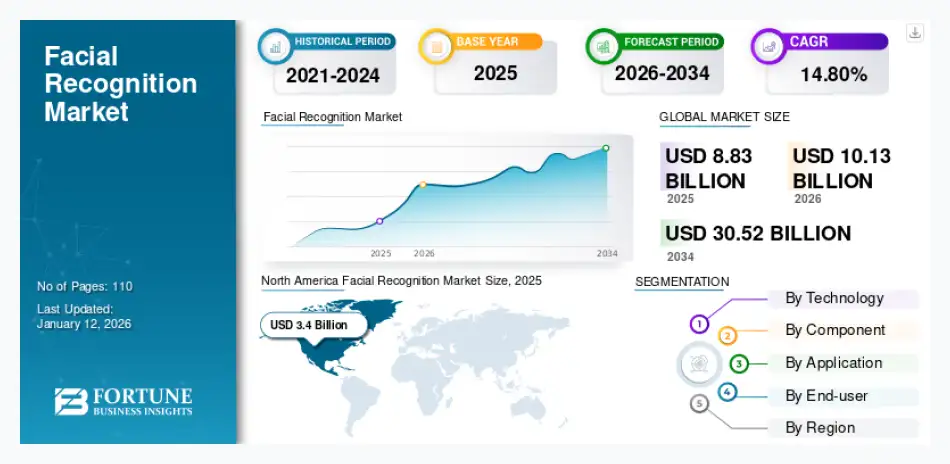
Market momentum clearly reflects this transition. The global facial recognition market is projected to grow from USD 10.13 billion in 2026 to USD 30.52 billion by 2034, while the U.S. alone contributes USD 2.7 billion in the same year.
As modern attacks increasingly bypass traditional authentication layers, businesses are prioritizing generative AI and biometric systems that verify real users rather than credentials. Many enterprises collaborate with a custom software development company early to ensure facial recognition aligns with operational workflows instead of becoming an isolated feature.
Organizations investing in AI facial recognition software development services are usually addressing practical business needs such as:
- Faster customer onboarding without manual identity checks
- Stronger fraud prevention across digital transactions
- Secure employee and facility access management
- Consistent identity verification across applications
This guide explains how organizations develop AI facial recognition system solutions, covering working principles, essential features, compliance factors, and cost considerations. The goal is to help decision-makers understand what it actually takes to build and scale a facial recognition solution successfully with AI integration.
Understanding AI Facial Recognition Software and its Working
AI facial recognition software is a technology that identifies or verifies a person using their facial features. It works by capturing an image of a face and analyzing distinct visual patterns that make each individual unique. Instead of remembering passwords or entering verification codes, the system relies on measurable facial characteristics such as the shape of the eyes, distance between facial points, and overall facial structure.
In AI facial recognition software development, these characteristics are converted into digital data that allows the system to recognize whether two faces belong to the same person. When engineers build biometric facial recognition software, the primary objective is to ensure the system can consistently recognize a face based on learned facial data rather than visual similarity alone.
How AI Facial Recognition Software Works
Facial recognition systems follow a structured process that converts a human face into identifiable digital data. Each stage ensures accuracy, consistency, and reliable identity matching across different use cases.
1. Face Detection: The system captures a face through cameras or uploaded images and identifies facial presence while filtering background elements that do not contribute to recognition accuracy.
2. Feature Mapping: Facial landmarks such as eyes, nose, and jawline are measured and converted into mathematical representations that uniquely describe an individual without storing raw visual details.
3. Data Conversion: Captured facial features are transformed into numerical vectors, enabling faster comparison and efficient storage within secure databases used during authentication processes.
4. Identity Comparison: The encoded facial data is compared against stored records to determine similarity scores, helping systems confirm or reject identity claims based on predefined confidence thresholds.
5. Continuous Learning: Through AI model development, systems improve recognition accuracy over time by learning from varied lighting conditions, angles, and real usage environments without manual reprogramming.
Facial recognition becomes more effective when integrated into broader AI automation workflows, allowing identity verification to trigger actions such as access approval or fraud alerts automatically. Together, these steps transform facial data into a secure and scalable identity mechanism businesses can rely on daily.
Why Businesses Are Investing in AI Facial Recognition Software Development?
Businesses today are rethinking how identity impacts growth, security, and operational efficiency. Investment decisions are no longer driven only by technology trends but by practical needs such as scalability, fraud control, and long-term digital reliability. Before understanding the reasons behind this shift, lets look at how the market itself is evolving.
Market Snapshot
Investment in AI Facial Recognition Software Development is accelerating as organizations rethink how identity management supports long-term digital growth.
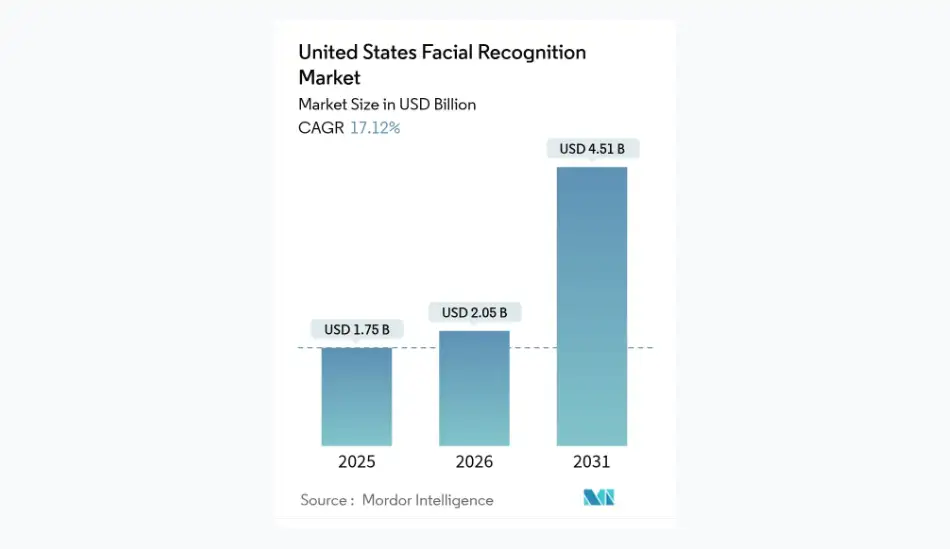
- The U.S. facial recognition market is expected to grow from USD 2.05 billion in 2026 and reach USD 4.51 billion by 2031, expanding at a 17.12% CAGR.
- Adoption is rising across border control systems, retail security, healthcare authentication, and national digital identity programs.
- Government modernization funding, airport and port digitization, and increasing e-commerce fraud risks are shaping investment priorities.
- Businesses are also responding to improvements in 3D recognition technologies, which increase reliability and reduce spoofing risks, making large-scale deployment a more confident investment decision.
Market growth explains the momentum, but the real question businesses ask is what practical value this investment brings to their operations and long-term strategy. Here are the reasons why businesses are investing in the development of AI facial recognition software:
1. Identity as a Business Infrastructure
Businesses increasingly treat identity verification as core infrastructure rather than a supporting feature.
- Reduces dependence on manual verification teams
- Creates consistent identity standards across services
- Supports long-term digital transformation initiatives
Many enterprise AI solutions now position biometric identity within foundational system architecture.
2. Lower Operational Costs Over Time
Investment decisions often focus on cost efficiency rather than immediate functionality.
- Minimizes recurring verification expenses
- Reduces human intervention in identity checks
- Lowers fraud investigation workload
Organizations create facial recognition software using AI to automate processes that previously required continuous operational effort.
Also Read: 10 AI Automation Use Cases for Enterprises to Scale Faster
3. Enabling Scalable User Growth
Rapid user expansion creates identity management challenges.
- Supports onboarding growth without proportional staffing increases
- Maintains verification consistency across regions
- Prevents operational bottlenecks during scale
This scalability is a key reason business pursue custom AI facial recognition software development instead of temporary solutions.
4. Strengthening Digital Trust
Customer confidence directly influences retention and platform adoption.
- Builds confidence in secure transactions
- Reduces friction during authentication moments
- Encourages repeat platform usage
Businesses that create facial recognition software with AI for identity verification often prioritize trust as a measurable business outcome.
5. Supporting Application Modernization
Many organizations invest while modernizing existing digital platforms.
- Helps integrate AI into an app already handling user identity
- Aligns security upgrades with product evolution
- Extends lifecycle of existing software ecosystems
This makes facial recognition investment a practical step toward upgrading systems without rebuilding entire digital platforms from scratch.
6. Preparing for Future Security Expectations
Investment decisions also anticipate future regulatory and security demands.
- Positions organizations ahead of evolving compliance needs
- Reduces future redesign costs
- Creates adaptable identity infrastructure
AI facial recognition software development is increasingly viewed as a strategic investment that supports secure scaling, operational efficiency, and long-term digital resilience rather than standalone technology upgrade.
Also Read: Top Computer Vision Software Development Companies in USA
Still treating identity as a feature instead of infrastructure?
If verification failures slow growth or increase fraud risk, it's time to rethink how identity works inside your business.
Let's Redesign Identity TogetherReal-World Use Cases of AI Facial Recognition Software Across Industries
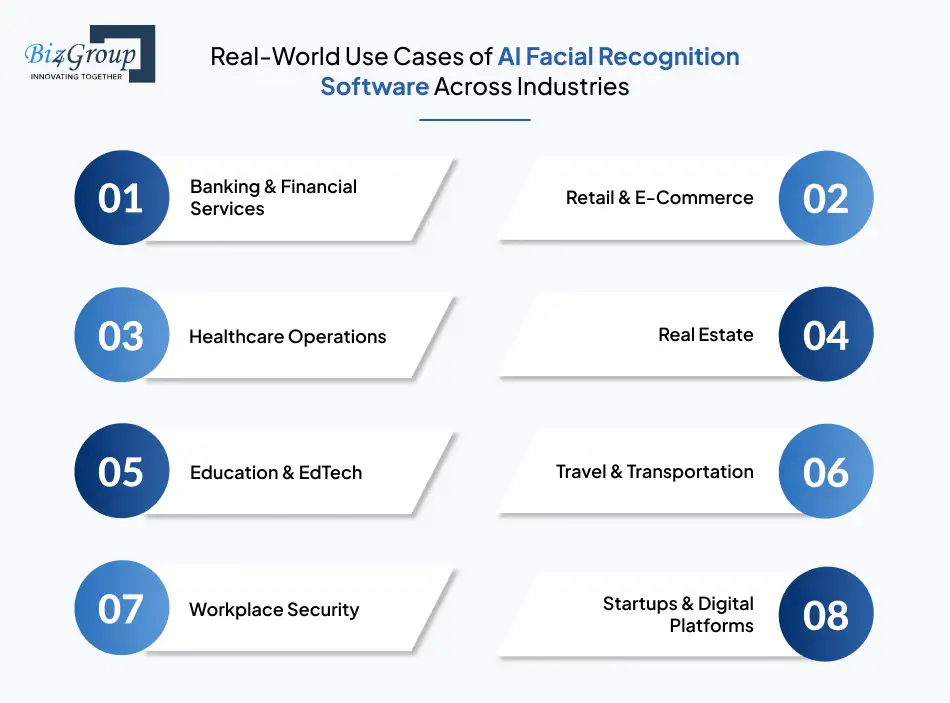
Businesses implement facial recognition when identity verification must happen inside real operational moments. Across industries, AI Facial Recognition Software Development supports scenarios where recognizing individuals quickly becomes part of everyday workflows rather than a separate security step.
1. Banking & Financial Services
- Mobile Banking Login: Banking applications verify users during login by matching a live facial scan. This is done with registered identity data before allowing access to personal financial dashboards built through AI face recognition system development.
- High-Value Transactions: Financial platforms require AI facial verification when users initiate large fund transfers or modify sensitive account settings from new devices or unfamiliar locations. This allows them to minimize and detect fraud payments done through different financial channels and platforms.
- Remote Account Opening: Digital banking apps confirm customer identity during online account registration by validating facial images against submitted identity documents before activating accounts.
Also Read: How to Develop Agentic AI in Banking
2. Retail & E-Commerce
- Customer Account Access: Online retail platforms authenticate returning users at login, helping platforms that build an AI app confirm account ownership before displaying saved payment methods or order history.
- Automated Store Entry: Smart retail environments recognize registered shoppers at store entrances to enable app-linked shopping sessions without manual identity checks.
- Self-Checkout Authentication: Retail kiosks verify shopper identity during checkout when digital wallets or subscription-based purchasing systems are used for payment authorization.
Also Read: Retail AI Agent Development: Automate Sales & Service
3. Healthcare Operations
- Patient Registration: Hospitals confirm patient identity during check-in using AI facial scans to retrieve correct medical records without relying on physical ID verification.
- Treatment Verification: Healthcare staff validate patient identity before procedures or consultations with trained AI model to ensure treatment is administered to the correct individual.
- Medical Portal Access: Healthcare applications authenticate patients accessing digital health portals to securely display prescriptions, reports, and appointment information.
Also Read: How to Build Agentic AI in Healthcare
4. Real Estate
- Resident Entry Management: Residential communities verify residents at building entrances through AI facial recognition, while an AI real estate assistant records verified access and manages visitor approvals during daily property operations.
- Digital Property Tours: Agencies using AI for real estate verify prospective buyers before granting access to scheduled smart property tours, ensuring only registered visitors enter listed properties.
- Lease Registration Verification: Real estate platforms confirm tenant identity during digital lease signing by matching facial scans with submitted identification before activating rental agreements.
Also Read: Agentic AI Platform Development for Real Estate Businesses
5. Education & EdTech
- Classroom Attendance: Educational institutions verify student presence during classroom entry using AI facial recognition. This allows AI teaching assistant to automatically record attendance linked to student learning systems.
- Online Exam Authentication: EdTech platforms authenticate students before remote examinations by matching live facial scans with registered learner profiles to confirm verified participation.
- Campus Facility Access: Universities validate student and staff identity at libraries and laboratories through facial recognition checkpoints that allow entry only to authorized individuals.
Also Read: A Complete Guide on AI Study Companion App Development
6. Travel & Transportation
- Airport Check-In: Airlines verify passenger identity at self-service kiosks through AI facial scans linked with booking and passport records before issuing boarding access.
- Boarding Gate Validation: Passengers are authenticated at boarding gates using facial recognition to confirm identity against flight records. This enables airlines to handle large traveler volumes without manual document checks when they develop scalable AI facial recognition platforms.
- Border Control Screening: Immigration checkpoints verify traveler identity by matching live AI facial data with government databases during entry and exit procedures.
Also Read: How to Build an AI Travel Agent
7.Workplace Security
- Office Entry Authentication: Organizations verify employees at building entrances using AI facial recognition systems that grant access based on registered identity permissions.
- Attendance Recording: Workplaces log employee attendance automatically when individuals enter premises, replacing manual sign-in or card-based tracking systems.
- Restricted Zone Access: Facilities confirm authorized personnel before allowing entry into controlled environments such as data centers or research laboratories.
8. Startups & Digital Platforms
- User Onboarding Verification: Digital platforms deploy AI facial recognition software for startups and enterprises to verify new users during registration before enabling platform access.
- Password Recovery Validation: Applications verify identity through AI facial recognition when users request account recovery after failed login attempts.
- Creator Platform Authentication: Content or marketplace platforms confirm creator identity before granting access to monetization features or publishing controls.
AI Facial recognition use cases differ across industries, yet each scenario applies identity verification exactly where operational interaction occurs. AI facial recognition software development enables organizations to embed recognition directly into real processes rather than treating security as a separate workflow.
Development Approaches: Build vs Integrate vs Customize AI Facial Recognition Solutions
Organizations planning AI Facial Recognition Software Development often face an early strategic decision. The development approach directly affects scalability, cost, flexibility, and long-term ownership of the recognition system. Understanding when to build, integrate, or customize helps businesses align technology decisions with operational goals instead of short-term convenience.
1. Build From Scratch
Building a system from the ground up provides complete ownership over architecture and workflows. This approach works well when identity verification is central to the product or security model.
- Full control over recognition logic and data handling
- Greater flexibility to create facial recognition software with AI for identity verification tailored to unique workflows
- Easier long-term scalability without platform limitations
- Higher initial investment and longer development timelines
Organizations typically follow this approach when differentiation and system independence are critical business priorities.
2. Integrate Existing Facial Recognition APIs
Integration focuses on connecting third-party recognition services into an existing application. It allows businesses to introduce facial verification quickly without developing core recognition components internally.
- Faster implementation and reduced upfront development effort
- Pre-built recognition capabilities managed by external providers
- Suitable for testing market demand or limited verification use cases
- Less flexibility in customization and performance tuning
This approach fits businesses that need rapid deployment while validating operational feasibility before deeper investment.
3. Customize an Existing Solution
Customization sits between building and integrating. Businesses adapt an existing framework while tailoring workflows, interfaces, and verification logic to operational needs.
- Balanced control without starting development from zero
- Ability to build custom AI facial recognition system for multiple industries with adaptable configurations
- Faster deployment compared to full custom builds
- Supports gradual expansion as requirements evolve
- Customization works best when organizations need flexibility but also want predictable development timelines.
The right development path depends on how deeply facial recognition connects with business operations. Aligning approach selection with long-term goals ensures the system remains scalable, practical, and sustainable as adoption grows.
Also Read: Top 20 Facial Recognition Software in 2026
Build it wrong once, rebuild it forever.
Not sure whether to build, integrate, or customize? A short architecture conversation can save months of rework later.
Discuss Your Development ApproachKey Features Required to Develop AI Facial Recognition System
A reliable recognition platform requires more than adding face detection to an application. Teams focus on essential features that support stability and performance when organizations build custom AI facial recognition system for multiple industries.
|
Key Feature |
What It Enables |
|---|---|
|
Face Detection |
Identifies and isolates human faces from images or live video before recognition begins, ensuring the system focuses only on relevant visual data. |
|
Facial Landmark Mapping |
Analyzes facial points such as eyes, nose, and jawline to create structured identity patterns used for consistent recognition across sessions. |
|
Face Encoding |
Converts facial characteristics into numerical representations that allow fast comparison without storing raw facial images directly. |
|
Identity Matching Engine |
Compares captured facial data with stored records and determines whether identities match based on predefined accuracy thresholds. |
|
Liveness Detection |
Confirms that the system interacts with a real person instead of photos, videos, or spoofing attempts during authentication processes. |
|
Multi-Device Compatibility |
Allows recognition to function across mobile devices, webcams, kiosks, and surveillance cameras without requiring separate system logic. |
|
Real-Time Processing |
Enables instant identity verification during live interactions such as entry authentication, onboarding, or transaction approvals. |
|
Secure Data Storage |
Protects facial templates and identity records through encrypted storage and controlled access permissions. |
|
Role-Based Access Control |
Grants or restricts system actions based on user roles, ensuring identity verification aligns with operational authorization policies. |
|
Performance Monitoring |
Tracks recognition accuracy, processing speed, and system activity to help teams maintain consistent performance over time. |
|
API Integration |
Connects recognition capabilities with existing applications, allowing businesses to extend identity verification into broader digital workflows. |
|
Compliance-Ready Architecture |
Supports audit logging and consent management so organizations can develop AI facial recognition software with compliance in mind from the initial design stage. |
Successful systems balance recognition accuracy with operational reliability. Organizations planning AI facial recognition software development prioritize feature readiness early so they can scale securely as adoption expands.
Advanced Features That Differentiate Your AI Facial Recognition System
When businesses develop real time facial recognition systems, advanced features become the differentiating layer that supports adaptability, reliability, and decision accuracy. In AI facial recognition software development, advanced features help organizations create solutions that perform consistently across real environments and evolving operational demands.
|
Advance Features |
What Makes it Different |
|---|---|
|
Adaptive Learning |
The system improves recognition accuracy over time by learning from new facial inputs and environmental variations without requiring repeated manual adjustments. |
|
Cross-Device Recognition |
Maintains consistent identity matching across mobile cameras, kiosks, surveillance systems, and web applications without retraining the entire recognition setup. |
|
Interprets facial expressions to understand user sentiment during interactions, helping systems respond appropriately in scenarios such as customer verification or assisted service environments. |
|
|
Mask & Occlusion Detection |
Recognize individuals even when faces are partially covered by masks, glasses, or accessories by focusing on available facial landmarks. |
|
Multi-Face Tracking |
Identifies and tracks multiple individuals simultaneously in crowded environments while maintaining accurate identity separation. |
|
Edge Processing Capability |
Processes recognition directly on local devices, reducing latency and enabling faster responses where constant cloud connectivity is not practical. |
|
Analyzes recognition patterns over time to anticipate identity risks or repeated access behaviors, allowing systems to prepare verification actions before suspicious activity escalates. |
|
|
Context-Aware Recognition |
Adjusts recognition sensitivity based on environment conditions such as lighting changes, camera angles, or movement intensity to maintain stable performance. |
Advanced capabilities often determine how effectively organizations build AI powered facial recognition software that performs beyond controlled testing conditions. Teams frequently hire AI developers to refine these features, so systems remain practical, adaptable, and ready for real-world operational complexity.
Basic recognition works but intelligent recognition wins.
Advanced capabilities decide whether your system survives real-world usage or fails under scale and edge cases.
Upgrade Your Recognition StrategyStep-by-Step Process to Build AI Powered Facial Recognition Software
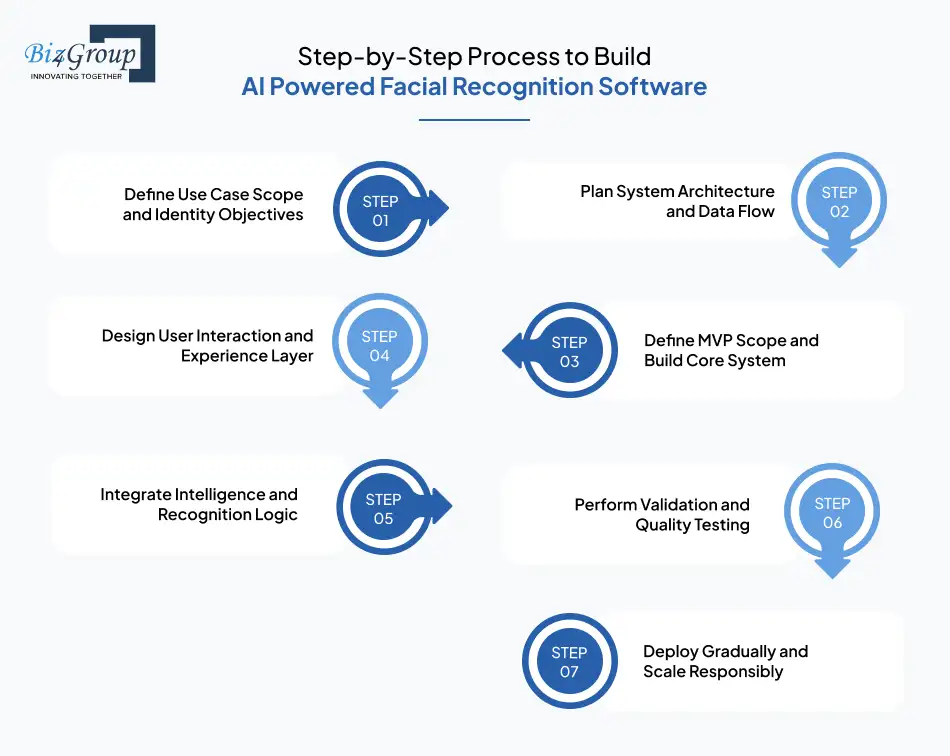
Building a reliable recognition platform requires structured execution rather than isolated feature development. During AI Facial Recognition Software Development, teams follow a phased approach that helps organizations create AI driven face recognition platform solutions aligned with real operational goals.
Step 1: Define Use Case Scope and Identity Objectives
Start by identifying where facial recognition will operate and what identity problems it must solve. Clear direction prevents unnecessary development efforts later.
- Target industry workflows and verification scenarios
- User roles and access requirements
- Security expectations and operational goals
- Deployment environments such as mobile, kiosk, or web
Clear scope ensures development decisions remain aligned with practical outcomes.
Step 2: Plan System Architecture and Data Flow
Architecture planning determines how well the system scales over time. Design a structure that separates recognition logic, data handling, and application workflows.
- Recognition engine structure
- Secure identity data handling
- API communication layers
- Integration readiness for existing platforms
A modular foundation allows future expansion without rebuilding core components.
Step 3: Define MVP Scope and Build Core System
Avoid building everything at once. A focused release validates recognition accuracy and workflow stability before scaling further. Teams often follow MVP software development practices to test assumptions early.
- Face detection and matching functionality
- Initial authentication workflows
- Limited user scenarios for validation
- Basic monitoring dashboards
Organizations frequently rely on MVP development services to accelerate early validation cycles while controlling development risks.
Also Read: Top 12+ MVP Development Companies
Step 4: Design User Interaction and Experience Layer
Recognition systems succeed when users interact with them naturally. Partnering with a UI/UX design company helps you focus on making verification simple while keeping identity checks clear and intuitive.
- Guided facial capture screens
- Clear feedback during verification
- Responsive layouts across devices
- Admin interfaces for identity management
A well-structured interface reduces confusion during real usage.
Also Read: Top UI/UX design companies in USA
Step 5: Integrate Intelligence and Recognition Logic
Once the core system works reliably, teams integrate AI models to strengthen recognition accuracy and automate identity decisions without increasing complexity.
- Facial pattern learning workflows
- Identity confidence scoring
- Automated verification responses
- Adaptive recognition improvements
This stage refines how the system responds to real user behavior.
Step 6: Perform Validation and Quality Testing
Before deployment, every workflow must be validated under realistic conditions. Many organizations collaborate with a software testing company to verify stability, accuracy, and system reliability.
- Identity matching accuracy checks
- Performance under peak usage
- Security validation scenarios
- Workflow consistency testing
Structured testing ensures readiness for production environments.
Step 7: Deploy Gradually and Scale Responsibly
Launch should happen in controlled stages instead of full activation immediately. Early monitoring helps teams identify improvements before expanding system usage.
- Phased rollout across environments
- Performance monitoring after launch
- Infrastructure adjustments based on usage
- Gradual expansion to new workflows
Measured deployment protects system stability while adoption grows.
A structured approach helps organizations build AI powered facial recognition system for security environments without unnecessary redesign later. Teams that follow disciplined execution create scalable platforms capable of evolving alongside operational and regulatory requirements.
Compliance, Privacy, and Ethical Considerations in AI Facial Recognition Software Development
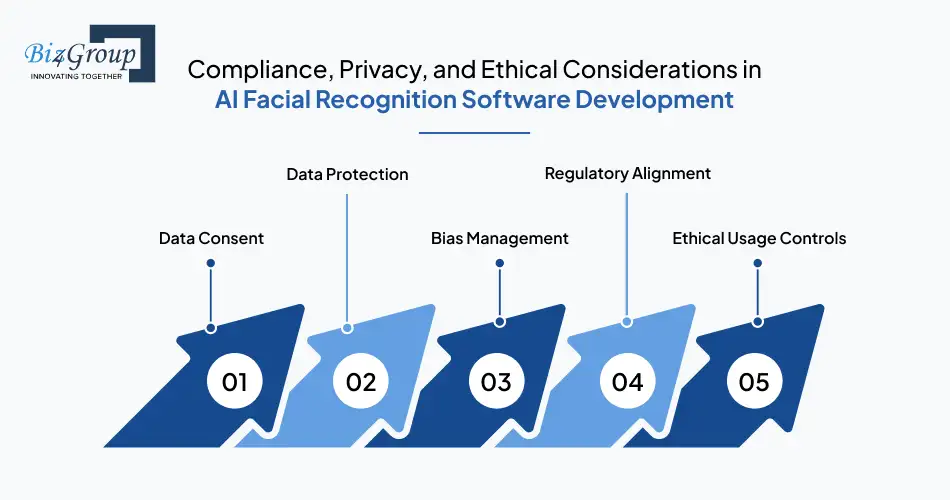
Responsible deployment begins with clear safeguards around how identity data is collected and used. In AI Facial Recognition Software Development, organizations must address compliance, privacy expectations, and ethical responsibilities early to build trust alongside technical capability.
1. Data Consent
- User Permission: Systems must obtain clear user consent before capturing facial data, ensuring individuals understand how their identity information will be used, stored, and processed within the application environment.
- Transparent Policies: Privacy notices should explain data usage in simple language, so users know when facial recognition is active and what actions trigger identity verification processes.
2. Data Protection
- Secure Storage: Facial templates should be encrypted and stored securely to prevent unauthorized access, reducing risks associated with identity misuse or data exposure incidents.
- Limited Retention: Organizations should define how long facial data remains stored, automatically removing information once verification purposes or regulatory timelines are completed.
3. Bias Management
- Dataset Diversity: Recognition systems must be trained using diverse facial datasets to reduce accuracy gaps across age groups, ethnicities, and environmental conditions during identity verification.
- Performance Monitoring: Continuous evaluation helps identify recognition inconsistencies so teams can refine system behavior and maintain fair outcomes across all users.
4. Regulatory Alignment
- Regional Compliance: Systems should align with regional privacy laws and identity regulations, ensuring deployment meets legal requirements across countries or industry sectors handling sensitive user information.
- Audit Readiness: Maintaining verification logs and consent records helps organizations demonstrate compliance during inspections or regulatory reviews.
5. Ethical Usage Controls
- Purpose Limitation: Facial recognition should operate only for clearly defined use cases, preventing misuse beyond originally approved identity verification objectives.
- Human Oversight: Critical decisions involving identity verification should allow human review when uncertainty occurs, helping maintain accountability in automated workflows.
Organizations often rely on AI consulting services to define responsible governance frameworks before deployment begins. Strong privacy planning allows teams to build biometric facial recognition software responsibly while ensuring long-term adoption, regulatory readiness, and sustainable deployment confidence.
Compliance isn’t a checklist. It’s architecture.
Privacy decisions made today determine whether your platform scales smoothly or faces costly redesigns tomorrow.
Build Responsibly From Day OneTechnology Stack Considerations to Develop AI Facial Recognition Software
A dependable recognition platform relies on coordinated technologies working across interfaces, processing layers, and infrastructure. In AI facial recognition software development, teams apply full stack development practices to ensure facial recognition workflows operate reliably from user interaction to backend intelligence.
|
Architecture Layer |
Technology Used |
Purpose |
|---|---|---|
|
Frontend Interface |
React.js |
Handles user interaction during facial capture and verification. ReactJS development supports responsive layouts that guide users clearly through identity authentication steps. |
|
Server Rendering Layer |
Next.js |
Manages fast page delivery and secure session handling. NextJS development helps applications maintain smooth verification experiences during real-time identity interactions. |
|
Backend API Layer |
Node.js |
Processes authentication requests and system communication. NodeJS development enables efficient handling of identity verification workflows between frontend interfaces and recognition services. |
|
AI Processing Layer |
Python |
Executes facial recognition logic and data preparation tasks. Python development supports model execution and accurate identity matching during recognition operations. |
|
Model Serving Layer |
TensorFlow Serving / ONNX Runtime |
Runs trained recognition models in production environments. It enables the system to process facial verification requests consistently without interrupting application performance. |
|
Recognition Engine |
OpenCV / PyTorch |
Detects facial landmarks and generates identity patterns used to compare captured faces with stored recognition data during authentication workflows. |
|
Vector Database |
FAISS / Milvus |
Store facial embeddings as numerical identity signatures. This allows fast similarity searches when matching faces against registered user records. |
|
Object Storage |
AWS S3 / Cloud Storage |
Securely stores captured images and verification data required for audit tracking and system validation processes. |
|
Cloud Infrastructure |
AWS / Azure / GCP |
Provides scalable computing resources that support fluctuating verification demand while maintaining availability across deployment environments. |
|
Monitoring & Analytics |
Prometheus / Grafana |
Tracks system accuracy, performance behavior, and operational health to ensure recognition reliability remains consistent after deployment. |
|
Security Layer |
OAuth / JWT |
Protects identity workflows by managing secure access permissions between users, applications, and recognition services during authentication processes. |
|
Edge Processing |
TensorRT / Edge SDKs |
Enables facial recognition processing directly on devices to reduce response time and support real-time verification in distributed environments. |
Technology decisions influence how well recognition systems perform outside controlled environments. Teams planning facial recognition application development with AI focus on balanced architecture choices. AI face recognition system development succeeds when scalability, security, and performance remain aligned from the beginning.
Cost to Develop AI Facial Recognition Software
Understanding the development cost begins with recognizing that pricing depends on system complexity, deployment scale, and feature depth. In AI facial recognition software development, businesses typically invest between $40,000 and $350,000+, depending on functionality, accuracy requirements, and long-term scalability goals.
|
Development Level |
Estimated Cost Range |
What This Typically Covers |
|---|---|---|
|
MVP Level Solution |
$40,000 – $85,000 |
Core face detection, basic identity matching, limited integrations, controlled user workflows, and validation-ready functionality used to test real-world feasibility before scaling. |
|
Mid-Level Platform |
$85,000 – $170,000 |
Improved recognition accuracy, real-time verification workflows, dashboard controls, API integrations, enhanced security layers, and support for multiple operational environments. |
|
Advanced Enterprise System |
$170,000 – $350,000+ |
High-scale infrastructure, adaptive learning capabilities, compliance-ready architecture, multi-device deployment, analytics monitoring, and optimized performance across large user bases. |
Cost differences become clearer when you examine what directly influences development effort and long-term maintenance requirements.
Key Factors That Shape Facial Recognition Development Costs
- Use Case Scope: Broader verification scenarios increase development effort because workflows, permissions, and identity handling rules must support multiple operational environments.
- Recognition Accuracy Needs: Higher accuracy requires more training data preparation, validation cycles, and optimization work during system refinement.
- AI Integration Complexity: Connecting recognition software with existing applications, access systems, or databases increases engineering time, AI integration costs and testing requirements.
- Infrastructure Scale: Systems handling large user volumes require stronger cloud resources and performance optimization, raising both development and operational investment.
- Compliance Requirements: Regulatory alignment adds effort through audit logging, consent handling, and privacy safeguards integrated during development stages.
- User Experience Design: Well-designed verification flows require thoughtful UI decisions to ensure users complete identity checks smoothly without confusion.
Smarter planning often reduces unnecessary spending without limiting system capability or long-term scalability.
Practical Ways to Control Development Investment
- Start With Focused Scope: Launch with essential verification workflows before expanding advanced capabilities across additional use cases.
- Adopt Modular Architecture: Build systems in independent layers, so future upgrades do not require rebuilding core components.
- Validate Early Through MVP: Early testing prevents large redesign costs by confirming assumptions before full-scale implementation.
- Reuse Existing Infrastructure: Integrating with current platforms lowers development effort compared to building everything from scratch.
- Prioritize High-Impact Features: Invest first in capabilities that directly support identity verification rather than adding secondary enhancements early.
- Work With Experienced Teams: Organizations that build AI software with experienced specialists often reduce costly iteration cycles caused by architectural mistakes.
Careful planning helps organizations build AI-powered facial recognition software aligned with business goals while controlling investment risk. Teams that create facial recognition software using AI through phased execution achieve predictable costs and scalable outcomes without unnecessary redevelopment later.
Also Read: AI Software Development Cost
Overpaying usually starts with unclear scope.
Understand what truly drives development cost before budgets expand and timelines stretch beyond expectations.
Get a Realistic Cost EstimateTurning AI Facial Recognition into Revenue: Business and Monetization Models
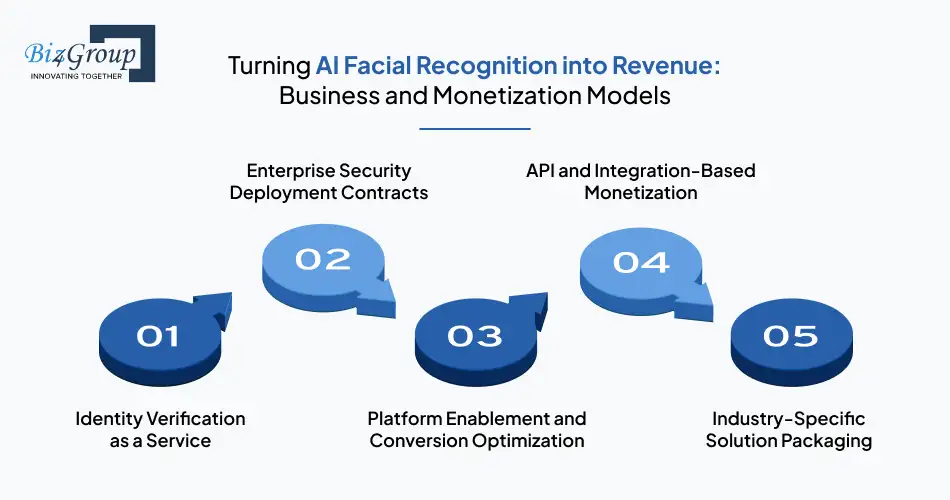
Revenue generation for businesses begins when facial recognition moves from being a technical feature to a business capability embedded into operational workflows. In AI facial recognition software development, organizations monetize identity intelligence by aligning verification systems with measurable business outcomes and service delivery models.
1. Identity Verification as a Service
Many companies generate revenue by offering identity verification as an ongoing service rather than selling standalone software. Businesses integrate AI facial recognition into onboarding and authentication of workflows used by other organizations.
- Charge per verification or onboarding request
- Offer subscription access for continuous identity validation
- Provide compliance-ready verification services for regulated industries
This model works effectively when organizations create facial recognition software with AI for identity verification across finance, healthcare, and digital platforms.
2. Enterprise Security Deployment Contracts
AI Facial recognition often becomes part of larger security infrastructure projects where revenue comes through implementation and long-term operational agreements.
- Deployment fees for enterprise or facility-wide systems
- Annual maintenance and monitoring contracts
- Managed identity verification services
Organizations that build AI powered facial recognition system for security environments commonly adopt this model to support airports, campuses, and commercial properties.
3. Platform Enablement and Conversion Optimization
Some businesses monetize facial recognition indirectly by improving operational efficiency and customer conversion outcomes within their own platforms.
- Faster onboarding leading to increased user acquisition
- Reduced fraud losses improving revenue retention
- Seamless authentication supporting repeat usage
AI facial recognition strengthens digital workflows, allowing businesses to generate revenue through improved platform performance rather than direct technology sales.
4. API and Integration-Based Monetization
Technology providers expose AI facial recognition capabilities through APIs that other platforms integrate into their applications. Revenue scales as adoption grows across partner ecosystems.
- Usage-based pricing tied to verification volume
- SDK licensing for external developers
- Integration fees for enterprise platforms
These models often evolve alongside broader business app development using AI initiatives where identity verification becomes a reusable platform capability.
5. Industry-Specific Solution Packaging
Organizations frequently package AI facial recognition into vertical solutions tailored to industry workflows instead of offering generic technology products.
- Workforce attendance and access management systems
- Real estate entry and tenant verification platforms
- Education exam authentication solutions
Vertical packaging allows providers to deliver complete operational solutions, making monetization clearer for buyers adopting identity-driven systems.
Revenue potential increases when facial recognition aligns with operational value rather than technical novelty. Businesses that structure monetization early build sustainable models that scale alongside adoption while maintaining user trust and long-term commercial viability.
Also Read: 65+ Software Ideas for Entrepreneurs and Small Businesses
Challenges Businesses Face When Developing Facial Recognition Systems
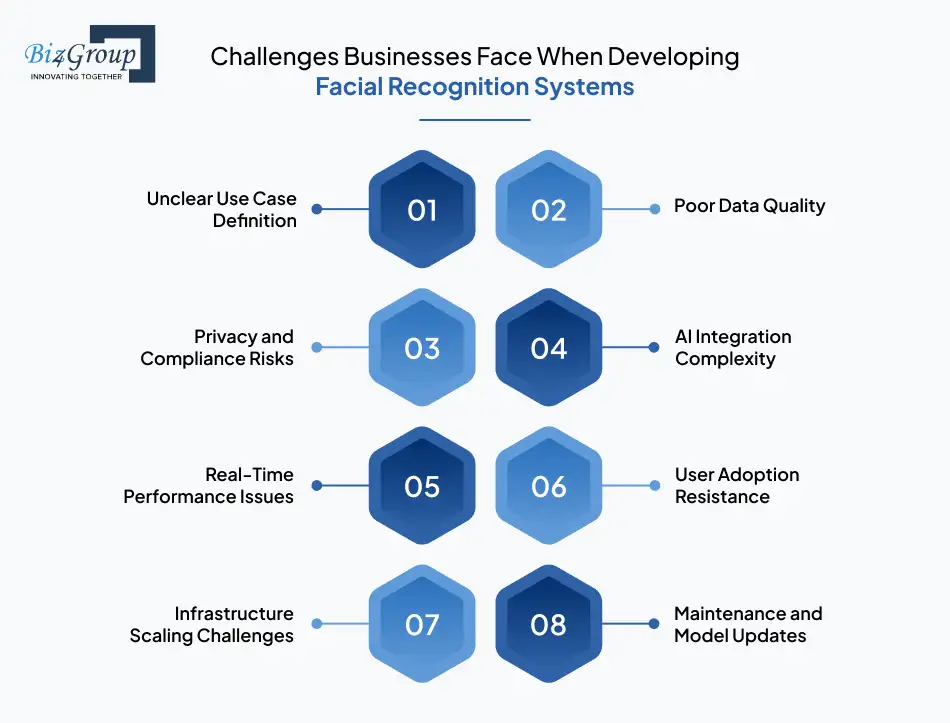
Building reliable identity recognition solutions involves more than technical implementation. During AI Facial Recognition Software Development, organizations often encounter operational and planning obstacles that influence performance, adoption, and long-term scalability when attempting custom AI facial recognition software development.
|
Challenges |
How to Avoid It |
|---|---|
|
Unclear Use Case Definition |
Define verification scenarios early, so development focuses on real operational workflows instead of adding unnecessary features that increase complexity. |
|
Poor Data Quality |
Use diverse and well-structured facial datasets to improve recognition consistency and prevent accuracy issues caused by limited environmental or demographic representation. |
|
Privacy and Compliance Risks |
Establish consent management and secure data handling policies from the beginning rather than attempting compliance adjustments after deployment. |
|
AI Integration Complexity |
Plan system integration early, so facial recognition connects smoothly with existing applications instead of creating isolated identity workflows. |
|
Real-Time Performance Issues |
Optimize infrastructure and processing pipelines before scaling to ensure systems can develop real-time facial recognition systems without delays during active usage. |
|
User Adoption Resistance |
Design clear verification experiences that guide users naturally, reducing confusion or hesitation during identity authentication processes. |
|
Infrastructure Scaling Challenges |
Use modular architecture that allows gradual expansion instead of rebuilding systems when user volume increases. |
|
Maintenance and Model Updates |
Continuously monitor system performance using AI automation tools to identify accuracy changes and maintain reliable recognition outcomes over time. |
Organizations that anticipate these obstacles early can plan mitigation strategies that reduce risk and improve deployment confidence. Teams approaching custom AI facial recognition software development with structured execution avoid costly redesign cycles while maintaining consistent performance as adoption grows.
Why Is Biz4Group the Right Technology Partner for AI Facial Recognition Software Development?
Organizations investing in AI Facial Recognition Software Development look for partners who can translate complex identity requirements into dependable systems. As a software development company in Florida, Biz4Group LLC focuses on practical execution, helping businesses implement secure recognition platforms aligned with operational needs rather than experimental technology adoption.
1. Experience Translating Business Requirements into Working Systems
AI Facial recognition projects succeed when technical decisions reflect real operational workflows. Our teams work closely with startups and enterprises to understand how identity verification fits daily processes before development begins.
This approach ensures recognition systems integrate naturally into business environments instead of creating additional operational friction. The focus remains on delivering solutions that function reliably under real usage conditions.
2. Engineering Discipline Built Around Compliance and Stability
We approach AI facial recognition development with a strong emphasis on stability and responsible data handling from the earliest stages. Identity systems require consistent performance, so architecture decisions prioritize reliability, structured validation, and predictable behavior under real usage conditions.
This execution-focused approach positions the team as an AI development company capable of delivering production-ready recognition systems that remain reliable as operational demands grow.
3. End-to-End Ownership Across the Development Lifecycle
Projects move faster when accountability remains clear. Biz4Group manages planning, engineering, validation, and deployment under a unified delivery process that keeps progress transparent for stakeholders.
This structured ownership allows businesses to scale confidently while maintaining alignment between product goals and technical execution throughout development stages.
4. Demonstrated Delivery Backed by Real Project Experience
Decision-makers rely on proven execution rather than theoretical capability. Our portfolio reflects experience delivering scalable platforms designed to handle sensitive data, automated workflows, and high user interaction volumes.
Industry discussions around building an AI face recognition app often highlight implementation complexity. Our experience helps organizations approach development with realistic planning and measurable expectations.
5. Custom Solutions Designed for Long-Term Adaptability
At Biz4Group LLC, facial recognition solutions are designed around how businesses actually operate rather than predefined templates. Every engagement begins by aligning verification workflows with client-specific operational needs, ensuring systems remain adaptable as regulations evolve, and user adoption increases.
Instead of rebuilding platforms when requirements change, our teams structure solutions so features can expand gradually. This approach helps organizations implement recognition systems that continue delivering value long after initial deployment without disrupting ongoing operations.
You don’t need more vendors; you need the right execution.
If you’re serious about deploying facial recognition that actually works in production, let’s talk about your next step.
Talk to Biz4Group ExpertsAI Facial Recognition Software Development for Startups and Enterprises: Final Thoughts
AI facial recognition software development is not limited to large enterprises only. Startups and growing businesses are adopting identity-driven systems to build trust early, reduce fraud risks, and create smoother digital experiences. Working with an experienced AI product development company helps organizations translate verification goals into reliable systems that scale alongside user growth instead of requiring repeated redesign.
For startups, facial recognition supports faster onboarding and operational efficiency without expanding manual processes. Enterprises focus on integrating recognition into broader platforms, where AI business app development connects identity verification with existing workflows, security layers, and customer interactions already in place.
Organizations evaluating the best companies for AI facial recognition software development often prioritize long-term reliability over quick deployment. Businesses investing in custom AI facial recognition development services gain sustainable identity infrastructure that evolves with changing needs. If you are planning your next step toward secure digital experiences, talk to us.
FAQ’s
1. What is AI Facial Recognition Software Development and how does it work for businesses?
AI facial recognition software development involves creating systems that identify or verify individuals using facial data instead of passwords or manual checks. Businesses use it to enable secure authentication, automate identity verification, and improve operational efficiency across digital and physical environments.
2. How can enterprises develop AI facial recognition system solutions that scale securely?
Enterprises typically start by defining verification use cases, designing scalable architecture, and integrating recognition into existing platforms. A structured approach ensures systems remain reliable while supporting growing user volumes and evolving compliance requirements.
3. What industries benefit most from AI facial recognition software for startups and enterprises?
Industries such as banking, healthcare, retail, government services, travel, and workplace security benefit significantly. These sectors rely on fast and accurate identity verification to reduce fraud, improve access control, and streamline user onboarding experiences.
4. How much does AI facial recognition software development cost for enterprise-grade solutions?
The cost usually ranges from $40,000 to $350,000+, depending on system complexity, accuracy requirements, integrations, and deployment scale. MVP solutions cost less, while advanced platforms with real-time verification and compliance features require higher investment.
5. How do organizations build AI powered facial recognition software for security and identity verification?
Organizations combine facial detection models, secure data storage, real-time processing, and compliance safeguards to create facial recognition software with AI for identity verification. Successful implementations focus on usability, accuracy, and seamless workflow integration.
6. How to choose an AI facial recognition development partner or the best companies for AI facial recognition software development?
Businesses should evaluate domain experience, compliance expertise, scalability approach, and proven delivery capability. The right partner provides custom AI facial recognition development services aligned with operational goals rather than offering generic technology implementations.
