Location :
Orlando, FL, USA
Location :
Orlando, FL, USA +1 (407) 714-1616
 info@biz4group.com

- AI medical claim processing software development helps healthcare organizations automate claim intake, validation and routing for faster and more predictable reimbursements.
- Businesses can develop AI medical claim processing systems to reduce denials, improve coding accuracy and streamline daily billing operations.
- Teams that create AI medical claims automation platforms gain strong features such as OCR, NLP coding support, denial prediction, payer rule validation and real-time reconciliation.
- Costs range widely based on scope, with MVP, advanced and enterprise options available for custom AI medical claim processing development services.
- Biz4Group LLC stands out as the partner that delivers fast MVPs, scalable architectures and enterprise grade solutions tailored for real healthcare workflows.
Nearly one in five respondents (17%) said their insurance plan has denied coverage for a doctor-recommended medical service or procedure according to a recent report by the Commonwealth Fund. This reality has pushed many healthcare leaders to explore AI medical claim processing software development as a lasting solution.
Many healthcare organizations still run on outdated billing workflows that slow revenue cycles and frustrate staff. This is why leaders are now turning toward AI medical claim processing software development services that take over repetitive claim work and bring order to scattered billing tasks.
Billing teams know how stressful manual data entry and back and forth resubmissions can be. The constant pressure to work faster often leads to coding errors and missed payer updates. This is where you can develop AI medical claim processing systems that support staff with intelligent automation and help improve claim accuracy from day one.
Healthcare businesses want better cash flow, fewer denials, and a structured way to scale their claim operations without hiring endlessly. With this in mind, the next sections will show you how to build AI powered medical claims software that fits modern healthcare workflows and supports future growth.
What is AI Medical Claim Processing Software Development and How It Works?
Healthcare leaders often hear about automation, yet few get a clear picture of how these systems actually function. AI medical claim processing software development focuses on building digital tools that simplify repetitive claim tasks and support billing teams with cleaner data and faster reimbursements.
To explain it more clearly, here is a simple view of the core components that help create AI medical claims automation platforms.
|
Component |
What It Handles |
How It Helps |
|---|---|---|
|
OCR and Document AI |
Reads claim forms, EOBs, lab reports and billing documents |
Cuts manual data entry and reduces clerical errors |
|
NLP Engine |
Interprets medical terms, codes, diagnoses and procedures |
Makes coding cleaner and improves claim accuracy |
|
Rules Engine |
Checks claims against payer policies and internal guidelines |
Lowers denial risks with consistent validation |
|
Machine Learning Models |
Predicts denial chances and flags missing information |
Helps billing teams avoid revenue loss proactively |
|
EDI Layer |
Handles 837 submissions and 835 responses |
Speeds up payer communication and reconciliation |
These components support billing teams that want to develop AI medical claim processing systems with reliable automation and predictable results.
How an AI Claim System Works in Daily Operations
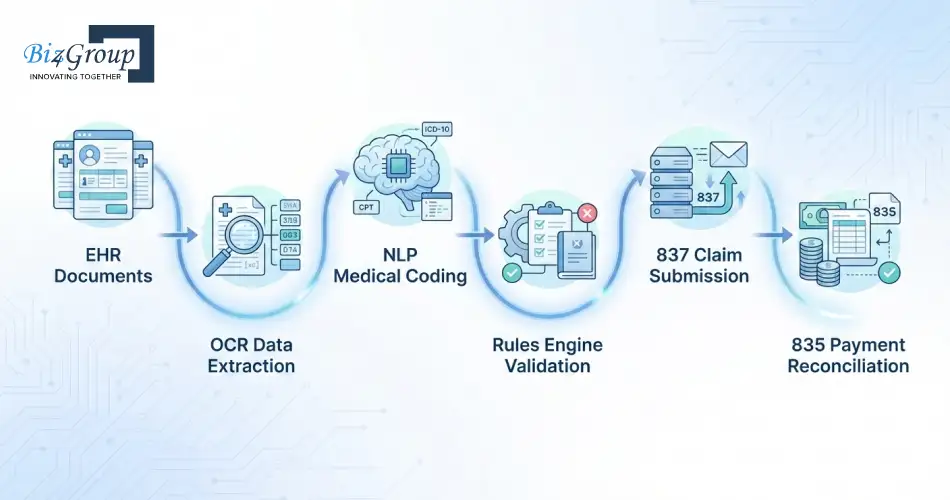
Here is a simple walkthrough to show how the process functions in real life.
- The system receives documents from EHRs or uploads
- OCR extracts the data
- NLP understands the medical coding context
- The rules engine validates it against payer requirements
- The platform submits the 837 file
- The 835 response flows back into the system for reconciliation
This workflow helps healthcare teams create AI-driven healthcare claims platforms that remove confusion from billing operations and make day to day work smoother. Many hospitals and billing companies adopt this approach because it improves speed and strengthens accuracy.
Why Businesses Are Investing in AI Medical Claim Processing Software Development Today
Healthcare billing complexity has risen sharply. Denials, coding errors and repetitive documentation tasks slow down reimbursements. Billing teams experience more workload while cash flow becomes less predictable.
A report shows that US health care administrative spending is approximately $1 trillion annually. This upward trend encourages many organizations to adopt solutions that reduce these inefficiencies.
Key Pain Points That AI Can Address
Healthcare executives and revenue cycle leaders explore automation because they want long term stability in financial operations. Here are some challenges they face each day.
- High denial rates with growing payer rules
- Manual entry errors due to repetitive tasks
- Slow reimbursements that limit cash flow
- Limited visibility into claim performance
- Rising operational burden on billing teams
- Difficulty scaling claim volume without large hiring plans
These points create a strong case for those who want to develop AI medical claim processing systems that bring accuracy and consistency to daily workflows.
Business Benefits of Modern Claim Automation
Healthcare organizations aim to support faster reimbursements, predictable operations and improved financial stability. When they build AI-powered medical claims software that supports these goals, they see immediate and lasting advantages.
|
Business Goal |
How AI Helps |
Impact |
|---|---|---|
|
Reduce Denials |
Automated validation and updated payer rules |
Fewer resubmissions and stronger revenue protection |
|
Improve Cash Flow |
Faster submission and reconciliation workflows |
Quicker reimbursements and better forecasting |
|
Increase Team Productivity |
Automation of repetitive tasks |
Staff can focus on complex cases and patient support |
|
Scale Operations |
AI handles growing claim volumes |
Expansion without large increases in headcount |
|
Strengthen Compliance |
Built in review layers and audit trails |
Lower compliance related risks |
These benefits inspire healthcare organizations to create AI medical claims automation platforms that support efficiency across hospitals, clinics and billing networks.
The healthcare industry is moving toward digital transformation. Payer rules, interoperability standards and revenue cycle expectations continue to evolve. Leaders who create AI-driven medical claims automation platform solutions position their teams for predictable growth and stronger financial outcomes.
Stop Losing Revenue to Avoidable Denials
Claim denials still cost healthcare providers millions every year.
Optimize Your Claims with Biz4GroupUse Cases of AI Medical Claim Processing Software Development Across Healthcare
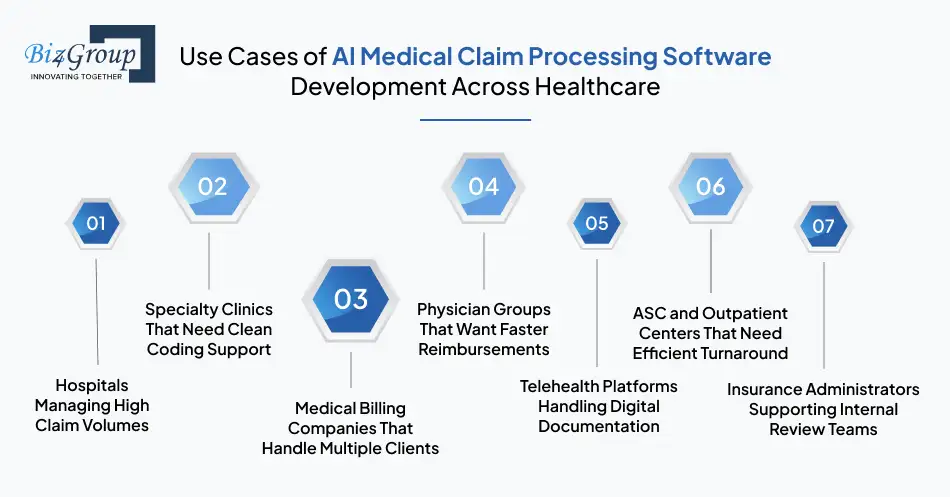
Healthcare organizations adopt AI automation services when they want cleaner workflows, fewer denials and faster reimbursements. AI medical claim processing software development supports these goals by improving accuracy and reducing repetitive tasks.
Below are the most practical use cases seen across hospitals, clinics and billing companies.
1. Hospitals Managing High Claim Volumes
Large hospitals work with thousands of claims daily. Staff often handle complex coding and documentation tasks under pressure. When leaders develop intelligent medical claims processing applications, they bring more structure to this workflow. Claims move faster from intake to submission. Staff get cleaner data and fewer surprises from payer rejections.
2. Specialty Clinics That Need Clean Coding Support
Orthopedic, cardiology, oncology and dermatology clinics often follow detailed coding guidelines. Small errors slow down revenue. When these clinics build AI powered medical claims software, they get real-time coding assistance that helps catch missing details. This support helps reduce denials and improves financial stability for specialty practices.
3. Medical Billing Companies That Handle Multiple Clients
Billing firms manage claims from different providers. Every provider has unique patterns and payer requirements. AI helps by standardizing these workflows. Teams that create AI-driven healthcare claims platforms can support many clients with the same accuracy level. This boosts output and reduces the cost per claim processed.
Also read: How to build an AI medical billing software?
4. Physician Groups That Want Faster Reimbursements
Independent physician groups want predictable cash flow. Manual claim handling slows this down. When they create AI driven medical claims automation platform solutions, they shorten the time between patient visits and payments. This helps improve financial planning for small and mid-sized groups.
Also read: AI assistant development guide for physicians
5. Telehealth Platforms Handling Digital Documentation
Telehealth providers work with digital notes and remote consultations. Manual claim filing for these records takes time. Automated systems help extract details from virtual visit notes. This improves accuracy and supports growth as visit volumes rise.
Also read: How to develop an AI-based telehealth automation system?
6. ASC and Outpatient Centers That Need Efficient Turnaround
Ambulatory surgery centers work with bundled payments, prior authorization and procedure heavy documentation. When these centers develop AI powered healthcare claims processing software, they minimize errors and improve payer communication. This helps improve turnaround for high value procedures.
7. Insurance Administrators Supporting Internal Review Teams
Insurance teams also benefit from automation. Claim validation and matching can be automated. Teams that build AI medical claim software with payer integration get reliable tools to review submissions, detect inconsistencies and strengthen compliance.
Also read: AI insurance software development guide
Each use case highlights a common goal. Organizations want accuracy, predictability and peace of mind. The next section will help you understand the essential features needed to support these goals.
Essential Features Required in Custom AI Medical Claim Software Development
When teams focus on AI medical claim processing software development, they aim to build a system that simplifies claim handling from intake to settlement. The table below highlights the core features that help billing teams improve accuracy and reduce denials.
|
Feature |
What It Is |
What It Does |
|---|---|---|
|
Automated Claim Intake |
A digital intake process for forms, EHR exports and uploaded documents |
Collects claim data without manual effort and centralizes all inputs |
|
OCR and Document AI |
Technology that reads structured and unstructured medical documents |
Extracts data from PDFs, scans and images to reduce typing errors |
|
NLP Based Coding Support |
A language model that understands medical terms and coding instructions |
Helps generate accurate CPT, ICD and HCPCS codes to reduce rework |
|
Claim Validation Engine |
A rule based checker that aligns claims with payer guidelines |
Flags missing information, incorrect codes and format issues before submission |
|
EDI 837 Submission Tool |
A system that formats and sends claim files in EDI compliant structure |
Speeds up submission and helps maintain consistency across payers |
|
EDI 835 Reconciliation |
Automated processing of remittance advice received from payers |
Updates claim status, identifies adjustments and simplifies reconciliation |
|
Denial Tracking Dashboard |
A unified view of all denied or pending claims |
Helps teams understand denial patterns and plan corrective action |
|
Audit Log and Compliance Tracking |
Built in tracking of user actions and data access |
Supports HIPAA compliance and reduces regulatory risks |
|
Role Based Access Control |
Multi-level permissions for admins, billers and managers |
Protects sensitive information and limits unauthorized access |
These features support billing teams that want to build AI medical claim management tool solutions that improve accuracy and create predictable workflows.
Advanced Features for Custom AI Medical Claim Software Development
Many healthcare organizations start with basic automation, but the real value appears when they add
advanced features that improve prediction, speed and decision making. These capabilities help teams
create AI medical claim automation tool solutions that support lasting growth.
Below are the
enhancements that bring the highest impact.
Predictive Denial Analytics
Billing teams often struggle to understand denial reasons. Predictive analytics helps solve this challenge. It learns patterns from past submissions and alerts teams before the claim goes out.
LLM Based Claim Summarization
Lengthy documents slow down billers. A summarization engine creates short claim summaries from charts, notes and reports. Staff review the information faster and reduce the chance of missing key details.
Automated Payer Policy Updates
Payer rules change constantly. Manual updates take time and increase risk. An automated policy engine pulls updates from payer sources and aligns the rules engine accordingly.
Anomaly and Fraud Detection
Unexpected patterns can mean incorrect billing or potential fraud. Anomaly and document fraud detection models analyze claim data and highlight entries that need human review.
Smart Workload Routing
Busy billing departments need balanced workloads. Smart routing assigns claims based on complexity and staff expertise. This makes operations smoother for providers that want to create AI-driven healthcare claims platforms tailored to their team structure.
Auto Correction for Missing or Incomplete Data
Claims often fail due to missing codes or unsupported documentation. Advanced systems repair common gaps using data patterns, historical entries and rule references. This helps businesses create AI medical claims automation platforms that increase first pass acceptance.
Each of these enhancements adds depth to your platform and supports billing teams that want more predictable outcomes. The next section will help you understand the system integrations required to support these advanced capabilities.
Ready for Features Your Billing Team Will Actually Use?
If your current system feels outdated, this is your chance to leap ahead with smarter automation.
Build Smart with Biz4GroupRecommended Tech Stack for Healthcare Claims Processing Software Development with AI
Selecting the right tools plays a big role in how well your platform performs. Many healthcare businesses look for full stack development approaches that offer stability, scalability and smooth integrations. A well-planned stack helps teams create AI-driven healthcare claims platforms that work consistently even as claim volume grows.
Below is a simple table that shows the essential components and the technologies often used for AI medical claim processing software development.
|
Layer |
Purpose |
Tools and Frameworks |
|---|---|---|
|
Frontend |
Creates the user experience for billers, coders and admins |
React, Vue, Angular |
|
Backend |
Manages workflows, rules, logic and data flow |
Node.js, Python, Java, .NET |
|
Databases |
Stores claims, coding data, logs and payer history |
PostgreSQL, MySQL, MongoDB |
|
OCR and Document AI |
Extracts data from scanned forms and digital records |
Tesseract, Google Document AI, Azure OCR |
|
NLP and Coding Intelligence |
Interprets medical terms, codes and documentation |
spaCy, NLTK, Hugging Face models |
|
Machine Learning Models |
Supports predictions, anomaly detection and analytics |
TensorFlow, PyTorch, Scikit Learn |
|
Integrations |
Connects with EHRs, PMS, clearinghouses and payer systems |
HL7 libraries, FHIR APIs, EDI 837 and 835 modules |
|
Cloud and DevOps |
Hosts applications and supports deployment pipelines |
AWS, Azure, GCP, Docker, Kubernetes |
|
UI Components |
Helps create clean and consistent interfaces |
Material UI, Tailwind CSS |
A stack built with these technologies helps organizations develop AI medical claim processing systems that are reliable and easy to scale. The next part of the blog will walk you through the step-by-step development process so you know what to expect when planning your project.
What is the Process of Developing an AI Medical Claim Processing Software?
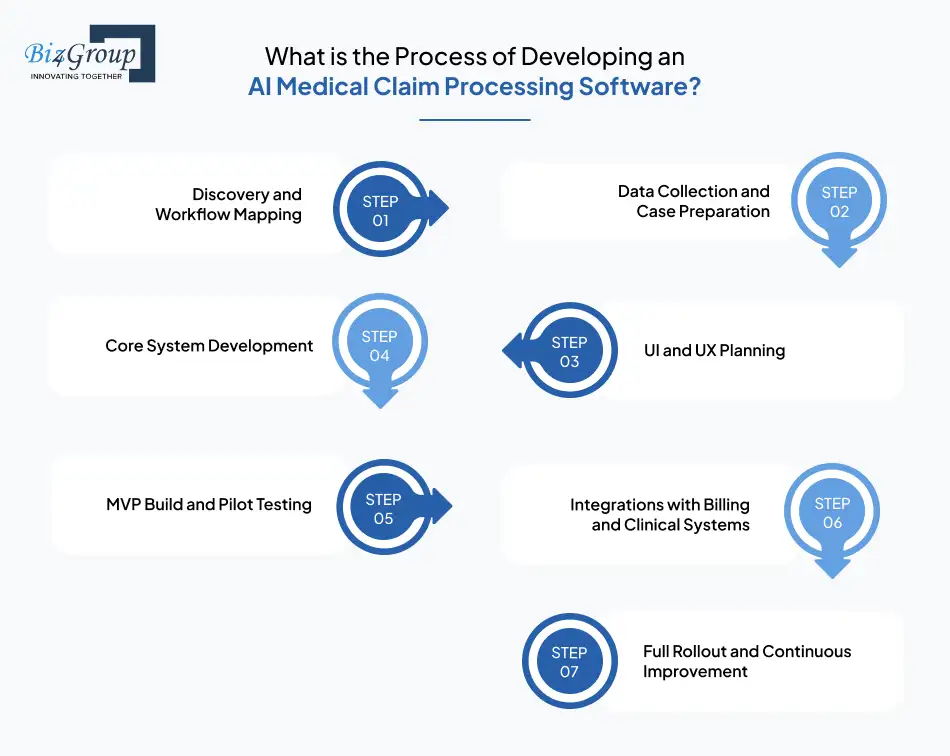
Building an automated claim platform works best when every phase is clear. A structured plan helps teams stay aligned and helps healthcare leaders track progress with confidence. The steps below outline how organizations create AI medical claim automation tool solutions that support efficiency.
Step 1: Discovery and Workflow Mapping
Every project begins with clarity. Understanding claim volume, payer mix and internal processes sets the direction for the entire platform.
A few common activities include
- Mapping the current claim lifecycle
- Identifying gaps in intake, coding, validation and reconciliation
- Defining goals for automation and performance improvement
Step 2: Data Collection and Case Preparation
Claims, codes, EOBs and payer rules need to be organized early so the system can work smoothly later. Teams gather sample claims and documentation types to understand variation and complexity.
Key tasks include
- Collecting structured and unstructured claim data
- Sorting documents by use case
- Identifying patterns that influence automation
Step 3: UI and UX Planning
Billing teams depend on simple screens and clear navigation. A structured design approach ensures the system feels intuitive for coders, auditors and administrators.
UI/UX design company often plans for
- Wireframes for claim intake, review, submission and tracking
- Testing layouts with sample billers
- Creating clean dashboards for denial trends and reconciliation
Also read: Top 15 UI/UX design companies in USA
Step 4: Core System Development
Once workflows and designs are set, the main platform is developed. This includes automation logic, document extraction, rules processing and claim handling features.
During this phase, teams usually
- Build modules for intake, coding support, validation and tracking
- Connect workflow steps for end-to-end claim movement
- Prepare testing environments for early quality checks
Step 5: MVP Build and Pilot Testing
Developing a minimal viable product helps organizations validate the system with real scenarios. It avoids long delays and gives early feedback from billing teams.
Important MVP elements
- A small claim volume test
- Limited payer groups
- Only essential automation features
Also read: Top 12+ MVP development companies in USA
Step 6: Integrations with Billing and Clinical Systems
EHRs, PMS platforms, clearinghouses and payer channels need to connect seamlessly. Smooth integration improves efficiency and reduces repeated manual work.
- Setting up EDI submission and response flows
- Syncing patient and encounter data from clinical systems
- Enabling status updates inside your billing interface
Step 7: Full Rollout and Continuous Improvement
Once the system performs well in pilot mode, it expands to more departments and payer groups. Continuous improvements help maintain accuracy as claim rules shift and volumes rise.
During rollout, teams often
- Train billers and revenue cycle staff
- Activate full reporting and dashboards
- Review performance metrics for fine tuning
A clear process keeps your team aligned, reduces rework and helps your organization create AI medical claim processing systems that deliver measurable improvements from day one.
Want an MVP in Weeks Instead of Months?
Biz4Group delivers rapid builds with reusable components so you can test real claims sooner than competitors.
Get in TouchSecurity and Compliance Requirements for Custom AI Medical Claim Software Development
Healthcare organizations work with sensitive data every day, so governance plays a central role in reliable automation. Strong compliance practices help your platform remain trusted, consistent and ready for audits. Teams that focus on custom AI medical claim software development often follow these requirements to protect their systems and users.
Key Compliance Areas to Follow
- HIPAA standards for safe handling of protected health information
This ensures every claim, document and user interaction is managed with controlled access and secure data practices. - Role based access expectations
Teams define user roles so administrative access stays limited and billing staff view only the information that supports their work. - Audit trails for system activity
Every action is recorded to support internal reviews, payer audits and future investigations. - Data retention and archiving guidelines
Healthcare organizations maintain clear rules for how long claim data should remain accessible. - Governance for ethical model use
AI decisions follow transparent principles with human review for complex or questionable outputs. - Operational policies for vendor and third-party access
External tools and partners are vetted to ensure they follow the same compliance expectations.
These practices help teams create AI medical claim automation tool solutions that stay aligned with healthcare regulations while delivering consistent performance.
Cost Breakdown for AI Medical Claim Processing Software Development
Planning a project becomes much easier when you have a clear view of the investment involved. Most organizations spend $25,000-$150,000+ based on the scope, features and integration needs. Teams that want to create AI driven medical claims automation platform solutions often begin with a smaller version and expand as workflows mature.
To give you a structured start, here is a simple comparison of what different build levels usually look like.
|
Version |
What You Get |
Typical Range |
|---|---|---|
|
MVP |
Basic intake, OCR, coding support and simple validation engine |
$25,000-$45,000 |
|
Advanced Level |
Predictive models, dashboards, multi payer workflows and automated reconciliations |
$50,000-$95,000 |
|
Enterprise Level |
Full scale automation with complex rule engines, multi clinic support and payer integrations |
$100,000-$150,000+ |
These ranges help healthcare leaders understand how AI medical claim processing software development aligns with their goals.
Cost Drivers in AI Medical Claim Processing Software Development
When teams build AI medical claim management tool solutions, these factors shape the final investment. The table below offers a clear view with cost implications added for easy planning.
|
Cost Driver |
What It Means |
How It Influences Budget |
|---|---|---|
|
Feature Complexity |
More modules, automation depth and intelligence |
$8,000-$40,000 based on scope |
|
Document Variety |
Number of document types such as EOBs, lab reports, forms and visit notes |
$4,000-$20,000 for expanded OCR-NLP coverage |
|
Payer Rule Variations |
State, federal and private payer rule complexity |
$6,000-$25,000 depending on rule depth |
|
Integration Needs |
EHR, PMS, clearinghouse or payer connections |
$8,000-$30,000 based on the systems involved |
|
User Roles and Permissions |
More user groups and custom access layers |
$2,000-$6,000 |
|
Reporting and Dashboards |
Standard or advanced real time analytics |
$3,000-$15,000 |
|
Deployment and Hosting |
Cloud setup and environment optimization |
$1,500-$8,000 |
|
QA and Pilot Rollouts |
More test cycles and scenario coverage |
$3,000-$12,000 |
These drivers help organizations plan a realistic budget when they develop intelligent medical claims processing applications for long term use.
Hidden Costs You Should Plan For
Some costs show up later in the project. These are not always expected, but they influence quality and performance. Teams that want to create AI-driven healthcare claims platforms should understand these early to avoid delays later.
1. Document Expansion and Data Volume Growth
As your platform gains adoption, new document types and higher volume often appear. Expanding OCR-NLP pipelines usually adds $3,000-$10,000 depending on complexity.
2. Workflow Revisions After Real World Testing
Billing teams give new insights once they test the platform in real operations. Adjusting modules after feedback often costs $2,000-$7,000.
3. Adding New Payers or Networks
New payer groups have unique rules. Supporting them usually costs $1,000-$5,000 per integration group depending on rule depth.
4. Extra Training for Billing Teams
User training is often overlooked. Proper onboarding sessions usually cost $500-$2,500.
5. Performance Optimization When Volume Increases
Once claim volume scales, teams may need performance tuning. This usually ranges $1,500-$6,000.
By understanding these components, you can allocate budget wisely and create AI-driven medical claims automation platform solutions that scale smoothly. Now that you have the financial picture, the next section will help you decide whether building or buying is the better path for your organization.
Make Every Dollar Count in Your Automation Journey
Smart budgeting begins with the right guidance before development even starts.
Get a Custom QuoteShould You Buy or Develop Custom AI Powered Healthcare Claims Processing Software
Healthcare organizations explore both paths when planning automation. Some prefer ready-made tools
for quick adoption. Others want tailored workflows that match their billing structure.
Understanding the difference helps leaders make confident decisions when they want to create AI
medical claims automation platforms that support lasting growth.
|
Criteria |
Buy |
Build |
|---|---|---|
|
Setup Time |
Quick setup in most cases |
Longer timeline due to custom planning and development |
|
Customization |
Limited changes allowed |
Full customization based on your workflows |
|
Upfront Cost |
Lower starting cost |
Higher due to design, development and testing |
|
Long Term Cost |
Subscription rises as users grow |
More cost effective over time for larger teams |
|
Integration Flexibility |
Depends on vendor support |
Matches your EHR, PMS and clearinghouse requirements |
|
Control Over Data |
Partial control under vendor policies |
Full control over your claims and configurations |
|
Scalability |
Varies by license and vendor model |
Scales with your workflow and claim volume |
|
Feature Ownership |
Vendor owns updates and features |
You own all features and enhancements |
Buy when your team
- Needs a fast solution for smaller claim volumes
- Prefers predictable subscriptions instead of development investment
- Can work within standard workflows provided by the vendor
Build when your team
- Handles complex claims across multiple payer groups
- Wants complete customization for coding, routing and reconciliation
- Plans to scale operations across clinics or networks
- Needs control over features, data and roadmap
Hybrid when you want
- A ready platform with add-on custom modules
- Faster deployment with some tailored automation
- More flexibility than buying and lower cost than full development
This overview helps leaders choose the most strategic path before they create AI-driven medical claims automation platform solutions for their organization. The next section will outline challenges and risks you should prepare for during development.
Challenges and Risks in AI Medical Claim Processing Software Development
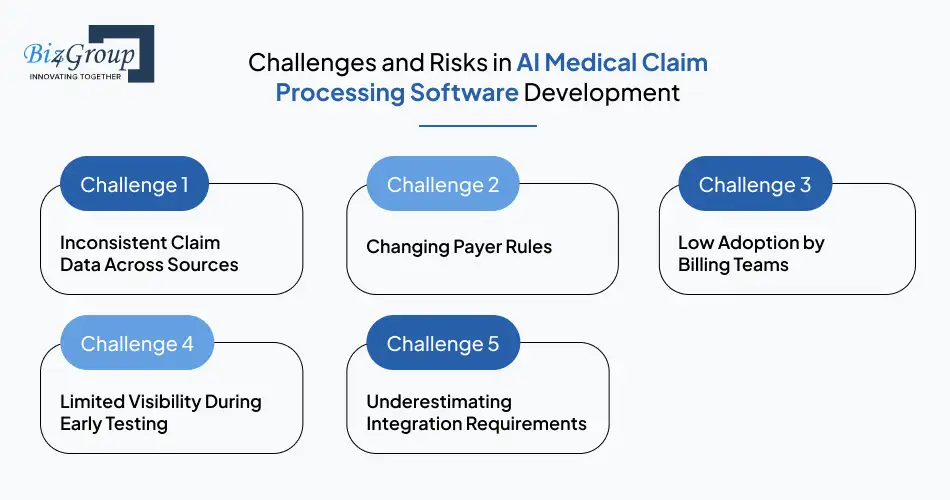
Every healthcare project has its hurdles. Planning ahead helps teams avoid slowdowns and costly
refactoring. When organizations create AI medical claims automation platforms, they often encounter
a few predictable challenges.
Below are the most common ones and practical ways to handle
them.
Challenge 1. Inconsistent Claim Data Across Sources
Different clinics follow different documentation patterns. This inconsistency leads to irregular inputs that slow automation.
How to solve it
- Standardize claim formats early in the project
- Build a clear document library for developers
- Use sample cases from each department during planning
Challenge 2. Changing Payer Rules
Payers revise criteria often. Manual updates increase the chance of errors and denials.
How to solve it
- Set a quarterly payer rule update review
- Keep a central rule repository for your team
- Assign a billing specialist to validate new logic before rollout
Challenge 3. Low Adoption by Billing Teams
Automation brings comfort only when the interface feels intuitive. Poor adoption slows ROI.
How to solve it
- Include billers in early design reviews
- Keep screens short and task oriented
- Offer onboarding sessions with real claim samples
Challenge 4. Limited Visibility During Early Testing
Pilot users may not provide complete feedback. This creates blind spots in claim routing and coding logic.
How to solve it
- Run controlled tests with mixed complexity claims
- Track missed validations and adjust before rollout
- Encourage daily feedback during pilot cycles
Challenge 5. Underestimating Integration Requirements
Billing systems connect with EHRs, PMS platforms and clearinghouses. Missing pieces stall progress.
How to solve it
- Confirm system architecture before development starts
- Identify required data fields for each integration
- Test small batches before moving to full scale sync
These challenges offer lessons for every team. The next section will help you choose a partner that can guide you through each phase with clarity and confidence.
Avoid the Mistakes Most Teams Discover Too Late
A strong partner helps you skip the headaches and move straight to predictable results.
Talk to Our ExpertsWhy Biz4Group LLC Leads AI Medical Claim Processing Software Development in the USA?
Healthcare organizations across the country look for partners who understand technology, operations and business goals. Biz4Group LLC brings this mix to every project.
We are a software development company that focuses on bringing structure, clarity and measurable outcomes. We work closely with decision makers who want AI healthcare solutions that simplify their operations and create long term value. Our experience in full AI development makes us a trusted partner for businesses that want to create enterprise AI solutions or strengthen their current systems.
Our Work: AI Driven IVR and Support Platform for Third Party Administrators
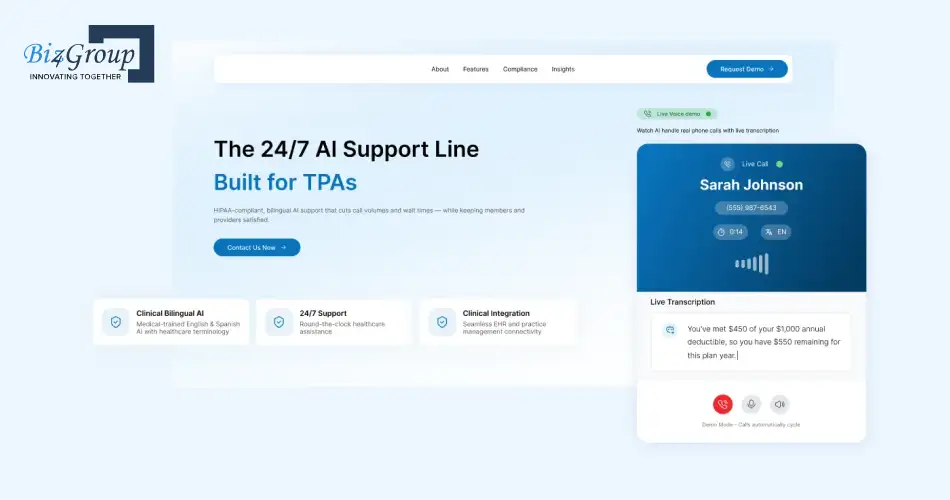
We built a HIPAA compliant AI-driven IVR and support platform for Third Party Administrators. The goal was to reduce repetitive support calls while delivering fast, natural, and accurate voice-based assistance for members and providers. The result was a reliable, fully automated calling experience that improves service efficiency at scale.
Key highlights of the project include
- AI powered IVR handling high volume eligibility, claim, and benefits inquiries
- Natural voice interactions with bilingual support and live translation
- Real time responses without chatbot or text-based interfaces
- Smart call escalation to human agents with full interaction context
- Secure, HIPAA compliant flows for sensitive healthcare data
This system performs efficiently in real time through optimized voice processing and automation. It resolves routine queries instantly while escalating complex cases smoothly, helping organizations improve service quality without increasing support staff or operational overhead.
Why Businesses Choose Us
- We deliver platforms that adapt to real workflows instead of forcing users to adjust
- We focus on accuracy, usability and measurable improvement
- We provide end-to-end planning, execution and optimization
- We collaborate closely with teams to reduce risks and maintain momentum
- We bring experience across healthcare, wellness, retail and enterprise systems
We build solutions that stand strong even under complex and fast changing conditions. That is why we remain a trusted choice for healthcare organizations across the USA that plan to develop AI medical claim processing systems suited to their needs.
Our approach supports long-term growth. Every system is designed to scale, adapt and stay reliable even as your organization expands. And in our honest opinion, that is exactly what you deserve!
If your organization is exploring automation or wants to strengthen claim operations, we can guide you through the best path forward. Let’s talk.
Wrapping Up
AI medical claim processing software development gives healthcare organizations a practical way to improve accuracy, shorten reimbursement cycles and reduce operational pressure on billing teams. From automated intake to denial prediction, the right solution strengthens every step of the revenue cycle and supports better financial performance.
With the right strategy, healthcare leaders can create AI-driven healthcare claims platforms that streamline daily operations. Whether you want to reduce denials, speed up submissions or improve visibility across payer networks, a well-designed system can help you reach those goals faster.
Biz4Group LLC partners with healthcare organizations across the USA to build platforms that align with real workflows and business outcomes. Our experience in automation, AI app development, data handling and intuitive UI design positions us as a strong partner for any organization planning to develop AI medical claim processing systems.
If you are ready to upgrade your claims workflow or explore what automation can do for your organization, now is a great time to start. Talk to Biz4Group LLC and begin shaping a smarter way to handle medical claims.
FAQs
How long does it usually take to launch an AI based medical claim processing platform?
Most projects move from planning to rollout within 3-6 months. Biz4Group, however, can deliver an MVP in 2-3 weeks, since our team uses reusable components that shorten development cycles and reduce both cost and effort.
Can small clinics benefit from AI medical claim automation or is it only for large hospitals?
Small clinics gain value quickly because they often face limited staffing and tight reimbursement timelines. Automation helps them handle claim tasks with fewer errors and more predictable results without needing a large internal billing team.
What type of documents can an AI claim platform process beyond standard claim forms?
Modern systems can interpret a wide mix of content such as physician notes, procedure summaries, lab results, itemized bills and digital encounter records. This helps streamline documentation across multiple clinical departments.
Does an AI claim system support both in network and out of network claims?
Yes. Platforms can be configured to manage both categories. Each type follows different payer expectations, so the system can route them into separate validation flows to keep the process organized.
How does AI improve claim quality before submission?
AI reviews each claim against historical patterns and common error indicators. It highlights missing fields, incorrect codes and inconsistent descriptions so teams can refine entries before sending them to payers.
Can AI assist with claim follow-ups when payers request extra information?
Yes. AI can flag claims that need supporting documents, track payer messages and notify staff about pending follow ups. This keeps claims from being forgotten or delayed during the review process.