 Location :
Orlando, FL, USA
Location :
Orlando, FL, USA +1 (407) 714-1616
 info@biz4group.com
- AI power bank rental app development helps businesses turn everyday charging needs into a scalable, recurring revenue model across high footfall locations.
- Businesses can build AI powered power bank rental app platforms with smart tracking, automated payments, and data-backed decision making.
- From malls and airports to events and smart cities, power bank sharing app development with AI improves customer convenience while increasing dwell time.
- A phased approach allows teams to develop scalable AI power bank rental platforms by starting with an MVP and expanding based on real usage data.
- Clear cost planning, flexible monetization models, and performance metrics help make AI power bank rental solutions for recurring revenue.
- Biz4Group LLC supports startups and enterprises in the USA by delivering fast, reliable, and scalable AI power bank rental app platform built for real world success.
Ever been out shopping, waiting for a cab, or attending an event when your phone battery drops
below 40%?
That moment of panic is universal. Smartphones power payments, navigation,
tickets, social media, and work, and for many users, anxiety starts well before the battery hits
critical levels.
A recent survey found that most Americans begin to feel anxious once their phone battery drops to around 38%, with younger users panicking even earlier. When batteries die, experiences break. This everyday problem is exactly why AI power bank rental app development has emerged as a serious business opportunity.
Malls, airports, cafes, and event venues see thousands of visitors daily, many searching for charging points. When companies build AI powered power bank rental app solutions, they turn a common frustration into a paid, automated service that improves customer satisfaction while creating predictable income.
The shift toward power bank sharing app development with AI is driven by more than demand. AI helps operators track usage patterns, forecast peak hours, and reduce losses. Smart systems learn where power banks move and which stations underperform.
For founders and operators exploring how to start a power bank rental business, timing matters. With the right technology foundation, power bank rentals move from a side service to a scalable, data-backed revenue stream.
Let's begin with the basics.
Understanding AI Power Bank Rental App and Its Core Components
Before diving into features, costs, or revenue, it helps to slow down and understand what businesses are actually building. Many operators hear about charging kiosks or QR-based rentals, but an AI-powered system goes much deeper than that.
What an AI Power Bank Rental App Actually Is
At its core, AI power bank rental app development focuses on creating a connected ecosystem rather than a standalone mobile app. It combines mobile development, backend systems, AI models, and physical charging stations into one coordinated platform.
When businesses build power bank rental software for businesses, they enable customers to locate a nearby station, scan a QR code, unlock a charged power bank, use it on the go, and return it at any supported station. Payments, tracking, and availability updates happen automatically in the background.
How an AI Powered Power Bank Rental System Works
The rental flow feels simple to users, but several systems work together behind the scenes.
Business workflow
- User authentication and payment authorization
- Real-time power bank tracking
- Rental time calculation and billing
- Automated return validation
- AI-based monitoring for misuse or anomalies
This is where businesses create AI-driven charging rental applications that operate with minimal human involvement while maintaining control and accuracy.
Core Components of AI Power Bank Rental App Development
To build a reliable platform, several components must work together seamlessly.
|
Component |
Purpose |
|---|---|
|
User mobile app |
Rental, payments, station discovery |
|
Admin dashboard |
Revenue tracking, inventory control |
|
AI analytics engine |
Demand prediction, loss reduction |
|
IoT enabled charging stations |
Secure locking and unlocking |
|
Payment gateway |
Automated billing and refunds |
|
Cloud backend |
Scalability and performance |
When companies develop AI power bank rental applications, each component plays a role in delivering a smooth customer experience and a profitable backend operation.
Where AI Fits into the System
AI adds intelligence where traditional rental systems fall short.
- Predicts peak demand based on location and time
- Identifies stations that need restocking
- Flags unusual rental behavior early
- Optimizes pricing and rental duration policies
This intelligence allows operators to develop intelligent power bank rental systems that adapt as usage patterns change.
AI power bank rental app development gives businesses a way to solve a common customer problem while building a connected, data-aware rental network that grows with demand. Next, we will look at why building this type of platform today makes strong business sense.
Why Build AI Power Bank Rental App Development Solutions Today?
Timing plays a major role in whether a digital product succeeds or struggles. In the case of AI power bank rental app development, multiple trends are aligning at once. Consumer behavior, mobile dependency, and expectations around convenience are pushing businesses to rethink how charging access is offered.
Smartphone usage keeps growing, and so does battery anxiety. According to a survey, the average person spends over 5 hours per day on their smartphone, with heavy usage tied to navigation, payments, and social apps.
At the same time, public charging access has not kept pace with this usage. This gap creates a clear opportunity for businesses to monetize convenience.
Key demand drivers include:
- High foot traffic in malls, airports, and transit hubs
- Event-based usage where charging access is limited
- Increased reliance on mobile payments and digital tickets
- Consumer willingness to pay small fees for instant convenience
This demand is why many operators now make AI power bank rental solutions for recurring revenue instead of treating charging as a free amenity.
The Pain Points Traditional Charging Models Cannot Solve
Before AI-powered platforms, businesses relied on wall chargers, free outlets, or basic vending machines. These options introduce friction and operational headaches.
Common issues include:
- Limited availability during peak hours
- No visibility into usage or losses
- High theft or damage rates
- Manual maintenance and monitoring
- Zero data to guide expansion decisions
When businesses attempt to scale without intelligence, costs rise faster than revenue. This is where companies look to build power bank rental software for businesses that operates with automation and insight.
Why This Moment Matters for Founders and Operators
The cost of building connected systems has dropped, while consumer expectations continue to rise.
According to McKinsey, businesses that adopt AI-driven operations see cost reductions of
up to 20% in certain operational workflows.
For those exploring how to start a power bank
rental business, this creates a window of opportunity. Early movers can secure locations, refine
pricing models, and build brand presence before the market becomes crowded.
Your Customers Are Already Searching for a Charger
Over 70% of users feel battery anxiety daily. Why let that moment pass without monetizing it?
Schedule a Strategy Call NowBusiness Benefits of AI Power Bank Rental App Development for Revenue and Growth
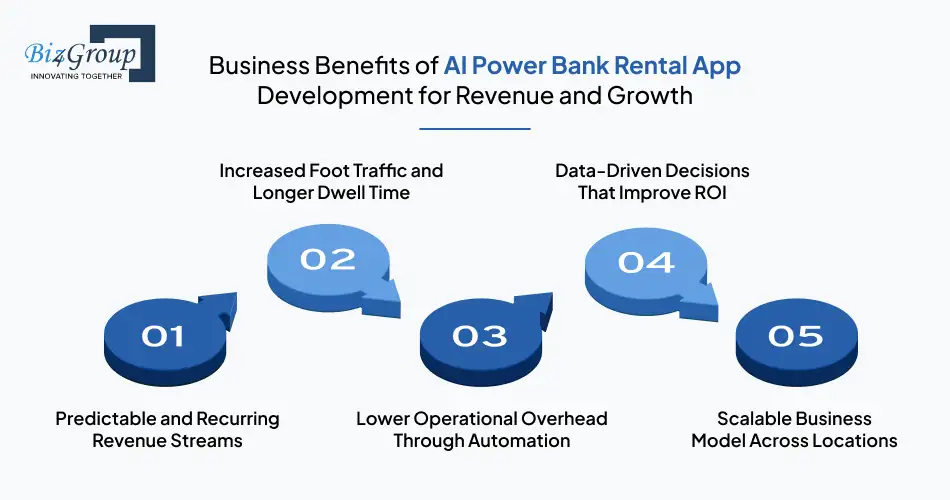 Once the demand is clear, the next question business owners
ask is simple. What do we gain from this? AI power bank rental app development delivers value on
multiple levels, from direct revenue to long-term customer engagement.
Once the demand is clear, the next question business owners
ask is simple. What do we gain from this? AI power bank rental app development delivers value on
multiple levels, from direct revenue to long-term customer engagement. Below are the most impactful benefits, explained from a business lens.
1. Predictable and Recurring Revenue Streams
When businesses build AI powered power bank rental app platforms, they unlock steady micro transactions that add up over time. Revenue opportunities include:
- Pay-per-use rentals
- Hourly or daily pricing
- Monthly user subscriptions
- Location-based pricing strategies
2. Increased Foot Traffic and Longer Dwell Time
Charging availability keeps customers inside venues longer. In malls, cafes, and airports, a charged phone means more browsing, more purchases, and fewer early exits. Businesses that create smart power bank rental platforms with AI often see:
- Higher average dwell time
- Increased repeat visits
- Improved overall customer experience
3. Lower Operational Overhead Through Automation
Manual charging stations require frequent checks, replacements, and customer assistance. AI-powered platforms automate these tasks. Key efficiencies include:
- Automated rental and return validation
- Real-time inventory tracking
- Early alerts for station or battery issues
- Reduced staff involvement
4. Data-Driven Decisions That Improve ROI
AI platforms generate actionable data. Operators gain visibility into:
- High performing locations
- Peak usage hours
- Average rental duration
- Power bank movement patterns
5. Scalable Business Model Across Locations
A well-built platform supports expansion without redesign. Whether adding ten stations or a thousand, AI adapts to scale. This allows businesses to:
- Expand into new venues quickly
- Partner with franchises and property owners
- Manage multi-city operations from one dashboard
AI power bank rental app development turns a common inconvenience into a structured, profitable service. With recurring revenue, improved customer engagement, and data-backed decision making, businesses gain a scalable digital asset.
Real World Use Cases Powering AI Power Bank Rental App Development Across Industries
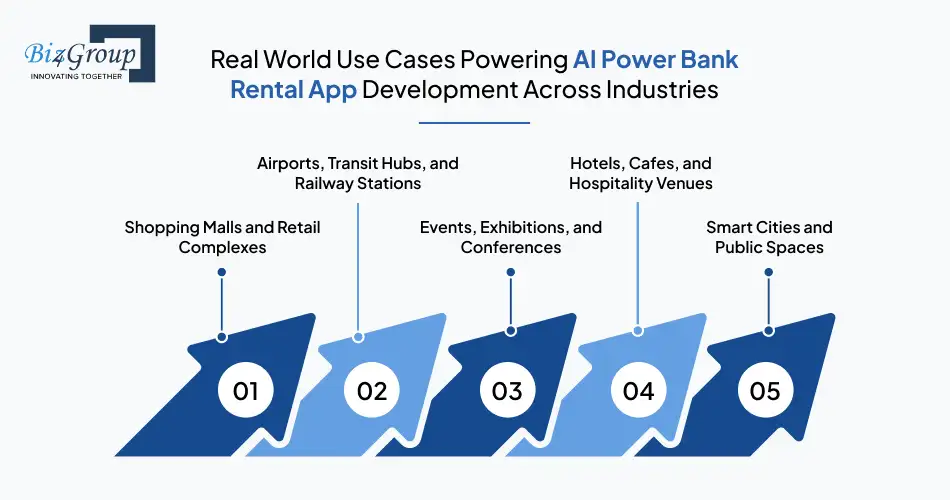 AI power bank rental app development gains real traction when applied
to environments where battery anxiety meets high foot traffic. Below are the most proven use cases,
explained with business context and measurable value.
AI power bank rental app development gains real traction when applied
to environments where battery anxiety meets high foot traffic. Below are the most proven use cases,
explained with business context and measurable value.
1. Shopping Malls and Retail Complexes
Malls thrive on time spent. When visitors run low on battery, shopping trips shorten. Retail operators who create AI-driven power bank rental platforms for malls and events help customers stay longer, navigate offers, and complete mobile payments. AI analyzes peak hours and station usage, ensuring power banks remain available where demand stays highest.
2. Airports, Transit Hubs, and Railway Stations
Travelers rely heavily on phones for boarding passes, ride bookings, and navigation. Power outages here cause immediate frustration. Businesses that build AI power bank rental apps with real time tracking reduce congestion at charging points and maintain availability across terminals. AI forecasts flight schedules and traveler density to rebalance inventory automatically.
3. Events, Exhibitions, and Conferences
Temporary venues face unpredictable demand spikes. Organizers using power bank sharing app development with AI can scale charging access without permanent infrastructure. AI tracks rental velocity during sessions and breaks, allowing operators to reposition stations and avoid shortages during peak moments.
4. Hotels, Cafes, and Hospitality Venues
Hospitality brands focus on experience. When guests search for outlets, service quality drops. By choosing build power bank rental software for businesses, hotels and cafes offer convenient charging without clutter. AI insights help managers understand guest behavior and optimize placement across lobbies, lounges, and dining areas.
5. Smart Cities and Public Spaces
Urban planners increasingly focus on connected services. Municipal authorities that develop AI power bank rental app for smart cities integrate charging rentals into transport hubs, parks, and tourist zones. AI supports large scale operations by predicting usage patterns across neighborhoods and adjusting capacity dynamically.
Across industries, AI power bank rental app development succeeds where mobility, convenience, and foot traffic intersect. These real-world use cases prove that smart charging platforms adapt wherever people depend on their phones to move, pay, and connect.
If It Works in Airports, Malls, and Events, Why Not Your Space?
High foot traffic locations recover costs faster and scale smarter with charging rentals.
Contact Biz4Group TodayEssential Features in AI Power Bank Rental App Development
Before advanced intelligence and optimization come into play, every successful platform starts with a solid foundation. These must have features ensure reliability, trust, and smooth daily operations. Businesses that develop AI power bank rental applications without these basics often face user drop offs, revenue leakage, and operational friction.
|
Feature |
What It Is |
What It Does |
|---|---|---|
|
User registration and login |
Secure onboarding via mobile number, email, or social login |
Verifies users and enables repeat rentals |
|
QR code based unlock system |
QR scanner integrated with rental stations |
Allows instant power bank release without staff support |
|
Real time power bank availability |
Live station and inventory status |
Shows users where charged power banks are available |
|
Automated payment processing |
Integrated payment gateway |
Handles deposits, rental fees, refunds, and failed payments |
|
Rental time tracking |
Timer based usage monitoring |
Calculates charges accurately and prevents misuse |
|
Multi station return support |
Network wide return validation |
Lets users return power banks at any supported station |
|
Admin dashboard |
Centralized business control panel |
Tracks revenue, rentals, locations, and device health |
|
Station status monitoring |
Hardware health and connectivity tracking |
Flags offline or faulty stations early |
|
User notifications |
In app and push notifications |
Sends rental reminders, return alerts, and payment updates |
|
Customer support module |
Ticket or chat-based assistance |
Resolves issues quickly and builds user trust |
Each feature plays a role in minimizing friction. Users expect speed, clarity, and reliability. Operators need visibility, control, and AI automation services. When businesses build power bank rental software for businesses with these essentials in place, the platform becomes easier to scale and optimize later.
Advanced Features That Power Scalable AI Power Bank Rental App Development
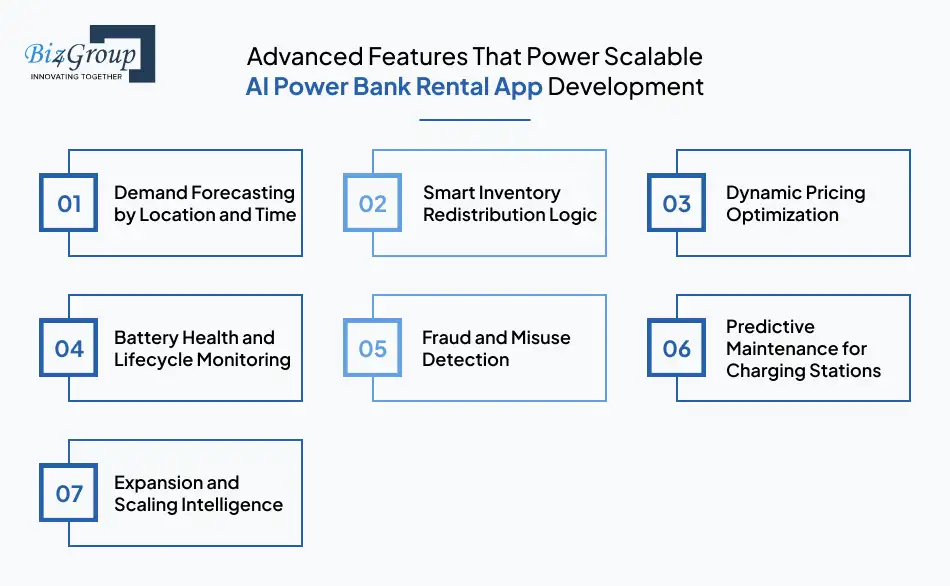 Once the foundation is in place, advanced intelligence is
what separates average platforms from market leaders. These capabilities help businesses move faster,
reduce losses, and operate at scale. Each feature below builds on existing data and infrastructure
without repeating core functionality.
Once the foundation is in place, advanced intelligence is
what separates average platforms from market leaders. These capabilities help businesses move faster,
reduce losses, and operate at scale. Each feature below builds on existing data and infrastructure
without repeating core functionality.
1. Demand Forecasting by Location and Time
AI analyzes historical rentals, foot traffic patterns, and time-based usage to predict demand. This allows operators to prepare stations in advance and avoid shortages.
2. Smart Inventory Redistribution Logic
Power banks rarely stay evenly distributed. AI continuously evaluates station performance and recommends redistribution routes. This reduces idle inventory and improves availability at high demand locations.
Also read: AI inventory management software development guide
3. Dynamic Pricing Optimization
AI adjusts rental pricing based on demand intensity, location value, and usage duration. High traffic zones can support premium pricing, while low usage areas benefit from incentives.
4. Battery Health and Lifecycle Monitoring
AI monitors charge cycles, discharge rates, and usage patterns to assess battery health. This prevents sudden failures and extends hardware lifespan.
5. Fraud and Misuse Detection
Advanced models identify abnormal behavior such as repeated non returns, unusual movement patterns, or payment anomalies. Early detection limits financial losses and protects the network.
6. Predictive Maintenance for Charging Stations
AI predictive maintenance helps in analyzing when docking stations may fail based on performance signals. Maintenance teams receive alerts before downtime occurs. Businesses that build power bank rental apps with automated payment also benefit from fewer service disruptions.
7. Expansion and Scaling Intelligence
As networks grow, AI evaluates which locations perform best and which underdeliver. These insights guide expansion decisions, franchise partnerships, and city-wide rollouts.
Advanced AI features turn power bank rentals into a responsive, learning system. AI power bank rental app development reaches its full potential when intelligence drives decisions, reduces friction, and supports growth without adding complexity.
Smart Platforms Earn More Than Static Stations
AI powered demand forecasting and pricing can
lift utilization by double digits over basic setups.
Build Smart with Biz4Group
Smart Platforms Earn More Than Static Stations
AI powered demand forecasting and pricing can lift utilization by double digits over basic setups.
Build Smart with Biz4GroupTechnology Foundations for Power Bank Rental Management Software Development
A strong technology foundation determines whether a rental network stays reliable under real world load. When teams build AI powered power bank rental app platforms, the goal is simple. Support fast transactions, stable hardware communication, and intelligent decision making without compromising security or compliance.
Recommended Tech Stack
Below is a practical tech stack that supports custom AI power bank rental app development at both MVP and enterprise scale.
|
Layer |
Tools and frameworks |
Purpose |
|---|---|---|
|
Mobile app |
React Native, Flutter, Swift, Kotlin |
Cross-platform and native user experiences |
|
Admin dashboard |
React.js, Angular, Vue.js |
Business controls and analytics views |
|
Backend services |
Node.js, Python, Java |
API handling, rental logic, 7s |
|
AI and analytics |
Python, TensorFlow, PyTorch |
Forecasting, optimization, fraud detection |
|
Database |
PostgreSQL, MongoDB, Redis |
Transaction data, logs, caching |
|
Cloud infrastructure |
AWS, Google Cloud, Azure |
Scalability, uptime, global access |
|
IoT communication |
MQTT, HTTP APIs |
Station and power bank connectivity |
|
Payment integration |
Stripe, PayPal, Square |
Automated billing and refunds |
|
Monitoring and logs |
Prometheus, ELK Stack |
Performance and issue tracking |
This stack allows businesses to build power bank rental software for businesses that can scale across locations while staying responsive.
Security Considerations for AI Power Bank Rental Platforms
Security builds trust for both users and partners. Platforms handling payments and physical assets
must protect every layer.
Key security practices include:
- Encrypted communication between apps and stations
- Secure authentication and session management
- Tokenized payment processing
- Role-based access for admin users
- Real-time alerts for suspicious activity
Regulatory, Ethical, and Governance Compliance
Compliance keeps operations stable as platforms grow across regions. Businesses planning to create AI driven charging rental applications should account for the following.
- PCI DSS compliance for payment processing
- GDPR and CCPA readiness for user data protection
- Clear user consent and data usage policies
- Transparent AI decision logic for pricing and access
- Audit trails for rentals, payments, and returns
A well-planned stack combined with strong security and governance enables AI power bank rental app development to scale confidently across cities, partners, and customer segments.
Next, we will walk through the step-by-step development process, from idea validation to launch and continuous optimization.
How to Build Power Bank Rental Application Using AI?
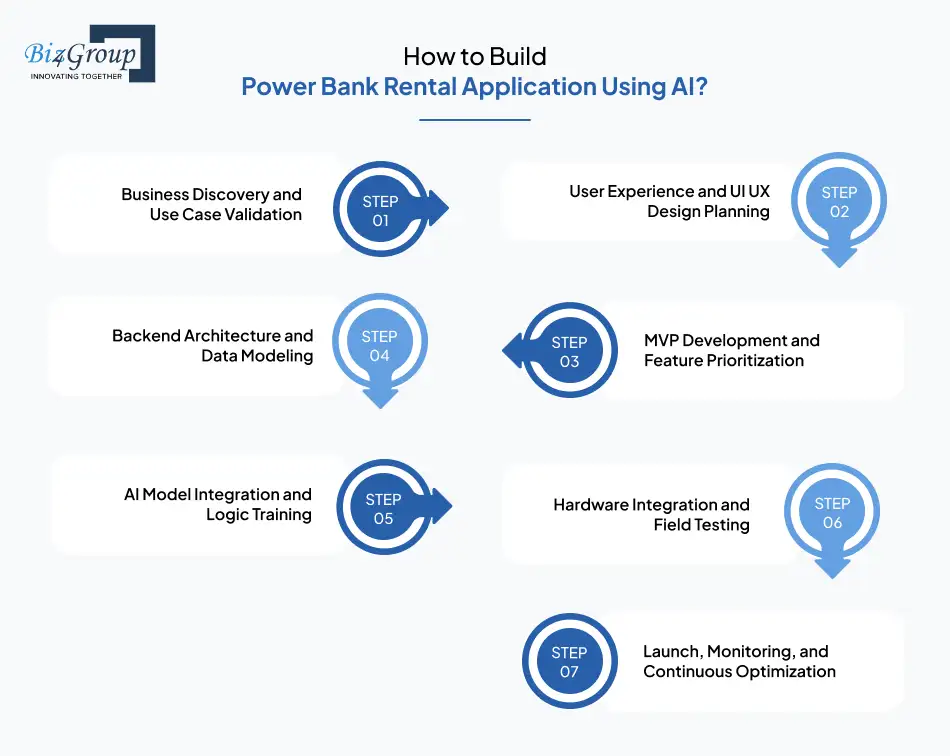 A clear development roadmap reduces risk, controls cost, and keeps
the AI product aligned with
business goals. Teams that rush into development often face rework and delays later. Below is a
structured seven step approach that businesses follow to develop AI power bank rental applications
successfully, without repeating earlier concepts.
A clear development roadmap reduces risk, controls cost, and keeps
the AI product aligned with
business goals. Teams that rush into development often face rework and delays later. Below is a
structured seven step approach that businesses follow to develop AI power bank rental applications
successfully, without repeating earlier concepts.
Step 1. Business Discovery and Use Case Validation
Every project starts by defining the business objective. This step focuses on identifying target locations, user profiles, expected rental frequency, and revenue goals. Teams also evaluate whether the platform serves malls, events, transit hubs, or smart cities.
This clarity guides all future decisions when companies build power bank rental software for businesses.
Step 2. User Experience and UI UX Design Planning
UI UX design shapes how users interact with the platform in real moments of need. Designers map user journeys for onboarding, scanning, renting, returning, and payment confirmation. For admin users, dashboards are designed around clarity and speed.
A strong UI/UX design company reduces friction and improves adoption for teams that create AI-driven power bank sharing systems for businesses.
Also read: Top 15 UI/UX design companies in USA
Step 3. MVP Development and Feature Prioritization
Developing an MVP focuses on building only what is required to launch and validate demand. Core rental flow, payments, and basic tracking are implemented first. This step helps founders test assumptions before committing to full-scale investment.
Many startups develop AI power bank rental app for smart cities by validating one zone or venue through an MVP rollout.
Also read: Top 12+ MVP development companies in USA
Step 4. Backend Architecture and Data Modeling
This stage defines how data moves across the system. Rental logs, station activity, payments, and user behavior are structured for scalability. Clean architecture ensures future AI features can plug in smoothly.
Step 5. AI Model Integration and Logic Training
AI models are trained using early usage data, location patterns, and operational signals. The focus is on decision support rather than automation overload. Models evolve gradually as the system collects real data.
Step 6. Hardware Integration and Field Testing
Charging stations and power banks are integrated with the software layer using robust AI integration services. Field testing validates unlock reliability, connectivity stability, and return verification. This step ensures physical and digital systems operate together before public launch.
Step 7. Launch, Monitoring, and Continuous Optimization
After launch, performance is monitored closely. User feedback, rental patterns, and system metrics guide improvements. AI models refine predictions over time. Continuous optimization allows platforms to grow without disruption and helps operators make AI power bank rental solutions for recurring revenue.
A structured development process reduces uncertainty and protects investment. When businesses follow a clear roadmap, AI power bank rental app development becomes easier to scale, easier to manage, and easier to monetize.
Why Spend 12 Weeks When You Can Validate in 2 or 3?
Launch faster using proven frameworks and reusable components built for speed.
Talk to Our ExpertsCost Planning for Custom AI Power Bank Rental App Development
Cost is often the deciding factor between moving forward and delaying an idea. For most businesses, AI power bank rental app development typically falls within an average range of $30,000-$200,000+, depending on scope, intelligence depth, and scale.
To set expectations clearly, here is how costs usually progress from initial validation to enterprise rollout when teams build AI-powered power bank rental app platforms.
|
Platform stage |
Typical scope |
Estimated cost range |
|---|---|---|
|
MVP |
Core rental flow, payments, limited AI logic |
$30,000-$55,000 |
|
Advanced level |
AI optimization, analytics, multi-location support |
$60,000-$120,000 |
|
Enterprise level |
Large scale deployment, deep AI, integrations |
$150,000-$200,000+ |
These ranges help businesses align investment with goals before committing to full scale development.
Core Cost Drivers in AI Power Bank Rental App Development
Several factors directly influence how costs add up. Understanding them early helps avoid budget surprises later, especially when companies develop AI power bank rental applications for growth.
|
Cost driver |
What it includes |
Typical cost impact |
|---|---|---|
|
Mobile app development |
User app for rentals and payments |
$8,000-$25,000 |
|
Admin dashboard |
Business controls and reporting |
$5,000-$15,000 |
|
Backend development |
APIs, rental logic, integrations |
$10,000-$35,000 |
|
AI model development |
Forecasting, optimization logic |
$8,000-$30,000 |
|
Hardware integration |
Station communication and testing |
$6,000-$20,000 |
|
Cloud infrastructure setup |
Hosting, databases, scaling |
$3,000-$10,000 |
|
QA and testing |
Functional and field testing |
$3,000-$8,000 |
Each driver scales based on complexity. Businesses that build power bank rental software for businesses across multiple locations will naturally invest more in backend stability and AI logic.
Hidden and Often Overlooked Costs
Hidden costs rarely appear in early estimates but play a major role in long term success. Planning for them protects ROI and prevents stalled rollouts.
Ongoing cloud and infrastructure expenses
As usage grows, cloud costs
increase. Storage, AI processing, and monitoring can add $500-$2,500 per month, depending on scale
and data volume.
AI model tuning and retraining
AI systems require periodic tuning as user
behavior changes. Budgeting $5,000-$15,000 annually ensures models stay accurate and relevant,
especially for demand forecasting and optimization.
Hardware maintenance and replacements
Power banks degrade over time.
Replacements and station repairs can add $3,000-$10,000 per year depending on usage intensity.
Compliance, security, and audits
Payment compliance updates and security
reviews often cost $2,000-$6,000 annually. These expenses protect businesses that build power bank
rental apps with automated payment from legal and operational risks.
Feature enhancements after launch
User feedback often leads to feature
additions. Post launch enhancements typically require $5,000-$20,000 per year, depending on roadmap
scope.
How to Control Costs Without Sacrificing Quality
Smart planning keeps budgets realistic. Many teams start with an MVP, validate demand, and expand gradually. This phased approach allows businesses to make AI power bank rental solutions for recurring revenue while reinvesting profits into growth.
Cost control strategies include:
- Prioritizing essential features in early stages
- Rolling out AI capabilities progressively
- Expanding locations based on performance data
- Monitoring cloud usage regularly
AI power bank rental app development requires thoughtful investment, not blind spending. By understanding cost drivers and planning for hidden expenses, businesses can launch confidently, scale responsibly, and protect long term profitability.
Also Read: AI App Development Cost – Know How Much Your App Will Cost
Business Models and ROI Metrics in AI Power Bank Rental App Development
Once the platform is live, the real question shifts from cost to returns. AI power bank rental app development offers flexible monetization paths that fit both single location operators and large enterprises. The key is choosing models that align with foot traffic, user behavior, and long-term growth goals.
Popular Business Models for Power Bank Rental Platforms
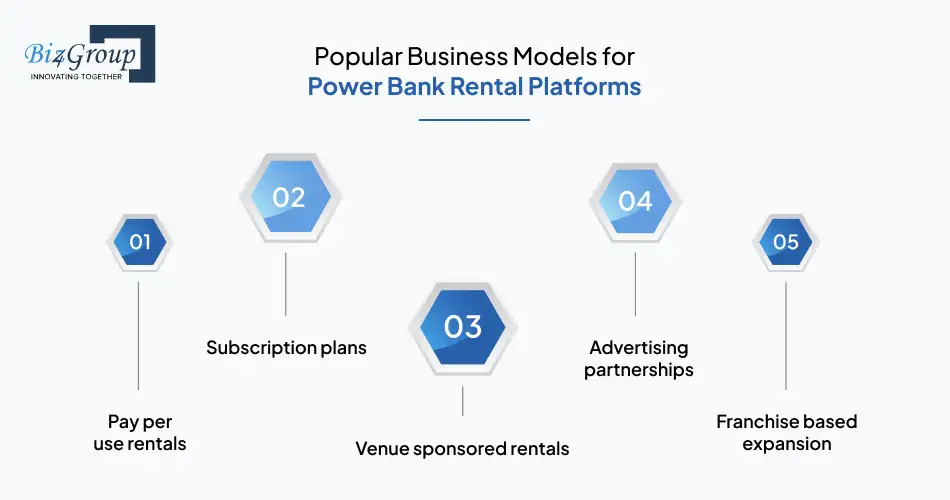 Different environments support different revenue strategies.
Businesses often combine more than one model as usage grows.
Different environments support different revenue strategies.
Businesses often combine more than one model as usage grows.
|
Business Model |
How It Works |
Best Suited For |
|---|---|---|
|
Pay per use rentals |
Users pay based on rental duration |
Malls, airports, transit hubs |
|
Subscription plans |
Monthly or weekly charging access |
Frequent users, commuters |
|
Venue sponsored rentals |
Venues cover usage costs |
Events, exhibitions, hotels |
|
Advertising partnerships |
Brands sponsor stations or app space |
High foot traffic locations |
|
Franchise based expansion |
Partners operate stations locally |
Multi city growth strategies |
These models help businesses create smart power bank rental platforms with AI that adapt pricing and access based on context.
How AI Improves Monetization Efficiency
AI plays a direct role in maximizing returns. Instead of static pricing and assumptions,
intelligence guides decisions in real time.
AI enables operators to:
- Adjust pricing during peak demand windows
- Identify underperforming locations early
- Optimize station placement for higher usage
- Reduce losses that impact revenue
This approach supports teams that make AI power bank rental solutions for recurring revenue while maintaining user satisfaction.
Key ROI Metrics Businesses Track
Measuring ROI goes beyond total revenue. Successful operators track metrics that reflect
operational health and scalability.
Important KPIs include:
- Average rentals per station per day
- Revenue per location
- Average rental duration
- Return compliance rate
- Hardware utilization rate
ROI Timeline Expectations
Returns vary based on location and pricing strategy. In many high traffic environments, operators begin recovering initial investment within 6-12 months. AI-driven optimization often shortens this timeline by improving utilization and reducing waste.
As networks grow, ROI improves further due to shared infrastructure and data reuse across locations.
AI power bank rental app development gives businesses control over how and when revenue is generated. With flexible monetization models and clear performance metrics, operators can scale confidently and measure success with precision.
What If Your Charging Stations Paid for Themselves?
With the right pricing and placement, many platforms break even within months.
Get a Custom QuoteChallenges, Risks, and Scaling Mistakes in AI Power Bank Rental App Development
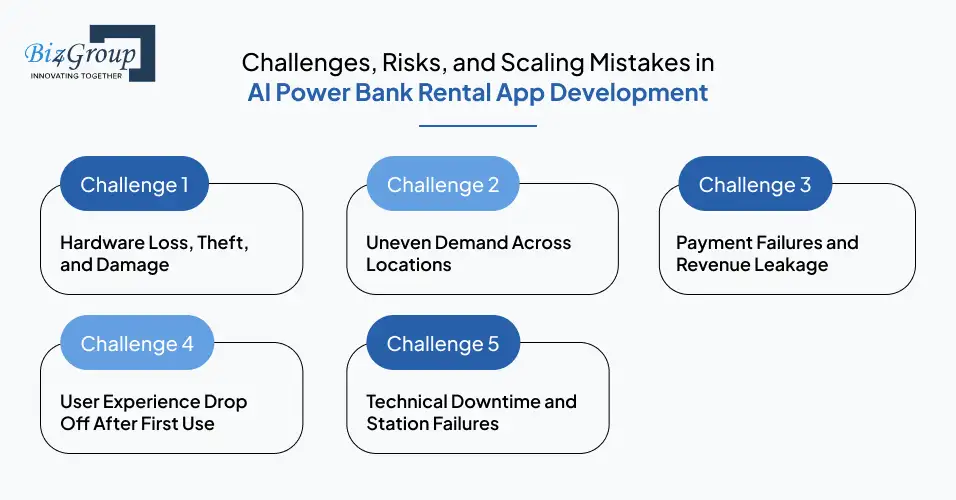
Every scalable business model comes with friction points. AI power bank rental app development is no different. Hardware dependency, real world usage behavior, and multi-location operations introduce challenges that software alone cannot solve. The good news is that most risks are predictable and preventable with the right planning.
Challenge 1: Hardware Loss, Theft, and Damage
Physical assets are exposed to misuse, delayed returns, and wear over time. Without controls, losses can grow quickly.
How businesses mitigate this:
- Deposit-based rental authorization
- AI-powered anomaly detection for non-return patterns
- Time-based escalation alerts
- Battery health monitoring to flag abuse
- Clear user penalties and reminders
Challenge 2: Uneven Demand Across Locations
Some stations run out of power banks while others sit idle. This imbalance hurts revenue and user trust.
How businesses mitigate this:
- AI-driven demand forecasting by time and location
- Smart redistribution recommendations
- Performance scoring for each station
- Expansion decisions based on real usage data
Challenge 3: Payment Failures and Revenue Leakage
Incomplete payments, failed authorizations, and refund disputes create financial gaps.
How businesses mitigate this:
- Pre-authorization before unlock
- Automated billing validation
- Clear rental time visibility for users
- Real-time payment status monitoring
Challenge 4: User Experience Drop Off After First Use
If rentals feel confusing or unreliable, users do not return.
How businesses mitigate this:
- Simple onboarding and scan flow
- Transparent pricing and notifications
- Fast support resolution paths
- UX improvements guided by usage data
Challenge 5: Technical Downtime and Station Failures
Connectivity issues or hardware faults disrupt rentals and reduce trust.
How businesses mitigate this:
- Predictive maintenance alerts
- Real-time station health monitoring
- Backup connectivity mechanisms
- SLA-driven response workflows
Challenges do not signal failure. They signal growth. AI power bank rental app development succeeds when risks are anticipated and designed out early. With the right safeguards, businesses can scale confidently while protecting revenue, assets, and user trust.
Why is Biz4Group LLC a Preferred AI Power Bank Rental App Development Partner in the USA?
Biz4Group LLC is a USA-based software development company that works closely with entrepreneurs, enterprises, and innovation focused organizations to turn complex ideas into scalable digital products.
Our team has deep experience building AI apps that combine backend intelligence, analytics, and hardware integrations. That experience matters when businesses invest in AI power bank rental app development. We understand the technical complexity, but more importantly, we understand the commercial reality behind it.
What sets Biz4Group LLC apart in the USA market is how we align technology with business outcomes. We help clients think through monetization models, rollout strategies, risk mitigation, and future expansion from day one. Our development approach focuses on stability first, intelligence second, and scale always. That balance allows our clients to launch enterprise AI solutions faster.
Why Businesses Choose Biz4Group LLC
Businesses choose Biz4Group LLC because we bring clarity, structure, and accountability.
- Proven experience delivering AI driven platforms for real world use cases
- Strong understanding of IoT, payments, and data heavy systems
- Transparent development process with clear milestones
- Scalable architectures designed for growth across locations
- USA-based delivery standards with global execution strength
- Strategic guidance beyond development, including ROI and scaling
Building an AI power bank rental platform requires trust. Trust that the system will work under
pressure. Trust that the architecture will scale. Trust that the partner understands both the
technology and the business behind it.
Biz4Group LLC has earned that trust by consistently
delivering solutions that perform in the real world.
We take pride in building platforms that are reliable today and ready for tomorrow. And we’d love
to that for you.
Get in touch.
Final Thoughts
AI power bank rental app development sits at the intersection of everyday convenience and smart business strategy. What starts as a simple charging need quickly turns into a recurring revenue opportunity when supported by the right technology. Across malls, airports, events, hospitality venues, and public spaces, these platforms solve a real problem while increasing dwell time, improving customer satisfaction, and unlocking new monetization channels.
As this guide showed, success depends on more than placing charging stations. Businesses that win focus on intelligent software, reliable operations, clear pricing models, and data led decisions.
This is where Biz4Group LLC stands out. As a USA based AI development company, we help entrepreneurs and enterprises move from idea to execution with confidence. We understand what it takes to launch, operate, and scale power bank rental systems that actually work outside of slide decks.
If you are exploring AI power bank rental app development and want a partner who thinks beyond code, now is the time to act. Connect with Biz4Group LLC and let’s build a smart charging platform that turns daily demand into dependable revenue.
FAQs
How long does it take to launch an AI power bank rental app after development starts?
Most businesses take 8–12 weeks to launch an MVP. Biz4Group LLC can deliver a functional MVP in 2–3 weeks by using reusable components that reduce both development time and cost. This helps businesses validate the idea and enter the market faster.
Do businesses need to manufacture power banks and stations themselves?
No. Most operators source power banks and docking stations from existing hardware vendors. The focus of AI power bank rental app development is on software intelligence, system integration, and operational control rather than hardware manufacturing.
Can a power bank rental platform work without a dedicated mobile app?
Yes. Many businesses start with QR based web apps or mini apps embedded within browsers or third-party platforms. A full mobile app is often introduced later as usage grows and customer retention becomes a priority.
What happens if a user never returns a rented power bank?
Rental systems are designed to handle this scenario. Payment authorizations, deposits, time-based penalties, and automated escalation rules ensure losses are limited. Over time, AI helps identify risky behavior patterns before losses occur.
Can power bank rental platforms integrate with existing POS or venue systems?
Most modern platforms support API-based integrations. This allows power bank rentals to connect with POS systems, loyalty programs, access control systems, or venue analytics tools when needed.
How do businesses handle customer support for charging rental issues?
Support is usually managed through in-app tickets, automated alerts, and predefined resolution workflows. Many issues resolve automatically, such as return confirmation delays or payment retries, reducing the need for live intervention.
