 Location :
Orlando, FL, USA
Location :
Orlando, FL, USA +1 (407) 714-1616
 info@biz4group.com

- AI property rental calculation tool development helps real estate businesses replace manual pricing with data driven rent optimization, improving accuracy across residential and commercial portfolios.
- These tools use market comparables, predictive analytics, and financial modeling to forecast rent, cash flow, and yield, reducing pricing risk for investors and operators.
- Key elements include AI powered rental calculation features, a scalable tech stack, and a structured development process that supports portfolio level decision making.
- The AI property rental calculation tool development cost estimate typically ranges from $15,000 to $150,000+, depending on features, data complexity, and integrations.
- With the right approach and the right partner like Biz4Group LLC, AI rental calculation solutions for real estate investors and firms turn rental pricing into a strategic, scalable advantage instead of a guessing game.
Have you ever locked in a rental price and then second guessed it a week later? Was it too aggressive for the market or too conservative for your returns? If that sounds familiar, you are not alone.
In 2025, the global AI in real estate market is projected to cross $300 billion, reflecting how quickly property businesses are adopting intelligent systems to guide pricing and investment decisions.

At the same time, over 70% of real estate professionals are already using at least one AI powered tool to support pricing, forecasting, or operational planning.
These numbers point to a clear shift. Rental pricing is no longer just about experience and intuition. It is about speed, accuracy, and confidence at scale.
If you are still relying on spreadsheets or static calculators, you are probably feeling the strain. Markets change quickly. Operating costs fluctuate. Tenant demand is unpredictable. Keeping up manually is exhausting and risky.
This is where AI property rental calculation tool development becomes a practical advantage.
- Instead of guessing, you use data.
- Instead of reacting late, you adjust in real time.
- Instead of pricing unit by unit, you think at a portfolio level.
Modern platforms built through property rental calculation software development help you analyze market trends, comparable rents, expenses, and yield potential in one place. They do not replace your judgment. They sharpen it.
You might already be investing in digital systems across your real estate stack.
In that case, pairing your rental pricing platform with AI rental calculation solutions for real estate investors and firms and seamless AI integration services ensures your tools actually talk to each other and deliver consistent insights.
So, ask yourself this - Are your current pricing methods helping you grow or holding you back?
In the next section, we will break down exactly what AI property rental calculation tool development means and how these systems work behind the scenes so you can decide if it is the right move for your business.
What Is AI Property Rental Calculation Tool Development and How Does It Actually Work in the Real World?
Before getting into features or use cases, let’s be clear on what this actually means.
AI property rental calculation tool development is the process of building an intelligent system that helps you determine the most accurate and profitable rent for a property using real market data. Unlike traditional calculators, this type of tool evaluates market behavior, financial inputs, and historical performance together before recommending a price.
If you have ever questioned whether your rental pricing truly reflects demand, expenses, and expected returns, this is exactly the gap these tools are designed to fill.
When you develop AI property rental calculation software, you are not creating a onetime calculator. You are building a system that continuously learns from data and adapts as market conditions change.
How an AI Property Rental Calculation Tool Works
The working of an AI-driven rental calculation platform becomes easier to understand when broken into clear steps.
- Property level data is captured
The system starts with essential property details such as location, size, layout, amenities, age, and condition. These inputs establish the baseline for rental potential. - Market intelligence is layered in
Comparable rental listings, local demand patterns, seasonality, and historical pricing trends are analyzed. This allows the system to understand how similar properties are performing in the same market. - Financial inputs shape profitability
Operating expenses, vacancy assumptions, maintenance costs, and target returns are factored in. This keeps pricing decisions aligned with long term income goals. - AI models analyze relationships
Machine learning models study how different variables influence rental performance. They identify pricing sensitivity, occupancy behavior, and yield impact instead of relying on fixed formulas. - Rent recommendations are generated
Rather than producing a single static number, the tool outputs a realistic rent range supported by data. This gives you flexibility while staying grounded in market reality.
As new leases are signed and market conditions shift, the system continues to refine its recommendations. This is what separates platforms built through property rental calculation software development from tools that quickly become outdated.
Many real estate teams also align rental pricing with valuation insights. When rental intelligence works alongside AI real estate valuation software, pricing decisions become more consistent with asset value and investment strategy.
At a practical level, AI property rental calculation tool development helps you move away from guesswork and toward confident, data backed pricing decisions that scale with your portfolio.
Still guessing your rental prices?
If pricing feels more reactive than strategic, AI can show you what your data already knows but spreadsheets never reveal.
Talk to an AI Pricing ExpertWhere AI Makes the Biggest Difference: Top Use Cases for AI Property Rental Calculation Tools
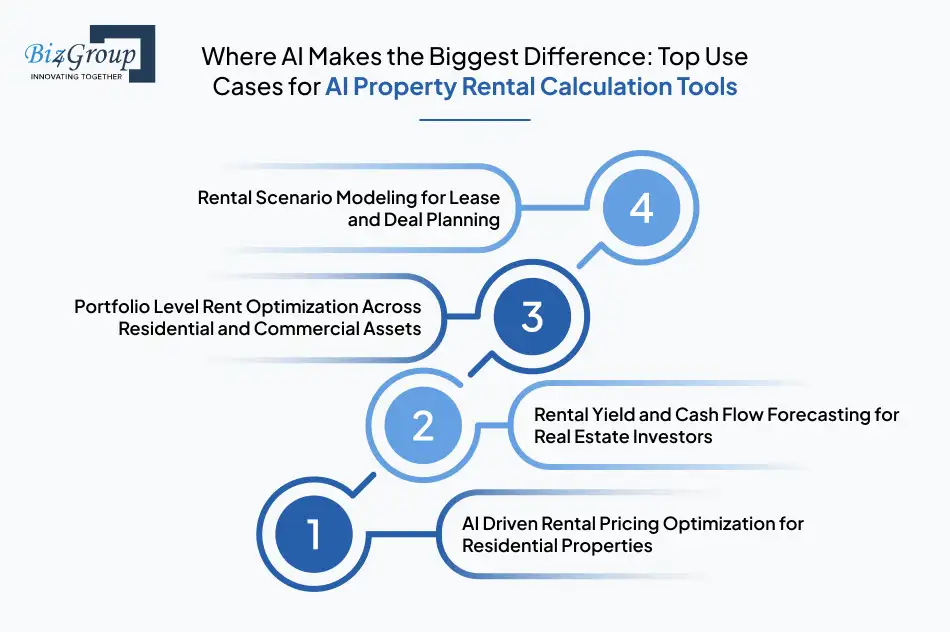
When businesses invest in AI property rental calculation tool development, they expect outcomes that directly impact revenue, occupancy, and decision making. These tools prove their value in day-to-day rental operations where pricing errors quickly translate into lost income.
Below are the most practical and proven use cases, explained clearly and grounded in real business scenarios.
1. AI Driven Rental Pricing Optimization for Residential Properties
This use case focuses on setting accurate rents for apartments, condos, and single-family homes. By analyzing comparable listings, local demand, tenant behavior, and seasonality, AI helps you arrive at a rent that attracts tenants while protecting margins. When you build AI powered rental calculation tools, pricing decisions stay consistent across locations without relying on guesswork.
Benefits
- More accurate and competitive rental pricing
- Faster leasing cycles with fewer vacant days
- Improved tenant acquisition without aggressive discounting
Example
A property management firm overseeing multiple residential communities struggled with inconsistent pricing across cities. By implementing logic similar to an AI house rental app, the team began adjusting rents dynamically based on demand signals. Over time, vacancy periods shortened while rental income improved because pricing aligned more closely with market behavior.
2. Rental Yield and Cash Flow Forecasting for Real Estate Investors
For investors, rental pricing is inseparable from returns. This use case focuses on forecasting income alongside expenses, vacancy assumptions, and long-term trends. When teams develop AI property rental calculation systems for portfolio optimization, they gain a clearer understanding of yield before committing capital.
Benefits
- Clear visibility into projected cash flow
- Better evaluation of risk versus return
- Stronger confidence in acquisition decisions
Example
An investment firm reviewing multiple rental opportunities used an approach similar to an AI real estate investment calculator app to simulate rent and occupancy scenarios. Instead of relying on fixed assumptions, the AI model highlighted which assets could maintain returns even during market slowdowns, helping the firm avoid risky investments.
3. Portfolio Level Rent Optimization Across Residential and Commercial Assets
Managing rent across dozens or hundreds of properties manually does not scale. AI enables standardized pricing logic while respecting local market conditions and asset type differences. This is especially useful when teams make AI rental calculation tools for residential and commercial properties within a unified platform.
Benefits
- Consistent pricing strategy across large portfolios
- Reduced manual effort for operations teams
- Better alignment between asset level and portfolio goals
Example
A commercial real estate operator managing office and retail properties aligned rental pricing with broader AI property asset management systems. The platform adjusted rent recommendations property by property while keeping overall revenue targets in view, allowing leadership to make faster and more confident decisions.
4. Rental Scenario Modeling for Lease and Deal Planning
This use case supports planning before leases are signed or renewed. AI models simulate how different rent levels affect occupancy, revenue, and long-term returns. When you develop intelligent rental pricing tools, you reduce the risk of locking into unprofitable pricing structures.
Benefits
- Stronger positioning during lease negotiations
- Reduced exposure to long term pricing mistakes
- Data backed planning instead of assumptions
Example
A leasing team preparing multi year commercial contracts used rental simulations connected with AI real estate lease management software. By testing different escalation and pricing scenarios, they identified rent structures that balanced tenant retention with predictable income growth.
How Renters Book Supports Better Rental Decisions (Beyond Pricing)
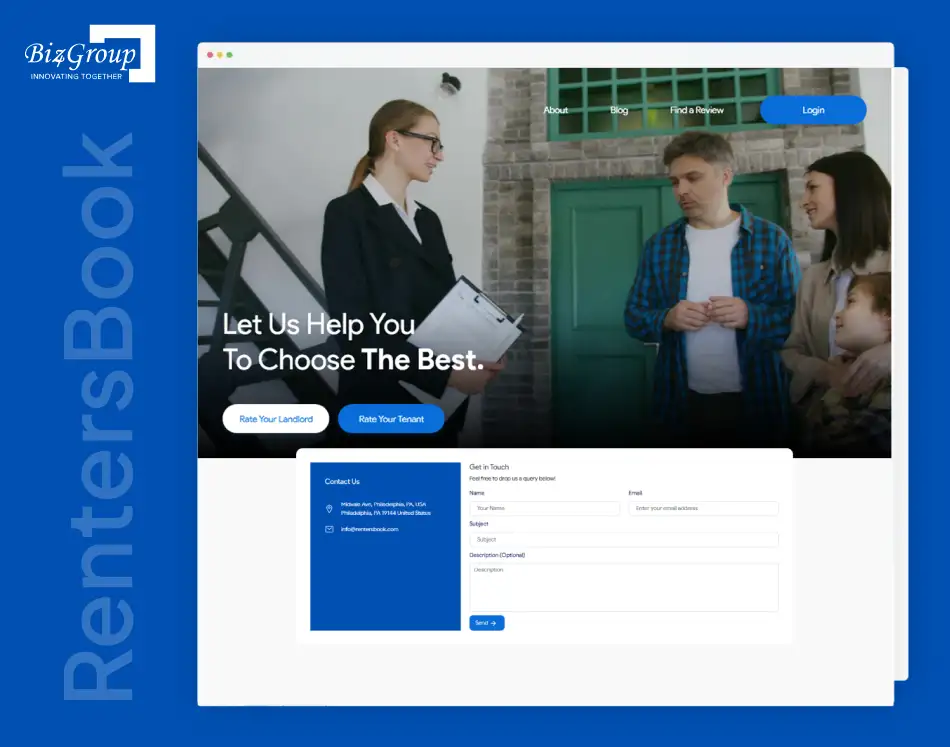
Renters Book, developed by Biz4Group, is a reputation and review platform that helps landlords and tenants make smarter rental decisions based on real feedback. It is not a rent calculator, but it strengthens trust in rental relationships, which supports more confident pricing and leasing outcomes.
What Renters Book Offers
- Verified reviews for tenants and landlords
- Searchable profiles with rental history
- Reputation insights that reduce leasing risk
- A platform that improves tenant-landlord transparency
Why It Matters for Rental Pricing
Strong reputation and trust reduce vacancy risk and help landlords feel confident about recommended rents. When pricing tools are paired with trustworthy tenant data, you get a more complete view of rental risk and long-term income stability.
This real-world project shows how technology can improve rental operations and support pricing decisions when used alongside tools built through AI property rental calculation tool development.
What Makes an AI Property Rental Calculation Tool Truly Effective: Must Have Features Explained
When you invest in AI property rental calculation tool development, features are what separate a basic calculator from a system you can actually trust for real decisions. The right features help you price confidently, forecast accurately, and scale without chaos.
Below is a clear, practical breakdown of the core features every AI driven rental calculation platform must have, explained in business terms, not technical jargon.
|
Feature |
What It Does for You |
Why It Matters in Real Operations |
|---|---|---|
|
Market Comparable Analysis Engine |
Automatically analyzes similar properties based on location, size, amenities, and demand |
Removes manual comp analysis and ensures your rent stays competitive and realistic |
|
Dynamic Rent Recommendation Logic |
Suggests an optimal rent range instead of a fixed number |
Gives you flexibility to adapt pricing without risking occupancy |
|
Rental Yield & Cash Flow Forecasting |
Projects rental income after expenses and vacancies |
Helps investors and operators understand true profitability before committing |
|
Expense & Vacancy Modeling |
Factors in maintenance, management costs, and vacancy assumptions |
Prevents overestimated returns and protects margins |
|
Portfolio Level Rent Optimization |
Evaluates pricing across multiple properties together |
Essential when you develop AI property rental calculation systems for portfolio optimization |
|
Scenario Simulation & What If Analysis |
Tests how rent changes impact yield, occupancy, and revenue |
Reduces pricing risk before leases are signed or renewed |
|
Residential & Commercial Logic Handling |
Adjusts pricing models based on asset type |
Critical when you make AI rental calculation tools for residential and commercial properties |
|
Data Integration Layer |
Connects with PMS, CRM, listing platforms, and market data sources |
Ensures decisions are based on real, up to date information using AI integration services |
|
AI Model Learning & Improvement |
Continuously improves recommendations as new data flows in |
Keeps pricing relevant as markets shift |
|
Dashboard & Decision Interface |
Presents insights in a clear, usable format |
Strong UI/UX design ensures teams actually use the tool |
|
Automation & Alerts |
Flags rent gaps, underperforming units, or market shifts |
Saves time and supports proactive decisions through AI automation services |
|
Security & Access Control |
Protects financial and portfolio data |
Non-negotiable for enterprise grade deployments |
|
Scalable Architecture |
Supports growth from a few properties to thousands |
Required when building enterprise AI solutions |
Each of these features plays a role in turning pricing from a reactive task into a strategic advantage. When combined thoughtfully, they allow you to build AI powered rental calculation tools that scale with your business and adapt to market realities instead of fighting them.
Once these features are clearly defined, the next step is understanding how to build them, starting with the development process itself.
Do these features sound powerful or overwhelming?
You do not need everything at once. We help you prioritize the features that actually move revenue and occupancy.
Build My Rental AI RoadmapFrom Idea to Execution: Step by Step Process to Develop an AI Property Rental Calculation Tool
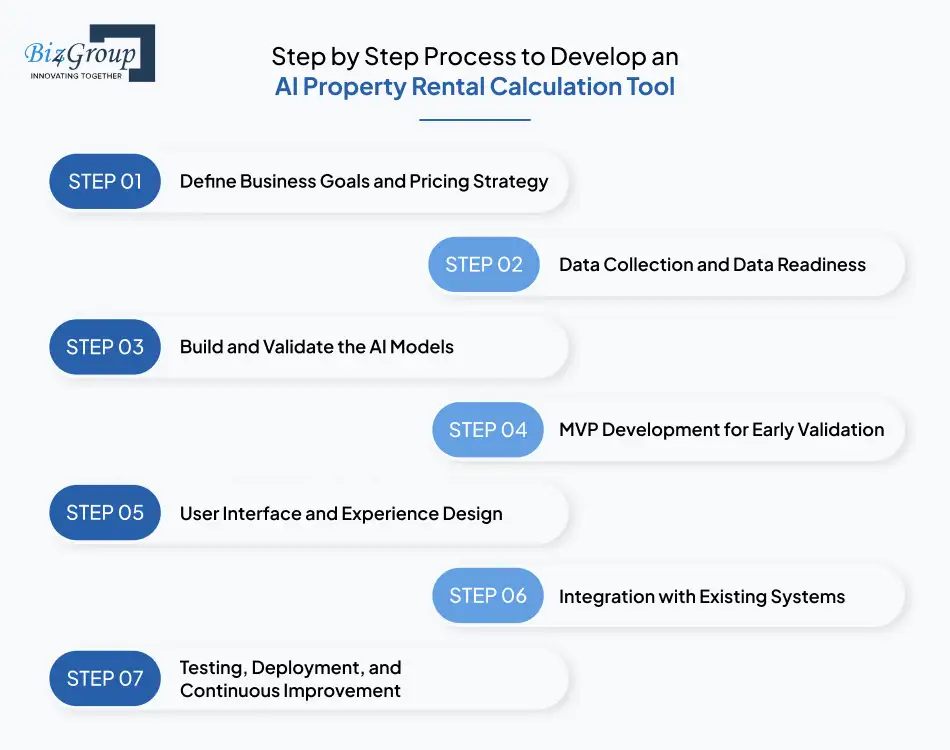
Building a reliable system is not about jumping straight into code. When done right, AI property rental calculation tool development follows a structured path that balances business goals, data readiness, and technical execution. Below is a clear breakdown of each step, explained in practical terms.
Step 1: Define Business Goals and Pricing Strategy
Everything starts with clarity. You need to decide what problems the tool should solve and for whom. This includes defining whether the focus is residential, commercial, or mixed portfolios, along with pricing objectives like yield optimization or vacancy reduction.
- Identify target users and decision makers
- Define pricing goals and success metrics
- Align rental logic with business strategy
Step 2: Data Collection and Data Readiness
AI systems are only as good as the data behind them. This step focuses on identifying, validating, and preparing the right datasets that will drive rent calculations and forecasts.
- Property level attributes and historical rent data
- Market comps, demand trends, and seasonality inputs
- Expense, vacancy, and return assumptions
Step 3: Build and Validate the AI Models
This is where intelligence takes shape. Machine learning models are trained to understand how different variables affect rental pricing, yield, and occupancy. The focus is accuracy, explainability, and adaptability.
- Select appropriate pricing and forecasting models
- Train models using historical and live data
- Validate outputs against real world outcomes
Many teams choose to hire AI developers at this stage to ensure models are built and evaluated correctly for real estate use cases.
Step 4: MVP Development for Early Validation
Before scaling, it is smart to start small. An MVP helps you test assumptions, validate pricing logic, and gather early feedback without over investing.
- Build core rent calculation and forecasting flows
- Test with a limited dataset or property group
- Refine logic based on real user feedback
This phase is often executed through structured MVP development to reduce risk and accelerate learning.
Step 5: User Interface and Experience Design
Even the smartest system fails if users struggle to understand it. This step ensures insights are presented clearly so pricing decisions feel intuitive, not overwhelming.
- Design dashboards for pricing and yield insights
- Keep workflows simple and decision focused
- Ensure usability for non technical users
Strong UI/UX design plays a major role in adoption and long term success.
Step 6: Integration with Existing Systems
Rental calculation tools rarely operate in isolation. This step connects the platform with property management systems, CRMs, listing platforms, and internal databases so data flows smoothly.
- Integrate with PMS and financial systems
- Enable real time data updates
- Maintain consistency across platforms
Step 7: Testing, Deployment, and Continuous Improvement
Once deployed, the system must be monitored and refined. Rental markets change, and your AI models need to keep learning to stay relevant.
- Test pricing accuracy and performance regularly
- Monitor model behavior as new data arrives
- Improve recommendations over time
Following this structured approach helps you develop AI property rental calculation software that is accurate, scalable, and trusted by your teams. It also ensures the tool grows with your portfolio instead of becoming another static system.
The Right Tech Stack for AI Property Rental Calculation Tool Development
Choosing the right technology stack plays a major role in how accurate, scalable, and future ready your solution becomes. When you plan AI property rental calculation tool development, the goal is not to overengineer, but to select tools that support data accuracy, learning capability, and smooth user experience.
The table below breaks down a practical and proven tech stack, along with how each layer supports real world rental calculation needs.
|
Tech Layer |
Recommended Technologies |
Why This Matters for Rental Calculation Tools |
|---|---|---|
|
Frontend (Web & Mobile) |
React, Next.js, Flutter |
Enables fast dashboards and responsive pricing views that decision makers can use without friction |
|
Backend Framework |
Node.js, Python (FastAPI, Django) |
Handles pricing logic, data processing, and AI model orchestration reliably |
|
AI & Machine Learning |
Python, TensorFlow, PyTorch, Scikit-learn |
Powers rent prediction, yield forecasting, and pricing optimization models |
|
Data Processing & ETL |
Pandas, Apache Airflow |
Ensures clean, structured data before it reaches the AI models |
|
Databases |
PostgreSQL, MongoDB |
Stores property data, rental history, and market intelligence securely |
|
Market Data Integrations |
MLS APIs, listing platforms, third party market data |
Keeps pricing recommendations aligned with real time market conditions |
|
Cloud Infrastructure |
AWS, Azure, Google Cloud |
Supports scalability as portfolios grow from dozens to thousands of properties |
|
AI Workflow Orchestration |
Model pipelines, retraining schedules |
Keeps AI models updated as new rental data flows in |
|
Security & Compliance |
Role based access, data encryption |
Protects sensitive financial and portfolio data |
|
Monitoring & Analytics |
Model performance tracking, logging |
Ensures rent recommendations stay accurate over time |
This stack allows you to build AI powered rental calculation tools that are flexible enough to support residential and commercial assets while remaining reliable at scale.
In many cases, businesses partner with an experienced AI app development company to design and implement this stack correctly from day one. This reduces technical debt and avoids costly rework later.
Technology is only one part of the equation. Once the stack is defined, the next big question most teams ask is straightforward. What does it actually cost to build and maintain a system like this?
That is where the cost breakdown becomes essential.
AI Property Rental Calculation Tool Development Cost Breakdown: What You Should Budget and Why
When planning AI property rental calculation tool development, cost is usually the first serious question. In most real-world scenarios, the AI property rental calculation tool development cost estimate falls between $15,000 to $150,000+, depending on scope, features, data complexity, and scale. A lightweight MVP sits at the lower end, while enterprise grade platforms with advanced AI models and integrations move toward the higher range.
It is important to note that costs vary because no two rental businesses have the same data maturity, portfolio size, or pricing strategy.
Feature Wise Cost Breakdown for AI Rental Calculation Tool Development
|
Feature Area |
Estimated Cost Range |
What You Are Paying For |
|---|---|---|
|
Core Rent Calculation Logic |
$5,000 to $15,000 |
Basic pricing models using property and market inputs |
|
Market Comparable Analysis |
$8,000 to $20,000 |
Integration with listing data and comp analysis logic |
|
AI Rental Yield & Cash Flow Forecasting |
$10,000 to $30,000 |
Predictive models for income, expenses, and vacancy |
|
Portfolio Level Optimization |
$12,000 to $35,000 |
Multi property pricing logic and portfolio insights |
|
Scenario Simulation and What If Analysis |
$8,000 to $20,000 |
Testing rent changes against yield and occupancy |
|
Data Integrations and APIs |
$5,000 to $25,000 |
PMS, CRM, market data, and internal system integrations |
|
Dashboard and Visualization |
$6,000 to $18,000 |
User friendly pricing, yield, and forecast views |
|
Security and Access Control |
$3,000 to $10,000 |
Data protection, roles, and permissions |
|
Testing and Model Validation |
$4,000 to $12,000 |
Accuracy testing and real-world validation |
This breakdown applies whether you develop AI property rental calculation software for a single asset class or make AI rental calculation tools for residential and commercial properties.
Key Factors That Affect AI Property Rental Calculation Tool Development Cost
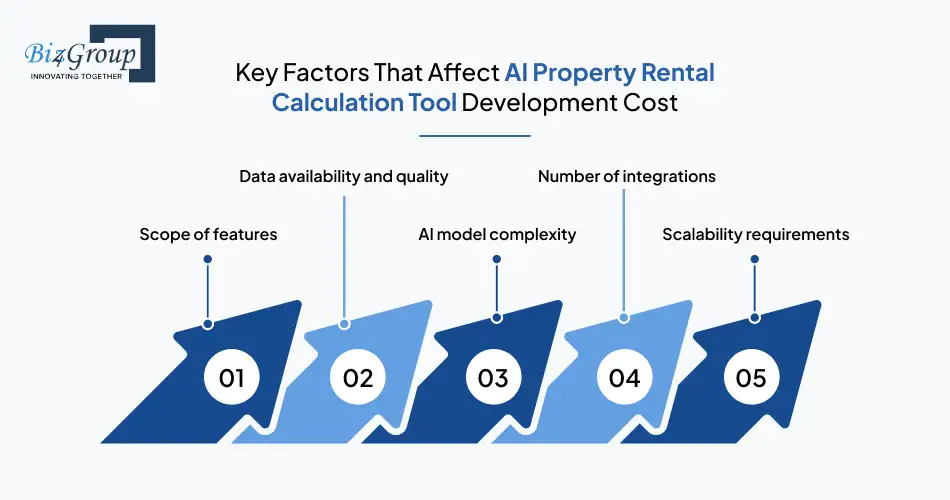
Several variables directly influence how much you spend.
- Scope of features
Advanced forecasting, portfolio optimization, and scenario modeling increase complexity and cost. - Data availability and quality
Clean, structured data reduces development effort, while fragmented data increases prep and validation costs. - AI model complexity
Simple regression AI models cost less than adaptive machine learning systems that retrain continuously. - Number of integrations
Connecting with multiple external systems raises both development and testing costs through AI integration services. - Scalability requirements
Tools designed for enterprise portfolios require stronger infrastructure and governance.
Hidden Costs Many Teams Overlook
Even with a clear budget, some costs often surface later if not planned upfront.
- Ongoing AI model retraining and performance monitoring
- Cloud infrastructure and data storage fees
- API usage costs for third party market data
- Compliance and security upgrades as the platform scales
- Continuous UI improvements based on user feedback
These are especially common when teams move beyond MVP stage.
How to Optimize AI Rental Calculation Tool Development Cost
Cost control does not mean cutting corners. It means building smart.
- Start with MVP to validate pricing logic before scaling
- Focus first on high impact features like rent calculation and yield forecasting
- Reuse existing data sources where possible instead of building everything from scratch
- Plan integrations carefully instead of adding them all at once
- Consider working with a trusted AI app development company that understands real estate use cases
Many businesses also choose to hire AI developers selectively to strengthen model accuracy without inflating overall budgets.
AI rental calculation solutions for real estate investors and firms can be built incrementally. Starting small and scaling based on results keeps costs predictable while still delivering measurable value. The next challenge most teams face is not cost, but execution hurdles and how to solve them effectively.
Wondering what your real build cost would look like?
Every portfolio is different. A quick discussion can clarify scope, cost, and the smartest place to start.
Get a Cost BreakdownChallenges in AI Property Rental Calculation Tool Development and How to Solve Them
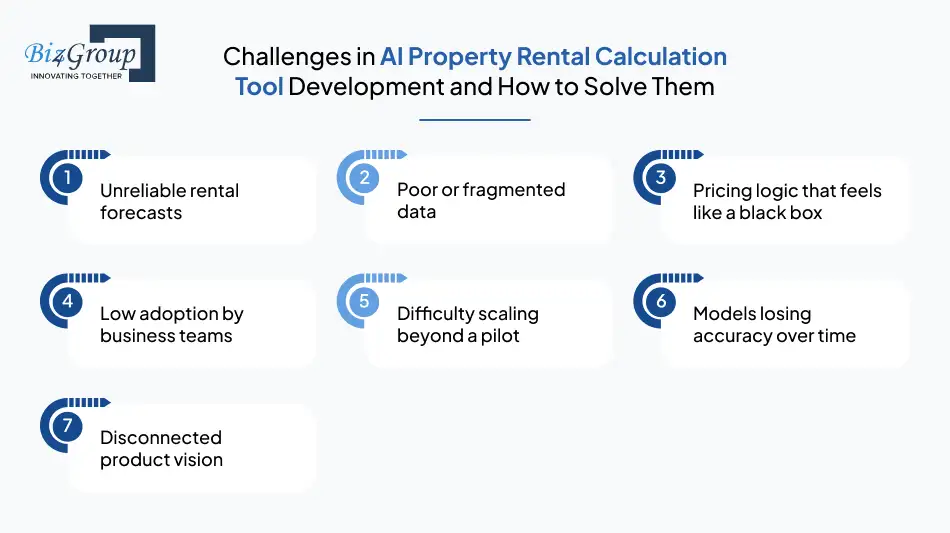
Building AI property rental calculation tool development the right way comes with challenges that most teams underestimate. These issues are common across real estate businesses, but they are also very solvable when addressed with the right approach.
Here is a clear, practical view of what usually goes wrong and how successful teams fix it.
|
Challenge |
Why It Becomes a Problem |
What Actually Works |
|---|---|---|
|
Unreliable rental forecasts |
Rental markets shift quickly due to demand changes, seasonality, and local factors |
Use stronger forecasting models backed by real estate AI predictive analytics to keep rent predictions aligned with real market behavior |
|
Poor or fragmented data |
Property, market, and financial data often live in separate systems |
Clean and standardize data early, and define a single source of truth before training models |
|
Pricing logic that feels like a black box |
Stakeholders struggle to trust AI recommendations they cannot understand |
Design explainable outputs that show why a rent range was suggested, not just the final number |
|
Low adoption by business teams |
Tools are built with technical thinking instead of user workflows |
Focus on clarity, simple dashboards, and decision focused insights instead of complex controls |
|
Difficulty scaling beyond a pilot |
MVPs are not designed for large portfolios or multiple asset types |
Plan scalability from day one with modular architecture and long-term growth in mind |
|
Models losing accuracy over time |
Markets evolve but models remain static |
Set up continuous monitoring, retraining, and validation as part of the system lifecycle |
|
Disconnected product vision |
Features are added without a clear roadmap |
Treat the platform as a long-term product, not a onetime build, following a structured AI product development company approach |
The key takeaway is simple. Most challenges in AI rental calculation solutions for real estate investors and firms are not technical roadblocks. They are planning and execution gaps.
Why Choose Biz4Group LLC for AI Property Rental Calculation Tool Development in the USA?
Choosing the right partner matters just as much as choosing the right technology. When you are investing in AI property rental calculation tool development, you are not just building software. You are shaping how pricing decisions, yield forecasting, and portfolio strategy will work for years to come.
Biz4Group LLC brings a strong mix of real estate domain understanding, AI engineering depth, and product thinking that US based businesses look for. We do not approach this as a one-off build. We approach it as a long-term product that needs to be performed reliably in real market conditions.
As an experienced AI development company based in the USA, Biz4Group understands the expectations around data security, scalability, and business accountability. Our teams work closely with founders, CTOs, and operations leaders to ensure the solution aligns with how pricing decisions are actually made inside real estate organizations.
What sets Biz4Group apart is our ability to blend AI intelligence with real world workflows. Whether you want to develop AI property rental calculation software from scratch or enhance an existing system, we focus on accuracy, explainability, and adoption. Pricing recommendations should make sense to your team, not just to an algorithm.
We also specialize in building tailored platforms. As a trusted custom software development company, we do not force templates or generic logic. Every rental market behaves differently, and your tool should reflect your asset mix, geography, and business goals.
A few strengths that clients value when working with Biz4Group:
- Deep experience building AI driven real estate platforms
- Strong focus on scalable and secure architectures for US enterprises
- Product first mindset that prioritizes usability and long-term value
At the end of the day, AI rental calculation solutions for real estate investors and firms only succeed when they are built with clarity, precision, and business context. That is exactly how Biz4Group approaches every AI product we deliver.
Ready to turn rental pricing into a competitive edge?
When strategy, data, and AI come together, pricing decisions become easier, faster, and more confident.
Contact Biz4Group LLCWrapping Up!
Rental pricing has moved far beyond spreadsheets and static calculators. Markets shift quickly, portfolios grow faster, and decisions now demand accuracy you can defend. That is exactly where AI property rental calculation tool development delivers real value. It helps you set optimal rents, forecast cash flow, and evaluate returns using data instead of assumptions.
This guide showed how to develop AI property rental calculation software, identify the right use cases, choose essential features, plan the tech stack, and understand the AI property rental calculation tool development cost estimate. When done right, these systems support portfolio optimization, reduce pricing risk, and help you build AI rental calculation solutions for real estate investors and firms that scale across residential and commercial assets.
Biz4Group LLC brings proven experience in custom AI rental calculation tool development for the US real estate market. We focus on building platforms that are accurate, explainable, and ready for real world operations, whether you want to build an AI powered rental calculation tool, develop intelligent rental pricing tools, or create AI driven property rent estimation platforms aligned with your business goals.
If you are ready to move from guesswork to confident, data driven rental decisions, we are ready to help you build it right.
FAQ
1. What exactly is AI property rental calculation tool development and why is it important?
AI property rental calculation tool development is the process of creating intelligent software that helps real estate businesses determine the most accurate rental pricing using data and predictive models. Instead of relying on spreadsheets or manual comparisons, these tools analyze market trends, comparable rentals, operating costs, and return expectations together. This is important because it reduces pricing risk, improves profitability, and allows you to scale rental decisions across residential and commercial portfolios with confidence.
2. How does AI rental calculation software work in real estate?
AI rental calculation software works by combining property level data, market intelligence, and financial inputs into a single system. It studies patterns across comparable rents, demand fluctuations, seasonality, expenses, and vacancy behavior. Using these insights, the system generates data backed rent recommendations and forecasts. When you develop AI property rental calculation software, the models continue learning over time, ensuring pricing stays aligned with real world market conditions.
3. What features should I focus on when building an AI powered rental calculation tool?
When you build an AI powered rental calculation tool, the most important features include predictive rent pricing, rental yield and cash flow forecasting, portfolio level optimization, and scenario modeling. Clear dashboards and explainable recommendations are equally important so teams trust and use the system. These features form the foundation of AI rental calculation solutions for real estate investors and firms that support daily pricing and long term planning decisions.
4. How much does AI property rental calculation tool development cost?
The AI property rental calculation tool development cost estimate typically ranges from $15,000 to $150,000+, depending on the scope and complexity of the solution. MVP builds with basic pricing logic sit on the lower end, while enterprise platforms with advanced predictive models, integrations, and portfolio optimization fall on the higher end. Costs vary based on data availability, AI sophistication, and scalability requirements.
5. Can AI rental calculation tools integrate with existing real estate systems?
Yes, most modern solutions are designed to integrate with property management systems, CRMs, listing platforms, and internal financial tools. These integrations ensure real time data flow and consistent pricing logic across workflows. When you create AI enabled rent calculation applications, integration plays a key role in maintaining accuracy and avoiding data silos that weaken pricing decisions.
6. Will AI replace human expertise in setting rental prices?
AI does not replace human expertise. It enhances it. These tools analyze far more data than a person can and surface insights quickly, but final pricing decisions remain with your team. When you develop intelligent rental pricing tools, AI supports consistency, speed, and accuracy while allowing decision makers to apply market knowledge and strategic judgment.
7. How does predictive analytics improve rental pricing accuracy?
Predictive analytics allows AI models to anticipate demand shifts, pricing sensitivity, and market trends before they fully materialize. This improves the accuracy of rent forecasts and reduces reliance on outdated data. When combined with developing AI property rental calculation systems for portfolio optimization, predictive analytics helps real estate businesses price proactively, protect returns, and plan confidently across growing portfolios.
