 Location :
Orlando, FL, USA
Location :
Orlando, FL, USA +1 (407) 714-1616
 info@biz4group.com

 AI Summary Powered by Biz4AI
- AI conversation intelligence for real estate turns calls, texts, emails, and agent notes into structured buyer insights, reducing fragmented information across brokerage systems.
- AI buyer preference analysis captures budgets, property requirements, location criteria, objections, and purchase timelines while distinguishing confirmed preferences from assumptions.
- Preference tracking and property matching help brokerages identify changing requirements, compare listings, and explain why properties fit or fall short.
- CRM integration and data safeguards connect insights to existing workflows while supporting access controls, human verification, and Fair Housing considerations.
- Custom AI platform development makes sense when existing CRM features fall short. You can partner with Biz4Group LLC to navigate the custom-build journey with an experienced development partner, from planning and integration to deployment.
A buyer starts with a clear brief: a two-bedroom condo under $500,000. A few conversations later, they’re open to a higher budget for a second bathroom, but the commute limit hasn’t budged. The agent catches the change. Does the CRM?
This is the gap AI conversation intelligence for real estate can help close. By connecting calls, texts, emails, and agent notes, brokerages can build buyer profiles that reflect what people want now, what has changed, and what still needs clarification. That’s far more useful than another call summary sitting untouched in the CRM.
The challenge is that buyer preferences evolve throughout the search. Zillow’s April 2026 research on homebuyer behavior explores how the journey can span months and hundreds of property views. Keeping up takes more than recording individual interactions; it takes a way to connect the dots between them.
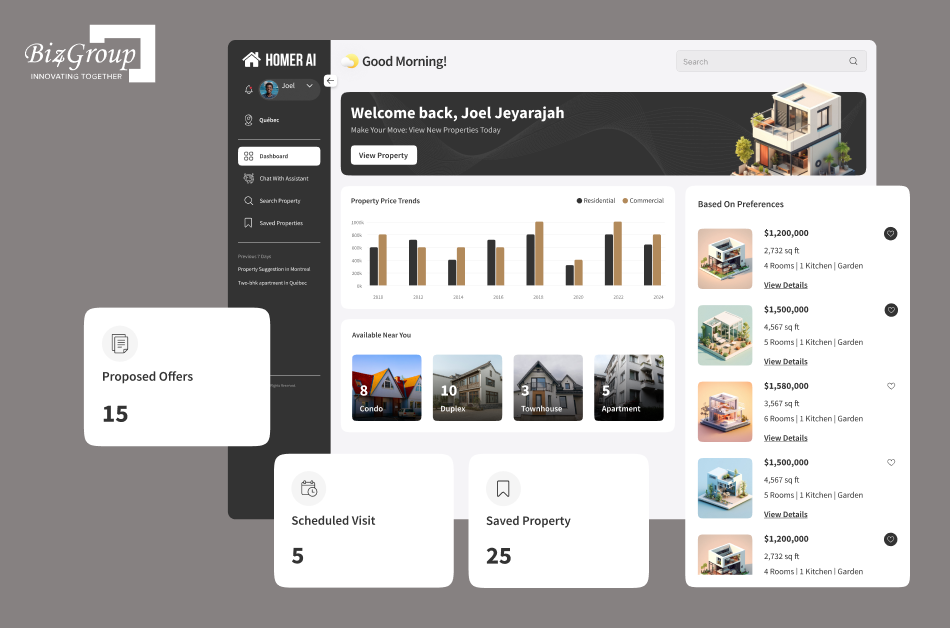
Building AI-powered real estate platforms, including conversational tools like Homer AI, a conversational AI-powered property management application, has taught the team at Biz4Group LLC a thing or two about what makes real estate AI truly useful. With over 20 years of experience in the industry, we’ve learned that a smart AI assistant needs to do more than understand what buyers are looking for. It should connect property listings, buyer preferences, customer data, and the tools real estate agents already use, turning everyday interactions into meaningful insights that simplify workflows and help agents close deals.
But tricky part is, valuable buyer information often gets scattered across conversations, CRM systems, and property inquiries, making it easy for important details to slip through the cracks. So, let’s explore where this information gets lost and how brokerages can turn scattered conversations into reliable, actionable insights.
How Can AI Conversation Analysis Solve Brokerage Buyer-Information Gaps?
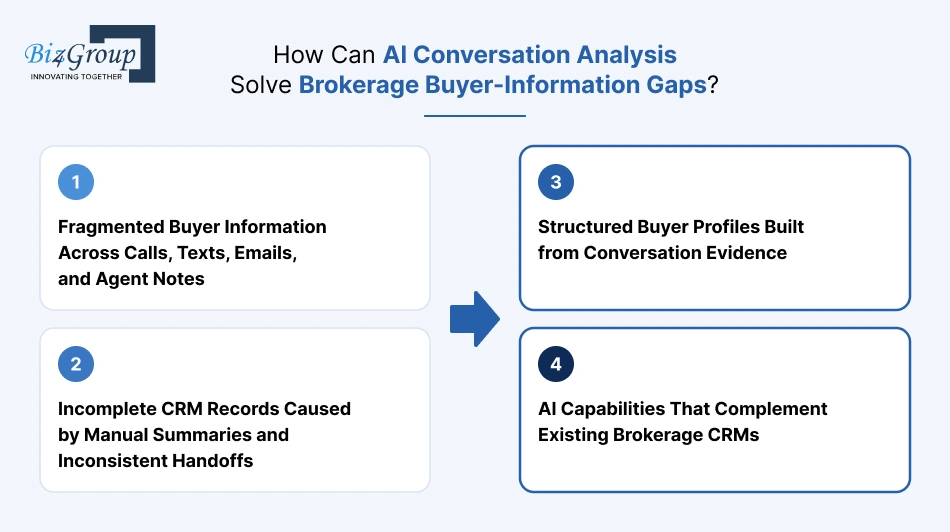
AI conversation analysis uses AI to interpret buyer communications across calls, texts, emails, chats, and agent notes, extracting property preferences, budget details, concerns, and changes in requirements. For brokerages, it connects information scattered across channels, reduces gaps in CRM records, builds evidence-backed buyer profiles, and gives agents relevant context for follow-ups and property recommendations.
1. Fragmented Buyer Information Across Calls, Texts, Emails, and Agent Notes
A buyer might share their budget on a call, preferred neighborhood by text, and need for a home office during a showing. When these details sit in separate systems, agents may miss important preferences or ask questions the buyer has already answered.
AI conversation intelligence for real estate can analyze authorized conversations across channels and bring relevant details together. Instead of reviewing each interaction separately, agents get a more complete view of what the buyer has shared.
2. Incomplete CRM Records Caused by Manual Summaries and Inconsistent Handoffs
CRM records often depend on agents having time to summarize conversations and update fields consistently. A detailed discussion can become a note like “Interested in condos, budget flexible, follow up next week,” leaving the next agent without the context needed to act.
AI can generate summaries and extract specific details for agent review. It can distinguish “budget is $500,000” from “might consider spending more for the right property,” preserving an important difference that a brief manual note might miss.
Automation still needs checks. Unclear or conflicting details should be flagged for review rather than added to the CRM as confirmed facts.
3. Structured Buyer Profiles Built from Conversation Evidence
A useful buyer profile organizes preferences and shows where each insight came from. It should distinguish what the buyer explicitly stated from what the AI inferred, while identifying details that remain unconfirmed.
|
Profile field |
Example |
How agents use it |
|---|---|---|
|
Required feature |
Two bathrooms |
Filter unsuitable listings |
|
Budget |
Ideally under $500,000 |
Guide the initial property search |
|
Flexible preference |
May pay more for the right layout |
Discuss relevant trade-offs |
|
Unresolved detail |
Maximum commute not confirmed |
Ask a focused follow-up question |
Each important insight should retain its source statement and interaction date. Agents can then verify its meaning, correct errors, and see whether a preference is confirmed or uncertain. This makes AI buyer preference analysis more explainable and useful than a profile containing unsupported conclusions.
4. AI Capabilities That Complement Existing Brokerage CRMs
Brokerages can often improve buyer intelligence without replacing their CRM. An AI analysis layer can interpret conversation data, structure the resulting insights, and send approved updates into existing records and workflows.
Relevant capabilities include:
- Conversation summarization: Condense interactions while preserving key buyer details.
- Preference extraction: Identify stated budgets, property requirements, location criteria, objections, and timelines.
- Context retrieval: Show agents relevant conversation history before a call or showing.
- CRM updates: Add reviewed insights to appropriate fields or activity records.
- Review workflows: Flag uncertain details and conflicting statements for agent correction.
The right approach depends on the brokerage’s existing systems. If its CRM already handles conversation records and structured preferences well, extending those capabilities may be sufficient. If information is spread across disconnected tools, broader real estate CRM integration may be necessary.
Start by identifying what agents cannot reliably access or update today. Then choose the AI capabilities that close those specific gaps.
What Buyer Preferences Should the Platform Capture?
An AI buyer preference analysis platform should capture what buyers need, where they’re willing to compromise, what concerns them, and when they plan to buy. These insights help agents narrow property options, address objections, and tailor follow-ups without relying on memory or scattered notes.
1. Essential Property Requirements, Budgets, and Location Criteria
Start with the basics. Agents need to know which properties fit the buyer’s needs and which ones are an automatic no.
The platform should capture property type, bedrooms, bathrooms, size, layout, parking, budget, preferred neighborhoods, and acceptable commute times. It should also flag deal-breakers that rule out a property.
Wording matters, too. “I’d prefer three bedrooms” leaves room for alternatives. “I need three bedrooms” sets a firmer requirement. Mixing up the two can send agents chasing listings that were never a good fit.
2. Flexible Preferences and Acceptable Property Trade-Offs
Buyers rarely get everything on their wish list. The key is understanding what they’re willing to trade and under what conditions.
A buyer might accept less space for a better location or stretch their budget for a second bathroom. For example, “I could go above $500,000 if the property has a second bathroom” signals conditional flexibility, not a higher budget for every listing.
Capturing these trade-offs helps agents compare properties against the buyer’s real priorities instead of treating every preference as fixed or assuming everything is negotiable.
3. Buyer Objections and Unresolved Information Needs
Sometimes, the reason a buyer rejects a property is just as useful as what they like about it. Concerns about HOA fees, renovation costs, parking, building condition, or commute times can quickly narrow the search.
The platform should also track unanswered questions. A buyer might like a condo but need confirmation that the building allows pets before moving forward.
Keep facts separate from guesses. “The HOA fees are too high” is an explicit objection. Not replying to a listing doesn’t explain why the buyer passed. Knowing the difference helps agents address genuine concerns instead of sending more listings and hoping one sticks.
4. Purchase Timelines, Motivations, and Follow-Up Preferences
A good property match can still miss the mark if the timing or follow-up is wrong. Agents also need to know when buyers plan to move, what they’ve shared about their reasons for buying, and what should happen next.
The platform should capture:
- Purchase timeline: Target move-in date, buying window, and relevant deadlines.
- Stated motivation: Relocation, changing space needs, investment goals, or other reasons the buyer has shared.
- Decision stage: Exploring options, comparing properties, arranging viewings, or preparing an offer.
- Follow-up preferences: Preferred contact channel, suitable contact times, requested information, and agreed next steps.
These details help agents match their follow-up to the buyer’s situation. Someone hoping to move next month may need timely options, while someone planning for next year may still be exploring.
The rule is simple: capture what buyers actually share. Don’t assume their urgency or motivations based on personal circumstances alone.
How Does AI Turn Buyer Conversations into Structured Insights?
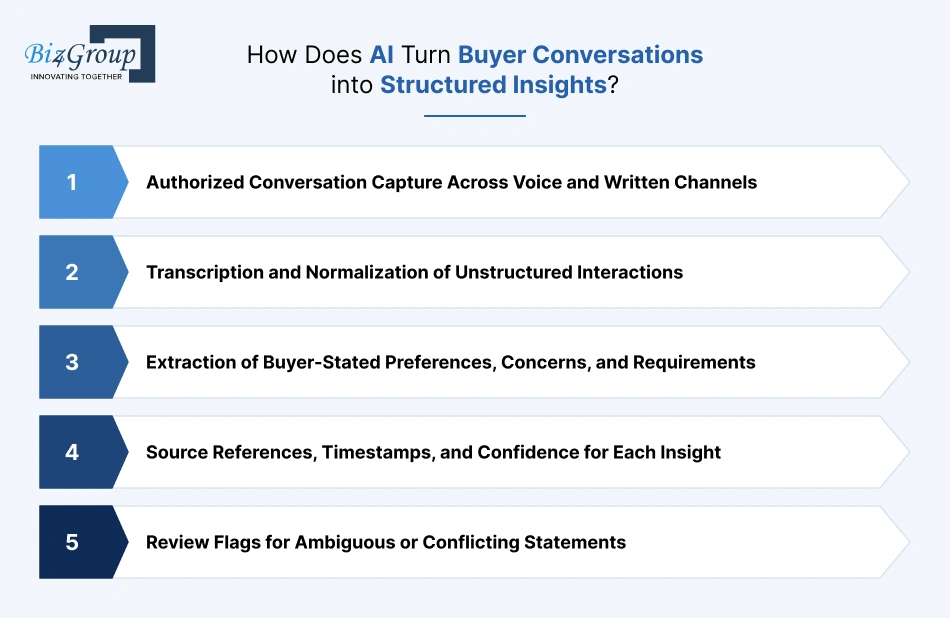
AI helps turn buyer conversations into clear, structured insights. It captures authorized interactions and converts them into text. Then, it identifies key details, links insights to their original sources, and flags uncertain information for review. This helps real estate teams make better-informed decisions with greater confidence. This workflow transforms unstructured conversations into buyer-profile data that agents can verify and use.
1. Authorized Conversation Capture Across Voice and Written Channels
First, the platform needs to bring the right conversations together. Depending on the brokerage’s systems and permissions, these might include call recordings, transcripts, SMS, emails, website chats, and agent notes.
APIs and channel integrations feed these records into one analysis workflow. The platform must also match each interaction to the right buyer and apply appropriate consent, access, and data-retention rules.
That identity check matters. A perfectly extracted preference is still useless if it ends up in the wrong buyer’s profile.
2. Transcription and Normalization of Unstructured Interactions
Calls need to become text before AI can analyze their content alongside emails and messages. Speech-to-text models handle the audio, while a normalization layer makes information from different channels consistent.
For example, “five hundred K” and “$500,000” can be standardized to the same budget value. Timestamps, message order, and speaker labels can also be organized where the source data supports them.
But transcription isn’t foolproof. Mishearing a price, property address, or the word “don’t” can change the meaning entirely. Unclear audio or questionable text should be flagged, not quietly passed along as fact. The original wording should remain available for checking.
3. Extraction of Buyer-Stated Preferences, Concerns, and Requirements
Now the AI gets to the useful part, identifying what the buyer actually said and mapping it into consistent fields. Natural language processing (NLP) and large language models can extract details such as:
|
Buyer information |
Example |
|---|---|
|
Budget |
Prefers properties under $500,000 |
|
Property requirement |
Two bathrooms |
|
Conditional flexibility |
May spend more for a second bathroom |
|
Concern |
Commute time is a priority |
|
Open question |
Confirm acceptable commute duration |
The goal is to capture meaning, not just keywords. “I might spend more” doesn’t mean “I’ve approved a higher budget,” and asking whether a property has a pool doesn’t mean having one is a must-have.
A defined data schema keeps the output consistent. Validation rules can catch missing fields, unsupported values, or incorrectly formatted responses before the information moves into the buyer profile or CRM.
4. Source References, Timestamps, and Confidence for Each Insight
Every important insight should come with a way to check its homework. The platform should link it to the original message or transcript excerpt, including a timestamp or message ID where available.
It should also distinguish between three kinds of information:
- Explicit: The buyer directly stated the preference.
- Inferred: The AI interpreted the statement as suggesting a preference.
- Uncertain: There isn’t enough clear evidence to draw a reliable conclusion.
Confidence scores can help prioritize what needs checking, but a high score doesn’t make an interpretation automatically correct. Agents should be able to open the source, read the surrounding context, and verify an insight before it drives an important profile update.
5. Review Flags for Ambiguous or Conflicting Statements
Buyers change their minds, speak hypothetically, and sometimes leave things open. The AI shouldn’t turn every statement into a firm requirement just to fill in a field.
The platform should flag cases such as vague budget limits, contradictory preferences, unclear wording, or unreliable transcripts.
Say a buyer initially caps their budget at $500,000 but later discusses properties priced above that. The system shouldn’t silently replace the old number or assume the buyer has committed to spending more. It should preserve the earlier record, flag the possible change, and let the agent confirm what the buyer means.
Once verified, the updated preference can be reflected in the profile with its history intact. That’s how AI buyer preference analysis stays useful without letting a guess become a fact.
How Can the Platform Track Changing Buyer Preferences Over Time?
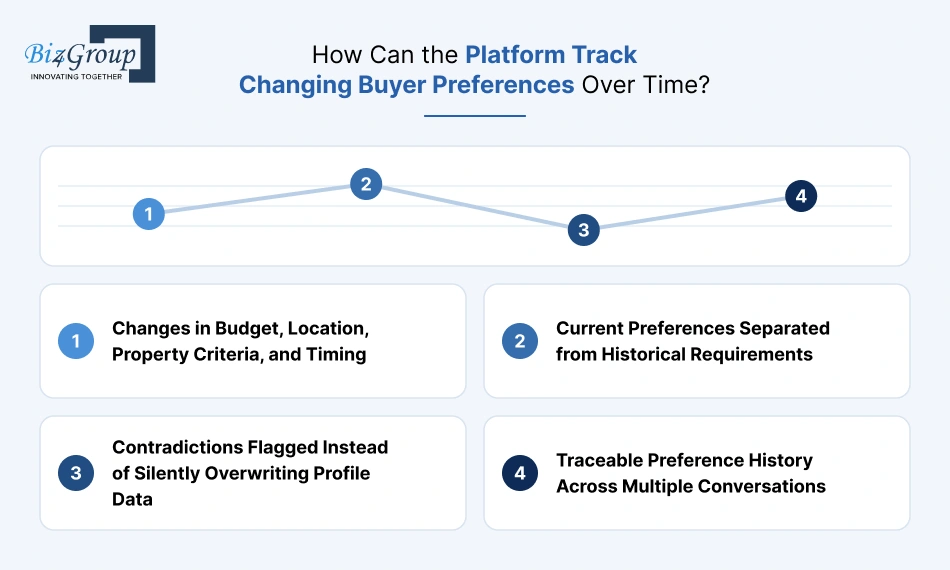
The platform can track changing buyer preferences by comparing new conversations with a buyer’s existing profile, identifying what has changed, and maintaining a history of previous requirements. This helps agents distinguish a genuine change of mind from a temporary possibility, an unresolved question, or a conflicting statement.
1. Changes in Budget, Location, Property Criteria, and Timing
Buyer preferences rarely stay fixed from the first call to the final offer. A buyer may increase their budget, expand their search area, reconsider the property type, or bring their purchase timeline forward.
The platform should monitor changes across key preference fields, including:
- Budget: The buyer is now considering properties above their original limit.
- Location: They have added new neighborhoods or ruled out an area they previously liked.
- Property criteria: A second bathroom has become essential, or a previously preferred feature is no longer important.
- Purchase timing: Their target move-in date has changed.
The important part is understanding the context behind each change. “We could consider homes in the next neighborhood” signals a possible expansion, not necessarily a confirmed change. The platform should record that distinction so agents can clarify before adjusting the search.
2. Current Preferences Separated from Historical Requirements
A buyer’s first requirements still matter, but they shouldn’t automatically dictate every future property search. The platform needs to maintain a clear view of what applies now and what belonged to an earlier stage of the search.
For example, a buyer initially wants a condo with one bathroom and a budget below $450,000. Later, they decide that two bathrooms are worth considering properties up to $500,000. Their original criteria provide useful context, but the current search should reflect their updated position once confirmed.
A practical profile can separate:
- Current preferences: The latest confirmed requirements and limits.
- Previous preferences: Earlier criteria retained for context.
- Pending changes: New statements that still need clarification.
- Superseded requirements: Preferences the buyer has explicitly replaced.
This prevents outdated criteria from narrowing property searches while preserving the context agents may need to understand the buyer’s decisions.
3. Contradictions Flagged Instead of Silently Overwriting Profile Data
Not every difference between conversations means a buyer has changed their mind. They may be discussing a hypothetical option, responding to a specific property, or correcting an earlier misunderstanding.
Suppose the profile records a maximum budget of $450,000, but a later conversation mentions a $475,000 property. The platform shouldn’t automatically raise the budget. It should flag the difference and help the agent establish whether the buyer is genuinely willing to spend more.
Useful review flags include:
- Possible preference change: A new statement differs from the current profile.
- Direct contradiction: Two statements cannot both be true under the same conditions.
- Unclear intent: The buyer is exploring an option without committing to it.
- Confirmed correction: The buyer or agent has verified that an earlier record was wrong.
Once clarified, the profile can be updated without losing the previous value. This keeps AI buyer preference analysis from turning every new remark into a permanent change.
4. Traceable Preference History Across Multiple Conversations
A changing buyer profile is much easier to trust when agents can see how it evolved. The platform should maintain a time-ordered history showing the preference, when it was expressed, its source, and whether it was confirmed, corrected, or superseded.
For example:
|
Event |
Preference History |
|---|---|
|
First conversation |
Budget: up to $450,000 |
|
Later conversation |
Buyer considers properties near $475,000 |
|
Agent follow-up |
Buyer confirms flexibility up to $475,000 for a second bathroom |
|
Current profile |
Budget remains $450,000 by default; up to $475,000 under the stated condition |
This history preserves a detail that a single current-value field would miss: the higher budget depends on getting something specific in return.
For brokerages, this creates a clearer record of buyer decisions across calls, messages, and agent handoffs. Agents can see not only what the buyer wants today, but also what changed, when it changed, and what still needs confirmation.
How Can Agents Use Buyer Conversation Insights in Daily Work?
AI Agents can use buyer conversation insights to prepare for meetings, manage handoffs, track commitments, and prioritize follow-ups. By putting relevant context within reach, AI conversation intelligence for real estate helps agents spend less time digging through records and more time moving buyer conversations forward.
1. Pre-Conversation Briefs Covering Buyer Needs and Previous Concerns
Before a call or showing, agents need the relevant highlights, not a transcript of every conversation. An AI-generated brief can surface:
- Key requirements: The buyer’s relevant property needs and priorities.
- Previous concerns: Questions about pricing, property features, fees, or location.
- Recent discussions: Listings reviewed and decisions already made.
- Pending commitments: Details the agent still needs to confirm or share.
For example, before a condo viewing, the brief might flag concerns about HOA fees and an unanswered question about parking. The agent can address both during the visit instead of making the buyer repeat themselves.
2. Consistent Agent Handoffs Through Shared Buyer Profiles
When a lead moves from an inside sales representative to a showing agent, the conversation shouldn’t have to start over. A shared buyer profile gives authorized team members the context needed to continue smoothly.
A useful handoff should cover:
- What the buyer has already discussed.
- Which questions or concerns remain open.
- What the previous agent promised.
- Who is responsible for the next step.
This reduces repeated discovery questions, missed commitments, and confusion over who owns the relationship.
3. Visible Unanswered Questions and Agreed Follow-Up Actions
Buyer conversations often produce specific tasks: send comparable listings, confirm a property feature, arrange a viewing, or answer a question about fees. AI can identify these tasks and organize them for follow-up.
Where available, each task should include:
- Action: What needs to happen?
- Owner: Who is responsible?
- Due date: When it should happen?
- Context: The buyer request or conversation behind it.
One important distinction: the platform must separate actions actually agreed upon from AI-generated suggestions. Otherwise, agents could end up managing tasks that nobody committed to completing.
4. Conversation Evidence Supporting Lead Prioritization
Conversation insights can add useful context to existing CRM lead scores and pipeline stages. Relevant signals might include:
- A buyer has stated a specific purchase timeframe.
- A buyer has requested a property viewing.
- An agreed follow-up date is approaching.
- An unanswered question is blocking the next step.
These signals help agents understand which leads need attention and why. However, frequent messages do not automatically mean a buyer is ready to purchase. Prioritization should consider the context of the conversation, show the evidence behind recommendations, and leave the final decision to the agent.
Also Read: AI Real Estate Lead Response & Qualification Platform: Automating Missed Calls Without Hiring an ISA
5. Team-Level Patterns in Missed Buyer-Discovery Details
At the brokerage level, conversation insights can reveal recurring gaps in how agents qualify buyers and document discussions. For example, aggregated reports might show that commute requirements often go unconfirmed or that agreed follow-ups are frequently missing from CRM records.
Managers can use these findings to improve the process through:
- Coaching: Reinforce discovery questions that agents regularly miss.
- CRM improvements: Add relevant fields to existing forms.
- Workflow changes: Clarify task ownership and follow-up expectations.
- Quality reviews: Examine selected conversations to understand recurring gaps.
The focus should be on improving buyer service, not simply counting agent activity. Reports should respect access permissions and highlight patterns that teams can act on.
Also Read: Build an AI Homebuyer Engagement Platform to Nurture Buyers from Discovery to Purchase
How Can Verified Buyer Preferences Improve Property Matching?
Verified buyer preferences become more useful when connected to listing data through AI property search integration. The platform can compare a buyer’s budget, location, property requirements, and flexible preferences against available listings, helping agents identify suitable properties and explain where a listing falls short.
1. Buyer Preferences Mapped to Searchable Listing Attributes
Buyers describe what they want in everyday language. Property databases store it in fields and filters. The platform needs to connect the two.
For example, “I need room to work from home” could map to a dedicated office or an additional bedroom. “I need two bathrooms” maps directly to the listing’s bathroom count.
Common mappings include:
- Property type: Condo, townhouse, or single-family home.
- Space and layout: Bedrooms, bathrooms, square footage, and office space.
- Price: Listing price compared with the buyer’s confirmed budget.
- Location: Preferred neighborhoods, geographic boundaries, and specified travel-distance limits.
- Features: Parking, outdoor space, and other requested property attributes.
Some preferences aren’t as easy to turn into filters. Take “I want a quiet neighborhood.” Unless the platform has reliable data to assess that, it shouldn’t pretend a listing meets the requirement. Missing information should stay marked as unknown, not get a convenient little checkmark.
2. Property Comparisons Against Stated Buyer Requirements
A matching engine should compare each listing against the buyer’s criteria and explain where it fits. Must-haves need to stay separate from nice-to-haves, so an attractive price or bonus feature doesn’t hide a deal-breaker.
Say a buyer wants two bathrooms, prefers a dedicated office, and has a budget of $500,000.
|
Listing Attribute |
Property A |
Property B |
|---|---|---|
|
Price |
$485,000 |
$460,000 |
|
Bathrooms |
2 |
1 |
|
Dedicated office |
Yes |
Not listed |
|
Bathroom requirement |
Meets |
Does not meet |
Property B is cheaper, but it fails a requirement the buyer considers essential. A matching system shouldn’t rank it as the better option just because the price looks good.
It should also distinguish between a genuine mismatch and missing data. If the listing doesn’t specify the bathroom count, the platform can’t assume the property has too few bathrooms. It needs to mark the detail as unverified.
3. Gaps Between Buyer Needs and Available Inventory
Sometimes, the right property simply isn’t in the current listings. Rather than padding search results with poor matches, the platform should show which requirements are limiting the search.
It can flag situations such as:
- No available properties meet the buyer’s budget and location criteria.
- Listings within budget lack an essential feature.
- Very few properties satisfy all the buyer’s must-haves.
- Missing listing details prevent a reliable comparison.
If no properties match a buyer’s requirements, the platform can show nearby alternatives for the agent to discuss. It shouldn’t change search criteria without the buyer’s approval.
Aggregated inventory data can also help brokerages identify property types, price ranges, and features in short supply across specific markets.
4. Preference Insights Integrated Into Existing Property-Search Workflows
Property matching works best when it fits into the search tools agents already use. Connecting buyer insights to existing listing databases and property-search systems lets agents put those insights to work without introducing another disconnected workflow.
Depending on the available APIs and listing data, the integration can support:
- Dynamic search filters: Apply confirmed buyer criteria to property searches.
- Match ranking: Prioritize listings based on stated requirements and approved trade-offs.
- New-listing matching: Compare incoming inventory against active buyer search criteria.
- Match explanations: Show which requirements each listing meets, misses, or lacks enough data to verify.
Not every preference belongs in a search filter. A confirmed bathroom requirement can be used as a direct filter, while a softer preference may help rank results or require an agent’s judgment.
That distinction matters. The goal isn’t just to produce a list of properties. It’s to give agents a clear, evidence-based reason for recommending each one.
How Does the Platform Integrate with an Existing Real Estate CRM?
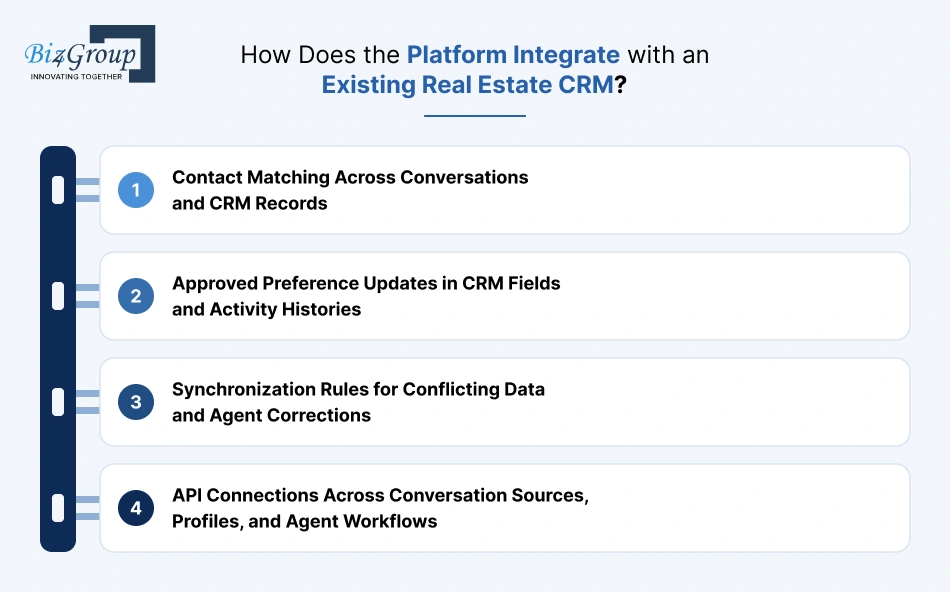
An AI buyer conversation platform integrates with an existing real estate CRM through APIs, webhooks, and data connectors that link conversation records, buyer contacts, and approved profile updates. The key is deciding which system owns each piece of data, what the AI can update, and how changes are handled when records disagree.
1. Contact Matching Across Conversations and CRM Records
Before connecting conversation insights to a CRM, the platform needs to identify which contact each interaction belongs to. That sounds simple until the same buyer appears under different email addresses, shares a phone number with a household member, or contacts the brokerage through several channels.
A contact-matching process can use available identifiers such as:
- CRM contact ID: The strongest reference when a reliable ID is already attached to the interaction.
- Email address and phone number: Useful for matching records, provided they are verified and handled appropriately.
- Channel-specific IDs: Identifiers supplied by connected messaging or calling systems.
- Agent review: A fallback when multiple records look like plausible matches.
Avoid merging contacts based on a name alone. When the match is uncertain, the platform should flag it for review rather than risk attaching one person's conversation to another person's CRM record.
2. Approved Preference Updates in CRM Fields and Activity Histories
Once the contact is matched, the integration needs clear rules for where each approved insight belongs. Structured fields are useful for values agents need to filter or report on, while activity histories preserve the context behind a conversation.
For example, a brokerage might store a confirmed budget range in a dedicated CRM field and retain the supporting call or message as an associated activity. This keeps searchable data separate from the full interaction history.
Before building the writeback workflow, decide:
- Which fields can be updated: Only map insights to CRM fields that support the relevant data.
- Which updates require approval: Define whether agents must review an insight before it changes a record.
- What belongs in activity history: Preserve useful context without copying entire conversations into general-purpose notes.
- How updates are identified: Record the source, timestamp, and processing status so changes can be traced.
Not every extracted detail needs its own CRM field. If the CRM cannot represent a preference accurately, keep the structured detail in the connected platform and link to it instead of squeezing it into the wrong field.
3. Synchronization Rules for Conflicting Data and Agent Corrections
The CRM and AI platform may not always agree. An agent might correct a budget manually just as the AI processes a new conversation, or two agents might enter different values. Without synchronization rules, one update can overwrite another.
Define how the integration should handle these situations:
- Agent corrections: Preserve approved manual edits and record who made the change.
- New conversation insights: Route potential changes through the agreed review process.
- Conflicting values: Flag disagreements rather than automatically choosing whichever value arrived last.
- Failed or repeated updates: Retry temporary failures safely and prevent duplicate records or activities.
A useful rule is to separate the latest statement from the approved current value. A newer comment may suggest a change, but it should not automatically replace a confirmed CRM field when its meaning is unclear.
Maintain an audit trail of the old value, proposed value, source, timestamp, and final decision. This makes errors easier to investigate and helps teams understand why a record changed.
4. API Connections Across Conversation Sources, Profiles, and Agent Workflows
APIs connect the platform to CRM records and external communication systems, while webhooks can notify it when relevant events occur, such as a contact update or a new conversation becoming available.
A typical integration may include:
- Inbound connectors: Retrieve authorized calls, messages, and CRM activities.
- Processing services: Normalize records, match contacts, and pass approved insights through validation.
- CRM APIs: Read and update permitted fields or create linked activities.
- Webhooks and event queues: Trigger processing when new records or changes arrive.
- Monitoring and error handling: Track failed requests, expired credentials, rate limits, and synchronization delays.
Integration depends on the CRM’s APIs, conversation providers, and access controls. Updates may sync in real time or on a schedule.
Test duplicate contacts, missing IDs, deleted records, expired credentials, and simultaneous edits. Ensure updates reach the correct records and failures trigger alerts.
Your CRM shouldn't need a detective to explain its own data.
Already juggling calls, texts, buyer records, and a dozen integrations? Let's untangle the tech stack and figure out how to get your systems talking to each other.
Let's Untangle Your Tech StackHow Can Brokerages Protect Buyer Data and Prevent Incorrect AI Insights?
Brokerages can protect buyer data by controlling what the AI collects, limiting who can access it, reviewing uncertain insights, and testing recommendations for discriminatory outcomes. These safeguards help AI conversation intelligence for real estate remain accurate, secure, and fair.
1. Consent, Authorized Collection, and Conversation-Data Retention
Before analyzing calls, texts, or emails, brokerages must establish that they are authorized to process the data. Having access to a conversation does not automatically authorize its use in an AI system.
Key controls include:
- Consent and permissions: Follow applicable call-recording, communication, and data-processing requirements.
- Purpose limitation: Use conversations for defined business purposes, not unrelated profiling.
- Data minimization: Collect only what the intended workflow requires.
- Retention and deletion: Set retention periods for recordings, transcripts, and extracted insights, with appropriate deletion rules.
The FTC’s data-security guidance recommends limiting data collection, protecting stored information, and disposing of it securely.
Brokerages should also check whether AI vendors retain submitted data or use it for model training. Vendor contracts and system settings should reflect the brokerage’s privacy requirements.
2. Role-Based Access to Sensitive Conversation Records
Agents, managers, and administrators need different levels of access. Role-based access control (RBAC) restricts each person to the information and actions their job requires.
Useful safeguards include:
- Least-privilege permissions: Limit access to relevant buyer records and conversations.
- Encryption: Protect data in storage and during transmission.
- Multi-factor authentication: Add protection for accounts handling sensitive information.
- Access logs: Track who viewed or changed records and when.
- Vendor restrictions: Limit third-party access to necessary data and services.
Apply these controls across connected systems, too. A protected AI platform cannot compensate for CRM permissions that expose buyer transcripts to unauthorized users.
3. Human Verification of Uncertain or Inaccurate Insights
AI can mishear a price, miss a word such as “not,” or interpret a tentative comment as a firm requirement. Brokerages should define which insights can be accepted automatically and which need agent approval.
For example, “I need two bathrooms” is a clear requirement. “We might stretch the budget a little” is not a confirmed budget change.
A practical review process should:
- Flag ambiguous statements, conflicting values, and poor-quality transcripts.
- Require approval for designated high-impact profile changes.
- Let agents correct errors while preserving the correction history.
- Track recurring mistakes to improve extraction rules and testing.
Reviewers need access to the supporting conversation, not just an AI-generated confidence score. That gives them the context to verify what the buyer actually meant.
4. Fair Housing Safeguards for AI Inferences and Property Recommendations
AI must not steer buyers toward or away from housing based on protected characteristics. Recommendations should rely on relevant, buyer-stated requirements and reliable property data, not assumptions about a person’s identity or background.
For example, matching a buyer’s stated budget, bedroom requirements, and preferred location is different from inferring demographic characteristics from their name or voice and using those assumptions to limit the properties they see.
Brokerages should:
- Use relevant criteria: Match properties against legitimate housing needs and listing attributes.
- Avoid sensitive inferences: Do not use protected characteristics or proxies to restrict housing options.
- Test outcomes: Check whether suitable listings are systematically excluded for particular groups.
- Explain recommendations: Retain the criteria behind matches so agents can review questionable results.
- Apply standards consistently: Evaluate buyers with similar stated requirements using consistent rules.
HUD’s April 2026 clarification addresses sharing factual neighborhood information about crime and school quality. That does not remove the need to assess how AI uses such information or whether its recommendations create discriminatory outcomes under applicable fair housing laws.
The key rule: AI can help interpret what buyers request, but it should not decide which housing opportunities they get to see.
How Should Brokerages Measure the Value of Conversation Analysis?
Brokerages should measure conversation analysis across three outcomes: data quality, agent efficiency, and business performance. Tracking these outcomes helps determine whether the platform produces reliable insights, improves daily workflows, and contributes to better lead progression.
1. Preference Extraction Accuracy and Correction Rates
Measure how accurately the AI captures buyer preferences and how often agents need to correct them.
Key metrics include:
- Extraction accuracy: Percentage of extracted preferences that match the original conversation.
- Correction rate: Percentage of reviewed insights that agents edit or reject.
- Critical error rate: Frequency of mistakes involving important details, such as budget limits or must-have features.
Validate a representative sample against source conversations. A low correction rate alone doesn't guarantee accuracy; agents may miss errors or skip reviews.
2. Buyer-Profile Completeness and Freshness
Measure whether buyer profiles contain the information agents need and whether that information is still current.
Track:
- Profile completeness: Percentage of required fields with usable values.
- Evidence coverage: Percentage of key preferences linked to supporting conversation records.
- Freshness: Percentage of important fields reviewed or confirmed within a defined period.
- Unresolved-field rate: Percentage of essential details awaiting clarification.
Set requirements by workflow. A preferred property type may remain relevant for months, while a target move-in date can become outdated quickly. More populated fields don't necessarily mean a better profile if the information is unsupported or stale.
3. Agent Adoption and Manual Note-Taking Effort
Measure whether agents use the platform and whether it reduces administrative work.
Useful metrics include:
- Active adoption: Percentage of eligible agents using the platform during a defined period.
- Feature usage: Frequency of brief views, insight reviews, and related CRM activity.
- Documentation time: Average time spent recording conversations before and after rollout.
- Rework time: Time spent correcting AI output or entering the same information manually.
If adoption is low, investigate the cause. Poor accuracy, awkward CRM integration, or extra steps can make agents avoid a tool that should save them time.
4. Repeated Discovery Questions and Follow-Up Consistency
Measure whether agents can build on existing buyer information without repeatedly collecting the same details or missing agreed actions.
Track:
- Repeated questions: Frequency of asking for information already documented and accessible.
- Follow-up completion: Percentage of assigned actions completed by their agreed deadlines.
- Missed commitments: Number of overdue or uncompleted buyer-related actions.
- Handoff continuity: Frequency of handoffs that require essential information to be collected again.
Use CRM records, task histories, and conversation reviews to establish these measures. Some questions must be repeated to confirm changed preferences, so distinguish useful clarification from avoidable repetition.
5. Lead Progression Measured Against an Established Baseline
To evaluate business impact, compare lead progression before and after implementation using consistently defined metrics.
Relevant measures include:
- Stage conversion: Percentage of leads progressing between pipeline stages.
- Time to milestone: Time from initial inquiry to a viewing or another defined sales milestone.
- Viewing conversion: Percentage of eligible leads that schedule or complete a viewing.
- Lost-lead reasons: Frequency of documented losses associated with missed follow-ups, unresolved questions, or poor property matches.
Set baseline metrics before rollout and account for seasonality, lead sources, inventory, and staffing. Compare results with a similar team not using the platform to better isolate AI’s impact.
Track extraction accuracy, correction time, documentation time, and buyer outcomes together. Improvements in one metric shouldn’t come at the expense of another.
Should a Brokerage Extend Its CRM or Build a Custom AI Platform?
In real estate, the answer depends on what your current CRM can do and where it starts falling short.
If built-in features cover your needs, stick with them. If you need capabilities your CRM can't handle, custom AI might be the way to go. And if you need a little of both, a hybrid approach could be your sweet spot.
The golden rule? Don't build a whole new platform just because your current one has a few gaps. First, figure out what's missing. Then decide how to fill those gaps without creating more work than necessary.
1. CRM-Native Summaries for Basic Conversation Capture
Sometimes, you don't need a fancy AI setup. You just need your CRM to remember what happened on a call while your agents focus on the next client.
If your main goals are call summaries, logged notes, and follow-up reminders, start with the AI features your CRM already offers.
Check whether they can:
- Summarize calls and extract key buyer details.
- Save insights to the correct contact record.
- Link notes back to the original conversations.
- Let agents review and correct extracted information.
If these features tick all your boxes, custom development might be money better spent elsewhere.
Here's the catch: A neat call summary doesn't always tell the whole story. It may miss preferences shared across emails and messages, overlook changing requirements, or fail to organize buyer needs into structured, searchable data.
2. Custom Analysis for Cross-Channel Insights and Preference History
Buyers rarely keep everything in one place. They might mention their budget on a call, share a preferred location over text, and change their mind about property size in an email.
That's where a basic CRM summary can struggle to keep up.
Custom AI becomes worth exploring when you need to connect these scattered details and turn them into a clearer picture of each buyer.
It can be designed to support:
- Cross-channel insights: Bring together buyer preferences from calls, emails, messages, and agent notes.
- Preference history: Track how requirements change over time instead of keeping only the latest summary.
- Smarter handling of uncertainty: Flag conflicting details or unclear statements for review.
- Traceable insights: Link extracted information to its original source so agents can verify it.
- Custom approval workflows: Decide which updates AI can process automatically and which need an agent's sign-off.
Of course, more flexibility comes with more responsibility. You'll need to account for development, integrations, testing, and ongoing maintenance.
The takeaway? Build custom when the capabilities you need justify the extra investment, not simply because custom AI sounds exciting.
3. Hybrid Platforms That Work with Your Existing Brokerage Systems
What if your CRM is doing a pretty good job, but it could use a little help connecting the dots?
You don't necessarily need to replace it. A hybrid approach lets your CRM handle everyday sales activities while a custom AI layer takes care of specialized buyer analysis.
Here's how it might work:
- The AI analyzes conversations across supported communication channels.
- It extracts buyer preferences and tracks changes over time.
- Agents review uncertain details and approve important updates.
- The approved information flows back into the existing CRM.
Agents keep their existing tools while AI analyzes buyer data across channels.
This hybrid approach works best when your CRM handles daily operations but lacks cross-channel analysis.
Define data ownership and synchronization rules to prevent duplicate records and conflicting information.
4. Decision Criteria: Data Access, Workflow Complexity, and Control
Before choosing your approach, ask four practical questions. Think of them as your pre-build reality check.
- Data access: Can your systems actually share the information AI needs? Check whether your CRM and communication tools provide access to the relevant records through APIs, AI integrations, or other supported methods. Great AI ideas won't go far if the required data stays locked away.
- Workflow complexity: How much intelligence do you really need? Basic summaries and reminders may be handled by your CRM. Cross-channel analysis, preference history, conflict detection, and custom approval rules may call for a more specialized solution.
- Control: How much say do you need over AI behavior? Consider your requirements for model selection, data retention, access permissions, and approval rules. The more specific your needs, the more carefully you'll need to evaluate your existing tools.
- Maintenance: Who keeps everything running after launch? AI isn't a one-and-done project. Someone needs to monitor accuracy, maintain integrations, address errors, and update workflows as your brokerage evolves.
5. Custom Integration for Cross-Channel Buyer Intelligence
At Biz4Group LLC, our real estate portfolio covers several pieces of the puzzle. While each platform serves a different purpose, they all offer useful lessons for building smarter real estate AI.
What We Built: Facilitor
Facilitor is an AI-powered real estate platform we built for buyers. It combines budget- and location-based search, AI property recommendations, MLS and GPS integration, and real-time chat. Buyers can tour homes by video call or with a neutral on-site facilitator.
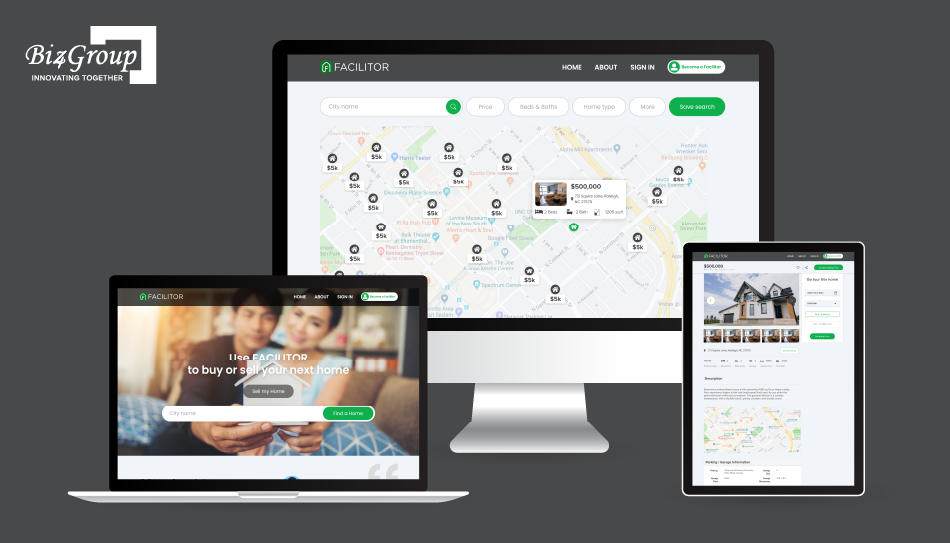
The build was shaped by three problems: unsafe remote property visits, buyers facing financial trouble after committing to a purchase, and poor buyer-seller communication. Three decisions carry over to buyer-preference analysis:
- Finances are verified before properties are shown. A stated budget and a confirmed budget are different inputs, the same distinction as explicit vs. inferred preferences above.
- Listings come from MLS data, not from the platform’s own assumptions. Recommendations are only as reliable as the listing fields behind them, which is why missing data must stay marked as unknown.
- Chat is a core channel. Once buyers and sellers talk in real time, what’s said there has to reach the buyer profile. That gap is what this article addresses.
Stack: Python and FastAPI, React and Next.js, PostgreSQL, Milvus (vector search), Socket.IO, OpenAI models, AWS.
What We Built: Contracks
Contracks is a web and mobile platform we built for real estate agents, brokers, and property managers to manage contracts. It uses AI to summarize lengthy documents and extract key content, and it tracks deadlines through reminders and alerts. Our project documentation reports up to 50% less time spent on paperwork and more than 20% faster document processing.
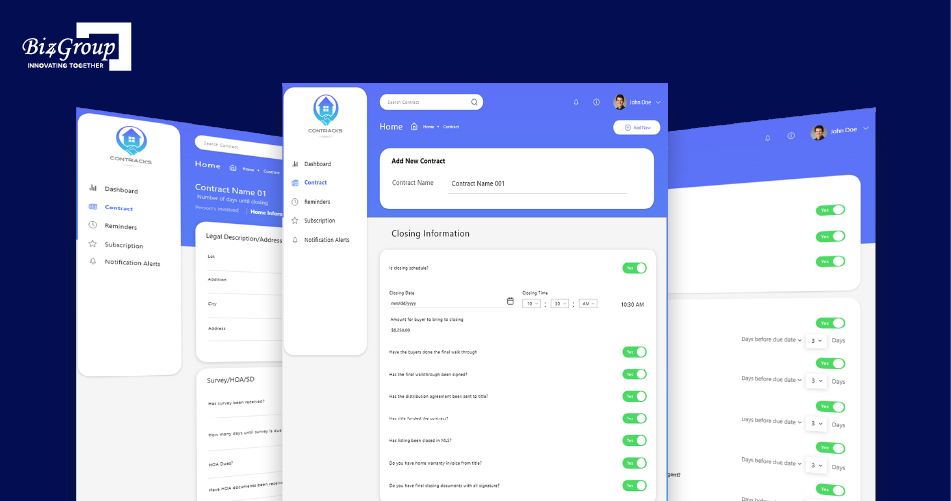
Three design choices carry over to buyer-conversation analysis:
- Summaries sit beside structured records. Contracks pairs AI summaries with structured fields such as sale price, earnest money, escrow agents, and HOA requirements. A summary is easy to read, but only structured data can be searched, filtered, and reported on.
- Extracted details drive actions. Reminders and alerts by contract type, a to-do list, and an event calendar turn deadlines into tasks someone owns.
- Every party keeps a defined role. One contract can hold multiple buyers, sellers, and stakeholders, each with an assigned role. The same logic applies to co-buyers with different priorities.
Stack: MongoDB, Express, React, and Node.js, with Ionic for the hybrid mobile app.
What connects these projects? They tackle different parts of the same challenge: making property data easier to understand, connect, and act on.
Of course, a conversation-intelligence platform for brokerages is a different ball game. It needs its own requirements, architecture, and testing to ensure the AI delivers reliable results.
So, what happens when you bring a project like this to us?
We start by finding the gaps. Where does buyer information get lost? Which tools need to talk to each other? And when should an AI suggestion go straight through versus wait for an agent's approval?
Once we have those answers, we map out the integrations, define a practical first version, and establish clear ways to measure extraction accuracy and workflow improvements.
That helps you avoid paying to rebuild what already works, while giving you a clear path to the capabilities your brokerage actually needs.
Give your CRM an AI sidekick, not another headache.
Whether you need a smart upgrade or a custom-built platform, Biz4Group can help you map out the right approach without building things your brokerage doesn't need.
Let's Talk AI for Real EstateWhat Does Developing an AI Buyer Conversation and Preferences Analysis Platform Involve?
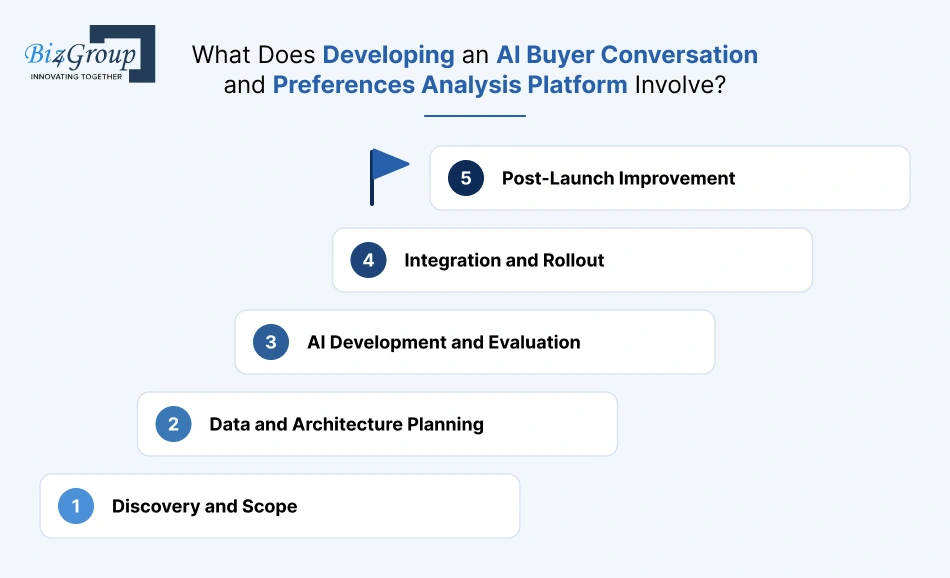
Building an AI platform for buyer conversation analysis takes more than choosing a model and connecting a few tools. You need a clear business goal, the right integrations, reliable AI outputs, and a plan to measure results.
A phased approach helps brokerages test what works before committing to a full-scale platform.
1. Discovery and Scope
Start by identifying where buyer information gets lost or agents lose time. Is it scattered conversations, inconsistent workflows, or limited visibility into buyer preferences?
Choose one high-value problem for the first release. Define the users, required integrations, data access, expected outcomes, and features that can wait.
The deliverable should be a prioritized MVP development, not a feature list that keeps growing.
Also Read: How to Build a Minimum Viable Product (MVP) for Your AI Agent?
2. Data and Architecture Planning
Next, map out how the platform will work with your existing systems. This may include your CRM, communication tools, property listing systems, and AI services.
Key decisions include:
- Data access: Which systems provide the required information, and how will the platform retrieve it?
- Data ownership: Where will insights be stored, and which system will maintain each record?
- AI selection: Which services meet your accuracy, privacy, speed, and cost requirements?
- Security and scalability: How will you manage permissions, data retention, and future changes?
The result should be an architecture plan showing how everything connects and what needs ongoing maintenance.
3. AI Development and Evaluation
With the scope and architecture in place, develop the AI workflow and test it against realistic conversations.
Include unclear statements, buyer corrections, and conflicting details. Use representative conversations with appropriate authorization.
Define acceptance criteria before testing. For example, specify the required accuracy for critical buyer preferences and when uncertain results must be flagged for human review.
This gives you a measurable way to assess performance instead of relying on a few impressive demos.
4. Integration and Rollout
Resist the temptation to launch everything at once. Start with a small pilot involving selected agents and communication channels.
The rollout should cover:
- Connecting the AI workflow to approved brokerage systems.
- Training agents to review and correct AI-generated insights.
- Assigning responsibility for errors, access issues, and support.
- Collecting feedback before expanding the rollout.
A pilot can reveal problems early, from missing data permissions to AI outputs that create extra work for agents.
5. Post-Launch Improvement
After launching the platform, track its performance against your original acceptance criteria and business goals.
For example, repeated budget-extraction errors may require better extraction rules or stricter review thresholds. Low agent adoption, on the other hand, may signal a workflow problem rather than an AI problem.
Assign clear ownership for monitoring accuracy, maintaining integrations, and addressing issues.
The approach is to start small, measure results, fix what isn't working, and expand when the evidence supports it. This keeps development focused on improvements that actually help your brokerage.
Final Takeaway
Extracting “three bedrooms” from a call is easy. Figuring out whether it's a must-have, a nice-to-have, or an outdated preference is where AI buyer intelligence gets interesting.
For brokerages, the best starting point is one complete workflow. Turn a buyer conversation into a source-backed profile, let the agent verify key details, and make approved preferences available for property searches. Test it against real conversations, including vague answers, changing budgets, and conflicting requirements.
Before scaling, ask three questions. Are agents spending less time correcting errors? Can they find suitable properties faster? Are recommendations matching confirmed buyer needs? If not, refine the workflow before adding more features.
At Biz4Group LLC, we help brokerages evaluate whether to extend their CRM, build a custom AI layer, or combine both. The focus is on building around your existing systems and actual business needs, not adding another platform that makes agents' jobs harder.
Planning an AI buyer intelligence platform for your brokerage? Explore our real estate AI development capabilities and start by identifying the gaps your current systems can't solve.
Frequently Asked Questions
1. Can AI Distinguish a Buyer's Preferences from an Agent's Suggestions?
Yes, if the platform is designed to identify who said what. If an agent suggests a three-bedroom home and the buyer responds vaguely, the AI shouldn't automatically record three bedrooms as a confirmed requirement. Speaker attribution and clear evidence of labels help preserve that distinction.
2. Can One Buyer Have Multiple Property Search Profiles?
Yes. A buyer might be searching for a primary residence while also exploring an investment property. An AI buyer preference analysis platform should support separate search profiles, budgets, and requirements, so details from one search don't distort recommendations for another.
3. How Should AI Handle Co-Buyers with Conflicting Property Preferences?
The platform should preserve each buyer's stated priorities rather than flattening them into one profile. If one person prioritizes location while the other requires more space, the system can flag the conflict for the agent to resolve before generating a shared shortlist.
4. Can AI Identify a Property When a Buyer Mentions Only Its MLS Number or Listing Link?
Yes, provided the platform can access the relevant MLS or listing database and reliably match the reference. It can then connect the conversation to that property's record for further analysis. If several listings appear to match, the system should request clarification instead of guessing.
5. What Happens When a Property's Details Change After an AI Recommendation?
The platform needs a way to refresh listing data and recheck affected matches. If a property becomes unavailable, its price changes, or a required feature is corrected, the system should update or flag the recommendation rather than continue relying on stale information.
6. Should AI Conversation Analysis Run in Real Time or After Each Call?
It depends on the workflow. Near-real-time processing is useful when agents need insights immediately after a call, while batch processing can work for historical conversations and periodic profile updates. A hybrid approach can prioritize urgent interactions while processing less time-sensitive records later.
7. Can the Platform Support Different Buyer Preferences Across Brokerage Offices?
Yes. A multi-office platform can use shared core fields while allowing approved variations for local workflows, property types, or market terminology. This helps maintain consistent reporting across the brokerage without forcing every office into an identical process.
8. Can a Brokerage Start AI Buyer Conversation Analysis Without Replacing Its Phone System?
Yes. A brokerage can begin with existing transcripts, emails, messages, and agent notes, provided they are available and authorized for processing. It can connect call-recording systems later if needed. This staged approach lets the team test the value of AI buyer insights before expanding data collection and integrations.
9. When Should a Brokerage Partner with an AI Development Company?
Partner with an AI development company like Biz4Group LLC when your existing CRM falls short or you need custom AI, cross-channel integrations, and specialized buyer-preference workflows. Biz4Group can help you plan, build, and integrate a tailored platform around your brokerage’s needs.
