 Location :
Orlando, FL, USA
Location :
Orlando, FL, USA +1 (407) 714-1616
 info@biz4group.com

- Real estate CRM implementation helps companies organize leads, streamline workflows, and support predictable growth across all property operations.
- A detailed real estate CRM setup and deployment process includes goal setting, workflow design, integrations, migration, training, and a careful rollout.
- Real estate CRM system implementation services range from MVP to enterprise scale, with costs between $10,000 and $150,000+ based on complexity.
- Measuring ROI becomes easier with better visibility, faster conversions, organized follow ups, and more predictable deal progress.
- CRM solutions for real estate firms help address challenges like inconsistent data, low adoption, and fragmented communication.
- Biz4Group LLC supports real estate companies across the USA with expert CRM implementation, custom development, integrations, and long term partnership.
Have you ever felt that you are working harder than ever, yet opportunities slip away before your
team can act? Many real estate leaders recognize this tension but are unsure where the leak begins.
A study shows that a well-supported CRM can increase sales
by up to 29%. This kind of shift can influence how smoothly your day operates and how
confidently your team moves. One of the reasons many firms explore real estate CRM implementation
is the desire for more clarity and better control over leads.
Some real estate professionals try to manage dozens of conversations across email threads, spreadsheets, and scattered notes. This usually works until it stops working. When companies begin real estate CRM software implementation, they look for a system that removes guesswork and brings calm to constant movement.
Others discover that growth becomes easier when they stop relying on memory and start relying on structure. This is why CRM implementation for real estate companies has become an important conversation among owners, brokers, and operations leaders. A consistent workflow gives everyone the same understanding, even on the busiest days.
If you are exploring the real estate CRM implementation guide for companies, you are in the right place.
What Is Real Estate CRM Implementation and How It Shapes Daily Operations?
Real estate CRM implementation refers to the process of setting up a structured system that organizes every lead, inquiry, client conversation, property detail, and deal movement in one place. It is not limited to installing software. It includes planning, configuring workflows, integrating tools, migrating data, and preparing your team to use the CRM with confidence.
A real estate business touches many moving parts each day. This is why a CRM becomes a foundation. Once the setup is complete, your team can follow clear paths for nurturing leads, scheduling showings, tracking follow ups, and managing active deals.
Why Companies Adopt a CRM Implementation Approach
A CRM helps a growing real estate firm build consistency. It supports your agents and back office teams by creating a reliable process for every task.
Key reasons companies invest in implementation:
- Cleaner lead pipelines
- Faster response times
- Organized conversation history for every client
- Better forecasting and planning
- Structured tasks for sales and leasing teams
How a Real Estate CRM Works in Daily Practice
|
Area of Work |
Before CRM |
After CRM Implementation |
|---|---|---|
|
Lead handling |
Manual notes and scattered lists |
Unified pipeline with clear stages |
|
Follow ups |
Dependent on memory |
Automated reminders and timelines |
|
Property information |
Stored in separate files |
Centralized property records |
|
Team communication |
Informal updates |
Recorded activity logs |
|
Deal tracking |
Inconsistent |
Standard stages with better prediction |
This shift makes your daily operations less reactive and more predictable.
Project Spotlight: AI-Powered Real Estate Platform
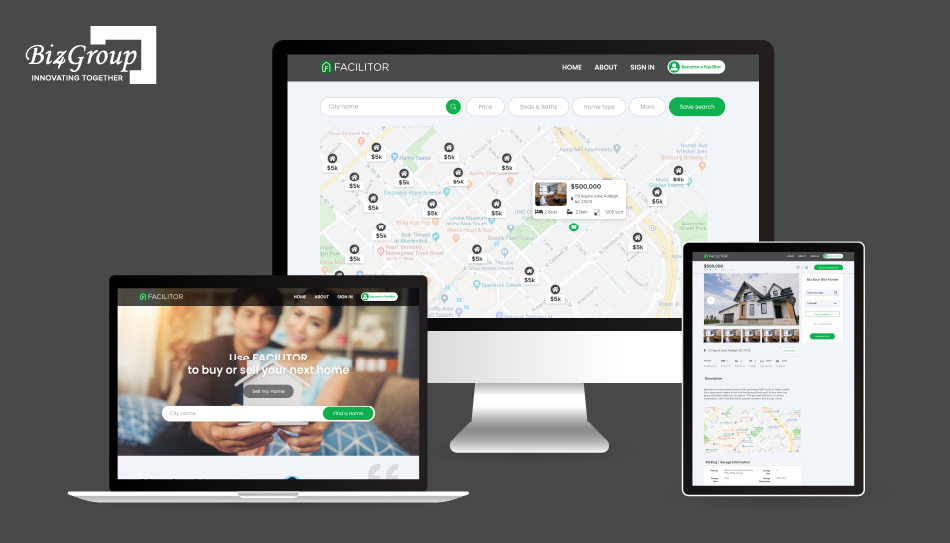
This AI real estate platform shows how a structured platform can guide users through complex real estate interactions with ease. It demonstrates how a clear system can improve communication and decision making for buyers.
Project highlights
- Real time chat built into the workflow
- Video call property visits
- Integrated GPS and MLS
- Seamless buyer guidance with step-based processes
This project reflects the kind of clarity and organization that real estate CRM implementation can bring into daily practice, whether you manage residential or commercial portfolios.
Key Benefits of CRM Implementation for Real Estate Companies
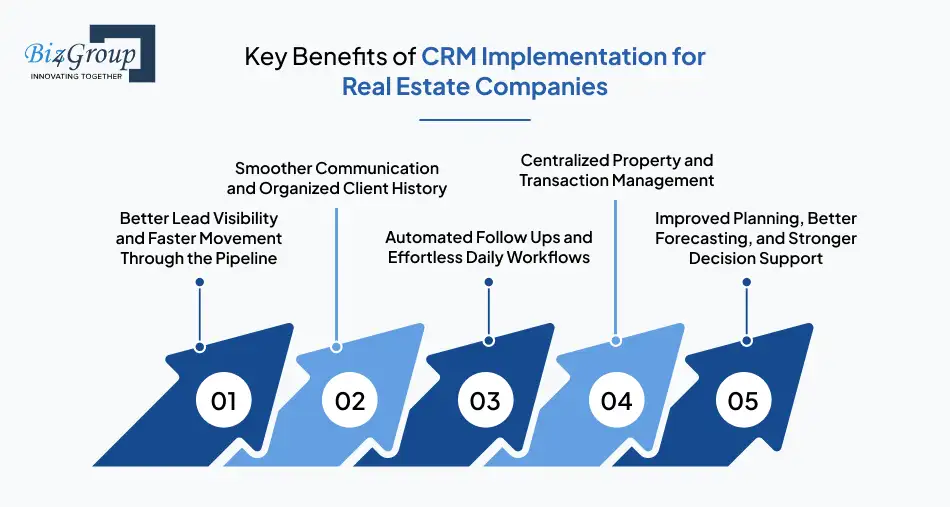
Real estate companies often reach a point where their growth depends on how well they organize information. This is where a structured CRM begins to support the team. The benefits influence how smoothly deals move and how confidently agents handle daily activity.
1. Better Lead Visibility and Faster Movement Through the Pipeline
A clear pipeline keeps your agents from guessing where leads stand. Once the system is implemented, everyone can track progress at the same pace. This creates more consistent outcomes across sales and leasing teams.
2. Smoother Communication and Organized Client History
A CRM captures every conversation so your communication feels steady instead of scattered. Agents can review past messages, understand the buyer’s needs, and follow up at the right moment.
3. Automated Follow Ups and Effortless Daily Workflows
Automation reduces manual effort and supports agents during busy seasons. The right workflow makes sure no inquiry is left unnoticed. This creates a more thoughtful client experience and frees up time for higher value work.
Project Spotlight: AI Property Management Application
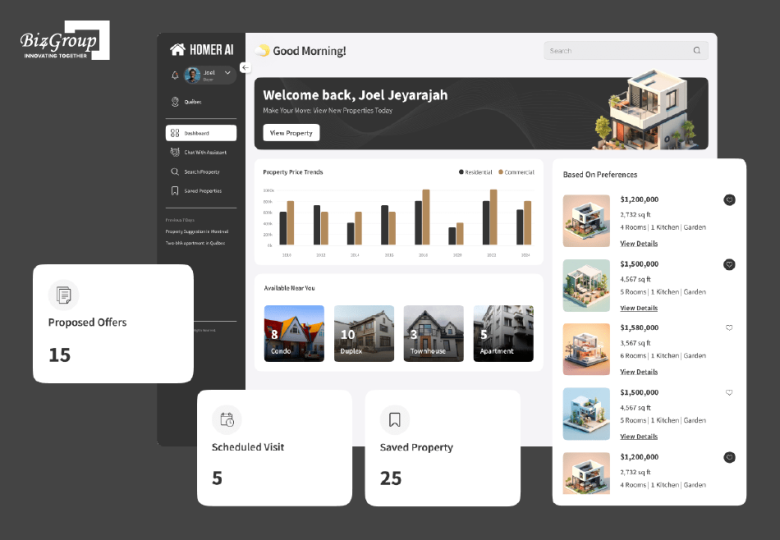
This modern AI property management application reflects how thoughtful automation can reshape day-to-day real estate activity. It brings buyers and sellers to one organized space and guides them through a conversational flow. This shows how automated journeys can help both sides engage with clarity.
Key highlights
- Interactive questionnaire for buyer preferences
- Smooth onboarding experience
- Filter options for location and price
- Seller guidance for listing their properties
This project demonstrates how automation supports real estate CRM implementation and helps teams maintain consistent engagement with minimal effort.
4. Centralized Property and Transaction Management
When property details, documents, and financial data sit in one unified structure, everyone stays aligned. This reduction in scattered files supports smoother decision making.
5. Improved Planning, Better Forecasting, and Stronger Decision Support
A CRM supports your ability to plan ahead. You can check active deals, track team performance, and identify areas that need more focus. This makes your strategy more deliberate.
Real estate CRM software implementation brings more stability to your daily operations and helps your team stay organized in ways traditional tools cannot match. With these benefits in place, the entire sales and leasing cycle begins to operate with more structure and confidence.
Ready to Capture Every Lead That Comes Your Way?
Most real estate teams lose almost 40% of leads to delayed follow-ups. Your CRM can fix that.
Build Smart with Biz4GroupPre Implementation Readiness for Real Estate CRM Setup and Deployment
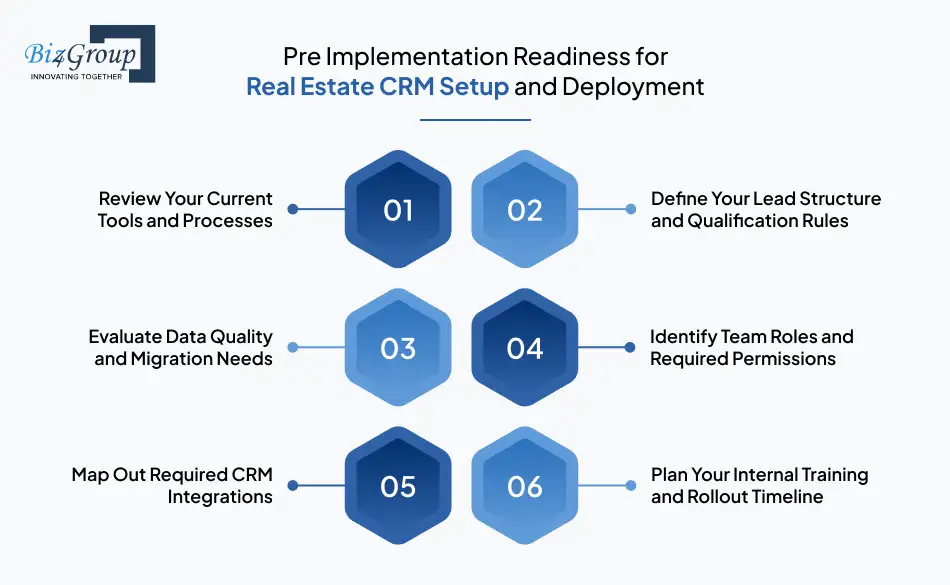
Before any company begins real estate CRM setup and deployment, there is a practical preparation
stage. This phase helps you avoid confusion later and gives your team a smoother onboarding
experience.
Think of this as clearing the path before the system becomes a daily tool.
1. Review Your Current Tools and Processes
- Identify all software used by your agents
- Map where lead data currently enters
- Review existing communication channels
- List tools that need to connect with the CRM
- Note any operational gaps that slow your team
2. Define Your Lead Structure and Qualification Rules
- Decide your lead categories
- Define qualification signals
- Map the buyer and seller journey
- Identify common follow up paths
- Create a pipeline that matches your workflow
3. Evaluate Data Quality and Migration Needs
- Collect all lead lists and databases
- Remove duplicates
- Identify missing fields
- Organize property records
- Tag data that needs reformatting
4. Identify Team Roles and Required Permissions
- Identify agent roles
- Define admin responsibilities
- Decide who manages follow ups
- Plan access levels for leasing and sales teams
- Prepare onboarding instructions
5. Map Out Required CRM Integrations
- Marketing tools
- MLS
- Lead generation platforms
- Communication tools
- Property management systems
6. Plan Your Internal Training and Rollout Timeline
- Plan training sessions
- Prepare onboarding material
- Decide pilot users
- Choose a rollout timeline
- Set review checkpoints
Strong real estate CRM setup and deployment starts long before the software is installed. A thoughtful readiness plan helps your team understand the new system, reduces errors during migration, and ensures smoother adoption once the CRM goes live.
Also read: AI chatbot integration with CRM
Step-by-Step CRM Integration for Real Estate Businesses
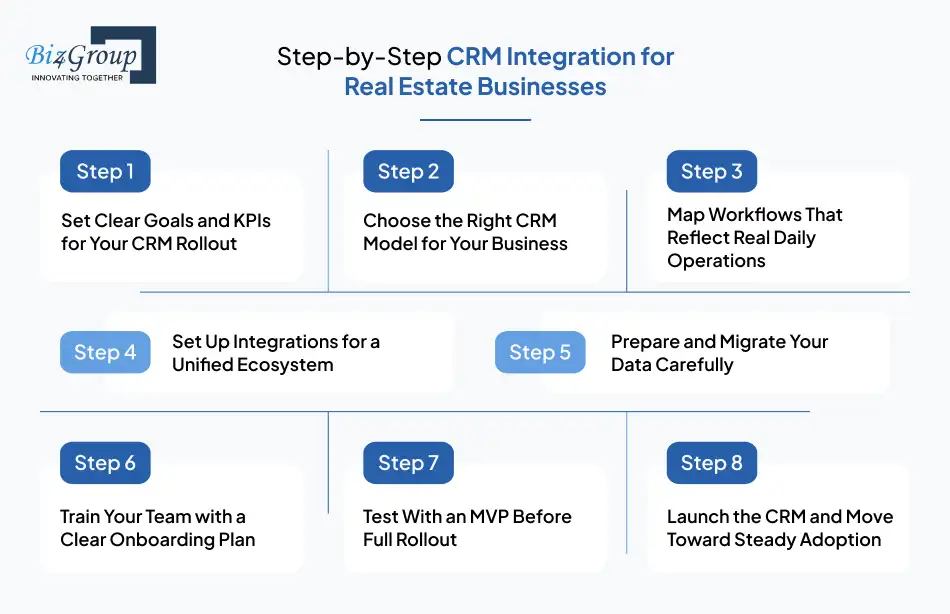
Real estate teams grow faster when they follow a structured implementation plan. A step-by-step
approach reduces confusion, supports cleaner workflows, and helps your team adopt the CRM without
interruptions.
This section walks you through the essential stages that guide a smooth
transition.
Step 1. Set Clear Goals and KPIs for Your CRM Rollout
Before the system is installed, your team needs clarity about what the CRM will solve. Defined goals help align expectations and guide configuration choices.
Key focus areas:
- Lead conversion improvement
- Response time reduction
- Client experience enhancement
- Deal stage visibility
- Agent performance tracking
Step 2. Choose the Right CRM Model for Your Business
Every company has different needs based on team size, property volume, and workflow complexity. Understanding these factors helps you choose between custom, hybrid, or ready-made CRMs.
Options to consider:
- Custom CRM
- Cloud based CRM
- Modular CRM systems
- Industry specific add-ons
Step 3. Map Workflows That Reflect Real Daily Operations
A CRM works best when the workflows match your actual process. This is the stage where you document how leads move, how contracts progress, and how communication usually flows.
Typical workflows to map:
- Lead routing
- Follow up logic
- Deal stage movement
- Showing and scheduling
- Contract handling
- Property data management
Project Spotlight: Real Estate Contract Management Tool
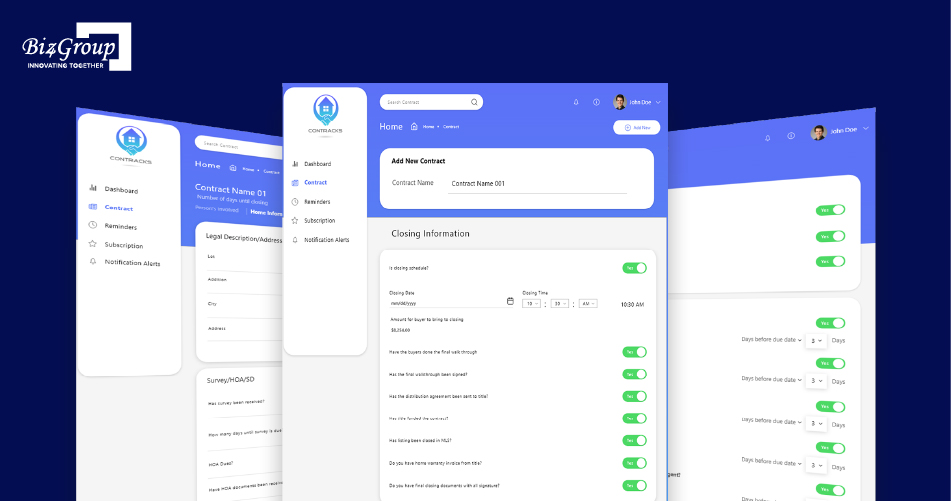
This real estate contract management tool highlights the value of thoughtful workflow mapping. It shows how a clear structure improves daily decision making for agents, brokers, and property managers.
Key workflow strengths:
- Dynamic contract creation and editing
- Organized financial responsibilities
- Multi-party contract handling
- House inspection scheduling
- Automated reminders and alerts
- Advanced document search for quick filtering
This project represents what strong workflow mapping can achieve during CRM integration for real estate businesses.
Step 4. Set Up Integrations for a Unified Ecosystem
A CRM becomes more powerful when it communicates with your existing systems. AI integration services prevent data duplication and help your team work with more speed.
Core integrations:
- MLS
- Property listing platforms
- Lead generation sources
- Email and SMS tools
- Property management systems
- Billing or payment tools
Step 5. Prepare and Migrate Your Data Carefully
Clean and organized data strengthens CRM adoption. This step involves reviewing all leads, property info, contacts, and active deals before moving them into the system.
Important tasks:
- Remove duplicates
- Fix missing information
- Sort property records
- Tag lead types
- Standardize naming for consistency
Step 6. Train Your Team with a Clear Onboarding Plan
Training determines how confidently your team uses the system. A thoughtful onboarding plan helps everyone feel comfortable with new workflows.
Key elements:
- Role based training
- CRM practice sessions
- Real examples during training
- Reference material
- Follow up sessions
Step 7. Test With an MVP Before Full Rollout
Before the CRM reaches the entire team, developing an MVP helps you spot errors early and adjust workflows based on real experiences.
MVP checklist:
- Choose a small user group
- Gather feedback
- Identify bottlenecks
- Adjust automations
- Recheck integrations
Also read: Top 12+ MVP development companies in USA
Step 8. Launch the CRM and Move Toward Steady Adoption
Once testing wraps up, the CRM becomes an active part of your daily operations. This phase focuses on reinforcement and continuous improvement.
What happens here:
- Full team onboarding
- Regular health checks
- Workflow refinement
- Process documentation
CRM integration for real estate businesses becomes smoother when you break it down into clear steps. This structured approach helps you avoid surprises, keeps your data clean, and supports better team adoption.
Also read: How to build a voice-enabled real estate AI assistant for property search and client engagement?
Want Your CRM To Work as Smoothly as Your Best Agent?
A well implemented CRM lifts team productivity by more than 30%. Let’s build yours with the right steps from day one.
Get in TouchChoosing Between Custom and Off the Shelf CRM Solutions for Real Estate Firms
Every real estate company reaches a point where it must choose between a building a custom real estate CRM and an off-the-shelf system. Both paths work, but not for the same reasons. The best choice depends on your workflows, team size, and goals.
|
Factor |
Custom CRM |
Off the Shelf CRM |
|---|---|---|
|
Workflow match |
Tailored to your exact process |
Basic workflows with limited flexibility |
|
Integrations |
Built to fit your ecosystem |
Standard options that may require add-ons |
|
Scalability |
Designed to scale with teams and portfolios |
Fixed structure that may limit growth |
|
Cost |
Higher upfront investment |
Lower initial cost with monthly fees |
|
Control |
Full control over features and data |
Dependent on vendor limitations |
|
Timeline |
Longer development and testing time |
Faster setup for small teams |
|
Unique features |
Can address niche processes |
Standard features for general use cases |
Choose custom if:
- Your workflows change often
- You manage multiple property portfolios
- You need strong integration control
- You want full data ownership
- You need custom dashboards and reporting
- You plan to scale into several locations
Choose off-the-shelf if:
- Your workflow is simple
- You want quick deployment
- You prefer subscription-based setups
- You do not require advanced integrations
- You do not need niche features or unique journeys
Project Spotlight: A Ratings Platform for Rental Agreements
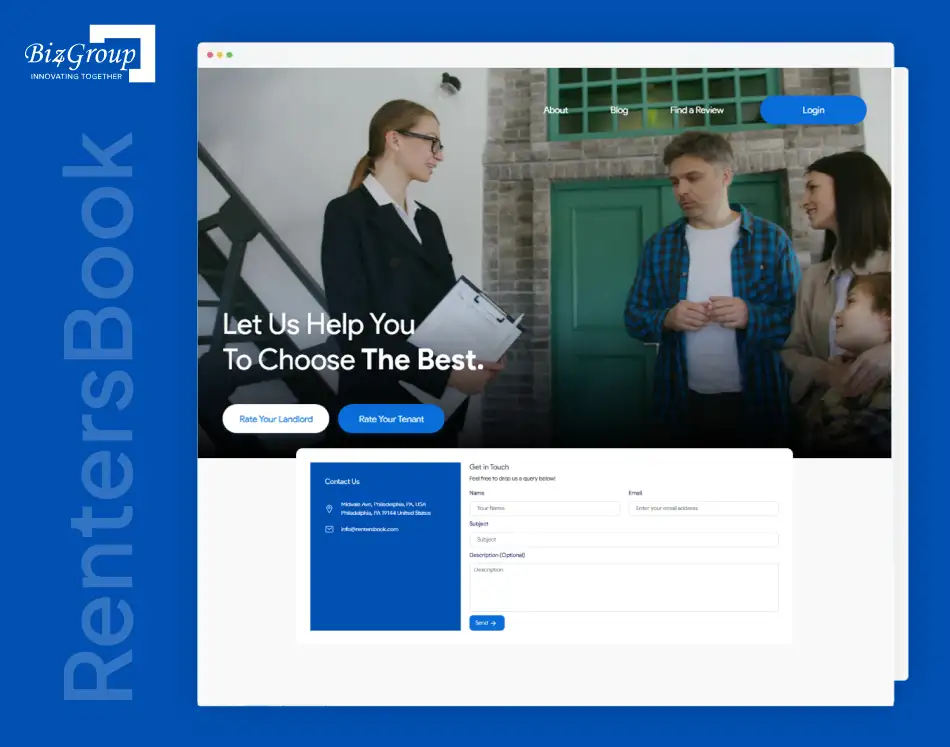
This reviews and ratings platform for rental agreements shows why some real estate businesses benefit from custom development. A generic CRM could not support the unique idea behind this platform, which focuses on reviews for tenants and landlords. The business needed features that did not exist in any ready-made CRM.
Why custom was essential:
- The platform needed custom review flows
- Required strong encryption for personal data
- Needed unique property and user matching logic
- Had to support image uploads and profile insights
- Needed a search mechanism tailored to rental relationships
This project is a strong example of how custom real estate CRM system implementation services help businesses address gaps that off the shelf solutions cannot fill.
Your decision between a custom CRM and an off-the-shelf system depends on how your real estate company operates today and where you plan to grow. Once the direction is set, your CRM becomes a dependable part of your daily operations and supports your team with better structure and greater confidence.
Cost Guide for Real Estate CRM Implementation for Lead Management
Planning your property management CRM implementation involves more than choosing the right tool. Cost is often the factor that shapes expectations and determines the pace of deployment. This section outlines the investment range and shows how the timeline shifts based on features and complexity.
This table helps you compare the three common levels of real estate CRM implementation. The full cost range typically falls between $10,000 and $150,000+ depending on the scope of work.
|
CRM Type |
What You Get |
Estimated Cost |
|---|---|---|
|
MVP CRM |
Core pipeline, basic lead tracking, simple automations, essential integrations |
$10,000 to $25,000 |
|
Advanced CRM |
Full sales cycle workflows, property modules, stronger automations, marketing integrations, role-based controls |
$30,000 to $75,000 |
|
Enterprise CRM |
Multi portfolio support, complex integrations, custom modules, advanced reporting, region wise access, AI workflows |
$80,000 to $150,000+ |
These levels help teams understand where they fall based on goals, adoption rate, and operational scale.
Core Factors That Influence Real Estate CRM Implementation Cost
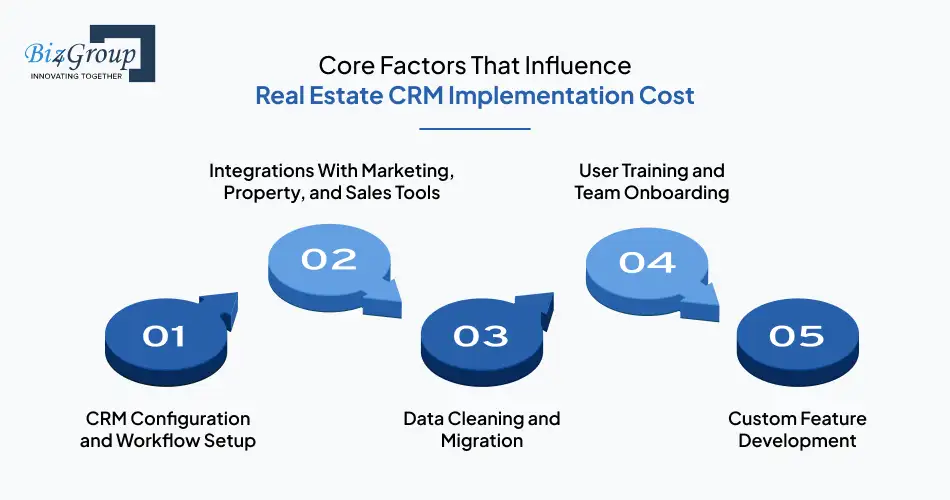
Every CRM project moves through a predictable set of tasks. Each task contributes to the total cost, which grows or shrinks depending on your workflow complexity and data flow. Below are the elements that usually affect the budget, each explained with clear cost expectations.
1. CRM Configuration and Workflow Setup
This stage shapes how leads move through your system. If your workflows are standard, configuration stays simple. Companies typically invest $2,000 to $15,000 depending on the number of pipelines, follow up processes, and approval rules they need.
2. Integrations With Marketing, Property, and Sales Tools
Real estate teams rely heavily on connected tools. Integrating MLS, lead portals, email platforms, and accounting systems can cost $3,000 to $30,000, based on the depth of the integration.
3. Data Cleaning and Migration
Data migration becomes one of the biggest cost drivers because it requires careful review. The cost usually ranges from $1,500 to $20,000, depending on volume and the condition of your current databases.
4. User Training and Team Onboarding
Real estate CRM implementation stays successful when people feel confident using the system. Training and onboarding typically cost $1,000 to $10,000, depending on the number of sessions and team roles involved.
5. Custom Feature Development
If your business needs custom modules like contract handling, asset tracking, multi-unit management, or advanced reporting, the cost can rise to $10,000 to $50,000+.
Timeline for Real Estate CRM Implementation
The timeline depends on the CRM level and depth of features. Here is a simple breakdown.
- MVP CRM usually takes 3 to 6 weeks
- Advanced CRM usually takes 6 to 12 weeks
- Enterprise CRM usually takes 3 to 6 months
These timelines include configuration, integrations, testing, training, and rollout.
A thoughtful property management CRM implementation becomes easier when you understand the financial and timeline expectations. Once you know where your needs fall on the MVP to enterprise scale, it becomes simpler to plan your rollout and prepare for long term adoption.
Also read: AI real estate app development cost in 2026
Worried About CRM Costs More Than CRM Results?
Companies that budget correctly see returns up to 8 times their CRM investment. Want a cost plan that actually pays back?
Get a Cost EstimateHow to Measure ROI in Real Estate Sales CRM Implementation?
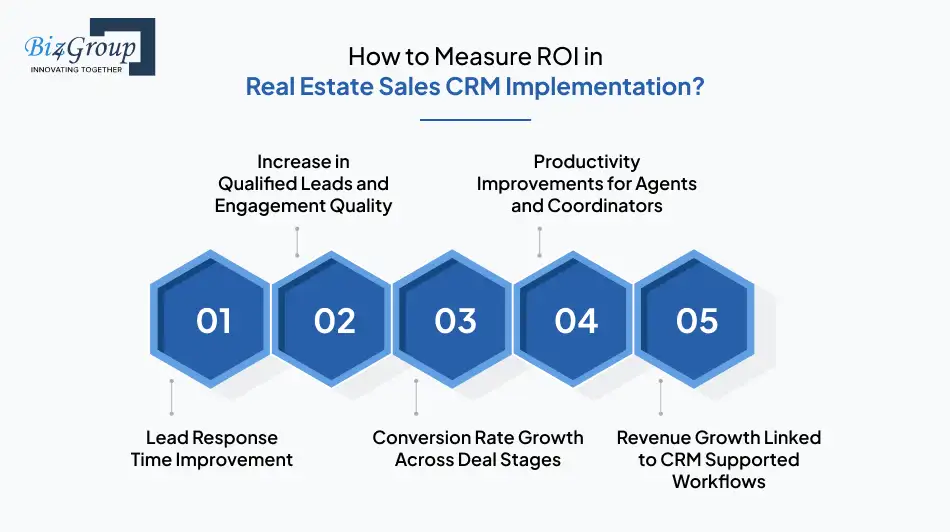
Real estate sales CRM implementation delivers value when teams can track measurable improvements. ROI becomes clearer when you review how your CRM influences response speed, lead flow, client engagement, and deal success. Below are the most practical ways companies measure performance after implementation.
1. Lead Response Time Improvement
Track:
- Average response time before CRM adoption
- Average response time after adoption
- Percentage improvement
- Changes in inquiry to lead conversion rate
2. Increase in Qualified Leads and Engagement Quality
Track:
- Number of qualified leads per month
- Movement across pipeline stages
- Follow up completion rate
- Buyer and seller engagement frequency
3. Conversion Rate Growth Across Deal Stages
Track:
- Inquiry to lead conversion
- Lead to showing conversion
- Showing to offer conversion
- Offer to closing conversion
ROI Table for Conversion Rate Improvements
|
Metric |
Before CRM |
After CRM |
ROI Indicator |
|---|---|---|---|
|
Lead response speed |
Slower |
Faster |
Higher engagement |
|
Deal stage movement |
Irregular |
Structured |
Improved forecasting |
|
Lead conversion |
Lower |
Higher |
Stronger revenue stability |
|
Client retention |
Unclear |
Consistent |
Repeat business growth |
4. Productivity Improvements for Agents and Coordinators
Useful indicators:
- Reduction in manual activities
- Increase in scheduled showings
- Completion rate of follow ups
- Daily tasks completed per agent
5. Revenue Growth Linked to CRM Supported Workflows
Track metrics such as:
- Monthly revenue growth
- Revenue per agent
- Repeat client revenue
- Referral driven revenue
Measuring ROI from real estate sales CRM implementation becomes simple when your team monitors the right metrics. With consistent tracking, your CRM becomes a powerful tool that guides strategic decisions and supports steady business growth.
Common Challenges and Practical CRM Solutions for Real Estate Firms
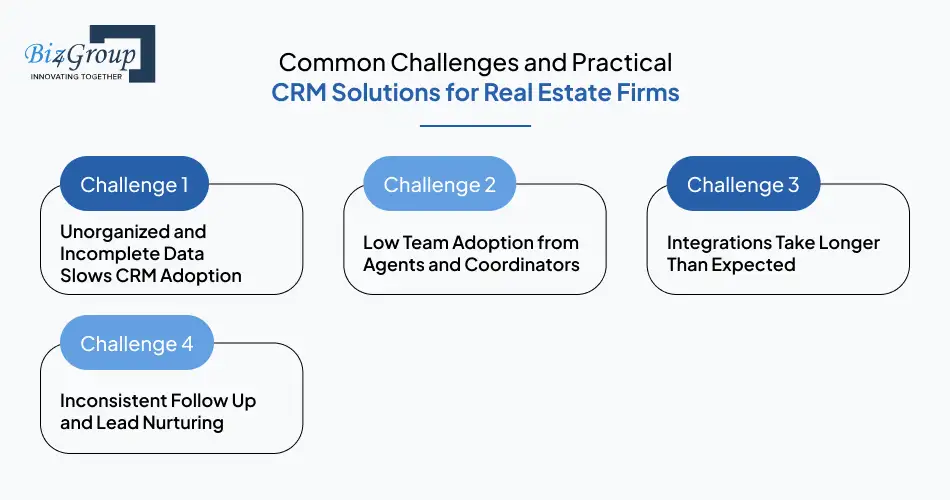
Every real estate company begins CRM adoption with enthusiasm, but challenges appear once migration, training, or workflow alignment begins. The hurdles below are the most common across residential, commercial, and property management teams.
Challenge 1. Unorganized and Incomplete Data Slows CRM Adoption
Most companies underestimate the amount of cleanup their lead lists and property data need before migration. Inconsistent formats, missing fields, and duplicate entries create friction during setup.
Solutions
- Create a pre-migration checklist for property and client data
- Remove duplicates before importing
- Standardize naming for contacts and property records
- Assign a data quality owner before rollout
Challenge 2. Low Team Adoption from Agents and Coordinators
Many teams feel overwhelmed when a new system arrives. Without proper onboarding, the CRM feels like extra work instead of a helpful guide.
Solutions
- Provide role-based training for each team
- Offer practice sessions using real use cases
- Allow early access to pilot users
- Gather post training feedback to refine workflows
Challenge 3. Integrations Take Longer Than Expected
Real estate teams rely on MLS, lead portals, marketing tools, and communication platforms. When integrations fail or sync poorly, productivity dips.
Solutions
- List all required integrations early
- Confirm compatibility with your CRM
- Use API based connections when possible
- Test syncing with sample data
Challenge 4. Inconsistent Follow Up and Lead Nurturing
Without structured reminders or automated tasks, agents struggle to keep up with follow ups during peak seasons. This can lead to missed opportunities.
Solutions
- Set automated reminders for key actions
- Create templates for common follow ups
- Track missed or delayed follow ups weekly
- Provide dashboards that highlight pending tasks
With thoughtful planning and the right CRM solutions for real estate firms, these challenges become manageable steps that bring your company closer to a stronger, more organized daily operation.
Still Fighting the Same CRM Issues Every Month?
Over 50% of CRM failures happen from poor setup. You do not have to be part of that statistic.
Talk to Our ExpertsFuture Trends and the Best Real Estate CRM Deployment Strategy for 2026 and Beyond
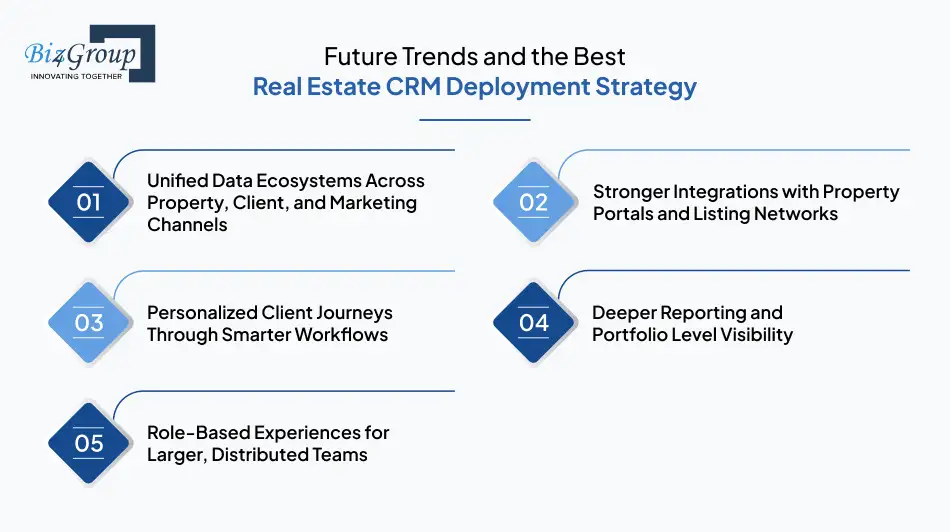
The real estate industry continues to evolve, and CRM systems now sit at the center of sales, leasing, marketing, property management, and client relationships. The points below explain what leaders can expect and how these changes will shape daily operations.
1. Unified Data Ecosystems Across Property, Client, and Marketing Channels
Instead of switching between marketing platforms, property management systems, and deal trackers, real estate companies will manage everything through a unified structure. This trend helps teams respond faster and reduces errors caused by scattered data.
2. Stronger Integrations with Property Portals and Listing Networks
Companies are beginning to rely on direct integrations that send inquiries, showing requests, and listing updates straight into the CRM. This improves lead capturing, reduces manual entry, and helps agents follow consistent workflows.
3. Personalized Client Journeys Through Smarter Workflows
Modern CRMs will allow teams to create personalized journeys for buyers, sellers, landlords, and tenants. These workflows will include tailored sequences, guidance steps, and reminders that reflect each client’s needs.
4. Deeper Reporting and Portfolio Level Visibility
Reporting tools will advance to show clearer breakdowns of revenue, pipeline health, team performance, and property activity. Companies handling residential, commercial, and mixed portfolios will benefit from detailed dashboards that highlight movement across all segments.
5. Role-Based Experiences for Larger, Distributed Teams
Clear permissions and role-based dashboards will reduce clutter and help each team member stay focused on the tasks that matter most in their daily workflow.
A forward-focused real estate CRM deployment strategy helps companies stay prepared for industry shifts and rising customer expectations. When companies choose tools that evolve with them, the CRM becomes a long-term asset instead of a temporary upgrade.
Why is Biz4Group LLC the Trusted Partner for Real Estate CRM Implementation in the USA?
Businesses across the USA look for a partner who understands real estate inside and out. Biz4Group LLC brings that rare combination of technical mastery and industry depth.
We are a real estate AI software development company that designs, builds, and implements CRM systems that make real estate teams stronger, faster, and more organized. Our work spans residential, commercial, and property management workflows, each shaped to match the way your team already operates.
Biz4Group LLC has spent years building modern platforms, CRMs, automation frameworks, and custom software for real estate companies across the country. Our strength comes from understanding how a real estate business moves in the real world. This makes our CRM implementations practical, error free, and aligned with the pace of modern property markets.
We bring strategy, AI automation services, and real estate website development expertise together to create CRM environments that feel polished and purposeful. Our team approaches every project with a clear understanding of data flow, lead movement, and internal handovers. With Biz4Group LLC, companies hire AI developers who listen carefully and execute with precision.
Why Businesses Choose Biz4Group LLC
Companies choose us because they want a partner who can translate real world real estate challenges into reliable systems.
Key reasons businesses prefer us:
- Expertise in CRM configuration built specifically for real estate teams
- Strong understanding of property lifecycles and transactional workflows
- Ability to design scalable CRM solutions for growing teams
- Deep technical knowledge of integrations, automation, and user experience
- Clean implementation practices that reduce risk and uncertainty
- Clear communication throughout planning, development, and rollout
Biz4Group LLC continues to guide real estate companies across the USA toward stronger workflows and better client relationships. Our work speaks for itself. Every platform we build or implement is stable, intuitive, and aligned with your company’s growth plan.
As your company grows, your CRM should grow with you. Biz4Group LLC helps you stay prepared for
that next chapter. So, if you’re ready to gain advantage from your CRM, we’re here to help
you.
Let’s talk.
Wrapping Up
A strong real estate CRM brings structure to the way your team manages leads, properties, conversations, and transactions. When companies follow a clear process, they gain better visibility, more meaningful client interactions, and smoother daily operations. A thoughtful implementation becomes the difference between a CRM that feels helpful and one that feels like a burden.
With the right setup, your CRM supports faster response times, cleaner pipelines, and more consistent sales performance across residential, commercial, and property management teams. The clarity it brings helps leaders plan ahead, improves productivity for agents, and gives your business the structure required to scale confidently. Once your workflows align with your goals, your CRM becomes a reliable foundation for growth.
Biz4Group LLC continues to support real estate businesses across the USA with CRM implementation, AI development, integrations, and enterprise AI solutions. We understand the pace, challenges, and complexity of this industry, which helps us create stable and intuitive systems.
If you are ready to modernize your real estate operations, the next move is simple.
Let’s
build your CRM the right way. Connect with
Biz4Group LLC and start your growth journey today.
FAQs
What should real estate teams prioritize before selecting a CRM vendor?
Real estate teams should prioritize understanding their internal approval cycles, communication gaps, and the level of visibility they expect across listings and transactions. This helps you choose a vendor who can meet your operational style rather than offering a one size fits all setup.
Can a real estate CRM be used by multiple departments beyond sales teams?
Yes. Modern CRMs support leasing, marketing, property management, admin teams, and finance departments. Each group uses a tailored view that reflects their responsibilities, keeping operations aligned across the company.
How often should real estate companies update or optimize their CRM workflows?
Workflows should be reviewed every three to six months. As markets shift and your business grows, updating stages, reminders, and filters helps keep the CRM aligned with real world conditions.
What makes a real estate CRM reliable for long term use?
A reliable CRM offers stable performance during heavy data activity, supports clear permission levels, gives accurate reporting, and remains flexible enough to adjust as your business expands into new areas or locations.
How can a real estate CRM help reduce manual reporting work for managers?
CRMs offer automated summaries that highlight daily activity, pipeline status, upcoming deadlines, and team performance snapshots. This removes the need to compile spreadsheets manually and saves managers significant time each week.
What type of support should companies expect after CRM implementation?
Post implementation support usually includes performance monitoring, workflow adjustments, integration health checks, user assistance, and periodic reviews to ensure the CRM continues to meet your operational goals.
