Location :
Orlando, FL, USA
Location :
Orlando, FL, USA +1 (407) 714-1616
 info@biz4group.com

 AI Summary Powered by Biz4AI
- AI social commerce combines artificial intelligence with social shopping to deliver personalized product discovery, conversational shopping, and seamless in-app purchasing experiences.
- Brands are leveraging AI shopping assistants, recommendation engines, creator commerce, and predictive personalization to improve customer engagement, conversions, and retention.
- Successful AI social commerce strategies go beyond automation by integrating AI across product discovery, customer support, merchandising, and the entire buying journey.
- As commerce evolves, businesses that invest in connected AI ecosystems, trusted customer experiences, and high-quality product data will be better positioned for long-term growth.
- As a leading AI development company, Biz4Group helps brands build scalable AI shopping assistants, recommendation engines, conversational commerce solutions, and custom AI-powered ecommerce platforms tailored to their business goals.
When was the last time one of your customers actually searched for a product?
Not discovered it through a TikTok video, not clicked on an Instagram shop recommendation and not purchased it after watching a creator's livestream. Actually searched for it by typing keywords into a search engine and browsing through pages of results.
If that question gives you pause, it reflects one of the biggest changes happening in ecommerce today. Customers still buy products every day, but the way they discover, evaluate, and purchase them has shifted dramatically. Social platforms have become commerce destinations, AI has become the intelligence behind recommendations, and traditional search is now just one part of a much larger buying journey.
This transformation is driving the rise of AI social commerce, where artificial intelligence powers product discovery, personalized recommendations, conversational shopping, creator commerce, and in-app purchasing experiences. Instead of treating social media as a channel for awareness and ecommerce as the destination for conversions, AI-powered social commerce is connecting every stage of the customer journey into a single, data-driven experience.
The pace of adoption explains why brands are rethinking their commerce strategy. A recent research estimates the global social commerce market will approach $1.93 trillion by 2026, another report suggest that U.S. social commerce sales will exceed $100 billion. Together, these trends point to a broader shift that customers are expecting discovery, engagement, and purchasing to happen within the same AI-powered ecosystem.
That shift is creating new challenges for ecommerce teams. We've encountered many such challenges while helping ecommerce brands explore and implement AI-powered commerce solutions. At Biz4Group, we've worked with businesses building AI shopping assistants, recommendation engines, conversational commerce platforms, and intelligent ecommerce experiences. That experience has shown us that success isn't about adopting every AI tool available. It's about choosing the right technologies for your customers, business goals, and commerce ecosystem.
Before exploring where AI social commerce is headed and how brands can use it effectively, let's build a clear understanding of what it is, how it works, and why it's becoming a fundamental part of modern ecommerce.
What Is AI Social Commerce and How Does It Work in 2026?
Let's clear up the biggest misconception first. AI social commerce is not another social media marketing strategy, and it isn't just integrating an AI chatbot in your ecommerce business.
AI social commerce is the use of artificial intelligence to optimize and automate every stage of buying within social commerce. It includes everything, from product discovery and customer engagement to personalized recommendations, conversations, checkout, and post-purchase interactions.
Basically, social commerce provides where customers buy, while AI determines how they discover, evaluate, and purchase products.
How AI Social Commerce Works in 2026?
Although different platforms use different technologies, most AI-powered social commerce systems follow the same underlying workflow.
Step 1: Customer signals are collected.
AI in social commerce gathers data from browsing behavior, product views, purchases, engagement history, search queries, social interactions, and contextual signals.
Step 2: AI models analyze customer intent.
Machine learning models identify patterns to predict what a customer is likely to view, engage with, or purchase next.
Step 3: The shopping experience adapts in real time.
Based on those predictions, AI in social commerce adjusts product recommendations, content, search results, promotional offers, and conversations to match each customer's interests.
Step 4: Every interaction improves future decisions.
Each click, conversation, purchase, or abandoned cart becomes additional training data, helping recommendation models and personalization engines become more accurate over time.
Instead of functioning as separate tools, these AI capabilities operate as a connected intelligence layer across the entire social commerce ecosystem.
How AI-Powered Social Commerce Differs from Traditional Social Commerce?
The difference between traditional social commerce and AI-powered social commerce isn't where customers shop. It's how they shop. The difference lies in how customer experiences are created and optimized.
|
Business Capability |
Traditional Social Commerce |
AI Social Commerce |
|---|---|---|
|
Product Discovery |
Customers discover products through manual browsing, ads, or creator content. |
AI recommends products based on behavior, intent, context, and preferences. |
|
Customer Experience |
One shopping experience for every visitor. |
Every customer receives a personalized shopping journey. |
|
Product Recommendations |
Manual collections, best sellers, or rule-based suggestions. |
AI continuously updates recommendations using real-time customer signals. |
|
Customer Engagement |
Human responses, static FAQs, or scheduled campaigns. |
AI shopping assistants and conversational AI provide instant, contextual interactions. |
|
Merchandising & Promotions |
Merchandising and offers are manually planned. |
AI optimizes product placement, promotions, and offers dynamically. |
|
Decision-Making |
Decisions rely on historical reports and manual analysis. |
AI predicts customer intent and recommends the next best action in real time. |
|
Optimization |
Periodic optimization based on campaign performance. |
AI continuously learns from every interaction and improves outcomes automatically. |
|
Business Impact |
Focuses on enabling purchases through social platforms. |
Focuses on maximizing conversions, customer lifetime value, and operational efficiency through intelligent automation. |
Now that we've seen how AI social commerce evolved from traditional commerce, let's clarify another concept that often causes confusion. Although Social Commerce, Social Media Marketing, and Agentic Commerce are closely connected, they solve different business problems and represent different stages in the evolution of digital commerce. Let's explore the use cases to better understand AI social commerce.
What Are the Use Cases for AI Social Commerce?
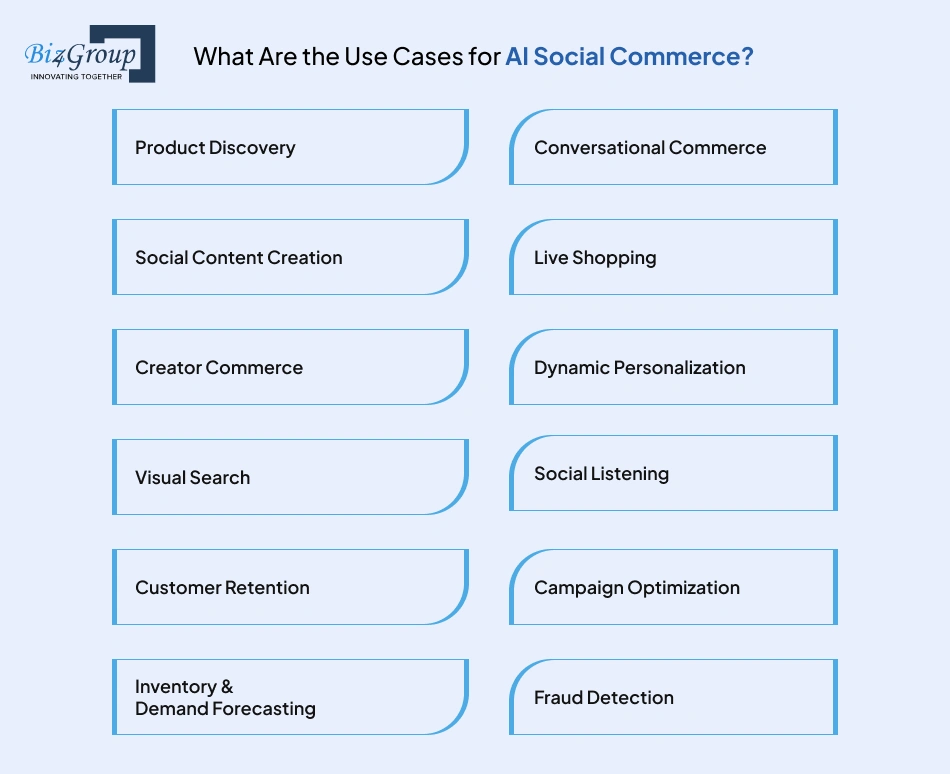
If someone asked where AI Social Commerce creates the biggest impact, what would your answer be?
Most people think of chatbots or product recommendations. But those are just a few of many use cases. From product discovery and live shopping to customer retention and business optimization, AI is influencing every stage of the commerce journey. Here is a table to explore the use cases of AI social commerce.
|
Business Function |
AI Social Commerce Use Case |
Business Impact |
|---|---|---|
|
Product Discovery |
Personalized product recommendations based on customer behavior and interests |
Higher product visibility and engagement |
|
Conversational Commerce |
AI shopping assistants guiding customers through product selection |
Faster purchase decisions and improved conversion rates |
|
Social Content Creation |
Generate captions, product descriptions, ad copy, and creator briefs |
Faster campaign execution and consistent messaging |
|
Live Shopping |
Answer viewer questions, recommend products, and moderate live chats in real time |
Higher engagement and increased live shopping conversions |
|
Creator Commerce |
Identify the right creators, analyze campaign performance, and repurpose creator content |
Better influencer ROI and wider content reach |
|
Dynamic Personalization |
Tailor product feeds, promotions, and offers for individual shoppers |
Improved conversion rates and repeat purchases |
|
Visual Search |
Help customers discover products using uploaded images or screenshots |
Reduced search effort and better product discovery |
|
Social Listening |
Analyze comments, reviews, and conversations to identify customer sentiment and trends |
Better campaign optimization and product insights |
|
Customer Retention |
Predict repeat purchases, recommend replenishment products, and trigger personalized offers |
Higher customer lifetime value and loyalty |
|
Campaign Optimization |
Optimize ad targeting, creative performance, posting schedules, and audience segmentation |
Better marketing ROI and lower acquisition costs |
|
Inventory & Demand Forecasting |
Predict product demand using social engagement and purchasing trends |
Improved inventory planning and fewer stock issues |
|
Identify fake reviews, suspicious transactions, and bot activity |
Increased customer trust and platform integrity |
To know how AI-powered capabilities are being translated into real business value, let's look at an AI-powered social commerce solution developed by Biz4Group.
Real-World Use Cases developed by Biz4group
1. AI-Powered Ecommerce Listing Automation
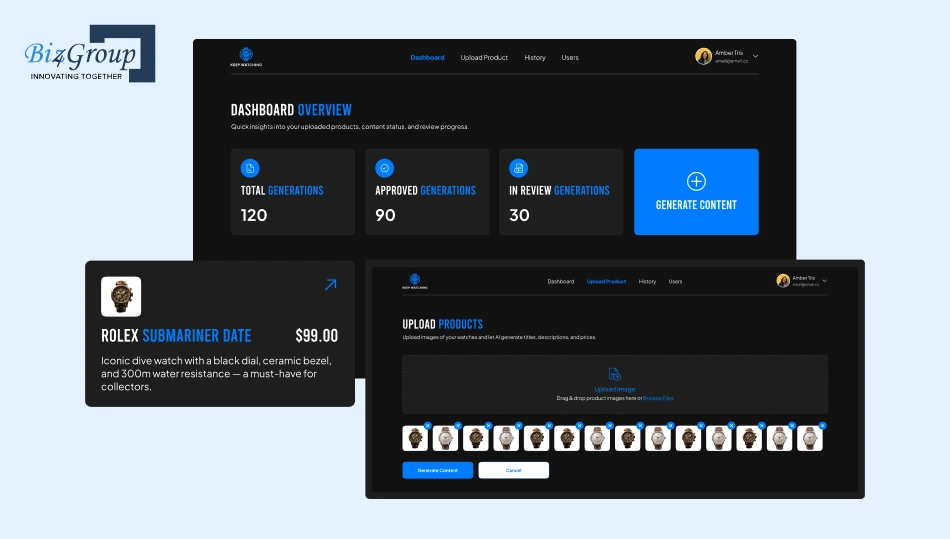
We developed an AI-powered product listing automation platform. The platform enables the retailer to automate eBay listing creation from product images to final publication.
The solution leverages OpenAI GPT-4 Vision to analyze watch images, extract product attributes, and generate eBay-optimized titles, descriptions, and specifications. It also integrates with Amazon S3 for efficient image management and the eBay API for seamless listing publication.
Key capabilities include:
- AI-powered image recognition with GPT-4 Vision
- Automated product title and description generation
- Intelligent product attribute extraction
- eBay listing automation and publishing
- Content review and approval workflow
- Amazon S3 integration for optimized image processing
This project demonstrates our expertise in applying generative AI, computer vision, and workflow automation to streamline ecommerce operations, reduce manual effort, and improve listing accuracy.
2. AI-Powered Product Recommendation Chatbot
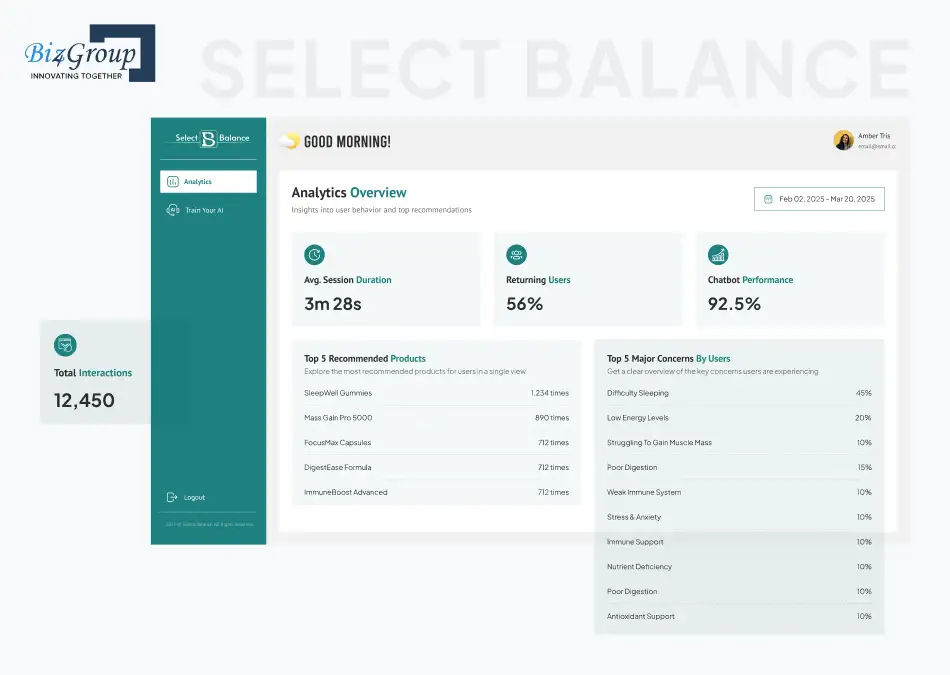
To demonstrate how AI chatbots are transforming social commerce, Biz4Group developed an AI-powered chatbot that helps users discover the right health supplements through natural conversations or a guided health quiz.
Instead of manually browsing products, users can describe their health goals or symptoms, answer a few follow-up questions, and receive personalized product recommendations in real time. The chatbot retrieves relevant products from a PostgreSQL database and presents product cards with key details and purchase links.
Key capabilities include:
- AI-powered conversational product discovery
- Guided quiz for personalized recommendations
- Context-aware follow-up questions
- Real-time product matching
- Product cards with direct purchase links
- Admin panel for chatbot training and content updates
This project demonstrates how AI chatbots can simplify product discovery, deliver personalized shopping experiences, and guide customers toward confident purchase decisions, making them a valuable component of modern AI-powered social commerce.
Now that we've explored the real-world use cases of AI-powered social commerce, it's important to distinguish it from related concepts that are often used interchangeably. Let's compare social commerce, social media marketing, and agentic commerce to understand how each fits into the modern ecommerce ecosystem.
Still selling the traditional way?
Discover how AI can turn every interaction into a buying opportunity.
Connect With UsWhat is the Difference Between Social Commerce vs. Social Media Marketing vs. Agentic Commerce?
These concepts are related, but they represent different stages in the evolution of digital commerce.
- Social media marketing focuses on building awareness, engagement, and traffic.
- Social commerce enables customers to discover and purchase products directly within social platforms.
- AI social commerce adds an intelligence layer that personalizes discovery, automates interactions, and optimizes the entire buying journey using AI.
- Agentic commerce extends this further by enabling agentic AI development to independently research products, compare options, make recommendations, and complete purchases based on user preferences and permissions.
Understanding this progression is important because these models don't replace one another. Most ecommerce brands already use social media marketing and social commerce. Now, let’s understand what caused customer behavior to shift.
Why Is AI Changing the Way Customers Discover and Buy Products?
For decades, ecommerce followed a predictable pattern. Customers searched for products, compared a few options, read reviews, and made a purchase.
AI hasn't replaced that journey. It has shortened it. Instead of asking customers to do all the research themselves, AI in social commerce now recommends products, answers questions, compares alternatives, and surfaces the most relevant options before a buying decision is made. The result isn't just a faster shopping experience. It's a completely different way of discovering products.
Understanding this shift helps explain why AI in social commerce is changing both customer expectations and brand strategies.
1. Why Keyword Search Is Not the Only Discovery Channel?
Traditional search is based on intent. A customer knows what they're looking for, types a query, and evaluates the results.
Today's discovery journey is increasingly driven by context instead of intent. Customers often discover products while scrolling social feeds, watching creator content, exploring AI recommendations, or asking conversational questions like "What's the best standing desk for a small apartment?"
This doesn't mean SEO is becoming obsolete. It means product discovery is expanding beyond search engines. Brands now need to optimize for social algorithms, recommendation engines, and AI-powered search experiences alongside traditional search rankings.
2. How AI Shopping Assistants Are Reshaping Product Discovery?
One question we're hearing from ecommerce teams captures this shift perfectly:
"I am trying to set up an AI shopping assistant for my store, and I keep getting confused between chatbots, personalization engines, and social commerce tools, what is the actual difference, and which one should I start with first?"
The confusion comes from treating these technologies as competitors instead of collaborators. An AI chatbot answers predefined questions. Whereas, a personalization engine decides which products and content are most relevant to each customer.
An AI shopping assistant brings these capabilities together. It understands natural language, recommends products, compares alternatives, answers follow-up questions, and guides customers toward confident purchase decisions.
Instead of searching through dozens of products, customers can explain what they need and receive recommendations tailored to their preferences.
3. The Three Buyer Journeys Every Ecommerce Brand Should Understand
Customers don't follow a single buying journey anymore. Depending on the product and purchase intent, they typically move through one of three paths.
- Search-first buying begins with a search engine or ecommerce website. The customer already knows what they need and actively looks for it.
- Social-first buying starts with discovery through creator content, short-form videos, live shopping events, or recommendations inside social platforms.
- AI-first buying begins with a conversation. Customers ask AI assistants to recommend products, compare features, summarize reviews, or narrow down their choices before visiting a website.
These journeys often overlap. A customer might discover a product on TikTok, ask ChatGPT to compare it with competing options, and complete the purchase through the brand's website. The goal isn't to optimize for one journey. It's to create a consistent experience across all three.
4. AI Social Commerce Impact on Customer Buying Behavior
The biggest shift isn't that customers trust AI more. It's that they're increasingly comfortable letting AI handle parts of the buying process.
Instead of manually comparing dozens of products, customers ask AI to shortlist the best options. Instead of reading hundreds of reviews, they ask for a summary. Instead of browsing multiple websites, they rely on personalized recommendations to narrow their choices.
For brands, this changes what it means to compete. Success is not determined only by ranking first in search results or running the biggest advertising campaigns anymore. Brands also need product data that AI can understand, content that answers real customer questions, and shopping experiences that help AI confidently recommend their products.
As AI becomes more involved in product discovery and purchase decisions, the next challenge is understanding which trends are shaping the future of AI social commerce and where brands should focus their investments.
What Is the Biggest AI Social Commerce Trends in 2026?
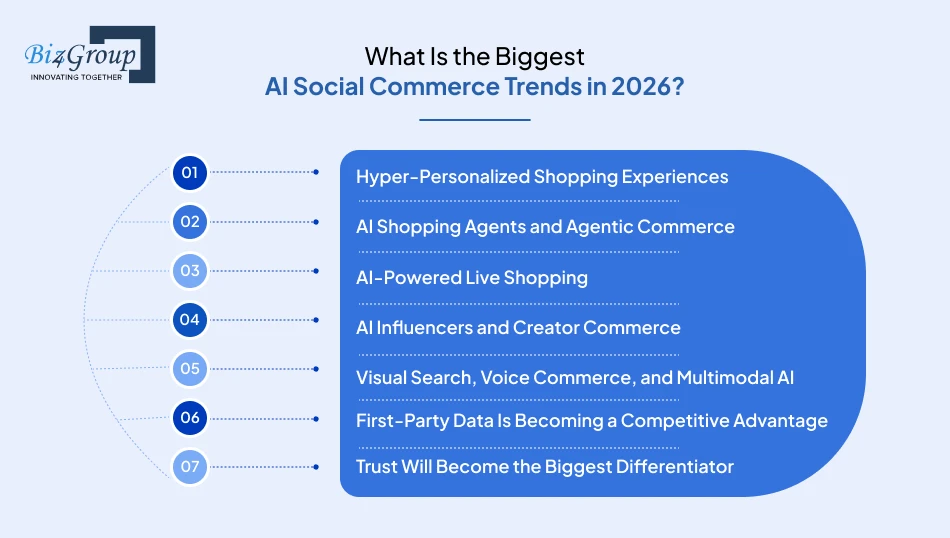
Not every AI innovation deserves your attention. Some technologies generate headlines but have little impact on revenue. Others quietly reshape how customers discover products, make decisions, and interact with brands. The trends below fall into the second category. They're already influencing how leading ecommerce brands compete and where future investments are heading.
1. Hyper-Personalized Shopping Experiences
Personalization is no longer about showing "Customers also bought..."
Today's AI models analyze browsing behavior, engagement history, purchase patterns, location, and real-time intent to create shopping experiences unique to every customer. Two shoppers visiting the same storefront can see different products, offers, content, and even product rankings.
For brands, this means moving beyond audience segments and creating experiences that adapt to individual buying behavior.
2. AI Shopping Agents and Agentic Commerce
Recommendation engines suggest products and AI shopping agents help customers make decisions. That's the difference. Instead of presenting a list of products, AI shopping agents can understand requirements, compare alternatives, explain trade-offs, answer follow-up questions, and guide customers toward the right purchase. Some platforms are already testing agents that can complete purchases after receiving customer approval.
This shift marks the early stages of agentic commerce, where agentic AI moves from assisting customers to acting on their behalf.
3. AI-Powered Live Shopping
Live shopping is becoming one of the fastest-growing formats in AI social commerce but scaling it has always been difficult.
AI is solving that challenge by answering customer questions during livestreams, recommending related products, translating conversations in real time, and helping hosts manage thousands of simultaneous viewers.
According to McKinsey, live commerce experiences can achieve conversion rates of up to 30%, significantly outperforming many traditional ecommerce experiences. For brands, the opportunity isn't replacing creators with AI. It's enabling creators to engage larger audiences without sacrificing responsiveness.
4. AI Influencers and Creator Commerce
Creator content continues to influence buying decisions, but AI is changing how that content is planned, produced, and optimized.
Brands are using generative AI to generate AI influencer, campaign variations, localize content for different markets, generate product visuals, and identify which creators perform best with specific customer segments.
The strongest strategies combine AI's efficiency with human creativity. AI accelerates production and optimization, while creators continue to provide authenticity and trust.
5. Visual Search, Voice Commerce, and Multimodal AI
Customers don't always search with keywords anymore. They upload images, speak naturally to AI voice search, or describe what they're looking for in a conversation.
Multimodal AI can process text, images, audio, and video together, making these interactions possible. This allows customers to search for products using a photo, ask voice assistants for recommendations, or discover products directly from videos.
For ecommerce brands, product information now needs to be optimized for machines that understand multiple forms of content, not just text.
6. First-Party Data Is Becoming a Competitive Advantage
Every AI capability depends on data quality. As third-party cookies disappear and privacy regulations continue to evolve, brands are relying more heavily on first-party data collected through websites, mobile apps, loyalty programs, purchase history, and customer interactions.
The businesses that organize this data effectively will build better recommendation systems, deliver more accurate personalization, and make faster AI-driven decisions than competitors working with fragmented data.
7. Trust Will Become the Biggest Differentiator
AI can recommend products, it can't earn customer trust on its own. Customers still want transparent pricing, authentic creator content, genuine reviews, and clear explanations for why a product is being recommended. Brands that over-automate or rely on AI-generated content without maintaining authenticity risk damaging the very trust they're trying to build.
The brands leading AI social commerce aren't replacing human relationships with AI. They're using AI to make those relationships more relevant, responsive, and consistent.
The next challenge is deciding where to invest those capabilities, because not every platform delivers the same value for every business.
Which AI Social Commerce Platforms Should Ecommerce Brands Prioritize?
The question isn't whether your brand should be present on TikTok, Instagram, YouTube, Pinterest, or AI-powered search experiences. It's whether your customers make buying decisions there.
One mistake brands continue to make is treating every platform as another marketing channel. Today, each platform influences a different stage of the buying journey. Choosing the right one isn't about chasing trends. It's about investing where your customers naturally discover, evaluate, and purchase products.
1. TikTok Shop

If discovery is your biggest growth challenge, TikTok Shop deserves to be at the top of your list. Unlike traditional ecommerce platforms that depend heavily on customer intent, TikTok's recommendation engine introduces products before customers actively search for them. That creates opportunities for brands with compelling products, even if they don't have the largest advertising budgets.
Best suited for:
- D2C brands
- Beauty and skincare
- Fashion and accessories
- Home and lifestyle products
- Impulse purchases
AI advantage: Content recommendations adapt continuously based on user behavior, making product discovery far more dynamic than keyword-driven search.
2. Instagram Shopping
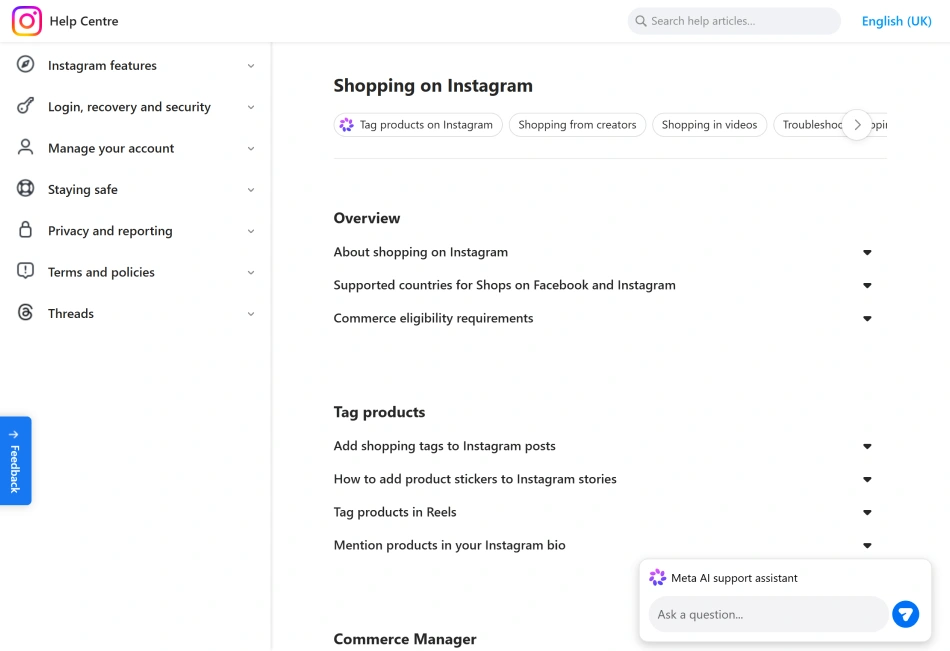
Instagram isn't where most purchases begin, it's where buying confidence is built. Customers often discover a product through a Reel, revisit it through Stories, browse tagged products, read comments, and only then decide to purchase. Every interaction adds another layer of trust.
Best suited for:
- Premium brands
- Lifestyle products
- Brands focused on community building
- Businesses with strong visual storytelling
AI advantage: Recommendation systems personalize content, shopping experiences, and advertisements based on engagement history and customer interests.
3. YouTube Shopping

Some products can't be sold in thirty seconds. Customers buying electronics, fitness equipment, software, or premium products often need demonstrations, reviews, comparisons, and tutorials before making a decision. That's where YouTube becomes less of a video platform and more of a research platform.
Best suited for:
- High-value purchases
- Products requiring education
- Technical or feature-rich offerings
AI advantage: AI recommends relevant videos, connects related content, and shortens the path from research to purchase.
4. Pinterest Shopping
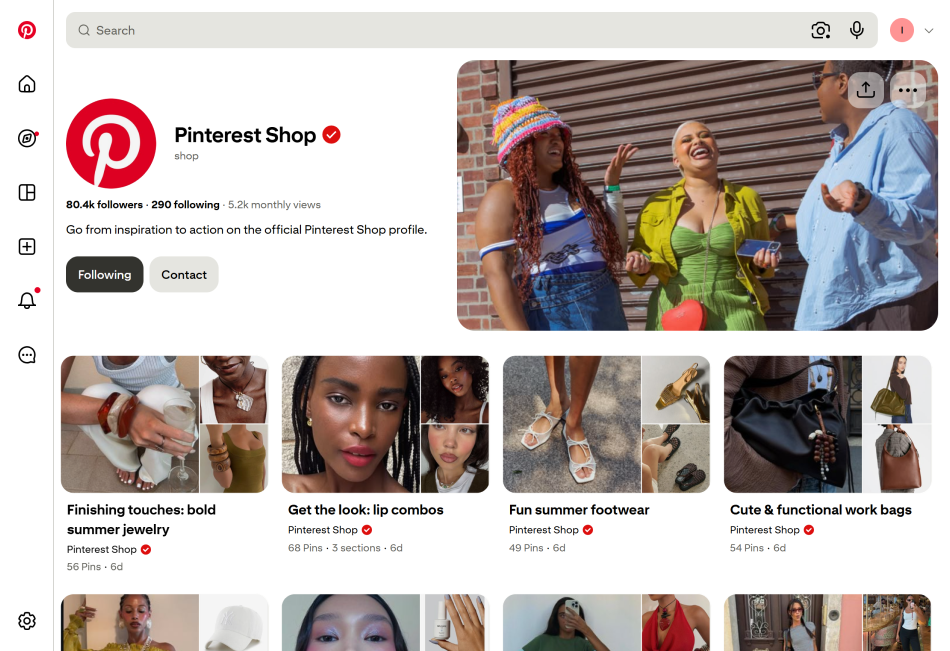
Pinterest operates differently from almost every other social platform. People don't usually visit Pinterest to be entertained, They visit with an idea they want to turn into reality. Whether it's furnishing a home, planning a wedding, refreshing a wardrobe, or redesigning a workspace, purchase intent already exists. The platform helps refine it.
Best suited for:
- Home décor
- Fashion
- DIY
- Beauty
- Lifestyle brands
AI advantage: Visual search and recommendation systems help customers discover similar products without relying on text-based searches.
5. ChatGPT Shopping and Google AI Mode
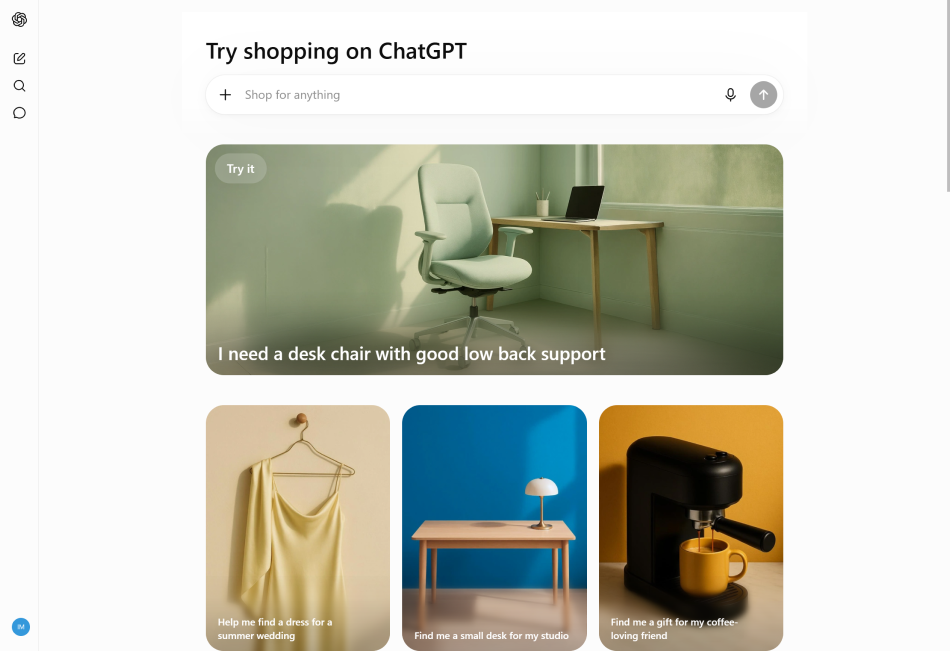
This is where many brands are still underprepared. Customers are beginning to replace keyword searches with conversations. Instead of searching for "best wireless headphones," they're asking, "Recommend wireless headphones under $200 for remote work and occasional gaming."
That changes what it means to be discoverable. One question we're hearing more often is:
"We are trying to figure out if our content needs to be optimized for AI Overviews and ChatGPT now, not just Google search, and I want to understand how that actually affects whether our products show up when someone asks an AI for shopping recommendations."
The answer is yes. AI systems rely on structured product information, trusted content, reviews, comparison pages, FAQs, and consistent product data to generate recommendations. Brands that invest in making their content understandable for both people and AI will have a significant advantage as conversational shopping continues to grow.
The strongest AI social commerce strategy rarely begins with trying to dominate every platform. It begins with understanding your business objective. The platform itself isn't your competitive advantage. Your ability to create a consistent experience across every platform is. Customers don't think in channels, they think in journeys. The brands that recognize this will be better positioned to compete as AI continues to reshape how products are discovered and purchased.
The next decision is just as important, which AI social commerce tools should you invest in first, and which ones can wait?
What if AI could sell smarter for you?
Let's create an AI commerce solution tailored to your business.
Connect With UsWhich AI Social Commerce Tools Should Brands Invest in First?
Many ecommerce brands approach AI social commerce with the same question, which AI tool should we buy first? The better question is Which customer problem should we solve first?
AI doesn't create business value because it's sophisticated. It creates value when it removes friction from the customer journey. A shopping assistant won't improve sales if customers can't discover your products, and a recommendation engine won't solve a poor post-purchase experience. The most successful brands prioritize AI investments based on the business outcome they want to achieve rather than the technology itself.
1. Which AI Tool Should You Invest in First?
One question consistently comes up during AI adoption discussions:
"We are a mid sized brand trying to decide between investing in AI chatbots for customer support or AI tools for personalized product discovery, and I want to know which one gives a faster return for a business that is still building trust with new customers."
The answer depends on where customers experience the greatest friction. Instead of comparing AI tools feature by feature, evaluate them based on the business challenge they solve.
|
Business Goal |
Primary Challenge |
Recommended AI Tool |
|---|---|---|
|
Increase product discovery |
Customers struggle to find relevant products |
AI Shopping Assistants |
|
Improve conversion rates |
Visitors browse but don't purchase |
Personalization Engines |
|
Reduce repetitive customer support |
Support teams spend time answering the same questions |
AI Chatbots |
|
Increase average order value |
Customers buy individual products instead of complementary items |
AI Recommendation Engines |
|
Recover abandoned carts |
Shoppers leave before completing checkout |
|
|
Scale content production |
Marketing teams can't keep up with campaign demand |
Generative AI Tools |
|
Improve live shopping engagement |
Hosts can't respond to every viewer during livestreams |
Live Shopping AI & Conversational AI |
A useful way to think about these technologies is that chatbots answer questions, shopping assistants influence decisions, recommendation engines improve discovery, and generative AI helps marketing teams scale content creation. Understanding these roles makes it easier to prioritize investments based on measurable business outcomes rather than emerging technology trends.
2. AI Recommendation Engines and Product Discovery Platforms
Most ecommerce businesses already recommend products, but very few have built an intelligent product discovery experience.
Traditional recommendation systems typically rely on predefined rules such as best-selling products, recently viewed items, or "Frequently Bought Together" suggestions. AI recommendation system work differently. They continuously analyze browsing behavior, purchase history, customer preferences, seasonal demand, and real-time engagement signals to determine which products are most relevant for each individual shopper.
The objective isn't to recommend more products. It's to reduce decision fatigue by presenting fewer, more relevant options that increase the likelihood of conversion. If personalized discovery is a priority for your business, our guide on AI recommendation engine development explores how these systems are designed and integrated into modern ecommerce platforms.
3. Content Generation and Creative Automation Tools
Content production has become one of the biggest operational challenges in AI-powered social commerce. Every campaign requires product descriptions, social posts, advertising copy, email campaigns, landing pages, creator briefs, and localized content for different audiences.
Generative AI significantly reduces the time required to create these assets, but successful brands don't use it to replace creativity. They use it to eliminate repetitive work, accelerate campaign execution, and give creative teams more time to focus on strategy, storytelling, and brand differentiation.
The competitive advantage doesn't come from publishing more content. It comes from producing relevant, high-quality content consistently across every customer touchpoint.
4. Live Shopping and Customer Engagement Tools
As live shopping grows, customer engagement becomes increasingly difficult to manage at scale. During a successful livestream, hundreds or even thousands of viewers may ask questions about pricing, product specifications, availability, shipping, or recommendations at the same time.
AI helps brands handle this complexity by answering common questions instantly, recommending complementary products, summarizing product features, and escalating complex conversations to human representatives when necessary. Rather than replacing hosts or sales teams, AI allows them to focus on meaningful interactions while routine conversations are managed automatically.
This combination of human expertise and AI support creates a more responsive shopping experience without increasing operational costs.
5. AI Social Commerce Tools for Small Businesses
A common misconception is that AI social commerce requires enterprise budgets and large technical teams. Many of the highest-impact AI capabilities are now available through existing ecommerce platforms and SaaS solutions, making adoption far more accessible for growing businesses.
Another question we hear frequently is: "We want to implement AI social commerce but we have a limited budget and small team. What are the most affordable AI tools and strategies that actually move revenue for growing brands?"
For smaller ecommerce brands, the smartest strategy isn't adopting every available AI capability. It's solving one high-impact problem at a time. If product discovery is limiting growth in your AI marketplace application, start with an AI shopping assistant. If visitors aren't converting, focus on personalization. If content creation slows your marketing efforts, implement generative AI. If customer support consumes your team's time, introduce conversational AI.
The businesses achieving the fastest return on investment aren't necessarily those using the most AI. They're the ones applying AI where it removes the greatest amount of customer friction and delivers measurable business impact.
Further, we will explore how are leading brands putting these capabilities into practice and consistently outperforming their competitors?
Where Should Brands Start with AI Social Commerce?
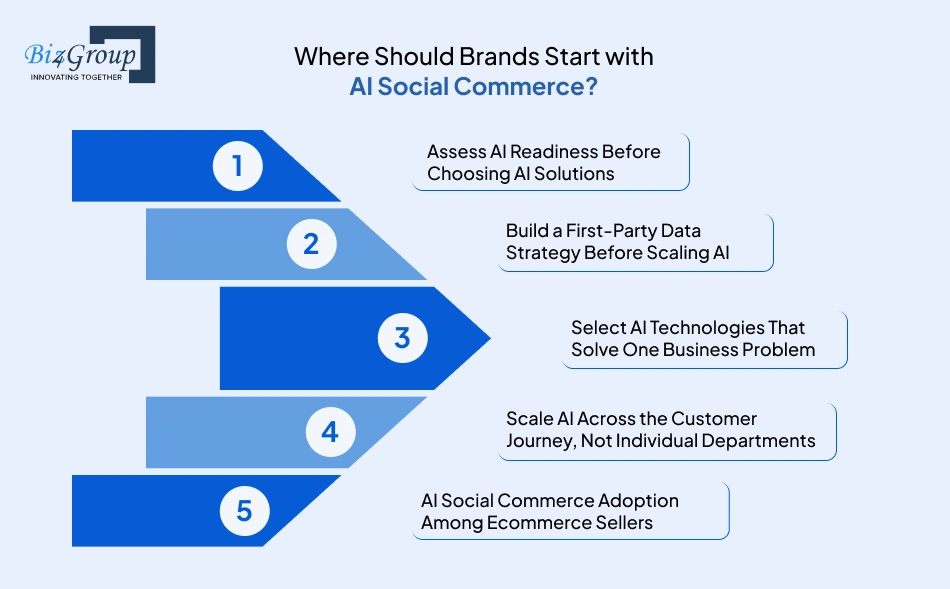
The fastest way to waste an AI budget is to start with technology. Many brands begin by evaluating AI platforms, comparing software vendors, or experimenting with new tools before they've identified the business problem they're trying to solve. That approach often leads to disconnected implementations, overlapping technologies, and little measurable impact.
The brands seeing consistent results follow a different path. They begin with the customer journey, identify where buying decisions become difficult, and then introduce AI where it removes the greatest amount of friction.
1. Assess AI Readiness Before Choosing AI Solutions
Before investing in any AI social commerce initiative, assess whether your business is prepared to support it.
AI performs best when it has access to reliable product information, customer data, and connected commerce systems. If inventory updates are inconsistent, product attributes are incomplete, or customer information is spread across multiple platforms, introducing more AI tools will only amplify those problems. A simple readiness assessment can help.
|
Ask Yourself |
Why It Matters |
|---|---|
|
Is our product data accurate and structured? |
Better product information improves recommendations and AI-driven discovery. |
|
Do our commerce, CRM, and marketing platforms share data? |
Connected systems create consistent customer experiences. |
|
Can we measure the customer journey from discovery to purchase? |
Measurement is essential for proving business impact. |
|
Have we identified the biggest source of customer friction? |
AI should solve business problems, not create new technology projects. |
The objective isn't to score perfectly. It's to understand where your foundation needs strengthening before adding more intelligence.
2. Build a First-Party Data Strategy Before Scaling AI
As AI capabilities become more accessible, data quality becomes the real differentiator. Many businesses have plenty of customer data but very little usable customer intelligence because information lives in disconnected systems. Purchase history sits in the ecommerce platform, engagement data lives inside marketing tools, and customer conversations remain isolated in support software.
Bringing these signals together creates a clearer picture of customer behavior and allows recommendation systems, shopping assistants, and personalization engines to deliver more relevant experiences.
The competitive advantage isn't collecting more data. It's making existing data easier to use across the entire customer journey.
3. Select AI Technologies That Solve One Business Problem
One of the most common implementation mistakes is deploying multiple AI tools at the same time. A better approach is to prioritize a single business objective and select technology that directly supports it.
|
Business Priority |
Recommended Starting Point |
|---|---|
|
Improve product discovery |
AI Shopping Assistant |
|
Increase conversion rates |
|
|
Reduce customer support workload |
Conversational AI |
|
Increase average order value |
|
|
Scale marketing output |
This approach makes implementation easier, improves adoption, and creates measurable outcomes that can justify future AI investments.
4. Scale AI Across the Customer Journey, Not Individual Departments
Many organizations introduce AI one department at a time. Marketing adopts generative AI, customer support launches a chatbot, and ecommerce teams experiment with personalization.
While each initiative may deliver value, customers experience the brand as one connected journey. High-performing organizations gradually extend AI across discovery, product evaluation, purchase, and post-purchase engagement so that every interaction feels consistent, regardless of the channel. The goal isn't to implement more AI. It's to remove friction wherever customers interact with your brand.
5. AI Social Commerce Adoption Among Ecommerce Sellers
One question many leadership teams continue to ask is:
"We are preparing our social commerce strategy for the future and want a step-by-step framework for implementing AI across discovery, engagement, recommendations, and checkout to drive measurable growth."
A practical roadmap looks like this:
|
Phase |
Primary Focus |
|---|---|
|
Phase 1 |
Strengthen product data and customer data foundations. |
|
Phase 2 |
Introduce AI shopping assistants or personalization to improve discovery and engagement. |
|
Phase 3 |
Expand recommendation systems, live shopping, and marketing automation. |
|
Phase 4 |
Measure performance, refine customer journeys, and prepare for AI-assisted and agentic commerce. |
Many ecommerce brands feel pressure to accelerate AI adoption because competitors are doing the same. The businesses creating sustainable results take a more disciplined approach. They build a strong foundation, solve one customer problem at a time, and scale only after they can measure the business impact.
That mindset often produces faster growth than trying to implement every new AI capability at once.
Is your store ready for AI-powered shopping?
Let's build experiences your customers will actually enjoy.
Connect With UsWhat Are the Biggest AI Social Commerce Challenges for Ecommerce Brands?
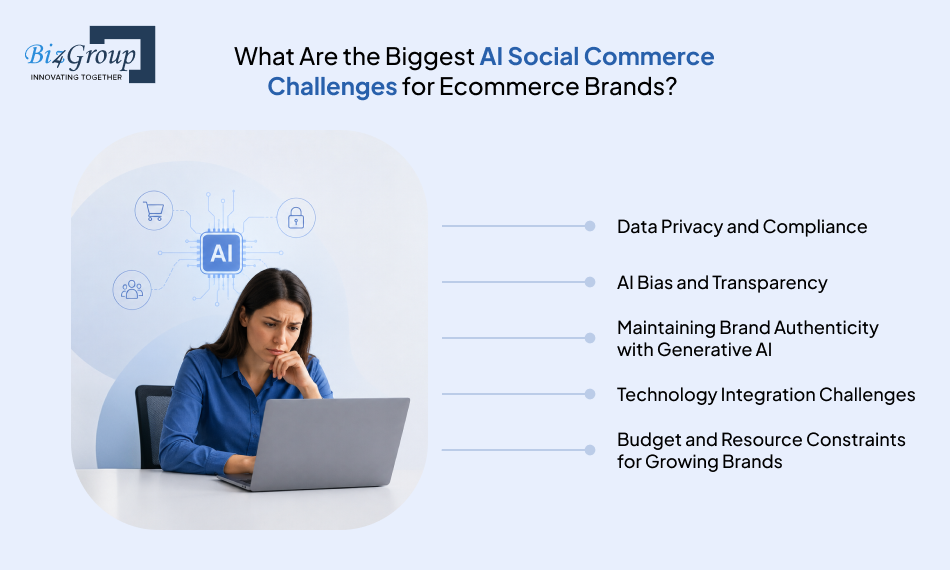
AI social commerce isn't difficult because technology is immature. In many cases, technology is already available. The real challenge is integrating it into existing business processes without creating fragmented customer experiences, operational complexity, or unrealistic expectations. Many ecommerce brands don't struggle because they chose the wrong AI platform. They struggle because they underestimated the organizational changes needed to make AI effective.
Understanding these challenges early helps businesses prioritize investments, reduce implementation risk, and build solutions that continue delivering value as they scale.
1. Data Privacy and Compliance
Every personalized shopping experience depends on customer data, which means privacy and compliance should be part of the implementation strategy from the beginning, not an afterthought.
As businesses collect browsing behavior, purchase history, and engagement data, they also take on greater responsibility for managing that information securely and transparently. Customers increasingly expect to know what data is collected, why it's being used, and how it improves their shopping experience.
For ecommerce brands, the goal isn't just regulatory compliance. Clear data practices also strengthen customer confidence, making people more comfortable engaging with personalized recommendations and AI-powered experiences.
2. AI Bias and Transparency
Recommendation systems learn from historical data. If that data is incomplete, outdated, or unbalanced, then AI hallucination happens and the shopping experience may become less relevant for certain customer groups.
This is why regular monitoring matters. Brands should review recommendation quality, search results, promotional visibility, and personalization outcomes to ensure they remain accurate, relevant, and aligned with business objectives. Explaining why products are recommended and giving customers control over their preferences also helps build confidence in AI-assisted shopping experiences.
Transparency isn't just an ethical consideration. It's becoming an important part of customer experience.
3. Maintaining Brand Authenticity with Generative AI
One question we're hearing more frequently is:
"We want to use generative AI for social commerce content creation but we are worried about maintaining authenticity and brand voice. How are successful brands balancing automation with trust?"
The strongest brands don't ask AI to replace their voice. They use it to scale it. Generative AI development can accelerate content production, adapt messaging for different audiences, and support campaign execution, but brand positioning, storytelling, and creative direction should continue to reflect human judgment.
Customers rarely object to AI-assisted content. They respond negatively when every interaction feels generic or disconnected from the brand they chose to follow.
4. Technology Integration Challenges
Most ecommerce businesses already use multiple systems, including ecommerce platforms, CRM software, AI marketing automation tools, inventory management systems, analytics platforms, and customer support solutions.
The challenge isn't adding another AI application. It enables these systems to exchange data effectively.
Disconnected platforms often lead to inconsistent recommendations, outdated product information, duplicate customer records, and fragmented shopping experiences. AI Integration therefore becomes less of an IT project and more of a business priority because every disconnected system introduces additional friction into the customer journey.
5. Budget and Resource Constraints for Growing Brands
Many growing ecommerce businesses delay AI adoption because they assume meaningful implementation requires enterprise budgets and dedicated AI teams. The larger risk often comes from trying to implement everything at once.
Successful ecommerce businesses using AI typically begin with one measurable business objective, validate results, and expand gradually as they build internal confidence and operational experience. This phased approach reduces financial risk while allowing teams to learn what delivers the greatest value for their customers.
The biggest challenge in AI social commerce isn't adopting AI too slowly or too quickly. It's adopting it without a clear business objective. When every AI investment is tied to a measurable customer problem, implementation becomes easier to prioritize, easier to justify, and much easier to scale.
What Does the Future Hold for AI Social Commerce Beyond 2026?
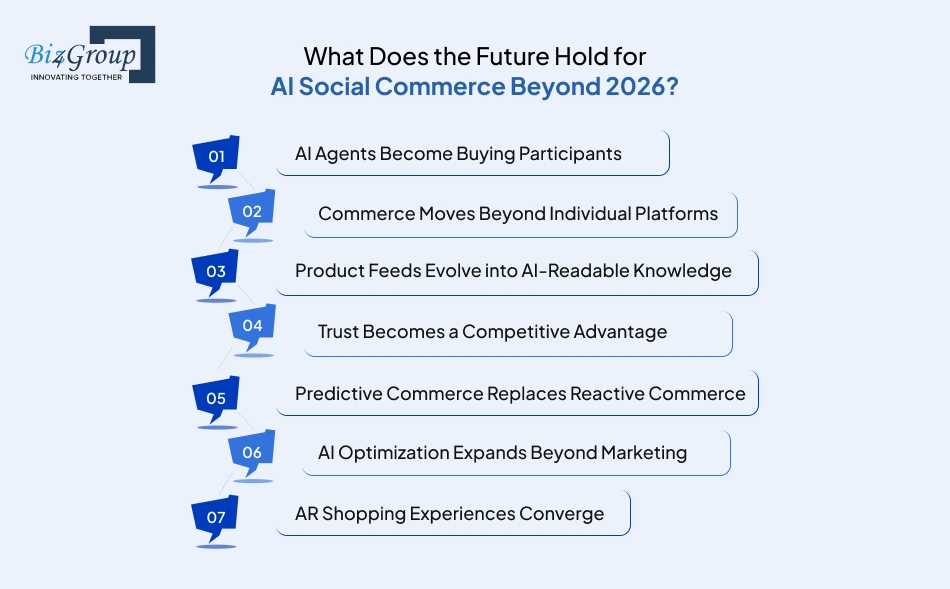
The next phase of AI social commerce won't be defined by better recommendation engines or more AI tools. It will be shaped by how buying decisions themselves evolve.
Over the next few years, brands are likely to compete less on who has the biggest storefront and more on who becomes the easiest brand for AI systems and customers to trust, understand, and recommend.
|
Future Shift |
What It Could Mean for Commerce |
|---|---|
|
AI Agents Become Buying Participants |
AI agents may increasingly research products, compare alternatives, negotiate subscriptions, and prepare purchase options before customers make the final decision. |
|
Commerce Moves Beyond Individual Platforms |
Customers are likely to move seamlessly between social platforms, AI assistants, websites, messaging apps, and marketplaces during a single purchase journey. |
|
Product Feeds Evolve into AI-Readable Knowledge |
Product catalogs will increasingly need rich attributes, comparison data, FAQs, compatibility information, sustainability details, and customer feedback to remain competitive in AI-assisted discovery. |
|
Trust Becomes a Competitive Advantage |
As AI-generated content becomes more common, authentic customer experiences, verified reviews, transparent policies, and credible brand authority will influence purchasing decisions even more. |
|
Predictive Commerce Replaces Reactive Commerce |
Instead of waiting for customers to search, brands will increasingly anticipate needs using behavioral signals, subscription patterns, replenishment cycles, and contextual recommendations. |
|
AI Optimization Expands Beyond Marketing |
AI adoption is expected to influence merchandising, pricing, inventory planning, supply chain forecasting, customer service, and post-purchase engagement, making commerce operations more connected. |
|
AR Shopping Experiences Converge |
AI could power immersive AR shopping experiences where customers virtually try products, furnish spaces, or explore digital storefronts while receiving real-time recommendations tailored to their preferences and context. |
The future won't belong to the brands using the most AI. It will belong to the brands that build trustworthy data, connected commerce systems, and customer experiences that remain valuable regardless of how people choose to shop. Whether purchases begin on a social platform, through an AI assistant, or with an autonomous shopping agent, businesses with a strong digital foundation will be in the best position to adapt.
How Can Biz4Group Help Brands Build AI Social Commerce Solutions?
Turning an AI social commerce strategy into measurable business outcomes requires more than integrating a few AI tools. It requires a technology partner that understands ecommerce, customer journeys, and how AI fits into existing business operations.
At Biz4Group, a leading AI ecommerce development company in USA, we help brands design, develop, and integrate AI-powered commerce solutions that improve product discovery, personalize shopping experiences, and streamline customer engagement without disrupting existing workflows.
With 20+ years of experience, 1,000+ successful projects delivered, and 500+ global clients, we have helped businesses turn emerging technologies into practical, scalable solutions. Our experience building AI-powered ecommerce platforms, shopping assistants, recommendation engines, and custom AI applications enables brands to move from experimentation to measurable business outcomes.
From AI strategy and solution architecture to development, integration, and ongoing optimization, we build AI Social Commerce solutions tailored to your business goals. Whether you're looking to develop AI shopping assistants, intelligent recommendation engines, conversational commerce experiences, or integrate AI into Shopify, Magento, or a custom ecommerce platform, our team ensures every solution fits seamlessly into your existing technology ecosystem.
Explore our AI development services to see how we can help you build a future-ready AI social commerce solution.
Final Thoughts
The future of ecommerce won't be won by the brands using the most AI. It'll be won by the brands that make buying easier.
That's the biggest shift behind AI social commerce. Success does not depend only on attracting customers. It depends on helping them discover the right products faster, reducing decision fatigue, delivering personalized experiences, and building trust across every stage of the buying journey.
As you've seen throughout this guide, the goal isn't to adopt every new AI capability. It's to solve the right business problems with the right strategy. Brands that build connected commerce experiences today will be far better prepared for the next generation of AI-powered shopping.
Turning that strategy into reality requires the right technology foundation and the right implementation partner.
At Biz4Group LLC, we help businesses design, develop, and integrate AI-powered commerce solutions, from AI shopping assistants and recommendation engines to end-to-end AI social commerce platforms, tailored to their growth goals.
If you're ready to transform your ecommerce experience with AI, connect with Biz4Group and let's build an AI social commerce solution that delivers measurable business results.
Frequently Asked Questions (FAQs)
1. Which social media platforms support AI social commerce?
Platforms such as TikTok Shop, Instagram Shopping, Facebook Marketplace, Pinterest, and YouTube Shopping are increasingly integrating AI-powered features to enhance product discovery and shopping experiences.
2. Is AI social commerce only for large ecommerce brands?
No. Businesses of all sizes can leverage AI social commerce through AI shopping assistants, personalized recommendations, and conversational commerce tools to improve customer engagement and sales.
3. How does AI improve product recommendations?
AI analyzes customer behavior, preferences, browsing history, and purchase patterns to deliver personalized product recommendations that are more relevant to each shopper.
4. Can AI social commerce integrate with Shopify or Magento?
Yes. Most AI social commerce solutions can integrate with Shopify, Magento, WooCommerce, and custom ecommerce platforms using APIs and third-party integrations.
5. How does AI reduce cart abandonment?
AI helps recover abandoned carts through personalized reminders, real-time assistance, tailored product suggestions, and timely offers that encourage customers to complete their purchases.
6. What role do creators and influencers play in AI social commerce?
AI helps brands identify relevant creators, optimize campaign performance, personalize content recommendations, and measure engagement across social commerce channels.
7. Is AI social commerce secure for customer data?
Yes, provided businesses implement strong security measures, comply with data privacy regulations, and maintain transparent data collection and consent practices.
8. How can businesses measure the success of AI social commerce?
Key performance indicators include conversion rate, average order value, customer engagement, cart abandonment rate, customer lifetime value, and return on AI investment.
9. How long does it take to implement AI social commerce?
Implementation timelines depend on the solution's complexity, usually 2-4 weeks for MVP development and 6-8 weeks for enterprise level development. AI-powered recommendation engines or shopping assistants may take a few weeks, while enterprise-scale AI commerce platforms can require several months.
10. How do I choose the right AI social commerce solution?
Start by identifying your business goals, customer journey, ecommerce platform, and existing technology stack. Then choose AI solutions that address your highest-impact use cases and integrate seamlessly with your operations.